The Lord Is My Chef Breakfast Recipe for the Soul, Wednesday, Easter Week-VI, 20 May 2020
Acts of the Apostles 17:15, 22-18:1 ><)))*> + <*(((>< John 16:12-15
From Facebook, 18 May 2020.
As I prayed over the readings for today, dear Jesus, I felt the great similarity of the time of St. Paul in Athens and of the world in this time of the corona virus that made me wonder what would your apostle tell the people of today who have made the malls as their new temples of worship.
Or, what would St. Paul tell those in government who see businesses as most essential needs, totally disregarding the need to open houses of worship where people can find spiritual nourishment?
What would St. Paul tell us your priests and Bishops who have suddenly become less assertive in pushing for the opening of churches so people may celebrate and receive the sacraments so essential in this time of crisis?
Lord Jesus, you know how like St. Paul we have always stressed to the people that
“The God who made the world and all that is in it, the Lord of heaven and earth, does not dwell in sanctuaries made by human hands, nor is he served by human hands because he needs anything. Rather it is he who gives to everyone life and breath and everything.”
Acts of the Apostles 17:24-25
…. and yet, they continue to consider you anything spiritual as non-essential?
Tell us Lord what we must do these days so we may reach the modern pagans and Athenians of this age who have turned to worship to other gods aside from you, O Lord.
May we probe more the reasons why like the Athenians at that time people today still “scoff and leave” when they hear about you, your Resurrection and other spiritual things.
Is it because we would rather massage ourselves with our own thoughts about you and the Divine that seem so magical and more delightful like Hollywood?
How sad that until now, we cannot accept and believe you truly love us so much that you rose again from the dead to bring us back to life too!
Dear Jesus, teach us to be patient and be opened to the Holy Spirit who enables us to understand slowly in your own time at our own pace the realities and truth of your Resurrection.
May the Holy Spirit open us to more imaginative ways like St. Paul in preaching you to the modern pagans and Athenians of today. Amen.
St. Bernardine of Sienna, pray for us!
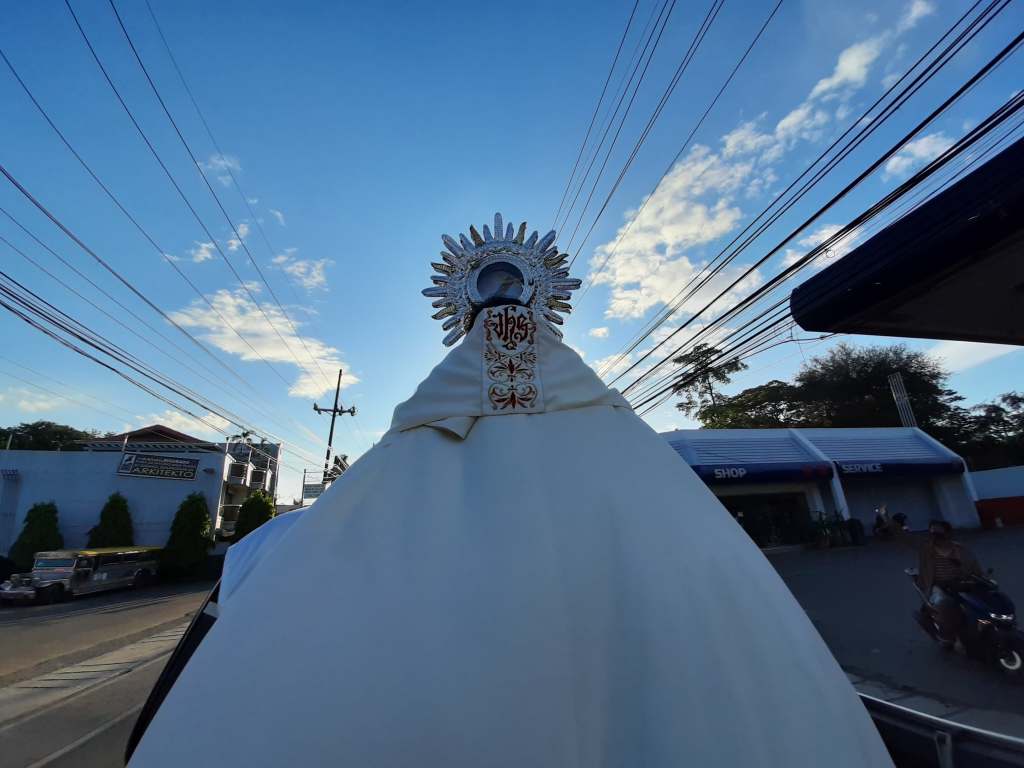
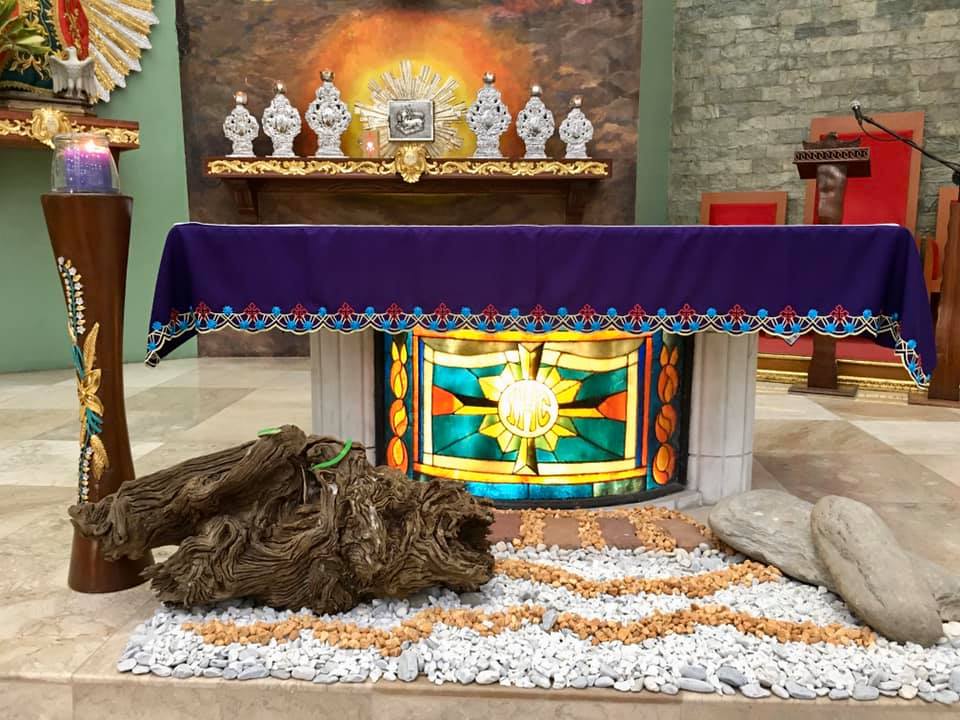
The “IHS” Christogram: the ancient way of writing the name “Jesus Christ” with the first three letters of his name in Greek substituting the sigma with “S” in Latin. It was St. Bernardine of Sienna who popularized reverence to the Holy Name of Jesus, encouraging Christians to put the letters “IHS” on their doors. Later St.Ignatius of Loyola adopted the Christogram to symbolize his newly founded Society of Jesus that eventually became a part of our Christian art and tradition.
Quiet Storm by Fr. Nicanor F. Lalog II, 03 May 2020
Photo by author, Parokya ni San Juan Apostol at Ebanghelista, Bagbaguin, Santa Maria, Bulacan. April 2020.
Against the advice of good friends, I went out to distribute Holy Communion in the streets to some parishioners who have participated in our Sunday Mass early this morning at Facebook Live.
I know the risks involved despite our best efforts in having all the precautionary measures but, what convinced me to go on with it is a beautiful Psalm so appropriate during this quarantine period.
As the deer longs for streams of water, so my soul longs for you, O God.
My being thirsts for God, the living God. When can I go and see the face of God?
And when our quarantine period was extended for the second time before the end of Holy Week last month, I began praying again Psalm 42 every night for that is when I truly long for God so much, most of the time lamenting to him our situation, my condition of being alone in my rectory.
This is the first time I felt like this, so different from those so-called “desolation” or “dryness” because I could feel God present in my prayers but… he is not “fresh”.
Like the deer longing for streams of water, my soul longs for God too.
Not just like the water we buy from a filling station but exactly what the deer yearns for — fresh water that is refreshingly cool not only on your face but deep into your body when sipped amid the burbling sounds of the spring, babbling through rocks and branches of trees with the loamy aroma of earth adding a dash of freshness in you.
Admittedly, sometimes I wonder if I still know how to pray or if I still pray at all!
I can feel God present but he is like someone stacked there in my mind, in my memory, in my ideas shaped by my years of learning and praying.
What I am longing for is a God so alive, so true not only in me but also in another person.
And that is when I realized, most likely, my parishioners must be longing for God too in the same way — the God we all come to meet and celebrate with every Sunday in our little parish, among the people present who are so alive, so vibrant, so true, so touching.
Our empty church since March due to COVID-19.
Psalm 42 is believed to have been sang by David when he was prevented from coming to the tent of God either during the reign of King Saul who plotted to kill him or during the revolt of his own son Absalom when he was already the king of Israel.
Like David or the psalmist, I miss celebrating Mass with my parishioners.
And maybe it is safe to assume that two or three of my parishioners are also feeling the same way with me and David, saying these to the Lord:
My tears have been my food day and night, as they ask daily, “Where is your God?”
Those times I recall as I pour out my soul,
When I went in procession with the crowd, I went with them to the house of God,
Amid loud cries of thanksgiving, with the multitude keeping festival.
Psalm 42:4-5
If there is one very essential thing this pandemic has brought back to us in our very busy lives, it is most certainly God. And if ever this is one thing people need most in this time of corona virus, it is spiritual guidance and nourishment from God through his priests.
Of course, people can pray and talk to God straight as the Pope had reminded us before Holy Week.
But, human as we are, we always experience God and his love, his kindness, his mercy, his presence among other people who guide us and join us in our spiritual journey. They are special people like friends or relatives or pastors with whom they can be themselves, let off some steam, get some rays of light of hope and encouragement.
And that this is why I try to keep in touch with my parishioners in various ways in this time of corona: even I myself can feel so low and dark despite my prayers and very condition of living right here in the house of God who can still feel alone and desolate, even depressed.
If I – a priest – go through all these uncertainties and doubts this in this time of quarantine, how much more are the people, the beloved sheep of Jesus the Good Shepherd?
Why are you downcast, my soul; why do you groan within me?
Wait for God, whom I shall praise again, my savior and my God.
Psalm 42:6
Photo by Ms. Ria De Vera, 10 April 2020.
After our Mass this morning when we set out to distribute the Holy Communion, there was a little drizzle. It did not last long that I just wore a hat and left my umbrella in the rectory.
There were about 30 people who waited for us to receive Holy Communion, most of them along the main highway that stretched to about 2 kilometers. Some families gathered with a little altar at their front gate while a waited a couple waited in a gas station along our route.
In less than 20 minutes, we have completed our mission and as we headed back to the parish, the rains fell again, this time stronger than before.
My driver commented, “The weather cooperated with us, Father”1
I just nodded my head to him inside his tricycle but deep inside me, I felt joy because God answered my prayer, my lamentations for he was crying too, – for me and his people.
May this lamentation be an answer to your lamentations during this pandemic of COVID-19.
Continue with your lamentations to God our Father for this very act of crying out to him is the working of the Holy Spirit he had sent us through our Lord Christ Jesus. Amen.
Quiet Storm by Fr. Nicanor F. Lalog II, 29 April 2020
Photo by author, 2010.
This is again for my brother priests and fellow workers in Church communication: our extended “enhanced community quarantine” is a call for us to rediscover the contemplative spirit so essential in our communication apostolate. It is best that before we go in front of the camera, before we post anything at all, or even before we go out doing our social action, let us first have Jesus Christ in us.
After all, it is always Jesus and only Jesus we bring as priests in everything we say and do. Jesus is our life as priests and without him, our works mean nothing. Worst, it may be happening that it is not Jesus whom we are following when we fail to spend time with him in serious prayers that unknown to us, we are already replacing him by creating our own ministry apart from him.
Incidentally, we are celebrating today the Memorial of St. Catherine of Siena who is considered as one of the patron saints for those working in telecommunications and TV stations.
In one of her numerous “ecstatic” visions, it is said that when she was so sick in her room, she begged the Lord to give her a glimpse of the celebration of the Mass in their chapel. The Lord heard her prayer and thus, she became the first person in history to have celebrated Mass by “remote telecast”!
From Google.
Faith and technology
We have mentioned in our previous reflection that we now live our faith in a mass-mediated culture. Media is all around us. And there is always that intense temptation by the devil to put us on TV and the internet to be popular.
So, how do we interact with technology on a daily basis?
What are we posting on Facebook? Are we like the rest who are also hooked into TikTok with all the inanities that go with it?
How much time do we spend for social media and Netflix these days?
And how many hours do we spend before the Blessed Sacrament, excluding our Liturgy of the Hours and praying of the Holy Rosary?
From Google.
We are familiar with Marshall McLuhan’s dictum “the medium is the message”.
This we have seen in the past very evident in our ministry when some priests have transformed the South American telenovelas and later Koreanovelas into a gospel too that people felt like listening to reviews during the homily. And it had given some people the idea that every homily of the priest must say something about television shows! In fact, about three years ago, some priests have to be reminded by the CBCP during the Simbang Gabi to focus only on the Word of God and not on TV shows and jokes to get the attention of their congregation during Mass.
But let us not forget that later in his life, McLuhan added to his dictum that “the medium is the massage” to warn us that sooner or later, we can be eaten up by media that everything is reduced into a show – or a palabas in Filipino that means outward.
That is what a show is, a palabas which is empty or walang laman.
And shallow, mababaw.
That is the sorry state of our many social communication efforts in the Church when we have Masses that have become like entertainment shows, priests becoming entertainers, church buildings and decors that look like videoke bars evoking none of the sacred, and tarps and posters that are all hype without any evangelical meaning.
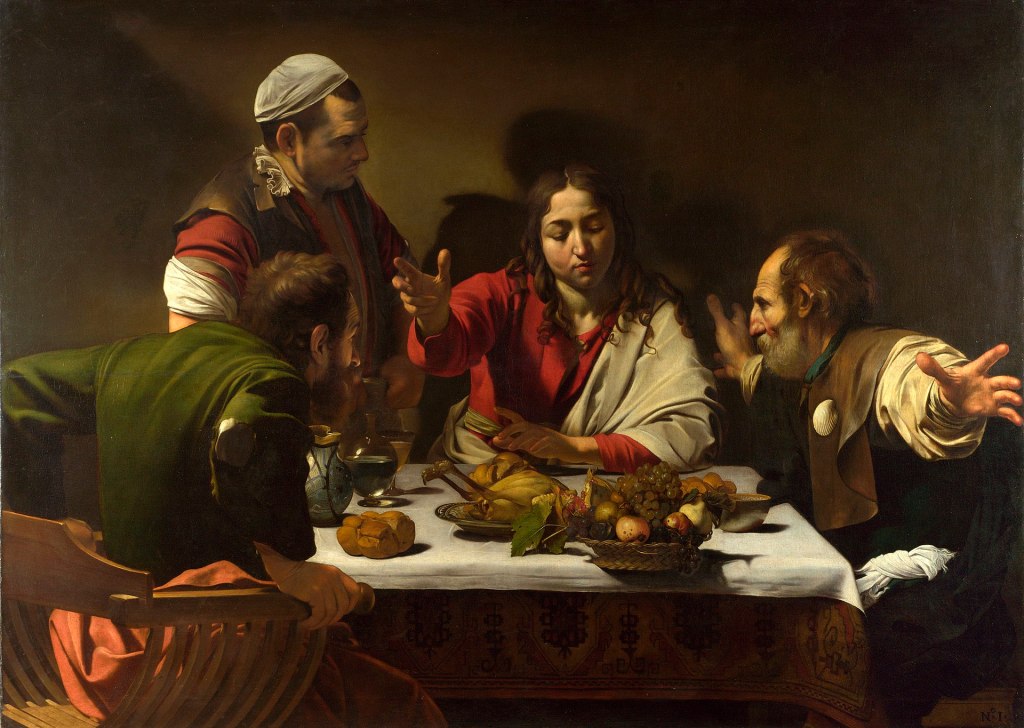
Observe also how our presentations and shows in our Catholic schools and parish halls have become mere repetitions of what are on television that have left many of us now stuck in Emmaus who could no longer find the way back to Jerusalem, even to Jesus because all we see are the fun and excitement, the glitz and the glamor of media.
And of our massaged ego.
Road to Emmaus from clarusonline.it
Keeping technology in its place in the Church
We are not saying modern communications is evil; the Church has always been clear that these modern means of communications are in fact a gift from God. Vatican II asserts that it is Church’s “birthright” to use and own these modern means of communication for evangelization (Inter Mirifica, 3)
Our challenge in the Church is to keep these modern technologies in its proper place.
A technological culture is not the most hospitable environment for religious belief, but neither is it necessarily hostile. If we are to find a way of expressing our faith in this technological culture and of speaking to and with the people formed by this culture we need to take time to consider how we, as individuals and as a faith community, interact with technology on a daily basis.
James Mcdonnell, Communicating the Gospel in a Technological Age: Rediscovering the Contemplative Spirit (1989)
In a story posted by the CBCP News two days ago, it reported the experience of Filipino priest Fr. Jun Villanueva who contracted the dreaded COVID-19 disease in New York City last March shortly after he had arrived to study there.
Assigned in a parish in the heart of the Big Apple, Fr. Villanueva tells how he spent his days of being “alone literally and emotionally” as “moments with God”. But, his turning point came after recovering from the corona virus when he began celebrating Mass alone:
“I really cried when I first celebrated Mass without churchgoers. There’s no one in the Church except Jesus,” he recalled. “Then I realized that the Mass is not a show but our union with Jesus, whether there are people or none,” he said. “I started to look at the situation from that perspective”.
Fr. Jun Villanueva, CBCP News, 27 April 2020
That is the first step needed to put technology in its proper place in the Church: that we bring back Jesus Christ whom we have banished in the name of our ministry and vocation. The more we think of putting so much “art” and other things to “enhance” our liturgies, then we banish Jesus Christ.
This is the other pandemic we have refused to stop in the Church: triumphalism, the overdoing of things for God that in the process we actually put more of ourselves in the ministry and liturgy than of the Holy.
Is there anyone or anything greater than the Lord?
Remember St. Theresa of Avila: Solo dios basta!
And, like our saints who guide us closer to God, the only way to have Jesus and bring him back in our lives and ministry, in the church as institution and building is through the contemplative spirit of the priests.
It is a good thing that the catch call these days is that the “return to normal” is actually a “return to basics” like washing of hands, covering of mouths when sneezing, and most of all, a return to God.
From Google.
The spirits of modernity characterized by constant changes and technological efficiency do not jibe so well with the demands of the Gospel of Jesus Christ who have always reminded us of guarding against the temptations of the material world.
Jesus tells us to practice poverty but the world tells us to be wealthy.
Jesus asks us to forget ourselves and follow him but the world tells us to be popular and follow the limelight.
Jesus tells us to go down and be humble but the world tells us to rise up and go higher!
The other day, Jesus reminded us in the gospel:
“Do not work for food that perishes but for the food that endures eternal life, which the Son of Man will give you. For on him the Father, God, has set his seal.”
John 6:27
Most of the time in the Church and in our lives as priests, we have to be “inefficient” like “waste time” doing nothing in front of the Blessed Sacrament; have less of everything like food, money and clothing; be silent to listen more than to speak and talk more.
The contemplative spirit is about poverty and going down while the world tells us to be wealthy and to rise and go upwards.
The contemplative spirit is to be silent and trusting always in the Lord rather than relying on our own powers and abilities.
Here is James McDonnell again on the need to rediscover the contemplative spirit in communicating the gospel in this modern time.
“The contemplative spirit is an attitude of mind and heart that enables us to focus on the essential, important things. It refuses to be hurried or rushed into premature rejection or acceptance of technology. If we Christians allow it to inform our use of communication technologies we shall learn to be realistic, but always hopeful, able to love and reverence our culture even as we strive, with God’s help, to transform it.”
Communicating the Gospel in a Technological Age: Rediscovering the Contemplative Spirit (1989)
Take heart, my dear brother priests: we are representatives of Jesus Christ, our Eternal Priest. We are not entertainers and pleasers of anyone but of God alone. We do not need followers and likers. And we have so many other things to do than TikTok and Facebook or Instagram.
Let us go back to Nazareth to be silent and hidden so we can return to Jerusalem to await for further instructions from the Lord. Amen.
40 Shades of Lent, Thursday, Week I, 05 March 2020
Esther C:12, 14-16, 23-25 +++ 0 +++ Matthew 7:7-12
Photo by author, Parokya ni San Juan Apostol at Ebanghelista, 01 March 2020, Bagbaguin, Santa Maria, Bulacan.
O God our Father, you know very well how ignorant I am with computers and the Internet. But, somehow, Lord, I have learned something very important with computers like the “default system” whereby a computer setting is on a desired preexisting configuration useful to the user.
On this season of Lent, help us to restore our default system in you, O God!
Make us stop “surfing” the universe for better default systems for there is no one better than you whom we must always have as our first option in everything, whether in good times or in bad.
Like Queen Esther in our first reading today who only had you as her recourse in seeking help for her countrymen:
“Now help me, who am alone and have no one but you, O Lord, my God… come to help me, an orphan. Put in my mouth persuasive words in the presence of the lion, and turn his heart to hatred for our enemy, so that he and those who are in league with him may perish. Save us from the hands of our enemies; turn our mourning into gladness and our sorrows into wholeness.”
Esther C: 13, 24-26
Create a clean heart in me, O God, so that I may always seek and follow you.
Most of all, incline my heart to you always so you may dwell in me to let justice and love and mercy reign in me. Amen.
Quiet Storm by Fr. Nick F. Lalog II, 03 February 2020
Detail of the Presentation painting by Italian artist Andrea Mantegna (1431-1506) with Mary handing the Child Jesus to Simeon at the temple of Jerusalem (man at the middle Mary’s husband, Joseph).
As we come to close today’s Feast of the Presentation of the Lord, I wish to share with you a Quiet Storm brewing within me which I call “the Nunc Dimittis experience”.
Nunc dimittis is the Latin opening line of Simeon’s Canticle that says “Now you dismiss” when he was filled with joy by the Holy Spirit upon meeting our Lord and Savior on his presentation at the temple.
According to St. Luke’s account, God had promised Simeon that “he would not see death before he had seen the Christ of the Lord” (Lk. 2:26). Hence, the overflowing joy of Simeon when he finally met the Child Jesus at the temple 40 days after Christmas!
Part of St. Luke’s artistry in his Christmas story is to put songs on the lips of some of its important characters to express their profound joys in their unique experiences of the coming of Christ.
The Nunc Dimittis is the fourth canticle in the Lucan Christmas story: first is Mary’s Magnificat when she visited her cousin Elizabeth who was six months pregnant with St. John the Baptizer; second is the Benedictus by Zechariah when he regained his speech after naming his son John; and third is the Gloria sang by the angels when Christ was born in Bethlehem.
Of these four canticles recorded by St. Luke, Simeon’s Nunc Dimittis sounds the highest level of all, the fulfillment of time within each one of us when we personally recognize and meet Jesus the Christ our Savior like Simeon.
And so often, when we are overjoyed in experiencing Jesus Christ, that is also when we feel like saying “now I am ready to go, ready to die” exactly like Simeon because we have met the Lord.
That is why I call it “the Nunc Dimittis experience”: real joy can only come from that experience and intimacy with Jesus Christ, when we feel so close with him. It does not really matter whether we experience him here in this life or hereafter. What matters most is we feel so close with him, as if embracing him, here and now.
This may be a religious experience like after listening to a homily that really touched us, or after a good confession, or while attending a wonderful retreat or recollection. It may also happen when we feel so loved and accepted, when we are vindicated, or when assured of support and trust and confidence while going through difficult trials in life.
Our Nunc dimittis experience always comes at the end of each day, when we feel despite our failures and shortcomings, we are in God’s loving presence.
Simeon’s Canticle, our Night Prayer
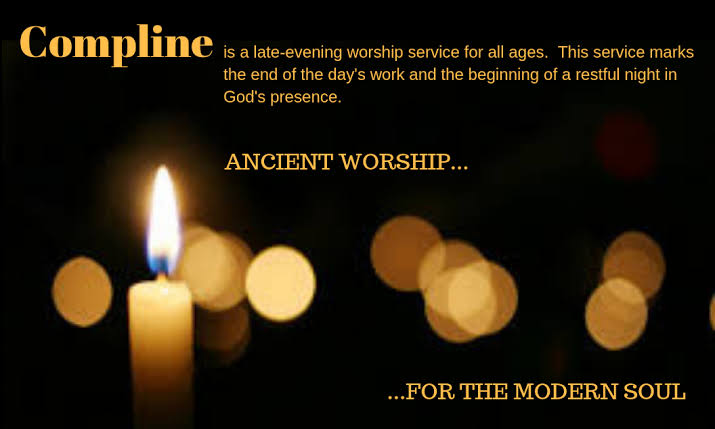
Since the early sixth century during the time of St. Benedict, the “Nunc Dimittis” has been sung in the monks’ night prayer or “compline” from the Latin completorium or completion of the working day. Eventually, it was adopted into the Liturgy of the Hours or the prayers of the Church usually recited by priests and religious. (St. John Paul II had suggested in his encyclical Novo Millennio Innuete after the Great Jubilee of 2000 that the lay faithful also pray the Liturgy of the Hours.)
After the praying of the psalms and meditation of the Sacred Scriptures, there is a Responsory that declares, “Into your hands, Lord, I commend my spirit.” Like Jesus before he died on the Cross, we offer to God our very selves. This is takes on a beautiful dimension especially if we have done a good examination of conscience at the start of the compline, before the psalms and readings.
Then, we recite the antiphon that introduces the Nunc dimittis: “Protect us, Lord, as we stay awake; watch over us as we sleep, that awake, we may keep watch with Christ, and asleep, rest in his peace.”
The antiphon in itself is already a prayer!
It is after the antiphon that we chant or recite Simeon’s Canticle:
Lord, now you let your servant go in peace; your word has been fulfilled: my own eyes have seen the salvation which you have prepared in the sight of every people: a light to reveal you to the nations and the glory of your people Israel.
From the Compline of the Breviary
The antiphon is repeated and immediately followed by the Closing Prayer.
The cross atop our parish church at night with the moon above taken with my iPhone camera, 02 February 2020.
Capping the compline is the blessing at the end that says: “May the all-powerful Lord grant us a restful night and a peaceful death. Amen.”
Usually, a hymn to Mary is sung, then all the lights are turned off and the great silence (magnum silencium) begins until the morning prayers or lauds (Latin for praise).
See how our night prayer or the compline is oriented towards meeting God, or to put it bluntly, towards death.
Yes, it is always easy to say we are ready to die. It is a lot whole different when we are already face to face with death itself.
But, when we come to think of it, we realize that indeed, in death, “there is nothing to fear but fear itself”.
When we die, everything happens so fast. We may not even feel anything at all. And unknown to us, every night when we go to sleep, we rehearse our death, so to speak!
And what a tremendous joy to keep in mind how every night, the Lord fills us with joy and faith within us even if we often forget him. Every night when we sleep, it is automatic within us to entrust everything to God “unconsciously” without even thinking we may never wake up!
It is a “Nunc Dimittis” experience too because most of us go to bed filled with joy, full of hope the following morning would be a better day than today. And that is Jesus still coming to us at the end of the day to assure us of his love and concern, never bothering us at all of this tremendous grace gratuitously given to us.
Next time you sleep, remember how blessed you are to have come to the end of another day, blessed and loved.
Pray, and start experiencing Jesus more from the beginning to the end of each day and forevermore. Amen.
The Lord Is My Chef Sunday Recipe for the Soul, Feast of the Presentation of the Lord, 02 February 2020
Malachi 3:1-4 ><)))*> Hebrews 2:14-18 ><)))*> Luke 2:22-40
Photo by author of Baby Jesus at the Bishop’s Chapel, Malolos Cathedral, 07 January 2020.
We take a break from our Ordinary Sunday to celebrate today the Feast of the Presentation of the Lord at the temple, 40 days after Christmas. It is a prolongation of the celebration of the Lord’s Nativity with a paschal undertone recognizing Christ as Light who had come to us to lead us back to the Father through his Passion, Death, and Resurrection.
This feast used to be known in the East as the Ypapante or the Encounter of Jesus by the two elderly people at the temple, Simeon and Anna. When it reached Europe, it came to be known as the “Purification of the Blessed Virgin Mary” based on St. Luke’s description, evolving into Candlemass or Candelaria when Pope Sergius I in Rome adopted in the eighth century the French tradition of procession of lighted candles at dawn before the Mass to signify Jesus as the light of the world who had come to bring us back to the Father expressed by Simeon in his canticle.
“Now, Master, you may let your servant go in peace, according to your word, for my eyes have seen your salvation, which you prepared in sight of all the peoples, a light for revelation to the Gentiles, and glory for your people Israel.”
Luke 2:29-32
Despite its evolution through the ages with its many names and practices, the Feast of the Presentation of the Lord is a good reminder to us in recognizing, meeting, and sharing Jesus Christ to everyone as the light of the world.
Photo by author of a view from the Temple of Jerusalem, May 2017.
Being devout leads us to recognize and meet Jesus
Only St. Luke reports the story of the Presentation of Jesus at the temple because he wanted to show his audience who were Gentiles or pagan converts that Jesus came not only for the Jews but for everyone.
This remains true to us especially in these modern times when people live in artificial lights and “Klieg lights” that put us on the centerstage only to leave us later groping in the dark, even blinded to false hopes of virtual realities.
St. Luke invites us today to emulate both Simeon and Anna in recognizing and meeting Jesus, the only Light of the world who dispels darkness within and around us.
Now there was a man in Jerusalem whose name was Simeon. This man was righteous and devout, awaiting the consolation of Israel, and the Holy Spirit was upon him. It had been revealed to him by the Holy Spirit that he should not see death before he head seen the Christ of the Lord. He came in the Spirit into the temple; and when the parents brought in the cild Jesus to perform the custom of the law in regard to him, he took him into his arms and blessed God.
Recall how during our Simbang Gabi that for the Jews, a “righteous” person is someone who is holy because he faithfully keeps the Laws of God like St. Joseph, the husband of Mary.
But more than being holy and just, St. Luke also described to us Simeon – as well as Anna implicitly – as “devout” Jews. It is a word rarely used in the Bible. In fact, St. Luke used it only four times: once here in this scene and thrice in the Acts of the Apostles.
In Acts 2:5, St. Luke called the Jews who came to Jerusalem for Pentecost as “devout” ones; then in 8:2, he said “devout men buried” the first martyr of the Church, St. Stephen; and finally in 22:12, he gave the distinction to Ananias as “a devout observer of the law” who came upon instructions from God to pray over and heal Saul who was blinded by Christ’s light on the way to Damascus.
In all four instances, St. Luke described people as “devout” including Simeon and Anna as those of “good heart, ready to believe, and then to act openly and with courage” (Timothy Clayton, Exploring Advent with Luke; page 125). Devout people or devoted persons are a notch higher than just being faithful because they do not merely wait but look forward to the fulfillment of what they believe.
Devoted people make things happen; they do not wait for things to unfold. And that is why they are always at the right place in the right time. Like Simeon and Anna, they give themselves to God wholly to stay attuned with the Holy Spirit and be ready to follow its promptings and leads.
Anna meeting Jesus from catholicfunfacts.com.
See the common trait of both Simeon and Anna as devout people — the presence of the Holy Spirit in them that amid the crowd in the temple on that day, they were able to spot the Child and Savior Jesus Christ being presented by his parents Mary and Joseph!
There was also a prophetess, Anna, the daughter of Phanuel, of the tribe of Asher. She was advanced in years, having lived seven years with her husband after her marriage, and then as a widow until she was eighty-four. She never left the temple, but worshipped night and day with fasting and prayer. And coming forward at that very time, she gave thanks to God and spoke about the child to all who were awaiting the redemption of Jerusalem.
Luke 2:36-38
Jesus comes to us everyday in various ways, in many occasions. He is always passing by, calling us. We have to be on guard in these moments so that we do not miss him. Like reporters following the news, we have to be focused or “tutok” and immersed or “babad” so that nothing or no one escapes us.
Three ways of being devout like Simeon and Anna
It is imperative that we have to be devout first with God so that we recognize and meet his Son Jesus Christ coming to us so we may eventually share him to enlighten everyone. Simeon and Anna show us three important things to keep for us to be devoted to God to encounter Jesus Christ.
First, we have to be faithful in our prayer life. There is no other way in meeting Christ except in having a life of prayer which is a discipline. It is something we do as a habit, every day, every night. Not just once a year like those going to Quiapo every January 9 or completing any novena and then the whole year does nothing.
Devotion is more than collecting images of Jesus, the Virgin Mary, and the saints, joining processions during fiesta or Holy Week, then nothing. Devotion is life, not a show.
Like Simeon and Anna, we have to grow intimately with the Lord by cultivating personal prayers and joining communal activities like the Sunday Mass so that we may know personally and vibrantly God who always leads us to various directions and mission. God is never static but dynamic, unlike us people who keep on insisting on some of our traditions and ways no longer applicable.
Notice how in the first reading the Prophet Malachi said the Lord will suddenly come in the temple, calling on people to always await him (Mal.3:1).
The Old Jerusalem from the inside of the Church of Dominus Flevit (The Lord Cried) at the Mount of Olives, Jerusalem. Photo by author, May 2017.
Second, we can only recognize, meet and share Jesus Christ as Light when we care, love, and respect others. See how Simeon spoke to Mary about his coming mission and its harsh realities. He recognized not only Jesus but also Mary and Joseph. Simeon’s speaking to Mary and Joseph means he recognized the important roles of the parents in being instrumental that he met the Lord.
Any devotion to God and his saints and the blessed Mother Mary without any concern for the people especially the poor and the needy is merely a show and a pageantry of clerical and liturgical excesses. It is triumphalism in its purest sense and hypocrisy at its worst.
We meet Jesus among other people not only within us. This is the gist of the author of the Letter to the Hebrews today when he claimed how Jesus suffered and endured sufferings and death to help those facing trials and tests in life.
Third, we can only recognize, meet, and share Jesus Christ as Light when there is joy in our hearts. And not just being joyful but overflowing with joy like Simeon and Anna that upon encountering the Child Jesus, the more they felt eager to share the good news with others. In fact, they were overjoyed that they even felt so ready to die.
Our parish church on a Sunday afternoon. Photo by Angelo Nicolas Carpio, 12 January 2020.
Fruit of devotion is finally embracing Jesus Christ
Every night before we priests and religious pray Simeon’s Canticle in our Compline (Night prayer), we recite a responsory that says, “Into your hands, Lord, I commend my spirit”. And after that, the antiphon: “Protect us, Lord, as we stay awake; watch over us as we sleep, that awake, we may keep watch with Christ, and asleep, rest in his peace.”
It is only then that we recite or chant Simeon’s Canticle or Nunc Dimittis. It is then followed by the final prayer closed with a blessing that says, “May the all-powerful Lord grant us a restful night and peaceful death. Amen.”
Without sounding morbid or anything, it is my most favorite prayer of all our prayers because it is filled with joy, filled with Jesus, filled with Light. At the end of the day, what a consolation to be filled with joy of Christ that you have had a glimpse of him that you rest in peace hoping to meet him again as well as share him with others too.
I think it is only when we are overflowing with joy that we realize its fullness is found only in Christ, whether in this life or in eternal life. Amen.
2 Samuel 7:4-17 ><)))*> ><)))*> ><)))*> Mark 4:1-20
An oasis near the Dead Sea, Israel. Photo by author, May 2017.
God our Sower, every good seed is from you.
Thank you very much in giving us the best seed of all, your Son Jesus Christ, the “Word who became flesh”, himself the very fruit of the “seed” you promised to King David long, long ago.
That night the Lord spoke to Nathan and said: “Go, tell my servant David, ‘The Lord also reveals to you that he will establish a house for you. And when your time comes and you rest with your ancestors, I will raise up your heir after you, sprung from your loins, and I will make his Kingdom firm. It is he who shall build a house for my name. Your house and your kingdom shall endure forever before me; your throne shall stand firm forever.'”
2 Samuel 7: 11-13, 16
Cultivate us, O Lord, to become good soil who will be open to receive your seed to make it sprout and grow and bear fruits.
So many times in our lives, we choose to be like the “path” where seeds fall and we do not mind at all. Likewise, we sometimes choose to be like the rocky ground who joyfully received Jesus for a while but when trials come, we give up on him because we have not taken him into our hearts to take root in us.
There are those among us, O Lord, who choose to be among the thorns, who choose to believe in science and technology, in materialism that choke the word in us until it dies out and bear no fruit.
In all instances, the problem is with the soil, never with the seed that is so good if given a chance to grow on rich soil would surely be fruitful.
Teach us to be a rich soil, one who is patient and still, willing to wait for your coming each day sowing us the good seed who value silence, and most of all, who uphold the sanctity of life itself so that YOU, O Lord will grow in us, be nurtured by us, be loved and embraced by us.
Show us anew the beauty of your words, O Lord, so we may immerse ourselves in you, be still in your presence to receive and digest your words as food that delights us and strengthens us. Amen.
Tuesday, St. Thomas Aquinas, Priest and Doctor of the Church, 28 January 2020
2 Samuel 6:12-15, 17-19 ><)))*> ><)))*> ><)))*> Mark 3:31-35
What else shall I say to you, O Lord our loving God? With this beautiful prayer by your “Angelic Doctor” St. Thomas Aquinas whose feast we celebrate today, we borrow not only his prayer but most of all, his attitude and disposition in seeking you always, serving you, loving you.
He had taught us that it is at the foot of the Cross of Jesus Christ where we can best learn about love, patience, humility, and obedience (Office of Readings).
Please us that desire always to seek you right there at the foot of your Son’s Cross, Lord.
Like King David, let us get near you O God represented at that time by the Ark of the Covenant but today in Jesus Christ, your Emmanuel present among us in the Holy Eucharist St. Thomas had loved so much with his hymns and prayers composed.
Like King David who danced before your Ark of the Covenant, may we give our selves totally at your service, Lord.
Help us do your will, Father, after praying at the foot of the Cross for that is when we truly become the “mother and brother and sister of Jesus” (Mk.3:35).Amen.
Photo by Mr. Jasper Dacutanan, 19 January 2020, our parish altar.
1 Samuel 3:1-10, 19-20 ><)))*> ><)))*> ><)))*> Mark 1:29-39
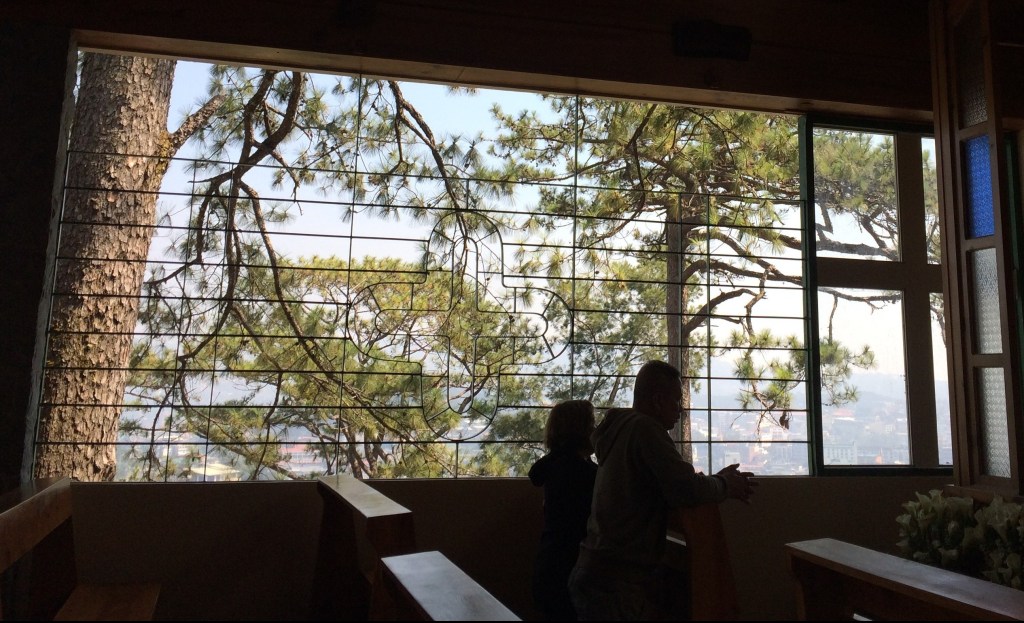
Photo by author, Grotto chapel, Baguio City, January 2020.
Thank you very much, O God, to your inspired words today that teach us some important lessons about prayer especially at this time of calamity from Taal Volcano’s eruptions.
Once again, you remind us to always have you first in every situation:
Simon’s mother-in-law lay sick with a fever. They immediately told Jesus about her.
Mark 1:30
Forgive us, O Lord Jesus especially in this time of social media, we have adored and followed our smartphones as our new gods, replacing you in prominence and importance.
Forgive us that upon waking up, the first thing we do is immediately check our messages, count our likes than kneel and thank you for the gift of life.
Teach us to be like Simon and his companions to always think first of you.
Most of all, teach us to center our lives in you through prayers like Jesus your Son who always went out of the way to pray before and after every ministry.
Give us that attitude of being open to you, of willingly presenting ourselves before you to listen and obey your words, O Lord, like Samuel.
Samuel answered, “Speak, for your servant is listening.”
1 Samuel 3:10
Today we pray for all travelers whose work have been seriously affected by Taal’s eruptions as we continue praying for the people of Batangas and Cavite affected by the calamity. Amen.
The Lord Is My Chef Recipe for 40th Wedding Anniversary
Tony and Joyce Lopez, 20 October 2019
Presentation of Our Lord Parish, Filinvest 1, Batasan Hills, QC
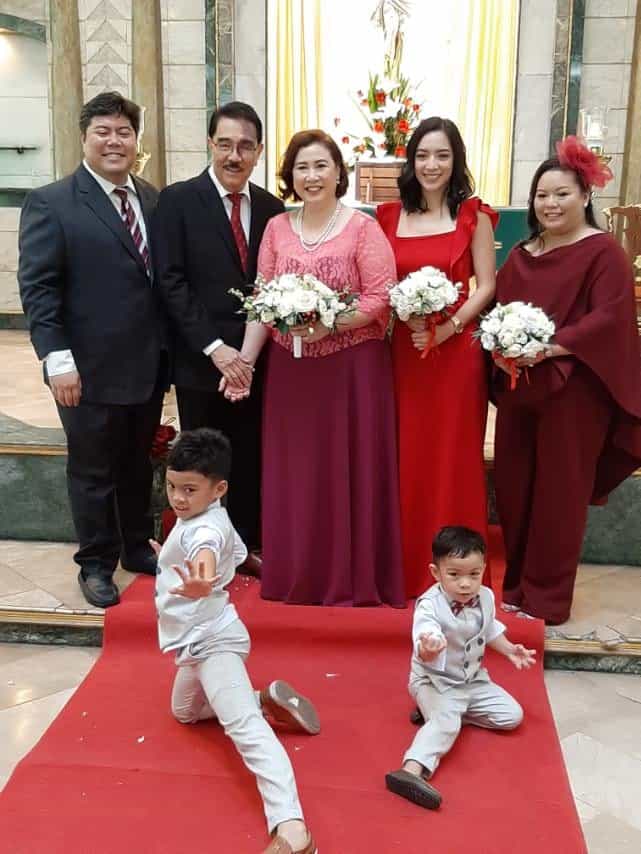
Tony and Joyce on their 40th Wedding Anniversary, 20 October 2019 at the Presentation of the Lord Parish, Filinvest I, QC joined by their son Atty. JA and wife Kathleen with two kids, and youngest daughter Rosella.
Every Sunday I write a blog connecting the gospel with a secular song.
As I prepared my homily for your anniversary, Joyce and Tony… “the moment I woke up and before your Mommy Fely put on her make-up, I said a little prayer for you.”
Joyce mom Fely Pollard with late husband Charles’ cousin, Beth Javier.
Of course that is not the theme song of Joyce and Tony. They haven’t met yet in 1967 when Dione Warwick recorded I Say a Little Prayer. But they were already married when it became one of the tracks in the movie “My Best Friend’s Wedding” starring Julia Roberts.
And since this is my “best cousin’s wedding anniversary” in this part of the city, I have thought of reflecting on married life as a form of prayer.
In our gospel we have heard Jesus Christ narrating the parable of the unjust judge and persistent widow to underscore “the necessity to pray always without becoming weary” (Lk. 18:1).
Prayer is an expression of faith.
When there is faith, there is also love.
And when there is prayer, faith, and love, what we have is a relationship, a community of believers who love each other.
People who love and believe with each other always talk and communicate. They make time to be with one another. And most often, that is what really matters with people who love and believe – simply to be together.
Even in silence.
Like prayer.
Joyce: “During our first few years as couple, I was the one always embracing Tony; but, later until now, it is Tony who often hugs and embraces me! Nabaligtad ang scenario.”
Prayer is more than asking things from God but most of all, prayer is a relationship with God expressed with others. That is the beauty of the Sacrament of Holy Matrimony: husband and wife are bound together in marriage to become signs of the saving presence of Jesus Christ.
Marriage as a sacrament means it is a prayer as well, a relationship of a man and woman with God as its source and foundation.
I am sure, Joyce and Tony along with all the other married couples here today will agree that married life requires a lot of prayers. In fact, married life is a prayer, a very difficult one that is much needed.
Like in that movie My Best Friend’s Wedding, there are real forces of evil that are trying to destroy couples. So many couples have already fallen, going their separate lives after several years of being together while on the other hand, more and more couples are refusing to get married at all due to this reality of breakups and separations.
And that is why we are celebrating today on this 40th anniversary of Joyce and Tony’s wedding! We are praying with them in expressing our faith and love for them in Christ Jesus. Prayers have kept them together, transforming them into better persons.
At the end of the parable of the persistent widow and unjust judge, Jesus posed a very crucial question for us, especially to every married couple here today: When the Son of Man comes again at the end of time, will he find faith on earth? (Lk.18:8)
Tony and Joyce at Villa San Miguel, Mandaluyong 1979.
And what shall be our response?
“Yes, Lord, you shall find faith when you come again in Joyce and Tony!”
Like Moses in the first reading, they both prayed hard with arms outstretched on many occasions as they battled life’s many challenges and struggles.
“Yes, Lord, you shall find faith when you come again in Joyce and Tony” because they have both proclaimed your word with persistence, whether it is convenient or inconvenient like St. Paul in his second letter to Timothy. They have weathered so many storms in the past 40 years and your words, O Lord, have kept them together, sharing these with their children and with everyone in their life of fidelity and love.
“Yes, Lord, you shall find faith when you come again in Joyce and Tony” now before your altar to renew their vows to love and cherish each other for the rest of their lives!
“Yes, Lord, you shall find faith when you come again” among the many couples gathered here who have remained faithful to each other despite their many sins and failures, weaknesses and shortcomings.
Joyce and Tony, you are not only a prayer of faith but also a homily of the Holy Matrimony, showing us the light and power of Jesus Christ to transform people in prayer and bring them to fulfillment.
Prayer does not change things like typhoons and earthquakes. We cannot ask God in prayer to spare us from getting sick or be exempted from life’s many trials and sufferings. Prayer cannot stop those from happening.
What prayer does is change us, change our attitude so we may hurdle life’s many blows and obstacles. Especially with couples who always find God in their lives, in good times and in bad.
Prayers transform us into better persons as children of God, especially couples who eventually look like brothers and sisters after living together in faith, hope and love.
Tony and Joyce, I am sure everyone in our family and among your friends here can attest to the many good things that have transformed you in the past 40 years.
You have changed to become the best for each other.
In the bible, the number 40 means perfect.
May God continue to perfect you, Tony and Joyce.
Keep us too in your prayers as we pray for you. Amen.



















 lordmychef.com