Marriage is completing each other

The Lord Is My Chef Wedding Recipe by Fr. Nicanor F. Lalog II
Homily, Wedding of Dra. Arianna Julia Enriquez & Dr. Dexter Falcon
Santuario de San Jose Parish, Greenhills, Mandaluyong
28 February 2025
Photo by Deesha Chandra on Pexels.com

Congratulations, Dra. Arianna and Doc Dexter in choosing to get married in the Church. Many people these days disregard the Sacrament of Marriage, sadly seeing it more in human terms and most sad of all, many would rather follow superstitions than faith in getting married.

When I was still in a parish in Bulacan, a couple met with me due to a problem with the date they wanted to get married that fell on a Saturday. I offered to them a Friday but the mother of the bride said “araw po ng mga mangkukulam ang Biyernes!” Whoa! Did you know that?

Trying to hide my laughter, I told the couple how about on a Thursday which is my day off and would just cancel it to officiate their wedding. The mother again interjected, “nakupo Father… lalo na po ang Huwebes! Araw ng kasal ng mga tikbalang!” I could not contain myself anymore and I told the mother, “Katoliko pala mga tikbalang dito sa inyo!”

I mentioned this experience because in the provinces, very few couples get married in the month of February like you. Your Tita, Dra Mylene knows this very well… happy birthday po! When people find out you were born in February, they say “kaya ka pala ganyan, kulang-kulang.” And that’s how most people see February – kulang or incomplete – that is why even couples avoid it as a date for their wedding.

Of course that is not true. Every day is a perfect day for wedding for each day is blessed by God – most especially the days of February, the most perfect month in number of days. February was added to our calendar to complete the 365 days of revolution of Earth around the Sun to make it a year. It is February that completes the year as it fills the missing days following the miscalculations by the early Romans.

Photo by Irina Iriser on Pexels.com

And that’s marriage. A man and a woman get married to complete each other.

Remember God’s declaration in the first reading, “It is not good for man to be alone.”

See how in creating the woman, God cast a deep sleep on man and took his rib to form it into a woman. The man was totally unaware of what was going on when God created and gave him the woman as his “suitable partner.”

This is most true with you, Dra. Arianna and Doc Dexter: you were both totally unaware in the beginning of how God worked silently in the background that you would eventually complete each other as friends, as lovers and now as husband and wife.

You have realized after your long relationship from pre-med to med proper and now as full-pledged doctors that you both cannot be complete without each other that even if you were separated by time and distance, you still made efforts to be together because that is love. You have realized that you can only be complete and whole with each other. Ikaw lang, sapat na!

Nothing is so toxic and difficult, nothing is most joyous when you think of each other, when you love each other. And so, simply love, love, and love! Huwag kayong magbibilangan! No need to have the numbers “224” tattooed on your arms like Philmar and Andi Eigenman.

When you have an LQ, who must make the first move to reach out and make peace?

Some couples say the man should make the first move but what happened to the rule “ladies first”? Others say the first to reconcile and say sorry is the one who started the lover’s quarrel but, would anyone really admit that?

The answer is this: when couples have an LQ, the one who has the most love to give must be the first to make the move for peace and reconciliation. Yung higit na nagmamahal ang unang kikibo.

Love is not a competition and love cannot be really measured. The true measure of love is when you love without measure. Nobody is perfect; hence, human love is also imperfect. Only God can love us perfectly. That is why, just keep on loving each other, letting your love flow to each other by taking care of each other.

That is the beautiful imagery of the ribs – inside the rib cage, the most vital organs of the body are protected and kept safe like the heart, the lungs, the liver. Lalo na ikaw, Doc Dexter: you are lacking in one rib and that is Dra. Arianna. Alagaan mo siyang mabuti. Boss namin siya…

God willed in all eternity that the two of you get married today not tomorrow nor next year nor last year. It was God who set February 28 as your wedding date because on this day God completes you.

However, though the husband and the wife complete each other, it is Jesus Christ who cements their union in the Sacrament of Holy Matrimony. Jesus is the “gold paint” in the Japanese kintsugi art of repairing broken pottery.

Kintsugi is the Japanese art of joining together the broken pieces of a jar or a vase with a glue and then pain with gold its cracks to make the broken piece more beautiful. Along this line of thought is St. Paul the Apostle who described us as “earthen vessels” – palayok in Tagalog: so delicate and easily broken yet God still fills us with Himself and His grace because He loves us so much.

And that is my second final reflection for you dear Dra. Arianna and Doc Dexter: love is not natural but supernatural – it is divine because it is rooted in God! Love is more than a feeling which is natural. Love is a decision, requiring your cooperation with God who pours out His blessings to you since you met despite your imperfections and flaws. That is the meaning of Marriage as a Sacrament – it is more than a human and natural bond but a supernatural, divine union of man and woman who become the signs of Christ’s saving presence in the world.

Heed the call of Jesus in our gospel today, “remain in me and make my joy complete.”

How lovely is your love story! Clearly of divine origin that you met in a theology class during your senior year in college. You did not meet in a party nor in any of those rows of restaurants across Ateneo or at the parking lot. You met in a theology class where you learned about God.

Photo by Pixabay on Pexels.com

And the more you discovered God, the more you discovered each other, realizing in the process that the more you need God to make you both complete which is the principle and foundation of St. Ignatius of Loyola’s Spiritual Exercises.

We are able to love because God loved us first as the beloved disciple wrote in his first letter. That is the mystery of love, of married love specifically that Ben & Ben said so well in their song, “Mahiwaga… Pipiliin ka sa araw-araw… Mahiwaga… and nadarama sa iyo ay malinaw.”

When I think of this mystery of divine love in married couples, the image that comes to my mind are the “praying hands”. Each hand represents the husband and the wife. They retain their individuality as they freely pursue growth and maturity and fulfillment in life and career. Both hands are flexible and can move freely.

But, look at these two praying hands: as you get closer with each other, you also create a sacred space between you for Jesus Christ. Like that glue painted gold in the Japanese art of kintsugi, it is Jesus who makes you one and complete, it is Jesus who joins you together in his love.

Hence, whatever you do to each other, you do it first to Jesus. When you are faithful and true to Dra . Arianna, you are first faithful and true Doc Dexter to Jesus. The same with you Dra. Arianna: when you bake pastries and cakes for Doc Dexter, it is Jesus whom you first make happy and delighted.

But the moment you Doc Dexter cheat and lie to Dra. Arianna, you first fool Jesus. When you make taray to Doc Dexter, you first make taray to Jesus, Dra. Arianna.

Handle your life always with prayer. Every day, invite Jesus into your married life, Dra. Arianna and Doc Dexter in the same manner you have both invited Him today on your wedding day. God bless you always, Dra. Arianna and Doc Dexter! May today be your least happiest day in your life as couple! Amen.


Photo by Emre Kuzu on Pexels.com

The debt that is never paid off

The Lord Is My Chef sunday Recipe for the Soul by Fr. Nicanor F. Lalog II
Sunday in the Twenty-third Week of Ordinary Time, Cycle A, 10 September 2023
Ezekiel 33:7-9 ><))))*> Romans 13:8-10 ><))))*> Matthew 18:15-20
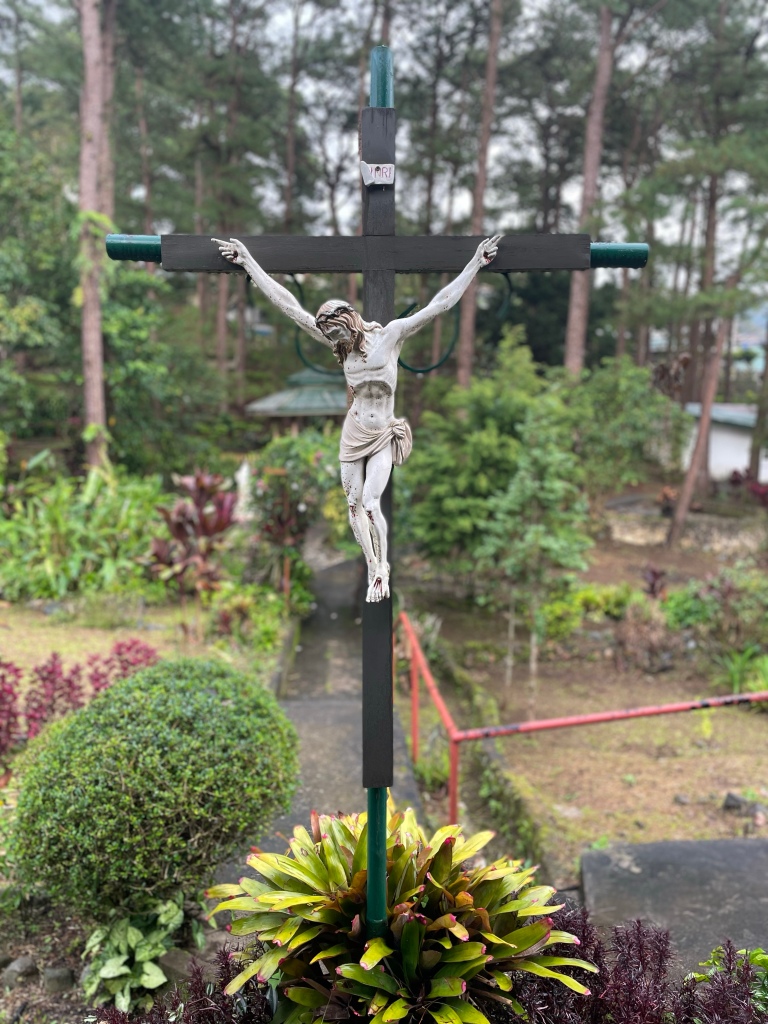
Photo by author, St. Scholastica Convent, Baguio City, 23 August 2023.

Our gospel this Sunday is very difficult but also one of the simplest and fundamental teachings by Jesus Christ: fraternal correction for more harmonious relationships.

That is very difficult because we have all experienced how when we heard of somebody going wayward in life, of living in a life of sin, our immediate reaction is to talk about them, engage in gossips without any intentions at all to correct them. Sad to say, we even distance ourselves from them – exactly the opposite of what Jesus is teaching us today:

Jesus said to his disciples: “If your brother sins against you, go and tell him his fault between you and him alone. If he listens to you, you have won over your brother. If he does not listen, take one or two other along with you, so that every fact may be established on the testimony of two or three witnesses. If he refuses to listen to them, tell the church. If he refuses to listen to the church, then treat him as you would a Gentile or a tax collector.”

Matthew 18:15-17
Photo by author, St. Scholastica Convent, Baguio City, 23 August 2023.

Jesus is now heading to Jerusalem to fulfill his mission. Along the way, he taught his disciples important lessons about the Church he had just “established” upon Peter, the Rock, while at Caesarea Philippi three weeks ago.

In these next three Sundays, Jesus tackles three delicate issues we continue to face even in our modern time like fraternal correction, forgiving, and work. These are delicate topics because they are all expressions of mutual love for one another.

Very often, we commit the sin of omission in the realms of these three, particularly of fraternal correction as we tend to detach ourselves from others especially if they are committing sin. By distancing from them, we unconsciously allow them to sin. In the movie The Good Nurse based on that true story of a nurse in the US who killed so many patients for some years by transferring to different hospitals, the good nurse asked him why he did it? The serial killer nurse said, “nobody told me to stop doing it.”

The dark side of the sin of omission lies in that tendency within us to not care at all especially with those who prefer to separate from us and lead their lives in the way they wanted. There is that tendency within us to be like Cain even if we are not guilty of any sin or may even be the offended party, saying, “am I my brother’s keeper?” Most sad are our Filipino expressions when somebody sins, “Bahal ka na sa buhay mo…pinili mo iyan, pagdusahan mo.”

Photo by author, Camp John Hay, 12 July 2023.

Fraternal correction is the antidote to sins of omission because it is about keeping our relationships intact as family, friends, brothers and sisters in Christ.

Jesus becomes truly present in the world among us when we live in harmony because “where two or three are gathered together in my name, there am I in the midst of them” (Mt. 18:20).

As early as the Old Testament, God had already insisted on this moral precept as his children that we look after one another like a guard or sentinel in the positive sense as he told the Prophet Ezekiel in the first reading. At that time, the enemies of Judah were closely approaching their borders that they designated watchmen as their first line of defense. Failure by these watchmen to warn the people – as it turned out later – could spell disaster for the kingdom.

The same thing is true with us. We are all interrelated with each other. One rotten tomato can spoil the whole batch. We cannot choose to be indifferent or just be mere bystanders amid the evil and sins happening around us perpetrated by those closest to us. But we must do it all in the spirit of love, not because we are better or holier.

Brothers and sisters: Owe nothing to anyone, except to love one another; for the one who loves another has fulfilled the law. Love does no evil to the neighbor; hence, love is the fulfillment of the law.

Romans 13:8, 10
Photo by author, Sacred Heart Novitiate, Novaliches, QC, 22 March 2023.

Fraternal correction is an expression of our mutual love for one another, the exact opposite of sin of omission. St. Paul offers us a lot today about this love that builds our family and community still from his letter to the Romans.

Let us start with St. Paul’s conclusion that love is the fulfillment of the law which we often hear and even proclaim to others. Main question that arises from this is the nature of this love. For St. Paul, love is the self-sacrificing love that Jesus showed us when he offered himself for us on the cross. Recall last Sunday St. Paul reminded us to offer your bodies as a living sacrifice (Rom. 12:1) like Jesus. In that same chapter, St. Paul spoke about not retaliating or seeking vengeance, an echoing of the Lord’s instruction on love when asked by a scholar of the law which is the greatest of the commandments (Mt.22:37-40).

Here we find, love for St. Paul is the imitation of Jesus Christ, a love that can never be measured at all and even be demanded and decreed! The love of Jesus Christ is so new as he mentioned at his last supper (Jn. 13:34) because it is a love rooted in God, a love that elevates us or as young people say “levels up” every disciple into the mystical plane.

Prior to his telling us today “to owe nothing to anyone, except to love one another”, St. Paul was expounding at the beginning of Romans 13 the theme of obedience to authority, a sort of social responsibilities, of things like justice (vv.1-7). While justice demands we pay off our debts and other dues to one another, to the state and public officials, it is a totally different scenario when it comes to love.

Photo by author, St. Scholastica Convent, Baguio City, 23 August 2023.

Love is not a possession that anyone can receive or give in an exactly measured quantity. St. Mother Teresa said that the measure of love is when you love immeasurably. There is no such thing as a kilo of love. It is either you love or do not love! And when that happens, when we do not love, then we sin. That sin can only be repaired and corrected by love. Sin is when we lack love; to overcome sin, pour in more love.

In all his writings, St. Paul always had love as the basis of his teachings so that without sounding as imposing, he could persuade us to live deeply moral lives as expression of that love in Christ which he eloquently expressed in his ode to love in 1 Corinthians 13. One of the earliest Latin phrases I have learned as a child was from my elementary school days at St. Paul College Bocaue (Bulacan). Our school motto is “Caritas Christi urget nos” – The love of Christ impels us (to love more) – from 2 Corinthians 5:14.

When we examine our true love experiences that are not selfish but other centered, we realize that love is a debt we can never pay off because love is a gift from God. This gift of his love makes us those who receive it in a filial, loving relationship with him our Father. Most of all, we realize we too can love like Jesus Christ!

God does not “order” nor “command” us in the strict sense to love him. He asks for our love because he loves us, because he is love. When we love, we fulfill the commandments of God. We live in peace and harmony with one another like in heaven. That is why it is only love that will remain in heaven where there will be no more fraternal corrections. Most of all, never be paid off as a debt because love is all that shall remain to become our very person in Christ. Amen. It is a Sunday. If you love, celebrate Mass in your parish. Have a blessed, loving week!

Photo by author, La Trinidad, Benguet, 12 July 2023.

The joy of leaving

The Lord Is My Chef Sunday Recipe for the Soul by Fr. Nicanor F. Lalog II
Solemnity of the Lord's Ascension-A, 21 May 2023
Acts 1:1-11 ><}}}*> Ephesians 1:17-23 ><}}}*> Matthew 28:16-20
Photo by author, sunset in the city from OLFU-QC, Hilltop Campus, January 2023.

Last Sunday we reflected that leaving is the most painful part of loving. Every separation hurts us, whether it is temporary or permanent like death. However, leaving can also be the source of our deepest joy when every departure is because of love, for love.

When we truly love, we only wish the best for our beloved. And sometimes that happens when our beloved leaves like when Jesus told his disciples at the last supper that it is better for him to leave so that the Holy Spirit would come (Jn. 16:7).

Moreover, when a loved one leaves, we are certain he/she is coming to somewhere better, someone better. That is why we have said last week that every leaving is also a coming like our coming together as a relationship no longer bounded by time and space but happening in spirit and truth.

That is the joy of leaving – it is a coming into a deeper or higher level of relationship that no longer depends in time and space.

That is the meaning of the Lord’s Ascension we celebrate today.

That is why the Ascension is not to be seen as Jesus “floating” on air going up to heaven which is not just a place but more of a relationship with God who is everywhere. Ascension is Jesus Christ’s entry into another level of intimacy and glory with the Father he shares with us his disciples as a result of his Passion, Death, and Resurrection.

The eleven disciples went to Galilee, to the mountain to which Jesus had ordered them. When they saw him, they worshipped, but they doubted. Then Jesus approached and said to them, “All power in heaven and on earth has been given to me. Go, therefore, and make disciples of all nations, baptizing them in the name of the Father, and of the Son, and of the Holy Spirit, teaching them to observe all that I have commanded you. And behold, I am with you always, until the end of the age.”

Matthew 28:16-20
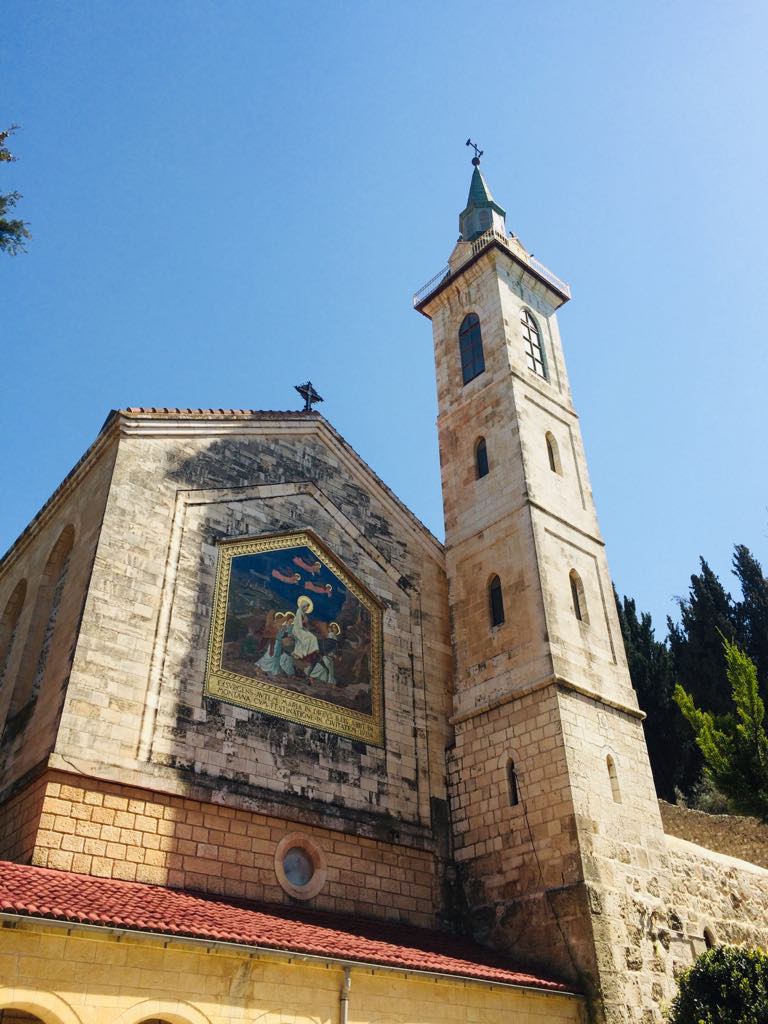
Photo by author, Chapel of the Ascension at the Mount of Olives in Jerusalem, May 2017.

It is in this context of a relationship, an intimate one, where we can understand fully what Matthew meant when he wrote how on the Ascension of Jesus, the disciples “worshipped, but they doubted him.” How could anyone worship but at the same time doubt?

Doubt here does not mean skepticism about the person of Jesus Christ. It has been 40 days since Easter and surely, the disciples have been convinced it was the Lord. The disciples’ doubt referred to their hesitancy to make a commitment to Jesus. No problem with Jesus. Problem was with the disciples. Just like us!

Photo by author, inside the Chapel of the Ascension on the Mount of Olives in Jerusalem, 2017.

We recently celebrated our silver anniversary in the priesthood. All six of us classmates unanimously agree on the tremendous grace of still being priests after 25 years despite our many flaws. Most of all, amid our doubts and hesitancy 25 years ago if we could really be that faithful and good as priests of Jesus Christ. That was the doubt of the disciples. “Makaya ko kaya yung ipinag-utos ni Lord?” must be the question nagging them that moment.

Or, that doubt of the disciples may be likened with the doubts of a man and a woman getting married, both so afraid with the vows and commitments they would make if they could really be faithful and loving to each other, “for richer or poorer, in sickness and in health.”

Remember that the Resurrection of Jesus did not instantly lead to a perfect faith for his followers who experienced it. They were still grappling with everything but have already embraced Jesus. There is no doubt with their love in Jesus. They were afraid for themselves they might fail, they might not measure up to Jesus whom they have failed on Holy Thursday and Good Friday. They were still wavering in their understanding and commitment to the Lord.

That is the good news of the Ascension – that amid all those doubts and hesitancies of his disciples, Jesus still believed in them, entrusting his mission to them, including us today. Imagine how everyday when we wake up, Jesus reminds us to “ascend” in him and with him to a higher level of relationship with the Father through one another in the exercise of our duties and responsibilities, in fulfilling our vows to God, to the Church, or to the country, to your wife, to your husband, to your office.

Like his disciples on that Ascension day, Jesus continues to entrust to us his Church his mission to the world because he believes in us even though he knows very well our imperfect faith.

Of course, it is difficult to make a complete and irrevocable commitment especially when there is the slightest doubt within us; but, most often what we do is to still make that bold step forward to grow deeper in that faith in God and with others than reduce or remove that little faith we have. This is most true as we have experienced in our relationships, that is why we celebrate anniversaries.

Photo by author, pilgrims waiting entrance into the Chapel of Ascension, May 2019.

Have you noticed how these past ten years young lovers celebrate “monthsaries” that sometimes look so cheesy and baduy? It was only recently have a realized how our young people are really serious with their relationships, with things of the heart like faith, hope and love. Their celebrations of their “monthsaries” indicate how the young generation desires long term relationships, celebrating each month of triumph over their initial doubts of keeping their love alive.

Even parents these days post pictures of the “monthsaries” of their babies to show how they have grown since birth which also indicate how the parents themselves have grown and matured despite so many odds and doubts within them in nursing, nurturing the life of another person, of their offspring.

These are all indications of our imperfect faith that gets perfected, gets deeper and stronger in the passing of each day every time we assert it. Not when we discard it. Try recalling those instances when you doubted your abilities in fulfilling a mission or assignment, in keeping a relationship and see how far you have gone now in life.

Photo by author, part of the site believed where Jesus stepped on his Ascension inside the Chapel of the Ascension, Mount of Olives in Jerusalem, May 2017.

Nobody is perfect. Everyone, including the most accomplished and successful people among us have our strengths and weaknesses. We all have our different areas of doubts we still struggle up to this time but that does not diminish the faith we possess. In fact, that is how our faith have grown deeper, our love perfected while our relationships leveled up higher than before.

This Sunday, Jesus does not only command us to fulfill his mission entrusted to us more than 2000 years ago through his eye-witnesses who made up the first community of disciples.

We who comprise this community of disciples today are likewise assured of Christ’s grace for us to grow in our faith and commitment to him.

Like in the first reading, we are reminded by the angels not to be idle nor complacent but instead to go out to fulfill Christ’s mission of proclaiming his gospel in words and in deeds.

Every Sunday we proclaim our faith in Christ’s death and resurrection until he comes again. That second coming belongs to our time. St. Paul is encouraging us in the second reading “to enlighten the eyes of our hearts” (Eph. 1:18) to realize how God had done everything and continues to do everything in Christ for us to mature in our faith, helping us in every step of our journey as disciples of Jesus. We cannot see the whole path of the journey but each step forward is enough for us to progress in our faith expressed in our loving service to one another.

This is the gist of the Pope’s Message for this Sunday’s World Communication Day, of “Speaking with the heart” which means to communicate in love and in truth, not with lies and fake news. To speak with the heart is to have a heart opened to love in strengthening our relationships not in destroying them like what is happening in the world with so much divisions and polarizations. Speaking with the heart means leaving behind our mistrust and doubts for one another in order to make that bold step toward peace by recognizing each one as a brother and sister in Christ. Amen. Have a blessed week ahead!

You are loved.

The Lord Is My Chef Breakfast Recipe for the Soul by Fr. Nicanor F. Lalog II
Monday, Memorial of St. Rose of Lima, 23 August 2021
1 Thessalonians 1:1-5, 8-10     ><]]]]*> + <*[[[[><     Matthew 23:13-22
Photo by Dr. Mylene A. Santos, MD, Rhode Island, April 2021.
Our loving God and Father,
today I pray only for one thing:
give me the grace to let others know
that you love them
like St. Paul.

We give thanks to God always for all of you, remembering you in our prayers, unceasingly calling to mind your work of faith and labor of love and endurance in hope of our Lord Jesus Christ, before our God and Father, knowing, brothers and sisters loved by God how you were chosen.

1 Thessalonians 1:2-4
In times like this with so many
getting sick and dying due to this pandemic
when so many have lost their jobs and
sources of income
when so many are so confused and 
depressed with how things are going on,
everybody seems to be so busy 
surviving and coping,
forgetting the most essential:
"work of faith
labor of love
and endurance in hope
of our Lord Jesus Christ"
as St. Paul wrote us today.
There are times we have become
like the scribes and the Pharisees:
so callous and self-centered, 
hiding in our devotions and 
religiosities when in fact
full of hypocrisies:

Jesus said to the crowds and to his disciples: “Woe to you, scribes and Pharisees, you hypocrites. You lock the Kingdom of heaven before men. You do not enter yourselves, nor do you allow entrance to those trying to enter. Woe to you, scribes and Pharisees, you hypocrites. You traverse sea and land to make one convert, and when that happens you make him a child of Gehenna twice as much as yourselves. Woe to you, blind guides who swear by the temple and by the altar…

Matthew 23:13-16
I know it is not that easy
to make even just one person
realize and feel that he 
or she is loved.

Like St. Rose of Lima,
let my faith in you
bear fruit with good works;
that my hope may not just be
a wishful thinking but confidence
in Jesus and eternal life;
and lastly, that my love be
like that of Jesus and his saints:
willing to suffer and give total self
for another.

Yes, it is not that easy, Lord
especially if we are afraid
to get hurt, to be laughed at,
to be last and to be least.
But with your grace,
let me do it, Lord.
Amen.

When God comes to visit us

The Lord Is My Chef Breakfast Recipe for the Soul by Fr. Nicanor F. Lalog II
Monday, Feast of the Visitation of the Blessed Virgin Mary, 31 May 2021
Romans 12:9-16     ><}}}'> + ><}}}'> + ><}}}'>     Luke 1:39-56
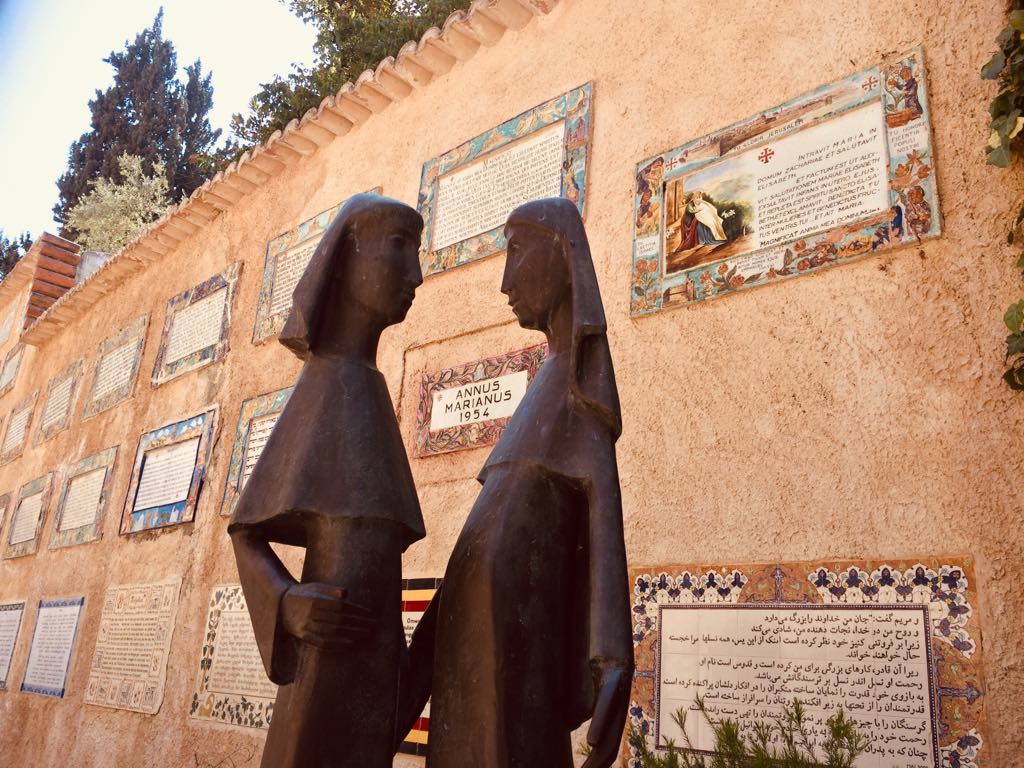
Photo by author, bronze statues of Mary and Elizabeth at the patio of the Church of the Visitation at Ein-Karem in Judah, 2017.
When Elizabeth heard Mary's greeting,
the infant leaped in her womb, and Elizabeth,
filled with the Holy Spirit, cried out in a loud voice
and said, "Most blessed are you among women,
and blessed is the fruit of your womb.
And how does this happen to me, 
that the mother of my Lord should come to me?"
(Luke 1:41-43)

In this time of the pandemic with threats of COVID-19 still prevalent, we feel exactly like St. Elizabeth, O God our loving Father, asking, “how does this happen that you O Lord, should come to us?” But that is how great and tender is your mercy for us, Father!

How great indeed is your goodness and mercy for us, Father, that your ways are always so different from our own ways like with the story of the cousins Elizabeth and Mary: ideally, it should have been the elder Elizabeth who visited Mary for she was bearing your Son Jesus Christ. That early, Jesus had shown us the nature of his mission here on earth, that he had come to serve and not to be served.

You know how much we miss one another so much these days, heavenly Father. We are getting tired of being kept at home and not able to visit or even receive visitors from family and friends for fear of getting sick.

Come and send us again Jesus your Son to visit us anew like what you did when Mary visited Elizabeth.

Increase our faith, let us believe like Mary that your words would be fulfilled as you have promised.

Keep our hope aglow like Elizabeth who, despite her old age and barrenness, joyfully received the gift of motherhood to the future John the Baptist.

Photo by author, Church of the Visitation, Holy Land, 2017.

Most of all, keep us humble and lowly before you, dear God, like Mary, hungry and thirsty for your words so we may have a space to receive and share Jesus with others, unlike the rich and powerful so filled with their pride and ego who could not welcome Jesus Christ’s coming.

Grant us courage, Lord, so we may heed and live out the words of St. Paul today so that like Mary and Elizabeth we may live in mutual love with one another, making you present among us. How unfortunate that we cannot see your coming to us in this time of crisis because we are so filled with arrogance and pride, of our lack of love and respect for one another.

Let love be sincere; hate what is evil, hold on to what is good; love one another with mutual affection; anticipate one another in showing honor.

Romans 12:9-10

We pray for those who dwell on their evil and malicious thoughts in taking advantage of others especially the poor and powerless in this time of crisis. Please visit our political leaders, bring back their shame and sense of patriotism so they may think more of the suffering people than of their selfish motives and interests. Amen.

“Promise Ain’t Enough” by Hall and Oates (1997)

The Lord Is My Chef Sunday Music by Fr. Nick F. Lalog II, 18 April 2021
Photo by author, 2020.
Don't want to open your heart
You're afraid from the start
That a new love's gonna let you down
There is something you should know
Before you give up and go
I don't believe in the run around
I just want to define myself
And show you how I feel

Yes! We’re feeling so romantic this Sunday because of this great love we’re feeling deep inside.

Like you, we have fallen in love, we have been hurt and disappointed, even felt betrayed and forgotten by a beloved that too often, we have closed our doors to new love, new relationships out of fear of being hurt again.

But, as Daryl Hall and John Oates sang in 1997 from their Marigold Sky album we thought would be their last (thankfully not!)….

If a promise ain't enough
Then a touch says everything
Got to hold you in my arms
Till you feel what I mean
Know that my heart just tells me what to say
But words can only prove so much
If a promise ain't enough
Hold onto my love

No… we’re not talking of a special relationship with anyone.

We’re feeling so good today because it is our 23rd year of Ordination to the priesthood – a love relationship like those of between a husband and wife that demands fidelity and trust, respect and kindness, mercy and forgiveness.

And a lot of prayers!

Human love is imperfect; only God can love us perfectly.

Too often in life, we we get hurt in so many ways, some so severe, others may be dismissed but still, every pain always leaves a mark in us that sometimes prevents us from loving again.

The disciples of Jesus felt the same: they thought he was gone after seeing his Crucifixion on Good Friday that when he suddenly appeared to them, they were so amazed and could not believe it so true that the Lord had risen (https://lordmychef.com/2021/04/17/jesus-in-our-midst/).

The same feeling we have when we love again.

When we forgive, when we move on, when we let go and let God.

Whenever we go back to our “Jerusalem” – to our crucifixion and sufferings, we are purified by Jesus, opening our minds and our hearts of how despite all the pains, the gains still outweigh the past that we can look forward to better days ahead as we share in his new life now.

So many times in our lives, in our relationships with one another, Jesus comes as the invisible guest, always appearing, speaking, and sharing meal with us. And after sometime, as we look back to our past, we feel deep inside how our hearts burned during those times we were not aware of Christ’s presence.

It is true, we humans make so many promises to be broken but only Jesus is keeping them.

Welcome him especially amid the many pains and darkness, let his love be perfected in your perseverance and you shall see…

It took a lifetime to find what I want
I won't let it get away
If a promise ain't enough
Then a touch says everything
Got to hold you in my arms
Till you feel what I mean
Know that my heart just tells me what to say
But words can only prove so much
If a promise ain't enough
Hold onto my love
If a promise ain't enough
Hold on
If a promise ain't enough
Hold onto my love

This is one of Hall and Oates’ most loved love songs that tells us the basic truth about love: it is best expressed in actions than in words.

Hold onto God’s love always. Amen.

“Pagtingin” by Ben&Ben (2019)

The Lord Is My Chef Sunday Music by Fr. Nick F. Lalog II, 21 March 2021
Photo from GMA Network of a scene from Ben&Ben’s music video “Pagtingin” with Gabbi Garcia and Khalil Ramos, 25 February 2021.

We go OPM this final Sunday in Lent to ease everyone with the alarming surge of COVID-19 infections happening in our country especially at the National Capital Region. Stay home, be safe, pray and listen to some good music from our homegrown local band Ben&Ben as we try to link the Sunday gospel to their recent hit “Pagtingin”.

I know… Ben&Ben is not my generation but that is the wonder and joy of music as food of the soul: it always strikes a chord in anyone’s heart that reaches to the soul, enabling us to see more beyond the material and natural realities.

Like with their 2019 hit called “Pagtingin” which means in English as “feelings, a sort of crush and attraction to a woman or a man.” Its Filipino root is “tingin” or “see” in English. Remember when we were growing up, feeling drawn to someone so special that we would look at her or steal glances just to see the woman we adore? And the kilig moments when your sights meet?

But of course, the moment you reveal those secret feelings, that is also when you begin to see the bigger picture: your object of pagtingin will either accept or reject you. There is always that risk because sometimes in life, what we see is not what we truly get.

Dami pang gustong sabihin
Ngunit ‘wag na lang muna
Hintayin na lang ang hanging
Tangayin ang salita

‘Wag mo akong sisihin
Mahirap ang tumaya
Dagat ay sisisirin
Kahit walang mapala’

Pag nilahad ang damdamin
Sana ‘di magbago ang pagtingin
Aminin ang mga lihim
Sana ‘di magbago ang pagtingin

Bakit laging ganito?
Kailangang magka-ilangan
Ako ay nalilito, ooh-ooh-ooh
Ooh-ooh-ooh, ooh

Pagtingin speaks similarly with the gospel this final week in Lent wherein some pagans requested the Apostle Philip “to see” Jesus (https://lordmychef.com/2021/03/20/lent-is-seeing-jesus/).

Seeing in the bible means believing. There are times when we see, we believe; but, ultimately, it is in believing first that we are able to see the whole picture in life especially Jesus in the light of his dying on the Cross. And this is what the song Pagtingin is hoping in the end that amid the pains and hurts with some prayers, the man with special feelings will finally see closely with him the woman he sees from afar.

Pahiwatig
Sana ‘di magbago ang pagtingin
Pahiwatig
Sana ‘di magbago ang pagtingin

Iibig lang kapag handa na
Hindi na lang kung trip-trip lang naman
Iibig lang kapag handa na
Hindi na lang kung trip-trip lang naman

‘Pag nilahad ang damdamin
Sana ‘di magbago ang pagtingin
Aminin ang mga lihim
Sana ‘di magbago ang pagtingin

Subukan ang manalangin
Sana ‘di magbago ang pagtingin
Baka bukas, ika’y akin
Sana ‘di magbago ang pagtingin

A blessed week ahead of everyone. Stay safe always. Amen.

Why are violets blue?

Quiet Storm by Fr. Nicanor F. Lalog II, 30 November 2020
When we were growing up
discovering the power of love,
these nursery rhymes
were so sublime
we used to find
  every Valentine's
without knowing why
"Roses are red,
Violets are blue,
Sugar is sweet.
So are you.
And I love you!"
Red means love
but what about blue
that has become violet too?
It is funny, though
now that I have become 
a priest and pastor
that I have come to know
why violets are blue:
According to one review,
violets mean
fidelity, humility,
modesty and simplicity
that to give
a violet is to reply
"I love you too!"
Like the season of Lent
when everything is violet,
Advent's shade is in blue
to keep things subdued
as we try to imbue 
value of patience and vigilance too. 
During Advent, violets are blue
the hue of God's mercy, that is so true.
In these four Sundays before Christmas
hear my prayer to you, dear Jesus
as I borrow the rhyme from "Mother Goose":
"Roses are red,
violets are blue;
let your Advent come true
because I love you too!" 

*All photos by author from our Advent celebrations in the parish this year 2020 (topmost collage) and last year 2019 (collage above). Flower arrangements by our liturgy commission head Ms. Imelda Santiago and Ms. Lucila Verana; am so thankful to their dedication and creativity in the past eight years, learning everything by experience, nurtured by prayer.

Generosity comes from the heart

The Lord Is My Chef Sunday Recipe for the Soul by Fr. Nicanor F. Lalog II
Week XXV-A, Ordinary Time, 20 September 2020
Isaiah 55:6-9   >><)))*>   Philippians 1:20-24, 27   >><)))*>   Matthew 20:1-16
Photo by the author on the way to Petra in Jordan, May 2019.

There was something amusing I realized while praying this Sunday’s gospel of how in our time we no longer hear or use the word “generous” anymore — except when the topic is about food like in the expression “generous servings”!

We all love and enjoy “generous servings” of food and drinks whether in restaurants or at home or at parties because it means something more than what we pay for or come for. And that is the essence of generosity: the giving of more than what is required and just. It is love in the real sense like the prayer for generosity by St. Ignatius of Loyola.

Dearest Lord:
Teach me to be generous.
Teach me to serve you as you deserve,
To give and not to count the cost,
To fight and not heed the wounds,
To toil and not seek for rest,
To labor and ask not for reward, except
To know that I am doing your will.  Amen. 
Photo by Mr. Jim Marpa, 2019.

Generosity bonds every community in Christ

Sorry if I have to start our reflection through the stomach because today is our “Pistang Pasasalamat” (Thanksgiving) in the Parish…

Going back to our reflection, my dear reader, recall how in the past two weeks we have heard Jesus teaching us important lessons how our relationships must be based on mutual love through fraternal correction and forgiving of those who have sinned against us.

This Sunday through another parable, Jesus teaches us the importance of generosity as a wonderful expression of love we forget most in our relationships and dealing with others.

Generosity is the glue that keeps our ties stronger and keeps us filled with joy because it is thinking more of the other person than of self. It is love at its finest – charming and elegant as in suave – but so disarming and revealing when overlooked as we shall see in this parable.

Jesus told his disciples this parable: “The kingdom of heaven is like a landowner who went out at dawn to hire laborers for is vineyard. After agreeing with them for the usual daily wage, he sent them into his vineyard. Going out about nine o’clock, he saw others standing idle in the marketplace, and he said to them, ‘You too go into my vineyard, and I will give you what is just.’ So they went off. And he went out again around noon, and around three o’clock, and did likewise. Going out about five o’clock, he found others standing around, and said to them… You too go into my vineyard.’ When it was evening the owner of the vineyard said to his foreman, ‘Summon the laborers and give them their pay, beginning with the last and ending with the first.’ When those who had started about five o’clock came, each received the usual daily wage. So when the the first came, they thought that they would receive more, but each of them also got the usual wage. And on receiving it they grumbled against the landowner, saying, ‘These last ones worked only one hour, and you have made them equal to us, who bore the day’s burden and the heat.’ He said to one of them i reply, ‘My friend, I am not cheating you. Did you not agree with me for the usual daily wage? Take what is yours and go. What if I wish to give this last one the same as you? Or am I not free to do as I wish my own money? Are you envious because I am generous?'”

Matthew 20:1-15

Notice how Jesus again elicited our feelings to drive home his lesson today about love as basis of our relationships. Last week we totally agreed with the king in punishing the merciless servant whose debt he had forgiven but was unmerciful to a fellow servant and debtor.

This Sunday, with whom did we take sides with? Be honest. Did you side with the workers hired in the morning and worked all day only to receive a pay exactly the same with those who worked only for an hour? Did we also feel treated unfairly like them?

But, why are we reacting the same way as those workers who toiled under the sun? What is our complaint? Are we envious because the owner is generous?

Recall our reflections last month about the parable as a simple story conveying deeper truths about life and our selves. From the French parabolein -along the way – Jesus is inviting us to read anew this parable we have heard so many times in the past so we may enter into a dialogue with him to purify and cleanse us to get its whole picture. And hopefully, become generous too.

Nuns bringing goods to the poor during the height of the Luzon-wide lockdown last summer.

Human justice, Divine kindness

The parable is not about social justice and just wages: it is about the immense love of God for us all. Jesus said it at the start, “The kingdom of heaven is like a landowner…” – it is a parable about God and his kingdom.

See the great love of the landowner who went out five times during the day, even at late afternoon so people may have a job to earn some money for the day. We have to keep in mind that the workers were hired because the owner is kind. Period.

The owner is like the good shepherd Jesus described as who would leave the rest of his flock to search for one missing sheep.

How many times have we acted like those early workers, complaining to God when we feel “shortchanged” for our work and efforts, or being better and more good perhaps than others?

It happens so many times when we question him even in the Church and specially in the society and government when we cannot understand how God who is supposed to be just and fair is allowing all injustices and evil to happen like during this time of COVID-19.

The first reading reminds us that to think that way as if we know everything is dangerous because we could be very wrong and mistaken after all. God sees and knows everything that in the end amid all the twists and turns in history and in our personal lives, it is always his will that prevails which proves best for us and mankind. In times like these, we need to have faith in God and trust him more through prayers and reflections.

Seek the Lord while he may be found, call him while he is near… As high as the heavens are above the earth, so high are my ways above your ways and my thoughts above your thoughts.

Isaiah 55:6, 9
Photo by author, Jaffa in Israel, May 2017.

We keep on saying that one immediate fruit of having a prayer life is the heightening of our sensitivities when we see more of God in others than more of ourselves. The problem with those workers hired earlier in the day that instead of thanking God for his kindness in hiring them, they even wanted more in their pay than what they have agreed upon — so selfish and feeling so entitled like some among us!!!

God as the landowner is teaching us not only to be thankful for the blessings we have received from him but also to rejoice when others aside from us are also blessed. As everyone would say these days, “sana all” are blessed, not only a selected few.

Again we find here a similar situation in the parable of the prodigal son where the father told the elder one that “everything I have is yours” (Lk.15:31) when he refused to come home to celebrate the return of his younger brother, citing how he had obeyed the father all his life without being given a young goat to feast with his friends.

Like that loving father of the prodigal son, God is reminding us this Sunday in this parable to rejoice that others have been blessed, instead of grumbling and complaining, demanding for more than what we have, forgetting everything is out of God’s goodness, never because of our merits.

Looking inside our hearts

My dear friends, this time of the pandemic invites us to be generous by looking deep into our hearts, of seeing God more and others than just our self. At this time when life is so difficult and death is so closest to home with everyone, the best thing we can do is to thank God for his gift of life to us each day and to deepen our faith in him.

Lately I have been praying to God to grant me St. Paul’s clarity of mind and purity of heart as we find ourselves in his similar situation of being imprisoned: him for the gospel, us due to COVID-19.

See the faith of St. Paul in God that even in prison with his death approaching each day, he continues to rejoice and experience peace within because he had realized that the success of the gospel is not on human efforts but in Jesus whom we cannot box in our little worlds and beliefs, rites and rituals. In fact, he was so confident that even with his death, the more the gospel would spread.

Photo by Dra. Mylene A. Santos at Katmon Harbor Nature Sanctuary, Infanta, Quezon, March 2020.

Brothers and sisters: Christ will be magnified in my body, whether by life or by death… conduct yourselves in a way worthy of the gospel of Christ.

Philippians 1:20, 27

Last Sunday, Jesus taught us to forgive from the heart, that is, to see one another as a brother and sister in God our Father who forgives us without limits for our many sins.

Today, Jesus is asking us to give from the heart – to be generous – not for anything else but because we are brothers and sisters in God our Father who blesses us without limits despite our sinfulness.

Generosity comes from the heart when in that heart is Jesus whom we find dwelling, giving us peace and joy no matter how much suffering we go through because him alone suffices that we are willing to let go of everything.

Share a generous serving of God’s blessings today to someone in need. Amen.

A blessed Sunday and week to you!

Forgiving from the heart

The Lord Is My Chef Sunday Recipe for the Soul by Fr. Nicanor F. Lalog II
Week XXIV, Cycle A in Ordinary Time, 13 September 2020
Sirach 27:30-28:7     >><)))*>   Romans 14:7-9   >><)))*>   Matthew 18:21-35
Photo by author, dusk in our parish, July 2020.

This Sunday we go deeper into the lessons gathered by Matthew from Jesus regarding love as the basis of our relationships. Last week we were told how mutual love is the sole reason why we correct brothers and sisters going stray in life.

But, more sensitive and delicate, not to mention most difficult than fraternal correction is the question of forgiving.

How many times should we forgive?

Peter approached Jesus and asked him, “Lord, if my brother sins against me, how often must I forgive? As many as seven times?” Jesus answered, “I say to you, not seven times but seventy-seven times. That is why the kingdom of heaven may be likened to a kind who decided to settle accounts wit his servants. When he began the accounting, a debtor was brought before hm who owed him a huge amount. Since he had no way of paying it back, his master ordered him to be sold, along with his wife, his children, and all is property, in payment of the debt. At that, the servant fell down, did him homage, and said, ‘Be patient with me, and I will pay you back in full.’ Moved with compassion the master of that servant let him go and forgave him the loan.

Matthew 18:21-27

Forgiving is always difficult because it is from God, calling us to be one with him, one in him, and be like him as that saying perfectly summed up, “To err is human, to forgive is divine.” It is beyond human abilities, reserved only for God until he became human like us in Jesus Christ who made us share in his greatest expression of love which is forgiveness. Hence, every time we forgive, we also become like God, divine and holy that unfortunately, we refuse and even hate!

Yes, it is very difficult because like love, forgiving is the nature of God. In fact, any kind of love is best expressed when it is forgiving. The good news is that we now share in this great love of God in forgiving others like him as we shall see in today’s parable, keeping in mind also that it was the Risen Lord’s commission to his disciples when he appeared to them on that Easter evening (John 20:22-23).

Photo by author, Baguio Cathedral, January 2018.

Forgiving like God our Father

The beauty of forgiving is that it is always a grace from God freely given to us. It is doable in Jesus Christ. The problem is when we refuse to let God work in us, when we refuse to level up our relationships to that of brothers and sisters in Jesus Christ.

There is always that pride in us exhibited by Peter at the start of the gospel today when he asked Jesus how many times he must forgive his brother. Must it be seven times?

Of course, seven being a “perfect number” does not specify a numerical figure of times to forgive except that it gives enough room to let go of a sinner or an offender. However, it still connotes some form of “counting” or taking tabs at how many times must one forgive, implying a limit.

But Jesus pushed it further when he told Peter to forgive “not seven times but seventy-seven times” — that is, twice the perfect number he had cited!

The Lord is telling Peter, and us today, to forget all about keeping tabs, of counting how many times you must forgive because God forgives us without limits which his parable tells us.

The king or master in the parable is God, so wealthy that he could lend sums exceeding the normal level of what one can borrow. Most surprising is like God, the master lent so much amount beyond the debtor’s ability to pay!

That is how rich our God is — so rich in love and mercy, giving us with so much even beyond our ability to pay him back in return. Exactly what we have in the responsorial psalm: “The Lord is kind and merciful; slow to anger and rich in compassion.”

And when that servant prostrated before his master, then the more we see in that religious gesture the deeper meaning of the parable: the rich mercy of God forgiving us for our debts even after we have lost everything like that debtor with nothing enough to pay his loans, not even his wife and children.

See the contrast of the king moved with compassion echoing the same attitude of Jesus so often like in the wilderness where he fed more than 5000 people and that servant so lost with nothing else left but still forgiven.

The parable could have stopped there but Jesus went on to continue what happened next to teach us the deeper truth of forgiving, which is imitating God our Father because we are brothers and sisters in him.

From Google.

When this servant had left, he found one of his fellow servants who owed him a much smaller amount. He seized him and started to choke him, demanding, ‘Pay back what you owe.’ Falling to his knees, his fellow servant begged him… but he refused. Instead, he had the fellow servant put in prison until he paid back the debt. Now when his fellow servants saw what had happened, they were deeply disturbed, and went to their master and reported the whole affair. His master summoned him and said to him, ‘You wicked servant! I forgave you your entire debt because you begged me to. should you not have had pity on your fellow servant, as I had pity on you?’ Then in anger is master handed him over to the torturers until he should pay back the whole debt. So will my heavenly Father do to you, unless each of you forgives his brother from his heart.”

Matthew 18:28-35

Forgiving from the heart

After hearing the second part of the parable, we all felt like the master, angry and indignant with that merciless servant whose action was very shameless and scandalous. But, more than being like the king who properly judged the conduct of that merciless servant, Jesus is also inviting us to probe deeper into our hearts the realities why we felt like the king in the parable?

How many times have we felt so angry and frustrated during this pandemic period at the many occasions when we heard news of injustices and abuse of powers against the little ones like Mang Dodong or the Marawi verteran shot to death in Quezon City? Of those punished in violating the protocols when its chief implementor got away free after attending a mañanita party?

The list goes on specially in our country where laws favor the abusive rich and powerful, those with connections while ordinary citizens with lesser violations, even without any crimes at all suffer the same fate as the servant with lesser debts.

Photo by author, “patak-dugo”, 2019.

We all feel so angry and very sad because more than the injustices and lack of mercies committed by those in powers, they have forgotten we are brothers and sisters in one God our Father. Parang sila lang ang anak ng Diyos…

We feel like the king in the parable because we felt left out, disregarded, and disrespected despite our kindness and mercy with others.

Forgiving from the heart means to forgive others not because we are fellow servants but most of all as brothers and sisters of a loving and merciful Father who forgives us always from our unpayable debts of sin and evil against each other.

This is the very thing St. Paul is telling us in the second reading, that “None of us lives for oneself, and no one dies for oneself” (Rom.14:7). Sometimes we need to be in control of our lives but the truth is, when we try to live St. Paul’s message that our lives belong to one another in Christ, the more we become truly free and happy.

It is the same reminder from Ben Sirach in the first reading telling us how we must avoid anger and resentment specially revenge because it is contrary to our faith in God. Most of all, we also know so well that we need the mercy of God in forgiving our countless sins.

The example of St. John Paul II about forgiving like God

I know what I am telling you are easier said than done. And I confess that I also find it so hard to forgive people who have wronged me, specially those I have loved and helped. Allow me to end this reflection with this beautiful bit of history that happened in our lifetime.

We were in high school seminary when Mehmet Agca shot and almost killed St. John Paul II at St. Peter’s Square on May 13, 1981. We were shocked, so sad for him and very angry with Agca. But, two years later after Christmas in 1983, we were more shocked in disbelief while at the same time in tears with joy when news came out that St. John Paul II came to visit Agca in his cell to forgive him!

It was a major news that landed on TIME magazine the following year with the cover story so relevant with our gospel today:

From Pinterest.

Those who do not forgive are those who are least capable of changing the circumstances of their lives…

Not to forgive is to be imprisoned by the past, by old grievances that do not permit life to proceed with new business.

Not to forgive is to yield oneself to another’s control. If one does not forgive, then one is controlled by the other’s initiatives and is locked into a sequence of act and response, of outrage and revenge, tit for tat, escalating always. The present is endlessly overwhelmed and devoured by the past. Forgiveness frees the forgiver. It extracts the forgiver from someone else’s nightmare. “Unless there is a breach with the evil past,” says Donald Shriver, “all we get is this stuttering repetition of evil.”

Lance Morrow, TIME Magazine, 19 January 1984

As I searched for photos of the assassination attempt on him by Agca, I came across this photo below of their meeting with an accompanying report that made me admire and love St. “JP2” more than ever.

It said that while recuperating in the hospital, St. JP2 learned from the news how people hated Agca, prompting him to ask everyone to “pray for my brother (Agca)… whom I have sincerely forgiven.” That is how holy is this great Pope of our time! Long before visiting Agca in 1983, St. JP2 had already forgiven him, calling him a “brother” despite the evil and sin done to him.

What a great Amen!

Have a blessed and wonderful week ahead, brothers and sisters in Christ!

From https://rarehistoricalphotos.com/pope-john-paul-mehmet-agca-1983/.