The Lord Is My Chef Easter Recipe for the Soul by Fr. Nicanor F. Lalog II
Thursday, Memorial of St. Athanasius, Bishop & Doctor of the Church, 02 May 2024
Acts 15:7-21 ><}}}}*> Psalm 96:1-2, 2-3, 10 ><}}}}*> John 15:9-11
Your words today, Lord Jesus,
are so dramatic like in the movies
when Your disciples twice went silent:
"The whole assembly fell silent,
and they listened while Paul and Barnabas
described the signs and wonders
God worked among the gentiles
through them.
After they had fallen silent,
James responded,
'My brothers, listen to me...'"
(Acts 15:12-13).
Teach me to be silent, Lord,
so that I may listen and hear
what others are saying,
what You are telling me
through others;
let me be silent, Jesus,
to listen more to You,
to experience Your presence,
Your love and care,
Your mercy and forgiveness,
and Your wisdom and direction
I must take in this life harassed
by so many noises and competing
voices to follow.
How interesting that Your
great servant and theologian
St. Athanasius whose Memorial
we celebrate today, the first of the
Doctors of the Church who fought
the heretics to insist on Your being
true God and true man
was forced into exile so many times
defending You and Your truth as the Christ;
how lovely to reflect in those repeated
exiles of St. Athanasius he fell silent
not because of fear but because of courage
by continuing to pray and reflect
on Your Person as the Son of God.
Lord Jesus Christ,
silence is the domain of trust;
hence, teach me most especially
to be silent like the saints
in order to trust You more
so that I can love more
like You by remaining close
with You, in You always
(John 15:9).
Amen.
The Lord Is My Chef Sunday Music by Fr. Nicanor F. Lalog II, 28 April 2024
Photo by author, somewhere in Bgy. Kaysuyo, Alfonso, Cavite, 27 April 2024.
It is a “frying Sunday” as heat index rose to over 40 degrees today and there’s no stopping at temperature rising in this final week of April. And so, we offer you this Sunday one of the coolest music we have grown up with courtesy of Ms. Carole King.
From her beautiful Tapestry album released in 1971, we find So Far Away perfectly expressing the essence of Jesus Christ’s call for us to remain in him, our true vine:
To remain is more than physical like to stay. A branch remaining, staying intact with the vine but had turned yellow and dried up is clearly not one with the vine. We can be inside the church but be detached with everyone and the celebration. We may be staying or residing in the same address and home but our heart and very self may be so far away from our siblings or parents, or from your wife or husband.
Remaining implies something more than physical presence. To remain is to have a relationship, a bonding that is deep and intimate. To remain is to be of one heart as GMA7 claims to be a kapuso which is more important than being a kapamilya or a kapatid. There is no sense of being a family (kapamilya) when there is no love in the family or at the other hand, a sibling (kapatid) is nothing if the brother or sister is your enemy. We remain with God and everyone when our hearts are attuned or inclined to God and with others in love which is the fruit of the vine, Jesus Christ.
So Far Away is a gospel in itself about love which is about oneness. Even if we are apart – temporarily or eternally – for as long as we have that communion and bonding of our hearts, that love will always be truly felt. Perhaps, one reason for the saying “absence makes the heart grow fonder” when lovers are apart. Remaining and presence are more than physical but a bonding of the hearts that Ms. King beautifully sings to us in her classic So Far Away:
So far away Doesn’t anybody stay in one place anymore? It would be so fine to see your face at my door Doesn’t help to know you’re just time away Long ago, I reached for you and there you stood Holding you again could only do me good How I wish I could, but you’re so far away
One more song about movin’ along the highway Can’t say much of anything that’s new If I could only work this life out my way I’d rather spend it bein’ close to you
In this age of modern communications, how ironic that we are brought closer with those so far from us by distance but have caused us too to be distant from those nearest to us. The Risen Jesus Christ tells us this Sunday that being close, remaining in love happens even without seeing the other person for as long as our heart is attuned with the one we love. What really happens is that for as long we keep that love in our hearts, even if our beloved is gone or far from us, the more we experience his/her presence in their absence.
Let Ms. Carole King bring back those loving moments we had.
The Lord Is My Chef Easter Recipe for the Soul by Fr. Nicanor F. Lalog II
Fifth Sunday in the Easter Season, Cycle B, 28 April 2024
Acts 9:26-31 ><}}}}*> 1 John 3:18-24 ><}}}}*> John 15:1-8
From the Good Shepherd last Sunday, Jesus today declares himself as the “true vine”. Notice that qualifier true vine similar with last Sunday’s good shepherd because Jesus “lays down his life for the sheep” (Jn. 10:11, 17, 18); so we ask, was there an untrue vine?
Yes. Jesus was referring to Israel, God’s vineyard lavished with all his care but produced wild grapes as portrayed in Isaiah’s “Vineyard Song” that he vowed to take it away and plant a new vine fulfilled in Christ (Is. 5:1-7). Jesus as the true vine is an expression of his Incarnation, of how God in Jesus Christ became human like us in everything except sin so that we in turn would become like him, holy and divine. This can only be when keep that union intact by remaining in Christ.
Jesus said to his disciples: “I am the true vine, and my Father is the vine grower. He takes away every branch in me that does not bear fruit, and every one that does he prunes so that it bears more fruit. You are already pruned because of the word that I spoke to you. Remain in me, as I remain in you. Just as a branch cannot bear fruit on its own unless it remains on the vine, so neither can you unless you remain in me.
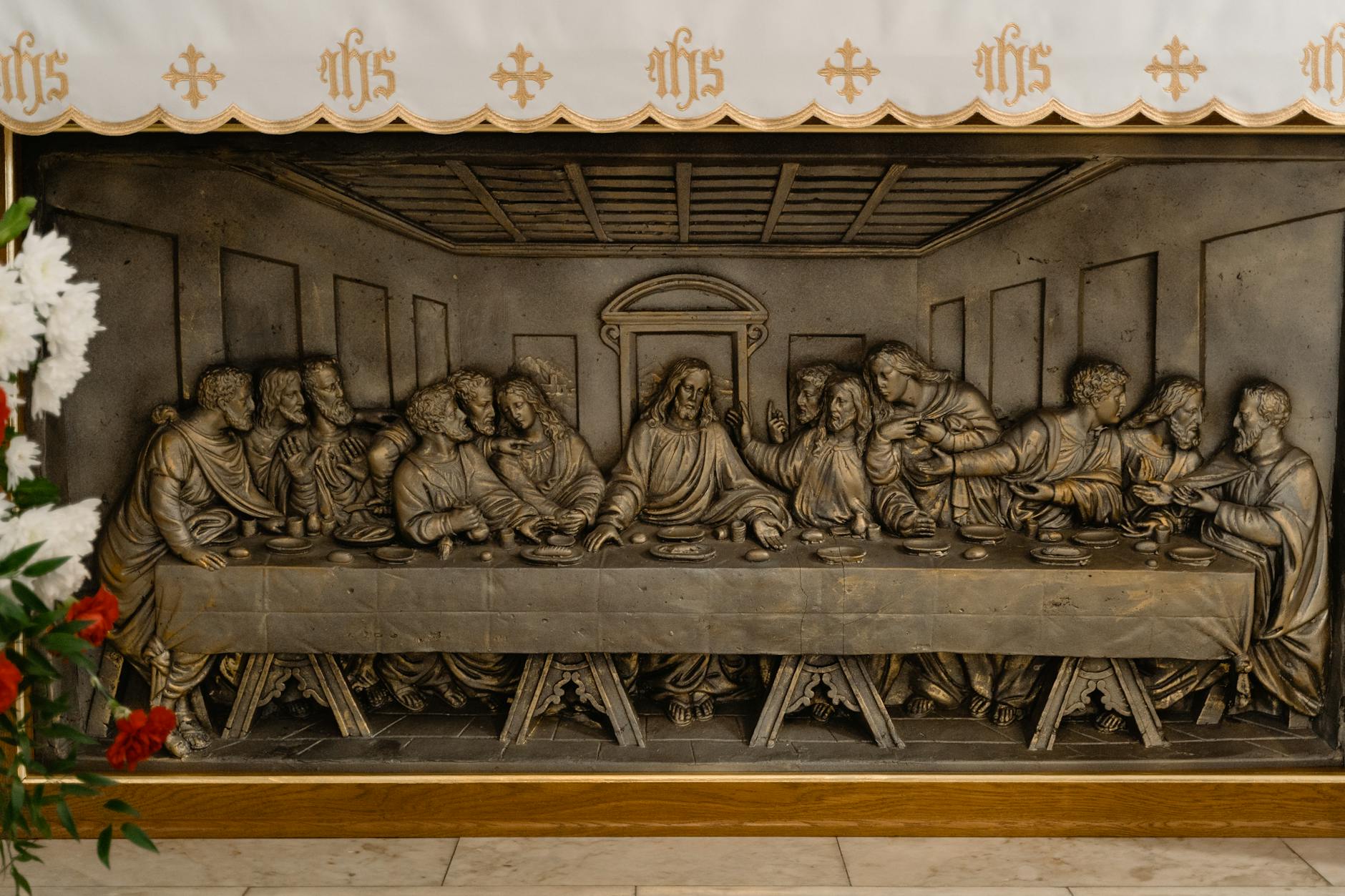
Our scene is now at the Last Supper, after the washing of the feet of the disciples. Judas had already left and Jesus began his series of discourses capped with his high priestly prayer after which they proceeded to Gethsemane for his betrayal and arrest.
Imagine the solemnity of the scene, of how Jesus had shown the Twelve the meaning of his being the good shepherd laying down his life by taking the bread and wine as his Body and Blood given to everyone. All these will have its fullness on Good Friday at the Cross while it would take some time after Easter and Pentecost when the disciples will finally grasp and understand its meanings.
We are not just going back to a past event, to what Jesus had done. In declaring himself as the true vine, Jesus reveals to us himself truly God and Risen from the dead, telling us how we can share in the joy and mystery of his Resurrection. And that is by remaining in Jesus first above all, “Remain in me, as I remain in you. Just as a branch cannot bear fruit on its own unless it remains on the vine, so neither can you unless you remain in me.”
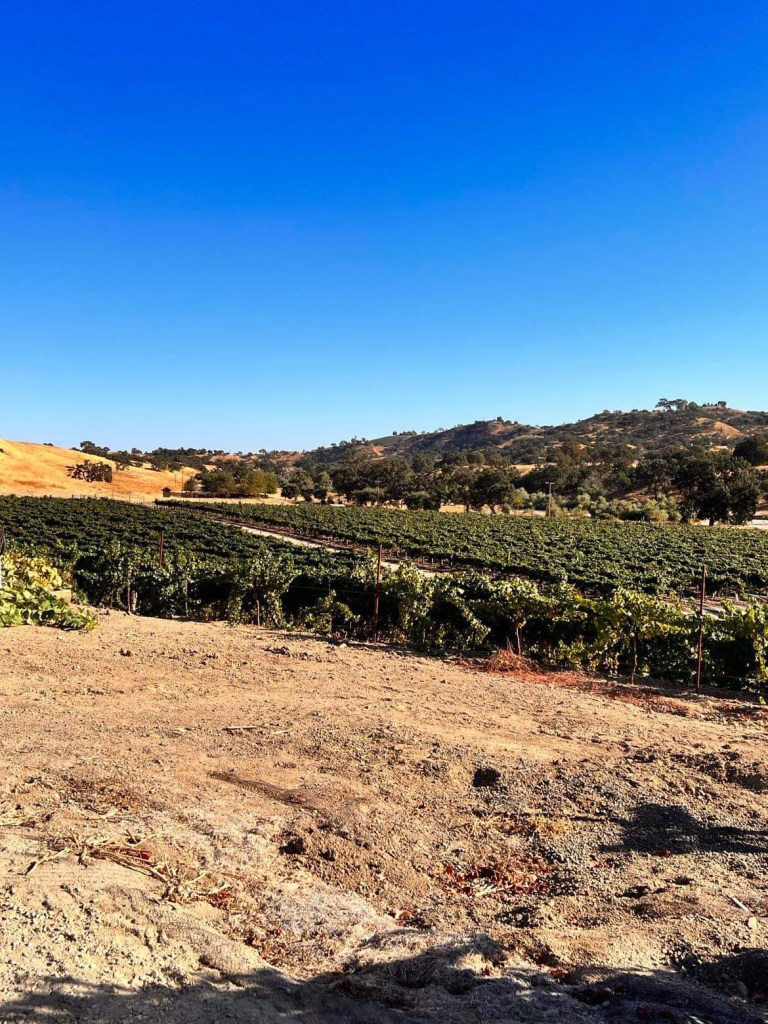
Photo by Dra. Carol Reyes-Santos, MD at Napa Valley, California, 2023.
See how in eight verses, Jesus used the word “remain” eight times because it is not enough Jesus is the true vine in whom we are blessed and become fruitful; we must remain in him too.
There is no doubt of Jesus remaining in us which is what his being a true vine is all about; unlike Israel in the Old Testament that produced wild grapes, Jesus can no longer be uprooted because he is God himself who had become one in us. But, are we one in him and with him?
To remain is more than physical like to stay. A branch remaining, staying intact with the vine but had turned yellow and dried up is clearly not one with the vine. We can be inside the church but be detached with everyone and the celebration. We may be staying or residing in the same address and home but our heart and very self may be so far away from our siblings or parents, or from your wife or husband.
Remaining implies something more than physical presence. To remain is to have a relationship, a bonding that is deep and intimate. To remain is to be of one heart as GMA7 claims to be a kapuso which is more important than being a kapamilya or a kapatid. There is no sense of being a family (kapamilya) when there is no love in the family or at the other hand, a sibling (kapatid) is nothing if the brother or sister is your enemy. We remain with God and everyone when our hearts are attuned or inclined to God and with others in love which is the fruit of the vine, Jesus Christ.
We can only bear much fruit, be more loving, if we remain in Jesus Christ. It is an imperative, therefore in this life that we remain in Christ for without him, separated him, we can do nothing. Fruit and love are always together as shown in the institution narrative and on Good Friday.
Being fruitful is more than being successful that is often seen and measured in material things. Being fruitful, being more loving is spiritual in nature, can never be measured with what we have but what have we given. Most of all, being fruitful is depending, relying more in Jesus Christ than in one’s self. That is why remaining in Christ is a prerequisite to be fruitful.
We remain in Jesus in prayer when he said, “If you remain in me and my words remain in you, ask for whatever you want and it will be done for you” (Jn. 15:7). But, prayer here as in most parts of the gospel does not mean asking God for anything; to remain in Jesus in prayer is to ask for God himself. It is only in having God we can truly love and experience joy and peace within despite the many trials and pains we go through in life.
In the first reading we have heard how Paul, still known as Saul arrived in Jerusalem and “tried to join the disciples, but they were all afraid of him, not believing that he was a disciple” (Acts 9:26). It must have been so difficult for Saul as well as for the early Christians too to welcome him! Saul must have a hard time convincing them he had really changed, that he had been converted in Christ while he must also understand the feelings of the Christians whom he persecuted before.
Photo by Dra. Carol Reyes-Santos,MD, at Napa Valley, California, 2023.
Let us keep in mind too that Saul’s conversion did not necessarily mean an end of their persecution; in fact, persecutions would turn more fierce later but it was during that time when the church grew so fast and wide too! That was because they remained in Christ who caused their efforts to bear much fruits no one expected.
Look back into our lives and see how when we remained in Christ and problems never stopped but that is when we are more fruitful, more fulfilled in life. Like our responsorial psalm this Sunday, “we praise the Lord in the midst of the assembly” to thank God from our hearts for all the blessings he bestows us like inner growth and maturity, feeling fruitful not just successful. Indeed, as the beloved disciple rightly noted in our second reading today, “God is greater than our hearts and knows everything” (1 Jn. 3:20).
This Sunday, Jesus is telling us “I am the true vine” to show us how God’s life is now in us through Christ and how our life is in God still through Christ. Let us remain in Jesus as he continues to reveal to us who he really is, our Lord and God, so we can share in the many joys and mysteries of his Resurrection. Let us pray:
Lord Jesus Christ,
let me remain in You;
let me stay in You
when things are so difficult
and let me still remain in You
when life is so beautiful;
let me be near  and close
to You as You are in me,
speaking Your words,
doing Your will;
in my remaining in You,
may I be fruitful by bringing
others closer to You so that
in the end, we all remain
one in You.
Amen.
The Lord Is My Chef Easter Recipe by Fr. Nicanor F. Lalog II
Friday in the Fourth Week of Easter, 26 April 2024
Acts 13:26-33     ><]]]]’> + ><]]]]]’> + ><]]]]’>     John 14:1-6
Photo by author, Anvaya Cove, 15 April 2024.
When Paul came to Antioch in Pisidia, he said in the synagogue: “My brothers… The inhabitants of Jerusalem and their leaders failed to recognize him, and by condemning him they fulfilled the oracles of the prophets that are read sabbath after sabbath.
Acts 13:26, 27
Failure.
One of life's many mysteries,
next to pain and suffering
that has baffled us ever since.
Sometimes avoidable,
sometimes inevitable
but surely happens
most of the time.
Like the Apostles
at the Last Supper,
I fear failures, Lord Jesus;
as much as possible,
I avoid or at least
minimize failures
to maximize success
and victories.
But, dear Jesus,
it is not enough to avoid
and minimize failures;
You have taught me so many times
that like You, I have to embrace
even befriend failure
which is part of our lives.
That is why You gifted us
with faith:
Jesus said to his disciples: “Do not let your hearts be troubled. You have faith in God; have faith also in me. In my Father’s house there are many dwelling places… I am the way and the truth and the life. No one comes to the Father except through me.”
John 14:1-2, 6
More than a virtue
and a gift from Above,
faith is a relationship
with You
and in You,
dear Jesus;
it is in entering
into a personal
relationship with You
in faith,
through faith
that I can embrace
and befriend failure
so that it does not matter
anymore how I got lost
but how I have
remained in You my Way,
a Person and a revelation
of the Father's love,
not just a concept
in philosophy or technology
like the AI pretending
to lead me;
deepen my faith in You,
Jesus so that every communication
in You is true because it is a giving
of my self in love
like You at the Cross;
lastly,
let me grow in faith in You,
dearest Jesus so that
despite the many failures
that may come to me,
everything leads to eternity
because You alone is
life.
Amen.
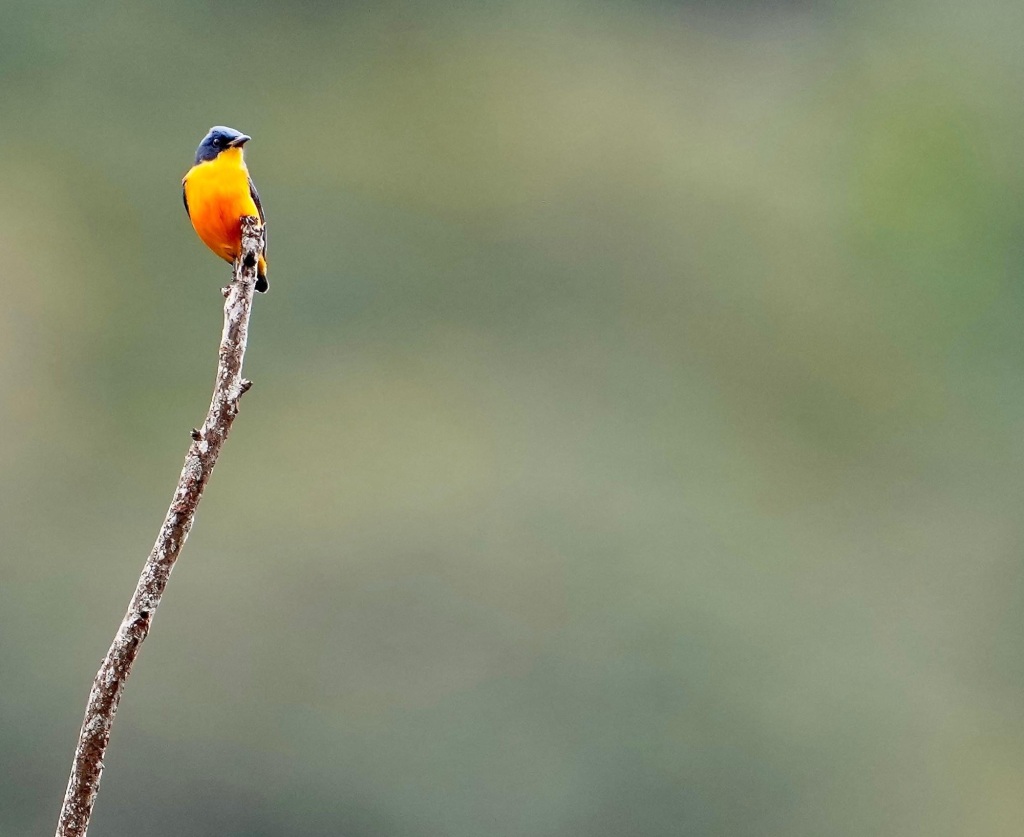
Photo by Dra. Mylene A. Santos, MD, an orange-bellied flowerpecker (Dicaeum trigonostigma) somewhere in the Visayas, December 2023.
The Lord Is My Chef Easter Recipe for the Soul by Fr. Nicanor F. Lalog II
Monday in the Fourth Week of Easter, 22 April 2024
Acts 11:1-18     ><))))*> + ><))))*> + ><))))*>     John 10:1-10
Photo by author in Silang, Cavite, September 2020.
Lord Jesus Christ,
as we go back to school and to work
this Monday, I pray
that we "object" less
to one another,
that we hold our "objections"
to ourselves first until
we have found the merits
of an endeavor or proposal
and most especially,
until we have found Your Holy Will.
The Apostles and the brothers who were in Judea heard that the Gentiles too had accepted the word of God. So when Peter went up to Jerusalem the circumcised believers confronted him, saying, “You entered the house of uncircumcised people and ate with them.” Peter began and explained it to them step by step… When they heard this, they stopped objecting and glorified God, saying, “God has then granted life-giving repentance to the Gentiles too.” (Acts 11:1-4, 18)
Teach us, dear Jesus,
to widen our perspectives
and to always be alert for
the movements of the Holy Spirit
so that we do not waste
time and energies with our
endless "objections"
that often paralyze
missions and operations
and worst of all, destroy
people.
How lovely is Your claim,
"I am the gate for the sheep"
(John 10:7) for we all belong
to You alone; when we object
a lot, we close the gate,
we hinder the flow of people
to the gate, and most of all,
we steal Your sheep!
Do not let our many and endless
objections claimed as for the
greater good but totally empty of You
hinder our flock in finding You
"so that they might have life
and have it more abundantly"
(John 10:10).
Amen.
Photo by author in Silang, Cavite, September 2020.
The Lord Is My Chef Easter Recipe for the Soul by Fr. Nicanor F. Lalog II
Fourth Sunday in the Easter Season, Cycle B, 21 April 2024
Acts 4:8-12 ><}}}}*> 1 John 3:1-2 ><}}}}*> John 10:1-10
Photo by author, dusk at Anvaya Cove in Bataan, 15 April 2024.
My kinakapatid is turning 60 this week with a dinner to be prepared by an Italian chef. His sister texted me for my main course and I chose lamb chops. And immediately she replied, “Pareho tayo. Mary’s little pet… the one who takes away the sins of the world.” Her wit floored me that I had to agree with a text, “Right. The most biblical and holiest food.”
Sorry for some little bragging as we celebrate this fourth Sunday in Easter as “Good Shepherd Sunday”…
We Filipinos have a hard time getting the “feel” of the shepherd because we have never had that image in our culture. Hence, it is a most welcomed development that there is now a growing popularity in tending sheep in the country while the Filipino palate had finally discovered a taste for lamb.
Come to think of this: the sheep exists only for two reasons, for food and clothing. They are meant to be slaughtered unlike dogs or cats or birds kept as pets. Another notable thing with sheep is the fact it is the only land animal that go against the flow when crossing a river like the salmon!
Photo by Dra. Mylene A. Santos, MD, at Katmon Nature Sanctuary & Beach Resort in Infanta, Quezon, 03 April 2024.
I love those characteristics of the sheep, for slaughtering which is almost like offering and always going against the tide. Exactly just like our Lord Jesus Christ who identified Himself as the good shepherd.
Jesus said: “I am the good shepherd. A good shepherd lays down his life for the sheep… This is why the Father loves me, because I lay down my life in order to take it up again. No one takes it from me, but I lay it down on my own. I have power to lay it down, and power to raise it up again. This command I have received from my Father (John 10:11, 17-18).
First we notice here His use of the “I AM” which for the Jews refers to God when He told Moses “I AM WHO AM.” Clearly, Jesus was declaring to the people at that time that He is the Son of God, the awaited Messiah or Christ.
This scene was shortly before the feast of the dedication of the Jews after Jesus had healed a man born blind, a miracle never heard of at that time. It was a big issue then as authorities refused to accept that Jesus did indeed healed the man born blind.
Secondly, Jesus mentioned four times in just three verses the act of “laying down his life for the sheep” (vv. 11, 17, and 18). It sounded so good to hear how Jesus loves us so much that He would lay down His life for us his sheep; but, those were not just mere words Jesus expressed but a reality that happened at the Cross on Good Friday that He actually explained after this discourse at their Last Supper!
Keep in mind that we are now going back to the earlier discourses and teachings of Jesus that only became clear to the disciples including us today after Easter. We shall be having a lot of these “flashbacks” to understand and love Jesus more and His teachings.
According to Pope Benedict XVI in his first book of the Jesus of Nazareth series, “The Cross is at the center of the shepherd discourse” (page 280). When Jesus said “This is my Body… This is my Blood”, He meant really Himself being given for us; Jesus did not merely give something for us but His very self as seen on the Cross on Good Friday.
That is how Jesus gives life – by giving up His life for us so that when He arose, we then share in His being a good shepherd through our little dying to ourselves because of love, giving life to those around us.
As the good shepherd, Jesus was the first to enter death, to be slaughtered but this time minus the violence and gore of the Cross that was the worst punishment of all time when He said “I lay down my life in order to take it up again”. No one takes it from me, but I lay it down on my own.”
Yes, there was victimhood but more than that was His being an offering never forced nor imposed by anyone or by circumstances. Jesus did it all for love!
Though He was handed over (paradidomi) and betrayed by Judas, Jesus was totally free, actively passive went to his Passion and Death because He was very certain of His Resurrection.
We experience the same thing many times in life when we have to make great sacrifices like when we have to allow a loved one to die after a long illness. Death is a grace and a blessing when freely given too by those around the dying, freeing the dying person of any guilt when he/she finally goes.
The same thing is true when friends and lovers separate either because they have found other loves to pursue or worst, have fallen out of love with us despite all our love for them. It is the most unkindest cut of all breakups and separations, excruciatingly painful as we blindly give up our relationships ironically for love. More than the persons and circumstances involved, we freely choose to let go – magparaya in Filipino – because deep in our wounded and hollowed heart is the hope they may grow in their new love.
Here we are like Jesus the Good Shepherd because even in the death of our relationships is still found our love. Like Jesus Christ, we do not simply give something but our very selves. The Jesuit theologian Karl Rahner beautifully expressed this when he described Jesus is both “the Gift and the Giver.”
Photo by Dra. Mylene A. Santos, MD of the sheep’s wool, 03 April 2024.
Love is better shown than said. Love cannot be defined but only be described for it is so wide and vast in its nature and scope. Love simply shows itself. That is why when we speak of love, we use comparisons and analogies and yet, they are not enough. How much more when we speak of the love of God?!
This Sunday, Jesus spoke of His love like every human being using the language of parable and allegories. But truly Divine, we find so much more when He claimed “I AM the good shepherd.” It is His total person and self, His being both the Gift and the Giver.
The good news is, because of His giving of self, we too have become like Him able to give ourselves wholly in love. Like Peter in the first reading, we experienced great powers within us not innately ours but God working in us, enabling us to empower others by healing them not literally but figuratively speaking.
When Jesus declared “I AM the good shepherd”, He reminds us of being the children of God, His indwelling, our being an “I AM” of God Himself. Like Him, we are good shepherds able to love in Christ to the point of being foolish as St. Paul experienced.
Like the sheep, let us continue to forge on with life’s many difficulties, even if many times we have to go against the flow of the world that is always selfish and misleading. Let us pray:
Dearest Jesus,
help me to give more of myself
not just of something from me;
help me to lay down my life
for my friends even if it means
not just losing myself but
losing them in order to gain You;
help me to remain in You,
my Good Shepherd,
to never go astray
because life and love
are found only in You,
the Gift and Giver.
Amen.
Have a blessed week ahead!
The Lord Is My Chef Sunday Music by Fr. Nicanor F. Lalog II, 14 April 2024
Photo by author, Sacred Heart Novitiate, Novaliches, QC, 20 March 2024.
We go punk this Sunday with the 1984 hit Ghost in You by the British band Psychedelic Furs more known to our generation with the song Pretty in Pink that was eventually made into a movie though not necessarily an interpretation of the music itself.
Ghost in You was written by the Psychedelic Furs’ lead vocalist Richard Butler, their second single from their fourth studio album Mirror Moves released in 1984. It is another poignant love song about someone most probably gone yet still so loved. The music and lyrics are very mysterious that we feel it perfectly captures our reflection this third Sunday Easter on the meaning of Christ’s Resurrection which is getting real as opposed with how young people today use the word “ghost” and “ghosting” which is to leave behind or drop like a hot potato. Our Filipino expression say it so well: to be ghosted is “iwanan sa ere” or to be left hanging.
In our gospel this Sunday, Luke tells us how the disciple thought Jesus was a ghost when He appeared to them anew after Easter; Jesus read their minds and clarified He was not a ghost but truly alive with flesh and bones.
The Filipino expression says it all completely, iniwan sa ere which is worst than the English expression “dropped like a hot potato”. To be ghosted is to be betrayed, to be taken for granted, to be discarded like a thing. It is utter lack of respect to another person. Worst, it is lack of life full of pessimism and indifference to life itself.
In Ghost in You, Butler tells us how he seemed to have been ghosted by his beloved for reasons not so clear. And we go with him, in his pains and deep longing to be loved in return by his beloved.
A man in my shoes runs a light And all the papers lied tonight But falling over you Is the news of the day Angels fall like rain And love is all of heaven away Inside you the time moves
And she don’t fade The ghost in you She don’t fade Inside you the time moves And she don’t fade
Notice how the lover declares his deep love that is so pure, “all of heaven away” that remains within him through time like a ghost “And she don’t fade/ The ghost in you/ She don’t fade”.
About ten years ago, we used to pass by a billboard somewhere in the Banaue-C3 area in Quezon City that says “True love is like ghosts, which everybody talks about and only a few have seen.” It is quote from French moralist Francoise de la Rochefoucauld (163-1680).
Very true!
Like our reflection this Sunday, Easter calls us to be real, not like ghosts. The Psychedelic Furs’ Ghost in You is great music because we all go through it some times even many times. Easter tells us to get real and move on with life.
Jesus Christ is not a ghost. Had never and would never ever ghost us because He is faithful, truly alive and truly present with us especially in our darkest and emptiest moments in life. Many times, we do not see nor recognize Him because we are so focused at how we were ghosted especially by loved ones.
Here’s one of our favorite music in the 1980’s worth listening to today to see how far we have gone real, especially in our love. Or, have we remained ghosted?
The Lord Is My Chef Easter Recipe for the Soul by Fr. Nicanor F. Lalog II
Thursday in the Second Week of Easter, 11 April 2024
Acts 5:27-33     ><))))*> + <*(((((><     John 3:31-36
Photo by author, Bolinao, Pangasinan, April 2022.
Once again,
O Lord,
Your words
are very amusing today:
"For the one whom God sent
speaks the words of God.
He does not ration his gift
of the Spirit" (John 3:34).
It sounds so funny
yet so true, dear Jesus!
We not only ration the
Holy Spirit but we also
ration every good gift
You give us as if it would
run out, as if You would
stop blessing us,
as if You are not God.
Forgive us, Lord,
when we ration
especially Your love
to others, when we
do not realize that love
and life and every blessing
You give are meant to be
given and shared fully
with others.
“We gave you strict orders did we not, to stop teaching in that name. Yet you have filled Jerusalem with your teaching and want to bring this man’s blood upon us.”
Acts 5:28
Dearest Jesus,
fill us with courage
like Your Apostles
after Pentecost that
we too may give all
to fill the world
with Your Good News
of salvation
in You,
with You,
and through You!
Amen.
The Lord Is My Chef Easter Recipe for the Soul by Fr. Nicanor F. Lalog II
Wednesday in the Second Week of Easter, 10 April 2024
Acts 5:17-26    ><}}}}*> + ><}}}}*> + ><}}}}*>     John 3:16-21
Photo by author, Sacred Heart Novitiate, Novaliches, QC, 20 March 2024.
When the captain of the temple guard and the chief priests heard this report, they were at a loss about them, as to what this would come to.
Acts 5:24
Your words, O Lord,
from the first reading are
very amusing:
after discovering the jail
securely locked
with guards stationed
outside but the apostles
nowhere,
they were the ones
who felt at a "loss";
they who have imprisoned
the Apostles
were the ones
LOST
when they were supposed
to control the situation.
How ironic
so often in life
when we feel to have
been more in control of
everything even people,
when we feel we lord
over everyone,
that is when we feel
more empty,
and more
at a loss.
And this is the verdict, that the light came into the world, but people preferred darkness to light, because their works were evil.
John 3:19
Photo by author, Jesuit Cemetery at the Sacred Heart Novitiate.
Forgive us,
Lord Jesus
in choosing darkness
of sin,
darkness of pride,
darkness of bitterness
and of unforgiving
that is why many times
we are at a loss
in life especially
when we profess
to believe in You,
when we claim to be
Your disciples;
let us go toward
Your light of truth
and justice,
Your light of loving
service,
Your light of mercy
and forgiveness
so that in our very selves,
people may truly experience
"God so loved the world."
Amen.
Lawiswis ng Salita ni P. Nicanor F. Lalog II, Ika-09 ng Abril 2024
Caravaggio’s painting “The Incredulity of St. Thomas” (1602) from en.wikipedia.org.
Sa tuwing maririnig ko
ang kuwento kay Santo Tomas
Apostol ni Kristo,
ako'y nanlulumo dahil
batid ko hindi ayon
turing natin sa kanya
na "Doubting Thomas"
gayong tanging tag-uri
sa kanya ng Ebanghelista
ay "Didymus" o "Kambal";
nag-alinlangan nga si Tomas
sa balitang napakita si Jesus
na muling nabuhay
sa kanyang mga kasama
nguni't kailanma'y
di nabawasan
kanyang paniniwala
at pagtitiwala.
Malaking pagkakaiba
ng hindi maniwala
sa hindi makapaniwala
na isang pag-aalinlangan
bunsod ng kakaibang pakiramdam
tulad ng pagkamangha
o ng tuwang walang pagsidlan
sa isang karanasang napaka-inam
ngunit hindi maintindihan
balot ng hiwaga
at pagpapala
gaya nang mabalitaan
ni Tomas
paanong nakapasok sa
nakapinid na mga
pintuan
Panginoong Jesus
na muling nabuhay.
Katulad ng kanyang
mga kasamahan
nonng kinagabihan ng Linggo
ding iyon,
wala ding pagsidlan
tuwa at kagalakan
ni Santo Tomas
nang sa kanya inilarawan
ipinakitang mga kamay
ni Jesus
taglay pa rin
 mga sugat natamo
 sa pagpapako sa Krus
nagpapatunay
na Siya nga
 ang Panginoong
nagpakasakit at namatay noon,
nabuhay muli ngayon!
Hindi ba
ganyan din tayo
sa gitna ng ating mga
pag-aalinlangan
bagama't damang dama
natin ang katotohanan
ng mga pagpapala at biyaya
hindi tayo makapaniwala
sa kadiliman ating natagpuan
liwanag ni Kristo habang sa
kawalan naroon Kanyang
kaganapan at kapunuan?
Sandigang ating pinananaligan
dasal na nausal ni Tomas na
banal pagkakita kay Jesus
na muling nabuhay,
"Panginoon ko
at Diyos ko!"
Huwag tayong matakot
kung tayo ay
mag-alinlangan
at kung minsa'y
hindi makapaniwala
sa mga gawa ng Diyos
na sadyang kahanga-hanga;
sa mundong ito
na ang pinanghahawakang
kasabihan ay
"to see is to believe",
ang kabaligtaran nito
ang siyang katotohanang
ating mapapanaligan,
"believe that you may see"
dahil  sa dilim at
kawalan parati dumarating
ang Panginoong Jesus natin!