The heart of the disciple, the heart of discipleship

The Lord Is My Chef Sunday Recipe for the Soul by Fr. Nicanor F. Lalog II
Eighth Sunday in Ordinary Time, Cycle C, 02 March 2025
Sirach 27:4-7 ><}}}}*> 1 Corinthians 15:54-58 ><}}}}*> Luke 6:39-45
Photo by Denniz Futalan on Pexels.com

The last time we have celebrated the eighth Sunday in Ordinary Time Cycle C was in 2001 when just like this year, the Season of Lent started late in March. In fact, the other last two Sundays of sixth and eighth in Cycle C were last celebrated in 2010 and 2007, respectively.

It is worth noting this because as Jesus delivered his Sermon on the Plain, we find that contrary to claims by many in this modern time, the teachings of Christ are actually taken directly from life as he reveals to us the truth in our hearts. Two Sundays ago, Jesus taught us the paradoxical happiness of our lives, of being poor, hungry, weeping, and maligned than rich, filled, laughing and well-spoken of; last Sunday, he taught us of the need to love truly that is rooted in God by loving without measure, loving even our enemies.

This Sunday, Jesus tells us something we often debate about as it usually puts us into a bind even a quandary on what to say and do.

Jesus told his disciples a parable, “Can a blind person guide a blind person? Will not both fall into a pit? Why do you notice the splinter in your brother’s eye, but do not perceive the wooden beam in your own eye? How can you say to your brother, ‘Brother, let me remove that splinter in your eye,’ when you do not even notice the wooden beam in your own eye? You hypocrite! Remove the wooden beam from your eye first; then you will see clearly to remove the splinter in your brother’s eye” (Luke 6:39, 41-42).

Photo by author, Hidden Valley Springs Resort, Calauan, Laguna, 20 February 2025.

Very often in many instances, most of us choose to be quiet than speak out against evil and other irregularities among us and in our society because of this teaching of the Lord. Many are afraid to notice the splinter in the brother’s eye lest they too might have a wooden beam blocking their views of themselves.

And that is why, evil persists everywhere that eventually, many of us become silent partners in the many sins happening around us which is very far from the demands of Jesus for us to choose what is right and good, to always make a stand for him even on the Cross.

See the flow of the Sermon on the Plain, of how Jesus is first of all never condemning nor judgmental of anyone. We have reflected his four “woes” were actually invitations for the rich et alii to change their ways in life, to think more of things that do not pass like wealth and other material things.

Secondly, last Sunday, Jesus directed our intentions into our hearts, to probe our hearts and find his grace of supernatural or divine love poured in there so that we can love selflessly without measure like him.

This Sunday, Jesus still directs us into our hearts, to examine whether we are truly his disciple or a hypocrite as someone who says something yet does the opposite. It is not opposite his exhortation last week for us to be merciful like God our Father rather a challenge to examine what we practice, our Christian praxis.

“A good tree does not bear rotten fruit, nor does a rotten tree bear a good fruit. For every tree is known by its own fruit. For people do not pick figs from thornbushes, nor do they gather grapes from brambles. A good person out of the store of goodness in his heart produces good, but an evil person out of a store of evil produces evil; for from the fullness of the heart the mouth speaks” (Luke 6:43-45).

Photo by Mr. Lorenzo Atienza, leftmost section of the stained glass at the National Shrine of Our lady of Fatima in Valenzuela City, 25 February 2025.

It is clearly a lesson in holiness, in integrity of every disciple! Do we walk our talk? The most basic norm of morality is that what we know in our mind and what we feel in our heart is what we say and therefore what we do.

Where are we now? Everybody is speaking about corruption while the devils celebrate everywhere as we are all entangled in all forms of corruption not only in the streets and government offices but even in our homes, in schools and offices and yes, right inside the church in many parishes.

Now we come full circle with Christ’s opening to his parable, Can a blind person guide a blind person? And this is what is now happening in the world, in our lives, in our country and in our parishes. Nobody would want to speak because nobody would want to examine one’s heart and follow the path of Jesus.

It is in our deeds that one is recognized as a true disciple. Let us not forget that. And let us not be afraid to examine constantly the value of our many ways and practices.

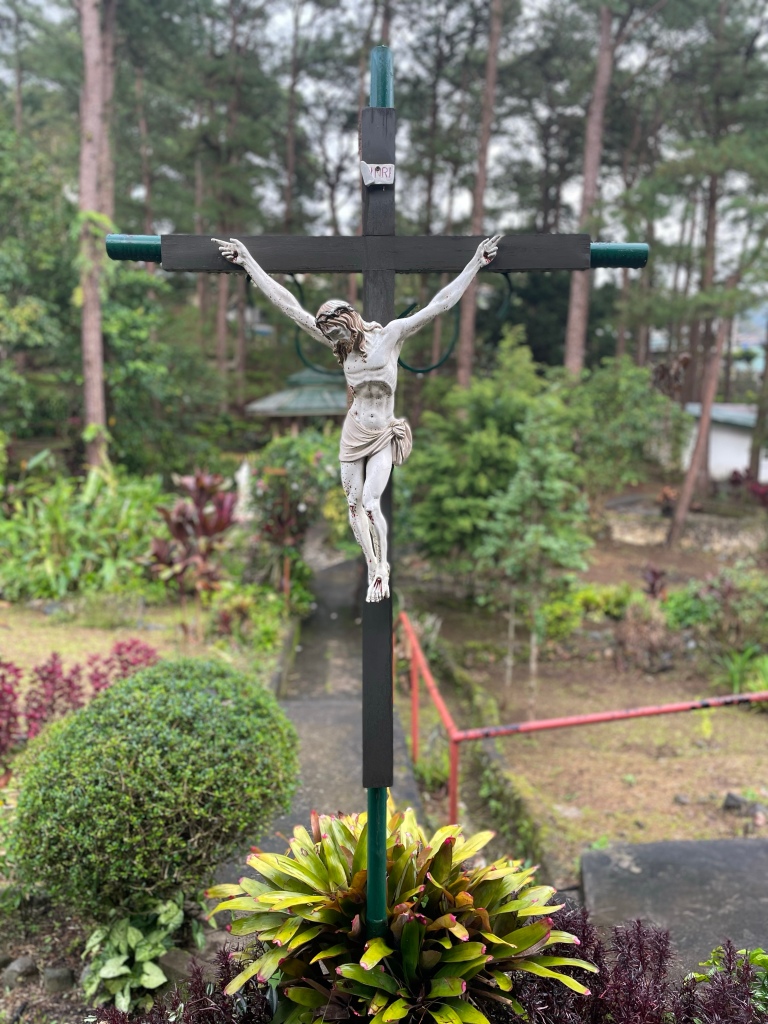
Photo by author, St. Paul Spirtuality Center, Pico, La Trinidad, Benguet, 05 January 2025.

One of the famous bishops and saint both recognized by the Eastern and Western Churches is St. John Chrysostom who served as Archbishop of Constantinople until the early 400’s. He is called the “golden mouthed” because of his gift in eloquence most true in his witnessing Christ, always meaning what he said like in this homily that sounds so 2025:

The Church is in an extremely critical state, and you think that all is going well. The fact is that we are plunged into countless sins, and we do not even know it!

You wonder why. We hav e churches, money, and everything else. There are places for assembly, people come there everyday; surely this is not nothing?

But it is not thus that we judge the state of the Church. Then how?, you ask.

Whether we lead a truly Christian life. Whether everyday we make ourselves spiritually more rich, bearing fruit, whether great or small; if we are not content simply with flfilling the law and expediting our religious duties.

Who is a better person, after having frequented the church all month?

This is what we must look for! After all, even what appears to be a good action is only a bad action, when one does not follow it up… If we bring nothing to fruition through it, it would be better to stay home (from Days of the Lord, vol. 6, page 62).

Photo by Mr. Lorenzo Atienza, 25 February 2025.

The kind of life we lead is the final test of our discipleship, the proof of what is in our hearts. St. Francis of Assisi used to tell his followers whenever they would preach to use only their mouth if necessary. Our actions speak louder than our words.

This is the biggest problem in the Church today: our lack of credibility as bishops and priests when our lives are far from what we say and teach.

God shared with us his power of the words. In the Bible, we find how his words and his being are always one since the story of creation into the coming of Jesus Christ who could heal with just mere words being the word who became flesh.

This is the whole point of Ben Sirach in our first reading this Sunday, reminding us that inasmuch as the potter knows the quality of his work after it has passed through fire, the same thing is most true with our words. We have to harness and master our speech, our words so that we walk what we talk.

We master our power of the words in our prayer life as St. Paul assured us in today’s second reading how in the Lord our labor is not in vain (1 Cor. 15:58). Let us pray to the Holy Spirit especially this Sunday as we approach the Season of Lent with Ash Wednesday. Let us keep our zeal for Christ not nonly for his words and teachings but most especially in his life and witnessing. Amen. See you at Ash Wednesday.

Campus Ministry, Our Lady of Fatima University, Valenzuela City.

Jesus takin’ us to the street

The Lord Is My Chef Daily Recipe for the Soul by Fr. Nicanor F. Lalog II
Friday, Sixth Week in Ordinary Time, Year I, 21 February 2025
Genesis 11:1-9 <'[[[[>< + ><]]]]'> Mark 8:34-9:1
Photo by Denniz Futalan on Pexels.com
What a blessed Friday,
Lord Jesus!
You are still with us,
about to cross the week
into another new set of
seven days but,
here you are again
reminding us
of our journey
that's not to a party
and all fun
but to the Cross:

Jesus summoned the crowd with his disciples and said to them, “Whoever wishes to come after me must deny himself, take up his cross, and follow me. For whoever wishes to save his life will lose it, but whoever loses his life for my sake and that of the Gospel will save it” (Mark 8:34-35).

As I prayed on this scene,
Jesus,
I could hear both the murmuring
and deafening silence
of people in the crowd
especially when you spoke
of denying, losing one's self
and that dreaded Roman
punishment, the cross!
But, yes, Jesus,
even deep down in me,
I felt at a loss...
OK na sana Lord ang lahat,
bakit may paglimot pa ng sarili
at pagpapasan ng krus?
Forgive me,
Jesus for being so used
to your words without really
appreciating them,
masticating them enough
to extract their meaning
and timeliness;
many times,
I have that attitude of the
the Tower of Babel
when all we want is to be on top,
to be in control
that is why you confused
them with many languages at that time
because we always forget
you speak only one language
in Jesus:
the language of love
by self-giving,
by self-sacrifice,
by being one in you in
the Holy Spirit.

Take us to the streets,
Jesus, to keep your words
your language
lived and spoken
especially among
the poor
and suffering.
Amen.
Photographer: Veejay Villafranca/Bloomberg via Getty Images


Jesus on the street

The Lord Is My Chef Daily Recipe for the Soul by Fr. Nicanor F. Lalog II
Thursday, Sixth Week in Ordinary Time, Year I, 20 February 2025
Genesis 9:1-13 <*{{{{>< + ><}}}}*> Mark 8:27-33
Photo by Cameron Casey on Pexels.com

Jesus and his disciples set out for the villages of Caesarea Philippi. Along the way he asked his disciples, “Who do people say that I am?” They said in reply, “John the Baptist, others Elijah, still others one of the prophets.” And he asked them, “But who do you say that I am?” Peter said to him in reply, “You are the Christ.” (Mark 8:27-29)

You are always on the move,
Lord Jesus:
you are always moving,
crossing the lake,
hiking in the mountains
and most often,
walking the streets.

What a lovely imagery
of you, Jesus,
always on the road
with me following you,
watching you,
observing you,
sometimes stopping
because of being tired
but you are always there
waiting for me.
And now,
what a lovely scene
of you back on the road again
but this time asking those closest
to you - including me! -
with that most personal question
of all: "But who do you say
that I am?"
Who are you for me, Jesus?
So many, actually.
I may not be as eloquent
like Peter, but no doubt about
who are you for me, Jesus:
my life,
my meaning,
my love,
my hopes,
my fullness.

But,
very often along this
road,
on these streets we walk
and cross,
dear Jesus
when that who are you for me
is shaken,
is tested,
even doubted
like Peter:
how could you allow
yourself and us your followers
suffer and cry,
and die?

He began to teach them that the Son of Man must suffer greatly and be rejected by the elders, the chief priests, and the scribes, and be killed, and rise after three days. He spoke this openly. Then Peter took him aside and began to rebuke him (Mark 8:31-32).

Let us think always
as God does, Jesus,
not as human beings do
seeking fame and prestige,
comfort and wealth,
self and ego;
let me walk closer with you
Jesus on the streets,
on whatever road
you take
upholding that covenant
of God with Noah to
uphold and respect
human life by
"accounting for human
life" (Genesis 9:5);
more than the colorful
rainbows of the skies,
may we always see in your
outstretched arms on the Cross
the true and new covenant
of God with us sealed in
your blood.
Amen.
Photo by author, St. Scholastica Spirituality Center, Baguio City, August 2023.

From our “ark” of life into God’s “house of mercy”

The Lord Is My Chef Daily Recipe for the Soul by Fr. Nicanor F. Lalog II
Wednesday, Sixth Week in Ordinary Time, Year I, 19 February 2025
Genesis 8:6-13, 20-22 <*0000>< + ><0000*> Mark 8:22-26
Photo by Pixabay on Pexels.com
I really wonder,
dear God,
how it felt to be inside
Noah's Ark for 40 days?
The feeling of restlessness,
of anxiety and uncertainty
of the future,
so unsure of what was to come
while at the same time
filled with hope
praying for the best.

How was the boat too?
How did it look like?
What was the smell inside,
the feeling inside that big ark,
the sounds from all the animals
and everything within and
outside?
We have been there many times,
Father, in that big ark called life;
we have passed through many floods,
have waited many times for the waters
to recede,
for the sun to shine,
for life to return to normal.

Through it all,
you never left us, Lord;
send us Noah
who would stand with
us inside the ark for
40 days and 40 nights,
stay afloat,
stay alive
wherever direction you bring us.
Help us, dear Father
to be patient even if we can't
see right away the distant shore
like that blind man healed
by Jesus at Bethsaida;
lead us, Father
in this ark of life
away from the idolatry of
modern world,
away from the trappings
of easy and comfortable life,
away from sin and evil
to be closer to your mercy,
to your "beth hesda" -
to your house of mercy.
Amen.
Photo by author, Cathedral of St. Catherine of Alexandria, Dumaguete City, November 2024.

In the beginning…

The Lord Is My Chef Daily Recipe for the Soul by Fr. Nicanor F. Lalog II
Monday, Memorial of St. Scholastica, Virgin, 10 February 2025
Genesis 1:1-19 ><))))*> + ><))))*> + ><))))*> Mark 6:53-56
Photo by author, sunset in Atok, Benguet, 27 December 2024.
Blessed are you,
God our loving Father
in giving us a taste of
the beginning everyday
especially on this first day
of work and of school
as your words in the first reading
remind of our daily
beginning in you!

In the beginning, when God created the heavens and the earth, the earth was a formless wasteland, and darkness covered the abyss, while a mighty wind swept over the waters. Then God said, “Let there be…” Thus evening came, and morning followed… (Genesis 1:1-3, 7).

In the beginning
there was nothing but
chaos just like in our lives
until you brought light,
order and life, God;
it is always light and order
that come first to set the
stage for life like in those first
two days; what is most lovely,
Father is when the third day came
and there began balance and
symmetry in your creation
like sea and earth,
day and night,
sun and moon
that relationships happened
and everything started to be good.
Photo by author, sunset in Atok, Benguet, 27 December 2024.
In the gospel today
as in our lives,
every day is a new beginning
with its many chaos:
sickness and diseases,
emptiness,
self-alienation,
rejection in all forms,
failures and disappointments
as well frustrations
that all remind us of how
everything was in the beginning;
but, with Jesus Christ's coming
and healing
we saw the light
and experienced healing
and order.

Everything becomes good
when seen in your light
and design, Lord Jesus;
when our relationships are
kept and maintained
especially at home like with
our siblings,
parents and family
as exemplified by the twins
St. Scholastica
and St. Benedict.

Make everything new again
and most of all good,
dear Jesus in our lives
like in the Genesis
as shown by St. Scholastica
who was able to do more
because she loved most.
Amen.
Painting “Altar of St. Scholastica” by Johann Baptist Wenzel Bergl (1765), ncregister.com

Being “caught” by Christ to catch for Christ

The Lord Is My Chef Sunday Recipe for the Soul by Fr. Nicanor F. Lalog II
Fifth Sunday in Ordinary Time, Cycle C, 09 February 2025
Isaiah 6:1-2, 3-8 ><}}}}*> 1 Corinthians 15:1-11 ><}}}}*> Luke 5:1-11
Photo by author, sunrise at the Lake of Galilee, the Holy Land, May 2017.

In my almost 27 years in the priesthood, I have always found kids asking the most difficult questions in life than adults. What makes their questions more difficult is that there are no easy answers that you have to use some imagery.

That is why it is always good to pray in advance the coming Sunday gospel like last Tuesday when a young girl asked me why God had allowed her to be given away by her biological mother for adoption.

After a pause of silence as I reflected today’s gospel, I told her that many times we are “thrown” by God – inihahagis, iniitsa – like in baseball or basketball not to be lost but to be caught in order to be cared and loved to score points and win this game called life. God knew so well her adoptive mother is an excellent “catcher” in life who “caught” her to give her a better life like now going to a good school, being dressed properly, never gone hungry. Hence, my reflection on this Sunday’s homily is focused on that magic word “to catch”:

For astonishment at the catch of fish they had made seized him and all those with him, and likewise James and John, the sons of Zebedee, who were partners of Simon. Jesus said to Simon, “Do not be afraid; from now on you will be catching men.” When they brought their boats to the shore, they left everything and followed him (Luke 5:9-11).

Mosaic in the Church of St. Peter in Capernaum from thework-fso.org.

The word “catch” is a very catchy one (pun intended), used in various ways that could mean positively or negatively like in catching a bus or a train and catching a ball. We catch a meaning while we also catch a glance. We do a lot of catching daily in our lives like catching up with lessons and chismis that eventually we catch a cold or catch pneumonia after a kiss like in the song.

To catch means to intercept and hold, to have something or someone like when lovers are told of having a good “catch” with their girlfriend or boyfriend. That is why, it is always said that in catching, never drop what you have caught – take care, and cherish what you caught! It could be a prized catch after all.

Photo by Mr. Jim Marpa, 2019.

It is the same thing that Luke is telling us this Sunday, of how Jesus makes a marvelous catch not only with Peter and company but for all of us in the gospel.

Coming home from a night of fishing without any catch, Jesus saw Peter with his companions washing their net. They must have been very sad with nothing to bring home to their families and then came Jesus who was so keen with everyone’s feelings and situation. Jesus surely noticed the sadness in Peter that He borrowed his boat to teach the crowd who have been following Him.

After teaching and dismissing the crowd, Jesus asked Peter to go fishing again. Imagine Peter twice allowing Jesus to “catch” him: first, in borrowing his boat and second, in instructing him to “Put out into deep water and lower your nets for a catch.”

Imagine Peter so lugi (bankrupt) with Jesus borrowing his boat that could have been so worn out with holes to be His platform for teaching. Was it not insulting? Are we not like Peter sometimes? Or like his boat then borrowed by Jesus?

Good that Peter did not mind it at all but, when asked by Jesus to go out fishing again, we find a change in Peter already. Jesus had already caught Peter as he had caught the Lord’s words and teachings that he replied, “Master, we have worked hard all night and have caught nothing, but at your command I will lower the nets.”

Photo by author, Macapagal Blvd.’s dampa restaurant, 2018.

The miraculous catch of fish caught Peter and everybody by surprise. See how Peter knelt to Jesus in reaction to their great catch instead of helping his men pulled their nets.

Most of all, Peter addressed Jesus as “Lord” whereas earlier, he called Him “Master”. There was already a recognition of Jesus more than a Teacher and Master but the Son of God for how can one really explain the great catch that happened?

The greatest sign that Peter was totally caught by Jesus was his conversion, when he begged the Lord to depart from him for he was a sinful man. At that point, Peter was already all caught up by Jesus along with his brother Andrew and their companions, the brothers James and John

Many times in life Jesus catches us by surprise in the most ordinary instances of our lives like in our daily routines. But most surprising of all is when Jesus catches us in our lowest moments in life too like Peter, deep in sin or deep in trouble, even deep into debts and other darkness in life. There are times we set limits to our patience and perseverance that we are so tempted to give up and quit, saying “I’ve had enough!” or “I’m done with this!”

Don’t give up, don’t quit! Jesus is passing by. If you feel like being thrown out of the room or up in the air or even the sea, muster all your courage and trust, Jesus is around waiting to catch you as you fall. Nobody had really gone rock bottom in life without anything at all. At least, we are still alive and that’s because Jesus had caught us, always carrying us in our worst moments in life.

That is why we have to do a lot of catching up with Jesus too. Persevere in prayer. Every failure, every suffering and pain is an opportunity to grow, to succeed, to meet someone or something so surprising who could be right beside you in the Sunday Mass.

Photo by Mr. Jim Marpa, 2019.

The Sunday gospel reminds us to be like Peter and company to remain open for new things and new persons who come to our lives who may be Jesus Himself passing by.

Yes, we may feel being thrown sometimes in life but not to fall but to be caught by Jesus, the best catcher of all time.

Let us allow ourselves to be caught by Christ like Paul in the second reading and Isaiah in the first reading. Despite their flaws in themselves, especially Paul who admitted being “the least” of all apostles, both were caught in the most ordinary circumstances of their lives. And once caught, there was no turning back: Isaiah offered himself to God to be sent while Paul became the best fisher of men in the early Church.

Remember our prayer before the Holy Communion, “Lord, I am not worthy to receive you under my roof but only say the word and I shall be healed.”

Photo by author, bronze statue of Peter kneeling before Jesus after the miraculous catch of fish near the shore of Capernaum, 2017.

Every time we pray that, we admit we are caught up in Jesus, by Jesus. What a fitting confession just before we catch Jesus Body and Blood in the Holy Communion. And just like the gospel this Sunday, we find in every Mass, in every week of our lives, Jesus our Lord and Master is the most essential and prized catch we can always have.

We can go “fishing” all our lives but remain incomplete, unfulfilled and even lost without our best catch of all, Jesus who sees us too as His best catch ever. Amen. Have a blessed week ahead.

Praying for discipline (and for those with breast cancer)

The Lord Is My Chef Daily Recipe for the Soul by Fr. Nicanor F. Lalog II
Wednesday, Memorial of St. Agatha, Virgin & Martyr, 05 February 2025
Hebrews 12:4-7, 11-15 ><))))*> + ><))))*> + ><))))*> Mark 6:1-6
Photo by author, Sakura Farm, Atok, Benguet, 27 December 2024.
Today dear Lord,
I pray for more discipline
which is a frightening
and misunderstood word
and concept for many
these days.
There are some who think
discipline is suppression of freedom,
a kind of constriction not realizing
it is in discipline we truly become
free; for some, discipline is optional,
even seasonal when in reality,
we need discipline in our entire life;
lastly, people have difficulty with
discipline because they see it only
as a human activity, a human effort
forgetting that God has a large part
in our discipline.

Brothers and sisters: You have also forgotten the exhortation addressed to you as children: My son, do not disdain the discipline of the Lord or lose heart when reproved by him; for whom the Lord loves, he disciplines; he scourges every son he acknowledges. Endure your trials as “discipline”… At the time, all discipline seems a cause not for joy but for pain, yet later it brings the peaceful fruit of righteousness to those who are trained by it (Hebrews 12:5-7, 11).

“Jesus Unrolls Book In the Synagogue” painting by James Tissot (1886-1894), brooklynmuseum.org
How I admire your own
discipline, Lord Jesus:
your coming home to
Nazareth and most especially
your practice of sabbath
are clear indications of your
great discipline!
How lovely that the word
discipline is also from disciple,
a follower;
as your follower,
help me continue with my
self-discipline
to inspire and teach
others too of the importance
of discipline in life
and in discipleship.
Amen.
*We also pray today
for all with breast cancer
being the memorial of
their patroness, St. Agatha
whose breasts were cut off
as one of the tortures she
endured; but after having a
vision of St. Peter,
her breasts were restored
and completely healed
while in prison.

Standing with Jesus, standing like Jesus

The Lord Is My Chef Sunday Recipe for the Soul by Fr. Nicanor F. Lalog II
Third Sunday in Ordinary Time, Cycle C, 26 January 2025
Nehemiah 8:2-4, 5-6, 8-10 ><}}}*> 1 Corinthians 12:12-30 ><}}}*> Luke 1:1-4; 4:14-21

Doctors tell us that prolonged periods of sitting can lead to many health issues like increased risks of heart disease, diabetes, certain cancers, obesity as well as depression. They have been sounding the alarm for several decades with the rise of “couch potatoes” and now had worsened as we get tied to our seats due to continuous use of computers and other gadgets.

Along with this worsening scenario of our prolonged sitting is the growing “competition” among us these days – consciously or unconsciously – for our places of seat in jeepneys and buses or airplanes, in classrooms and offices, on dining tables, in meeting rooms and in churches. People are so concerned where to be seated not realizing that what really matters in life is where we stand than where we sit!

The verb “to stand” evokes firmness and stability not only in the physical sense but also emotionally and spiritually speaking. Very close to it is the word “stance” that indicates our “stand”, of where we “stand” with our beliefs and convictions regarding issues. Before the coming of social media where we often make our stand while seated, there were placards calling us to “make a stand”.

In this age when most people prefer to sit than to stand as well as kneel to pray, our Sunday readings today are very timely as they teem with the words and images of standing for God.

He came to Nazareth, where he had grown up, and went according to his custom into the synagogue on the sabbath day. He stood up to read and was handed a scroll of the prophet Isaiah. He unrolled the scroll and found the passage where it was written… (Luke 4:16-17).

“Jesus Unrolls Book In the Synagogue” painting by James Tissot (1886-1894), brooklynmuseum.org

We now dive into the Sunday Ordinary Time with Luke giving us a glimpse of how Jesus spent a typical sabbath day proclaiming the word of God by first “standing to read.”

It was not the first time Jesus stood to read as He always stood teaching and preaching to the people. Jesus was a man who literally stood for the Father, stood for what is true and good, stood for what is just and fair. Most of all, He stood for all of us that He died on the Cross.

This Sunday as He launched His public ministry in His hometown Nazareth in Galilee, Jesus made it clear that He is the “word who became flesh” as He stood to read the scripture, claiming what He proclaimed from the Prophet Isaiah:

“The Spirit of the Lord is upon me, because he has anointed me to bring glad tidings to the poor. He has sent me to proclaim liberty to captives and recovery of sight to the blind, to let the oppressed go free, and to proclaim a year acceptable to the Lord” (Luke 4:18-19).

Imagine present there. More than being spellbind, there must have been that feeling of fulfillment, of the true reality unfolding as Jesus clearly stood by the word of God because He is the word who became flesh.

Our Filipino word paninindigan evokes it so well like in Pinanindigan ni Jesus ang kanyang ipinahayag (Jesus stood by what He proclaimed). From its root tindig which is “to stand” in English, paninindigan is conviction. Jesus spoke with such conviction and authority that those in the synagogue were amazed with Him. Interestingly, our Filipino synonym for paninindigan is pangatawanan which is from the root katawan or “body” in English. Pangatawanan ang salita is to stand by one’s word, like Pinangatawanan ni Jesus ang Kanyang sinabi (Jesus stood by what He said).

See how our readings this Sunday are so interesting, so beautiful especially for us in the Philippines because the words of “standing” and “body” are related, capturing in our own language discipleship in Christ, our standing for Jesus and His gospel.

“Jesus Unrolls Book In the Synagogue” painting by James Tissot (1886-1894), brooklynmuseum.org

At the end of this scene in the synagogue, Luke told us how Jesus declared as He sat that His words were “fulfilled in your hearing” which amazed the people because Christ “walked the talk” even before this took place.

Anyone wishing to have any kind of fulfillment in life has to first make a stand for whatever he believes in. To walk the talk, one has to stand first. Nothing gets fulfilled by sitting. We have to make a stand for everything and everyone we care and love most.

Like Jesus, we can only bring glad tidings to the poor by standing by their side, standing with them to uplift them. In the same manner, liberty for captives and recovery of sight to the blind can only happen standing, by actually being present with them and never remotely from a distant office or setting where we are comfortably seated. The oppressed can only go free as we proclaim a jubilee like this 2025 when we stand for justice and truth instead of simply affixing our “like” to some posts “standing” for whatever causes.

Photo by author, ambo in our Chapel of the Angel of Peace, RISE Tower, Our Lady of Fatima University, Valenzuela City, 25 December 2024.

In the first reading we find the priest Ezra standing as he proclaimed the words of God from a book recovered after their exile from Jerusalem.

Ezra convinced the people so well in his proclamation of the scriptures that people cried and bowed their heads before finally prostrating themselves to God because they felt and experienced the Scriptures as so true.

The words “standing” and “stood” were repeated thrice to underscore not only the physical posture taken by Ezra and Nehemiah but most of all to indicate their emotional and spiritual bearings.

Going back to our gospel scene, see how before narrating to us Jesus in the synagogue, the Church had rightly chosen to include for this third Sunday the prologue of Luke where he laid down the reason for writing his gospel account – so that we “may realize the certainty of the teachings” about the Christ. In writing his prologue, Luke naturally sat but in mentioning that word “certainty”, he tells us a lot of standing he had to make in completing his two-volume work, the gospel and the Acts.

Here we find that like all the evangelists and saints for that matter, they spent much time standing than sitting, second only perhaps to kneeling or praying.

There is a beautiful prayer attributed to St. Teresa of Avila called “Christ has no body” which goes this way, “Christ has no body but yours, no hands, no feet on earth but yours.”

Can we make a stand for Jesus, stand with Jesus, and stand like Jesus to be His body as St. Paul explained to us in the second reading?

“Brothers and sisters: As a body is one though it has many parts, and all the parts of the body, though many, are one body, so also Christ… Now the body is not a single part, but many” (1 Corinthians 12:12, 14).

Photo by author, Chapel of Angel of Peace, RISE Tower, Our Lady of Fatima University, Valenzueal City, June 2024.

As we embark into this long journey of Ordinary Time with Luke as our guide every Sunday, may we do the work of Jesus by standing along with our fellow believers and disciples.

Together let us make that collective stand for truth and justice, for decency and reason in this time when people are so fragmented, held captive by so many thoughts and beliefs propagated from the arrogant chairs of entitlement by some lazy minds influencing the world remotely. Together we stand and experience life as it is in Jesus Christ, even at His Cross. Amen. Have a blessed week ahead as we close January 2025!