Lord My Chef Daily Recipe for the Soul by Fr. Nicanor F. Lalog II Friday, Memorial of the Presentation of the Blessed Virgin Mary, 21 November 2025 1 Maccabees 4:36-37, 52-59 <*{{{{>< + ><}}}}*> Luke 19:45-48
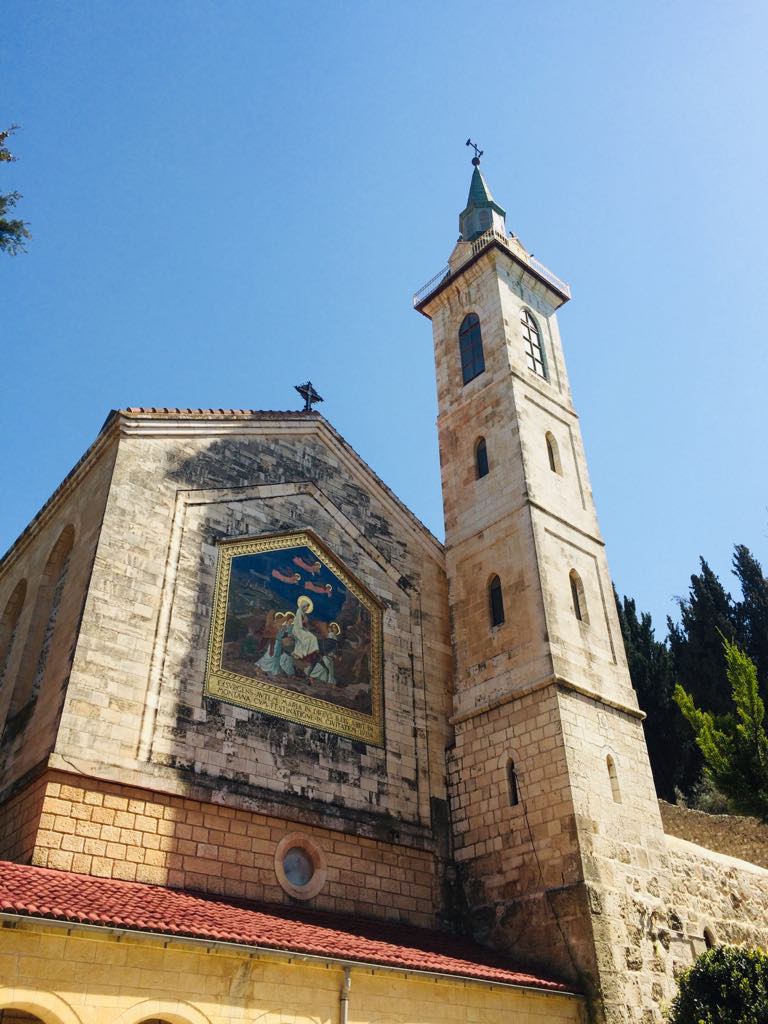
Photo by author, Mary’s home in Ephesus, 03 November 2025.
God our loving Father, today I praise and thank you again for the recent chance to travel and experience your majesty and beauty abroad and among other peoples of different culture; most of all, I am grateful to have been to the home of the Blessed Virgin Mary in Ephesus; until now, I am savoring, "masticating" the blessed experience.
Jesus entered the temple area and proceeded to drive out those who were selling things, saying to them, “It is written, My house shall be a house of prayer, but you have made it a den of thieves” (Luke 19:45-46).
As I recall that brief moment of stay inside the Ephesus home of Mary, I felt my whole being emptied - hollowed - and as I knelt and prayed without any distractions, no worries about pictures nor of time, slowly I felt being filled within by you, O God: from hollowedness to holiness or hallowed; that is why Jesus drove away the merchants out of temple: every temple, every place of worship including our very selves is a home and dwelling place of God; the chief priests, scribes and leader of the people felt under attack by Jesus because they were empty of God, filled of the world and its things; the people were spellbound on the other hand because they have realized that truly, we are the indwelling of God; therefore, let us cleanse ourselves always within not only of sin but also of so many things that distract us away from God to dwell in us like social media.
O Blessed Virgin Mary, from the very start you have been reserved by God from any stain of sin to be the Mother of the Christ but it was also fulfilled because of human cooperation: of your parents dedicating you to God and most of all, of your fiat to God. Pray for us, Mama Mary that we may cultivate a prayer life that shall make us a home to God; let us express our fiat to him daily by presenting ourselves to him like you. Amen.
Photo by author, back of Mary’s home in Ephesus, 03 November 2025.
Lord My Chef Daily Recipe for the Soul, 18 August 2025 Monday, Twentieth Week in Ordinary Time, Year I Judges 2:11-19 <*((((>< + ><))))*> Matthew 19:16-22
Photo by Mr. Vigie Ongleo, Virginia, USA, August 2021.
Your words today, O God our Father are so disheartening not only because after a week of joyful stories of Moses and Joshua and the Israelites finally nearing the Promised Land, we begin work and classes this Monday with the distaff side of Israel's history, of their low point of being repeatedly attacked and defeated by their enemies.
But more sad and disheartening is the fact that low point in their history was also their low point in their faith in you - it was all due to their repeated falling into sin of idolatry, of worshipping false gods instead of you alone.
Whenever the Lord raised up judges for them, he would be with the judge and save them from the power of their enemies as long as the judge lived; it was thus the Lord took pity on their distressful cries of affliction under their oppressors. But when the judge died, they would relapse and do worse than their ancestors, following other gods in service and worship, relinquishing none of their evil practices or stubborn conduct (Judges 2:18-19).
And that is the painful truth of the story, of the fact still true among us today: the problem, the trouble are all with us.
Yes, Lord, many times we are like your people during that time of the judges: you keep on saving us from troubles of our own making but once we are able to rebound in life, we go back to our old ways of sins and self-centeredness, forgetting you and your love; we do not have the false gods of old like Baal but we keep on turning away from you, Lord, worshipping fame and wealth, power and control, comfort and safety; though through all these you keep on coming to save us, giving us all the chances to be better in Jesus Christ your Son, we are like the young man in the gospel who can't let go of our many possessions, choosing to leave sad than follow Jesus empty but filled with love and and meaning in life. Help us fix this trouble in us, Lord. Amen.
God our loving Father, as we end this first week in Lent, teach us more on the need to be empty of ourselves, empty of our pride for us to be consistent and most especially, kind.
We have been so filled with the world that our hearts burn with anger and hate, totally disregarding reason and morals with so many parents still in grief, crying for their children mercilessly killed on mere suspicions while friends and neighbors even family are caught in a huge web of lies everyone believes; worst, everyone sees one's self being so right while others so wrong, even accusing you, O God, of being "unfair" like during the time of Ezekiel.
How sad in this age of boundless and instant communications, our world had shrunk into little worlds and galaxies of "me and mine and I"; teach us your way of kindness in Jesus so we may see everyone as a "kin" - a kindred, a one of us filled with goodwill for one another; remind us always, Jesus, that it is not enough that we do not just kill anyone but most of all has goodwill with everyone right in our hearts as a sign of true worship for it is only when we see each one as a kin that loving can begin consistently. Amen.
Photo by author, Northern Blossoms Farm, Atok, Benguet, 27 December 2024.
The Lord Is My Chef Sunday Recipe for the Soul by Fr. Nicanor F. Lalog II Fourth Sunday in Advent-C, Simbang Gabi-7, 22 December 2024 Micah 5:1-4 ><}}}}*> Hebrews 10:5-10 ><}}}}*> Luke 1:39-45
Photo by author, Baguio City, March 2020.
Christmas is a story of love, about the meeting of lovers with God as the Great Lover who gave us His only Son because of His immense love for us. But, this love is not the kind of love conveyed by the cheesy Christmas tunes “Pasko na Sinta Ko” and “Last Christmas”.
The word “lovers” may be too serious as a term for us to relate this with today’s gospel of the Visitation of Mary to her cousin Elizabeth though both women were so in love with God who clearly loved them so much with children in their womb bound to change the course of human history forever. They were also filled with love for each other as expression of their love for God. And when there is love, there is always tenderness and sweetness that all happen in the context of a visitation that we must first clarify.
Photo by author, Church of Visitation, Israel, May 2017.
Visit and visitation may seem to be one and the same as both share the Latin root vidi, videre which is the verb “to see” as in video and visual. But, a visit is more casual and informal without intimacy because it is just “a passing by” or merely to see. It is more concerned with the place or the location and site and not the person to be visited. We say it clearly in Filipino as in “napadaan lang” when it just so happened you were passing by a place and even without any intentions, you tried seeing someone there.
On the other hand, visitation is more commonly used in church language like when a bishop or priests come to see the parishioners in remote places; hence, a chapel is always called a visita where priests “visit” to celebrate Mass and check on the well-being of people living in areas far from the parish. Aside from being the venue for the celebration of Masses, the visita serves as classroom for catechism classes and other religious even social gatherings in remote barrios. Now as a chaplain in a University with a hospital, I do sick visitations every Sunday after our Mass to anoint and bring communion to our patients.
Thus, visitation connotes a deeper sense in meaning because there is an expression care and concern among people, a kind of love shared by the visitator/visitor and the one visited like Mary and Elizabeth. Visitation is more of entering into someone’s life or personhood as reported by Luke on Mary’s visitation to Elizabeth where Mary “entered the house of Zechariah and greeted Elizabeth” (Lk.1:40), implying communion or the sharing of a common experience. In this case, the two women shared the great experience of being blessed with the presence of God in their wombs!
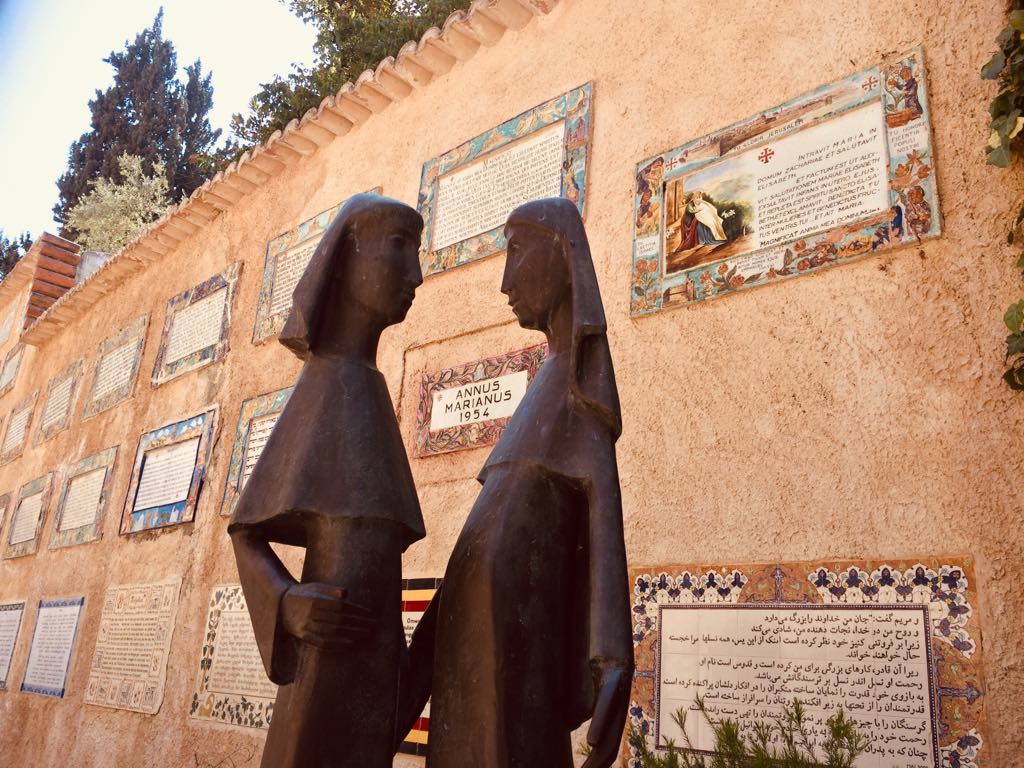
Photo by author, bronze statues of Mary and Elizabeth at the patio of the Church of Visitation, Israel, May 2017.
Visitation is a sharing or oneness in the joys and pains of those dear to us. The word becomes more meaningful when we try to examine its Filipino equivalent –“pagdalaw” from the root word “dala” that can be something you bring or a verb to bring.
When we come for a visitation, we dala or bring something like food or any gift. But most of all we bring our very selves like a gift of presence wherein we share our total selves with our time and talents, joys and sadness, and everything to those being visited that Mary did exactly in her visitation of Elizabeth where she brought with her the Lord Jesus Christ in her womb.
This fourth Sunday of Advent, we are invited to become like Mary in the visitation of others to bring Christmas and Jesus Himself to others by allowing our very body to be the “bringer” or taga-dala of Christ, the highest good we can bring as pasalubong in every visitation we make. Here again is another beautiful Filipino word, pasalubong that is literally the gift you bring when you visit somebody. It has a verb equivalent that is salubong or meeting/encounter. To salubong or meet another person, one has to leave one’s place, one has to leave behind one’s biases and mistrust to be empty to meet the other person.
How lovely and sweet if we can leave our negativities behind this Advent and Christmas so we can dala (bring) Jesus to family and friends and strangers to therefore salubong (meet) to experience God’s tenderness and sweetness in Jesus Christ.
Photo by author, Fourth Sunday of Advent 2022, Chapel of Basic Education, Our Lady of Fatima University, Valenzuela City.
Tenderness and sweetness in Filipino are often translated in just one word which is “malambing” from “lambing” that has no direct English translation except that it connotes a loving affection; however, both terms are more than just affections but stirrings from the heart that move us into action.
Tenderness is very much like gentleness; the former is more focused while the latter is very general attitude. Tenderness is more than being soft and gentle but an awareness of the other person’s weaknesses, needs and vulnerabilities. A tender person is one who tries not to add more insult to one’s injuries or rub salt onto one’s wounds so to speak. A tender person is one who tries to soothe and calm a hurting person, trying to heal his/her wounds like God often portrayed in many instances in the bible in lovingly dealing with sinners filled with mercy.
Like God, a person filled with tenderness is one who comes to comfort and heal the sick and those taking on a lot of beatings in life. When Jesus Christ came, He also personified this tenderness of God like when He was moved with pity and compassion for the sick, the widows, the women and the children and the voiceless in the society. Tenderness is coming to heal the wounds of those wounded and hurt, trying to “lullaby” the restless and sleepless. Mary visited Elizabeth because she also knew the many wounds of her cousin who for a long time bore no child, living in “disgrace before others” as she had claimed (Lk.1:25).
Photo from The Valenzuela Times, 02 July 2024.
Sweetness always goes with tenderness. It is the essence of God who is love. Anyone who loves is always sweet, something that comes naturally from within, bringing out good vibes. It is never artificial like Splenda, always flowing freely and naturally that leaves a good taste and feeling to anyone. In the Hail Holy Queen, Mary is portrayed as “O clement, O loving, O sweet Virgin Mary” to show her sweetness as a mother. There are no pretensions and pompousness in being sweet, never needs much effort to exert in showing it for it comes out naturally and instantly.
Tenderness and sweetness are the most God-like qualities we all have but have buried deep into our innermost selves, refusing them to come out because of our refusal to love for fears of getting hurt and left behind or, even lost. When Mary heard Elizabeth’s condition, she simply followed her human and motherly instincts that are in fact so Godly – she went in haste to visit her. Tenderness and sweetness are the twin gifts of Christmas to humanity when God almighty became little and vulnerable like us so we can be great and powerful like Him in being able to love.
Photo by author, Archdiocesan Shrine of Nuestra Señora De Guia, Ermita, Manila, 28 November 2024.
It is the final Sunday of Advent. In a few days it will be Christmas day and we still have enough time to empty our hearts of sins and bitterness to be filled with God’s love, sweetness and tenderness in Christ.
Let me leave you with my favorite quote from the novel “The Plague” by Albert Camus, “A loveless world is a dead world, and always there comes an hour when one is weary of prisons, of one’s work, and of devotion to duty, and all one craves for is a loved face, the warmth and wonder of a loving heart.”
Let that love in you come out this Christmas and hereafter; simply be like the child Jesus and be surprised with His tremendous power to transform the world. Amen. Have a blessed, sweet and tender Christ-filled week ahead!
The Lord Is My Chef Daily Recipe for the Soul by Fr. Nicanor F. Lalog II Friday, Memorial of St. Andrew Kim Tae-gon & Companion Martyrs, 20 September 2024 1 Corinthians 15:12-20 <8{{{{>< + ><}}}}8> Luke 8:1-3
Photo by author in Bolinao, Pangasinan, 2022.
"And if Christ has not been raised, then empty too is our preaching; empty, too, your faith"....
and empty too is our life!
St. Paul's words to the Corinthians echo so well in our own time when many of us believers live as though there will be no resurrection of the dead; so many of us believers today see life limited only to this temporal world that we indulge in everything that is material and pleasing, avoiding all pains and sufferings, simply subscribing to that dictum to drink and be merry for tomorrow we shall die.
Forgive us, Jesus, when we see life's fullness is found only in things and pleasures of the world that we forget the truth that life is empty without your Cross because it leads us to Resurrection each day like the sunrise; life is empty when we have more of the world and less of God whose ultimate reality is in the resurrection and life everlasting.
Grant us the grace of those holy women who followed you in your ministry, giving up everything they have especially their sinful past because in you they found and experienced resurrection; most of all, like the more than 100 martyrs of Korea whom we remember today, let us bear our cross of witnessing to you and your gospel, Jesus, so that people may realize that truly, life is most meaningful most fulfilled only in you. Amen.
St. Andrew Kim Taegon, first Korean priest with his lay associate St. Paul Chong Hasan with 113 other Koreans died as martyrs between 1839 and 1867.
The Lord Is My Chef Daily Recipe for the Soul by Fr. Nicanor F. Lalog II Monday in the Fourteenth Week of Ordinary Time, Year II, 08 July 2024 Hosea 2:16,17-18, 21-22 <*((((><< + >><))))*> Matthew 9:18-26
Thus says the Lord: I will allure her; I will lead her into the desert and speak to her heart… I will espouse you to me forever: I will espouse you in right and in justice, in love and in mercy; I will espouse you in fidelity, and you shall know the Lord (Hosea 2:16, 21-22).
Praise and glory to You, God our loving Father! Lead us back to You, lead us back to the desert - to that state of dryness, of emptiness, of nothingness for us to find and experience You again; lead us to the desert, Father, for us to feel our heart again that You are our first love after all!
Forgive us, Father, when life is in abundance we are filled of our selves we forget You and others; when life is affluent, we disregard what is right and just, we become so greedy with nothing enough; when life is going on smoothly without problems, we disregard love and mercy as we see more of things than persons as we veer away from You, sinking into infidelity, not knowing You.
I do not ask for too much pain and suffering; just something enough to knock our heads like that father in the gospel and woman suffering hemorrhages for 12 years who both felt so isolated from the rest like in a desert to realize there is only You in Jesus Christ to restore us back to life, back to community, back to our real selves and back to You. Amen.
Quiet Storm by Fr. Nicanor F. Lalog II, 03 May 2024
Photo by author, Anvaya Cove in Morong, Bataan, 15 April 2024.
How I wish I could strum and sing like Simon and Garfunkel saying hello and listening to the sound of silence that nobody hears, nobody cares; what a lovely commodity now a rarity in the time of Siri, everybody is so afraid of silence when its loudest sound is less than a breath, feebler than a whisper.
How foolish have we become to disregard silence when it is the only sound before we have all become that is why when death comes, in silence we shall return; woe the Walkman that pushed us back to the caves of our own world enslaved by gadgets that muffle our ears and head from the warmth of another soul speaking in silence.
Let us touch and be disturbed by the sound of silence! Listen to its wisdom and truth for it is not emptiness but fullness; embrace silence, feel its warmth to see life's vibrance in its natural sound telling us to trust again so we can love anew that is most true when words are few because the heart is empty, silently awaiting YOU!
Photo by author, Anvaya Cove in Morong, Bataan, 15 April 2024.
Lawiswis ng Salita ni P. Nicanor F. Lalog II, Ika-09 ng Abril 2024
Caravaggio’s painting “The Incredulity of St. Thomas” (1602) from en.wikipedia.org.
Sa tuwing maririnig ko ang kuwento kay Santo Tomas Apostol ni Kristo, ako'y nanlulumo dahil batid ko hindi ayon turing natin sa kanya na "Doubting Thomas" gayong tanging tag-uri sa kanya ng Ebanghelista ay "Didymus" o "Kambal"; nag-alinlangan nga si Tomas sa balitang napakita si Jesus na muling nabuhay sa kanyang mga kasama nguni't kailanma'y di nabawasan kanyang paniniwala at pagtitiwala.
Malaking pagkakaiba ng hindi maniwala sa hindi makapaniwala na isang pag-aalinlangan bunsod ng kakaibang pakiramdam tulad ng pagkamangha o ng tuwang walang pagsidlan sa isang karanasang napaka-inam ngunit hindi maintindihan balot ng hiwaga at pagpapala gaya nang mabalitaan ni Tomas paanong nakapasok sa nakapinid na mga pintuan Panginoong Jesus na muling nabuhay.
Katulad ng kanyang mga kasamahan nonng kinagabihan ng Linggo ding iyon, wala ding pagsidlan tuwa at kagalakan ni Santo Tomas nang sa kanya inilarawan ipinakitang mga kamay ni Jesus taglay pa rin mga sugat natamo sa pagpapako sa Krus nagpapatunay na Siya nga ang Panginoong nagpakasakit at namatay noon, nabuhay muli ngayon!
Hindi ba
ganyan din tayo
sa gitna ng ating mga
pag-aalinlangan
bagama't damang dama
natin ang katotohanan
ng mga pagpapala at biyaya
hindi tayo makapaniwala
sa kadiliman ating natagpuan
liwanag ni Kristo habang sa
kawalan naroon Kanyang
kaganapan at kapunuan?
Sandigang ating pinananaligan
dasal na nausal ni Tomas na
banal pagkakita kay Jesus
na muling nabuhay,
"Panginoon ko
at Diyos ko!"
Huwag tayong matakot kung tayo ay mag-alinlangan at kung minsa'y hindi makapaniwala sa mga gawa ng Diyos na sadyang kahanga-hanga; sa mundong ito na ang pinanghahawakang kasabihan ay "to see is to believe", ang kabaligtaran nito ang siyang katotohanang ating mapapanaligan, "believe that you may see" dahil sa dilim at kawalan parati dumarating ang Panginoong Jesus natin!
The Lord Is My Chef Easter Recipe by Fr. Nicanor F. Lalog II Second Sunday in Easter, Divine Mercy Sunday, 07 April 2024 Acts 4:32-35 ><))))*> 1 John 5:1-6 ><))))*> John 20:19-31
Photo by author, Mirador Jesuit Retreat House, Baguio City, 2018.
We celebrate today the Octave – eighth day – of Easter which coincides with the Feast of Divine Mercy. Both Christmas and Easter observe an octave signifying eternity because when you count from Easter Sunday to this Sunday, there are actually eight, not seven days. That is why there is no such thing as weekend for us Christians because the week never ends but continues on and on every Sunday.
And that is also the mystery, beauty and reality of Jesus Christ’s Resurrection that according to Pope Benedict XVI, “a life that opens up a new dimension of human existence” (Jesus of Nazareth, Part Two, p. 244).
Photo by author, view the refectory, Sacred Heart Novitiate, Novaliches, QC, 18 March 2024.
From now on, nothing can hold us nor keep us locked in sadness and grief, suffering and misery as well as sin and death because in rising from the dead, Jesus had opened up for us new possibilities in the future not only in eternal life but right here on earth.
Like the apostles on that same evening of Easter, we also find it so difficult to grasp and understand, even believe and explain right away though we could feel and experience deep down within us that Jesus is risen.
On the evening of that first day of the week, when the doors were locked, where the disciples were, for fear of the Jews, Jesus came and stood in their midst and said to them, “Peace be with you.” When he had said this, he showed them his hands and his side. The disciples rejoiced when they saw the Lord. Jesus said to them again, “Peace be with you. As the Father has sent me, so I send you.” And when he had said this, he breathed on them and said to them, “Receive the Holy Spirit.”
John 20:19-22
Photo by author, dusk at Sacred Heart Novitiate, 20 March 2024.
Since Sunday we have the prevalence of darkness and emptiness in our Easter stories, reminding us how often that it is in the darkness of our lives when we find light, when in the midst of emptiness when there is fullness.
This Sunday we find the presence of Jesus but still in an unusual manner. There was still darkness for it was night but more than that was the darkness within each disciple who locked themselves inside the Upper Room for fears from Jewish officials who might arrest and put them to death like Jesus.
Many times in life we feel locked in, imprisoned in some situations, feeling resigned as there is no way out from our troubles and miseries but through faith in Jesus, out of nowhere and without any explanation at all, we find ourselves extricated from our inescapable situations.
When my youngest sister was diagnosed with cancer the other year, she told me how she prayed on the eve of her surgery asking God to simply give her the grace to accept whatever the results of her tests would be. But after her surgery, it turned out her cancer was at its earliest stage that required no treatment at all except constant medical checkups! Last February on her major checkup again, doctors found no traces of cancer in her while her surgery had healed so well.
Hope is not positive thinking that things could get better; in fact, to hope is even to expect things to get worst like when the disciples were hiding in fear, expecting to be arrested too. Or my sister resigning to God her fate, just asking for the grace to accept she had cancer.
But it was in that darkness when Christ came and brought light to His disciples and my sister and our family. Strangely enough, it was after seeing the wounds of Jesus when they rejoiced because that proved that the Lord had risen. It was in my sister’s cancer we found ourselves together more in love and care for each other.
In life, our wounds will remain with us but most important of all for Easter to lead us into new existence in Christ, we must first remain in Him and with one another amid our wounds and darkness around us. And for us to remain or stay in Jesus with each other, we must first come.
Now a week later his disciples were again inside and Thomas was with them. Jesus came, although the doors were locked, and stood in their midst… Then he said to Thomas, “Put your finger here and see my hands”… Thomas answered and said to him, “My Lord and my God!” Jesus said to him, “Have you come to believe because you have seen me?”
John 20:26, 27, 28-29
Caravaggio’s painting “The Incredulity of St. Thomas” (1602) from en.wikipedia.org.
My dear friends, while praying over the gospel this week, this line by the Lord kept on echoing within me. And every time it would echo, the Lord shortened the sentence like these:
“Have you come to believe because you have seen me?”
“Have you come to believe because…?”
“Have you come to believe…?”
“Have you come…?”
Before we can stay and remain in the Lord, we must first come. Like Thomas.
What he had asked as proofs to believe in the Lord’s Resurrection were not really doubts to be taken negatively. John referred to him being known as Didymus for Twin. We were the ones who gave him that nickname Doubting Thomas. Like us, there are times we feel at a loss like Thomas with our faith and with ourselves when extraordinary things happen to us. It was not that he did not believe but in fact, he wanted to believe more. That is why he came the following Sunday.
Though I have always loved Caravaggio’s paintings, I don’t think Thomas ever touched the Lord’s wounds. Thomas must have been overwhelmed with the presence of Jesus that all he could say was “my Lord and my God” which we repeat during consecration of the bread and wine into Christ’s Body and Blood.
Photo by Ka Ruben, Easter Vigil 2024, National Shrine of Our Lady of Fatima, Valenzuela City.
Easter leads us into community life centered in the Eucharist. See how since Sunday when Jesus appeared to Mary Magdalene, He instructed her to tell Simon Peter and others of His Resurrection; after appearing to Cleopas and companion on the road to Emmaus, they hurried back to Jerusalem to proclaim the good news of seeing the risen Lord at the breaking of bread; and while they were together which would be the gospel next Sunday, Jesus appeared to them again as a community.
In His rising to life, Jesus brought us together, fellow wounded healers to heal each other, to remain with each other amid our poverty and sufferings because together in Christ, that is when we open new dimensions in existence, in living as a community. We grow into an I-Thou person from the selfish ego. That is what the first reading is telling us in how “the community of believers was of one heart and mind, and no one claimed that any of his possession was his own, but they had everything in common” (Acts 4:32).
It is the risen Lord who comes and stays among us in darkness and woundedness whenever we come and reach out to others like Thomas in the gospel. Even in our doubts, Jesus comes for us to believe more in Him. That is when great things start to happen, many so unbelievable and too deep for words. Basta.
That is why St. John Paul II rightly made the eighth day in Easter as the feast of Divine Mercy too because it is the love of God poured out to us in Jesus Christ’s suffering and death on the Cross when Blood and Water flowed out from His heart as an ocean of mercy for us. This is the love of God John was reflecting in the second reading that was too deep for words to explain except that it is the power that also “conquers the world” (1 Jn.5:3-4). Like St. Faustina in her Diary number 163, let us also pray:
"Help me, O Lord, that my heart may be merciful" by being more loving, by coming and remaining in Jesus among our brothers and sisters in their many darkness and emptiness and wounds in life. Like You, Lord Jesus, let me come to reach out to those in doubts to be Your very proof of Your having risen from the dead. Amen.
The Lord Is My Chef Daily Recipe for the Soul by Fr. Nicanor F. Lalog II Tuesday, Misa De Gallo IV, 19 December 2023 Judges 13:2-7, 24-25 <'[[[[>< + ><]]]]'> Luke 1:5-25
Here’s another beautiful story I got from a blogger I recently followed from Spain at wordpress.com. It is actually an analogy which may sound simple but very true.
You are holding a cup of coffee when someone comes along and bumps into you or shakes your arm, making you spill your coffee everywhere. Why did you spill the coffee?
"Because someone bumped into me!!!"
Wrong answer. You spilled the coffee because there was coffee in your cup. Had there been tea in the cup, you would have spilled tea. Whatever is inside the cup is what will spill out.
Therefore, when life comes along and shakes you - which surely happens all the time - whatever is inside you will come out. It's easy to fake it, until you get rattled. So, we have to ask ourselves, "what's in my cup?" When life gets tough, what spills over from me?
Photo by Mr. Boy Cabrido, Quiapo Church, Misa de Gallo, 17 December 2023.
My dear friends, we are now on the fourth day of our Misa de Gallo and I find that story/analogy so appropriate with our readings today.
How interesting that Zechariah with his wife Elizabeth – according to St. Luke – prayed so hard all their lives to have a child but when God was about to fulfill it, Zechariah doubted it despite being told by an angel from God. Like in that story/analogy we presented above, Zechariah was “rattled” by the angel’s good news. “What was inside Zechariah that he doubted the good news”?
Then Zechariah said to the angel, “How shall I know this? For I am an old man, and my wife is advanced in years.” And the angel said to him in reply, “I am Gabriel, who stand before God. I was sent to speak to you and to announce to you this good news. But now you will be speechless and unable to talk until the days these things take place, because you did not believe my words, which will be fulfilled at their proper time.”
Luke 1:18-20
Photo by author, Wailing Wall of Jerusalem, May 2017, the section of the remaining parts of the temple closest to the Holy of Holies where priests used to incense once a year.
Advent is the presence of God but sometimes when we are overburdened with so many things like anxieties and problems in life, frustrations and disappointments, sickness and death in the family, we become unaware of his divine presence even if we continue to pray and do our religious duties and devotions. Too often we lack the conscious awareness of God in our lives that we take him for granted, considering him more as a given than a presence and a reality.
This is exactly what we told you yesterday about some of us pretending to be real disciples of Christ when in reality we are merely dreaming in a sleepwalking existence. It is a kind of spiritual immaturity due to our lack of honesty and sincerity with one’s self and with God that we remain a spiritual dwarf. Like Zechariah who happened to be a priest who must be more attuned and rooted in God, we too hardly notice God’s coming or even doubt him and his powers because we want to hold on to our comfort zone or insist our own agenda.
God is never put off by our queries in life but what “irritates” him is when we question him, when we doubt him, when we ask about his character like Zechariah. That is a lack of faith in God, a lack of trust, and lack of personal relationship with him unlike St. Joseph in our reflection yesterday, truly a righteous man.
Contrast Zechariah with his wife Elizabeth who is presented by St. Luke in a better position despite her being barren. In the Bible, barrenness is a sign of lifelessness and absence of God’s blessings. Worst, it was seen as a punishment from God for one’s sins.
Yet in this opening scene of St. Luke’s infancy story beginning with the annunciation of John’s birth, we find God’s power at its fullest when we are most emptied which is exactly the imagery of Elizabeth being barren and old. She had nothing at all to be proud of unlike Zechariah who still had duties to perform as a priest.
As we have reflected yesterday too, we burst in great rejoicing actually in those moments filled with negativities, with a lot of “no” answers of rejections and failure. That was how Elizabeth felt after being pregnant with John.
After this time, his wife Elizabeth conceived, and she went into seclusion for five months, saying, “So has the Lord done for me at a time when he has seen fit to take away my disgrace before others.”
Luke 1:24-25
Earlier, we asked what was inside Zechariah that he doubted the good news of the angel; now, we imagine what was inside the barren Elizabeth who welcomed the good news rejoicing by voluntarily going into a seclusion?
The story of the elderly couple Zechariah and Elizabeth finally being blessed by God with a child shows us God’s consistency not only in keeping his promises but most of all in working best even in our worst conditions, in the most unusual circumstances. In these two stories, one from the Old Testament and in the New Testament, we find the importance of being filled with God always.
Recall our story/analogy above. What is inside us that comes out when we are shaken? What spills over from our cup, is it joy, gratitude, and peace? Or, anger, bitterness, harsh words and reactions long festering within?
In starting his Christmas story with the annunciation of the birth of John the Baptist, St. Luke is telling us an important aspect in celebrating this blessed season – the need to fill ourselves with God.
See how Zechariah was forced to be silent and made mute so that he could spend more time listening and rediscovering God anew in his heart, of filling himself with God. On the other hand, Elizabeth opted to go into seclusion also to contemplate God already dwelling in her though she may have never known before that is why she wanted to listen more intently to his other plans with the gift of John. Similarly like her in the first reading was the wife of Manoah who remained silent and open when a man of God told her she would bear a son to be called Samson, saying that “I did not ask him where he came from” (Jgs.3: 6). Advent invites us to simply be still to be filled by God, with God.
The other day I joined my nieces and nephew for lunch. After dropping me off at the parish, they asked for a nearby Starbuck’s because my nephew had to buy a coffee mug for his exchange gift in their class. When I asked him why he had to give a Starbuck’s mug as gift, it turned out that is now the way it is in class Christmas party – your exchange gift partner can make a wish for the gift to receive for as long as it is within the agreed budget by the class.
Anyway, our life gives us the cup or the mug. We make the decision, the choice to fill it with coffee or chocolate or tea, in the same manner we fill ourselves with joy or bitterness, anger or serenity, gratitude or complaints. Or God.
Like Zechariah in the gospel today, we could be so tired already of doing so much, of banging our heads on the wall to solve everything, to answer everything. In this final stretch before Christmas, let us empty our cups or mugs of our selves and fill it with God who alone can truly fill us with life despite our dryness and barrenness. Amen.Have a blessed Tuesday!