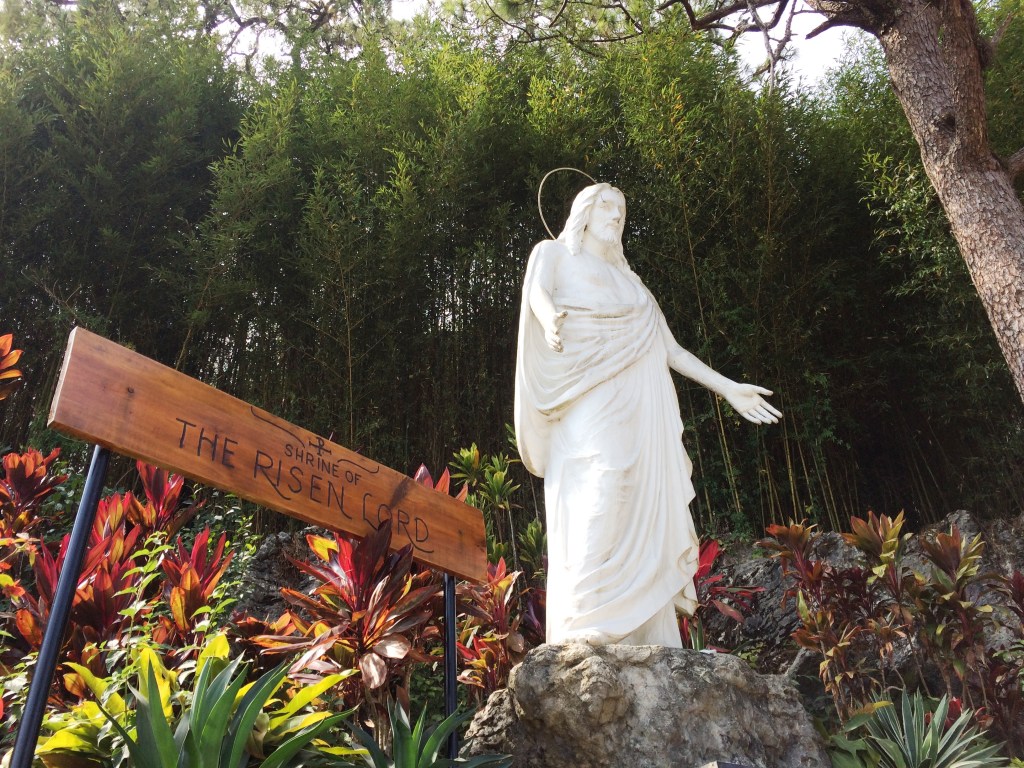
The Lord Is My Chef Breakfast Recipe for the Soul by Fr. Nicanor F. Lalog II
Monday, Feast of the Exaltation of the Cross, 14 September 2020
Number 21:4-9   >><)))*>   Philippians 2:6-11   >><)))*>   John 3:13-17
Photo by author, Lent 2019.
Thank you very much, God our loving Father, for this Feast of the Exaltation of the Cross of your Son Jesus Christ. Please increase our patience lest we complain like your people at the desert to Moses.
With their patience worn out by the journey, the people complained against God and Moses, “Why have you brought us up from Egypt to die in this desert, where there is no food or water? We are disgusted with this wretched food!
Numbers 21:4-5
You know, dear God, how we feel right now after seven months of journey in the pandemic: we are tired and exhausted, wearied and anxious, most of all, afraid of how things can go worst specially with the incompetence of our government officials.
Please, grant us patience to continue with the journey but allow us too to complain from our hearts, to cry out our pains and fears to you because it is only you who can help us in our situation. Most of all, let us complain from our hearts as an expression of faith and hope in you, Lord.
We are convinced of your love and presence but sometimes we are overwhelmed by the sufferings and difficulties on this period of the pandemic that we think more of ourselves, of our well-being that we forget you are our companion in the journey.
We fail and even refuse to see you in this journey as we complain from our minds, when we are filled with pride, believing in our ourselves that we question you, when we dare you, when we think of ways of manipulating you in our favor.
Open our eyes to see again on this feast and celebrate how you have transformed the worst signs of death and torture in history to be the doorway to life and healing like snakes becoming medicines to snake bites and the cross becoming the sign of love.
Open our minds that instead of complaining of the death of Jesus Christ, we celebrate his resurrection and glory in heaven. Instead of dwelling on pain and suffering, we focus more on healing and salvation.
May we keep in our minds that taking the form of a slave, of carrying our crosses leads to your exaltation, our loving and merciful Father. Amen.
Photo by author of Brazen Serpent Monument on Mt. Nebo inside the Franciscan Monastery in Jordan, May 2019.
40 Shades of Lent, Sunday Week-V, Year-A, 29 March 2020
Ezekiel 37:12-14 +++ Romans 8:8-11 +++ John 11:1-45
Photo by Ms. Anne Ramos last March 22, 2020 during our procession of Blessed Sacrament in the Parish when a rainbow appeared at the horizon.
Once again as we near the closing of our Lenten journey, Jesus does another “sign” or miracle — his last and grandest in anticipation of his coming Passion, Death, and Resurrection: the raising from death of his friend Lazarus.
What is so beautiful in this story is how the evangelist involves us his readers and hearers into a conversation with Jesus unlike last Sunday at the healing of a man born blind where the characters conversed only among themselves.
The raising of Lazarus to life is more engaging because it is deeply personal and intimate as it involves friends dearest to Jesus — exactly like each one of us! And that is why it is also very timely as we go through the ongoing lockdown due to COVID-19.
When Jesus heard this he said, “This illness is not to end in death, but is for the glory of God, that the Son of God may be glorified through it.”
John 11:4
My dear family and friends, Jesus assures us today of the Father’s love and healing, that he would save us from the deadly corona virus. Come and let us converse with him with the sisters of Lazarus, Martha and Mary.
After my “private Mass” (Missa sine populo) during the Solemnity of the Annunciation, 25 March 2020.
Presence of Jesus
Martha said to Jesus, “Lord, if you had been here, my brother would not have died. But even now I know that whatever you ask of God, God will give you.”
John 11:21-22
Twice do we hear this line in this very long story of the raising of Lazarus when Mary repeated it upon meeting Jesus later at the entrance of their town of Bethany.
And like Martha and Mary, we always say it to Jesus too as if he ever leaves us alone!
“Lord, if you had been here…”
Jesus is always with us.
We are the ones who always leave Jesus behind.
We always have so many other things to do, so many other people to meet that we have no time to truly pray and most of all, celebrate the Sunday Mass every week.
It is my hope that following the suspension of the “public Masses” due to lockdown, people now realize the value of the Holy Eucharist which is the “summit” of our Christian life where we are nourished by the words of God and strengthened by the Body and Blood of Christ.
Photo from Forbes.com via Facebook, 2019.
Long before we were told to observe “social distancing” in this time of pandemic, we have long been distant from one another and from God.
How ironic that these modern means of communications were invented to bring us closer but have actually brought us farther apart! Most often, we are close enough with someone miles across the seas but too distant and cold to persons physically near us, even seated beside us.
Let us spend more time with our family and most especially with God in prayer during this enhanced quarantine period to be the presence of Christ with one another. Let us remember Fr. Patrick Peyton’s expression, “The family that prays together, stays together; a world at prayer is a world at peace”.
Remember: the most wonderful and enriching relationships we can have are those rooted in Jesus Christ who is always present in us.
Jesus is perturbed and deeply troubled
While praying over this long gospel, this photo by Raffy Lerma kept on flashing in my mind, showing me how Jesus must have reacted upon seeing Mary weeping over the death of her brother Lazarus.
He became perturbed and deeply troubled, and said, “Where have you laid him?” They said to him, “Sir, come and see.” And Jesus wept.
John 11:33-35
Like our gospel today, Lerma’s photo of a mother crying over her son lost to “tokhang” at the height of this administration’s war against drug in July 2016 is very conversant, so moving like the Pieta by Michaelangelo in Rome. In fact, the government doubted the veracity of the photo, claiming through its trolls it was merely “staged” or “drawing” as we say in journalism. The photo is authentic because the event truly happened. And continued to happen before this lockdown.
What I like most with this photo is the composure of the mother. You can feel she was deeply sad and troubled, weeping without the hysterical theatrics or palahaw in Tagalog that we see in many instances like funerals.
Photo by Mr. Jay Javier, Quiapo, January 2020.
Multiply that to the highest degree and we get the image of Jesus “perturbed and deeply troubled, weeping” at the death of his friend Lazarus.
There is the gentle yet firm mastery by Jesus of the situation, of the loss and tragedy.
No hysterics nor theatrics. Pure and all-encompassing presence.
It would be the same mastery and composure Jesus would exhibit at his coming Passion and Death, reaching its highest point on Easter.
Here we find Jesus Christ truly human, truly Divine. Yes, he was perturbed and deeply troubled; he cried and wept not because of weakness but rather more of strength, of being true and determined in overcoming not only his coming Passion but most of all, our own setbacks and losses.
Have faith, my dear reader. Jesus is surely “perturbed and deeply troubled, weeping” again with us in this time of the corona pandemic. Step back and let him be himself in being one with us; then, wait and see what he is going to do next for us.
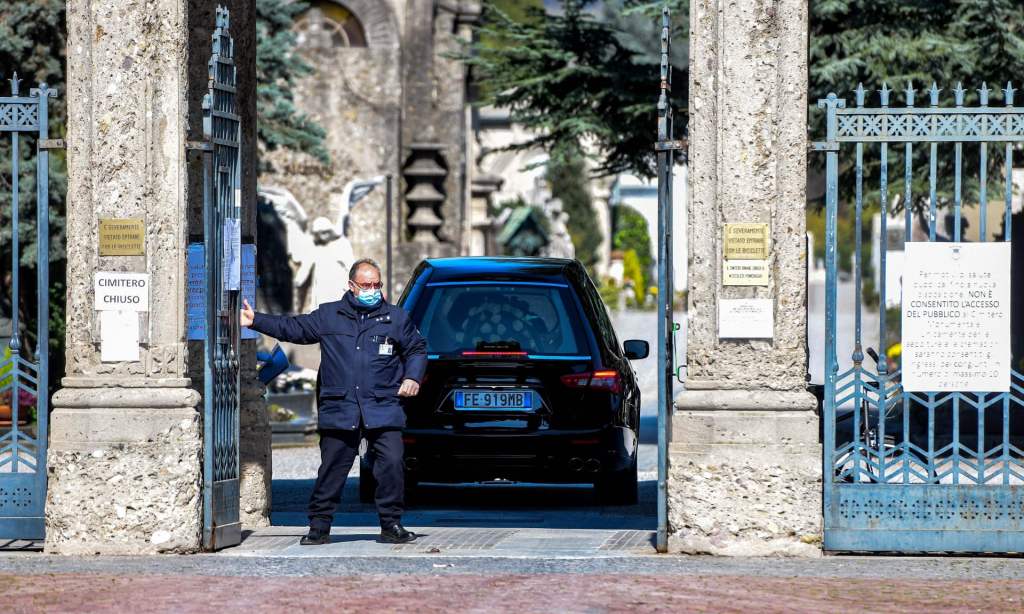
Photo from theguardian.com, 19 March 2020 reporting how a “generation has died” in Bergamo, Italy struggling with 1959 deaths from corona virus that has overwhelmed the nation’s funeral sector.
Jesus joins us in death so we can rise to life in him
Today is not a beautiful day to die, especially for victims of COVID-19. No wakes. No Masses. Just simple blessings after cremation. If ever possible.
The scenes from Italy are deeply disturbing that has become the new epicenter of corona pandemic. According to a report last Monday, the obituary page of a local newspaper had increased tenfold in a week, listing up to 150 deaths daily! More disturbing is the fact that “death and mourning happen in isolation”.
Our readings this Sunday speak a lot about death symbolized by graves.
But not on a morbid sense like a defeat or a loss; rather, as a victory, a raising to new life!
Thus says the Lord God: O my people, I will open your graves and have you rise from them, and bring you back to the land of Israel. Then you shall know that I am the Lord, when I open your graves and have you rise from them, O my people! I will put my spirit in you that you may live.
Ezekiel 37:12-14
Ezekiel proclaimed these words of the Lord to the Israelites during their Babylonian Exile when they lost everything and everyone, including God as they thought have forsaken them for their sinfulness. This prophecy is finally fulfilled in Christ’s coming and victory over death on Easter.
In calling back Lazarus to life, Jesus shows us in this scene his tremendous power over death and defeat, agony and pain, sin and evil. It is a prefiguration to a grander scale of his own Resurrection on Easter after the Good Friday.
And when he had said this, he cried out in a loud voice, “Lazarus, come out!” The dead man came out, tied hand and foot with burial bands, and his face was wrapped in cloth. So Jesus said to them, “Untie him and let him go.”
John 11:43-44
Photo by Mr. Raffy Tima of GMA-7 News. Used with permission. Seen here from atop the GMA Network Center in QC is Mt. Samat in Bataan with the Memorial Cross visible, across the Manila Bay, taken on 26 March 2020.
Do you believe this?
Jesus is calling us to have faith in him, to believe in him especially in this time of COVID-19 pandemic. And like his question to Martha which he repeated twice, the Lord is asking us the same question today:
Jesus told her, “I am the resurrection and the life; whoever believes in me, even if he dies, will live, and everyone who lives and believes in me will never die. Do you believe this?
John 11:25-26
Do you believe in him, Jesus the Christ?
Good things have also been happening lately in this two-week old lockdown.
Families are again getting together, staying together. Finally we now have more time than ever to converse once again as husband and wife, children and parents, brothers and sisters.
Some people have rediscovered God and are back to praying again, to believing again.
Even Mother Nature is said to have taken a big break during this lockdown, giving us spectacular views never seen before due to cleaner air, less pollution and congestion in the cities.
These are all conversations going on – thanks to COVID-19!
Let us join the conversations with our loved ones, with nature, with our self, and with God.
Below is one of my favorite photos this week taken by GMA-7 reporter Mr. Raffy Tima. Again, another photo conversing with us, like Jesus in the story of the raising to life of Lazarus.
See the Memorial Cross on Mt. Samat in Bataan?
The raising of Lazarus is the “sign” or miracle as the other evangelists would say, that prefigures the definitive victory of Jesus on the cross.
Like the sisters of Lazarus, believe in Jesus who is awakening us today amid the threats or crosses of corona virus to bear all these sufferings, to passover like him to the life that bodily death cannot touch “through his Spirit dwelling in us” (Rom. 8:11). Amen.
Soon afterward Jesus journeyed to a city called Nain, and his disciples and a large crowd accompanied him. As he drew near to the gate of the city, a man who had died was being carried out, the only son of his mother, and she was a widow. A large crowd from the city was with her. When the Lord saw her, he was moved with pity for her and said to her, “Do not weep.” He stepped forward and touched the coffin; at this the bearers halted, and he said, “Young man, I tell you, arise!” The dead man sat up and began to speak, and Jesus gave him to his mother. Fear seized them all, and they glorified God, exclaiming, “A great prophet has arisen in our midst,” and “God has visited his people.”
Luke 7:11-16
Today, we are like at the city of Nain. Traffic is so heavy outside as many of us – family and friends, former classmates, colleagues at work from all over and neighbors – gather to pray and pay our last respects for Archie.
Celebrating a funeral Mass for a young person is always difficult for me. Like Jesus, I feel so sad for their parents. Normally, it is the children who bury their parents. It must be so painful for parents burying a son or a daughter. That is why in our gospel, Jesus was “moved with pity” with the widow of Nain.
But today, amid the pains and sorrows with the sudden death of Archie last week at a very young age, we actually celebrate life in Jesus Christ.
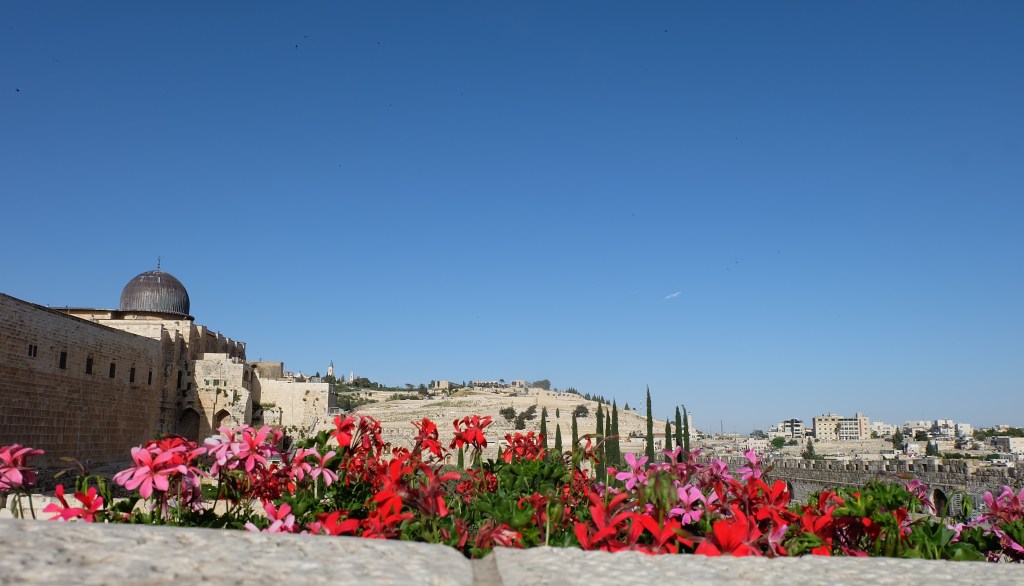
Photo by author of the hills of Galilee from the Walls of Jerusalem, May 2017.
Jesus comes to visit us always
Like in that scene at Nain, we remember and celebrate the life of Archie who had come to visit us even for a short time.
I love that part of the gospel where the people at Nain exclaimed at how “God has visited his people” when Jesus raised the dead young man.
Jesus continues to visit us everyday through one another like Archie.
Despite his many sins and imperfections, Archie made us experience Jesus Christ’s love and friendship, warmth and kindness, especially to his two sons, family, and friends.
Surely, Jesus must have visited Archie, too, during those dark moments of his life.
And the good news is, Archie visited Jesus so often especially these last two years when he started to pick up the pieces of his life.
Last time I saw Archie was last November when he came to celebrate Mass in our Parish. And I have heard how he had sought spiritual guidance from Fr. Carl, driving that far to Paco every month as he renewed his relationship with Christ, trying to follow anew the Lord he had served since elementary as a sacristan and later as a seminarian in our high school seminary.
It is Jesus who first finds us always
Photo by author at Mt. St. Paul Spirituality Center, Baguio, 04 February 2020.
We all know Archie’s tocayo is one of ancient Greece’s great scientist and inventor, Archimedes.
It is said that he discovered the principle of buoyancy – the “Archimedes’ principle” – while taking a bath.
When Archimedes sat onto his bathtub, he observed that “when a body is submerged in a fluid, it experiences an apparent loss in weight that is equal to the weight of fluid displaced by the immersed body.”
Archimedes was so ecstatic with his accidental discovery that he jumped naked from his bathtub out to the streets, shouting “eureka!” or “I have found” the solution to a problem he was trying to solve at that time.
Archimedes had not only enriched the field of mathematics and sciences with his discoveries but also the English language with the word “eureka” or “eureka moment”: when somebody discovers something very significant in business and economics, the sciences especially medicine, and practically in every field and subject.
Most especially in life.
Photo by author, Mt. St. Paul Spirituality Center, Baguio, 04 February 2020.
Archie had the same eureka moment in life: he had found Jesus Christ again that he went back to Mass and Confessions.
He had found meaning in life again after losing hope and directions.
Most of all, Archie had found love again.
Like his namesake of ancient Greece, Archie is now exclaiming “eureka” ecstatically into heaven – naked – with nothing but the love and mercy of Jesus Christ who first found him and brought him back to life a few years ago.
Today as we bring the remains of Archie into his final resting place, we thank God who never stops looking for us, finding us so that we can find him again and finally rest in him.
Today it is Jesus who is most ecstatic of all because he is the first to have found Archie and that is why, he had called him back to him, never to get lost again.
But the souls of the just are in the hand of God, and no torment shall touch them. They seemed, in the view of the foolish, to be dead; and their passing away was thought an affliction and their going forth from us, utter destruction. But they are in peace. In the time of their visitation they shall shine.
Thursday, Memorial of St. Pedro Bautista and companion priest-martyrs, Week 4, Year 2, 06 February 2020
1 Kings 2:1-4, 10-12 ><)))*> 0 <*(((>< Mark 6:7-13
Our merciful God and Father, on this memorial of your great priest-missionaries and martyrs – St. Pedro Bautista, St. Paul Miki and companions who have also worked in the Philippines – we pray today in a very special way for our dearly beloved mentor and brother priest, the Rev. Fr. Danny Bermudo.
We are not complaining, Lord, but year 2020 is a very tough year for many of us, right into January that continues to this month of February with many deaths and sickness, problems and trials not only in our own circles of family and friends but also in our country and the whole world in general.
We trust in you, O God, and can clearly see now in your readings especially that essentially, in life and in death, we are commissioned only to one thing — be faithful to you and your instructions, Lord.
While nearing his death, King David perfectly said it to his son and heir to the throne, Solomon:
“I am going the way of all flesh. Take courage and be a man. Keep the mandate of the Lord, your God, following his ways and observing his statutes, commands, ordinances, and decrees as they are written in the law of Moses, that you may succeed in whatever you do, wherever you turn…”
1 Kings 2:2-3
In a similar manner, at the start of his ministry, Jesus said the same thing while sending the Twelve two by two with authority over unclean spirits: leave everything behind in life and solely be focused on you, Lord, so we may fulfill your work and mission.
Photo by author, 2019.
Thank you, O God, for the gift of Fr. Danny who taught us in his classes and most especially in his personal way of being our seminary formator to always be faithful to you and your laws; to always be good and holy like you, our Heavenly Father.
In words and in deeds, in life and in death, Fr. Danny lived out his life totally for you, Lord, dying after fulfilling his mission and ministry of celebrating the Eucharist.
Bless Fr. Danny, O Lord, and may we carry on his lessons until our death like him. Amen.
Quiet Storm by Fr. Nick F. Lalog II, 03 February 2020
Detail of the Presentation painting by Italian artist Andrea Mantegna (1431-1506) with Mary handing the Child Jesus to Simeon at the temple of Jerusalem (man at the middle Mary’s husband, Joseph).
As we come to close today’s Feast of the Presentation of the Lord, I wish to share with you a Quiet Storm brewing within me which I call “the Nunc Dimittis experience”.
Nunc dimittis is the Latin opening line of Simeon’s Canticle that says “Now you dismiss” when he was filled with joy by the Holy Spirit upon meeting our Lord and Savior on his presentation at the temple.
According to St. Luke’s account, God had promised Simeon that “he would not see death before he had seen the Christ of the Lord” (Lk. 2:26). Hence, the overflowing joy of Simeon when he finally met the Child Jesus at the temple 40 days after Christmas!
Part of St. Luke’s artistry in his Christmas story is to put songs on the lips of some of its important characters to express their profound joys in their unique experiences of the coming of Christ.
The Nunc Dimittis is the fourth canticle in the Lucan Christmas story: first is Mary’s Magnificat when she visited her cousin Elizabeth who was six months pregnant with St. John the Baptizer; second is the Benedictus by Zechariah when he regained his speech after naming his son John; and third is the Gloria sang by the angels when Christ was born in Bethlehem.
Of these four canticles recorded by St. Luke, Simeon’s Nunc Dimittis sounds the highest level of all, the fulfillment of time within each one of us when we personally recognize and meet Jesus the Christ our Savior like Simeon.
And so often, when we are overjoyed in experiencing Jesus Christ, that is also when we feel like saying “now I am ready to go, ready to die” exactly like Simeon because we have met the Lord.
That is why I call it “the Nunc Dimittis experience”: real joy can only come from that experience and intimacy with Jesus Christ, when we feel so close with him. It does not really matter whether we experience him here in this life or hereafter. What matters most is we feel so close with him, as if embracing him, here and now.
This may be a religious experience like after listening to a homily that really touched us, or after a good confession, or while attending a wonderful retreat or recollection. It may also happen when we feel so loved and accepted, when we are vindicated, or when assured of support and trust and confidence while going through difficult trials in life.
Our Nunc dimittis experience always comes at the end of each day, when we feel despite our failures and shortcomings, we are in God’s loving presence.
Simeon’s Canticle, our Night Prayer
Since the early sixth century during the time of St. Benedict, the “Nunc Dimittis” has been sung in the monks’ night prayer or “compline” from the Latin completorium or completion of the working day. Eventually, it was adopted into the Liturgy of the Hours or the prayers of the Church usually recited by priests and religious. (St. John Paul II had suggested in his encyclical Novo Millennio Innuete after the Great Jubilee of 2000 that the lay faithful also pray the Liturgy of the Hours.)
After the praying of the psalms and meditation of the Sacred Scriptures, there is a Responsory that declares, “Into your hands, Lord, I commend my spirit.” Like Jesus before he died on the Cross, we offer to God our very selves. This is takes on a beautiful dimension especially if we have done a good examination of conscience at the start of the compline, before the psalms and readings.
Then, we recite the antiphon that introduces the Nunc dimittis: “Protect us, Lord, as we stay awake; watch over us as we sleep, that awake, we may keep watch with Christ, and asleep, rest in his peace.”
The antiphon in itself is already a prayer!
It is after the antiphon that we chant or recite Simeon’s Canticle:
Lord, now you let your servant go in peace; your word has been fulfilled: my own eyes have seen the salvation which you have prepared in the sight of every people: a light to reveal you to the nations and the glory of your people Israel.
From the Compline of the Breviary
The antiphon is repeated and immediately followed by the Closing Prayer.
The cross atop our parish church at night with the moon above taken with my iPhone camera, 02 February 2020.
Capping the compline is the blessing at the end that says: “May the all-powerful Lord grant us a restful night and a peaceful death. Amen.”
Usually, a hymn to Mary is sung, then all the lights are turned off and the great silence (magnum silencium) begins until the morning prayers or lauds (Latin for praise).
See how our night prayer or the compline is oriented towards meeting God, or to put it bluntly, towards death.
Yes, it is always easy to say we are ready to die. It is a lot whole different when we are already face to face with death itself.
But, when we come to think of it, we realize that indeed, in death, “there is nothing to fear but fear itself”.
When we die, everything happens so fast. We may not even feel anything at all. And unknown to us, every night when we go to sleep, we rehearse our death, so to speak!
And what a tremendous joy to keep in mind how every night, the Lord fills us with joy and faith within us even if we often forget him. Every night when we sleep, it is automatic within us to entrust everything to God “unconsciously” without even thinking we may never wake up!
It is a “Nunc Dimittis” experience too because most of us go to bed filled with joy, full of hope the following morning would be a better day than today. And that is Jesus still coming to us at the end of the day to assure us of his love and concern, never bothering us at all of this tremendous grace gratuitously given to us.
Next time you sleep, remember how blessed you are to have come to the end of another day, blessed and loved.
Pray, and start experiencing Jesus more from the beginning to the end of each day and forevermore. Amen.
Malaci 3:19-20 ><}}}*> 2 Thessalonians 3:7-12 ><}}}*> Luke 21:5-19
The Wailing Wall of Jerusalem Temple, May 2019.
We are now at the penultimate Sunday of the year as Jesus continues to summarize his teachings today at the Temple area in Jerusalem about his final coming at the end of time.
While some people were speaking about how the temple was adorned with costly stones and votive offerings, Jesus said, “All that you see here — the days will come when there will not be left a stone upon another stone that will not be thrown down.” Then they asked him, “Teacher, when will this happen? And what sign will there be when all these things are about to happen?” He answered, “See that you not be deceived… “
Luke 21:5-8
On the surface, Jesus seemed like to be a “kill joy” in making those bold assertions about the coming destruction of the Temple while everybody was admiring it. But notice how the people reacted: instead of being worried, they asked when it would happen and what would be the warning signs before it takes place as if it is just an ordinary thing!
“Wala lang…” as the young would say these days. Nothing, duh…?
View of Jerusalem from the Church of Dominus Flevit where Jesus wept upon seeing the city from the Mount of Olives.
St. Luke tells us that before Jesus entered Jerusalem, “he wept over it” at the thought that it would be destroyed and that its enemies would not “leave one stone upon another” (Lk.19: 41-44).
If there is anyone deeply hurt and saddened with the Temple’s destruction, it is not other than Jesus Christ our Lord. He certainly shared the people’s admiration for the Temple which he had also claimed as “my Father’s house” (Lk.2:49) when he was accidentally left behind there by Mary and Joseph when he was 12 years old.
Imagine what Jesus must have felt when he spoke of the destruction of the Temple which is the heart of Jerusalem, the jewel of the city, and most of all, the sign of God’s presence among his chosen people!
There must be something deeper with his warning words of the Temple’s destruction that pertains not only to his people at that time but also to us today.
Wailing Wall of Jerusalem, may 2019.
For the Jews at that time, the destruction of the Temple is the end of the world, the signal of the apocalypse. More than a catastrophe involving the destruction of buildings and almost everything including life, it is judgment day that must not be taken lightly.
It is a day calling for conversion as the prophet Malachi in the first reading reminds us that every coming of God is a day of judgment and salvation.
Lo, the day is coming, blazing like an oven, when all the proud and all evildoers will be stubble, and the day that is coming will set them on fire… But for you who fear my name, there will arise the sun of justice with its healing rays.
Malachi 3:19-20
Christ had already come and will come again.
This was his promise and this is what he meant at the cleansing of the temple, “Destroy this temple and in three days I will raise it up” (Jn.2:19). At his Passion, Death, and Resurrection, Jesus Christ had replaced the old Temple worship with himself!
This is what we celebrate in every Holy Mass, God’s coming to us in Jesus Christ his Son.
Jesus comes in every here and now, and his every coming is a process of destroying our old temple of self to give rise to a new temple in Christ. Our concern need not be about a future date of his Second Coming or specific signs of its fulfillment.
Every day Jesus comes again and the challenge is for us to live authentically as Christians daily and not be bothered about the future. He warns us not to be deceived by all of these apocalyptic predictions and statements.
The key word is conversion, of living in the present. Jesus tells us so many things that can be very frightening and scary because what he wants us to do in preparation for his Second Coming is to love, love, and love.
And to love is to always suffer in Christ, with Christ.
He answered, “See that you not be deceived, for many will come in in my name… Do not follow them! When you hear of wars and insurrections, do not be terrified; for such things must happen first, but it will not immediately be the end.” Then he said to them, “Nation will rise against nation, and kingdom against kingdom. There will be powerful earthquakes, famines, and plagues from place to place; and awesome sights and mighty signs will come from the sky. Before all this happens, however, they will seize and persecute you… You will even be handed over by parents, brothers, relatives, and friends, and they will put some of you to death. You will be hated by all because of my name, but not a hair of on your head will be destroyed. By your perseverance you will secure your lives.”
Luke 21:8-19
From I.REDD.IT.
Yes, Jesus will definitely come again at the end of time. Like last Sunday, definitely, there is a resurrection of the dead and life everlasting. But both must be seen in the context of the present time, of the here and now.
When Jesus comes again to judge us at the end of time, he won’t be asking us about the things we have been so preoccupied with in this life like how much money we earn, what car do you drive, or how big is your house?
When Jesus comes again, he will be asking us questions we have always refused to answer in our daily lives like how much have you loved, how much have you sacrificed and suffered for a loved one, or how much have you shared to a stranger?
These are the questions we must be asking ourselves as we near towards the end of the year: how close have I followed Jesus Christ in his Passion and Death so I may be with him in his Resurrection?
May we imitate St. Paul in his second letter to the Thessalonians today to faithfully and calmly fulfill our daily tasks in this life, avoiding being idle for each day is the day of the Lord. Amen.
Our gospel today helps us to further reflect the meaning of last week’s All Saints’ Day and All Souls’ Day when we honored our departed loved ones with prayers, believing and hoping that some day we shall be with them in heaven at “the resurrection of body and life everlasting”.
Every Sunday this is what we profess and so today, our readings invite us to reflect anew this last but crucial article of our faith, theresurrection of body and life everlasting.
Some Sadducees, those who deny that there is a resurrection, came forward and put this question to Jesus, saying, “Teacher, Moses wrote for us, If someone’s brother dies leaving a wife but no child, his brother must take the wife and raise up descendants for his brother. Now there were seven brothers; the first married a woman but died childless. Then the second and the third married her, and likewise all the seven died childless. Finally the woman also died. Now at the resurrection whose wife will that woman be? For all seven had been married to her.”
Luke 20:27-33
The Jewish Cemetery at the Mount of Olives facing Jerusalem, May 2019.
Jesus had finally entered Jerusalem. What an extraordinary manner for him to discuss death and resurrection right in the city he knew where he would eventually die and rise again in a few days later!
And the first to confront him there were the Sadducees, Israel’s elite from whose ranks came the high priests who later conspired with Rome to put Jesus to death.
Jews at the wailing Wall, May 2017.
Very conservative and rigorous in their practice of religion, the Sadducees were basically fundamentalists who refused to accept oral traditions on equal footing with the Pentateuch. They only accepted whatever was explicitly written on the Pentateuch, discarding anything that the Torah does not mention at all like the resurrection, existence of spiritual beings like angels and immortality of the soul.
Don’t we find ourselves into the same situation too when despite our professed religiosity, we subscribe to other beliefs like reincarnation and fortune-telling because of “proofs” we find about their veracity unlike the resurrection that seems to be so difficult to think of in the first place?
We have those vestiges of fundamentalism within, always searching and asking for proofs on so many things about our religious beliefs, especially about God and Jesus Christ.
Jesus said to them, “The children of this age marry and remarry; but those who are deemed worthy to attain to the coming age and to the resurrection of the dead neither marry nor are given in marriage. They can no longer die, for they are like angels… That the dead will rise even Moses made known in the passage about the bush, when he called ‘Lord’ the God of Abraham, the God of Isaac, and the God of Jacob; and he is not God of the dead, but of the living, for to him all are alive.”
Luke 20:34-38
Photo by Mr. Raffy Tima of GMA-7 News, 2018.
Notice how Jesus right away told them analogies and comparisons are not applicable because marriage and resurrection are of two different realms. The Sadducees were thinking on ground level when resurrection is definitely of a higher plane.
Jesus finds no need to prove anything at all to them – even to us! What he is more concerned is for us to “level-up” our thoughts, to set our sights to him, the Son of the Living God.
Now in Jerusalem to fulfill his mission, Jesus in the next two weeks will summarize for us all his teachings that lead to our coming home to the Father in heaven upon our death. Like Jesus Christ who died and rose again, we shall experience the same in the end.
How? Nobody really knows but our faith teaches us that resurrection is more than being restored to life; resurrection is life perfected in Christ. Life is surely changed and that is why it is on a different and higher level of existence.
Every time we experience our little deaths on our daily cross with Christ, we also experience our little resurrection when our lives are changed for the better. Amidst our many struggles in this life, we experience God’s loving presence, his very revelation of himself that moves us to deeper faith in him for indeed, he “is not God of the dead” – nor a dead God – because “for him all is alive” .
This faith in the resurrection is faith in the living God “who has loved us and given us everlasting encouragement and good hope through his grace” (2 Thes. 2:16) in Jesus Christ.
It is a faith borne out of our encounter with him as our loving and merciful Father that we are filled with passion to do everything for him because he is so true, so real, like in the experiences of the seven Maccabean brothers who heroically accepted death than sin against God in the first reading.
In 2013, I lost my best friend from high school to cancer.
One week before he died, I visited him three more times and that was when I noticed something so different: during the early months of his sickness, he would always cry to me, expressing his fears and anger but, during that final week of his life, I was the one crying to him while he was the one who would console and explain things to me!
Later, I experienced the same thing with some friends and parishioners I have accompanied in their final journey as a priest.
I have learned that the dying stop crying, stop fearing death because they could already see their final destination. They could feel God so close already that they no longer resist dying, so certain of their own resurrection. We who are left behind cry not only in losing our loved ones but unconsciously because we are afraid, unsure of where our lives are leading to.
In one of the beautiful scenes of the Netflix series The Kominski Method, Sandy (Michael Douglas) told his friend Norman (Alan Larkin) how everyone else is also afraid because nothing is so certain in this life. But, Sandy added, we continue to live because we have others with us journeying together in this life.
Let that Other be Jesus Christ who has come to accompany us in this life and back to the Father in heaven. Amen.
We were in Grade Six when the American progressive rock band Kansas released “Dust In the Wind” in 1978. Immediately upon hearing it on radio with its signature guitar plucking, everybody was talking about its spiritual meaning, especially its music that sounded so mystical.
According to its composer and band guitarist Kerry Livgren, the song was inspired by a line from the Book of Ecclesiastes which we have heard proclaimed in today’s Sunday Mass with some references also from Genesis 3:19 “…for dust thou art, and unto dust thou shall return.”
I have seen all things that are done under the sun, and behold, all is vanity and a chase after wind.
Ecclesiastes 1:14
Like the author of the Ecclesiastes who called himself Qoheleth, Dust in the Wind is no “kill joy” but a beautiful and timely reminder to us all that indeed, we are all dust in the wind, that we must seek things that truly last even after death.
And that is God alone.
What I like most in Dust in the Wind is its haunting melody that elicits a kind of fear that does not make you cower or tremble. It is a positive kind of fear that according to experts motivates man to further his knowledge and abilities. Like this fear of death that has enabled man to achieve so many breakthroughs in medicine and the sciences to cure and prevent many diseases that have greatly improved our quality of life. It was also the fear of death, of going hungry that enabled many explorers to discover many new lands and territories that now push advanced nations to explore the universe for future human colonies.
Sometimes in life, we have to be shocked and shaken because fear can be a good motivator for us to strive for the best. But more than a motivator, the fear of death can also be a path to holiness and communion in God as the Book of Ecclesiastes shows us: the more we realize our nothingness like dust in the wind, that everything is vanity, the more we also desire and hold on to God who is the only One permanent and absolutely good after death.
The French author and film director Georges Bernanos (Diary of a Country Priest) wrote in one of his novels that,
In a sense, you see, Fear is the daughter of God, redeemed on the night of Good Friday. It is not pretty to see— of course not!— sometimes mocked, sometimes cursed, renounced by everyone… And yet, do not deceive yourself: it is at the bedside of each agony, it intercedes for man.
Joy (La Joie)
May this music by Kansas remind us that only Jesus Christ can fulfill us. Not money or wealth, power or fame for “one’s life does not consist of possessions” (Lk. 12:15). May it also remind us of Christ’s parable of the rich man who died after storing treasures for himself, forgetting to be rich in what matters to God (cf. Lk.12:21).
Outside Jerusalem is the Mount of Olives Jewish Cemetery. It is one of the world’s oldest, existing for over 3000 years. It is also one of the most expensive cemetery in the world for having the choicest spot to be buried in the planet as it faces the Eastern Gate of Jerusalem where the bible tells us the Messiah would be coming through. Hence, all tombs at the Mount of Olives Cemetery point to that direction so that all those buried there would be the first to rise again to life and welcome the Messiah when he comes.
Of course, we Christians believe Jesus is the Messiah or the Christ who in fact came through that Eastern Gate on Palm Sunday when he entered Jerusalem over 2000 years ago to offer his life for our salvation on Good Friday, resurrecting on Easter Sunday!
And while the Jews await the Messiah and we Christians affirm he has come in Jesus, our Moslem brothers and sisters sealed the Eastern Gate during the Middle Ages that since then, no one could pass through it except literally face a blank wall.
I love telling this amusing story to fellow pilgrims to the Holy Land but find it today as a beautiful springboard for reflection to balance our Sunday gospel that sounds like a “shock preaching” by Jesus Christ.
Someone in the crowd said to Jesus, “Teacher, tell my brother to share the inheritance with me.” He replied to him, “Friend, who appointed me as your judge and arbitrator?” Then he said to the crowd, “Take care to guard against all greed, for though one may be rich, one’s life does not consist of possessions.” Then he told them a parable… “Thus will it be for the one who stores up treasure for themselves but are not rich in what matters to God.”
Luke 12:13-16, 21
Beginning this Sunday until the next three weeks, we’ll hear Jesus Christ “shock preaching” us the plain truth we always forget or even disregard: that we all die and what really matters most in life are the good deeds we have done. All our cherished possessions, everything we have labored so hard in this life we shall leave behind when we die because as the Lord had said, “life does not consist of possessions”.
We have known this all along but we rarely realize its full impact until we come face to face with death due to an illness, retirement, or situations when we existentially feel we are mortals after all, contrary to what we have felt and held when we were younger.
So, why wait until it is too late? Start considering now in everything of what will remain after our death.
And if you find this shocking, see also how Jesus coldly refused the man’s plea for his intervention to have his share of inheritance that is rightly his: “Friend, who appointed me as your judge and arbitrator?” What had happened to his teachings last week about prayer, of God giving what is best for us like our sinful parents?
Here we find the value of Christ’s shock preaching: his response was not only directed to the man but to us all who always pray to him, asking him for so many things when we forget the more essential, God. As we have reflected last Sunday, we pray to have God because when we have him, we have everything! Jesus is redirecting our attention and focus on things that last even after our death, on “being rich in what matters to God.”
After my father had retired, he was diagnosed with glaucoma. While driving for him on our way home from the hospital, he told me how he had realized that God is not really so concerned about our temporal affairs like wealth. He claimed that everything he had prayed for was granted by God except only that one thing of being rich.
I totally agree with my Dad and that is why I do not pray for any material thing for myself since 1995 while a seminarian until now that I am a priest for 21 years. I do pray for the material well-being of my family, relatives and friends because when they are financially stable, I know they would take care of me and of my needs just like last week when a relative gave me a brand new laptop (a Mac, in fact). I do not pray for things because I am so convinced that whatever I need, God will give me. The only thing I pray for myself is that when I die, God brings me to heaven.
When we try to pray deeper, we also realize that in whatever problem we find ourselves confronted with especially with those pertaining to material things like money, cars, house, and gadgets, Jesus always responds in the same manner he did with that man who requested him on his way to Jerusalem. That is because Jesus came not to be a judge and arbitrator of our inheritance and assets. Jesus came for the salvation of our souls, for the fulfillment of our lives that can never be achieved with money and wealth or power and fame.
Jesus came for us, for you and me. Personally. He wants us to focus more on “what matters to God” like love and mercy, kindness and generosity with others which he lavishly gives us. When we are rich with these gifts that matter to God, we also find ourselves desiring less material things, being more fair and just in our dealing with others. No stealing, no cheating, no character assassination. When we have more of spiritual goods, we have more joy within, more peace and contentment. But when we have more of material goods, we feel more uneasy and most prone to sin.
Vanity of vanities, says Qoheleth, vanity of vanities. All things are vanity! For what profit comes to a man from all the toil and anxiety of heart with which he labored under the sun? All his days sorrow and grief is his occupation; even at night his mind is not at rest. This is also vanity.
Ecclesiastes 1:2; 2:22-23
Women pose for photos near a homeless man during the New York Fashion Week , October 2012. Photo by Reuters via The Economist Magazine.
Qoheleth is no “killjoy” but merely telling us that everything on earth vanishes like thin air. Only God lasts for all eternity. And that is also the whole point of St. Paul in the second reading.
Brothers and sisters: If you were raised with Christ, seek what is above, where Christ is seated at the right hand of God. Think of what is above, not of what is on earth. For you have died, and your life is hidden with Christ in God.
Colossians 3:1-3
Sometimes in life, we need to be shocked and shaken of the simple facts we take for granted like our relationships with God and with others. Here we find that fear can sometimes be good. In fact, it was our fear of death that led mankind to many medical and scientific breakthroughs in history that have made life today better and safer, and yes, easier. It was also this fear of death that had enabled man to discover new lands to inhabit and is now pushing us to explore the universe.
But most of all, this fear of death can also be holy and blessed too because when we become conscious of our own end in life, that is when we start living authentically in the hope of eternal life in God. A blessed Sunday to you! Amen.
Jerusalem as seen from the Mount of Olives with a Jewish cemetery at the foreground facing its eastern wall where the Messiah is believed would pass through when he comes. It is the very route Jesus had taken more than 2000 years ago on Palm Sunday before his Passion, Death and Resurrection. Photo by author, 04 May 2019.
After all the solemnities we have celebrated since the closing of Easter Season last Pentecost Sunday, we now get into the very heart of the Ordinary Time of our liturgy with St. Luke as our guide. Feel the sobriety and hint of solemnity at the start of the second part of his gospel we have heard today which is about discipleship and facing death like Jesus.
When the days for Jesus’ being taken up were fulfilled, he resolutely determined to journey to Jerusalem.
Luke 9:51
I love the way St. Luke wrote this part about Jesus “resolutely determined to journey to Jerusalem.” In some translations, they have retained its literal equivalent from the original Greek text that says “Jesus set his face to Jerusalem”. For Jesus, Jerusalem is where he fulfills his mission from the Father by dying on the Cross. So, if we are going to be more literal with this opening sentence by St. Luke, it would be “Jesus set his face to death.”
In fact, I have been very hesitant to write about death as a topic for my homily this Sunday because Sundays are supposed to be joyful! And that is perhaps our problem with death: we always see it as something dark and negative. (Is it not?)
Today Jesus is teaching us to see death in his perspective as something beautiful and even glorious. St. Luke saw it and is now leading us in this new approach to death as he tells us the story when “Jesus resolutely determined to journey to Jerusalem.”
One thing that strikes me during sick visitations in my parish and in Metro Manila is how we see death as an escape or an ending. Patients and relatives alike always tell me to pray for death to end all sufferings and pains.
When “Jesus resolutely determined to journey to Jerusalem,” he was not sick, physically and emotionally. He was very well and able. When he was hanging on the Cross, he did not wish death to end his pains. On the contrary, he actually faced death head on. And this is one of the very important lessons Jesus had taught and shown us: facing death, even embracing death. Recall how during his Last Supper on Holy Thursday Jesus was never caught surprised by death. He was in total control of everything.
This is the reason why Jesus accomplished so much in just three years of his ministry because he was very aware of his coming death. In coming to terms with death, Jesus lived fully even if he died at 33 years old. The same is very true with some of our saints who have died young and have accomplished so much because they have all lived to the fullest that death did not surprise them at all in their works and mission.
The “sleeping Jesus” on a bench at the entrance to Capernaum. See the wounds on his feet, markings from his crucifixion. Photo by author, 02 May 2019.
One of the new attractions at Capernaum today when you come to visit the ruins of the synagogue Jesus used to visit there during his lifetime is a park where one finds his statue sleeping on a bench at the entrance across the Franciscans’ quarters. The statue is executed artistically and realistically that passersby would drop some coins for alms in a pot near the image! The sleeping Christ on a bench depicts exactly the second part of the gospel we have heard today: there is nothing certain in this life except Jesus Christ. The sooner we come to accept and embrace this reality vis-a-vis death, the better for us.
As they were proceeding on their journey someone said to him, “I will follow you wherever you go.” Jesus answered him, “Foxes have dens and birds of the sky have nest, but the Son of Man has nowhere to rest his head.”
Luke 9:57-58
Discipleship is coming to terms with death, accepting its reality so that we stop wasting our lives with bitterness and resentments to start living joyfully and meaningfully in Christ. I have heard countless of times how most patients including relatives and friends would bargain for more time, for more life because they felt they have not lived fully. As they come face to face with death during sickness or an accident, they beg even for a little time to live fully, proving that “in the end, it is not the years in your life that count but the life in your years.”
Facing death like Jesus Christ is having God as our top priority. Unlike the second and third people Jesus had invited to follow him and asked his permission “to first bury his dead father” and “to first say goodbye to his family.” Jesus is not teaching us to turn away from our family and loved ones; he wants us to always have God and eternal life as our top priorities in life. Like Elisha in the first reading who slaughtered his oxen and cooked them using the yoke and plow as firewood to show he was foregoing everything to follow Elijah as a prophet.
Every disciple is a nomad following Christ, a pilgrim and sojourner whose true home is in heaven with the Father; hence, the importance of thinking always of things of the above, of heaven and of eternal life. St. Ignatius of Loyola calls it the “principle and foundation” in life wherein we do the things that would lead us to salvation and avoid things that would bring us to eternal damnation.
Of course, such a vision about life is not only contrary to the values of the world but even a folly. See how the world tells us to “just do it” and to “obey your thirst” so that we can have easy and comfortable lives, enjoying everything to the fullest by ensuring our security with material wealth. On the other hand, discipleship in Christ as St. Paul reminds us in the second reading is allowing the Holy Spirit to direct our lives because it is the spiritual things that truly fulfill us. What a tragedy especially among affluent nations we hear reports of increasing number of people committing suicides, feeling empty and lost despite their material wealth?!
Jesus alone is our joy and security. In him, trials and sufferings become blessings because they make us stronger and better persons. Most of all, death is neither an end nor an escape in Jesus but a passage to life in the fullest. This is not a simplification of the complex reality of death but an assurance that Jesus had conquered it and had made it into a blessing that we can now discuss and reflect about it.
I know that speaking about death is easier said than done. It may even be Quixotic. But, death is a reality of life we have to face and deal with, even befriend little by little as we age. Reflecting about death is a kind of death itself and at the same time a grace from God who enabled us to face it even in our limited abilities. Let us put our complete faith in Christ, following him resolutely to Jerusalem as his disciples so that when death finally comes to us, we find Jesus by our side. A blessed week to you!Amen.