The Lord Is My Chef Daily Recipe for the Soul by Fr. Nicanor F. Lalog II
Tuesday, Memorial of St. Hildegard, Virgin & Doctor of Church, 17 September 2024
1 Corinthians 12:12-14, 27-31     <'[[[[><  +  ><]]]]'>     Luke 7:11-17
Jesus journeyed to a city called Nain, and his disciples and a large crowd accompnaied him. As he drew near to the gate of the city, a man who had died was being carried out, the only son of his mother, and she was a widow. When the Lord saw her, he was moved with pity for her and said to her, “Do not weep” (Luke 7:11-13).
Today, O God our Father,
you remind us of life's fragility,
of life's daily crossings
into a gate, a portal
of death and life,
of weeping and rejoicing,
of absence and presence
like Jesus drawing near
to the gate of the city of Nain;
you give us each day
a chance to enter each day
filled with life and joy,
love and mercy
of your Son Jesus Christ.
We pray most especially for widows
who have lost everything:
their husband,
their son or daughter,
their joy and meaning in life;
help them cross each day's
gate and portal of their daily Nain;
how lovely that Jesus was
moved by the widowed mother
not by the dead son to be buried;
many times we forget the living
especially widows
without realizing the unique
pains and hurts they go through
in losing a husband
and a child.
Take care, dear Jesus,
of the widows and widowers too
who often cry alone,
suffer in silence
for their loss;
visit them today with
your warmth and joy
to comfort them with your
loving presence through
their family and friends,
the Church which is your Body.
Through the intercession of the
great mystic St. Hildegarde von Bingen,
may widows and widowers
experience what she had written that
"The mystery of God hugs you
in its all-encompassing mystery."
Amen.
The Lord Is My Chef Daily Recipe for the Soul by Fr. Nicanor F. Lalog II
Monday, Sts. Cornelius, Pope, and Cyprian, Bishop, Martyrs, 16 September 2024
1 Corinthians 11:17-26, 33     <*((((><  +  ><))))*>     Luke 7:1-10
Photo by author, Alfonso, Cavite, 21 April 2024.
Therefore, my brothers and sisters, when you come together to eat, wait for one another (1 Corinthians 11:33).
Lovely words,
God our Father,
for this lovely,
cold Monday
of overcast skies
most likely with a lot of
rains ahead.
Wash us clean, O God,
with your rains of mercy
and wisdom:
it must be so easy to understand
what St. Paul meant that we
"wait for one another"
when we come to eat together
but that is exactly what has
become a rarity these days;
forgive us, Father,
for like the Corinthians
we have become like pagans,
so unChristian in our lives
especially at the Eucharist of
your Son Jesus Christ;
we no longer "wait"
for one another as in
we do not celebrate as one
due to factions and selfishness
that come in all forms;
we no longer "wait"
not serving each other
truly as brothers and sisters;
worst of all, we live for the
present moment alone,
being so unwise like unfaithful
servants not "waiting"
for Christ's return.
Let us "wait" for you,
Jesus, like the people in
Capernaum:
the locals "waiting" for the
centurion as they "strongly urged" you
to help him because of his kindness
to Jews; lovely was how
the centurion "waited"
for you, sending emissaries
asking you Jesus for the healing
of his slave; but, most wonderful of all,
was the centurion's faith in you, Lord
as he described how his slave
faithfully "waited" on him,
prompting him to tell you:
“Lord, do not trouble yourself, for I am not worthy to have you enter under my roof; but say the word and let my servant be healed. For I too am a person subject to authority, with soldiers subject to me. And I say to one ‘Go’, and he goes; and to another, ‘Come here,’ and he comes; and to my slave, ‘Do this,’ and he does it” (Luke 7:6, 7-8).
Indeed, dear Jesus,
to "wait" is to serve;
to "wait" is to be one
with others and with you;
to "wait" to find myself always
not worthy to receive you
but you chose to "wait" for us
in the Cross
with your words of mercy
and forgiveness
that we are all healed,
we are saved.
Pray for us,
holy martyrs Pope Cornelius
and Bishop Cyprian
who both waited faithfully
for their flock
especially those who have
lapsed in faith,
those who have sinned
and erred.
Amen.
The Lord Is My Chef Sunday Recipe for the Soul by Fr. Nicanor F. Lalog II
Twenty-fourth Sunday in Ordinary Time, Cycle B, 15 September 2024
Isaiah 50:5-9  <*{{{{>< James 2:14-18  ><}}}}*>  Mark 8:27-35
There is something very striking with the similarities and differences in our gospel last Sunday and today that greatly reveal to us the person of Jesus Christ whom we all imitate and follow as His disciples.
In Decapolis last Sunday, Jesus separated a deaf man – “took him off by himself away from the crowd” – to heal him by putting his fingers into the man’s ears, then spitted and touched his tongue as he groaned “Ephphatha” – be opened – and the man was healed as “he spoke plainly”.
Further up north of Decapolis which is the chief pagan city of Caesarea Philippi, the Apostle Peter took Jesus away from the crowd after the Lord spoke openly of His coming Passion, Death, and Resurrection.
But unlike the deaf mute healed when separated from the rest, Jesus rebuked Peter as He returned to the crowd as He continued to speak openly of His coming Passion, Death, and Resurrection.
He began to teach them that the Son of Man must suffer greatly and be rejected by the elders, the chief priests, and the scribes, and be killed, and rise after three days. He spoke this openly. Then Peter took him aside and began to rebuke him. At this he turned around and, looking at his disciples, rebuked Peter and said, “Get behind me, Satan. You are thinking not as God does, but as human beings do” (Mark 8:31-33).
Photo by author at Petra in Jordan, May 2019.
I love the contrast of these two events Mark tells us so succinctly without missing details that speak so well of God’s ways and man’s ways, of what is to think and act like Jesus and how the devil tricks us into its devious and insidious ploys.
See also how last Sunday the healed deaf-mute “spoke plainly” in Christ while today we are invited by Mark to “openly speak” like Jesus of life’s sufferings and death.
When God separates us from the rest of the people and our usual routines like what happened at Decapolis last Sunday, it is because He wants us to experience Him more closely, for us to be healed, and for us to touch base with Him anew who is the very root of our being. Like that nameless deaf man, we need to separate once in a while from the world for us to be healed of our many deafness so that we may listen more intently to God’s voice and words right in our hearts, in the scriptures, and in the cries of the poor and suffering among us.
Actually, Jesus was continuing in Caesarea Philippi His method last Sunday of “separating” when He first asked the Twelve “Who do people say that I am?” that prompted them to tell Him the many misconceptions about His identity. In a similar way with the deaf at Decapolis, Jesus took off the Twelve in Caesarea Philippi when He asked them the more specific question “But who do you say that I am?” and Peter rightly answered Him, “You are the Christ.”
Matthew has a similar story probably with some additions from other sources that we find Jesus praising Peter for his answer, entrusting to him the church, and promising him with the key to heaven. The rebuke of Peter would happen later in their journey.
Mark had none of that considering his gospel was Matthew’s basis. We find in Mark’s brief account of Peter’s confession at Caesarea Philippi Perhaps how often just as when we feel so close with God like Peter, it is the same moment when the devil comes to trick us to break away from God and follow our own ways, not His.
Photo by author near ancient city of Caesarea Philippi, May 2017.
The event at Caesarea Philippi gives us clearest sign to identify Jesus as the Christ, that is when Jesus speaks openly of His coming Passion, Death, and Resurrection.
He began to teach them that the Son of Man must suffer greatly and be rejected by the elders, the chief priests, and the scribes, and be killed, and rise after three days. He spoke this openly (Mark 8:31-32).
Jesus never hides us from the realities of life as He speaks “openly” of His Pasch. From Caesarea Philippi, Jesus and the Twelve would head back south towards Jerusalem making a stop over on Mount Tabor for the Transfiguration where Christ’s glory was revealed to Peter, James and John.
It was during His Transfiguration that that Father and the Son made clear that Christ’s glory cannot be separated from the Cross. It was after Caesarea Philippi when Jesus announced thrice to the Twelve His coming Passion, Death, and Resurrection.
Notice too that qualifier “must” – that He “must suffer greatly”.
Just one word but so powerful, showing us the consistency of Jesus in speaking about His Pasch, the Cross, and later its relationship with discipleship, of the need for us to forget ourselves, take up our cross and follow Him.
Our motorized procession of the Blessed Sacrament in our previous Parish at the start of the COVID-19 lockdown in March 2020. Photo by Ms. Anne Ramos.
It saddens me when some priests and people in the Church shy away from talking openly about life’s many sufferings. We recognize their good intentions of not forgetting the beautiful and brighter side of being a Christian but to look at the Cross negatively and all its other implications is totally unChristian.
We cannot disregard the pains and darkness that come in being a disciple of Jesus; the Cross is the life of a disciple because it is the center of Christ’s person and teachings as expressed in yesterday’s Feast of the Exaltation of the Cross. All these “health and wealth” style of many preachers even in the Church are red flags of the devil’s ploy, of Peter separating Jesus from the Cross.
We act like Peter rebuking Jesus in Caesarea Philippi whenever we try to soften or hide, even cover the corruption and abuses going on in the society and families, the Church and our communities. That is clearly thinking in man’s ways not in God’s ways.
We cannot arrive at the truth and beauty of life disregarding the falsehoods and negativities around us. That was the problem with the people in mistaking Jesus as one of the prophets who were seen more as miracle workers who instantly healed them of their sickness.
Photo by author in my previous parish, 2017.
And here lies the danger too to us that we will never be able to have a good answer to Christ’s question “But who do you say I am?” if we avoid the many passion and death of this life in Jesus.
To openly speak like Jesus and embrace the sufferings and death we must endure is our first expression of faith with works we heard in the second reading from James.
To openly speak like Jesus and embrace the sufferings and death we must endure is the fulfillment of the first reading’s Song of the Suffering Servant who is Jesus Himself.
When we openly speak and embrace life’s daily sufferings and deaths like Jesus is to trust completely in God like Him. Let us speak openly of the Cross, of love and mercy, of God like Jesus Christ! Let us pray:
Lord Jesus Christ,
let me continue to follow
you closely by separating
from the rest often
to hear you more,
to love you more,
to trust you more;
let me know you more clearly
so that I may love you more dearly
and follow you more closely
speaking plainly,
speaking openly
without sugarcoating your call,
your Cross.
Amen.
The Lord Is My Chef Daily Recipe for the Soul by Fr. Nicanor F. Lalog II
Saturday, Feast of the Exaltation of the Cross, 14 September 2024
Numbers 21:4-9 ><}}}}*> Philippians 2:6-11 ><}}}}*> John 3:13-17
Photo by author in my previous parish, 2017.
Today we celebrate a most unique Feast, the Exaltation of the Cross.
It is so unique because first of all, the cross is perhaps the most unique thing on earth made up of two pieces of wood that are so ordinary yet so deeply extraordinary in meaning, a sign of God’s immense love for us humans through Jesus Christ’s Passion and Death.
From being the sign of the most inhuman punishment in history, the Cross is now the very sign of how God “so loved the world that he gave his only Son, so that he who believes in him might not perish but might have eternal life” (Jn.3:16). It encapsulates the whole mystery of Jesus Christ, of how this all-powerful God beyond the ordinary became weak like us in everything except sin so that we too may be like Him, divine and more than ordinary. In His suffering and death on the Cross, Jesus made the lowly wood so ordinary to be so exalted to become His sign of love and mercy, power and majesty.
Photo by author, Jerusalem, May 2017.
Hence, in the Cross is the power of God’s love to transform us to better persons.
In the Cross is God’s power to lead us closer to Him with its vertical beam and to others with its horizontal beam.
In the Cross is the power of good if we choose to embrace it with Christ Jesus as our Lord and Master.
The Cross is most unique of all signs in the world because underneath its ordinariness, that is where we see God’s glory and majesty. It was underneath the Cross of darkness and gloom on Good Friday that humanity began to see light and hope in life’s many absurdities. Most of all, it was underneath that Cross of suffering and death of Jesus Christ that we feel and experience the assurance of the Resurrection.
How?
Through our own pains and sufferings that are most uniquely ours too!
With their patience worn out by the journey, the people complained against God and Moses, “Why have you brought us up from Egypt to die in this desert, where there is no food or water? We are disgusted with this wretched food!” In punishment the Lord sent among the people saraph serpents, which bit the people so that many of them died (Numbers 21:4-6).
Photo by author, Dominican Hills, Baguio City, January 2018.
You must have heard that old story of a man who came to Jesus to return the cross given for him to carry; he asked Jesus to have it replaced with a lighter one. Jesus then led the man to a huge room with all kinds of crosses for him to choose which he prefers as the best one for him so that he would stop complaining.
After closely examining the specs of so many crosses, the man finally decided to pick one he deemed as perfect for him after considering its weight and other dimensions, only to find out from Jesus Himself that it was the same cross he had actually returned for exchange!
Many times in life we are like those people in the first reading, never ending in their complaints to God, even challenging Him, accusing Him of forsaking us, of being unfair when life becomes difficult and unbearable. There are times we feel being on the distaff side of life always like a flat tire, never on top. We cry foul to God especially with all our hurts and pains inflicted by others, asking Him where was He when most needed?
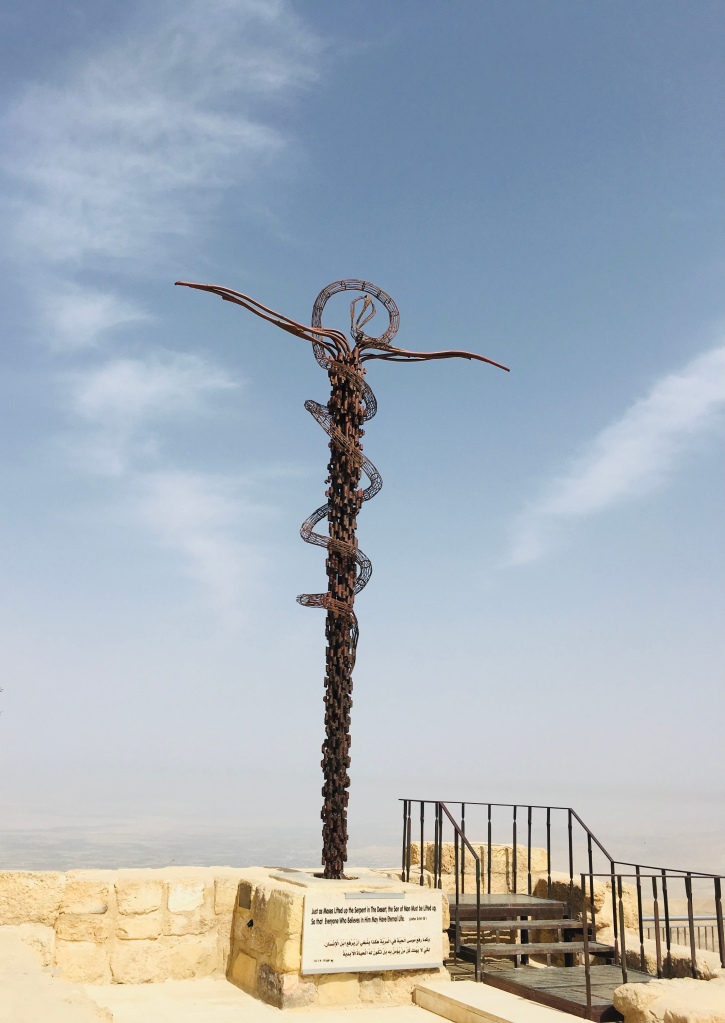
Photo by author in Jordan near the Israeli border where Moses put up the bronze serpent as instructed by God to heal those bitten by the snakes after they have complained of their conditions in the wilderness, May 2019.
While it is true life is indeed difficult, the cross reminds us of the fact that the pains and hurts we have are uniquely ours too, something we have to accept and most of all, own.
There are pains that are so deep and won’t go away that have in fact affected us dismally in our lives already. Instead of self-blaming and self-pity, we just have to ask for God’s grace to accept and own them like Jesus Christ. We just have to “bring it home” – that imagery of the Cross planted on the Calvary – into our very selves, in our being as something so true and real. And uniquely ours.
Stop thinking of others’ pains and hurts. We are not all the same. If ever we have similar experiences, the hues and shades even gravity and circumstances are not same because each pain and hurt, like the cross, is uniquely ours. Like every person, every cross is unique because it is also a gift, a mystery, and life. We have to “befriend” our pains and hurts, our own cross instead of resist it. It is in “befriending” our pains and hurts, our cross in life that we grow and mature, becoming more free to love and to be joyful because that is when the cross triumphs over its disgrace and shame in us and with others. That is when our pains and hurts, when our crosses begin to reveal to us the many beautiful truths of Easter awaiting us.
The Cross of Christ triumphed because Jesus carried it wholeheartedly, allowing those two pieces of wood to reveal not only to Him who knew everything beforehand its meaning but most of all to everyone of us the deeper truths the Cross signifies as St. Paul eloquently expressed in our second reading.
The Cross of Christ atop the church of our Lady of Lourdes in France. Photo by my former student Philip Santiago during his pilgrimage, September 2018.
One thing I realized after my mother died in May is the fact that while there are so many pains and sufferings in this world, my own pain and suffering in losing her are most difficult to bear; hence, something I must carry because it is uniquely mine.
But, one thing so unique I noticed is that the more I see my cross following my mother’s death, the more I saw also the cross of others. The Cross of Jesus triumphed truly in me when I embraced and owned my cross, when I befriended my pains and hurts that eventually led me to recognize and see, to feel more and experience too the crosses of others.
When we become conscious of each one’s unique cross, slowly we are able to reveal to them the meaning of their personal crosses too because we become more sympathetic, more open, more silent to listen more, love more, care more and be more present with those in their own unique cross. No wonder, I find conversing more engaging with others who also grieve because we can see each other’s unique crosses!
Jesus calls us to imitate Him that by embracing and owning our cross, we too may lead others to finding the meaning of their own cross and thus experience Easter soon. Let us pray:
Give us the grace, O God,
to always embrace the Cross
 like your Son Jesus Christ
where we can all be empty
of ourselves to be filled
with your Holy Spirit
to make your love visible in us.
Amen.
The Lord Is My Chef Daily Recipe for the Soul by Fr. Nicanor F. Lalog II
Friday, Memorial of St. John Chrysostom, Bishop & Doctor of Church, 13 September 2024
1 Corinthians 9:16-19, 22-27     <*((((><  +  ><))))*>     Luke 6:39-42
Photo by Mr. Jim Marpa, 2018.
Lord Jesus Christ,
help me be like St. Paul,
a man truly free:
free from slavery of sin,
free from selfishness,
free from what others may say
so that I may be truly
free to love,
free to serve,
free to be my true self.
Although I am free in regard to all, I have made myself a slave to all so as to win over as many as possible. I have become all things to all (omnia omnibus), to save at least some. All this I do for the sake of the Gospel, so that I too may have a share in it (1 Corinthians 9:19, 22-23).
In a world when most people
insist on their rights,
you teach us Lord through St. Paul
that inasmuch as the Church is the
your Body, then being a slave to others
is actually the path to true freedom,
making no room for anyone to insist
on his or her rights superseding
the common good;
most of all, in becoming
all things to all men like St. Paul,
then we acknowledge that
the strong and powerful
 must take into consideration
the needs of the weak and powerless;
forgive us, Jesus,
for blindly leading others
to doom and more darkness;
forgive us, Jesus,
for always seeing defects of others
without recognizing our own;
cleanse us with your words
like St. John Chrysostom
who wrote us in one of his letters
on the way to his exile,
"Distance separates us,
but love unites us,
and death itself cannot divide us.
For though my body die,
my soul will live and
be mindful of my people."
Amen.
The Lord Is My Chef Daily Recipe for the Soul by Fr. Nicanor F. Lalog II
Thursday, Twenty-third Week in Ordinary Time, Year II, 12 September 2024
1 Corinthians 8:1-7, 11-13     <'[[[[><  +  ><]]]]'>     Luke 6:27-38
Photo by author, 2018.
Brothers and sisters: Knowledge inflates with pride, love builds up. If anyone supposes he knows something, he does not yet know as he ought to know. But if one loves God, one is known by him (1 Corinthians 8:1-2).
O dear Jesus,
how lovely are your words
today through St. Paul;
so timely like during his time
when so many of us today
have become so proud and
arrogant in knowing so much
that have bloated their egos,
seeing only themselves
unmindful of others around them,
losing their personal touch,
forgetting their humanity,
miserably failing to love
at all.
Dear Jesus,
remind us anew of that
basic truth that true knowledge
is when we realize we know
so little,
that we must learn more
not only from books
but most of all from persons;
let us be more loving
so that we can build more
lasting and fulfilling relationships;
let us be more loving
so we can build more trust
and understanding when we
learn to love our enemies;
let us be more loving
so we can build more goodwill
and fellowship by being more
merciful like the Father in heaven;
let us be more loving
so we can build persons
than destroy them by being
non-judgmental of one another;
let us be more loving, Jesus,
so we can build and overflow
with more grace and gifts
as we give more of Jesus Christ.
Amen.
The Lord Is My Chef Daily Recipe for the Soul by Fr. Nicanor F. Lalog II
Wednesday in the Twenty-third Week of Ordinary Time, Year II, 11 September 2024
1 Corinthians 7:25-31     <*[[[[><  +  ><]]]]*>     Luke 6:20-26
Photo by author at Anvaya Beach Resort, Morong, Bataan, April 2024.
I tell you, brothers, the time is running out. From now on, let those having wives act as not having them, those weeping as not weeping, those rejoicing as not rejoicing, those buying as not owning, those using the world as not using it fully. For the world in its present form is passing away (1 Corinthians 7:29-31).
Thank you, dear Father
for these timely and wonderful
reminders as we often compare
our selves with others or
are never contented with what we have
or where we stand,
always wondering amid
great temptations that
"the grass is greener at the
other side of the fence."
Teach us contentment
in your Son Jesus Christ;
teach us dear Father
to be always aware of the
day of the Lord,
of Parousia;
while many times most Christians
believe in parousia,
only a few believe it will happen
in their lifetime;
many of us forget that
even if the parousia does not
occur in our lifetime,
our life will definitely end,
making us stand before the
judgment seat of Christ for sure;
help us realize that to live as if
our life will never end is the height of folly,
while to live with the knowledge
that our life will end is the beginning of wisdom.
That is why, Jesus calls us blessed
when we are poor,
when we hunger,
when we weep,
when we are hated
and maligned
because in your beatitudes
you make us look forward
what is beyond material and temporary,
that is passing away;
let us set our sights more
on things that shall remain after
everything has ended,
with things that shall persist
in eternity like our souls
and You, O God.
Amen.
The Lord Is My Chef Daily Recipe for the Soul by Fr. Nicanor F. Lalog II
Tuesday in the Twenty-third Week of Ordinary Time, Year II, 10 September 2024
1 Corinthians 6:1-11     <*[[[[><  +  ><]]]]*>     Luke 6:12-19
By Kay Bratt, Facebook, 13 December 2023.
Thank you,
Lord Jesus Christ
for continuing to call us
to be your disciples
and apostles,
inviting us to get closer
with You like the Twelve
to share your light
first of all to our fellow
disciples and apostles
who have lost their will
to burn.
Now indeed then it is, in any case, a failure on your part that you have lawsuits against one another. Why not rather put up with injustice? Why not rather let yourselves be cheated? Instead, you inflict injustice and cheat, and this to brothers. Do you not know that the unjust will not inherit the Kingdom of God? That is what some of you used to be; but now you have had yourselves washed , you were sanctified, you were justified in the name of the Lord Jesus Christ and in the Spirit of our God (1 Corinthians 6:7-9, 11).
Forgive us, Lord Jesus,
when many times we live and
act like the Corinthian Christians
forgetting our new person in You
received in Baptism,
when we turn to the courts
to get justice that often terribly
end in bitterness and recriminations;
instead of bearing your light of
justice and mercy,
love and equality,
kindness and tenderness,
we resort to the ways of the world,
endlessly debating on technicalities
that we forget the person and the
wrongs and evil done;
let us return to you,
Jesus, the true Light of the world
to dispel the darkness of sin
and evil around us
by being your witnesses
of the good news of salvation
as your new chosen people.
Amen.
Quiet Storm by Fr. Nicanor F. Lalog II, 09 September 2024
Image from crossroadsinitiative.com.
And people brought to Jesus a deaf man who had a speech impediment and begged him to lay his hand on him. He took him off by himself away from the crowd. He put his finger into the man’s ears and, spitting, touched his tongue; then he looked up to heaven and groaned, and said to him, “Ephphatha!” – that is, “Be opened!” – And immediately the man’s ears were opened, his speech impediment was removed, and he spoke plainly (Mark 7:31-35).
Come, Lord Jesus,
take me away from the
routines and ordinariness
of this life that has become
my comfort zone;
touch me again
and speak to me that word
"Ephphatha"
so I may be opened
to speak plainly again:
let me speak plainly of love
not with eloquent words
but with sincere gestures
of care and kindness for the
other person;
let me speak plainly of love
not with technicalities of the laws
and rituals but with mercy
and compassion for a sinner
and those who have gone wayward;
let me speak plainly of love,
dear Jesus, like you,
not with letters and punctuations
but full of tenderness for the
weak and the sick;
let me speak plainly by
being open, giving all that I have
not only whatever is in excess;
let me speak plainly not with
advocacies so passionate
but simply doing what is right
and good to keep this world
clean and just;
let me speak plainly, O Lord,
with a ready smile to anyone,
wide arms to hug and welcome
family and friends,
warmth and joy to inspire those
lost and about to give up;
let me speak plainly, Jesus,
like you that in the end of this
life the heavens may open
as I pray, "into your hands
I commend my spirit."
Amen.
Photo by author, Chapel of St. Francis Xavier, Sacred Heart Novitiate, Novaliches, QC, 20 March 2024.
The Lord Is My Chef Daily Recipe for the Soul by Fr. Nicanor F. Lalog II
Monday, Memorial of St. Peter Claver, Priest, 09 September 2024
1 Corinthians 5:1-8     <*((((><  +  ><))))*>     Luke  6:6-11
God our loving Father,
make me a yeast,
a leaven for your people,
bringing them into
a community,
a communion.
Do you not know that a little yeast leavens all the dough? Clear out the old yeast, so that you may become a fresh batch of dough, inasmuch as you are unleavened. For our Paschal Lamb, Christ, has been sacrificed. Therefore, let us celebrate the feast, not with the old yeast, the yeast of malice and wickedness, but with the unleavend bread of sincerity and truth (1 Corinthians 5:6-8).
Many times,
we in the Church fail
to recognize the importance
of corporate witness to
the Gospel as one body;
many times,
we pretend to be blind
and deaf and mute
in the evil pervading among us,
afraid of hurting others feelings,
worst, afraid of being unmasked
in living a double standard life;
straighten our lives,
Lord Jesus like that man
with a withered hand in the synagogue;
straighten our paths to your
righteousness as we discern
justice and mercy and love
whenever there are some
of us on the wrong side of the road.
Like St. Peter Claver
who called himself a
"slave of the slaves forever"
in his pioneering work among the
 African slaves in in Colombia,
grant us the grace of courage
and strength to dare start the
impossible of being a yeast,
a leaven to the people
transforming them into
witnesses of your Gospel.
Amen.







 lordmychef.com