The Lord Is My Chef Daily Recipe for the Soul by Fr. Nicanor F. Lalog II
Tuesday, Memorial of St. Hildegard, Virgin & Doctor of Church, 17 September 2024
1 Corinthians 12:12-14, 27-31     <'[[[[><  +  ><]]]]'>     Luke 7:11-17
Jesus journeyed to a city called Nain, and his disciples and a large crowd accompnaied him. As he drew near to the gate of the city, a man who had died was being carried out, the only son of his mother, and she was a widow. When the Lord saw her, he was moved with pity for her and said to her, “Do not weep” (Luke 7:11-13).
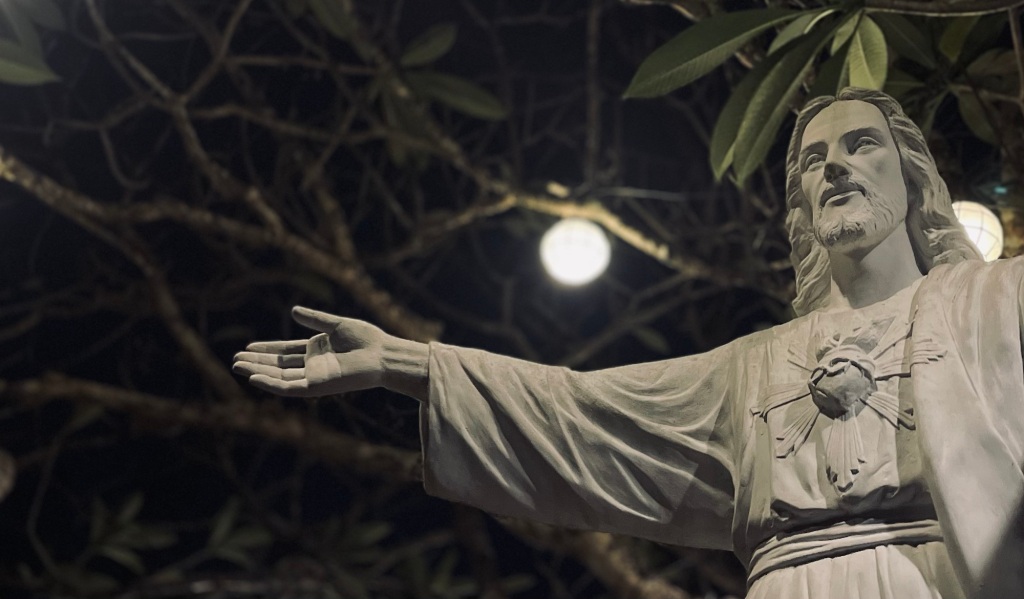
Today, O God our Father,
you remind us of life's fragility,
of life's daily crossings
into a gate, a portal
of death and life,
of weeping and rejoicing,
of absence and presence
like Jesus drawing near
to the gate of the city of Nain;
you give us each day
a chance to enter each day
filled with life and joy,
love and mercy
of your Son Jesus Christ.
We pray most especially for widows
who have lost everything:
their husband,
their son or daughter,
their joy and meaning in life;
help them cross each day's
gate and portal of their daily Nain;
how lovely that Jesus was
moved by the widowed mother
not by the dead son to be buried;
many times we forget the living
especially widows
without realizing the unique
pains and hurts they go through
in losing a husband
and a child.
Take care, dear Jesus,
of the widows and widowers too
who often cry alone,
suffer in silence
for their loss;
visit them today with
your warmth and joy
to comfort them with your
loving presence through
their family and friends,
the Church which is your Body.
Through the intercession of the
great mystic St. Hildegarde von Bingen,
may widows and widowers
experience what she had written that
"The mystery of God hugs you
in its all-encompassing mystery."
Amen.
The Lord Is My Chef Sunday Recipe for the Soul by Fr. Nicanor F. Lalog II
Twenty-fourth Sunday in Ordinary Time, Cycle B, 15 September 2024
Isaiah 50:5-9  <*{{{{>< James 2:14-18  ><}}}}*>  Mark 8:27-35
There is something very striking with the similarities and differences in our gospel last Sunday and today that greatly reveal to us the person of Jesus Christ whom we all imitate and follow as His disciples.
In Decapolis last Sunday, Jesus separated a deaf man – “took him off by himself away from the crowd” – to heal him by putting his fingers into the man’s ears, then spitted and touched his tongue as he groaned “Ephphatha” – be opened – and the man was healed as “he spoke plainly”.
Further up north of Decapolis which is the chief pagan city of Caesarea Philippi, the Apostle Peter took Jesus away from the crowd after the Lord spoke openly of His coming Passion, Death, and Resurrection.
But unlike the deaf mute healed when separated from the rest, Jesus rebuked Peter as He returned to the crowd as He continued to speak openly of His coming Passion, Death, and Resurrection.
He began to teach them that the Son of Man must suffer greatly and be rejected by the elders, the chief priests, and the scribes, and be killed, and rise after three days. He spoke this openly. Then Peter took him aside and began to rebuke him. At this he turned around and, looking at his disciples, rebuked Peter and said, “Get behind me, Satan. You are thinking not as God does, but as human beings do” (Mark 8:31-33).
Photo by author at Petra in Jordan, May 2019.
I love the contrast of these two events Mark tells us so succinctly without missing details that speak so well of God’s ways and man’s ways, of what is to think and act like Jesus and how the devil tricks us into its devious and insidious ploys.
See also how last Sunday the healed deaf-mute “spoke plainly” in Christ while today we are invited by Mark to “openly speak” like Jesus of life’s sufferings and death.
When God separates us from the rest of the people and our usual routines like what happened at Decapolis last Sunday, it is because He wants us to experience Him more closely, for us to be healed, and for us to touch base with Him anew who is the very root of our being. Like that nameless deaf man, we need to separate once in a while from the world for us to be healed of our many deafness so that we may listen more intently to God’s voice and words right in our hearts, in the scriptures, and in the cries of the poor and suffering among us.
Actually, Jesus was continuing in Caesarea Philippi His method last Sunday of “separating” when He first asked the Twelve “Who do people say that I am?” that prompted them to tell Him the many misconceptions about His identity. In a similar way with the deaf at Decapolis, Jesus took off the Twelve in Caesarea Philippi when He asked them the more specific question “But who do you say that I am?” and Peter rightly answered Him, “You are the Christ.”
Matthew has a similar story probably with some additions from other sources that we find Jesus praising Peter for his answer, entrusting to him the church, and promising him with the key to heaven. The rebuke of Peter would happen later in their journey.
Mark had none of that considering his gospel was Matthew’s basis. We find in Mark’s brief account of Peter’s confession at Caesarea Philippi Perhaps how often just as when we feel so close with God like Peter, it is the same moment when the devil comes to trick us to break away from God and follow our own ways, not His.
Photo by author near ancient city of Caesarea Philippi, May 2017.
The event at Caesarea Philippi gives us clearest sign to identify Jesus as the Christ, that is when Jesus speaks openly of His coming Passion, Death, and Resurrection.
He began to teach them that the Son of Man must suffer greatly and be rejected by the elders, the chief priests, and the scribes, and be killed, and rise after three days. He spoke this openly (Mark 8:31-32).
Jesus never hides us from the realities of life as He speaks “openly” of His Pasch. From Caesarea Philippi, Jesus and the Twelve would head back south towards Jerusalem making a stop over on Mount Tabor for the Transfiguration where Christ’s glory was revealed to Peter, James and John.
It was during His Transfiguration that that Father and the Son made clear that Christ’s glory cannot be separated from the Cross. It was after Caesarea Philippi when Jesus announced thrice to the Twelve His coming Passion, Death, and Resurrection.
Notice too that qualifier “must” – that He “must suffer greatly”.
Just one word but so powerful, showing us the consistency of Jesus in speaking about His Pasch, the Cross, and later its relationship with discipleship, of the need for us to forget ourselves, take up our cross and follow Him.
Our motorized procession of the Blessed Sacrament in our previous Parish at the start of the COVID-19 lockdown in March 2020. Photo by Ms. Anne Ramos.
It saddens me when some priests and people in the Church shy away from talking openly about life’s many sufferings. We recognize their good intentions of not forgetting the beautiful and brighter side of being a Christian but to look at the Cross negatively and all its other implications is totally unChristian.
We cannot disregard the pains and darkness that come in being a disciple of Jesus; the Cross is the life of a disciple because it is the center of Christ’s person and teachings as expressed in yesterday’s Feast of the Exaltation of the Cross. All these “health and wealth” style of many preachers even in the Church are red flags of the devil’s ploy, of Peter separating Jesus from the Cross.
We act like Peter rebuking Jesus in Caesarea Philippi whenever we try to soften or hide, even cover the corruption and abuses going on in the society and families, the Church and our communities. That is clearly thinking in man’s ways not in God’s ways.
We cannot arrive at the truth and beauty of life disregarding the falsehoods and negativities around us. That was the problem with the people in mistaking Jesus as one of the prophets who were seen more as miracle workers who instantly healed them of their sickness.
Photo by author in my previous parish, 2017.
And here lies the danger too to us that we will never be able to have a good answer to Christ’s question “But who do you say I am?” if we avoid the many passion and death of this life in Jesus.
To openly speak like Jesus and embrace the sufferings and death we must endure is our first expression of faith with works we heard in the second reading from James.
To openly speak like Jesus and embrace the sufferings and death we must endure is the fulfillment of the first reading’s Song of the Suffering Servant who is Jesus Himself.
When we openly speak and embrace life’s daily sufferings and deaths like Jesus is to trust completely in God like Him. Let us speak openly of the Cross, of love and mercy, of God like Jesus Christ! Let us pray:
Lord Jesus Christ,
let me continue to follow
you closely by separating
from the rest often
to hear you more,
to love you more,
to trust you more;
let me know you more clearly
so that I may love you more dearly
and follow you more closely
speaking plainly,
speaking openly
without sugarcoating your call,
your Cross.
Amen.
The Lord Is My Chef Daily Recipe for the Soul by Fr. Nicanor F. Lalog II
Saturday, Feast of the Exaltation of the Cross, 14 September 2024
Numbers 21:4-9 ><}}}}*> Philippians 2:6-11 ><}}}}*> John 3:13-17
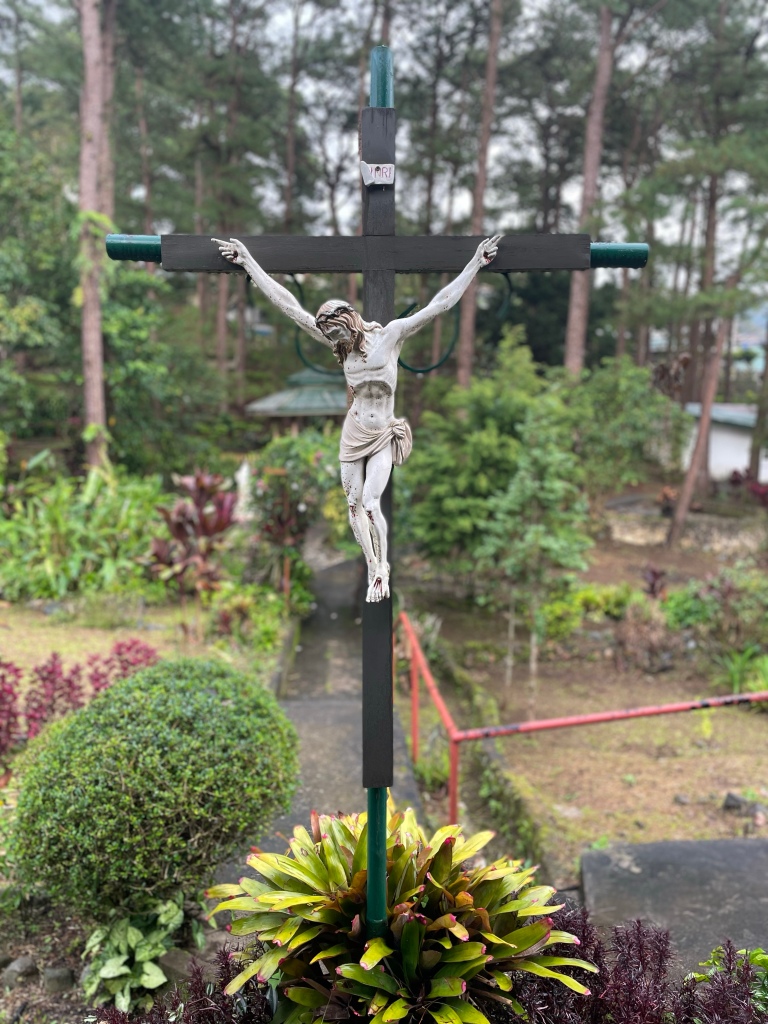
Photo by author in my previous parish, 2017.
Today we celebrate a most unique Feast, the Exaltation of the Cross.
It is so unique because first of all, the cross is perhaps the most unique thing on earth made up of two pieces of wood that are so ordinary yet so deeply extraordinary in meaning, a sign of God’s immense love for us humans through Jesus Christ’s Passion and Death.
From being the sign of the most inhuman punishment in history, the Cross is now the very sign of how God “so loved the world that he gave his only Son, so that he who believes in him might not perish but might have eternal life” (Jn.3:16). It encapsulates the whole mystery of Jesus Christ, of how this all-powerful God beyond the ordinary became weak like us in everything except sin so that we too may be like Him, divine and more than ordinary. In His suffering and death on the Cross, Jesus made the lowly wood so ordinary to be so exalted to become His sign of love and mercy, power and majesty.
Photo by author, Jerusalem, May 2017.
Hence, in the Cross is the power of God’s love to transform us to better persons.
In the Cross is God’s power to lead us closer to Him with its vertical beam and to others with its horizontal beam.
In the Cross is the power of good if we choose to embrace it with Christ Jesus as our Lord and Master.
The Cross is most unique of all signs in the world because underneath its ordinariness, that is where we see God’s glory and majesty. It was underneath the Cross of darkness and gloom on Good Friday that humanity began to see light and hope in life’s many absurdities. Most of all, it was underneath that Cross of suffering and death of Jesus Christ that we feel and experience the assurance of the Resurrection.
How?
Through our own pains and sufferings that are most uniquely ours too!
With their patience worn out by the journey, the people complained against God and Moses, “Why have you brought us up from Egypt to die in this desert, where there is no food or water? We are disgusted with this wretched food!” In punishment the Lord sent among the people saraph serpents, which bit the people so that many of them died (Numbers 21:4-6).
Photo by author, Dominican Hills, Baguio City, January 2018.
You must have heard that old story of a man who came to Jesus to return the cross given for him to carry; he asked Jesus to have it replaced with a lighter one. Jesus then led the man to a huge room with all kinds of crosses for him to choose which he prefers as the best one for him so that he would stop complaining.
After closely examining the specs of so many crosses, the man finally decided to pick one he deemed as perfect for him after considering its weight and other dimensions, only to find out from Jesus Himself that it was the same cross he had actually returned for exchange!
Many times in life we are like those people in the first reading, never ending in their complaints to God, even challenging Him, accusing Him of forsaking us, of being unfair when life becomes difficult and unbearable. There are times we feel being on the distaff side of life always like a flat tire, never on top. We cry foul to God especially with all our hurts and pains inflicted by others, asking Him where was He when most needed?
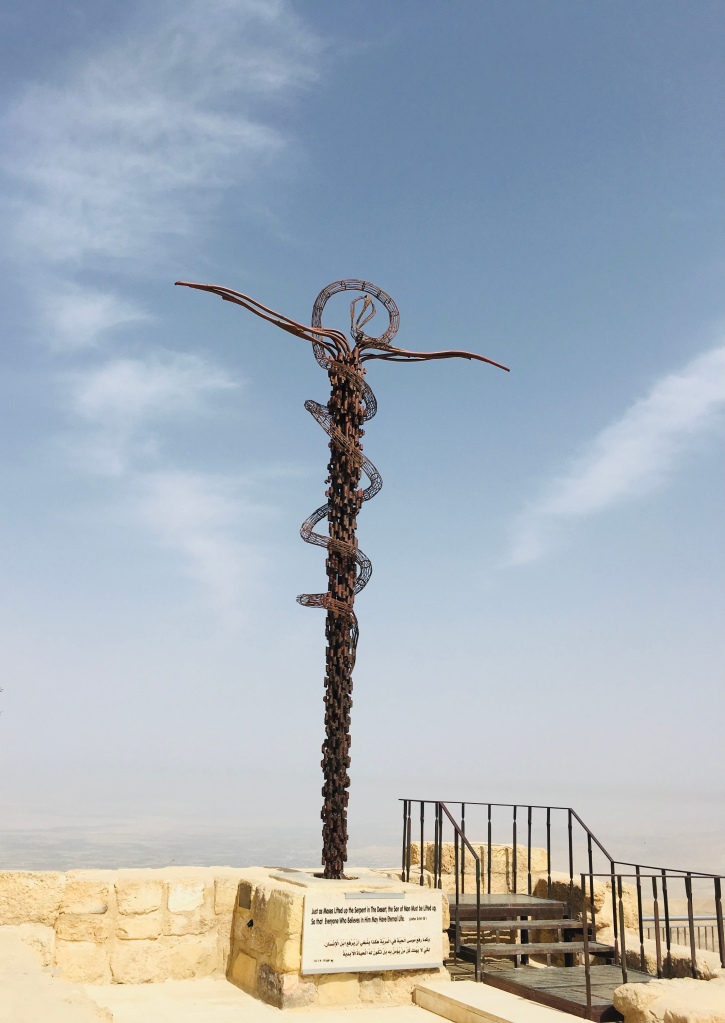
Photo by author in Jordan near the Israeli border where Moses put up the bronze serpent as instructed by God to heal those bitten by the snakes after they have complained of their conditions in the wilderness, May 2019.
While it is true life is indeed difficult, the cross reminds us of the fact that the pains and hurts we have are uniquely ours too, something we have to accept and most of all, own.
There are pains that are so deep and won’t go away that have in fact affected us dismally in our lives already. Instead of self-blaming and self-pity, we just have to ask for God’s grace to accept and own them like Jesus Christ. We just have to “bring it home” – that imagery of the Cross planted on the Calvary – into our very selves, in our being as something so true and real. And uniquely ours.
Stop thinking of others’ pains and hurts. We are not all the same. If ever we have similar experiences, the hues and shades even gravity and circumstances are not same because each pain and hurt, like the cross, is uniquely ours. Like every person, every cross is unique because it is also a gift, a mystery, and life. We have to “befriend” our pains and hurts, our own cross instead of resist it. It is in “befriending” our pains and hurts, our cross in life that we grow and mature, becoming more free to love and to be joyful because that is when the cross triumphs over its disgrace and shame in us and with others. That is when our pains and hurts, when our crosses begin to reveal to us the many beautiful truths of Easter awaiting us.
The Cross of Christ triumphed because Jesus carried it wholeheartedly, allowing those two pieces of wood to reveal not only to Him who knew everything beforehand its meaning but most of all to everyone of us the deeper truths the Cross signifies as St. Paul eloquently expressed in our second reading.
The Cross of Christ atop the church of our Lady of Lourdes in France. Photo by my former student Philip Santiago during his pilgrimage, September 2018.
One thing I realized after my mother died in May is the fact that while there are so many pains and sufferings in this world, my own pain and suffering in losing her are most difficult to bear; hence, something I must carry because it is uniquely mine.
But, one thing so unique I noticed is that the more I see my cross following my mother’s death, the more I saw also the cross of others. The Cross of Jesus triumphed truly in me when I embraced and owned my cross, when I befriended my pains and hurts that eventually led me to recognize and see, to feel more and experience too the crosses of others.
When we become conscious of each one’s unique cross, slowly we are able to reveal to them the meaning of their personal crosses too because we become more sympathetic, more open, more silent to listen more, love more, care more and be more present with those in their own unique cross. No wonder, I find conversing more engaging with others who also grieve because we can see each other’s unique crosses!
Jesus calls us to imitate Him that by embracing and owning our cross, we too may lead others to finding the meaning of their own cross and thus experience Easter soon. Let us pray:
Give us the grace, O God,
to always embrace the Cross
 like your Son Jesus Christ
where we can all be empty
of ourselves to be filled
with your Holy Spirit
to make your love visible in us.
Amen.
The Lord Is My Chef Daily Recipe for the Soul by Fr. Nicanor F. Lalog II
Thursday, Solemnity of the Assumption of the Blessed Virgin Mary, 15 August 2024
Revelation 11:19;12:1-6, 10 ><}}}}*> 1 Corinthians 15:20-27 ><}}}}*> Luke 1:39-56
Photo from shutterstock.com
Glory and praise,
God Almighty Father
in sending us Jesus our Savior
who gave us His Mother
the Blessed Virgin Mary,
the very first fruit as St. Paul said
of Christ's wondrous work
of salvation due her oneness in Him.
Mary set out and traveled to the hill country in haste to a town of Judah, where she entered the house of Zechariah and greeted Elizabeth (Luke 1:39-40).
Right after the Annunciation
to Mary, her path to her Assumption
began when she "set out and
travelled to the hill country in haste"
to share Christ in her with Elizabeth;
what a beautiful imagery of the same
path to the Calvary, another hill
outside Jerusalem to be with Christ
her Son.
Bless us with the same grace
You gave Mary your Mother, Lord Jesus,
to follow your path to every hill in this life,
to be one with those especially who are
in pain and suffering; let us trust in You
fully in faith, hope and love that the
sufferings we may endure in setting out
to travel to the hills of this life is
the very path of our assumption
in You; let us realize that despite the
many comforts and ease of technology
today, it is not what life really is, that
we all have to go through your
Passion, Death, and Resurrection.
Like Mary, may we believe
your words, Jesus,
will be fulfilled.
Amen.
“The Assumption of the Virgin” by Italian Renaissance painter Titian completed in 1518 for the main altar of Frari church in Venice. Photo from en.wikipedia.org.
The Lord Is My Chef Daily Recipe for the Soul by Fr. Nicanor F. Lalog II
Tuesday, Feast of the Transfiguration of the Lord, 06 August 2024
Daniel 7:9-10, 13-14 ><}}}}*> 2 Peter 1:16-19 ><}}}}*> Mark 9:2-10
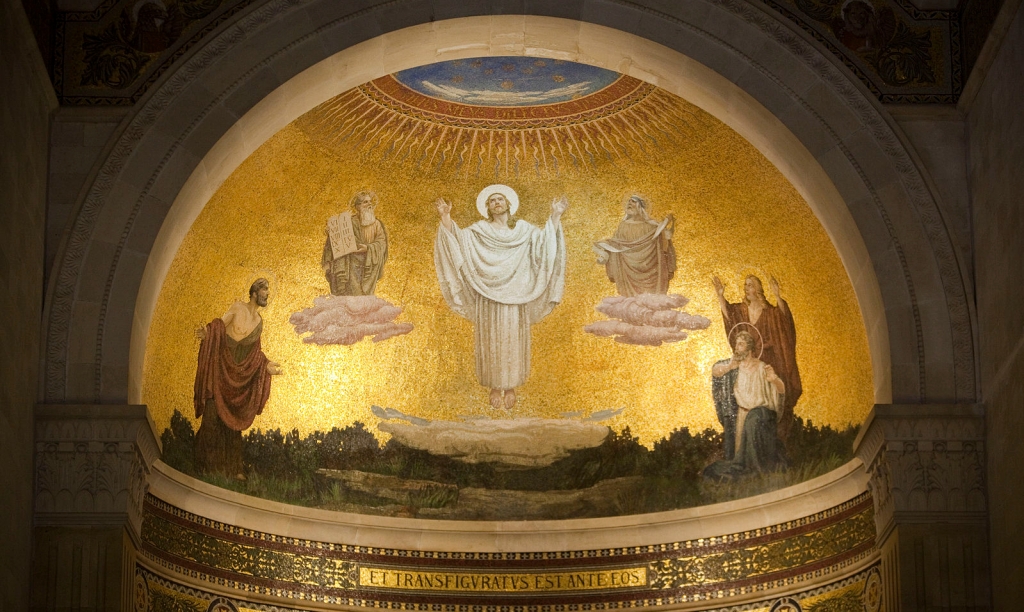
Photo from commons.wikimedia.org of mosaic inside the Basilica of the Transfiguration on Mt. Tabor, Israel.
Thank you very much, Lord Jesus,
 "in taking us always with You,
apart from others by ourselves
like Peter, James, and his brother John
to a high mountain” (cf. Mark 9:2);
many times You set us apart from others
amid many darkness like that night
on Mount Tabor
just to be with You,
to experience You;
how ironic in this age of
so much light everywhere
with a world running 24/7,
the more we are plunged
in darkness
that we feel lost and empty.
Continue to invite us
to detach from so much
worldly attachments
that are so irresistible
due to social media
and the glamor that come with them.
And he was transfigured before them, and his clothes became dazzling white, such as no fuller on earth could bleach them… Then a cloud came, casting a shadow over them; then from the cloud came a voice, “This is my beloved Son. Listen to him” (Mark 9:2-3, 7).
Like Peter, James, and John
we also wonder at the meaning
of your Passion and Death when You
are the Christ?
Why all the sufferings happening
in us and among us with all
the confusions and divisions going on?
Like Peter during the Transfiguration,
we do not know what we are saying to you, Lord;
whether we are filled with joy or burdened
with sorrow, we speak without thinking much
even if you know what is in our hearts.
Open our hearts, dear Jesus,
to always listen to You by remaining with You
on the path to Your Cross;
let us listen more than talk
or click more without much reflections;
two ears form the image of heart,
never the mouth nor the lips.
Let us heed Peter in his words today:
Moreover, we possess the prophetic message that is altogether reliable. You will do well to be attentive to it, as to lamp shining in a dark place, until day dawns and the morning star rises in your hearts (2 Peter 1:19).
Bring us back to your path of faith, Jesus;
amidst all these noise and divisions
of relativism and wokism,
open our hearts by listening intently
to your voice when all is dark
and even dead or as it happens these days,
blindingly so bright with artificial lights
because for as long as we return to You,
sin and failures become means for us
to be changed and transformed -
or transfigured
when we rise in your Resurrection.
Amen.
A 1311 painting of the Transfiguration by Italian artist Duccio di Buoninsegna from commons.wikimedia.org.
The Lord Is My Chef Daily Recipe for the Soul by Fr. Nicanor F. Lalog II
Monday, Memorial of Sts. Martha, Mary & Lazarus, 29 July 2024
1 John 4:7-16     <*{{{{><  +  ><}}}}*>     John 11:19-27
“The Raising of Lazarus”, 1311 painting by Duccio de Buoninsegna from commons.wikimedia.org
If you have love in your heart, you have been blessed by God; if you have been loved, you have been touched by God (Anonymous author).
What a lovely Monday
You have given us today,
O God our Father
as we celebrate the Memorial
of the friends of Jesus Christ,
the sisters St. Mary and St. Martha
with their brother St. Lazarus -
a beautiful
and most powerful
reminder to us all
that Jesus comes
first in our family
most especially
among our siblings.
How sad, dear Father
are the growing number of couples
having only one child
or two the most
with kids denied of this
most wonderful experience
of kinship;
on the other hand,
there is the growing trend
of family disintegration
due to divorce and separation
of many couples
with children as main casualties;
likewise, of the growing trend
among young people to selfishly
pursue many things in life
in total disregard of others
beginning in their own family circle.
No one has ever seen God. Yet, if we love one another, God remains in us, and his love is brought to perfection in us (1 John 4:12).
Help us, dear Father,
to rekindle this love
we first experienced
in our homes,
among our siblings
like Saints Mary,
Martha and Lazarus;
let us discover anew
the wonderful
and amazing gifts of
brothers and sisters
in the family
who remind us
of your blessing us
with so much love in our hearts;
let us feel and
experience again
your gift of love in our hearts
in the mere mention of
names of our own brother
and/or sister
who made us first experience
love next from our parents;
refresh our memories
of those times You touched us
with the selfless love,
the unconditional love
freely shared with us
by our brother
and/or sister.
We pray,
most merciful Father,
for all brothers
and sisters separated
from each other
due to misunderstandings,
jealousy,
betrayals and mistrust;
like St. Martha,
let us never lose faith
and hope for estranged
brothers and sisters
to rise anew from their
deaths into sin,
to find again that love
You have given them in their hearts
and most of all,
touch them
so they may remember
and miss anew
those experiences
of being loved by their
siblings in their childhood
to rebuild their ties again
in Jesus Christ our Lord.
Amen.
An icon of Jesus visiting his friends, the siblings Sts. Lazarus, Mary and Martha. Photo from crossroadsinitiative.com.
The Lord Is My Chef Sunday Recipe for the Soul by Fr. Nicanor F. Lalog II
Fourteenth Sunday in Ordinary Time, Cycle B, 07 July 2024
Ezekiel 2:2-5 ><}}}}*> 2 Corinthians 12:7-10 ><}}}}*> Mark 6:1-6
Photo by Mr. Gelo Carpio, Bagbaguin, Sta. Maria, Bulacan, January 2020.
Last week’s readings clarified with us the disturbing mystery of death and sickness are not from God but from the evil enemy. Nothing bad could come from God who is love Himself that is why He sent us Jesus Christ to heal and save us. Should something bad happen to us, God works silently to ensure everything would turn out good for us. Hence, the need for faith.
Today our readings clarify another mystery in life that happens so often that we encounter daily despite our efforts and sacrifices, demanding us for more faith too. It may be lighter than death or tragedies but still a kind of suffering that is most persistent, even troublesome we refer to as failures like rejections and other weakness we have as humans.
Jesus departed from there and came to his native place, accompanied by his disciples. When the Sabbath came he began to teach in the synagogue, and many who heard him were astonished… And they took offense at him (Mark 6:1-2,3c).
Photo by author, 2023.
Mark tells us today how our Lord Jesus Christ embraced failure and rejection. Though perfect and powerful, Jesus chose to be weak and powerless, experiencing rejections so that we may become like Him, holy and divine.
If we go by the world’s standard, Jesus and His mission were actually a “failure” after He was rejected by the crowds, shamed and crucified along with two other criminals. But, it was in that failure that Jesus rose again on Easter!
See that small detail Mark noted so well in his story this Sunday, “they took offense at him (Mk.6:3c).” It is that classic case among us humans we say so well in Filipino, “walang personalan, trabaho lang”. Everything is personal because we are all relating beings. Every rejection is personal. However, Jesus is teaching us too that rejection and failures become a problem when we are not able to accept them as a part of our weaknesses as humans.
Photo by author, 2019.
Of course, it is painful. And that’s the good news this Sunday – Jesus is with us in every failure and rejection we go through as He joins us in crossing this life right in our own home and among our own people with all the negative things they throw on us. Jesus must have felt sad too when His own folks “took offense at him.” Rejection is humiliating as we feel to have failed in life. Or worst, as if we are a failure. Even that simple act of being “unfriended” in Facebook is painful, is it not?
However, when we examine failures and rejections, these are not really about us but more on those around us, on those “who took offense at us” that like Jesus, we really can’t perform anything at all because those around us lack faith and not that we are powerless or could not do anything at all.
This Sunday, Jesus is telling us not to take every failure and rejection personally though it is really very personal. See the other sides of failures in life as these are not really that bad at all! Oftentimes, we are not the problem but those who reject us. Have a heart. Stop those self-pity. Next Sunday after this rejection in Nazareth seen by the Twelve, Jesus would even send them to preach and heal;surely, part of their mission was to face rejection first hand too.
Photo by author, 2023.
Once again, Mark is revealing to us who is Jesus Christ really – truly Divine, the Son of God who spoke with authority, who could heal the sick and raise the dead but at the same time, truly human who embraced rejections and failures, even becoming “powerless” that would reach its highest point on Good Friday.
And to know Jesus more is to have that deep faith in Him which is most essential like a hinge connecting us to Him and other virtues. Even God cannot do anything at all if we do not have faith in Him, if we do not believe Him. Jesus had said this a few weeks ago when He mentioned the sin agains the Holy Spirit. We can’t even talk of any relationships unless we have faith from which springs love and understanding.
Most of our failures and pains in life came from this lack of faith in our family like mistrust among husband and wife or among children and parents. Failures begin when we refuse to believe or have faith in our very selves, with others, and with God. When people lack faith, we have no relationships, no common ground to start anything like simple conversations and dialogue that is more of being with others than a way of thinking through issues and problems.
Photo by author, 2022.
Lately I have been going through some serious reflections in life as friends and colleagues in my former work and past ministries are retiring and getting sick with some of them dying. One thing I have realized is that no one is really so good, so brilliant because each one of us has imperfections and limitations.
The best managers and pastors I have met and known are those who knew so well how to gather and inspire the best people to work together.
Most of all, when I look back to these great men and women who have taught and formed me in school and work, their most outstanding trait is their courage to be imperfect. They do not hide their fears and failures, insecurities and mistakes that they were able to see more of what is possible than impossible because they believed in God, in themselves and in others.
Faith is infectious like disbelief or unbelief. Better choose faith which leads us to life. See how the men and women in the Church who have become saints like St. Paul along with the many statesmen, thinkers, writers, and scientists who were able to shape and change the world by being courageous enough to be imperfect due to their faith.
Photo by author, Malagos Garden Resort, Davao City, 2018.
God knows our limitations and weaknesses; most of all, our sinfulness yet, He never loses hope in us that He continues to call us to be converted, even sending us prophets who at the start are already aware of the failures and rejections they would face in such difficult mission.
This is one important aspect we priests have forgotten or disregarded – the courage to be imperfect as we always play God. Nobody’s perfect except God; the challenge in this life is to overcome every failure and defeat we encounter for that is how we are perfected. Remember that term “blessings in disguise” that are our many imperfections in life.
When facing a failure in life, the best thing to do is to be silent and to pray, be the presence of God like the prophets, “And whether they resist— for they are a rebellious house — they shall know that a prophet has been among them” (Ez.2:5). After all, God’s “grace is always sufficient” for us because “power is made perfect in our weaknesses so that when we are weak, then we are strong in Christ Jesus” (1Cor.12:9,10).
During His lifetime here on earth, Jesus was “amazed” only twice. First was when a Roman centurion asked Him to cure his slave from afar, saying “I am not worthy to have you enter under my roof; only say the words and my servant will be healed.” Jesus was “amazed” that He cured the servant from afar, declaring that He had not seen such great faith in Israel (Mt.8:5-13). The other time Jesus was amazed was when He returned home narrated in our Gospel this Sunday when people “took offense at him” that “He was amazed at their lack of faith” (Mk.6:3,6).
When Jesus comes, would He be amazed with our great faith, or with our lack of faith?
Be amazed. Choose Jesus, choose faith in Him, the Christ! Let us pray:
Lord Jesus Christ,
thank You for always
believing in me despite
my sins and many flaws;
remind me always I am not You,
and therefore,
imperfect and weak;
keep me faithful and
persevering in You,
crossing the turbulent sea of life,
helping others cross
to make it through to the side of life;
let me your voice of hope
and your presence in this world
fascinated with anything
that glitters and sparkles,
afraid of the dark,
of emptiness,
of failures,
of faith.
Amen.
The Lord Is My Chef Daily Recipe for the Soul by Fr. Nicanor F. Lalog II
Friday, Solemnity of the Most Sacred Heart of Jesus-B, 07 June 2024
Hosea 11:1, 3-4, 8-9 ><}}}*> Ephesians 3:8-12, 14-19 ><}}}*> John 19:31-37
You must be wondering why this photo of a quote from Tom Hanks’ 1994 character Forrest Gump on the Solemnity of the Most Sacred Heart of Jesus. What’s with shoes and the Sacred Heart of Jesus? Let me explain…
Last Tuesday while checking on my Facebook, I saw the post of a former seminarian who said, “Buying us shoes has been the love language of my parents to us… It will not change.” Posted below were photos of him buying two kids with new pairs of shoes.
How I admired him for being a father to those less fortunate kids! And that’s why I remembered Forrest Gump too who said how his mother used to tell him that shoes tell a lot about people, “Where they are going. Where they been.”
There’s something special with our feet, with the shoes we wear. Or do not wear. One is clear, though: our feet being at the lowest part of our body are most cared when we are growing up but later forgotten though overworked. That is why, it is so wonderful to go back to those days of childhood when our parents used to buy us with new pair of shoes, of how they would stoop down to help us fit the right ones for us. Just like God who is a Father to each one of us!
Thus says the Lord: when Israel was a child I loved him, out of Egypt I called my son. Yet it was I who taught Ephraim to walk, who took them in my arms; I drew them with human cords, with bands of love; I fostered them like one who raises an infant to his cheeks; Yet, though I stooped to feed my child, they did not know that I was their healer.
That’s the tenderness of God, so Fatherly to us in taking care of us, teaching us to walk, taking us to his arms, lovingly raising us to his cheeks while we burst in laughter. Try reading that whole quotation to include the second verse skipped by our lectionary today, the more you can feel God’s tenderness. And our sinfulness.
Thus says the Lord: When Israel was a child I loved him, out of Egypt I called my son. The more I called them, the farther they went away from me.
Hosea 11:1-2
Is it not this is how our love relationship is with our parents and family including God?
When we were kids, we loved running to our parents, taking pride for being their son or daughter, always clinging to their big hands. Or, like couples at their early years in marriage who seem to be inseparable and always together. Then, as years passed by as we find new friends and new relationships, we drift apart from our parents or spouse, including God. And worst, we drive them away, even feeling ashamed of them especially when they come near us with their gestures of love and concern. But, when problems arise like betrayal and infidelity, failures and losses, we return to our parents or to our original spouse or family, and most especially to God, rediscovering their genuine love that is so tender and very comforting again: “I took you in my arms, drew you with human cords with bands of love. I fostered you like one who raises an infant to his cheeks; yet, though I stooped to feed you my child, you did not know I am your healer” (Hos.11:3-7).
From GettyImages.com.
That “stooping down” by God He had spoken to Hosea hundreds of years earlier took its deepest plunge when He sent us Jesus Christ His Son as our Savior by dying on the Cross. In fact, Jesus literally “stooped down” on the night He was betrayed when He washed the feet of His disciples to portray to them the depth of His love for us all.
From His birth to His passion and death, Jesus Christ, therefore, is the Father’s love language.
This was very evident on Good Friday as John narrated how the soldiers broke the legs of the other two thieves crucified with Jesus to hasten their death; but, when they saw Jesus “already dead, they did not break his legs, but one soldier thrust his lance into his side, and immediately blood and water flowed out. For this happened so that the Scripture passage might be fulfilled: Not a bone of it will be broken. And again another passage says: They will look upon him whom they have pierced” (Jn.19:33-34, 36-37).
Jesus Christ is the Father’s love language to us all because His death on the Cross is the most tender moment of love in history when our God who personally loves us by becoming like us in everything except sin loved us until the last drop of His blood because we are His beloved brothers and sisters in His loving and faithful Father in heaven we have always deserted in our many sins.
Photo by author, Baguio City, 2023.
Indeed, when blood and water flowed out from His pierced side on the Cross, the ocean of Divine Mercy flowed out for us, forgiving our most grievous sins, regardless of our many weaknesses.
In His Most Sacred heart, Jesus is inviting us to have tender moments with Him, to have the same “love language” of sacrifice and giving of self for others so that “He may dwell also in our hearts through faith so that once we are rooted and grounded in His love, we may have the strength to comprehend the breadth and length and height and depth of His love that surpasses knowledge and be filled with the fullness of God”(Eph.3:17-19).
Unlike us humans, God makes no mistakes in loving. He remains faithful to us with His love, even “allowing” us often to sin and commit mistakes so that eventually, when we hit rock bottom, we rediscover Him and His love that is so real and so personal.
That is why we must heed St. Paul’s admonition in the second reading to be “rooted and grounded in His love” because human love is always imperfect. Only God can love us perfectly in Christ Jesus who offered Himself on the Cross to fulfill what we have failed since the beginning – that is, to love God and others.
Photo by author, Sacred Heart Novitiate, Novaliches, QC, 20 March 2024.
Today we complete the series of three Solemnities in Ordinary Time right after the great season of Easter: Trinity, Body and Blood of Christ, and now, the Most Sacred Heart of Jesus. All three Solemnities tell us how great is this God we believe in, someone so immense and powerful, yet so loving and so gentle; most of all, a God so personal that He is much like us but at the same time so different from us.
This Solemnity of the Sacred Heart of Jesus is an occasion for us to meditate deeply on how God touches us in the most intimate manner when He stooped down in Christ through the Cross to experience His love and mercy so that we could make others feel that too.
Like John who witnessed everything on the Cross, we need to see more with the eyes of faith the realities of God’s immense love for us who gave His Son Jesus as the new Lamb offered for our many sins and that is why, in accordance with the Jewish law and with the Old Testament, not one of His bones were broken on the Cross. May we learn to stoop down like God in Jesus by looking down to our feet by first examining our hearts as we pray, Jesus meek and humble heart make my heart like thine! Amen.
Photo by author, Sacred Heart Novitiate, Novaliches, QC, 20 March 2024.
The Lord Is My Chef Daily Recipe for the Soul by Fr. Nicanor F. Lalog II
Wednesday, Memorial of St. Boniface, Bishop & Martyr, 05 June 2024
2 Timothy 1:1-3, 6-12     <*((((><  +  ><))))*>     Mark 12:18-27
Photo by author, Sacred Heart Novitiate, Novaliches, QC, 20 March 2024.
Thank you so much,
dear Jesus for your words
today that shed light again
to this issue about divorce:
of how resurrection is real because
God is very much alive,
very much present with us
and in us!
Jesus said to them, “Are you not misled because you do not know the Scriptures or the power of God? When they rise from the dead, they neither marry nor are given in marriage, but they are like the angels in heaven. As for the dead being raised, have you not read in the Book of Moses, in the passage about the bush, how God told him, I am the God of Abraham, the God of Isaac, and the God of Jacob? He is not God of the dead but of the living. You are greatly misled.
Mark 12:24-27
Most of all,
you have shown us too how
marriage is a path towards heaven:
man and woman marry in this life
for a taste of heaven,
to work for heaven,
to try making this imperfect world
a heaven, your dwelling;
we pray for all couples
especially those going through
crises these days
to heed St. Paul's words to
Timothy, "to stir into flame
the gift of God" they have received
on their wedding day before
your altar:
For God did not give us a spirit of cowardice but rather of power and love and self-control. So do not be ashamed of your testimony to our Lord, not to me, a prisoner for his sake; but bear your share of hardship for the Gospel with the strength that comes from God.
2 Timothy 1:7-8
Remind us that life
is always difficult
because there is always
the cross we have to carry;
however, let it sink into us too
that the cross is meant to make
us better and stronger,
that every sacrifice and
mortification we make is not to lose
life but actually to gain it more,
to have it more fully!
Most of all, every perseverance
to love and to forgive,
to be kind and be caring
happen all in your grace, O God;
in this age of instants
when every difficulty has become
a door to escape and exit from problems,
let us not be ashamed of the
real stuff that truly makes
life meaningful
by suffering and dying
in You, dear Jesus;
in this time of serious attacks
against marriage,
may we remember the words
of your servant St. Boniface
"Let us be neither dogs
that do not bark
nor silent onlookers
nor paid servants
who run away before the wolf.
Instead,
let us be careful shepherds
watching over Christ's
flock."

May we stand for what
is true and good,
O Lord,
not only in words but
especially in deeds,
 witnessing your Gospel.
Amen.
Photo by author, Ubihan Island, Meycauyan City, December 2021.
The Lord Is My Chef Easter Recipe for the Soul by Fr. Nicanor F. Lalog II
Fourth Sunday in the Easter Season, Cycle B, 21 April 2024
Acts 4:8-12 ><}}}}*> 1 John 3:1-2 ><}}}}*> John 10:1-10
Photo by author, dusk at Anvaya Cove in Bataan, 15 April 2024.
My kinakapatid is turning 60 this week with a dinner to be prepared by an Italian chef. His sister texted me for my main course and I chose lamb chops. And immediately she replied, “Pareho tayo. Mary’s little pet… the one who takes away the sins of the world.” Her wit floored me that I had to agree with a text, “Right. The most biblical and holiest food.”
Sorry for some little bragging as we celebrate this fourth Sunday in Easter as “Good Shepherd Sunday”…
We Filipinos have a hard time getting the “feel” of the shepherd because we have never had that image in our culture. Hence, it is a most welcomed development that there is now a growing popularity in tending sheep in the country while the Filipino palate had finally discovered a taste for lamb.
Come to think of this: the sheep exists only for two reasons, for food and clothing. They are meant to be slaughtered unlike dogs or cats or birds kept as pets. Another notable thing with sheep is the fact it is the only land animal that go against the flow when crossing a river like the salmon!
Photo by Dra. Mylene A. Santos, MD, at Katmon Nature Sanctuary & Beach Resort in Infanta, Quezon, 03 April 2024.
I love those characteristics of the sheep, for slaughtering which is almost like offering and always going against the tide. Exactly just like our Lord Jesus Christ who identified Himself as the good shepherd.
Jesus said: “I am the good shepherd. A good shepherd lays down his life for the sheep… This is why the Father loves me, because I lay down my life in order to take it up again. No one takes it from me, but I lay it down on my own. I have power to lay it down, and power to raise it up again. This command I have received from my Father (John 10:11, 17-18).
First we notice here His use of the “I AM” which for the Jews refers to God when He told Moses “I AM WHO AM.” Clearly, Jesus was declaring to the people at that time that He is the Son of God, the awaited Messiah or Christ.
This scene was shortly before the feast of the dedication of the Jews after Jesus had healed a man born blind, a miracle never heard of at that time. It was a big issue then as authorities refused to accept that Jesus did indeed healed the man born blind.
Secondly, Jesus mentioned four times in just three verses the act of “laying down his life for the sheep” (vv. 11, 17, and 18). It sounded so good to hear how Jesus loves us so much that He would lay down His life for us his sheep; but, those were not just mere words Jesus expressed but a reality that happened at the Cross on Good Friday that He actually explained after this discourse at their Last Supper!
Keep in mind that we are now going back to the earlier discourses and teachings of Jesus that only became clear to the disciples including us today after Easter. We shall be having a lot of these “flashbacks” to understand and love Jesus more and His teachings.
According to Pope Benedict XVI in his first book of the Jesus of Nazareth series, “The Cross is at the center of the shepherd discourse” (page 280). When Jesus said “This is my Body… This is my Blood”, He meant really Himself being given for us; Jesus did not merely give something for us but His very self as seen on the Cross on Good Friday.
That is how Jesus gives life – by giving up His life for us so that when He arose, we then share in His being a good shepherd through our little dying to ourselves because of love, giving life to those around us.
As the good shepherd, Jesus was the first to enter death, to be slaughtered but this time minus the violence and gore of the Cross that was the worst punishment of all time when He said “I lay down my life in order to take it up again”. No one takes it from me, but I lay it down on my own.”
Yes, there was victimhood but more than that was His being an offering never forced nor imposed by anyone or by circumstances. Jesus did it all for love!
Though He was handed over (paradidomi) and betrayed by Judas, Jesus was totally free, actively passive went to his Passion and Death because He was very certain of His Resurrection.
We experience the same thing many times in life when we have to make great sacrifices like when we have to allow a loved one to die after a long illness. Death is a grace and a blessing when freely given too by those around the dying, freeing the dying person of any guilt when he/she finally goes.
The same thing is true when friends and lovers separate either because they have found other loves to pursue or worst, have fallen out of love with us despite all our love for them. It is the most unkindest cut of all breakups and separations, excruciatingly painful as we blindly give up our relationships ironically for love. More than the persons and circumstances involved, we freely choose to let go – magparaya in Filipino – because deep in our wounded and hollowed heart is the hope they may grow in their new love.
Here we are like Jesus the Good Shepherd because even in the death of our relationships is still found our love. Like Jesus Christ, we do not simply give something but our very selves. The Jesuit theologian Karl Rahner beautifully expressed this when he described Jesus is both “the Gift and the Giver.”
Photo by Dra. Mylene A. Santos, MD of the sheep’s wool, 03 April 2024.
Love is better shown than said. Love cannot be defined but only be described for it is so wide and vast in its nature and scope. Love simply shows itself. That is why when we speak of love, we use comparisons and analogies and yet, they are not enough. How much more when we speak of the love of God?!
This Sunday, Jesus spoke of His love like every human being using the language of parable and allegories. But truly Divine, we find so much more when He claimed “I AM the good shepherd.” It is His total person and self, His being both the Gift and the Giver.
The good news is, because of His giving of self, we too have become like Him able to give ourselves wholly in love. Like Peter in the first reading, we experienced great powers within us not innately ours but God working in us, enabling us to empower others by healing them not literally but figuratively speaking.
When Jesus declared “I AM the good shepherd”, He reminds us of being the children of God, His indwelling, our being an “I AM” of God Himself. Like Him, we are good shepherds able to love in Christ to the point of being foolish as St. Paul experienced.
Like the sheep, let us continue to forge on with life’s many difficulties, even if many times we have to go against the flow of the world that is always selfish and misleading. Let us pray:
Dearest Jesus,
help me to give more of myself
not just of something from me;
help me to lay down my life
for my friends even if it means
not just losing myself but
losing them in order to gain You;
help me to remain in You,
my Good Shepherd,
to never go astray
because life and love
are found only in You,
the Gift and Giver.
Amen.
Have a blessed week ahead!










 lordmychef.com