40 Shades of Lent by Fr. Nicanor F. Lalog II
Tuesday in the First Week of Lent, 24 February 2026
Isaiah 55:10-11     + + +     Matthew 6:7-15
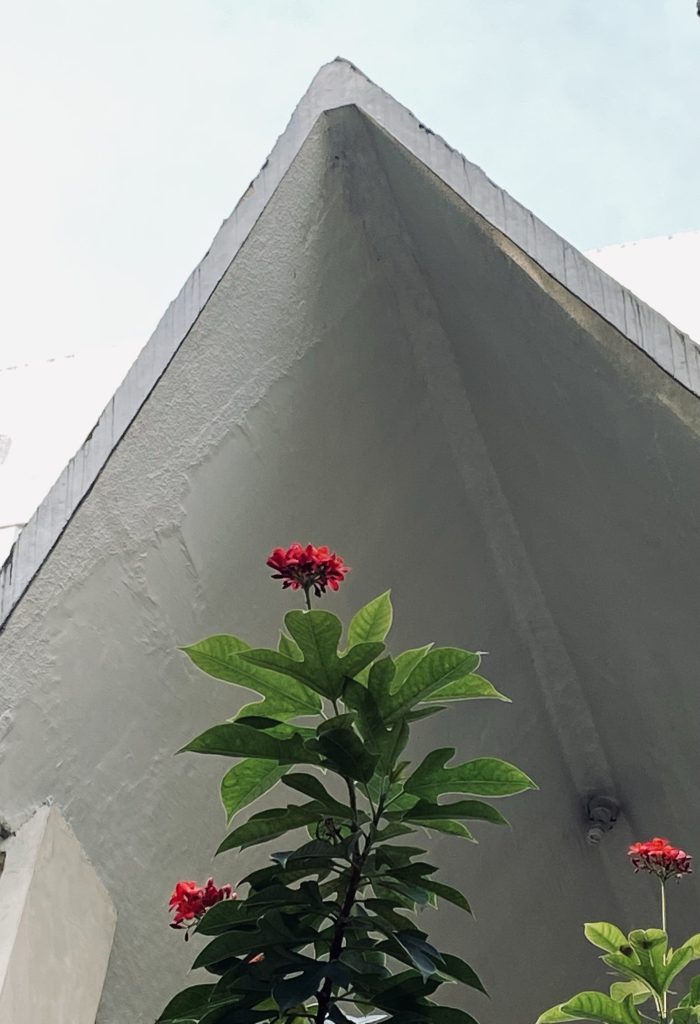
Photo by author, somewhere in the SCTEx, November 2018.
Today I borrow
the words of your servant,
Lord Jesus Christ,
the late Fr. John Main, OSB
who wrote that
"The meaning of life
is the mystery of Love.
Just as the roots of trees
hold firm in the soil,
so it is the roots of love
that hold the ground
of our being together."
Keep me rooted in you,
God our Father;
keep me rooted in your love
in Jesus Christ your Son;
water and nourish me
with your words of life
so I may grow tall,
spread my branches,
bloom and bear fruit
to share your love and
kindness and mercy
with others;
keep me rooted in you,
Lord,
strong and firm
to weather the harshest
storms and summer
in life, still full of sap,
still full of life.
Lord Jesus,
you have given me with so much
and I have given so little;
teach me to give more
of myself to you
so I can give more of you
and of your love
to others.
Amen.
Lord My Chef Sunday Recipe for the Soul by Fr. Nicanor F. Lalog II
Sixth Sunday in Ordinary Time, Cycle A, 15 February 2026
Sirach 15:15-20 ><}}}}*> 1 Corinthians 2:6-10 ><}}}}*> Matthew 5:17-37
Photo by author, Benguet, July 2023.
It is a day after Valentine’s, also the final Sunday before we take a long break from Ordinary Time to start the 40 days of Lent this Ash Wednesday leading us to Easter that lasts until the month of May. It is so lovely and timely that we hear Jesus teaching us this Sunday to examine our hearts always so that we can live our faith in him daily, of remaining blessed in his beatitudes.
We are still at the sermon on the mount with Jesus giving us a series of general teachings illustrated in some concrete examples. However, keep in mind these are not new teachings as Jesus himself clarified he had come not to abolish but to fulfill the laws. In the light of the Beatitudes he taught us the other Sunday, Jesus is now directing us to look deeper into our hearts, to make it whole again in him and stay blessed unlike the scribes and the Pharisees.
Jesus said to his disciples: “I tell you, unless your righteousness surpasses that of the scribes and Pharisees, you will not enter into the kingdom of heaven” (Matthew 5:20).
Photo by author, Jerusalem, May 2017.
This is not the first time we have heard the word “righteousness” in Matthew who used it to describe Joseph in his Christmas story as “a righteous man” (Mt.1:19).
Being righteous for the Jews is being holy which is obeying and living by the laws and commandments of God. Unfortunately, they got centered with the letters of the laws as insisted by their scribes and Pharisees. When Jesus came, they have forgotten God himself as well as the value of the human person and life itself for which the laws were meant to be. Matthew rectified this at the start of his gospel with the story of the annunciation of Christ’s birth to Joseph who obeyed God’s command expressed in his love for Mary whom he took as his wife then pregnant with the Savior he named as “Jesus”.
Righteousness or holiness is not being sinless but being filled with God, living our faith in Christ by witnessing his gospel. From the Greek word holos that means “whole” not broken, holiness in a sense is what we call as integrity.
Holiness, righteousness, and integrity all begin in the heart that we find expressed in the sixth Beatitude taught by Jesus two Sundays ago, “Blessed are the clean of heart, for they will see God” (Mt.5:8).
A clean heart is a loving heart. We can only see God and the other persons with a loving heart. The human intellect cannot know most especially God as St. Paul tells us in the second reading.
In the same manner, we know the other person not with the intellect but always with the heart as the Little Prince said, “What is essential is invisible to the eye; it is only with the heart that one can truly see” while Marvin Gaye expressed it so beautifully in his 1971 hit “What’s Going On” with the lines “we have to put some lovin’ here today” so we can understand each other.
Indeed, the heart is the very center or core of every person because everything flows from the heart. And this is what Jesus himself underscores in his three admonitions against anger, lust, and falsehoods this Sunday. In all three teachings, we find how love is severely damaged when we quarrel against each other, when we take everyone as things and objects to be used, and when we lack the sincerity in our words.
Photo by author, September 2021.
“You have heard that it was said to your ancestors, You shall not kill; whoever kills will be liable to judgment. But I say to you, whoever is angry with his brother will be liable to judgment, and whoever says to his brother ‘Raqa,’ will be answerable to the Sanhedrin, and whoever says, ‘You fool,’ will be liable to fiery Gehenna”(Mt.5:21-22).
First thing we notice in these three teachings is its construction where Jesus first mentioned what was said by the ancestors in the phrase “You have heard” immediately followed by his own take, “But, I say to you.”
Again, Jesus is not contradicting the laws given by Moses and elaborated by their elders; Jesus was actually expressing its fullness in him found in love that begins in the heart which St. Paul reiterated in his letters that love is the perfection of the laws and commandments of God.
Whenever we quarrel in words or in deeds, we not only break our ties with each other as brothers and sisters but even with God we call “our Father”. Remember, love of God is love of one another. And the sad part of this reality is our being cut off from God even if we don’t admit it. And even if we know we have nothing against anyone, we surely feel the break-up in our selves due to the lack of love and charity, most of all, of peace. That is why Jesus added that when in our worship we realize a brother or sister has anything against us, we must first reconcile with him or her. That is why before the Holy Communion, we give the greeting of peace with one another who represents the person we are at odds with. The responsibility becomes more pronounced if the person is in the same assembly we are in if we really want to have a meaningful and holy communion.
“You have heard that it was said, You shall not commit adultery. But I say to you, everyone who looks at a woman with lust has already committed adultery with her in his heart” (Mt.5:27-28).
Here we go again with the issues of marital infidelity as well as of divorce: at the very core of this is the equality of every person, of every man and woman as being created in the image and likeness of God with same equal dignity. Jesus reminds us today that there is no difference between man and woman when it comes to marriage because the same duties of fidelity bind each partner. Most of all, Jesus has consistently taught how we must go beyond the Laws when it comes to marriage because every spouse is an image of himself, of his saving grace. Hence, we must reject every temptation and inappropriate words and actions that may destroy unity and love of couples and even in our other relationships as family and friends.
Photo by author, Makati City, 09 February 2026.
“Again you have heard that it was said to your ancestors, Do not take a false oath, but make good to the Lord all that you vow. But I say to you, do not swear at all. Let your ‘Yes’ mean ‘Yes,’ and your ‘No’ mean ‘No.” Anything more is from the evil one” (Mt.5:33-34).
This last admonition is perhaps most needed these days when we are bombarded with too much fake news as well as our own words are empty. Shakespeare said it so well in Hamlet, “words, words, words” wherein we think and believe that the more we increase our words, the more it becomes true and meaningful.
Of course, it it totally untrue as Jesus reminded us today to be truthful always. In Genesis, we are told in the story of creation how God shared only this power of words, of language with humans alone. Our ability to speak is a sharing in God’s power that demands responsibilities (Spiderman). Hence in the first reading, Ben Sirach reminds us to be responsible in choosing good than evil like in choosing between “fire and water”, “life and death”. Ben Sirach’s short reminders are very timely in this age of social media where “influencers” choose for us not only the candidates to elect but even the food to eat and clothes to wear. Being free is to decide, to choose knowingly what is good.
This Sunday, Jesus invites us to look into our hearts, to cleanse it of evil and sins so that he may dwell and reign completely in our hearts so we can have integrity and remain blessed and holy in him. Amen. Have a blessed week ahead, everyone!
Lord My Chef Wedding Recipe by Fr. Nicanor F. Lalog II
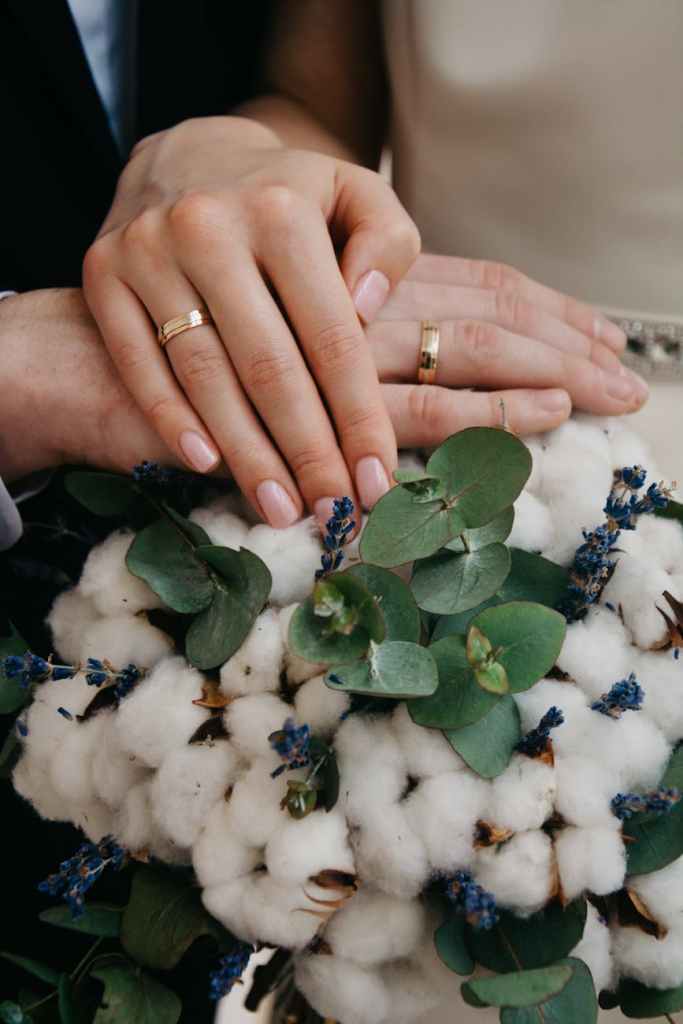
Homily, Wedding of Ellah and John Victor
Santuario de San Jose Parish, Greenhills, Mandaluyong
27 December 2025
A former student in our girls’ high school invited me to officiate her wedding last December 27, 2025; we were supposed to meet December 20 before my Simbang Gabi in our university chapel for my formal invitation when her father died suddenly that same afternoon while on a trip down south with his fellow big-bikers.
Ellah was so devastated with the news, wanting to reset her wedding. She has been working overseas for the past three years and had saved enough for her wedding day. Her only request from her parents who have separated when she was in elementary was for them to be together when she gets married. And they willingly obliged for their unica hija. And then tragedy struck exactly a week before her wedding day that happened to be the feast day of St. John Evangelist, the beloved disciple of the Lord. Sharing with you my homily on that bittersweet day of wedding of a beloved student and funeral of her father.
Congratulations, Ellah and JV on this most joyous day of your lives.
I know, it must be so difficult for you, Ellah but I am so glad that you still pushed through with your wedding today as planned. Your dad would not be happy if you had this postponed.
Showbiz ka rin talaga, Ellah!Parang cine – a wedding and a funeral.
But, let it be clear with you both, Ellah and JV that God willed it for you get married today on the feast of Jesus Christ’s beloved disciple St. John the Apostle and Evangelist. God wanted you to be married this day – not next year nor next month, nor last year. This is the day that the Lord has made for you to seal your love at His altar in this beautiful church because God has great plans for you, Ellah and JV.
Our gospel is so beautiful – the story of Easter when Jesus Christ rose from the dead.
On the first day of the week, Mary Magdalene ran and went to Simon Peter and to the other disciple whom Jesus loved, and told them, “They have taken the Lord from the tomb, and we don’t know where they put him.” So Peter and the the other disciple went out and came to the tomb (John 20:1,2-3).
“The Three Marys” (1910), painting by American Henry Osawa Tanner from biblicalarchaeology.org.
Here we find a most beautiful image of human relationships, of how a woman needs a man, and a man’s readiness to be at her side, to comfort and accompany the woman.
Just like you today, Ellah and JV.
Of course, Mary Magdalene and Simon Peter were both disciples of Jesus. They have no romantic relationships. But, the mere fact that Mary thought of reporting the missing body of Jesus to Peter being the leader of the Apostles speaks a lot to us these days when gender equality is overextended.
A woman needs a man for leadership that is why he is the man of the house. This we find in the rite of putting on veil on the newly-weds: only the head of the woman is covered because in every family, in every couple there is only one head, one leader – the man. Wherever there are two heads, it means there is a monster. There can be no order in any relationship when everyone is the leader or the head. This is most especially true in every couple.
However, let it be clear too that these mutual need of woman for man and man for woman is always governed by love which is more than a feeling but a decision, a meeting of one’s mind and heart. If your read the letters of St. John like what we have in our first reading today, you will realize three important lessons by the beloved disciple about LOVE:
Ellah and JV, remain rooted in God for “God is love.” If there is one thing you have found so clear in your lives since college, Ellah and JV, God has always been there with you. His abiding love never forsake you both, especially in your most trying times. Keep serving Him in your parish, in your lives, in your married life. Handle life with prayer.
Second, St. John tells us that love is not merely said in words but proven in deeds and works.
Walk your talk of “I love you.” One of the things I ask couples preparing for marriage is, who should be the first to greet, to speak when you have an LQ? Sino dapat maunang kumibo kapag nag-away ang mag-asawa o magkasintahan?
Many say it should be the man but I ask them whatever happened to the principle of ladies first? On the other hand, some say whoever caused the quarrel must be the one to apologize but the problem is, would anyone admit fault? The answer is simple but difficult to practice: whoever has more love to give must be the first to blink, must be the first to make the move. Love in any relationship is not a competition. Just keep on loving and loving. Show and make your love felt in actions. Not just words.
Third, very clear with St. John that love is always self-giving.
The true measure that you have loved is when you are able to love somebody else more than yourself. Love is always the giving of self.
In another part of his letter, St. John beautifully wrote that “No one has ever seen God. Yet, if we love one another, God remains in us, and his love is brought to perfection in us” (1Jn.4:12).
Remember, Ellah and JV, Jesus is always between the two of you, not in front nor at your back. Whatever you do to each other, you do it first to Jesus. When you work hard JV and become patient with the tantrums of Ellah, you first become loving to Jesus and then to Ellah. The same with you Ellah: when you take care of JV, when you cook his favorite meal, you are first loving Jesus then JV. But, the moment you become mean to each other, when you become unfaithful to each other, Ellah and JV, you become unloving first to Jesus and then to each other.
Wedding is not everything, Ellah and JV. There will be dark days and difficult times ahead of you, just like now as you grieve at the death of your dad, Ellah.
But, remember Ellah and JV your gospel today: Easter happened when it was dark; the tomb was empty because Jesus had risen from the dead. Like in life, whenever it is dark and empty, hold on to each other Ellah and JV, have faith in God for there in your midst is Jesus Christ.
Never lose hope in life; as I used to teach you Ellah in high school, hopelessness is the opposite of love, not hatred. The moment you find no hope in everyone and in everything, then you stop loving and that is when you start destroying everything and everyone. Never lose that hope and you will always find love, Ellah and JV. God bless you more and blessed Merry Christmas!
Lord My Chef Sunday Recipe for the Soul by Fr. Nicanor F. Lalog II
Feast of the Baptism of the Lord, Cycle A, 11 January 2026
Isaiah 42:1-4, 6-7 ><}}}}*> Acts 10:34-38 ><}}}}*> Matthew 3:13-17
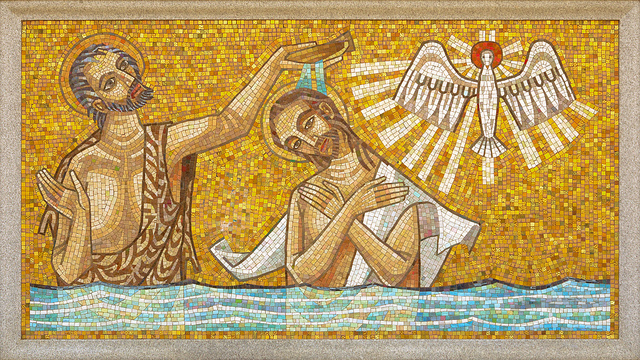
Mosaic of the Lord’s Baptism by John at the Neonian Baptistery, Ravenna, Italy; from wikimedia commons.
Still, our greeting today is a blessed Merry Christmas until the last Mass tonight when we close the Christmas Season with this Feast of the Lord’s Baptism. Tomorrow we shift into the Ordinary Time with the green motif back in our liturgy.
Most often during this time of the year, many of us make “new year’s resolutions” that always end up unfulfilled, discarded, and forgotten because these are merely based on whims or fads or anything less than a matured decision. A decision is the making up of the mind and heart to act firmly on something; hence, it connotes a sense of determination in fulfilling that decision made.
In this Feast of the Lord’s Baptism, Jesus invites us to reflect our decision-making process as we embark on another journey of twelve months in him with Matthew as our guide so we can be more matured in our faith and as a person.
Jesus came from Galilee to John at the Jordan to be baptized by him. John tried to prevent him, saying, “I need to be baptized by you, and yet you are coming to me?” Jesus said to him in reply, “Allow it now, for thus, it is fitting for us to fulfill all righteousness.” Then he allowed him (Matthew 3:13-15).
From wikimedia.org.
See the brief and direct reportage by Matthew of the event that immediately followed his story last Sunday of the Lord’s Epiphany to the world represented by the wise men from the East as we meet Jesus today all grown up, so matured as a man in his decisions.
And what do we find so remarkable in his decision-making process we can all emulate? His obedience to the Father!
All throughout his ministry, Jesus always made known to everyone that whatever he said and did were not his but the Father’s will. From his coming here at the first Christmas until his death on the Cross, it was all about Christ’s obedience to the Father. In fact, there was no need for him to be baptized by John for it was a baptism of repentance because Jesus is sinless, being the Son of God. Yet, he decided to be baptized “to fulfill all righteousness” as planned by the Father. In a similar manner, see John’s obedience too to Jesus and the Father when he could had insisted not to do it because Jesus is the Christ.
Photo by author, 2025.
Fulfillment of every aspiration and mission in this life becomes difficult when we insist on what we know or what we prefer rather than what God wills for us.
Obedience is one virtue that is vanishing in this modern age so characterized by everyone wanting to be in control of everything, of one’s life and even of others expressed in those handheld gadgets as well as cars and other vehicles. See how everyone would want to “drive” one’s own life, totally disregarding those in authority especially God.
The word obedience is from two Latin words “ob audire” that literally means “to listen attentively”.
One cannot be obedient without first learning to listen that begins with our willingness to to be silent. Jesus is obedient because he always listens to the Father through frequent and long periods of prayers. Even the Blessed Mother as we reflected last January first exemplified the virtue of obedience when she listened intently and treasured in her heart the words spoken by the shepherds who came to adore the new-born Jesus in Bethlehem.
It would be nice this 2026 that we start cultivating a prayer life by embracing silence to listen attentively to God’s plans for us so that we could make the right decisions in life.
The opposite of “ob audire” in Latin is “absurdus” – exactly what we are when we make the wrong decisions and become absurd.
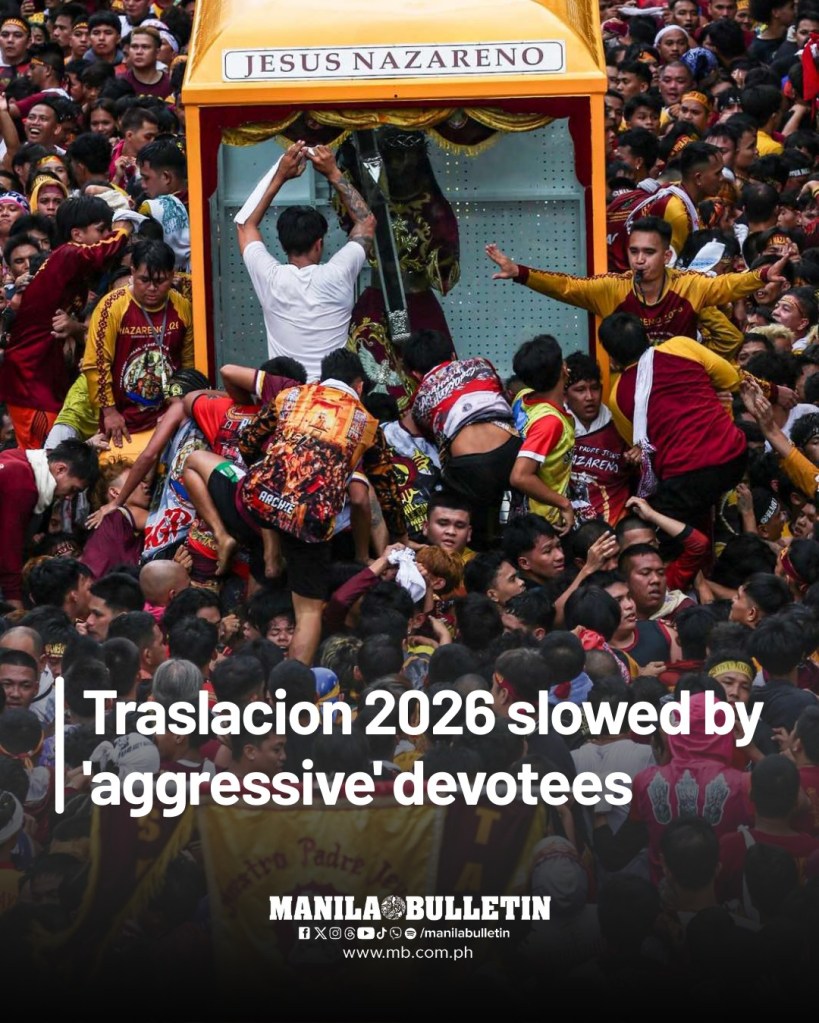
And sorry, that’s how we can describe this year’s Traslacion – absurd. In fact, every year, it becomes more absurd than ever and something drastic even radical has to be done in the real sense of the word, that is, by going back to its very roots.
When the devotees refused to obey the priests to stop at the San Sebastian Church and insisted on bringing the Poon Nazareno to Quiapo regardless of its many safety and practical implications, it was a clear case of misplaced devotion. It is fanaticism. Selfish and un-Christian. Despite the many defenses and theologizing by many, it is about time Nazareno devotees examine themselves about this devotion, of their panata that admittedly have been so baffling that if our faith in God is such intense, why are we still electing corrupt and evil officials?
Obedience is always a virtue because everything that is good follows when we are obedient, like being more loving at its truest sense. Whenever we decide out of obedience to God and parents and superiors, it is most often because of love.
Photo by Ryan Jacob, Paco, Obando, Bulacan, 2023.
This is the second characteristic of Jesus Christ’s decision-making process that is based on his love for the Father expressed in his love for us.
Again, there was no need for Jesus Christ to be baptized by John in the river Jordan because he is sinless but, he chose to be baptized there as a sign of his solidarity, of his oneness with us sinners and weak people. It was all because of love.
Jesus chose to be baptized even there was no need because he loves us and wants to be one with us. Jesus chose to die on the Cross, as depicted in the Black Nazarene of Quiapo, because he loves us and wants to carry our burdens. Jesus chose to be eaten as bread in the Holy Mass all because he loves us too so that we may have eternal life.
When Jesus went down to Jordan river, out of obedience and most of all out of love for all of us, he became one with us in our pains and hurts and sickness and failures and even sins which St. Peter realized personally that he declared after Pentecost that “God shows no partiality” (Acts 10:34) that we are all loved by God and are called to be obedient to him always by loving one another as he loves us. That is our mission, to love and be like Jesus Christ, the “Suffering Servant” who was “sent to bring forth justice… to open the eyes of the blind, to bring out prisoners from confinement, and from the dungeon, those who live in darkness” (Is.42:1,6-7).
Photo by Mr. Boy Cabrido, January 2024.
In going down into the dirty waters of Jordan River that signifies this earth, this life, Jesus showed us his mission of redeeming us so that we can become like him, God’s beloved child with whom he is well pleased. Every morning when we wake up, this scene at Jordan happens anew. The choice is ours to make by being like Jesus Christ who throughout his earthly life was a total obedience and yes to God because of love.
Last week I went to Baguio to facilitate a retreat with some of my kababata or teenage friends from my hometown of Bocaue. Being the youngest among them at 60 years old, I reflected about our senior years. Two things I shared with them:
First, as senior citizens, let us stop thinking of getting old because we are already old. Stop saying pagtanda ko… matanda na nga tayo. Let us face the reality we are old and find most especially the grace of God of reaching this stage. Being senior is to look with gratitude to our youth and to our past as we look forward to finding and meeting God who continues to call us to him.
Second, I told them to stop saying or thinking about our coming death because we are already dying. Huwag na nating isipin yung “kapag namatay tayo” kasi namamatay na nga tayo. Being senior is doing away with all those bucket lists, of things to do or places to visit before we die. We are already dying; hence, do whatever you can do now!
Perhaps the same propositions are applicable to anyone of any age. What matters is how much we love God and others expressed in our obedience to them like Jesus Christ. Let us keep following Jesus in the next twelve months of this 2026 to be filled with himself. Amen. Have a blessed week ahead.
Lord My Chef Sunday Recipe for the Soul by Fr. Nicanor F. Lalog II
Third Sunday in Advent-A (Gaudete Sunday), 14 December 2025
Isaiah 35:1-6, 10 ><}}}}*> James 5:7-10 ><}}}}*> Matthew 11:2-11
Photo by author, December 2019.
Our churches are bursting in hues of pink this Third Sunday of Advent rejoicing not only in the fast approaching Christmas but most especially in the Lord’s Second Coming already happening in our midst.
Like John the Baptist in today’s gospel who was imprisoned at the time, we could feel in our own waiting for Jesus his saving presence in the many good things happening within us and around us.
When John the Baptist heard in prison of the works of the Christ, he sent his disciples to Jesus with the question, “Are you the one who is to come, or should we look for another?” Jesus said to them in reply, “Go and tell John what you hear and see: the blind regain their sight, the lame walk, lepers are cleansed, the deaf hear, the dead are raised, and the poor have the good news proclaimed to them” (Matthew 11:2-5).
Remember our reflection last Sunday of John’s preaching in the desert of Jordan signifying our own desert where amid the dryness and emptiness Jesus comes to us, Jesus is most present with us and in us. That is because more than an imagery of nothingness and death, the desert signifies too our intimacy with God. Many times in life, God brings us or allows us to get lost in our own desert to experience his intimacy with us, his immense love for us because when we are sufficient and strong, we rarely feel him nor even desire him. But, when we are like in a desert with nothing, that is when we long for God, and most especially feel him present.
That is why every prophet in the Bible including our Lord Jesus Christ frequented the desert and wilderness to show their intimacy and communion with God. The desert is thus transformed into a greenery filled with life like what Isaiah prophesied in the first reading today:
The desert and the parched land will exult; the steppe will rejoice and bloom. They will bloom with abundant flowers, and rejoice with joyful song. The glory of Lebanon will be given them, the splendor of Carmel and Sharon; they will see the glory of the Lord, the splendor of our God… Then will the eyes of the blind be opened, the ears of the deaf be cleared; then will the lame leap like a stag, then the tongue of the dumb will sing (Isaiah 35:1-2, 5-6).
See now the transformations found in our readings: in the last two Sundays we heard Isaiah speaking of the dried and barren desert but today he spoke of its transformation into a lush and verdant stretch of land; in the gospel we find John still in the desert, firm and unchanging in his preaching though his situation had changed a lot.
Last Sunday John was freely proclaiming the coming of the Christ in the desert as he sternly warned the Pharisees and Sadducees of their judgment; this Sunday, John was still in the desert but imprisoned awaiting death when he reproached King Herod in taking his brother Philip’s wife Herodias. But despite that clear danger daily hanging on his head, John was not disturbed at all as he patiently awaited the coming of the Messiah that he sent emissaries to Jesus to ask if he is already the Christ.
Here we find something so human in John the Baptist, so much like us when we sort of doubt ourselves not because we lack faith but simply we just want to be sure of what we are hearing, what we have seen, of what God is really doing.
Photo by author, December 2021.
Let it be clear: like John, most often we doubt ourselves not really God when things happen not according to our plans or expectations. Inasmuch as life is a mystery, God is more mysterious! Most of the time, we cannot understand his ways because he moves so differently, even unpredictably from what we know and expect.
Perhaps, John had a different scenario in his mind about the arrival of the Messiah like in the Old Testament tradition of judgment day, of action-packed events punishing evil people. Recall how called the Pharisees and Sadducees “You brood of vipers…Even now the ax lies at the root of the trees. Therefore every tree that does not bear good fruit will be cut down and thrown into the fire (Mt.3:10).
But something totally different was happening at that time as he heard while in prison – many people and their lives were being transformed. John realized something deeper than expected was going on in Judea and Galilee. And when his emissaries relayed to him the reply of Jesus, John realized that indeed the Christ he was proclaiming had arrived in Jesus. As a prophet well-versed with the scriptures, John found Jesus as the fulfillment of the prophecy by Isaiah when the blind can see, the lame can walk, dead are raised and the good news proclaimed to the poor.
It must have been a Nunc Dimittis experience of Simeon for John that soon enough, he died a martyr ahead of his Lord and Master Jesus Christ. John indeed prepared the way of the Lord in his birth and in his death, showing us the importance of patience in awaiting Christ and in experiencing the joy in his coming.
Be patient, brothers and sisters, until the coming of the Lord. See how the farmer waits for the precious fruit of the earth, being patient with it until it receives the early an the late rains. You too must be patient. Make your hearts firm, because the coming of the Lord is at hand (James 5:7-8).
Photo by author, December 2020
Before the COVID pandemic, my brother and I used to rest at Camp John Hay in Baguio where he would buy in one of the shops there a line of local and organic perfumes. His favorite scent was called “Patience” but one time when we went there, it had ran out of stock that he said wryly, “maski ba naman pabango na patience, wala na rin?”
So true! Patience seems to have been almost extinct in this age of instants. Nobody wants to be patient anymore especially if one can have almost everything instantly. Even during the time of the early church, people have been impatient in life that St. James wrote them on the importance of patience in our journey of faith, in awaiting the Lord’s return.
From the Latin word patior that means to suffer, patience is a kind of suffering, of bearing the pain of waiting especially over a long period of time that we doubt if it is still worth the waiting at all. But we fail to “see” or realize as St. James pointed out like the farmer that waiting is never passive nor empty; there is always something wonderful happening that we do not see like the germination, growth and blooming of crops and plants. The more patient we are, the more suffering in waiting, the greater always the joy that comes when our waiting is finally fulfilled!
Advent teaches us this third Sunday that we need to be patient for waiting itself is a holy ground where we experience God’s coming and intimacy. Though patience tests our limits, it transforms us too!
Think of the stalactites and stalagmites in caves formed millions of years by drops of water. Or the great natural wonders of earth that took thousands of years of formation, transformation. Most of all, our very selves. Who we are and what we are today are long years of patient efforts to be healthy or successful or simply be alive. And that’s a great reason to rejoice.
Photo by author, December 2020.
Patience is so difficult to practice like in our daily experiences of horrendous traffic everywhere but with patience, we arrive at our destination. Patience transforms us into better persons and disciples of Jesus, enabling us to rejoice no matter what is the situation we are into. It is in the midst of sufferings and waiting, of patience and impatience that Jesus calls us to experience his silent and steady presence resting upon us like the rains every farmer is so familiar with. Our joy is doubled, becoming a rejoicing when we practice patience in our endeavors, in life itself.
Let me end this reflection with a quotation I memorized as a child on the wall of our former family dentist’s office in Meycauayan, Bulacan that said:
Time is fast for people who rush;
time is slow for people who wait;
time is not for people who love.
The most loving persons are also the most patient ones. Always. And first among them is Jesus Christ who patiently awaits us to return to him so we can experience his joy. Amen. Have a joyful week ahead!
Lord My Chef Daily Recipe for the Soul, 23 September 2025
Tuesday, Memorial of St. Padre Pio de Pietrelcina
Ezra 6:7-8, 12, 14-20     <*{{{{>< + ><}}}}*>     Luke 8:19-21
Photo by author, Angels’ Hills Retreat House, Tagaytay City, 19 April 2025
How amusing are
the settings of your
words today,
God our loving Father!
In the first reading
is the story of the
rebuilding of your home,
your temple in Jerusalem,
of your people's homecoming
in you while in the gospel
is the striking story of
our Lord Jesus Christ's
Mother standing outside
the house where he was
preaching.
They completed this house on the third day of the month of Adar, in the sixth year of the reign of King Darius. The children of Israel – priests, Levites, and the other returned exiles – celebrated the dedication of this house of God with joy (Ezra 6:15-16).
The mother of Jesus and his brothers came to him but were unable to join him because of the crowd. He was told, “Your mother and your brothers are standing outside and they wish to see you.” He said to them in reply, “My mother and my brothers are those who hear the word of God and act on it” (Luke 8:19-21).
How lovely,
dear Jesus
that in Hebrew
the first letter
in the word "God"
resembles a house,
or a door because
you, O Lord,
is our home,
our house;
like our home,
it is more than
walls and beams
but of relationships,
of love and kindness
that make each one of us
your indwelling.
Bless our homes,
bless our families
with your presence
always, Lord.

Through the intercession
of St. Padre Pio,
help us heed his words:
"Always be united
in the Faith
and try to be
a family according
to the heart of God."
Amen.

St. Padre Pio,
Pray for us!

Fr. Nicanor F. Lalog II
Our Lady of Fatima University
Valenzuela City
(lordmychef@gmail.com)
Lord My Chef Daily Recipe for the Soul, 18 September 2025
Thursday in the Twenty-Fourth Week of Ordinary Time, Year I
1 Timothy 4:12-16     <'[[[[><  +  ><]]]]'>     Luke 7:36-50
Photo by author, Manila Club, BGC, June 2025.
Your words today
surprised me again,
Lord Jesus:
so many times I find
myself like Simon the Pharisee,
always welcoming you
into my home,
into my life,
into my meal
and many times too
like him,
I am shocked,
becoming judgmental
at times like the others
when a sinner comes
like that sinful woman
who gatecrashed
to get near you,
Lord.
When the Pharisee who had invited him saw this he said to himself, “If this man were a prophet, he would know who and what sort of woman this is who is touching him, that she is a sinner.” Jesus said to him in reply, “Simon, I have something to say to you.” “Tell me, teacher,” he said. “Two people were in debt to a certain creditor; one owed five hudnred days’ wages and the other owed fifty. Since they were unable to repay the debt, he forgave it for both. Which of them will love him more?” Simon said in reply, “The one I suppose, whose larger debt was forgive.” He said to him, “You have judged rightly” (Luke 7:39-43).
Forgive me,
Jesus,
when I fail to see
my own sinfulness,
my past where I came from
before being with you
as a disciple:
I, too, am a sinner
like that woman who
broke all protocols
and conventions
just to get close to you,
to touch you
and be restored by you
in your mercy and forgiveness;
let me heed Paul's call to Timothy
to be "absorbed"
in your love
because
discipleship is more
than knowing you
and following you
but most of all,
loving you most
especially among
the unloveable
for we were once
like them.

Like that sinful woman,
let me go in peace today
by rejoicing
in your infinite mercy
for us all,
not just me.
Amen.
Photo by author, Manila Club, BGC, June 2025.
Fr. Nicanor F. Lalog II
Our Lady of Fatima University
Valenzuela City
(lordmychef@gmail.com)
Lord My Chef Sunday Recipe for the Soul, 14 September 2025
Feast of the Exaltation of the Cross
Numbers 21:4-9 ><]]]]'> Philippians 2:6-11 ><]]]]'> John 3:13-17
*This is a reissue of our 2023 reflection. Salamuch.
Photo by Mr. Gelo Carpio, 27 January 2020, Bagbaguin, Sta. Maria, Bulacan.
The cross is one of the most widely used but also abused and misunderstood sign in almost every generation. In fact, we are so accustomed with the cross of Jesus Christ found everywhere like in homes and offices, churches and classrooms, hospitals, restaurants and vehicles. Almost everybody carries it in our persons as an object of veneration, as a badge, or as a jewel.
On the cross we find Jesus shown in glory, peacefully sleeping in death, sometimes with his body broken by suffering. Hence, many times we use the word “cross” like in “cross my heart” to indicate our sincerity and truthfulness. But, are we truly aware of its meaning and significance in our faith, of its centrality as the symbol of God’s love for us expressed by the self-sacrificing death of Jesus Christ his Son?
Photo by author, St. Scholastica Convent, Baguio City, 23 August 2023.
This Sunday we take a break from our cycle of readings to celebrate this Feast of the Exaltation of the Cross which falls on September 14. Due to its centrality in our faith, it is still celebrated even if the date falls on a Sunday like today.
This feast started in the fourth century with the miraculous discovery of the True Cross by Helena, mother of the Emperor Constantine, on 14 September 326, while she was on a pilgrimage to Jerusalem. She then ordered through her son the emperor the building of the Church of the Holy Sepulchre that was dedicated nine years later with a portion of the True Cross placed inside it in September 13, 335. The following day, the Cross was brought outside of the church to be venerated by the clergy and the faithful.
In the year 627, during the reign of the Emperor Heraclius I of Constantinople, the Persians conquered the city of Jerusalem and removed a major part of the Cross from its sanctuary. The emperor then launched a campaign to recover the True Cross which he regarded as the new Ark of the Covenant for the new People of God. Before embarking into war, Emperor Heraclius went to church wearing black as a sign of penance, then prostrated himself before the altar and begged God for courage. His prayer was granted as he won the war and recovered the Cross from the Persians. He brought the Cross back to Jerusalem in 641 amid great celebrations by carrying it on his shoulders. Upon reaching the gate leading to Calvary, the emperor could not go forward! Heraclius and his retinue were astonished and could not understand what had happened until the Patriarch Zachary of Jerusalem told him, “Take care, O Emperor! In truth, the imperial clothing you are wearing does not sufficiently resemble the poor and humiliated condition of Jesus carrying His cross.”
Upon hearing those words, the emperor removed his shoes and bejewelled robes, put on a poor man’s clothing and was eventually able to proceed to Calvary and replaced the Cross inside the Church of the Holy Sepulchre where a number of miracles happened during the occasion: a dead man returned to life, four paralytics were cured, ten lepers were healed, 15 blind men were given their sight, with several possessed people exorcised and many sick people totally healed!
Photo by author, Mirador Jesuit Villa & Retreat House, Baguio City, 24 August 2023.
Very notable in this story were the words of the Patriarch of Jerusalem. It was only after the emperor had taken off his royal clothings and put on those of the poor was he able to carry the Cross.
It is the same thing that is asked of us today: it is so easy to display the cross inside our homes and cars, or wear it as a jewelry or even as a tattoo on our skin. But, that amounts to nothing unless we have the cross inside our hearts, our very being. More than the many signs of the cross and imaginary drawing of its lines we draw on our chest is the need for us to empty ourselves of our pride and sins so that we can be filled with Jesus Christ.
Brothers and sisters: Christ Jesus, though he was in the form of God, did not regard equality with God something to be grasped. Rather, he emptied himself, taking the form of a slave, coming in human likeness; and found human in appearance, he humbled himself, becoming obedient to death, even death on a cross (Philippians 2:6-8).
Called kenosis in Greek, self-emptying is the way of the Cross of Christ. It is choosing love and mercy than self-centeredness and self-righteousness; sacrifice than satisfaction; fairness and justice than greed and possession; bearing all the pains and perseverance than complaining and whining about difficulties and trials in life like the Israelites in the wilderness (first reading); and, thinking more of others than of one’s self.
Photo by author, 02 September 2023.
The recent COVID-19 pandemic had taught something very amusing about the positivity of being negative, when negative was actually positive – healthy and COVID free! Remember how during those days when we would always wish we would yield negative results in our swab tests for COVID?
When we look at the sign of the cross (+), it is a positive sign, a plus sign. Though the cross calls us to let go, to be detached and dispossessed, it is actually an invitation to have more of God, of life and fulfillment! In this time of affluence when everything is easily available for as long as you have the means and the resources, the sign of the Cross reminds us that life is more of letting go and of giving than of having like God who “so loved the world that he gave his only Son, so that he who believes in him might not perish but might have eternal life” (Jn.3:16). St. Francis of Assisi said it perfectly why the Cross is an exaltation, a triumph:
For it is in giving that we receive,
it is in pardoning that we are pardoned.
and it is in dying that we are born to eternal life.

Amen. Enjoy Sunday and have a blessed week ahead!

Fr. Nicanor F. Lalog II
Our Lady of Fatima University
Valenzuela City
(lordmychef@gmail.com)
Lord My Chef Sunday Recipe for the Soul, 14 September 2025
Feast of the Exaltation of the Cross
Numbers 21:4-9 ><}}}}*> Philippians 2:6-11 ><}}}}*> John 3:13-17
*This is an updated version of our reflection last year; pray for our Marriage Encounter this weekend.
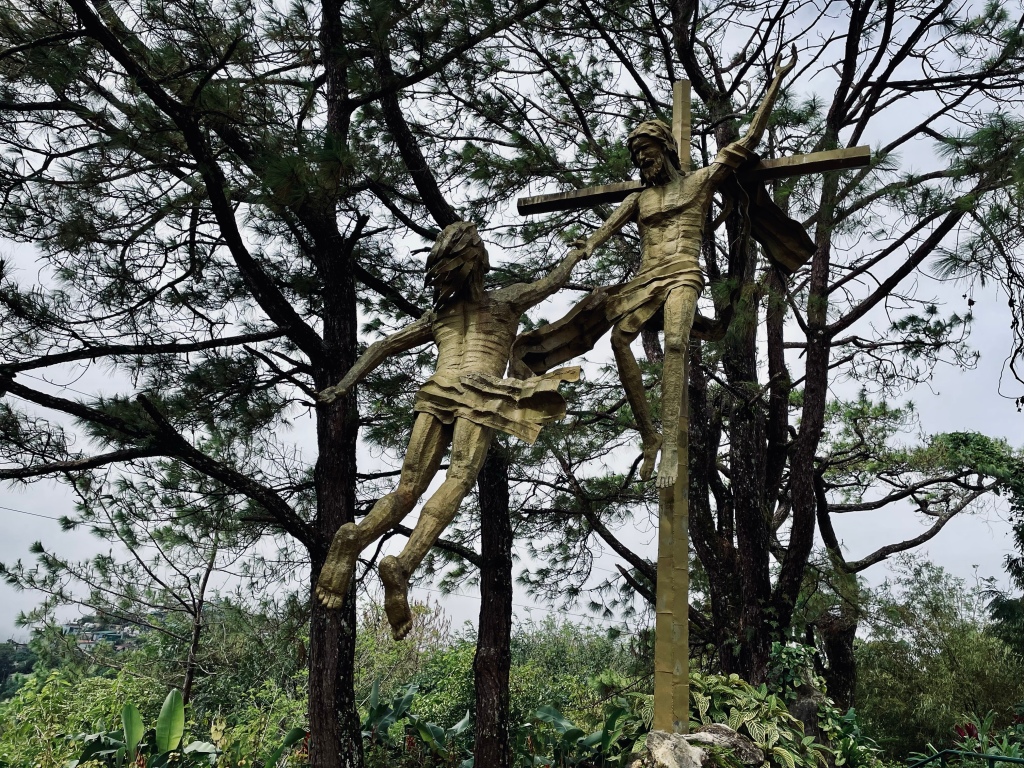
Via Crucis at Fatima University Medical Center, Valenzuela City, 2025.
This Sunday we have a unique celebration, the Feast of the Exaltation of the Cross that falls on the 14th day of September. It is so important that even if it falls on a Sunday, the more it must be celebrated as it is most central in the teachings of Jesus Christ.
It is so unique because despite its being made up of two ordinary pieces of wood, the Cross is most unique with its deeply extraordinary in meaning as sign of God’s immense love for us humans through Jesus Christ’s Passion and Death.
From being the sign of the most inhuman punishment in history, the Cross is now the very sign of how God “so loved the world that he gave his only Son, so that he who believes in him might not perish but might have eternal life” (Jn.3:16). It encapsulates the whole mystery of Jesus Christ, of how this all-powerful God beyond the ordinary became weak like us in everything except sin so that we too may be like Him, divine and more than ordinary. In His suffering and death on the Cross, Jesus made the lowly wood so ordinary to be so exalted to become His sign of love and mercy, power and majesty.
Photo by author, Jerusalem, May 2017.
Hence, in the Cross is the power of God’s love to transform us to better persons.
In the Cross is God’s power to lead us closer to Him with its vertical beam and to others with its horizontal beam.
In the Cross is the power of good if we choose to embrace it with Christ Jesus as our Lord and Master.
The Cross is most unique of all signs in the world because underneath its ordinariness, that is where we see God’s glory and majesty. It was underneath the Cross of darkness and gloom on Good Friday that humanity began to see light and hope in life’s many absurdities. Most of all, it was underneath that Cross of suffering and death of Jesus Christ that we feel and experience the assurance of the Resurrection.
How?
Through our own pains and sufferings that are most uniquely ours too!
With their patience worn out by the journey, the people complained against God and Moses, “Why have you brought us up from Egypt to die in this desert, where there is no food or water? We are disgusted with this wretched food!” In punishment the Lord sent among the people saraph serpents, which bit the people so that many of them died (Numbers 21:4-6).
Photo by author, Dominican Hills, Baguio City, January 2018.
You must have heard that old story of a man who came to Jesus to return the cross given for him to carry; he asked Jesus to have it replaced with a lighter one. Jesus then led the man to a huge room with all kinds of crosses for him to choose which he prefers as the best one for him so that he would stop complaining.
After closely examining the specs of so many crosses, the man finally decided to pick one he deemed as perfect for him after considering its weight and other dimensions, only to find out from Jesus Himself that it was the same cross he had actually returned for exchange!
Many times in life we are like those people in the first reading, never ending in their complaints to God, even challenging Him, accusing Him of forsaking us, of being unfair when life becomes difficult and unbearable. There are times we feel being on the distaff side of life always like a flat tire, never on top. We cry foul to God especially with all our hurts and pains inflicted by others, asking Him where was He when most needed?
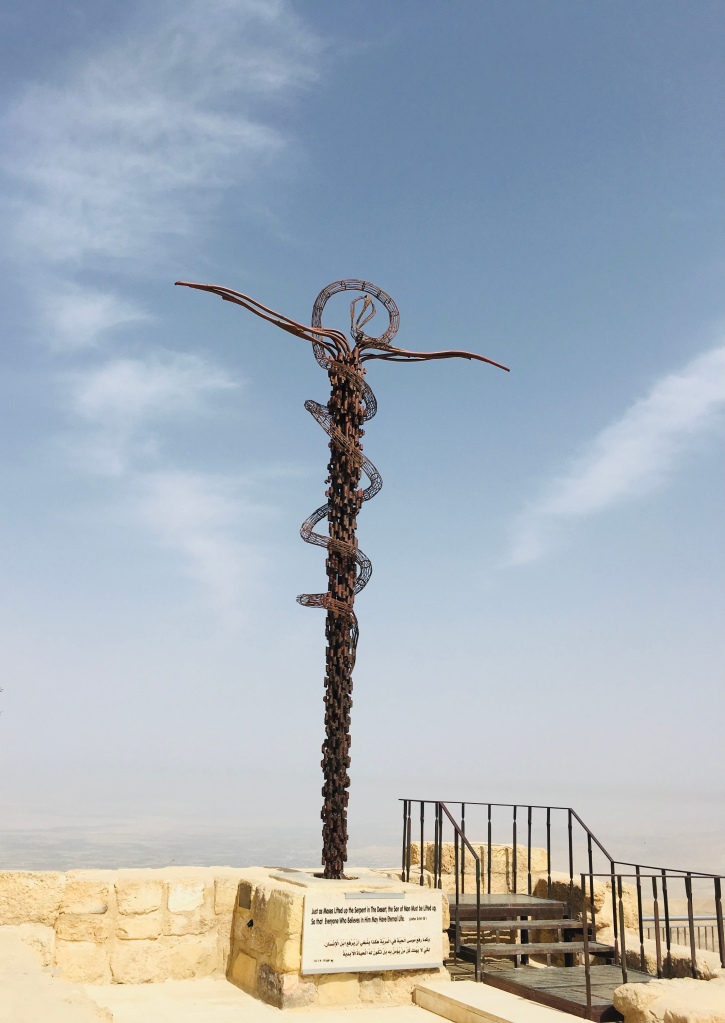
Photo by author in Jordan near the Israeli border where Moses put up the bronze serpent as instructed by God to heal those bitten by the snakes after they have complained of their conditions in the wilderness, May 2019.
While it is true life is indeed difficult, the cross reminds us of the fact that the pains and hurts we have are uniquely ours too, something we have to accept and most of all, own.
There are pains that are so deep and won’t go away that have in fact affected us dismally in our lives already. Instead of self-blaming and self-pity, we just have to ask for God’s grace to accept and own them like Jesus Christ. We just have to “bring it home” – that imagery of the Cross planted on the Calvary – into our very selves, in our being as something so true and real. And uniquely ours.
Stop thinking of others’ pains and hurts. We are not all the same. If ever we have similar experiences, the hues and shades even gravity and circumstances are not same because each pain and hurt, like the cross, is uniquely ours. Like every person, every cross is unique because it is also a gift, a mystery, and life. We have to “befriend” our pains and hurts, our own cross instead of resist it. It is in “befriending” our pains and hurts, our cross in life that we grow and mature, becoming more free to love and to be joyful because that is when the cross triumphs over its disgrace and shame in us and with others. That is when our pains and hurts, when our crosses begin to reveal to us the many beautiful truths of Easter awaiting us.
The Cross of Christ triumphed because Jesus carried it wholeheartedly, allowing those two pieces of wood to reveal not only to Him who knew everything beforehand its meaning but most of all to everyone of us the deeper truths the Cross signifies as St. Paul eloquently expressed in our second reading.
The Cross of Christ atop the church of our Lady of Lourdes in France. Photo by my former student Ar. Philip Santiago during his pilgrimage, September 2018.
One thing I realized after my mother died May last year is the fact that while there are so many pains and sufferings in this world, my own pain and suffering in losing her are most difficult to bear; hence, something I must carry because it is uniquely mine.
But, one thing so unique I noticed is that the more I see my cross following my mother’s death, the more I saw also the cross of others. The Cross of Jesus triumphed truly in me when I embraced and owned my cross, when I befriended my pains and hurts that eventually led me to recognize and see, to feel more and experience too the crosses of others.
When we become conscious of each one’s unique cross, slowly we are able to reveal to them the meaning of their personal crosses too because we become more sympathetic, more open, more silent to listen more, love more, care more and be more present with those in their own unique cross. No wonder, I find conversing more engaging with others who also grieve because we can see each other’s unique crosses!
Jesus calls us to imitate Him that by embracing and owning our cross, we too may lead others to finding the meaning of their own cross and thus experience Easter soon. Let us pray:
Give us the grace,
dear God
to always embrace the Cross
like your Son Jesus Christ
where we can all be empty
of ourselves to be filled
with your Holy Spirit
and make your love
visible in us.
Amen.
A blessed week to everyone!

Fr. Nicanor F. Lalog II
Our Lady of Fatima University
Valenzuela City
(lordmychef@gmail.com)
Lord My Chef Daily Recipe for the Soul, 11 September 2025
Thursday, Twenty-third Week in Ordinary Time, Year I
Colossians 3:12-17     <*((((><  +  ><))))*>     Luke 6:27-38
Photo by Ms. Jo Villafuerte in Atok, Benguet, September 2019.
Your words today
Lord Jesus are very soothing,
so personal,
so YOU!
Brothers and sisters: Put on, as God’s chosen ones, holy and beloved, heartfelt compassion, kindness, humility, gentleness, and patience, bearing with one another and forgiving one another… And over all these put on love, that is, the bond of perfection (Colossians 3:12-13, 14).
A disciple should be like
the one he follows
and much of this words
by St. Paul describe you,
Lord Jesus Christ -
and how I miserably fail!
Forgive me for not being
compassionate and kind,
humble and gentle,
patient and forgiving like you,
Jesus; help me to put on
more love so that I may look like
you, my Lord and Master.
Amen.

Fr. Nicanor F. Lalog II
Our Lady of Fatima University
Valenzuela City
(lordmychef@gmail.com)



























 lordmychef.com