40 Shades of Lent by Fr. Nicanor F. Lalog II
Friday in tbe Fourth Week of Lent, 15 March 2024
Wisdom 2:1, 12-22     ><}}}}*> + <*{{{{><     John 7:1-2, 10, 25-30
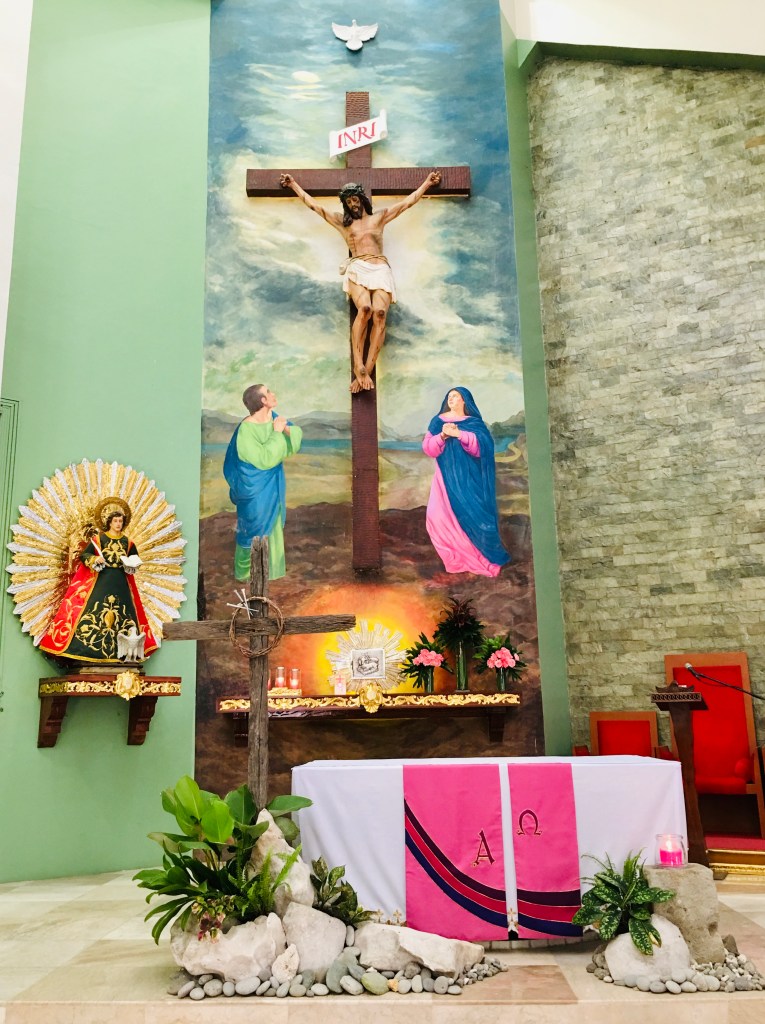
Photo by author, Theologate Chapel of the Immaculate Conception Major Seminary, Guiguinto, Bulacan, November 2020.
Loving Father,
as we come closer
to the final week of Lent,
the Cross of Christ gets clearer;
 preparing for Easter
 is facing and approaching,
embracing and owning
the Cross of Christ;
hence, grant us the courage
and strength to continue this journey
in Jesus with his Cross:
The wicked said among themselves, thinking not aright: “Let us beset the just one, because he is obnoxious to us; he sets himself against our doings, reproaches us for transgressions of the law and charges us with violations of our training… Let us see whether his words be true; let us find out what will happen to him… Let us condemn him to a shameful death; for according to his own words, God will take care of him.”
Wisdom 2:1, 12, 17, 20
Like Jesus,
let us overcome our fears
and continue to come to you,
to speak your words,
to do your works
amid the many people
"blinded by wickedness";
indeed, life is a daily Lent,
a passing over from every trial
because you are, O Lord,
"close to the brokenhearted."
Amen.
40 Shades of Lent by Fr. Nicanor F. Lalog II
Thursday in the Fourth Week of Lent, 14 March 2024
Exodus 32:7-14     <'[[[[[>< + ><]]]]]'>     John 5:31-47
So true,
O God our Father,
that we are like your people
in the desert
– “stiff-necked” –
who easily turned away from you
to worship the golden calf
while you conversed with Moses
up on Mt. Sinai.

We can be easily
carried away
and distracted
by the many other “golden calves”
around us that we worship
especially if they give us
delight and answers
to our needs
and questions.

Forgive us, Father,
in doubting your love for us,
in doubting your fidelity
to your promises to us,
in doubting your powers
despite the many blessings
you have showered upon us;
forgive us for our foolishness
for not being convinced that
we are your chosen people
when we would rather get trapped
with our daily worries in life
and forget all your
love and concern for us.

What a tragedy
when we prefer to be
second or even third rate people
when in fact we are all your children,
your beloved and forgiven children!

In this Season of Lent,
help us to "level up"
to you, O Lord,
of not simply stopping
with the prophets who
were all like a “burning and shining lamp”
to us when they were all
your precursors.

Help us,
O Lord,
to desire you
and nothing less
for we are all special
in your eyes.
Amen.
Photo by Ms. April Oliveros, Mt. Pulag, April 2023.
Until now I still relish in delight,
Father that expression
I realized this Monday:
Lent is God always "now here"
and us people "nowhere";
your words today are about
your abiding presence among us,
of remembering and not forgetting,
of the ties that bind us together
of we your beloved children
and you our loving Father in
Christ Jesus our Brother.
Can a mother forget her infant, be without tenderness for the child of her womb? Even should she forget, I will never forget you.
Isaiah 49:15
Jesus answered the Jews, “My Father is at work until now, so I am at work… Amen, amen, I say to you, the Son cannot do anything on his own, but only what he sees the father doing; for what he does, the Son will do also. For the Father loves the Son and shows him everything that he himself does, and he will show him greater works than these, so that you may be amazed.
John 5:17, 19-20
How sad is the fact that
what we most often forget
and fail to remember is our
ties and relationships;
every sin,
every injustice,
every hurt
happens in the context
of our relationships disregarded:
with you God our Father,
we as brothers and sisters;
between husband and wife,
among siblings,
children with their parents,
parents with their kids;
persons of authority
with their subjects supposed
to protect and care for;
worst of all, Father,
we forget that marvelous truth
and reality of you always
finding ways to save us,
to free us,
to forgive us,
and to bless us
because we your beloved children!
Thus says the Lord: In a time of favor I answer you, on the day of salvation I help you; and I have kept you and given you as covenant to the people, to restore the land and allot desolate heritages, saying to the prisoners: Come out! To those in darkness: Show yourselves! Along the ways they shall find pasture, on every bare height shall their pastures be.
Isaiah 49:8-9
In this Season of Lent,
let us go back to our relationships
in you through Jesus with one another
for even if we forget our tasks and
responsibilities in life,
for as long as we remember
the ties that bond us together
then, we shall never forget,
will always remember,
to be present like you
"now here" never "nowhere"
filled with your love and
kindness for everyone.
Amen.
When we were growing up
discovering the power of love,
these nursery rhymes
were so sublime
we used to find
every Valentine's
without knowing why
"Roses are red,
Violets are blue,
Sugar is sweet.
So are you.
And I love you!"
Red means love
but what about blue
that has become violet too?
Late have I known
as a chaplain to kids
and grown ups too
when I Googled that
violets mean simplicity,
humility and modesty
that to give a violet
close to blue is to say
"I love you too!"
In this blessed season of Lent
when everything is violet
a shade akin to blue
to keep things subdued
as we try to imbue
virtues and values
of repentance and
contrition for sins,
of patience and perseverance,
of sacrifice and alms-giving
that lead to a sharing of self in love
like Jesus Christ did a long time ago.
True,
violets are blue,
hue of God's mercy
for me and you;
as we go through
 this journey in Lent
hear my plea to you,
 Jesus:
"Roses are red,
violets are blue;
let your Lent come true
because I love you too!"
Amen.
40 Shades of Lent by Fr. Nicanor F. Lalog II
Tuesday in the Fourth Week of Lent, 12 March 2024
Ezekiel 47:1-9, 12     ><))))*> + ><))))*> + ><))))*>     John 5:1-16
Photo by author, 2017.
As we prepare for Easter
in this season of Lent,
you also remind us,
dear Jesus of our Baptism,
of our being cleansed
to new life in you;
it is in Baptism we have come
into new life in you, Jesus,
becoming children of the Father,
sharing in God's life.

In this season of Lent
amid the dry and sweltering
summer we now have,
remind us of our true identity
as children of God through Baptism,
that without Jesus our living water,
we die, we lose life, we lose meaning;
keep us one in you,
one with you, Jesus,
our abundant life giving river
like what the Prophet Ezekiel saw
in a vision:
Wherever the river flows, every sort ofn living creatures that can multiply shall live, and there shall be abundant fish, for wherever this water comes the sea shall be made fresh. Along both banks of the river, the fruit trees of every kind shall grow; their leaves shall not fade, nor their fruit fail.
Ezekiel 47:9-12
Most of all, Lord Jesus,
thank you for coming to us,
for approaching us like what
happened at the pool of Bethesda
to cleanse and heal us
of our so many infirmities
especially in this highly competitive
world that has become so impersonal;
cleanse and heal, dear Jesus,
our inner hurts due to our own sins
or sins by others, knowingly or unknowingly;
in your mercy,
wash and cleanse us,
of our many
fears and anxieties,
anger and bitterness,
frustrations and failures
to start anew in you
this Season of Lent.
Amen.
40 Shades of Lent by Fr. Nicanor F. Lalog II
Monday in the Fourth Week of Lent, 11 March 2024
Isaiah 65:17-21     ><)))))*> + <*(((((><     John 4:43-54
Photo by author, September 2020.
God our Father,
you are so amazing!
You never fail to surprise us,
never runs out of mysteries
that convey deep truths so
difficult to dissect and understand
but just enough to be experienced
and savored to be delighted
again and again
when remembered
and realized
like when you said
through the Prophet Isaiah:
Thus says the Lord: Lo, I am about to create new heavens and a new earth; the things of the past shall not be remembered or come to mind. Instead, there shall always be rejoicing and happiness in what I create; for I create Jerusalem to be a joy and its people to be delight.
Isaiah 65:17-18
Later, John the Beloved
in his Book of Revelation linked
this idea of new heaven and new earth
with the new Jerusalem (Rev. 21:1-2)
with both passages speaking of a world
free of pain and sickness,
no weeping nor wailing
with no kids dying before
their time and no one living
below 100 years old.
Wonderful!

Of course, your words are
symbolic though we are sure
it would literally happen some day;
but what we are sure now is how
your words have paved the way
for the coming of Jesus Christ
who bridged the gaps
among us;
in Jesus Christ,
the reality of physics
is experienced daily like
in that remote healing of
a royal official's son in
Capernaum.
Our loving Father,
we do not expect to live
lives without pain,
sickness,
or tragedy
even though we wish
that so often;
grant us the grace
to remain committed
to Jesus and his Way of the
Cross to experience the peace
only he can give for he is always
NOW HERE, present in us
and among us
when so often
we are NOWHERE
by his side.

Let us remain in you,
O Lord,
let us stay with you,
in you,
even if nothing seems to happen
because
that is when
our faith and trust
in you are deepened
like with that royal official.
Amen.
Lord My Chef Sunday Music by Fr. Nicanor F. Lalog II, 10 March 2024
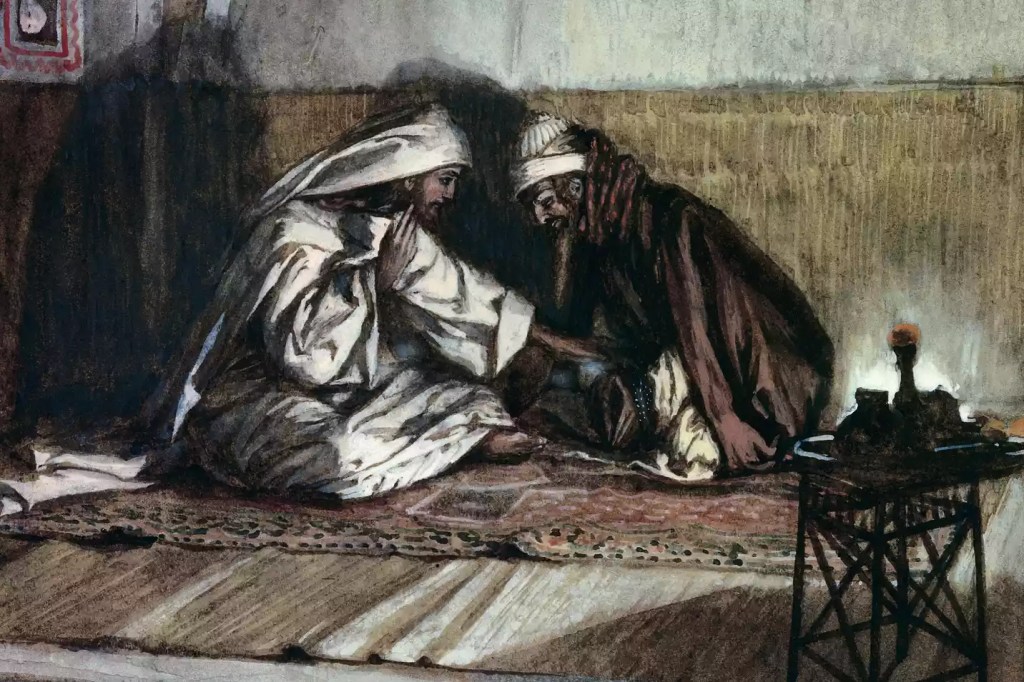
“Nicodemus and Jesus” painting by James Tissot (1836-1902) from SuperStock/GettyImages via learnreligions.com.
One of our favorite singer-songwriters James Taylor is coming next month for a one-night concert at the Mall of Asia Arena; hence, we are featuring two of his songs we find so related with the gospel message this fourth Sunday in Lent also known as Laetare or Rejoice Sunday.
But first, let us take a slight deviation from our usual manner of coming up with the music right away as we realized too the strong links between Nicodemus and James Taylor in their experiences.
Nicodemus belonged to the group of Pharisees, one of the enemies of Jesus at that time. But he admired and believed in Jesus that is why he chose to visit the Lord at night so that people would not notice. Eventually, Nicodemus became a disciple of Jesus after Good Friday after he and another Pharisee named Joseph of Arimathea took the body of Christ and buried him in a tomb (https://lordmychef.com/2024/03/09/lent-is-the-love-mercy-of-god-in-me/).
Nicodemus’ coming to see Jesus at night evoked his situation of being in the darkness of fears and confusions, trying to find directions in life which he found in Christ. It was similar with James Taylor’s plight he beautifully expressed in his 1970 hit Fire and Rain which is about the suicide of a childhood friend as well as his coping with his addiction and depression following his fame.
Just yesterday morning, they let me know you were gone. Suzanne, the plans they made put an end to you. I walked out this morning and I wrote down this song, I just can’t remember who to send it to. I’ve seen fire and I’ve seen rain. I’ve seen sunny days that I thought would never end. I’ve seen lonely times when I could not find a friend, but I always thought that I’d see you again.
Won’t you look down upon me, Jesus, You’ve got to help me make a stand. You’ve just got to see me through another day. My body’s aching and my time is at hand and I won’t make it any other way. Oh, I’ve seen fire and I’ve seen rain. I’ve seen sunny days that I thought would never end. I’ve seen lonely times when I could not find a friend, but I always thought that I’d see you again.
Many times, we find ourselves in situations like Nicodemus when everything is all dark like the night, or James Taylor going through fire and rain.
Now look, Jesus is most present with us when we are in the darkest darkness of the night, right in the middle of a raging storm. Many times we could not see him because he hugs us, embraces us to shield us from more harms.
When Jesus told Nicodemus about his coming crucifixion – “when the Son of Man is raised up” – it was an assurance to us all too that Christ is with us in our worst situation because he suffered first for us on the Cross. I am so glad that JT mentioned Jesus in his song, pleading to the Lord to “look down upon me and help me make a stand.”
That is why we rejoice this Sunday: in the midst of our troubles and sufferings, there are bursts of joy and relief from Jesus within us dwelling in our hearts. And that is why, we find JT’s 1976 hit, Shower the People, so related too with our gospel this Sunday.
When Jesus told Nicodemus how “God so loved the world that he gave his only Son, so that everyone who believes in him might not perish but might have eternal life” (Jn.3:16), it was also a call for us all to be the love and mercy of Christ in the world.
Nicodemus eventually became a disciple of Jesus while JT is still very much around, having weathered so many fires and rains or storms in his life, both telling us how God finds ways to save us, even extricate us from our worst situation. Hence, the need for us to become the presence of Christ’s joy and mercy to people especially those closest to us so that they may realize and experience that God so loved the world because of the way we shower them with love through us.
You can play the game and you can act out the part, even though you know it wasn’t written for you. Tell me, how can you stand there with your broken heart ashamed of playing the fool? One thing can lead to another; it doesn’t take any sacrifice. Oh, father and mother, sister and brother, if it feels nice, don’t think twice, just shower the people you love with love, show them the way that you feel. Things are gonna work out fine if you only will do as I say, just shower the people you love with love, show them the way you feel. Things are gonna be much better if you only will.
Here is our doubleheader from the “Sweet Baby James”. Have a blessed, lovely week ahead!
*Both materials are not ours without any intentions at all of infringing its copyrights.
40 Shades of Lent by Fr. Nicanor F. Lalog II
Sunday Recipe for the Soul, Lent IV-B, 10 March 2024
2 Chronicles 36:14-16, 19-23 ><}}}}*> Ephesians 2:4-10 ><}}}}*> John 3:14-21
Photo of pink convolvulus from the Botanical Gardens of Jerusalem, flora.org.il.
Many times during prayer periods I banter with God especially when I feel overwhelmed by his kindness and love. Like last Thursday on my way to the adoration chapel when I passed by a row of banks.
As I knelt before the Blessed Sacrament to pray, I just felt like asking God: “BDO (Banco De Oro) ka ba, Lord? Kasi…you always find ways.”
That, for me, my dear friends is the meaning of this fourth Sunday in Lent – God never stops in finding ways to reach out to us, to be with us, to make us experience his love and mercy, kindness and forgiveness despite the hardness of our hearts.
Photo by author, 2019.
Our altars burst in shades of pink this Sunday called Laetare (Latin, rejoice) Sunday from the entrance antiphon that says, “Rejoice, Jerusalem, and all who love her. Be joyful, all who were in mourning; exult and be satisfied at her consoling breast.”
It is a misconception to see Lent as dull and drab due to its penitential nature; while there is the sober tone in our liturgy, let us keep in mind that it is also a season filled with joy and excitement for the coming Easter, the mother of all feasts in the Church.
And today we rightly rejoice because John reminds us in our gospel scene only him narrates – Nicodemus meeting with Jesus in the cover of the darkness of the night – of God’s immense love for us manifested in the dying of Jesus on the Cross.
Jesus said to Nicodemus: “Just as Moses lifted up the serpent in the desert, so must the Son of Man be lifted up, so that everyone who believes in him may have eternal life.” For God so loved the world that he gave his only Son, so that everyone who believes in him might not perish but might have eternal life.”
John 3:14-16
“Nicodemus and Jesus” painting by James Tissot (1836-1902) from SuperStock/GettyImages via learnreligions.com.
John saw a deeper meaning, of a sign pointing to Jesus as the Christ in this conversation with Nicodemus at night. Nicodemus was a Pharisee afraid to come out in the open to show his admiration and belief in Jesus. He eventually joined the disciples on Good Friday with another Pharisee, Joseph of Arimathea when they buried Jesus in a tomb.
See the deep perception of John in this recalling by Jesus to Nicodemus of the bronze serpent raised by Moses in the wilderness (see Num. 21:4-9) as a prefiguration of his own crucifixion.
In the gospel of John, the “lifting up” of the Son of Man refers to Jesus on the Cross. After that scene with the woman caught committing adultery, Jesus declared, “When you lift up the Son of Man, then you will realize that I AM…” (Jn.8:28). Then on Palm Sunday while in the temple area, Jesus told the crowd “‘And when I am lifted up from the earth, I will draw everyone to myself.’ He said this indicating the kind of death he would die” (Jn.12:32-33).
John’s gospel teems with other similar passages showing the inseparability of Christ’s Cross and glory. And so with our life, that is why in the middle of Lent, we rejoice this Sunday!
Photo by author in Petra, Jordan, May 2019.
Like last Sunday, here we find again early in the gospel of John how Jesus laid his vision-mission statement of coming to save us by dying on the Cross during his conversation with Nicodemus that night.
Jesus assured Nicodemus and us today that even while we are in the darkness of life’s many confusions and fears, problems and sufferings, we just have look up to him crucified lighting up our way to life and salvation. That night in their conversation, Jesus assured Nicodemus and us today that even in the worst situations in life when “darkness is our only light and hopelessness is our only hope” as T.S. Eliot wrote in his Four Quartets, God is in us, with us and for us in Christ. Just as when the world was covered in darkness on Good Friday when Jesus died on the Cross, it was the precise moment too of Christ’s glory when he conquered death and sin in obedience to the Father.
Yes, it is true these things are easier said than done but like Nicodemus, even in the darkness of the night we have to dare come close to Jesus, to speak to him and most of all, to hear and listen to him. As one poet had said, “only the brave who walk the darkness of the night shall see the brightness of the stars above.” Most of all, Jesus calls us today to be his love and mercy, his joy and light to the many other Nicodemus groping in the darkness of sin and evil.
In my three years as chaplain in a hospital, I have experienced personally and through others that truth so clear as crystal of God most closest with us in the worst days of our lives. Sometimes, we just sigh deeply as we feel him inside us, assuring us how everything is taken cared of, that everything would be fine.
Like the Israelites in the first reading, we too have to go through an “exile”, a kind of “punishment” not from God but as a result of own our sins and wrongdoing. Many times God let bad things happen to us because we insist on our ways; as God retreats to the back or sides of our lives, he never stops finding ways to save us, even “extricate” us from our imprisonment to sin and sufferings!
Indeed, as St. Paul had said in our second reading today, God is “rich in mercy, because of the great love he had for us” (Eph.2:4). Let us not waste that gift. Even though God forgives every sin no matter how bad it may be, do not forget some of our sins have irreversible consequences we shall face and suffer. Of course, God would still be there to help and guide us but, why wait for that to happen?
There lies the joy and grace – and challenge – of this fourth Sunday in Lent: even while we are in our worst situations in life, in our darkest nights, Jesus is always there for us, in fact, the first to have suffered and died for us so that with him on Easter, we may rise again to new life.
Be the sower of his love and mercy. Be his presence. Be another Nicodemus in the night leading others to the light of Jesus. Let us, therefore, rejoice in the Lord as we pray:
Praise and glory to you,
dearest Father
in giving us your Son
Jesus Christ our Lord,
our light,
our life,
our joy;
make us, O Lord,
your love and mercy
in this world
so everyone may experience
that indeed, God loves the world
that He gives us Jesus through me;
let your Holy Sprit enlighten
my mind and my heart
like Nicodemus
leading those in darkness
into the light of Christ.
Amen.
40 Shades of Lent by Fr. Nicanor F. Lalog II
Friday, Memorial of St. John of God, Religious, 08 March 2024
Hosea 14:2-10     ><]]]]]'> + ><]]]]]'> + ><]]]]]'>     Mark 12:28-34
Photo of convolvulus sabatius from frustratedgardener.com
Your words today,
dear Father,
led me back to the
Monday reflection of another
blogger about the word
"acceptance":
“Acceptance” can be seen as a passive word suggesting that we just put up with something we cannot change.
On the other hand, it can be a positive condition in our spirituality by which we prepare ourselves to hospitably receive that which we had not expected. Such positive acceptance suggests a non-judgmental, wise, and discerning heart.
Why are we so fond,
O God, of doing anything
except precisely what you want
us to do?
Why can't we just accept
your words,
your plans,
or your instructions
we always disregard,
"hoping" there could be
something better?

Forgive us, Father,
when even in the
quagmire of sin and evil,
we keep resisting you,
refusing to accept
your suggestions;
let us learn
beginning this Lent
when to just stop
and simply accept
you and your words.
Photo by author, Banaba Tree, 2020.
Thus says the Lord: Return, O Israel, to the Lord, your God; you have collapsed through your guilt. Take with you words, and return to the Lord; say to him, “Forgive all iniquity, and receive what is good, that we may render as offerings the bullocks from our stalls.”
Hosea 14:2-3
Draw us closer to you,
Lord Jesus Christ and your
kingdom by accepting
the basic truth of our faith
that the love of God is
always the love of others;
help us realize
life is more than searching
for what is the best
possible condition
or situation we can have
but to accept our whereabouts
where we can give our best selves
to you through others
to make this world a
better one.
'
Everything, O Lord,
begins in finding you
within each of us
so we may find you in others
especially the sick and
the weakest like St. John of God
who simply accepted
everything that came to his life
as coming from you;
it is in our acceptance
of you, O Lord,
that we begin to lovingly serve
you in others because that is
also when we are able to relate
our lives
with your Church,
with the world,
with our callings;
it is in accepting these
that we become
"not far
from the Kingdom
 of God."
Amen.
Photo of a convolvulus tricolor from BBC Gardeners World Magazine.
40 Shades of Lent by Fr. Nicanor F. Lalog II
Thursday, Memorial of Sts. Perpetua & Felicity, Martyrs, 07 March 2024
Jeremiah 7:23-28   ><}}}}*> + ><}}}}*> + ><}}}}*>     Luke 11:14-23
Your words today, O God,
are too strong,
that we are so bad
and, that is so true, too.
Thus says the Lord: When you speak all these words to them, they will not listen to you either; when you call to them, they will not answer you. Say to them: This is a nation which does not listen to the voice of the Lord, its God, or take correction. Faithfulness has disappeared; the word itself is banished from their speech.
Jeremiah 7:27-28
Though we are so bad,
you are still so good to us,
Father; you continue to speak to us
even if you know we do not listen
nor heed your voice.
What is worst,
even in the coming of your Son
Jesus Christ who offered himself
on the Cross, we still refused
to listen and heed his calls,
always asking for signs.
Some of them said, “By the power of Beelzebul, the prince of demons, he drives out demons.” Others, to test him, asked him for a sign from heaven. But he knew their thoughts and said to them, “Every kingdom divided against itself will be laid waste and house will fall against house. Whoever is not with me is against me, and whoever does not gather with me scatters.”
Luke 11:15-17, 23
Lord Jesus Christ,
in your dying on the the Cross,
you have expressed to us
the Father's immense love for us;
indeed, your Cross until now remains
a sign of contradiction in the world
as your calls to love and to forgive,
to be humble and be kind,
to give than to receive
remains a foolishness and weakness
for many of us;
but you continue to speak to us
despite our being deaf and hard-hearted
because by your Cross,
you have shown us too
it is the greatest sign of reconciliation,
reminding us of the many
contradictions within and around us,
of the many contradictions
in the world that can be
reconciled and be made one
in your self-giving in love
we must imitate like your martyrs
Saints Perpetua and Felicity.

Reconcile us
in you, dear Jesus,
make us one in you
on the Cross!
Amen.



















 lordmychef.com