40 Shades of Lent by Fr. Nicanor F. Lalog II
Holy Tuesday, 30 March 2021
Isaiah 49:1-6   ><}}}*>   John 13:21-33, 36-38
Photo by author, December 2020
Though I thought I had toiled in vain,
and for nothing, uselessly, spent my strength,
yet my reward is with the Lord,
my recompense is with my God.
(Isaiah 49:4)
So many times, dear Father in heaven, I feel like your “Suffering Servant” feeling that nothing is happening with all my efforts, with things I persevere, as if they are all useless until I realize what matters most is my being faithful to you.
Thank you for the sign of the Cross of Jesus Christ your Son, our Lord and Master: when things become so difficult and frustrating for me, I just look at him there on the cross, “dead” like me who had failed in your mission.
But as I contemplate his Cross, I remember how before all my sadness and sufferings, Jesus was there first for me to be good with others, to be kind, to be understanding, to be merciful and forgiving, to be patient, and most of all, first to be holy in being faithful to you and your call, Father.
Remind me the words of St. Mother Teresa of Calcutta that we are called to be faithful, not successful.
Let me focus more on you, Lord, instead of wondering how I have been doing, how good I have been.
Let me stop competing with others, asking who is not faithful to you, who is going to betray you like Peter during the last supper when he told the beloved disciple to clarify it with Jesus:
He leaned back against Jesus' chest
and said to him,
"Master, who is it?"
(John 13:25)
How lovely is the context of that question when what we must contemplate with is whether we have been faithful to Jesus in his Holy Eucharist.
How sad, O dear Father, that we are most unfaithful to you when we betray you right in the Eucharist – when do not listen to your words and message to us, when we do not live and practice the essence of thanksgiving to you by being faithful in witnessing Christ’s sacrifice on the Cross in our daily lives. Amen.
40 Shades of Lent by Fr. Nicanor F. Lalog II
Holy Monday, 29 March 2021
Isaiah 42:1-7   ><}}}*>   John 12:1-11
Photo by author, December 2020.
Here is my servant whom I uphold,
my chosen one with whom I am well pleased,
upon whom I have put my spirit;
he shall bring forth justice  to the nations,
not crying out,
not shouting,
not making his voice heard in the street.
A bruised reed he shall not break,
and a smoldering wick  he shall not quench.
(Isaiah 42:1-3)
On this Holy Monday of our holiest week, we pray to you, O God, for gentleness for us to be holy like your “Suffering Servant” according to Prophet Isaiah and fulfilled in your Son Jesus Christ our Lord.
In this world saturated in a cacophony of many voices and noises competing to be heard in the various social media platforms, teach us to be gentle, to never view ourselves better than someone else when we would rather be silent to listen more, “not crying out, not shouting, not making our voices heard in the street.”
In this world where “size always matters” while power is always expressed in force and violence, teach us to be gentle with them who are actually weak and soft inside, even broken like the reed or a smoldering wick.
Teach us holiness in gentleness through Jesus Christ who showed us the path to real power is in weakness, that instead of asserting superiority, we would rather help others to assert their innate goodness especially when the weak come forward to express their gentleness too like Mary who poured oil and perfume on his feet.
Give us the grace to dwell today on his words, “Leave her alone. Let her keep this for the day of my burial. You always have the poor with you, but you do not always have me” (Jn.12:7-8).
O how foolish we can be, dear Father, to miss this essential truth that we can only love the poor in you and through Jesus your Son. Take away that attitude of Judas Iscariot among us of “thinking the poor” yet always feeling superior to them, even to Jesus our Lord!
Make us gentle in our thoughts and in our words, most especially in our actions so that everyone may feel your gentle mercy and compassion in Christ. Amen.
40 Shades of Lent by Fr. Nicanor F. Lalog II
Palm Sunday of the Lord’s Passion, 28 March 2021
Photo by Ms. Kysia Cruz, 28 March 2021.
Dearest Lord Jesus Christ:
Today we started the most holy week
of the year celebrating Palm Sunday
listening to your Passion story proclaimed;
but, today was so different
when people were gone
and all we have were palms
and more other fronds.
Photo by Ms. Kysia Cruz, 28 March 2021.
It pained my heart, dear Jesus
when all the people and familiar faces
I see every Sunday morning
were all praying and standing
outside, hoping they could come in
while we are under strict quarantine
as between our glancing, my heart was shrinking
so I raised my hands, and began praying on them.
Photo by Ms. Kysia Cruz, 28 March 2021.
Lord, I cannot understand nor see clearly
things happening except hear people silently crying;
all I know is that you are passing
still on a donkey riding
a king not domineering but serving;
open our eyes of faith to see your indwelling
so we may learn self-emptying
thus, becoming like you, an offering.
Photo by Ms. Kysia Cruz, 28 March 2021.
As we begin this Holy Week journey
in the most unholy time of our history
let us not miss this opportunity
to be filled by you in our being empty
joining you to the calvary
with the cross that we carry
to rest and trust in your palms fully
serving you in others lovingly and faithfully.
40 Shades of Lent by Fr. Nicanor F. Lalog II
Palm Sunday of the Passion of the Lord, 28 March 2021
Isaiah 50:4-7  +  Philippians 2:6-11  +  Mark 14:1-15:47
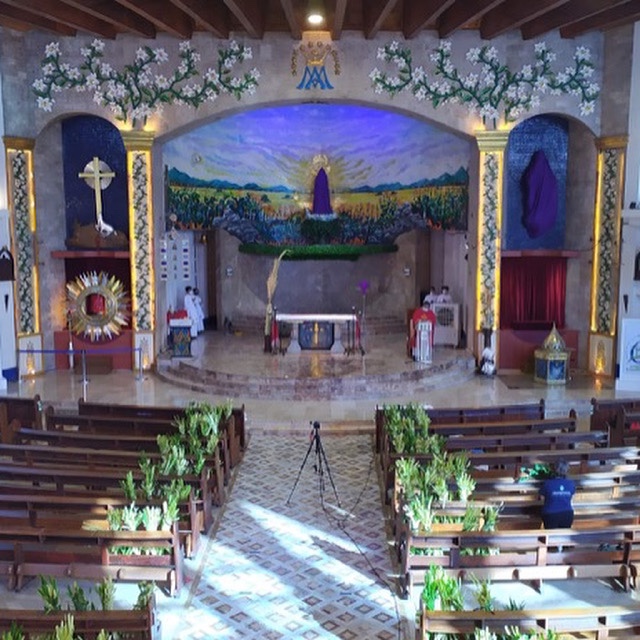
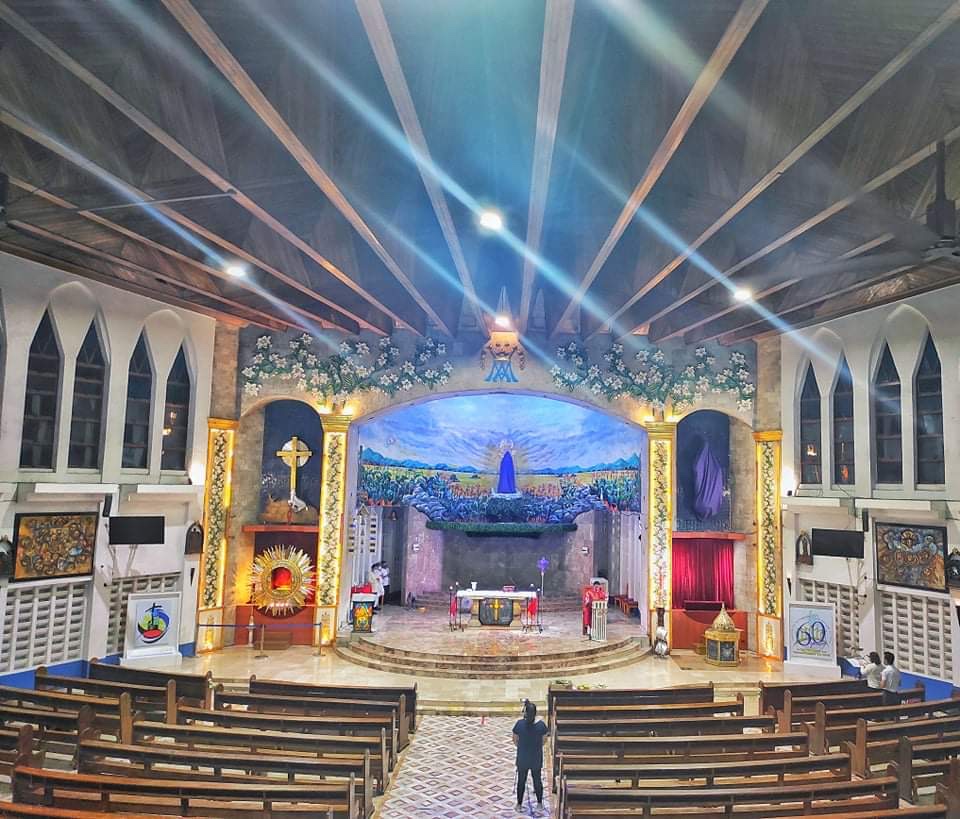
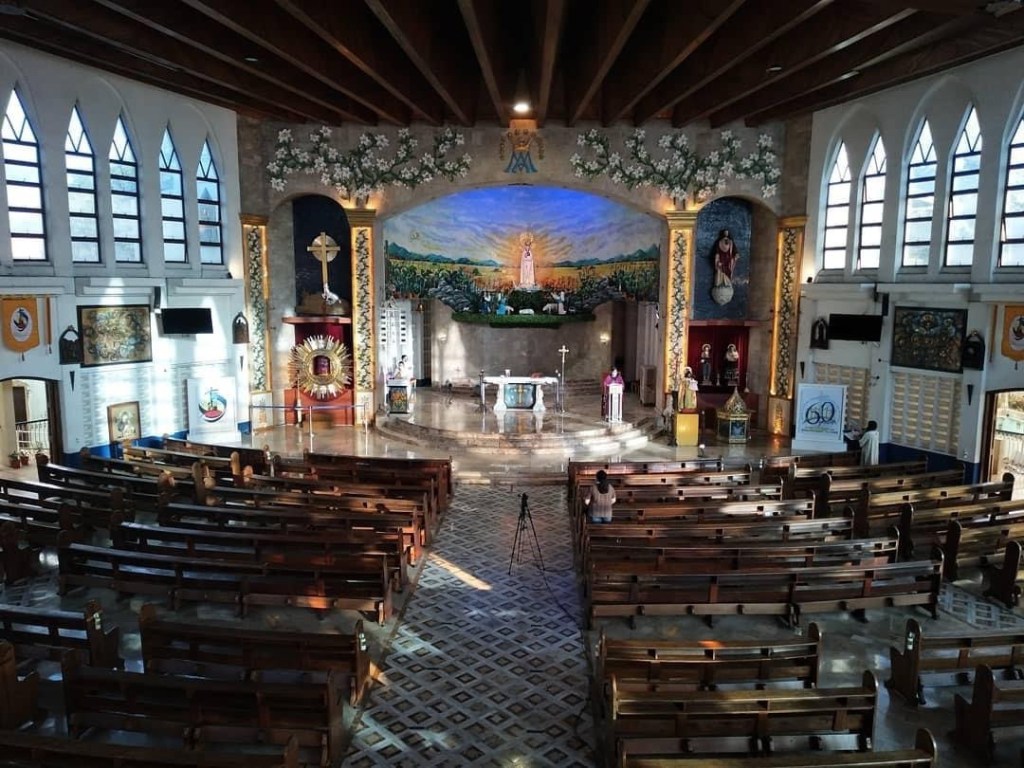
Photo by Mr. John Karol Limjuco, Parish of the National Shrine of Our Lady of Fatima, Valenzuela City, 26 March 2021.
For the second straight year, we are again celebrating our holiest week in the most unholy time of our lives in this COVID-19 pandemic. The timing could not escape everybody’s suspicion of something so sinister, if not diabolic, that religious gatherings are again limited.
But on a closer look and deeper reflection, we find what is happening right now is something similar with what Jesus went through that made these days so holy.
Notice that the official designation of our celebration today is “Palm Sunday of the Lord’s Passion” when Vatican II fused the two earliest preparations by the Church for Easter: the palm procession by Christians at Jerusalem in the fourth century and the proclamation of the long gospel of the Passion of the Lord in Rome by the Pope in the fifth century.
Both ancient celebrations set our sights to the Paschal Mystery of Jesus beginning this Sunday stretching it through this whole week to remind us of the triumph and tragedy, of darkness and light, of death and life. These contrasts shall be most pronounced when we enter the Triduum of the Lord’s Passion, Death, and Resurrection on Holy Thursday evening, Good Friday, and Easter Vigil.
Then everything becomes light and pure joy in Easter!
And the key to understanding, appreciating, and deeply imbibing the meaning of all these confluences of mixed emotions and feelings, colors and hues like our situation while under this time of the corona is to have the same attitude of Jesus Christ expressed so beautifully by St. Paul in our second reading:
Have among yourselves the same attitude (mind) that is also yours in Christ Jesus, though he was in the form of God, he did not regard equality with God something to be grasped. Rather, he emptied himself, taking the form of a slave, coming in human likeness; and found human in appearance, he humbled himself, becoming obedient to death, even death on a cross.
Having the mind and heart of Jesus Christ is opening ourselves to the Father by trying to see everything in his light as we go through life especially during this pandemic. It is what Jesus has always reminded us of “reading the signs of the times”.
God is telling us something in this pandemic but we are not listening to him as we continue to see it as a medical and social issue, refusing to recognize its spiritual and moral implications. In a lot of senses, this pandemic and quarantine we are undergoing is similar with situation when Jesus entered Jerusalem more than 2000 years ago when Israel under Roman rule and life was so difficult but nobody recognized him as the Christ and Savior!
In his entire life here on earth, Jesus always saw everything in the light of his Father in heaven. He never got involved into politics and other temporal concerns or subject but throughout the course of history since then until now, his teachings remain relevant in addressing our social issues and problems.
Seeing things and events in our lives and history in the light of God demands that we have the same attitude of Jesus of opening ourselves to be empty of our pride, of our plans and agenda, of our self-interests as well as of our illusions and insecurities in life.
We will never see God nor find him when we are filled with our selves, especially with our bloated egos when we think we know everything, when we presume we are always right, when we play gods.
Like the people who welcomed Jesus entered Jerusalem holding palms, singing “Hosanna in the highest!”, soon we would also be shouting “Crucify him!” unless we get emptied of ourselves and be filled with God.
St. Paul could eloquently present the mind and heart of Jesus in this beautiful hymn because he himself went through a process of kenosis, of self emptying. He had experienced in himself how when Jesus emptied himself and went down to his lowest point obediently accepting death on the cross, that is also when he was at his closest union with the Father who raised him to his highest glory at Easter.
That is why St. Paul called it the “scandal of the cross” for when we empty ourselves and offered everything to God out of love for him and for others that we are willing to go down to our lowest point in life, that is when God raises us up to “meet” him, to be one in him that miracles begin to happen, when things change for the best not only for us but also for others and those around us.
Hence, while we are in the most unholy period of our history, the Lord is giving us every chance to have the holiest Holy Week of our lives by examining our very selves in this time of quarantine to cleanse and empty ourselves of sins and evil to be filled with God of his holiness and grace through Christ’s cross.
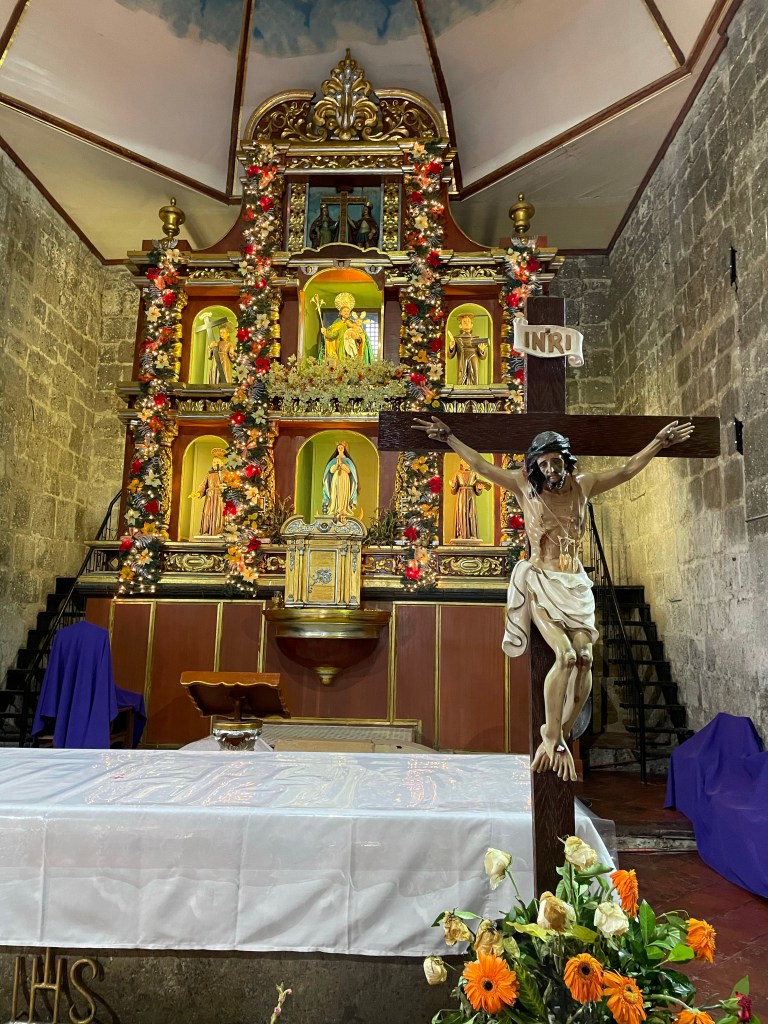
Photo by author, St. Joseph Parish, Baras, Rizal, 15 January 2021.
The logic of the Cross
As we go to another Enhanced Community Quarantine (ECQ) or lockdown like last year, I am convinced that while we are sad at how things are going on, it is actually God who is most “sad” of all as we go through all these pains and difficulties due to the COVID-19 pandemic.
God cannot suffer because he is perfect; but, he can suffer with us that is why he sent his Son Jesus to become human like us to join us in all our sufferings including death and thus, “console” us in Christ.
“To console” is from the Latin terms “con” (with) + “solatio” (solace/comfort) that means not only to comfort or delight those in suffering but to also “strengthen” or make strong those weakened by trials and difficulties which is the literal meaning of cum fortis, with strength.
And here lies the “logic” of Christ’s Cross: Jesus died by the hatred of others so that we may live again by his love. Only God can give us the evidences of his love to render us capable through Jesus Christ to forge on amid our pains and sufferings, hoping against all hope that love is always stronger than suffering, death, and sin.
When we persevere in our sufferings, especially in silence for the sake of others out of love, imitating the self-emptying of Jesus, that is when God showers us with more of his love and mercy, strength and vigor to overcome everything in Christ.
This he had promised and fulfilled in Christ who is the “Suffering Servant” we heard in the first reading from the Prophet Isaiah:
The Lord God has given me a well-trained tongue, that I might know how to speak to the weary a word that will rouse them. Morning after morning he opens my ear that I may hear; and I have not rebelled, have not turned back. I gave my back to those who beat me, my cheeks to those who plucked my beard; my face I did not shield from buffets and spitting. The Lord God is my help therefore I am not disgraced; I have set my face like flint, knowing that I shall not be put to shame.
Isaiah 50:4-7
See how everything Isaiah had written was fulfilled in Jesus as we heard in the gospel today when at the praetorium “They clothed him in purple and, weaving a crown of thorns, placed it on him. They began to salute him with, ‘Hail, King of the Jews!’ and kept striking his head with a reed and spitting upon him. They knelt before him in homage” (Mk.15:17-19). It went on up to the calvary when “They gave him wine drugged with myrrh, but he did not take it. Then they crucified him…” (Mk.15:23-24).
In my reflections this Lent, I have been dwelling lately on tenderness and compassion as mercy of God in action, as mercy of his hands. To be tender and compassionate is to be one with the suffering even if you are suffering too – just like our medical frontliners who risk not only their very lives but even their families.
Last Friday I was asked to give a talk via webinar about development of compassionate teachers and staff at Our Lady of Fatima University where I serve as chaplain. A doctor asked if there is such a thing as “over compassion” wherein she can already feel chest pains in seeing and hearing all the sufferings of their patients in this time of the pandemic.
I was so touched by her question because I felt it too; I told her she is not alone feeling that way when I also feel overwhelmed with the sufferings of the people but cannot do so much. I told her it is a grace to feel that way, that she had to find ways how her mercy in the heart can flow to mercy of the hands while ensuring safety protocols as a doctor.
But that is where the grace of God works fullest, when we believe and trust more in Jesus Christ when the chips are already down, when we feel defeat is inevitable that we just surrender everything to Divine grace and intervention.
“Ecce Homo” by Murillo from wikipediacommons.org.
That is the meaning of Palm Sunday of the Lord’s Passion when we see life in its total weakness and even wreak, whether in our selves or among others, and yet we continue to persevere, to hope against hope because deep in us we know God is with us, God is working in us, and God will save us.
French poet Charles Péguy wrote in one of his great poems at the turn of the century that hope is God’s favorite virtue because “hope surprises him”.
Péguy described hope like the end of a play or a movie in our time; we know the show had ended but we stay on refusing to leave the theater because we believe that something is still coming up like a preview or a surprise scene!
See how St. Mark tells us at the end of his Passion Story when everything was so dark after Jesus had died when “he breathed his last” that the centurion standing there believed that “Truly this man is the Son of God!” (Mk.15:39)
Sometimes in life, God becomes clearest and most truest when we have lost everything, including what is most precious and dearest to us.
Have a heart with a lot of faith, hope and love that this may be the holiest Holy Week in our lives because it is the most unholy period in our history like when Jesus entered Jerusalem more than 2000 years ago. Amen.
Keep safe, be blessed, and be a blessing to others!
40 Shades of Lent by Fr. Nicanor F. Lalog II
Friday, Week V in Lent, 26 March 2021
Jeremiah 20:10-13   ><}}}*> + <*{{{><   John 10:31-42
Photo by Dr. Mylene A. Santos, MD, February 2021.
I hear the whisperings of many:
"Terror on every side!  Denounce!
Let us denounce him!"
All those who were my friends
are on the watch for any misstep of mine.
(Jeremiah 20:10)
God our loving Father, we are now in great danger, in critical level not only with the pandemic happening but with the continuing callousness and heartlessness of those in power in our land. Instead of fighting COVID-19, they are fighting those who speak the truth like your prophet Jeremiah.
They utter all lies and harsh words in public, even make faces to put down those who speak about the real situation and suggest solutions to the problem.
Even families and communities are breaking apart because of COVID-19 as many of us forget the enemy is the virus not the afflicted.
We only have you as our refuge,Lord. We count only on you. Indeed, you probe the mind and the heart of everyone as Jeremiah mentioned today.
Increase our faith in you and do not allow us to take vengeance into our hands against our oppressors who are our very own countrymen, even relatives and friends.
Let us focus on the evil that is pervading which is our closed minds, hard hearts, and angry fists.
May we all go back to you, dear God, in Christ Jesus.
Help us retreat to our own Jordan River (Jn.10:40) like Jesus where everything started – our baptism, our mission – to find rest and comfort in you.
Let us come home in you, God our Father, from whom everything started and finds meaning. Make us remember our journey in faith in you, our sense of mission from you.
In this time when many are rejecting Jesus and his message of salvation, open our minds and our hearts to believe the many signs by which you reveal in him your love and mercy to us. Amen.
40 Shades of Lent by Fr. Nicanor F. Lalog II
Solemnity of the Annunciation of the Lord, 25 March 2021
Isaiah 7:10-14, 8:10  +  Hebrews 10:4-10  +  Luke 1:26-38
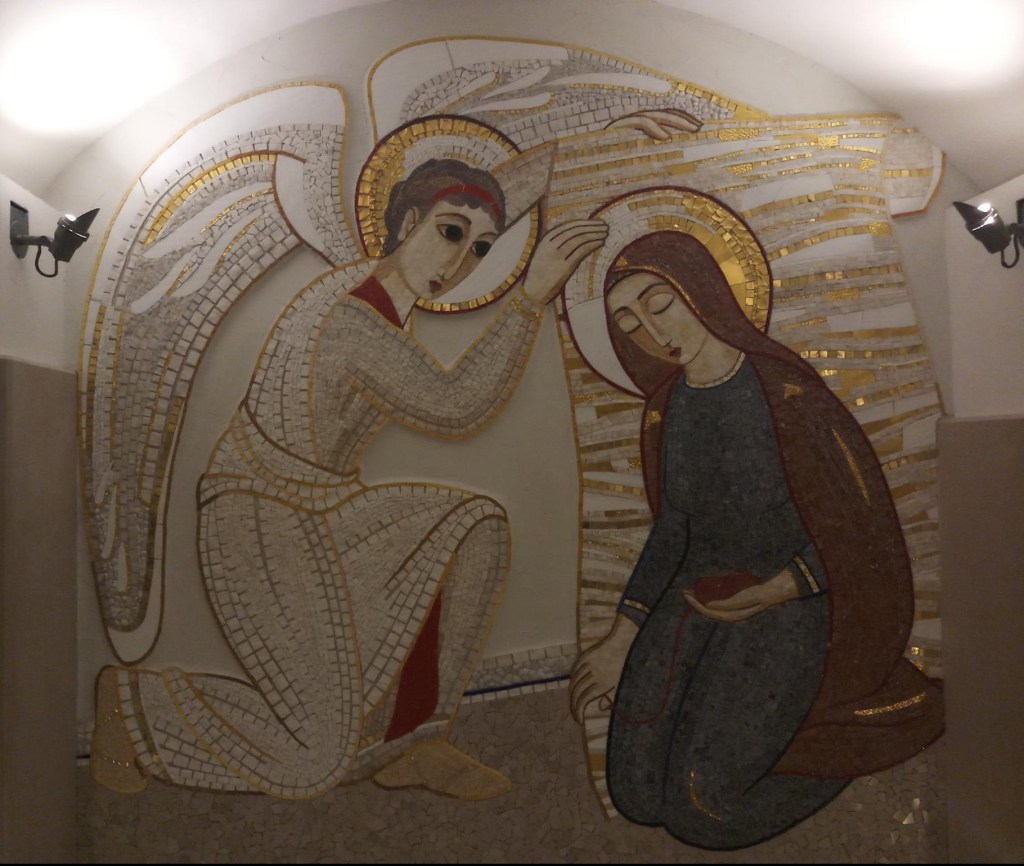
Photo by Arch. Philip Santiago of a mosaic of the Annunciation at the Shrine of St. Padre Pio at Rotondo, Italy, 2018.
Praise and glory to you, O God our Father on this Solemnity of the Annunciation of the birth of our Savior Jesus Christ! Thank you very much in fulfilling your promise, in sending us the perfect offering we can have to be one with you again.
Brothers and sisters: It is impossible that the blood of bulls and goats take away sins. For this reason, When Christ came into the world, he said, “Sacrifice and offering you did not desire, but a body you prepared for me; in holocausts and sin offerings you took no delight. Then I said, ‘As is written of me in the scroll, Behold, I come to do your will, O God.’” By this “will,” we have been consecrated through the offering of the body of Jesus Christ once for all.
Hebrews 10:4-7, 10
In his becoming human like us, your Son Jesus Christ taught us the value and beauty of obedience to you, O God, even unto death on the cross to restore our relationships with you and with one another destroyed by sin.
Teach us, O God, as we celebrate the Annunciation of the Lord, that more than the many things we expect in this life like our plans and dreams are the relationships and ties that bind us together as family and friends, as a nation and your people.
Give us the grace to offer our very selves, to let go of our many plans and agenda in life like the Blessed Virgin Mary as well as her most chaste husband St. Joseph to always say “yes” to your words, to your calls and invitations.
Mary said, “Behold, I am the handmaid of the Lord. May it be done to me according to your word.” Then the angel departed from her.
Luke 1:38
May we be like Mary giving flesh to your Word Jesus Christ, bringing his peace and mercy to this world so wounded by our many divisions and self-interests even in the midst of a pandemic. Amen.
Photo by author, site of the Annunciation, Basilica of the Annunciation at Nazareth, Israel, 2019.
40 Shades of Lent by Fr. Nicanor F. Lalog II
Solemnity of the Annunciation of the Lord, 25 March 2021
Isaiah 7:10-14, 8:10  +  Hebrews 10:4-10  +  Luke 1:26-38
Photo by author, Basilica of the Annunciation, Nazareth, Israel, 2017.
Last Monday I celebrated my 56th birthday in quarantine after having a close contact with a person with COVID-19. The health officers were both smiling in disbelief as they took my swab test that morning after finding out after my interview it was indeed my birthday.
Between that morning and its eve – in fact since Saturday when I went on quarantine – I felt like in another scene of the Annunciation as I awaited the “good news” with my whole world standing still in animated suspension.
Earlier that morning, I celebrated Mass in my room when I looked back to my birthday last year. It was a Sunday, the first week of the lockdown when public Masses were suspended. After celebrating the Mass alone in our Parish church, I borrowed a truck and mounted the Blessed Sacrament at the back and went around our parish that afternoon to bless the people who knelt on the road with some were crying.
This year, I felt the Lord wanted me to celebrate my birthday in quarantine to be alone with him again to realize the rich meaning of this Solemnity in relation with our lives, especially with me as his priest.
Photo by Ms. Ria de Vera, 2020.
Brothers and sisters: It is impossible that the blood of bulls and goats take away sins. For this reason, When Christ came into the world, he said, “Sacrifice and offering you did not desire, but a body you prepared for me; in holocausts and sin offerings you took no delight. Then I said, ‘As is written of me in the scroll, Behold, I come to do your will, O God.'” By this “will,” we have been consecrated through the offering of the body of Jesus Christ once for all.
Hebrews 10:4-7, 10
The mystery of Christ’s coming
Notice that in Mass today at the proclamation of the Creed, we are asked to genuflect at the words “conceived by the Holy Spirit, born of the Virgin Mary” to remind us that the Incarnation of the Son of God is the fundamental mystery of our faith which the Church has always proclaimed since the beginning.
This is the gist of our short but rich reflections by the author of the Letter to the Hebrews of how Jesus truly became human born by the Blessed Virgin Mary in the power of the Holy Spirit without losing any of his divinity in the process in order to save us and make us new again before God our Father.
In his reflection, the author of the Letter mentions how the Old Testament worship was more symbolic and a preparation to the perfect offering made by Jesus on the cross.
Photo by author, Basilica of the Annunciation, Nazareth, 2019.
In the Old Testament, priests offered animals for atonement of sins with the blood symbolizing life. They offered three animals: first for their sins so they may be cleaned before God in making the sacrifices for the people for whom the second animal stood for. The third animal was usually a goat to cover all the other sins of the world from which we got “scapegoat” as term for one who takes all the blame.
Jesus Christ came to perfect the temple worship in his very body when he told the Pharisees and scribes after cleansing the temple, “Destroy this temple and in a three days I will raise again” (Jn.2:19).
By dying on the cross, Jesus fulfilled his words to the Samaritan woman at Jacob’s well that someday, people would no longer worship in just one place because through his “hour” of glory – his crucifixion – people will be able to “truly worship the Father in Spirit and truth” (Jn.4:23).
On the cross, Jesus made himself the perfect sacrifice to God by atoning for our sins. The word atonement was coined by a Protestant translator of the bible to convey the idea of salvation as being one again with the Father, or “at-one-ment”.
Following the reflection by the author of the Letter to the Hebrews, we find that the very coming of Christ announced by the angel to Mary was in fact directed toward this paschal sacrifice of Jesus.
In the gospel today we have seen the angel telling Mary to name her child “Jesus” that means “God is my savior”. The angel was more explicit in the Annunciation to Joseph who was instructed, “you are to name him Jesus, because he will save his people from their sins” (Mt.1:21).
It was from this celebration of the Annunciation of Christ’s birth that we have the tradition of praying the Angelus every 6am, 12noon and 6pm to make our day holy, reminding us of this great mystery of the Incarnation of Jesus who became both “the gift and the giver” when he offered himself on the cross for us which we remember and make present in every celebration of the Mass.
Photo by author, chapel at the site of annunciation, Basilica of the Annunciation, Nazareth, 2019.
The life of obedience in Christ
From that beautiful story of the Annunciation of Lord we find how in the coming of Jesus Christ from the very start – from heaven to its coming on earth to Mary’s virginal conception at Nazareth – the mystery of his Incarnation has always been characterized by obedience.
In being obedient to the Father, Jesus consecrated us through him in offering his body once and for all that opened for us an avenue to a life of holiness through obedience to God. And the first to have this distinction is his Mother, the Blessed Virgin Mary.
Mary said, “Behold, I am the handmaid of the Lord. May it be done to me according to your word.” Then the angel departed from her.
Luke 1:38
Next to Mary is her husband, St. Joseph whose Solemnity we celebrated last week. His “yes” to following the angel’s instruction upon waking up from his dream echoed the Blessed Mother’s obedience to God’s plan and will for everyone through Jesus Christ.
Here we find Mary and Joseph, two righteous people who allowed themselves to be instruments in the fulfillment of the divine plan in Jesus Christ, relying more in the power of God, believing in his words spoken by the angel to them.
Photo by author, Basilica of the Annunciation, Nazareth, 2019.
On this Solemnity of the Annunciation of the Lord, we are challenged and invited to be open and obedient to God, to his words we hear proclaimed in the celebration of the Mass and in our personal prayers.
Jesus is the word who became flesh and dwelled among us, present among us because of the obedience and faith of Mary and Joseph.
It is always very tempting to be like King Ahaz in the first reading, when we rely more in ourselves, in our wisdom and intelligence, expertise and experience that we sometimes feel it no longer needed to bother God at all for directions especially with “earthly” things and concerns like the economy or defense of the country.
Or, pandemic.
This is the saddest part with COVID-19: a year after it started and wreaked havoc on this planet, we still continue to consider it as a medical and social issue, refusing to see its spiritual meaning.
This pandemic is an annunciation moment when God is telling us something very important for our salvation like with Mary over 2000 years ago.
God has been sending us messengers since the start of this crisis to welcome his Word, Jesus Christ so that he can work in us to bring us back to the Father and with one another through our loving service especially with the weak and most needy.
It is easy for God to send us solutions right away to end this pandemic. In fact, he had blessed us with at least six vaccines that took only a year to develop unlike the normal course of 3-5 years.
But vaccines will not entirely solve and end this pandemic. This we can see right in our country where spas and gyms and malls are seen as more essential than religious gatherings. Its worst part is how we have modern King Ahaz so confident with themselves in addressing the issues from the pandemic. Incidentally, the main sin and mistake by King Ahaz during the time of Isaiah was his aligning himself with the superpower Assyria that eventually conquered Israel – something so similar with our dealings and reliance with China, the origin of this virus and pandemic!
How sad at how this government pinned all its hopes last year in the discovery of vaccines without working hard in other aspects of mitigating the effects of the pandemic when now that there are vaccines available, it is still at a loss in making any progress in the vaccination program especially with those most vulnerable like the medical frontliners who are doing a life of offering like Jesus Christ.
Early this year, we had our major revamp in our parish assignments in almost nine years. It was an Annunciation event for us priests as it directed us to new challenges in the ministry to continue proclaiming the mystery of Incarnation.
I was assigned as chaplain of Our Lady of Fatima University (OLFU) and Fatima University and Medical Center (FUMC). At first, I was afraid like Mary in going to a new ministry at the forefront of facing the pandemic. But like Mary, I gave my fiat to God, joyfully coming to my assignment with so many plans and dreams.
And just when I was starting to heat up in my ministry, I was suddenly sent on a quarantine. That was when I realized the meaning of this Annunciation of the Lord to me: becoming like the Body of Christ to be offered too for many.
As I heard news of more people including friends and relatives getting COVID-19, I promised God in my prayers during my “quarantined” birthday that whatever may be the result of my swab test, I will still serve him with same enthusiasm in my previous assignments.
Like the Blessed Virgin Mary, may we say yes to God everyday, relying more than ever in our relationships with him and with others in Christ than in the hopes of things getting better; should things get worst like Jesus dying on the Cross, like Mary, may we hold only on God’s loving mercy and presence in this world marred by sin. And pandemic. Amen.
Photo by author, Basilica of the Annunciation, Nazareth, 2019.
40 Shades of Lent by Fr. Nicanor F. Lalog II
Wednesday, Fifth Week in Lent, 24 March 2021
Daniel 3:14-20, 91-92, 95   +++   John 8:31-42
Parish Church of St. Joseph, Baras, Rizal.
We pray most specially today, O God our Father, for all who are sick especially with COVID-19 along with the doctors and nurses and other medical frontliners who take care of them. We pray also in a special way for doctors and nurses getting sick because of this surge in COVID-19.
At the same time, we pray for our good bishops who gallantly stand to continue with the public Masses because our spiritual nourishment is very essential in times like these. Give them the courage and grace to stand their trials like your three prophets in the first reading today.
Shadrach, Meshach, and Abednego answered King Nebuchadnezzar, “There is no need for us to defend ourselves before you in this matter. If our God, whom we serve, can save us from the white-hot furnace and from your hands, O king, may he save us! But even if he will not, know, O king, that we will not serve your god or worship the golden statue which you set up.”
Daniel 3:16-18
Make us at home with you, Father, like those three young men.
Let us remain in the words of your Son Jesus Christ so we may know the truth and be set free from our idols and others gods like persons who make it difficult for us to truly follow you and do your holy will.
Let our lives be centered in you, Father, through Jesus Christ we receive in the Holy Eucharist daily.
In these trying times of the pandemic worsened by leaders chained to their personal interests and foreign powers, make us remain in you in Jesus and set us free, free from fears and biases and free to serve and care for those in need. Amen.
40 Shades of Lent by Fr. Nicanor F. Lalog II
Tuesday, Fifth Week in Lent, 23 March 2021
Numbers 21:4-9  ><}}}*> + <*{{{><  John 8:21-30
Photo by author, Franciscan Monastery on Mount Nebo overlooking Israel, 2019.
It has been a year, dear God our Father, since we went into this journey into the wilderness of this COVID-19 pandemic. It has become very similar with the wandering in the desert of your chosen people during the time of Moses that like them, we have become impatient too.
But with their patience worn out by the journey, the people complained against God and Moses, “Why have you brought us up from Egypt to die in this desert, where there is no food or water? We are disgusted with this wretched food!” In punishment the Lord sent among the people seraph serpents, which bit the people so that many of them died.
Numbers 21:4-6
Of course, we know you do not punish for you are love, O God; you even took that occasion to foreshadow the dying on the cross of your Son Jesus Christ for us.
Very much like them, we have been grumbling and complaining with you, forgetting all your goodness to us while we have been remiss with our own duties and responsibilities.
How ironic that the more they spoke of the tastelessness of the food you sent from heaven called manna, the more they revealed their own tastelessness as people.
And that is what is sadly happening with us too — our tastelessness as a people: our tastelessness in choosing our leaders in government, our tastelessness in giving value to your many blessings in life like family and country, our tastelessness in tolerating corruption and all the evils in our society long before this pandemic came.
We have lost our sense of taste, Lord, like being afflicted with COVID-19 — exactly like what your Son Jesus declared to his enemies always seeking ways to entrap him.
He said to them, “You belong to what is below, I belong to what is above. You belong to this world, but I do not belong to this world. That is why I told you that you will die in your sins. For if you do not believe that I AM, you will die in your sins.”
John 8:23-24
Send us your Holy Spirit, O Lord, to enlighten our minds and our hearts, to be simple and humble like those folks in Jerusalem who came to believe in you because you spoke in such a way (Jn.8:30), unlike the learned Pharisees and scribes who, despite thei education, remained tasteless like many among us.
O dear Jesus, give us some tastes! — a taste for what is decent and good, a taste of heaven and holiness, a taste of true order and beauty found only in you. Amen.
40 Shades of Lent by Fr. Nicanor F. Lalog II
Monday, Fifth Week in Lent, 22 March 2021
Daniel 13:41-62   ><}}}*> + <*{{{><   John 8:1-11
Praise and glory to you, O God our loving Father for the gift of life, for this final week of Lent you are giving us to continue uncovering the sins we hide from you, from others and even from ourselves. And worst, the sins of others we bare to cover our own sins.
How wonderful are your words today, Lord, of two women accused of adultery – one falsely, the other guilty – but, the same story of your justice and mercy.
Susana in the first reading was spared from death when her two accusers who were both elders and judges of the people were convicted of perjury following the courage and wisdom of your prophet Daniel.
As she was being led to execution, God stirred up the holy spirit of a young boy named Daniel, and he cried aloud, “I will have no part in the death of this woman.” All the people turned and asked him, “What is this you are saying?” He stood in their midst and continued, “Are you such fools, O children of Israel! To condemn a woman of Israel without examination and without clear evidence? Return to court, for they have testified falsely against her.”
Daniel 13:45-48
Stir in us, O God the same Holy Spirit that like Daniel we may have the courage to defend and stand for those wrongly accused of any wrongdoing whether in our homes or community or in the courts.
I pray most especially for women who are often at the receiving end of false accusations, of gossips and of hurtful lies. The victims of rape and molestation and sexual harassment cry in the silence of their deep pains and sufferings just because they are women and sadly, because their accusers are men of stature and position. Send us more Daniels, dear God to defend them.
Let us take into our hearts the challenge of your Son Jesus Christ to let the one who is without sin be the first to throw a stone at anyone guilty of sins (Jn.8:7). It is not that we must be silent with the evil persisting around us but so we may be cautious against hasty pronouncements and judgement against those guilty of any sin.
Worst of all is when we accuse sinners of evil they are guilty of doing only to cover our own sins we have been hiding from you and others, even foolishly from ourselves. Give us some decency, at least like those people, “beginning with the elders (Jn.8:9)” who left guilty of sins without casting any stone to the woman caught in adultery.
Have mercy on us, Jesus, when we act like those Pharisees and scribes who look for sinners, accuse them in public in order to look good and find something against you. Amen.











 lordmychef.com