The joy of Easter: Christ comes in our rejections

The Lord Is My Chef Daily Recipe for the Soul by Fr. Nicanor F. Lalog II
Friday in the Easter Octave, 14 April 2023
Acts 4:1-12   ><]]]]'> + <'[[[[><   John 21:1-14
Photo by author, Mt. Nebo in Jordan overlooking the Israeli border, May 2019.
How wonderful to ponder,
to think over and over,
Lord Jesus,
how you yourself experienced
rejection - big time -
that now you come to us
in our own rejections too!

Then Peter, filled with the Holy Spirit, answered them, “Leaders of the people and elders: If we are being examined today about a good deed done to a cripple, namely, by what means he was saved, then all of you and all the people of Israel should know that it was in the name of Jesus Christ the Nazorean whom you crucified, whom God raised from the dead; in his name this man stands before you healed. He is the stone rejected by you, the builders, which has become the cornerstone.”

Acts 4:8-11
Many times, Lord,
we keep on going back
to our previous way of life
like Peter and company on
that third time you appeared
to them at the Lake of Tiberias;
actually, O Lord,
the most crushing rejections
we have gone through are nothing
compared to yours because very often,
most rejections we experience 
actually come from our very selves:
our self-rejections
of our worth,
of our abilities,
most of all,
of us being loved
and forgiven by you!

Help us to find you in
every rejection that comes
our way when you appear
like after a night of fruitless
catch of fish when you told 
the disciples to cast their net
to the right side (Jn. 21:6);
open our eyes to recognize you,
Jesus, like your beloved disciple
in every bountiful catch
after every rejection as you
firmly establish us
for your task 
and mission.
Amen.
Photo by author, June 2019, Macapagal Blvd., Pasay City.

Ang “isa pang Maria”

Lawiswis ng Salita ni P. Nicanor F. Lalog II, Ika-13 ng Abril 2023
Larawan ng painting ni American painter Henry Osawa Tanner, “The Three Marys” (1910) mula sa biblicalarchaeology.org.
Magkakatulad 
ang mga ebanghelista 
sa paglalahad 
ng mga kababaihang naiwan,
sinamahan si Jesus sa Krus
hanggang sa kanyang kamatayan;
tatlo sa kanila ating nakikilala
na sina Maria na Ina ni Jesus,
Maria Magdalena at 
Maria asawa ni Clopas.

Subalit, sino 
iyong "isa pang Maria"
na binabanggit sa ebanghelyo
ni San Mateo na kasama
ni Maria Magdalena
"nakaupo sa tapat ng
libingan" ni Jesus (Mateo 27:61)
na hindi naman niya kinilala
nakatayo rin sa paanan
ng Krus?

Kataka-taka sino nga ba
itong kasama ni Maria Magdalena
"Makaraan ang Araw ng Pamamahinga,
pagbubukang-liwayway 
ng unang araw ng sanlinggo, 
pumunta sa libingan ni Jesus 
si Maria Magdalena
at isa pang Maria" (Mateo 28:1)
na unang pinagpakitaan
ng Panginoong muling nabuhay?
Hindi na natin malalaman
tunay niyang pangalan
maliban sa "isa pang Maria"
na hindi kasing tanyag
 ni Magdalena,
 ni walang nakakakilala
ni pumapansin
bagama't matitiyak natin
hindi siya mahuhuli
 pagbibigay ng kanyang sarili
bilang tapat na alagad
ng ating Panginoon din!
Bawat isa sa atin
katulad ni Maria Magdalena,
dapat ipagpasalamat
 kasama at kaibigan
maituturing din na
  "isa pang Maria" - 
tahimik at walang kibo
subalit buo ang loob
tayong sinasamahan
saanmang kadiliman
basta patungo kay Kristo
na kapwa nating sinusundan!
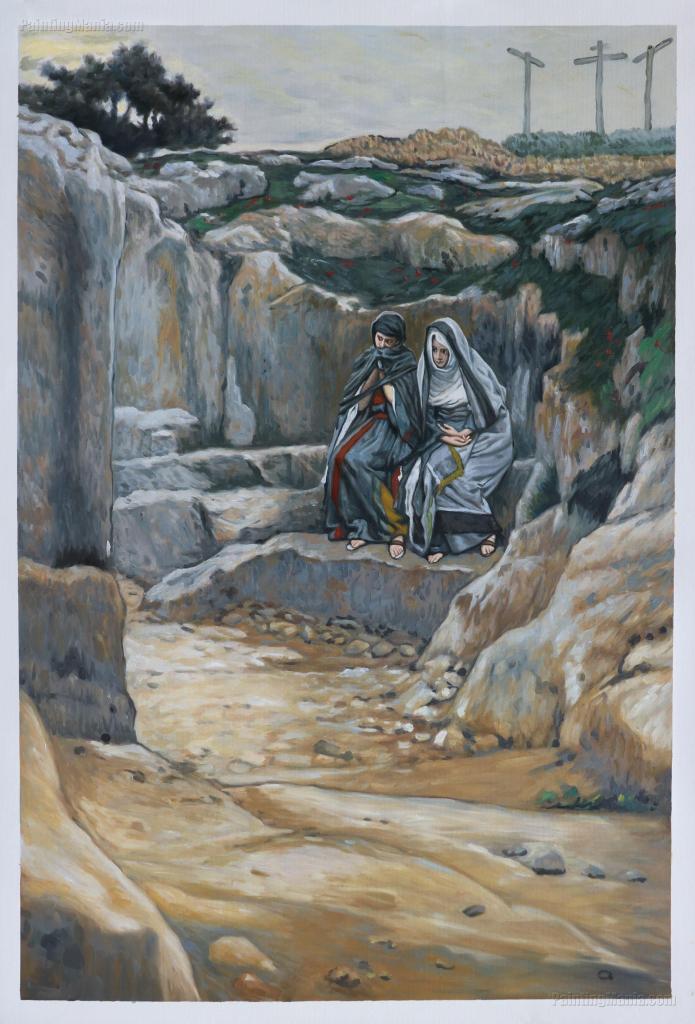
Larawan ng painting ni French painter James Tissot ng “The Two Marys Watch the Tomb” (1894) mula sa paintingmania.com.

The joy of Easter: Christ comes despite our ignorance and sins

The Lord Is My Chef Daily Recipe for the Soul by Fr. Nicanor F. Lalog II
Thursday in the Easter Octave, 13 April 2023
Acts 3:11-26   ><]]]]'> + <'[[[[><   Luke 24:35-48
Photo from Facebook, Easter 2021: “There is an urgency to announce the Joy, the joy of the Risen Lord.”
Praise and glory to you,
Lord Jesus Christ who still
comes to us in our
sins and ignorance
(Acts 3:17),
doubts and incredulity
(Luke 24:37),
even disbelief or unbelief.

Like the psalmist today,
we sing of your glory:
"O Lord, our God,
how glorious is your name 
over all the earth!
What is man that you should
be mindful of him, 
or the son of man that 
you would care for him?"
(Psalm 8:2) that you never stop 
coming to us 
to call and send us,
to forgive and convince us
of your love!

Then he said to them, “Why are you troubled? And why do questions arise in your hearts? Look at my hands and my feet, that it is I myself. Touch me and see, because a ghost does not have flesh and bones as you can see I have.”

Luke 24:38-39
Dearest Lord Jesus,
let us come closer to you
to know you better,
to love you truly,
and to follow you closely
so we may share you
with others
and be your loving presence
especially among
the unloved and neglected,
to be the extensions of your healing 
hands to the sick and old,
and most especially,
your gift of peace.
Amen.
Photo by author, 08 February 2023.

Ang bagong damit ni Kristo

Lawiswis ng Salita ni P. Nicanor F. Lalog II, Ika-12 ng Abril 2023
Larawan mula sa freebibleimages.org.
Batay sa kuwento
noong pasko ng pagkabuhay
ni Kristo,
patakbong tumungo 
sa kanyang libingan
sina Pedro at Juan,
ang alagad na minamahal;
wala nga doon si Kristo
mga tanging naiwan at natagpuan
ay ang kayong lino na pinambalot
sa kanyang katawan at ang
panyong ibinalot sa ulo
na parehong nakatiklop
at magkahiwalay.
Larawan mula sa freebibleimages.org.
Kung saan nanggaling
mga bagong damit
ni Kristong muling nabuhay
sa atin ay walang isinasaysay
ngunit kung tayo ay magninilay
napakagandang aral sa atin ang binibigay
ng mga naiwang kayong lino:
ngayong Pasko ng Pagkabuhay,
iwanan na natin mga lumang damit
ng pag-uugali
sa atin ay bumabalot
tulad ng pag-iimbot
at mga makasariling paghahangad;
huwag nang itiklop bagkus
hubarin at iwanan
masasakit na karanasan
upang lubusang malasap
tuwa at galak ni Kristong muling
nabuhay; atin na ring hubarin
mga damit ng pagluluksa sa
masasama at di magandang
nakaraan bagkus isuot
malinis at bagong pagkatao
na hinugasan sa dugo ni Kristo
noong Biyernes Santo.
Hindi natin maisusuot
bago nating katauhan kay Kristo
bilang kanyang mga naligtas
at napatawad
hangga't hindi natin
hinuhubad
dati nating pagkatao
sa kasalanan at
kasamaan;
sa isang liham ni San Pablo
ating mapananaligan
mga aral niya tungkol sa
dapat nating kasuotan:
ang pagiging mahabagin,
maganda ang kalooban,
mapagpakumbaba,
mabait at matiisin.
Higit sa lahat,
maibigin.
Iyan ang bagong damit
natin kay Kristo
at huwag natin
hayaang malukot
at marumihan
ng kasalanan!
Mula sa Google.

The joy of Easter: Jesus going the opposite direction with us

The Lord Is My Chef Daily Recipe for the Soul by Fr. Nicanor F. Lalog II
Wednesday in the Easter Octave, 12 April 2023
Acts 3:1-10   ><}}}'> + <'{{{><   Luke 24:13-35
“The Road to Emmaus” painting by American Daniel Bonnell from fineartamerica.com.
Thank you, Lord Jesus Christ
in leading us back to you,
to Jerusalem in those 
many nights of our lives
when we walked the opposite
direction of going back to Emmaus,
to our previous ways of life like
those two disciples on that
Easter afternoon.

Oh what a joy,
dearest Lord that even for a while
you walk with us going the
opposite direction,
listening to our frustrations and
disappointments when things do not
happen as we have planned and
expected; no coercions, no reprimands
except for calling us "foolish" and
"slow of the heart" to believe the
Scriptures (Lk.24:25) for that is 
what we really are!
Forgive us, Jesus,
when we easily give up
to failures and shortcomings
that we leave you and your mission
entrusted to us; help us find our way
back to you, to Jerusalem!
Most especially,
keep our hearts "burning"
with love and zeal for you,
sharing you with others,
strengthening them,
raising them up like
what Peter and John did 
to the crippled man at the
Beautiful Gate
as we continue to seek
you O Lord even
in darkness and emptiness,
sadness and losses,
sickness and failures.
Amen.
Photo by author, Sacred Heart Novitiate, Novaliches, Quezon City, 22 March 2023.

The joy of Easter: Jesus comes in our weeping

Photo by author, morning sun at Sacred Heart Novitiate, Novaliches, Quezon City, 20 March 2023.
One with the Psalmist today, 
O dear Jesus Christ, 
I also proclaim that indeed
"The earth is full of the goodness of the Lord"
(Psalm 33:5)
because even in our sadness,
right in our weeping and in
our crying, 
that is where and when you come!

Jesus said to Magdalene, “Woman, why are you weeping? Whom are you looking for?” She thought it was the gardener and said to him, “Sir, if you carried him away, tell me where you laid him, and I will take him.” Jesus said to her, “Mary!” She turned and said to him in Hebrew, “Rabbouni,” which means Teacher.

John 20:15-16
Like Magdalene,
there are times we are overtaken
by our grief and sadness over our
many disappointments and failures,
losses and defeats like deaths 
that we could not see 
your loving presence,
your consoling comfort
O Lord Jesus Christ.
Like the listeners of Peter on that
day of Pentecost, "cut us to the heart"
(Acts 2:37), lay bare before us this
glaring truth of your Resurrection, Jesus,
of your victory over death and darkness,
over sin and sickness
that we may be more open to accept and
embrace your loving presence
with us and in us during the most
trying times of life like death of a loved one
or a sudden shift in our lives.
Amen.
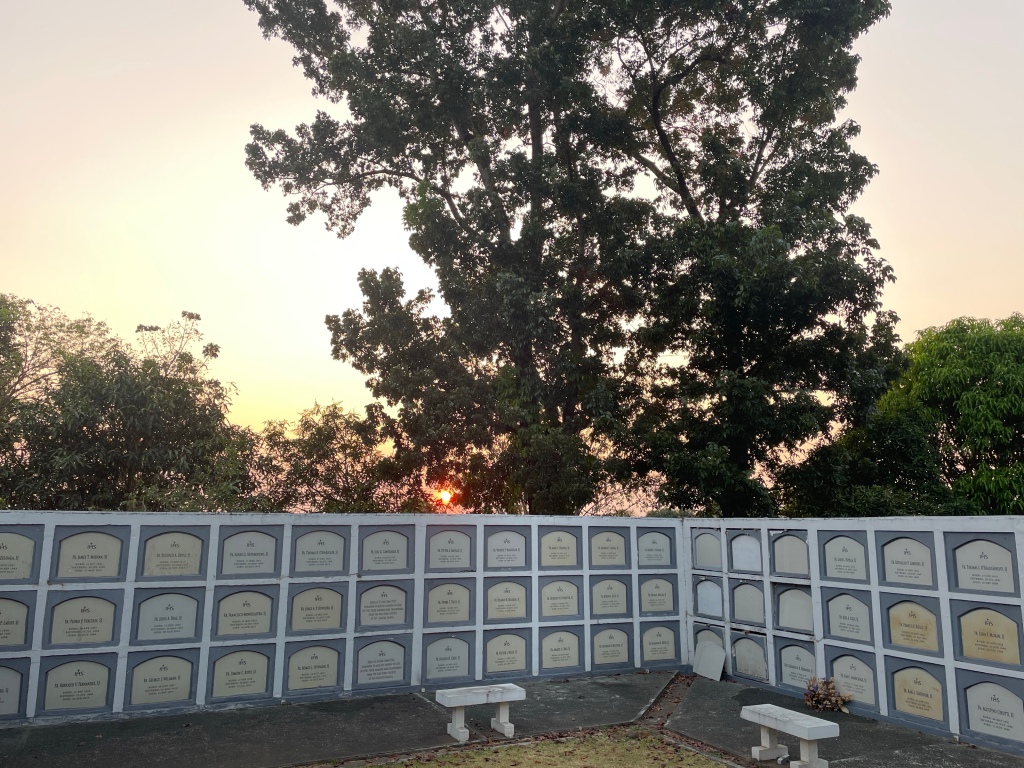
Photo by author, Jesuit Cemetery, Sacred Heart Novitiate, Novaliches, Quezon City, 20 March 2023.

The joy of Easter: still called “brothers” by Jesus despite our sins

The Lord Is My Chef Daily Recipe for the Soul by Fr. Nicanor F. Lalog II
Monday in the Easter Octave, 10 April 2023
Acts 2:14, 22-33   ><)))"> + <"(((><   Matthew 28:8-15
Photo by author, Sacred Heart Novitiate, Novaliches, Quezon City, 22 March 2023.
Did I hear you right,
my Lord Jesus Christ,
you called me "brother"
after I have abandoned you
on your Cross?

Then Jesus said to them (Mary Magdalene and the other Mary), Do not be afraid. Go tell my brothers to go to Galilee, and there they will see me.”

Matthew 28:10
Yes, Lord Jesus.
I hear you every day,
each morning when I wake up
to a brand new day is like Easter Sunday
when you call me "brother" despite
my being like one of the Twelve
who abandoned you,
denied you,
even betrayed you!
Despite my sinfulness,
you forgive me,
you bless me,
most of all, 
love me by calling me still
a brother!
Let me relish and savor
this truth,
this relationship
you have kept with me
but I have always forgotten
and taken for granted;
let me go back to Galilee
where you have called me,
where you have healed me,
where you have fed me,
where you have forgiven me;
let me go back to Galilee
to continue your work,
to continue crossing the seas
amid storms,
to continue walking by your side
even if I falter and fall behind
in this journey as your fisher of men.
Amen.
Photo by author, sunrise at Lake of Galilee, the Holy Land, May 2019.

Fulness in emptiness

The Lord Is My Chef Sunday Recipe for the Soul by Fr. Nicanor F. Lalog II
Easter Sunday, Cycle A, 09 April 2023
Acts 10:34, 37-43 ><}}}"> Colossians 3:1-4 ><}}}"> John 20:1-9
Photo by author, sunrise at Katmon Nature Sanctuary & Beach Resort, Bgy. Binulusan, Infanta, Quezon, 04 March 2023.

Blessed happy Easter everyone! Rejoice, the Lord is Risen! I know it is very difficult to greet everyone with Happy Easter compared with Merry Christmas primarily due to our weather. Most of all, because Easter is so empty unlike Christmas so filled with many signs and symbols, even with gifts and other things.

But that is the mystery – and joy – of Easter.

Emptiness. Even nothingness.

Because when we are empty, when we have nothing, that is when God fills us with his abundance.

On the first day of the week, Mary of Magdala came to the tomb early in the morning, while it was still dark, and saw the stone removed from the tomb. So she ran and went to Simon Peter and to the other disciple whom Jesus loved, and told them, “They have taken the Lord from the tomb, and we don’t know where they put him.”

John 20:1-2
Photo from GettyImages/iStockphoto.

How amazing that we Filipinos are so fond of using the expression “wala lang” for nothing or empty. When a man texts a woman with a simple hi or hello plus the words, wala lang, do not believe him because that’s something! There is something in simply texting you out of the blue! Meron yun kasi di ka niya text kung wala talaga.

In the provinces if you come for a lunch or dinner, whether there is an occasion or none, it is common to hear the hosts especially the poorer ones apologizing for not having a lot of food when in fact there are more than two viands like the freshest fish and vegetables we urbanites miss most. They would always say, “wala po kaming nakayanan, mahina po ang ani/huli, pasensiya na po.” Such kind of superb graciousness among us Filipinos in the provinces is so ordinary.

Perhaps, it is a beautiful sign we have imbibed from our deep faith in Jesus Christ who was nowhere to be found inside the empty tomb.

His absence from the empty tomb meant he was present somewhere. That was what Magdalene implied when she said “They have taken the Lord from the tomb, and we don’t know where they put him” (Jn.1:2).

Though the tomb was empty, Jesus was not missing at all. He had risen from the dead! In fact later, they would meet him along the way and that very evening too until his ascension into heaven.

Emptiness and nothingness can be positive or negative.

Positive emptiness means nothingness for God who alone suffices. There is an inner feeling of emptiness for something or Someone bigger, greater. That is how a man feels when he texts a woman of his dream with wala lang: he feels empty and nothing without her! The same with God. St. Augustine perfectly said it, “my heart is restless until it rests in you, O Lord.”

Henry Osawa Tanner’s painting, “The Three Marys” (1910), photo from biblicalarchaeology.org.

Easter is positive emptiness: Jesus is no longer in the tomb because he is risen. It is the definitive sign we have been freed from the clutches of evil and sin, of death and decay. Death is not the final statement in life. The gospel at Easter Vigil is more picturesque when Matthew narrated how Magdalene saw an angel seated on the empty tomb of Jesus, a beautiful reminder of how suffering and death have become Christ’s crowing glory. From being a tomb to becoming a Throne!

Every time we experience pains and sufferings, of emptiness and nothingness in life that all we could do is surrender everything to God like Jesus on the Cross, that is positive emptiness. We know for sure and feel it inside us that there is something in this nothingness. That is why never say “walang-wala ako” (I got nothing) because we always have God in us.

Positive emptiness/nothingness is the virtue of hope which is not positive thinking that things would get better. In fact, to have hope in God is to believe and accept that things could get worst like Jesus during the days leading to his arrest and crucifixion because to hope is believe that even if everything is lost, there is always God loving us in the end.

Hope is positive emptiness because it is creating a space within us for God and for others in love. Positive emptiness and nothingness is seeking God right in that emptiness like Peter and John running into the tomb after learning it was empty because we love, we have a relationship that continues after one is gone and not seen.

That ultimately is what positive emptiness/nothingness is all about, love.

It is similar to that feeling at the end of a movie when we refuse to stand and leave the cinema because we believe – we hope – there is still another final scene, there is still a coming sequel to what we have seen. We are not totally saddened with the end of the movie as we strongly feel, there would be a part two, a part three, and a part four which has been the trend all these years of the great movies of our youth! How funny that after exhausting the sequels, there came also the prequels. Why? Because we have all established a relationship, a love among us the fans of a movie franchise like Star Wars or Die Hard and its creators.

Photo by Ms. April Oliveros, Mt. Pulag, 25 March 2023.

That is what Easter is all about. We do not simply give up for life’s many sufferings and pains, trials and tribulations because we feel and know deep inside we have Jesus Christ who have risen from the dead. We are emptied daily in order to be filled with Jesus himself every day too. There is no need to see much things. Enough to feel deep inside like what Peter explained to the people at the first reading. Their very lives proved amid the physical emptiness or absence of Jesus in the world that Jesus was present, was Someone with Something.

This is the great challenge for us these days. More and more people are spending the Holy Week and Easter in the beach or somewhere else to bond as family where they could see more of each other and see more sights than the ordinary we have during this time of the year at home and in the parish that are usually bland and dry. More people prefer to go somewhere here and abroad in the hope of still being able to pray and celebrate the sacraments there because they feel empty here at home. We really hope they have positive emptiness than negative emptiness.

Negative emptiness is feeling empty amid the plethora of things and pleasures in life. Many times these days due to mobility, it is so easy to go hiking to the mountains or to some exotic destinations to fill the emptiness we have inside, to search for our “lost selves” (hanapin ang sarili). But very often, after some time of relief, the same emptiness and nothingness occurs. Nothing happens because what we really have is positive emptiness, our desire for God, the most essential in life who cannot be replaced by anything at all.

Negative emptiness is seeking things, sights and sounds, things of the senses to fill up curiosities, to settle doubts, to find happiness not realizing it is totally different from joy and fulfillment.

Negative emptiness is insisting on holding on to what can be seen, to what is tangible despite the inner directions we have been feeling inside toward God. For some time, we can refuse to follow its directions but there are times, positive emptiness and nothingness impose itself on us like when there is death or serious illness in the family. At first, it can be scary, so frightening but eventually, liberating like in the experiences of the first disciples of Jesus.

May we heed St. Paul’s words this Easter from the second reading, “Brothers and sisters: If then you were raised with Christ, seek what is above, where Christ is seated at the right hand of God” (Col. 3:1).

Dearest Lord Jesus,
grant us the grace to seek and find
you in emptiness and nothingness,
even in darkness;
many times, our senses blur 
our sight of you;
how sad that even in our celebrations
we are so fascinated with all the colors
and antics in the rituals and processions 
we keep in our cameras and cellphones
but never in our hearts and memories
that soon enough, they fade, we forget
and see them only as pictures
bereft of meaning because it lacked relationship;
let us see you more beyond 
to have sights and insights
as well as hindsight and foresight
of your loving presence
in emptiness and nothingness
because what we have and keep
is your relationship,
your love and mercy.
Amen.

The gospel according to Five for Fighting on living & leaving

Quiet Storm by Fr. Nicanor F. Lalog II, 20 September 2022
Photo by Pixabay on Pexels.com
I'm 15 for a moment
Caught in between ten and 20
And I'm just dreaming
Counting the ways to where you are

I'm 22 for a moment
And she feels better than ever
And we're on fire
Making our way back from Mars

The piano, the voice and the lyrics were unmistakably Five for Fighting when I heard it played again after a very long time at the 40th day of the death of a young college student in our parish recently.

It was only then when I truly appreciated this 2003 hit “100 Years” after realizing its deeper implications about life and death leading to eternity. Besides, there were some interesting things about the song and the deceased young man who was also a talented pianist like Five for Fighting himself – Vladimir John Ondasik III. Most of all, the deceased young man I have celebrated Mass for was aged 22 like the character depicted in the song 100 Years.

Celebrating Mass at the funeral of a child, whether an infant or a grown-up is the most difficult one for me. Normally, we children bury our parents but, it is so different when children die ahead of their parents and even grandparents. As a priest, I could feel the pain of the grieving parents in losing their son or daughter even if I totally do not know them at all. Yet, it is a grace of the priesthood that while we are emotionally affected by grieving parents we hardly know that we are likewise uplifted in identifying with Jesus who had brought back to life a dead young man at Nain after being moved with pity for the man’s widowed mother (Lk.7:11-15).

Photo by author, Pangasinan, April 2022.

Notice that Jesus brought back to life the dead young man because of pity for his mother, not because he pitied the dead son. God tells us in the Old Testament that he is saddened with the death of even just one of us but the event at Nain shows us how the eyes of the Lord are always with those left behind especially mothers because they are indeed the most pitiable in losing a child who would always be a part of them. Moreover, life is most difficult for those left behind who have to continue to bear all pains and sufferings while their departed loved ones rest in peace in eternity. And here lies the call of Jesus for us all to help those grieving to rise again and move on with life after the death of a beloved, especially of a child.

We shall talk about this later and let us just remain a little more with the reality of death.

Although 100 Years is a soft-rock ballad about a love relationship, it is very philosophical, in fact a Martin Heidegger, in calling for “authentic living” because we are all “being-towards-death”. While the song is generally a “feel good” piece, it reminds us of that reality we refuse to accept that coming to terms with death is coming to terms with life. It is when we are faced with the “existential” possibility of death that we begin to see the beauty of life and the joy of living.

15, there's still time for you
Time to buy and time to lose yourself within a morning star
15, I'm alright with you
15, there's never a wish better than this
When you've only got a hundred years to live

Half time goes by, suddenly you're wise
Another blink of an eye, 67 is gone
The sun is getting high
We're moving on

Truly, as the song tells us, our life is precious – whether you are 15 or 22 or 33 or 45 or 67 or 99 – because it could all be gone in a moment or a blink! Like Heidegger, Five for Fighting is calling us in his song to cherish each one’s presence with more love and kindness, care and understanding, with a lot of mercy and forgiveness because we live only for a period of time like 100 Years.

St. Paul also spoke of this constant awareness of death, of how “the world in its present form is passing away” (1 Cor. 7:31) that we should live authentically as Christians. This pandemic has taught us in the most strongest terms this truth, not only with actually dying but also of being prevented from spending precious moments with our dead’s remains! May we not forget this pandemic’s lesson of living in the present moment as if it is also your final moment in life, of cherishing each other always because true riches are found only in God through one another as Jesus reminded us in last Sunday’s gospel (Lk.16:11).

Photo by Ms. Jo Villafuerte, Atok, Benguet, September 2019.

To live is to love. What we need are more people, more children, more friends to celebrate life with. Like God, friends and family do not perish; they live on even if we do not see them because they just move on to higher level of existence. Unlike money and wealth, power and fame, and other material things that perish and become obsolete after a year.

Our weekday readings these past week teemed with so many beautiful nuggets of wisdom about people and relationships learned at the heels of death: the centurion who sent for Jesus for the healing of his slave who “was valuable to him” (Lk.7:2) on Monday; praying for those who grieve like that widowed mother in Nain (Lk.7:13) on Tuesday; and last Wednesday at the Feast of the Exaltation of the Cross we were reminded of our transformation through life’s sufferings or little deaths in life; and, finally on Thursday at the memorial of Our Lady of Sorrows, of how we are invited to imitate Mary who remained at the foot of the Cross on Good Friday with her dying Son Jesus Christ. Here we find how death has become a blessing when seen in the light of Jesus and his Cross as witnessed by the Blessed Mother and preached by St. Paul.

This positive aspect of death as a blessing is wonderfully portrayed in the music video of 100 Years set in an isolated place in soft shades of dark blue and green, with some hues of grey evoking a deep sense of peace and tranquility minus the morbidity. Laid-back and relaxed, perhaps. Of course, Five for Fighting’s trademark piano makes the music video so lovely, so appealing, giving a joyful note on death’s certainty leading to eternity.

I'm 99 for a moment
And dying for just another moment
And I'm just dreaming
Counting the ways to where you are

15, there's still time for you
22, I feel her too
33, you're on your way
Every day's a new day

At the start of the music video of 100 Years, we find a younger man playing the piano before Five for Fighting appears singing. That shifting of the younger and older Ondasik would happen about six times maybe interspersed with other characters coming to play the piano too until in the end he leaves to walk toward a big tree to meet his older self. Or God maybe.

Photo by Mr. Jay Javier, “Acacias”, UP Diliman, QC, April 2022.

That big tree seems to convey something like paradise, a gateway to eternity where time is totally held in completeness with everything at the present moment shown by Five for Fighting’s repeated returns to climb the big tree to look at his younger self kissing his first girlfriend until toward the end, he fell from the tree as if he had died only to be seen singing while playing the piano again. It was reminiscent of one of the final scenes in the 1990 movie Flatliners with Kiefer Sutherland trying to amend his childhood sin and crime in pushing to death his playmate from a similar big tree; Sutherland was eventually forgiven when during an induced “flatline” he was able to go back to his past to apologize to his dead playmate with a reversal of role, of him as an adult in the present moment falling from the big tree.

It was after that scene of falling from the big tree when Five for Fighting had awakened singing and playing the piano again when he finally stood to walk back to the big tree to meet his older self, or maybe God — something like Easter.

On the first day of the week, Mary of Magdalene came to the tomb early in the morning, while it was still dark, and saw the stone removed from the tomb. Mary stayed outside the tomb weeping. And as she wept, she bent over into the tomb and saw two angels in white sitting there, one at the head and one at the feet where the Body of Jesus had been. And they said to her, “Woman, why are you weeping?” She said to them, “They have taken by Lord, and I don’t know where they laid him.” When she had said this, she turned around and saw Jesus there, but did not know it was Jesus.

John 20: 1, 11-14
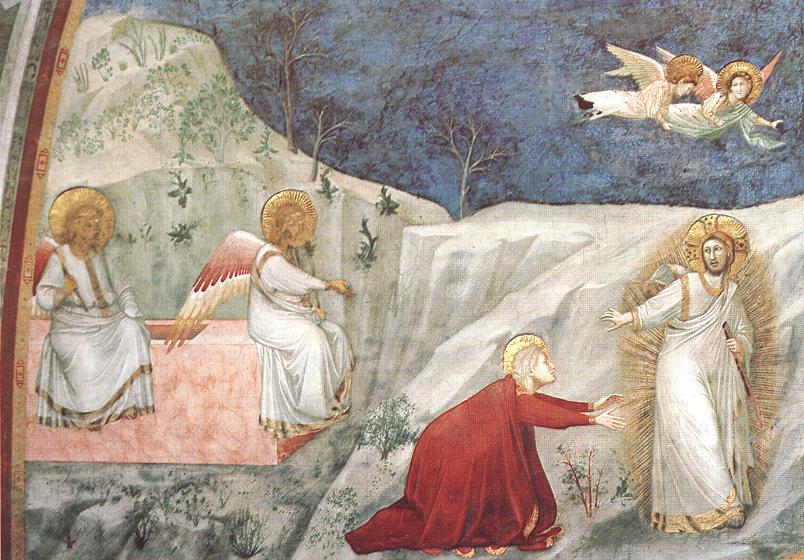
“Noli me tangere” (touch me not) fresco in the Lower Basilica of St. Francis Assisi Church in Italy painted by Giotto de Bondone in the 13th century from commons.wikimedia.org.

Like on that Easter morning, there will always be the darkness of death but only for a moment if we keep our eyes and our hearts open to Jesus who had risen. Many times we are like Mary Magdalene grieving and weeping that we fail to see the light of Jesus and of our deceased staying with us right in the darkness of grief and death that envelop us. And like Mary, we keep on insisting in relating with them in our old, physical level, forgetting the fact they have risen with Jesus to new life, to new realm of existence.

Jesus said to her, “Mary!” She turned and said to him in Hebrew, “Rabbouni,” which means Teacher. Jesus said to her, “Stop holding on to me, for I have not yet ascended to the Father. But go to my brothers and tell them, ‘I am going to my Father and your Father, to my God and your God.’” Mary of Magdalene went and announced to the disciples, “I have seen the Lord,” and then reported what he told her.

John 20:16-18

“Stop holding on to me” or “noli me tangere – touch me not” are the words also meant for us today who continue to cling and hold to our departed loved ones like Mary Magdalene, still hoping to hug and kiss them again, to touch and tell them how much we loved them or perhaps say sorry for our sins and lapses when they were still around. It is time to level up in our relationships with them as Five for Fighting reminds us in the last stanza that “every day is a new day”.

It does not really matter if we, or they our departed, are just 15 or 22 or 33 or 45 or 67 or 99 — what is most important is we value each moment of our lives here and now where in the present we meet them once or twice if we are living fully and not blinded by our grief and wishful thinking. Have faith in God. Someday, we shall all be together. For the moment, here is Five for Fighting with his100 Years. May the Lord console you and raise you up to move forward again in life. Amen.

*We have no intentions of infringing into the copyrights of this music and its uploader except to share its beauty and listening pleasure.

From YouTube.com.

Light amid darkness: the grace of grieving in Mary Magdalene

The Lord Is My Chef Daily Recipe by Fr. Nicanor F. Lalog II
Friday, Feast of St. Mary Magdalene, 22 July 2022
Song of Songs 3:1-4   ><}}}}*> + ><}}}}*> + ><}}}}*>   John 20:1-2. 11-18
Photo from GettyImages/iStockphoto.com
Praise and glory to you,
O Lord Jesus Christ in giving
us today this Feast of St. Mary
Magdalene, the "apostle of the
apostles" who proclaimed to Peter
and company that you have risen
on that Easter morning!
Thank you most especially in 
showing us through St. Mary Magdalene
the grace in that state many of us find
ourselves so often especially these days
of the pandemic - that of grieving.

On the first day of the week, Mary of Magdalene came to the tomb early in the morning, while it was still dark, and saw the stone removed from the tomb. Mary stayed outside the tomb weeping. And as she wept, she bent over into the tomb and saw two angels in white sitting there, one at the head and one at the feet where the Body of Jesus had been. And they said to her, “Woman, why are you weeping?” She said to them, “They have taken by Lord, and I don’t know where they laid him.” When she had said this, she turned around and saw Jesus there, but did not know it was Jesus.

John 20:1, 11-14
Dearest Lord Jesus,
I pray for those weeping, 
for those grieving for the lost
of a beloved wife or husband,
a son or a daughter, a brother or
a sister, a friend or a colleague;
I also pray, Jesus, for those 
who are weeping in silence,
fighting their tears, hiding when
they cry as they attend and care 
for a dying loved one at home or
in the hospital.
Like St. Mary Magdalene, death
from its approach and coming
always has that dark presence in
us; mourning and weeping become
more difficult when nights become
longer we could hardly know morning
is coming or has broken.
And many times in those dark moments
we do not recognize you, Jesus, 
present among us in our weeping,
right in our grieving for our loved ones.
Open our eyes, open our hearts,
enkindle our faith and hopes in you, Lord
in these long, dark hours of our grieving.
You know very well how difficult it is
to let go of a loved one like St. Mary Magdalene
when you have died; like her, we continue
to "cling" and "hold" to our beloved 
in our old ways of relating with them 
in the hope of again hugging them,
touching them, and perhaps telling them 
how we love them and if given a chance,
to say sorry too for our sins and lapses.
“Noli me tangere” (touch me not) fresco in the Lower Basilica of St. Francis Assisi Church in Italy painted by Giotto de Bondone in the 13th century from commons.wikimedia.org.

Jesus said to her, “Mary!” She turned and said to him in Hebrew, “Rabbouni,” which means Teacher. Jesus said to her, “Stop holding on to me, for I have not yet ascended to the Father. But go to my brothers and tell them, ‘I am going to my Father and your Father, to my God and your God.'” Mary of Magdalene went and announced to the disciples, “I have seen the Lord,” and then reported what he told her.

John 20:16-18
Call us with our name again,
dear Jesus; call us anew with your
reassuring voice of love and kindness,
of mercy and forgiveness no matter
who we really are 
for you are the only one sent by the Father 
to assure us we are accepted despite and
in spite of our sins and weaknesses.
Let us exclaim again "Rabbouni" like
St. Mary Magdalene, filled with joy in
finding you amidst the darkness 
in our lives as we learn to stop "holding"
on to our departed and dying loved ones
as we recall and realize your teaching 
that every death is a sharing in your pasch,
a passing over into eternal life,
of leveling up our ties with them 
in you, Christ Jesus
to the Father and the Holy Spirit.
Amen.
Photo by author, sunrise at Camp John Hay, Baguio City, November 2018.