Lawiswis ng Salita ni P. Nicanor F. Lalog II, Ika-30 ng Abril 2020
Isang matandang kasabihan
itong ating masasandigan
na nagsasaad ng katotohanan
na hindi nalilikha ating pag-uugali
sa panahon ng krisis, bagkus dito
ito nahahayag at nalalantad din.
Sa gitna nitong quarantine ng COVID-19,
maraming pag-uugali natin ang nabuking:
nakilala sino ang may tunay at dalisay
na pagtingin at malasakit sa kapwa
sariling kaluguran at kapakanan ipinagkait
upang madamayan, masamahan higit nangangailangan.
Gayon din naman napatunayan higit kailanman
hindi lahat ng kumikinang ay ginto
kungdi tanso din naman
dahil sa asal at pag-uugali
hindi lamang magaspang
kungdi kamuhi-muhi, nakakapangiwi!
Sa kaunting halaga
o anumang ayuda maaring makuha
ipinagpalit ang kaluluwa
dangal ay ipagpapaliban
matiyak lamang hindi siya malalamang
sapagkat sariling kaluguran tanging panuntunan.
Pagkaraan nitong lockdown
kawawa mga nanlamang
hindi na sila pagkakatiwalaan
makitid na isipan, sarili lamang ang tanaw
kaya pag-uugali ay gayon na lamang;
sa kabilang dako naman, pakatandaan
yaong mga sa gitna ng kagipitan
nanatili sa atin at hindi nang iwan
pasalamatan at ituring na tunay na kaibigan
dahil kanilang pagdamay at pag-agapay
nadalisay pang tunay nitong kahirapan.
Quiet Storm by Fr. Nicanor F. Lalog II, 29 April 2020
Photo by author, 2010.
This is again for my brother priests and fellow workers in Church communication: our extended “enhanced community quarantine” is a call for us to rediscover the contemplative spirit so essential in our communication apostolate. It is best that before we go in front of the camera, before we post anything at all, or even before we go out doing our social action, let us first have Jesus Christ in us.
After all, it is always Jesus and only Jesus we bring as priests in everything we say and do. Jesus is our life as priests and without him, our works mean nothing. Worst, it may be happening that it is not Jesus whom we are following when we fail to spend time with him in serious prayers that unknown to us, we are already replacing him by creating our own ministry apart from him.
Incidentally, we are celebrating today the Memorial of St. Catherine of Siena who is considered as one of the patron saints for those working in telecommunications and TV stations.
In one of her numerous “ecstatic” visions, it is said that when she was so sick in her room, she begged the Lord to give her a glimpse of the celebration of the Mass in their chapel. The Lord heard her prayer and thus, she became the first person in history to have celebrated Mass by “remote telecast”!
From Google.
Faith and technology
We have mentioned in our previous reflection that we now live our faith in a mass-mediated culture. Media is all around us. And there is always that intense temptation by the devil to put us on TV and the internet to be popular.
So, how do we interact with technology on a daily basis?
What are we posting on Facebook? Are we like the rest who are also hooked into TikTok with all the inanities that go with it?
How much time do we spend for social media and Netflix these days?
And how many hours do we spend before the Blessed Sacrament, excluding our Liturgy of the Hours and praying of the Holy Rosary?
From Google.
We are familiar with Marshall McLuhan’s dictum “the medium is the message”.
This we have seen in the past very evident in our ministry when some priests have transformed the South American telenovelas and later Koreanovelas into a gospel too that people felt like listening to reviews during the homily. And it had given some people the idea that every homily of the priest must say something about television shows! In fact, about three years ago, some priests have to be reminded by the CBCP during the Simbang Gabi to focus only on the Word of God and not on TV shows and jokes to get the attention of their congregation during Mass.
But let us not forget that later in his life, McLuhan added to his dictum that “the medium is the massage” to warn us that sooner or later, we can be eaten up by media that everything is reduced into a show – or a palabas in Filipino that means outward.
That is what a show is, a palabas which is empty or walang laman.
And shallow, mababaw.
That is the sorry state of our many social communication efforts in the Church when we have Masses that have become like entertainment shows, priests becoming entertainers, church buildings and decors that look like videoke bars evoking none of the sacred, and tarps and posters that are all hype without any evangelical meaning.
Observe also how our presentations and shows in our Catholic schools and parish halls have become mere repetitions of what are on television that have left many of us now stuck in Emmaus who could no longer find the way back to Jerusalem, even to Jesus because all we see are the fun and excitement, the glitz and the glamor of media.
And of our massaged ego.
Road to Emmaus from clarusonline.it
Keeping technology in its place in the Church
We are not saying modern communications is evil; the Church has always been clear that these modern means of communications are in fact a gift from God. Vatican II asserts that it is Church’s “birthright” to use and own these modern means of communication for evangelization (Inter Mirifica, 3)
Our challenge in the Church is to keep these modern technologies in its proper place.
A technological culture is not the most hospitable environment for religious belief, but neither is it necessarily hostile. If we are to find a way of expressing our faith in this technological culture and of speaking to and with the people formed by this culture we need to take time to consider how we, as individuals and as a faith community, interact with technology on a daily basis.
James Mcdonnell, Communicating the Gospel in a Technological Age: Rediscovering the Contemplative Spirit (1989)
In a story posted by the CBCP News two days ago, it reported the experience of Filipino priest Fr. Jun Villanueva who contracted the dreaded COVID-19 disease in New York City last March shortly after he had arrived to study there.
Assigned in a parish in the heart of the Big Apple, Fr. Villanueva tells how he spent his days of being “alone literally and emotionally” as “moments with God”. But, his turning point came after recovering from the corona virus when he began celebrating Mass alone:
“I really cried when I first celebrated Mass without churchgoers. There’s no one in the Church except Jesus,” he recalled. “Then I realized that the Mass is not a show but our union with Jesus, whether there are people or none,” he said. “I started to look at the situation from that perspective”.
Fr. Jun Villanueva, CBCP News, 27 April 2020
That is the first step needed to put technology in its proper place in the Church: that we bring back Jesus Christ whom we have banished in the name of our ministry and vocation. The more we think of putting so much “art” and other things to “enhance” our liturgies, then we banish Jesus Christ.
This is the other pandemic we have refused to stop in the Church: triumphalism, the overdoing of things for God that in the process we actually put more of ourselves in the ministry and liturgy than of the Holy.
Is there anyone or anything greater than the Lord?
Remember St. Theresa of Avila: Solo dios basta!
And, like our saints who guide us closer to God, the only way to have Jesus and bring him back in our lives and ministry, in the church as institution and building is through the contemplative spirit of the priests.
It is a good thing that the catch call these days is that the “return to normal” is actually a “return to basics” like washing of hands, covering of mouths when sneezing, and most of all, a return to God.
From Google.
The spirits of modernity characterized by constant changes and technological efficiency do not jibe so well with the demands of the Gospel of Jesus Christ who have always reminded us of guarding against the temptations of the material world.
Jesus tells us to practice poverty but the world tells us to be wealthy.
Jesus asks us to forget ourselves and follow him but the world tells us to be popular and follow the limelight.
Jesus tells us to go down and be humble but the world tells us to rise up and go higher!
The other day, Jesus reminded us in the gospel:
“Do not work for food that perishes but for the food that endures eternal life, which the Son of Man will give you. For on him the Father, God, has set his seal.”
John 6:27
Most of the time in the Church and in our lives as priests, we have to be “inefficient” like “waste time” doing nothing in front of the Blessed Sacrament; have less of everything like food, money and clothing; be silent to listen more than to speak and talk more.
The contemplative spirit is about poverty and going down while the world tells us to be wealthy and to rise and go upwards.
The contemplative spirit is to be silent and trusting always in the Lord rather than relying on our own powers and abilities.
Here is James McDonnell again on the need to rediscover the contemplative spirit in communicating the gospel in this modern time.
“The contemplative spirit is an attitude of mind and heart that enables us to focus on the essential, important things. It refuses to be hurried or rushed into premature rejection or acceptance of technology. If we Christians allow it to inform our use of communication technologies we shall learn to be realistic, but always hopeful, able to love and reverence our culture even as we strive, with God’s help, to transform it.”
Communicating the Gospel in a Technological Age: Rediscovering the Contemplative Spirit (1989)
Take heart, my dear brother priests: we are representatives of Jesus Christ, our Eternal Priest. We are not entertainers and pleasers of anyone but of God alone. We do not need followers and likers. And we have so many other things to do than TikTok and Facebook or Instagram.
Let us go back to Nazareth to be silent and hidden so we can return to Jerusalem to await for further instructions from the Lord. Amen.
Quiet Storm by Fr. Nicanor F. Lalog II, 26 April 2020
This is for my brother priests and fellow communicators in the church who might be failing to recognize Jesus Christ along the way and sadly, stuck at Emmaus.
That very day, the first day of the week, two of Jesus’ disciples were going to a village seven miles from Jerusalem called Emmaus, and they were conversing about all the tings that had occurred. And it happened that while they were conversing and debating, Jesus himself drew near and walked with them, but their eyes were prevented from recognizing him.
Luke 24:13-16
We live our faith today in a mass-mediated culture.
Media is all around us.
Vatican II tells us that these modern means of communications are gifts from God that are “necessary for the formation of Christians and for pastoral activity” (Inter Mirifica, 3).
Communication is a sharing in the power of God who created everything by just saying “Let there be…”. When this power to communicate is mishandled and eventually abused, sooner or later, it can blind us and prevent us from recognizing Jesus in our midst.
And sadly, it is already happening.
Even before the start of the enhanced community quarantine, many of us were already using the various platforms of social media proclaiming the good news of Jesus Christ.
But, are our hearts still burning deep inside in him and for him?
Is Jesus still the One we are proclaiming, or are we now trying to be like the so-called “influencers” of the secular world that we are more preoccupied and focused with gimmicks and antics, shows and bravaduras for the sake of followers and likes?
Are our hearts still burning with the Sacred Scriptures or the words of the world that we have made our ambos and altars like studios and stage complete with all the props to tickle the bones of people than build up their faith and experience Jesus?
On the road to Emmaus, after Cleopas had expressed their feelings and thoughts to Jesus, he and his companion fell silent and simply listened to Jesus explaining the Sacred Scriptures. No need to shout or mimic voices.
No need to keep on clapping hands like in a circus or even dance like Salome who later asked for the head of St. John the Baptist.
It is sad that on the road to Emmaus, it has become our monologue, our show that Jesus can no longer speak.
Remember that “in the beginning was the word, and the word became flesh”: God’s communication is always preceded by silence.
Even in the road to Emmaus, there was total silence when Jesus spoke that the two disciples were silent that they felt their hearts burning.
As they approached the village to which they were going, he gave the impression that he was going on farther. But they urged him, “Stay with us, for it is nearly evening and the day is almost over.” So he went to stay with them. And it happened that, while he was with them at table, he took bread, said the blessing, broke it, and gave it to them. With that their eyes were opened and they recognized him, but he vanished from their sight. Then they said to each other, “Were not our hearts burning within us while he spoke to us on the way and opened the Scriptures to us?” So they set out at once and returned to Jerusalem where they found gathered together the eleven and those with them…
Luke 24:28-33
The Mass and our Priesthood are both a mystery so unique especially for us. It is something beyond explanation without much physical descriptions but more of inner recognition.
Exactly like Easter: the moment we recognize Jesus in the Scriptures and in the Eucharist, he vanishes because he is more than enough than anybody or anything else in the Mass and in our ministry in general.
Even in our very own lives!
St. Mother Teresa asked us priests long ago to “always give (them) Jesus, only Jesus”. And that will always be valid until the end of time when Jesus comes again.
And here lies the great lesson for us from Emmaus: the more we try harder, insisting on giving “physical appearances” of Jesus in our celebrations with our showbiz kind of preaching complete with a song and dance number to the excessive use of modern means of communications like slide presentations during homilies to our “creative liturgies” that are very distracting to other trappings of overdoing everything called “triumphalism” — that is when we BANISH Jesus from the scene.
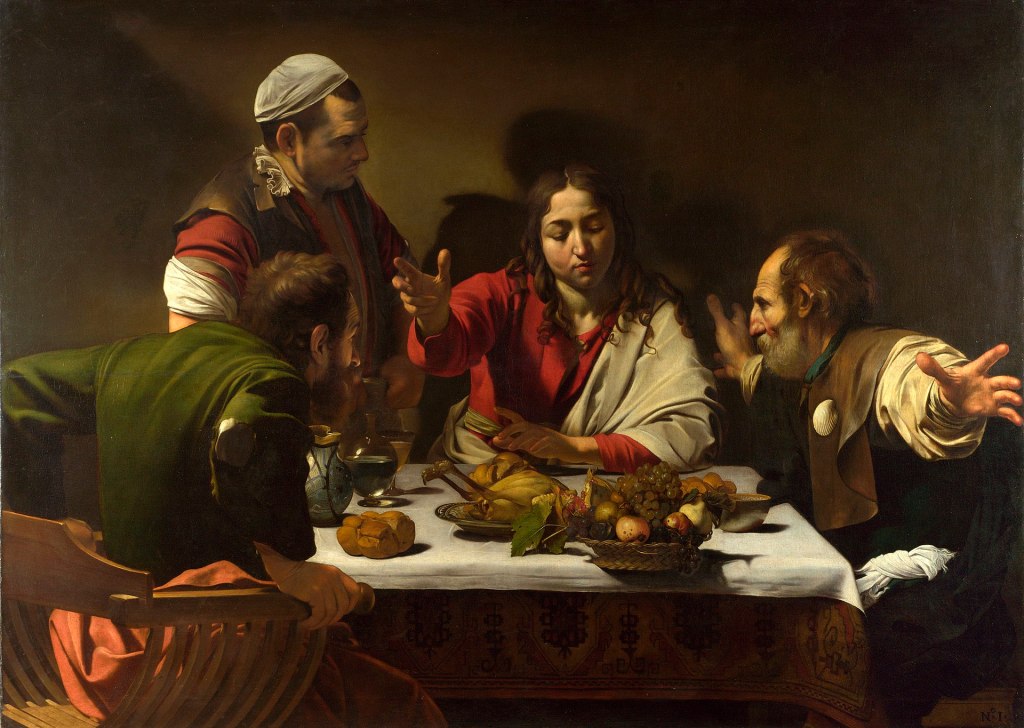
In Emmaus, Jesus vanished when the disciples’ eyes were opened.
In some Masses today, unfortunately, Jesus is banished and many eyes are not only left closed but sadly, even blinded.
“Supper at Emmaus” by Caravaggio.
We are priests called to preside the celebration of the Eucharist in persona Christi.
We priests do not own the Mass and we cannot insist on whatever we want to do, even if it is very pleasing and delighting to the senses of the people.
Do away wit all those “styles” and gimmicks.
Jesus saved us not with activities; Jesus saved us by dying on the Cross.
If all we are concerned with is to “feel good”, to tickle our bones and senses, our eyes – and those of the people we serve and bring closer to God would never be opened to recognize Jesus Christ.
Our Masses and other celebrations need only Jesus, always Jesus.
There is no need to put our pictures in every tarpaulin or announcement. Rest assured that every disciple of Jesus is always good-looking and handsome. Believe. And stop bragging it.
Let us have him always and let others recognize him from within. If there is no inner recognition of Jesus, maybe we have never met him at all. Neither in Emmaus nor in Jerusalem nor in our selves.
A blessed week ahead of you, my brother priests and fellow communicators of Christ, in Christ.
Quiet Storm by Fr. Nicanor F. Lalog II, 23 April 2020
Detail of “The Temptation of Jesus According to St. Matthew” on the wall of St. Mark’s Cathedral in Venice, Italy. Photo from psephizo.com.
English journalist and satirist Thomas Malcolm Muggeridge (1903-1990) said in his book “Christ and the Media” (1978) that if Jesus Christ were still with us in this age, the devil would have surely tested him a fourth time in the wilderness with, “I will put you on TV“.
So true!
Muggeridge has been proven right especially in the last 40 years when television has become the new “altar” not only in homes but everywhere, including in our churches that has made the sacred so ordinary, almost profane with priests speaking and moving more like entertainers with the Mass becoming quite like a variety show, complete even with raffles and prizes!
That is why we priests have to restudy again and review Church teachings on social communication during this long quarantine period. And pray more intensely on our next moves after COVID-19.
Although the corona pandemic has given the much-needed push for our social communication ministry in the church, it is my firm belief that the post-COVID 19 scene can be misleading if not handled properly at this stage.
This early, we can see some abuses in the celebrations of the Holy Mass on TV as well as in other similar platforms like Facebook live.
But the most serious danger now becoming so clear and present are some of us priests totally “lost in media” who have become the center of attractions, pushing Jesus Christ out of the total picture.
Communication is sharing in the power of God
Communication is power. In the story of creation, God created everything by merely saying the words “Let there be…” and everything came into being. Our ability to communicate intelligibly unlike other creatures is a tremendous gift from God which is a sharing in his power to communicate.
This is explains the simple reason that when we love a person, we always talk; any lack of communication is a sign of a breakdown in the relationship like when husband and wife or lovers have “LQ”.
We have seen in recent years with the advent of smartphones how powerful can communication be that it can build or destroy anyone with a single “click”.
Or, how our ego is massaged when we are the first to break a news on Facebook or when our posts get viral or trending!
See how the most influential and highest paid people are always the ones on TV.
The seal of “Good Housekeeping” on every product had been replaced with “As Seen on TV!” as mark of good quality of anything being sold.
To succeed in any war campaign or coup d’etat, military handbooks now give top priority in first neutralizing TV and radio stations to ensure victory.
And, sadly also due to this power of TV, every political career is now launched first on television that is why we have more actors and actresses than solons and statesmen in the corridors of power.
How amazing that it is the fictional character Spider-Man, one of the top grossing film franchise in recent years, is the one who reminds us that “with great power comes great responsibility”.
In the Old Testament, people prided themselves in building the tower of Babel that reaches to heaven that God confused them with different languages causing its collapse. The reverse happened in the New Testament when during the Pentecost, God sent the Holy Spirit so people could understand each other despite their different languages and the Holy Church was built up.
When communication is seen in the right perspective, it becomes a spirituality because it is always a sharing in the power of God which is love.
“Communication is more than the expression of ideas and the indication of emotion. At its most profound level, it is the giving of self in love. Christ’s communication was, in fact, spirit and life. In the institution of the Holy Eucharist, Christ gave us the most perfect, most intimate form of communion between God and man possible in this life, and out of this, the deepest possible unity between men. further, Christ communicated to us his life-giving Spirit, who brings all men together in unity.
Pastoral Instruction on the Means of Social Communication (Communio et progressio), #11
Communication is spirituality, the sharing of Jesus Christ
Church communication, specifically the communication by every priest is communicating Jesus Christ, the eternal Word who became flesh.
Our mission as priests according to Vatican II as “man of the Word of the living God” (Presbyterorum Ordinis, 4) is to primarily share Jesus Christ.
My spiritual director and mentor, truly another father and dad to me, Rev. Fr. Franz-Josef Eilers, svd would always tell me….
“Priesthood is for the service of the Lord and a priest should reflect it. He is not to become a ‘star’ with the public but rather another Jesus figure in humble service of the Lord… The test for a good priest is the depth and power of his spiritual life and being with the Lord. Can you imagine saints like John Vianney and John XXIII as television stars? If the media would report about their life, it is ok; but they themselves should not appear as “star” but rather as servants of the Lord. And this is reflected in their spiritual life and not any ‘show’…”
Personal notes with Fr. Eilers
What a tragedy when we priests are more after the number of followers and likes, forgetting the fact that Jesus himself had only 12 followers with one betrayer among them!
What a tragedy when we priests, starting from the seminary, has always been speaking and working around “Galilee” without any moments of silence and hiddenness of Nazareth and of the desert and wilderness.
All the spiritual masters from the apostolic period down to this modern age of Nouwen and Merton, including the secular Pico Iyer have always emphasized silence and solitude or stillness in prayer before the world and the Lord to truly have impact in this world.
We are priests asked to be the mouth and arms and limbs and legs of Jesus Christ. We are not replacing but merely representing Jesus Christ for it is him who is going to change the world, not us. Our task is to be filled always with Jesus Christ, to be like Jesus Christ, to share always and only Jesus Christ.
Like St. John the Baptist, our attitude toward Jesus and our communication ministry must always be “He must increase; I must decrease” (Jn.3:30).
Then why all our pictures in every post, in every announcement?
If we firmly believe in Jesus, we do not need pomp and pageantry and all the gimiks and antics in our celebrations of the Mass or announcements of recollections or bible studies. People would always surely come for Jesus Christ who is more than anybody else.
The primacy of Christ in every Church communication
Long before Canadian philosopher and communication researcher Marshall McLuhan (1911-1980) came up with his dictum “the medium is the message”, there has always been the towering figure of St. Augustine in early Church communication process.
In the fourth book of his “Doctrina Cristiana” (Christian Doctrine), he noted that in Christian communication, the process always begins with the Message, Jesus Christ.
Hence, whereas we normally find the process as:
SENDER —> MESSAGE —-> RECEIVER ;
in Church communication, it is always:
MESSAGE (JESUS CHRIST) —> SENDER —> RECEIVER.
When there is a breakdown in this flow of communication, especially by a priest, there is already a problem. When it is the priest who is always in the limelight, always his photo hogging whatever communication platform it may be, or when the homily has become more to delight and tickle the senses, it is a sign of falling into the fourth temptation.
Sooner or later, it will not be surprising that during consecration, instead of experiencing and realizing Jesus saying “This is my Body will be given up for you”, what the priest may be revealing is that “This is my body. Be envious.”
Soon, Father will be endorsing products and services, entering into various contracts in the name of the Church, hanging out in the most expensive restaurants, rubbing elbows with the rich and famous, leaving Jesus behind among the poor and worst — alone in the Blessed Sacrament because Father is so busy with his “shootings” and media appearances.
And that is when he forgets being a priest, forgets Jesus Christ until it is too late, he had fallen into the trap of the devil as sex and financial scandals unfold, hurting the Church, hurting Jesus Christ, hurting himself and everybody else in the process.
Anybody can always be a good speaker and orator. But not everybody is called to speak for the Lord. Let us not waste it nor abuse it. Most of all, let us not disappoint the Lord who has called us not because we are good but because he is good!
May this quarantine period be another wilderness experience for us priests and communication ministers in the church so we may empty ourselves to be filled with Jesus Christ the Perfect Communicator we must share and proclaim. Amen.
Lawiswis ng Salita ni P. Nicanor F. Lalog II, Ika-16 ng Abril 2020
Larawan kuha ni G. Raffy Tima ng GMA-7 News nang sumabog ang Bulkang Taal, Enero 2020.
Hindi lamang minsan
sumagi sa aking isipan
nakalulungkot nating kinagawian
Diyos ay ating kinakawawa
kapag may masamang karanasan
Siya ating pinagbibintangang
tayo ay pinarurusahan
kulang na nga lang
lahat ng kasamaan inatang
lahat ng sisi sa Kanyang pangalan.
Kinakawawa natin ang Diyos
sa tuwing siya ang tinuturing pinagmulan
ng bawat kalamidad at kasawian;
madalas idahilan pa ng karamihan
sa pagaakalang mabuting katuwiran
na mga ito ay pagsubok lamang
ng Maykapal na hindi ibibigay
kung hindi malalampasan
gayong Siya ay purong kabutihan
paanong ipaliliwanag iyan?
Kinakawawa natin ang Diyos
katulad noong kanyang kapanahunan
nilalapastangan at pinasasakitan
gayong tao ang may kasalanan
at palaging nagkukulang
katulad doon sa ilang nang tuksuhin ng diyablo
hinahamon Kanyang katuwiran
pati katarungan bakit Niya
pinababayaan mga kahirapan
at hindi pakinggan mga karaingan?
Ang mahirap maintindihan
Diyos ang laging tinatawagan
sa maraming pangangailangan
ngunit kapag napagkalooban
Siya ay kinalilimutan, tinatalikuran
habang ating inaangkin
lahat ng husay at galing
sa nakamit na katanyagan
at magandang kapalaran
na tila baga wala Siyang kinalaman?
Kay laking kabalintunaan
kakatwang kahangalan
at sukdulang kayabangan
nating mga nilalang
na Diyos ay kalimutan at talikuran
sa paniniwalang lahat ating makakayanan
pati kamatayan pilit iniiwasan
mga kamay ng orasan pinipigilan
habang hinahatulan sinong may karapatang mabuhay
sanggol sa tiyan at mga tinotokhang!
Lingid sa ating kaalaman
na pinalabo ng ating kapalaluan
sa bawat kalungkutan at kahirapan
pagtitiis at kabiguan
Diyos ang higit sa ating nasasaktan
sa pagpanaw ng maski isa lang
Siya ang labis nahihirapan
dahil sa ano mang ating kalagayan
Diyos ay palagi tayong sinasamahan
pilit naman nating iniiwan at sinusumbatan.
Sakaling tayo ay dumaraan
sa kahirapan at ano mang kagipitan
hindi ito nagmula sa Diyos
dahil Siya ang kabutihan;
gayon pa man ating maaasahan
lahat ng ating nararanasan
Kanyang nalalaman
hindi Niya papayagang magwagi
anumang dalamhati bagkus Kanyang titiyakin
mga ito ay humantong sa ating luwalhati.
Hindi ang Diyos ang kawawa
sa tuwing atin Siyang kinakawawa
sa salita at sa gawa
kungdi tayong kanyang mga tinubos
pagkatao natin ang nauubos
dangal nati'y nauupos
sa tuwing aasta tayong boss
gayong tayo ang nabubusabos
nitong kapalaluan nating lipos
na sana ay maubos, matapos kasabay ng corona virus.
The Lord Is My Chef Breakfast Recipe for the Soul, Thursday within the Octave of Easter, 16 April 2020
Acts of the Apostles 3:11-26 <*(((>< +++ ><)))*> Luke 24:35-48
Dearest Lord Jesus Christ:
Today I pray for just one simple thing for everyone: that we believe in you and the One who sent you.
How sad, O Lord, that in the midst of this pandemic, we still refuse to believe in you with some people continuing to rely more in themselves, in their sciences, in their technologies, in their peoples.
How sad, O Lord, when our religious beliefs border mostly between the two extremes of either blaming you for every tragedy and calamity we go through or, forgetting and even disregarding you from every triumph and victory we achieve in life.
Enlighten our minds and our hearts, Jesus.
“Now I know, brothers and sisters that yo acted out of ignorance, just as your leaders did; but God has thus brought to fulfillment what he had announced beforehand through the mouth of all the prophets, that his Christ would suffer. Repent, therefore, and be converted, that your sins may be wiped away, and the Lord may grant you times of refreshment and send you the Christ already appointed for you, Jesus…”
Acts of the Apostles 3:17-20
Indeed, O Lord, to believe in you is the starting point of everything.
Give us the grace to recognize you within us most especially when we break the bread even through the wonders of the modern internet.
One common thing that the evangelists tell us after you rose from the dead is how you would always join your disciples on the table and share meal with them.
In this time when churches are closed and all we can do is celebrate the Eucharist on TV or the Internet, pour out your grace upon us to continue to recognize and experience you in our table fellowship to remove our doubts of your presence and assure us of your salvation.
“Why are you troubled? And why do questions arise in your hearts?” While they were still incredulous for joy and were amazed, he asked them, “Have you anything here to eat?” They gave him a piece of baked fish; he took it and ate it in front of them. He said to them, “These are my words that I spoke to you while I was still with you, that everything written about me in the law of Moses and in then prophets and psalms must be fulfilled.” Then he opened their minds to understand the Scriptures. And he said to them, “Thus it is written that the Christ would suffer and rise from the dead on the third day and that repentance, for the forgiveness of sins, would be preached in his name to all the nations, beginning from Jerusalem. You are witnesses of these things.”
Luke 24:38, 41-48
Help us, Jesus in our unbelief, increase our little faith in you in these times of crisis.
Keep us strong in being your witnesses in this modern time when we have so many other gods being worshipped. Amen.
Lawiswis Ng Salita ni P. Nicanor F. Lalog II, Ika-13 ng Abril 2020
Katulad ninyo
ako man ay humiling
sa aking mga panalangin
sana'y magbalik na
dating normal na buhay natin
bago mag-COVID-19.


Ngunit nang aking suriin
mali itong aking hiling
at tiyak hindi diringgin
ng Panginoon nating
nagpakasakit upang baguhin
kinamihasnang pagkakasala natin.


Ano nga ba ibig sabihin
pagbabalik sa dating normal
na buhay natin?
Hindi ba ito naging sanhi
nitong COVID-19 kaya
tayo ngayon ay naka-quarantine?
Bago pa man dumating
itong social distancing
magkakahiwalay at hindi natin pansin
mga kapwa lalo mga nalilihis
habang ang iba ay minamaliit
tila baga buhay ng iba walang halaga sa atin?
Kaya dating normal na buhay natin
hindi na dapat magbalik sa mga panahong...
normal ang walang Diyos
normnal ang hindi pagsisimba
normal ang paglapastangan sa magulang at kapwa
normal ang makasarili
normal ang walang pakialam
normal ang kasakiman
normal ang patayan
normal ang pakikiapid
normal ang pagsisinungaling
normal ang fake news at chismis
normal ang pagnanakaw
normal ang korapsiyon
normal ang gulangan
normal ang pagmumura at pag-alipusta
normal ang kawalan ng kahihiyan
normal ang mga trapo na pulitikong pulpol
normal ang pagbebenta ng boto
normal ang kawalan ng modo
normal ang pagwasak sa kalikasan.
Iyan ang dating normal na buhay natin
na hindi na dapat mabalik
sari-saring mga diyos-diyosang
sinasamba upang magkamal ng maraming pera
hangaan at tingalain ng iba
waring ang sarili'y angat sa karamihan.

Iyan ang dating normal na buhay natin
na hindi na dapat mabalik pagkaran nitong COVID-19:
malayo sa Diyos at sa kapwa tao
dahil itong Pasko ng Pagkabuhay
ay pagbabalik sa landas ng kabutihan at kabanalan
paglimot sa sarili, pagpapasan ng Krus upang si Kristo ay masundan.

Kaya marahil matatagalan itong ating lockdown
upang higit nating madalisay ating mga buhay
nang sa gayon matapos pagdaanan mga kahirapan
huwag nating malimutan ang Diyos na makapangyarihan
hangad ang ating kabutihan at kapakanan.
40 Shades of Lent, Thursday, Week IV, 26 March 2020
Exodus 32:7-14 ><)))*> +++ <*(((>< John 5:31-47
Illustration from Chabad.org.
Like you, O God in the first reading today, we are all angry. We are so mad with our so-called leaders and officials in government. We are angry at their arrogance and total disregard of others especially in this time of global crisis due to COVID-19.
Like you, O God, we also seeth with anger when you at Sinai saw how the Israelites created a golden calf to worship, after you have brought them out from Egypt. We admit our sinfulness and guilt before you in having our own we golden calves like power, money, and fame among many others.
But what we are so mad, O God, is how these leaders and officials in government – whether elected or appointed – have made themselves the golden calves to be served and worshipped by everyone.
They are the golden calves themselves who have brought shame and dishonor to our nation.
They do exactly what your Son and our Savior Jesus Christ had taught us that whoever wants to be great must be the least and servant of all.
But they are certainly not. They have shamelessly acted foolish and selfish since this pandemic started.
Forgive us, too, merciful Father, for our many sins, for being deluded by these many other golden calves in our midst, in the government.
The words of your Son Jesus Christ today are so true:
“I do not accept human praise; moreover, I know that you do not have the love of God in you. I came in the name of my Father, but you do not accept me; yet if another comes in his own name, you will accept him.”
John 5:41-43
Like you, O God, we are angry at them, at how things are going on.
But like you, O God, let us relent in wishing ill for these misguided leaders whom your misguided people have put in power too.
Like you, O God, let us temper with mercy and charity our feelings and emotions against them.
Most of all, make us truly wiser in the next elections! Amen.
Lawiswis ng Salita ni P. Nicanor F. Lalog II, Ika-24 ng Pebrero 2020
Mula sa Inquirer.net
Tuwing maiisip ko pangalang EDSA
ako ay naluluha at naaalala noong una
ang tuwa ng mapayapang pagbabago
nagmula sa makasaysayang kalsada.
Naluluha pa rin ako ngayon
tuwing masasambit pangalang EDSA
ngunit mayroon na parating sumasagitsit
mula sa langit lungkot at pait sa ating sinapit.
Masakit para sa amin na noon pa ma'y
tumutol sa mga ulol at hibang na K-B-L
ngunit pagkaraan ng EDSA,
mga halimaw din pala aming nakasama!
Inuna kanilang mga hacienda
makinarya sa pulitika
reporma anila sa ekonomiya
pagkakanya-kanya lang din naman pala.
Ano nga ba talaga nangyari
noong Pebrero mil-nueve-ochenta'y-sais?
Trahedya ng EDSA o
Trahedya sa EDSA?
Kung maari sana'y pakinggan nating muli
hindi tinig ko o ng kung sinu-sinong
magkomentaryong pilosopo o lalo naman
pinagsasabi ng sino mang pulitiko at relihiyoso!
Bawat isa sana ay magtika
dahil alin mang trahedya - ng EDSA o sa EDSA -
ay iisa:  Panginoong Diyos na siyang kumilos noon,
ating tinalikuran at kinalimutan ngayon!













 lordmychef.com