Lord My Chef Daily Recipe for the Soul by Fr. Nicanor F. Lalog II
Friday, Memorial of the Presentation of the Blessed Virgin Mary, 21 November 2025
1 Maccabees 4:36-37, 52-59     <*{{{{>< + ><}}}}*>     Luke 19:45-48
Photo by author, Mary’s home in Ephesus, 03 November 2025.
God our loving Father,
today I praise and thank you again
for the recent chance to travel
and experience your majesty
and beauty abroad
and among other peoples
of different culture;
most of all,
I am grateful to have been
to the home of the Blessed
Virgin Mary in Ephesus;
until now,
I am savoring,
"masticating" the blessed
experience.
Jesus entered the temple area and proceeded to drive out those who were selling things, saying to them, “It is written, My house shall be a house of prayer, but you have made it a den of thieves” (Luke 19:45-46).
As I recall
that brief moment of stay
inside the Ephesus home of Mary,
I felt my whole being emptied - hollowed -
and as I knelt and prayed
without any distractions,
no worries about pictures nor of time,
slowly I felt being filled within
by you, O God: from hollowedness
to holiness or hallowed;
that is why Jesus drove away
the merchants out of temple:
every temple,
every place of worship
including our very selves
is a home and dwelling place of God;
the chief priests, scribes
and leader of the people
felt under attack by Jesus
because they were empty of God,
filled of the world and its things;
the people were spellbound
on the other hand because
they have realized that
truly, we are the indwelling
of God; therefore, let us cleanse
ourselves always within
not only of sin but also of
so many things that distract
us away from God
to dwell in us
like social media.
O Blessed Virgin Mary,
from the very start you have
been reserved by God from any stain
of sin to be the Mother of the Christ
but it was also fulfilled because
of human cooperation: of your parents
dedicating you to God and most of all,
of your fiat to God.
Pray for us, Mama Mary
that we may cultivate a prayer life
that shall make us a home
to God; let us express our
fiat to him daily by presenting
ourselves to him like you.
Amen.
Photo by author, back of Mary’s home in Ephesus, 03 November 2025.
The Lord Is My Chef Sunday Recipe for the Soul by Fr. Nicanor F. Lalog II
Feast of the Baptism of the Lord, Cycle C, 12January 2025
Isaiah 40:1-5, 9-11  ><}}}*>  Titus 2:11-14; 3:4-7  ><}}}*>  Luke 3:15-16, 21-22
Photo by author, San Fernando, Pampanga, November 2021.
Today is your last chance to greet “Merry Christmas” the people you have forgotten as well as claim your gifts from Santa because this Sunday’s “Feast of the Lord’s Baptism” closes the Christmas Season.
The Lord’s Baptism shows us that Jesus did not remain an infant on the manger in Bethlehem nor a child in Nazareth. It is sad to note both the religious and secular emphasis on this child imagery of Christ have reinforced the notion among people that Christmas is for children and a time for adults to return to the innocence and joy of their childhood.
Jesus grew up and matured into an adult on a mission from the Father to save us that led to His Passion, Death and Resurrection at Easter. Through our baptism in becoming the children of God, Jesus invites us to continue His Christmas story by maturing in our faith, hope and love in Him by embracing His Cross that His Baptism anticipated.
This Sunday Feast of the Lord’s Baptism is a coming to full circle of last week’s Epiphany into a theophany. Yes, they sound Greek because both are from the Greek words “epiphanes” and “theophanes”.
Epiphany is Jesus manifesting Himself to all nations through the Magi as the King of kings last Sunday; today, it is God the Father who recognizes Jesus as His Christ, His Anointed One with the voice declaring as a theophany, “You are my beloved Son; with you I am well pleased” (Lk.3:22).
Every morning as we wake up is a theophany with God telling us “You are my beloved child; with you I am well pleased.” Three things I wish to share with you for us to hear God’s daily theophany and fulfill our mission as baptized children of the Father.
Photo by author, sunrise in Atok, Benguet, 27 December 2024.
First, let us recognize and affirm our being, identity, and existence. Many times, we are more of a “zombie” than a human person who can’t find life nor experience living at all, wasting precious time to be somebody else, living in the past or living in the future.
When Luke noted “The people were filled with expectation, and all were asking in their hearts whether John might be the Messiah”(Lk.3:15), he wished to inform us how the people at that time recognized and admitted they were sinners, that they were broken, that they were sick physically, emotionally and spiritually as they all affirmed their need for salvation. They accepted and owned the realities of their lives that they needed God, they needed the Christ whom they thought was John the Baptizer.
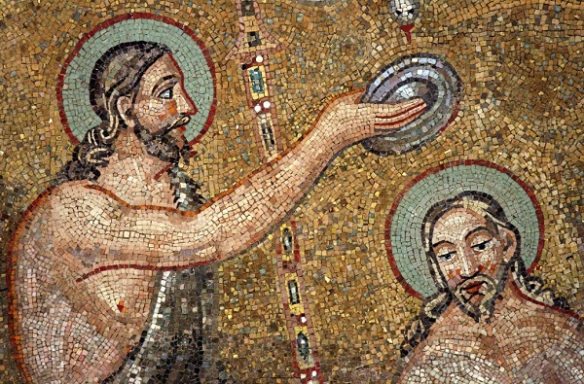
The Baptism of Christ by John the Baptist in the Jordan River. Detail of dome mosaic in the Battistero Neoniano (Orthodox Baptistery) in Ravenna, dating from 451-75. On lower right is a personification of the Jordan River as an old man rising from the water, holding a reed in one hand and offering a garment to Christ in the other. The right arm and dish of John the Baptist, the dove, and Christ’s head are 18th- and 19th-century restorations; the rest is original.
Even John the Baptizer is presented by Luke as also so sure of who he was as the precursor of the Messiah. Among the expectant people and John, we realize that indeed, growth happens the moment we accept who we are.
Examine the testimonies of many devotees of the Nazareno at Quiapo, of how they support each other in their woes and sufferings in life that we find a sort of theophanies by God, something like what we have heard from the first reading today, “Comfort, give comfort to my people, says your God”(Is.40:1). That comfort, that salvation, happened right there and then, in the now and not in a distant future.
Despite my “dislike” for their attitudes during the Traslacion, devotees of the Nazareno have always amazed me for daring to be truthful and honest with themselves, admitting their own sinfulness and weaknesses as they recognized too their need for help and most especially of their desire for God. This desire for God and admission of one’s sinfulness are very crucial to experience and hear God’s daily theophanies to us.
Photo by Mr. Jay Javier, 09 January 2019.
Second, for us to hear God’s theophany, we need to imitate Jesus Christ in taking the downward movement in life. His baptism at Jordan clearly illustrates this with His coming down to the Jordan valley through the mountains that evoked His own coming down from heaven to be born here on earth, in Bethlehem.
What is so beautiful with Jesus Christ’s downward movement is essentially a being with the sinful, the sick, the rejected, the marginalized, the poor, and those considered dirty. From being purely clean and sinless, Jesus took all our dirt to be cleansed like Him. Such is the kindness of God that Paul speaks today to Titus “so that we might become heirs in hope of eternal life”(Titus 3:7).
Our world today teaches us the opposite direction Jesus Christ had taken by climbing up the pinnacle of success, of good life, of supremacy, of power, of everything! They call it “upward mobility” that has prompted everyone even those in the Church to join the rat race for being rich and famous, of being somebody, putting on masks and taking more of the goods the world offers until we get lost in misery finding no meaning at all with one’s self because we thought life is “up there.”
Jesus Christ is not up there but down here, in our very selves, in our very hearts filled and battered with our many agonies and failures, hurts and pains, weaknesses and sins. Look down more into our very selves to find Jesus in our dirt and miseries which is the message of Jesus Nazareno.
Observe all those interviewed in Quiapo have only one prayer – well-being of a loved one. They never asked to be rich or have money. Just heal a sick child or parent was the most requested prayer of devotees. Our favorite Pope Benedict XVI explained this downward movement so well:
To accept the invitation to be baptized now means to go to the place of Jesus’ Baptism. It is to go where he identifies himself with us and to receive there our identification with him. The point where he anticipates death has now become the point where we anticipate rising again with him (Jesus of Nazareth, page 18).
Photo by author, sunset in Liputan Island, Meycauayan City, Bulacan 31 December 2022.
Last but not least for our reflection is something very peculiar with Luke alone: the theophany of Jesus happened not right after His baptism but while He was praying, “After all the people had been baptized and Jesus also had been baptized and was praying, heaven was opened and the Holy Spirit descended upon him in bodily form like a dove”(Lk.3:21-22).
In the Acts of the Apostles, Luke recorded the Pentecost happened while the Apostles with the Blessed Mother Mary were all praying when the Holy Spirit descended upon them like tongues of fires which is similar with what took place at Jesus’ Baptism. In all books of the whole Bible, divine revelation is always preceded with prayer. As we shall see this year when Luke guides us every Sunday with his gospel account, he is the one who portrayed Jesus most in prayer than any of the other evangelists.
Photo by author, Garden of Gethsemane, the Holy Land, May 2017.
If we want to hear God’s theophanies to us, let us handle life with prayer which is more of listening and being one with God. Begin and end each day with prayer. There is no other way to hear God’s voice, to hear Him affirming us, to know His plans for us until we are one with with Jesus in prayer.
In His baptism at Jordan, Jesus Christ as the Second Person in the Holy Trinity prayed not because He needed something from the Father but because He is one with Him in the Holy Spirit. That was when the Father affirmed Him as the Christ being sent on a mission.
Through the Sacrament of Baptism we have received, we are reminded today of God’s anointing of each of us as His beloved child. May we heed His voice and be one with Him for a more blessed 2025 ahead of us as we begin Ordinary Time tomorrow. Have a blessed week. Amen.
The Lord Is My Chef Sunday Recipe for the Soul by Fr. Nicanor F. Lalog II
First Sunday of Advent, Cycle C, 01 December 2024
Jeremiah 33:14-16  ><}}}}*>  1 Thessalonians 3:12-4:2  ><}}}}*>  Luke 21:25-28, 34-36
Photo by author, Advent 2018.
Blessed happy New Year, everyone! We officially start the new year in the Church on this first Sunday of Advent; that is why the Mass we have every January 1 is the Solemnity of Mary, Mother of God, not New Year as many believe.
This is the reason I insist on everyone to stop greeting “Happy New Year” after December 25 because Christmas is until Epiphany Sunday. And this is the problem with us every Christmas season – we have forgotten its very essence Jesus Christ, replacing Him with all the trimmings of this consumerist and materialistic world we live in.
Photo by author, Advent 2021 at BED Chapel, Our Lady of Fatima University, Valenzuela City.
The first Sunday of Advent is our new year, our new beginning in our journey in life in God through His Son Jesus Christ who had come, would come again, and continues to come daily in our lives. Beginning today until December 16, Advent invites us to focus on Christ’s Second Coming or Parousia at the end of time which nobody knows when except the Father in heaven; from December 17 to 24 and Christmas, we look back to the stories around Christ’s First Coming more than 2000 years ago. Between these two comings of Jesus is His coming in our daily living, in the here and now which St. Bernard of Clairvaux called Christ’s “Third Coming.”
There lies the tension in those three comings of Jesus Christ that have really taken so long that we get impatient or begin to doubt God especially with how world history has unfolded until now with wars as well as natural calamities. Just recently some parts of our country were devastated by a series of powerful typhoons while some parts of the world like Spain had its share of catastrophic flooding that claimed so many lives. Making things worst is how politics has rocked our country this week, trying to undermine our democracy as well as our sense of decency as a nation that had decayed during the past administration.
Photo by author, Dau, Mabalacat, Pampanga, November 2022.
Many are feeling disgusted everywhere in the world with how history is unfolding, wondering if life is going to get any better at all. Some have imitated Pilate in the gospel last Sunday, putting God on trial again, asking Jesus what He had done for all these upheavals and problems going on in history.
Like them, we are also tempted to ask, where is Jesus Christ? Or, the all-powerful and loving God our Father?
The days are coming, says the Lord, when I will fulfill the promise I made to the house of Israel and Judah. In those days, in that time, I will raise up for David a just shoot; he shall do what is right and just in the land. In those days Judah shall be safe and Jerusalem shall dwell secure, this is what they shall call her: “The Lord our justice” (Jeremiah 33:14-16).
Photo by author, Pulong Sampalok, DRT, Bulacan, 23 November 2024.
The Prophet Jeremiah sets the tone of Advent this Sunday, reawakening our hopes in God amid history’s defiance as seen in the many cycles of sufferings and calamities that continue to shake our lives.
Yes, the “days are coming” and indeed had come when God fulfilled His promise in sending us His Son Jesus Christ who redeemed us from our sins and renewed us in Him with fulfillment in life even while here despite the many trials and tribulations we go through.
The “days are coming” as foretold by Jeremiah long ago and most true these days because the promised Messiah Jesus is now with us, acting in subtle and and complex ways beyond our imaginations, always surprising us with how things turn out than what we believe or expected.
Yes, the “days are coming” – right now – as Jeremiah meant that day after Jerusalem had fallen that amid all the chaos around us, God is among us in Jesus Christ who works among visible realities we cannot see, always coming and going among us unnoticed. That time of great salvation is already among us, being accomplished now by Jesus in silence, in secret.
Hence, the need for us to be vigilant through prayers which Luke emphasized in his gospel account.
Jesus said to his disciples: “But when these signs begin to happen, stand erect and raise your heads because your redemption is at hand. Beware that your hearts do not become drowsy from carousing and drunkenness and the anxieties of daily life, and that day catch you by surprise… Be vigilant at all times and pray that you have the strength to escape the tribulations that are imminent and to stand before the Son of Man” (Luke 21:28, 34-35, 36).
Photo by author, San Fernando, Pampanga, November 2021.
On this new liturgical year designated as “Cycle C”, all our gospel readings on Sundays will be from Luke (Cycle A has Matthew and Cycle B, Mark; John is used partly in cycle B and for great feasts).
Of the four evangelists, Luke is the one who emphasized the importance of prayer in his gospel account wherein he always portrayed Jesus in prayer; hence, not surprisingly, he tells us today that “praying at all times” is being “vigilant at all times” too.
And this we have been told ever since as prayer has always been central in all our teachings. It is in prayer when we are one with God in Jesus. It is in prayer when our senses are heightened that we become open to God’s subtle movements in us and among us.
Everything begins in prayer, both in our personal prayers and as a community like in the Sunday Mass where Christ’s presence is unveiled, where we experience Him most in us and among us and in the world that we are then filled with hope in God despite the darkness and sufferings going on.
Recently, our University joined the annual Red Wednesday celebration of the Church when we remember our Christian brothers and sisters persecuted in various forms in many parts of the world in this modern time. I was overwhelmed at the sight of the great number of our students who joined us, many standing outside our chapel.
What touched me was after the dismissal, some students remained inside the chapel lit in red with flickering candles at the altar, still praying. That for me is the sign of that “little shoot” God promised Jeremiah who would come to bring justice and peace on earth.
Photo courtesy of The Tribune, official publication of Our Lady of Fatima University.
To keep watch in prayer (which we mean as a way of life not just mere recitation of formula prayers) while remaining upright and abounding in love as St. Paul instructed us in the second reading is to be open to Jesus Christ, ready to receive Him without fear amid the tumults in the world when He comes in His final glory.
Yes, the world is still plagued with so many imperfections, even darkness and evil that may dishearten us even make us doubt God in His goodness why these bad things are happening. Advent invites us to reawaken our hope in the salvation that had come, that still comes now, and will surely come in the fullness of the Day of the Lord when Jesus comes again.
Lord Jesus Christ,
fill us with fervent hope
in You amid the many darkness
and sufferings in life;
reawaken our hope amid
our hopelessness and be surprised
with Your loving coming and presence.
Amen.
Photo courtesy of The Tribune, official publication of Our Lady of Fatima University.
The Lord Is My Chef Daily Recipe for the Soul by Fr. Nicanor F. Lalog II
Tuesday, Memorial of St. Monica, Married Mother, 27 August 2024
2 Thessalonians 2:1-3, 14-17     <*((((><  +  ><))))*>     Matthew 23:23-26
Photo by author, St. Scholastica Spiritual Center, Tagaytay City, 20 August 2024.
I thank you today,
dear God our Father
for the gift of mothers
as we celebrate today
the Memorial of St. Monica,
mother of St. Augustine.
Therefore, brothers and sisters, stand firm and hold fast to the traditions that you were taught, either by an oral statement or by a letter of ours. May our Lord Jesus Christ himself and God our Father, who has loved us and given us everlasting encouragement and good hope through his grace, encourage your hearts and strengthen them in every good deed and word (2 Thessalonians 2:15-17).
How wonderful to find
St. Monica handled her life with prayer,
the most beautiful tradition
the Church had always taught
and passed on since its beginning;
it was St. Monica's life of prayer
that flowed out into the grace of
patience and perseverance
as well as kindness to others
leading ultimately to undying hope
in God's goodness in converting
first her pagan husband Patricius
and then their three sons
led by the eldest St. Augustine.
Thank you dear God
for our mothers who shed tears
when we go wayward as children
so lost in a life of sin,
and for us aching and hurting deep
inside only mothers can detect
and empathize with.

Thank you dear God
for our mothers who have
taught us the importance of prayer
and goodness to others
and most especially of the value
of sincerity than hypocrisy.
Bless all mothers today, merciful Father,
may they find comfort in Jesus always.
Amen.
Photo of St. Monica from the cover of the book “St. Monica Club: How to Wait, Hope and Pray For Your Fallen-away Loved Ones by Maggie Green, Sophia Institute Press, 2019.
A wedding homily for Sir Vicente R. Santos III & Ms. Jillian Bianca Carpio
St. Michael the Archangel Parish, Bonifacio Global City, Taguig, 12 July 2024
Tobit 8:4b-8     >><}}}}*>  +  <*{{{{><<     John 15:9-12
Photo by author in La Trinidad, Benguet, 12 July 2023.
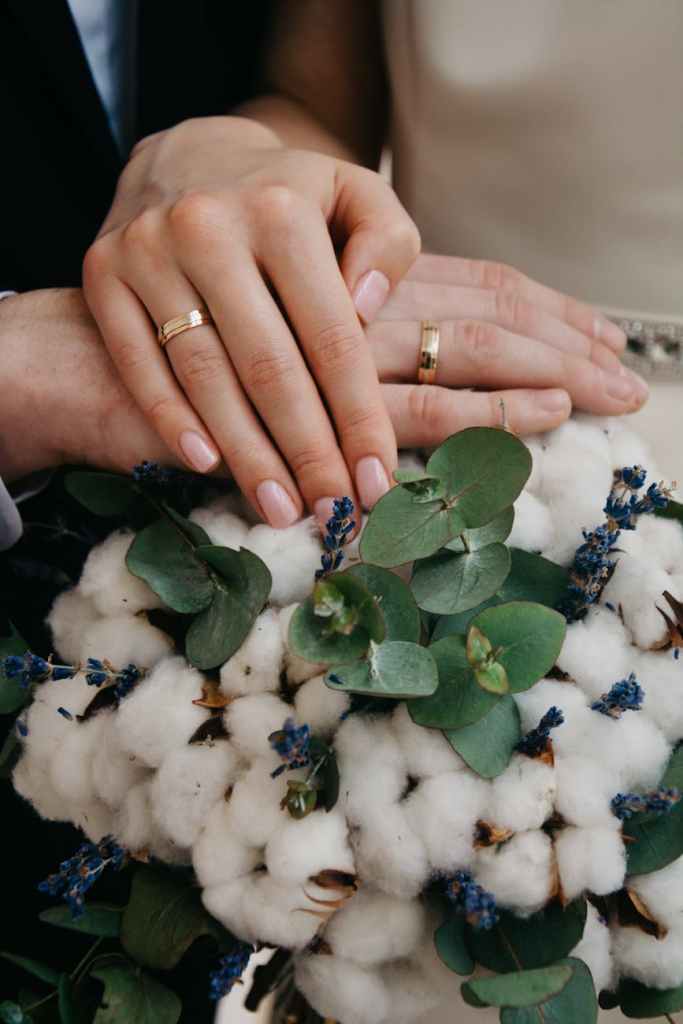
Congratulations, Sir Teng and Mam Jill on your wedding day. Your decision to get married in the Church is an expression of love itself because love is a decision, not just a feeling. Making a decision to get married is a choice to be small, to be broken into pieces to be united, to be one with the other person, your beloved.
Every time we make that decision to love, we renounce our very selves, our selfishness. The truest sign that we love is when we are able to love somebody more than our self; and to grow in love is to always choose the other person by a daily renunciation of one’s self which Ben&Ben sang so well, “Mahiwaga… pipiliin ka sa araw-araw…”
Photo by author, Camp John Hay, 12 July 2023.
This we saw in our first reading in the beautiful prayer by Tobiah with Sarah on their honeymoon when he mentioned God’s original plan in Genesis in creating woman as a suitable partner of man.
The root word of “partner” is part. A part is always small that makes up the whole. Every whole is made up of small parts.
A part-ner means you are both a part of each other and you both have to be small in order to be whole as married couple.
In that beautiful story of Tobiah and Sarah, we find them choosing to become small in order to become part of the bigger whole, of each other, and of God.
Tobiah is the son of Tobit who lived in exile in Nineveh, the capital of Assyria that had conquered Israel in the Old Testament. Tobit used to be wealthy but had a reversal of fortunes later in life made worse with his going blind. He sent his son Tobiah to Media to collect a debt from a fellow Jew with hopes he could also find there a bride for himself among their kindred.
God then sent Archangel Raphael who disguised as a traveler to Tobiah who was so kind to welcome him as companion. On their way to Media, Tobiah was attacked by a large, strange fish while taking a bath at the Tigris River. Tobiah was able to subdue the creature while Raphael instructed him to take out its heart, liver and gall due to its medicinal properties. Tobiah obeyed Raphael and they proceeded to Media to collect the debt owed to his father. There he met and fell for a Jewish woman named Sarah.
But, there was a major problem with Sarah: she had been widowed seven times because the devil Asmodeus would always come and kill her husband just before their honeymoon!
Engraving of Raphael instructing Tobiah to gut the fish by Georg Pencz (1543) from en.wikipedia.org.
Raphael pushed Tobiah to still marry Sarah, teaching how to drive away the devil Asmodeus on their honeymoon by burning the heart and liver of the strange fish he had killed. Tobiah followed Raphael’s instructions and Asmodeus was finally driven away that is why we have this scene of them praying in thanksgiving for their marriage. (This is the reason St. Raphael is portrayed with a fish and why arbularyos burn fish intestines to drive away evil spirits.)
Tobiah returned home to present his wife Sarah to his parents in Nineveh; Raphael again instructed Tobiah to apply the dried gall of the fish onto the eyes of his father Tobit to regain his sight. Amid their celebrations for Tobit’s healing and Tobiah’s marriage, Raphael revealed himself as God’s archangel sent to them to bring their healing which is the meaning of the name Raphael, “God has healed”.
See how Tobiah and Sarah, as well as Tobit even Archangel Raphael chose to be small and humble before God and everyone, to play mere parts in the grand plan of God in their lives. They were all willing to be humble and small.
Photo by author, St. Michael Archangel Parish, BGC, Taguig City, 12 July 2024.
Sir Teng and Mam Jill, you were sent for each other by God like St. Raphael to Tobiah and Sarah and Tobit. Handle your life with prayer. Always invite Jesus into your life as a married couple just like today you when you invited Him to bless your wedding. Do not forget to celebrate Mass every Sunday, to pray daily, as much as possible together as husband and wife.
True greatness is in becoming small like a little child as Jesus Christ repeatedly told His disciples. In this world where we compete on being the biggest and most powerful, God tells us the key to fulfillment is in being small, being humble, to become a part of the whole. The greatness of every person depends on the measure of his or her ability to share because it is only in participating in the whole does one becomes truly great.
Marriage is becoming small to become one. Husband and wife cannot be one unless they let go of themselves first. Marriage is not a competition of who has more love to give and share but simply of loving and loving, giving and giving.
When you reflected Sir Teng on what to do with your life and realized you will never be complete without Mam Jill, that is being small, that is truly loving because you are willing to let go of yourself to be a part of Jill.
Remember, there’s no perfect husband nor perfect wife but you can be the ideal husband, the ideal wife by forgetting yourself through daily conversion in Jesus Christ who gave His total self out of love for us. And you do not have to die on the cross literally, Sir Teng and Mam Jill.
Sir Teng, the ideal husband is someone who is deaf. Bingi. You know how women are. They talk a lot as they remember everything in detail even from long, long time ago. The moment Mam Jill starts talking, play deaf. So you don’t quarrel or debate.
Mam Jill, the idal wife is someone who is blind. Bulag. Problem with women is you see everything, kahit wala naman, may nakikita pa rin mga babae. When you see something with Sir Teng, play blind. Wala yun. Mabait siya talaga.
You two were brought together by your love for the French language. Every language is made up of small parts called letters used to form words put together in a sentence to express a thought or a feeling so we can communicate.
But, “communication is more than the expression of one’s thoughts and feelings; at its most profound level, it is the giving of self in love like Jesus Christ on the Cross” (Communio et Progressio #11)… just like every husband and wife too.
So, be small, Sir Teng and Mam Jill for you to remain in love, to grow in love, and be great in love. Amen.
Much of my 25 years in the priesthood were spent in the school ministry. My first assignment after ordination in 1998 was as a school administrator and teacher at our diocesan school in Malolos City until 2010. After a decade of parish ministry with a parish of my own, I was again sent to the school setting as chaplain of the Our Lady of Fatima University in Valenzuela City in 2021 to present.
As I celebrated Masses of the Holy Spirit in our six campuses amid the rains of the past two weeks, I told our students of the one important lesson they must first learn every school opening: there will always be storms in life. Literally and figuratively speaking. There are no ways of preventing storms and typhoons. Just like other calamities. Hence, the need for our students at a very young age to learn too the very important lesson of prayer.
Photo by author.
My dear students, prayers do not necessarily change situations like typhoons and calamities but prayers transform the person.
A man of prayer or a woman of prayer is like a gold bar or a diamond that even if it is thrown into the mud or sewage, it remains a gold or diamond. A person of prayer becomes strong and pure like gold and diamond or any precious stone.
So, have a prayer life.
Handle life with prayer so you will be able to weather every storm that comes to your life. Have that sacred space within you where you meet and commune with God, with Jesus Christ. Remember, God’s presence is never determined by outside forces like storms. God is always with us, even within us. Problem is we rarely notice nor recognize him because we are not attuned with him.
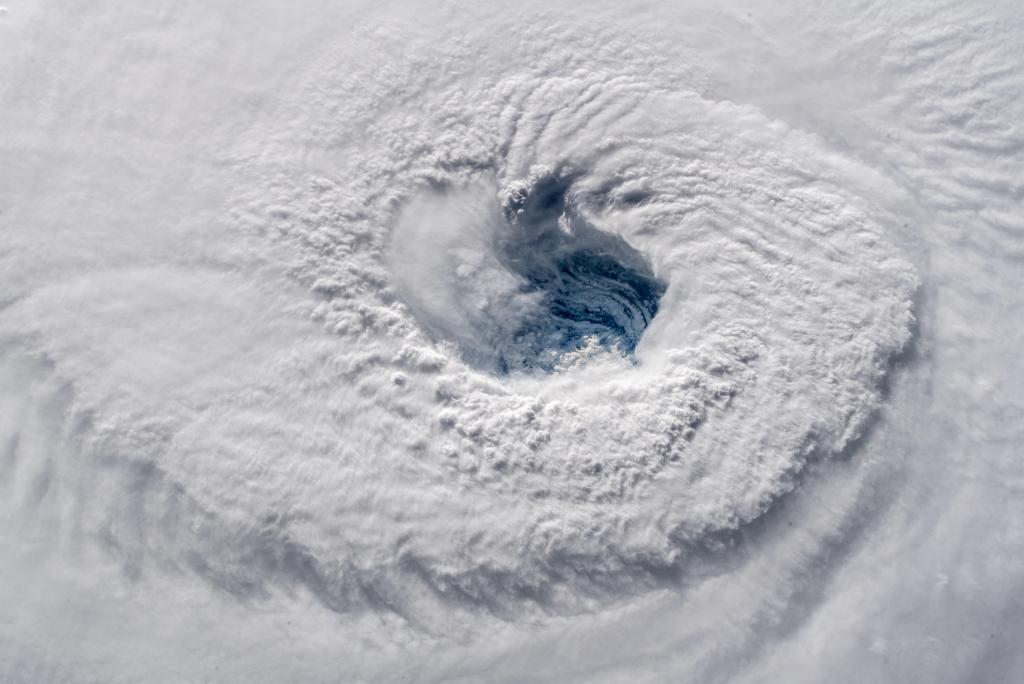
Experts tell us that every storm has an eye as its central part; however, the eye is the calmest part of every storm, always bright and sunny. It is its walls that are most dangerous where winds are most strongest and unpredictable. Having a prayer life, having a sacred space within us is like having that eye of the storm, our center of being that is always calm and peaceful because that is being rooted and grounded in God.
More than reciting prayers, having a prayer life is entering into a relationship with God in Jesus Christ, creating that sacred space within us where we experience his Divine presence whatever the season or weather is. It is being one with God. This relationship with God is reflected in our relationships with others, enabling you to make many friends and create wonderful relationships that enrich you as a person and eventually, after graduation, as a professional.
Photo by author.
The post-COVID period offers us with so many new ways of learning even amid class suspensions during storms. New methods, new technologies will emerge in the future making learning more enriching, more sustainable amid many outside factors like storms. But one thing remains very true in all our learning endeavors: we can only know so much, and there is only one who truly knows everything in this life – God. Know him first. And well.
This school year and every school opening until your graduation, remember these three things always, my dear students: study hard, work harder, and pray hardest. God bless!
The Lord Is My Chef Sunday Recipe for the Soul by Fr. Nicanor F. Lalog II
Sunday in the Sixteenth Week of Ordinary Time, Cycle A, 22 July 2023
Wisdom 12:13, 16-19 ><}}}*> Romans 8:26-27 ><}}}*> Matthew 13:24-30
Photo by author, Bgy. Alno, La Trinidad, Benguet, 11 July 2023.
Start with Why is Simon Sinek’s bestselling book written more than a decade ago about the need to focus on asking first “why” before making any choice and decision in life. I have found it very enlightening and useful even in matters of spirituality and prayers.
This is seen in our readings too this Sunday as we continue to listen to our Lord’s teachings using parables until next week. In all occasions of his teachings, his disciples asked him always “Why do you speak to them in parables?” (Mt. 13:10).
As we have explained many times before, parables are simple stories we usually take for granted that reveal to us profound truths about life and our very selves, most especially of God and his kingdom which Jesus had come to proclaim.
The key to unlocking the beauty and lessons within parables is having that spirit of openness and sincerity of heart, especially in asking why which may often take different forms.
Jesus proposed another parable to the crowds, saying: “The kingdom of heaven may be likened to a man who sowed good seed in his field. While everyone was asleep his enemy came and sowed weeds all through the wheat, and then went off. When the crop grew and bore fruit, the weeds appeared as well. The slaves of the householder came to him and said, ‘Master, did you not sow good seed in your field? Where have the weeds come from?'”
It is the question we ask most often, why is there evil at all if God our Creator is good? It is most difficult, even scandalizing when evil happens to us despite our efforts to be better and holy.
Today’s parable of the weeds among the wheat answers those many whys we have in life. It is a beautiful continuation of last Sunday’s parable of the sower that offers us Christians with many insights and challenges for the deepening of our faith and commitment to our mission.
First is our sense of sinfulness. It is one of the most serious problem Christianity, even the whole humanity is facing today. More and more people are losing that sense of sinfulness with so many becoming complacent in their faith and morals, always having reasons and alibis, worst, even justifications in committing sins. Or just about everything!
Today’s parable reminds us to always ask like the slaves, “Master, did you not sow good seed in your field? Where have the weeds come from?”
Photo by author, Bgy. Bahong, La Trinidad, Benguet, 12 July 2023.
Why all the evil in the world today?
How sad that many people have grown cynical with evil, simply accepting its existence in the world as a given reality, to be accepted wholly as if we can do nothing about it. Some even go to the extent of thinking the devil does not exist at all with evil simply existing like weeds?!
Here we find the importance of prayer life when we get to examine our conscience daily, asking why all the evils are happening. From there, we learn humility by examining too how we may have contributed in the commission of evil. Most of all, it makes us aware of that tricky “sins of omission”, of how we might have failed by omitting in doing what is good that have contributed to the spread of evil and sin. It is always easy to look outside blaming others, pointing at others for all the evil happening without seeing our own sins.
Second is the danger of neglect and complacency among us disciples of Christ. See the genius of Jesus as a storyteller when he mentioned that the planting of the bad seed or weeds happened while the Master was asleep, “The kingdom of heaven may be likened to a man who sowed good seed in his field. While everyone was asleep his enemy came and sowed weeds all through the wheat, and then went off. When the crop grew and bore fruit, the weeds appeared as well.”
From Pinterest.com.
In the New Testament, sleep is a metaphor for neglect. Jesus cautions us his disciples that if we are not vigilant and discerning of what we allow to influence us, bad seeds can get planted in our lives, families and relationships, even in the Church and in our ministry!
In some translations, the word used for the weeds is darnel, a kind of weed that looks like the wheat to show how evil works itself into our lives by masking itself to look something as good and harmless for a moment. “Wala namang masama” is our usual excuse until later when that evil is unmasked and revealed, its devastating impact had already wreak havoc on us because we have complacently tolerated its growth for some time.
Remember the saying, the devil is in the details. Likewise, keep in mind that the devil does not merely want us to sin but to eventually destroy our lives! “Be sober and vigilant. Your opponent the devil is prowling around like a roaring lion looking for someone to devour” (1 Pt. 5:8).
Third is Christ’s call for us to be patient but firm in dealing with evil and sin. We live in an imperfect world. There will always be evil and sin like this growing trend called liberalism and wokism that stress everyone’s rights without any regard at all with personal responsibility and accountability. These liberals and wokes who have infiltrated the media and government, maybe even the Church, want the natural order of things be changed like gender and marriage. For them, everything is relative. To each his own like praying the Our Father in a drag version.
Photo by Fr. Pop dela Cruz, San Miguel, Bulacan, 2022.
We have to be patient with them and fight them squarely with more reason and charity, to never stoop down to their level that only shows their weaknesses within.
The author of the Book of Wisdom tells us today how God in his power and might chose to be patient and moderate with us sinners precisely because he is strong; the exercise of strength like being noisy, the flexing of muscles with large gatherings actually indicate weakness.
That is why St. Paul in the second reading reminds us of our own weaknesses too in this time of hope and waiting for Christ’s Second Coming while in the midst of all these evils happening. Hence, our need to pray for the Holy Spirit to enable us to carry out our mission in this world marred by sin.
Here we find again the primacy of prayer life. Not just the recitation of prayers. What St. Paul envisions in our short reading today is the kind of prayer wherein God’s own Spirit is the one interceding for us according to God’s will. Teaching people to pray effectively is one of the most challenging of all pastoral duties because we priests and bishops must first be the ones deep into prayer. When we live in the Spirit, we would always be faithfully in prayer.
Sorry to mention here again our disappointment to our bishops in failing to reflect more on the reasons of upholding the rule that only the priest extends his hands in praying the Our Father. It is fidelity to the liturgy to prevent us from being misled by plain emotions that is already happening like in those “charismatic” Mass and gatherings with emphasis on health and wealth (gagaling, gagaling…siksik, liglig at umaapaw) interspersed with clapping of hands.
Photo by author, Bgy. Alno, La Trinidad, Benguet, 11 July 2023.
Jesus assures us in this parable there will be a time for separation, judgment, and punishment but it is not ours to carry out those actions in the present. Let us continue probing our hearts in prayer. Always start by asking why, not with what we think we know. Many times, as the parables of Jesus tell us, the kingdom of God is found in the simplest things in life like a simple word or a sentence we tend to interpret with our many assumptions. Amen. Have a blessed week ahead everyone!
The Lord Is My Chef Daily Recipe for the Soul by Fr. Nicanor F. Lalog II
Tuesday in the Sixth Week in Easter, 16 May 2023
Acts 16:22-34   ><]]]]'> + ><]]]]'> + ><]]]]'>   John 16:5-11
Photo by author, Katmon Nature Sanctuary & Beach Resort, Infanta, Quezon, 04 March 2023.
Today dear Jesus we pray
for those going through
catastrophes in life:
victims of natural and man-made
calamities,
victims of wars and persecutions,
people going through everything
that is wrong in life, so to speak.
Teach us Lord to stay still
in you in times of catastrophe;
like St. Paul and Silas who remained
inside their prison cell when a powerful
earthquake struck Philippi:
About midnight, while Paul and Silas were praying and singing hymns to God as the prisoners listened, there was suddenly such a severe earthquake that the foundations of the jail shook; all the doors flew open, and the chains of all were pulled loose. When the jailer woke up and saw the prison doors wide open, he drew his sword and was about to kill himself, thinking that the prisoners had escaped, But Paul shouted out in a loud voice, “Do not harm yourself; we are all here.”
Acts 16:25-28
Oh what a beautiful event
for that jailer, Lord!
Twice he faced situations with
catastrophic consequences that could
have cost his own life - first the severe
earthquake and second the possible escape
of Paul and Silas;
but you spared his life, Lord,
not only in making him survive
the earthquake but most of all
opening eternal life to him
in hearing your gospel from Paul
and eventually being baptized with
his whole family!
In the gospel, amid the
dangers lurking with your
impending arrest and pasch,
you told your disciples that it
is better for you to go and leave
so you could send the Holy Spirit,
the Advocate (Jn.16:7).
Teach us, Jesus,
to be still, to be not foolish
in rushing, to avoid panic
when catastrophes happen;
let us trust in you alone;
let us think clearly of avoiding
drastic steps that may put us
and others in harm's way;
let us cultivate a prayer life,
a relationship with you that
would keep us attuned with the
Holy Spirit in reading the signs
of the times so we may find you
always especially when uneventful
things happen to us.
Amen.
The Lord Is My Chef Sunday Recipe for the Soul by Fr. Nicanor F. Lalog II
Thirtieth Sunday in Ordinary Time, Cycle C, 23 October 2022
Sirach 35:12-14, 16-18 ><}}}}*> 2 Timothy 4:6-8, 16-18 ><}}}}*> Luke 18:9-14
Photo by Mr. Jim Marpa, 2018.
Standing is a very powerful posture. It expresses our stance or – stand – on everything. Where we stand tells who we are, both positively and negatively. It is always good to make a stand on our beliefs, defending them, making a “gallant stand” on whatever or whomever we hold so dearly. However, no matter how hard we make a stand on just about everything and everyone, we cannot fake our stand because people could surely recognize if it is just mere “grandstanding” or self-serving like what politicians always do.
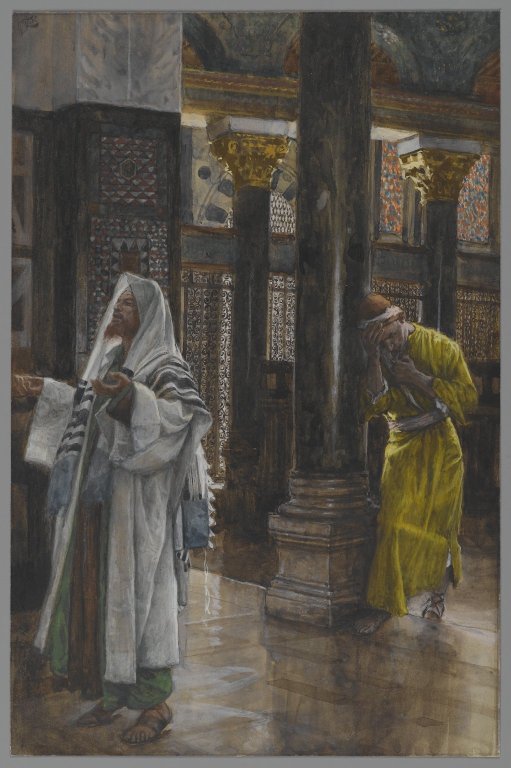
That is what Jesus is telling us today in his second series of teaching about prayer, the parable of the Pharisee and the tax collector, of how two men stood before God in prayer at the temple.
Painting by French artist James Tissot, “The Pharisee and the Tax Collector” (1886-1894) from commons.wikimedia.org.
Jesus addressed this parable to those who were convinced of their own righteousness and despised everyone else. “Two people went up to the temple area to pray; one was a Pharisee and the other was a tax collector. The Pharisee took up his position and spoke this prayer to himself, ‘O God, I thank you that I am not like the rest of humanity – greedy, dishonest, adulterous – or even like this tax collector. I fast twice a week, and I pay tithes on my whole income.’ But the tax collector stood off a distance and would not even raise his eyes to heaven but beat his breast and prayed, ‘O God, be merciful to me a sinner.’ I tell you, the latter went home justified, not the former; for everyone who exalts himself will be humbled, and the one who humbles himself will be exalted.”
Luke 18:9-14
Our lost sense of sinfulness
Right at the start, Luke tells us the purpose of this parable, “Jesus addressed this parable to those who were convinced of their own righteousness and despised everyone else.” But, we have to be careful in reading this parable lest we end up like the Pharisee of not seeing ourselves being addressed too by the Lord!
While the Pharisee is clearly in the bad light in his kind of prayer that revealed his self-centeredness, feeling so self-satisfied with his holiness that in fact he felt no need for God, his character invites us to guard against this temptation within us that we are not sinners. That is the sin of the Pharisee, the reason his prayer was not heard unlike that of the tax collector: the Pharisee saw himself as clean and spotless like God! And that is what we have to keep guard of ourselves in this time when we have lost our sense of sinfulness.
Photo by author, Jerusalem 2017.
We may not have the kind of self-righteousness of the Pharisee in public or in private, of claiming to be not like other people who are sinful and corrupt; but, still deep inside us is the temptation of forgetting that even a true saint remains a sinner who must constantly pray deep in his/her heart, “O God, have mercy on me, a sinner.”
Such attitude is the deeper meaning of why we must be powerless before God in praying like the persistent widow last Sunday. It is not that only God is capable of giving us whatever we need but most of all, we have to accept and own by embracing wholeheartedly the fact we are all sinners. Recall how in 2013 after being elected as Pope, on his first interview Pope Francis was asked to describe himself as a person and he simply said, “I am a sinner.” Beautiful!
Holiness is not being sinless but being filled with God. Anyone who is filled with God is one who is always aware of his/her sinfulness. The more we get nearer to God, the more we see our sinfulness, our being dirty and weak. Hence, the more we pray to become better persons, to be one with God; we cannot be one in him and with him unless we realize our sinfulness. That Pharisee in the parable comes so strongly, so proud to God as if he were God himself too! Worst, he wanted God to commend him, to reward him for being so good. Why prayed at all if he did not need God?
We pray because we need God and that is the prayer that “pierces the clouds; that does not rest till it reaches its goal” – God – as Ben Sirach tells us in the first reading. That is the reason we begin our Holy Mass first with admission of our sins, of being sorry for them. We come to Mass because we need God first of all to cleanse us of our sins.
How true are we in admitting our sinfulness before God?
Consistency and humility in prayer
On the surface, the Pharisee in the parable was really commendable as he tried to be a good person, avoiding all kinds of sins, piously observing the demands of his faith like fasting and tithing. However, he lacked consistency and humility.
Consistency in prayer means our lives become a prayer itself. The prayers we recite and say to God expressed in so many ways should make us become more like God – loving and caring, kind and understanding, merciful and forgiving of others, not judgmental like the Pharisee.
St. Paul in the second reading offers us an example of how he had considered his life his prayer, an offering of himself to God like a “libation”.
Beloved: I am already being poured out like a libation, and the time of my departure is at hand. I have competed well; I have finished the race; I have kept the faith.
2 Timothy 4:6-7
Photo by Ms. Mira Mandal Sibal, 2021.
Sometimes, people comment how they find St. Paul as too proud especially when he speaks of his virtues and works like when he wrote “Be imitators of me, as I am of Christ” (1 Cor. 11:1). But, reading all his letters, one finds his powerlessness before God like the persistent widow last Sunday as well as his being powerful in God like the unjust judge who was converted like him and channelled all his talents and energies in proclaiming the gospel to the Gentiles!
Most of all, in today’s parable, we find St. Paul who referred to himself as “the very least of the holy ones” (Eph.3:8) so much like the tax collector, sinful yet sorrowful for his sins. In short, not just consistent but most of all, filled with humility.
It will always be difficult to be consistent in life as every saint had proven to us. That is why we should never forget that reality – even the saints are sinful, needing God’s mercy and forgiveness. Nobody is perfect. When there is inconsistency in our lives and prayers, surely there is sin. But, are we humble enough to accept that fact like the saints?
That is why humility is so important as exemplified by the tax collector at the temple. He could not look up to heaven because he was so humbled by his sin, looking more into himself, into his heart, of how he had strayed so far from God that he longed to be near him again.
It is only in humility when we can realize also the sad truth that when we sin, we actually offend ourselves, not God! That is why our conscience bother us, we feel untidy. God remains God and perfect even if we sin. The Pharisee wrongly thought he was not offending God as he believed he was clean and sinless that is why he felt so entitled too. Unknown to him, the more he had sank deeper in misery in his lack of sense of sinfulness.
Photo by Mr. Red Santiago of his son, January 2020.
When we lost our sense of sinfulness, that is when we are most inconsistent, when we are most lost. Without humility, we live in our false selves, wrongly believing we can do everything, including earning our own salvation which only God had done in Jesus Christ.
This Sunday, let us pray for the grace and virtue of humility that St. Teresa of Avila described as “walking in truth.”
Being humble is not putting ourselves down but actually the path to true greatness, exaltation. When we humbly accept our sins and sinfulness, that is when we are forgiven by God and we are able to rise to greater heights as we lose ourselves in God and in his wonderful plans for us.
This Sunday, let us stand before God admitting our sins like the tax collector, our being poor and lowly, insufficient and weak as in the first reading needing his grace so that like St. Paul, we may compete well in this life to finish this race by keeping the faith in Jesus Christ. Amen. A blessed and fruitful week ahead for all of us!
The Lord Is My Chef Daily Recipe for the Soul by Fr. Nicanor F. Lalog II
Tuesday, Feast of St. Luke, Evangelist, 18 October 2022
2 Timothy 4:10-17   ><}}}}*> + ><}}}}*> + ><}}}}*>   Luke 10:1-9
Photo by author, 2018.
Dearest Jesus:
as we celebrate today
the feast of your Evangelist
St. Luke, I pray for the grace
to be like him - prayerful
and faithful to you,
especially when
things become so tough
and difficult.
Of the four Evangelists,
St. Luke emphasized most
your praying so often
to show your oneness
in the Father, of your
going to deserted places
to pray especially before
major events like the choice
of the Twelve Apostles
and the Transfiguration,
clearly showing that prayer
is the very center of the life
of every disciple to be able
to follow Jesus closely by
carrying the cross "daily" (Lk.9:23).

Like St. Luke,
may my life be a prayer,
a gospel in writing.
Photo by author, 2018.
Beloved: Demas, enamored of the present world, deserted me and went to Thessalonica, Crescens to Galatia, and Titus to Dalmatia. Luke is the only one with me.
2 Timothy 4:10-11
Let my prayers,
O dear Jesus,
lead me to deeper
faith in you especially
when in severe tests
like St. Luke who remained
faithful to you by standing
by his mentor St. Paul
even in prison.

Like St. Luke, keep me faithful
to you, Jesus, by always remembering
the poor and marginalized in the
society especially the women
and the sinners this Evangelist
had put on the limelight
like Elizabeth, Anna the Prophetess
and the widow of Nain
as well Zacchaeus and Dimas.

Like St. Luke, keep me faithful
to you Jesus by being faithful too
to your Mother, the Blessed Virgin Mary:
St. Luke was the only one who sought her
in Ephesus to give us the lovely story
of Christmas from the Annunciation
to the Visitation, the Nativity and
the Presentation up to her presence
at the Pentecost found in his
second book called the Acts,
the gospel of the Church
which is the other side of
every fidelity to you and Mary
is fidelity to your Church!
Dearest Jesus,
in writing the Gospel
and the Acts of the Apostles,
you have touched St. Luke so deeply
that he narrated your story in great details
as if he was touching you
that in the process,
he has touched us too,
enabling us to experience
as well as paint and picture
your Divine Mercy for everyone
Amen.
Painting of “Saint Luke Drawing the Virgin” by Flemish painter Roger van der Weyden (1400-1464); photo from en.wikipedia.org.

















 lordmychef.com