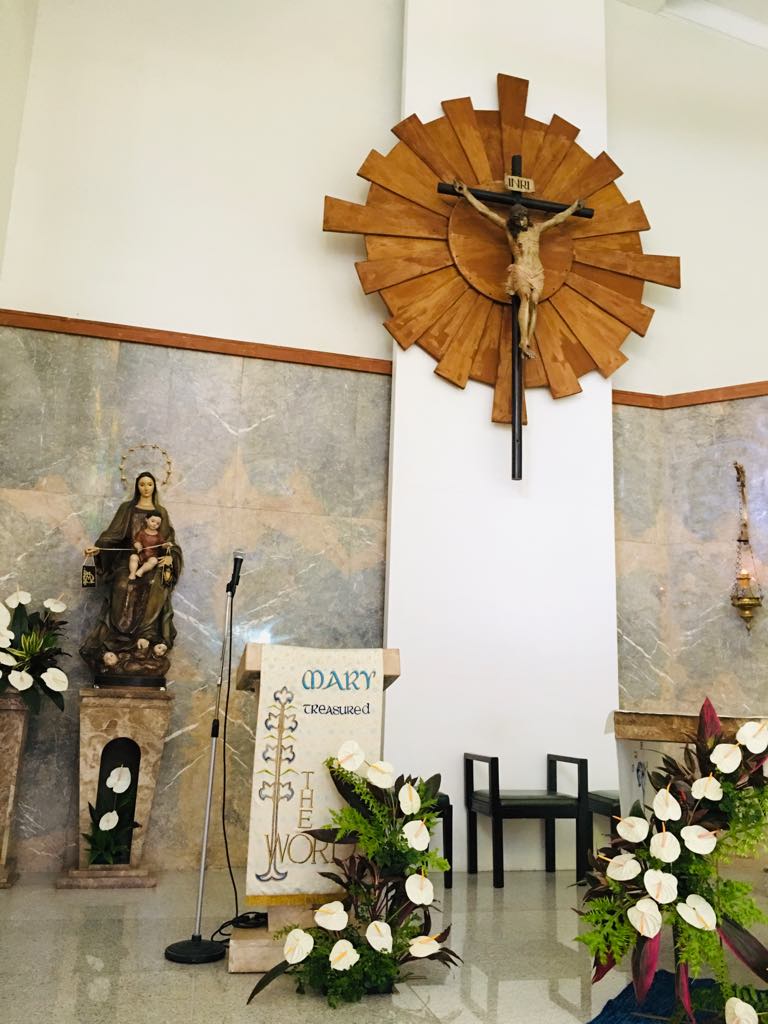
It is not “what” we say who Jesus is but “how” we say who he is.

The Lord Is My Chef Sunday Recipe for the Soul by Fr. Nicanor F. Lalog II
Week XXI, Cycle A in Ordinary Time, 23 August 2020
Isaiah 22:19-23 | >><}}}*> | Romans 11:33-36 | >><}}}*> | Matthew 16:13-20
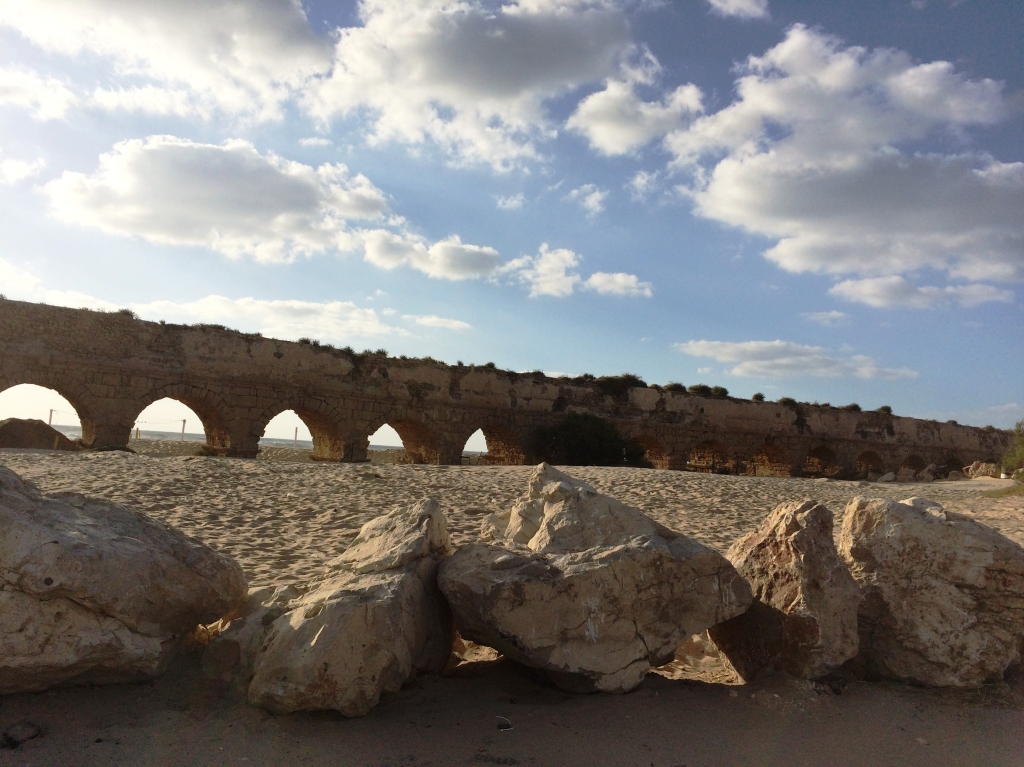
Photo by author at Caesarea, Israel, May 2019.

After showing us some glimpses of the person of the Lord these past three weeks, St. Matthew now leads us into the middle of his gospel where Jesus takes a U-turn in his ministry by revealing himself to the Twelve as he heads back to Jerusalem to fulfill his mission.

Jesus went into the region of Caesarea Philippi, he asked his disciples, “Who do people say that the Son of Man is?” They replied, “Some say John the Baptist, others Elijah, still others Jeremiah or one of the prophets.” He said to them, “But who do you say that I am?” Simon Peter said in reply, “You are the Christ, the Son of the living God.” Jesus said to him in reply, “Blessed are you, Simon son of Jonah. For flesh and blood has not revealed this to you, but my heavenly Father.” Then he strictly ordered the disciples to tell no one that he was the Christ.

Matthew 16:13-17, 20

St. Matthew told us last Sunday how Jesus withdrew to the region of Tyre and Sidon where he had healed the daughter of a Canaanite woman tormented by a demon. From there, they headed north to Caesarea Philippi, a pagan major city at that time.

It was a perfect setting for our gospel this Sunday – just like our present milieu that challenges us not only to be identified as a Christian but also to make a stand for Jesus as his true disciple at a time when faith and morals are disregarded, economics takes precedence over spirituality.

Who do people say I am: “what” I know of Jesus

The two questions posed by Jesus to his disciples while at Caesarea Phillip – and to us today – may sound very similar and even simple but are actually distinctly different and even worlds apart from each other.

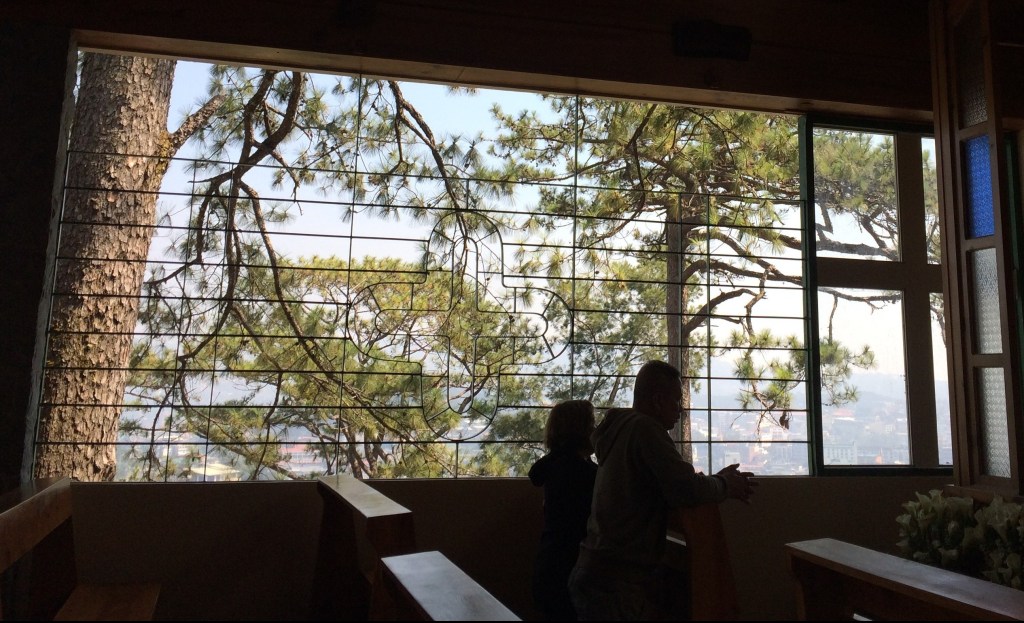
Photo by Mr. Jim Marpa, 2019.

His first question “Who do people say that the Son of Man is?” is straightforward, seems to demand not much critical thinking and introspection. A plain question with a plain answer like the usual news we hear and read called “straight reporting” in journalism that tells us the essential “who, what, where, and when” of the story.

So many times, we face this question without even being asked at all!

Through our words and actions we reveal “who do you say the Son of Man is?” in how we pray, what we pray for, the things we post on social media, especially those electronic chain letters that if you say “Amen” you will get money. And so many other things when we try to show everyone we know Jesus without really thinking and reflecting well. No wonder, people get so many wrong impressions about who Jesus is: “some say he is John the Baptist, others Elijah, still others Jeremiah” or one of those prophets of wealth and health who make life easier!

Telling who Jesus Christ from “what” we know and believe can always be dangerous and misleading because it is all in our heads that could often be wrong. Telling who Jesus Christ from “what” we know and believe cannot be so reliable because it is always mechanical, by the book, not actual and most of all, not real.

It is always easy to speak highly of Jesus from “what” we know and believe like those many preachers with fire and brimstone or modern apostles, a.k.a. vloggers complete with their “shock” preaching and antics and gimmicks who end up more popular with thousands of followers and likes. And wealthy, too! Jesus Christ? Forgotten and stuck in Facebook, the bible, and tabernacle.

But who do you say I am: “how” I know Jesus

On the other hand, the Lord’s second question is direct and personal, probing our heart and soul, asking not just for answer from our lips but from our total self: “But who do you say that I am?”

See the words of the Lord after Simon had answered he is the Christ, the Son of the living God:

Jesus said to him in reply, “Blessed are you, Simon son of Jonah. For flesh and blood has not revealed this to you, but my heavenly Father.”

Matthew 16:17

More than a play of words, here we find a deeper dimension of saying who Jesus Christ is: not just telling the what but most of all, the how that reveals more than what we know in our minds but how we have experienced Jesus, of how we have been living in him!
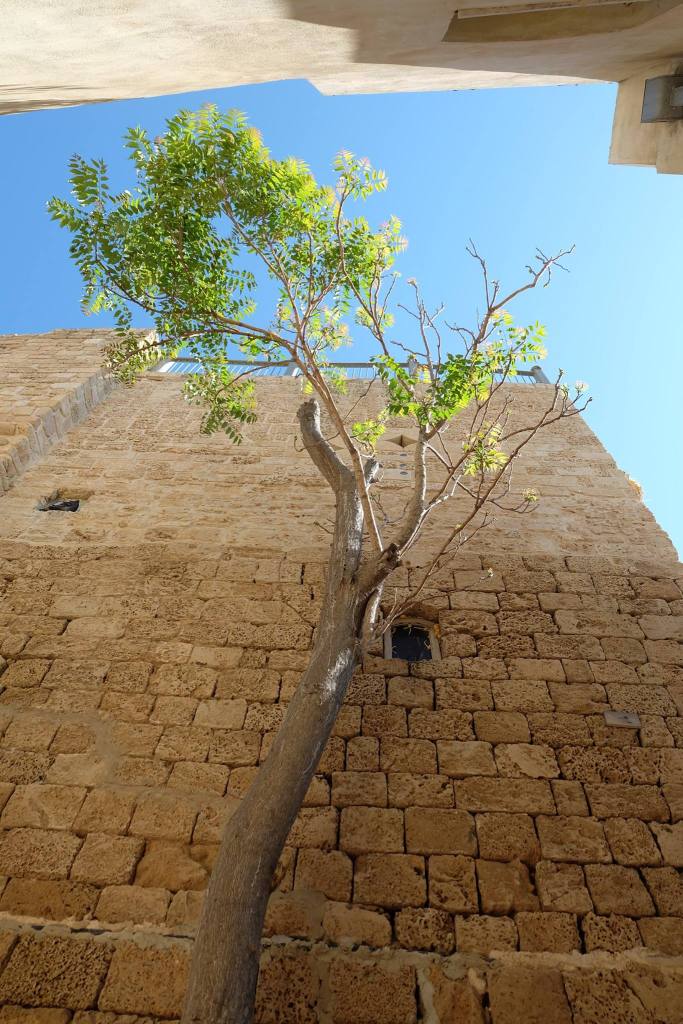
Photo by author, house at Jaffa (Jopa), Israel where Peter met some gentiles according to Book of Acts, May 2017.

For us to say who is Jesus Christ is always a how because it is a story of our relationship with him, it is a how we have grown deeper, how we have journeyed in him and with him.

It is the ability to see beyond structures and persons, excesses and sins, faults and misgivings because despite shortcomings, it is how we see Jesus as the foundation of our lives and of our Church.

See the ways of other religious sects, their pastors and members who spend so much time bashing us Catholics, insisting on the what of Jesus and the bible, never the how they live.

No wonder, they can raise their hands in prayers and still clap their hands while the President in maligning us Catholic priests and bishops in their gatherings.

To speak of who is Jesus is more than to tell what we know about him but how we have known him, how we have been since knowing him!

Anyone who can say who Jesus is from his how is always blessed like Simon because our answer is always the fruit of our life in Christ. We all become like Simon, another Peter or Rock whose very life and existence rests on Jesus our Lord. Despite our weaknesses and sinfulness, we are still blessed and entrusted with the keys of heaven because we have allowed Jesus to be our foundation of life. There is a process, a history always. Hence, it is a telling of the how.

In the first reading, we find God dismissing the master of the palace named Shebna to be replaced by Eliakim due to his infidelity. That is the meaning of the whole prophecy by Isaiah, of how the Lord will someday entrust his people to a trustworthy steward, someone who does not only know what God is but one who has truly known and experienced God.

Saying who God is, always a revelation from him

It is interesting that in the Jewish thought, to know another person is not knowing the what but of having a relationship or some degree of intimacy. Again, it speaks of the how we have been saying.

St. Paul shows us in the most beautiful manner in his many writings this saying of who Jesus is with his how, his very personal experience of the Lord in his life that has continued and deepened until his death. See the beautiful hymn he had composed for our second reading today:

Oh, the depth of the riches and wisdom and knowledge of God! How inscrutable are his judgments and how unsearchable his ways! For from him and through him and for him are all things. To him be glory forever. Amen.

Romans 11:33, 36

Like St. Peter, we find here St. Paul so blessed despite his sins and sinfulness, of how he had experienced Christ not just a name or a man like any what he had known in his mind.

No one can ever write such great poetry with profound thoughts without any deep relationship with God. Whatever we know of God is always a revelation from him, too. When we speak of who God is, it is always borne out of how we have been relating with him our Lord which is called “spirituality”; it is deeper than religiosity or being religious that is always at the level of the head and more of our ego than of the reality of God.

Sometimes, we do not even have to speak and say who Jesus Christ is.

We simply have to live out that relationship we have in him and people would know who Jesus is. No need for elaborate and spectacular showmanships we have in our many rites and rituals, even in our liturgies now so maligned with our triumphalism.

Lest we forget, Jesus saved the world by suffering and dying on the Cross, not with activities and debates which would be his topic next Sunday. God bless everyone!


Photo by Angelo Carpio, January 2020

“What will there be for us?”

The Lord Is My Chef Breakfast Recipe for the Soul by Fr. Nicanor F. Lalog II
Tuesday, Week XX, Year II in Ordinary Time, 18 August 2020
Ezekiel 28:1-10 <*(((><< || + || >><)))*> Matthew 19:23-30
Photo by author, Petra in Jordan, May 2019.

Then Peter said to Jesus in reply, “We have given up everything and followed you. What will there be for us?” Jesus said to them, “Amen, I say to you that you who have followed me… And everyone who has given up houses or brothers or sisters or father or mother or children or lands for the sake of my name will receive a hundred times more, and will inherit eternal life.”

Matthew 19:27-28, 29

“We have given up everything and followed you, Lord. What will there be for us?”

Oh! how often we tell this to you, Lord Jesus, as if we have given so much for the sake of your kingdom.

Sometimes, it is not really a question we ask but a reminder to you of our “goodness” and “benevolence” with others, of how good we have been when in fact whatever we give and share are all from you.

Forgive us, O Lord, when most specially in the midst of pains and sufferings, we ask you “What will there be for us?” in order to remind you of our rewards, or entitlement as if you forget them or that there is such a thing at all with you.

Photo by author, 2019.

We are sorry Lord in counting the costs and most of all, in demanding so many in return.

“What will there be for us?” is often the question we ask when we doubt your generosity and fidelity to your promises to us.

Like Ezekiel in the first reading, remind us O Lord to keep in mind not to be “haughty of heart”, that “we are not god despite our many achievements brought about by our intelligence or beauty” (Ezekiel 28:1-7).

Dearest Jesus, you have given us with so much and we have given so little; teach us to give more of ourselves, more of our time, more of our treasures, and most of all, more of you to others. Amen.

Praying for holiness in the world

The Lord Is My Chef Breakfast Recipe for the Soul by Fr. Nicanor F. Lalog II
Friday, Memorial of St. Maximilian Mary Kolbe, Priest and Martyr, 14 August 2020
Ezekiel 16:1-15, 60, 63 >><)))*> || + || <*(((><< Matthew 19:3-12
From companionsofstanthony.org

“The most resplendent manifestation of God’s glory is the salvation of souls, whom Christ redeemed by shedding his blood. To work for the salvation and sanctification of as many souls as possible, therefore, is the preeminent purpose of the apostolic life.”

From the Letters of Maximilian Mary Kolbe, Office of Readings

Praise and thanksgiving to you our loving Father for a holy saint in our modern time, St. Maximilian Mary Kolbe whose memorial we celebrate today. His offering of his life in place of another prisoner at Auschwitz in 1941 was a fitting cap for his life of dedication in proclaiming the Gospel of Jesus Christ in words and in deeds.

Though there are no more gas chambers unlike during the time of St. Maximilian Mary Kolbe, the killing of so many people in various forms and methods continue to this day — right on our streets, in abortion clinics, in prisons, even in our homes and in social media where we spread toxins of lies that mislead and destroy many lives.

Inspire us like St. Maximilian Mary Kolbe to work for the sanctification of the world by sharing more of your love and kindness, mercy and forgiveness to everyone especially the weak and vulnerable to abuses and worldly influences.

Like this modern saint who lived during the harshest conditions of World War II, may we strive to make you present in the world where despite the ease and comforts of modern life, many of us are still lost and alone, feeling angry, empty, and confused.

Through our lives, may we fill the world with your presence and holiness by reminding people to return to your original plan of harmony and unity in your love as Jesus told the Pharisees in the gospel today:

Jesus said to them, “Because of the hardness of your hearts Moses allowed you to divorce your wives, but from the beginning it was not so.”

Matthew 19:8

Most of all, to make the world holy anew, grant us courage to stand for what is true and good, to remain standing at the side of your Son’s Cross for indeed, as St. Maximilian Mary Kolbe had taught us in one of his writings, “The deadliest poison of our time is indifference.” Amen.

Photo of Auschwitz from Google.

New normal is not normal

Quiet Storm by Fr. Nicanor F. Lalog II, 28 July 2020
Photo by Mr. Raffy Tima of GMA-7 News, March 2020

Experts have been telling us since the start of this COVID-19 pandemic that our lives would no longer be the same like before 2020. Even if a new vaccine and more effective treatment are discovered to fight this disease, life on this planet is definitely changed.

But, for better or for worse?

That is the most important challenge of this pandemic next to finding a vaccine and cure or treatment against it: that we seize this unique opportunity from COVID-19 to “reset” or “refresh” the world so we can all start anew by correcting the mistakes and excesses of the past to finally kickoff a true and meaningful growth and development among peoples, especially the poor and marginalized.

Photo from TurboSquid.com

This we can start – or restart – by immediately deleting from our vocabulary and consciousness that word we have been erroneously using since summer, “new normal”.

New normal is abnormal because norms or standards like morality always remain.

Washing of hands frequently, covering one’s mouth and nose when sneezing and coughing, not spitting everywhere are not new normal. Cleanliness has always been the norm since the beginning that we have that saying always true, “Cleanliness is next to Godliness”.

Praying every day, individually and as a family especially the Holy Rosary is not a new normal. Connecting with the Divine has always been the norm of man since the beginning even before Jesus Christ came to the world.

More than half a century ago, the late Fr. Patrick Peyton has been saying, “The family that prays together, stays together; and the world at prayer is a world at peace.” Praying has always been the norm in our lives.

Normal or norms do not change because they are the standard measure. Even before COVID-19 came, normal temperature has always been 37 degrees Celsius, 12-inches make a foot, and so on and so forth.

So, please forget this abnormality of referring to our new way of living as “new normal” because it is not new at all.

Worst, this usage of the term “new normal” courtesy of the media, politicians, and policy makers is a dangerous indication of unconsciously or subconsciously perpetuating our excesses of the past that the Wuhan virus have rightly exposed: too much greed especially among capitalists, materialism and consumerism, and individualism.

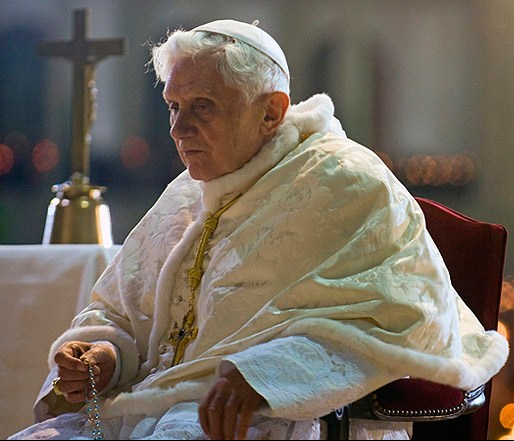
From vaticannews.va

Pope emeritus Benedict XVI had long been speaking against these by describing it as “dictatorship of relativism”.

Acceptance of this term or concept that was actually coined at the aftermath of the 2007 financial crisis indicates that we are miserably not learning the lessons of this global crisis.

Our sights remain myopic, even blinded in looking at this pandemic without realizing at all how this was spawned by our own excesses and sins. Long before we have been told to maintain physical or social distancing to stop spread of the new corona virus, we have long been distant from one another. We have been spending more time with our computers and smartphones, trying to connect with friends and everyone in various social media platforms unmindful of the persons seated near us. “Table for one” in restaurants is fast becoming the order of the day than the exception to the rule.

My point is, accepting everything now as the new normal is also accepting wholesale the new ordering of things going on that continues to neglect the weakest and poorest among us. We are only perpetuating an error and worst an evil among us that we have refused to examine closely in the past.

This “new normal” is a conditioning concept that pushes the marginalized and disadvantaged people deeper into misery as the daily news tells us. Unconsciously to many of us, “new normal” is an excuse even a justification for the continued poverty and slavery of the weak and disadvantaged.

What a shame that while so many countries are suffering from COVID-19 like ours, Beijing is flexing its muscles around the world economically and militarily – right in our seas!- as if they are not bothered at all by this virus that came from their own province of Wuhan.

A very interesting read I have found last month was written by Nigerian Chime Asonye who rightly claims that “the new normal” “should not be the lens through which we examine our changed world”.

The ‘new normal’ discourse sanitizes the idea that our present is okay because normal is regular. Yes, there may be public health challenges, but these are issues that can be managed. We accept life under the omnipresent threat of disease as ordinary. But what exactly is normal about this pandemic? It is not normal for society en masse to be isolated, but if this is normal, then we are supposed to have control of the situation. Even if we feel loss or despair, we are expected to get used to it — accepting that this morbid reality is now standard.

https://www.weforum.org/agenda/2020/06/theres-nothing-new-about-this-new-normal-heres-why/

COVID-19 can serve both as a catharsis to our past excesses and a watershed for a brighter future.

The old system, or what people refer to as “normal” before in the world had erroneously set is not working, plainly wrong and abusive; why continue or import it into this coming new period?

As the pandemic rages on it gives us a chance to reimagine the world by tracing history, not forgetting it.

We should revel in the discomfort of the current moment to generate a ‘new paradigm’, not a ‘new normal’. Feeling unsettled, destabilized and alone can help us empathize with individuals who have faced systematic exclusions long-ignored by society even before the rise of COVID-19 — thus stimulating urgent action to improve their condition. For these communities, things have never been ‘normal’.

https://www.weforum.org/agenda/2020/06/theres-nothing-new-about-this-new-normal-heres-why/

COVIDS-19 is definitely not a punishment from God but a result of man playing God.

And like in the past, whether in world history or in our own lives when things go wrong even worst, God ensures to make ways that anything bad happening to us would always lead to something good.

Photo by author, Christmas 2019 in our Parish.

See how providential in the sense that microscopic viruses are reminding us that true power is not in being big but in being small, not in being strong but being weak — the very example of God to us when he became human like us more than 2000 years ago.

Unfortunately, his lessons remain unheeded up to our time even among us in the Church.

It is a most welcomed change in the midst of this pandemic that the Vatican last week issued new guidelines through the Congregation for the Clergy (directed to us priests) for the world’s parishes that can help us respond adequately to the challenges of this crisis (http://press.vatican.va/content/salastampa/en/bollettino/pubblico/2020/07/20/200720a.html).

But, that will require another blog.

For the meantime, please stop using that abnormal term “new normal”.

A blessed Tuesday to everyone!

Discipline and tenderness

The Lord Is My Chef Breakfast Recipe for the Soul by Fr. Nicanor F. Lalog II
Tuesday, Week XVI, Year II in Ordinary Time, 21 July 2020
Micah 7:14-15, 18-20 >><)))*> ] + [ <*(((><< Matthew 12:46-50
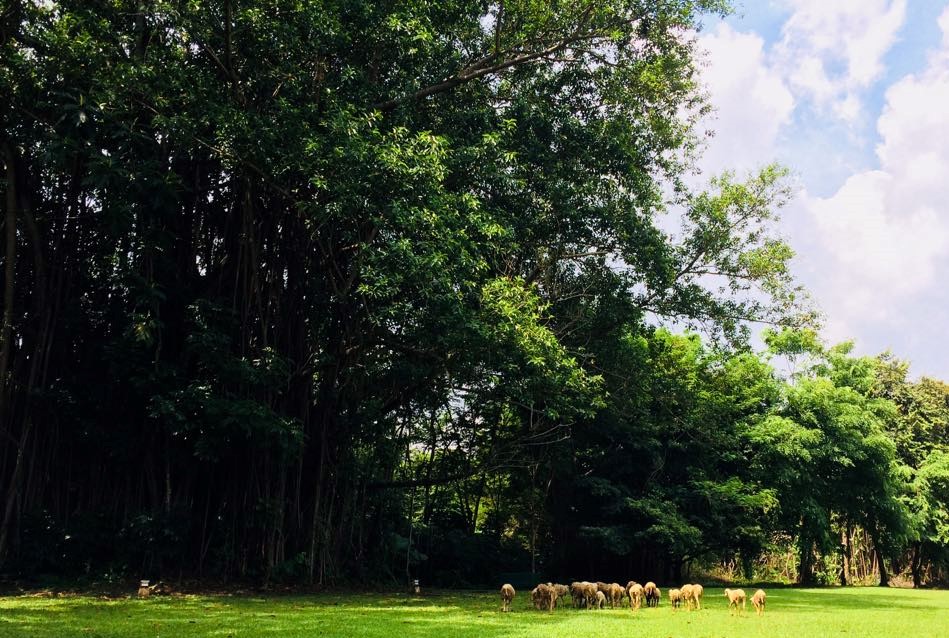
Photo by author of sheep grazing at Sacred Heart Novitiate in Novaliches, QC, 2018.

What a beautiful prayer today to you, O God our Father by your prophet Micah:

Shepherd your people with your staff, the flock of your inheritance that dwells apart in a woodland, in the midst of Carmel. Let them feed in Bashan and Gilead, as in the days of old; as in the days when you came from the land of Egypt, show us wonderful signs.

Micah 7:14-15

Shepherd us like a true father, God, the old fashioned and right way symbolized by your staff: strong and sturdy to discipline us especially when we wander far from you, and yet at the same time, so tender and forgiving – full of clemency as Micah mentioned – when we are lost or stuck in a cliff or a crevice.

This is probably the one combination we are terribly missing these days, discipline and tenderness, the cornerstone of formation in every family expressed in the adage from the Sacred Scriptures, “Spare the rod, spoil the child” which the modern society strongly objects and frowns upon:

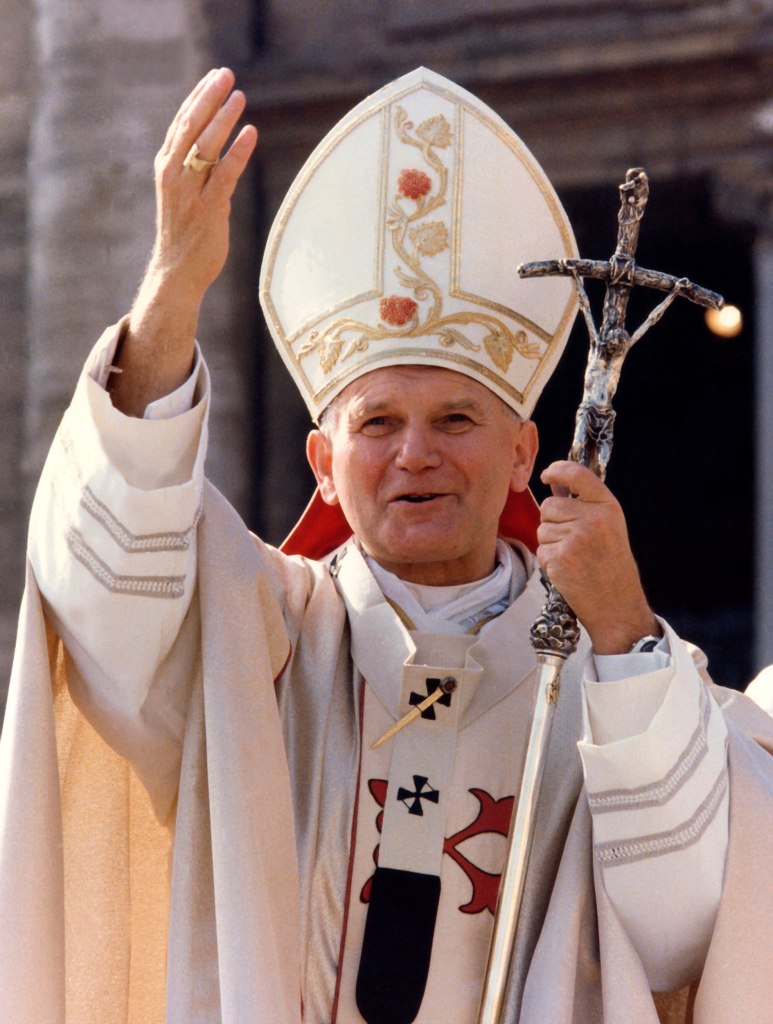
St. John Paul II waves to well-wishers in St. Peter’s Square at the Vatican in 1978 when elected as Pope, holding his staff, symbol of his being a shepherd.

He who spares his rod hates his son, but he who loves him takes care to chastise him.

Proverbs 13:24

Discipleship or being a disciple is primarily about discipline, of following not only the steps of the Lord and Master but also his ways.

From the word discipulos or to follow came the words follower and discipline alike.

Jesus Christ your Son perfectly said it in our gospel today when he rightly claimed that “whoever does the will of my heavenly Father is my brother, and sister, and mother” (Mt.13:50).

Give us the grace, O Lord, to take the right path anew of discipline to form our moral backbones tempered with your tenderness and mercy so we may truly work for a just and humane society here on earth so that your kingdom may finally come! Amen.

Holding on to God

The Lord Is My Chef Breakfast Recipe for the Soul by Fr. Nicanor F. Lalog II
Thursday, Memorial of Our Lady of Mount Carmel, 16 July 2020
Isaiah 26:7-9, 11, 16-19 >><)))*> + <*(((><< Matthew 11:28-30
Photo by author, Our Lady of Mt. Carmel of the Holy Family, Guiguinto, Bulacan, 08 December 2019.

Your words today, O God our Father, are very comforting and consoling, so reassuring of your love and mercy for us sinners, giving us new life in you as we celebrate the memorial of Our Lady of Mount Carmel.

Like the Israelites living in exile because of their own making when they turned away from you in sins worshiping false gods, we also admit our sinfulness and failures in standing up for what is true and just, in being faithful to you.

Help us to rise again, heavenly Father, breathe into us your life-giving Spirit specially at this time we feel so down and crushed not only by COVID-19 pandemic but by public officials concerned only with their well-being and whims forgetting the people they are supposed to serve.

We conceived and writhed in pain, giving birth to wind. Salvation we have not achieved for the earth, the inhabitants of the world cannot bring it forth. But your dead shall live, their corpses shall rise; awake and sing, you who lie in the dust. For your dew is a dew of light, and the land of shades gives birth.

Isaiah 26:18-19

If there is anything we would want to have these days, it is rest, O Lord.

A lightening of our load and burdens.

But why another yoke, Jesus?

Forgive us Jesus when we feel negative with yoke because they always portray to us images of slavery and oppression. Open our eyes, Lord, as we come closer to you to take your yoke because you not only help us carry our burdens but most of all, your yoke gives us direction in our path back to the Father.

May your Blessed Mother of Mount Carmel help us to hold on to God in this hour of darkness in our lives as individuals and as a nation. Amen.

Photo by author, Our Lady of Mount Carmel of the Holy Family, Guiguinto, Bulacan, November 2019.

With God, everything continues; without God, everything ends

The Lord Is My Chef Breakfast Recipe for the Soul by Fr. Nicanor F. Lalog II
Friday, Week XIV, Year II in Ordinary Time, 10 July 2020
Hosea 14:2-10 <*{{{><< <*{{{><< + >><}}}*> >><}}}*> Matthew 10:16-23
Photo by author, Wailing Wall of Jerusalem, May 2019.

Your words today, dear God, hit us hard, very hard especially after we have gravely sinned against you when we have “collapsed through our guilt” (Hosea 14:2). Indeed, without you on our side, everything ends.

And the sad part of this reality is we refuse to listen to you. We have grown so accustomed to our sinful ways, believing more to our selves that we can get away with everything. How foolish, indeed, O Lord that we would not stop until everything collapses and crumbles before us. We have been so drunk with the fleeting pleasures of the world, thinking they are the “real things” we badly need.

Open our eyes, our minds, and our hearts to your love and mercy, Father.

Teach us to be wise to understand your ways and your teachings, your offer of redemption to start anew because with you, everything continues despite some setbacks sometimes.

Let him who is wise understand these things; let him who is prudent know them. Straight are the paths of the Lord, in them the just walk, but sinners stumble in them.

Hosea 14:10

Let us take into our hearts the assurance given us by your Son Jesus Christ not to worry about what to speak or say when persecuted because it is the Holy Spirit who shall be speaking for us, fighting our battles.

Most of all, teach us how to be “shrewd as serpents and simple as doves” (Mt. 10:16) especially in this world and time where sin and lies are glorified and seemingly to be having the “upperhand” in everything, whether in our personal lives or life as a community and a nation.

May we see beyond this world where our lives and stories live on, continuing in you through eternity. Amen.

Photo by author, 2020.

Separations, good and bad…

The Lord Is My Chef Breakfast Recipe for the Soul by Fr. Nicanor F. Lalog II
Monday, Memorial of St. Maria Goretti, Virgin and Martyr, 06 July 2020
Hosea 2:16, 17-18, 21-22 >><)))*> >><)))*> >><)))*> Matthew 9:18-26
Photo by author, procession cross, 2019.

Today, O God our loving Father, your words have invited me to reflect about “separations” — something we are always afraid of, sometimes beyond our control, but one thing for sure, many times needed in life.

Usually, we dread separations because it means being detached, being away from people we love or, situations we are familiar with.

Like with death, the ultimate separation in this life.

While Jesus was speaking, an official came forward, knelt down before him, and said, “My daughter has just died. But come, lay your hand on her, and she will live.” Jesus rose and followed him, and so did his disciples.

Matthew 9:18-19

Death as a separation is most painful when committed in cold blood, like the martyrdom of the young St. Maria Goretti who was only 12 years old when an older neighbor stabbed her to death in their home near Ancona, Italy after she had refused to give in to his sexual advances in 1902.

Death as a separation is painful and sad because it is “the end” in our running story, when we lose somebody so special, so close to us with whom we have special plans and dreams to be together but suddenly gone.

Sickness and diseases also separate us from others.

Often, people regard sickness as a kind of slow death. And here lies its agonizing pain when due to some medical conditions we are separated from others, unable to fully interact and relate with them even if they are near us. Its worst part is how we can only look from afar at the activities and things going on among our brothers and sisters because we are bedridden, stuck on a wheelchair, disabled, or sometimes deep inside us cannot fully integrate because of the sickness within like bleeding or some form of cancer or deafness.

A woman suffering hemorrhages for twelve years came up behind him and touched the tassel on his cloak. She said to herself, “If only I can touch his cloak, I shall be cured.”

Matthew 9:20-21

Thank you for sending us your Son Jesus Christ who have not only come to lead us to life eternal but also to heal our sickness and mediate in bridging the gaps among us and within us.

By giving himself on the Cross, Jesus has made us whole again, brought us together in unity both in time and eternity for nothing can now separate us from you and from others through his immense love poured upon his death.

Photo by author, Petra in Jordan, 2019.

Give us the grace, O Lord of heaven and earth, to seek and follow your voice always, that sometimes, we on our own separate from our daily routines, from others to be one with you in the desert so we may know you more, love you more and follow you more.

Thus says the Lord: I will allure her; I will lead her into the desert and speak to her heart. She shall respond there as in the days of her youth, when she came up from the land of Egypt. I will espouse you in fidelity, and you shall know the Lord.

Hosea 2:16, 17, 22

There are still other forms of separations we experience in life, both good and bad.

Grant us the grace of courage, dear God our Father, to face every separation in life we experience, whether good or bad, permanent or temporary, our choice or imposed upon us — always trusting in the uniting power of your Son Jesus Christ in the Holy Spirit. Amen.

God our foundation

The Lord Is My Chef Breakfast Recipe for the Soul by Fr. Nicanor F. Lalog II
Thursday, Week XII, Year II in Ordinary Time, 25 June 2020
2 Kings 24:8-17 <*(((>< ><)))*> <*(((>< ><)))*> Matthew 7:21-29
Photo by author, the Walls of Jerusalem, May 2019.

Your words today, O Lord, are so graphic and chilling about the nature of sin that unfortunately, we continue to take for granted.

Jesus said to his disciples: “Not everyone who says to me, ‘Lord, Lord,’ will enter the Kingdom of heaven, but only the one who does the will of my Father in heaven.”

Matthew 7:21

Forgive us Jesus when we are so complacent with our prayers and words to you that remain only in our mouths and lips, but never coming from our hearts and most of all far from our actions.

Forgive us Lord for the great divide within us, between our words and our actions, of what we believe and what we live.

Give us the grace to be rooted in you always, to have you as our foundation.

Your words are so true, Lord, that so often our lives collapse like Jerusalem in the Old Testament, like the house built on sand in your parable because we live far from you.

Help us to take these lessons into our hearts, that whatever bad befalls us is never your punishment but the result of our sins, when everything collapses in us and starts to breakdown.

May we hold on fast to your words and examples in the power of the Holy Spirit. Amen.

Photo by author, Church of the Holy Family, Taipei, Taiwan, 2019.

When do we really call on God?

The Lord Is My Chef Breakfast Recipe for the Soul by Fr. Nicanor F. Lalog II
Tuesday, Week XII, Year II in Ordinary Time, 23 June 2020
2 Kings 19:9-11, 14-21, 31-35, 36 ><)))*> <*(((>< Matthew 7:6, 12-14
Photo by author, Our Lady of Lourdes Chapel, the Grotto, Baguio City, 2019.

God our loving Father, I have been praying to you for so long, in fact almost in my entire life. But as I prayed over your words for today, it just dawned upon me that every “existential question”: when do I really call on you?

The attitude of your King in Jerusalem struck me while praying, wondering if I have the same attitude of having you first of all when things are not going good in my life.

Hezekiah took the letter from the hand of the messengers and read it; then he went up to the temple of the Lord, and spreading it out before him, he prayed in the Lord’s presence: “O Lord, God of Israel, enthroned upon the cherubim! You alone are God over all the kingdoms of the earth… Therefore, O Lord, our God, save us from the power of this man, that all the kingdoms of the earth may know that you alone, O Lord, are God.”

2 Kings 19:14-15, 19

What a deep faith and intimate relationship with you, Lord, by Hezekiah! He went straight up to you, even presenting to you the letter of the Assyrian king threatening to conquer Jerusalem at that time. He did not mind at all the warnings about the strength and power of the Assyrians because he only had you, Lord, in his mind and in his heart.

So often, Lord, I only come to you after I have exhausted my mind thinking about my problems and situations in life; I come to you when I can no longer find solutions; worst, I come to you after I have tried everything and had failed.

Forgive me, Father, when I only think of you as a last resort — instead of being my first always!

Maybe, that is because before ever coming to you, calling on you, Lord, I try doing things first on my own that is always be easy and quick. I have no patience of waiting and of going through sufferings and inconvenience especially through paths and doors.

Jesus said to his disciples: “Enter through the narrow gate; for the gae is wide and the road broad that leads to destruction, and those who enter through it are many. How narrow the gate and constricted the road that leads to life. All those who find it are few.”

Matthew 7:13-14

Dearest Jesus Christ, you have come among us to bring us closest to the Father and yet we continue to remain far from him. Give us the grace today to be more intimate with God our Father so we may truly be centered on him in life, having him as our personal “default” in every situation, whether good or bad. Amen.

Photo by author, Tam-Awan, Baguio City, 2019.