The Lord Is My Chef Daily Recipe for the Soul by Fr. Nicanor F. Lalog II
Thursday, Third Week in Ordinary Time, Year I, 30 January 2025
Hebrews 10:19-23     ><}}}}*>  +  ><}}}}*>  +  ><}}}}*>     Mark 4:21-25
Photo by author, sunset in Atok, Benguet, 27 December 2024.
Many times, O Lord Jesus,
I feel you "hide" from me
not because you are avoiding me
but simply because you want me to
find you.
And be surprised
because that is how it is
really with you and the Father
and the Holy Spirit:
you want us
to experience that sense
of awe and wonder
of Jacob in Bethel
when he dreamt of your stairway
to heaven that upon waking up,
he cried out in joy, "Truly,
the Lord is in this spot,
although I did not know it!"
(Genesis 28:16)
Photo by author, Mt. Olis Park, Atok, Benguet, 27 December 2024.
Many times in the gospel
you have asked those you have
healed not to say anything
about you to anyone but
the more they talk about you,
dear Jesus;
and this is what you are
telling us today,
that we cannot hide a shining light
or lamp;
any good will always shine
will always be known
and be seen.
And that is YOU,
Jesus.
When I examine my life,
I have experienced many instances
when you, Jesus, had broken
through the surface after being "hidden"
for a long time deep within me;
and what a joy until now
especially when I am confused,
when I feel alone,
when I see nothing
but darkness,
that is actually when you are "hidden",
 waiting to reveal yourself
 in the simplest occasions,
giving me with "more"
even though I already have
received so much from you
just in finding you!

Grant me the grace, Jesus,
"to approach and seek you
with a sincere heart and in
absolute trust... let me hold
unwaveringly to our confession
that gives us hope for you are
trustworthy as I rouse one another
to love and good works"
(Hebrews 10:22, 23, 24).
Amen.
Photo by author, sunrise at St. Paul Spirituality Center, Pico, La Trinidad, Benguet, 06 January 2025.
The Lord Is My Chef Sunday Recipe for the Soul by Fr. Nicanor F. Lalog II
Thirty-first Sunday in Ordinary Time, Cycle B, 03 November 2024
Deuteronomy 6:2-6 ><}}}}*> Hebrews 7:23-28 ><}}}}*> Mark 12:28-34
Photo by author, river at the back of Nagsasa Cove, San Antonio, Zambales, 19 October 2024.
Jesus finally entered Jerusalem to fulfill His mission as we also enter the last four Sundays of our liturgical year before entering the season of Advent in preparation for Christmas.
Two Sundays ago we reflected the atmosphere of fear among the Apostles and the crowd following Jesus to Jerusalem after He had made known to them for the third time His coming Passion, Death, and Resurrection. This Sunday our readings invite us to look into that feeling of fear we often experience.
Fear can be negative in nature when we experience a threat to our safety whether there is a clear and present danger from a person or animal hurting us, or when our imagination runs wild with ghosts or a snake underneath the bed at night.
Positive fear is actually the reverence we experience due to a sense of awe often associated with our relationships like with our parents and relatives, teachers and superiors, or any person who seem to amaze us. We fear them not because they threatened us but actually inspired us with their presence, dignity and grace, intelligence and kindness among other things. This kind of fear we experienced in childhood then slowly matured and blended with trust, translated into adoration of the persons so unforgettable to us, influencing us in many ways that we have come to love them eventually, especially God. This is what the Bible and catechism books refer to as “fear of the Lord”.
Photo by author, Mount Sinai, Egypt, May 2019.
Moses spoke to the people, saying: “Fear the Lord, your God, and keep, throughout the days of your lives, all his statutes and commandments which I enjoin on you, and thus have long life. Hear, O Israel! The Lord is our God, the Lord alone! Therefore, you shall love the Lord, your God, with all your heart, and with all your soul, and with all your strength. Take to heart these words which I enjoin on you today” (Deuteronomy 6:2, 4-6).
This “fear of the Lord” that Moses and later the prophets instilled among the Israelites was expressed in faithfulness and obedience to the Laws so that for them, being holy or upright was obedience to the Laws.
This “fear of the Lord” is not about God overpowering man to keep him in bondage. In giving the Ten Commandments, God first entered into a relationship or covenant with the chosen people based on friendship, trust, and love. See here that positive aspect of fear, of reverence like our fear of parents and elders as well as those seemed larger than us including our crushes and first love when we revered them by showing them love and respect.
This “fear of the Lord” then becomes a passing from fear to love that leads us to maturity as persons. And believers. Then lovers and followers not only of those significant people in our lives but most especially of God!
One of the scribes came to Jesus and asked him, “Which is the first of all the commandments?” Jesus replied, “The first is this: Hear, O Israel! The Lord your God is Lord alone! You shall love the Lord your God with all your heart, with all your soul, with all your mind, and with all your strength. The second is this: You shall love your neighbor as yourself. There is no other commandment greater than these” (Mark 12:28-31).
Photo of author, Mount Sinai, Egypt, May 2019.
Unlike the tricky questions posed by His enemies, this one from a scribe was so unique with his calm attitude that invites everyone including us to join in the discussion. One can feel his sincerity in seeking out the truth he felt (rightly so!) only Jesus can answer.
Many times, we feel the same way like that scribe so convinced in asking Jesus, ready to follow Him only if we are clarified which is the first to follow in life in order to mature from fear to love.
"Which is the first of all the commandments?"
Like that scribe, many times we feel confused in our lives, in our faith with the many laws and traditions we were told since childhood to follow; hence, we ask “which is the first of the commandments” that really matter most in life.
Such moments in our life is a grace from the Holy Spirit because in asking “the first of the commandments” is not to determine a hierarchy nor a list of which ones to be prioritized and dismissed; the “first” commandment means the absolutely capital that is always binding on all. The “first” commandment is the one to which all others are subjected without being cancelled or considered least nor optional. The “first” commandment is the very essence of all commandments present in each commandment. It is actually a search for the First Principle who is God Himself!
That is why Jesus quoted verbatim Deuteronomy 6:4-5, the opening words of their best known prayer Shema every pious Jew knows by heart, “Hear, O Israel! The Lord is our God, the Lord alone! Therefore, you shall love the Lord, your God, with all your heart, and with all your soul, and with all your strength.”
Similar to His manner of answering the question about divorce last month, Jesus did not answer the scribe’s question by making reference to a code of laws but instead recited the Shema that encapsulates maturity and deepening of faith in God who is One, with no other except Him. The Shema also shows how our personal God relates with us His people, bonding in a covenant like husband and wife that is reciprocal, exclusive, and total love “with all your heart, with all your soul, with all your mind, with all your strength.”
This “first” commandment is also a relationship that flows to our relationships with one another we rightly call as neighbors. See how Jesus added a “second” commandment not as in a hierarchy making it less important but as an expression of the essential “first” commandment of all the scribe understood well when he affirmed, “Well said teacher… and to love your neighbor as yourself is worth more than all burnt offerings and sacrifices” (Mk.12:32, 33).
For the Jews, their neighbors were their fellow Jews and those aliens residing in their land as found in the Book of Leviticus; but, in this scene, we find Jesus bringing that whole notion of neighbors for everyone, regardless of color and status in life, or of gender, or beliefs.
Jesus makes known to us this Sunday His mission of salvation is for all, for everyone. Most of all, Jesus tells us this Sunday that He is the fulfillment of the Law that many during His time and sadly until now have misread as mere letters to be followed, failing to find the face of God in every law inscribed on every person.
Photo by author, view from Jerusalem Temple, May 2019.
How interesting that each face has two cheeks, both essential, both as the first commandment: love of God is love of neighbor. To profess and practice this faith in God that started in fear and matured into love finding Him in everyone as our neighbor is to be “not far from the kingdom of God” (Mk.12:34).
Friends, let us not fear asking Jesus which is the “first” of the commandments like that scribe.
Keep asking Him until we find Jesus “first” in our trials and tribulations, darkness and confusions, failures and emptiness.
Keep asking Him until we find Jesus “first” on those people who burden us, those who hurt us, those who judge us, those who refuse to listen to us, those who dictate on us.
Keep asking Him until we find Jesus even in programs and plans we could not understand or that are downright crazy.
That is what to truly love God and to love everyone. It is difficult but we have Jesus as our high-priest “who has passed through the heavens” leading us closer to the kingdom of God. Amen. Have a lovely November!
Photo by author, Pundaquit Mountains, San Antonio, Zambales off Nagsasa Cove, 19 October 2024.
40 Shades of Lent by Fr. Nicanor F. Lalog II
Wednesday in the Third Week of Lent, 06 March 2024
Deuteronomy 4:1, 5-9     ><}}}}*> + <*{{{{><     Matthew 5:17-19
Lent is remembering
especially because we are
beings of forgetfulness;
but, teach us Father,
that to remember you
is not like in remembering
an equation or a formula
as a task of the mind
or intellect;
to remember you, O God,
in the spirit of Lent is
to surrender ourselves to
you whom we do not see
but present among our
brothers and sisters;
to remember you, dear God,
is to surrender ourselves
to your Holy Will
that are not mere laws
and decrees
but the very person
of your Son Jesus Christ.
Jesus said to his disciples: “Do not think that I have come to abolish the law or the prophets. I have come not to abolish but to fulfill. Amen, I say to yo, until heaven and earth pass away, not the smallest letter or the smallest part of a letter will pass from the law, until all things have taken place.”
Matthew 5:17-18
To remember and keep your laws,
dear God is to remember and keep you
found in our brothers and sisters
through your Son Jesus Christ;
indeed, the greatness of any
nation is measured to a large part
in its legal system, in how it is justly
implemented and observed:
Moses spoke to the people and said: “Observe them carefully for thus will you give evidence to your wisdom and intelligence to the nations, who will hear of all these statutes and say, ‘This great nation is truly wise and intelligent people.’ For what great nation is there that has gods so close to it as the Lord, our God, is to us whenever we call upon him? Or what great nation has statutes and decrees that are just as this whole law which I am setting before you today?'”
Deuteronomy 4:1, 6-8
Father, in this season of Lent,
may we recover and put into practice,
not just remember that your laws
are fulfilled in Christ when we love;
how sad that love of God
and love of neighbors
is your law we often forget,
and find hard to remember
because we keep it in our minds
than in our hearts where you dwell.

Most of all, to remember
means to make one a member
of the present moment again:
help us remember in making
you present always in our love
and good works.
Amen.
The Lord Is My Chef Daily Recipe for the Soul by Fr. Nicanor F. Lalog II
Monday in the First Week of Lent, 19 February 2024
Leviticus 19:1-2, 11-18   ><))))*> + + + <*((((><     Matthew 25:31-46
Photo by Mr. Jay Javier in Quiapo, Manila, 09 January 2024.
Today I pray dear God
to your directive since the
Old Testament until the coming
of your Son Jesus Christ:
"Be holy , for I, the Lord your God,
am holy" (Leviticus 19:2).
But, what is really to be holy,
what is to be like you,
God?
There are so many other
traits and characteristics I can think
of you as being holy,
O God,
that we have to imitate
to be like
you
that makes holiness
 so difficult,
elusive,
and impossible!

Who can really be like you
when we are so different from you?
But, thank you in sending us
Jesus who not only made it
possible for us to be holy
like you, God,
but also made it
simpler:
“Amen, I say to you, whatever you did for one of these least brothers of mine, you did for me… Amen, I say to you, what you did not do for one of these least one, you did not do for me.”
Matthew 25:40, 45
On this blessed season
of Lent,
teach us to fast
and be empty of ourselves,
of our pride,
and of our sins
so we may be filled with YOU;
holiness is first of all
being filled
with you, O God,
that we feel,
we see,
we think
of others like you,
that is, of seeing you
in each one of us.
When we begin to
realize and experience
that you fill us, O God,
then we learn to be
generous in sharing
more of ourselves,
of our time,
of our talent,
of our treasure,
and most of all,
of you dear God
dwelling in us
with others;
we can only be holy
not when we try being
like you but more of finding
you first in us
in order to find you
in others too!

Then,
maybe we stop
fighting,
committing every sin
against each other
if only we can see you
dwelling,
filling
each one of us.
Amen.
The Lord Is My Chef Daily Recipe for the Soul by Fr. Nicanor F. Lalog II
Thursday before the Epiphany of the Lord, 04 January 2024
1 John 3:7-10 ><]]]]'> + <'[[[[>< John 1:35-42
Photo by author, La Mesa Forest Park at the back of Our Lady of Fatima University-Quezon City, January 2023.
The two disciples heard what he said and followed Jesus. Jesus turned and saw them following him and said to them, “What are you looking for?” They said to him, “Rabbi” (which translated means Teacher), “where are you staying?” He said to them, “Come, and you will see.”
John 1:37-39
Thank you very much,
dear Lord Jesus in helping us
find new directions in life
this fourth day of 2024;
 your question to Andrew
and his companion still echoes
to us in this time,
confronting us for an answer,
for a response.
Lord Jesus,
enlighten our minds and our hearts
with your Holy Spirit
this beginning of the year;
we are constantly in search
of so many things but mostly
not essential;
thank you in giving us Andrew
and companion as guide
on what to look for -
you and nobody else!
Teach me, dear Lord,
to always first ask that important
question what matters most to me
that I am looking for
because it reveals who I am,
where I stand before you, my Lord,
and before others.
Many times,
we merely follow you
but when the going gets tough
and rough, we leave
and stay behind;
many times,
we merely follow you
without truly searching
where you stay,
where can you truly be found,
Lord Jesus
because you are never idle
nor confined in a book nor a place
nor a kind of person;
very often,
you stay dear Jesus
where it is difficult,
even agonizing,
and disturbing.
Let us come to you,
and see you,
dear Jesus,
to personally experience you
even in the most surprising
ways for there is no
place nor person nor situation
where you cannot be found.
Amen.
The Lord Is My Chef Daily Recipe for the Soul by Fr. Nicanor F. Lalog II
Tuesday, Misa De Gallo IV, 19 December 2023
Judges 13:2-7, 24-25 <'[[[[>< + ><]]]]'> Luke 1:5-25
Here’s another beautiful story I got from a blogger I recently followed from Spain at wordpress.com. It is actually an analogy which may sound simple but very true.
You are holding a cup of coffee when someone comes along and bumps into you or shakes your arm, making you spill your coffee everywhere. Why did you spill the coffee?
"Because someone bumped into me!!!"
Wrong answer. You spilled the coffee because there was coffee in your cup. Had there been tea in the cup, you would have spilled tea. Whatever is inside the cup is what will spill out.
Therefore, when life comes along and shakes you - which surely happens all the time - whatever is inside you will come out. It's easy to fake it, until you get rattled. So, we have to ask ourselves, "what's in my cup?" When life gets tough, what spills over from me?
Photo by Mr. Boy Cabrido, Quiapo Church, Misa de Gallo, 17 December 2023.
My dear friends, we are now on the fourth day of our Misa de Gallo and I find that story/analogy so appropriate with our readings today.
How interesting that Zechariah with his wife Elizabeth – according to St. Luke – prayed so hard all their lives to have a child but when God was about to fulfill it, Zechariah doubted it despite being told by an angel from God. Like in that story/analogy we presented above, Zechariah was “rattled” by the angel’s good news. “What was inside Zechariah that he doubted the good news”?
Then Zechariah said to the angel, “How shall I know this? For I am an old man, and my wife is advanced in years.” And the angel said to him in reply, “I am Gabriel, who stand before God. I was sent to speak to you and to announce to you this good news. But now you will be speechless and unable to talk until the days these things take place, because you did not believe my words, which will be fulfilled at their proper time.”
Luke 1:18-20
Photo by author, Wailing Wall of Jerusalem, May 2017, the section of the remaining parts of the temple closest to the Holy of Holies where priests used to incense once a year.
Advent is the presence of God but sometimes when we are overburdened with so many things like anxieties and problems in life, frustrations and disappointments, sickness and death in the family, we become unaware of his divine presence even if we continue to pray and do our religious duties and devotions. Too often we lack the conscious awareness of God in our lives that we take him for granted, considering him more as a given than a presence and a reality.
This is exactly what we told you yesterday about some of us pretending to be real disciples of Christ when in reality we are merely dreaming in a sleepwalking existence. It is a kind of spiritual immaturity due to our lack of honesty and sincerity with one’s self and with God that we remain a spiritual dwarf. Like Zechariah who happened to be a priest who must be more attuned and rooted in God, we too hardly notice God’s coming or even doubt him and his powers because we want to hold on to our comfort zone or insist our own agenda.
God is never put off by our queries in life but what “irritates” him is when we question him, when we doubt him, when we ask about his character like Zechariah. That is a lack of faith in God, a lack of trust, and lack of personal relationship with him unlike St. Joseph in our reflection yesterday, truly a righteous man.
Contrast Zechariah with his wife Elizabeth who is presented by St. Luke in a better position despite her being barren. In the Bible, barrenness is a sign of lifelessness and absence of God’s blessings. Worst, it was seen as a punishment from God for one’s sins.
Yet in this opening scene of St. Luke’s infancy story beginning with the annunciation of John’s birth, we find God’s power at its fullest when we are most emptied which is exactly the imagery of Elizabeth being barren and old. She had nothing at all to be proud of unlike Zechariah who still had duties to perform as a priest.
As we have reflected yesterday too, we burst in great rejoicing actually in those moments filled with negativities, with a lot of “no” answers of rejections and failure. That was how Elizabeth felt after being pregnant with John.
After this time, his wife Elizabeth conceived, and she went into seclusion for five months, saying, “So has the Lord done for me at a time when he has seen fit to take away my disgrace before others.”
Luke 1:24-25
Earlier, we asked what was inside Zechariah that he doubted the good news of the angel; now, we imagine what was inside the barren Elizabeth who welcomed the good news rejoicing by voluntarily going into a seclusion?
The story of the elderly couple Zechariah and Elizabeth finally being blessed by God with a child shows us God’s consistency not only in keeping his promises but most of all in working best even in our worst conditions, in the most unusual circumstances. In these two stories, one from the Old Testament and in the New Testament, we find the importance of being filled with God always.
Recall our story/analogy above. What is inside us that comes out when we are shaken? What spills over from our cup, is it joy, gratitude, and peace? Or, anger, bitterness, harsh words and reactions long festering within?
In starting his Christmas story with the annunciation of the birth of John the Baptist, St. Luke is telling us an important aspect in celebrating this blessed season – the need to fill ourselves with God.
See how Zechariah was forced to be silent and made mute so that he could spend more time listening and rediscovering God anew in his heart, of filling himself with God. On the other hand, Elizabeth opted to go into seclusion also to contemplate God already dwelling in her though she may have never known before that is why she wanted to listen more intently to his other plans with the gift of John. Similarly like her in the first reading was the wife of Manoah who remained silent and open when a man of God told her she would bear a son to be called Samson, saying that “I did not ask him where he came from” (Jgs.3: 6). Advent invites us to simply be still to be filled by God, with God.
The other day I joined my nieces and nephew for lunch. After dropping me off at the parish, they asked for a nearby Starbuck’s because my nephew had to buy a coffee mug for his exchange gift in their class. When I asked him why he had to give a Starbuck’s mug as gift, it turned out that is now the way it is in class Christmas party – your exchange gift partner can make a wish for the gift to receive for as long as it is within the agreed budget by the class.
Anyway, our life gives us the cup or the mug. We make the decision, the choice to fill it with coffee or chocolate or tea, in the same manner we fill ourselves with joy or bitterness, anger or serenity, gratitude or complaints. Or God.
Like Zechariah in the gospel today, we could be so tired already of doing so much, of banging our heads on the wall to solve everything, to answer everything. In this final stretch before Christmas, let us empty our cups or mugs of our selves and fill it with God who alone can truly fill us with life despite our dryness and barrenness. Amen.Have a blessed Tuesday!
The Lord Is My Chef Daily Recipe for the Soul by Fr. Nicanor F. Lalog II
Monday in the Twenty-Seventh Week of Ordinary Time, Year I, 09 October 2023
Jonah 1:1-2:1-2, 11   <*((((>< + ><))))*>   Luke 10:25-37
Photo by author, Central Luzon Link Expressway (CLLEx) in Tarlac, 19 July 2023.
As we embark to
our work and duties this
first working day of this new week,
bless us, dear God our Father,
to follow your path;
if we have to cross the street,
if we have to go to the other side
of the road or of life's terrain,
let us follow you.
Like with Jonah,
find ways so we can go back
to your path,
to your mission.
This is the word of the Lord to Jonah, the son of Amittai: “Set out for the great city of Nineveh, and preach against it; their wickedness has come up before me.” But Jonah made ready to flee to Tarhish away from the Lord. He went down to Joppa, found a ship going to Tarhish, paid the fare, and went aboard to journey with them to Tarhish, away from the Lord.
Jonah 1:1-3
Forgive us,
merciful Father,
how often we are like
Jonah trying to run away
from you,
always going out the
opposite direction far from you,
refusing to accept your invitation
to a destination where you
may be found too.
Like the Good Samaritan
in today's gospel,
teach us to be kind
with everyone,
to dare cross the street,
to go to the other side
to care,
to feel,
to know
others not like us
for you, O God,
comes most often
in people and circumstances
we least expected.
Amen.
The Lord Is My Chef Daily Recipe for the Soul by Fr. Nicanor F. Lalog II
Wednesday in the Twenty-first Week of Ordinary Time, Year I, 30 August 2023
1 Thessalonians 3:7-13   <*((((>< + ><))))*>   Matthew 24:42-51
Photo by author in Alfonso, Cavite, 2019.
Loving Father,
it is always good
to be affirmed,
to be praised,
to be accepted;
but, like St. Paul,
there is no greater joy
for me than to be your
servant and vessel
of grace!

Keep me simple
and humble,
to desire nothing
but to do your will
and bring people
closer to you,
not me.
And for this reason we too give thanks to God unceasingly, that, in receiving the word of God from hearing us, you received it not as a word of men, but as it truly is, the word of God, which is now at work in you who believe.
1 Thessalonians 2:13
Remind me always,
dear Lord, to share
only Jesus,
always Jesus;
let me learn to leave
the scene immediately
after I have accomplished
your will; most of all,
may the people I serve
forget me to only remember
you alone.
Amen.
The Lord Is My Chef Daily Recipe for the Soul by Fr. Nicanor F. Lalog II
Monday, Memorial of St. Pope Pius X, 21 August 2023
Judges 2:11-19   ><]]]]'> + ><]]]]'> + ><]]]]'>   Matthew 19:16-22
Photo by author, La Trinidad, Benguet, 11 July 2023.
It is nice to be back here in Baguio City, this time with my brother priests for our annual clergy retreat at the St. Scholastica Spirituality Center. As usual, we started our brief “vacare Deo” with the Holy Mass and the gospel brought me to the start of my vocation history in elementary school as I found myself in that young man asking Jesus almost the same question:
a young man approached Jesus and said, “Teacher, what good must I do to gain eternal life?” He answered him, “Why do you ask me about the good? There is only One who is good. If you wish to enter into life, keep the commandments… If you wish to be perfect, go sell, what you have and give to the poor, and you will have treasure in heaven. Then come, follow me.” When the young man heard this statement, he went away sad, for he had many possessions.
Matthew 19:16-17, 21-22
Photo by author, Sacristy of the Manila Cathedral, 07 July 2023.
Indeed, there is only One good, God himself. Him is what we all seek in life. St. Teresa Benedicta of the Cross – St. Edith Stein – said anyone who seeks the truth seeks God, whether or not he realizes it.”
That is easier. In fact, it is God who seeks and finds us always. Not us. Our own seeking for him is a pure grace from him.
The problematique is seeking what is good.
Especially after finding God.
And that is priesthood, which is to constantly affirm and and say yes to God.
More than just obeying his commandments, doing what is good is saying yes to God every day, choosing him above all things and even person, even one’s self! Many times, I must admit, I have been like the Israelites in the first reading: after having God’s immense blessings in life, I turn away from him with my many other new gods.
What is really good who is God is contrary to what is good according to the world like wealth and power, pleasures and comforts, fame and honor, adulations and recognition, and so many other things that exaggerate our bloated ego especially in this age of instant fame and glory. They are not really good because they wane and dissipate like every wealth the world offers. Worst, when gone, we are left empty.
Photo by author, St. Scholastica Spirituality Center, Baguio City, 21 August 2023.
There is only One good, God himself whom we must only have as our only wealth, our only treasure, our only valuable. And to have him, we must divest ourselves of our worldly riches, of everything that massages and inflates our ego.
How lovely is that scene when Matthew noted “A young man approached Jesus”.
That is the beauty of every retreat, of every sabbath break. We become young again, we go back to our beginning when we were so simple in seeking what is good. How sad that after finding God in Jesus, we become old not in age but in our face, in our heart because we have become sad and saddled with our many possessions that possess us!
Lord Jesus Christ,
thank you for this retreat,
thank you for making me young again,
for making me go back
to those days of innocence,
of simplicity in seeking you,
in having you,
and being like you;
help me "divest" of myself,
empty me of my pride
and other "possessions"
to fill me with your humility,
justice and love.
Amen.
The Lord Is My Chef Sunday Recipe for the Soul by Fr. Nicanor F. Lalog II
Sunday in the Twentieth Week of Ordinary Time, Cycle A, 20 August 2023
Isaiah 56:1, 6-7 ><}}}*> Romans 11:13-15, 29-32 ><}}}*> Matthew 15:21-28
Photo by author, 2018.
Weddings are special occasions for me as a priest because they remind me so much of God’s presence in our time. Weddings gladden my heart as a priest because I find faith, hope and love still so vibrant in our own time when people seem to have turned away from God and spiritual values in exchange of material things. Weddings remind me that faith in God is also faith in one another.
Last Sunday we have reflected that outside forces like storms can never determine God’s presence in our lives. He is always present; problem is with us always absent, running away from him. In fact, our gospel this Sunday tells us how Jesus even dares to go to foreign territory just to find us, to heal us, and bring us back home to the Father.
At that time, Jesus withdrew to the region of Tyre and Sidon. And behold, a Canaanite woman of that district came and called out, “Have pity on me, Lord, Son of David! My daughter is tormented by a demon.” But Jesus did not say a word in answer to her. Jesus’ disciples came and asked him, “Send her away, for she keeps calling out after us.” He said in reply, “I was sent only to the lost sheep of the house of Israel.”
Matthew 15:21-24
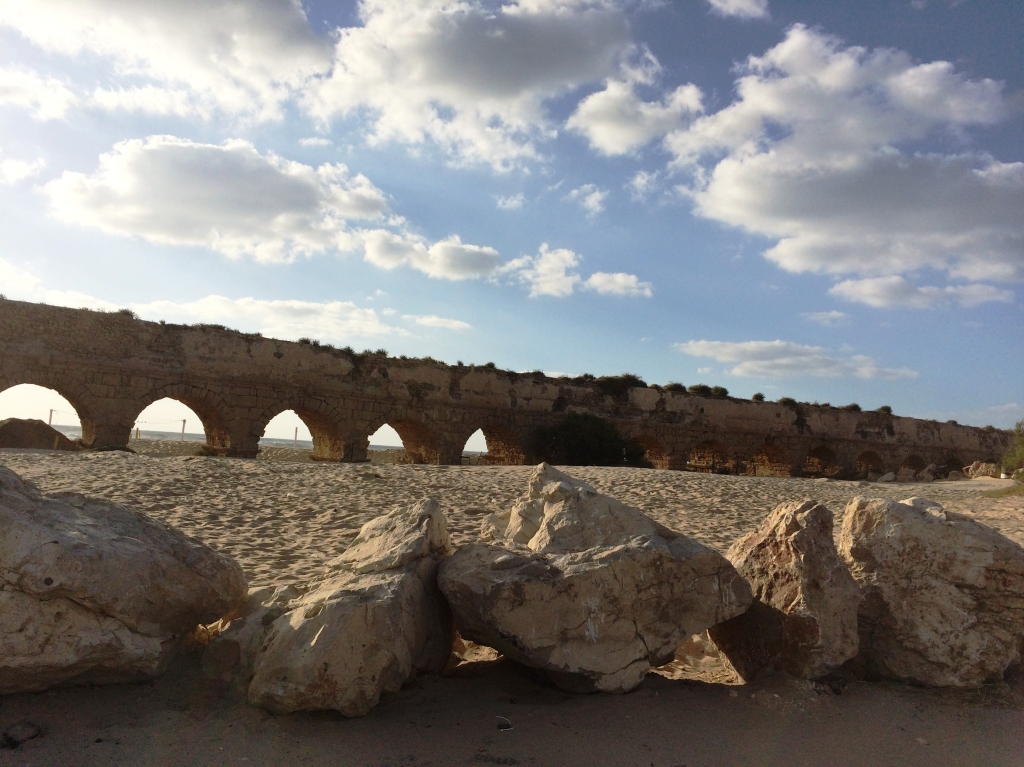
Photo by author, Caesarea in northern Israel near Tyre and Sidon in Syria, May 2019.
What a beautiful scene presenting to us God’s love for each of us, of Jesus going into foreign and pagan territory to save us, to share us his good news of salvation. But, are we there to meet Jesus when we are in unusual circumstances in our lives?
Like what we have reflected last Sunday, we need to have that sacred space within us where we could be one with God in Jesus in prayer where we grow deeper in faith, hope and love. There is no doubt with the presence of God in our lives but are we attuned with him?
That day when Jesus withdrew to Tyre and Sidon, there were also many other people who were also sick or with sick family members but, it was only the Canaanite woman who had faith that she recognized Jesus as the Christ by calling him not just “Lord” but also “Son of David.” Though a pagan, she recognized Jesus as the promised Savior of the world, not just of the Jews! Many times in life we are that Canaanite woman, feeling so alone in a foreign territory or unusual situations with nobody to come to for any kind of help or even companionship except God alone. Hence, the need to cultivate a prayer life so we can have that sacred space within us for God, where Jesus comes and dwells.
Photo by author, Camp John Hay, Baguio City, 12 July 2023.
But, there is something else interesting in this scene not just the faith of the Canaanite woman in Christ but also with others. Our faith in God is expressed in our faith with others too. The depth and strength of our faith can be measured with our faith in one another especially those dearest to us.
See the Canaanite woman’s POV or “point of view” and contrast it with the apostles who begged Jesus to entertain her so that she would get out of their way. The apostles wanted to get rid of her because she was making a great commotion. Maybe they felt so ashamed, so jahi to the madlang people!
How sad that we act like the Twelve many times in our lives, with that great disparity between what we believe and what we live. This is the tragedy especially of those serving in the Church with us priests included. Do we believe others as the presence of God? What a tragedy when we categorize people as ones to keep and others to dismiss for whatever reason. Like the apostles, we feel suspicious of those asking Jesus or, us for help. Do they really believe her daughter was sick? Did they believe the Canaanite woman at all?
For us to get a clearer snapshot of the Canaanite woman’s faith and POV, let us return for a while why Jesus ignored her by reminding his disciples that, “I was sent only to the lost sheep of the house of Israel.” Recall that was also his instruction to his apostles after naming them and sent them to their first mission not to go to pagan territories but look for the lost sheep of Israel.
But the woman came and did Jesus homage, saying, “Lord, help me.” He said in reply, “It is not right to take the food of the children and throw it away to the dogs.” She said, “Please, Lord, for even the dogs eat the scraps that fall from the table of their masters.” Then Jesus said to her in reply, “O woman, great is your faith! Let it be done for you as you wish.” And the woman’s daughter was healed from that hour.
Matthew 15:25-28
Photo by author, Katmon Nature Reserve & Beach Resort, Infanta, Quezon, 04 March 2023.
Their conversation about the bread and the dogs reminds us of the wedding feast at Cana when Mary approached Jesus to inform him that the newly-wed couples have ran out of wine. When Jesus told her, “Woman, how does your concern affect me? My hour has not yet come” (Jn. 2:4), we find it echoing here in Tyre and Sidon when he told the Twelve, “I was sent only to the lost sheep of the house of Israel.”
Here now is the most beautiful part, the POV of the Canaanite woman who was very much like the Blessed Virgin Mary when she came and did homage to Jesus, begging “Lord, help me.”
I love that part of the Canaanite woman begging Jesus in the name of her daughter. When she finally had the attention of Jesus, she said “Lord, help me”, – not “Lord, help my daughter tormented by a demon”! It was her daughter in need of healing but the woman identified with her just like Mary when she told the servers, “Do whatever he tells you” (Jn.2:5).
What a lovely and amazing scene of faith in God and faith in others! Both Mary believing in Jesus passing on her faith to the servers and the Canaanite woman assuming into her the faith of her sick daughter. It was indeed a tough and deep faith she had professed to Jesus like the servers at the wedding in Cana: it was just a matter of time before something great happens. She felt it coming when she said even the dogs eat the scraps falling from their master’s table.
In life, like that Canaanite woman and the Blessed Virgin Mary, we have to assert even insist our faith while at the same time claiming whatever we believe is ours even if we have to wait. That is why St. Paul tells us in today’s second reading of the need to cultivate and deepen our faith even if God’s gifts and call are permanent and irrevocable (Rom.11:29) because we might fall into the same mistake of his fellow Jews who felt so secured in their beliefs and failed to recognize Jesus as the Christ.
Every Sunday, Jesus calls us to gather for the Eucharist. Everybody is welcomed, especially those feeling lost and alienated, or considered as outsiders because Isaiah prophesied in the first reading today, “my house shall be called a house of prayer for all peoples” (Is.56:7). Jesus comes to us in his words, in his Body and Blood, in one another especially those nearest to us like our family, your spouse or wife, your children, our siblings, our parents.
It is a Sunday. Let us gather as one family in the house of Lord, to share in his table of the word and of the bread – believing, hoping, and loving. Amen.











 lordmychef.com