Lawiswis Ng Salita ni P. Nicanor F. Lalog II, Ika-14 ng Abril 2020
Nakapanlulumo kung iisipin
itong sinapit natin sa COVID-19
sa isang iglap, kaagad-agad
takbo ng ating buhay tila nasagad
tayo ay sumadsad sa kaabahan
na dati ni hindi sumagi sa ating isipan
na tayo ay walang puwedeng panghawakang
kapangyarihan na maaring ipagyabang.
Aanhin ang pera at kayamanan
wala ka namang mabili o mapuntahan
sarado ang lahat pati ang simbahan
lansangan walang laman
lahat natigilan, natauhan
sa katotohanan tayo ay tao lamang
sa mahabang panahon ay nahibang
sarili ay nalinlang sa maling katotohanan.
Kay gandang pagmasdan
nakakakilabot hanggang kaibuturan
pananabik ng mga tao masilayan
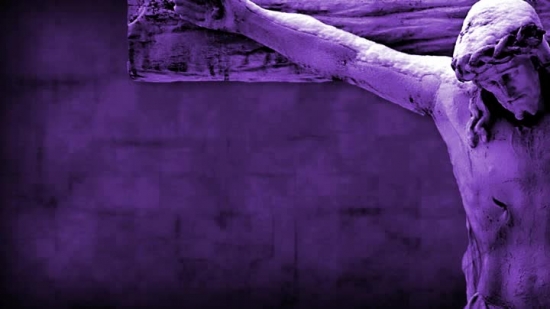
Panginoong Jesu-Kristo
sa Santisimo Sakramento at Santo Entierro
hanggang sa Señor Resuscitado
ng Pasko ng Pagkabuhay nang lahat kumaway
maging sundalo tinaas mga kamay sa pagpugay.
Suko kami sa inyo, Panginoon
tinalikuran ka namin noon:
ang pagkamakasarili sa amin ay lumamon
at sa nakakalasong ilusyon, kami naluom
kaya kami ay iyong hanguin sa pagkakabaon
ibangon upang muling makatugon
sa iyong tawag at hamon limutin ang sarili
pasanin ang Krus upang kasama mo kami makaahon.
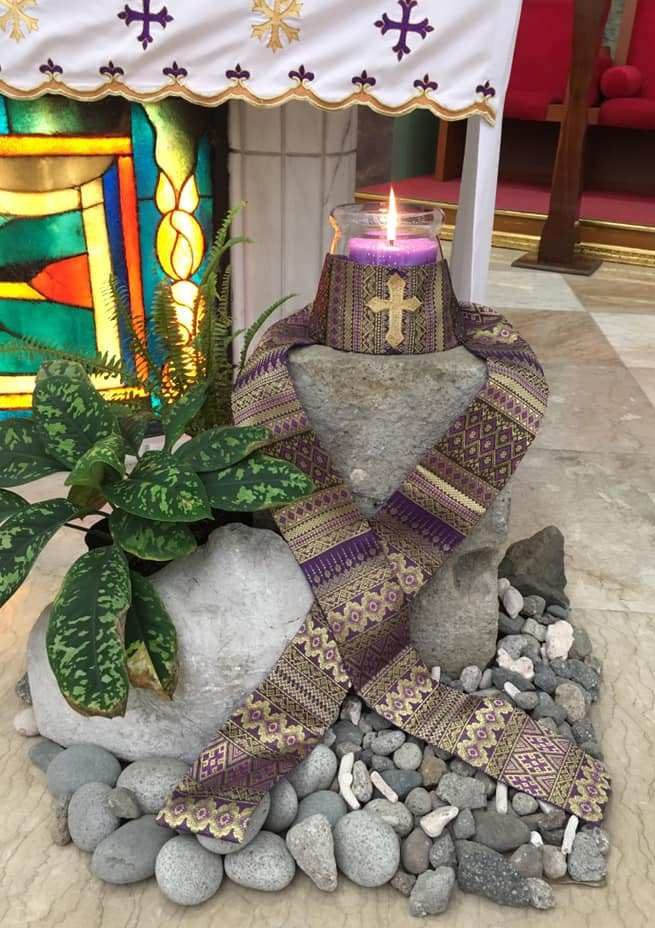
Photo by author, Parokya ni San Juan Apostol at Ebanghelista, Bagbaguin, Santa Maria, Bulacan, Lent 2020.
Once again, our loving Father, I take the computer as my point of comparison for my prayer reflection on this second Friday of Lent.
Thank you in giving us this blessed season of Lent when we are able to “debug” our “internal hard drive” – the heart – to be cleansed of bugs and virus as well as unnecessary materials that slow us down to be holy and perfect like you.
Your words are very reassuring of how you want us to be “fixed” always, to be in good condition, filled with life and holiness.
Thus says the Lord God: “Do I indeed derive any pleasure from the death of a wicked?” says the Lord God. “Do I not rather rejoice when he turns from his evil way that he may live? Hear now, house of Israel: Is it my way that is unfair, or rather, are not your ways unfair? When someone virtuous man turns away from virtue to commit iniquity, and dies, it is because of the iniqity he committed that he must die. But if the wicked, trning from the wickedness he has committed, does what is right and just, he shall preserve his life; since he has turned away from all the sins that he committed, he shall surely live, he shall not die.”
Ezekiel 18:23, 25-28
Educate our hearts, O Lord.
Help us “surpass the righteousness of the scribes and the Pharisees” in Jesus Christ who have come to perfect the laws in himself, in love.
May your purifying love, sweet Jesus, cleanse us of our sins, delete our painful memories that continue to hold us back, preventing us to move forward and forgive others and especially our very selves.
Make us rejoice, O Lord, in your immense love and share it with others so that we may grow more in holiness in you. Amen.
40 Shades of Lent, Wednesday, Week I, 04 March 2020
Jonas 3:1-10 +++ 0 +++ Luke 11:29-32
Photo by Mr. Raffy Tima of GMA-7 News, Batanes, 2018.
Our dearest Father in heaven:
On this first week of Lent, we pray for the grace that we become more trusting of ourselves, of our worth, of our identity as your beloved children.
Until now, we can hear your Son Jesus our Lord lamenting that “This generation is an evil generation; it seeks a sign, but no sign will be given it, except the sign of Jonah (Lk.11:29)” because we keep on looking for signs from you and from others before we can believe in ourselves.
Remind us, O God, that we are already a sign of your presence in Christ Jesus, our Emmanuel or “God-is-with-us”.
Like Jonah in the first reading, we keep on running away from you, from disobeying your will.
Worst of all, like Jonah, we cannot trust you and others because we always doubt and mistrust the people around us of something good they could do.
From Google.
And sad to say, the very people we doubt much about their own abilities and goodness are the ones closest to us like husband or wife, children, brother or sister, and friends!
What a tragedy indeed that we always refuse to appreciate our worth as your beloved children that lead us to see also the value of others around us, especially those who truly care and love us like our family and friends.
May we have the grace and courage to finally be reconciled with you in the Sacrament of Confession in one of these 40 days of Lent, that we may return to you in Jesus Christ with our “whole hearts, for you are gracious and merciful.”
Most of all, may we believe more in you, O God, so we also begin to believe in our selves, in our goodness and ability to change for the best. Amen.
Genesis 2:7-9, 3:1-7 +++ Romans 5:12-19 +++ Matthew 4:1-11
From Google.
Lent has always been associated with the Sacrament of Baptism since the beginning of the Church. In fact our Sunday readings this 2020 (Cycle A) are among the oldest in our liturgy used in the preparation of candidates or catechumens to Baptism on Easter Vigil.
This intimate link between Lent and Baptism is very evident in our synoptic gospels as Matthew, Mark, and Luke present to us how after Jesus was baptized by John in Jordan River, his temptations by the devil in the desert immediately comes next.
At that time Jesus was led by the Spirit into the desert to be tempted by the devil. He fasted for forty days and forty nights, and afterwards he was hungry. The tempter approached and said to him, “If you are the Son of God, command that these stones become loaves of bread.”
Matthew 4:1-3
The Season of Lent and the Sacrament of Baptism
From Google.
Let us go back a little to that Baptism scene of Jesus at Jordan so we can understand this link between Lent and Baptism as well as to appreciate the meaning of our celebration this first Sunday of Lent.
It was during his Baptism at Jordan when the Father formally launched and made known the mission of Jesus as the Christ or the “Anointed One” of God, that is, the Messiah in Hebrew or Christo in Greek from which we derived the word Christ in English.
As a prefiguration of his coming Pasch – Passion, Death, and Resurrection – Jesus Christ’s Baptism became his “investiture” or “commissioning” when the Father declared, “This is my beloved Son, with whom I am well pleased” (Mt. 3:17).
In his Baptism, Jesus entered into solidarity with us sinners when he plunged into Jordan River to be one with us in everything except sin. It is here we find very clear the intimate link of Baptism with Lent when we are called to be faithful children of God like Jesus Christ
An anatomy of temptation and sin
Detail of the mosaic of the “Temptations of Christ” at the St. Mark Basilica in Venice. Photo from psephizo.com.
Every temptation by the devil, every sin is always a turning away from God, a deviation from our identity as children of the Father in Jesus Christ.
Whenever we would wake up, the Father reminds us like at the Baptism of Jesus at Jordan that we are his beloved son or daughter with whom he is well pleased despite our many sins, failures, and weaknesses.
And like Jesus Christ right after his Baptism at Jordan, the devil also comes every day to tempt us to turn away from the Father, echoing to us his same words in the desert with the Lord, “If you are the Son of God” to lure us into becoming someone we are not.
The tempter approached and said to him, “If you are the Son of God, command that these stones become loaves of bread.” He said in reply, “It is written: One does not live by bread alone, but by every word that comes forth from the mouth of God. Then the devil took him to the holy city, and made him stand on the parapet of the temple, and said to him, “If you are the Son of God, throw yourself down. For it is written…”
Matthew 4:3-6
See this pattern of the devil in his first two temptations, “If you are the Son of God” – very enticing to be somebody else, to prove one’s worth and being.
This pattern will significantly change at the third temptation when the devil took Jesus to a high mountain to show him all the kingdoms of the world in their magnificence. No more “If you are the Son of God” but a more direct temptation that is affront and “garapal” as we say in Filipino:
“All these I shall give to you, if you will prostrate yourself and worship me.”
Matthew 4:9
Observe how cunning was the devil in his temptations of Jesus until finally, he brings out his sinister plot: worship him, turn away from God!
The same is true with us: the devil will lure and deceive us in so many ways with just one objective which is for us to turn away from God. In every temptation, in every sin, the issue has always been the primacy of God which Jesus Christ firmly affirmed in his triumph over the devil’s temptations at the desert.
And this issue on the primacy of God is always attacked by the devil in every temptation when he confuses us on who we really are like the woman in the first reading after the serpent had told her that she would be like God:
The woman saw that the tree was good for food, pleasing to the eyes, and desirable for gaining wisdom. So she took some of its frit and ate it; and she also gave some to her husband. Then the eyes of both of them were opened, and they realized that they were naked; so they sewed fig leaves together and made loincloths for themselves.
Genesis 3:6-7
Do we not feel the same way after every sin? We feel naked – ugly, dirty, and alienated from our very selves precisely because we have not become our true selves!
These temptations of Jesus by the devil would persist up to his crucifixion where some people jeered and taunted him, telling him “if you are the Son of God” or “if you are the Messiah” so that he would turn away from the Father and forget all about his mission and Divine plan of salvation.
Notice that the last temptation of Jesus is exactly our last temptation too: abandon God the Father and simply be like the devil, with no dignity, with nothing at all because he is separated from God, our only grounding of being.
Hubris, our greatest temptation and sin
Photo by Mr. Raffy Tima of GMA-7 News, Batanes, 2018.
Last Sunday we have mentioned how the Greeks have always held that man’s first and greatest temptation and sin is hubris – that is, the arrogant presumption of man that he is god, or that he can defy the divine to do everything and have anything.
We call it pride which is at the very core of every temptation and sin. The director of the classic film “Ten Commandments”, Mr. Cecil de Mille was once asked which of the Lord’s commandments is most often violated by man?
According to Mr. De Mille, it is the first commandment of God that we always violate because whenever we sin, that is when we also have another false god or idol aside from the true God.
Very true!
Our problem in the world is not really hunger or war or poverty but our refusal to be faithful to God, to be who we really are as his blessed sons and daughters. In some instances, there are some who have totally rejected and denied God, believing more in themselves, in the sciences and technologies.
Jesus is not indifferent to hunger or wars still going on in many parts of the world today; he had come to show us the path to our problems is to reclaim our being children of the Father, listening and living his words, worshiping and trusting him alone.
In going through his Pasch, in fighting all temptations, Jesus shows us the path to see and experience the God we can meet when we come to our desert where we rely only in him alone. It involves hard work, without any shortcut and quick fixes or instants that have become our norm these days.
It is not a simplistic approach to the many problems we are facing, but if you read the newspapers or watch the news, we see how humanity is still in solidarity with Adam, with sin, with the material world as St. Paul explained in the second reading.
On this first Sunday of Lent, we are reminded anew of our identity as beloved children of the Father in Jesus Christ who showers us with every grace and blessing that we need. Let us live in him, trust in him, hold on to him to experience life anew.
Let us give Jesus a chance to work in us, rise with him to our being beloved children of the Father! Amen.
Photo by author at the ancient city of Jericho, Israel, May 2019.
40 Shades of Lent, Thursday after Ash Wednesday, 27 February 2020
Deuteronomy 30:15-20 +++ 0 +++ Luke 9:22-25
As we step forward into the second day of Lent, O Lord, you remind us today of your call to conversion which is actually a call to love and a call to life.
Forgive us, O Lord, for those times we have turned away from you in sins, thinking that is the path to life, the path to freedom, the path to fulfillment – only to find out later it is the path to destruction and death.
Moses said to the people: “Today I have set before you life and prosperity, death and doom. If you obey the commandments of the Lord, your God, which I enjoin on you today, loving him, and walking in his ways, and keeping his commandments, statutes and decrees, you will live and grow numerous, and the Lord, your God, will bless you in the land you are entering to occupy. I have set before you life and death, the blessing and the curse. Choose life, then, that you and your descendants may live, by loving the Lord, your God, heeding his voice, and holding fast to him.”
Deuteronomy 30:15-16, 19-20
Photo by author, our Parish altar candle, Lent 2019.
Help us, Jesus, “to deny ourselves, take up our crosses daily, and follow you” (Lk.9:23) in the path of conversion and fidelity to your everlasting covenant.
Make us realize that Lent is more than a season we yearly celebrate but a reality of life itself, a life so blessed in your coming to be one with us in our sufferings and struggles.
Give us the strength, dear Jesus, to renew your covenant with us, to always choose God, choose life.
May we also share your love and mercy, understanding and patience, kindness and compassion to our fellow pilgrims in this journey of life so that together in the end, we may all enter into the house of the Father in heaven. Amen.
40 Shades of Lent, Ash Wednesday, 26 February 2020
Joel 2:12-18 + + + 2 Corinthians 5:20-6:2 + + + Matthew 6:1-6,16-18
From Google.
We begin today the Season of Lent, the 40 days of prayers and fasting, contrition and alms-giving in preparation for Easter Sunday. It is the only season in our liturgical calendar that starts on an ordinary day, Ash Wednesday when we are reminded of that basic truth in life we have always evaded: that we all die and go back to God.
“Remember man that dust thou art, and unto dust shalt thou return.”
In this age of social media where many practically live in media making known to everyone everything happening to them from confinement to hospital to drinking coffee somewhere or simply saying “thank you” to someone just beside for a gift they have received, the more we need this blessed season to recover the essential realities in life like our true self and God.
So unlike Adam and Eve who went into hiding after their fall, modern men and women have shamelessly flaunt everything they think they have that actually indicate what they lack – depth and meaning, sense and respect.
Ash Wednesday enables us to find anew our bearings in life that must be centered in God, our very life and meaning of being and existence.
Life is a daily Lent.
From Google.
St. Benedict tells his followers in his Rule that “the life of a monk ought to be a continuous Lent”. And this is also very true for every Christian who follows Jesus Christ as Lord and Master.
Our life is a daily Exodus from darkness into light, from sin into grace, from failure into victory, from slavery into freedom when we experience the Paschal mystery of Jesus Christ even if we are not aware of it.
And the sooner we become aware of this reality, the better for us because that is when we find more meaning in life, the deeper our existence becomes.
Pope Francis tells us in his Lenten Message this year that “Jesus’ Pasch is not a past event; rather, through the power of the Holy Spirit it is ever present, enabling us to see and touch with faith the flesh of Christ in those who suffer.”
Life is all about God. This life we live is a sharing in his very life and the more are aware of this reality and link, the more we discover its beauty because we get to know God more in Jesus Christ who have come in flesh and blood for us.
“Brothers and sisters: We are ambassadors for Christ, as if God were appealing through us. We implore you on behalf of Christ, be reconciled to God.”
2 Corinthians 5:20
To be reconciled to God is to be one in God in Christ Jesus through daily conversion. This we achieve through the many sacrifices and corporal and spiritual works of mercy during this season. Fact is, these pious practices are meant to be done even outside the Lenten season so we never lose sight that life is all about God, not us.
From Google.
Lent is a journey into our hearts, and into the heart of God, too!
In these 40 days of Lent, we try little by little to “rend our hearts, not our garments to return to the Lord our God” (Joel 2:13) through prayers and sacrifices. These are done not for others to see but primarily for us to find and meet God waiting for us always to experience his love and mercy, his life and his fullness right in our hearts.
Like in our gospels these past two weeks when we reflected on the “education of the heart”, it is the truth of the heart that is being worked out in Lent. It is our heart that must be strengthened and converted by all these religious practices of the season.
It is in our hearts where God dwells and resides though we often try to bury and disregard.
All these fasting and abstinence, confessions and alms-giving as well as other works of mercy are meant to create a space in our hearts for God and for others. Without the proper attitude in our hearts, everything then becomes a hypocrisy that neither deceives God nor fools humans.
See how Jesus in the gospel which is also a part of his Sermon on the Mount which we have been reflecting these past three Sundays of Ordinary Time have painstakingly reminded us to guard against pleasing humans than God.
Jesus said to his disciples: “Take care not to perform righteous deeds in order that people may see them; otherwise, you will have no recompense from your heavenly Father.”
Matthew 6:1
It is not that we are encouraged to give alms, pray and fast to get rewards from God that Jesus is telling us to practice these pieties but in order to be more focused with the Father. Ultimately, getting into heaven is the reason why Jesus came to save us, to assure us of this reward of being with the Father eternally. There is nothing else greater than that.
This is why Lent is all about God, not us.
From Google.
In our journey to him this season, both as an individual and as a community, Lent enables us to free ourselves from our strong individualistic drives within so we can truly experience conversion in the midst of a community of believers.
The more we see God, we see our sinful selves, and that is when we are converted and renewed in Christ.
This is always marked with a deep realization that we are not alone, that there are also others suffering with whom we must share with God’s rich mercy and love rather than keep these for ourselves alone.
That is what that ash on our forehead reminds us, of God who loves us all, dwelling within each one of us, renewing us, loving us, and most of all, forgiving us. Amen.
Photo from catholicworldreport.com, “The Beheading of St. John the Baptist” (1869) by Pierre Puvis de Chevannes.
Your gospel today, O Lord, is so appropriate and timely: while we were busy, albeit foolishly discussing the novel coronavirus in every fora, a technical committee in the House of Representatives has approved three measures seeking to legalize divorce in the country.
We do not know what have really happened but it is so sad that no one among the Catholic and Christian lawmakers there made a solid stand against these measures like St. John the Baptist who was imprisoned on account of his objection to Herod’s taking of his brother’s wife Herodias.
So many times, Lord, we are so afraid and worried of what others might say against us when we make a stand for what is right and just, for what is proper and decent, for what is right and good, for what is your will.
Worst, O Lord, many of us are like Herodias who have prostituted our very selves in the service of the worldly allures of sex, fame, and wealth, choosing to be silent with all the many immoralities going on in government, in the society, and even in the church!
Give us the same courage, Lord, you have given your precursor St. John the Baptist to be prophets in this modern age, to be a voice in the wilderness, making a stand for what is holy, true, and just.
Like David, may we always seek your ways, ask for your grace to do your will against the giants and monsters of this world who ram into us every modern thought and idea that disregard the sanctity of life, the value of every person, as well as the sanctity of marriage.
Let us not be silent anymore with the growing impunity of many in their arrogant display of authority, throwing their weight around us with their cuss words and fallacious arguments that dignify their truncated egos and pride for the sake of progress and modernity. Amen.
The thing we dearly miss in Baguio is the beautiful scenery now marred by houses and buildings sprouting everywhere that pose grave risks to lives in case of calamities.
O God our Father, you are so loving and merciful. You have only one desire for each one of us to be fulfilled in life that you always insist on our obedience and fidelity to you.
One thing we fail to see is the reality of evil that is sin found actually within each one of us, not from without or outside of us. Worst part of sin is how we kind of “assert” its reality in the world through us!
In the first reading, you have given David three options to choose from as his punishment for his grave sin (again) in ordering a census of Israel; he chose pestilence than fall into the hands of his enemies as well as three years of pestilence in his kingdom.
But upon seeing the severity of the pestilence that happened during the wheat harvest, David felt so sorry for his people. Most of all, so guilty of his sin. Just like us whenever we commit grave sins, when we never think of its serious repercussions on others, especially those dearest to us.
When David saw the angel who was striking the people, he said to the Lord: “It is I who have sinned; it is I, the shepherd, who have done wrong. But these are sheep; what have they done? Punish me and my kindred.”
2 Samuel 24:17
In the gospel, we also find ourselves among the town folks of Jesus Christ who “took offense at him” (Mk.6:3) that he was not able to perform any mighty deed there because of their lack of faith.
Yes, Lord Jesus, the problem is with us, not with you.
We are the ones who always make life so miserable and unbearable for us and for others because of our sinfulness.
Forgive us, Lord, for those many times when we were so absorbed with our selves that we totally ignored those around us who have to suffer the consequences of our sins.
Today we pray for the gift of sensitivity and consideration for others. Amen.
Quiet Storm by Fr. Nick F. Lalog II, 03 February 2020
Detail of the Presentation painting by Italian artist Andrea Mantegna (1431-1506) with Mary handing the Child Jesus to Simeon at the temple of Jerusalem (man at the middle Mary’s husband, Joseph).
As we come to close today’s Feast of the Presentation of the Lord, I wish to share with you a Quiet Storm brewing within me which I call “the Nunc Dimittis experience”.
Nunc dimittis is the Latin opening line of Simeon’s Canticle that says “Now you dismiss” when he was filled with joy by the Holy Spirit upon meeting our Lord and Savior on his presentation at the temple.
According to St. Luke’s account, God had promised Simeon that “he would not see death before he had seen the Christ of the Lord” (Lk. 2:26). Hence, the overflowing joy of Simeon when he finally met the Child Jesus at the temple 40 days after Christmas!
Part of St. Luke’s artistry in his Christmas story is to put songs on the lips of some of its important characters to express their profound joys in their unique experiences of the coming of Christ.
The Nunc Dimittis is the fourth canticle in the Lucan Christmas story: first is Mary’s Magnificat when she visited her cousin Elizabeth who was six months pregnant with St. John the Baptizer; second is the Benedictus by Zechariah when he regained his speech after naming his son John; and third is the Gloria sang by the angels when Christ was born in Bethlehem.
Of these four canticles recorded by St. Luke, Simeon’s Nunc Dimittis sounds the highest level of all, the fulfillment of time within each one of us when we personally recognize and meet Jesus the Christ our Savior like Simeon.
And so often, when we are overjoyed in experiencing Jesus Christ, that is also when we feel like saying “now I am ready to go, ready to die” exactly like Simeon because we have met the Lord.
That is why I call it “the Nunc Dimittis experience”: real joy can only come from that experience and intimacy with Jesus Christ, when we feel so close with him. It does not really matter whether we experience him here in this life or hereafter. What matters most is we feel so close with him, as if embracing him, here and now.
This may be a religious experience like after listening to a homily that really touched us, or after a good confession, or while attending a wonderful retreat or recollection. It may also happen when we feel so loved and accepted, when we are vindicated, or when assured of support and trust and confidence while going through difficult trials in life.
Our Nunc dimittis experience always comes at the end of each day, when we feel despite our failures and shortcomings, we are in God’s loving presence.
Simeon’s Canticle, our Night Prayer
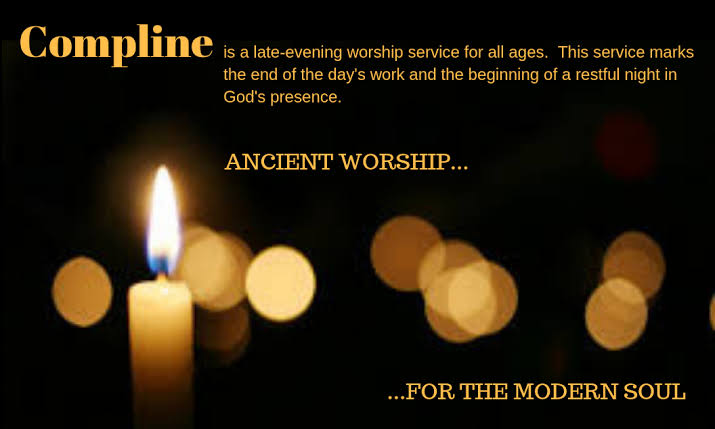
Since the early sixth century during the time of St. Benedict, the “Nunc Dimittis” has been sung in the monks’ night prayer or “compline” from the Latin completorium or completion of the working day. Eventually, it was adopted into the Liturgy of the Hours or the prayers of the Church usually recited by priests and religious. (St. John Paul II had suggested in his encyclical Novo Millennio Innuete after the Great Jubilee of 2000 that the lay faithful also pray the Liturgy of the Hours.)
After the praying of the psalms and meditation of the Sacred Scriptures, there is a Responsory that declares, “Into your hands, Lord, I commend my spirit.” Like Jesus before he died on the Cross, we offer to God our very selves. This is takes on a beautiful dimension especially if we have done a good examination of conscience at the start of the compline, before the psalms and readings.
Then, we recite the antiphon that introduces the Nunc dimittis: “Protect us, Lord, as we stay awake; watch over us as we sleep, that awake, we may keep watch with Christ, and asleep, rest in his peace.”
The antiphon in itself is already a prayer!
It is after the antiphon that we chant or recite Simeon’s Canticle:
Lord, now you let your servant go in peace; your word has been fulfilled: my own eyes have seen the salvation which you have prepared in the sight of every people: a light to reveal you to the nations and the glory of your people Israel.
From the Compline of the Breviary
The antiphon is repeated and immediately followed by the Closing Prayer.
The cross atop our parish church at night with the moon above taken with my iPhone camera, 02 February 2020.
Capping the compline is the blessing at the end that says: “May the all-powerful Lord grant us a restful night and a peaceful death. Amen.”
Usually, a hymn to Mary is sung, then all the lights are turned off and the great silence (magnum silencium) begins until the morning prayers or lauds (Latin for praise).
See how our night prayer or the compline is oriented towards meeting God, or to put it bluntly, towards death.
Yes, it is always easy to say we are ready to die. It is a lot whole different when we are already face to face with death itself.
But, when we come to think of it, we realize that indeed, in death, “there is nothing to fear but fear itself”.
When we die, everything happens so fast. We may not even feel anything at all. And unknown to us, every night when we go to sleep, we rehearse our death, so to speak!
And what a tremendous joy to keep in mind how every night, the Lord fills us with joy and faith within us even if we often forget him. Every night when we sleep, it is automatic within us to entrust everything to God “unconsciously” without even thinking we may never wake up!
It is a “Nunc Dimittis” experience too because most of us go to bed filled with joy, full of hope the following morning would be a better day than today. And that is Jesus still coming to us at the end of the day to assure us of his love and concern, never bothering us at all of this tremendous grace gratuitously given to us.
Next time you sleep, remember how blessed you are to have come to the end of another day, blessed and loved.
Pray, and start experiencing Jesus more from the beginning to the end of each day and forevermore. Amen.
Friday, St. John Bosco, Priest, Patron of the Youth, 31 January 2020
2 Samuel 11:1-4, 5-10,13-17 ><)))*> 0 <*(((>< Mark 4:26-34
Pilgrims waiting for their turn into the Ascension Chapel at the Mount of Olives outside Jerusalem in Israel. Photo by author, May 2019.
On this last day of January 2020, we thank you God our Father for the grace of being alive and safe, for not forsaking us in this most trying first month of the year where we have seen and experienced many calamities here and abroad, deaths and sickness even among our relatives and friends as well people we look up to for inspirations.
It was a very trying month, Lord, that have sent many of us down into our knees in prayer and reflection, making us realize the many moments you have talked to us “in private” – the same way you did to your Apostles to explain the parables you have narrated (Mk.4:34).
How lovely are those words indeed, evoking a sense of kinship and intimacy with you and the Twelve. You know very well everything in our hearts, our innermost thoughts and feelings that you talk to us personally, in private.
What a shame, O Lord, when we commit despicable sins, believing we do them “in private” like David who had relations with Bathsheba and caused the death of her husband Uriah to cover up his sins.
So many times, Lord, we act like David as if nobody would ever know our sins and evil ways except us alone in private – “walang makakaalam kungdi ako lang” -as if you are not all-powerful (omnipotent), all-knowing (omniscient), and ever-present (omnipresent).
It is so foolish of us, Lord! And we are sorry.
Remind us that our most private moments are in fact the time you are most present with us, and in us. That there is no other path to follow in this life except your path, O Lord. Walk us through, Lord.
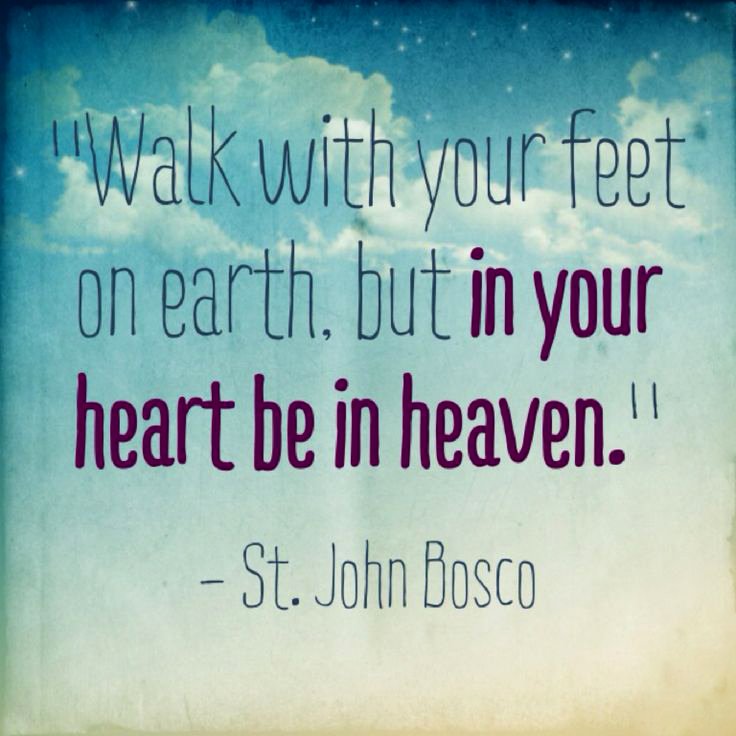
Like St. John Bosco, instill in our hearts this beautiful lesson he had taught us with:
From twitter.com
Like St. John Bosco, may we “always have fun in life, but never sin”, thinking only the glory of heaven as the ultimate end of everything we do in life! Amen.