Lawiswis ng Salita ni P. Nicanor F. Lalog II, Ika-04 ng Pebrero 2025
Larawan kuha ng may-akda, Tagaytay, 17 Enero 2025.
Sampung araw
bago sumapit
ang Valentine's
sa akin ay lumapit
isang dalagita
nahihiyang nagtanong
bagama't ibig niyang
mabatid kung
"makakahanap po ba ako
ng lalaking magmamahal
sa akin ng tunay
at tapat?"
Ako'y nanahimik,
ngumiti at tumingin sa
dalagitang nahihiyang
nakatungo ang ulo
sa kanyang tanong
at nang ako'y magsimulang
mangusap,
mukha niya ay bumusilak
sa tuwa sa bagong
kaalaman sa pag-ibig
na matiyaga niyang
sinasaliksik.
Larawan kuha ng may-akda, Atok, Benguet, 27 Disyembre 2024.
Ito ang wika ko sa dalagita:
"Ang pag-ibig,"
ay hindi hinahanap
parang gamit nakakamit
dahil ang pag-ibig
ay kusang dumarating
kaya iyong matiyagang hintayin
ikaw ang kanyang hahanapin;
tangi mong gampanin
buksang palagi iyong
puso at damdamin
dahil itong pag-ibig
ay dumarating sa mga tao
 at pagkakataong
hindi inaasahan natin;
banayad at mayumi
hindi magaspang pag-uugali
magugulat ka na lamang
ika’y kanyang natagpuan
palagi na siyang laman
 ng puso at isipan."
"Pakaingatan din naman",
wika ko sa dalagita
"itong pag-ibig ay higit pa
sa damdamin na dapat
payabungin tulad ng mga
pananim,
linangin upang lumalim
hanggang maging
isang pasya
na laging pipiliin
ano man ang sapitin
at hantungan."
Ang pag-ibig
ay parating dumarating
ngunit kadalasan hindi
natin pansin
kung minsan tinatanggihan,
inaayawan
dahil ang ibig ay kumabig;
darating at mananatili
itong pag-ibig
sa simula na ating limutin
lahat ng para sa sarili
natin.
Larawan kuha ng may-akda, Atok, Benguet, 27 Disyembre 2024.
The Lord Is My Chef Daily Recipe for the Soul by Fr. Nicanor F. Lalog II
Thursday, Week II in Ordinary Time, Year I, 23 January 2025
Hebrews 7:25-8:6     <*{{{{><  +  ><}}}}*>     Mark 3:7-12
Photo by author, St. Paul Spirituality Center, Pico, La Trinidad, Benguet, 06 December 2024.
Let me come to you,
Jesus, with confidence
and humility to express
to you my deepest longings
and desires,
my deepest needs
and cries you know so well
but I always deny or too shy
to tell you completely.
Though I know very well
how your death on the Cross
is the single most important event
in history for all times
and for all peoples,
I balk its realities not for lack
of faith but due to low self-esteem,
lack of self-acceptance
that you do love me truly.
The main point of what has been said is this: we have such a high priest, who has taken his seat at the right hand of the throne of Majesty in heaven, a minister of the sanctuary and of the true tabernacle that the Lord, not man, set up. Now he has obtained so much more excellent a ministry as he is a mediator of a better covenant, enacted on better promises (Hebrews 8:1-2, 6).
Let me follow you,
Jesus like the people in
the gospel:
let me not follow you only
to the sea but even to the
Cross to be one in you,
one with you
for you alone
is truly one with me
everywhere,
all the time.
Amen.
Photo by author, Mount Olis, Atok, Benguet, 27 December 2024.
The Quiet Storm by Fr. Nicanor F. Lalog II, 27 December 2024
Photo by author, DRT, Bulacan, 23 November 2024.
Many people these days claim that “budol is life” when nothing escapes hackers and scammers in stealing money from hard-working OFW’s to housewives, students and retirees including priests and religious called to always lend a hand to those in need.
One collateral damage more serious than scammers and hackers in this cashless transactions and e-wallet is the perversion of our cherished values of gift-giving especially at Christmas as well as our generosity in lending money to those struggling with their financial needs.
I am referring to the erroneous advertising efforts by the highly popular GCash that is creating a generation of people lacking in shame and respect for others. We say it so well in Filipino – kawalan ng kahihiyan or hindi na marunong mahiya.
Though I do not have a GCash without any plans of getting one, e-wallets like online banking by nature is good. It is very innovative, so helpful in providing a convenient, safe, and reliable exchange of money in a cashless manner. However, though the problem lies mostly on those who abuse its system, GCash is still guilty of perverting the values of Christmas and practically of the essence of gift-giving by promoting online or virtual pamamasko.
Photo by author, San Fernando, Pampanga, November 2021.
Like the online Mass, there is no such thing as virtual pamamasko that supposes an actual presence, a face-to-face meeting to greet anyone with a Merry Christmas.
Pamamasko is one Filipino tradition worth keeping wherein once a year we visit not only our godparents (Ninong and Ninang) but also our relatives and friends as well to personally greet and wish them a Merry Christmas. It is only on this joyous day when some people could really meet as relatives and friends next to funerals and wakes.
But, when the COVID-19 pandemic started in 2020 and limited our social interactions, some inaanak (godchildren) pushed the limits of GCash when they dared to greet their godparents with Merry Christmas via text messages that had their GCash account number included.
From Instagram, 26 December 2024.
It is a virtual hold-up in fact, the start of that dictum “budol is life”. Worst of all, it had spawned a generation of people who are bastos (rude) and kapal-muks (thick-faced)!
Sorry for the words but that’s the kind of people who use social media to get money from anyone except for purchase transactions. Christmas is about love and being together. Iyon lang!
As far as our generation is concerned (GenX and those before us), pamamasko is not about money but the spread of love and joy of Christmas. The money given was just a “consolation” that is why the amount never mattered at all. Salamat kung may bigay, okey lang kung wala because what really mattered was to be present with our elders to assure them they are loved and remembered.
Sad to say, GCash had normalized this kabastusan and kakapalan ng mukha with their ads on the internet about sending Christmas greetings with a reminder not to forget to send their QR Code. In normalizing this despicable manner of greeting Merry Christmas, GCash in effect showed its true color of being self-serving. And bastos and kapal-muks too!
We hope GCash will stop this kind of advertisement that is grossly erroneous and wrong. They are not teaching our young to be worthy people of dignity and respect, eroding our social fabric and made shamelessness as normal. Pera-pera na lang ba talaga tayo ngayon?
See how almost daily we find in social media of many friendships and relationships marred and destroyed with some people abusing GCash, borrowing money online especially by mere acquaintances. That is just a hairline difference between them and those scammers!
From Instagram, 26 December 2024.
Gift-giving even the borrowing or lending of money are things that remain on a person-to-person level. Forcing others especially the well-meaning and good ones into the virtual world as we have now witnessed spawn scams and corruption. Modern technology can only be good for as long as it remains confined to its intended application like convenience, safety and reliability of having cashless transactions. What GCash has promoted this season is actually budol – not only of a literal hold-up of Ninong and Ninang but almost of everyone when some callous people dare to borrow money on line with the tag, “i-GCash mo na lang.”
The budol now rampant in e-wallets in effect is a result of their own unconscious budol for more clients and customers.
Let us bring back our true sense of shame and delicadeza. GCash is for transactions, for things to buy and pay for. Not for friends and relatives because they are persons to be loved, not objects to be used or possessed via GCash.
Maybe “budol is life” indeed, but, beware more of scams that erode our values than steal our money. These last two weeks until the new year, visit your godparents because of love and concern, not for the gift they will give you because that is the true spirit of Christmas. God bless and Merry Christmas!
The Lord Is My Chef Daily Recipe for the Soul by Fr. Nicanor F. Lalog II
Simbang Gabi-6 Homily, 21 December 2024
Zephaniah 3:14-18     ><}}}*> + ><}}}*> + ><}}}*>     Luke 1:39-45
From Clergy Coaching Network, posted on Facebook 13 December 2023.
Advent and Christmas are a story of love of God’s love for us all that “He gave us His only Son.” No wonder, it is on this blessed Season when we share gifts, and most of all, our gift of self to others.
My youngest sister Bing works as an area manager of a Jollibee franchise in Bulacan. A few years ago before Christmas during our family conversations over dinner, she told us of a story shared by the Jollibee manager at NLEX. According to her story, two nuns entered their store there with some Dumagats with their driver. Right away, the store manager noticed how the two nuns were busy “calculating” the meal they have to take until settling for the cheapest, a rice meal of shanghai rolls. Obviously, the religious sisters have limited budget which did not escape the intuition of the lady manager who offered to treat them to a ChickenJoy meal for free. But the nuns felt shy and refused the manager’s offer, asking her not to be bothered at all until another woman with two kids in tow interrupted them, giving them ChickenJoy buckets with extra rice enough for the religious sisters and their companions! The woman refused to be identified and simply said that she too had noticed the nuns trying to budget their limited money that she ordered right away the food. For her part, the kind manager treated them instead for desserts to complete their meal.
That’s when my sister said “talagang Pasko na nga” (it’s really Christmas).
Yesterday in our reflection on the annunciation of the birth of Christ, we said of the need for us to enter in a dialogue with others to let Christmas happen. Dialogue is not just about improving relationships with others by thinking through issues and problems but more of a way of being with others, of being present with others to experience and feel their situations, exactly what Jesus did in being human like us in everything except sin.
At the annunciation of the Lord’s birth, Mary dialogued with Gabriel unlike Zechariah who was eventually silenced in order to be open to God. True dialogue as an incarnation like Jesus with God and with others can only happen when we are convinced of God’s love for us. Mary went in haste to visit Elizabeth because she felt God’s love in her that she wanted to share it with her cousin right away.
Mary set out in those days and travelled to the hill country in haste to a town of Judah, where she entered the house of Zechariah and greeted Elizabeth(Luke 1:39).
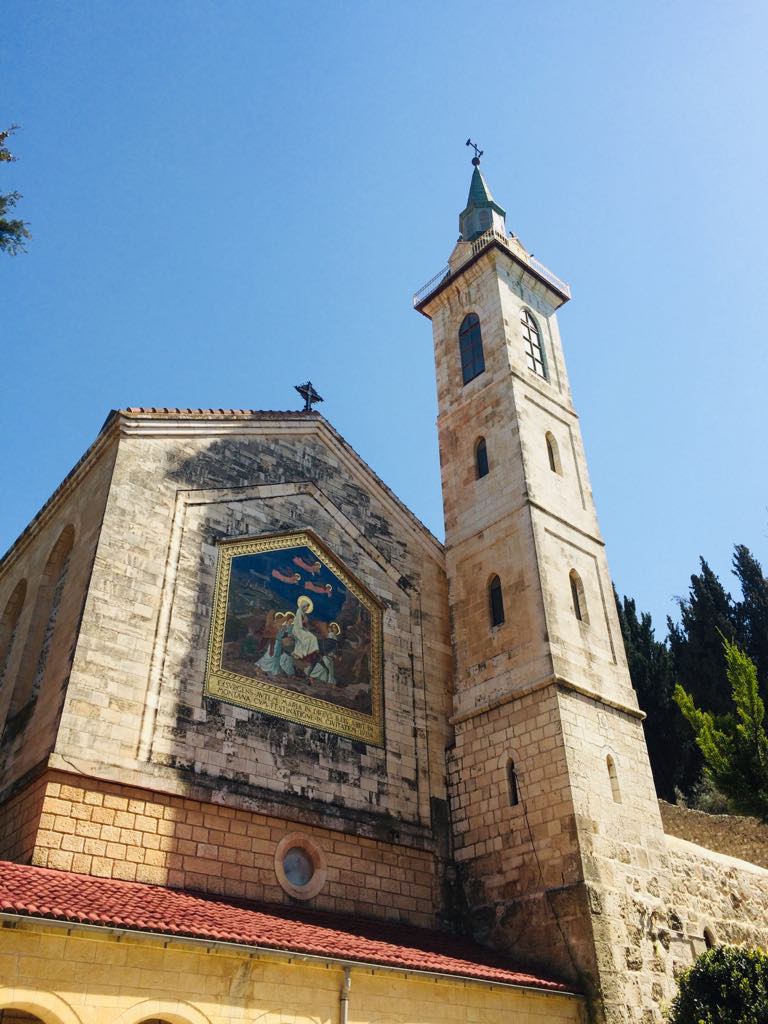
Photo by author, Church of the Visitation, the Holy Land, May 2017.
Try imagining that scene of Mary’s Visitation of Elizabeth. What did you feel? Did you feel some sense of tenderness, of being loved, of being touched by God?
While praying over this scene as I recalled my second pilgrimage to the Holy Land when we went to the Church of Visitation, I remembered my early years in the ministry when I always felt ashamed accepting invitations for dinners because I could not bring a gift.
Maybe part of our upbringing, I have always felt inadequate coming to another home bringing nothing. That is why I keep cards and stampitas in my desk along with some chocolates so that when I visit families, I could bring a little something for them.
It was only in 2011 after being assigned to a parish of my own when I was able to let go of this feeling of inadequacy after a parishioner told me how they deeply appreciated priests visiting them at home, sharing in their meal because they felt so blessed. That is why most of us priests are fat – we always get invited to meals and gatherings that sometimes I wonder if people really love me when they “force” me to eat more of their cholesterol-laden food and sugary desserts they serve!
It was during these home visitations especially of the sick and for simple meals I felt “rootedness” or oneness with people, of being “a member of each family yet belonging to none” as the famous French Dominican Fr. Lacordaire said a hundred years ago about priesthood. The more I visit families, bidden or unbidden, the more I feel the joy of my priesthood because of the family and community that I belong to. That is when I realized too that celibacy is lived in a community both of priests and laity.
For 26 years in schools and the parish and now the hospital, the more I felt Jesus present in me as a priest as I live among brother priests and lay people. Tenderness and intimacy take on a new dimension that is spiritual in nature because I don’t just touch people but am also being touched by them. Every time they thank me, I also thank them for blessing me with their warm welcome. It is like Mary and Elizabeth during the Visitation blessed abundantly by God and still sharing that same blessing with each other.
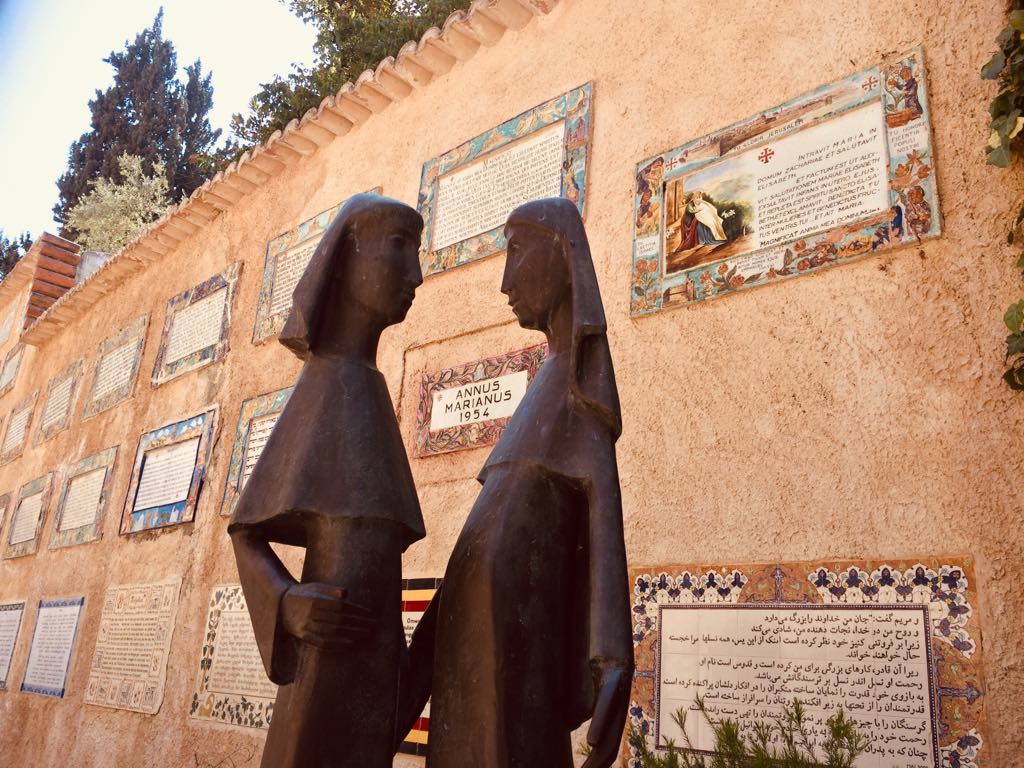
Photo by author, bronze statues of Mary and Elizabeth at the patio of the Church of Visitation, May 2017.
That is the meaning and significance of the Visitation: inasmuch as Christ comes to us individually, He behooves us to share Him also with others to form a community.
Mary visited Elizabeth not merely to help her out in her pregnancy nor to confirm what Gabriel had told her but simply because she was so convinced of God’s love that she wanted to share it with her cousin.
Mary visited Elizabeth because she felt touched by God in the Annunciation and wanted so much her cousin to be touched also by the Lord! And indeed when Luke wrote that “When Elizabeth heard Mary’s greeting, the infant leaped in her womb, and Elizabeth, filled with the Holy Spirit, cried out in a loud voice and said, ‘Most blessed are you among women, and blessed is the fruit of your womb'” (Lk.1:41-42).
Faith in Christ leads to love that moves us to bond with one another to form Christ’s body, a community of believers, a community of beloved, a community of lovers.
After receiving Jesus, like Mary, we have to move to the Visitation and share Him with others. To be able to do this, we must first be convinced that God loves us so much like what the Prophet Zephaniah said in the first reading and what Elizabeth told Mary in the Visitation, “Blessed are you who believed that what was spoken to you by the Lord would be fulfilled” (Lk.1:45).
There’s a saying, “If you have love in your heart, you have been blessed by God; if you have been loved, you have been touched by God.”
Let God touch somebody today with your visitation… believe and feel the love of Jesus! Amen.
The Lord Is My Chef Sunday Recipe for the Soul by Fr. Nicanor F. Lalog II
Second Sunday in Advent, Cycle C, 08 December 2024
Baruch 5:1-9 ><}}}}*> Philippians 1:4-6, 8-11 ><}}}}*> Luke 3:1-6
Photo courtesy of Mr. Jilson Tio, Archdiocesan Shrine of Nuestra Señora De Guia, Ermita, Manila, 28 November 2024.
Two weeks ago I officiated the golden wedding anniversary of a friend’s parents where I said the best wedding homily is actually the couple themselves still much in love, filled with joy after 50 years as husband and wife.
“May forever pa rin,” despite all the celebrity break ups we feast on social media and the many separations happening among some couples these days. How I wish that more young people are invited to wedding anniversaries so they would aspire for lasting relationships too.
Photo by author at the Archdiocesan Shrine of Nuestra Señora De Guia, Ermita, Manila, 28 November 2024.
Of course, it is never easy – that is why there is the Sacrament of Marriage where couples pray to God and promise Him to cooperate in His grace so that until death, they would remain together in faith, hope and love that would eventually bring them to eternity.
It is the reality not only of marriage but of life itself. God calls us to a particular vocation or state in life like marriage, priesthood and religious life, or single-blessedness in order to lead us to Him in eternity.
And that is the two-fold meaning of Advent too! We are preparing not only for the first coming of Jesus at Christmas but most of all to His Second Coming at the end of time (parousia). This is the second Sunday in Advent so beautifully presented by Luke.
In the fifteenth year of the reign of Tiberius Caesar, when Pontius Pilate was governor of Judea, and Herod was tetrarch of Galilee, and his brother Philip tetrarch of the region of Iturea and Trachonitis, and Lysanias was tetrarch of Abilene, during the high priesthood of Annas and Caiaphas, the word of God came to John the son of Zechariah in the desert (Luke 3:1-2).
Photo by author, Second Sunday Advent 2022, BED Chapel, Our Lady of Fatima University, Valenzuela City.
First we notice is Luke’s solemn account of how the Son of God Who is eternal entered through our own time that is temporal. If Luke were to write his gospel today, maybe he would simply change the names above into BBM and Sara Duterte, with Pope Francis and Cardinal Advincula representing the Church then spice it with some showbiz tidbits or whatever is trending in social media.
But, here also is the artistry of Luke when he segued to John the Baptist to direct our thoughts to the Second Coming of Christ without losing sight of the present moment, of the here and now.
John went throughout the whole region of the Jordan, proclaiming a baptism of repentance for the forgiveness of sins, as it is written in the book of the words of the prophet Isaiah: A voice of one crying out in the desert: “Prepare the way of the Lord, make straight his paths. Every valley shall be filled and every mountain and hill shall be made low. The winding roads shall be made straight, and the rough ways made smooth, and all flesh shall see the salvation of God” (Luke 3:3-6).
“St. John the Baptist Preaching in the Wilderness” by German painter Anton Raphael Mengs (1728-1779) from commons.wikimedia.org.
Though John is the main character in today’s gospel and next Sunday, Luke is actually focused on Jesus Christ who had come, would come again, and continues to come to us today. All four evangelists were clear about John as secondary only to Jesus as His precursor.
However, only Luke of the four evangelists cited the Prophet Isaiah extensively regarding John’s unique mission with Christ to stress this future aspect of Advent, skipping only that part “the glory of the Lord shall be revealed” by closing it at “all flesh shall see the salvation of God” in Isaiah 40:3-5.
Luke is teaching us that Advent is looking beyond Christ’s birth but also to His Easter and most of all, to His Second Coming now happening.
For Luke, to be like John in the wilderness is for us to be bold and daring in opening ourselves to God in Jesus Christ amid the turmoils of our time like wars and pandemic, calamities and upheavals. No matter how much pains and disappointments we have had this year that made us doubt God’s love and presence for us in Christ, let us dare anew like John in the wilderness to believe and live out His coming and presence.
In citing Isaiah 40:3-5, Luke is reminding us that we shall all see and experience God’s salvation in Jesus Christ today while awaiting His Parousia. Notice the similarity of Isaiah’s prophecy with that of Baruch’s in the first reading when “every lofty mountain be made low, and that age-old depths and gorges be filled to level ground, that Israel may advance to secure in the glory of God” (Bar. 5:7). Both prophets spoke of the future expectation expressed by John already unfolding in Christ who had come.
Photo by author, Fatima Avenua, Valoenzuela City, December 2023.
A friend texted me last week complaining if Christmas would happen at all in their family after a serious rift with their youngest brother. “Dinaraan-daanan lang po ako Father ng kapatid kong bata, para akong patay na.”
Being the eldest in the family, my friend asked his younger brother to shape up and fix his life (ayusin ang buhay) after taking a third partner. He had dumped his first wife after the birth of their son who turned out to be a special child; then, took a second partner and had a daughter whose godmother, his kumare is now his third partner. My friend had taken upon himself to rear his special nephew and niece while his brother does not care at all.
With that situation at home, my friend told me he could not feel Christmas at all despite the material things they have. After a few hours, I texted him back and told him no one can take away the joy of Christmas because that is Jesus in our hearts. Keep Jesus alive in your heart, I texted him, asking him to continue to still love his wayward brother, never losing that hope in Christ that someday, peace would be restored among them in the family. I ended my texts reminding him that Jesus was born during the darkest night of the year.
That’s the voice of John in the wilderness – when we dare to open to God amid our many pains and sufferings, proclaiming and living out His love in Jesus who had come, continues to come and would come again at the end of time. That’s preparing the way of the Lord even when it is all dark, taking small steps at a time as we could not see the next distant scene. In times like these, let St. Paul’s desire in the second reading be our Advent prayer, “that your love may increase ever more in knowledge and every kind of perception, to discern what is of value, so that you may be pure and blameless for the day of Christ” (Phil.1:9-10).
Photo by author, RISE Tower, Valenzuela City, 06 December 2022.
How lovely during this time of Advent when our days are getting shorter, dark earlier than usual because this is also the time sunsets are most awesome. Somewhere out there where the sun sets with skies redolent like embers of the dying day is the voice in the wilderness proclaiming to us Christ’s coming and presence even in the long dark night of waiting.
What do you long or desire most right now in your heart? Reawaken your hopes in Christ Jesus and be ready to be surprised as He shall straighten your path soon especially with your loved ones. Amen.
Lord My Chef Daily Recipe for the Soul by Fr. Nicanor F. Lalog II
Wednesday in the First Week of Advent, 04 December 2024
Isaiah 25:6-10     ><}}}}*> + ><}}}}*> + ><}}}}*>     Matthew 15:29-37
Photo by author, Pulong Sampalok, DRT, Bulacan, 22 November 2024.
Praise and glory to You,
God our loving Father
for this gift of Advent Season:
thank you in bringing us
to this brand new day
of salvation, of freedom,
of new life in Jesus;
most of all,
thank you for ending death
in Christ's advent.
On this mountain he will destroy he will destroy the veil that veils all peoples, the web that is woven over all nations; he will destroy death forever. The Lord God will wipe away the tears from all faces… (Isaiah 25:7-8).
Come to us this Advent,
dear Jesus and take away
all kinds of veils of selfishness
that cover and make us
unloving,
unkind, unmerciful,
unhappy...
set us free, Jesus,
free to love and serve
especially the sick and hungry;
set us free, Jesus,
this Advent to open our hearts
to bring out those treasures
You have filled us with like
goodwill and care for others
like the disciples in today's gospel.
Amen.
Photo courtesy of Our Lady of Fatima Tribune, 27 November 2024.
The Lord Is My Chef Daily Recipe for the Soul by Fr. Nicanor F. Lalog II
Tuesday in the Thirty-fourth Week of Ordinary Time, Year II, 26 November 2024
Revelation 14:14-19     <*((((><  +  ><))))*>     Luke 21:5-11
Photo by author, San Antonio, Zambales, 19 October 2024
It happens so often,
Lord Jesus Christ -
just as when we are enjoying
something like a vacation,
exactly at that moment too
when it ends or, at least,
its coming end is felt and realized?
While some people were speaking about how the temple was adorned with costly stones and votive offerings, Jesus said, “All that you see here – the days will come when there will not be left a stone upon another stone that will not be thrown down.” Then they asked him, Teacher, when will this happen? And what sign will there be when all these things are about to happen?” (Luke 21:5-7)
What a paradox,
a mystery so beautiful
that inspires us to live more fully
than sulk with life's sure endings
like what your words tell us today:
I, John, looked and there was a white cloud, and sitting on the cloud one who looked like a son of man, with a gold crown on his head and a sharp sickle in his hand (Revelation 14:14).
Endings are beginnings,
Lord; everything and everyone
shall end in order to begin anew;
despite the destruction,
endings happen to build up
new beginnings,
to signal another start.
Teach us, dear Jesus,
to be ready always,
to prepare for our endings
by living fully,
celebrating life
in your love that
banishes all fears
like death and
endings.
Amen.
The Lord Is My Chef Daily Recipe for the Soul by Fr. Nicanor F. Lalog II
Friday in the Thirty-Second Week of Ordinary Time, Year II, 15 November 2024
Memorial of St. Albert the Great, Bishop & Doctor of the Church
2 John 4-9     <*{{{{><  +++  ><}}}}*>     Luke 17:26-37
Photo by author, 20 August 2024, St. Scholastica Retreat House, Tagaytay City.
Another short letter
for our first reading today,
Jesus but filled with wonder
and power that impacts our
daily life: help us to keep your love
Lord! The words of your beloved
disciple are strikingly so true to us
these days:
Anyone who is so “progressive” as not to remain in the teaching of the Christ does not have God; whoever remains in the teaching has the Father and the Son (2 John 9).
Forgive us, dear Jesus,
with our so many excuses
and alibis along with our
endless arguments
for the sake of being modern
and progressive
to be excused from your only
law and command which is
to love;
let us love always
for to love is live in your presence;
without love,
there is disorder and sin,
and fear;
with love,
there is true freedom
to be who we truly are
as children of the Father.

Therefore,
open our eyes
that we may consider the wonders
of your laws,
O Lord
(Psalm 119:18).
Amen.
Photo by author, Cathedral of St. Catherine of Alexandria, Dumaguete City, Negros Or., 07 November 2024.
The Lord Is My Chef Daily Recipe for the Soul by Fr. Nicanor F. Lalog II
Wednesday in the Thirty-Second Week of Ordinary Time, Year II, 13 November 2024
Titus 3:1-7     ><))))*>  +  ><))))*>  +  ><))))*>     Luke 17:11-19
Photo by author, 20 August 2024, St. Scholastica Retreat House, Tagaytay City.
“For we ourselves were once foolish, disobedient, deluded, slaves to various desires and pleasures, living in malice and envy, hateful ourselves and hating one another” (Titus 3:3).
What a beautiful reminder by St. Paul
to his co-worker in the Lord, Titus,
and to us in this modern age;
Oh, how often are we all
foolish, disobedient,
and deluded, too?
That word struck me today,
Lord: deluded
which is to suffer from delusion
which is to believe in something
not true!
And that's the great tragedy
in these days of modern communications
when information is easily
accessible,
when facts can be quickly
verified if true or not
but,
why do we remain deluded
that St. Paul rightly noted,
we are "hateful ourselves,
hating one another"?
Proof? Our being ungrateful. Our refusal to express gratitude like the nine lepers cleansed of leprosy by Jesus; only one, a Samaritan returned to Jesus and thanked Him for the healing: forgive us Jesus when so often in life it is easier for us to believe in things not true at all than to accept and embrace simple truths in life like that we are loved, that we are good, that You believe in us; clear us of our built-in biases against ourselves that delude us and blur our vision of others; teach us to be more appreciative of simple joys and pleasures in life.
The Lord Is My Chef Sunday Recipe for the Soul by Fr. Nicanor F. Lalog II
Thirty-second Sunday in Ordinary Time, Cycle B, 10 November 2024
1 Kings 17:10-16 ><}}}}*> Hebrews 9:24-28 ><}}}}*> Mark 12:38-44
Our Sunday readings are so lovely, so picturesque where you find in both first reading and gospel the character of a poor widow standing side by side with great men of faith in God as the main focus, the Prophet Elijah and Christ Jesus, respectively.
In the first reading, we find humorously the Prophet Elijah asking for water, then some bread from a widow gathering sticks outside her home in Zarephath.
Elijah said to her, “Do not be afraid… For the Lord, the God of Israel, says, ‘The jar of flour shall not go empty, nor the jug of oil run dry, until the day when the Lord sends rain upon the earth.'” She left and did as Elijah had said. She was able to eat for a year, and he and her son as well; The jar of flour did not go empty, nor the jug of oil run dry, as the Lord had foretold through Elijah (1 Kings 17:13, 14-16).
Elijah had fled Israel after proclaiming a drought because the people turned away from God to worship baals or false gods brought by the wife of King Ahab, Queen Jezebel. God then directed Elijah to Zarephath outside the city of Sidon to hide where the king was the father of his archenemy, Queen Jezebel!
Imagine Elijah hiding in the most hostile place of all with a pagan widow who worshipped baal so denounced by him. But, here is a marvelous story of faith of Elijah who trusted God completely in obeying Him to move to the pagan region ruled by his enemies. Similar was the faith of the pagan widow who surprisingly believed Elijah and God’s power that she did not mind putting her life and her son’s at risk in harboring their enemy. Their admirable faith both remind us how God accomplishes His great acts of mercy and love when we surrender ourselves totally to Him.
Photo by author, Wailing Wall of Jerusalem, May 2019.
Nine hundred years later after Elijah, we had Jesus in Jerusalem like the prophet in a very hostile place and situation too – in the Temple that was the very domain of His enemies. This was the Holy Week after Jesus had entered Jerusalem on Palm Sunday leading to Good Friday.
And like Elijah who approached a widow worshipper of baal, Jesus dared to sit at the temple area after harshly castigating the scribes there:
He sat down opposite the treasury and observed how the crowd put money into the treasury. Many rich people put in large sums. A poor widow also came and put in two small coins worth a few cents. Calling his disciples to himself, he said to them, “Amen, I say to you, this poor widow put in more than all the other contributors to the treasury. For they have all contributed from their surplus wealth, but she, from her poverty, has contributed all she had, all her livelihood” (Mark 12:41-44).
Jesus sat down
opposite the treasury and observed
how the crowd put money into the treasury.
Throughout this week, that scene of Jesus seated at the Temple had so absorbed me. What was Mark trying to tell us in reporting this? Jesus seated at the temple opposite the treasury observing the crowd is something else.
See the genius of Mark in weaving this Sunday’s gospel scene: right after castigating the corrupt leaders of Israel who were affiliated with the temple, Mark segued into this poor widow dropping some coins into the treasury box. In ancient Israel, the poor like the widows were not required to give those contributions. In a stroke of genius, Mark tells us something is wrong in this scene which Jesus rightly attacked because that widow was one of those widows whose house was devoured by the scribes!
“The Widow’s Mite” painting by French painter James Tissot, from brooklynmuseum.org.
And Mark never intended the story only for the Christians of his time but also for us as we have continued in the Church that malpractice by priests and scribes of Jerusalem. Woe to us priests and bishops who go around in “long robes and accept greetings, seats of honor” and worst of all, “devour houses of widows”, forgetting the poor, preferring always to be with the rich and powerful that social media attest.
Like Zarephath and the Jerusalem Temple, there is Jesus sitting in the middle of our Church under attack on all fronts and within in order to be closer with us especially the widows and the poor who are victims of an unjust society and systems perpetrated by same men and women supposed to be servants of God, or, at least men and women of God.
Photo by author, July 2024.
That image of Jesus seated at the Temple opposite the treasury was in fact a reminder of His being the victim too of injustice in the temple like the poor widow, of His Crucifixion on Good Friday. In fact, the 30 pieces of silver the priests have paid Judas Iscariot to betray Jesus must have come from that treasury.
In the midst of the hostilities and hurts, the divisions and abuses of power by priests and lay alike, in the Jerusalem Temple then and now in our Church, there has always been Jesus sitting among us, observing our offerings after first offering Himself for us all as our perfect High Priest (second reading) who finally freed us from these injustices and inhumanity of the past.
That is why I love this scene so much.
More than tithing, Jesus tells us this Sunday that like that generous heart of the poor widow, despite her plight, she continued to give because she believed, she hoped, most of all, she loved God. She need not give but still insisted because the treasury was for the upkeep of the temple, the very house of God, therefore, for God Himself.
There are times I hurt deep inside for the pains of the many scandals some priests and bishops have caused the Church but I choose to remain, even to sit in this Church or be a victim like Jesus amid all these because I love Jesus. Yes, amid all these sorrows, there is one “first” I see above all, Jesus Christ. This is concretization of last Sunday’s “which is the first of the commandments” – God who is love above all!
Jesus is telling us this Sunday through the poor widow that it is recognizing God in us and in one another that matters, and that is why we give at all.
Photo by author, 2022.
If we love God, if we find God in us and in others, when we find Jesus seated among us, then we realize we are the Church, we are the Temple we love. The moment we realize this, the more we feel at home “sitting with Jesus in the temple”, then we start giving totally because we love as well as know for a fact that whatever we give is actually what we receive from God in Jesus.
Why give so little? Give all, give everything because you never have anything to begin with! Everything is from God. That is why it is in giving that we truly receive. In every Mass, we do not give anything except our mere presence that is not even complete and yet, we get abundant blessings, primarily Jesus Christ whom we receive wholly, Body and Blood.
In every Mass we celebrate, we sit with Jesus in the midst of this inhospitable world we live in, even right in the church we love and hate sometimes. We do not give up. We persevere because we believe, we trust, we hope. Most of all, we love like Elijah and Jesus and believe like the poor widows of Zarephath and Jerusalem Temple. Amen. Have a blessed week ahead!







 lordmychef.com