40 Shades of Lent by Fr. Nicanor F. Lalog II
Friday in the First Week of Lent, 27 February 2026
Ezekiel 18:21-28     + + +     Matthew 5:20-26
Photo by Dra. Mylene A. Abad Santos, MD, February 2021.
Thank you,
dear Father for the
first week of Lent about
to end; much is still to be
desired to be closer to you,
to be faithful to you,
to be one in you;
teach me in your Son Jesus
to go beyond the letters of
your laws,
to go beyond the minimum
requirements,
to go beyond of what is asked
of us in order to be more
loving to others in you:
Jesus said to his disciples: “I tell you, unless your righteousness surpasses that of the scribes and Pharisees, you will not enter into the Kingdom of heaven” (Matthew 5:20).
Photo by Dra. Mylene A. Abad Santos, MD, February 2021.
Teach us to be holy
or righteous
like you;
make us whole,
to be different
and be radical by
going back to you
our very roots of being
and existence;
instead taking the path
of supremacy especially
when we are angry
that we are unafraid of
breaking away from others,
insisting on what is right
than on what is good,
let us be reconciled
with you in others
and in our very selves
where peace remains
the best to have.
To go beyond
than what is required
is to be humble and gentle
like you, dear Jesus,
caring more for people
and relationships
than on being right
which often is not the case;
holiness
or righteousness
is confronting and accepting
our limitations
so that your infinite power
of love and mercy
may work in us
and through us,
Lord Jesus.
Photo by Dra. Mylene A. Abad Santos, MD, February 2021.
Lent is going beyond
the ordinary
because it is about
choosing you, Lord
above all else always:
you never condemn us
letting go and forgetting
of our past sins when we
choose to finally live in
your presence doing your will;
however,
let us not be complacent
in your presence, Lord
for our good record
can be undone completely
when we refuse to love
you in others.
O Lord Jesus,
you have given me
with so much chances
to become better;
help me to remain in you
so I can also give more
chances
more mercy
and more love
to others lost and trying
to find you.
Amen.
Lord My Chef Sunday Recipe for the Soul by Fr. Nicanor F. Lalog II
Sixth Sunday in Ordinary Time, Cycle A, 15 February 2026
Sirach 15:15-20 ><}}}}*> 1 Corinthians 2:6-10 ><}}}}*> Matthew 5:17-37
Photo by author, Benguet, July 2023.
It is a day after Valentine’s, also the final Sunday before we take a long break from Ordinary Time to start the 40 days of Lent this Ash Wednesday leading us to Easter that lasts until the month of May. It is so lovely and timely that we hear Jesus teaching us this Sunday to examine our hearts always so that we can live our faith in him daily, of remaining blessed in his beatitudes.
We are still at the sermon on the mount with Jesus giving us a series of general teachings illustrated in some concrete examples. However, keep in mind these are not new teachings as Jesus himself clarified he had come not to abolish but to fulfill the laws. In the light of the Beatitudes he taught us the other Sunday, Jesus is now directing us to look deeper into our hearts, to make it whole again in him and stay blessed unlike the scribes and the Pharisees.
Jesus said to his disciples: “I tell you, unless your righteousness surpasses that of the scribes and Pharisees, you will not enter into the kingdom of heaven” (Matthew 5:20).
Photo by author, Jerusalem, May 2017.
This is not the first time we have heard the word “righteousness” in Matthew who used it to describe Joseph in his Christmas story as “a righteous man” (Mt.1:19).
Being righteous for the Jews is being holy which is obeying and living by the laws and commandments of God. Unfortunately, they got centered with the letters of the laws as insisted by their scribes and Pharisees. When Jesus came, they have forgotten God himself as well as the value of the human person and life itself for which the laws were meant to be. Matthew rectified this at the start of his gospel with the story of the annunciation of Christ’s birth to Joseph who obeyed God’s command expressed in his love for Mary whom he took as his wife then pregnant with the Savior he named as “Jesus”.
Righteousness or holiness is not being sinless but being filled with God, living our faith in Christ by witnessing his gospel. From the Greek word holos that means “whole” not broken, holiness in a sense is what we call as integrity.
Holiness, righteousness, and integrity all begin in the heart that we find expressed in the sixth Beatitude taught by Jesus two Sundays ago, “Blessed are the clean of heart, for they will see God” (Mt.5:8).
A clean heart is a loving heart. We can only see God and the other persons with a loving heart. The human intellect cannot know most especially God as St. Paul tells us in the second reading.
In the same manner, we know the other person not with the intellect but always with the heart as the Little Prince said, “What is essential is invisible to the eye; it is only with the heart that one can truly see” while Marvin Gaye expressed it so beautifully in his 1971 hit “What’s Going On” with the lines “we have to put some lovin’ here today” so we can understand each other.
Indeed, the heart is the very center or core of every person because everything flows from the heart. And this is what Jesus himself underscores in his three admonitions against anger, lust, and falsehoods this Sunday. In all three teachings, we find how love is severely damaged when we quarrel against each other, when we take everyone as things and objects to be used, and when we lack the sincerity in our words.
Photo by author, September 2021.
“You have heard that it was said to your ancestors, You shall not kill; whoever kills will be liable to judgment. But I say to you, whoever is angry with his brother will be liable to judgment, and whoever says to his brother ‘Raqa,’ will be answerable to the Sanhedrin, and whoever says, ‘You fool,’ will be liable to fiery Gehenna”(Mt.5:21-22).
First thing we notice in these three teachings is its construction where Jesus first mentioned what was said by the ancestors in the phrase “You have heard” immediately followed by his own take, “But, I say to you.”
Again, Jesus is not contradicting the laws given by Moses and elaborated by their elders; Jesus was actually expressing its fullness in him found in love that begins in the heart which St. Paul reiterated in his letters that love is the perfection of the laws and commandments of God.
Whenever we quarrel in words or in deeds, we not only break our ties with each other as brothers and sisters but even with God we call “our Father”. Remember, love of God is love of one another. And the sad part of this reality is our being cut off from God even if we don’t admit it. And even if we know we have nothing against anyone, we surely feel the break-up in our selves due to the lack of love and charity, most of all, of peace. That is why Jesus added that when in our worship we realize a brother or sister has anything against us, we must first reconcile with him or her. That is why before the Holy Communion, we give the greeting of peace with one another who represents the person we are at odds with. The responsibility becomes more pronounced if the person is in the same assembly we are in if we really want to have a meaningful and holy communion.
“You have heard that it was said, You shall not commit adultery. But I say to you, everyone who looks at a woman with lust has already committed adultery with her in his heart” (Mt.5:27-28).
Here we go again with the issues of marital infidelity as well as of divorce: at the very core of this is the equality of every person, of every man and woman as being created in the image and likeness of God with same equal dignity. Jesus reminds us today that there is no difference between man and woman when it comes to marriage because the same duties of fidelity bind each partner. Most of all, Jesus has consistently taught how we must go beyond the Laws when it comes to marriage because every spouse is an image of himself, of his saving grace. Hence, we must reject every temptation and inappropriate words and actions that may destroy unity and love of couples and even in our other relationships as family and friends.
Photo by author, Makati City, 09 February 2026.
“Again you have heard that it was said to your ancestors, Do not take a false oath, but make good to the Lord all that you vow. But I say to you, do not swear at all. Let your ‘Yes’ mean ‘Yes,’ and your ‘No’ mean ‘No.” Anything more is from the evil one” (Mt.5:33-34).
This last admonition is perhaps most needed these days when we are bombarded with too much fake news as well as our own words are empty. Shakespeare said it so well in Hamlet, “words, words, words” wherein we think and believe that the more we increase our words, the more it becomes true and meaningful.
Of course, it it totally untrue as Jesus reminded us today to be truthful always. In Genesis, we are told in the story of creation how God shared only this power of words, of language with humans alone. Our ability to speak is a sharing in God’s power that demands responsibilities (Spiderman). Hence in the first reading, Ben Sirach reminds us to be responsible in choosing good than evil like in choosing between “fire and water”, “life and death”. Ben Sirach’s short reminders are very timely in this age of social media where “influencers” choose for us not only the candidates to elect but even the food to eat and clothes to wear. Being free is to decide, to choose knowingly what is good.
This Sunday, Jesus invites us to look into our hearts, to cleanse it of evil and sins so that he may dwell and reign completely in our hearts so we can have integrity and remain blessed and holy in him. Amen. Have a blessed week ahead, everyone!
Lord My Chef Daily Recipe for the Soul by Fr. Nicanor F. Lalog II
Friday, Third Week in Ordinary Time, Year II, 30 January 2026
2 Samuel 11:1-4, 5-10, 13-17     <*((((>< + ><))))*>     Mark 4:26-34
Photo by author, Museo Valenzuela & the National Shrine of Our Lady of Fatima, Valenzuela City, 21 January 2026.
Thank you Lord Jesus
for the Friday break,
the penultimate day of this month
of January 2026;
it was a heavy week
and a very long month
for most of us we thought
would never end.
We are thankful Lord
today because we are still
with you with many of us
struggling in our prayer lives,
persevering in being good
and everything like being king
and understanding and forgiving;
indeed, like your parable today,
everything good begins so small
like the seed scattered in the field
that sprout and grow while the farmer
sleeps and rises night and day
without really knowing how;
but that is how it is also with
sin and evil that always begins
so small, so subtle
like in the experience of
David in the first reading:
he had been complacent
in his life falling into temptations
of lust that led into murder.
Dear Jesus,
remind us always
to never take little things
for granted -
whether small deeds that
lead to holiness or small
sins that may leave us stuck in
a moment we can't get out of
according to Bono of U2:
You've got to get yourself together
You've got stuck in a moment
And now you can't get out of it
Don't say that later will be better
Now you're stuck in a moment
And you can't get out of it
We pray, Lord Jesus
for those feeling stuck in
a moment or a sin or a vice
or a relationship that they can't
get out of;
give them the courage to quit
and return to you,
even little by little.
Amen.
*I know what you are thinking but this is a good piece from U2's 2000 album "All That You Can't Leave Behind"... it might help you pray better.
Lord My Chef Simbang Gabi Recipe for the Soul by Fr. Nicanor F. Lalog II
Thursday, Simbang Gabi-III, 18 December 2025
Jeremiah 23:5-8     ><}}}}*> + ><}}}}*> + ><}}}}*>     Matthew 1:18-25
Photo of St. Joseph with Child Jesus from vaticannews.va.
After presenting to us the genealogy of Jesus, Matthew now gives us the very essence of Christ’s origin who is God himself making him truly Divine but at the same time coming from the lineage of Abraham and David, truly human like us in everything except sin.
But, in the light of the corruption so rampant in our country, I find Matthew’s genealogy so timely as it also shows us so clearly the need to break away from the much vaunted and abused powers of bloodlines and kinship so common in most nations and societies where key positions and status are considered as hereditary.
Sociologists call it “familism” which is too much emphasis on one’s family line that leads to abuses like nepotism in offices, dynasty in politics and even caste systems that all degrade of the value of every human person. We reflected yesterday how in the genealogy of Jesus, we are all beloved children of God; when some people cling to power and positions as if they are the only ones capable of doing things even in bringing Christmas, they are totally wrong.
See how in our country politicians shamelessly abuse their power in a family dynasty occupying all elective positions aside from controlling major businesses in their town or city, region or province. A classic example of kawalan ng kahihiyan. And thank God Jesus was not born in the Philippines!
Sorry for the rant but let us recall Matthew’s shift yesterday in the flow of Christ’s genealogy at the end: “Eliud the father of Eleazar. Eleazar became the father of Matthan, Matthan the father of Jacob, Jacob the father of Joseph, the husband of Mary, of her was born Jesus who is called the Christ” (Mt.1:15-16). See the break from the rhythmic cadence of “is the father of, is the father of” to stress that Jesus is from God, not from any man like St. Joseph, biologically speaking. This, I think, is crucial for Matthew so that no one can ever claim an exclusive family tie or bloodline in Jesus nor brag being a “relative” or even the “son” of God like that pastor now in jail in Manila.
Francisco Goya’s painting, “Dream of St. Joseph” (El Sueno de San Jose) done in 1772; from en.wikimedia.org.
With the birth of Jesus by Mary, all mankind by faith in Christ can now trace our origin in God – thanks to both St. Joseph and Blessed Virgin Mary! They showed us that Christmas did not happen by mere bloodlines but through active cooperation in the work of God.
This is how the birth of Jesus Christ came about. When his mother Mary was betrothed to Joseph, but before they lived together, she was found with child through the Holy Spirit. Joseph her husband, since he was a righteous man, yet unwilling to expose her to shame, decided to divorce her quietly. Such was his intention when, behold, the angel of the Lord appeared to him in a dream and said, “Joseph, son of David, do not be afraid to take Mary your wife into your home. For it is through the Holy Spirit that this child has been conceived in her (Matthew 1:18-20).
Men are seldom described by their relationship to a woman as it is more often the other way around like in the tradition of wives assuming their husband’s surnames.
Most notable exception anywhere in history is St. Joseph who is known more because of his connection to Mother Mary; however, it is in this unique aspect that we also find his greatness, his holiness.
Like in any patriarchal society, it is always the father who gives the identity to the child especially among the Jews. Every pilgrim who had gone to the Holy Land knows this so well when you look at the ID of tour guides and bus drivers that always include the lines that says “bar” followed by one’s father’s name as “son of so and so.” Unlike men, women easily claim motherhood for a child as part of her nature; a man would never give his name to any child not his.
But not Joseph who was really an exception for being “righteous” according to Matthew.
Photo from vaticannews.va, 2020.
Righteousness among the Jews is also holiness which is to keep and abide by the laws of God.
Here we find Matthew as a Jew writing to his fellow Jewish converts to Christianity that holiness is more than obedience to the Ten Commandments and its over 600 precepts every pious Jew must first follow.
For Matthew, righteousness or holiness is always complementary to justice which is more than legal fairness but having the character of God who is fair and merciful, compassionate and kind especially with the weak. In the first reading, we hear Jeremiah speaking about the coming Messiah to be called “the Lord is justice” who shall restore what’s broken, primarily his people.
Actually we got this thought on the complementarity of justice and righteousness from one of our favorite bloggers at WordPress, Sr. Renee Yann who in her “Lavish Mercy” issue in March 19, 2019 cited a Protestant exegete about the matter:
“Justice in the Old Testament concerns distribution in order to make sure that all members of the community have access to resources and goods for the sake of a viable life of dignity…. Righteousness concerns active intervention in social affairs, taking an initiative to intervene effectively in order to rehabilitate society, to respond to social grievance, and to correct every humanity-diminishing activity” (Walter Brueggemann, Journey to the Common Good).
That complementarity of justice and righteousness in St. Joseph is best expressed by Matthew when he said that “When Joseph awoke, he did as the angel of the Lord had commanded him and took his wife into his home.”
When Mary was found pregnant with a child not his, St. Joseph already displayed his righteousness when he took the concrete and painful step of quietly leaving her to spare her of all the shame and even punishment their laws imposed on such cases. And after the angel had explained to him everything about the pregnancy of Mary, St. Joseph all the more showed the depth and reality of his holiness or righteousness that was willing to forget his total self for the greater good of Mary and everyone!
Photo by author, “St. Joseph Protector of the Child Jesus”, 2024.
As a sign of his righteousness in accordance with his deep sense of justice, St. Joseph showed in his very life that true relationship with God is expressed in our love for others which would become later a major teaching by Jesus Christ.
Moreover, it was in accepting Mary as his wife that Jesus finally came into the world as our Savior. Today, St. Joseph is teaching us that Christmas happens whenever we respect and accept each other because that is when Christ comes in our midst like in their eventual marriage.
It was not the first time that St. Joseph displayed his kind of righteousness complemented by the virtue of justice. After the Nativity, St. Joseph took the difficult and perilous task of fleeing to Egypt to protect and save Mother Mary and the Infant Jesus from the murderous wrath of King Herod.
Twice St. Joseph acted as a righteous man in the temple: first at the presentation of Jesus when he allowed Simeon and Anna to take the Holy Infant into their arms and praised him; and second in the finding of Jesus in the temple when St. Joseph chose to step into the background to let the Child Jesus assume his teaching vocation among the learned men there, an apparent anticipation of the ministry of Jesus later. (Recall in that scene that St. Joseph was totally silent while it was the Blessed Mother who did all the talking by speaking to Jesus how worried they have been looking for him.)
Based on these few instances found in the gospel wherein the Holy Family were presented together, St. Joseph remained righteous and just during their hidden years in Nazareth as he worked hard to provide for Mary and Jesus, actively doing good for his family and community while silently fostering, forming the personality and ministry of Jesus Christ.
Let us imitate St. Joseph working hard in silence amid the great temptations of glamor in this social media age, always rooted in Christ, our only Savior and Mediator. True holiness is purely grace and part of that is our hard work in actively bringing Jesus into this world so sick, so dark with evil and sin. Amen. Have a blessed Thursday!
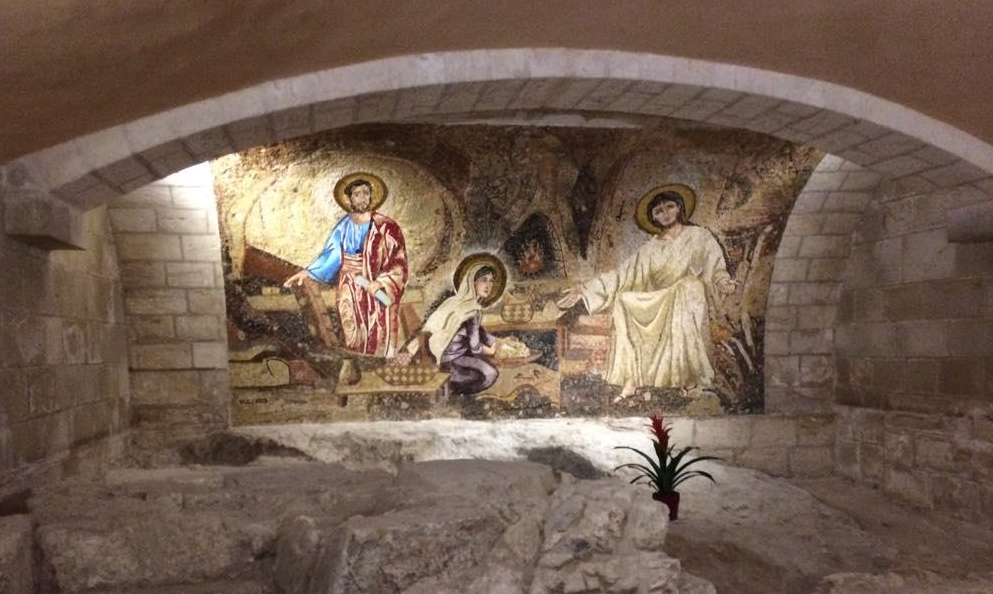
Photo by author, site of the Nazareth of the Holy Family underneath the Church of St. Joseph in Nazareth, Israel.
Lord My Chef Daily Recipe for the Soul by Fr. Nicanor F. Lalog II
Friday, Memorial of the Presentation of the Blessed Virgin Mary, 21 November 2025
1 Maccabees 4:36-37, 52-59     <*{{{{>< + ><}}}}*>     Luke 19:45-48
Photo by author, Mary’s home in Ephesus, 03 November 2025.
God our loving Father,
today I praise and thank you again
for the recent chance to travel
and experience your majesty
and beauty abroad
and among other peoples
of different culture;
most of all,
I am grateful to have been
to the home of the Blessed
Virgin Mary in Ephesus;
until now,
I am savoring,
"masticating" the blessed
experience.
Jesus entered the temple area and proceeded to drive out those who were selling things, saying to them, “It is written, My house shall be a house of prayer, but you have made it a den of thieves” (Luke 19:45-46).
As I recall
that brief moment of stay
inside the Ephesus home of Mary,
I felt my whole being emptied - hollowed -
and as I knelt and prayed
without any distractions,
no worries about pictures nor of time,
slowly I felt being filled within
by you, O God: from hollowedness
to holiness or hallowed;
that is why Jesus drove away
the merchants out of temple:
every temple,
every place of worship
including our very selves
is a home and dwelling place of God;
the chief priests, scribes
and leader of the people
felt under attack by Jesus
because they were empty of God,
filled of the world and its things;
the people were spellbound
on the other hand because
they have realized that
truly, we are the indwelling
of God; therefore, let us cleanse
ourselves always within
not only of sin but also of
so many things that distract
us away from God
to dwell in us
like social media.
O Blessed Virgin Mary,
from the very start you have
been reserved by God from any stain
of sin to be the Mother of the Christ
but it was also fulfilled because
of human cooperation: of your parents
dedicating you to God and most of all,
of your fiat to God.
Pray for us, Mama Mary
that we may cultivate a prayer life
that shall make us a home
to God; let us express our
fiat to him daily by presenting
ourselves to him like you.
Amen.
Photo by author, back of Mary’s home in Ephesus, 03 November 2025.
Lord My Chef Daily Recipe for the Soul, 23 October 2025
Thursday in Twenty-Ninth Week of Ordinary Time, Year I
Romans 16:19-23     <'[[[[><  +  ><]]]]'>     Luke 12:49-53
Photo by Dra. Mai B. Dela Peña, Japan, 2016.
I may be struggling with
stress daily like most
people these days,
Lord Jesus,
but today's gospel made me
realize how you too experienced
"stress" like us because,
after all , you are
truly human
like us.
Jesus said to his disciples: “I have come to set the earth on fire, and how I wish it were already blazing! There is a baptism with which I must be baptized, and how great is my anguish until it is accomplished! Do you think that I have come to establish peace on the earth? No, I tell you, but rather division (Luke 12:49-51).
How good it is to realize
that you, Lord Jesus,
was also stressed -
"I have come to set the earth
on fire...
There is a baptism with which
I must be baptized...";
like you, we could feel
the weight of things to be done,
of mission to be accomplished;
like you, we too could feel
 the great responsibilities
on our shoulders.

Thank you,
Jesus,
thank you
for being one with us
in our stress.
Teach us Lord your
way of handling stress
so we can put these
challenges into good use,
into more evangelical in nature
by first accepting and embracing
 like you our mission and
 responsibilities when you said,
"how I wish it were already blazing"
and "how great is my anguish
until it is accomplished";
many times what we do
is as much as possible avoid
our mission and responsibilities
or, if not, delay acting on them
that eventually stress us further;
give us also the courage like you,
Jesus,
to face and deal with our
many divisions in life
that stress us,
of learning to bridge the many
gaps between the ideal
and the sad realities
we are into
as well as the many
limitations and handicaps
we have.
Photo by Dra. Mai B. Dela Peña, Mt. Carmel, Israel, 2015.
Make us whole,
Lord Jesus
in your love and
kindness and peace
by claiming our
blessedness in your
gift of salvation
and sanctification
as we pursue
holiness
according to
St. Paul's advice
in the first reading.
Amen.

Fr. Nicanor F. Lalog II
Our Lady of Fatima University
Valenzuela City
(lordmychef@gmail.com)
Lord My Chef Daily Recipe for the Soul, 02 September 2025
Tuesday in the Twenty-Second Week of Ordinary Time, Year I
1 Thessalonians 5:1-6, 9-11     <*((((>< + ><))))*>     Luke 4:31-37
Photo by author, sunrise at the Lake of Galilee, Israel, May 2017.
Let your light shine on me,
Jesus,
keep me "alert and sober
so that I may continue
to encourage one another
and build one another up"
(1 Thessalonians 5:6, 11);
let your light shine in me,
Jesus,
fill me with your authority
and power to disclose truth
and expose evil as people
nowadays are so used to sin
as very ordinary, tolerable
and acceptable;
let your light shine in me,
Jesus,
fill me with your Spirit
to always proclaim
in words and in deeds
your gospel of salvation
from self-centeredness,
materialism,
and relativism
that have all tried
deleting God
and prayer
in life;
despite my sinfulness
and weaknesses,
help me bring you Jesus
to those burdened and lost,
sick and confused
after being so misled
by the world's many lies
and broken promises.
Amen.

Fr. Nicanor F. Lalog II
Our Lady of Fatima University
Valenzuela City
(lordmychef@gmail.com)
Lord My Chef Daily Recipe for the Soul
Monday, Memorial of the First Martyrs of Rome, 30 June 2025
Genesis 18:16-33     <*((((><  +  ><))))*>     Matthew 8:18-22
Photo by author, Cabo Da Roca, Pundaqit, San Antonio, Zambales, 15 May 2025.
*Apostle, from "apostolein",
to be sent forth;
Disciple, from "discipulous",
to follow.
A day after celebrating the
Solemnity of your Apostles
Saints Peter and Paul,
you gave us today Jesus the
memorial of the first martyrs
of the Holy Roman Church
who were killed during the reign
of Nero in 64 A.D.; many of them
were literally used as torches and
lamps when their mutilated bodies
were burned to light the city of Rome.
How inspiring,
dear Jesus to hear their
story of witnessing their faith
in you at that time;
grant us the same courage today
to always follow you, Jesus,
to follow your footsteps by doing
your work and most specially,
in carrying your Cross;
let us seek sanctity regardless
of our social status, age or
skills.
Let us imitate Abraham in
the first reading who walked
with God, his visitors at Mamre;
like Abraham walking with you,
following you, Lord,
let us work more for the conversion
of others not their judgment;
in following you, Jesus,
let us think more of how to save
followers lost in their directions
in life; instead of leaving them behind
on their own in their evil ways,
may we appeal to God for their
conversion.
May we not be like
the two hesitant disciples
in today's gospel: though
willing to follow you, Jesus,
one was impulsive
and the other was cautious;
give us courage to do a
sincere reality check today of our
discipleship in you:
help us bring back the joy
and zeal of following you,
Jesus when we started to heed
your call of discipleship;
let us dare again to leave the sides
to walk at the middle of the road
following you Jesus even to the Cross;
help us bring back that desire
to go near you, Jesus,
to always seek you and follow you
by forgetting our selves;
and like Abraham,
let us be gracious always
to one another as your followers.
Amen.
Fr. Nicanor F. Lalog II
Our Lady of Fatima University
Valenzuela City
First Martyrs of the Holy Roman Church photo from ucatholic.com.
Lord My Chef Daily Recipe for the Soul by Fr. Nicanor F. Lalog II
Tuesday in the Eleventh Week of Ordinary Time, Year I, 17 June 2025
2 Corinthians 8:1-9     ><]]]'> + ><]]]'> + ><]]]'>     Matthew 5:43-48
Photo by author, Archdiocesan Shrine of Nuestra Señora De Guia, Ermita, Manila, 28 November 2024.
Your words struck me hard
again today, Lord Jesus:
can we really be perfect
just as our heavenly Father
is perfect?
(Matthew 5:48)
Jesus said to his disciples: “You have heard that it was said, You shall love your neighbor and hate your enemy. But I say to you, love your enemies and pray for those who persecute you, that you may be children of your heavenly Father, for he makes his sun rise on the bad and the good, and causes rain to fall on the just and the unjust” (Matthew 5:43-45).
When I recall your mercies,
Jesus as you spared me
from the bad things I deserved
due to my many and repeated sins,
the more I must be loving
and perfect like the Father;
when I think, O Lord,
of your many graces poured
upon me, of the many good things
that are mostly I never asked
and certainly I never deserved,
it is but natural that I must be loving
and perfect like the Father;
when I examine my life
and experience how you have filled
and blessed me, Jesus,
with all your mercy and grace
despite and in spite of who I am,
the more I am convinced
of my need to be perfect
like the Father.
Dearest Jesus,
we are all undeserving of your
love and grace,
mercy and blessings
but you simply showered us with
these all because you love us;
let our love for you be genuine
with our concern for others
like you who became poor
for us so that we may become rich
for God through others
(2 Corinthians 8:9).
Start in me,
Lord Jesus,
a revolution of love
in tenderness
and kindness
in a world that has
become so harsh
and inhospitable.
Amen.
Photo by author, sunflower farm, Benguet Province, 12 July 2024.
The Lord Is My Chef Daily Recipe for the Soul by Fr. Nicanor F. Lalog II
Simbang Gabi-4 Homily, 19 December 2024
Judges 13:2-7, 24-25     <*((((><  +  ><))))*>     Luke 1:5-25
Photo by author, wailing wall of Jerusalem where Jews pray until now being the section closest to the Holy Holies destroyed in year 70AD.
From Matthew, we now shift to Luke to listen to his account of Christmas which is the most complete and detailed. In fact, most artistic renditions of Christmas were inspired by Luke’s gospel.
Very surprising in his Christmas story, Luke started it with the annunciation of the birth of John the Baptist to his father Zechariah who was then serving at the temple of the Lord in Jerusalem. It is a reminder to us all these days that Advent and Christmas begin in the church, in our holy celebrations.
In the days of Herod, King of Judea, there was a priest named Zechariah of the priestly division of Abijah; his wife was from the daughters of Aaron, and her name was Elizabeth. Once when he was serving as priest in his division’s turn before God, according to the practice of the priestly service, he was chosen by lot to enter the sanctuary of the Lord to burn incense. Then, when the whole assembly of the people was praying outside at the hour of the incense offering, the angel of the Lord appeared to him, standing at the right of the altar of incense (Luke 1:5, 8-11).
Luke’s detailed account of the event is the Jewish Day of Atonement (Yom Kippur) when their priests incense yearly between September 18-24 the Holy of Holies where they used to keep the Ark of the Covenant. From this detail by Luke we got the reliable timetable in the celebration of Christmas on December 25 by considering this event as the time of Elizabeth’s conception of John who was born June 24 or nine months after. Tomorrow we shall hear in the gospel how “on the sixth month” of Elizabeth’s pregnancy which fell on March 25, the angel Gabriel announced to Mary the birth of Jesus, the Solemnity of the Annunciation we celebrate on that date. Nine months from March 25, we have December 25! Who said our Christmas date is not in the Bible? We got it here in our gospel today courtesy of Luke!
Photo by author, Parish Church of St. Joseph in Morong, Rizal, January 2021.
It may sound simple yet, it is so profound. In narrating this to us, Luke reminds us today that the Christmas story began in a holy celebration in the temple of Jerusalem now happening in our Eucharistic celebrations in every church around the world.
Many take our Sunday Masses for granted these days with so many excuses and alibis but, let us set aside all these to reflect on this simple detail from Luke’s first story on Christmas.
Photo by Mr. Jim Marpa, 2018.
First, this is a call for us all to go back to the church by finally putting a stop NOW of online Masses. Online Mass as a term is an oxymoron because it presupposes actual presence of people. There can be no virtual Mass because there is no such thing as virtual sacrament nor virtual grace. That is why God introduced Himself to Moses as “I AM WHO AM”, the One who is perfectly present, always actual never virtual.
Since the waning of the COVID virus last year, both the Pope and the CBCP have called for the ending of online Masses but unfortunately, so many priests have remained stubborn with some making “shameful profit” out of it which is strongly prohibited by Canon Law and other Church and papal documents. Unless online Masses are stopped, people will always find reasons and alibis not to go to church on Sundays.
As we reflect on Luke’s account of the celebration at that time of the annunciation of the angel to Zechariah while he was incensing the Holy of Holies, we get the feel of solemnity and sacredness that are sorely missing these days in many of our celebrations of the Mass.
Like Zechariah and the priests of the Jerusalem temple at that time who were all steeped in traditions and presumably spirituality, we have every reason to expect the same, even more, from our bishops and priests today. They are the ones who set the tone of every celebration and of life in the parish; their spirituality or lack of it is manifested in the parish life, from its building structure to its witnessing.
Photo by author, pious Jews and Rabbis in another enclosed section of the wall of the temple of Jerusalem, May 2017.
How sad when priests have lost the sense of the sacred of the Holy Mass when they disregard the solemnity of the celebration with all their antics and gimmicks; worst of all, of coming to Mass unprepared without a homily and good vestments, sometimes without having showered or shaved! What is tragic is when the priest attends all socials in proper attire, but never in the Mass.
The other day, I saw a sticker at the back of a delivery van that asks, “How’s my driving? And my grooming?” Too bad I was not able to get the name of the company of that delivery van but how great are its people must be in giving a premium on how their drivers behave and look!
Some priests shamelessly argue that what is essential is what is inside but they forget that the outward appearance is an indication of what’s inside them too. How can the people feel and experience God if their pastor comes shabbily dressed without any good vestments, so untidy as in dugyot, unprepared for the Mass, without a good homily?
What had become of our churches that have been the shining glory of architecture through the centuries but now look like malls? Some churches look like videoke bars with a lot of giant TV screens while priests serenade the people with their wonderful voices instead of delivering a homily.
How sad that many churches are untidy and ugly. Yes, ugly is the word. And kitschy, bereft of any sense of the holy that people cannot experience God except be played on their emotions with dramas and not to forget, second and third collections. Choirs are on their own with a concert, totally deaf to the fact their music is supposed to lead the congregation into prayerful reflections not to applaud them for a performance. It is about time we restore the dictum of the Roman liturgy of noble simplicity not only of the church and also of celebrations.
Photo by author, Archdiocesan Shrine of Nuestra Señora De Guia, Ermita, Manila, 28 November 2024.
Our gospel invites us today, especially us priests and bishops along with those involved in preparing our parish celebrations to be silent like Elizabeth – lest we be silenced and be made mute by the Lord like Zechariah to finally open ourselves to listen to God’s instructions about His Son’s coming.
Let’s face that sad reality of so many of us clergy and laity in the church who are like Zechariah trying to control everything including God, even playing God who give the people enough reasons to turn away from the Church completely.
Photo by author of the beautiful sacristy of the Archdiocesan Shrine of Nuestra Señora De Guia in Ermita, Manila where even a guest priest could feel at “home” with everything in order.
Like Elizabeth, let us choose to be silent in order to pray truly, awaiting God in the Holy Spirit to stir us into His Divine Plans like Samson in the first reading, “The boy grew up and the Lord blessed him; the Spirit of the Lord first stirred” (Jgs.13:24-25). We find the same thing in the gospel when Gabriel told Zechariah how John while still in Elizabeth’s womb would be filled with the Holy Spirit (Lk.1:15) in accomplishing his mission as precursor of Jesus.
If we could allow ourselves to be stirred by God first – not by fad or ulterior motives in our church celebrations – then every Mass becomes a Christmas, a coming of Christ.
Let us do away with unnecessary things in the church and in our celebrations that call attention to us, to our abilities and talents, even power like Zechariah by being more daring in silence and noble simplicity to experience God’s coming every Mass.
As we shall see in the coming days from the gospel of Luke, Christmas is both a journey into Bethlehem, Jerusalem and other places as well as into the very hearts of Joseph and Mary and of those who would recognize and accept Jesus Christ. May our churches reflect what is in our hearts as disciples of Christ, always with a space for Jesus to come and dwell inside and among us. Amen.
Photo by author, Simbang Gabi in our previous parish, 2018.













 lordmychef.com