The Lord Is My Chef Breakfast Recipe for the Soul, Saturday, Easter Week-IV, 09 May 2020
Acts of the Apostles 13:44-52 ><)))*> ><)))*> ><)))*> John 14:7-14
According to Pope Francis, the serpent is the first peddler of “fake news” when it deceived Adam and Eve into eating the forbidden fruit in Paradise. Photo from gettyimages.com.
As we end another week O Lord, we pray this time for those who refuse to follow your path of truth. We pray for all trolls and peddlers of fake news and lies, including those who concoct and spread nasty and malicious talks about us.
The gossipers and slanderers.
We pray for them, Jesus, that they may finally come to their senses to see and accept the realities around them.
We pray that they may stop living in darkness, speaking of lies that have destroyed many good names and have caused so much heartaches to those they have maligned.
How sad, O Lord, that these liars and trolls are using the modern means of communications to spread their fake news and lies and gossips to mislead a nation, destroy families and organizations.
Photo by author, February 2020.
In the first reading from the Acts of the Apostles, we saw how Jews were filled with jealousy against Paul and Barnabas while proclaiming your Gospel at the synagogue of Antioch in Pisidia.
Not contented in engaging your apostles into “violent abuse of contradicting” their teachings, they also “incited the women of prominence and leading men of the city” to persecute Paul and Barnabas (Acts 13:45, 50) because they cannot accept the truth, they cannot accept you, Jesus.
And that continues to happen today when people cannot accept you as Lord and God who truly loves us, forgiving our sins and setting us free to become better persons despite our sins and weaknesses.
Keep us faithful to your words, Lord, and purify our minds and our hearts that we may be one with you in the Father in thoughts, words, and deeds.
Likewise, we pray for everyone that we may always be on guard in examining information and stories we read and hear in order to stop the spread of fake news and lies. Amen.
The Lord Is My Chef Breakfast Recipe for the Soul, Friday, Easter Week-IV, 08 May 2020
Acts of the Apostles 13:26-33 ><)))*> +++0+++ <*(((>< John 14:1-6
Photo by Ms. Jo Villafuerte in Atok, Benguet, 2019.
Your words today, O Lord Jesus, are so assuring, so refreshing like the rains last night. Even if all our problems and worries remain, your words are more than enough to banish their power over us as we gain that trust and confidence to forge into this day we do not know where it would lead us to.
Jesus said to his disciples: “Do not let your hearts be troubled. You have faith in God; have faith also in me.”
John 14:1
Keep us by your side, Jesus.
Let us take your path of love and humility, kindness and mercy especially in this time when patience is running out among many of us and emotions in everyone go high that we lose sight of the other persons going through troubles similar with ours.
Sometimes we fail to recognize you like what St. Paul said in the first reading because we always seek something more tangible, someone we can talk to like another person.
Let us be calm and trust in you that no matter what happens, you will never leave us alone and eventually lead us home to the Father’s house in heaven. Amen.
The Lord Is My Chef Breakfast Recipe for the Soul, Thursday, Easter Week IV, 07 May 2020
Acts of the Apostles 13:13-25 <*(((>< ++0++ ><)))*> John 13:16-20
Photo by author, February 2020.
Thank you, O Lord, for the gift of remembering, of not simply recalling the past but even the joy or pain of experiencing them again. Most of all, of learning their lessons that have made us what we are today.
In this time of quarantine when we have so many time spent in remembering our past, our family and friends, may we also remember your saving grace to us like St. Paul at the synagogue of Antioch in Pisidia.
Help us to remember – that is, to make you a part of the present again of which re + member is all about.
May we never live like what we have done before this pandemic began when we thought we can lead our lives without you.
As we remember your goodness, your coming to us in your Son Jesus Christ who suffered and died like us, may we keep in mind that everything is in your hand, in your power and control. Not ours.
Grant, O Lord, that in re + membering your saving action to us, your great love for each one of us, may we continue to lovingly serve one another in your name. Amen.
Mosaic of “Washing of Feet of the Apostles”, photo from Google.
Quiet Storm by Fr. Nicanor F. Lalog II, 03 May 2020
Photo by author, Parokya ni San Juan Apostol at Ebanghelista, Bagbaguin, Santa Maria, Bulacan. April 2020.
Against the advice of good friends, I went out to distribute Holy Communion in the streets to some parishioners who have participated in our Sunday Mass early this morning at Facebook Live.
I know the risks involved despite our best efforts in having all the precautionary measures but, what convinced me to go on with it is a beautiful Psalm so appropriate during this quarantine period.
As the deer longs for streams of water, so my soul longs for you, O God.
My being thirsts for God, the living God. When can I go and see the face of God?
And when our quarantine period was extended for the second time before the end of Holy Week last month, I began praying again Psalm 42 every night for that is when I truly long for God so much, most of the time lamenting to him our situation, my condition of being alone in my rectory.
This is the first time I felt like this, so different from those so-called “desolation” or “dryness” because I could feel God present in my prayers but… he is not “fresh”.
Like the deer longing for streams of water, my soul longs for God too.
Not just like the water we buy from a filling station but exactly what the deer yearns for — fresh water that is refreshingly cool not only on your face but deep into your body when sipped amid the burbling sounds of the spring, babbling through rocks and branches of trees with the loamy aroma of earth adding a dash of freshness in you.
Admittedly, sometimes I wonder if I still know how to pray or if I still pray at all!
I can feel God present but he is like someone stacked there in my mind, in my memory, in my ideas shaped by my years of learning and praying.
What I am longing for is a God so alive, so true not only in me but also in another person.
And that is when I realized, most likely, my parishioners must be longing for God too in the same way — the God we all come to meet and celebrate with every Sunday in our little parish, among the people present who are so alive, so vibrant, so true, so touching.
Our empty church since March due to COVID-19.
Psalm 42 is believed to have been sang by David when he was prevented from coming to the tent of God either during the reign of King Saul who plotted to kill him or during the revolt of his own son Absalom when he was already the king of Israel.
Like David or the psalmist, I miss celebrating Mass with my parishioners.
And maybe it is safe to assume that two or three of my parishioners are also feeling the same way with me and David, saying these to the Lord:
My tears have been my food day and night, as they ask daily, “Where is your God?”
Those times I recall as I pour out my soul,
When I went in procession with the crowd, I went with them to the house of God,
Amid loud cries of thanksgiving, with the multitude keeping festival.
Psalm 42:4-5
If there is one very essential thing this pandemic has brought back to us in our very busy lives, it is most certainly God. And if ever this is one thing people need most in this time of corona virus, it is spiritual guidance and nourishment from God through his priests.
Of course, people can pray and talk to God straight as the Pope had reminded us before Holy Week.
But, human as we are, we always experience God and his love, his kindness, his mercy, his presence among other people who guide us and join us in our spiritual journey. They are special people like friends or relatives or pastors with whom they can be themselves, let off some steam, get some rays of light of hope and encouragement.
And that this is why I try to keep in touch with my parishioners in various ways in this time of corona: even I myself can feel so low and dark despite my prayers and very condition of living right here in the house of God who can still feel alone and desolate, even depressed.
If I – a priest – go through all these uncertainties and doubts this in this time of quarantine, how much more are the people, the beloved sheep of Jesus the Good Shepherd?
Why are you downcast, my soul; why do you groan within me?
Wait for God, whom I shall praise again, my savior and my God.
Psalm 42:6
Photo by Ms. Ria De Vera, 10 April 2020.
After our Mass this morning when we set out to distribute the Holy Communion, there was a little drizzle. It did not last long that I just wore a hat and left my umbrella in the rectory.
There were about 30 people who waited for us to receive Holy Communion, most of them along the main highway that stretched to about 2 kilometers. Some families gathered with a little altar at their front gate while a waited a couple waited in a gas station along our route.
In less than 20 minutes, we have completed our mission and as we headed back to the parish, the rains fell again, this time stronger than before.
My driver commented, “The weather cooperated with us, Father”1
I just nodded my head to him inside his tricycle but deep inside me, I felt joy because God answered my prayer, my lamentations for he was crying too, – for me and his people.
May this lamentation be an answer to your lamentations during this pandemic of COVID-19.
Continue with your lamentations to God our Father for this very act of crying out to him is the working of the Holy Spirit he had sent us through our Lord Christ Jesus. Amen.
The Lord Is My Chef Breakfast Recipe, Memorial of St. Athanasius, 02 May 2020
Acts of the Apostles 9:31-42 <*(((>< ><)))*> <*(((>< ><)))*> John 6:60-69
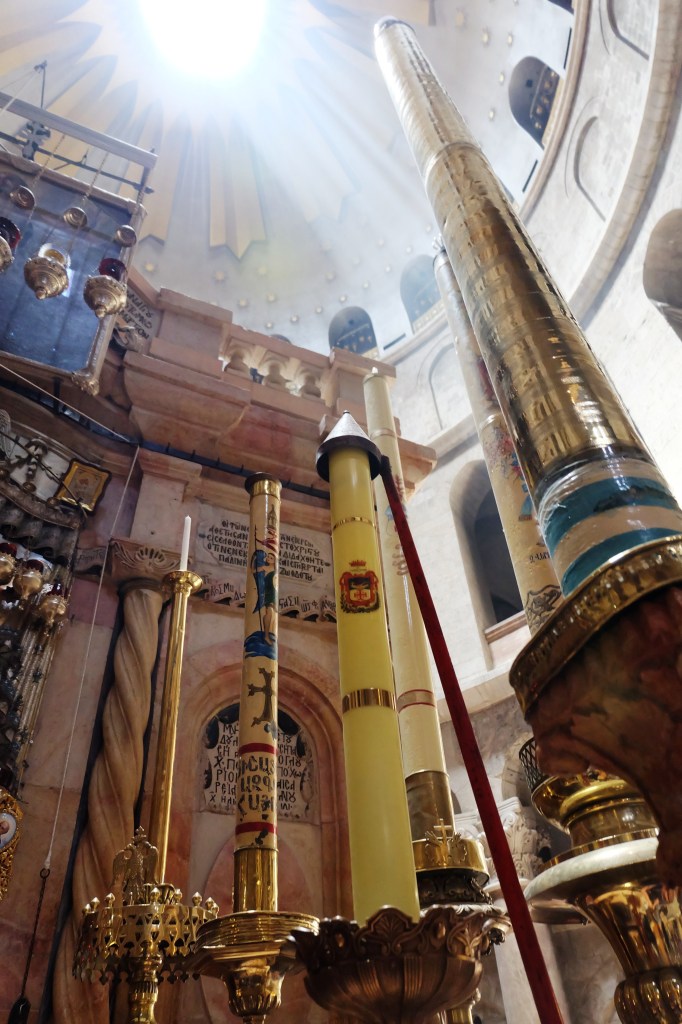
Photo by author inside the Holy Sepulchre Church in Jerusalem near the tomb of Jesus, 2017.
Dearest Lord Jesus:
We are getting tired and weary.
This community quarantine is slowly taking its toll in us with its emotional and psychological stresses especially for those living alone, for the elderlies, those with debilitating diseases and condition, for those in the margins of the society.
Give us the gift of faith like that of St. Peter in the first reading and the gospel: in this time of the corona virus when many of us are wishing to give up and walk away, may the words of faith by St. Peter re-echo within us too…
“Master, to whom shall we go? You have the words of eternal life. We have come to believe and are convinced that you are the Holy One of God.”
John 6:68-69
Let us be reminded that like St. Peter, there are moments of crisis in faith when we are so tempted to walk away from you or even deny you, Lord; yet, your grace is always there to encourage us, to strengthen us, and most of all, to inspire us to find those going through various tests of their faith.
In this time of the quarantine, help us to make that extra effort to learn and know you more like St. Athanasius who spent many hours praying and studying your teachings so more people may be enlightened, especially those who are misled by heresies and trappings of the modern world.
Keep us faithful and focused only on you, Jesus, so we may always follow you alone. Amen.
Sana ay huwag ninyong masamain
itong aking puna at pansin
sa marami nating kababayan
ngayong panahon ng COVID-19
palaging daing walang makain
ating sinasambit
saan mang bahagi ng mundo sumapit
kapag tayo ay nagigipit.
Hindi naman sa kung ano pa man
pagkain lamang ba ang sadya nating kailangan
na siyang laging pinahahalagahan
kaya naman kadalasan ito ang sanhi
ng ating mga alitan at di pagkakaunawaan?
Anong sakit mapakinggan, malaman na
nag-aagawan, pinag-aawayan
ay pagkain lamang?
Larawan mula sa Google.
Sa Banal na Kasulatan ating matutunghayan
habilin ng Diyos sa ating unang magulang
maari nilang kainin mga munting butil
pati na rin mga bunga ng punong kahoy sa hardin
huwag na huwag lamang nilang kakanin
mahigpit Niyang bilin
bunga ng puno ng karunungan
dahil magiging sanhi ng ikasasawi natin.
Hindi napigilan kanilang tinikman
pinagbabawal na bunga kaya lumuwa mga mata
sa katotohanang lumantad sa kanila na di nakaya
kaya't dating kapwa hubad ay nagdamit na!
Nang pumarito si Jesu-Kristo upang tubusin ang tao
unang tukso na kanyang pinagdaanan sa ilang
sa gitna ng kanyang kagutuman
ay gawing tinapay mga bato upang busugin Kanyang tiyan.
Hindi nalito si Kristo nang sagurtin niya ang diyablo
na hindi lamang sa tinapay nabubuhay ang tao
kungdi sa bawat salitang namumutawi sa bibig ng Diyos;
kaya noong gabing ipagkanulo siya habang kumakain sila,
nangunsap Siya sa mga alagad Niya
habang hawak-hawak ang tinapay na pinaghati-hati
"Tanggapin ninyong lahat ito at kanin
ito ang aking katawan na ihahandog para sa inyo."
Mula noon hanggang ngayon
nakikilala, naaalala natin ang Panginoon
sa hapag ng kanyang piging, sa mesa ng Misa
nang kanyang inangat katayuan at kahulugan
nitong pangkaraniwang gawain natin na kumain:
hindi lamang upang busugin mga tiyan at laman natin
kungdi upang punuin din kamalayan at kaluluwa natin
ng diwa ng piging na mismo tayo ay maging pagkain din!
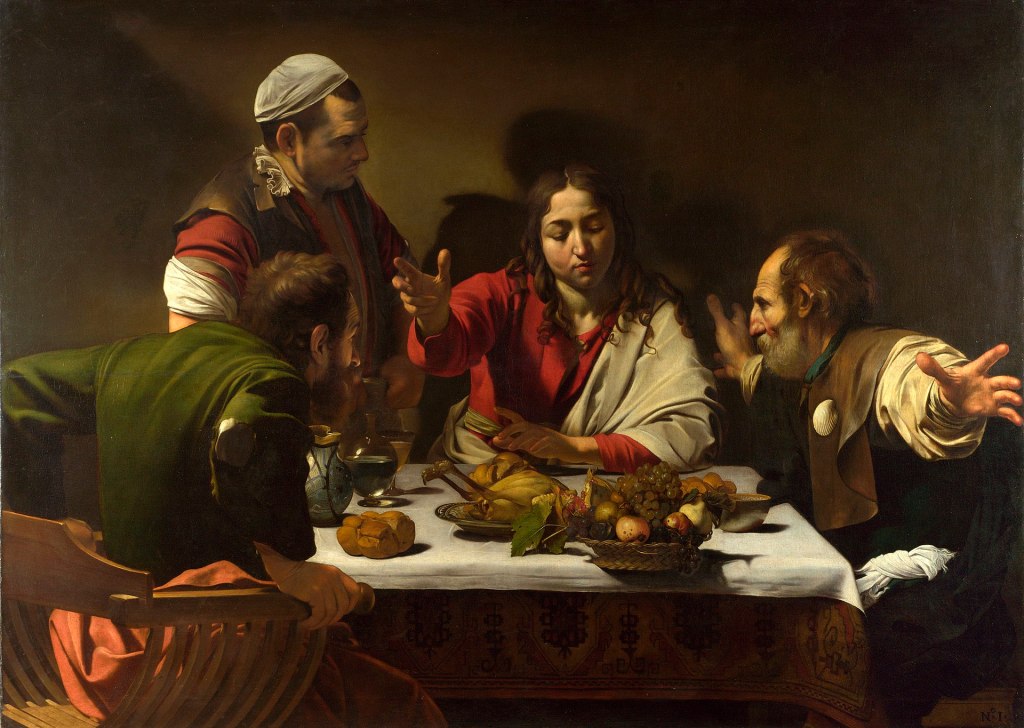
Larawan ng “Supper at Emmaus” ni Caravaggio mula sa Google.
Nakikila pag-uugali ng tao
kapag nakita paano siyang kumain
sapagkat doon lamang sa mesa ng piging
nawawala mga pagkukunwari natin
nabubunyag tunay nating saloobin
kaya naman sa bawat pagdiriwang natin
palaging mayroon pagkain upang
magkasalu-salo, magkaniig at magkaisa mga kumakain.
Alalahanin si Hudas noong Huling Hapunan
lumisan na kaagad dahil siya ay tumiwalag
di lamang sa hapag kungdi sa kaisahan at
pakikipag-kaibigan kay Jesus at mga kasamahan;
iyon din ang sinasaad sa bawat piging ng mga
dumadalo at hindi dumarating
mga kumakain at nanginginain
kay daming pagkain ngunit makasarili pa rin!
Sa tuwing tayo ay kumakain
laging alalahanin kaisa palagi natin
Diyos na bukal ng lahat ng pagpapala sa atin:
huwag mangangamba o mag-aalinlangan
kung sakali mang tayo ay gutumin
sapagkat hindi iyan ikamamatay natin
kungdi pagkabunsol sa labis na pagkain
lahat-lahat ay inaangkin.
Ang tunay na sarap ng pagkain
nalalasap pa rin
maski tapos nang kumain
kapag nabusog di lamang tiyan
kungdi puso at kalooban;
mga alitan nahuhugasan sa inuman
mapanghahawakan pagsasamahan at pagkakapatiran
upang huwag masabi ninuman na wala silang makain!
The Lord Is My Chef Breakfast Recipe for the Soul, Memorial of St. Pius V, 30 April 2020
Acts of the Apostles 8:26-40 <*(((>< 000 ><)))*> John 6:44-51
Photo by Mr. Raffy Tima of GMA-7 News, 2020.
It is the last day of April 2020 and we still cannot rejoice, Lord, because we still have to continue with our enhanced community quarantine until the 15th of next month to further control the spread of the dreaded COVID-19 virus.
Yes, it is very difficult and sad for everyone but deep inside each one of us is the excitement too of seeing that day finally when the pandemic is finally over and the corona virus wiped away.
And that is why we have to believe in you, O God our Father for you alone is the God of history, you have the final say at how things are in this life and the good news is, you always ensure that even tragedies and miseries end for our own good.
“Amen, amen, I say to you, whoever believes has eternal life.”
John 6:47
Yes, Lord Jesus, we believe in you because we want to see how all these things will end, if not in this life then in the eternity.
We have to believe to understand further and accept how things are in this life.
Like St. Pius V, the first Dominican Pope, he believed in your presence and power in the praying of the Holy Rosary that helped the Spanish Armada crushed the Ottoman Turks in Lepanto Bay to finally stop them from getting into Europe any further.
Incidentally, every Rosary begins with the Credo, “I believe in God…”
He believed in your works, O Lord, that despite the gargantuan tasks ahead of him, St. Pius pushed for the reforms of the Council of Trent that revitalized the whole Church after the Protestantism movement that swept the whole of Europe at that time.
We have to believe because believing is the starting point of everything in you; without it, we can never see through and look beyond to discover more meanings in life here and thereafter. Amen.
Quiet Storm by Fr. Nicanor F. Lalog II, 29 April 2020
Photo by author, 2010.
This is again for my brother priests and fellow workers in Church communication: our extended “enhanced community quarantine” is a call for us to rediscover the contemplative spirit so essential in our communication apostolate. It is best that before we go in front of the camera, before we post anything at all, or even before we go out doing our social action, let us first have Jesus Christ in us.
After all, it is always Jesus and only Jesus we bring as priests in everything we say and do. Jesus is our life as priests and without him, our works mean nothing. Worst, it may be happening that it is not Jesus whom we are following when we fail to spend time with him in serious prayers that unknown to us, we are already replacing him by creating our own ministry apart from him.
Incidentally, we are celebrating today the Memorial of St. Catherine of Siena who is considered as one of the patron saints for those working in telecommunications and TV stations.
In one of her numerous “ecstatic” visions, it is said that when she was so sick in her room, she begged the Lord to give her a glimpse of the celebration of the Mass in their chapel. The Lord heard her prayer and thus, she became the first person in history to have celebrated Mass by “remote telecast”!
From Google.
Faith and technology
We have mentioned in our previous reflection that we now live our faith in a mass-mediated culture. Media is all around us. And there is always that intense temptation by the devil to put us on TV and the internet to be popular.
So, how do we interact with technology on a daily basis?
What are we posting on Facebook? Are we like the rest who are also hooked into TikTok with all the inanities that go with it?
How much time do we spend for social media and Netflix these days?
And how many hours do we spend before the Blessed Sacrament, excluding our Liturgy of the Hours and praying of the Holy Rosary?
From Google.
We are familiar with Marshall McLuhan’s dictum “the medium is the message”.
This we have seen in the past very evident in our ministry when some priests have transformed the South American telenovelas and later Koreanovelas into a gospel too that people felt like listening to reviews during the homily. And it had given some people the idea that every homily of the priest must say something about television shows! In fact, about three years ago, some priests have to be reminded by the CBCP during the Simbang Gabi to focus only on the Word of God and not on TV shows and jokes to get the attention of their congregation during Mass.
But let us not forget that later in his life, McLuhan added to his dictum that “the medium is the massage” to warn us that sooner or later, we can be eaten up by media that everything is reduced into a show – or a palabas in Filipino that means outward.
That is what a show is, a palabas which is empty or walang laman.
And shallow, mababaw.
That is the sorry state of our many social communication efforts in the Church when we have Masses that have become like entertainment shows, priests becoming entertainers, church buildings and decors that look like videoke bars evoking none of the sacred, and tarps and posters that are all hype without any evangelical meaning.
Observe also how our presentations and shows in our Catholic schools and parish halls have become mere repetitions of what are on television that have left many of us now stuck in Emmaus who could no longer find the way back to Jerusalem, even to Jesus because all we see are the fun and excitement, the glitz and the glamor of media.
And of our massaged ego.
Road to Emmaus from clarusonline.it
Keeping technology in its place in the Church
We are not saying modern communications is evil; the Church has always been clear that these modern means of communications are in fact a gift from God. Vatican II asserts that it is Church’s “birthright” to use and own these modern means of communication for evangelization (Inter Mirifica, 3)
Our challenge in the Church is to keep these modern technologies in its proper place.
A technological culture is not the most hospitable environment for religious belief, but neither is it necessarily hostile. If we are to find a way of expressing our faith in this technological culture and of speaking to and with the people formed by this culture we need to take time to consider how we, as individuals and as a faith community, interact with technology on a daily basis.
James Mcdonnell, Communicating the Gospel in a Technological Age: Rediscovering the Contemplative Spirit (1989)
In a story posted by the CBCP News two days ago, it reported the experience of Filipino priest Fr. Jun Villanueva who contracted the dreaded COVID-19 disease in New York City last March shortly after he had arrived to study there.
Assigned in a parish in the heart of the Big Apple, Fr. Villanueva tells how he spent his days of being “alone literally and emotionally” as “moments with God”. But, his turning point came after recovering from the corona virus when he began celebrating Mass alone:
“I really cried when I first celebrated Mass without churchgoers. There’s no one in the Church except Jesus,” he recalled. “Then I realized that the Mass is not a show but our union with Jesus, whether there are people or none,” he said. “I started to look at the situation from that perspective”.
Fr. Jun Villanueva, CBCP News, 27 April 2020
That is the first step needed to put technology in its proper place in the Church: that we bring back Jesus Christ whom we have banished in the name of our ministry and vocation. The more we think of putting so much “art” and other things to “enhance” our liturgies, then we banish Jesus Christ.
This is the other pandemic we have refused to stop in the Church: triumphalism, the overdoing of things for God that in the process we actually put more of ourselves in the ministry and liturgy than of the Holy.
Is there anyone or anything greater than the Lord?
Remember St. Theresa of Avila: Solo dios basta!
And, like our saints who guide us closer to God, the only way to have Jesus and bring him back in our lives and ministry, in the church as institution and building is through the contemplative spirit of the priests.
It is a good thing that the catch call these days is that the “return to normal” is actually a “return to basics” like washing of hands, covering of mouths when sneezing, and most of all, a return to God.
From Google.
The spirits of modernity characterized by constant changes and technological efficiency do not jibe so well with the demands of the Gospel of Jesus Christ who have always reminded us of guarding against the temptations of the material world.
Jesus tells us to practice poverty but the world tells us to be wealthy.
Jesus asks us to forget ourselves and follow him but the world tells us to be popular and follow the limelight.
Jesus tells us to go down and be humble but the world tells us to rise up and go higher!
The other day, Jesus reminded us in the gospel:
“Do not work for food that perishes but for the food that endures eternal life, which the Son of Man will give you. For on him the Father, God, has set his seal.”
John 6:27
Most of the time in the Church and in our lives as priests, we have to be “inefficient” like “waste time” doing nothing in front of the Blessed Sacrament; have less of everything like food, money and clothing; be silent to listen more than to speak and talk more.
The contemplative spirit is about poverty and going down while the world tells us to be wealthy and to rise and go upwards.
The contemplative spirit is to be silent and trusting always in the Lord rather than relying on our own powers and abilities.
Here is James McDonnell again on the need to rediscover the contemplative spirit in communicating the gospel in this modern time.
“The contemplative spirit is an attitude of mind and heart that enables us to focus on the essential, important things. It refuses to be hurried or rushed into premature rejection or acceptance of technology. If we Christians allow it to inform our use of communication technologies we shall learn to be realistic, but always hopeful, able to love and reverence our culture even as we strive, with God’s help, to transform it.”
Communicating the Gospel in a Technological Age: Rediscovering the Contemplative Spirit (1989)
Take heart, my dear brother priests: we are representatives of Jesus Christ, our Eternal Priest. We are not entertainers and pleasers of anyone but of God alone. We do not need followers and likers. And we have so many other things to do than TikTok and Facebook or Instagram.
Let us go back to Nazareth to be silent and hidden so we can return to Jerusalem to await for further instructions from the Lord. Amen.
The Lord Is My Chef Breakfast Recipe for the Soul, Monday, Easter Week-III, 27 April 2020
Acts of the Apostles 6:8-15 <*(((>< 000+000 ><)))*> John 6:22-29
Photo by Mr. Jim Marpa, Panglao Beach, 2019.
Thank you very much, our loving Father for this very different Monday: it is the last for the month of April, but most of all, so unlike of all the other Mondays of our lives as we continue to stay home under our enhanced community quarantine extended until May 15, 2020.
We have been so used in our entire lives that Monday is always the start of work, the start of everything when in fact, Sunday is the first day of the week.
Due to COVID-19, we have started to lose track of dates and days, thus making us less mechanical and more natural, giving us with enough time to review our selves and our lives, to see the peoples and things we value most, and finally, to make a stand on so many things we have taken for granted and even disregarded in the past.
We have never been like your deacon Stephen in the first reading who at a very young age chose to stand for Jesus Christ and his teachings, never giving into the fear of going against prevailing thoughts and sentiments. Most of all, he never gave into the lies thrown against him by his many detractors.
Enlighten us, dear Jesus, to seek for “food that endures for eternal life so we can accomplish your works, O Lord” (Jn.6:27-28).
Let us believe in you always, Jesus.
Nourish and sustain us with your words of life so that we can remain firm in our faith and conviction in you, always willing to go back to Jerusalem and Galilee to start anew in you like the two disciples you walked with to Emmaus on Easter. Amen.
The Lord Is My Chef Sunday Recipe, Easter Week III-A, 26 April 2020
Acts of the Apostles 2:14.22-33 ><)))*> 1 Peter 1:17-21 ><)))*> Luke 24:13-35
Photo by author, sunset at Laguna de Bay (Los Banõs), February 2020.
I am sure all of us can identify with the two disciples going home to Emmaus on that evening of Easter. And surely, as we accept with a heavy heart the extension of this enhanced community quarantine (ECQ) until May 15, we pray like them, saying, “Stay with us, Lord.”
As they approached the village to which they were going, he (Jesus) gave the impression that he was going on farther. But they urged him, “Stay with us, for it is nearly evening and the day is almost over.” So he went in to stay with them. And it happened that, while he was with them at table, he took bread, said the blessing, broke it, and gave it to them. With that their eyes were opened and they recognized him, but he vanished from their sight. Then they said to each other, “Were not our hearts were burning within us while he spoke to us on the way and opened the Scriptures to us?”
Jesus always walking with us, without us recognizing him
Once again we see the presence of darkness in this story of Easter found only in St. Luke’s gospel. And that is the beauty of Easter – like Christmas – showing us the immense love of God for us that he sent us his Son Jesus Christ in the darkest moments of our lives to lead us to light and life.
And it always happens when we least expect it like that Easter evening when Cleopas and his companion were on their way to Emmaus.
Jesus comes to us as a stranger and most of all, joins us in the “wrong direction” to bring us back to the right path we must take especially when things go against our plans and expectations.
Until now, we cannot still believe how these things are happening to us: the lockdown, the sufferings and uncertainty of life when everything is on a “wait-and-see” situation especially in business and education while houses of worship remain closed and mass gatherings prohibited to control the spread of COVID-19.
But, if we look back and see how we are today, do we not also feel our “hearts burning within” that despite all the sickness and deaths almost everywhere, we are still here, alive, forging on in darkness, and most of all, somehow being led by Jesus even though we do not recognize him right away to be always on our side?
Yes, we worry, we ache deep inside but, more than these, we hope, we love, we live because we firmly believe in the Risen Lord present in us, present among us.
Deep in our hearts we experience Jesus with us, feeling with us, listening to our cries and worries just like that Easter evening to Emmaus. As we would say in Filipino, “ah basta!” that means without doubt, we are certain of someone or something from deep within not visibly seen.
“Supper at Emmaus” by renowned painter Caravaggio. See the emotion depicted by Caravaggio with his trademark of masterful play of light and shadows. At the center is the Risen Lord blessing the bread that caught the two disciples who are seated in disbelief, one outstretching his arms and the others pushing back in his chair. The third character in the painting is the innkeeper unaware of the significance of the gesture of Jesus. It was at this instance that the two disciples recognized Christ as the travelling man with them to Emmaus.
Our inner recognition of Christ in the breaking of bread
Notice that in all resurrection stories, the followers of Jesus did not recognize him immediately. There is always that feeling within them, like what we feel when we see somebody and we try to recall where we have met him/her, trying to dig into our memories when and how did we get to know the seemingly not “stranger” before us.
It is a funny feeling that is finally resolved with a very simple memory of an instance long ago or a small detail that leads into an “inner recognition” of the person before us.
This is how the disciples of Jesus recognized him — not through his external appearances but more from within like when Cleopas and his companion invited him into their home in Emmaus or when the seven apostles led by Simon Peter met him by the shore of the lake when no one would dare ask who he is because deep within, they knew it was the Lord (Jn.21;12-14).
And this happens always in the context of a meal, a table fellowship when Jesus instituted the Sacrament of the Eucharist on Holy Thursday evening before he was arrested to be crucified.
Here we find the mystery of this sign left to us by Jesus to be his very presence among us in his Body and Blood under the perceptible signs of bread and wine as well as the Sacred Scriptures proclaimed in every liturgical gathering: the more we do not see his outward appearances, the more we recognize Jesus!
Every time we celebrate the Mass and listen to the scriptures proclaimed, we realize within us like the people of Jerusalem in the first reading that this Jesus of Nazareth is a true person present in our lives fulfilling his works of salvation despite our sinfulness.
Like some people we meet, we recognize Jesus Christ not with the outward appearances but from within, from what we have experienced beyond explanations that gives us always a sense of awe because as St. Peter tells us in the second reading, “he had ransomed us from our futile conduct with his most precious blood” (1 Pt. 1:18-19) which is affirmed to us in every celebration of the Holy Eucharist.
The Easter mystery of recognizing Jesus when he vanishes
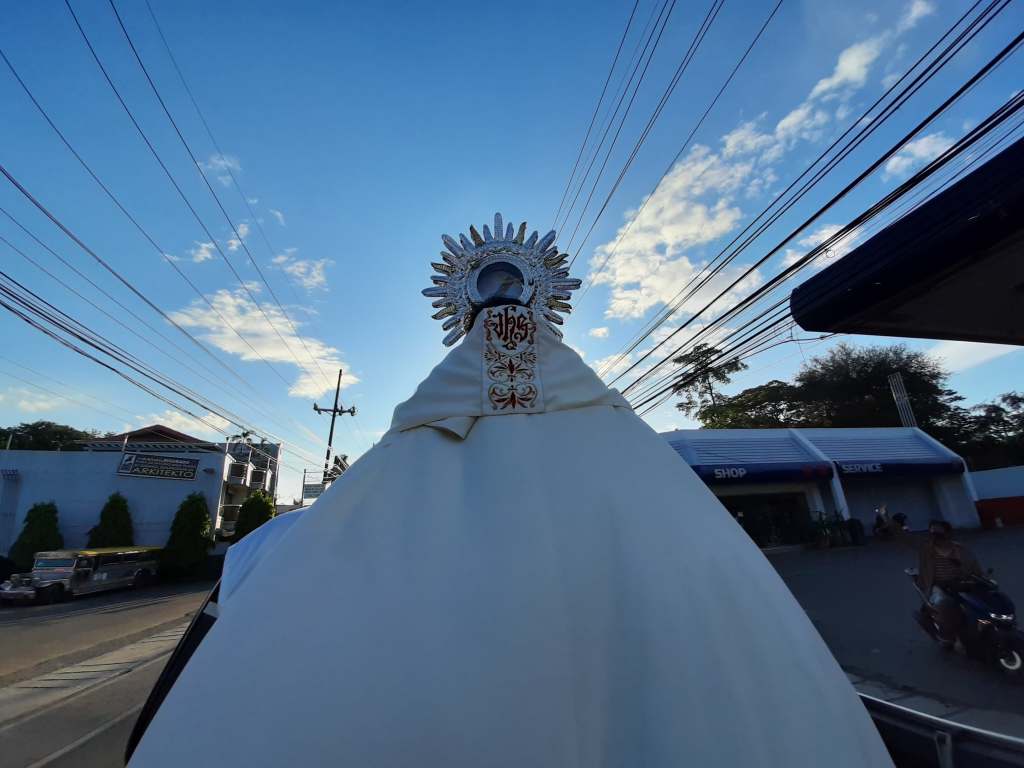
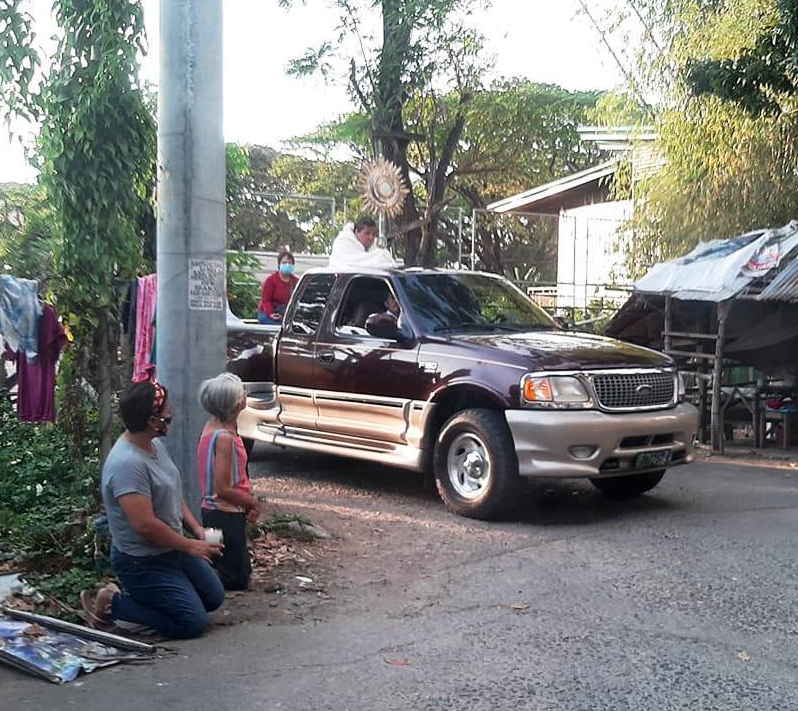
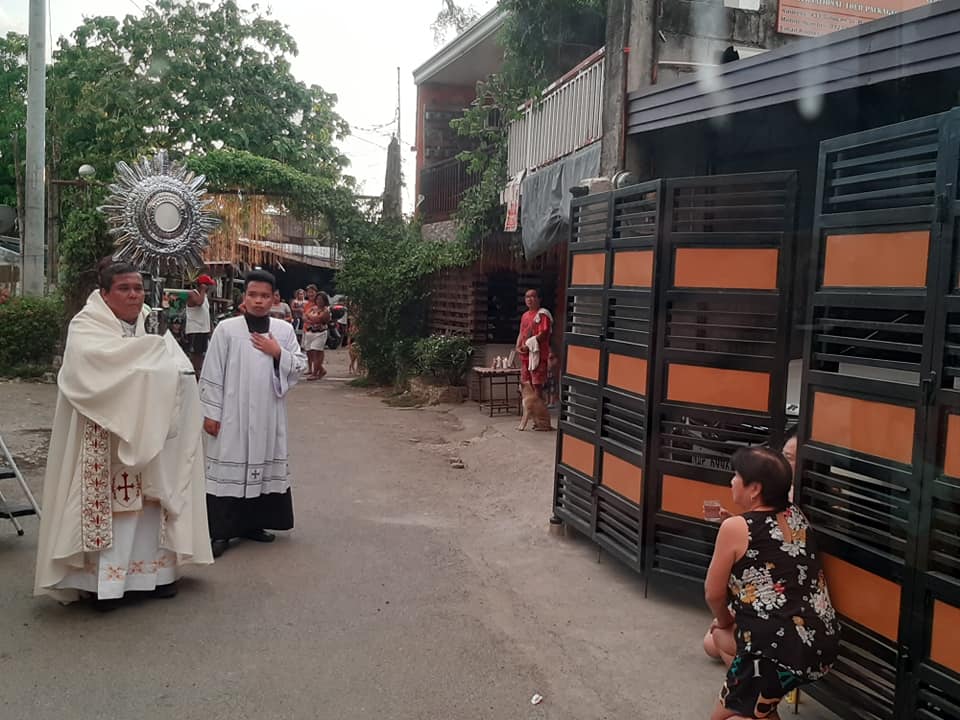
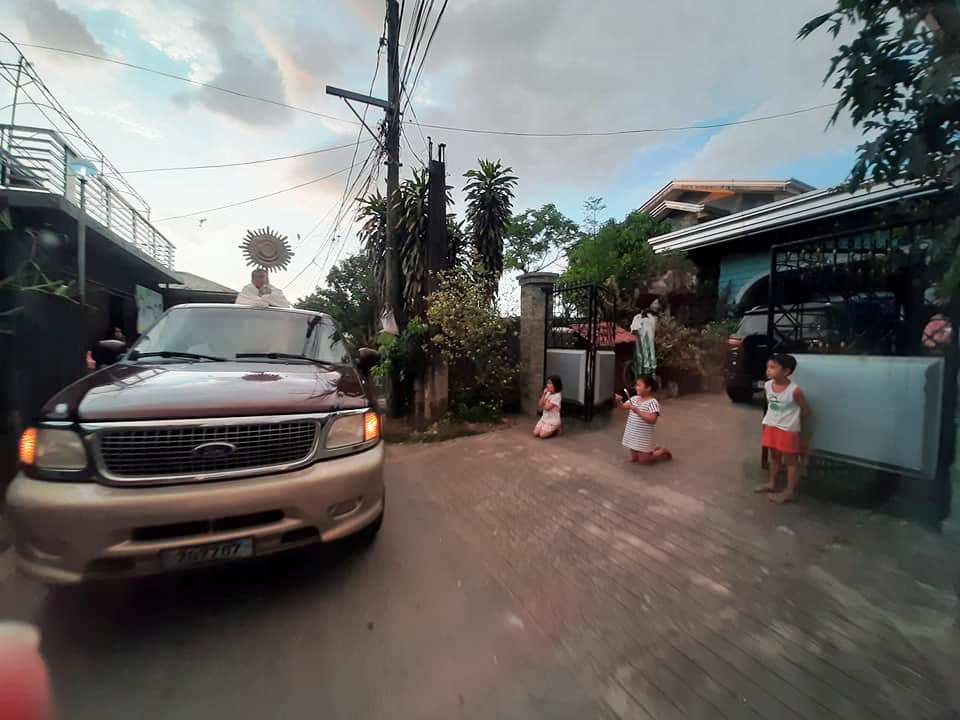
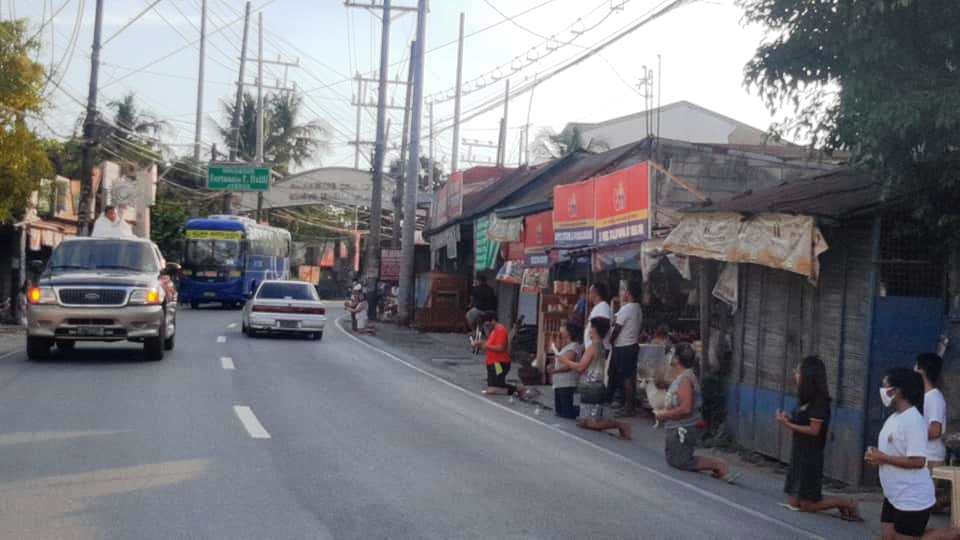
Every Sunday afternoon since this lockdown began due to COVID-19, we have been bringing the Blessed Sacrament around our Parish to remind the people of Christ’s presence among us.
And every Sunday, I am amazed at the faith of the people who would kneel on the side of the road, totally believing that it is Jesus himself who visits them in the Blessed Sacrament.
The sight is so moving with people from all walks of life bowing their heads or raising their hands, recognizing Jesus in the Blessed Sacrament as they pray in silence with others crying. The few motorists passing by stop at the side of the road to see Jesus and be blessed while others get near our truck for a blessing.
Here lies the great mystery of Easter: Jesus need not appear to us in person because as he vanishes in the Blessed Sacrament, that is when we recognize him!
In the most simple gestures of the Mass under the most simple signs of bread and wine, Jesus vanishes from our outward view and through this vanishing our interior or inner recognition opens up that we “see” him in the many instances he had touched us especially in our “heart-breaking” experiences in the past.
We know with certainty that “it is the Lord” – Dominus est – present in every breaking of bread because part of the Easter mystery tells us deep within that it is only in his vanishing that he truly becomes recognizable to us.
What a shame and a tragedy especially in these days of live television or internet Mass when priests do all the gimmicks and antics to wow the people as if they are audience in a show than faithful in a sacred gathering.
May we not forget this mystery of Easter that, the more Jesus vanishes, the more we recognize him because Jesus is more than enough than anybody or anything else especially in the Mass. And when we pray “Stay with us, Lord”, we actually ask for more faith to believe in him to see him in his vanishing. Amen.
A blessed week ahead to everyone! Stay safe, stay in the Lord.