Lawiswis Ng Salita ni P. Nicanor F. Lalog II, Ika-22 ng Pebrero 2024
Larawan kuha ni Stefano Rellandini ng Reuters sa Manila Cathedral, Enero 15, 2015. Binatikos at binash (dapat lang) ng mga netizens mga pari noong Misa ni Papa Francisco sa Manila Cathedral nang mapansing walang tigil nilang pagkuha ng mga video at larawan, di alintana kasagraduhan ng Banal na Misa.
Ang demonyong cellphone palaging nasa loob ng simbahan hindi upang magsimba o manalangin kungdi upang tayo ay linlangin mawala tuon at pansin sa Diyos na lingid sa atin, unti-unti na nating ipinagpapalit sa demonyong cellphone na halos sambahin natin!
At iyan ang pinakamalupit na panunukso sa atin ngayon ng demonyong cellphone na ating pahalagahan mismo sa loob ng simbahan habang nagdiriwang ng Banal na Misa at iba pang mga Sakramento gaya ng pag-iisang dibdib ng mga magsing-ibig!
Isang kalapastanganan hindi namamalayan ng karamihan sa kanya-kanyang katuwiran gaya ng emergency, importanteng text o tawag na inaabangan, higit sa lahat, remembrance ng pagdiriwang: nakalimutan dahilan ng paqsisimba pagpapahayag ng pananampalataya sa Diyos na hindi tayo pababayaan kailanman; kung gayon, bakit hindi maiwanan sa tahanan o patayin man lamang o i-silent sa bag at bulsa ang demonyong cellphone?
Hindi man natin aminin ang demonyong cellphone ang pinapanginoon, pinagkakatiwalaan ng karamihan kaysa Diyos at kapwa-tao natin kaya pilit pa ring dadalhin, gagamitin sa pagsisimba at pananalangin!
Kung tunay ngang Diyos ang pinanaligan habang ating pamilya at mga kaibigan ang pinahahalagahan, bakit hinahayaang mahalinhan ating buong pansin ng pag-atupag sa demonyong cellphone tangan natin?
Pagmasdan sa mga kasalan sa halip ating maranasan kahulugan ng pagdiriwang, kagandahan at busilak ng lahat, asahan aagaw ng eksena demonyong cellphone kahit mayroong mga retratista naatasang kunan at ingatan makasaysayang pagtataling-puso kung saan tayo inanyayahan upang ipanalangin na pagtibayin pagmamahalan haggang kamatayan na ating tuluyang nakalimutan matapos tayo ay nalibang at nalinlang ng demonyong cellphone.
Sa bingit ng kamatayan naroon ating "last temptation" ng demonyo sa anyo pa rin ay cellphone upang sa halip na ipanalangin naghihingalong mahal natin, demonyong cellphone pa rin sa kahuli-hulihan ang hawak habang kinukunan huling sandali ng pagpanaw Diyos na ating kaligtasan, tinalikuran!
Lawiswis Ng Salita ni P. Nicanor F. Lalog II, Ika-15 ng Nobyembre 2023
Ang kauna-unahang may sakit na aking pinahiran ng Banal na Langis ay ang tiyahin ng aking ina na kung tawagin namin ay Ned. Ayon sa nanay ng aming ina na Ate ng Ned, utal daw kasi ang dalawang nauna niyang anak at hindi masabi ang Nana Cedeng(o Chedeng), ang palayaw ng kanyang tunay na pangalang Mercedes.
Kaya, naging Ned na ang nagisnang tawag ng mga mommy ko at pati na kaming magpipinsan na kanyang mga apo. Walang anak ang Ned dahil maaga siyang nabiyuda nang magka-cancer ang kanyang kabiyak na siyang tunay na taga-Bocaue, Bulacan. Mula sa Aliaga, Nueva Ecija ang mga lola ko sa panig ng aking ina na mula sa angkan ng mga Bocobo.
Nang ako ay magdiriwang ng aking Primera Misa Solemne bilang bagong orden na pari noong ika-26 ng Abril 1998, hindi na nakapaglalakad ang Ned kaya bago kami magprusisyon, siya ay aking dinalaw at pinahiran ng Langis ng Maysakit. Pagkaraan ng ilang Linggo, sinugod siya sa ospital dahil sa stroke at nag-comatose kaya kinailangang ipasok sa ICU. Hindi naman siya kaagad namatay tulad ng iba kong pinahiran ng Langis ng Maysakit….
Pagkaraan ng isang linggo, inilipat na siya ng regular na silid at aking dinalaw. Hindi naapektuhan ng stroke ang kanyang pananalita. Tumingin siya ng matagal sa akin at pagkaraan ay hiniling na lumapit sa kanya.
“Mayroon akong ikukuwento sa iyo, Father, pero hindi ko alam kung ikaw ay maniniwala” sabi niya sa akin. Hinagod ko kanyang noo gaya ng ginawa niya sa akin noong ako ay natigdas nang bata pa. “Ano po inyong sasabihin?”, tanong ko sa kanya.
Larawan kuha ni G. Bryan San Luis, Kapistahan ni San Martin ng Tours, Patron ng Bayan ng Bocaue, Bulacan, 11 Nobyembre 2023.
“Father… ako e namatay na. Ang natatandaan ko lang ay naglalakad ako mag-isa sa madilim na kalsada. Maya-maya may nakita akong liwanag at bigla mayroong sumalubong sa aking mama na naka-kabayong puti. Sinabi sa akin nung mama, ‘Cedeng, magbalik ka na ika… hindi mo pa oras.'”
Sabi ng Ned, kaagad naman siyang tumalikod at naglakad pabalik ngunit muli niyang nilingon yung mama na naka-kabayo. Tinanong daw niya, “Hindi ba kayo si San Martin ng Tours?” At sumagot naman daw yung mama na siya nga si San Martin ng Tours. “E paano po ninyo ako nakilalang si Cedeng?” tanong daw niya. Sumagot daw si San Martin, “Paanong hindi kita makikilala, Cedeng, e kada piyesta ng Mahal na Krus at kapistahan ko ay nagsisimba ka palagi sa Bocaue?” Nangiti raw si San Martin sa kanya at di na niya nalaman ang mga sumunod maliban sa makita sarili niya naroon na sa ospital.
Wala daw siyang pinagsabihan ng karanasang iyon maliban sa akin dahil ako ay pari. At muli niya akong tinanong, “naniniwala ka ba Father na pinabalik ako dito ni San Martin ng Tours?” Hinagod ko muli ang noo ng Ned at sinabi ko sa kanyang “Opo, naniniwala po ako sa inyo.”
Larawan kuha ni G. Bryan San Luis, si San Martin aming Patron kasama ang Mahal na Krus sa Wawa na amin ding ipinagpipista tuwing buwan ng Hulyo sakay ng pagoda sa Ilog ng Bocaue.
Tumagal pa ang Ned ng limang taon bago siya pumanaw noong ika-5 ng Hulyo, 2003. Mismong sa harap ko siya namatay nang siya ay aking dalawin matapos ako magmisa sa kapit-bahay niyang namatay.
Naku, kay laking isyu noon sa aming lugar ang pagkamatay ng Ned. Ako sinisisi ng matatanda kasi daw inuna kong puntahan ang patay bago ang buhay! Ewan ko sa kanila ngunit pagpapala ang aking naranasan at nakita sa pangyayari: nang malagutan ng hininga ang Ned sa harap ko, kaagad kong tinawag ang kanyang tagapag-alaga, pinahiran ko pa rin siya ng Banal na Langis, at nang matiyak na patay na siya, kaagad akong nagmisa mag-isa doon sa kanyang silid kasama malamig niyang bangkay. (Ewan ko ba. Dalawang pari na rin, parehong Monsignor, ang namatay sa harapan ko at sa pangangalaga ko.) .
Palagi ko ikinukuwento ang “near-death experience” na iyon ng aking Lola hindi lamang sa dahil kakaiba kungdi mayroong malalim na katotohanang inihahayag – ang pagmamahal sa ating parokya, ang pananalangin ng mga Banal sa atin at higit sa lahat, ang kahalagahan ng Banal na Misa na siyang “daluyan ng lahat ng biyaya at rurok ng buhay Kristiyano” ayon sa Vatican II. Wika ni San Juan Pablo II, sa Banal na Misa aniya ay mayroong cosmic reality
Nang magkaroon ako ng sariling parokya noong 2011, isa iyon sa mga una kong kinuwento sa mga tao upang ituro pagmamahal sa kanilang parokya. Ipinaliwanag ko sa kanilang ang mga Banal na mga Patron ng parokya ang unang nangangalaga sa mga mananampalataya, ang ating mga tagapagdasal doon sa langit, mga taga-pamagitan.
Larawan kuha ni G. Bryan San Luis, prusisyon noong Kapistahan ni San Martin ng Tours, Patron ng Bayan ng Bocaue, Bulacan, 11 Nobyembre 2023.
Naniniwala ako na si San Martin ng Tours ang sumalubong kay Ned kasi nga hindi pa naman niya oras, kaya wala pang paghuhukom na naganap sa kanya na tanging si Jesu-Kristo lang ang makagagawa.
Ang pinaka-gusto kong bahagi ng kanyang kuwento ay ang kanilang usapan kung paano nakilala ni San Martin ang aking Lola sa tunay niyang palayaw na Cedeng. At hindi Ned.
Ipinakikita nito sa atin ang kahalagahan ng pagsisimba tuwing Linggo at mga pistang pangilin sa simbahan lalo ngayon panahon na akala ng marami ay sapat na ang online Mass. Ang Banal na Misa ay “dress rehearsal” natin ng pagpasok sa Langit. Kay sarap isipin na bukod sa Panginoon at Mahal na Birheng Maria na sasalubong sa atin doon ay kasama din ang Patron ng ating Parokya na kinabibilangan natin. Nakalulungkot maraming tao ngayon ni hindi rin alam kung ano at saan kanilang parokya! Alalahanin mga nakita ni San Juan Ebanghelista sa langit habang siya ay nabubuhay pa upang isulat sa Aklat ng Pahayag:
At narinig ko ang isang tinig mula sa langit na nagsasabi, “Isulat mo ito: Mula ngayon, mapapalad ang naglilingkod sa Panginoon hanggang kamatayan!” “Tunay nga,” sabi ng Espiritu. Magpapahinga na sila sa kanilang pagpapagal; sapagkat susundan sila ng kanilang mga gawa.”
Pahayag 14:13
Anu-ano nga ba ating mga pinagkakaabalahanan sa buhay ngayon? Anu-ano ating pinag-gagawa na susundan tayo sa kabilang buhay upang ating ipagpatuloy? Kabutihan ba o kasamaan? Huwag nating sayangin pagkakataong ipinagkakaloob sa atin ng Diyos ngayon. Siya nawa.
San Martin ng Tours, ipanalangin mo kami.
Larawan mula sa flickr.com ng isang icon ni San Martin ng Tours hinahati kanyang kapa para sa isang pulubi.
The Lord Is My Chef Sunday Recipe for the Soul by Fr. Nicanor F. Lalog II
Twenty-Eighth Sunday in Ordinary Time, Cycle A, 15 October 2023
Isaiah 25:6-10 ><}}}}*> Philippians 4:12-14, 19-20 ><}}}}*> Matthew 22:1-14
Photo by Mr. Jay Javier in Taal, Batangas, 15 February 2014.
I grew up in a generation when dressing properly – meaning, decently – was deeply inculcated both at home and the school. It has always been considered in our time as a sign of maturity when we come properly attired in every occasion.
Now, those days are gone along with the expression “Sunday’s best” when sneakers are paired with formal suits and worn even in weddings! Dressing has become so relative with total disregard for basic fashion sense and worst of all, without any sense of propriety at all in the name of personal comfort and style as well as individuality. That culture on “liberal” or “liberated” dressing has encroached into the church with priests refusing to wear the proper garments and dress as required by Code of Canon law. How ironic that while the lay people appreciate us priests dressed properly for the liturgy and ministry, the harshest insults and negative reactions against it come from some priests who argue using the hot weather as an excuse. Many priests have subscribed to the lame excuse of people that clothes do not make us who we are, that there is much more beneath the clothing we wear of who we really are.
True but not absolutely because what we wear, how we look outside is indicative of who we are, what we value, what we believe in. Dress speaks a lot about ourselves whether we like it or not as the Lord’s parable this Sunday teaches us.
The servants went out into the streets and gathered all they found, bad and good alike, and the hall was filled with guests. But when the king came in to meet the guests he saw a man there not dressed in a wedding garment. He said to him, ‘My friend, how is it that you came in here without a wedding garment?’ But he was reduced to silence. Then the king said to his attendants, ‘Bind his hands and feet, and cast him into the darkness outside, where there will be wailing and grinding of teeth.’ Many are invited, but few are chosen.”
Matthew 22:11-14
Photo by Fr. RA Valmadrid, National Shrine of Our Lady of Fatima, 13 October 2023.
We now come to the third and final series of parables addressed by Jesus Christ directly to his enemies, the chief priests and elders of the people while teaching at the temple area in Jerusalem to underscore to them the need to reform their lives and be converted to his good news of salvation like the tax collectors and prostitutes.
See how in today’s parable some semblances with the parables of the two sons and wicked tenants of the past two weeks to show us God’s loving patience in doing everything to make us come to him like the subjects of the king with all the chances to come to his son’s wedding banquet.
And like with the parables of the past two Sundays, Matthew makes again a crucial twist in today’s parable that can be sufficiently ended in that part when the king was enraged by the continued refusal of his guests to come to his son’s wedding banquet that he ordered them all killed and instead extended his invitation to everyone in the streets.
The wedding banquet is heaven like the vineyard in the parables of the past two Sundays.
But it is not only referring to heaven at the end of time but also speaks so well of the here and now – the present life we live as citizens of the kingdom of God in Jesus Christ. Rejecting the invitation to come to the meal which as an expression of our citizenship in God’s kingdom is an act of disloyalty and treason against him.
Photo by Arch. Philip Santiago, Hearts of Jesus and Mary parish, Malolos City, 2022.
When we were baptized, we became citizens of the kingdom of God. We do our “pledge of allegiance” to God as his citizens every time we pray and most especially celebrate Mass which is just half of the whole deal of being citizens of his kingdom! Like in being Filipinos or whatever nationality we have, we must live up to our citizenship in God’s kingdom by being good and holy. That is the wedding dress referred to in the parable, the life we lead as children and citizens of God and his kingdom.
Jesus invites us today to face squarely the uncomfortable issues that prevent us from being his good and faithful disciples and citizens of God’s kingdom. Many times we are like those invited guests in the parable who allowed something else in their lives like their wealth and possession, businesses and worldly pursuits become more important than their allegiance to the King. Every time we sin, every time we skip the Sunday Mass, that is when we have our new God and King that may be our very selves, gadgets, vices, or the malls we frequent more than the church!
Here we find a deepening in Jesus Christ’s invitation to conversion into conforming our lives into him. St. Paul made a lot of beautiful imageries of “putting on Jesus Christ” as our new clothes and garment which we have retained in the Rite of Baptism when the newly baptized is clothed with the white dress. See how the man caught by the king fell silent when confronted because there was no excuse at all at not wearing the wedding dress in the banquet. The same thing is true with us today. We have no excuse for not being dressed, for not being conformed in Jesus Christ in our lives as his disciples. Everyday he gives us the opportunities of being conformed to him through our daily conversions through prayers and good works. God does not expect us to wear extravagant nor expensive clothes for his wedding banquet; just a clean and decent clothes are enough. Nobody is perfect.
Photo by Dra. Mylene A. Santos, MD at Tagalag, Valenzuela City, 13 September 2023.
One of the things I used to enjoy in my school and seminary days were joining stage plays. Yes, I love acting but I just don’t know if acting (and singing) love me. Nonetheless, one of our most dreaded moments before the actual play was always the dress rehearsal when everything is considered as the “real thing”, the real play as our teaches and nuns have insisted when we were supposed to have memorized our lines and cues.
But, as I grew and matured, I realized that life is not a dress rehearsal at all; each day is an actual “play”, a “live” presentation where we must “perform” or “act” so well. Yes, we are all required to memorize our lines and cues in life but many times, we forget them. Nobody is perfect. And here lies the immense love and kindness of God to us: he allows us to improvise for our selves in case we have forgotten our lines just like those people instantly invited to the wedding banquet of the King’s son. They were able to improvise to make it to the banquet hall except for that one who came not dressed for the occasion. He was silent because he was so lazy to improvise, to find ways like the chief priests and elders in the time of the Lord. Until now, many of us make a lot of excuses and alibis for not being conformed in Christ, from the ordinary excuse of being “difficult” to the most absurd that “I am only human” or tao lamang, mahina at marupok. Keep in mind St. Paul’s words in the second reading, “I can do all things in him who strengthens me… My God will supply whatever you need, in accord with his glorious riches in Christ Jesus” (Phil.4:13, 19).
Photo by Ka Ruben, National Shrine of Our Lady of Fatima, 2022.
Every Sunday we are invited to celebrate with others the coming of Jesus and the salvation he has won for us. This wedding banquet is the Sunday Mass we celebrate, a fulfillment of the first reading from Isaiah of that mountain where “the Lord of hosts will provide for all peoples a feast of rich food and choice wines, juicy, rich food and pure, choice wines” (Is. 25:6). In the Holy Eucharist, we have the choicest food and drinks – the Body and Blood of Jesus Christ – given to us to nourish us and keep us strong in this journey of life into eternity in heaven with the Father.
How amazing that nothing is really imposed upon us in coming to this banquet of the Lord in the Eucharist that is totally free of charge except that we have to come properly dressed on the inside, of being conformed in him.
But please, let’s get dressed also on the outside. No need to wear expensive and beautiful clothes. Just proper and clean ones are more than enough. A good rule of thumb we can rely on is this: God has blessed me tremendously this week and I am coming to celebrate with him, for him. How do I look to to express to him my gratitude and appreciation to his wondrous gifts? Amen. It is a Sunday, go to Mass!
The Lord Is My Chef Daily Recipe for the Soul by Fr. Nicanor F. Lalog II
Homily for the 106th Anniversary of Last Apparition in Fatima, 13 October 2023
Isaiah 61:9-11 ><}}}}*> Galatians 4:4-7 ><}}}}*> Luke 11:27-28
Today – October 13, 2023 – is the 106th anniversary of the last apparition of the Blessed Virgin Mary at Fatima, Portugal when the “Miracle of the Sun” happened, witnessed by about 70,000 people. It was her sixth apparition to the three young children at Cova da Iria that started in May 13, 1917.
Except for the month of August when authorities jailed the three children on August 13 on their way to Cova da Iria to force them to recant their earlier statements of the apparition, the Blessed Mother appeared to them on August 19 at the nearby Valinhos where she repeated her calls for prayers and sacrifices as well as the request for them to come every 13th day until the coming October when she reveals herself after a great miracle.
What is significant with the 13th day of each month that Mary appeared in Fatima from May to October 1917 that we have continued with this 13th Day Devotion?
From Pinterest.com.
The Blessed Mother never explained to the three children, now St. Francisco and his sister St. Jacinta Marto and their cousin Sr. Lucia dos Santos why she appeared to them every 13th day of each month.
According to later interviews with Sr. Lucia who became a Carmelite sister and the last to die of the three children in 2005, she believed as the fruit of her prayers that the number 13 signified the Blessed Trinity. Sr. Lucia explained that number “13” illustrates to us that there is one (“1”) God in three (“3”) Persons (she was recently declared Venerable by Pope Francis to pave the way for her sainthood).
Here we find anew in the Fatima apparitions the consistency of truths found in our Church teachings and doctrines, specifically, the Blessed Trinity, that there is One God in Three Persons. Saints have also tried to explain the Blessed Trinity in simple analogies like the number 13 reflection of the Venerable Sr. Lucia.
In a 2022 article by Catholic author Joseph Pronechen that appeared in Soul magazine (see, https://www.bluearmy.com/the-significance-of-fatimas-13th-day/), he presented how the number “13” has many biblical foundations to be chosen by the Blessed Mother in Fatima as date of her apparitions. Foremost of this is found in the Old Testament Book of Esther.
Esther was among the Jewish exiles living in Persia after the Babylonian captivity. She was said to be so lovely and beautiful that the Persian king, Ahasuerus chose her to be his Queen among his many wives. Her uncle named Mordecai was the King’s most trusted adviser too that earned the jealousy among Persians in the royal court. Both Mordecai and Queen Esther remained faithful to God despite their royal positions. Esther then discovered a plot by some of the King’s men to exterminate all the Jews in Persia, especially her uncle Mordecai. It was at this instance that she prayed so hard to God for her to be able to warn her King of his men’s evil plot against the Jews even it could have cost her own life.
By the grace of God, Esther was able to muster all the strength and courage to speak to King Ahasuerus to foil the evil plot of his men set on “the 13th day of the twelfth month of Adar” (Esther 3:7).
The Persian king truly loved Queen Esther and ordered the arrest and execution of his aide (Haman) to prevent the murder of so many Jews. Queen Esther thus saved her fellow Jews on the 13th day of the Jewish month of Adar! And because of her intervention, King Ahasuerus ordered Jews in his kingdom to freely worship their God with assurance of protection from enemies.
Like Queen Esther, the Blessed Virgin Mary is also our Queen being the Mother of the King of kings, Jesus Christ. Every August 22 we celebrate her Queenship and in the Glorious Mysteries, we meditate her being Queen of heaven and earth.
Most of all, like Queen Esther, the Blessed Virgin Mary in Fatima intervened on October 13, 1917 to save the world from the ongoing WWI that began in 1914 and ended the following year in 1918. Sad to say, the world was plunged anew into the darkness of WWII that was more deadlier in 1939-1945 as predicted by our Lady at Fatima if the world would not heed calls for repentance and conversion of sinners. In recent history we have witnessed how our Queen Mother Mary saved St. John Paul II on May 13, 1981 – her feast day as our Lady of Fatima – from a deadly assassination attempt at St. Peter Square in the Vatican. Again, the world is in the darkness of deadly wars right in the Holy Land and in Ukraine by Russia whom the Virgin Mary had specifically mentioned in her October 13, 1917 apparition at Fatima.
When are we going to follow her maternal instructions of repentance and conversion, something which she merely repeated from similar calls by Prophets in the Old Testament and by her Son Jesus Christ in the gospels?
If we truly consider Mary is our Queen, why can’t we obey her and follow her instructions more than 100 years ago?
See how in today’s gospel Jesus underscored the importance of listening and following his words as main component of being part of his family. Mary was the first to listen and act on his word at the Annunciation and until now, she does the same thing so we may be saved from the wraths of evil caused by man’s inhumanity to one another.
Page from Ilustração Portuguesa, 29 October 1917, showing the people looking at the Sun during the Fátima apparitions attributed to the Virgin Mary. From en.wikipedia.org.
Going back to the Sacred Scriptures, we find more bases of the significance of number “13” used by the Blessed Mother at Fatima in 1917. In the Book of Acts, we find that when the Holy Spirit came on Pentecost, the 12 Apostles (Matthias replaced Judas Iscariot) were with “Mary the mother of Jesus” (Acts 1:14). Here we find 12 (Apostles) + 1 (Mary) = 13!
In the gospel accounts, we know Jesus Christ’s choice of 12 apostles was from the “12 tribes of Israel” or 12 sons of Jacob who was also called by God as “Israel”. Again, 12 + 1 = 13.
According to an interview by Pronechen of a Jewish rabbi, the meaning of number 13 in Hebrew is “bonding of many into one”. Every time we pray the Apostle’s Creed, we profess our faith not only in God in Three Persons but also to the Catholic Church that bonds us into Christ’s body who was born of the Virgin Mary. In Fatima on October 13, 1917, our Lady called on us to be one in God through Jesus in prayers, fasting and sacrifices, and commitment to live as true Christians.
Most of all, Pronechen explained that according to the Jewish rabbi he had interviewed, every letter in the Hebrew language has a numeric value. The word “love” which is ahava in Hebrew is connected with God with a numeric value of 13. Now, consider that when the Virgin Mary first appeared at Fatima on May 13, 1917, it was the original feast of Our Lady of the Blessed Sacrament. Here we find another intimate link in our Lady of Fatima’s insistence in celebrating Mass and receiving Jesus in the Holy Communion often because the Holy Eucharist is the Sacrament of Love.
How wonderful to meditate that our Blessed Mother Mary appeared in Fatima 106 years ago today with that singular message and expression of God’s love for us all!
When are we going to listen to her call for us to truly live in the love of God expressed by Jesus Christ on the Cross? Amen. Have a blessed weekend everyone!
From cbcpnews.net, 13 May 2022, at the Parish of the National Shrine of Our Lady of Fatima, Valenzuela City.
The Lord Is My Chef Sunday Recipe for the Soul by Fr. Nicanor F. Lalog II
Solemnity of the Body & Blood of Jesus Christ, 11 June 2023
Deuteronomy 8:2-3, 14-16 ><}}}}*> 1 Corinthians 10:16-17 ><}}}}*> John 6:51-58
Photo by author, 2018.
There is a weird British series in Netflix called the Inside Man about a professor of criminology at the death row in the States for the murder of his own wife. He had deep perceptions and analysis of events that people came to see him in prison to consult in locating their missing loved ones. One of them is an American journalist trying to do a story about him while at the same time seeking his expertise in locating her missing friend, a math tutor in England held hostage in the basement by a pastor and his wife.
Though the series is weird, it has some interesting lines about life and death like when the wife of the pastor told him how she had spent the whole afternoon searching the internet how to kill their son’s math tutor they have thrown in their basement. The wife found it unusual there was nothing in Google that tells of ways of killing another person (so weird, is it not?); however, she was surprised that almost everything she had found in the internet and social media was mainly about sex as he teased her husband that it is not love that makes the world go round but sex!
Yes, it is very funny and weird but her observations seem to be true because nobody in his right mind would ever want to destroy life except terrorists and lunatics. People generally love life that our social media are saturated with contents that try to show how we can enjoy this life through sex, food, and travels in that order. Also with cars for boys aged 5 to 95.
Photo by author, March 2020.
Of course, we all know that is not what life is all about that is filled with mysteries.
Last Sunday we reflected in the Solemnity of the Holy Trinity that mysteries are not problems to be solved but realities to embrace to discover life’s truest meaning found in our relationships with God and with others
This Sunday we celebrate the second most important doctrine and mystery of our faith, the Incarnation of the Son of God Jesus Christ. It is a mystery not only how the Son of God became human like us in everything except sin but most of all, of how he has given us his very flesh and blood as our food and drink in this journey called life.
Jesus said to the crowds: “I am the living bread that came down from heaven; whoever eats this bread will live forever; and the bread that I will give is my flesh for the life of the world.” The Jews quarreled among themselves saying, “How can this man give us his flesh to eat?” Jesus said to them, “Amen, amen, I say to you, unless you eat the flesh of the Son of Man and drink his blood, you do not have life within you. For my flesh is true food, and my blood is true drink.”
John 6:51-53, 55
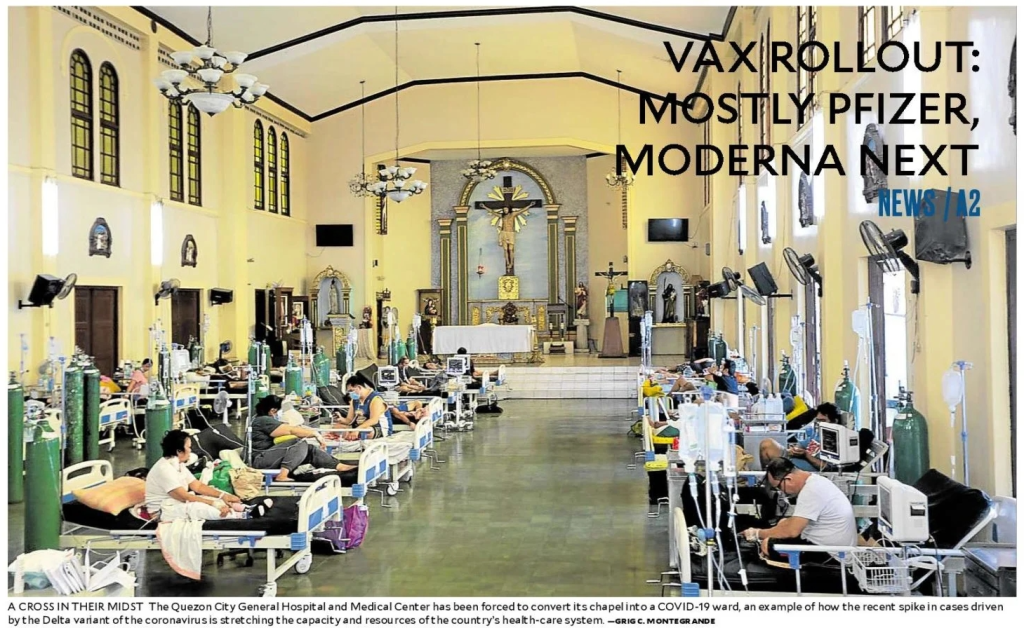
My favorite front page photo during the Delta outbreak of the COVID-19 pandemic published by the Inquirer on 20 August 2021. So evocative of the truth of Jesus himself being our true food and drink – and medicine.
As we have reflected last Sunday, a mystery is a divine truth revealed by God we learn through the gift of faith. It is non-logical but not illogical. It can be explained and understood but not fully.
Here in the mystery of the Body and Blood of Christ we call as the Eucharist, the mystery of our Triune God becomes a reality in our life truly present in perceptible signs of bread and wine. From relating, we now come to the mystery of sharing of our selves like God who shared us his Son Jesus Christ who in turn gave himself for us on the Cross that continues today in the Holy Eucharist as his everlasting sign of his loving presence and service.
See how Jesus spoke clearly in this passage of his giving us his physical body and blood that to receive it, we have to actually eat it too.
First we notice is how in other parts of the New Testament that the term soma is used to refer to the Eucharist which is the Greek word for “body” that may have symbolic meanings; but in this passage, Jesus used the word sarx which means “flesh” in Greek that means only one thing, the corporeal reality of his physical body. Jesus is telling us in no uncertain terms in this passage after the miracle feeding of more than 5000 in the wilderness that he himself is truly and really present as flesh and blood in the Eucharist. Recall that at his Prologue to his gospel, John also used the same term sarx in declaring “the Word became flesh” (Jn.1:14) to correct misunderstandings and doubts that were already developing during the first century of Christianity regarding the physical Incarnation of Jesus the Eternal Word and his true presence in the Eucharist.
Second term used by Jesus four times as he emphasized the reality of his Body and Blood in the Eucharist is the word trogein which in Greek means “to munch” or “bite”; the other Greek word for the verb to eat is phragein which evokes many symbolic meanings like “digesting” a book or “assimilating” the culture. Again, when Jesus said we have to eat his flesh and drink his blood, he truly meant himself as a true food and true drink to nourish and sustain us in this life and hereafter.
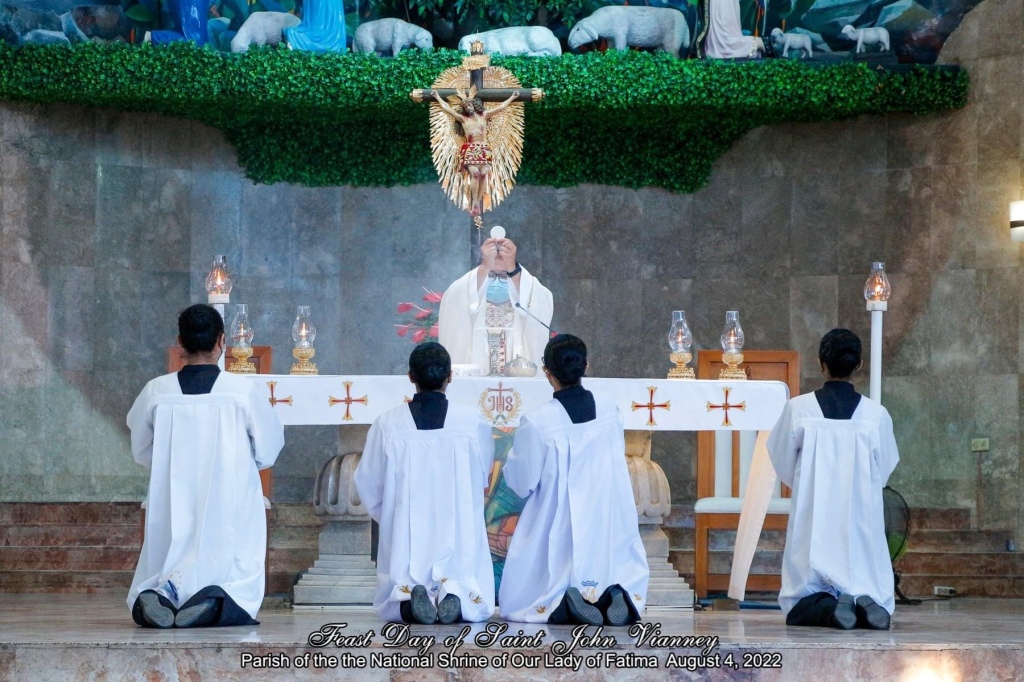
Photo by Kuya Ruben, 04 August 2022.
There lies the beauty of this mystery of the Eucharist: Jesus himself is the one we receive, who comes to us personally, physically to be one with us in our very selves. We do not have to wait for death and be in heaven to experience fullness of life in Christ because he comes truly to us while in this life when we receive him in the Holy Communion.
St. Paul reminds us in the second reading with his rhetorical questions, “The cup of blessing that we bless, is it not a participation in the blood of Christ? The bread that we break: is it not a participation in the body of Christ?” (1 Cor. 10:16) of this reality of Christ’s presence in us and among us. He was not waiting for answers of yes or no but posed those questions to affirm the very truth we all know that Jesus is really present in us and among us especially when we are broken like the Israelites in the first reading. This is where the mystery deepens, becomes more real and more fascinating. Jesus the Son of God emptying himself to be like us in everything except sin so that we may become like him, holy and divine.
This I have learned in my two years of being a chaplain in the hospital. Admittedly, it is difficult especially for me as I could easily be carried away by emotions in seeing the sick and suffering while at the same time, can often have my stomach overturned by sights of blood and wounds of others. But, there is always that indescribable feelings of joy and fulfillment after visiting and anointing our sick patients.
Photo by Kuya Ruben, June 2022.
I have no claims to holiness as I am a sinner too but the Eucharist has become most truest to me these past two years in the hospital and university as well as I get into contact with the sick and the students. When I touch patients to pray over them or help in moving them, when students cry to me or ask for hugs after confessions, they all flash to me during the consecration as I raise and say, This is my Body… This is my Blood. Jesus is most truest in the Eucharist when we too imitate him in giving ourselves to others to be broken and shared.
The Eucharist is the most wonderful gift of God to us when we receive his Son Body and Blood to make us strong and holy like him in this life.
That is why we have to go to Mass every Sunday. That is why a priest has to celebrate Mass daily for the people to be strengthened like him in this journey of life filled with trials and sufferings. That is why Moses kept on reminding the Israelites of their many hardships from their exodus into their wandering in the wilderness. That is why this coming Friday, we cap these three weeks of transition into the Ordinary Time with the Solemnity of the Most Sacred Heart of Jesus, another mystery of Christ truly among us and within us as we experience his love most truly right here in our hearts.
What an awesome God we have indeed who has become so small and so simple like us so we can be great like him. Like the simple bread and wine, in the Mass through the Holy Spirit, they become Christ’s Body and Blood. Let’s make it happen this Sunday in our celebration of the Mass. Amen.Have a blessed week ahead.
The Lord Is My Chef Daily Recipe for the Soul by Fr. Nicanor F. Lalog II
Thursday after Pentecost,
Feast of Our Lord Jesus Christ,
the Eternal High Priest, 01 June 2023
Genesis 22:9-18 ><]]]]'> + <'[[[[>< Matthew 26:36-42
Photo by Mr. Mon Macatangga, 12 May 2023.
God our loving Father,
thank you for allowing us
to reach the first half of the year
and what a tremendous blessing
on this first day of June we are
also celebrating the Feast of
your Son, our Lord Jesus Christ,
the Eternal High Priest.
In Jesus Christ
you have given us
the perfect mediator
to you, our Father
and to one another
as brothers and sisters.
In Baptism,
you have made us share
in your priesthood, Lord Jesus;
you have weakened the
COVID virus and how sad
that now we are free to
travel, many of us have refused
to come back to Sunday
Eucharist when we exercise
Christ's priestly ministry.
May our lives be a life of
worship to you, O God,
like Abraham, trustingly
obeying you even in
giving up those most
precious to us.
Again then Lord’s messenger called to Abraham from heaven and said: “I swear by myself, declares the Lord, that because you acted as you did in not withholding from me your beloved son, I will bless you abundantly…
Genesis 22:15-17
Also on this Feast of Jesus Christ
our Eternal High Priest,
we pray most fervently for our
priests that each of them may be
a man of the Word,
a man of prayer
in intimate
relationship with you, dear Jesus
so that they may give us only you, Jesus,
always you, Jesus.
We pray for priests
most especially bishops too
who have no more time to pray
to be one with you, Jesus,
as they spend more time with
people, sad to say, with the rich
and powerful forgetting your little ones
like the poor and the sick;
transform our priests and bishops,
Jesus, to be more like you
in thinking,
in speaking,
in doing,
in living,
and in loving.
Amen.

The Lord Is My Chef Daily Recipe for the Soul by Fr. Nicanor F. Lalog II
Wednesday in the Third Week of Easter, 26 April 2023
Acts 8:1-8 ><]]]]'> + ><]]]]'> + ><]]]]'> John 6:35-40
Photo by Mr. Jim Marpa, 2019.
Lord Jesus,
teach me to be a "devout"
person; not just righteous or
holy but devout as well
like those "Devout men (who)
buried Stephen and made a loud
lament over him" (Acts 8:2).
Yesterday, you taught us dear Lord
that whatever is in our heart is
reflected on our face;
today you teach us that
to be "devout" is still of the heart
which is to be of a good heart
ready to believe and act openly
with courage on that belief.
Only St. Luke used the adjective
"devout" to describe some persons
like Simeon who praised God upon
seeing Jesus when presented to the
temple by his parents; the Jews from
all over the world who came to observe
Pentecost day in Jerusalem;
the men who buried Stephen, and
Ananias who sought Saul while
still blind to bring him to the Church.
Many times dear Lord
our being devout is
self-serving when we merely
open our eyes for things
that are seen in our many
devotions, seeing more our selves
failing to see Christ in
the other persons
who have to be loved
and cared for, understood
and forgiven, accepted and
affirmed.
No wonder until now,
though we receive you Jesus
in the Eucharist, we do not
experience and feel your Body,
your Person because our hearts
are not open at all to you through
others especially the sick and
suffering. Amen.
The Lord Is My Chef Sunday Recipe for the Soul by Fr. Nicanor F. Lalog II
Third Sunday in Easter, 22 April 2023
Acts 2:14, 22-33 ><)))*> 1 Peter 1:17-21 ><)))*> Luke 24:13-35
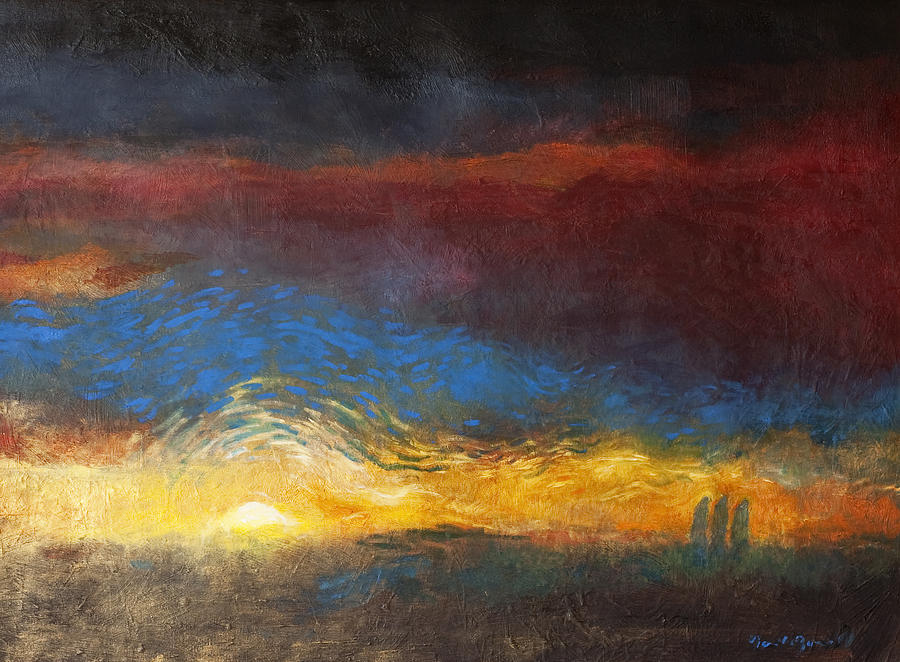
The Road to Emmaus” painting by American Daniel Bonnell from fineartamerica.com.
As I have been telling you, the beauty and joy of Easter is in its “nothingness” like the empty tomb of Jesus and its “darkness” found in the setting of the Lord’s appearances. We have found these in the past two Sundays when Jesus appeared to the Twelve “on the evening of the third day” and “eight days later” amid locked doors.
This Sunday is very different. It is the story of two disciples going back home to Emmaus whom St. Luke did not identify except the one named Cleopas. There is still the setting of darkness as it happened at sunset to early evening while news of the empty tomb was still trending amid reports Jesus had appeared to some women but still nowhere to be seen. But this time, darkness is more evident inside the two disciples walking away from Jerusalem – sad, disappointed and frustrated, forlorn.
Now that very day two of them were going to a village seven miles from Jerusalem called Emmaus, and they were conversing about all the things that had occurred. And it happened that while they were conversing and debating, Jesus himself drew near and walked with them, but their eyes were prevented from recognizing him. He asked them, “What are you discussing as you walk along?” They stopped, looking downcast.
Did you feel the sadness of the two disciples? Today, Jesus assures us of his companionship especially when we are in a “perfect storm”, when everyone and everything are against us, when it is all darkness within us, when we are at our lowest low awaiting for the next worst thing that could happen to us.
It is during these times we think of quitting, of just going home, going back where we have been before, abandoning everything because it seems better to start all over again as everyone/everything have been lost. There need not be tragedies in life for these to happen. Many times it could be when we are in the midst of grave sins or even with our most common sins repeated over and over like venial sins. We feel discouraged, even depressed we could not see any sense at all in going back to God in prayers and the sacraments especially the Holy Eucharist. Those moments we tell ourselves and everyone, “para que?” or “para saan pa?” that we would go back to God, our Jerusalem.
Like the two disciples, we have become so nega that as we walk to the opposite direction in life, we fail to notice Jesus accompanying us, making sakay (ride on) with our trip, just listening to our woes and complaints, stories of sins and failures, pains and hurts, disappointments and frustrations.
Here we find Jesus our only true friend who allows us to be our truest self, even our worst self. He walks with us not only in darkness but in the opposite direction, waiting for the prefect timing to gently bring us back to the right path to Jerusalem. And sometimes, he does it with a splash of humor like when he told the two disciples “Oh, how foolish you are! How slow of heart to believe all that prophets spoke!” (Jn. 21:25).
Many times, we fail to bring back to God and to the right path our lost family and friends because we lack the compassion and gentleness of Jesus. Very often, fail because we react than act like Jesus who’s companionship and compassion opened the hearts of the two disciples: it was only after they have unloaded their burdens when Jesus loaded them or filled them with his words and eventually with his very presence at the breaking of the bread.
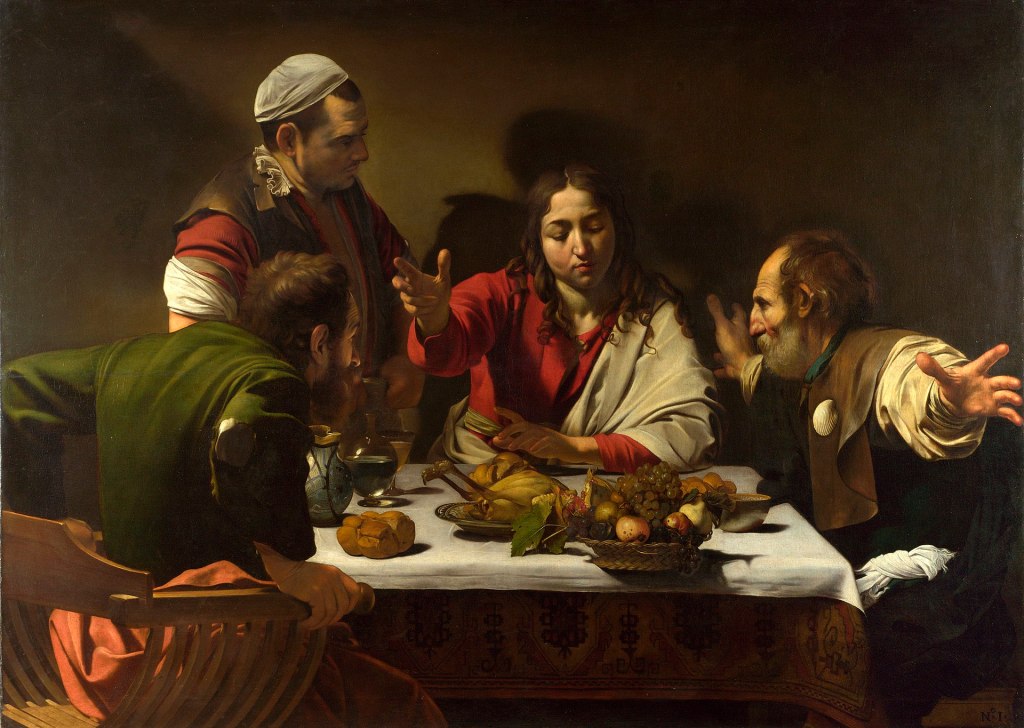
“Supper at Emmaus” by renowned painter Caravaggio from en.wikipedia.org. See the emotion depicted by Caravaggio with his trademark of masterful play of light and shadows. At the center is the Risen Lord blessing the bread that caught the two disciples who are seated in disbelief, one outstretching his arms and the others pushing back in his chair. The third character in the painting is the innkeeper unaware of the significance of the gesture of Jesus. It was at this instance that the two disciples recognized Christ as the traveling man with them to Emmaus.
Human transformation happens only in Christ, with Christ and through Christ in the Eucharist where we also experience a reversal of roles in our relationships with God and with others. Notice how the attitudes and perspectives of the two disciples changed when Jesus broke the bread. Remember it was the two disciples who invited Jesus inside to stay because it was getting dark, hosting a meal for him as their guest but that changed at the table: the two disciples ended up as guests of Jesus who merely joined them in their journey!
And it happened that, while he was with them at table, he took bread, said the blessing, broke it, and gave it to them. With that their eyes were opened and they recognized him, but he vanished from their sight. Then they said to each other, “Were not our hearts burning within us while he spoke to us on the way and opened the scriptures to us?” So they set out at once and returned to Jerusalem where they found gathered together the eleven and those with them who were saying, “The Lord has truly been raised and has appeared to Simon!” Then the two recounted what had taken place on the way and how he was made known to them in the breaking of the bread.
John 21:30-35
One thing I have found in life these past 25 years as a priest is that we can only realize and understand, even see the clearer and bigger picture of our life later after so many years of series of trials and tribulations, joys and celebrations. And often, what we see is the Lord, the companionship of Jesus Christ even in those times we were in sin and away from him. St. Peter said it so well in the second reading that we are in a “sojourning, realizing that you were ransomed from your futile conduct with the precious blood of Christ” (1 Pt. 1:17, 18, 19).
Photo by author, Sacred Heart Novitiate, Novaliches, QC, 20 March 2023.
Many times in life we feel as if we are really the captain of our ship, we direct everything, we control everything but it is actually Jesus. There is always Christ our companion in this journey of life, our true host and we are his guests who shared himself with us on the Cross so we can share in the mystery and victory of his Resurrection. In being one with us in our brokenness, Jesus immediately vanishes the moment we recognize him so we may keep on following him by changing course and direction in our lives.
In this time when people have lost interests in the Church, the Sacraments especially the Holy Eucharist, and the Scriptures along with prayers and devotions, we who are inside the church especially us priests are reminded of this important truth by Jesus, that he is the one in command, he is our host. We only share him in our co-journeyers in life, he is the one who opens our eyes, the one who effects transformation and changes within us. Not us.
Are we one with Jesus, especially in the Eucharist we manipulate so much with our many rituals and acts not necessary? See that the more we manipulate the Mass and other devotions, the more Christ disappears and persons especially priests become the focus.
In Emmaus, Jesus walked with the two disciples going the opposite direction to lead them back and never the other way around as it happens when we priests and volunteers are the ones who mislead people away from Jesus with our lack of warmth and charity for people like the unchurched.
Jesus is truest in the Eucharist when we touch people literally with our hands, when we get our hands dirty in taking care of the sick and needy, when we are truly present with them especially in their griefs, emptiness and sinfulness. That is when they experience, not just know that Jesus is real and true in the Eucharist when they first experience him in us his disciples, in our companionship and compassion with those suffering.
Nobody is perfect. As St. Peter had noted in the first reading, we are all responsible for the suffering and death of Jesus with our sinfulness; however, God’s love for us is far greater than our sins so that in our darkness and emptiness, we are able to see and have fulfillment in Jesus his Son. Amen. Have a blessed week!
Photo by author, Sacred Heart Novitiate, Novaliches, QC, 20 March 2023.
The Lord Is My Chef Recipe for the Soul by Fr. Nicanor F. Lalog II
Maundy Thursday, 06 April 2023
Exodus 12:1-8, 11-14 + 1 Corinthians 11:23-26 + John 13:1-15
Photo by author, Holy Thursday 2019, Parokya ni San Juan Apostol at Ebanghelista, Bagbaguin, Sta. Maria, Bulacan.
Tonight we begin the most solemn days of the year called the “Holy Triduum” of Maundy Thursday, Good Friday, and Easter Vigil. All roads rightly lead to the Parish Church at sundown for the celebration of the Holy Eucharist that begins with the Tabernacle empty. There will be no dismissal at the end of the Mass, it is open ended. Most of unique of all in tonight’s Mass is the ritual of the washing of feet of some members of the community.
But there is something more beautiful to the ritual washing of feet. It is the context and words from John’s gospel that set the mood of tonight’s mood and tone of celebration as well as the hint of the meaning of Good Friday too.
Before the feast of Passover, Jesus knew that his hour had come to pass from this world to the Father. He loved his own in the world and he loved them to the end.
John 13:1
Photo by author, Holy Thursday 2019, Parokya ni San Juan Apostol at Ebanghelista, Bagbaguin, Sta. Maria, Bulacan.
First thing we have to consider here is the fact that “Jesus knew his hour had come to pass from this world to the Father.” He was never caught by surprise. Jesus knew everything, was never taken over by events. Luke said it beautifully after his identification as the Christ at Caesarea Philippi, When the days for his being taken up were fulfilled, he resolutely determined to journey to Jerusalem (Lk. 9:51).
We have heard in the first reading the story of the exodus of the Israelites, their passover from Egypt to the Promised Land, their passover from slavery to freedom that was perfected by Christ’s own pasch beginning tonight with his Passion, Death and Resurrection. This is our call, to live Christ’s Paschal Mystery daily, to be one in him, one with him, one through him in passing over life’s many challenges and trials.
To passover means to grow, to mature, to overcome, to hurdle. Every day we go through many series of passovers, from sickness to health, from sinfulness to forgiveness, from failures to victory, from our little deaths to our daily rising to new life in Jesus. This we can only accomplish with love, the kind of love by Jesus Christ.
That is the second, most important thing we must consider in John’s brief introduction to our gospel tonight, Jesus “loved his own in the world and he loved them to the end”. The Greek word for the “end” is telos which is not just a terminal end in itself but indicates or connotes direction. Or fulfillment and perfection, not just a ceasing or end or stoppage of life or any operation. Jesus knew everything that is why his life here on earth had direction which is back to the Father, with us. Everything he said and did was out of love for the Father and for us.
From google.
Love is the sole reason Jesus came to the world to save us because we have failed to love from the very beginning. It is love that Jesus showed us on that Holy Thursday evening to be fully expressed on Good Friday when he died on the Cross. His whole life was love because he himself is love. This he showed when he washed the apostles feet and after that, asked them and us to do the same with each other. That is love’s highest point when we are able to get to our lowest point of service and love. In our daily passover, it is love that moves us to keep on going with life’s many ups and downs because we love our parents, our siblings, your wife or husband, your children. Our vocation and the people entrusted to us. We go through our passover we because we love.
When Jesus died on the Cross, he said, “It is finished” – meaning, he had fulfilled his mission, that is, he had perfectly loved us to the end by giving us his very life. At his death on the Cross, Jesus showed us perfectly his love for us, the Father’s love for us that he had told to Nicodemus at the start of John’s gospel that “God so loved the world that he gave his only Son” (Jn. 3:16).
This is the love Jesus spoke of during that supper that rightly prompted St. Paul to put into writing, the very first one to do so in the New Testament:
Photo by author, 2019.
Brothers and sisters: I received from the Lord what I also handed on to you, that the Lord Jesus, on the night he was handed over, took bread, and, after he had given thanks broke it and said, “This is my body that is for you…” In the same way also the cup, after supper, saying, “This cup is the new covenant in my blood. Do this in remembrance of me.”
1 Corinthians 11:23-24, 25
There on the Cross this was definitively fulfilled and perfected more than ever. Jesus did not have to die on the Cross but he chose to go through it because of his love for us.
Here we find the beautiful meaning of love expressed to us in the celebration of the Holy Eucharist. More than obedience to commandments and keeping the laws of God by being good and kind with everyone, love is the perfection of life.
Love is our true destiny – end – in life, our call to life from the very beginning.
Keep on loving until it hurts. Until the end because God is love as John wrote in his first letter where he beautifully expressed, Beloved, if God so loved us, we also must love one another. No one has ever seen God. yet, if we love one another, God remains in us, and his love is brought to perfection in us(1 Jn. 4:11-12).
Love, love, love.
Photo by Ms. April Oliveros, Mt. Pulag, 25 March 2023.
My dear friends, only God can love us perfectly. Only Jesus can love us perfectly like what he did on the Cross.
Human love is always imperfect. That is why Jesus showed us the example of washing the feet of his apostles at the Last Supper.
In the Holy Mass, we all bow down before God and with everyone at the start to confess our sins, to admit our sinfulness “in what we have done and failed to do.”
In the Eucharist, Jesus fills up, completes our imperfect love with his love found in his words, in his peace we share with others, and most especially in his Body and Blood we receive.
St. Paul rightly reminded us of this meaning of the Eucharist, For as often as you eat this bread and drink the cup, you proclaim the death of the Lord until he comes (1 Cor. 11:26). This is why we have to celebrate Mass every Sunday. Most especially on holy days like tonight and Easter. Please, complete the Holy Triduum until Easter. Go on vacation some other date. Give these days to God who gave us his Son Jesus Christ by dying on the Cross for us.
Let us pray silently, be wrapped and awed by that mystery of the Eucharist Jesus established on that Holy Thursday evening at the Upper room.
Dearest Jesus,
teach us to love you more
by imitating your love,
of humbly going down to serve
even those who betray us,
of bending our hearts
to forego all bitterness
and festering anger within,
"let our tongues sing the
mysteries telling of your Body,
price excelling of your Blood"
in a life of loving service,
of daily dying in you
with you and
through you.
Amen.
Have a blessed and meaningful Holy Triduum. Please pray and reflect on God’s love for us these days at home, in the church.
40 Shades of Lent by Fr. Nicanor F. Lalog II
Fourth Sunday in Lent-A, 19 March 2023
1 Samuel 16:1, 6-7, 10-13 + Ephesians 5:8-14 + John 9:1, 6-9, 13-17,34-38
Photo by author, sunrise at Katmon Nature Sanctuary & Beach Resort, Bgy. Binulusan, Infanta, Quezon (04 March 2023)
We continue to journey with Jesus and his disciples towards Jerusalem for the fulfillment of his mission and like last Sunday, we take on a short stop-over today with him in the healing of a man born blind. It is another long story in these last three weeks of Lent that we hear from the gospel by St. John, filled with so many layers of meaning about our sense of sight or seeing which we often take for granted. Many of us are misled by the world’s insistence that to see is to believe when so often, we still fail to really see persons, things, and situations.
Experience has taught us that it is not enough for us to have eyes to be able to see, that after all, what Jesus has been teaching us is most true – believe and you shall see which is what our story of his healing of a man born blind is all about.
As Jesus passed by he saw a man blind from birth. He spat on the ground and made clay with the saliva, and smeared the clay on his eyes, and said to him, “Go wash in the Pool of Siloam” – which means Sent. So he went and washed, came back able to see. His neighbors and those who had seen him earlier as a beggar said, “Isn’t this the one who used to sit and beg?” Some said, “It is,” but others said, “No, he just looks like him.” He said “I am.” They brought the one once blind to the Pharisee.
John 9: 1, 6-9, 13
Photo from freebibleimages.org
Like last Sunday, let us just focus at the beginning of this long, beautiful story with many details still relevant to our own time like the apostles asking Jesus who’s to be blamed for the man being born blind, himself or his parents? Jesus clearly tells us how we must stop our blaming game and start believing and trusting God who makes himself visible even in unfortunate circumstances.
In the story of Jesus with the Samaritan woman, St. John revealed to us how God would come to our lives at “noontime” when we are hot or in the heat of our worldly pursuits including sins; in this healing of the man born blind, we are shown how God through Jesus comes to us right in our most sorry plight in life, when we are in darkness. See how so disadvantaged is that man born blind who not only had no sight but practically a nobody as he had nothing in life, begging for food and money in order to live.
And that is when Jesus Christ comes to us, when we are nothing and practically down in the dumps.
Photo from freebibleimages.org
And here the story gets better. In the original Greek text, we find that “he was blind from his genesis” which has double meaning of both birth and creation. In using the term genesis, St. John is telling us that Jesus is not someone who had come to bring back the world to its original set up before the Fall of our first parents by destroying earth.
Jesus came not to destroy earth and us to start anew but to restore us to our original status of blessedness by being like us so we could be like him. Here in this instance, Jesus created a new beginning for the man when he touched the man’s eyes with mud and having him wash in the waters of Siloam which mean the “Sent One”. We are reminded how Adam the first man was formed from the dust of the earth as Ash Wednesday would always tell us at the start of Lent.
In Genesis, after forming man from dust, God breathed on Adam and he became alive.
Photo from freebibleimages.org
In today’s gospel, Jesus spat on the mud and “smeared the clay on his eyes” to show the process of new creation. Spitting is Jesus infusing himself on the mud or earth that was put on the eyes of the man born blind. He then instructed the man to “Go wash in the Pool of Siloam – which means Sent” (Jn.9:7), a complete reference to him too as the Christ or the Messiah long awaited.
Clearly in this scene we find the sign of water like last Sunday, an image of the Sacrament of Baptism where we are all re-created into new persons in Jesus Christ who is himself the water who cleanses us of our sins and impurities, re-creating us into new persons with unlimited possibilities and chances in life because of our union with God.
The healing of the man born blind was his salvation, his being saved through his union with God in Jesus Christ.
The man born blind represents us all who need cleansing by Jesus Christ. Everyday, Jesus comes to us in our lowest points in life, when we are so sick and weak, when we are losing all hopes and inspiration in life, when we are lost and defeated, when we are deep into sin. Jesus gives us himself as our saving gift.
But it is just the beginning.
See how the man born blind did not have his sight right away with Jesus putting mud on his eyes; it happened after obeying the Lord’s instruction to wash himself in Siloam. We have to cooperate with Jesus Christ like the man born blind.
Recall how Jesus reminded Peter on Holy Thursday of the need for him to wash his feet in order to have “inheritance with me” (Jn.13:8). We have been washed and cleansed by Jesus in our Baptism which is perfected in our celebration of the Holy Eucharist he established on Holy Thursday. The more we immerse ourselves in Jesus in the Eucharist, the more we are cleansed, the more we have faith in him, enabling us to see clearer not just have sights of things before us but its meanings in the light of Christ.
We need to go back to Jesus in the Eucharist to be washed clean, especially our eyes to be able to see clearly.
How funny if you have entirely read this story of how the people could not believe with their eyes what they saw after the man born blind was healed by Jesus. They could not agree among themselves they have to consult their authorities, the Pharisees to verify if he was really the man born blind who was healed; but, when summoned the Pharisees questioned the man, they too refused to believe him, even insulted him. The worst part of the story was when the parents of the man born blind were called to verify if he was really their son who was born blind and now can see. Unfortunately, the parents refused to vouch for him, insisting they ask him personally for he was old enough to speak.
There are times in our lives that we could be left alone standing for Jesus Christ for what is true, what is right, what is just, and what is good because it is only us who could see everything clearly like that man born blind after his healing. That is why, it is not enough to have sights only but also insight to see the meaning of things happening at present, as well as hindsight to see the meaning of the past and foresight to find its meaning in the future. We need faith in God in order to see beyond the surface and superficial, to see the deeper meaning of persons and events like what God told Samuel in anointing Jesse’s youngest son David to be Israel’s new king.
But the Lord said to Samuel: “Do not judge from his appearance or from his lofty stature, because I have rejected him. Not as man sees does God see, because man sees the appearance but the Lord looks into the heart.”
1 Samuel 16:7
To see things and events including persons, of finding Jesus working in the present moment (insight), in the past (hindsight) and the future (foresight) requires a lot of courage too to stand for Christ and his values of truth and justice, mercy and love, life and persons like that man born blind and later healed. Here we find American writer Helen Keller’s words ringing so truly, “The only thing worse than being blind is having sight but no vision.” Visionaries are people who dream with eyes wide opened, those who dare to see beyond because of their deep faith and conviction in their beliefs or whatever they held as true. Very much like our saints too who gave their lives for the sake of Jesus Christ.
Beginning this Sunday, let us heed St. Paul’s call for us to “Live as children of light”(Eph. 5:8) by following the light of Jesus Christ. Let us leave our blindness and darkness as well as shortsightedness by seeing to it we “Take no part in the fruitless works of darkness” (Eph. 5:11). Amen.Enjoy a blessed and insightful week ahead, everyone!
Photo by author, early morning rains at Katmon Nature Sanctuary & Beach Resort, Bgy. Binulusan, Infanta, Quezon (04 March 2023)