Lord My Chef Daily Recipe for the Soul by Fr. Nicanor F. Lalog II
Tuesday in the Eleventh Week of Ordinary Time, Year I, 17 June 2025
2 Corinthians 8:1-9     ><]]]'> + ><]]]'> + ><]]]'>     Matthew 5:43-48
Photo by author, Archdiocesan Shrine of Nuestra Señora De Guia, Ermita, Manila, 28 November 2024.
Your words struck me hard
again today, Lord Jesus:
can we really be perfect
just as our heavenly Father
is perfect?
(Matthew 5:48)
Jesus said to his disciples: “You have heard that it was said, You shall love your neighbor and hate your enemy. But I say to you, love your enemies and pray for those who persecute you, that you may be children of your heavenly Father, for he makes his sun rise on the bad and the good, and causes rain to fall on the just and the unjust” (Matthew 5:43-45).
When I recall your mercies,
Jesus as you spared me
from the bad things I deserved
due to my many and repeated sins,
the more I must be loving
and perfect like the Father;
when I think, O Lord,
of your many graces poured
upon me, of the many good things
that are mostly I never asked
and certainly I never deserved,
it is but natural that I must be loving
and perfect like the Father;
when I examine my life
and experience how you have filled
and blessed me, Jesus,
with all your mercy and grace
despite and in spite of who I am,
the more I am convinced
of my need to be perfect
like the Father.
Dearest Jesus,
we are all undeserving of your
love and grace,
mercy and blessings
but you simply showered us with
these all because you love us;
let our love for you be genuine
with our concern for others
like you who became poor
for us so that we may become rich
for God through others
(2 Corinthians 8:9).
Start in me,
Lord Jesus,
a revolution of love
in tenderness
and kindness
in a world that has
become so harsh
and inhospitable.
Amen.
Photo by author, sunflower farm, Benguet Province, 12 July 2024.
Lord My Chef Daily Recipe for the Soul by Fr. Nicanor F. Lalog II
Monday in the Eleventh Week of Ordinary Time, Year I, 16 June 2025
2 Corinthians 6:1-10     ><))))*> + ><))))*> + ><))))*>     Matthew 5:38-42
Photo by author, Sacred Heart Novitiate, Novaliches, QC, 20 March 2025.
Your words today,
O Lord Jesus Christ
are very astonishing -
from the writings of St. Paul
to your teachings that literally
go against the ways of the world;
of course, you and your message
have always been against the ways
of the world but, how do we strike
a balance in the present conditions
happening today?
Jesus said to his disciples: “You ahve heard that it was said, An eye for an eye and a tooth for a tooth. But I say to you, offer no resistance to one who is evil. When someone strikes you on your right cheek, turn the other one to him as well” (Matthew 5:38-39).
You know very well,
dear Jesus our situation:
our country going into a great
showdown with all the maneuverings
of the evil forces in the Senate to
cover up a crime, a serious case of
corruption and abuse of authority
while in the Middle East,
Israel and Iran are in a very
dangerous war that may spread
in the whole region; O Jesus,
we live in a world of "preemptive
strikes" and "counterstrikes"
and your words seem impossibly
naive and optimistic?
Is it really possible?
Brothers and sisters: As your fellow workers, we appeal to you not to receive the grace of God in vain. For he says: In an acceptable time I heard you, and on the day of salvation I helped you. Behold, now is a very acceptable time; now is the day of salvation (1 Corinthians 6:1-2).
Have mercy on me,
dearest Christ Jesus
in doubting the power of your
words and of your teachings;
have mercy on me,
dearest Lord when I think
in the ways of the world
than in the ways of God;
the balance I am seeking
is found only in YOU:
teach me to be generous like you,
like St. Paul, always in communion
with you through much endurance
in afflictions, hardships, constraints
and other sufferings (1 Cor. 6:4);
let me be centered in you always
Jesus, guided by the Holy Spirit
in "unfeigned love, truthful speech,
and power of God; with weapons of
righteousness through glory and dishonor,
insult and praise";
grant me the courage to be truthful
even when treated as deceiver,
to be acknowledged when
unrecognized, alive and living when
considered dead,
always rejoicing amid sorrows,
being poor to enrich many
and simply having YOU,
Jesus in having nothing
(1Corinthians 6:4-10).
Amen.
Photo by author, Sacred Heart Novitiate, Novaliches, QC, 20 March 2025.
Lord My Chef Sunday Recipe by Fr. Nicanor F. Lalog II
Solemnity of the the Holy Trinity, Cycle C, 15 June 2025
Proverbs 8:22-31 ><}}}}*> Romans 5:1-5 ><}}}}*> John 16:12-15
Photo by author, Hidden Spring Resort, Calauan, Laguna, 20 February 2025.
We resume the Sundays in Ordinary Time with the Solemnity of the Holy Trinity today that is the highest truth in our Church teachings often referred to as a “mystery” or something so difficult to explain and understand.
We find this context of “mystery” right in our gospel this Sunday that takes us back again to the Last Supper scene as in the final Sundays of Eastertide.
Jesus said to his disciples: “I have much more to tell you, but you cannot bear it now. But when he comes, the Spirit of truth, he will guide you to all truth. He will not speak on his own, but he will speak what he hears, and will declare to you the things that are coming” (John 16:12-13).
Photo by author, Hidden Spring Resort, Calauan, Laguna, 20 February 2025.
What is the “more” Jesus has to tell his disciples that include us today which we cannot bear, that we need to be guided by the Holy Spirit?
“I have much more to tell you, but you cannot bear it now.”
As we have learned in the scriptures especially during the Holy Week and Easter, Jesus was speaking at that time of his life and death prefigured by his Last Supper. He was preparing his disciples to do the same as he expressly said after washing their feet.
It is the same lesson Jesus teaches us every Sunday in the Holy Eucharist, of how we his modern disciples must learn to offer our lives with others which is what the Holy Trinity is all about – a sharing and giving of life of the Three Persons in One God. Unity happens only in the total union of one’s self-giving.
This is the mystery of our personal or relating God revealed to us slowly through time, from the Old Testament that reached its highest point in Jesus Christ in the New Testament that continues to these days because each one of us is a reality of the Holy Trinity.
This Holy Trinity sharing and mutuality of Persons in One God is an ongoing lesson we undergo as disciples of Jesus because like the Apostles, we too continue to cling to life, finding it so hard to let go and let God.
Photo by author, Sacred Heart Novitiate, Novaliches, 20 March 2025.
As we move on with life, we realize that life is not in clinging but in dying and letting go, in giving and sharing than having or taking or keeping. We realize as we age and mature that more than the wealth and recognition we all aspired for when younger were nothing but a waste in life because what really matters most is our relationships – with God and with others.
It is a lesson that unfolds to us every day, getting better as we age, when we look back to our past especially to our very roots like our parents with whom we find not only proximity and intimacy but most of all, delight and pride in being one with them. This is exactly what the first reading is telling us about Wisdom said to be the personification of Jesus Christ as the Second Person of the Trinity who is one with the Father:
Thus says the wisdom of God: “The Lord possessed me, the beginning of his ways, the forerunner of his prodigies long ago; from of all I was poured forth, at the first, before the earth… When the Lord established the heavens I was there, when he marked out the vault over the face of the deep… then was I beside him as his craftsman, and I was his delight day by day, playing before him all the while, playing on the surface of his earth; and I found delight in the human race” (Proverbs 8:22-23, 27, 30-31).
Photo by Mr. Boy Cabrido, EDSA 1986 People Power Revolution.
Life and man are all a mystery. Many times there are no easy answers to our many questions in life. There are times when our questions in life are actually answered in deaths like in the passing of our loved ones. Most of all, many questions in life can never be answered at all.
But, the joy of living is in still asking more questions. Man is known more in the questions he asks because the answers he gives are often wrong or off-tangent. When we ask the right questions, even if we do not arrive at the right answers, somehow we get a grasp or glimpse of the bigger realities and mysteries of life, of the things to come that Jesus tells us today.
I have always been curious as a child, always asking my father on the various things I heard from him and my mother or from the television and later from books I have read. After explaining things to me or passages I have read that I still could not understand, daddy would assure me that “pag-tanda mo maiintindihan mo rin yan.”
Those are my fondest memories of childhood with my father – the delight of learning, of discovering, of understanding. Now that I am a priest and a senior, there is still that deep joy and delight in searching and asking because like what Jesus said, there is so much more to learn in this life and in our very selves. There is that desire and attraction within that leads us outside our very selves to search for more meaning – like resulting from faith and hope in God as reflected by St. Paul speaks in the second reading wherein the Holy Spirit leads us to the glory of God.
Photo by Ms. Ria De Vera in Delia, Alberta, Canada, 03 June 2025.
A senator recently made a mockery of the Holy Spirit, claiming his move to dismiss the impeachment complaint as a leading of the Holy Spirit. Making things worst and most unbelievable is the fact that another senator, son of a founder of a local church and preacher played a real devil in quashing efforts to find the truth about the charges of corruption against the Vice President of the Republic.
Clearly, it was not of the Holy Spirit but more of the devil that is divisive and most untruthful, totally unmindful of our relationships as a nation.
The “more” that Jesus speaks of in sending us the Holy Spirit is for each of us to realize our being a Trinity in our very selves, our connectedness as one in God. It is sad that for many, the Blessed Trinity does not really matter that much for them to appreciate or even understand. For many, it is enough to believe in God just like the others in various religions and sects or worst, like those who do not care at all about God except that they “believe” in a Supreme Being.
As we resume the Sundays of Ordinary Time, this Solemnity of the Holy Trinity evokes the most concrete reality of God, that he is a Person like a Father who is the giver of life because he is life himself with whom alone we owe our lives. This we realize and experience in the Son Jesus Christ who became like us humans so we may become like him again as divine, with honor and dignity. It is the Holy Spirit, the third Person of the Trinity who guides us to more realities and truth of this loving God so immense, delighting us in awaiting our union in him. Let us pray:
Come, Holy Spirit!
Fill our hearts with that
desire to continuously await
God's coming in Jesus Christ,
as we delight in a life of
giving and sharing,
of caring and kindness,
of mercy and forgiving
until that day we shall be one
in the Father in heaven
in his love.
Amen.
Lord My Chef Daily Recipe for the Soul by Fr. Nicanor F. Lalog II
Friday, Memorial of St. Anthony of Padua, Priest & Doctor of Church, 13 June 2025
2 Corinthians 4:7-15     <*((((><  +  ><))))*>     Matthew 5:27-32
Photo by author, 18 December 2018.
Your words today,
O Lord Jesus through
St. Paul are so refreshing,
so reassuring of our worth
and giftedness:
Brothers and sisters: We hold this treasure in earthen vessels, that the surpassing power may be of God and not from us. We are afflicted in every way, but not constrained; perplexed, but not driven to despair; persecuted, but not abandoned; struck down, but not destroyed; always carrying about in the Body the dying of Jesus, so that the life of Jesus may also be manifested in our body (2 Corinthians 4:7-10).
How lovely
are those words,
"we hold this treasure
in earthen vessels";
today as we come to close
the week, we are reminded to
think of the "treasures" we hold
dear most in our lives;
many times we forget the many
treasures within us or in our
very lives God has given us
or shown us that have kept us
still standing all these years,
weathering the many storms that
have come to batter us that eventually
made us more firm and strong,
most of all, fruitful; let us be mindful toda
of the many treasures you have
given us, Jesus.
Let us learn from our weaknesses
and failures, sins and mistakes
for life is always filled with many
struggles that serve not as
obstacles but opportunities
to become better
not bitter;
indeed,
life is difficult
as you have taught us
today in the gospel,
of the need to respect everyone
at all times and be faithful;
through the intercession of
St. Anthony of Padua who is invoked
for lost items,
help us find our treasures in you,
Jesus.
Amen.
Lord My Chef Daily Recipe for the Soul by Fr. Nicanor F. Lalog II
Thursday after Pentecost, Feast of Our Lord Jesus Christ,
the Eternal High Priest, 12 June 2025
Isaiah 6:1-4, 8     <'{{{{><  +  ><}}}}'>     John 17:1-2, 9, 14-16
Photo by author, Cabo de Roca, Pundaquit, San Antonio, Zambales, 14 May 2025.
Lord Jesus Christ,
our Eternal High Priest
who called and sent us
to continue your work of love
and mercy into this world
so broken by pride and selfishness,
personal interests and evil schemes,
continue to pray for us,
to consecrate us to your truth
so we may continue to make you known
in this world that refuses to
recognize you
accept you
and worship you.
So much decadence has been
going with us these past six months
especially in our Senate:
we have put into office inept and
corrupt lawmakers who shamelessly
disregard the rule of law especially
the welfare of the people,
taking on themselves a wrong
sense of authority based on power
and personal whims instead of
seeing it as a sharing in your
rule meant to keep justice
and peace among us;
decadence has come upon us
all when pride is something to
be proud of,
when persons and sexuality
are redefined to suit each one's
inclination disregarding God's
original design so that love and
life may flourish amid our differences;
our family is disintegrating
while our society is decaying
127 years since our Independence;
what a mess we are into,
Lord Jesus.
To whom shall we go,
Lord Jesus?
You have the words of life
but many times the problems
and darkness we are into
even with our personal lives
are so enormous;
we have been so detached
from you that is why we have been
far from each other too;
on this Feast of your Eternal Priesthood,
remind us of our share in your Priesthood,
of our being a priest,
a bridge,
a link with others
in you and through you;
let us imitate you Jesus
in your gentleness and mercy,
kindness and love;
many times Lord we forget
these qualities are already in us,
our giftedness in becoming like you
because you are our perfect mediator
with the Father,
our Eternal High Priest who became
like us so that we can become
like YOU.
When Jesus had said this, he raised his eyes to heaven and said this, “Father, the hour has come. Give glory to your son, so that your son may glorify you, just as you gave him authority over all people, so that he may give eternal life to all you gave him… I gave them your word, and the world hated them, because they do not belong to the world any more than I belong to the world. I do not ask that you take them out of the world but that you keep them from the evil one” (John 17:1-2, 14-15).
Lord Jesus,
your prayer offered for us
 since that Holy Thursday evening
remains true and sincere,
and most fulfilled in our time
as you never cease to fail in giving us
everything we need;
on this Feast of your Eternal Priesthood,
we pray that we do our share,
 our part in fulfilling that prayer
 by becoming like you,
 of being in the world
 but not of the world;
like the Prophet Isaiah,
we each one pray too
"Here I am! Send me"
to be your witness,
to be your light,
to be your presence.
Amen.
Lord My Chef Daily Recipe for the Soul by Fr. Nicanor F. Lalog II
Wednesday, Memorial of St. Barnabas, Apostle, 11 June 2025
Acts 11:21-26, 13:1-3     <*{{{{><  +  ><}}}}*>     Matthew 10:7-13
Rains have started to pour,
a good news to many
and a bad news too to many more
caught in jams, floods, and
the worst of situations
in life, especially at night.
We pray, dear Jesus
you send us more "Barnabas"
whom you sent to Antioch
where your followers were first called
Christians.
… and they sent Barnabas to Antioch. When he arrived and saw the grace of God, he rejoiced and encouraged them all to remain faithful to the Lord in firmness of heart, for he was a good man, filled with the Holy Spirit and faith… Then he went to Tarsus to look for Saul, and when he had found him he brought him to Antioch (Acts 11:22-24, 25-26).
On this memorial of your Apostle
Barnabas whose name
means "son of encouragement",
teach us to be like him
filled with the Holy Spirit
and faith in God,
searching for those in the worst
situations in life like Saul at that
time who was so ashamed
to join the disciples because of
his sinful past;
like Barnabas,
may we encourage others
to hope and look forward
to better days in Christ,
to trust in your mercy and
forgiveness,
to take every moment a chance
to be converted;
in this world that had shrunk
into a global village,
how sad that more and more
are getting discouraged
than encouraged
when we look more into the dark
dismal side of life than to its
brighter and even colorful and joyful
realities found in you, Lord,
the kingdom of God in our midst.
Amen.
*Photos by Ms. Ria De Vera in Delia, Alberta, Canada, 03 June 2025.
Quiet Storm by Fr. Nicanor F. Lalog II, 10 June 2025
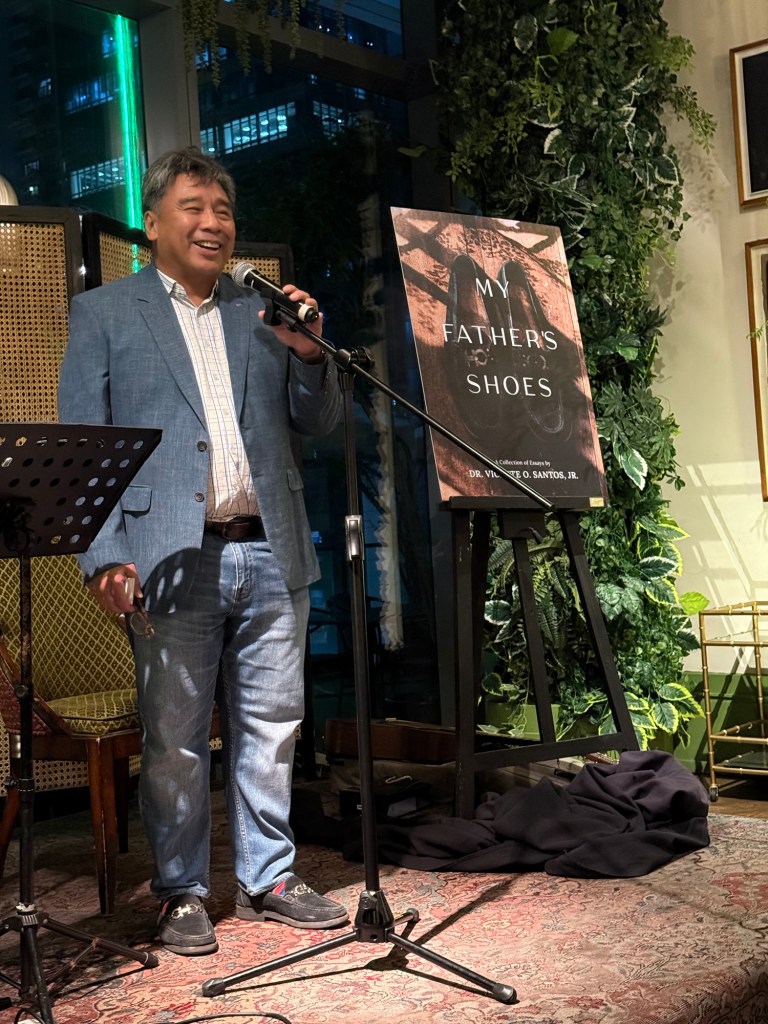
Homily on the advanced birthday celebration and book launching last June 4 of Dr. Vic Santos Jr., President of Fatima University Medical Center in Valenzuela and Antipolo
Photo by author, Manila House, BGC, Taguig, 04 June 2025.
We heard today in the first reading St. Luke’s account of St. Paul’s departure from Miletus to Rome for his trial and eventual martyrdom. We are told how the priests and leaders of the Ephesus community cried as St. Paul bid goodbye. It was a major turning point in the Apostle’s life.
We too are gathered tonight at a major turning point in the life of Dr. Vic as he officially becomes an elder among us, a senior sixty cent. There are no crying as we so filled with joy celebrating his gift of life. Like the Ephesians who were so glad in being a part of the life and mission of St. Paul, we praise and thank God for Dr. Vic’s gift of self especially to us, his family and friends and colleagues.
I’d like to focus your attention to St. Paul’s speech where he discussed how he had used his hands in his ministry, “You know very well that these very hands have served my needs and my companions. In every way I have shown you that by hard work of that sort we must help the weak, and keep in mind the words of the Lord Jesus who himself said, ‘It is more blessed to give than to receive'” (Acts 20:34-35).
What a beautiful imagery of the hardworking hands of St. Paul who was a tent maker by profession who earned money for his own needs so as not to be a burden to the community.
With his caring and loving hands, people accepted Jesus Christ and Christianity.
With his gentle and kind hands the people saw and experienced the love of God, felt more convinced than ever of God’s presence among them.
With his strong hands as an Apostle of Jesus, the people felt the discipline of God.
Photo by author, Manila House, BGC, Taguig, 04 June 2025.
It is the same thing why we are here tonight. So many sights were restored by the gentle hands of Dr. Vic that helped us to better or even see again.
Dr. Vic’s hands toiled not only in the clinic and OR but also in the tennis court and golf course as well as the kitchen that reminded us of God’s loving presence among us, of the Divine grip that everything will be fine so we can enjoy life. The hands of Dr. Vic as an ophthalmologist, as a husband and a dad, a brother and a friend and a colleague tell us we are in good hands. Like the hands of St. Paul, his hands allowed us to be touched by God’s love and mercy, kindness and forgiveness.
But there is something else about the hands of Dr. Vic I would like you to reflect upon. Like St. Paul, Dr. Vic’s hands not only restored sight but most of all allowed us to have vision, of seeing beyond physical or material things.
St. Paul’s hands were so gifted that more than half of the New Testament writings were from him; in fact, he was the first to write about Jesus Christ, way ahead of the gospel writers. By his writings, we are able to have a glimpse about God in Jesus Christ and eternal life.
Photo by Dra. Mary Anne Santos, Manila House, BGC, Taguig, 04 June 2025.
With his gifted hands in writing not just prescriptions but also elegant prose and essays, Dr. Vic opened our eyes to see the deeper realities and truth behind our many common experiences in life. His hands seem to have eyes too that he can weave a beautiful tapestry of the joy of living side by side with its many pains and hurts, even losses and griefs, failures and disappointments. Dr. Vic’s hands are so precise not only in surgery but especially in writing, giving us hope to never give up, to always forge on, and be open to many possibilities in life.
Like St. Paul, Dr. Vic can boldly proclaim of the timeless truth of Christ’s teaching that “it is better to give than receive” because he had experienced God’s abundant blessings through his very hands that were always opened, ready to work and take on new tasks, willing to hold others hands to lead and guide them to healing and new life.
Salamuch po, Dr Vic in sharing with us your blessed hands that taught us to find God we rarely see due to our many blindness in life.
Your hands did not only heal our sight but gave us a vision of God present in us and among us always. We pray like Jesus in the gospel tonight that the Father may consecrate you with his sacred hands in order to bless you with more fulfillment and fruitfulness on your 60th birthday. With Dra. Mary Anne and your sons – Angelo, Francis, and Vince – may God fill your hands with his blessings, holiness and healing. Amen.
Photo by author, Manila House, BGC, Taguig, 04 June 2025.
Lord My Chef Daily Recipe for the Soul by Fr. Nicanor F. Lalog II
Tuesday in the Tenth Week of Ordinary Time, Year I, 10 June 2025
2 Corinthians 1:18-22     <*[[[[><  +  ><]]]]*>     Matthew 5:13-16
What a great way to resume
the Ordinary Time this Tuesday,
Lord Jesus Christ as your words
today invite us to examine
some of the most "ordinary" things
in life we take for granted.
Brothers and sisters: As God is faithful, our word to you is not “yes” and “no.” For the Son of God, Jesus Christ, who was proclaimed to you by us, Silvanus and Timothy and me, was not “yes” and “no,” but “yes” has been in him (2 Corinthians 1:18-19).
Many times in our answers
of yes or no we cannot even make
a clear stand in you, Jesus;
like Paul,
give us the strength and courage
to mean "yes" in you, Jesus;
let our "yes"
to your gospel,
to your love and justice,
to your kindness and forgiveness
be a resounding "Amen"
in Christ, without any reservations,
without ifs nor buts
but a firm "yes, Lord!"
Teach to become
the salt of the earth bringing out
the flavor and goodness
of every person like what salt
does to our food;
at the same time,
let your light shine in us,
Jesus, to bring out the light,
the beautiful colors of every person
around us with our witnessing
to you, Jesus.
Amen.
Lord My Chef Daily Recipe by Fr. Nicanor F. Lalog II
Monday, Feast of the Blessed Virgin Mary, Mother of the Church, 09 June 2025
Acts 1:12-14     <*{{{{>< <*{{{{><  +  ><}}}}*> ><}}}}*>     John 19:25-27
Painting by El Greco, “Pentecostes” (1597) from commons.wikimedia.org.
Praise and glory to you,
Lord Jesus in inspiring the Church
in its most recent celebration of
the Feast of the Blessed Virgin Mary,
Mother of the Church every Monday
after Pentecost when we resume
Ordinary Time; it is so right and fitting
that after your return to heaven,
you send us to the world to continue
your work of salvation by being rooted
in you in prayer,
not just by ourselves
but with Mary your Mother,
your first disciple,
the first doer of your word,
the first to receive you,
Jesus the Christ.
Then they returned to Jerusalem from the mount called Olivet…Peter and John and James and Andrew, Philip and Thomas, Bartholomew and Matthew, James son of Alphaeus, and Simon the Zealot, and Judas son of James. All these devoted themselves with one accord to prayer, together with some women, and Mary the mother of Jesus, and his brothers (Acts 1:12, 13-14).
Icon of Mary “Mater Ecclesiae” (Mother of the Church) in St. Peter’s Square from opusdei.org.
Since the very start of the Church,
you have always been with her,
truly her Mother being the
Body of Christ your Son;
all your life,
you have devoted yourself
into prayer as a communion
in Jesus Christ which is essentially
what discipleship is - prayer!

As we resume the Ordinary Time,
teach us Mother Mary to remain in
union with Jesus in prayer:

let us be one with Jesus your Son
to make our joy complete
not only in listening and receiving
his word but most especially
in doing his words;

let us be one with Jesus your Son
for us to persevere in our sorrows
by finding him always in every suffering
by embracing his Cross;

let us be one with Jesus your Son
so that glory and victory may not
inflate our ego,
realizing everything
is for God's greater glory;

let us be one with Jesus your Son
for us to remain in his light of the
Holy Spirit in this time
we are engulfed in darkness of sin
and materialism,
pride and power,
vanity and self-centeredness.
Photo by author, Sacred Heart Novitiate, Novaliches, Quezon City, 20 March 2025.
O most Blessed Virgin Mary,
Mother of the Church,
Mother of Christ
and our Mother too,
be our companion in this
long journey in Ordinary Time,
knowing Jesus,
loving Jesus,
following Jesus,
always leading and pointing
others to Jesus
to be like Jesus.
Amen.
Lord My Chef Sunday Recipe for the Soul by Fr. Nicanor F. Lalog II
Solemnity of the Pentecost, Cycle C, 08 June 2025
Acts 2:1-11 ><}}}}*> Romans 8:8-17 ><}}}}*> John 14:15-16, 23-26
VATICAN CITY, VATICAN – MAY 08: Faithful in St. Peter’s Square participate in the first blessing of Pope Leo XIV immediately after the white smoke on May 08, 2025 in Vatican City, Vatican. Photo by Ivan Romano/Getty Images.
The other “good news” I heard next to the election of Pope Leo XIV last month were reports of people from different countries and other religions who went to join the pilgrims at the Vatican Square celebrating the election of our new Holy Father.
According to news, many of those non-Catholics who came there were so attracted and drawn by the unity of the people in rejoicing and celebrating Pope Leo XIV’s election to the papacy. That is Pentecost in modern time happening whenever people are one with each other in God by the Holy Spirit.
Painting by El Greco, “Pentecostes” (1597) from commons.wikimedia.org.
When the time for Pentecost was fulfilled, they were all in one place together… Then there appeared to them tongues as of fire, which parted and came to rest on each one of them. And they were all filled with the Holy Spirit and began to speak in different tongues, as the Spirit enabled them to proclaim. Now there were devout Jews from every nation under heaven staying in Jerusalem… They were astounded, and in amazement they asked, “Are not all these people who are speaking Galileans? Then how does each of us hear them in his own native language?” (Acts 2:1, 3-5, 7-8).
The Pentecost is an old Jewish Feast commemorating the ratification 50 days after of their covenant with God through Moses at the Sinai desert; today in the Church, we celebrate it 50 days (pente) after Christ’s Resurrection that also closes the Easter Season.
Considered as the birthday of the Church, see how appropriate the way Luke described the Church “born” on that day, “When the time for Pentecost was fulfilled, they were all in one place together.”
They were all in one place. There has always been the oneness or gathering of people as one body. However, it was more than being physically together in one place but of being one heart and one mind of the Church that continue to this day in our own time despite our many physical differences. What we celebrate today is not just a remote event in the past but a reality that continues in the Church and in various churches everyday.
The Pentecost is the fulfillment of those reflections we have had these past weeks on Jesus Christ’s commandment to love so that God would dwell among us. It is again our gospel this Sunday that was experienced by the Jews from other parts of the world there in Jerusalem on that day when they were astounded at how the Apostles were speaking in their own languages of God’s mighty deeds. They felt the love among everyone that they felt home. It was the complete opposite of what happened at the Babel’s Tower in the Old Testament.
They were astounded, and in amazement they asked, “Are not all these people who are speaking Galileans? Then how does each of us hear them in his own native language? We are Parthians, Medes, and Elamites, inhabitants of Mesopotamia, Judea and Cappadocia, Pontus and Asia, Phrygia and Pamphylia, Egypt and the districts of Libya near Cyrene, as well as travelers from Rome, both Jews and converts to Judaism, Cretans and Arabs, yet we hear them speaking in our own tongues of the mighty acts of God” (Acts 2:7-11).
Biblical vector illustration series, Pentecost also called Whit Sunday, Whitsunday or Whitsun. It commemorates the descent of the Holy Spirit upon the Apostles and other followers of Jesus Christ
"We hear them speaking in our own tongues of the mighty acts of God"
The social media was recently abuzz with a post by a vlogger who brought to Facebook his misgivings with Starbuck’s for wrongfully calling him “JC” instead of “JP” notwithstanding his earlier insistence on not making a mistake with his name’s spelling.
He is labeled as OA – overacting – or maarte in bringing to social media his experience which has anyway been a trademark of most coffee shops. What really got the attention of everyone that made his post viral was his declaration of how Starbuck’s had lost one loyal customer following that mistake which became the subject of many memes with some parodies that are thought-provoking. One is by a brother priest, Fr. Ritz who called his parody with the long title NOT ONLY A COFFEEHOUSE MAY LOSE A LOYAL CUSTOMER TODAY.
Fr. Ritz satirically narrated the two common laments of parishioners almost everywhere, namely, the priest’s boring homilies and lack of transparency with the faithful’s financial contributions. Sadly true, many of our faithful have become lukewarm in their faith and have stopped coming to church especially on Sundays due to these particular reasons.
Of course, we can’t put all the blame on the priests but we can’t blame either the lay faithful who make up the Church, the flock of Christ entrusted to us to love and care for by bringing out their giftedness in order to build this mystical Body of Christ on earth. The Church is more than Starbuck’s or any food and service entity but they all essentially share the same things like love and care among others to keep their relationships for existence and relevance or meaning.
Of course, that vlogger’s post about his experience at Starbuck’s was way off the mark but it is something we need to look deeper. How did it happen that people are now more concerned and more eager in coming to Starbuck’s than to our parish church? Maybe because like him who had given albeit wrongly his loyalty to a mere coffee shop, some of our faithful have felt taken for granted. We cannot claim “para yun lang” because certain things no matter small may be the world for some like being called in their name, being greeted or simply acknowledged as present on a weekday Mass. Or being enriched by a good homily which is after all the right of every baptized Christian.
At Pentecost, imagine the great joy of the Jews from diaspora visiting Jerusalem, hearing others speaking their language. They must have felt at home!
Are we at home in our Church?
Do we find and experience solace and comfort in our parish? Is there justice and sense of being fair from the priests instead of taking sides with the rich and famous? Can we feel our pastors and church volunteers and servants one with us?
Many times some of our parish workers and volunteers are more strict than the priests, throwing their weight around with their own rules and regulations. The single most important PR department of any parish is its office but sadly, some of its staff members scrimp on their smiles, feeling grouchy when ordinary folks come to inquire or get some certificates. Some are so unmindful of people walking for an hour only to be told they are still closed or about to close for lunch.
How sad when we are left out in the singing because the choir members stage a concert every Mass, experimenting with their voicing even with the most common Christian prayer of Our Father that people just stand and stare waiting for the communion to come and get home. Worst, as a preparation for the Father’s homily that often unprepared anyway, there are also the unprepared lectors lost which readings to proclaim or totally unmindful of the dignity of the ministry.
Above all these things, is the total lack of sense of prayer and silence among church servers who lead the Maritess sessions before and after each Mass right there inside the church. Worst, they cap each service with selfies and photo sessions at the altar as if it was their last serve. Clearly many of us live in the flesh than in the Spirit as St. Paul reminded us in the second reading. Where is the love that Jesus Christ had sent us in the Holy Spirit to make us one, feel at home joyful, safe and loved?
On this Pentecost Sunday, let us start practicing silence to feel the Holy Spirit within so that we can be in touch with everyone around us in love and kindness. Let us allow the Holy Spirit to teach us everything and remind us of all that Jesus had told us (Jn. 14:26). Amen. Have a blessed week ahead everyone!









 lordmychef.com