When “where” and “there” are persons, not locations

The Lord Is My Chef Sunday Recipe for the Soul by Fr. Nicanor F. Lalog II
Sunday XVII-B in Ordinary Time, 25 July 2021
2 Kings 4:42-44 ><]]]]*> Ephesians 4:1-6 ><]]]]*> John 6:1-15

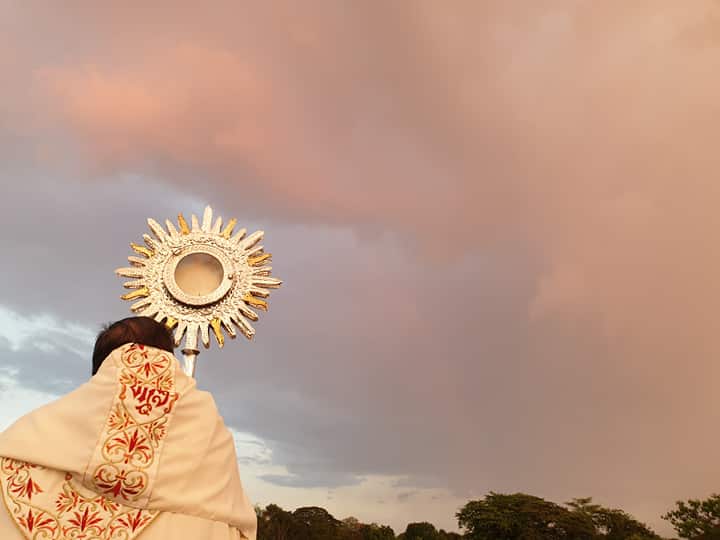
Photo by Mr. Raffy Tima of GMA7-News, Batanes after a storm, 2018.

Beginning today until August 22, 2021, our Sunday gospel will be from the sixth chapter of John who continues last week’s scene of the great crowd following Jesus and his disciples to a deserted place in order to rest after returning from their first mission.

We were told by Mark how Jesus was “moved with pity” upon seeing the people who were “like sheep without a shepherd” that he taught them with so many things (Mk.6:34); after teaching them, Jesus fed them – about 5000 men excluding children and women – from just five loaves of bread and two pieces of fish with a lot of leftovers gathered that filled 12 wicker baskets!

It is a very beautiful story found in all four gospel accounts but it is only in John’s gospel where we are presented with a more complete and detailed story of the event followed by Jesus Christ’s “bread of life discourse” at Capernaum. Let us focus at the conversations among Jesus, Philip, and Andrew before the miracle where they used the demonstrative pronouns “where” and “there” that indicate deeper meanings.

The Jewish feast of Passover was near. When Jesus raised his eyes and saw that a large crowd was coming to him, he said to Philip, “Where can we buy enough food for them to eat?” He said this to test him, because he himself knew what he was going to do. Philip answered him, “Two hundred days’ wages worth of food would not be enough for each of them to have a little bit.” One of his disciples, Andrew, the brother of Simon Peter, said to him, “There is a boy here who has five barley loaves and two fish; but what good are these for so many?”

John 6:4-9
Photo from iStock/Studio-Annika.

When all directions point to Jesus – but we miss!

While praying over today’s gospel, one song kept playing in my mind, the Beatles’ 1966 classic love song by Paul McCartney, Here, There and Everywhere. It is a very lovely music, so unique in many aspects that it is also McCartney’s most favorite as a member of the Fab Four.

What struck me with this Beatles hit are the demonstrative pronouns here, there and everywhere used not to point at directions but to a person, the girlfriend of McCartney at that time he so loved who would also be his Here, There and Everywhere!

To lead a better life, I need my love to be here
Here, making each day of the year
Changing my life with a wave of her hand
Nobody can deny that there's something there

There, running my hands through her hair
Both of us thinking how good it can be
Someone is speaking
But she doesn't know he's there

The same is so true with Jesus today asking Philip Where can we buy enough food for them to eat?”

Jesus was not asking for a store in that deserted place to buy and get food for the people. John tells us that Jesus said this to test Philip because “he himself knew what he was going to do”. He wanted Philip to look deeper, to see beyond places and things even if his answer was correct, that “two hundred days’ wages worth of food would not be enough for each of them to have a little bit.”

When odds are against us, when things are beyond us and humanly impossible, where do we go to?

Of course, we go to God!

Where else do we go when we are in deep or great troubles?

We go to prayers, we go to church, we go to the prayer room or Adoration Chapel, or wherever there is peace and silence where we can be with God.

When this pandemic started, where did we go during lockdown? To God with our online Masses at home, daily praying of the Rosary with the whole family. But when the quarantines were eased, we suddenly forgot God, regarding every where as merely a place, a location.

Every where is where God is, where Jesus is!

From Facebook, May 2020.

We now come to that second demonstrative pronoun in the same scene before the miraculous feeding of five thousand said by Simon Peter’s brother Andrew who told Jesus, “There is a boy here who has five barley loaves and two fish; but what good are these for so many?”

How unfair that the boy who actually had Jesus working on his miraculous feeding of the crowd with those five barley loaves and two fish he had given was merely referred by Andrew as there or here!

See how Andrew did not bother to ask the boy’s name because during that time, any male kid had no any significance at all except by the time they reached 13 years of age for the bar mitzvah, when boys begin to read the Torah. In fact, John noted in this narrative how the children and women were not even counted to show their grave error at that time of giving importance only to men.

How sad the same thing continues to our own time when we are taken for granted as a person, reduced to mere statistics, to mere numbers, to there and here!

Despite our insistence on the use of inclusive terms for all, it seems that the more we have actually degraded the human person into objects as we personified objects. Listen to commercials and newscasts to realize what I mean: food is described as “masarap siya” while typhoon is referred to as “siya ay lalabas ng Philippine Area of Responsibility” while persons are made into objects like handsome men called “yummy” or “delicious”. No wonder, people have become like food, good only when young and fresh but when old, discarded like trash! Sometimes, people are labelled like ice cream as “flavor of the month” or “all-time favorite” when rich and famous while ordinary folks are called “dirty ice cream”.

There is always a person to be respected and recognized in every here and there!

Let us heed St. Paul in the second reading telling us “to live in a manner worthy of the call” we have received as beloved children of God “with all humility and gentleness, with patience, bearing with one another through love, striving to preserve the unity of the spirit through the bond of peace” (cf. Eph. 4:1-3).

How sad that we cannot even look at one another as a brother and a sister, even in our own family circles because we are so focused on the bread, that is, the money and wealth we could get for ourselves. And that is the great irony in this scene: the boy was willing to let go of his five loaves of bread and two pieces of fish yet Andrew did not notice at all the face, the personhood of the boy so kind to share what he had, thinking more of others than himself!

What a tragedy in our time, in our own family and circle of friends, at work and in school, even in our parish community when some people would give more value to things than persons, who would rather maintain or keep their honor and dignity at the expense of others.

Photo by Marc Angelo Nicolas Carpio, January 2020, Bagbaguin, Santa Maria, Bulacan.

When the “where” and “there” of Jesus meet on the Cross

This story of the multiplication of bread occupies an exceptional place in all four gospels. However, it was only John who added a long discourse preached by Jesus at Capernaum after this event to reveal its full meaning.

For John, the multiplication of bread is more than a miracle but a sign, a revelation of supernatural power above the ordinary pointing to Jesus as the Christ, the Son of God who is the bread from heaven who had come down to nourish us in this journey of life to eternity like during the time of Moses in the wilderness. Or like Elisha in the first reading, Jesus multiplied the loaves of bread to satisfy the hunger of not just 100 people but over 5000 with leftovers of 12 wicker baskets.

Photo by author, March 2020.

We are reminded of other instances in the Old Testament like the Jewish feast of Passover as backgrounds of this sign by Jesus in the deserted place as a prelude to the sign of the Holy Eucharist he instituted on Holy Thursday that we celebrate daily especially on Sundays as one body, one family. This in turn will reach its highest point on Good Friday as the ultimate sign Jesus Christ’s loving presence when his being the “where” and “there” of God would be revealed in the final sign of the Crucifixion that many would still miss to recognize.

That is why in the next four weeks, we shall hear John narrating to us the discourse by Jesus to explain the full meaning of this multiplication of bread in that deserted place.

When the people saw the sign he had done, they said, “This is truly the Prophet, the one who is to come into the world.” Since Jesus knew that they were going to come and carry him 0ff to make him king, he withdrew again to the mountain alone.

John 6:14-15

Let us “capture” Jesus in the Holy Communion of the Mass later when the priest holds high the Body of Christ saying, “Behold the Lamb of God, behold him who takes away the sins of the world. Blessed are those called to the supper of the Lamb.”

Here in the Mass, it is very clear this is where Jesus is, where we get the real food to eat. Tell it to everyone, point unto Jesus, there is the Lamb of God who takes away the sins of the world like John the Baptist. Most of all, it is in the the Holy Mass where Jesus is present here, there, and everywhere – in his words proclaimed, Body and Blood shared, and with everyone celebrating!

Have a blessed week! Keep safe and stay dry. Amen.

Photo by Pixabay on Pexels.com

We are the right person in Christ

The Lord Is My Chef Breakfast Recipe for the Soul by Fr. Nicanor F. Lalog II
First Friday of the Month, Week XIII, Year I in Ordinary Time, 02 July 2021
Genesis 23:1-4, 19-24:1-8, 62-67   ><)))'> + <'(((><   Matthew 9:9-13
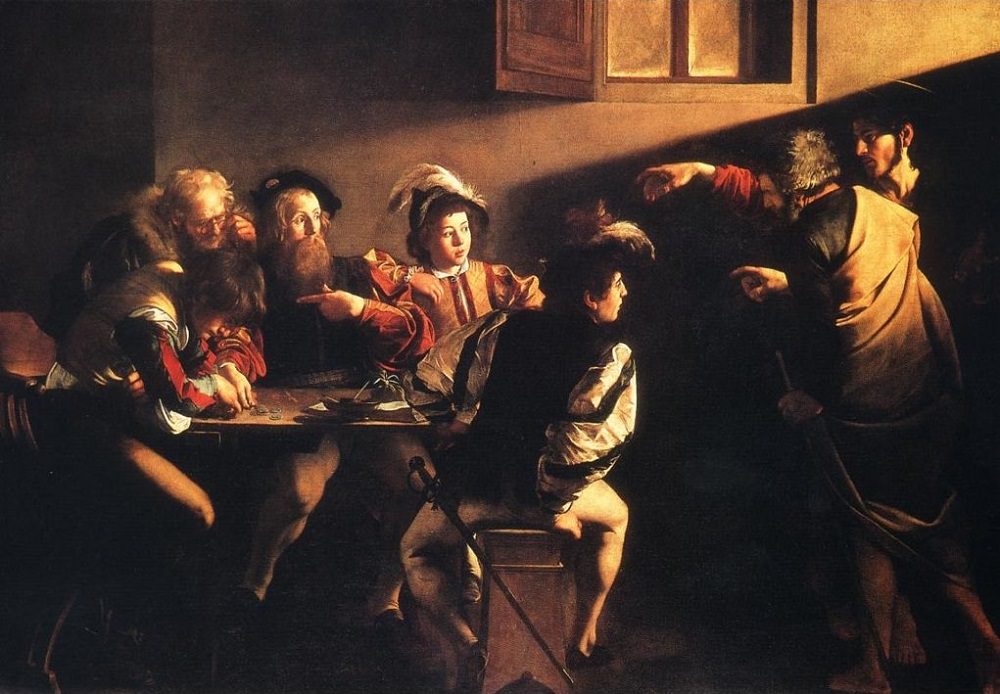
“Calling of St. Matthew” painting by Caravaggio from en.wikipedia.org.
God our loving Father in heaven,
open our eyes to see and recognize
the right persons you send us
to be our friends and colleagues,
co-workers and co-journeyers in life.
Let us not forget that first of all,
the right person we first meet from you 
is our very selves!
Thank you for believing in us.
Thank you for creating us.
Thank you in sharing with us your
truth and beauty, your image
and likeness that is very good.
As Jesus passed by,
he saw a man named Matthew
sitting at the customs post.
He said to him,
"Follow me."
And he got up and followed him.
(Matthew 9:9)
Let this scene be a constant reminder to us
of your mercy and love, dear God
that no matter how bad is the perception
of others on us, you still see the best in us.
Give us the grace to be attentive
to Jesus Christ passing by, calling us
even while we are in the darkness of our sin
indulging in luxuries and comfort,
power and fame of a sick world.
Like Matthew, let Jesus our light
make us rise to follow him
leave the damp and dark world of sin
and see again the light within
of your glow and majesty.
"Never take my son back there
for any reason," Abraham told his servant.
"the Lord, the God of heaven,
will send his messenger before you,
and you will obtain a wife for my son there."
A long time later, Isaac went to live
in the region of the Negeb.
One day toward evening
he went out in the field,
and as he looked around, 
he noticed that camels were
approaching.  Rebekah, too,
was looking about, and when she
saw him, she alighted from her camel...
Then Isaac took Rebekah into his tent;
he married her, and thus she became
his wife.  In his love for her 
Isaac found solace after the death 
of his mother Sarah.
(Genesis 24:6, 7, 62-64, 67)
What a beautiful love story
that looked like in the movie, sweet Lord
where you surely send us the right persons
at the right time
for the right reason
because of love.
We pray for those waiting for their
right persons, whether in love or profession,
or for any reason you and they alone know,
grant them the faith of Abraham
and the enlightenment of Matthew.
Amen.

Ministry. Or gimmickry?

The Lord Is My Chef Breakfast Recipe for the Soul by Fr. Nicanor F. Lalog II
Friday, Week XI, Year I in Ordinary Time, 18 June 2021
2 Corinthians 11:18, 21-30   ><)))'> + <'(((><   Matthew 6:19-23
Photo by author, December 2020.

Forgive us, O Lord, in making ministry a gimmickry, when we forget all about you and your sacrifice on the Cross; when all we see is technology and novelty, pretending to make you a reality amid the changing world when in fact it is us and not you whom we advertise and make known to everyone.

Forgive us, dear Jesus, when so many times we brag in shrouded manners our exploits and achievements, sacrifices and sufferings to proclaim your name without your Cross not realizing that any cross detached from you is all folly and plain publicity.

Teach us to be like St. Paul to boast more of our weaknesses than of our strength for it is only when we are weak that we are truly one with the rest of humanity – weak and sinful, struggling and striving, always at your mercy and forgiveness.

Who is weak, and I am not weak?
Who is led to sin, and I am not indignant?
If I must boast , I will boast of the things
that show my weakness.
(2 Corinthians 11:29-30)

Remind us always, Lord, before we could ever speak of what we have done and achieved, of what we are doing for you and your people, that we first examine what we treasure most in our hearts for it will always be what others experience and see in us.

No matter how lofty are our words nor our visions of you and of your Church, what we treasure most in our hearts always radiate in our lives, in our actions, in our very selves.

If we have not really done that much for you and for others, if we have not truly embraced you on the Cross with all the blood and pains as seen in our lives and relationships, then, nothing will suffice despite our many claims and monuments to our ministry because it is all gimmickry.

Jesus said to his disciples:
"but if your eye is bad,
your whole body will be in darkness.
And if the light in you is darkness,
how great will the darkness be."
(Matthew 6:23)

Lord Jesus Christ, you are our light. Please enlighten us today, restore our sight and vision to find and follow the real treasures and most precious things we all must have in this life — YOU. Amen.

Image from Pinterest, quotation by Josh at his blog “Project: Faith Journey” at wordpress.com, 15 October 2015.

What the Holy Spirit does vs. what we can do

The Lord Is My Chef Breakfast Recipe for the Soul by Fr. Nicanor F. Lalog II
Tuesday in the Third Week of Easter, 20 April 2021
Acts 7:51-8:1   <*(((><  +  ><)))*>   John 6:30-35
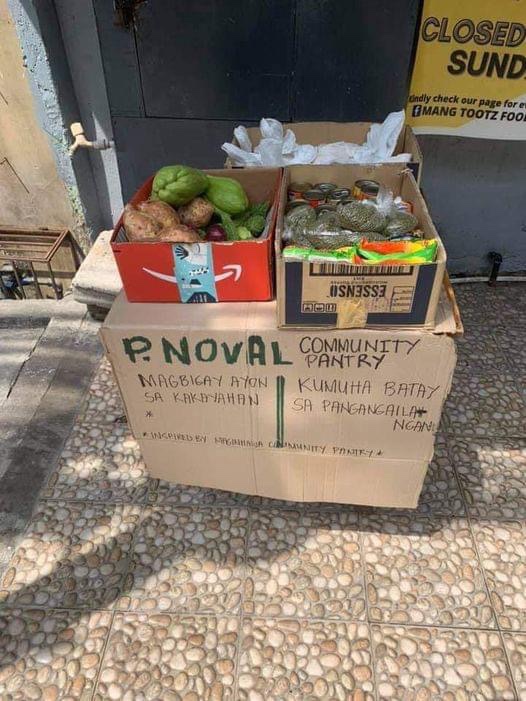
Posted by Jean Palma on Facebook, 18 April 2021 with the caption: “All these community pantries in four days, and counting. What a powerful movement.” #CommunityPantry

Praise and glory to you, O God our loving Father in heaven! Thank you in sending us your Son Jesus Christ our Bread of life who taught and showed us how to be a food ourselves to one another by giving and sharing our very selves in loving service especially in times of crisis like this pandemic.

Thank you very much for the grace and inspiration by the Holy Spirit for the people behind this movement fast spreading called “Community Pantry” teaching us to see one another as a brother and a sister who needs to be helped, that each can be of help to anyone in need.

So many times, in our search for food that perishes like wealth and power, we get more focused on “doing” than “being” and “becoming” like those people who have followed Jesus in Capernaum after being fed with bread and fish at the wilderness last week.

The crowd said to Jesus:
"What sign can you do, that we may see and believe in you?
What can you do?"
(John 6:30)

Forgive us, Father, when until now we still ask the very same question to you and one another, “What can you do?” like the devil’s first temptation of Jesus in the wilderness, “If you are the Son of God, command this stone to become bread” (Lk.4:3).

Make us aware of this ploy of the devil to keep us doing everything, to claim everything as our work in order to forget you or even discredit you.

How sad that we are so concerned with doing than with being and becoming, forgetting the value of every person, asking more of “what you can do” than “who are you?” which is more essential because we are all from you, O God our Father, our image and likeness.

No wonder, we have become like the members of the Sanhedrin addressed by Christ’s first martyr, St. Stephen during his trial:

"You stiff-necked people, 
uncircumcised in heart and ears,
you always oppose the Holy Spirit;
you are just like your ancestors."
(Acts 7:51)

We have never grown and matured in our relationships because we have refused to see each one’s worth as a person, measuring our value in what we can do than in who we really are as your beloved children. As a result, we continue to refuse surrendering ourselves to the Holy Spirit for you to do your work in us. Unfortunately, as we keep on doing everything, the results are always miserable. And the more we get into bigger mess in life.

Teach us, especially our leaders in government, to open their minds and their hearts to what your prophets are saying from the various sectors of the society, especially the masses involved in the Community Pantry movement.

May our government officials led by the President realize that ever since this pandemic started, what we have been saying has always been for the good of one another as brothers and sisters, valuing life above all, and not for any achievement nor fame at all that they are so intent on having.

How sad that the more government officials dare and insult people with what they can do, the more it becomes truer that they cannot do anything good at all. Amen.

Photo by Toots Vergara, Philippine Daily Inquirer, 16 April 2021.

What…?

The Lord Is My Chef Breakfast Recipe for the Soul
Monday, Sixth Week in Ordinary Time, Year I, 15 February 2021
Genesis 4:1-15, 25     >><)))*>  >><)))*>  >><)))*>     Mark 8:11-13
Photo by Ms. Jo Villafuerte at Atok, Benguet, 01 September 2019.

Last Saturday, Lord, you surprised us as we prayed over the deeper meaning of the question “where” like “where are you?” and “where are we going to get?” The question where always implies something that is lost or about to lose, missing or denied.

Today, we pause for the more usual question of “what” like your question to Cain in the first reading:

The Lord then said: “What have you done? Listen: your brother’s blood cries out to me from the soil!”

Genesis 4:10

In the gospel, the enemies of your Son Jesus were also asking, in effect, about “what” signs he can show them from heavens to prove he is the Christ you have sent.

How funny it is, dear God our Father that in your asking Cain as in most cases, you ask us with WHAT because you knew what had happened, you know everything and merely want us to admit the truth and be sorry— but we would not!

For you, the what is already known for you know everything! Nothing can be hidden from you.

On the other hand, for many of us like the Pharisees, we keep on asking you with WHAT because we refuse to recognize or acknowledge what is present, what is existent, what is there because we prefer to accept what is in our minds than what is revealed and true.

What a silly world at how we have made the objective question of what very subjective, depending on what we wish to know and accept or believe. May the question what lead us closer to recognizing every person as a subject to be loved and cherished because we are indeed, our brothers’ keepers. Amen.

Photo from Facebook posted by Ms. Marivic Tribiana, 17 April 2020 during fire in Tondo area.

Imitating the priesthood of Jesus

The Lord Is My Chef Breakfast Recipe for the Soul
Wednesday, Second Week in Ordinary Time, 20 January 2021
Hebrews 7:1-3, 15-17     >><)))*>   +++   <*(((><<     Mark 3:1-6

O God our Father, we praise and thank you in making us share in the priesthood of your Son Jesus Christ, our Lord and eternal Priest. So many times we forget – priests and lay people alike – the meaning of our priesthood which is to communicate your love to others, to become a bridge of men and women with God.

So many times we have become legalistic, paying more attention to the letters of the laws, to forms and to rituals forgetting the very essence of loving service for others. We always enter the church but never the community of believers.

Jesus entered the synagogue. There was a man there who had a withered hand. They watched Jesus closely to see if he would cure him on then sabbath that they might accuse him. He said to the man with the withered hand, “Come up here before us.” Then he said to the Pharisees, “Is it lawful to do good on the sabbath rather than to do evil, to save life rather than to destroy it?” But they remained silent.

Mark 3:1-4

What a shame, dear God when such moments happen when we refuse to look at the persons with their sufferings and pains, choosing to look at things around us like rules and conventions. That more sad part is as we have turned blind to others around us, we have also chosen to be deaf to their cries as well.

Forgive us, Father, when we fail to enter into oneness with others made possible to us in the coming of Jesus Christ who has become our “priest forever according to the order of Melchizedek” (Heb.7:17).

Help us discard those old understanding of priesthood with emphasis on the mystery of being a priest, of the distinction and honor, forgetting the more important aspects of working for justice and righteousness, and most of all, for peace. Both can only be earned if we strive to be men and women of love and commitment to what is good. Amen.

Our dis-ease COVID-19

Quiet Storm by Fr. Nicanor F. Lalog II, 08 October 2020
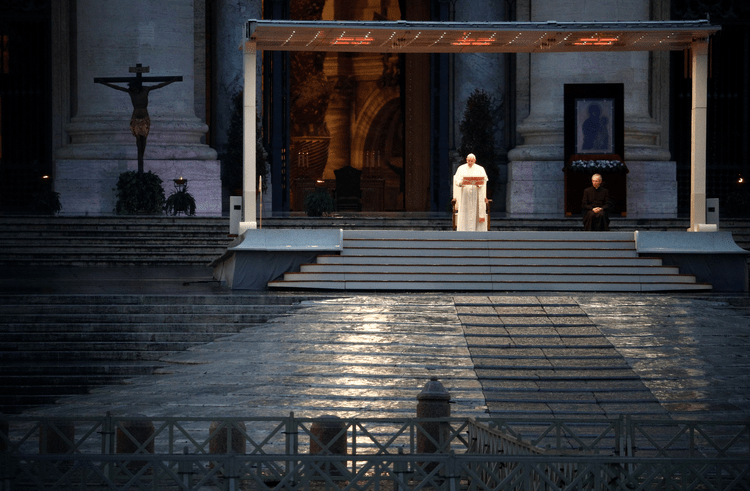
Pope Francis delivering his “Urbi et Orbi” before an empty St. Peter’s Square in Rome, 27 March 2020 at the height of COVID-19 pandemic. Photo from Vatican Media/AFP via Getty Images.
In the beginning
we were counting
the days of quarantine
but when COVID-19
spread with so many dying
then we realized this is not just passing
but could be staying 
leaving the world in a standstill
shaking our very core and being
bringing us back to God
praying, surrendering everything
to him as our sole grounding.
Finding God 
during this quarantine
is indeed a blessing 
directing us to look within
to examine our being
where every healing must begin;
Any sickness is a dis-ease
a lack of order
when things are not pleasing
because of sin and wrong-doing
exactly what we are now seeing
with COVID-19.
Photo by Mr. Jay Javier, May 2020.
Consider the following:
Long before social distancing
we have always been so far away
even from those with whom we stay
foregoing all the loving,
replaced with twitting or texting;
When we were growing
we were taught to keep our hands clean
but we have pushed it to the extreme
refusing to dirty our hands
forgetting to work with honor and dignity
keeping them free from stains of dishonesty;
Of all the most disturbing
during this quarantine
is the mask that cover our face;
but, why be fazed, objections raised
when we have long erased
to see in every face
that tremendous grace
of God's trace?
In the midst of this calamity
when air became pollution-free
we rejoiced at Nature's beauty;
the remedy for every malady
is not found only in the pharmacy
but right in our hearts when we see
everything and everyone in harmony.
Oh how I long when that day shall be
when everyone is free with nothing to worry;
at ease shall we carry within the peace and serenity 
of one big family living cleanly in God's mercy.
Photo by Ms. Anne Ramos, March 2020.

When we humans know so much

The Lord Is My Chef Breakfast Recipe for the Soul by Fr. Nicanor F. Lalog II
Tuesday, Week XIV, Year II in Ordinary Time, 07 July 2020
Hosea 8:4-7, 11-13 >><)))*> <*(((><< Matthew 9:32-38
Photo by author, 2019.

Forgive us, O Lord, for the many times we have played gods, knowing too much when in fact we know nothing at all. So often, we never consult you and rely more in our limited understanding and perception of things that in the end lead to more woes and problems for us.

Thus says the Lord: They make kings in Israel, but not by my authority; they established princes, but without my approval. With their silver and gold they made idols for themselves, to their own destruction. Cast away your calf, O Samaria! my wrath is kindled against them. How long will they be unable to attain innocence in Israel? The work of an artisan no god at all; destined for the flames — such is the calf of Samaria! When they sow the wind, they shall reap the whirlwind; the stalk of grain that forms no ear can yield no flour; even if it could, strangers would swallow it.

Hosea 8:4-7

When will we ever learn, Lord?

We always have our own golden calf to worship, turning away from you, the only true God, fount of all life and meaning, grace and fulfillment. We keep doing things according to our plans, each of us desiring to outdo each other, turning away from you.

How sad that whenever you try to intervene and save us or bring us back into the right course of life, we see you more as coming from the devil. Forgive us, Lord, in making it so difficult even for you to be in the right place in our lives for we are so full of ourselves.

And that is really how it is with us: we always feel so troubled and abandoned, like sheep without a shepherd but would never admit it, replacing persons with material things not realizing that life is meant to be lived with people not with things.

Create in us an awareness of your presence, of your love so we may be more attuned with you and the people around us. Amen.

Photo by author of plants growing on rocks at the Holy Land, 2019.

Where is our love?

40 Shades of Lent, Saturday, Week III, 21 March 2020

Hosea 6:1-6 <*(((>< +++ ><)))*> Luke 18:9-14

Photo by author, Mount St. Paul, Trinidad, Benguet (04 February 2020).

Your words today, O Lord, are so true.

And so painful, too.

What can I do with you, Ephraim? What can I do with you, Judah? Your piety is like a morning cloud, like the dew that early passes. For this reason I smote them through the prophets, I slew them by the words of my mouth. For it is love that I desire, not sacrifice, and knowledge of God rather burnt offering.

Hosea 6:4-6

We could feel your sadness, O Lord, speaking to us who have become like your people Israel. Slay us with your words as we close the first week of our heightened community quarantine deep in confusion and loss when our leaders fail – or refuse – to rise to maturity and statesmanship when concern for ego and turfs have become their main preoccupation while others are nowhere to be found.

Where is the love, O Lord, they have promised us, our country?

But the more painful question we all have to answer really is where is our love? Where is our love for our country expressed in electing all these officials we now have? Where is the love we have promised to one another, of husband and wife, of parents and children, of siblings, of friends?

We have sinned, O God our Father, because we have failed or refused to love and share your immense love for each one of us.

Forgive us, for we have lost the essence of love, of forgetting one’s self in favor of the beloved. We have loved our selves too much, thinking we are always just and right, truly the ones for whom today’s gospel is meant for without exceptions.

Jesus addressed this parable to those who were convinced of their own righteousness and despised everyone else. Two people went up to the temple area to pray; one was a Pharisee and the other was a tax collector.

Luke 18:9-14

We have thought that love is when the good times roll, when there is laughter and pleasure, when there is affluence. Worst of all, we have thought that love is a material expressed in things or mere feelings we always show in sweet nothings.

Teach us again to remember that love is a person … because you are love, O God!

Deus caritas est (1 John 4:8).

Let us love, love, and love truly like Jesus your Son who gave himself for us on the cross. Amen.

Parokya ni San Juan Apostol at Ebanghelista, 2019.

Best Gifts of Christmas, II

Quiet Storm by Fr. Nicanor F. Lalog II, 28 December 2019

Italian artist Giorgione’s “Adoration of the Shepherds” (1510) showing an intimate scene set up against a distant landscape. The shepherds’ gently kneeling and bowing their heads down show their humility and fascination with the Infant Jesus while the long road behind them shows the long and tiring journey they have taken before reaching their destination.

We continue with our enumeration of the best gifts of Christmas which is above all the coming of our Lord Jesus Christ. And because of his coming as human like us, we have come to share in his dignity and glory, thus, making us also the best gifts to share and receive every Christmas!

We await Christmas every year because we await Jesus Christ, the most beloved person of all we can know and have as friend.

We wait only for persons, not things.

Waiting is beautiful because we never wait alone. There is always another person waiting with us, waiting for us. And when we finally come and meet with the other person also awaiting us, then we become present, a gift for one another.

In our presence with each other comes the wonderful gift of intimacy.

“God became a human being so that in one person you could both have something to see and something to believe.”

St. Augustine, Sermon 126, 5
The spot where Jesus Christ is believed to have been born now covered and protected by this hole under the main altar of the Church of the Nativity of the Lord in Bethlehem. May 2019

Christmas is a story about persons called by God to bring us his Son Jesus Christ. It is a living story that continues to our own time. Here are some of the best gifts of Christmas coming from the gift of our personhood.

  1. The gift of family. Christmas happens in a family of husband and wife and children. Very much like Joseph, Mary, and Jesus. Remove one and the Nativity scene becomes incomplete. Let us be thankful for our family, let us pray for the unity of our family. When Jesus was lost at the age of 12, Joseph and Mary decided to return to Jerusalem – symbolizing God – and eventually found him there in the temple. Let us always turn to God, ask for his guidance and protection of every family, for the healing of our family, for the mending of our broken relationships. Let us pray for all broken families whose members from the husband and wife to their children are all aching deep inside for the pains of separation.
  2. The gift of women and of motherhood. When God created man, he found “it is not good for man to be alone” that is why he created the woman as man’s “suitable partner” (Gen.2:18). What a beautiful term for woman, part-ner, a part of man who is never complete by himself alone. How sad that until now, it is right inside the home where every woman first experience physical, verbal and emotional pains. Women are the best signs of fidelity and faith: Elizabeth called Mary “blessed” because she believed the words spoken to her by the angel from God will be fulfilled. Let us pray for the women in our lives especially own own mother and sisters, lola and aunties, cousins and nieces. Remember, the way we relate with women reflect to a great extent the way we relate with God. Love and bless the women!
  3. The gift of men and fatherhood. When Jesus taught us how to pray, he taught us that God is like a “Father” whom we shall call “Our Father”. There is a crisis in fatherhood and manhood these days because many men have forgotten to be truly man enough like God our Father: a giver of life and protector of life as well. Most of all, when children lose this gift of life, it is the father who restores the life lost like the merciful father of the prodigal son in Luke’s gospel chapter 15.
Aleteia, December 2019.

This Christmas break, spend time with your family, hug your mommy and your daddy tightly and feel their presence again.

Thank your family, your mom and dad.

Pray for your departed loved ones, visit the cemetery and say a prayer for them, talk to them. Most of all, listen to them and feel them again.