Lord My Chef Daily Recipe for the Soul, 18 July 2025
Friday in the Fifteenth Week of Ordinary Time, Year I
Exodus 11:10-12:14     <'[[[[>< + ><]]]]'>     Matthew 12:1-8
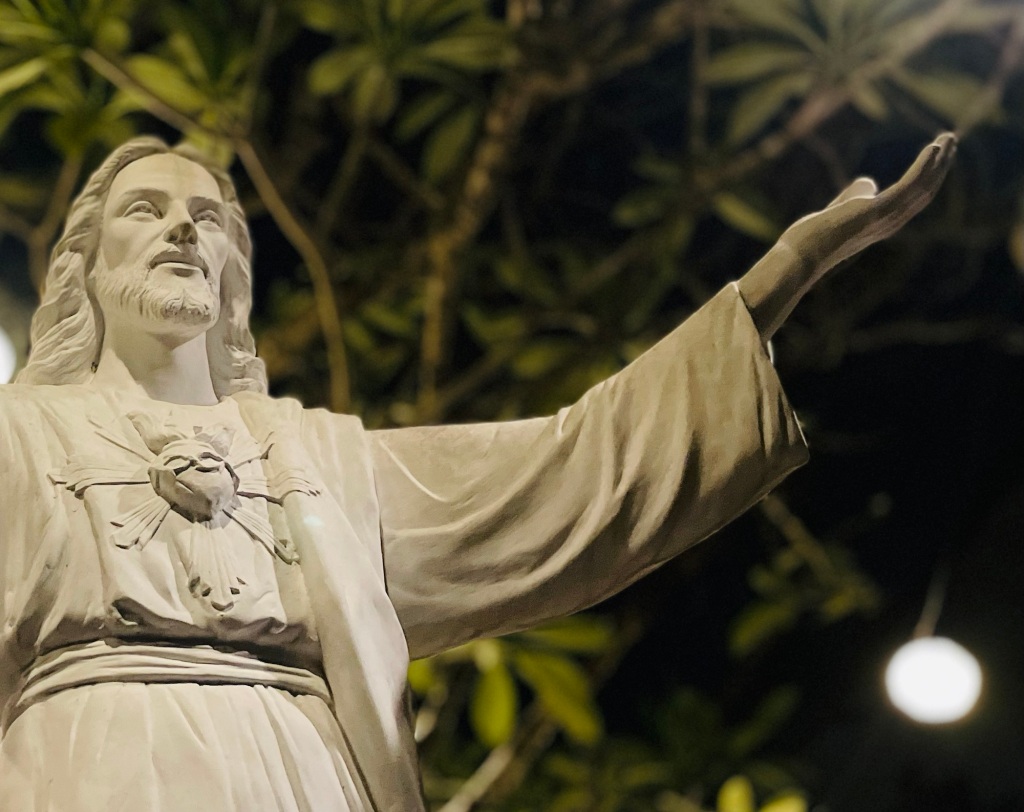
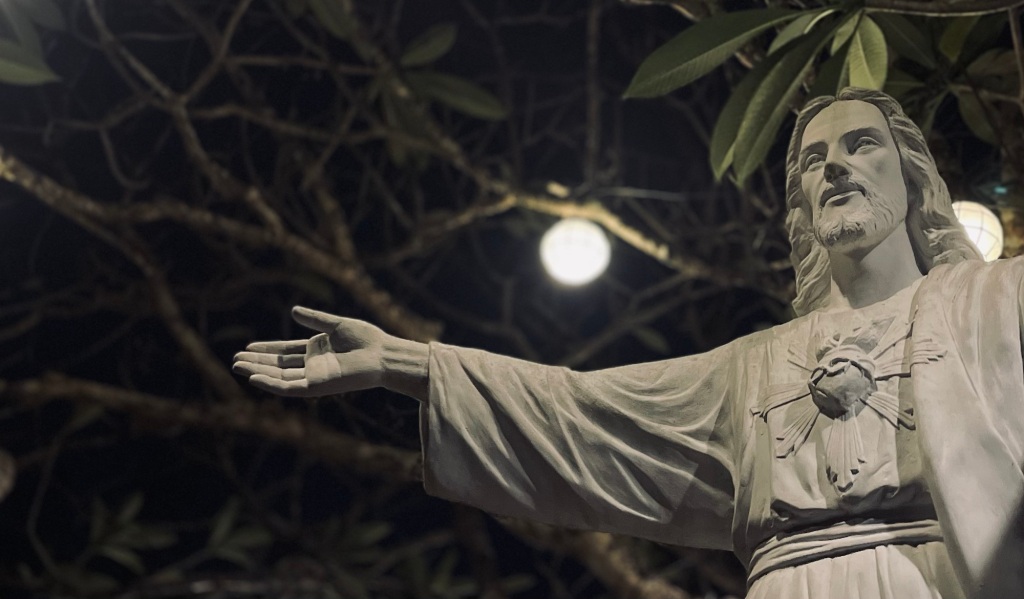
Photo by author, Sacred Heart Novitiate, Novaliches, QC, 20 March 2025.
How lovely are your words
today, O God,
on this dark, rainy Friday
with many light and shadows
that show life's many contrasts
with you still remaining
with us,
in us,
and among us.
Although Moses and Aaron performed these various wonders in Pharaoh’s presence, the Lord made Pharaoh obstinate, and he would not let the children of Israel leave his land (Exodus 11:10).
You know everything,
dear God that is why you
set the stage for the first passover
at "evening twilight" just in time
for the people to see the light
of freedom in you;
you sometimes allow storms
to happen but
you already have
provisions for us
beforehand:
Jesus was going through a field of grain on the sabbath. His disciples were hungry and began ton pick the heads of grain and eat them (Matthew 12:1).
What a beautiful contrast
is today's gospel!

How did it happen
the Twelve were hungry
while with Jesus
who had fed more than
5000 people with just five
loaves of bread and two pieces
of fish?

Right there under
the glaring light
and heat of the sun
on a Sabbath
when you "fed" on the Twelve
with grains in the field;
moreover,
when criticized by your
enemies,
you defended the Twelve!
You are a God of
mystery, Jesus!
Truly "greater than
the temple" for you are
the Christ,
the Son of God
who became human like us
to show us you are with us,
in us,
and among us
when everything seems
so dark or so bright
that may blind our sights;
incline our hearts to you, Jesus
who "desires mercy,
not sacrifices"
 so that when we grapple
in light and shadows,
it is solely you whom we hold on.
Amen.

Fr. Nicanor F. Lalog II
Our Lady of Fatima University
Valenzuela City
Photo by author, Sacred Heart Novitiate, Novaliches 20 March 2025.
Lord My Chef Daily Recipe for the Soul, 17 July 2025
Thursday, Fifteenth Week in Ordinary Time, Year I
Exodus 3:13-20   <*(((>< + ><)))*>   Matthew 11:28-30
Photo by author, Cabo da Roca, Pundaquit, San Antonio, Zambales, 14 May 2025.
Today, I tried going back
to your presence, Lord;
I tried feeling your sacred
ground again;
there was no burning bush
to see but I felt my heart
burning inside as I dwelled
on your name:
God replied, “I am who am.” Then he added, “This is what you shall tell the children of Israel: I Am sent me to you.” God spoke further to Moses, “This is my name forever; this is my title for all generations” (Exodus 3:14-15).
Unlike our name,
your name "I AM",
Lord is most unique -
right away when I say
your name, I feel you!
Your name is more than a name
for it is YOU yourself - so deep,
so true, so powerful that you envelop
me in your person; when I think of
your name "I AM", I am already
dissolved and overwhelmed!
Moreover,
your "I AM" is exactly
what I feel,
and realize,
and experience
in Christ calling us:
“Come to me, all you who labor and are burdened, and I will give you rest” (Matthew 11:28).
Photo by author, Sacred Heart Novitiate, Novaliches, QC, 2023.
Today I come to you,
Jesus with all my burdens
and worries,
pains and hurts,
sickness and
sufferings;
you are I AM, Lord -
heed our cries like in Egypt:
the crime and corruption
so rampant,
the selfishness and pride
of everyone,
the sin and evil that stink,
 a kind of darkness lurking
everywhere;
yes, there are modern Pharaohs
lording over us today
but most of all too,
it is us who lord over
our lives most of the time;
bring us back to the burning bush
so we may take off our
sandals because the whole
earth is yours which we have
usurped and destroyed;
let us feel you again, "I AM"
all around,
all encompassing;
let us enter you, Lord,
to experience your abundance
of love and mercy,
warmth and light,
life and new hope;
let us rest in you, Lord
like in Eden when you alone
is God.
Not us.
Amen.

Fr. Nicanor F. Lalog II
Our Lady of Fatima University
Valenzuela City
Photo by author, Hidden Spring Resort, Calauan, Laguna, February 2025.
Quiet Storm by Fr. Nicanor F. Lalog II, 15 July 2025
From the internet.
Bless me, for I have sinned: this Father is a “dinosaur” so afraid of modern technology, so hesitant even in upgrading my cellphone and laptop. And most of all, always suspicious of messages in social media.
Generally, I am more inclined to mistrust everything in the net. But, something happened this Monday that I feel like changing this attitude.
I have celebrated Mass of the Holy Spirit in our Cabanatuan City campus before noon when I found multiple “message requests” from some people asking if I know their former boss at NEDA, Mr. Joseph T. Lalog, a first cousin we fondly called Kuya Jojo.
My initial reaction was budol. Scam.
But when I read that he was in the ER of a hospital in EDSA, I prayed and finally hit the number sent to me by a certain Byron to inquire about Kuya Jojo. After a brief introduction, I was told Kuya Jojo had just died after being rushed that morning to the Victor R. Potenciano Medical Center (VRPMC) in EDSA, Mandaluyong City.
Kuya Jojo was allegedly found by a janitress lying on the floor in one of the restrooms of Shangrila Mall morning of July 14, 2025. He was rushed by the mall’s emergency response team to the ER of VRPMC where doctors tried to revive him but later declared as dead around noon that Monday.
The people at the ER checked Kuya Jojo’s contacts in his cellphone and like my initial reaction, his former staff and colleagues at work thought it was also budol until after they have personally called the hospital with some of them going there to verify the report.
That was when Byron and his colleagues at NEDA who were under Kuya Jojo tried reaching out to us by checking his Facebook contact lists of “Lalog” and “Tobias”. And similarly, we all suspected it could be a scam because Kuya Jojo had always been healthy without any vice at all. He was a varsity of the track and field team at De La Salle University where he finished AB Political Science.
What convinced me to set aside my doubts and press that number provided by Byron was his message that my Kuya Jojo would always speak to him about my being a priest. He asked in one of his texts, “kayo po ba si Father Nick pinsan ni Sir Jojo?” With that, I finally felt deep inside this must be true. Not a scam. Or budol.
Mahirap palang maging netizen, mabuhay sa internet.
You know that daily or maybe every second of struggles just to verify and check whether those messages and information in the social media are true or not.
Baka niloloko ka lang? O, ako lang ang OC, takot at duda sa social media?
Ang hirap lalo na sa gitna ng maraming kuwento ng pangloloko at mga budol ng kung sino sino sa social media at internet na kahit kaming mga pari niloloko o ginagamit sa pangbubudol!
At ang pinakamahirap sa lahat – kapag binabanggit na pangalan ng mga taong malapit sa iyo katulad ng pinsan kong buo na si Kuya Jojo. Ang hirap at nakakatakot paniwalaan mga texts na namatay o kung napano na…
That entire stretch of travel from Cabanatuan City to EDSA, I felt being warped between reality and virtual reality, between the net and the real world. What if this is not true? Paano ako?
Aside from those things running in my mind, I was also thinking of my elder relatives. How am I going to break the news? How reliable were those people if they were really the colleagues and staff of my cousin even after I spoke to one of them on phone?
As I thought of my cousin lying on the floor of the CR of the mall, suddenly I remembered last Sunday’s gospel of the good Samaritan. It was like a modern version. My cousin almost dead or already dead on the marble floor of the restroom when a janitress had the courage and mercy to call their emergency response team.
Most of all, of the most kindred souls of Kuya Jojo’s friends and colleagues who never gave up on reaching out to us. They are all the modern good Samaritans who “treated him with mercy” (Lk.10:37).
Photo by author, 14 July 2025.
I arrived 4:30 PM in the hospital where the ER doctor in charge briefed me of Kuya Jojo’s death. Soon Byron arrived and told the doctor my cousin’s medical condition while the funeral service sent by my uncle in Los Baños finally arrived at around 8:00 PM.
At the morgue, I gave the final blessings for Kuya Jojo before being transported to Los Baños where his wake will be held at the Heaven’s Gate Memorial Park in Bgy. Anos. After thanking and blessing Byron and the hospital staff, I booked my ride home as I had earlier sent home our university driver to rest for another trip to our Pampanga campus the following morning.
In less than ten minutes I was on board my Grab ride to Valenzuela City, still wondering what had happened that Monday. As I scrolled on my Facebook and Instagram with its bright light filling my ride, I felt a sense of relief that Jesus is very much present in the internet, in social media. St. Paul wrote it so well more than 2000 years ago that “where sin increased, grace overflowed all the more” (Rom. 5:20).
No matter how bad we see the world including the internet these days with its many sins and evil, God assured me that night that there are still far more good people, good Samaritans than evil ones. We simply have to make the right choice always by choosing Jesus who remains “the way, the truth, and the life” (Jn. 14:6). God bless everyone!
*Thank you to the staff and colleagues of the late Joseph T. Lalog at the NEDA. We do not have yet the details of his wake and interment as his sisters are arriving only this Thursday. On behalf of our clan, thank you and may God bless you more!
Lord My Chef Daily Recipe for the Soul, 11 July 2025
Friday, Memorial of St. Benedict, Abbot, Fourteenth Week in Ordinary Time
Genesis 46:1-7, 28-30   <*{{{>< + ><}}}*>   Matthew 10:16-23
For those still moving places,
changing careers,
pursuing new love, hobbies
and interests;
for those in their senior years
embarking on new journeys
in life,
for those who have finally
decided to leave their
"comfort zones" to dare
live life authentically,
let us learn from
Jacob, aka, Israel:
Israel set out with all that was his. When he arrived at Beer-sheba, he offered sacrifices to the God of his father Isaac. There God, speaking to Israel in a vision by night, called, “Jacob! Jacob!” He answered, “Here I am.” Then he said: “I am God, the God of your father. Do not be afraid to go down to Egypt, for there I will make you a great nation. Not only will I go down with you; I will also bring you back here, after Joseph has closed your eyes.” (Genesis 46:1-4)
Photo by author, Egypt, May 2019.
Thank you, dear God
our loving Father in calling us
and sending us still to missions
despite our age
and unworthiness;
just be patient with us.
Accompany us in this
new journey we take in life;
be our companion.
Thank you, dear God
our loving Father in believing
in us,
in trusting us
after all these years of
hiding and running away from you;
keep us faithful
to your call and direction.
Thank you, dear God
most of all for Jesus,
in sending him to us
who commissioned us to be
like "sheep in the midst of wolves";
enlighten our minds
and our hearts
with your Holy Spirit
so we may be "shrewd as serpents
and simple as doves"
(Matthew 10:16)
in this world that values
youth and technology,
forgetting persons to be loved
and cared
and cherished
like you.
Like St. Benedict who in his
old age continued to follow you
in new directions in his life
and ministry,
give us the courage
to do the same
for your greater glory.
Amen.

St. Benedict,
Pray for us.

Fr. Nicanor F. Lalog II
Our Lady of Fatima University
Valenzuela City
VATICAN CITY, VATICAN – MAY 08: Faithful in St. Peter’s Square participate in the first blessing of Pope Leo XIV immediately after the white smoke on May 08, 2025 in Vatican City, Vatican. White smoke was seen over the Vatican early this evening as the Conclave of Cardinals took just two days to elect Cardinal Robert Francis Prevost, who will be known as Pope Leo (Leone) XIV, as the 267th Supreme Pontiff after the death of Pope Francis on Easter Monday. (Photo by Ivan Romano/Getty Images)
Lord My Chef Daily Recipe for the Soul, 10 July 2025
Thursday in the Fourteenth Week of Ordinary Time, Year I
Genesis 44:18-21, 23-29; 45:1-5   <*{{{>< + ><}}}*>   Matthew 10:7-15
Photo by author, August 2024.
“Come closer to me,” he told his brothers. When they had done so, he said: “I am your brother Joseph, whom you once sold into Egypt. But now do not be distressed, and do not reproach yourselves for having sold me here. It was really for the sake of saving lives that God sent me here ahead of you.” (Genesis 45:4-5)
Dear God our Father:
give me that magnanimity
of Joseph to his brothers,
give me that same kind of
attitude of being better
than bitter with life's many
trials and difficulties caused
by others especially those closest
to us; what a tremendous grace
for Joseph after all those years of
pains of being sold and lost in a far-away
country, he remained faithful to you
and you gifted him the wisdom
to save not just a nation
but the whole region.
Photo by author, Alfonso, Cavite, 2024.
Teach us to be empty always
to never carry so many
baggages and luggages,
so many wealth and
extras in life journeys
whether they be positive
or negative because in life,
it is always that attitude of
emptiness for you and your plans
that matters for us to fulfill your
mission, everything else is
incomparable to you as our
most cherished gift
and treasure;
for those going through
many trials these days
especially when the days
are dark and rainy,
teach us to have fun
and celebrate life
with much love in you.
Amen.

Fr. Nicanor F. Lalog II
Our Lady of Fatima University
Valenzuela City
Lord My Chef Daily Recipe for the Soul, 08 July 2025
Tuesday in the Fourteenth Week of Ordinary Time, Year I
Genesis 32:23-33     <*((((>< + ><))))*>     Matthew 9:32-38
Photo from wikipedia.org, “Jacob Wrestling with the Angel” by Leon Bonnat (French, d.1922).
Once again,
you challenge us O Lord
to get closer to you like
the readings yesterday;
but, this time much, much
closer like in wrestling.
Jacob was left there alone. Then some man wrestled with him until the break of dawn. When the man saw saw that he could not prevail over him, he struck Jacob’s hip at its socket, so that the hip socket was wrenched as they wrestled. The man then said, “Let me go, for it is daybreak.” But Jacob said, “I will not let you go until you bless me.” Then the man said, “You shall no longer be spoken of as Jacob, but as Israel, because you have contended with divine and human beings and have prevailed” (Genesis 32:25-27, 29).
How I love this scene,
God most powerful yet
so loving,
so engaging,
always inviting us to a wrestling
but nobody would dare
not because we are afraid of you
but more because of pride -
we do not want to lose,
we always want to be on top,
always in control
even with you,
O God;
remind us always,
Lord,
that every fight
we have in this life is
already assured of victory in you.
At the sight of the crowds, his heart was moved with pity for them because they were troubled and abandoned, like sheep without a shepherd (Matthew 9:36).
Like that Angel
wrestling with Jacob,
you finally wrestle with us
in your Son Jesus Christ
who became truly human like us;
and like your Angel at Peniel,
humans prevailed over you,
Lord;
your heart
 is always moved
with pity,
stirred
to bow down
to us from your immense
love and mercy;
we are all Jacob,
Israel who prevailed over you
not because we are stronger
but because we believe
and rely only on you, Lord.
Let us pick up your fight,
Jesus;
let us not be proud
and be humble
to wrestle with you
because whether we win
or lose our battles in life,
we still prevail
for after every fight
and struggle,
we are transformed
into a better person
in you,
O most loving
Jesus.
Amen.

Fr. Nicanor F. Lalog II
Our Lady of Fatima University
Valenzuela City
Photo by author, Chapel of St. Francis Xavier, Sacred Heart Novitiate, March 2024.
Quiet Storm by Fr. Nicanor F. Lalog II, 07 July 2025
Photo by author.
For the first time in 25 years since daddy’s passing, I did not deliver any homily during his death anniversary Mass in our home last June 17, 2025. My sisters readily agreed when I told them after the gospel proclamation “hindi na ako mag-homily at baka maiyak lang tayo.”
It was the second time we celebrated daddy’s death anniversary after mommy’s passing last May 7, 2024 but, it was only at that time when I truly felt the deeper realities of both parents being gone, of being “ulilang lubos”.
Perhaps that’s because we have been preoccupied for over two decades with mommy’s grief when dad passed away right on her 61st birthday before dawn of June 17, 2000. We were at a loss how to pacify her with such a surreal date for the two most loving couple we have known first hand. During my dad’s wake, we have to warn everybody not to mention anything about mom’s birthday.
From then on, mommy practically stopped celebrating her birthday even when she turned 70, 75, and 80 as we threw small gatherings at home for her siblings and friends but she would always remind us all not to forget it was also daddy’s death anniversary.
That is why I have always dreaded the days approaching June 17 because I felt sad for her. I thought after her death last year, it would be different because we would no longer see mommy sad on her birthday mourning dad’s death. I told myself, “hindi na malulungkot si mommy… hindi na rin kami malulungkot.”
But I was wrong.
Hindi na nga malungkot ang mommy ko ngayon pero ako naman ang malungkot – malungkot na malungkot. Noon ngang araw ng Linggo bago mag-June 17, naalala ko ang mommy at daddy bigla kaya naluha ako sa bahagi ng Ama Namin noong aming Misa sa Dambana.Wala na sila dito. Iyon una ko nadama, ulila na nga kami at saka pa lamang naisip ko magkasama na sila sa buhay na walang hanggan.
Indeed, the pains of losing our loved ones never decrease through time but actually increase. Those pains will remain until we are reunited with them in death and eternity.
There are pains in life meant to remain, that cannot be removed like a hole or a scar in our hearts not to burden nor hurt us but to uplift us actually. These wounds keep us in persevering in love to keep our relationships alive with those left behind after the deaths of our loved ones like parents or children. These wounds enable our hearts to sing of faith, hope and love in God all merciful who would one day unite us all together as one family after our days on this earth. These pains make us see the very thin line separating us from eternity, telling us that life goes on among us even after death. They open our eyes to see beyond, to have visions of the future.
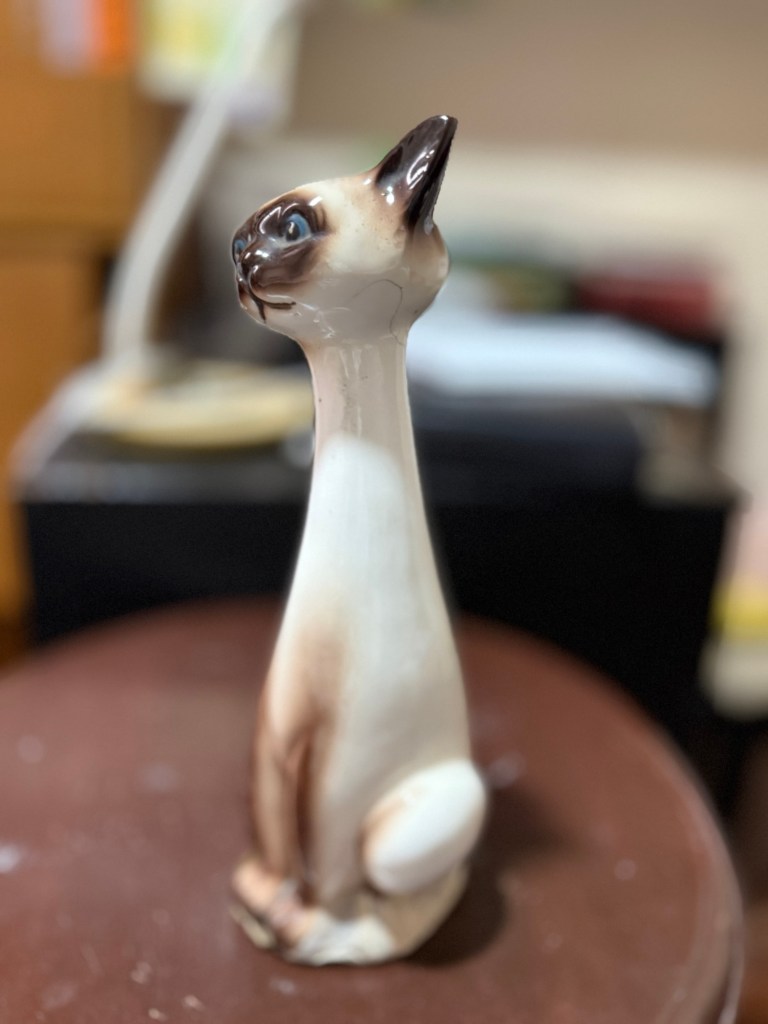
Photo by author, my mom’s kitty bank, 10.5 inches to the tip of ears.
While these things were running through me during our family dinner that night, my brother presented to me mommy’s “kitty bank” which is older than I am, 61 years old. It is one of her most cherished possessions she truly took great care as far as I can remember.
I have been thinking about it recently if it were still around though I never had any interest with it when growing up as a child except that I enjoyed counting the rare coins inside mostly dating back to the American occupation with the usual designs of the US flag and an eagle.
That evening on dad’s 25th death anniversary that could have been mom’s 86th birthday if she were still alive today, I felt a very strong attraction with that “kitty bank” whose face seemed to be speaking to me.
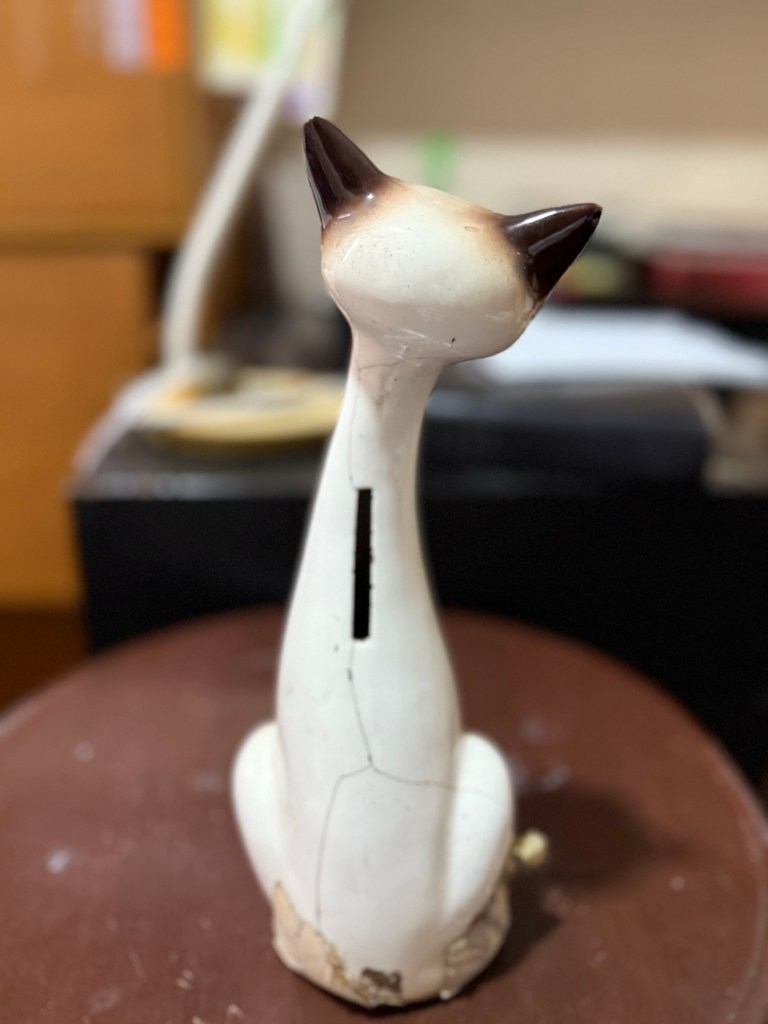
Photo by author, my mom’s kitty bank, circa 1964.
As I held it closer to see its many fissures and tapes following the wear and tear of over 60 years, I saw mommy again, of how she loved us and life so much, especially cats, dogs and fish, and most of all, plants- being a certified tita herself. Our house may be small but mommy lovingly took care of her pets and plants, always talking with them even after having a stroke.
Like the cat with its nine lives, death is never the end but the prelude to new life or, more lives hereafter.
And that is the nobility and giftedness of every mother – even after they are gone, they continue to bring forth and nurture life. God bless everyone… and the cats.
Lord My Chef Sunday Recipe, Fr. Nicanor F. Lalog II
Solemnity of Sts. Peter & Paul, Apostles, 29 June 2025
Acts 12:1-11 ><}}}}*> 2 Timothy 4:6-8, 17-18 ><}}}}*> Matthew 16:13-19
St. Peter’s Square at the Vatican in Rome.
We enter today the 13th week in Ordinary Time with a fourth celebration on a Sunday of another Solemnity, that of Saints Peter and Paul, the two pillars of the Church Jesus Christ established over 2000 years ago.
Sts. Peter and Paul were men of diverse backgrounds with Peter the fisherman, impulsive and so human while Paul the Pharisee was an intellectual converted by an encounter with Jesus on the road to Damascus. Both were flawed as persons yet so loved and called by the Lord – Peter as first leader of his church and Paul as its first missionary to the Gentiles. Their Solemnity reminds us of Christ’s call for us to build his Body, his Church here on earth.
While this celebration is about the two great apostles of Jesus, our readings direct us to God’s goodness and grace in his actions on behalf of the church founded by Christ. Its focus is on God, not ourselves.
Statues of Sts. Peter & Paul, st. Peter’s Basilica, Rome; photos from opusdei.org
Being an apostle of Jesus is not about doing great things or being so good but more of encountering and keeping faith in Christ our Lord. By recognizing ourselves as the church – the Body of Christ as we have reflected last Sunday, all of our actions are indeed God’s actions on behalf of the church because it is through us that the proclamation of the Gospel of Jesus’ death and resurrection is continued and completed in this age.
What is essential is we constantly enter into a conversation with Jesus in prayer not only to tell him things but most especially for us to realize how he sees us!
When Jesus went into the region of Caesarea Philippi he asked his disciples, “Who do people say that the Son of Man is?” They replied, “Some say John the Baptist, others Elijah, still others Jeremiah or one of the prophets.” He said to them, “But who do you say that I am?” Simon Peter said in reply, “You are the Christ, the Son of the living God.” Jesus said to him in reply, “Blessed are you, Simon son of Jonah. For flesh and blood has not revealed this to you, but my heavenly Father. And so I say to you, you are Peter, and upon this rock I will build my church, and the gates of the netherworld shall not prevail against it” (Matthew 16:13-18).
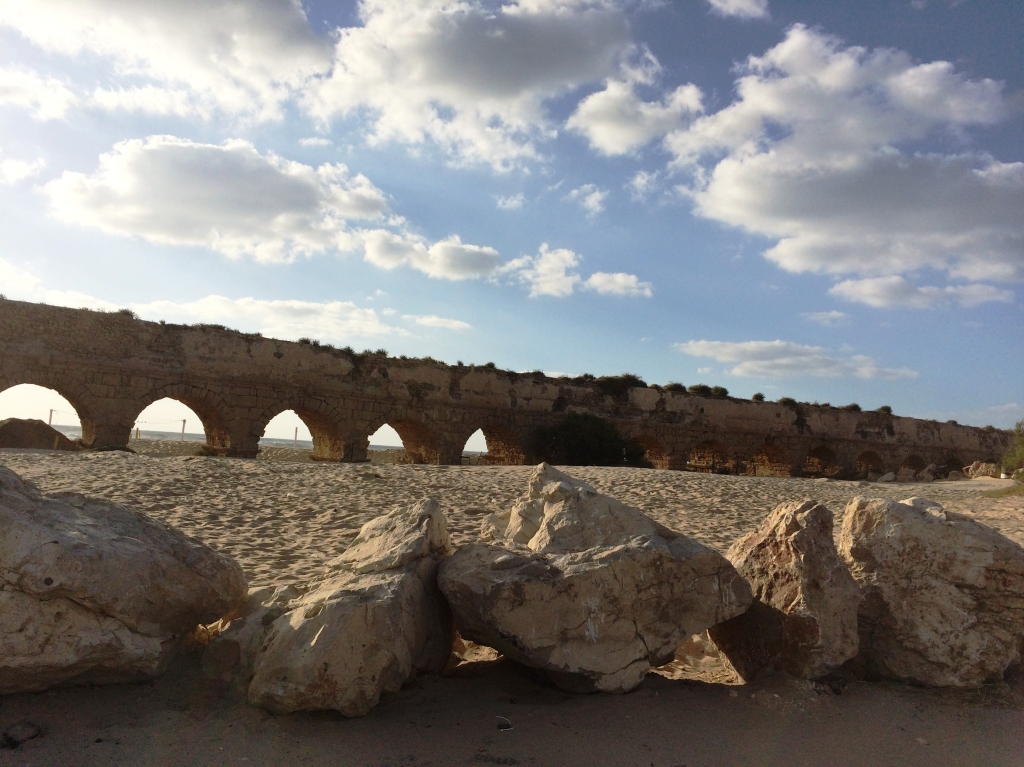
Photo by author at Caesarea, Israel, May 2017.
What really happened at Caesarea Philippi was a close encounter of the apostles with Jesus, especially Simon whom would he called as Peter on that day on.
Very often in most reflections and commentaries, we are told to answer the question of Jesus like Peter in our most personal way not based from what we have read or heard: “who do you say I am?”
Of course, what else can we say but imitate Peter’s answer that seems to be the most correct answer.
But, is it really the best answer? Not really.
Paul later in his many writings will declare similar answers but far more better like when he said “For me to live is Christ, and to die is gain” (Phil.1:21).
Jesus is telling us something else in this scene, as if asking us too, would you want to know “who do I say you are?” What the Lord is actually telling us in this scene is the fact that he knows us so well inasmuch as he knows himself perfectly because he is God. In fact, he had said there was no need for him to have human testimony as the Christ (Jn. 2:25; 5:34).
Photo by author, Sea of Galilee, Israel, May 2019.
What I see more at Caesarea Philippi is Jesus Christ’s omniscience as God who knows everything – even that early he already knew Peter would deny him thrice, that Judas Iscariot would betray him, so on and so forth.
Jesus knows everything about us but he chose to love and believe in us that despite and in spite of everything he knew that could go wrong with us later in life, of how we would fall into sin over and over, STILL – he calls us, he sends us on a mission because he believes in us, he loves us.
Many times in life, we forget the truth about the saints who are just like us, ordinary people with many weaknesses and flaws, imperfections and even idiosyncrasies. What made them stand out and did all those great feats for the Lord was because they were able to see themselves the way Jesus sees them.
That’s the very core of the story at Caesarea Philippi – Jesus made the apostles felt especially Peter how valuable they were, how they were all loved, of how Jesus saw them as his ambassadors later when he returns to the Father.
Bass relief of St. Peter at the Malolos Cathedral, 2019.
Jesus had no need of knowing what people were saying about him because he knew himself so well aside from the fact he surely knew what they were saying about him. Actually, the answers the apostles gave him were for them to know and think about why people wrongly perceived Jesus.
Most of all, Jesus had no need to know what everyone of us is saying about who he is because, again, he knows himself perfectly. Whatever answer others would have given about him would have been surely appreciated and praised by Jesus. What matters most for everyone to realize is the fact that despite Christ’s foreknowledge of Peter’s fall and weaknesses, he still dared to call him to head his church. The same holds true with everyone of us. Jesus wants us to continue building his Body, his church here on earth, to make Jesus more present in us in this world so dark and lost searching for meaning except in Christ.
The same thing is true with Paul when Jesus called him on the road to Damascus to persecute the first Christians. Jesus knew everything Paul was doing; most of all, Jesus knew that even when converted, Paul would still be stubborn and insistent, would eventually quarrel with other disciples like Peter, Barnabas and John Mark but still, Jesus called him and even set him aside for a special mission to the Gentiles.
Bass relief of St. Paul at Malolos Cathedral 2019.
Again in his experiences, Paul saw how Jesus loved and trusted him that even he were the worst of all the apostles of the Lord, he was given such great task of proclaiming the gospel to the ends of the earth at that time. That is why in our second reading we find Paul giving up his whole life in the service of Jesus after experiencing Christ’s tremendous love for him.
Like Peter and Paul, we are all gifted with the same faith in Christ Jesus who challenges us to accept the same mission to continue in this modern time of proclaiming his gospel of love and mercy, of building up his Body the church so that there would be a more humane and just society here on earth as Vatican II envisioned (Lumen Gentium).
Many times when God works in us and through us, we could not believe it as happening like Peter when set free from prison by an angel at night. There are times we are resigned with our situations, of being deserving of the many hardships and sufferings without realizing that there are more bad things we deserve to suffer in this life but Jesus spared us because he believes in us that he sends us to some more missions for him.
Lord Jesus Christ, thank you for still calling me, sending me to a mission despite my many flaws and imperfections; thank you for trusting me, believing me; let me see myself the way you see me as someone worth loving and trusting. Amen.
Lord My Chef Daily Recipe, Fr. Nicanor F. Lalog II
Sacred Heart Novena Day 9, 26 June 2025
Detalye ng painting ng Sacred Heart of Jesus sa Visitation Monastery, Marclaz, France mula sa godongphoto / Shutterstock.
Huling araw ng ating pagsisiyam sa Dakilang Kapistahan ng Kamahal-Mahalang Puso ni Jesus. Pinangakuan kahapon ng Diyos si Abram na magiging ama ng lahat ng bansa, na magiging kasing dami ng mga bituin sa langit kung gabi ang kanyang mga anak subalit matanda na siya ay wala pa rin silang anak ni Sarai.
Nag-magandang loob si Sarai at sinabi kay Abram na tabihan ang alipin niyang si Agar upang magkaanak sa kanya. Hindi nga nagtagal ay nagdalantao si Agar mula kay Abram at dito nagbago ihip ng hangin. Nagmalaki at hinamak ni Agar ang kanyang amo na si Sarai kaya’t nagalit siya at nagsumbong kay Abram.
Tulad ng sino mang mister, walang nagawa si Abram sa pagkagalit ni Sarai kaya sinoli niya sa kanya ang alipin niyang si Sarai. Gumanti at pinahirapan ni Sarai ang kanyang aliping si Agar na noon ay nagdadalang-tao ng anak ni Abram hanggang sa maglayas.
Pinagmalupitan ni Sarai si Agar, kaya ito ay tumakas. Sinalubong siya ng anghel ni Yahweh sa tabi ng isang bukal na nasa ilang. Tinanong siya, “Agar, alipin ni Sarai, saan ka nanggaling at saan ka pupunta?” “Tumakas po ako sa aking panginoon,” sagot niya. “Magbalik ka at pailalim sa kanyang kapangyarihan,” wika ng anghel. At idinugtong pa: “Ang mga anak mo ay pararamihin, At sa karamiha’y di kayang bilangin” (Genesis 16:6b-10).
Larawan kuha ng may-akda, Pundaquit, San Antonio, Zambales, 15 Mayo 2025.
Maraming pagkakataon sa buhay katulad tayo ni Sarai: sa pagmamagandang loob natin, madalas napapasama pa tayo. Inaabuso ng ilan kabutihang loob natin. Kasi rin naman, madalas tayo pabigla-bigla sa pagdedesiyon lalo na kung pinanginigbabawan tayo ng kapangyarihan na sa una tingin natin ginagamit natin sa kabutihan ngunit di alintana masamang epekto sa ilan.
Sa gitna ng lahat ng ito, naroon pa rin kabutihan ng Diyos. Mabuti na lang na hindi natin siya katulad dahil ang gawi natin kapag sumablay plano natin ay magsisihan.
Patas ang Diyos sa lahat. Kasi mapagmahal siya. Sa halip na sisihin tayo na dahil tayo naman palagi may kagagawan ng problema natin, humahanap siya palagi ng solusyon. Nakita ng Diyos na nakawawa si Agar bagama’t inabuso niya kagandahang loob ni Sarai. Wala siyang kapangyarihan, napakahina bilang alipin. At pagkatapos ay nagdadalantao. Kaya sa kanyang lungkot at hirap ay naglayas at nakita kanyang sariling nag-iisa, nawawala at takot na takot doon sa ilang. Parang tayo.
Ngunit hinanap pa rin siya – at tayo – ng Diyos upang pagpalain.
Tingnan kabutihan ng Diyos: hinahanap tayo at pinagpapala maski hindi tayo mabuti sa harap niya. Bagkus, higit pa nga niyang hinahanap at tila pinahahalagahan ang mga nawawala o naliligaw.
Ang ganda ng tanong ng anghel kay Agar na siya ring tanong sa atin ngayon, “Saan ka nanggaling at saan ka pupunta?”
Pagkaraan ng siyam na araw nating nobenaryo sa Sacred Heart, tingnan natin sarili nating paglalakbay sa pananampalataya, ating pinanggalingan at pinagdaanan sa buhay. Naroon ba Diyos sa oras ng ating paghihirap at pagsubok?
Tayo ba ay papalapit o papalayo sa Diyos sa ating buhay ngayon?
Pagmasdan pagkilala ng Diyos sa paghihirap ni Agar. Batid ng Diyos kanyang mga sugat. Sa sariling buhay natin marami ding pagkakataon nagpahayag ng habag at awa ang Diyos sa ating mga hirap na pinagdaraanan.
Ang pinaka-magandang bahagi nito ay ang pagbabalik ni Agar kay Sarai. Ang kanyang pagtitiwala sa Diyos na nangakong mula sa kanyang magiging anak kay Abram ay magmumula ang isa ring malaking lahi. Pati pangalan ng kanyang magiging anak ay Diyos ang nagbigay, Ishmael na ibig sabihin ay “nakikinig ang Diyos.”
Larawan mula sa Pinterest.com.
Ngayong bisperas ng Dakilang Kapistahan ng Kamahal-Mahalang Puso ni Jesus, walang duda nakikinig ang Diyos sa ating mga poanawagan at dalangin, tangis at panaghoy sa maraming sakit at hirap. Subalit, tayo ba ay nakikinig naman sa kanya?
Mismong si Jesus nagsabi hindi lahat ng tumatawag sa kanya ng “Panginoon, Panginoon” ay maliligtas dahil kung taliwas naman ang ating buhay sa ating pananampalataya. Kaya ngayong araw, balikan natin ating pinanggalingan upang maging maliwanag kung tayo nga ay malinaw pa rin sa patutunguhan, ang Diyos.
O Jesus na mayroong
maamo at mapagkumbabang Puso,
Gawin Mong ang puso nami'y
matulad sa Puso Mo!
Amen.
Lord My Chef Daily Recipe by Fr. Nicanor F. Lalog II
Sacred Heart Novena Day 4, 21 June 2025
Detalye ng painting ng Sacred Heart of Jesus sa Visitation Monastery, Marclaz, France mula sa godongphoto / Shutterstock.
Siguro napakanta kayo sa pamagat ng ating pagninilay ngayong araw na buhat sa 1992 hit ng yumaong si Bodjie Dasig at ng kanyang Law of Gravity na Sana Dalawa ang Puso Ko (ginawa din itong pelikula noong 1994 starring Dina Bonnevie, Alice Dixson at Rustom Padilla).
Usiginanga… kantahin nga natin:
Sana dalawa ang puso ko
Hindi na sana nalilito kung sino sa inyo
Sana dalawa ang puso ko
Hindi na sana kailangan pang pumili sa inyo
Maraming naging bersiyon ang kantang iyon kasi nga bukod sa maganda ang tono, e talaga namang paborito ng maraming “nalilito” sa pag-ibig kungdi sa kungdi sa buhay mismo.
Subalit ang mabuting balita ngayong ikaapat na araw ng ating Nobenaryo sa Kamahal-Mahalang Puso ni Jesus ay batid mismo ito ng Panginoon – ang ating kalituhan sa buhay na kanyang tinatalakay sa ebanghelyo ngayon.
“Walang makapagilingkod nang sabay sa dalawang panginoon sapagkat kapopootan niya ang isa at iibigin ang ikalawa, paglilingkuran nang tapat ang isa at hahamakin ang ikalawa. Hindi kayo makapaglilingkod ng sabay sa Diyos at sa kayamanan” (Mateo 6:24).
Larawan kuha ng may-akda, Sacred heart Novitiate, Marso 2024.
Ginamit na kataga sa English translation ng bahaging ito ng ebanghelyo ang orihinal na kataga na “mammon” – You cannot serve both God and mammon.
Kung tutuusin sabi ng mga dalubhasa sa bibliya, walang tiyak na translation ang “mammon” at naging pakahulugan na lang ang kayamanan at pera o salapi. Ayon sa kanila, malawak at kumplikado ang sinasaad ng “mammon” katulad ng ano mang labis (excess) at imbalance o kawalan ng balanse sa mga bagay-bagay na nagdudulot ng pagkakasakit at kawalan ng katarungan.
Alalaong-baga, ang “mammon” gaya ng ano mang labis at sobra ay nakakasama at nakakasira sa ating pagkatao. Maaring ituring ang pagkain at inumin o kahit anong bagay na mabuti ngunit sumasama kung sumosobra. Ang “mammon” ay ano mang bagay na nakaka-addict na ayaw na nating bitiwan hanggang sa malunod o malulong na tayo at malimutan natin ating sarili pati mga kapwa natin.
Totoo naman na kailangan natin ang pera upang makapag-aral, magkaroon ng damit at ng makakain ngunit kapag ito at iba pang mga bagay maging mga tao na ang ating pinapanginoon, ang mga ito ay nagiging mammon. At kung magkagayon, mas malamang na hindi malayo na tayo ay nagkakasala o namumuhay sa kasalanan. Kaya kailangang matukoy natin ang ating mga “mammon” bago maging huli ang lahat at masira na ating buhay sa kasalanan.
Larawan kuha ng may-akda, Sacred heart Novitiate, Marso 2024.
Gayon din naman, hindi pa rin sapat na matukoy lamang natin ang iba’t ibang “mammon” at mga kalabisan sa buhay natin. Mahalaga ring makita ang sitwasyon ng buhay ngayon na kung saan ang Diyos ay binabale-wala at ang mga turo ng Simbahan maging ano mang kabutihan ay pinagtatawanan.
Ito pinakamahirap sa ating panahon ngayon na namumuhay tayo sa gitna ng maraming makabagong teknolohiya na nagbubunsod ng mga kakaibang kamalayan at kaisipan kung saan ang lahat ay sinusukat na lamang sa pera at kapakinabangan. Hindi lamang nangingibabaw ang mga materyal na bagay at lahat ng uri ng “mammon” kungdi wala na rin ang Diyos sa usapan.
Tawag dito sa Ingles ay “dissonance” o mawala sa tono tulad ng sa musika. Hindi ba ganito ang buhay nating ngayon, wala sa tono?
Sa ating pagsisikap na mamuhay ayon sa ebanghelyo, lumago sa espirituwalidad at maging banal gaya ng panawagan ni Jesus sa ating lahat, kitang-kita at damang-dama natin na napaka-hirap nito. Palaging nakasalungat ating mga pahalagahan o values sa pinahahalagahan at patakaran ng mundo na ang gusto palagi ay maging mayaman at makapangyarihan, maging sikat at kilala, maging malaya sa maling paraan kayat ang panawagan ng marami ay diborsiyo at abortion, pati na rin same sex marriage.
13th Day Devotion sa Our Lady of Fatima University CAS Chapel, Agosto 2023.
Subukan mong ituro o magsalita ukol sa katapatan sa pag-aasawa, ang kamalian ng pakikipagtalik sa kapwa lalake o babae, ang karapatan ng mga sanggol sa sinapupunan at ikaw ay pagtatawanan, lalaitin at kukutyain habang pinagsasabihan ng lahat ng pangalan mula kosnerbatibo o makaluma, Pariseo, at nagmamalinis.
Balikan ating mga pagbasa nitong lumipas na isang linggo na ang mga paksa ay salungat sa gawi ng kasalukuyang daigdig tulad ng pagmamahal sa kaaway, pagiging bukas-palad, at pagdarasal tuwina.
Sa mundo ngayon, ang binibigyang halaga palagi ay kaginhawahan, kung ano ang madali at kalugod-lugod. Ultimo ang pagtanda ay tinitingnang kapintasan at sakit na kinatatakutan kaya lahat ay gustong manatiling bata.
Noon pa man ay napansin na ito ni San Pablo ngunit para sa kanya, walang saysay ang ipagyabang ating husay at galing bagkus dapat nating ikatuwa ang mga sakit at pagtitiis na pinagdaraanan sa ngalan ng Panginoon.
ganito ang kanyang (Panginoon) sagot, “Ang tulong ko ko’y sapat sa lahat ng pangangailangan mo; lalong nahahayag ang aking kapangyarihan kung ikaw ay mahina.” Kaya’t buong galak na ipagmamapuri ko ang aking kahinaan upang palakasin ako ng kapangyarihan ni Cristo. Dahil kay Cristo, walang halaga sa akin kung ako ma’y mahina, kutyain, pahirapan, usigin, at magtiis. Sapagkat kung kailan ako mahina, saka naman ako malakas (2Corinto 12:9-10).
Mismong ang Panginoong Jesus ito rin ang naranasan noong siya ay pumarito sa lupa. Hanggang sa Krus hindi siya tinantanan ng diablo sa panunukso, pilit na hinahati kanyang puso at kalooban upang talikuran ang Ama sa langit kasama na tayong mga tao.
Larawan kuha ng may-akda, Sacred Heart Novitiate, Novaliches, QC, 20 Marso 2025.
Subalit nanatiling matatag si Jesus. Ni minsan hindi niya naisip na sana dalawa ang kanyang puso sapagkat sa kanyang Kamahal-Mahalang Puso, iisa ang nanatiling tuon at laman.
Ngunit pagsumakitan ninyo nang higit sa lahat ang pagharian kayo ng Diyos at mamuhay nang ayon sa kanyang kalooban, at ipagkakaloob niya ang lahat ng kailangan ninyo (Mateo 6:33).
Nag-iisa lang ang ating puso dahil nag-iisa lamang tayo sa Puso ni Jesus. Bawat isa sa atin ay kanyang pinakamamahal.
Sa atin bang puso, si Jesus din ang ang pinaka-mamahal? O, nahahati na rin ang puso natin, namamangka sa dalawang ilog?
O Jesus na mayroong
maamo at mapagkumbabang Puso,
Gawin Mong ang puso nami'y
matulad sa Puso Mo!
Amen.