“Switching on” the grace of God

The Lord Is My Chef Daily Recipe for the Soul by Fr. Nicanor F. Lalog II
Friday, Homily on Solemnity of the Birth of John the Baptist, 23 June 2023
Isaiah 49:1-6 ><}}}}*> Acts 13:22-26 ><}}}}*> Luke 1:57-66.80
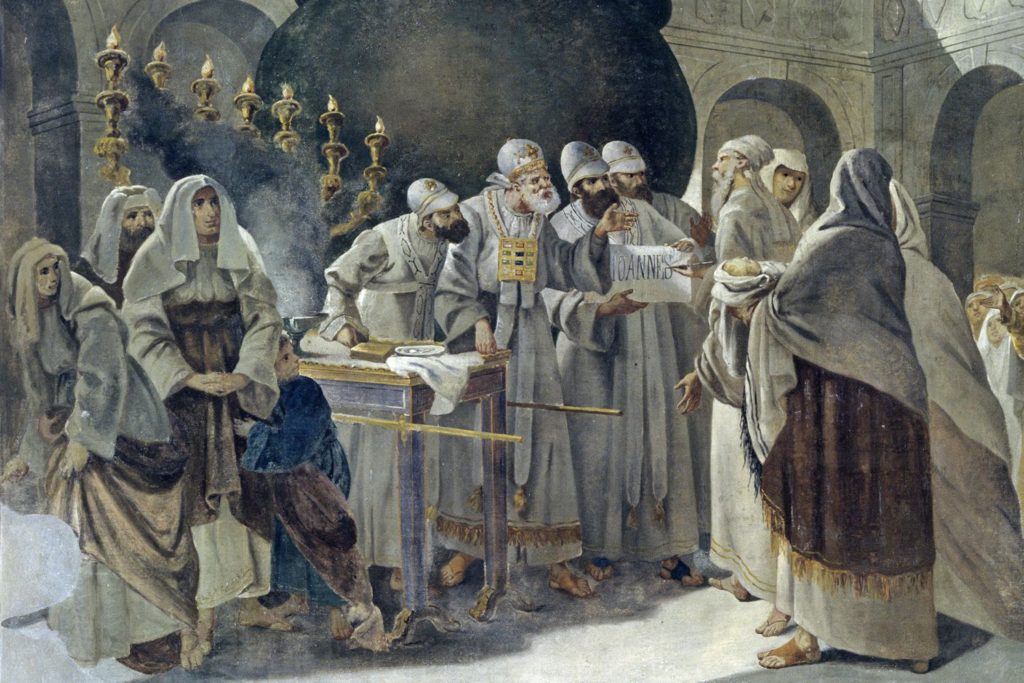
Painting of Zechariah giving name to his son John by Italian painter Riccardo Cessi (1892) from commons.wikimedia.org.

You must have heard a lot of “Dad jokes” from Instagram. Let me now share with you a “Father joke” or priest joke. The world’s first techie was the Jewish priest Zechariah, father of St. John the Baptist because he “asked for a tablet and wrote, ‘John is his name'”.

Ok. It is corny and dry but may I invite you, friends, on something wonderful about this gospel scene in celebration today of the Solemnity of the Birth of St. John the Baptist, the precursor of our Lord Jesus Christ.

Remember how Zechariah was punished by Archangel Gabriel by becoming deaf and mute after he had doubted the good news that he and his wife Elizabeth would soon have a son to be named John. Actually, Zechariah not only doubted but even questioned “how” his barren wife could still bear a child at an old age. As a result, he was forced into silence by the Lord’s angel until everything he had announced was fulfilled.

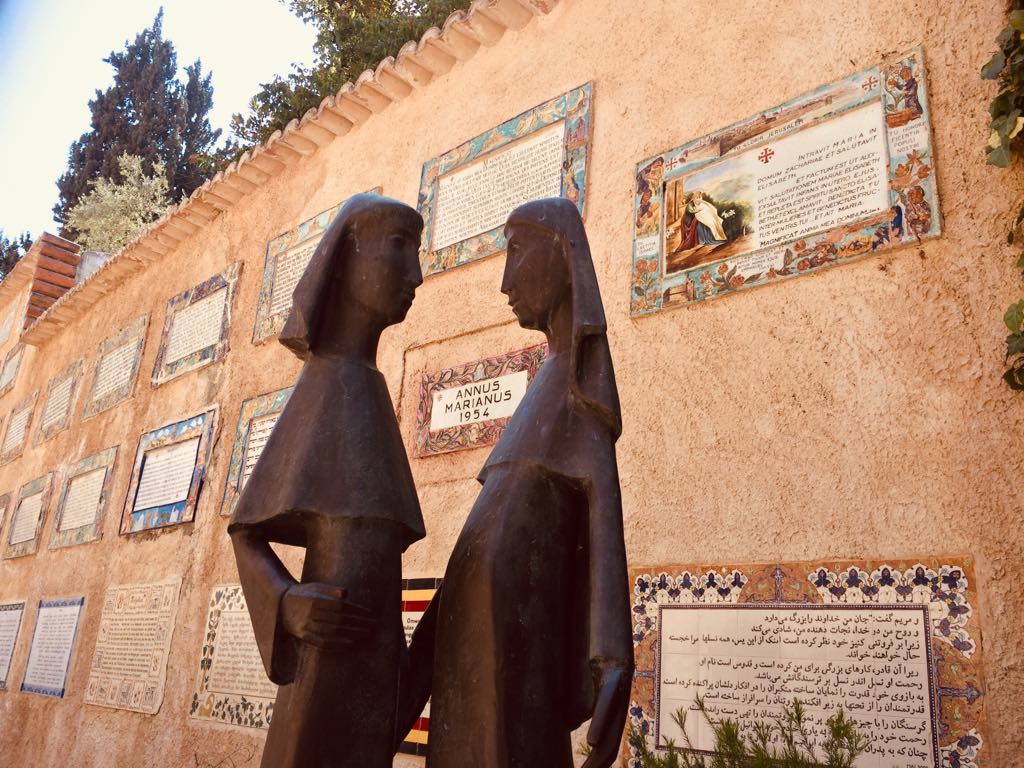
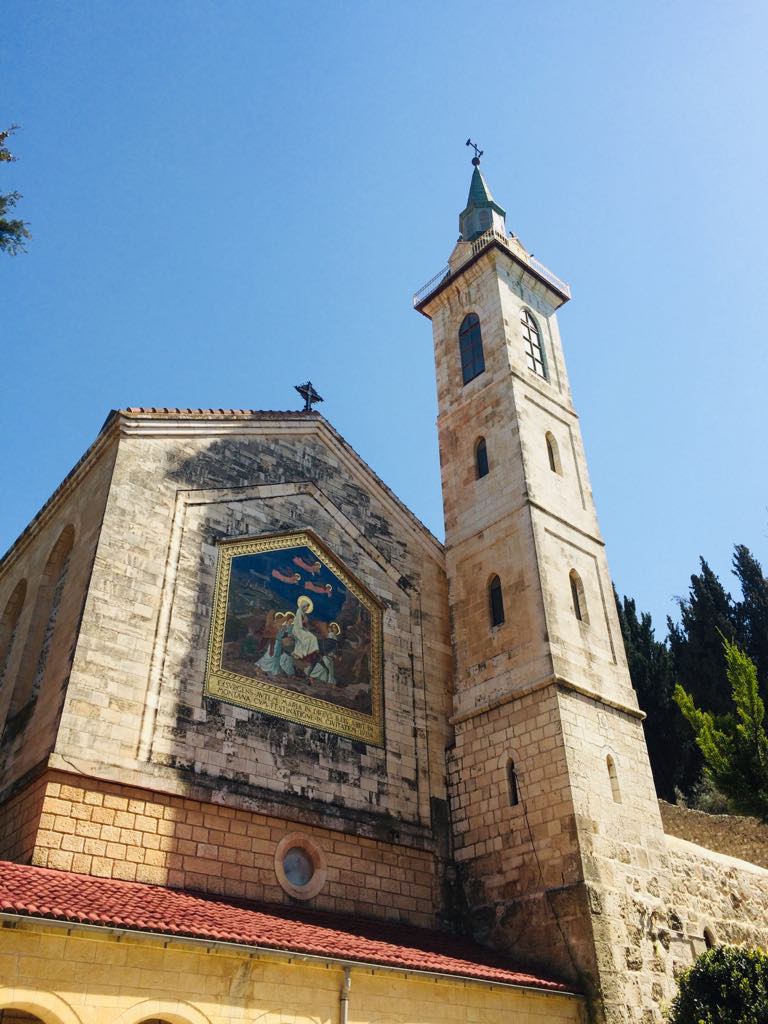
Photo by author, May 2019, Church of St. John the Baptist, Ein Karem, Israel.

When the time arrived for Elizabeth to have her child she gave birth to a son. Her neighbors and relatives heard that the Lord had shown his great mercy toward her, and they rejoiced with her. When they came on the eighth day to circumcise the child, they were going to call him Zechariah after his father, but his mother said in reply, “No. He will be called John,” But they answered her, “There is no one among your relatives who has this name.” So they made signs, asking his father what he wished him to be called. He asked for a tablet and wrote, “John is his name,” and all were amazed. Immediately his mouth was opened, his tongue freed, and he spoke blessing God.

Luke 1:57-64

Imagine the sight narrated to us by St. Luke: everybody so happy, trying to take a piece of action while Zechariah, father of the new-born child, old and deaf and mute was so silent like a nobody in a corner. In the Jewish society, it is the father who gives name to the children, especially to the son; but, due to Zechariah’s condition, nobody bothered to ask him so that their neighbors, like the typical epal or pakialamera we call in Filipino, assumed the role.

But Elizabeth the mother who had gone into a self-imposed silence upon bearing her child, declared their son would be called “John” or Jehohanan that means “God is gracious” or “graciousness of God” in Hebrew.

Finally amid all the noise and talk, Zechariah made the bold move by writing on a tablet “John is his name” to confirm and reaffirm the name given by his wife Elizabeth. It was a crucial moment when Zechariah boldly made a stand about his faith in God, obeying the angel’s instruction to name his son “John”.
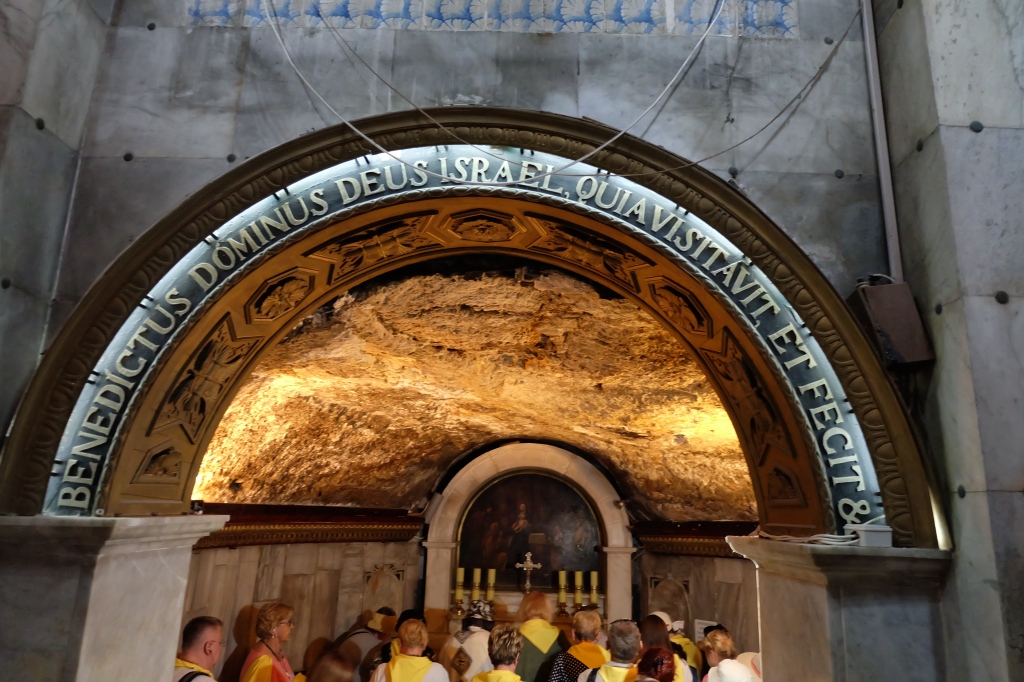
Photo by author of the site believed to be the birthplace of St. John the Baptist at the side of the Church of St. John the Baptist in Ein Karem, Israel, May 2019.

What really happened was the assertion of the plan of God when Zechariah faithfully wrote “John is his name”. That’s what amazed the people so that “fear came upon the neighbors for surely the hand of the Lord was with him” (Lk.1:65, 66).

With a single stroke of hand, everyone felt God present among them as they realized something very special with the child. So amazing too as experienced by the people was when Zechariah asserted God’s plan by naming his son “John”, he was finally able to speak and hear again!

Whenever we assert the plan of God in our lives, in our community, in our family and country, new possibilities open as we break free from all obstacles and hindrances that prevent us from growing and maturing, from being joyful and fulfilled.

Whenever we assert the plan of God in our lives, in our community, in our family and country, that is when we “switch on” the grace of God, when we make God’s blessings operable among us and thus we become like John, a precursor of the Lord whose name means “God is gracious”.

Whenever we obey and assert the plan of God in our lives, in our community, in our family and country, that is when we take that leap of faith, believe again and experience God again.

Many times we could not see nor experience nor realize God’s blessings around us and within us because we do not actually believe and trust him. God’s grace is like a “switch” we have to turn on to operate like the electric light or any appliance and gadget. And the good news is, that grace and “switch” is in us already! We just have to switch it on.

Here we find anew the importance of silent, deep prayer.
Photo by author, Anvaya Cove, 19 May 2023.

The imposed silence on Zechariah made him realize how he had been held prisoner by his disappointments and frustrations over a long period of time when God did not hear his prayers for a child. Imagine their shame being childless despite their being good persons and as husband and wife. At that time, childlessness was seen as a punishment from God, a curse. It must have been a strong blow too to Zechariah’s ego as a priest consulted by everyone for advise and prayers yet could not sire his wife with a child!

All those negative feelings of humiliation and dejection could have caused Zechariah’s trust and faith in God to wane that even his priestly duties have become perfunctory that he never saw the tremendous grace and blessing of incensing the Holy of Holies of the temple. Such duty was a pure grace in itself because it happens only once a year during the holiest celebration of the Jewish of Yom Kippur or Day of Atonement. Priests went through a long process of drawing lots on who among them would incense the Holy of Holies because they were so many in number.

Many times we have been like Zechariah, numb and even indifferent to the movements and works of God in our lives following our many failures in life. Though we may be praying with many devotions doing so many religious activities, we have actually become “spiritual dwarfs” who never grew and matured in faith. Our prayers and devotions have become mere “habits hard to break” that are empty and meaningless.
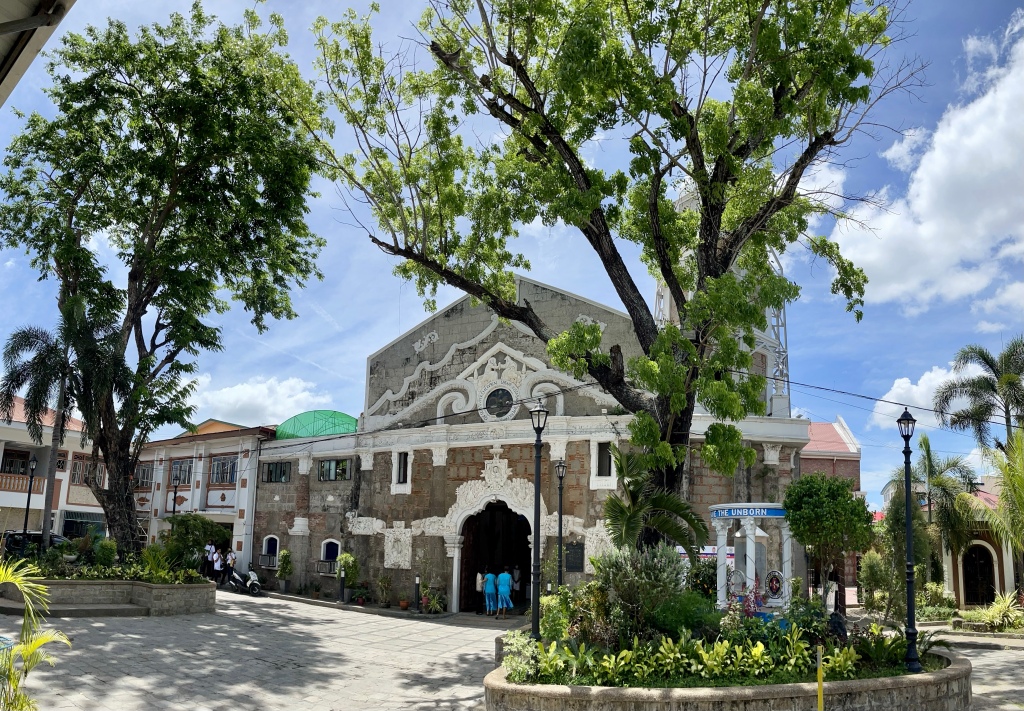
Photo by author taken in May 2022, Parish of St. John the Baptist in Calumpit, the oldest church in Bulacan province.

Today God is calling us to do a Zechariah, to take that bold step of asserting and insisting God’s plan like when Zechariah boldly declared in writing “John is his name”. The first reading beautifully reminds us of one reality we all go through by wrongly thinking God does not care at all for us when nothing seems to happen with our prayers and efforts in life, in our ministry and mission.

Hear me, O coastlands; listen, O distant peoples. The Lord called me from birth; from my mother’s womb he gave me my name. Though I thought I had toiled in vain, and for nothing, uselessly, spent my strength, yet my reward is with the Lord, my recompense is with my God.

Isaiah 49:1, 4

We cannot be another John – a graciousness of God within us and for others unless we rediscover the courage and clarity to do a Zechariah by asserting God’s command and plans entrusted specifically to us.

See also that upon regaining his sense of hearing and ability to speak, Zechariah “spoke blessing God” by singing the Benedictus in the following verses. The Benedictus is the morning hymn of praise to God we priest sing or recite daily in praying the Liturgy of the Hours. It mentions the blessedness of God and his many blessings to Israel while towards its end, we find Zechariah sending forth his son John to fulfill his mission from God in preparing the way of Jesus Christ. It is prayed in the morning to make us aware of our mission to prepare the way of the Lord Jesus.

Let us be patient, never lose hope and enthusiasm in doing the works of God even if nothing seems to happen at all. Everything we do matters a lot with God and with those around us as St. Paul explained in the second reading on the role of St. John the Baptist in salvation history.

Let us keep in mind that God remembers and keeps his promise always because he is gracious all the time. The name Zechariah in Hebrew means “God remembers” while Elizabeth is “God has promised”. John, as we have earlier said, means “God is gracious.” Let us do our part to bring Jesus into this world so fragmented and tired. Have a grace-filled weekend! Amen.

Photo by author taken in May 2022, altar of the Parish of St. John the Baptist in Calumpit, the oldest church in Bulacan province.

The riches of Christ

The Lord Is My Chef Daily Recipe for the Soul by Fr. Nicanor F. Lalog II
Homily, Solemnity of the Most Sacred Heart of Jesus, 16 June 2023
Deuteronomy 7:6-11 ><}}}*> 1 John 4:7-16 ><}}}*> Matthew 11:25-30
Photo by author, Sacred Heart Novitiate, Novaliches, Quezon City, 20 March 2023.

It has been two months since I celebrated by silver anniversary of ordination to the priesthood. Until now, I still continue to reflect and relish on this immense gift of priesthood, still asking with the same sense of awe and wonder since ordination day, “why me, Lord?”

As I reflected this week the Solemnity of the Most Sacred Heart of Jesus which is dedicated for the sanctification of us priests, I have realized how I have remained the same sinful, insecure and fearful man ordained 25 years ago with my six other classmates. As I get closer to becoming a senior citizen in 2025, the more my past sins and stupidities, carelessness and vices are coming back like “Facebook Memory”, reminding me how I have them kept under control, that they could burst and be out in the open if I get careless.

But in the midst of all these darkness and weaknesses still in me, the more I feel so blessed and consoled, and overjoyed by the fact that I still have that same desire to proclaim Jesus Christ to everyone, of how beautiful this life is because of the Lord’s immeasurable love for each of us. Whenever I look back to my past with all my sinfulness and weaknesses amid my getting older, the more I am eager to make Jesus known to everyone while I am still strong and able. There is that feeling of being like St. Paul in saying, “To me, the very least of all the holy ones, this grace was given, to preach to the Gentiles the inscrutable riches of Christ, and to bring to light for all what is the plan of the mystery hidden from ages past in God who created all things” (Eph. 3:8-9).

Or, like in our first reading, I could identify with the Israelites being reminded by Moses in the wilderness that “You are a people sacred to the Lord, your God; he has chosen you from all the nations on the face of the earth to be his people peculiarly his own. It was not because you are the largest of all nations that the Lord set his heart on you and chose you, for you are really the smallest of all nations. It was because the Lord loved you” (Dt.7:6-8).

Beautiful!

Love, love, and love!

That is the “inscrutable riches of Christ”, his immense love for us, dying for us, coming for us even if we are worth nothing at all. And it is because of that love of God for us that we have become so worthy that he gave us even his only Son, Jesus Christ.

That is the essence of this celebration of the Solemnity of the Most Sacred Heart of Jesus.

Love.

A reality we all experience and know but could not define for it has no limits. Love can only be described and best expressed in actions than in words.

See this Solemnity of the Most Sacred Heart of Jesus comes right after the Solemnities of the Most Holy Trinity and of the Most Precious Body and Blood of Jesus these past two Sundays. Both celebrations speak of love: the latter is about relationships based on love and the former is about giving of self in love.

Now that we are well into the Ordinary Time of our liturgical calendar, our celebration today tells us to remember throughout this year this most basic truth and reality of our faith – that we are so loved by God.

Beloved, let us love one another because love is of God; everyone who loves is begotten by God and knows God. Whoever is without love does not know God, for God is love. In this way the love of God was revealed to us: God sent his only Son into the world so that we might have life through him.

1 John 4:7-9

Love is symbolized by the heart, the very core of every person. That is why I love the Spanish word for heart which is corazon, evocative of the core, of the deeper self. And of course, love is the very the person of God.

Of all the writers in the Bible, St. John is the one who most frequently used the word “love”, an indication of its centrality in his thoughts. Moreover, he clarified that this love is not human love because its origin, motives and effects are supernatural in nature who is God himself.

Being the very self and also the riches or wealth of Christ, love is for sharing, for giving. Never for keeping. Because of its supernatural nature, love is inexhaustible. The more you give it, the more you share, the more you have it!

In this is love: not that we have loved God, but that he loved us and sent his Son as expiation for our sins. Beloved, if God so loved us, we also must love one another. No one has ever seen God. Yet, if we love one another, God remains in us, and his love is brought to perfection in us.

1 John 4:10-12
Photo by Ms. April Oliveros, March 2023 at Mt. Pulag.

Let me repeat that last sentence, “if we love one another, God remains in us, and his love is brought to perfection in us.”

The more we love, the more we are able to see and recognize God and other people amidst the darkness around us. Likewise, the more we love the more we see our true selves too despite dark spots within us.

Love is the law of life. To love God by loving ourselves and others is not an obligation imposed from outside. It is the very proof of our faith and union with God in Jesus Christ.

Jesus makes this very clear to us today in the gospel that opens with him praising the simple people, those who were child-like who welcomed him and his preaching. They were the ones Jesus referred at his sermon on the mount, “Blessed are the poor” because love is not an intellectual structure or system to be learned or analyzed. Love is a call to be disarmed of everything we hold onto so we can totally love and follow Jesus Christ.

“Come to me, all you who labor and are burdened, and I will give you rest. Take my yoke upon you and learn from me, for I am meek and humble of heart; and you will find rest for yourselves. For my yoke is easy, and my burden is light.”

Matthew 11:28-30

Jesus came to reveal to us God our Father. And to know the Father is not through the head or intelligence but through our heart that is like Christ’s, meek and humble, filled with love.

By becoming human like us in everything except sin, Jesus who is the image of the invisible God (Col. 1:15) enables us to feel and experience God now closest to us than ever. Most of all, we are able to love and still love especially when the going gets tough and rough.

Here Jesus shows us that love is not absence of sufferings. In fact, love is truest and noblest when there are sacrifices and sufferings as exemplified by Jesus in his life and death on the Cross.

There are times we feel grouchy, so sensitive when people seem to ask even demand so much from us.

From Facebook, 2021.

Sometimes we wonder why are we the ones always giving, always loving, always forgiving. Sometimes we even ask God why are we the ones going through all these trials in life, why are we the ones afflicted with this sickness, why are we given with a special child, why your child had gone ahead of you to eternal life?

So many whys, so many questions.

Rest today in Christ. Feel his embrace. Listen to his silence. Be filled with his love. As you ask Jesus with all those questions, realize that each cry, each lamentation is the “inscrutable riches of Christ”, his very love perfected in your labors and burdens. Amen.

Jesus, meek and humble of heart,
Make my heart like thine!

On being kind

40 Shades of Lent by Fr. Nicanor F. Lalog II
Friday in the Second Week of Lent, 10 March 2023
Genesis 37:3-4, 12-13, 17-28   >>> + <<<   Matthew 21:33-43, 45-46 
Photo by author, Anvaya Cove, Bataan, January 2023.

Being kind is more than being good. The word “kind” is from the old English kin – as in kindred or kinsfolk or same family, clan, or tribe. A kind person is someone who treats you as a kin, a family and not as an alien or a stranger. “Hindi ka naman iba sa amin” as we would say in Tagalog (“You are not different from us”). It is perhaps the most Christian word in the English language as it refers to our belonging to one big family with God as our Father and everyone a brother and a sister in Christ.

Unfortunately, kindness has become a rarity in our world today that has become so unkind where we feel so “different” as in “iba” in Tagalog even right in our own family like in the experience of Joseph in our first reading today.

They said to one another: “Here comes the master dreamer! Come on, let us kill him and throw him into one of the cisterns here; we could say that a wild beast devoured him. We shall then see what comes of his dreams.”

Genesis 37:19-20

Most often, it is jealousy that makes people unkind like with the elder brothers of Joseph. This is expressed in our name-calling as we refuse to acknowledge someone as our kin by giving them aliases like Joseph referred to by his brothers as “master dreamer”. We Filipinos have all kinds of aliases and codes for the family members we hate like “bruha”, “demonyo”, “Hudas” or even “Hitler”. The more mean, the better, without us realizing how our jealousies expressed in name-calling deteriorate into sinister plots against our own kin. It is the most unkindest kind of unkindness demonstrated in the selling of Joseph:

Judah said to his brothers, “What is to be gained by killing our brother and concealing his blood? Rather, let us sell him to these Ishmaelites, instead of doing away with him ourselves. After all, he is our brother, our own flesh.” His brothers agreed. They sold Joseph to the Ishmaelites for twenty pieces of silver. (Gen.37:26-28).

Genesis 37:26-28
Photo by author, Infanta, Quezon, 04 March 2023.

This is the tragedy now going on in our family when we call our parents and siblings as “mom” and “dad”, “kuya” and “ate” yet at the same time, disrespect them in our thoughts and deeds! See the absurdity of Judah in concluding, “after all, he is our brother, our own flesh” that they sold him! He miserably missed the whole point that if Joseph were their brother and own flesh, all the more he should have cared and saved him even from being sold to slavery right there!

This is the curse of many fraternities in our universities. Even worst than Judah, there are some fratmen blinded by their rites and rituals of initiations that they have forgotten or have become oblivious to the meaning of brotherhood or fraternity. The most incomprehensible of all is with every death happening among their brods, still the same story of silence and cowardice happening with all attempts to hide their heinous crimes.

It is a tragedy we also participate daily in our homes when we regard our family as kin yet at the same time disregard all kindness and respect due to our parents and brothers and sisters, or to husband and wife. What an unkind world we have when we cheat on one another with our infidelity and betrayals, when we stab each other with harsh words of suspicions without bases at all as well as our never ending sumbatan.

Jesus himself shows us in his parable of the wicked tenants the face of this “unkindest kind of being unkind” springing not only from jealousy but from our self-centeredness and self-righteousness.

“when the tenants saw the son, they said to one another, ‘This is the heir. Come, let us kill him and acquire his inheritance.’ They seized him, threw him out of the vineyard, and killed him.”

Matthew 21:38-39
Photo by author, Infanta, Quezon, 04 March 2023.

What an unkind world when after recognizing one another as a kindred, instead of being kind and respectful, of having malasakit, like the wicked tenants we use our ties and kinships as bases for murderous and other evil plots against those we know and closest to us.

It is disheartening and frustrating when our social media are filled with moral aspersions as well as downright accusations so harsh that could sometimes get into one’s nerves, hurting our sensibilities. True, charity is never imposed and respect has to be earned but kindness is demanded of us because being kind is the hallmark of a person’s goodness.

Our responsorial psalm captures the reason why we must always be kind, “Remember the marvels the Lord has done.” And here lies the warning to those unkind, “When the Lord called down a famine on the land and ruined the crop that sustained them, he sent a man before them, Joseph, sold as a slave” (Ps. 105:16-17).

The story of Joseph the Dreamer never fails to move us of how in the end, his brothers wept in shame upon meeting him as their brother whom they have sold into Egypt. As Jesus said too to the chief priests and Pharisees of his time, “Did you never read in the Scriptures: the stone that the builders rejected has become the cornerstone; by the Lord has this been done, and it is wonderful in our eyes?” (Mt.21:42).

This season of Lent, let us try to bring back kindness in our hearts, in our words, in our thoughts and in our deeds even if others are not kind to us. Sometimes, kindness has a way of teaching us the importance of this virtue that may not be always be so kind at all. Amen.

Photo by author, Infanta, Quezon, 04 March 2023.

Christmas is saying “NO”

The Lord Is My Chef Simbang Gabi Recipe for the Soul by Fr. Nicanor F. Lalog II
Friday in the Fourth Week of Advent, Eighth Day of Christmas Novena, 23 December 2022
Malachi 3:1-4, 23-24     ><000'> + ><000'> + ><000'>     Luke 1:57-66

We are now in the penultimate day to Christmas and Luke is getting more dramatic in his narration of the events leading to the birth of our Savior Jesus Christ. The scene is still in Judea, the house of Zechariah when Elizabeth finally gave birth to John the Baptist, the Lord’s precursor.

Everyone rejoiced and something so wonderful happened during the child’s circumcision when he was named.

When the time arrived for Elizabeth to have her child she gave birth to a son. Her neighbors and relatives heard that the Lord had shown his great mercy toward her and they rejoiced with her. When they came on the eighth day to circumcise the child, they were going to call him Zechariah after his father, but his mother said in reply, “No. He will be called John.”

Luke 1:57-60

I love that part when Elizabeth suddenly spoke to her relatives and neighbors on the name to be given to her son, but his mother said in reply, “No. He will be called John.”

Beautiful! Another example of Luke’s artistry.

Recall that when Elizabeth was put into the scene by Luke last Monday after the annunciation of John’s birth to his father Zechariah, she was portrayed as soft and somewhat passive. In fact, after conceiving John, Luke tells us Elizabeth went into seclusion for five months to reflect on God’s wondrous deed to her, not to mention the “embarrassment” of an 80-year old woman getting pregnant. That was when Mary visited her.

Elizabeth was all praises to her younger cousin Mary and of course, to God. At the Visitation, we got a picture of Elizabeth as a kind and genteel woman until today when she suddenly roared like a lioness, standing her ground to protect her child! From being passive, Elizabeth is now portrayed as a very active person, a woman in the fullest sense, standing her ground on what she firmly believes and thinks best for her and her child when she adamantly declared to everyone “No. He will be called John.”

One of the things my mother had told me is learning to say NO especially if it has something do with sin and evil, something very bad, including expensive things. Later in life I realized the great value she had instilled in me of knowing to say NO, even of standing by it.

Many times in our modern time, we just go on with the flow, approving without even thinking whatever the world tells us as seen in many commercials and logo like “Just do it!” and “Obey your thirst”. It is what Pope emeritus Benedict XVI called as “dictatorship of relativism” – no more absolutes like God, almost everything is allowed from morals to fashion that many have lost any sense of truth and good, of beauty and decency and propriety.

Elizabeth showed us in the naming of her son something very vital in Christ’s coming: she herself was the finest example and model for John the Baptist in his mission of preparing the way of the Lord, of cleansing the world of its sins and excesses that nobody seemed to fight anymore. In the first reading, Malachi prophesied how the precursor would be like a “refiner’s fire, or like the fuller’s lye” (Mal.3:2) cleansing the people, preparing their hearts to receive Jesus Christ.

Any cleansing or conversion or repentance begins first with a decisive NO to sin and evil, to useless traditions and beliefs that forget God and his people.

See how Luke brought out this strong character of Elizabeth perfectly in the timing of the circumcision and naming of her child – right at the moment of the “cutting” of the foreskin, Elizabeth intervened and insisted on God’s plan that was contrary to everyone’s thought and belief. It was Elizabeth who “cut off” or broke off John and her self from the traditions and old rituals of the people at that time. She was a trailblazer in fact, a trait John must have acquired from her from the very start of his life.

Most beautiful scene here is when Elizabeth stood her ground to the point that her relatives and neighbors protested to her naming her child John. She really meant her NO despite their protests that they asked Zechariah to write on a tablet the child’s name.

And everyone was amazed, even shocked, when Zechariah who was deaf-mute at that time, affirmed that “John is his name” (Lk.1:63), affirming Elizabeth’s choice of name.

Immediately his mouth was opened, his tongue freed, and he spoke blessing God. Then fear came upon all their neighbors, and all these matters were discussed throughout the hill country of Judea. All who heard these things took them to their heart, saying, “What, then, will this child be?” For surely the hand of the Lord was with him.

Luke 1:64-66

Imagine how those things happened simply because Elizabeth said “NO”.

John eventually would offer his life for saying NO to Herod’s taking of his brother’s wife, Herodias.

Lastly, our Lord Jesus Christ suffered and died on the Cross for saying NO too to the ways of the world, to sin and to evil. In a sense, he came to teach us to say NO to the world so that we may experience his love and mercy, freedom and peace and prosperity. Let us pray:

Lord Jesus Christ,
as your birthday fast approaches,
give me the courage to say NO like
Elizabeth, the mother of your precursor,
John the Baptist;
teach me to say NO to traditions and rituals
without meaning, full of pomp and pageantry,
most especially of our very selves and ego,
empty of meaning, and worst, disregard you 
who are among the poor and suffering;
let us say NO to death and injustice;
NO to reducing life into mere lifestyle,
NO to divorce,
NO to abortion,
NO to same sex union,
NO to deviation from you,
our Lord and God.
Amen.

Christmas is being grateful

The Lord Is My Chef Simbang Gabi Recipe for the Soul by Fr. Nicanor F. Lalog II
Thursday in the Fourth Week of Advent, Seventh Day of Christmas Novena, 22 December 2022
1 Samuel 1:24-28     ><000'> + ><000'> + ><000'>     Luke 1:46-56

Christmas is a call for us to be grateful. Only a grateful heart can truly be emptied and be filled with Jesus Christ. A heart that truly praises God is first of all a grateful heart. Mary’s song, the Magnificat is a both a song of thanksgiving and gratitude to God for all his wondrous blessings to her and to mankind in general.

Yesterday we heard how Mary hastily went to visit her cousin Elizabeth in Judea to share with her the Good News she had received, our Lord Jesus Christ Himself. After being praised by Elizabeth, Mary responded today not by praising her cousin as we would always do; she instead praised and thanked God.

Again, we hear today wonderful stories of women – not just two like yesterday but three! – who were so blessed by God, thanking and praising God for blessing them with sons: Hannah in the first reading for her son Samuel who became one of Israel’s greatest prophet, Mary pregnant with Jesus Christ while visiting her cousin Elizabeth who was sixth month pregnant with John.

See how Hannah as a sign of her gratitude to God through the priest Eli who promised to pray for her to conceive a son gave Samuel at a very young age to serve in the Lord’s altar. The same is true with Mary in singing the Magnificat when she reaffirmed her fiat to God, of being his ever-faithful handmaid doing his will always.

“My soul proclaims the greatness of the Lord; my spirit rejoices in God my savior. For he has looked upon his lowly servant. From this day all generations will call me blessed: the Almighty has done great things for me, and holy is his Name.”

Luke 1:46-49
Photo by Mr. John Ryan Jacob, 20 December 2022, Paco, Obando, Bulacan.

Gratitude is a virtue that works great wonders for everyone because it makes us live in the present moment. A grateful person is one who lives in the here and now, not in the past nor in the future. Look at the structure of Mary’s Magnificat that is in the present tense.

When our heart is filled with gratitude, we have no time to complain and nurse old wounds and pains in the past but simply learn from them and move on with life. Living in the present moment means making things happen, working hard on our dreams and aspirations to become a reality, exactly what the Magnificat is telling us! How are we going to continue God’s wondrous works like Mary? By remaining faithful to Jesus Christ all the way to his Cross on Good Friday.

People who refuse to be grateful in life are busy wishful thinking of how things should be or would be, always looking at the future as a fantasy that would just pop out of nowhere instead of working for it in the present moment.

Unknown to many, gratitude is the fount of all good vibes in life, enabling us to be more positive than negative. It helps us accept the reality we are into – whether it is good or bad.

And that is when we start growing and maturing as persons when we learn to accept our present realities.

Most of all, gratitude disposes us to more blessings and grace from God because a thankful heart is always the one that seeks relationships, with God and with others. See that Mary did not sing her Magnificat while with the angel Gabriel after announcing the birth of Christ nor after he had left, right in the comforts of her home. Mary went in haste to Judea to celebrate and thank God’s gifts with her cousin Elizabeth.


People who go out of their way to say thank you, 
to express gratitude are person-oriented. 
They see more the persons 
not just the kind deeds done to them 
and beautiful gifts given them. 

Very often, people thank us priests especially for praying for them, enlightening and guiding them. That is why people lavish us with all kinds of gifts. Every time people thank me, I tell them, “kami po ang dapat magpasalamat sa inyo kasi lumalago kami kay Kristo!” In my 24 years as a priest, I have realized that the more faithful we are in serving God through his people, the more we are blessed and hence, the more we must be grateful!

People who go out of their way to say thank you, to express gratitude are person-oriented. They see more the persons not just the kind deeds done to them and beautiful gifts given them. When we say thank you, when we let others know of how grateful we are, we recognize their personhood that is why we reach out to them, trying to connect with them and befriend them. Or, to keep our ties alive and strong. As the old song says, “People who need people are the luckiest people in the world.”

Remember the ten lepers healed by Jesus Christ on his way to Jerusalem?

Only one returned – a Samaritan – to thank Jesus. He was the only one who was “saved” when Jesus told him, “Stand up and go; your faith has saved you” (Lk.17:19).

Photo by Mr. John Ryan Jacob, 20 December 2022 in Paco, Obando, Bulacan.

Gratitude is a very practical virtue, “the parent of all virtues” according to the Roman scholar and statesman Cicero. It is the one virtue we need to recapture and reacquire in this time to make through the many challenges and trials this pandemic has brought us. Instead of complaining and being so sorry with the plight we are into due to COVID-19, let us start counting our many blessings in life to see the vast opportunities and lessons this crisis has given us. In fact, the more this pandemic has persisted, the more blessings we can find that we must be thankful too.

Because of the pandemic, we have learned to cherish more one another as we come to value persons and life again more than things. There are so many things we have to be grateful in life during this time of the pandemic, perhaps even more than the sufferings and trials we have gone through as it opened to us new views and perceptions about life itself.

Most of all, it had brought us back to the grounding of our being, to God who is life himself, the source of all good things we have long forgotten and now remember. And rightly praise and thank. That is why I keep on telling everyone, God willed Christmas 2022 falls on a Sunday so we may personally, face-to-face celebrate together. And thank him through the people he has given us! Let us pray:

My soul also proclaims 
your greatness, O Lord Jesus Christ
like Mary your Mother!
Thank you for the gift of life
with all of its pains and hurts
that have strengthened me,
for all the joys that have enriched me.
Most of all, for the call to serve you.
Who am I, O Lord, to be called
and visited by you?
Many times I have failed you
yet you keep on coming, still calling me,
still believing in me, still trusting me.
What else can I say except 
thank you from the bottom of my heart.
As your birthday approaches,
as my gift to you dearest Jesus,
enable me to remain faithful to you
like Mary your Mother and our Mother too
even up to your Cross.  
Here am I, Lord, send me.
Amen.
Photo by Mr. John Ryan Jacob, 19 December 2022 in Paco, Obando, Bulacan.

More than a visit, Christmas is a visitation!

The Lord Is My Chef Simbang Gabi Recipe by Fr. Nicanor F. Lalog II
Wednesday in the Fourth Week of Advent, Sixth Day of Christmas Novena, 21 December 2022
Song of Song 2:8-14     ><))))*> + ><))))*> + ><))))*>     Luke 1:39-45
Photo by Mr. John Ryan Jacob, 20 December 2022.

Did you know that there is a funny story behind that lovely entrance hymn in all our Masses we have been singing since the start of the Advent Season rightly called Halina Jesus, Halina?

According to the story, when Jesus turned seven years old – that’s the seventh Christmas of the world! – the Blessed Mother decided to bake him a beautiful birthday cake. The child Jesus was busy playing with his cousins when his Mother asked him to buy some flour, eggs, butter, and sugar. Of course, the young Messiah obeyed her and went to the store to buy the ingredients for his birthday cake. But, as the Catholic Catechism of the Church attests that Jesus is truly human like us, he suddenly forgot the most important ingredient needed in his cake, the flour. He rushed back home and asked Mama Mary again what was he supposed to buy. This happened thrice that for the third time, Mary was exasperated, wrote it on a piece of paper, telling the child Jesus, “Harina, Jesus, harina!”

For our non-Filipino followers, harina is flour, very close to halina which is come as the song tells us.

Christmas is a story of people, real persons like you and me meeting, encountering God. So far since Sunday we have heard stories of encounters by Joseph, Zechariah and Mary with an angel.  Today, we hear the beautiful encounter between two women so blessed by God, two mothers whose sons would usher in a new beginning of life on earth. 

Mary set out in those days and travelled to the hill country in haste to a town of Judah, where she entered the house of Zechariah and greeted Elizabeth.  When Elizabeth heard Mary’s greeting, the infant leaped in her womb, and Elizabeth, filled with the Holy Spirit, cried out in a loud voice and said, “Most blessed are you among women, and blessed is the fruit of your womb.  And how does this happen to me that the mother of my Lord should come to me?”

Luke 1:39-43

The Visitation of the Blessed Virgin Mary to her cousin Elizabeth is in itself a proclamation of the Good News of Jesus Christ that presents us with the beautiful personages of two women who are “beloved ones of God” as well as “lovers of God.” 

Both of them “believed” in the promised salvation from God through their mysterious maternity, Mary being a virgin while Elizabeth in her being old and barren. 

They both love God so much that they were gifted with exceptional vocations, Elizabeth bore the Precursor of the Lord Himself born by Mary. 

Most of all, both women waited patiently for the coming of the promised salvation in Christ Jesus.

Visit and visitation may seem to be one and the same in the sense that both have a common Latin root word, the verb to see or vidi, videre from which came the word video.  But, a visit is more casual and informal without intimacy because it is just “a passing by” or merely to see.  It is more concerned with the place or the location and site and not the person to be visited.   We say it clearly in Filipino as in “napadaan lang” when it just so happened you were passing by a place and even without any intentions, you tried seeing someone there. 

On the other hand, visitation is more commonly used in church language like when a bishop or priests come to see the parishioners in remote places.  This is the reason a chapel is more known as a visita in our country because that is where priests visit and check on the well-being of people living in areas very far from the parish usually at the town proper.  Aside from being the venue for the celebration of Masses, the visita serves as classroom for catechism classes and other religious even social gatherings in a particular place. 

Thus, visitation connotes a deeper sense in meaning because there is an expression of care and concern among people, a kind of love shared by the visitator/visitor and the one visited like Mary and Elizabeth. 

Visitation is more of entering into someone’s life or personhood as reported by Luke on Mary’s visitation to Elizabeth where Mary “entered the house of Zechariah and greeted Elizabeth” (Lk.1:40), implying communion or the sharing of a common experience.  In this case, the two women shared the great experience of being blessed with the presence of God in their wombs! 

Visitation, therefore, is a sharing or oneness in the joys and pains of those dear to us.  The word becomes more meaningful when we try to examine its Filipino equivalent which is “pagdalaw” from the root word “dala” that can be something you bring or a verb to bring.  When we come for a visitation, we dala or bring something like food or any gift.  But most of all we bring our very selves like a gift of presence wherein we share our total selves with our time and talents, joys and sadness, and everything to those being visited.  And that is what Mary did exactly in her visitation of Elizabeth where she brought with her the Lord Jesus Christ in her womb, becoming the first monstrance of the Lord as well as His first tabernacle. 

Today we are invited to become like Mary in the visitation of others to bring Christmas and Jesus Himself to others by allowing our very selves, our body, to be the “bringer” or taga-dala of Christ.  The Lord Himself is the highest good we can bring as pasalubong in every visitation we make.  And if we can only be like Mary in our visitations and dealings with one another sharing Jesus Christ, then we also bring with us God’s tenderness and sweetness to others. 

That is why we have to rush, we have to go in haste like Mary for we have the best good of all – Jesus Christ – to share for everyone!

Come, Lord Jesus Christ!
Come in haste like your Mother Mary
so we may also have a visitation of
persons we have forgotten,
we have taken for granted
all these years!
Come into my heart, Jesus,
and let me see my connections
and links with everyone in you!
We do not need so many presents to give,
just our presence is more than enough
for others to experience your coming
especially on this Christmas.
Amen.

Christmas, a return to Paradise

The Lord Is My Chef Simbang Gabi Recipe for the Soul by Fr. Nicanor F. Lalog II
Friday in the Third Week of Advent, Day 1 of Christmas Novena, 16 December 2022
Isaiah 56:1-3, 6-8     ><}}}}*> + ><}}}}*> + ><}}}}*>     John 5:33-36
Photo by author, 08 December 2022.

All roads lead to the church early today for the start of our traditional Christmas novena known as Missa de Aguinaldo or simply, Simbang Gabi. And this year, we are having a truly blessed Christmas because after two years in COVID pandemic, we are celebrating Christ’s birth face-to-face while still keeping basic health protocols like the wearing of face masks inside churches.

Christmas is essentially face-to-face. The Son of God became human like us in everything except sin so we may experience and meet God personally, face-to-face in Jesus Christ.

Everything in Christmas is face-to-face, from the Annunciation to Mary of Christ’s birth to the Visitation, the Nativity itself when shepherds and magi visited Jesus face-to-face until the presentation at the temple of Jesus when Simeon and Anna saw and carried him while a child.

According to Pope emeritus Benedict VI, what Jesus really did in his coming was to bring God closest to us humans. In that sense, Christmas is then a return to Paradise, to Eden — of the Son of God fetching us back to the Father.

That is why on the first week of Advent, we claimed this season is a Sabbath when we go back to God to rest in him, to be breathed on by him and be filled with his life and spirit.

Photo by author, 2021.

Christmas is a return to paradise which we have lost after the Fall when Adam and Eve turned away from God. And that is why we find the word sabbath twice in our first reading on this first day of our Christmas novena.

Thus says the Lord: Observe what is right, do what is just; for my salvation is about to come, my justice, about to be revealed. Blessed is the man who does this, the son of man who holds to it; who keeps the sabbath free from profanation, and his hand from any evil doing… all who keep the sabbath free from profanation and hold to my covenant, them I will bring to my holy mountain and make joyful in my house of prayer; their burnt offering and sacrifices will be acceptable on my altar, for my house shall be called a house of prayer for all peoples.

Isaiah 56:1-2, 6-7

This Christmas 2022 when God willed that we celebrate his Son’s birth on a Sunday is very special because he wants us to go back to him, to stop playing God. On this Simbang Gabi, we are invited to return to Eden to be the image of God once again – loving and kind, beautiful and free as his children doing what is right.

Christmas as a sabbath is rediscovering the rhythm of time like the time of creation, the time of birth, the time of everything centered on God. On this Simbang Gabi as we go back to God, it is hoped that we discover anew our own rhythm of time too! How sad that the more we get so centered with ourselves, pursuing everything in life with so many excuses and alibis of not being able to celebrate Masses or even pray, the more we get lost. And the more we get sick physically and most of all, emotionally drained and practically empty, no matter how much money and gadgets we may have. There is always that feeling of emptiness within. A kind of discontentment, of someone of something so great missing in our lives.

That is God who comes to us through our family and friends.

God reminds us through Isaiah to go back to him, to be rooted in him again which means simply being good and holy. Being holy is not being sinless – being holy is being filled with God. Being aware we are his children, he is our Father to whom we must always go home to, touch base with. Just like in the family, we are never complete without one another. Though we are separated by great distances, we still try to get connected once in a while not only to express our love for them but because deep inside, we miss them, we long them. We know we are not complete without our mom and dad, brothers and sisters – no matter how much pains they may have done to us. They are a part of our very selves and we can never be complete without them.

No wonder, it is during this time of the year when we have all kinds of get together and reunions as families and friends, classmates and colleagues in work. Let us not forget the lessons of 2020 when COVID first came and forced us to separate from one another physically. Now we have realized that the meaning of life can only be found in another person, not in one’s self. Let us seek and follow Jesus this Christmas in one another, especially our family and church.

From Facebook 2019.
Our dearest Lord Jesus Christ,
as we prepare for your birthday,
let us seek you in our hearts,
in the sacraments especially
the Eucharist and Confession,
let us recognize you on the face
of every person we meet,
on those we miss so much,
and on those we have hurt
or have caused us pains;
help us go back to the Father
and may his face shine on us;
most of all, dear Jesus,
let us not be stuck with all those 
glitters and lights of this season:
let us rest in you,
feel you
and experience you
in those great and little things
you have been doing for us
especially when we are lost
and empty.  Amen.

From “dance” to “guidance”

The Lord Is My Chef Daily Recipe for the Soul by Fr. Nicanor F. Lalog II
Thursday, 105th Year of Final Apparition at Fatima, Portugal, 13 October 2022
Ephesians 1:1-10   ><}}}}*> + ><}}}}*> + ><}}}}*>   Luke 11:27-28
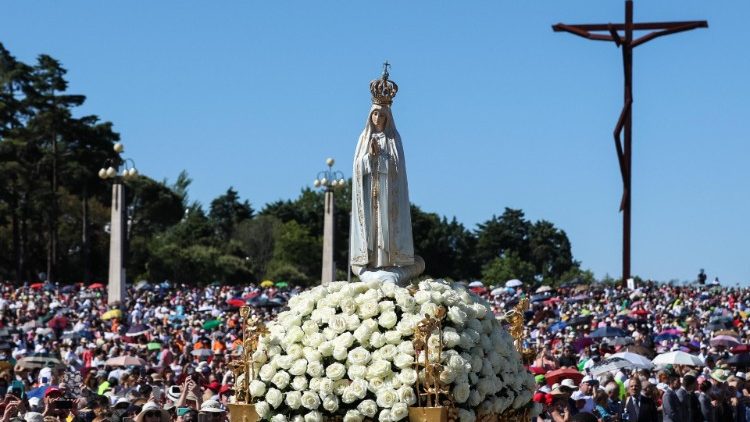
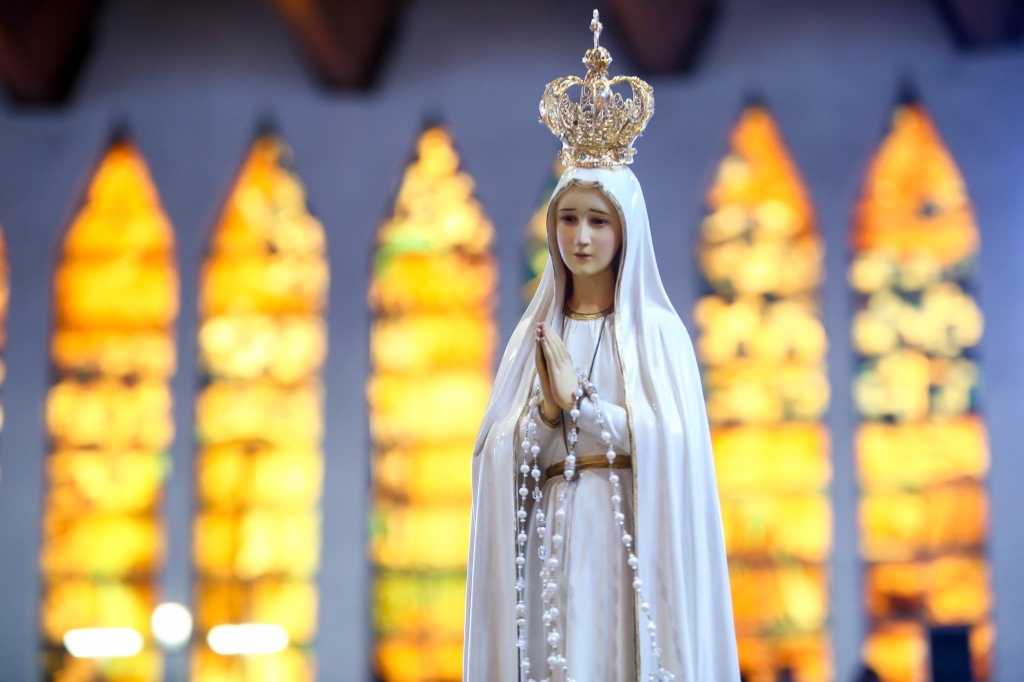
Photos from pinterest.com.

Today we commemorate the 105th year of the final apparition of the Blessed Virgin Mary at Fatima, Portugal where over 70,000 people witnessed the “Miracle of the Sun”.

It was raining the whole previous night until noon of October 13, 1917 when people made up of believers and unbelievers alike with skeptics and hecklers at the sides came to Cova Da Iria to await the Virgin Mary’s reported apparition to three young children, Lucia Santos and her two younger cousins Francisco and Jacinta Marto. The Blessed Virgin began appearing to the three children at the site on the 13th of May of that year and had promised to appear for the sixth and final time on that October 13, promising a great miracle to everyone. By noon, she finally appeared to the three children and after conversing with them, the sun “danced” or zigzagged the sky emitting radiant colors before careening down to Earth.

Page from Ilustração Portuguesa, 29 October 1917, showing the people looking at the Sun during the Fátima apparitions attributed to the Virgin Mary. From en.wikipedia.org.

Many people cried in fear, begging for mercy as the spectacular occurrence seemed like the end of the world that nothing of such kind was ever experienced nor recorded in history.

The dancing of the sun lasted for about ten minutes before it stood still, shining brightly with warmth that dried the people and nature soaked in rain the night before until that noon.

From then on, devotion to Our Lady of Fatima grew and spread worldwide until the Church recognized the apparition as authentic so that even its official feast was set on May 13, devotees have kept October 13 very special.

The eldest of the three children, Lucia became a Carmelite nun and provided so many useful information to later investigations and studies of the Fatima apparitions. She died on the 13th of February 2005, a few months ahead of the great St. John Paul II who had a very special devotion to Our Lady of Fatima after surviving an assassination attempt on the 13th of May 1981. Sr. Lucia’s younger cousins, as promised by the Lady to them in one of her apparitions, died earlier and have been canonized as saints recently.

Photo by author, April 2022.

Dance as expression of union

Lately I have been observing with great interest and appreciation how our young generation had been “borrowing” the music we grew up with from the 70’s to the 80’s into new level of dance steps via TikTok that are so coool and grooovy!

From the Bee Gees’ Staying Alive to EWF’s September and Groove Tonight to Patricia Rushen’s Forget Me Nots and Puff Daddy’s spin of Sting’s Every Breath You Take, generation gaps are being bridged, even closed with these endearing dance reels in social media.

Latest video I have been watching over and over these past two weeks is by a group of young Asians dancing to a James Brown 1973 funk song recorded by Fred Wesley & The J.B.’s. that is so funky and spunky. So fantastic! You may catch the fever and get the funky feel in both Instagram and YouTube in the link below.

The choreography is superbly modern and contemporary with dress and colors so 70’s yet as you watch the video, you do not feel lost or alienated because you feel a sense of belonging, of oneness unlike most modern music videos.

From YouTube.com.

Dance is a non-verbal communication that expresses our relationships and social interactions as a people, as a culture and as a society which we refer to as social intercourse. At the same time, dance is, generally speaking in the animal kingdom which includes us humans, the expression of gender roles in mating process or sexual intercourse. Notice how the many dance moves in the 70’s and 80’s expressed the promiscuity wrongly promoted by the so-called sex revolution.

Of course, sex is good, sex is holy.

But, it is more than an act or a part of the body! What the sex revolution of the 70’s until now missed greatly is the fact that sex is the totality of the person. Sex was created by God to bring humans into unity, into a communion and oneness with him and with others within his plan found in the sacrament of marriage. Not just according to human plans like same sex marriage nor union.

That noble union is the deeper meaning of a dance, of dancing – whether with a partner or by one’s self – it is always communicative of our higher aspirations of communion with God and others!

It is perhaps the reason why the sun “danced” on October 13, 1917 – it was God’s longstanding invitation for us mankind to dance with him, to follow his steps as taught to us by his Son Jesus Christ repeated by the Blessed Virgin Mary at Fatima. Notice how in our second reading, it was also the message of St. Paul to us through the Ephesians.

Grace to you and peace from God our Father and the Lord Jesus Christ. Blessed be the God and Father of our Lord Jesus Christ, who has blessed us in Christ with every spiritual blessing in the heavens, as he chose us in him, before the foundation of the world, to be holy and without blemish before him. In love he destined us for adoption to himself through Jesus Christ…

Ephesians 1:2-5
Photo from vaticannews.va, 13 May 2017.

Guidance: God + u and i dance in life!

Like during that time of 1917 in Fatima and the whole world, life was very difficult with the First World War still raging in Europe. People could not find meaning as they found the world so chaotic like today with the ongoing COVID-19 pandemic, wars in various parts of the world, rising costs of living and so many other difficulties and sufferings in life.

But, like St. Paul, the Blessed Mother at Fatima reminded us of an alternative vision of the world found in Jesus Christ, of the need to renew everything in Christ who had “bestowed on us every spiritual blessing” we need in this life. Despite our sinfulness, God still “chose us in Christ to be one in him” here in this life and in eternity, offering us salvation and fulfillment when we turn away from our sins and evil ways to follow Jesus.

If we reflect deeper into the miracle of the sun in Fatima 105 years ago, the great miracle was not really the sun dancing in the sky but how did the three little children so poor without higher form of learning believed in the promise of our Lady of the Rosary, that a great miracle would happen that day?

Clearly, the three children were guided by the Blessed Mother, most especially by the Holy Spirit! It was their faith that was so outstanding that like Mary, they believed the words spoken to them would be fulfilled as our gospel today told us (Lk.11:28) which were the same words spoken by Elizabeth to Mary at the Visitation (Lk.1:45)!

When we allow ourselves to be guided by the Blessed Mother and by the Holy Spirit, miracles happen in our lives: problems and sufferings are overcome, life becomes fruitful and fulfilling in God. And that is the meaning of the word GUIDANCE:

God
U and
I
D
A
N
C
E 
in life!

May we pray to imitate the three children’s faith in Fatima – that of Sr. Lucia, St. Francisco and St. Jacinta so we may follow the GUIDANCE of Jesus Christ with his Mother the Blessed Virgin Mary as we dance our ways into the many difficulties of this life like in 1917. May we dance with Jesus and Mary in prayers and faith, hope and love. Amen. Have a blessed Thursday!

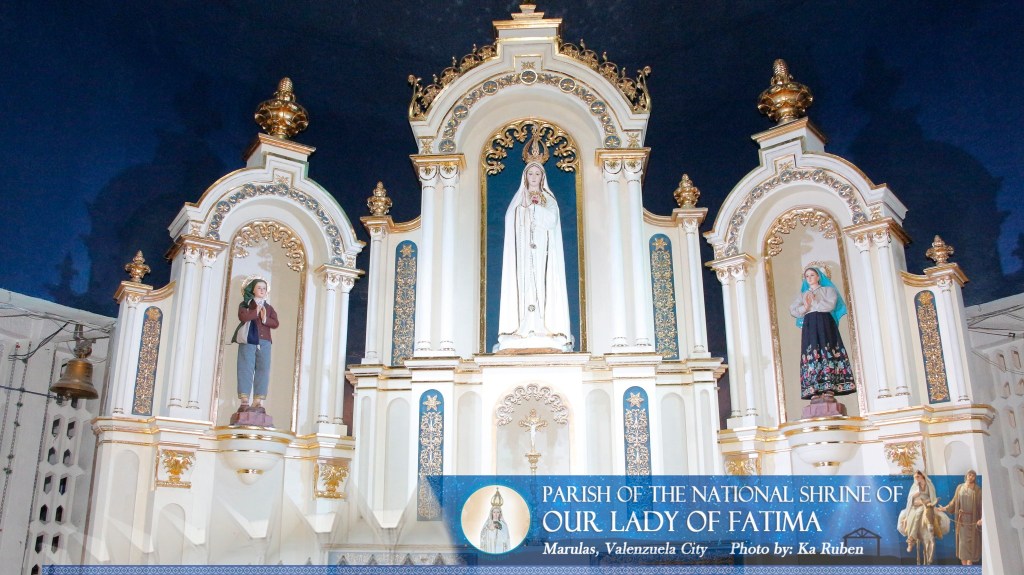
Photo from cbcpnews.net, 13 May 2022, at the Parish of the National Shrine of Our Lady of Fatima, Valenzuela City.

Every birthday a small Christmas

The Lord Is My Chef Daily Recipe for the Soul by Fr. Nicanor F. Lalog II
Thursday, Feast of the Birth of the Blessed Virgin Mary (Homily), 08 September 2022
Romans 8: 28-30   ><}}}*> + <*{{{>< + ><}}}*> + <*{{{>< + ><}}}*>   Matthew 1:18-23
Photo by author, Christmas 2021 at Our Lady of Fatima University Chapel at the Basic Education Dept., Valenzuela City.
"Every birthday is a small Christmas 
because with the birth of every person 
comes Jesus Christ."  

These words by the great St. John Paul II from his 1995 encyclical “Evangelium Vitae” (The Gospel of Life) is most truest today as we celebrate the Feast of the Birth of the Blessed Virgin Mary, the Mother of Jesus Christ.

It is right and proper that we celebrate her birthday today because of her coming to life and later her becoming a woman of deep faith in God, Christmas became a reality when she bore in her womb Jesus Christ our Savior.

This is how the birth of Jesus Christ came about.  When his mother Mary was betrothed to Joseph, but before they lived together, she was found with child through the Holy Spirit.
Matthew 1:18

Matthew beautifully tells us in his genealogy of Jesus Christ followed by this brief explanation of the Lord’s birth through the annunciation to Joseph how every birth, every coming of us is part of God’s plan.

Like Jesus Christ, we all came from God ultimately.

No one is an accident, nor a “chamba” as we say in Pilipino for we are not just lucky to have been born and alive but most of all, blessed. This is the gist of that beautiful alternative first reading from St. Paul’s letter to the Romans.

We know that all things work for good for those who love God, who are called according to his purpose. And those he predestined he also called; and those he called he also justified; and those he justified he also glorified.

Romans 8:28, 30
“The Birth of the Blessed Virgin Mary”, a 1305 painting by Renaissance artist Giotto in the Scrovegni Chapel in Padua, Italy. The two babies are Mary: below is Mary upon birth wrapped in swaddling cloth and washed by attendants and then above being handed to St. Anne her mother. Photo from en.wikipedia.org.

It is part of God’s purpose and plan that we were born, from our “election” or calling, to our “justification” or redemption and “glorification” in Jesus Christ — these did not happen by chance but are parts of God’s grand design for each of us.

Every person, every life is a gift of God, so valuable and precious. That is “the good news of life” expressed by St. John Paul II in his 1995 encyclical we have cited earlier. We are all sharing in the very life of God with each one of us a sign of Jesus Christ, the Emmanuel which means “God is with us” (Mt.1:23).

But, are we with God in Jesus Christ – in our trials and sufferings, in our joys and pains, in our victories and defeats, ultimately, in our life and death?

This is something very important we must always examine in our lives, at least during our birthday if we can truly say that it is a small Christmas because Jesus comes through us!

Like Mary, we have to conform ourselves to the image and likeness of her Son Jesus Christ especially in this time when we have reduced life into mere lifestyles and every person into a commodity who can be possessed and used, then discarded just like things.

In this time of Tiktok with everyone vying to be instantly popular, would we trade our dignity as persons just to be trending and viral, doing all those inanities on camera, wearing almost nothing with all kinds of filth and obscenities spewing from our mouths?

How sad that despite the affluence we now enjoy with everything almost within reach of everyone, we have become more lost and more empty these days than before. Everything has become so decadent that the worth of life and every person is being measured in external factors so that everybody wants to be somebody else except their true selves!


Most of all, the best birthday gift we can give Mama Mary
 is to bring out the giftedness of everyone 
so that each one may find in themselves Jesus 
who was born into this world more than 2000 years ago 
by the Blessed Mother herself! 

In celebrating the birth of the Blessed Virgin Mary, we are reminded that we are all good and pleasing in our very selves. We are so good that when Jesus chose to become human like us in everything except sin, he entrusted himself to us as his carriers or bearers so that we may rediscover our giftedness as God’s beloved children.

Photo by author, La Niña Maria at the National Shrine of Our Lady of Fatima, Valenzuela City, 07 September 2021.

Now that we are slowly going back to our “normal” ways of life with more “face-to-face” activities, may we keep in mind this great honor from God, of how he trusted us so much to bear his Son into this world like Mary by being his very sign of presence and love especially to those feeling alone and left out. Like Mary, may we bring the joy of Christ and his good news of life and salvation to those in despair, those sick, and dying inside because of bitterness and being so unforgiving not only to others but to their very selves.

It is said that whenever we greet someone with a “happy birthday”, what we really tell them is “I love you and thank you for making me who I am today”. Do we truly feel that way when we greet Mama Mary with happy birthday today?

The best birthday greeting we can give the Blessed Mother Mary today is to be like her, of being conformed in the image and likeness of Jesus Christ so that people may truly feel God is with us, that through our kindness and simplicity minus all those stunts and excitements that exist only on Facebook, people may have a glimpse of the beauty and majesty of God in us.

Most of all, the best birthday gift we can give Mama Mary is to bring out the giftedness of everyone so that each one may find in themselves Jesus who was born into this world more than 2000 years ago by the Blessed Mother herself! Amen.

Photo by author, the patio of the Church of St. Anne in Jerusalem (2017) that was dedicated on September 8 sometime in the sixth century from which originated the celebration of Mary’s birth on this date since then until it spread to Rome and the whole world; the date stuck to become the basis in setting December 8 as the Solemnity of the Immaculate Conception of Mary which is exactly nine months preceding her birth.