First temptation: doing vs. being

40 Shades of Lent by Fr. Nicanor F. Lalog II
First Sunday in Lent, Cycle C, 09 March 2025
Deuteronomy 26:4-10 + Romans 10:8-13 + Luke 4:1-13

Photo by Walid Ahmad on Pexels.com

On this first Sunday in Lent, we find our Lord Jesus Christ led into the desert by the Holy Spirit after his baptism at Jordan for forty days to pray and later tempted by the devil. It is exactly the picture of our daily life wherein the closer we come to God, the more we strive to be good and holy, the more we are intensely tempted by the devil.

Indeed, life is a daily Lent of spiritual battles with the devil and as we enter the first Sunday of this 40-day journey, Jesus reminds us we too can overcome this temptations if we remain in God by taking into heart his words that give life.

Of course, Jesus was tempted by the devil not just thrice but many times until his crucifixion; however, turn your attention my dear friend to the first and third temptations that are very similar:

The devil said to him, “If you are the Son of God, command this stone to become bread.” Jesus answered him, “It is written, One does not live by bread alone” ….. Then he led him to Jerusalem, made him stand on the parapet of the temple, and said to him, “If you are the Son of God, throw yourself down from here, for it is written: He will command his angels concerning you, to guard you, and: With their hands they will support you, lest you dash your foot against a stone.” Jesus said to him in reply, “It also says, You shall not put the Lord, your God, to the test” (Luke 4:3-4, 9-12).

Photo by shy sol on Pexels.com

In this scene that comes right after the baptism of Jesus at Jordan by John the Baptist, Luke wants us to see how the devil would always challenge the identity of Jesus Christ, “If you are the Son of God.”

Recall that after his baptism while praying, the heaven opened with the Holy Spirit descending on him in the form of a dove with a voice declaring “You are my beloved Son; with you I am well pleased” (Lk. 3:22). Everyday the devil tempts us too in that way, always challenging us with the same line, “if you are the Child of God, do this, do that” as if our identity is on doing than being.

In our baptism, we have become the beloved children of God in Christ which is our identity and being that is an inherent gift from God no one can take away which the devil works so hard to destroy. The devil’s devious line of challenging us “if you are the child of God” to prove ourselves by doing certain actions is designed to wear us off and eventually for us to self-destruct for not keeping up with the demands of the world and of others.

Our worth is not found in what we can do; we are worthy because God made us in his own image and likeness, giving us the unique identity as his beloved children in Jesus Christ. Even when we get old and sick in the future, not able to do anything worthwhile for the economy or the family, we remain worthy and valuable in God’s eyes.

Photo by author, Sakura Farm, Atok, Benguet, 27 December 2024.

Like Jesus we face intense spiritual battle with the devil daily, tempting us in various ways with desires for wealth and fame, power and pleasures. He tempts us in our personal and professional lives, in our relationships with God and with others, even with our very selves with long lists of things to do to prove our worth.

Remember, the devil tempts us not just to sin but ultimately to destroy our lives by separating us from our grounding, our root who is God our Father.

The devil’s dare to Jesus that “If you are the Son of God… turn this stone into bread” is echoed daily in our own temptations when the evil one through people aided by the consumerist culture ask us to prove our worth by doing many things without any regard to the values of life and human person, or the importance of virtues and spirituality.

When the devil repeated the same line of temptation to Jesus “If you are the Son of God… throw yourself down from the parapet of the temple”, the same trick is played on us by the world luring us to forget morals, to disregard traditions that in the process we already deny the value of life and persons by pushing the crazy, modern ideas of relativism and wokism.

How sad in this world today when everyday we are dared to prove our worth in doing not realizing that our worth remains even if we can’t do so much. That is why youth and strength are glorified while sickness, disability and old age are frowned upon these days simply because we can’t do as much, including life in its earliest and weakest stage in the mother’s womb. Our worth as a person is in our being, not doing.

It is so crazy that eventually we have replaced life with lifestyles, while persons are degraded as objects and commodities to be possessed than loved and cherished. In our desire to prove our worth with everything we can do and accomplish, we end up more empty and lost in the process, reduced to nothingness.

Now see the ways of Jesus which is the theme of Lent every year – conversion of sinners, a return to God our Father by trusting his words again as our source of life and being.

When Jesus answered the devil that man does not live by bread alone, the Lord is inviting us to have a more wholistic view on life, on those hidden and not seen, on the mysterious that makes us experience life more not just skin-deep but within no one can snatch nor steal. In a world so amazed with big, spectacular things, the truth remains that the most wonderful things in life are those found within our hearts and lips, those words that build and comfort us as St. Paul tells us in the second reading.

In the third temptation, Jesus thwarted the devil completely when he declared you must not put God to the test. It is a clear reminder for us to keep in mind always that we are the creatures not the creator, telling us all those vain attempts of playing God since time immemorial have gone to nothing.

We can’t just do anything nor everything in this world and in this life. All of the mysteries around us and within us are not meant to be solved but simply accepted and embraced, allowing ourselves to be wrapped in God to find him deep inside us that in itself a vast universe of beauty and majesty.

This is what Moses was telling the people in the wilderness as they prepared to enter the Promised Land. See how the first reading is like a dream sequence, of the many beautiful scenarios that could happen once they entered the Promised Land. Moses was telling his people and us today to be ready with God’s many surprises if we abide in him and trust him. No need to test God nor play God because we are all covered in God’s grace!

This first Sunday, Jesus invites us back to the wilderness of our lives to be still, to rest in God, to trust his words as we experience and appreciate our giftedness in him even if we can no longer move and do things because more than anything else in this world, each of us is precious in God’s sight and presence. Amen. Have a blessed week! Keep yourself hydrated this summer.

Photo by Dra. Mylene A. Santos, MD, somewhere in Palawan, 2023.

Standing with Jesus, standing like Jesus

The Lord Is My Chef Sunday Recipe for the Soul by Fr. Nicanor F. Lalog II
Third Sunday in Ordinary Time, Cycle C, 26 January 2025
Nehemiah 8:2-4, 5-6, 8-10 ><}}}*> 1 Corinthians 12:12-30 ><}}}*> Luke 1:1-4; 4:14-21

Doctors tell us that prolonged periods of sitting can lead to many health issues like increased risks of heart disease, diabetes, certain cancers, obesity as well as depression. They have been sounding the alarm for several decades with the rise of “couch potatoes” and now had worsened as we get tied to our seats due to continuous use of computers and other gadgets.

Along with this worsening scenario of our prolonged sitting is the growing “competition” among us these days – consciously or unconsciously – for our places of seat in jeepneys and buses or airplanes, in classrooms and offices, on dining tables, in meeting rooms and in churches. People are so concerned where to be seated not realizing that what really matters in life is where we stand than where we sit!

The verb “to stand” evokes firmness and stability not only in the physical sense but also emotionally and spiritually speaking. Very close to it is the word “stance” that indicates our “stand”, of where we “stand” with our beliefs and convictions regarding issues. Before the coming of social media where we often make our stand while seated, there were placards calling us to “make a stand”.

In this age when most people prefer to sit than to stand as well as kneel to pray, our Sunday readings today are very timely as they teem with the words and images of standing for God.

He came to Nazareth, where he had grown up, and went according to his custom into the synagogue on the sabbath day. He stood up to read and was handed a scroll of the prophet Isaiah. He unrolled the scroll and found the passage where it was written… (Luke 4:16-17).

“Jesus Unrolls Book In the Synagogue” painting by James Tissot (1886-1894), brooklynmuseum.org

We now dive into the Sunday Ordinary Time with Luke giving us a glimpse of how Jesus spent a typical sabbath day proclaiming the word of God by first “standing to read.”

It was not the first time Jesus stood to read as He always stood teaching and preaching to the people. Jesus was a man who literally stood for the Father, stood for what is true and good, stood for what is just and fair. Most of all, He stood for all of us that He died on the Cross.

This Sunday as He launched His public ministry in His hometown Nazareth in Galilee, Jesus made it clear that He is the “word who became flesh” as He stood to read the scripture, claiming what He proclaimed from the Prophet Isaiah:

“The Spirit of the Lord is upon me, because he has anointed me to bring glad tidings to the poor. He has sent me to proclaim liberty to captives and recovery of sight to the blind, to let the oppressed go free, and to proclaim a year acceptable to the Lord” (Luke 4:18-19).

Imagine present there. More than being spellbind, there must have been that feeling of fulfillment, of the true reality unfolding as Jesus clearly stood by the word of God because He is the word who became flesh.

Our Filipino word paninindigan evokes it so well like in Pinanindigan ni Jesus ang kanyang ipinahayag (Jesus stood by what He proclaimed). From its root tindig which is “to stand” in English, paninindigan is conviction. Jesus spoke with such conviction and authority that those in the synagogue were amazed with Him. Interestingly, our Filipino synonym for paninindigan is pangatawanan which is from the root katawan or “body” in English. Pangatawanan ang salita is to stand by one’s word, like Pinangatawanan ni Jesus ang Kanyang sinabi (Jesus stood by what He said).

See how our readings this Sunday are so interesting, so beautiful especially for us in the Philippines because the words of “standing” and “body” are related, capturing in our own language discipleship in Christ, our standing for Jesus and His gospel.

“Jesus Unrolls Book In the Synagogue” painting by James Tissot (1886-1894), brooklynmuseum.org

At the end of this scene in the synagogue, Luke told us how Jesus declared as He sat that His words were “fulfilled in your hearing” which amazed the people because Christ “walked the talk” even before this took place.

Anyone wishing to have any kind of fulfillment in life has to first make a stand for whatever he believes in. To walk the talk, one has to stand first. Nothing gets fulfilled by sitting. We have to make a stand for everything and everyone we care and love most.

Like Jesus, we can only bring glad tidings to the poor by standing by their side, standing with them to uplift them. In the same manner, liberty for captives and recovery of sight to the blind can only happen standing, by actually being present with them and never remotely from a distant office or setting where we are comfortably seated. The oppressed can only go free as we proclaim a jubilee like this 2025 when we stand for justice and truth instead of simply affixing our “like” to some posts “standing” for whatever causes.

Photo by author, ambo in our Chapel of the Angel of Peace, RISE Tower, Our Lady of Fatima University, Valenzuela City, 25 December 2024.

In the first reading we find the priest Ezra standing as he proclaimed the words of God from a book recovered after their exile from Jerusalem.

Ezra convinced the people so well in his proclamation of the scriptures that people cried and bowed their heads before finally prostrating themselves to God because they felt and experienced the Scriptures as so true.

The words “standing” and “stood” were repeated thrice to underscore not only the physical posture taken by Ezra and Nehemiah but most of all to indicate their emotional and spiritual bearings.

Going back to our gospel scene, see how before narrating to us Jesus in the synagogue, the Church had rightly chosen to include for this third Sunday the prologue of Luke where he laid down the reason for writing his gospel account – so that we “may realize the certainty of the teachings” about the Christ. In writing his prologue, Luke naturally sat but in mentioning that word “certainty”, he tells us a lot of standing he had to make in completing his two-volume work, the gospel and the Acts.

Here we find that like all the evangelists and saints for that matter, they spent much time standing than sitting, second only perhaps to kneeling or praying.

There is a beautiful prayer attributed to St. Teresa of Avila called “Christ has no body” which goes this way, “Christ has no body but yours, no hands, no feet on earth but yours.”

Can we make a stand for Jesus, stand with Jesus, and stand like Jesus to be His body as St. Paul explained to us in the second reading?

“Brothers and sisters: As a body is one though it has many parts, and all the parts of the body, though many, are one body, so also Christ… Now the body is not a single part, but many” (1 Corinthians 12:12, 14).

Photo by author, Chapel of Angel of Peace, RISE Tower, Our Lady of Fatima University, Valenzueal City, June 2024.

As we embark into this long journey of Ordinary Time with Luke as our guide every Sunday, may we do the work of Jesus by standing along with our fellow believers and disciples.

Together let us make that collective stand for truth and justice, for decency and reason in this time when people are so fragmented, held captive by so many thoughts and beliefs propagated from the arrogant chairs of entitlement by some lazy minds influencing the world remotely. Together we stand and experience life as it is in Jesus Christ, even at His Cross. Amen. Have a blessed week ahead as we close January 2025!

Pope Francis’ rule of 8

Quiet Storm by Fr. Nicanor F. Lalog II, 05 December 2024
Pope Francis waves to pilgrims as he enters St. Peter’s Square for his general audience on Wednesday, Dec. 4, 2024. Credit: Julia Cassell/CNA

Pope Francis again called on us priests to keep our homilies short during his General Audience at the Vatican yesterday, December 04, 2024. He said, “Preachers must preach an idea, a feeling, and a call to action. Beyond eight minutes the preaching starts to fade, it is not understood.”

According to the Catholic News Agency, the pilgrims applauded the Pope’s remarks that is again sweeping the social media circles of many Catholics especially in the Philippines. It is trending, in fact, because our people are so fed up with our long, boring homilies.

However, I find the Pope’s reminder lacking in substance, in what is most essential.

Photo from Catholic News Agency, 12 June 2024.

This is the second time this year since June and the third since 2018 that Pope Francis urged priests to be brief with their homilies. It is actually an echo to the recommendations by Archbishop Nikola Eterovic’s 2010 book on the 2008 Synod on the Word of God that advised bishops to keep their homilies to eight minutes or shorter to avoid “improvisations” at the pulpit.

(Now you see, the problem actually is with the bishops who mostly give poor homilies but effective tranquilizers. In fact, Pope Francis’ homily last Holy Thursday was over 20 minutes, but, of course, he is the Supreme Pontiff…)

Instead of focusing on the duration of the homily, Pope Francis should have adopted St. Augustine’s stance: the priest must first and foremost pray to give a good homily. Duration and length of homily is secondary when the priest’s homily is the fruit of his prayers (and studies).

From Pinterest.com.

In the fourth book of his Doctrina Cristiana, St. Augustine said that “every homily is from God” when truly prayed upon by the priest and deacon. He admitted that not every priest is gifted in preparing good homilies that is why he encouraged priests to share homilies that others may imitate. St. Augustine categorically wrote that there is no problem in copying the homily of other priests; what is unacceptable (and sinful) is when the priest’s homily and life do not jibe, when the priest does not walk his talk.

That is why when people ask me what is the most difficult part of priesthood, I always say since my first year as a priest, it is the prayer life – not celibacy nor poverty. Both are hinged on the priest’s prayer life.

Prayer is always difficult because it is the work of the Holy Spirit, demanding our time and total self. When we pray, we strip ourselves naked before God, facing our true selves minus our many pretensions and masks as a person. And a priest.

Hence, whatever we preach is the fruit of our prayer which is very scary. When we priests deliver our homily, we subject ourselves to your scrutiny. And that’s how we are judged by the people: does this priest practice what he preaches?

I have been a priest for more than 26 years but I still get nervous and scared before every celebration of the Mass, specially in delivering the homily.

When the Alleluia is sung and we bow our heads before the altar to recite our silent prayer – “Lord, cleanse my heart and my lips that I may worthily proclaim the Gospel” – I always add the words of John the Baptist to Jesus at Jordan before His baptism, “Lord, let me decrease so that you will increase.”

We priests are the first to be affected by our preaching. Kami ang unang nasasaktan at tinatamaan sa katotohanang ipinahahayag namin. That is when true connection with people and the gospel happens which Pope Francis discussed lengthily in his 2013 Apostolic Exhortation “Evangelii Gaudium”, giving practical tips in preparing homilies in its third chapter, “Proclaiming the Gospel”. Always at the very core of every homily and of the priesthood in particular is prayer, our communion with Jesus Christ, our Eternal Priest.

When the priest lacks the passion in celebrating the Sacraments particularly Holy Eucharist and Confession, when he habitually skips giving a homily, and worst, when he avoids celebrating the Mass daily – he is no longer praying. That is 100% sure. Most likely, Father is in crisis, deep into a vice, or a relationship.

Therefore, instead of zeroing into the duration of the homily, the Holy Father must encourage – or demand – us priests and bishops to have a prayer life, to go back to Jesus in prayer as the late Pope Benedict XVI had insisted until shortly before his death in December 2022.

And this falls upon you, too, our dear lay people. Please stop inviting us priests too often to late night socials and coffee. Give us the space and time to be home before 9PM or better, to keep us in our rectory in the evening to study and pray for our celebration of the Holy Mass the following day. We may go out at night but not so often. It is not our way of life.

Let me end this with another worthy lesson from St. Augustine in his other book about teaching catechism called De Catechizandis Rudibus, “the catechist is the lesson himself/herself.” In the same manner, “the priest is the homily himself”, too! Pray for us your priests and help us remain holy and prayerful.

Clothed in humility

The Lord Is My Chef Easter Recipe for the Soul by Fr. Nicanor F. Lalog II
Feast of St. Mark, Evangelist, 25 April 2024
1 Peter 5:5-14 ><}}}}*> + ><}}}}*> + ><}}}}*> Mark 16:15-20
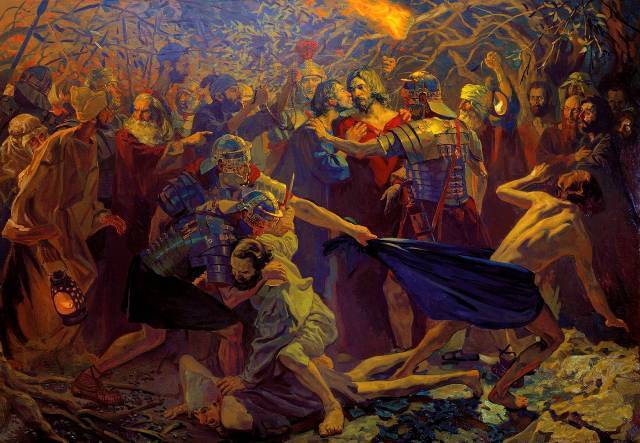
“Judas Betrays Jesus With A Kiss”, painting by Russian Pavel Popov from arthive.com; notice young man fleeing from the scene naked believed to be St. Mark.
"Beloved:
Clothe yourselves with humility
in your dealings with one
another, for: God opposes
the proud but bestows favor
on the humble"
(1 Peter 5:5).
Your words, 
O Lord Jesus
from St. Peter's first letter
are amazing, a most beautiful
juxtaposition of being
"clothed with humility"
on this feast of St. Mark
who is believed
to have been that naked man
fleeing from the scene
of Your arrest at Gethsemane:
"Now a young man followed him
wearing nothing but a linen cloth
about his body.
They seized him,
but he left the cloth behind
and ran off naked"
(Mark 14:51-52).
A painting of St. Mark the Evangelist by French artist Valentin de Boulogne done in 1624-1625 from en.wikipedia.org.
Only St. Mark
has this detail on that scene
because only him could have known
that embarrassing moment
but have boldly kept it because,
before we can ever be
"clothed with humility"
and any other virtue,
we must first be naked
like him,
laying bare not only our body
but most of all,
our heart and soul
with its kind of
superficial discipleship;
very notable too how
St. Mark later ran away too
from Paul and Barnabas
at Perga (Acts 13:13)
for reasons unknown
except his being so young
and immature.
But everything changed,
during the Roman persecution
when St. Mark remained to work
with St. Peter and St. Paul,
and after their martyrdom,
that was when he ventured into
writing the first gospel account
that inspired the early Christians
to remain faithful in You, Jesus,
amid the persecutions.
Clothe us in humility, O Lord,
like St. Mark by having
the courage to admit
our nakedness,
to remember and learn
from our shameful
humiliations in the past
because more important
than these are Your love
and mercy dear Jesus
to start anew in You after
every failure and sin;
most of all,
fill us Jesus Christ
with Your strength and
courage to be Your witnesses
proclaiming the Gospel
to every creature
because in every disciple,
what really matters most
is being present with You, Lord,
and not our absences
nor lapses in the past.
Amen.
St. Mark,
pray for us!

Physician for the sick world

The Lord Is My Chef Daily Recipe for the Soul by Fr. Nicanor F. Lalog II
Wednesday, Feast of St. Luke, Evangelist, 18 October 2023
2 Timothy 4:10-17   <*[[[[>< + ><]]]]*>   Luke 10:1-9
Painting of “Saint Luke Drawing the Virgin” by Flemish painter Roger van der Weyden (1400-1464); photo from en.wikipedia.org.  
Merciful Father,
thank you for sending us
St. Luke the Evangelist
whose feast we celebrate today:
a physician,
an artist,
and a disciple of your Son
Jesus Christ.

"The Lord appointed seventy-two disciples 
whom he sent ahead of him in pairs
to every town and place
he intended to visit"
(Luke 10:1).
Regardless of our state
in life, we, too, like St. Luke
are called to preach 
and write the gospel of 
Jesus Christ with our 
lives,
with our silent witnessing
of his glory and humility,
kindness and firmness,
art and humanity,
intimacy in prayer
and most especially,
special concern for
women and children
until now so abused in
in so many homes
and in every nation.
Help us, dear Jesus, 
to be like St. Luke, 
a physician
for this world so sick
with wars and other
inhumanity to one another
perhaps due to our lack of
genuine love and respect
for women; what a joy to
read and pray St. Luke's
gospel account teeming 
from the very start with those
wondrous stories of Mary
and Elizabeth who brought
us into the New Testament
with their sons!
Help us imitate St. Luke
as a true physician
who accompanied
until the end his mentor
St. Paul the Apostle:

"Beloved:  Demas, enamored 
with the present world,
deserted me and went to Thessalonica,
Crescens to Galatia,
and Titus to Dalmatia.
Luke is the only one with me"
(2Timothy 4:10).
O God,
how painful to think
everybody is saying that
the world population has to be controlled
when so many among us everywhere
are suffering alone,
dying alone? 

Let us realize like St. Luke 
Jesus Christ's declaration that
"The harvest is abundant but the 
laborers are few" (Lk. 10:2)
that we may go too to your abundant
harvest to heal and console,
comfort and assure the many people
in pain and suffering.
Amen.

St. Luke,
Pray for us!
Photo by author, La Trinidad, Benguet, 12 July 2023.

Every kind of people

The Lord Is My Chef Daily Recipe for the Soul by Fr. Nicanor F. Lalog II
Thursday, Feast of St. Matthew, Apostle, 21 September 2023
Ephesians 4:1-7, 11-13   ><}}}}*> + ><}}}}*> + ><}}}}*>   Matthew 9:9-13
Photo by Mr. Virgie Ongleo in Singapore, 2021.
God our loving Father,
on this feast of your Son's
Apostle St. Matthew who used
to be known as Levi, a tax collector,
I pray for all the men and women
who work hard to provide food,
shelter, and clothing for their
families; through St. Matthew,
Jesus Christ had shown us
you love so dearly every working
man and woman who toil and labor
under the most harsh conditions
trying to earn a living.

As Jesus passed by, he saw a man named Matthew sitting at the customs post. He said to him, “Follow me.” And he got up and followed him.

Matthew 9:9
St. John Chrysostom rightly
noticed how the gospels mentioned
the work of some Apostles called
by Jesus:  Peter, James and John were
fishing while Matthew was collecting
taxes; oh how perceptive were the eyes
and tongue of St. John Chrysostom!
Because fishing was seen as a lowly job
during that time while the taxman was 
the most despicable person for Jews
and yet, Jesus called them!
Lord Jesus,
grant your mercy and comfort,
consolation and help to all workers
so hard pressed in this life,
especially the forgotten who strive
to earn money decently like our
farmers and fishermen,
drivers and vendors,
maidservants and nannies
who working abroad
to care for other families as they
left their own families behind;
bless the cops and traffic enforcers,
our government workers
and officials who live in the darkness
of sin, trapped in the lures of wealth
and money; in calling St. Matthew,
Jesus showed us his daily passing
and calling of everyone of us,
people of all social classes while
they go about their ordinary,
daily work.
Grant us the strength
and courage, dear Jesus,
to be like St. Matthew 
to immediately rise up and
follow you, to leave everything
behind especially sin and evil,
to be detached and to finally
stop activities that are not
compatible in following
you, Lord; like St. Matthew,
may we "write" your gospel
with our very lives of holiness,
making known to everyone
your Divine Mercy.
Dearest Jesus,
open our hearts to 
intently listen to St. Matthew's
voice and message
so we may learn to
rise and stand
then follow you,
Lord, 
with determination.
Amen.

St. Matthew,
pray for us!

Speaking our hearts out

The Lord Is My Chef Daily Recipe for the Soul by Fr. Nicanor F. Lalog II
Thursday, Memorial of Sts. John Fisher & Thomas More, Martyrs, 22 June 2023
2 Corinthians 11:1-11   <'[[[>< <'[[[>< + ><]]]'> ><]]]'>   Matthew 6:7-15
Photo by author, sunset over the Caloocan-Malabon-Navotas-Valenzuela district, January 2023.
Glory and praise to you,
God our almighty and loving Father
for the gift of two great saints,
John Fisher and Thomas More
whose memorial we celebrate today
after giving their lives in defending
the gospel of Jesus Christ
before the powerful king of England
in 1535.
Like St. Paul in today's first reading,
St. John Fisher and St. Thomas More
spoke their hearts out to everyone,
opposing King Henry VIII's divorce
and call to break away from Rome;
for standing for what is true and good
like the sanctity of marriage 
and primacy of Rome,
they were both beheaded.
What a beautiful example for us
to emulate today when so many of us
professing to be Catholics yet 
have turned their backs from
the Church and especially from the Gospel,
choosing to be oblivious 
to you dwelling in our hearts;
like St. Paul, they have taught us
that standing firm on our faith 
is the best expression of our love
not only for God but for everyone;
help us realize that when we allow
ourselves to follow modern trends 
that are contrary to the life and teachings 
of Jesus our Lord,
that is when we do not love at all
because that is when we allow evil and sin
to spread its errors and destruction
of persons and life in general.

But I am afraid that, as the serpent deceived Eve by his cunning, your thoughts may be corrupted from a sincere and pure commitment to Christ. For if someone comes and preaches another Jesus than the one we preached, or if you receive a different spirit from the one you received or a different gospel from the one you accepted, you put up with it well enough.

2 Corinthians 11:3-4
Forgive us, dear God,
when we would call you "Father"
but could not stand for what is
true and just, good and holy
there in our hearts;
forgive us, dear God,
when we would call you "Father"
but would keep on holding to our
anger and bitterness, 
refusing to forgive
from our hearts;
forgive us, dear God,
when we would call you "Father"
but would always push the lines
and limits in our hearts
until we fall into temptations and sin.

Forgive us Father,
in Jesus' name.
Amen.
St. John Fisher
and 
St. Thomas More,
pray for us!

On being first for Christ

The Lord Is My Chef Daily Recipe for the Soul by Fr. Nicanor F. Lalog II
Tuesday in the Third Week of Easter, Feast of St. Mark, Evangelist, 25 April 2023
1 Peter 5:15-14   <*(((>< + ><)))*> + <*(((>< + ><)))*>   Mark 16:15-20
A painting of St. Mark the Evangelist by French artist Valentin de Boulogne done in 1624-1625 from en.wikipedia.org.
Thank you, dear Lord Jesus
for calling and sending us
St. Mark the Evangelist,
the first to have written
your gospel account based
on the teachings of his
friend and mentor,
St. Peter; his gospel
account eventually 
became the guide of
later gospel accounts by
Matthew and Luke.

And we thank you for
that giftedness of being
the first to write,
the first to dare
go out and make you
known by everyone,
Lord Jesus Christ!

Jesus appeared to the Eleven and said to them: “Go into the whole world and proclaim the gospel to every creature. Whoever believes and is baptized will be saved; whoever does not believe will be condemned.

Mark 16:15-16
St. Mark is often described
as being young 
and at the same time
immature:  twice he is 
portrayed as fleeing
from your mission, 
first from the scene 
when you O Lord was
arrested that he left his
linen cloth behind
and then during the
missionary journey of
Paul and Barnabas 
when he left them
and went back to
Jerusalem.
But, it was his youthfulness
that pushed him too to dare and
write the first gospel account;
how wonderful that he is
represented by the lion
as he began his gospel with
the fulfillment of the prophecy of
Isaiah in John the Baptist as 
"the voice crying in the wilderness"
like the lion.

Every time we dare to cry
and shout in the wilderness
of your coming, dear Jesus,
your gospel comes,
your gospel is fulfilled;
every time we overcome
our immaturities 
and recklessness,
you become present;
every time we imitate you,
Jesus, we write the gospel!

Let us clothe ourselves 
with humility in our dealings
with one another, resisting 
the devil by being steadfast
in our faith in you (1 Peter 5:5, 9).
Amen.

Christ our King & our overcoming of sin

The Lord Is My Chef Sunday Recipe for the Soul by Fr. Nicanor F. Lalog II
Solemnity of Christ the King, Cycle C, 20 November 2022
2 Samuel 5:1-3 ><000'> Colossians 1:12-20 ><000'> Luke 23:35-43
Painting of Christ’s Crucifixion by Tintoretto in 1565 portraying Jesus so “kingly”; interesting too were the people dressed as Venetians of his time as reminder that the evils that crucified Jesus continue in our own time. Photo from wikiart.org.

We now come to the final Sunday of our liturgical calendar called the Solemnity of Christ the King with a scene from his crucifixion on Good Friday. All these Sundays since June “When the days for Jesus’ being taken up were fulfilled, he resolutely determined to journey to Jerusalem” (Lk.9:51), Luke had been showing us that Christ’s crucifixion and glory are one just like John in his gospel account.

But the most beautiful part of our gospel on this solemn celebration is the fact that inasmuch as Jesus had clearly showed in all eternity his kingship while dying on the Cross, it is also right on the cross of sufferings as we strive to resist temptations of turning away from God that we proclaim Christ’s kingship. Please bear with me, my friends in reflecting Luke’s artistic presentation of Christ’s crucifixion as the expression of his kingship.

Notice how Jesus was “sneered, jeered, and reviled” at the cross, reminding us of the devil’s three temptations in the wilderness after his baptism at Jordan by John. After failing to tempt Jesus at the wilderness, Luke said the devil “departed from him for a time” (Lk.4:13), returning at his crucifixion as the most opportune time to test him.

In the wilderness, the temptations by the devil to Jesus applied very well with us too but, here on the cross, it was totally different. The devil himself was nowhere to be found because he was in the person of the rulers, the soldiers, and the thief! And that is how evil and sin have become so “powerful” in a pernicious manner among us when many times we are the devil in fact.

Here, we are reminded to be aware always of that opportune time when the devil attacks us when we see or face many sufferings in life by reflecting the last three temptations of Jesus on the Cross.

Photo by author, 2017, Sacred Heart Novitiate, Novaliches, QC.

The rulers sneered at Jesus and said, “He saved others, let him save himself if he is the chosen one, the Christ of God” (Lk.23:35).

Just like at the wilderness when the devil tempted Jesus with what he can do as the Son of God by changing stone into bread, at the Cross it was the same temptation hurled on him by the rulers of Israel, the priests and the scribes.

How sad that amid the many sufferings in the world today we contemptuously mock others like the poor for not working so hard to liberate themselves from poverty and hunger. There is the tendency among us blessed with better living conditions to look down at others without considering how they never have the same opportunities in life like us in having good education or a caring family or worse, not having the right connections.

The tragic part of this “sneering” by the rulers on Jesus is when we look at others as if they are not humans and persons like us who play gods knowing everything even who should live and who should die like in the systematic approach by state rulers to come up with what St. John Paul II called as “culture of death” in solving poverty and crime with abortions and capital punishments.

Let us examine our attitudes at the way we look at those going through sufferings and pains like sickness, poverty and other social ills we do not go through. Let us stop the mockeries of blaming them for their plight because many times like Jesus Christ, they were betrayed by loved ones like us, by the society, or even by the institutions meant to uplift them.

Photo by author, 2017.

Even the soldiers jeered at him. As they approached to offer him wine they called out, “If you are King of the Jews, save yourself.” Above him there was an inscription that read, “This is the King of the Jews” (Lk.23:36-38).

Sneering and jeering are both contemptuous mocking or insulting of others; they are both employed by those in vantage positions of power and control like the rulers of Israel. Going “higher” than the priests, the Roman soldiers sneered Jesus by rudely mocking him in loud voice. Sneering is a superfluous display of might, of superiority, of power. It is a kind of vanity that is why in the wilderness, the devil tempted Jesus to have all the kingdoms in the world for him to be famous and popular in exchange of worshipping him.

Sneering is something so prevalent these days in our use of the social media where we practically scream and insist on everyone to notice and recognize us, that we have “arrived” in having the latest and most expensive clothes, food, gadgets and everything. There is so much wild attitude among us like the soldiers at the cross when we use social media in too much talks, even of spewing foul languages and invectives as well as lies. Fake news and lies spread so fast and are sadly taken as true to the detriment of its victims because we have been so gullible for gossips and rumors too.

But the worst part of our imitation of the soldiers jeering at Jesus is when many of us are afflicted with this perversion called exhibitionism – from those salacious posts in TikTok to those “food porns” and too much display of everything about ourselves and of our loved ones. When do we get tired of all these selfies that have become so sickening that we do not realize of how we make known to everyone of our emptiness and lack of the more essential things like love and self-respect? Like the soldiers, the more we promote ourselves, the more we affirm the obvious that Jesus indeed is the King we needed most.

Photo by author, 2017.

Now one of the criminal hanging there reviled Jesus, saying, “Are you not the Christ? Save yourself and us” (Lk.23:39).

Reviling is also kind of of mocking others like sneering and jeering; however, to revile is the lowest kind because it is to insult somebody you are with in a same situation. To revile is the lack of recognition of one’s faults and sins that he would rather insult others like this thief traditionally identified as Hestas. In reviling Jesus while also hanging on the cross, Hestas went down deeper his lowest point as a convicted criminal when he had the gall to insult Jesus!

And that is the most unkind evil of all when we become so numb, so dense and stupid to even mock others we are with us in a similar situation. It happens daily when even we are in deep shit, we still see ourselves cleaner and better than others! Just read or watch the news about our politicians.

In the wilderness, the final temptation of the devil to Jesus was to jump from the top of the temple because his angels would not let him fall and even touch ground; here at the cross, Hestas saw himself no different from Jesus, feeling so entitled to be liberated. Many times, this is the problem why evil continues among us: when people from below are promoted to higher positions, they forget their roots that they also forget to fix the problems of inequalities and injustices down below where they came from. The key is to always remember. Like Dimas, the good thief.

Photo by author, 2017.

The other, however, rebuking him, said in reply, “Have you no fear of God, for you are subject to the same condemnation? And indeed, we have been condemned justly, for the sentence we received corresponds to our crimes, but this man has done nothing criminal.” Then he said, “Jesus, remember me when you come into your kingdom.” He replied to him, “Amen, I say to you, today you will be with me in Paradise” (Lk.23:40-4).

See how Luke inserted here the fourth verb “to rebuke” to break the series of sneering, jeering, and reviling of Jesus. Like Dimas, we have to strive in breaking the cycle and series of evil especially in this time.

To rebuke means to express sharp disapproval. Imagine Dimas contradicting Hestas and even the rulers and soldiers as well by defending Jesus Christ while hanging there on the cross.

How sad when we remain silent, when we just walk away from people sneering, jeering and reviling Jesus in those who suffer in life because we are afraid to make a stand for what is true and good, what is right and just. How ironic that another thief hanging on the cross was the only one who made a stand for Jesus on that Good Friday along with the Mary and the beloved disciple below.

Every time we make a stand for life and dignity of every person, when we stand for what is true, right and just, that is when we imitate the tribes of Israel in the first reading coming to David to pledge their loyalty and allegiance to him as their king.

When we submit ourselves to Jesus Christ as our only King to be obeyed and followed, that is when our celebration today becomes a daily reality.

That is when we also earn heaven right on the Cross of our sufferings like Dimas when we “remember” Jesus.

Normally in the whole Bible, it is God who remembers. People always forget. When we sin, we forget consciously and unconsciously God and all the good things he had done to us. We forget others too.

There on the Cross, see the reversals of roles Luke has presented so beautifully, from the devil replaced by the rulers, the soldiers and the other thief; and now Dimas sort of assuming God’s role who remembered everything and everyone, especially Jesus our Savior. Dimas remembered what St. Paul expressed to the Colossians that Jesus is Lord in whom, with whom and through whom everything was created and renewed because he is the Christ!

From Google.

The word “remember” literally means to make member or part again, that is, “re” + “member”.

When we remember somebody, we make that person present with us again.

In asking Jesus to remember him when he comes into his kingdom, Dimas was assured that right now as he remembered everything including his sins, he already becomes a member, a part of his kingdom.

May we not forget and always remember Jesus and others always to experience Paradise even when we are on the cross. Amen. Have a blessed week ahead!

Tasting Jesus Christ

The Lord Is My Chef Daily Recipe for the Soul by Fr. Nicanor F. Lalog II
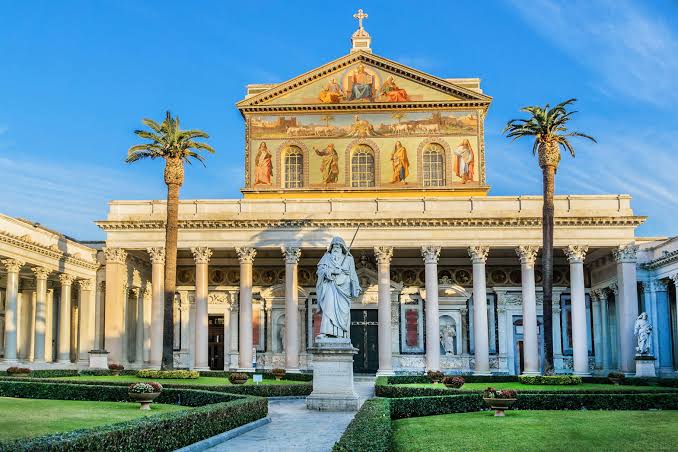
Friday, Memorial of the Dedication of the Basilicas of Sts. Peter and Paul, Apostles, 18 November 2022
Revelation 10:8-11   ><000'> + ><000'> + ><000'>   Luke 19:45-48
Lord Jesus Christ,
as we celebrate today the
memorial of the Dedication of the
last two Basilicas in Rome -
St. Peter's in Vatican and 
St. Paul's Outside the Walls -
you give us a "taste" 
of what is to be your Church,
your Body,
and your accompanying mission.

I took the small scroll from the angel’s hand and swallowed it. In my mouth it was like sweet honey, but when I had eaten it, my stomach turned sour. Then someone said to me, “You must prophecy again about many peoples, nations, tongues, and kings.”

Revelation 10:10-11
Thank you, Lord Jesus Christ,
for the sweet taste, 
for the sensation of being a Christian,
of listening to your words,
of being a Catholic,
of serving you,
of worshipping you,
of being loved by you.
Definitely so sweet indeed
to experience you in the Church!
But everything becomes sour
and bitter when we internalize
your words,
your call,
your mission
for that is when reality happens,
when we realize being your disciple
is a way of life in you,
a way of the Cross,
of giving one's self
to others like
the two pillars of your Church,
St. Peter and St. Paul.
Sometimes, Lord Jesus,
give us a taste of your anger
like when you cleansed the temple; 
let us taste your strong words
when we make the church a den of thieves
literally speaking;
let us have a taste of your discipline
when we dirty your Body,
when we hurt your Body,
and worst, 
when we mutilate your Body,
the Church with our lives so far from
your calling and mission
especially us your apostles.
Let us learn to love and accept
being Christian is savoring both
the sweet and sour tastes of
proclaiming your gospel 
both in words and in deeds.
Amen.

*Photos from en.wikipedia.org.