Your words today,
O Lord Jesus
are short but give
much to reflect on:
"Be merciful...
stop judging...
stop condemning...
Forgive...
Give."
Jesus,
teach me to be
"shamefaced"
like Daniel in the first
reading: it is not enough
that I realize my sinfulness,
of my wickedness in refusing
to love, in turning away from you,
in disregarding your words
over and over and still -
be forgiven and loved.
Jesus said to his disciples: “Be merciful, just as your Father is merciful” (Luke 6:36).
So often in life,
I forget the Father's
mercy that I have totally
been oblivious to being
merciful; thank you Jesus
in giving this comparison today,
of being merciful as the Father
is merciful.
What a shame
of how often I look up
to myself as so good,
so righteous
against others
that I judge
and condemn them;
teach me to be like
you, Lord: merciful,
non-judgmental,
forgiving;
most of all,
teach me to give
freely like you, Lord;
remind me always
to remember your
mercy on me
to realize that
more than an ideal,
mercy is about
how it feels
in my own life.
Lord Jesus Christ,
you have given me with
so much love and mercy,
kindness and forgiveness
of sins but I have refused
to be merciful with others;
have mercy on me, Lord
and let me be merciful
like the Father.
Amen.
The Lord Is My Chef Daily Recipe for the Soul by Fr. Nicanor F. Lalog II
Wednesday, Third Week in Ordinary Time, Year I, 29 January 2025
Hebrews 10:11-18     ><]]]]'>  +  ><]]]]'>  ><]]]]'>     Mark 4:1-20
From Facebook, 11 March 2024.
Where there is forgiveness of these, there is no longer offering for sin (Hebrews 10:18).
How lovely and reassuring
are these words from the author
of the Letter to the Hebrews today,
Lord Jesus Christ;
thank you for coming
to save us from our sins,
for forgiving our sins,
for teaching us to forgive others
most especially by being more
loving.
Thank you, Jesus,
for being the Sower,
always coming out to
scatter seeds of love and mercy
to us; open our ears, Lord,
that we may ought to hear
you: forgive us for being hard
and harsh in our ways and words,
forgive us for being easily
pricked and agitated,
forgive us for not listening
at all to you, Jesus.
Let me open myself to you,
Jesus, by opening myself too
with others to listen to their
points of view in order
to understand them,
not to judge them;
open myself to your healing
words so I may also soothe
others pains and hurts
than add salt to their injuries.
Lastly, let me do your will
Jesus by always listening
and forgiving.
Amen.
Lawiswis ng Salita ni P. Nicanor F. Lalog II, Ika-20 ng Marso 2024
Unang Huling Wika ni Jesus sa Krus
Larawan kuha ng may-akda, 2019.
Ang Unang Wika ni Jesus:
Nang dumating sila sa dakong tinatawag na Bungo, ipinako nila sa krus si Jesus. Ipinako rin ang dalawang salarin, isa sa gawing kanan at isa sa gawing kaliwa. Sinabi ni Jesus, “Ama, patawarin mo sila, sapagkat hindi nila nalalaman ang kanilang ginagawa.” At nagsapalaran sila upang malaman kung alin sa kanyang kasuutan ang mapupunta sa isa’t isa.
Lukas 23:33-34
Kay sarap isipin at namnamin na ang kauna-unahang mga salita na sinabi ni Jesus nang ipako siya ay krus ay ang kapatawaran sa ating mga kasalanan. Hindi lamang doon sa mga mismong nagpako sa kanya sa krus kungdi sa ating lahat ngayon na patuloy pa rin siyang ipinapako sa krus “sapagkat hindi natin nalalaman ating ginagawa.”
Ano nga ba iyong sinasabi ni Jesus na patawarin “sapagkat hindi nila nalalaman kanilang ginagawa”?
Sa kaisipan ng mga Judio, ang “malaman” ay hindi lamang matanto ng kaisipan ano mang data o impormasyon kungdi galaw ng puso at kalooban na pumasok sa pakikipag-ugnayan. Ang malaman ay magkaroon ng ugnayan bilang kapwa-tao sa isa’t isa.
Nang sabihin ni Jesus na “Ama, patawarin mo sila, sapagkat hindi nila nalalaman ang kanilang ginagawa”, ipinaaalala din niya sa ating lahat ang katotohanang dapat malaman natin na tayo ay magkakapatid sa kanya, iisang pamilya sa Diyos na ating Ama.
Sa tuwing sinisira natin ang ating mga ugnayan bilang magkakapatid, sa kada pagbale-wala natin sa bawat tao na tinuturing bilang kasangkapan at gamit para sa sariling kaluguran at kapakinabangan ng walang pag-galang at pagmamahal, doon tayo nagkakasala dahil pinuputol natin ating mga ugnayan.
Madalas, iyan ang hindi natin alam kapag ating inaabuso ating tungkulin at kapangyarihan na dapat ay pangalagaan kapakanan lalo ng mga maliliit at mahihina.
Nagkakasala tayo at hindi natin alam ating ginagawa kapag ating nilalapastangan ating mga magulang lalo na kapag matanda na at mahina o hindi makarinig; kapag sinasaktan ating mga kapatid sa masasakit na pananalita at ating pilit ibinababa kanilang pagkatao.
Hindi rin natin alam ating ginagawa sa tuwing tayo ay sumisira sa pangakong magmahal sa asawa at kasintahan, kapag tayo ay nagtataksil o nagbubunyag ng sikretong ipinagkatiwala sa atin at tayo ay nagiging plastik sa harap ng iba.
Pinakamasaklap sa mga hindi natin nalalaman ating ginagawang masama ay kapag nawalan tayo ng pag-asa at kumpiyansa sa mga mahal natin sa buhay kaya sila ay atin pinababayaan, ni hindi pinapansin o bigyang-halaga dahil sa paniwalang hindi na sila magbabago pa ng ugali o hindi na gagaling pa sa kanilang sakit at karamdaman lalo na kung matanda na at malapit nang mamatay.
Ngayong mga Mahal na Araw, isipin natin mga tao na ating nasaktan sa ating salita man o gawa dahil ating nalimutan o kinalimutan ituring kapatid at kapwa.
Sinu-sino din ang mga tao na nagpapasakit sa ating kalooban dahil hindi nalalaman kanilang ginagawa? Manalangin tayo:
Ipagpatawad po ninyo,
Panginoong Jesus
aking pagpapako sa iyo muli sa krus
sa tuwing hindi ko nalalaman
aking ginagawa,
kapag aking nililimot at tinatalikuran
itong pangunahing katotohanan
na igalang at mahalin bawat kapwa;
ipinapanalangin ko sa Iyong habag at awa
mga tao na aking sinaktan at tinalikuran
lalo na yaong mga binigay mo sa akin
tulad ng aking pamilya at kaibigan
at mga dapat pangalagaan;
ipinapanalangin ko rin sa Iyo,
O Jesus, yaong mga nanakit sa aking
damdamin, tumapak at yumurak
sa aking pagkatao na hanggang ngayon
aking pa ring ibig paghigantihan.
Panginoong Jesus,
huwag ko nawa malimutan
na kami ay magkakapatid,
magkakaugnay
sa iisang Ama
na siyang sinasagisag
ng Iyong Krus na Banal.
Amen.
The Lord Is My Chef Daily Recipe by Fr. Nicanor F. Lalog II
Wednesday, Memorial of St. Vincent de Paul, Priest, 27 September 2023
Ezra 9:5-9   <*(((>< + ><)))*> __ <*(((>< + ><)))*>   Luke 9:1-6
Photo by author, San Juan, La Union, 25 July 2023.
Show us your will,
your ways,
and your path,
loving Father
in the face of the many
great changes happening now
in our lives,
in our world,
in our places of work;
truly, changes are
inevitable; in the process,
there would be alterations,
destructions in order to build
like the restoration of your
temple after the exile;
but, dear God,
let us not forget in all these
our own sinfulness
and your mercy and forgiveness.
Give us the grace to cry
and pray like Ezra:
I said: “My God, I am too ashamed and confounded to raise my face to you, O my God, for our wicked deeds are heaped up above our heads and our guilt reaches up to heaven. From the time of our fathers even to this day great has been our guilt, and for our wicked deeds we have been delivered up, we and our kings and our priests, to the will of the kings of foreign lands, to the sword, to captivity, to pillage, and to disgrace, as is the case today. And now, but a short time ago, mercy came to us from the Lord our God…”
Ezra 9:6-8
How sad that we
never learn from
our lessons of past sins,
of how the many scourges
we deserve fell on us that
we still keep on living in evil,
denying its hold on us,
becoming blind to all
the excesses around us
that indeed our wicked deeds
are heaped up above our heads!

How sad, most of all,
that we easily forget your
love and mercy,
the forgiveness and
new life you gave us
to start anew
in rebuilding our lives
in you.
Let us heed
your call and summons
to proclaim Christ's
gospel of forgiveness
and healing like
St. Vincent de Paul
to the many people
deep into sin
and evil these days
because of fame
and power
and wealth.
Amen.
The Lord Is My Chef Sunday Recipe for the Soul by Fr. Nicanor F. Lalog II
Sunday in the Twenty-fourth Week in Ordinary Time, Cycle A, 17 September 2023
Sirach 27:30-28:7 ><}}}}*> Romans 14:7-9 ><}}}}*> Matthew 18:21-35
Photo by author at the RISE Tower, Our Lady of Fatima University, Valenzuela City, 28 July 2023.
This past week has been a very toxic one for us in the hospital where I serve as a chaplain.
Beginning last Sunday morning after our Mass at the University adjacent to our hospital, I had to proceed to the ICU to anoint a critical patient who expired 20 minutes later while I was still attending to seven other patients there in the unit. One died that evening, the other the following day. Last Tuesday and Thursday I had to go back to the hospital to anoint four more patients, two of them eventually died before this Saturday.
When that patient died last Sunday morning, the doctors and nurses at the ICU thanked me, telling me how the deceased must have just waited for me to receive the Sacrament of Anointing. “Hinintay lang po kayo, Father.”
I have heard that so many times even while I was assigned in a parish. And every time people would tell me that, I thank God deep in my heart for his infinite love and mercy, in never allowing patients to die until they have been anointed and absolved of their sins. That is why I am so convinced that almost everybody goes to heaven or purgatory when they die because God ensures that each one of us will have a chance to prepare to meet him in heaven. Only a few, even almost no one, except anyone who would reject God totally goes to hell.
Photo by Dra. Mylene A. Santos, MD at Tagalag, Valenzuela City, 13 September 2023.
My dear friends and family, today we continue the second in a series of what I have told you last Sunday of the Lord’s teaching on some of life’s most delicate issues we are all aware of but find so difficult to accept and practice.
Last Sunday, it was about fraternal correction, of the need for us to speak to those living in sin. Today, Jesus teaches us to forgive those who sin against us.
Peter approached Jesus and asked him, “Lord, if my brother sins against me, how often must I forgive? As many as seven times?” Jesus answered, “I say to you, not seven times but seventy-seven times. That is why the kingdom of heaven may be likened to a king who decided to settle accounts with his servants….”
Matthew 18:21-23
Notice how Jesus used a parable in explaining forgiving to Peter and other apostles along with us today. Forgiving from the heart because of love can never be fully explained as a concept; love is best expressed in forgiveness which Jesus showed us on the Cross where his first words were for the forgiveness of his enemies who “knew not what they were doing”.
Photo by Dean Mon Macatangga, May 2023.
When we love, we level up in our existence and that becomes most true when we forgive. See how love remains the antidote to sin which is lack of love. Both fraternal correction and forgiving are expressions of love that is true, the love of Christ. That is the point of Christ’s parable when he said, “That is why the kingdom of heaven may be likened to a king who decided to settle accounts with his servants.”
To love, to forgive, to correct those who sin are all in the realms of God, of the divine as Shakespeare said, “to err is human, to forgive is divine.” Whenever we forgive because we love like God, we become like him!
Becoming like God, becoming divine happens when we recognize one another as brothers and sisters in Christ. Here lies the beautiful twist in the Lord’s parable: forgiving is in the realm of the kingdom of God where we are brothers and sisters, not just servants who owe God our king or anyone with debts to be paid that are measurable in exact amount or quantity. St. Paul expressed it beautifully last Sunday, “Brothers and sisters: Owe nothing to anyone, except to love one another; for the one who loves another has fulfilled the law” (Rom. 13:8).
Love is the only debt we owe everyone. We can never repay love because it is a debt so huge, like the debt of that servant summoned by the king in today’s parable. Jesus came to “save” us from that debt of love that God asks us not because he needs it repaid but because he showers us with so much of that love. We just have to keep on sharing that love of God that is infinite because love is the essence of our lives. To live is to love and when we love, that is when we truly live. And that is why we must forgive also like him. On our own it is impossible to love and to forgive but that grace has always been there for us to take and share because we are all loved and forgiven children of God. To forget or disregard this truth is to separate from God and from everyone which is what hell is all about.
Photo by Dra. Mylene A. Santos, MD at Tagalag, Valenzuela City, 13 September 2023.
Both teachings and instructions by Jesus to correct our wayward brothers and sisters and to forgive those who often sin against us are expressions of our love of God. Indeed, they are both difficult, most especially forgiving from the heart. Problem with forgiveness is the fact that the most painful hurts we incur are always inflicted by those we love, by those people closest to us and dearest to us. It is a grace we have to pray for always, whether for us who have sinned or hurt by others.
But, there are also practical considerations why we have to forgive as Ben Sirach had noticed since the Old Testament days. It is something we continue to experience these days and sadly, even see on social media like the endless series of road rage everywhere in the world that has become like a pandemic.
How true were the observations by Ben Sirach that “Wrath and anger are hateful things, yet the sinner hugs them tight” (Sir. 27:30) as clips of road rage vividly show us in social media, from the lack of respect of those involved to abuse of authority as well as destruction of lives and properties. Like the other servants in the parable, we feel sorry for the victims of road rage considering mostly are about petty things blown out of proportions.
Photo by Dra. Mylene A. Santos, MD, Quezon Province, August 2022.
Psychologists and experts also tell us the importance of forgiving for practical reasons but they all pale in the light of the simple fact that the obligation to avoid resentment, hatred and violence is strictly enjoined on us who know God and are conscious of our own need for his forgiveness and mercy. In the end, let us forgive one another as St. Paul reminded us today in the second reading that everything will be determined and judged in our relationship with Jesus Christ who suffered and died for our sins. This we constantly honor and deepen when we forgive, when we pray the Our Father, and when we celebrate the Holy Eucharist. Amen. Have a blessed week ahead!
The Lord Is My Chef Daily Recipe for the Soul by Fr. Nicanor F. Lalog II
Wednesday, Memorial of San Roque, Healer, 16 August 2023
Deuteronomy 34:1-12   ><)))*> + ><)))*> + ><)))*>   Matthew 18:15-20
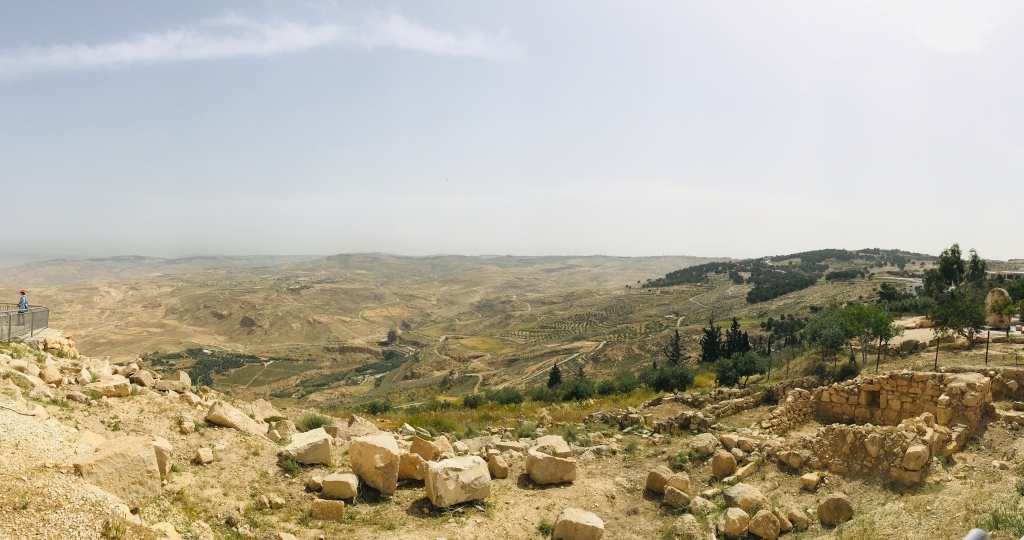
Photo by author, view of Israel from Mt. Nebo in Jordan, May 2019.
God our loving Father,
today we thank you for the gift
of another popular saint among us,
San Roque or St. Rock of France;
he was like Moses, Joshua,
and our Lord Jesus Christ
who primarily worked for the
"healing" of our community,
of your chosen people.

Invoked in time of pestilence
like in the recent pandemic,
San Roque cared and cured many
sick people infected during a plague
in Italy in the 14th century;
when he caught the disease himself,
he hid in the woods to die so that
others may not be infected through him;
but, in your divine providence, O Lord,
you sent him a dog that licked his wounds
and brought him bread until he was saved
by its owner until he could finally get home
to settle the disputes among his relatives
when an uncle usurped his position
and inheritance from his late father,
the former governor of Montpellier.
Today you remind us, O Lord,
to always care for the unity of
our community that includes our
family, our church, our school even our
office where you call us to gather as one;
like Moses who spent all his life
keeping your chosen people united in you,
may we also work for the common good
of our designated community.

What a beautiful sight to behold of Moses
seeing the Promised Land from Jordan!
More than our home here on earth,
give us a glimpse of your heavenly
dwelling, dear God, by continuing
your works of leading our community
close to you like Joshua who succeeded Moses.
Teach us to forgive and correct
those who sin and err with humility
and sole concern of being good
and holy like you, O God,
never to put others into shame
nor to look as better than others;
in the name of Jesus Christ your Son,
help us to work for our unity so that
"whenever two or three of us are
gathered in his name, he may truly be
in our midst" (Mt.18:20),
reflected and mirrored in our community
as we live in justice and mercy,
love and kindness
and holiness.
Amen.
Photo by author, view of Israel from Mt. Nebo, Jordan, May 2019.
The Lord Is My Chef Daily Recipe for the Soul by Fr. Nicanor F. Lalog II
Monday, Memorial of Mary, Mother of the Church, 29 May 2023
Genesis 3:9-15, 20   ><)))*> + ><)))*> + ><)))*>   John 2:1-11
From google.com.
God our loving Father,
as we resume the Ordinary Time
this Monday, grant us the grace
your Son Jesus Christ had given
his Mother, the Blessed Virgin Mary,
to "face" you again,
to be sincere and true before your
holiness and perfection,
power and might.
How sad that despite
the graces of his Cross
and Resurrection, we remain
too far from you, O God, because
we are still ashamed like Adam and Eve
to "face" you as we constantly turn away from
you in sins.
Remind us how on that
first miracle of Jesus at the
wedding in Cana when Mary
interceded for the newly-wed couple
that they have ran out of wine,
our worthless selves marred with
sins and imperfections like water
have been transformed into beloved
children of the Father,
so beautiful,
so lovely,
so noble
like an excellent wine.
Amen.
40 Shades of Lent by Fr. Nicanor F. Lalog II
Tuesday in the Third Week of Lent, 14 March 2023
Daniel 3:25, 34-43   >>> + <<<   Matthew 18:21-35
Photo by author, sunrise at Katmon Nature Sanctuary & Beach Resort, Bgy. Binulusan, Infanta, Quezon, 04 March 2023.
God our Father,
grant me the grace of sincerity
to pray like Azariah whom you
spared from death along with
Shadrach and Meschach in the fiery
furnace of King Nebuchadnezzar;
not even their clothes were singed
by the intense heat that burned to death
their executioners!

Teach me to be sincere
like Azariah who prayed to you while
walking into the furnace with his
companions, telling you one of the
most beautiful prayers in the Bible
we too pray in our Sunday Lauds:
“For we are reduced, O Lord, beyond any other nation, brought low everywhere in the world this day because of our sins. We have in our day no prince, no prophets, or leader, no burnt offering, sacrifice, oblation, or incense, no place to offer first fruits, to find favor with you. But with contrite heart and humble spirit let us be received. Do not let us be put to shame, but deal with us in your kindness and great mercy. Deliver us by your wonders, and bring glory to your name, O Lord.”
Daniel 3:37-39, 42-43
Yes, dear God,
there is no need,
not even necessary,
for us to do anything
"to win your favor"
to grant our prayers except
that we be sincere before you,
that is, to be true and humble,
putting ourselves into your hands
completely that you would take care
of us like Azariah and companions.
Many times, O God,
we can't be like you and be
forgiving as a Father to those
who have wronged us because
we ourselves are not true,
lacking sincerity in begging
your mercy and forgiveness;
many times we doubt your
mercy and forgiveness
that often we act like
the unforgiving servant
in Jesus Christ's parable.
Amen.
The Lord Is My Chef Sunday Recipe for the Soul by Fr. Nicanor F. Lalog II
Twenty-Seventh Sunday in Ordinary Time, Cycle C, 02 October 2022
Habakkuk 1:2-3, 2:2-4 ><}}}}'> 1 Timothy 1:6-8,13-14 ><}}}}'> Luke 17:5-10
Photo by Ms. Ria De Vera, Christ the King Celebration in our former parish assignment, November 2020.
Our gospel this Sunday may be short and brief but so power-packed that can put us into a knock out. In fact, the scene is very disarming that can throw off all our previously held beliefs to give us fresher perspectives on discipleship and faith.
Recall how these past consecutive Sundays that Jesus taught us the importance of God and persons above material wealth like money and possessions. Notice how these lessons were directed by Jesus to the Pharisees and scribes who were known as so obsessed with money. Hardly did we hear any reactions from the Twelve – nor from most of us – until now when they asked Jesus to “increase our faith” (Lk.17:5).
The apostles said to the Lord, “Increase our faith.” The Lord replied, “If you have faith the size of a mustard seed, you would say to this mulberry tree, ‘Be uprooted and planted in the sea,’ and it would obey you.”
Luke 17:5-6
Photo by Dr. Mylene A. Santos, MD, 2021.
When we talk of faith,
it does not really matter how long
we have known each other,
or how much we have given and received,
or how much we have shared.
Faith is being one, being together,
of going the extra mile
because we believe, we trust, we love.
What elicited a reaction from the apostles? Or from us? Let’s admit the fact that many of us have felt the parables last two Sundays were not directly meant for us considering our professed “poverty” and “simplicity” in life. But, when Jesus spoke of the need to forgive those who sin against us every time they come saying sorry, the apostles realized that needed a lot of faith.
And rightly so.
When it comes to hurting our pride and ego, something deeper is at play, something so close to our person is involved than when we lose a material thing. Like the apostles, we have felt how much faith in God is demanded from us to forgive especially those who repeatedly offend us, that on our own we cannot do it.
Photo by Dr. Mylene A. Santos, MD, 10 September 2022.
Hence, their request (that is also ours) to “increase our faith” because forgiving requires a lot of faith, a lot of love; however, faith is like love that cannot be quantified nor measured because like love, faith is also a relationship.
Our relationship with God and with one another is seen always in the kind of intensity we have for each other. My generation used to call it as “vibes” or vibrations, of how we are one with the other person, of how we are in communion or aligned and attuned with the other person. When we talk of faith, it does not really matter how long we have known each other, or how much we have given and received, or how much we have shared. Faith is being one, being together, of going the extra mile because we believe, we trust, we love.
This is the reason that Jesus followed up his answer to the Twelve’s request with a parable of the unworthy servants who came home after working from the field and still waited on their master at dinner; then, after fulfilling their tasks, they simply told their master “We are unprofitable servants; we have done what we were obliged to do” (Lk. 17:10). There was no real relationship between the master and slaves except their job or task and responsibility. If it were a faith relationship, the servants would have done more than just waiting on their master because they would have believed in him!
When our faith is true, when our faith is burning like the reminder of St. Paul to Timothy in the second reading, it means we are focused with the object of our faith who are God and our loved ones. We need not be reminded of things to do, of our obligations; when there is faith in us, our focus is keeping the relationship alive and well that we go the extra mile in lovingly serving our loved ones which is discipleship is all about.
That is how faith as a relationship
 may be described these days:
like an online class, an online meeting,
even online Mass when sometimes
you really wonder if there is somebody listening
 or paying attention at the other side of the screen
 but you just go on...
Photo by author, Makati skyline from Antipolo, August 2022.
People who are deeply in love are first of all one with their loved ones that they are able to do great things because of their intense and vibrant faith that keep them united. With a burning faith inside us, we are able to love the unloveable, forgive the most despicable, achieve what others claim as impossible.
Just think of the saints like St. Mother Teresa of Calcutta or the very young St. Therese of the Child Jesus. Or, the great martyrs of Auschwitz, St. Teresa Benedicta of the Cross (Edith Stein) and St. Maximilian Kolbe. There is no way of measuring how much faith they have in Jesus Christ and humanity but we can learn from their lives the intensity of their faith and love for God and others that they did the impossible!
Very interesting was the faith too of the late Mother Angelica who founded and started EWTN that is now the largest Catholic media organization in the world. She knew nothing about broadcasting yet, all she had was faith in God and in people that she was able to overcome every obstacle to make what EWTN right now.
Think of the big corporations and enterprises around you; they all started so small in material resources but so intense in faith and conviction that they have all grown to become the leading institutions in whatever field they are into. Sometimes, believers are described as visionaries because people with deep faith see beyond what others can perceive. Remember how Jesus would remind his apostles on different occasions to “believe so that you will see” that runs opposite what the world tells us with “to see is to believe”. People who are faithful, those who believe are the ones who can truly see, not the other way around. Faithful people have vision.
Photo by author, Pangsinan, April 2022.
Prayer is the primary expression of our faith as a relationship that we just keep on doing because we believe it is good even if it is so difficult especially when nothing seems to be happening at all. We just keep on praying, believing and hoping that God is with us, very similar to our online experiences these past two years of the pandemic when many times, we wonder if there is somebody listening or paying attention at the other side of the screen! But, call it faith and relationship that we just went on with our classes and work including prayers and Masses online because we believe someone, especially God, is at the other side, even beside us!
We have not seen God but we have all experienced his love and kindness, his mercy and forgiveness that even if nothing happens like Habakkuk in the first reading, we just keep on praying (and loving) because our relationship remains intact with God who is faithfully by our side.
When our faith is alive and vibrant, we get closer to God and with others, we become more loving and caring and kind, understanding and patient and forgiving, finding ways and means to love and serve God in others.
God knows what is best for us. He has gifted us with enough faith. Let us ask him not just to increase our faith but most of all, to deepen, strengthen, and perfect our faith so that our ties and bonds as family and friends and community of disciples be stronger in Jesus Christ, both in good times and in bad. Amen.
Have a blessed week ahead!
Photo by author, Sacred Heart Spirituality Center, Novaliches, QC, 2014.
The Lord Is My Chef Sunday Recipe for the Soul by Fr. Nicanor F. Lalog II
Twenty-Fourth Sunday in Ordinary Time, Cycle-C, 11 September 2022
Exodus 32:7-11, 13-14 ><}}}}*> 1 Timothy 1:12-17 ><}}}}*> Luke 15:1-10
Photo by author, 2018.
Last Wednesday morning during breakfast, we heard on television news the interview of the undersecretary of agriculture blaming our farmers for the recent oversupply of garlic in Batanes and cabbage in Benguet, saying “they plant crops but they don’t think about the market for their harvests.”
We have been so used to such comments by many heartless government officials ever since; and, they also happen everywhere like in our schools where teachers blame students, at homes with parents blaming children and siblings blaming one another and of course, not to be left out is our church where priests always blame people for whatever problems and mishaps that happen in the parish.
No wonder, we feel more comfortable with God depicted in the Old Testament like in our first reading today when God was so angry and instructed to immediately get down from the mountain to punish the people who have created a golden calf to worship.
We find it so difficult to fully and truly accept despite Christ’s words and assurances that God our Father finds joy in forgiving as depicted today in our gospel. So often, we are like the Pharisees and scribes who could not understand why we have to share in the joy of God when a sinner repents.
Tax collectors and sinners were all drawing near to listen to Jesus, but the Pharisees and scribes began to complain, saying, “This man welcomes sinners and eats with them. So to them he addressed this parable.
Luke 15:1-3
Photo by author, 2018.
Jesus reminded us these past two Sundays of the demands of discipleship, of the need for us to conform to his very person and not just with morality and even religiosity. Discipleship is being like Jesus, always having him as our top priority in life.
This progression of Christ’s teaching on discipleship reaches its peak as we move into the 15th chapter of Luke’s gospel account considered as the “heart” of the Gospel in presenting to us three parables showing God full of mercy and forgiveness for sinners. Actually, it does not merely present God as forgiving but in fact as the One who finds joy in forgiving, who is inviting us to share in his joy of forgiving repentant sinners.
There are three parables in Luke chapter 15: the lost sheep, the lost coin and the lost son known as prodigal son. We have opted to consider the shorter form of the gospel which skips the third parable which we have already reflected in the recent Season of Lent.
Photo by Dr. Mylene A. Santos, MD, in Quezon, July 2022.
The first two parables deal with things that are lost, a lamb and a coin; both deal with only one person like “one of you” and “a woman”. On surface, the two parables seem very ordinary but Jesus – and Luke – have a very captivating manner of narrating them, similarly ending each parable with great sense of rejoicing after finding the lost sheep and lost coin.
Simply put, Jesus is appealing to our common experience of how one lost item would surely claim our attention, no matter how small or even insignificant it may be compared with the rest of what we have.
How do you feel when after losing something you were so worried and disturbed searching for it then someone tells you, “para yun lang?”
We feel so mad, like being rubbed with salt on our wounds because such comment “para yun lang?” betrays their lack of concern and love for us, of not knowing at all or at least recognizing how much that missing thing means to us!
How much more with persons like family and friends who have gone wayward in life like the prodigal son and suddenly coming back to us, saying sorry, trying to pick up the broken pieces of our lives to be whole again as friends and family? Would we not also rejoice when they come home, when we finally find them again?
Photo by Dr. Mylene A. Santos, MD, 2020.
In narrating the two parables in such manner so common with us, Jesus now affirms the incomparable value of every repentant sinner. Moreover, Jesus is showing us in these parables the more deeper ties we have with each other that we must rejoice when a sinner is converted. Hence, the demand too on the part of the sinner, of everyone, to recognize our sinfulness first.
Notice how Luke began this new chapter by telling us how “Tax collectors and sinners were all drawing near to listen to Jesus, but the Pharisees and scribes began to complain, saying, ‘This man welcomes sinners and eats with them.’ So to them he addressed this parable.”
Look at the attitudes of the Pharisees and scribes that are not just snobbish but recriminating against the tax collectors and sinners; for them, those kind of people were hopeless, improbable to change that no one should be socializing with them like Jesus.
But, what really got to their nerves that they were complaining why Jesus was sharing meals with them was the fact that tax collectors and sinners were not turning to the Law but to Jesus himself, following him, and even preferring him more than everything! They felt left out when in fact they were the first to separate themselves from everyone.
That’s what they could not accept, that they were no longer relevant.
And the main stumbling block to that was their lost their sense of sinfulness as they have believed so much with themselves as if they were like God, so pure and so clean. Due to their lost sense of sinfulness, they have been totally detached from God and from others as well because they were playing gods, setting them apart from everyone even from God himself because they believed they were sinless. In that sense, they felt God had nothing to do with them because they were sufficient in themselves.
There is nothing God cannot forgive.
This is the grace of this 24th Sunday in Ordinary Time.
Whenever we admit and confess our sins to him,
it is God who is first of all filled with so much joy
 for he has long been searching
and waiting for us to return to him.
Photo by author, 2019.
This is the problem we have in this modern time, when we have all kinds of excuses and alibis, reasons and arguments in doing just everything, losing our sense of sin that unconsciously, we feel like God, in fact always playing God when we presume to know everything that we would neither rejoice when people change for the better nor sympathize with those suffering and in misery. Like the Pharisees and scribes and those heartless people in power and authority in government and schools, at home and in the church, they have no time to even see and review why and what have caused people to sin.
In the first reading, Moses is teaching us the attitude of a true disciple, of one who intercedes for the people by confessing the tender mercy and fidelity of God to his promises and to his people; Moses did not bargain with God to relent in punishing the people. Notice his language, his manner of praying to God, appealing to him as “Lord” filled with faith in God’s boundless mercy and forgiveness. We all know how in a twist of humor, it was Moses who was so furious later when he saw the people worshipping the golden calf that he threw on them the two tablets of stone of God’s Ten Commandments.
In the second reading, St. Paul reminds us through Timothy of God’s boundless love expressed in his mercy and forgiveness to us all sinners. We can never experience this unless we first realize and admit and own our sinfulness like St. Paul who may be considered the worst of sinners for having persecuted the early Christians. There are so many other saints who followed after him with so dark and sinful pasts but became great men and women of faith because they first admitted their sins and sinfulness. As the saying goes, there is no saint without a sinful past and there is no sinner who is denied of a saintly future.
There is nothing God cannot forgive. This is the grace of this 24th Sunday in Ordinary Time. Whenever we admit and confess our sins to him, it is God who is first of all filled with so much joy for he has long been searching and waiting for us to return to him. Amen.
Have a blessed week ahead!
Photo by author, Mount Sinai at the Monastery of St. Catherine, Egypt, 2019.

















 lordmychef.com