Photo by Dr. Mylene A. Santos, MD, at Rhode Island, 10 April 2021.
It was the best of times, it was the worst of times,
it was the age of wisdom, it was the age of foolishness,
it was the epoch of belief, it was the epoch of incredulity,
it was the season of Light, it was the season of Darkness,
it was the spring of hope, it was the winter of despair,
we had everything before us, we had nothing before us,
we were all going direct to Heaven, we were all going direct the other way
 – in short, the period was so far like the present period,
that some of its noisiest authorities insisted
on its being received, for good or for evil,
in the superlative degree of comparison only.
(Charles Dickens, "A Tale of Two Cities")
I know this blog is supposed to be music but Charles Dickens’ famous lines opening his novel “A Tale of Two Cities” are in fact very lyrical and musical. And with our Dickensian situation especially in the way this government has mishandled the pandemic since the very start, we have chosen for our music this Sunday of Divine Mercy something so lively and upbeat, so intense like our Risen Lord who broke free from death and sin, able to enter any locked door and person.
It is a song “resurrected” in 2014 with Justin Timberlake after Michael Jackson suddenly died in 2009, earning so much popularity and acclaim as if MJ were back in life again with this posthumously released hit, Love Never Felt So Good.
Originally written and recorded in a demo track in 1980 with Paul Anka, Love Never Felt So Good was the first single released from Jackson’s second posthumous album, Xscape.
The song is the second collaboration between Jackson and Anka to be released since Jackson’s death in 2009 with This Is It being the first. (Interesting trivia: Anka rearranged the song in 1984 for Jackson’s longtime friend Johnny Matthis who recorded it in his 1984 album A Special Part of Me.)
We chose Love Never Felt So Good primarily for its feel good, positive vibes so infectious which we all need this Easter 2021 with all the deaths and sickness happening due to the pandemic.
There is also the semblance with Easter in a sense with MJ being “resurrected” with the reworked version of the song with Timberlake, another intense artist who can surely drive away the blues today.
Most of all, we find the lyrics very apt with our gospel story of St. Thomas who doubted Christ’s appearance to his fellow apostles (not his Resurrection).
Let us not take doubt as lack of faith; in fact, doubts lead us to deeper and stronger faith like with what happened to Thomas. What matters is we remain in the Lord, keeping ourselves open to his coming like St. Thomas (https://lordmychef.com/2021/04/10/easter-the-intensity-of-jesus/).
In Love Never Felt So Good, Jackson mentions his doubts many times if he is also loved by the woman he desires; but in spite of those doubts, he believed deep in his heart that love never felt so good if they would be together.
The same thing is true with us: amid our doubts are also the strong conviction something good can still happen with the grace of God. What matters is that we learn to balance the many twins in our lives like Thomas: the joys and sorrows we experience, the light and darkness that come our way, the triumph and defeats we face, and lately, the births and healing and deaths we experience in this pandemic.
Trust in Jesus always who promised us his Divine Mercy overflowing despite our sins and sufferings.
The Lord Is My Chef Breakfast Recipe by Fr. Nicanor F. Lalog II
Second Sunday in Easter (Divine Mercy Sunday), 11 April 2021
 Acts 4:32-35  >><)))*>  1John 5:1-6  >><)))*>  John 20:19-31
Caravaggio’s “Doubting Thomas” from en.wikipedia.org.
Praise and glory to you, O God our loving Father in heaven! Despite the recent surge in the COVID-19 pandemic, we are still here today celebrating the Easter Octave which is also the Divine Mercy Sunday of your Son Jesus Christ.
Thank you for the gift of life.
Thank your for the tears we have been shedding lately for those whom we have lost.
Thank you for the gift of faith in you, for the grace to still pray amid all the pains and sufferings coming our way.
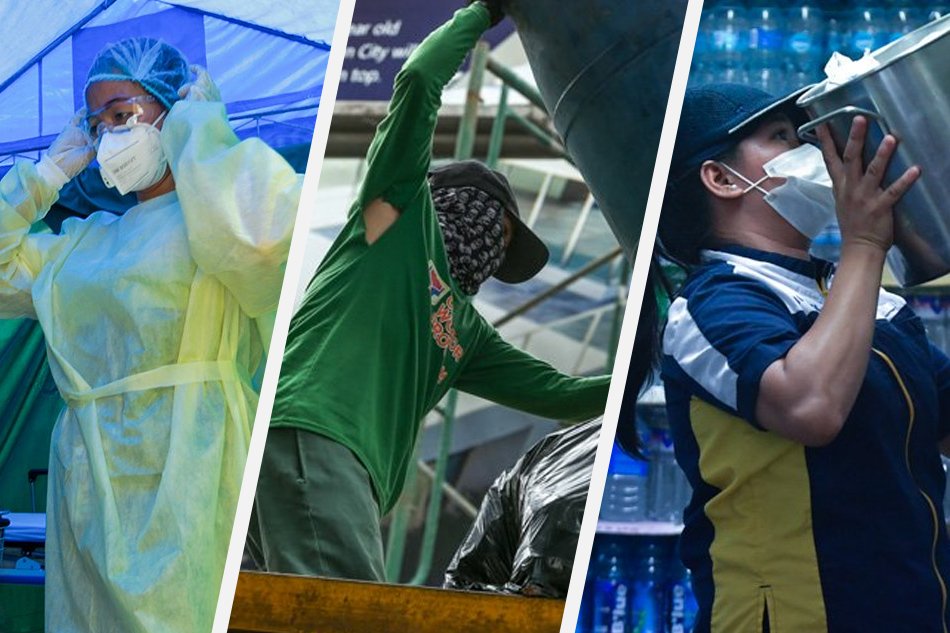
Thank you so much for our medical frontliners who are so exhausted and drained serving us for over a year now since this pandemic started. Keep them strong in body, mind and soul. Take care of their families and loved ones. We want to see them and celebrate with them when this is all over so we may thank them personally for being our rays of hope and life in these times.
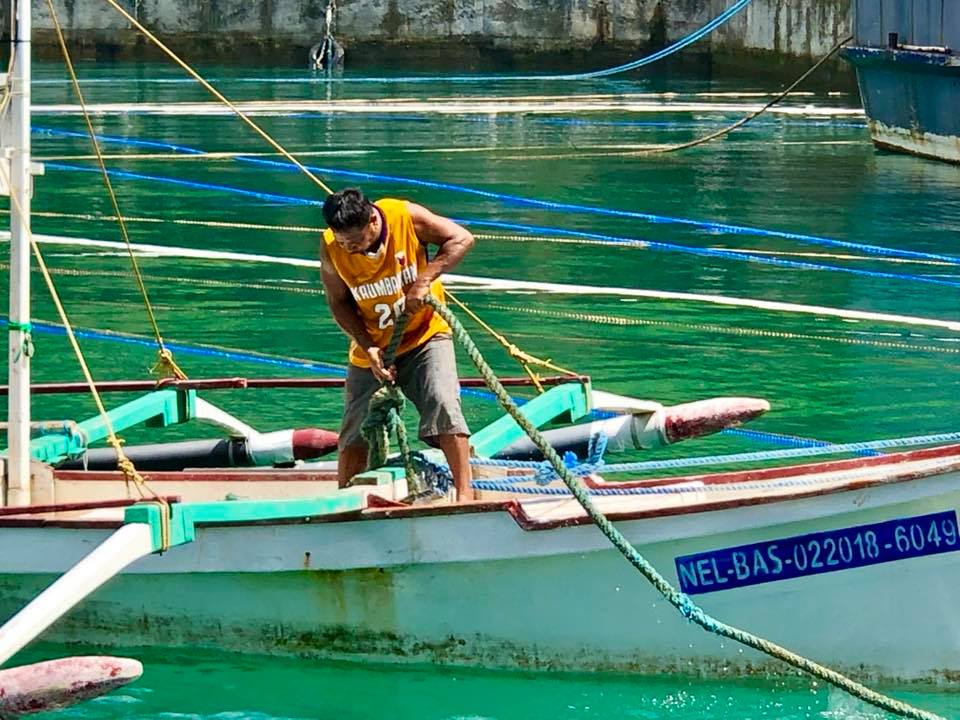
Thank you also for those who have been working tirelessly especially at night so we can have bread and other food in the morning, those who keep our industries and utilities running, those people we hardly know and remember but so essential not only in keeping us alive and comfortable but most of all sane in this crazy period in history.
You know very well our cries, our complaints and our pleadings, dear Father.
Forgive us when we forget those living in the margins, suffering and crying in silence, those who have stopped going to school, those who have lost jobs, those to be evicted from their homes for lack of money to pay their rentals, for those who could not make their ends meet.
Dear Father in heaven… we do not know what else to do. Show us the way in Jesus, the object of our faith, the guarantee of our hope and future glory in you.
And for those now in your presence, those who have gone ahead of us, we pray for their eternal rest, O Lord. We pray also for those they have left behind. One death is too many, Lord.
Rekindle our faith, direct our gaze onto your Son Jesus Christ who had conquered death and sin, sickness and darkness in his Resurrection.
Like Thomas his apostle, make us realize that we can only recognize him in his wounds from the cross.
And like Thomas called Didymus or Twin, help us strike balance and harmony in the many twins in our lives like our faith and doubts, joys and sadness, victory and defeats, glory and sorrows, as well as life and death, rejoicing and mournings.
Oh God… help us in this time that is so Dickensenian in every sense!
It is the best of times, it is the worst of times;
it is the age of wisdom, it is the age of foolishness;
it is the epoch of belief, it is the epoch of incredulity;
 it is the season of Light, it is the season of Darkness;
 it is the spring of hope, it is the winter of despair;
 we have everything before us, we have nothing before us;
we are all going direct to Heaven,
we are all going direct the other way—
(adapted from "A Tale of Two Cities"
by Charles Dickens)
Help us learn the lessons of this pandemic and make us turn back to you in Jesus Christ your Son, who is our Lord and our God as we pray with conviction, “Jesus, King of Mercy, we trust in you!”Amen.
The Lord Is My Chef Sunday Recipe for the Soul by Fr. Nicanor F. Lalog II
Second Sunday of Easter (Divine Mercy Sunday), 11 April 2021
Acts 4:32-35  >><)))*>  1John 5:1-6  >><)))*>  John 20:19-31
Today’s gospel shows us the unique intensity of Easter wherein God broke through human limitations by conquering death to open for us new realms and vast expanse of realities never before imagined (https://lordmychef.com/2021/04/04/breaking-into-new-realities/).
More than the “resuscitation” of a dead person, Jesus Christ’s Resurrection opened us to a new dimension and new possibilities of human existence that leads us all to a new kind of future now.
At Easter, Jesus broke out into an entirely new form of life with his glorified body that it is not just an event in the past we remember but something that continues up to now (cf. Pope Benedict XVI, Jesus of Nazareth, Part II, page 244; Ignatius Press, 2011).
On the evening of that first day of the week,
when the doors were locked,
where the disciples were,
for fear of the Jews,
Jesus came and stood in their midst
and said to them, "Peace be with you."
When he had said this,
 he showed them his hands and his side.
The disciples rejoiced when they saw the Lord.
(John 20:19-20)
Easter is not an ending but a beginningstill continuing in our lives, in our time.
The Intensity of Easter
Easter is not an ending but a beginning still continuing in our lives, in our time. It is a reality so intense that even now we feel deep within us especially in the darkest moments of our lives like during this COVID-19 surge proving to be more dangerous and fatal than last year.
Its intensity comes from the Risen Lord Jesus himself who had conquered death and sin for our salvation. Such is the meaning of his ability to enter the room where his disciples gathered on that Easter Sunday night, despite their doors and windows were all locked for fear of the Jews outside.
This is also the reason that even the evangelists did not have to record so much his every appearance but remain simply noble and grand in their stories because adding details did not matter at all. Most important for them especially to the beloved disciple was the inexpressible intensity of the Lord’s appearances which he mentioned twice, first at the end of this episode and at the conclusion of his gospel account.
Now Jesus did many other signs in the presence of his disciples that are not written in this book. But these are written that you may come to believe that Jesus is the Messiah, the Son of God, and that through this belief you may have life in his name.
There are also many other things that Jesus did, but if these were to be described individually, I do not think the whole world would contain the books that would be written.
John 20:30-31; 21:25
Many times in our lives, the Lord is not asking us to be intense like him.
Only Jesus can remain that intense in his love and mercy for us. He only wants us to be there always, even if we come in late like his apostle Thomas Didymus.
Like Thomas, what we really need are silence and adoration before the Lord who remains with us, comes to journey with us amid the darkness and gloom that envelop us like these days of the pandemic as we now see with everybody posting on Facebook the need to be silent, to be contemplative in spirit.
Thomas Didymus, balance and harmony
Now a week later his disciples were again inside
 and Thomas was with them.
Jesus came, although the doors were locked,
and stood in their midst and said, "Peace be with you."
Then he said to Thomas, "Put your finger here and see my hands,
and bring your hand and put it into my side,
and do not be unbelieving, but believe."
Thomas answered and said to him,
"My Lord and my God!"
Jesus said to him,
"Have you come to believe
because you have seen me?
Blessed are those who have not seen
and have believed."
(John 20:26-29)
First, let us not take the doubts of Thomas negatively. Some accounts claim that his name Didymus or “Twin” in both Aramaic and Greek may refer to his twin characteristics of having doubts and faith at the same time.
Thomas was not an unbeliever when he doubted the news told by his companions that the Lord had risen. In fact, when he said he will not believe them unless he sees and puts his hands into the mark of the nails in the Lord’s hands and side was already an expression of his faith in Jesus. He already knew at that time that the Lord can only be recognized by his wounds from the cross and not by his face which is the usual and ordinary way of knowing another person.
Here we find Thomas having deep faith in Jesus though not so intense. When Jesus told him “do not be unbelieving, but believe”, he was not reproaching Thomas but more of exhorting him to cling more in that faith in him. And that exhortation applies to us to this time too!
Caravaggio’s “Doubting Thomas” from en.wikipedia.org.
Yes, it is not enough to see in order to believe for there are times that it is in believing that we are able to see.
But in this episode with Thomas, we are reminded that our faith lies more in our personal acknowledgment of Jesus Christ alive in us, is risen among us. Even if we can enumerate so many reasons for believing in him along with the proofs by other reliable witnesses attesting to us, what is most crucial is always our own, personal conviction that Jesus Christ is “my Lord and my God.”
That is the giftedness of our faith that John tries to tell us in the second reading: all of our sight and faith in God beginning with the commandments rest in Christ Jesus affirmed to us daily by the Holy Spirit as we slowly inch closer to our future glory in heaven with him in the Father.
Through the Holy Spirit, our faith in God in Jesus Christ is led onto the horizontal dimension of our relationships with one another in love as a “community of believers of one heart and one mind where no one claimed any of his possessions as his own, but had everything in common” (Acts 4:32).
On this eight day of Easter that signifies the continuation of Easter, may we experience the intensity of our Risen Lord Jesus anew in his Divine Mercy working in us, working through us.
We are not asked to be intense like Jesus who can break every barriers in life. He knows our weaknesses and limitations, especially our doubts and insecurities.
In his Divine Mercy, Jesus comforts us amid the grave sufferings we are going through in this pandemic surge, encouraging us to persevere in our faith, hope, and love in him.
Let us imitate the Apostle Thomas to always strike that balance and harmony of our faith and doubts, joys and sadness, glory and sorrows so that we keep ourselves awake and responsive to Christ’s calls to share in his wounds and healing especially in this time of the pandemic. May we keep the commandments of God, walk in the truth of the Spirit and live in faith and love of Jesus for others. Amen.
Quiet Storm by Fr. Nicanor F. Lalog II, 09 April 2021
Photo by author after celebrating “private Mass” first day of lockdown last year, 18 March 2020.
The reality – and gravity – of the lockdown hit me most that Wednesday morning when I celebrated Mass alone. Without the usual faces and voices of our regular Mass goers who greeted me daily upon opening our church door since I came to my former parish in 2011, I just felt something so unique.
And special.
It was as if Jesus was making some “lambing” (tender moments) with me as his priest.
For so long, I have been celebrating Mass on weekdays with at least five people present that there were times it had become mechanical like a routine, sometimes even like a “show” that it has to be good so that I look good, sound good, and everybody feels good.
But on that first day of the lockdown, as I prepared everything from removing the altar cover to bringing out the books and sacred vessels to celebrating “alone” with some birds keeping me company, I somehow felt Jesus most truly present.
Just him and me, at his altar, in his church.
Photo by author, two birds after my private Mass during the lockdown last year.
That was how I realized deep within me the beauty and sanctity of the Holy Mass not in the external things we see and hear but most of all in my intimacy and union with Jesus Christ as his priest.
With or without the congregation, every Holy Mass is the summit of the priest’s life and very existence because that is where his union in Jesus Christ our Eternal Priest is most true.
The way the priest celebrates the Mass – his disposition, his attitude, the way he looks and keep things in order – all indicate his oneness with Jesus Christ. Liturgy flows from the heart of the priest and from that springs our social action and involvement.
How sad when some priests has made the lockdown an excuse not to celebrate the Mass at all.
In depriving himself of the essential union with the Lord and Master, in effect he has deprived his flock the much needed strength from the Good Shepherd.
Even without the pictures and videos of the priest celebrating the Mass sine populo (without the people), that is the most wonderful and most treasured image of COVID-19 only God sees because it is the most sublime image of his Son Jesus Christ present amid this pandemic.
Every word in the Lectionary and the Sacramentary, every moment of that private Mass during the lockdown was like a “cosmic experience” where the eternal and the temporal converge as if time stands still, with these words echoing in the silence of the universe within me:
"...you never cease  to gather a people to yourself,
so that from the rising of the sun to its setting
a pure sacrifice may be offered to your name."
(Eucharistic Prayer III)
Images of COVID-19,
Images of Hope,
Images of Christ
Two Sundays after the lockdown last year came the Holy Week ushered in by Palm Sunday when we went around the parish blessing the palms and fronds of people who have gathered on the streets after our announcement in Facebook and online Mass.
Skies were overcast that morning that we decided to visit first the other end of our parish, Purok Gulod, where we experienced rains and saw the beautiful rainbow the other Sunday.
Nobody saw the lockdown coming. Most of the people did not have the ready-made palms and instead had branches of leaves and fronds available in their surroundings which we blessed while on board our borrowed Ford F-150 after the Mass that morning attended by a few parish volunteers.
But the most touching images of COVID-19 that Holy Week last year happened on the Good Friday procession of the Santo Entierro we have mounted on a truck, brought around the parish after the Veneration of the Cross at 3PM.
From images of COVID-19 as images of hope, the sights have transformed into images of Christ suffering and dead among the people who knelt and prayed while others cried on the streets during procession.
Since it was a Good Friday when there was no holy water, I brought the crucifix with which to bless the people not only on the streets but also those in their vehicles passing by during the procession.
It was very edifying.
How I felt Jesus described in the gospel while going around preaching the good news to all towns and villages:
At the sight of the crowds,
his heart was moved with pity for them
because they were troubled and abandoned,
like sheep without a shepherd.
(Matthew 9:36)
Passing through Purok Gulod where people lighted candles too.
With Kuya Ver sounding the matraca to alert the people…
With Kuya Leonardo the caretaker of the Santo Entierro. Since I came there in 2011, he always brought along the children from their Purok Gitna to pray the Rosary aloud. After each mystery, we would sing some religious songs with “Kristo” as their favorite, singing in unison, “Kristo, Kristo bakit minsan ka lang nakikilala…”
I can still remember my short homily during that Good Friday’s Veneration of the Cross: I told the people that while we were so sad with what was happening due to the pandemic, Jesus was surely more sad with what was going on in the world, in our parish community.
It was a very meaningful Good Friday after all when as the sun set, God reassured me anew and I think everybody else in our parish that we were not alone. We have him as company, consoling us in this time of the pandemic with the beautiful sights of everyone out in the streets praying.
Yes, they are images of COVID-19 but also images of hope.
Most of all, images of Christ among us, suffering and dying first among us in our community during the pandemic.
Join us again on Monday with more images of COVID-19 as images of hope and images of Christ risen among us!
The Lord Is My Chef Breakfast Recipe for the Soul by Fr. Nicanor F. Lalog II
Friday within the Octave of Easter, 09 April 2021
Acts of the Apostles 4:1-12  <*(((><  +  ><)))*>  John 21:1-14
Photo by Mr. Jim Marpa, 2019.
I could easily identify with your words today, Lord Jesus, especially with the flow of the story of the healing of the crippled man through Peter and John: from the Upper Room to the Beautiful Gate to Solomon’s Portico to their being thrown to prison; from the proclamation of the Good News of salvation to the healing of the crippled man and now their persecution and harassment.
After the crippled man had been cured,
while Peter and John were still speaking to the people,
the priests, the captain of the temple guard,
and the Sadducees confronted them,
disturbed that they were teaching the people
and proclaiming in Jesus the resurrection of the dead.
They laid hands on Peter and John
and put them in custody until the next day,
since it was already evening.
(Acts 4:1-3)
So many times, Lord, we resent and avoid sufferings in life like persecution without realizing that it is through these trials that we make it to Easter like you when you passed over from your Passion and Death to Resurrection.
There are also times, Lord, when we feel so down, feeling lost and disappointed that we try going back to our old ways like Peter and his companions that Sunday morning when they decided to go fishing again after you have risen.
Like them, we feel we can be on our own that when failures come, we fail to recognize you only to realize later that without you, we can do nothing.
When it was already dawn,
Jesus was standing on the shore;
but the disciples did not realize that it was Jesus.
Jesus said to them,
"Children, have you caught anything to eat?"
They answered him, "No."
So he said to them, "Cast the net
over the right side of the boat and you will find something."
So they cast it, and were not able to pull it in
because of the number of fish.
So the disciple whom Jesus loved
said to Peter, "It is the Lord."
(John 21:4-7)
Thank very much, dear Jesus for bearing with us when we feel afraid of your mission, when we doubt if it is really you who is with us, directing us, guiding us.
Send us your Holy Spirit to enlighten our minds and our hearts to be firm in our faith in you, to trust you that when trials come our way, your abundant blessings are also there pouring into us to weather every storm in life. Amen.
Photo by Mr. Raffy Tima of GMA7 News, Batanes, 2018.
The Lord Is My Chef Breakfast Recipe for the Soul by Fr. Nicanor F. Lalog II
Thursday within the Easter Octave, 08 April 2021
Acts 3:11-26   ><)))*> + <*(((><   Luke 24:35-48
From Facebook, 04 April 2021: “There is an urgency to announce the Joy, the joy of the Risen Lord.”
So they set out at once and returned to Jerusalem...
The disciples of Jesus recounted
what had taken place along the way,
and how they had come to recognize him in the breaking of bread.
While they were still speaking about this,
he stood in their midst and said to them,
"Peace be with you."
Then he opened their minds to understand the Scriptures.
And he said to them,
"Thus it is written that the Christ would suffer
and rise from the dead on the third day
and that repentance, for the forgiveness of sins,
would be preached in his name to all the nations,
beginning from Jerusalem.
You are witnesses of these things."
(Luke 24:33,35-36,45-48)
O dearest Jesus, help us find our way back to you! Let us turn around, turn towards you, go back to you in Jerusalem to meet you with the other disciples. Help us to repent and be converted as Peter preached in the first reading so our sins may be wiped away to see and experience you (Acts 3:19).
Cast away our doubts and fears of coming to you, of experiencing you, of seeing you because all you want is for us to be free from the bondage of sins and guilt, of the past pains and hurts so we may experience Easter – which is the fulfillment and fullness of life in you, Lord Jesus.
Strengthen our faith through the words of the scriptures that attest everything written about you is true and are meant for our own good as children of the Father.
May we keep in mind that Easter is not an ending, Lord.
As your “witnesses” to your passion, death, and resurrection, remind us of this great mission to spread your gifts of peace and forgiveness to everyone as we strive to establish your Kingdom here on earth by making life more humane especially in this time of the pandemic.
Give us patience and perseverance to go through the process of daily conversion so that your Easter may continue in us and lead to our genuine reconciliation with everyone to the Father by removing our many divisions, fears and hostilities that prevent us from caring and loving each other. Amen.
It was a Tuesday within the Octave of Easter under our first – and world’s longest – Enhanced Community Quarantine (ECQ) when I started this prayer blog based on the Mass readings as a “spiritual recipe” for tired and weary souls at that time when churches were closed and public Masses were not allowed.
It was pure grace that I was able to keep it daily until now in my new assignment, never running out of inspiration from God for my prayers, poems, essays and reflections, and the usual Sunday homilies I have been sharing via email since 2003.
Some of my inspirations came from unforgettable images of COVID-19 that went viral on Facebook and the news that for me were “images of hope” of the Risen Christ reminding us of his presence during this pandemic.
They are images of hope because they tell us modern Easter stories of holiness and kindness, love and sacrifice among ordinary people willing to share Jesus in their very selves for others in need.
And this photo tops them all!
From Facebook, 25 March 2020.
I got this from the Facebook by a church-beat reporter who personally met the photographer who took that shot and interviewed the banana vendor.
What a beautiful reminder of the poor widow praised by Jesus who gave “two small coins worth a few cents” into the temple collection box, saying: “Amen, I say to you, this poor widow put in more than all the other contributors to the treasury. For they have all contributed from their surplus wealth, but she, from her poverty, has contributed all she had, her whole livelihood” (Mk.12:43-44).
My initial reaction upon seeing this image of COVID-19 was how the world never runs out of many good people, who give without expecting anything in return: “may mga tao pa rin palang tunay at dalisay ang pagmamahal at hindi naghihintay ng kapalit.”
I wonder where is that vendor now and what has happened to him. Surely, God must have blessed him abundantly!
A week before the lockdown that March 2020, another set of images appeared on Facebook of a beautiful story of miracle in the supermarket.
According to the Facebook post that became viral, people were panic buying following rumors of a lockdown to be imposed due to the pandemic.
A young lady waiting at the long line to the counter noticed a man had only a basket containing a handful of grocery items.
She turned out to be a “fairy godmother” who offered the manong to get more goods for his family assuring him she would pay for them.
Manong was hesitant at first, very shy with the kind offer by the young lady until he acceded, getting a few more canned goods.
According to the post by an eye-witness, the “fairy” asked manong again to get more goods, saying “dagdagan pa po ninyo at babayaran ko.”
That was when miracle happened…
Some of those at the counter were infected with a holy virus by the young lady’s generosity.
One by one, each customer gave manong a can or an item of their purchases so that he had a basket full of goodies to take home for his family!
Indeed, love begets love begets love… it is the kind of good virus I am sure still happening today even without being reported in social media.
What a beautiful modern version of Jesus Christ’s feeding of 5000 in the wilderness when everybody shared their baon with others (Jn.6:1-15) that filled everyone to his/her delight with still plenty of leftovers.
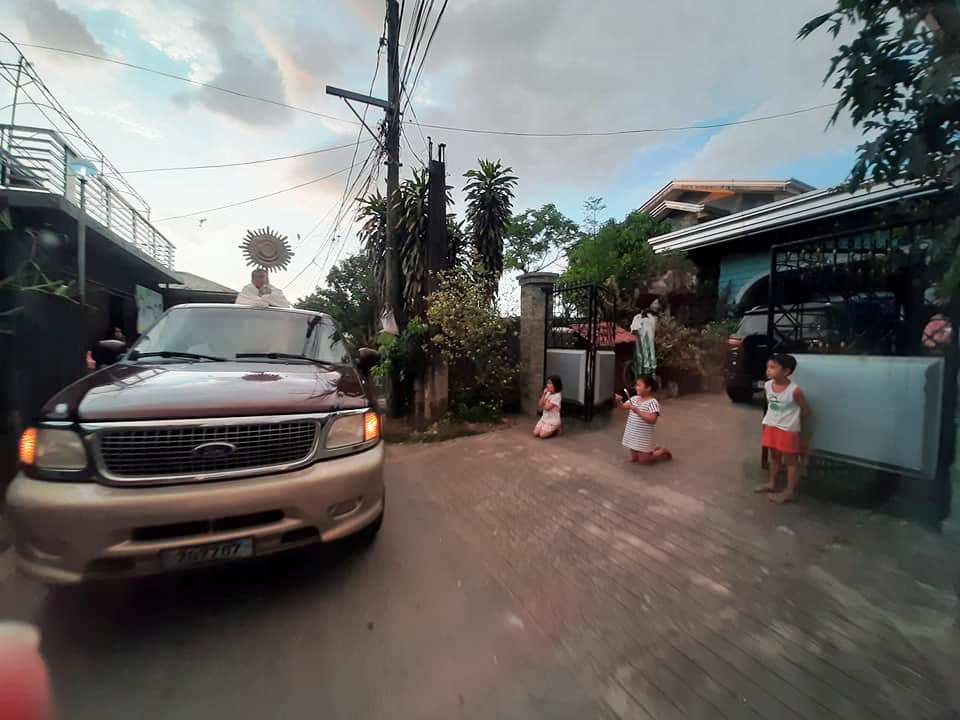
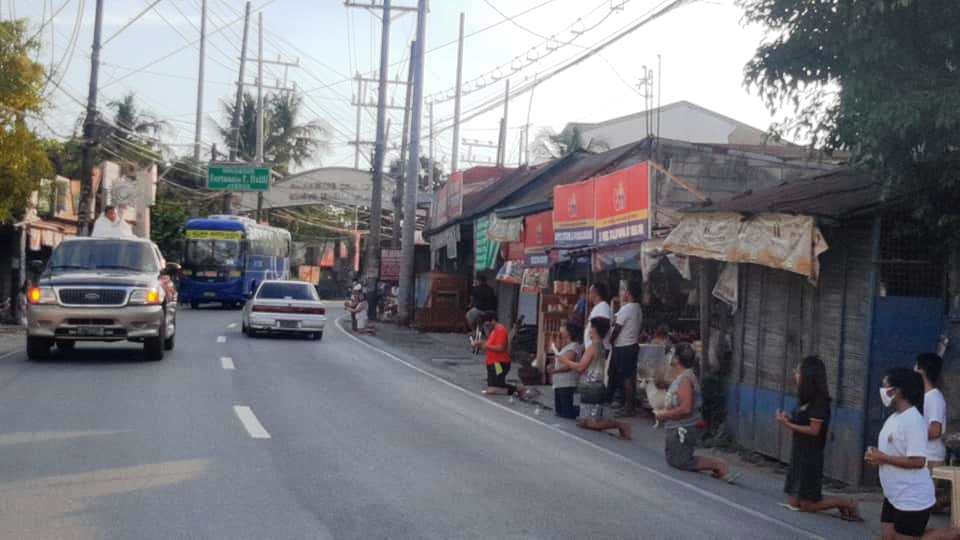
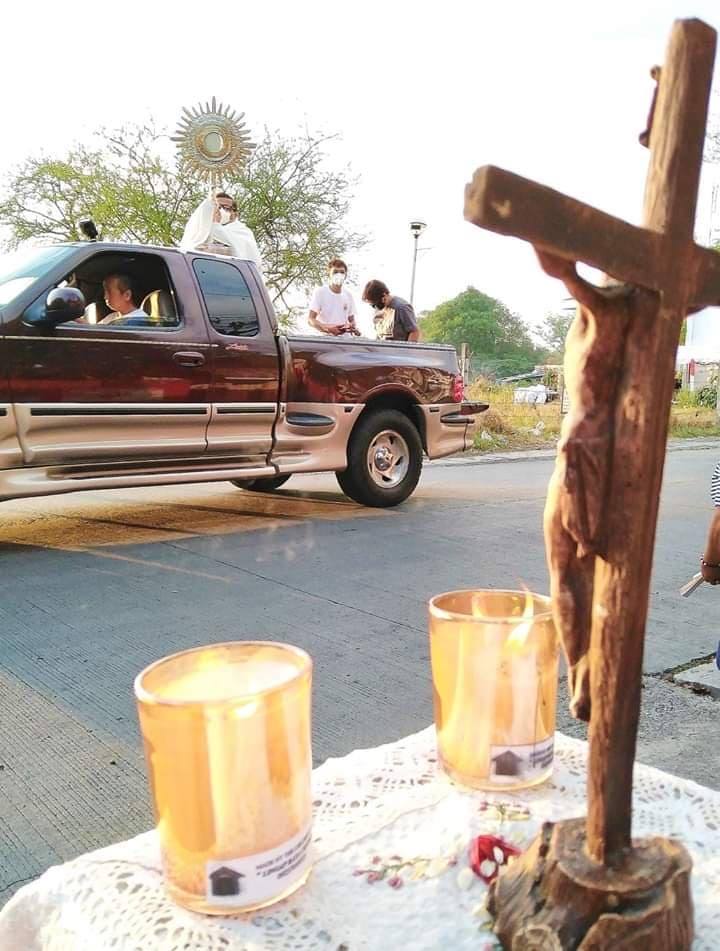
I turned 55 on March 22, the first Sunday of the start of last year’s lockdown, the fifth Sunday of Lent. It was also the first time we went online with our Mass that morning when I called on the people to wait outside their homes later at 3PM – while maintaining health protocols – for the “paglibot” (motorized procession) of the Blessed Sacrament in our Parish at Barangay Bagbaguin made up of ten purok.
How my heart was moved at the sight of people, young and old, rich and poor alike, kneeling on the streets with some crying, adoring Jesus Christ in the Blessed Sacrament!
Truly the images of hope that have sustained and blessed our parishioners at Bagbaguin with the lowest incidence of COVID infections and deaths that year in the whole town of Santa Maria, Bulacan!
Photo by Mr. Ryan Cajanding.
But the most beautiful image of hope for me that day was the appearance of a rainbow before the end of our “libot” of the Blessed Sacrament.
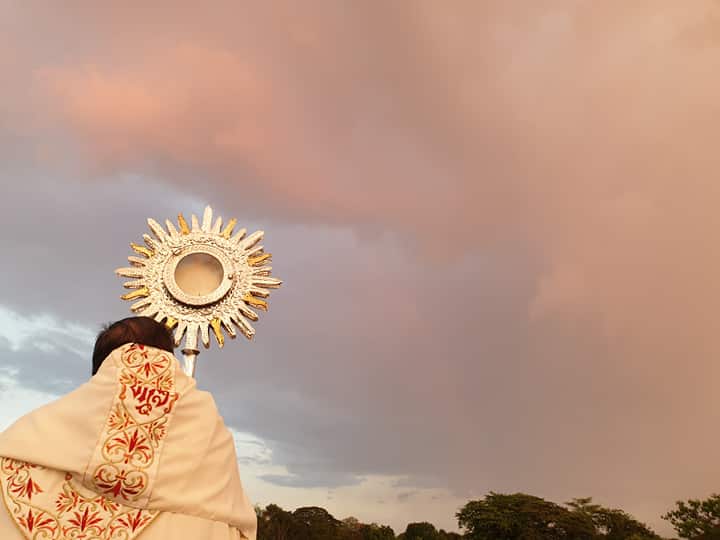
We were at the last leg of our “libot” when it started to rain with our volunteers asking whether we would still go to the next purok of Gulod or not. From the back of our truck with both my hands holding the big monstrance, my response was adamant: we proceed even if it rains!
I knew we have brought plastic to cover and protect the Blessed Sacrament from the rains and I felt what mattered most then were the people to have a glimpse of Jesus in their most difficult trials in life.
Lo and behold, after a few minutes, the rains stopped and a rainbow appeared at the horizon!
Tears rolled down to my cheeks saturated with perspirations as I held the big monstrance.
I could not contain the joy within my heart as I thanked God for the grace of that moment, of sending us with a rainbow to assure us like during Noah’s time that he would keep his promise never again to destroy earth with floods or with virus, that we would be safe during this pandemic.
It was the best birthday gift I ever had in recent years that made me decide to continue that practice of libot of the Blessed Sacrament every Sunday while public Masses were not allowed during the lockdown.
What are your images of COVID-19 that were images of hope that sustained you in this year-old pandemic?
Join us again this Friday with more images of COVID-19 and this time, images of Christ among us!
*Other photos by Ms. Ria De Vera and Ms. Anne Ramos of our Parish Commission on Social Communications.
The Lord Is My Chef Breakfast Recipe for the Soul by Fr. Nicanor F. Lalog II
Wednesday within the Octave of Easter, 07 April 2021
Acts of the Apostles 3:1-10  <*(((>< + ><)))*>   Luke 24:13-35
Photo by author, sunrise at Lake Tiberias in Galilee, the Holy Land, 2017.
When the crippled man saw Peter and John
about to go into the temple, he asked for alms.
But Peter looked intently at him, as did John,
and said, "Look at us."  He paid attention to them,
expecting to receive something from them.
Peter said, "I have neither silver nor gold,
but what I do have I give you:
in the name of
Jesus Christ the Nazorean,
rise and walk."
Then Peter took him by the right hand
and raised him up, and immediately
his feet and ankles grew strong.
(Acts 3:3-7)
Praise and glory to you, our Risen Lord Jesus Christ, in sharing with us your victory and glory over sin and death, sickness and powerlessness. In joining us in our humanity in all of its aspects except sin, you have made us share in your divinity at Easter.
Like Peter and John at the Beautiful Gate that afternoon, fill us with your presence and power, love and mercy to uplift and empower our brothers and sisters afflicted with sickness and other burdens that drag them down, unable to rise again to experience life anew.
Give us the courage to tell people to look at us and find you like that crippled man you have healed through Peter and John.
Moreover, let us look at your face, look for what will unite us than divide us, look at your light than at the world’s darkness and shadows so we may look for Easter especially in this time of the COVID-19 pandemic.
Remove the pessimism and cynicism growing among us in this worsening pandemic.
Ignite the flames of faith, hope and love within us so our eyes may be opened to see you again walking with us in this journey.
Cleanse us of our biases and prejudices, as well as of our expectations and other personal beliefs so we may see you most especially when we are treading the wrong path to our Emmaus of sunset and defeat.
That very day, the first day of the week,
two of Jesus' disciples were going to a village
seven miles from Jerusalem called Emmaus,
and they were conversing about all the things that had occurred.
And it happened that while they were conversing and debating,
Jesus himself drew near and walked with them
but their eyes were prevented from recognizing him.
(Luke 24:13-16)
O dear Jesus, may welook at Easter on the face of everyone you send us and at every situation we find ourselves into so we may lead and guide others to you.
May we see and recognize you most of all in the darkness enveloping us this time of crisis so that eventually, we may come together in the breaking of bread and sharing of our very selves to others blinded by the calamities that have fallen upon us. Amen.
“Road to Emmaus I” painting by Daniel Bonnel, 2011 from mwerickson.com.
The Lord Is My Chef Breakfast Recipe for the Soul by Fr. Nicanor F. Lalog II
Tuesday within the Octave of Easter, 06 April 2021
Acts 2:36-41  ><)))*>  +++  <*(((><  John 20:11-18
Painting by Giotto of the Risen Lord Jesus Christ appearing to St. Mary Magdalene from commons.wikimedia.org.
Recent events of sufferings due to a surge in COVID-19 infections and the difficulties this lockdown had put on our people have somehow “cut us to the heart” like the listeners of Peter in Jerusalem after the Pentecost, God our loving Father.
Yes, we feel being cut to the heart, so moved by your presence in Christ despite this crisis in the pandemic.
Help us, Lord, answer the two questions posed by your words this Tuesday within the Easter Octave that can help us experience you more amid this unholy events happening in our history.
"What are we to do, my brothers?"
(Acts 2:37)
First of all, Lord, we pray for our government officials who are until now clueless on what really to do during this pandemic. We pray for their conversion, to get down from their ivory towers and admit their mistakes rather than cover up with so many lies and inanities.
Give us the courage to examine too what we are really doing to overcome this crisis. So many times, we have been hiding and running away from our responsibilities in our home, in the school, in the office and even in the church! Let us confront our many fears to start trusting you and take the big leap forward learning and working on how to help others.
Teach us to be grateful for the many blessings you have given us even in this time of crisis and therefore find purpose in our lives to share the good news of Easter with others especially the less fortunate.
 "Woman, why are you weeping?"
(John 20:13, 15)
Secondly, Lord, let us live in the present moment so we may recognize and find you amid all the darkness that surround us these days. Twice your friend Mary Magdalene was asked with the same question, first by the angels and then by you, dear Jesus: “Woman, why are you weeping?”
Why did she not recognize you, Lord, considering you are the best of friends?
Sometimes, Lord, we are not like her your friend: we do not live in the present moment, always in the past that is why we cannot find you. We cannot find nor recognize you because we are stuck in your old ways and looks, in our old ways of relating with you, forgetting you have passed over from the past into the new present.
If we shall be able to live in the present moment, we shall stop weeping and start rejoicing finding you amid all the darkness and uncertainties of this pandemic. Give us the grace, dear Jesus to level up in our relating with you and with others by first meeting you in your words, in prayer, and in the Eucharist. Amen.
Photo by Bro. Cristian Pasion, National Shrine of Our Lady of Fatima in Valenzuela, 03 April 2021.
Quiet Storm by Fr. Nicanor F. Lalog II, 05 April 2021
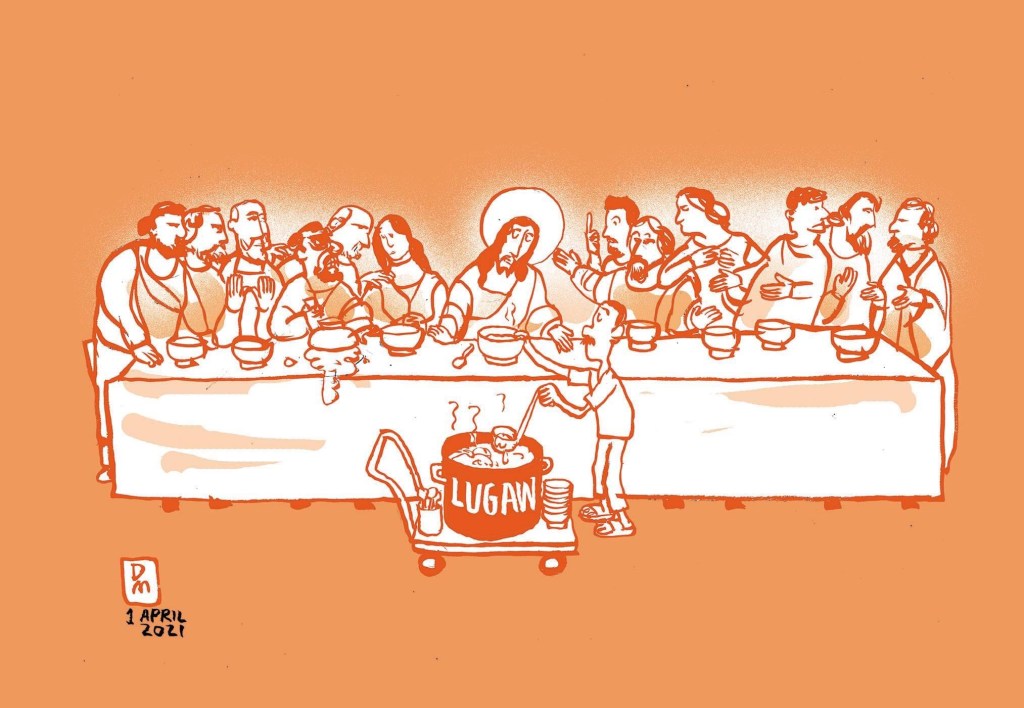
“An Essential Holy Thursday Transubstantiation” by artist DengCoy Miel posted on his Facebook, 01 April 2021.
It was a Holy Wednesday when the incident went viral as picked up by network news that evening when the previous night some barangay officials in Muzon, San Jose Del Monte, Bulacan insisted that lugaw is “not essential”, that man can live even without lugaw.
The timing was so perfect being a “Spy Wednesday” or the night of traitors when Judas Iscariot struck a deal with the chief priests to hand them over Jesus for 30 pieces of silver (Mt.26:15).
And so, there were the three barangay officials handing over to their power trip the common lugaw not knowing they have in fact betrayed us Filipinos in their arrogant insistence that lugaw is a non essential food.
The following Holy Thursday, another Judas Iscariot not only betrayed but crucified si lugaw as non-essential without knowing his remark was a self-indictment of this government’s preoccupation with politics, disregard for the people and lack of any definitive plan regarding the year-old pandemic. Trying to sound a smart aleck and clown rolled into one this administration has too much of, his explanations only made him look like the lowest kind of lugaw – rice leftovers boiled in water.
The benighted souls who have denigrated our favorite food have just proven that this pandemic is something we have to see in the light of spirituality and morality, not just a medical and social issue to be addressed.
Any food is always essential because every food signifies a person, has life and sustains life.
Recall that during his Last Supper on the night before he was betrayed, Jesus had chosen the most ordinary but very essential food to be the sign of his loving presence among us until the end of time – the bread. An unleavened bread, to be exact, which was the food taken by the Jews during their exodus from Egypt at the time of Moses.
The bible teems with so many references to the lowly food of bread as something divine with deeper meaning as a sign.
Consider that Jesus was born on a manger which is an open box or a trough for animals like horses and cattle to eat from to signify his being our very food in this life journey. He was born in Bethlehem that literally means “house of bread”; thus, at his last supper, Jesus gave himself to us under the sign of a bread.
In establishing the Sacrament of the Holy Eucharist which St. John Paul II emphasized in 2002 by adding the Mysteries of Light in praying the Rosary, Jesus elevated the meal into the most sublime human activity making our food divine and holy. As a result, the table had become one of the most intimate places in our lives that every time there is a meeting or any gathering, there is always the meal to be shared. I used to tell my students before that every first date is always in a restaurant – if possible a fine dining one – because what matters most is the moment to be shared together by you and your date.
It is always easy to know when couples and parents are not in good terms with each other: they never eat together or during meals, they do not talk or speak to each other. The same is true when people decline our invitations for dinner or party or simple meal: they do not want to be with us. Period. That is why Judas Iscariot had to leave and not finish the Lord’s supper!
See that we never call people as “enemies”: like Jesus Christ, as much as possible we welcome everyone to our table to share meal with us and it is only then when we realize who is our enemy when like Judas, some people stab us in our backs while sharing meal.
When we eat and share food and drinks, we actually share our very selves to our guests and friends. We host parties because we want to share our very selves with our family and friends, to share and be a part of our lives, of our achievements, of our important stages in life. Their coming signify the same willingness to share us their lives too.
Photo by desiringgod.org, April 2019.
The food we share are signs of our bonding, of our relationships, of how we care and respect for one another. It does not really matter what food we share. More often, the most simple and ordinary food are the ones that truly delight us like tuyo. Or lugaw!
How I wish parents today would bring back those days of old when nobody is supposed to waste not even a single grain of rice or any food for that matter because it is from God.
When we were growing up, every meal was the most awaited family time not because of the food but more of the bonding and exchanging of stories. As we age, it has become more truer than ever! That is why we all wish this pandemic would end so we could all eat together as families and friends, is it not?
Any food is always essential because every food signifies a person who has life and sustains life of others.
Every one of us is a companion to each other. From the two Latin words “cum panis” that mean someone you break bread with, a companion is a friend, a fellow traveler who sustains and nourishes you like food in your journey!
In that beautiful story of the road to Emmaus when Jesus appeared to two disciples disappointed with his death and news of his empty tomb on Easter, they recognized him only after he had broken bread but simultaneously disappeared because at the table of the Lord, we also become his Body meant to be shared with everybody.
The recent issue that went viral on whether lugaw is a non-essential or not is a tragic indication of the kind of people we are, of how we categorize persons like food.
There seems to be a direct correlation
between food and humans:
when there are plenty of food,
that is when people are taken for granted,
while where there is scarcity of food, people are valued.
Take the case of ice cream. When somebody is rich and young and beautiful or handsome, they are the “flavor of the month” or the “all-time favorite” and “classic” or “premium”.
And how do we call our ordinary ice cream peddled by Mamang Sorbetero? “Dirty ice cream” – dirty because ordinary and cheap like the street kids, the poor, the “wa-class” and opposite of the more expensive sosyal ice cream.
Worse, with so much food available these days unlike before when we valued every food so much because we can only have apples (and softdrinks) when sick or chocolates when relatives from the States sent packages or some rich neighbors brought you as pasalubong from Dau’s PX stores outside Clark Air Base in Pampanga, things today have also changed in the way we relate with one another.
There seems to be a direct correlation between food and humans: when there are plenty of food, that is when people are taken for granted while where there is scarcity of food, people are valued.
As more food are readily available these days, the more we have become choosy, the more we categorize food as essential and non-essential that at the same time, the more we denigrate humans.
Such was the plan of Satan with his first temptation to Jesus – turn stones into bread after fasting for 40 days in the wilderness.
For Satan, let us have more food and things to satisfy our body so we forget God and one another, and everything of higher value. When food is retained in the stomach and becomes an end in itself, it then becomes an occasion for sin like gluttony, exactly what Satan was pushing for so that we just keep on filling our stomachs with food, satisfying the cravings and desires of the body until we destroy ourselves and our image as likeness of God.
Jesus put food into the right perspective that God is our real and true food that in two instances at least, he fed vast crowds of people in the wilderness after seeing them rightly disposed for material food.
Call it as generation gap but I am shocked when I hear some people especially the young describing handsome men and pretty women as “yummy” and “delicious” like food. Problem with that kind of mentality is how it shows we have come to regard everybody like food that if we are no longer “fresh” or “new”, becoming “old” and stacked in the cold fridge, later to be discarded or thrown out like old people being sent to retirement homes totally unknown to us 40 years ago.
Worst of all is how this administration launched its bloody campaign against drugs when addicts and other criminals were considered as non-essentials to be eliminated or killed like animals – exactly the deeper implication of what that government official kept saying last Holy Thursday that “non essential si lugaw”!
Since last year’s Holy Week when we first went into this lockdown, I have been telling friends to avoid as much as possible posting their lavish food on Facebook as a sensitivity to others with almost nothing to eat. And I maintain it is still valid to this time of this worsening crisis.
Let us be food to everyone as source of strength and nourishment, of inspiration. We do not have to make extraordinary efforts. Simply be human as yourself. Be present with a text or a phone call to those suffering. Pray for them and let them know you care for them.
Be a lugaw who could warm someone’s cold body freezing in fear and anxiety, offering quick relief from whatever suffering others may be going through.
Most of all like a hot, steamy lugaw, giving hope that Jesus is with us, his salvation is coming soon.
Remember, friends, lugaw is essential.
And so is everyone.
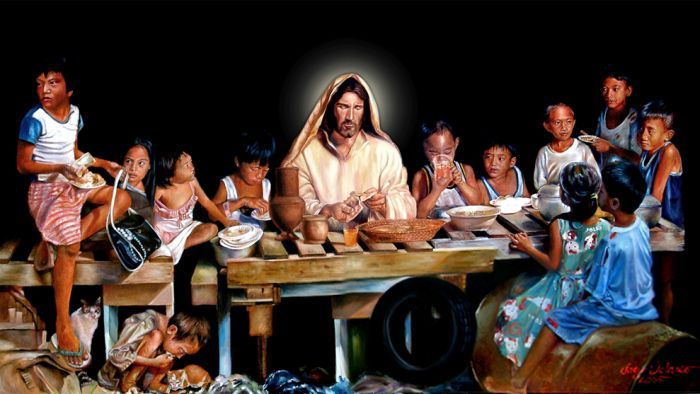
The late Joey Velasco’s 2005 painting “Hapag ng pag-Asa”.