Immaculate Conception, Intimacy of God

Lord My Chef Daily Recipe for the Soul by Fr. Nicanor F. Lalog II
Monday, Solemnity of the Immaculate Conception, 08 December 2025
Genesis 3:9-15, 20 ><}}}}*> Ephesians 1:3-6, 11-12 ><}}}}*> Luke 1:26-38
“Cestello Annunciation” by Botticelli painted in 1490; from en.wikipedia.org.

We praise and thank God today on this Solemnity of the Immaculate Conception of Mary that formally kicked off the process of the fulfillment of his promised salvation in Jesus born by the Virgin Mother.

According to our official Church teaching called dogma, Mary was conceived by her mother St. Anne without any stain of original sin through the merits of Jesus Christ our Savior. Mary has to be pure and clean because she would bear the Son of God who is perfect and spotless.

God chose Mary to be the Mother of Jesus not because of her having any special traits but purely out of God’s goodness “who has blessed us in Christ with every spiritual blessing in the heavens” (Eph.1:3).

Hence, this feast reminds us too to imitate the Blessed Virgin in saying “yes” to God’s invitation to cooperate in his wonderful plans of bringing Jesus into this world so darkened by sin that has left us broken and fragmented from each other. Rejoice, therefore, because everyday, God sends us his angel to greet us with “Hail, full of grace! The Lord is with you” (Lk.1:26), inviting us into an intimacy with him like Mary.

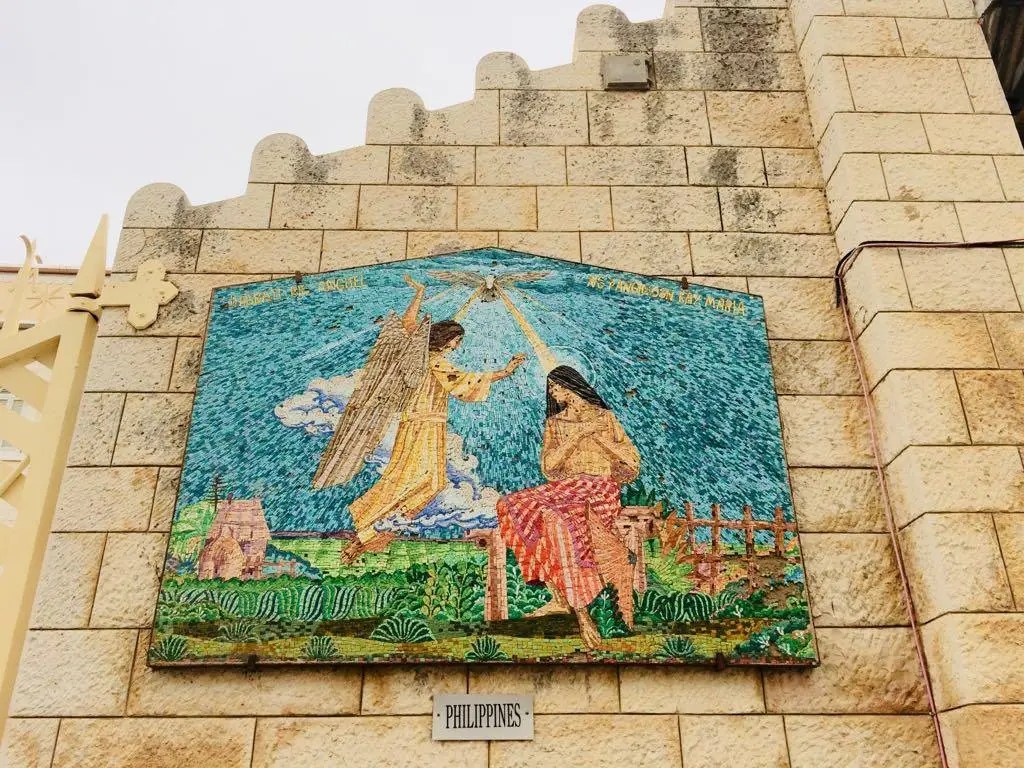
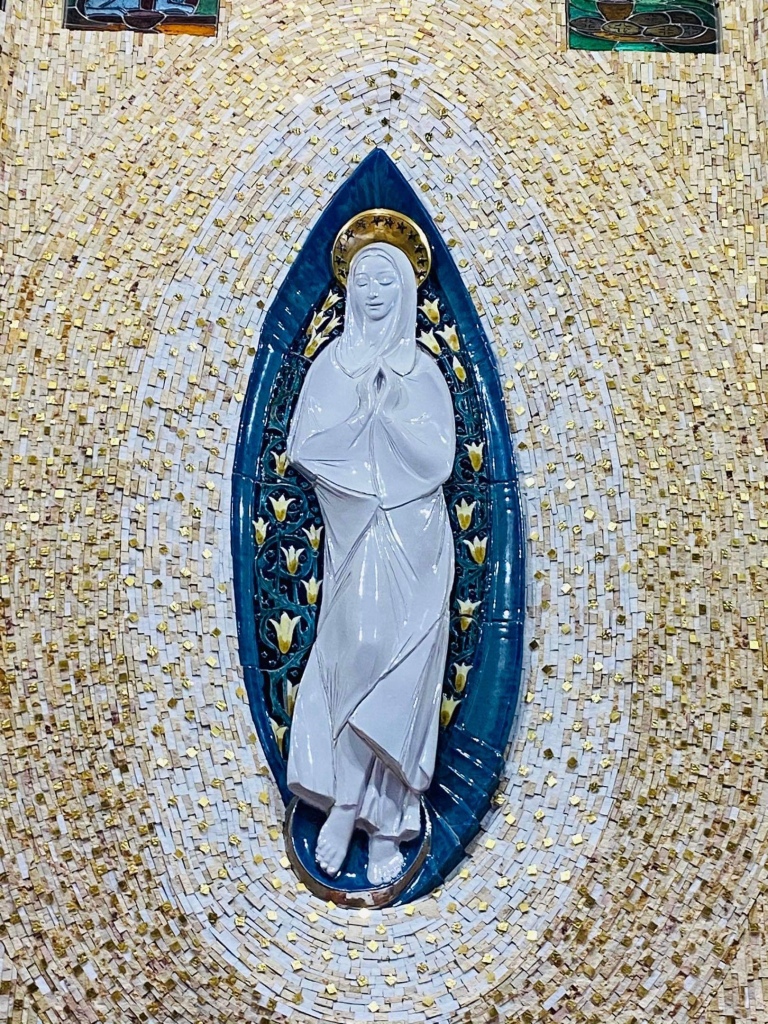
Photo by author, left side of the facade of the Basilica of the Annunciation in Nazareth, Holy Land, May 2019.

Intimacy is more than being close with another; it is an expression of love that is willing to sacrifice, to suffer and get hurt for the sake of the beloved.

God was the first to express his intimacy with us not just by expressing his immense love for us in words by the prophets in the Old Testament but by sending us his Son Jesus Christ who became human like us in everything except sin. Actually, God does not need to become human like us to save us but he chose to be one of us because he loves us so much. As an expression of his intimacy and solidarity with us, Jesus suffered and died on the Cross while going through every pain and hurt we go through in life like grief and sadness in losing a friend, betrayal by a friend, abandonment by friends, no to mention being terrified, going hungry and thirsty. Jesus became like us so that we may become like God – intimately loving him through others.

Actually, God does not need us but he chose to love us, to be with us, to be intimate with us because he loves us so much. God remains God even without us. When we do not pray, when we do not go to Mass on Sundays, when we are bad and not good, God is still God. It is us humans who are lessened when we turn away from from God.

That’s the intimacy of God with us.

How about us, are we willing to be intimate with God in Jesus Christ?

Sadly, many people “create” and “force” intimacy which is a grace, a gift of God freely given to everyone. Like friendship, we cannot force intimacy into someone not meant to be. And like friendship too, intimacy begins in Christ, blooms in Christ.

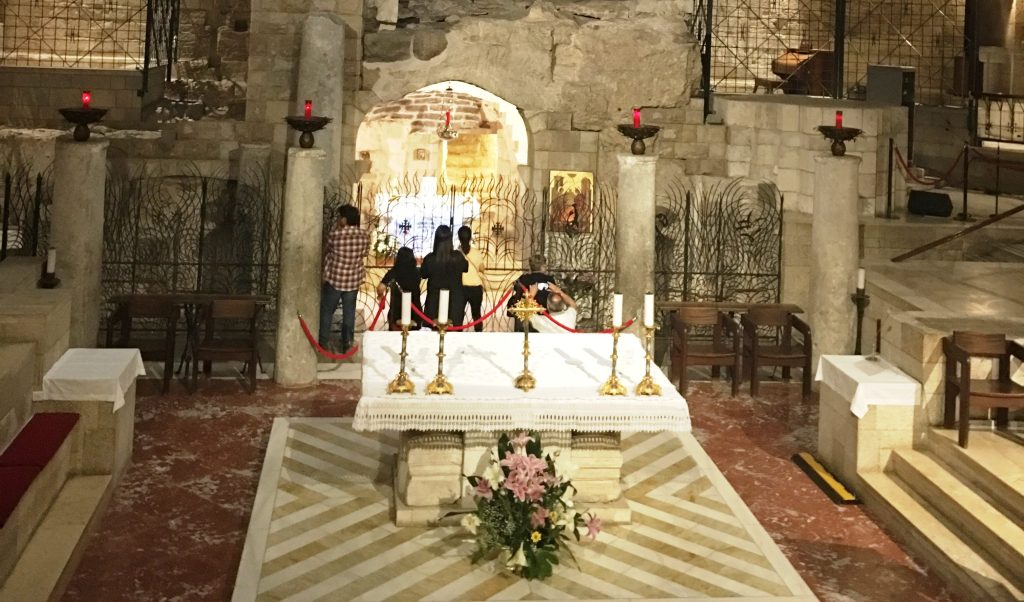
Photo by author, chapel beneath the Basilica of the Annunciation in Nazareth; see those pilgrims praying behind iron grills at the back of the sanctuary which is the site where the Angel announced to Mary the birth of Jesus Christ.

Underneath the Basilica of the Annunciation in Nazareth is a chapel near the very site where the angel is believed to have appeared to Mary to announce the coming of the Savior. At the back of the sanctuary of this chapel is that holy site of the Annunciation enclosed by iron grills with an altar table at the center with the declaration in Latin, Verbum Caro Hic Factum Est (The Word became flesh here).

Mary’s intimacy with God began long before the Annunciation to her by the Angel cultivated in her prayer life. Every time I pray this scene of the Annunciation, I always imagine Mary deeply absorbed in prayer. Most likely, she must be praying about her coming wedding to Joseph. Luke and Matthew were both consistent about their status as being “betrothed to each other” when God announced through the Angel the birth of the Christ.

Photo by author, close up of the Annunciation site beneath the Basilica of the Annunciation in Nazareth; written on the altar table that says in Latin, “The Word became flesh here.”

Imagine the excitement and joy of two faithful Jews getting married soon when suddenly the Angel appeared to them on separate occasions and diverse situations to announce God’s plan of sending his own Son Jesus Christ for the salvation of the world?

It must have been most painful to both Mary and Joseph but as being truly faithful and loving of God, they both agreed to the Divine plan! And that is the great sign of their immense love for God – eventually for each other. Moreover, in saying yes to God, both Mary and Joseph showed the kind of intimacy they have with the Divine.

Let us focus on the intimacy of Mary with God on this Solemnity of the Immaculate Conception found in our gospel account of the Annunciation.

Photo by Rev. Fr. Gerry Pascual of Iba, Zambales at Santuario di Greccio, Rieti, Italy in 2019.

Then the angel said to her, “Do not be afraid, Mary, for you ahve found favor with God. Behold, you will conceive in your womb and bear a son, and you shall name him Jesus (Luke 1:30-31).

Notice that in many scenes and prayers about the Blessed Virgin Mary, we find the prominence of her “womb” like here in the Annunciation and when Elizabeth praised her during her Visitation as “blessed is the fruit of your womb” (Lk.1:42).

In Hebrew, the word for womb is “racham, rachamin” which is their word too for “mercy” because for them, God’s mercy comes from his innermost being. Hence, whenever the Jews speak of mercy of God, they point their fingers downward into the womb or uterus and moves it upward to the heart to indicate the flow of mercy of God from his innermost being expressed in love which is he’s very being and core.

This is the reason the Church Fathers translated mercy into “misericordia” from the Latin verb to move or to stir – “misereor” – and word for heart “cor” that literally means “to move or to stir one’s heart”. It is more than a feeling like compassion; mercy is deeper as it encompasses one’s being leading to intimacy that is a communion or oneness with others which is also intimacy.

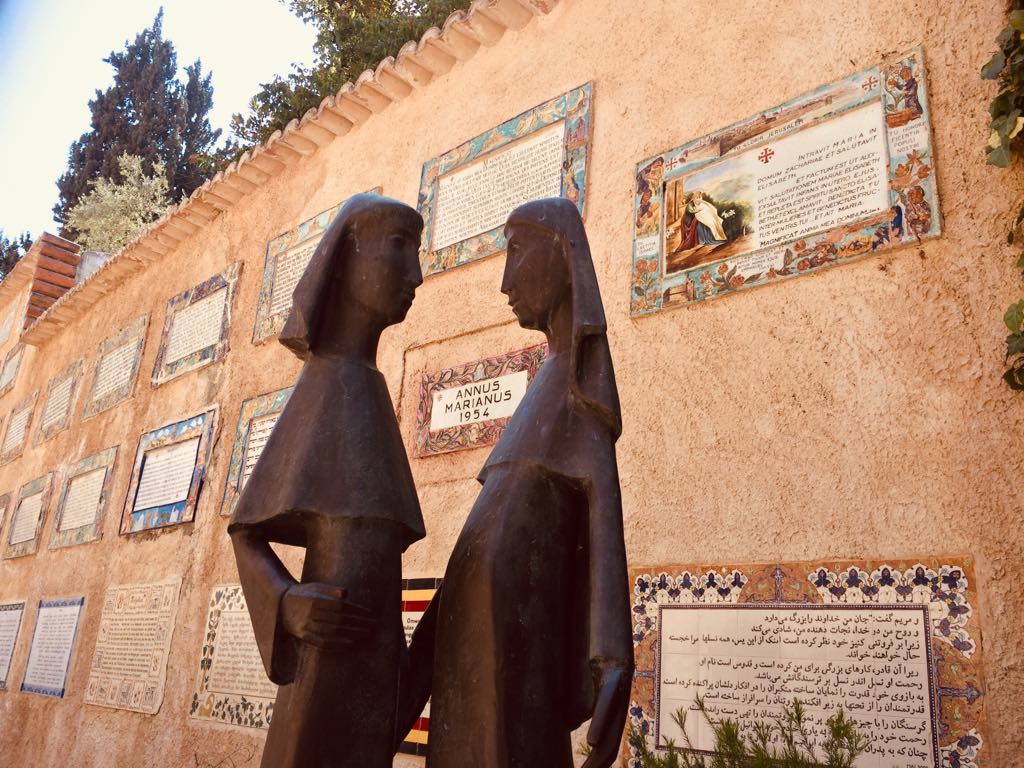
Photo by author, Church of the Visitation, Ein-Karem, Israel, May 2017.

Where there is love, there is always intimacy with the lover willing to bear all pains and hurts for the beloved. And vice versa. Like Jesus. Then Mary who was willing to sacrifice her wedding and marriage to Joseph by being the Mother of the Son of God.

But why? Because we have experienced too that true joy comes only when there is giving of self, when there is willingness to let go and suffer. At the Last Supper, Jesus described joy as like a mother in the pangs of childbirth when she goes through a lot of pains and worries and fears almost like dying but once the baby is delivered, joy happens because she had brought forth a new life into the world.

True joy is having the firm belief that no matter what happens even in the worst scenarios, God would never leave nor forsake us. Joy happens when we find new life, new directions because there is another person willing to remain with us, assuring us we are never alone. That again is intimacy when you feel not alone especially in the most trying times.

Without intimacy with God and another person, there can be no true joy because no one would dare to take risks in this life like mothers. This is what modern women are missing when they see childbearing more as a chore or a burden or a suffering they can always avoid than self-giving borne out of love which happens in the context of an intimacy. No wonder too that sex has been so trivialized, reduced to an activity and act instead of as a gift of self because there is no more responsibility and intimacy. We cannot have lasting and meaningful relationships without intimacy.

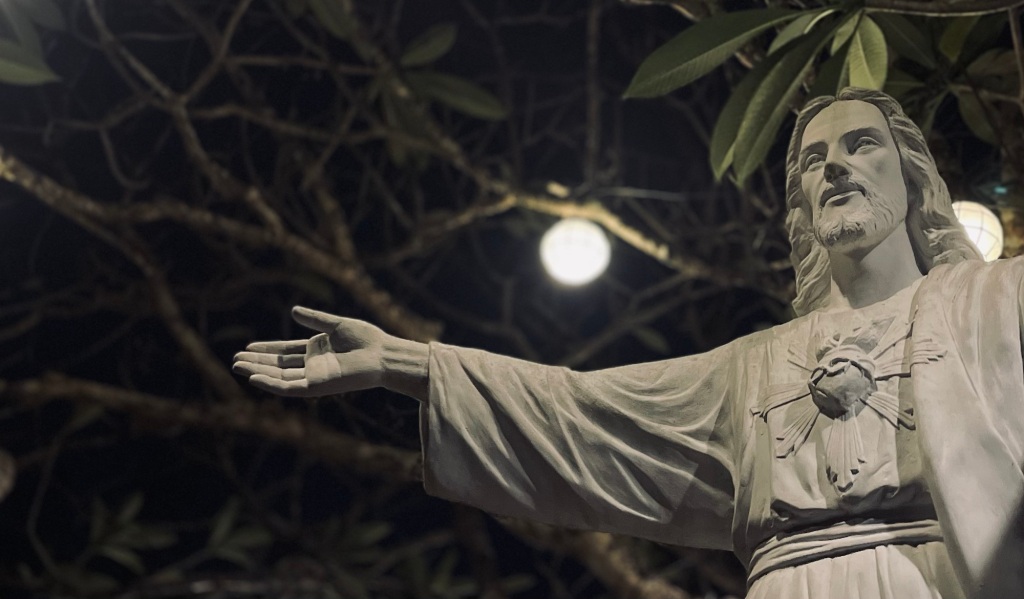
Photo by author, 2021.

On this Solemnity of the Immaculate Conception, we are reminded of God’s mercy and intimacy with us, of his loving relationship with us that continues in Christ Jesus with Mary.

Let us nurture this beautiful relationship with God that flows and bears fruit in our relationships with one another.

Like Mary, may we finally say yes to God into an intimate relationship with him through our selflessness. Like Mary, we are blessed and full of grace. The joy awaiting far outweighs the pains and sufferings we shall go through in our gift of self in our relationships. Have no fear for Jesus had suffered first before us so that we can love and be intimate like him. Amen. Have a blessed week.

When less is more

Lord My Chef Daily Recipe for the Soul by Fr. Nicanor F. Lalog II
Monday, Memorial of St. Andrew Dung-Lac & Companion Martyrs, 24 November 2025
Daniel 1:1-6, 8-20 ><))))*> + ><))))*> + ><))))*> Luke 21:1-4
Photo by Mr. Chester Ocampo, UST-SHS, 04 November 2019.
Lord Jesus Christ,
give me a new perspective
today on this final stretch
of November
and of our liturgical calendar;
let me see this too familiar scene
with you at the temple with
new eyes:

When Jesus looked up he saw some wealthy people putting their offerings into the treasury and he noticed a poor widow putting in two small coins. He said, “I tell you truly, this poor widow put in more than all the rest; for those others have all made offerings from their surplus wealth, but she, from her poverty, has offered her whole livelihood” (Luke 21:1-4).

Every day,
dear Jesus I witness
a similar scene
but never bothered myself
to search for you,
to find you there,
also sitting,
looking,
observing
how we put our
offerings not only to
the treasury but to each day;
teach me to suspend every
judgment so I may see truly
the poor and the rich among us;
open my eyes and let me
move away from everything familiar
to converse and share moments
with that woman,
perhaps share a meal with her
and ask her,
"why give 
all those 
two small coins?"

I feel you, Lord
speaking also to me:
teach me to be content
and grateful with whatever
I have like that poor widow;
teach me to believe more,
to trust more in you;
most of all,
teach me to have less
for myself,
less of myself
in order to have more
of you.
Amen.

Bringing the good news

Lord My Chef Daily Recipe for the Soul, 19 September 2025
Friday, St. Januarius, Bishop and Martyr
1 Timothy 6:2-12 <*[[[[>< + ><]]]]*> Luke 8:1-3
Photo by Thiago Matos on Pexels.com
Lord Jesus Christ,
teach me to imitate you
in bringing the good news
by inspiring others
to follow you.

Jesus journeyed from one town and village to another, preaching and proclaiming the good news of the Kingdom of God. Accompanying him were the Twelve and some women who had been cured of evil spirits and infirmities, Mary, called Magdalene, from whom seven demons had gone out, Joanna, the wife of Herod’s steward Chuza, Susanna, and many others who nprovided for them out of their resources (Luke 8:1-3).

So, why do I follow you,
Jesus?
What inspires me
in your bringing
the good news
of God's Kingdom?
Here are some, Lord:
I follow you, Jesus
because in you I feel
loved and welcomed
despite who I am
like the Twelve Apostles
who were of most diverse
backgrounds and personalities
yet, were united in you;
I follow you, Jesus
because in you there
is warmth and lightness,
of forgiveness and healing
like those women
who followed you after
being freed from evil possessions
and healed of many sickness;
I follow you, Jesus
because you inspire me
to leave everything behind
as I find everything in you
like those women
who provided for you
from their resources.
Teach me Jesus
to proclaim
to bring
to share
your gospel
of God's Kingdom
to others
by finding life
in you.
Amen
Our Lady of Fatima University, Valenzuela City, June 2025.
Fr. Nicanor F. Lalog II
Our Lady of Fatima University
Valenzuela City
(lordmychef@gmail.com)

What impresses Jesus?

Quiet Storm by Fr. Nicanor F. Lalog II, 11 September 2025
Photo by author, Sacred Heart Novitiate, Novaliches, QC, 2023.

Of course, there is no need for us to impress Jesus Christ for he loves us so immensely beyond measure. However, I have realized this week in my prayers that the Lord is most impressed with us when we are in our weakest.

It has been recurring in my prayers several times with the latest in this Wednesday’s gospel, “Raising his eyes toward his disciples Jesus said: ‘Blessed are you who are poor, for the Kingdom of God is yours’” (Luke 6:20).

I just love that scene of Jesus looking up to his disciples, looking up to us because normally we humans are the ones who look up to God his Father where he is seated to his right in heaven. When we pray, we sometimes raise our hands reaching up to God.

There is something so beautiful and wonderful when the Sacred Scriptures tell us of Jesus looking up to us. What an honor and a privilege! Because that happens when we are weakest, most flawed, and dirty with sin.

Imagine being there at that scene of the sermon on the plain and Jesus had to raise his eyes toward his disciples: he must have been at a lower position than them. This scene will have its fullness in the washing of the disciples’ feet after their Last Supper on Holy Thursday.

We who could no longer bow that low to clean and wash our feet as well as trim our toenails know this so well. Imagine all the dirt and flaws Jesus must have seen in the disciples’ feet that evening. Not a word was heard from Jesus. He teased no one nor complained of the dirt and unsightly things he must have seen too. Jesus simply bore everything because he loved them so much.

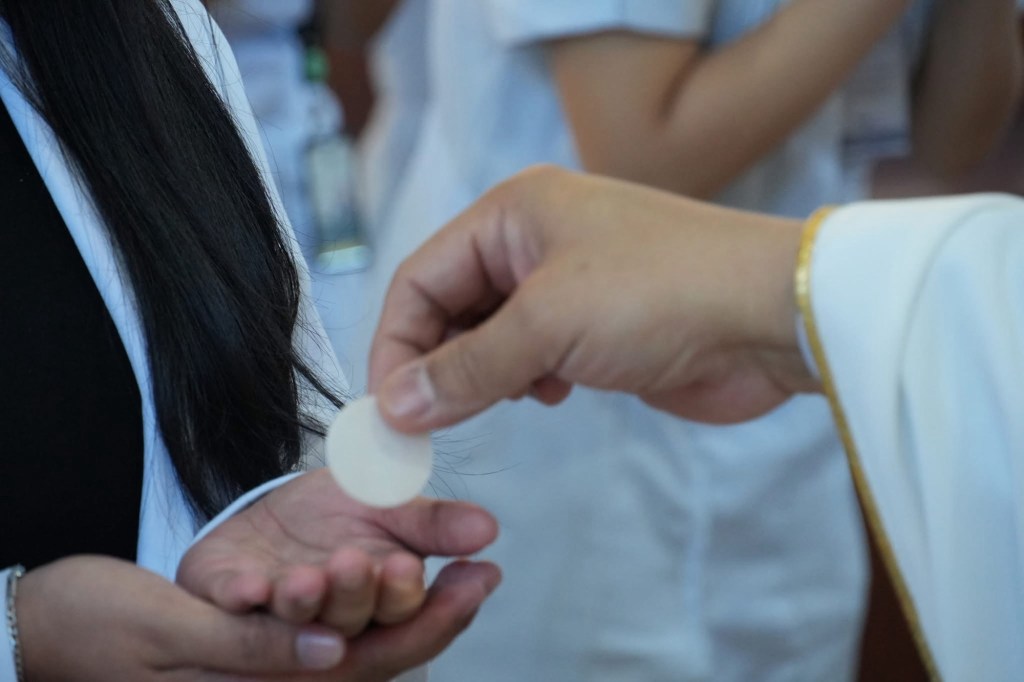
Photo from Our Lady of Fatima University website, June 2025.

Jesus continues to look up to us every time we receive him in our hands during the Holy Communion. That is why I always tell the people especially our students to be very solemn during that occasion when the Son of God most powerful, all-knowing in his simplest form and sign as a thin wafer, enters us body and blood. It is the most perfect time to pray to Jesus, to tell him everything and most of all, to listen to him because that is when he is right inside our body, when he is down inside us, we above him.

Jesus does not need our triumphs and “goodness” because they all came from him actually. What he does not have is what we have a lot- the negative things like sins, hurts and bitterness, anger and resentment festering deep inside us for a long time. Those are the thing Jesus want from us, the very things he is most “impressed” with us that we are able to live with those burdens for so long. But, he is most impressed with us in the truest sense when we are able to surrender these to him because that’s when we are blessed and filled in him.

Raising his eyes toward his disciples Jesus said: “Blessed are you who are poor, for the Kingdom of God is yours. Blessed are you who are now hungry, for you will be satisfied. Blessed are you who are now weeping, for you will laugh. Blessed are you when people hate you, and when they exclude and insult you, and denounce your name as evil on account of the Son of Man” (Luke 6:20-22).

Photo by author, Sacred Heart Novitiate, Novaliches, QC, 2023.

In this age of affluence brought about by technological advances, being poor and hungry, being maligned and weeping are things to be avoided at all costs. With people so fascinated with money and wealth, fame and power, being poor and hungry for God, weeping and being maligned for what is true and good and just are not impressive at all, even foolish.

But, look at the effect of those shameless social media posts by “nepo babies” of their crass lifestyle sustained by ill-gotten wealth at the expense of the poor – they have all been bashed relentlessly in the country leading to more evidence of corruption among government officials and law-makers while in Indonesia and Nepal, these same practices have sparked social unrest and upheavals recently!

For so long, many have wished to be rich and wealthy, to have all the money to buy good food and drinks, build mansions filled with expensive cars and adorn themselves with signature clothes and jewelries in the belief they can impress others. Maybe with their fellows with the same benighted souls but more often, they only bred jealousies and envies that led to vicious circles of corruption and crimes in the name of having more money.

In truth, no one is impressed with material things because people who feel good only with possessions are actually the most pitiable ones for they could not see their own value as a person. To be able to see one’s value as a person despite one’s sins and weaknesses is the beginning of being truly human.

Recall the Lord’s parable of the Pharisee and the publican praying at the temple: the publican who stayed at the back beating his chest so contrite for his sins went home blessed according to Jesus than the Pharisee who boasted of his own righteousness. “Magpakatotoo ka!” screamed a soda commercial not too long ago but still echoes so true these days.

Jesus is not impressed with what we have done nor achieved but with what we have become – that amid all the beatings and pains of life with all of our shortcomings and sins, we forge on with life, persevering in faith, filled with hope that Christ is our salvation. What impresses Jesus Christ most in us is what we lack because that is when he can be closest to us, one in us. See yourself the way Jesus sees you – as a person, loved and cared for. Regardless of what. Let me end this with a prayer wrapped in a song which I have always loved because it sounds like Jesus speaking to me, so impressed with me despite of everything.

From YouTube.com

People observe, Jesus notices

Lord My Chef Sunday Recipe, 31 August 2025
Twenty-Second Sunday in Ordinary Time, Cycle C
Sirach 3:17-18, 20, 28-29 ><}}}*> Hebrews 12:18-19, 22-24 ><}}}*> Luke 14:1,7-14
“Meal in the House of a Pharisee” 1886-1896 painting by James Tissot from brooklynmusueum.org.

For the next three Sundays beginning today, Luke gathered teachings of Jesus Christ all set on the dining table, a sort of some “table talks” about the great banquet in the end of time and how we could all get in to share in the eternal meal with the Father.

On a sabbath Jesus went to dine at the home of one of the leading Pharisees, and the people there were observing him carefully. He told a parable to those who had been invited, noticing how they were choosing the places of honor at the table (Luke 14:1, 7).

I love the way Luke presented this scene when he said “the people there were observing Jesus carefully” while the Lord told them a parable after “noticing how they were choosing places of honor at the table.”

How lovely! People observe, Jesus notices.

As it had happened in every instances of gatherings with Jesus, people carefully observed him, trying to find something to accuse him in of disregarding their traditions and laws like healing the sick on a sabbath day. They have “boxed” and judged Jesus as a dissident and a trouble-maker among them in his apparent disregard of laws and traditions.

Photo by author, Manila Club, BGC, June 2025.

In a funny twist, Luke tells us in this scene the immense love of Jesus then and now for everyone that despite his noticing and knowing everything in us, he neither counted those things against us nor ever judged us. How sad many of us with that habit of putting God in a box like a cop keeping tabs of our infractions when in fact God simply noticed our actions and behavior to invite us to become better without any judgment at all.

Keep in mind this scene reveals to us its context of the heavenly banquet which took place after the sabbath services at the synagogue where Jesus participated, hosted by a Pharisee, a VIP of the synagogue and of the society at that time. It was a party where every who’s who was supposed to be present, with everyone competing for the best seats closest to the host. And so, Jesus the keen observant but never judgmental used the occasion to teach us the essence of humility to make it to heaven or eternal life that is signified by a wedding banquet like that big meal he attended.

“When you are invited by someone to a wedding banquet, do not recline at table in the place of honor. A more distinguished guest than you may have been invited by him… For everyone who exalts himself will be humbled, but the one who humbles himself will be exalted” (Luke 14:8, 11)

Photo by Pixabay on Pexels.com

These past Sundays, we have seen Christ’s insistence of the Father’s desire to have everyone welcomed into heaven by giving us some instructions of what to do to gain eternal life.

This Sunday while in a big party, Jesus took the occasion to teach us the value of humility to get into heaven. From doing, Jesus now moves into being, our disposition and attitude to make it into heaven where what matters most is not where we are seated but where we stand. Recall how Jesus reminded the brothers James and John with their mother that he has nothing to do with the seating arrangements prepared by the Father in heaven after she requested her two sons to be seated beside him when he comes into his glory.

Heaven is more of where we stand with Jesus where his virtue of humility is most pronounced when he “humbled himself, becoming obedient to death, even death on a cross” (Phil.2:8). That is why St. Augustine taught that “humility is a sign of Christ”, a revelation of Jesus that allows us to recognize him our Lord and Master leading us to the Kingdom of heaven without any feelings of inferiority and despair.

On the Cross which he prefigured at his Last Supper, Jesus showed himself as the most humble of all who went to life’s lowest point of suffering and dying to meet us as he noticed everything in us to lift us up and be like him, humbly standing in our sufferings. It is on the Cross that we find humility as the basic and essential requirement to get into the heavenly banquet of the Lord.

Very often when we examine our state of humility, what comes to our mind are the many negativities we have like our sins and failures, vices and weaknesses, our being unworthy. But, that is when we bow down most to beg for Christ’s mercy like before the Holy Communion when we pray, “Lord, I am not worthy to receive you under my roof but only say the word and I shall be healed.”

That is both the humility of Jesus and of us humans so vividly expressed at the washing of the feet after the Last Supper. Normally, we look up to Jesus in heaven but at the washing of feet, like every time we receive Holy Communion, we take the higher position, looking down at him not with pride but with all humility because Jesus humbled himself first before us. Here we find humility as seeing ourselves the way Jesus sees us – weak and sinful, yet so loved and forgiven. This is what Ben Sirach taught us in the first reading: humility is the fundamental attitude of wisdom because it opens us to the splendor of God when we find our self-worth and value too!

Without humility, it is either we see only the best or the worst in us as a person, without God, without others.

This is the bigger issue with the “nepo babies” now being bashed on social media after flaunting their wealth and ostentatious lifestyles. Their posts were far from inspiring, at most are tasteless and most convulsive. All we have noticed in their posts is their pride not only in lacking humility but most precisely in not finding value in themselves. Sadly but I dare say they are the ugliest and most pitiable persons because they find value only in wealth and things, not in themselves as persons. Hence, the flaunting of their possessions that only make them so pathetic because along that came their utter disregard for others especially the poor who suffer most with their parents’ greed for money through corruption.

Humility is always uplifting in the positive sense, not looking at others as below us but to realize despite our sins and weaknesses, we are loved, we are noticed as a person so worthy, so valuable. When we are humble, then we become joyful too because we are assured of love and acceptance despite our flaws. This is the gist of the message to us this Sunday of the author of the Letter to the Hebrews: unlike the Israelites in the Old Testament who were so fearful to approach God who spoke to them with thunder and lightning, we can get close to God in Jesus who humbled himself to be one with us by dying on the Cross.

True humility keeps us rooted with our selves, with others and with God. It is this rootedness best expressed in the Sunday Eucharist that we are able to follow Jesus in his journey to Jerusalem and eventually into heaven in all eternity. Amen. Have blessed Sunday and most blessed September too!

Photo by the Marketing Office, Our Lady of Fatima University, Valenzuela City, June 2025.

Counting our blessings

Lord My Chef Daily Recipe for the Soul, 08 August 2025
Friday, Memorial of St. Dominic de Guzman, Priest
Deuteronomy 4:32-40 <*((((>< + ><))))*> Matthew 16:24-38
Photo by author, Malagos Garden Resort, Davao City, August 2018.
Thank you dear Lord,
my God for another week
of work and tasks about to close;
another "crossing"
I am to complete;
you have done so much
to me,
you have given me with so much,
and I have given back so little,
even nothing at all.
The words of Moses echo
to me personally today
as in those days when your
people were about to cross Jordan
into the Promised Land.

This is why you must now know, and fix in your heart, that the Lord is God in the heavens above and on earth below, and that there is no other (Deuteronomy 4:39).

When I look to my past
and see how I have passed
every trial and struggle,
how I have grown and matured
from the many lessons of life,
how I have felt so loved
and fulfilled deep inside,
there is only you, God
my loving Father
personally coming to me,
personally blessing me,
personally guiding me
in Jesus Christ your Son;
you don't need anything back
for yourself, Father;
you don't need anything from us
except our very self not for you
but still for our very self -
to have more of you,
to be fulfilled in you,
to be one in you
in Jesus Christ who invites
us daily to deny our self,
take up our cross,
and follow him.
Amen.
St. Dominic De Guzman,
pray for us to lead our lives
in total gratitude in God
like you.
Amen.
From catholictothemax.com.
Fr. Nicanor F. Lalog II
Our Lady of Fatima University
Valenzuela City
(lordmychef@gmail.com)

Lent is encountering Jesus

40 Shades of Lent by Fr. Nicanor F. Lalog II
Fifth Sunday in Lent, Cycle C, 06 April 2025
Isaiah 43:16-21 + Philippians 3:8-14 + John 8:1-11
Photo by author, Sacred Heart Novitiate Main Chapel, 17 March 2025.

Our gospel on this last Sunday in Lent is so similar in its beauty and simplicity -and drama – with last week’s parable of the prodigal son. In fact, some believe the style of the woman caught in adultery is very much like Luke but, let’s leave that to the experts.

On this beautiful Sunday, it is John’s turn to invite us to enter into the scene of his story set at the temple area shortly before the arrest of Jesus Christ.

Jesus went to the Mount of Olives. But early in the morning he arrived again in the temple area, and all the people started coming to him, and he sat down and taught them. Then the scribes and the Pharisees brought a woman who had been caught in adultery and made her stand in the middle (John 8:1-3).

Photo by author, Sacred Heart Novitiate, 17 March 2025.

Try entering the scene. See the woman who most likely almost naked draped only in a piece of cloth as proof of her committing adultery. The Pharisees and the scribes were ganging up on her to Jesus whom they wanted to test, “Teacher, this woman was caught in the very act of committing adultery. Now in the law, Moses commanded us to stone such women. So what do you say?”

Imagine being there, standing close to Jesus and the woman. How would you feel? Would you be able to look at the woman straight on her face? Nah… seems not good. Perhaps, glance only as you feel also her pain and shame. But, can you look straight at the angry mob? Probably for a while with much fears and trepidation along with a deep anger within you cannot express.

Most likely, it is only at Jesus you can look intently and longer because he is not looking at you. Tensions were rising and Jesus simply bent down, writing something on the ground with his finger while the Pharisees and scribes raised up their attacks against him and the lowly woman standing listlessly, so embarrassed, so ashamed. Even in tears.

Recall those moments when we too were caught in the midst of an undeniable transgression like her or, simply being a witness, someone caught in between of another person without any way out of his/her predicament. It must be so dark. So scary. And shameful.

Then, the unexpected happened: But when they continued asking him, he (Jesus) straightened up and said to them, “Let the one among you who is without sin be the first to throw a stone at her.” Again he bent down and wrote on the ground. and in response, they went away one by one, beginning with the elders. So he was left alone with the woman before him (John 8:7-9).

Photo by author, Sacred Heart Novitiate Main Chapel, 17 March 2025.

Many times, we encounter Jesus in our most vulnerable situation when we let go of our guards so to speak.

It is one of the great ironies in life: when we are most vulnerable and weakest, that is when we are also most truest to our self. And that is when we truly grow and mature in life.

That is when we feel peace and joy and freedom within when we are left alone with Jesus still looking down, writing with his finger on the ground to give us more space literally and figuratively speaking. It is not that Jesus wants to shame us or whatever but simply wants us to be true as he has always been true to us, full of love and mercy. Most of all, with all of Christ’s humility in bending, that is when we finally admit the need for a Savior, the need to be converted in him.

We encounter Jesus when we disarm ourselves of our false securities and pretenses, masks and camouflages that all cover our sins. It is when we come face-to-face with our sinful self when we eventually meet Jesus face-to-face too because that is when we surrender in silence like the woman caught in adultery and the mob to some degree because all the charges against us are true.

See also that it is only the fourth gospel that Jesus is portrayed “bending” low – first here before the woman caught committing adultery and secondly at the washing of the feet of his Apostles at their Last Supper. How lovely is that sight to behold, dear friends! Imagine God bending before us, giving us like the sinful woman and the mob that space for us to confront our true self, to realize and accept the whole realities we are all interconnected in love.

Only the woman remained – like the eleven Apostles at the Last Supper – because she was the only one willing to change, probably sorrowful and contrite for her sins. Contrary to our fears, Jesus has only love and mercy, kindness and forgiveness to anyone contrite and sorrowful of one’s sin that so unlike with the people’s wrath and anger, judgment and condemnation. St. Augustine perfectly described that moment in today’s gospel, Relicti sunt duo; misera et miserecordia (Two were left; misery and mercy).

Then Jesus straightened up and said to her, “Woman, where are they? Has no one condemned you?” She replied, “No one, sir.” Then Jesus said, “Neither do I condemn you. Go, and from now on do not sin anymore” (John 8:10-11).

Stations of the Cross, Fatima University & Medical Center, Valenzuela City, 28 March 2025.

We are now on the final Sunday of Lent. Next week will be the Palm Sunday of the Lord’s Passion that ushers in the Holy Week leading to the Sacred Triduum of Holy Thursday Evening, Good Friday and Easter Vigil and on to the Mother of all Feasts, Easter.

As we get closer to the holiest week of the year, our liturgy invites us to intensify our Lenten practices to be “conformed to Christ’s death” as St. Paul urged us in the second reading which opened with these beautiful confession:

“Brothers and sisters: I consider everything as a loss because of the supreme good of knowing Christ Jesus as my Lord. For his sake I have accepted the loss of all things and I consider them so much rubbish, that I may gain Christ” (Philippians 3:8).

The pillars of Lent – prayer, fasting and alms-giving – aim to empty us of our very selves, of our pride and sins that all prevent us from encountering Jesus Christ always coming to us full of love and mercy. On this final stretch of Lent, are we ready to let go of ourselves and to let God?

Today, Jesus assures us of his love and forgiveness for our sins. The first reading tells us of God asking us to forget the events of the past. Just come home to him. And never leave him like the woman caught committing adultery. Amen. Have blessed week ahead.

Stations of the Cross, College of Maritime Engineering, Our Lady of FatIma University, 28 March 2025.

Lent is being consistently kind

40 Shades of Lent by Fr. Nicanor F. Lalog II
Friday, First Week in Lent, 14 March 2025
Ezekiel 18:21-28 + + + Matthew 5:20-26
Photo by Pixabay on Pexels.com
God our loving Father,
as we end this first week
in Lent, teach us more on the
need to be empty of ourselves,
empty of our pride
for us to be consistent
and most especially,
kind.
We have been so filled 
with the world that our
hearts burn with anger
and hate, totally disregarding
reason and morals
with so many parents
still in grief, crying for
their children mercilessly
killed on mere suspicions
while friends and neighbors
even family are caught
in a huge web of lies
everyone believes;
worst, everyone sees
one's self being so right
while others so wrong,
even accusing you, O God,
of being "unfair" like during
the time of Ezekiel.
How sad in this age of
boundless and instant
communications,
our world had shrunk
into little worlds and galaxies
of "me and mine and I";
teach us your way of kindness
in Jesus so we may see
everyone as a "kin" -
a kindred,
a one of us
filled with goodwill
for one another;
remind us always, Jesus,
that it is not enough that
we do not just kill anyone
but most of all has goodwill
with everyone right in our hearts
as a sign of true worship
for it is only when we see
each one as a kin
that loving can begin
consistently.
Amen.
Photo by author, Northern Blossoms Farm, Atok, Benguet, 27 December 2024.

Jesus takin’ us to the street

The Lord Is My Chef Daily Recipe for the Soul by Fr. Nicanor F. Lalog II
Friday, Sixth Week in Ordinary Time, Year I, 21 February 2025
Genesis 11:1-9 <'[[[[>< + ><]]]]'> Mark 8:34-9:1
Photo by Denniz Futalan on Pexels.com
What a blessed Friday,
Lord Jesus!
You are still with us,
about to cross the week
into another new set of
seven days but,
here you are again
reminding us
of our journey
that's not to a party
and all fun
but to the Cross:

Jesus summoned the crowd with his disciples and said to them, “Whoever wishes to come after me must deny himself, take up his cross, and follow me. For whoever wishes to save his life will lose it, but whoever loses his life for my sake and that of the Gospel will save it” (Mark 8:34-35).

As I prayed on this scene,
Jesus,
I could hear both the murmuring
and deafening silence
of people in the crowd
especially when you spoke
of denying, losing one's self
and that dreaded Roman
punishment, the cross!
But, yes, Jesus,
even deep down in me,
I felt at a loss...
OK na sana Lord ang lahat,
bakit may paglimot pa ng sarili
at pagpapasan ng krus?
Forgive me,
Jesus for being so used
to your words without really
appreciating them,
masticating them enough
to extract their meaning
and timeliness;
many times,
I have that attitude of the
the Tower of Babel
when all we want is to be on top,
to be in control
that is why you confused
them with many languages at that time
because we always forget
you speak only one language
in Jesus:
the language of love
by self-giving,
by self-sacrifice,
by being one in you in
the Holy Spirit.

Take us to the streets,
Jesus, to keep your words
your language
lived and spoken
especially among
the poor
and suffering.
Amen.
Photographer: Veejay Villafranca/Bloomberg via Getty Images


Advent is unveiling of veils of death and selfishness

Lord My Chef Daily Recipe for the Soul by Fr. Nicanor F. Lalog II
Wednesday in the First Week of Advent, 04 December 2024
Isaiah 25:6-10 ><}}}}*> + ><}}}}*> + ><}}}}*> Matthew 15:29-37
Photo by author, Pulong Sampalok, DRT, Bulacan, 22 November 2024.
Praise and glory to You,
God our loving Father
for this gift of Advent Season:
thank you in bringing us
to this brand new day
of salvation, of freedom,
of new life in Jesus;
most of all,
thank you for ending death
in Christ's advent.

On this mountain he will destroy he will destroy the veil that veils all peoples, the web that is woven over all nations; he will destroy death forever. The Lord God will wipe away the tears from all faces… (Isaiah 25:7-8).

Come to us this Advent,
dear Jesus and take away
all kinds of veils of selfishness
that cover and make us
unloving,
unkind, unmerciful,
unhappy...
set us free, Jesus,
free to love and serve
especially the sick and hungry;
set us free, Jesus,
this Advent to open our hearts
to bring out those treasures
You have filled us with like
goodwill and care for others
like the disciples in today's gospel.
Amen.
Photo courtesy of Our Lady of Fatima Tribune, 27 November 2024.