The Lord Is My Chef Breakfast Recipe for the Soul by Fr. Nicanor F. Lalog II
Tuesday, Week XXII, Year I in Ordinary Time, 31 August 2021
1 Thessalonians 5:1-6, 9-11   ><)))*> ><]]]]'> ><)))*>   Luke 4:31-37
Photo by author, ruins at the ancient town of Capernaum beside a modern church, May 2017.
God our Father,
thank you for being on our side:

"For God did not
desire us for wrath, but to gain
salvation through our Lord Jesus
Christ, who died for us, so that
whether we are awake or asleep
we may live together with him.
Therefore, encourage one another
and build one another up,
as indeed you do."
(1 Thessalonians 5:9-10)
May we always seek and respond
to your call to us, O God,
in every person and in every
experience we go through daily
so that we are not caught by surprise
in your Son Jesus Christ's coming.
May we learn to understand
and appreciate the true meaning
of "authority" like that of Jesus Christ:
an authority to serve
and not of domination.
Jesus went down to Capernaum, a town of Galilee. He taught them on the sabbath, and they were astonished at his teaching because he spoke with authority. They were all amazed and said to one another, “What is there about his word? For with authority and power he commands the unclean spirits, and they come out.” And news of him spread everywhere in the surrounding region.
Luke 4:31-32, 36-37
Remind us, almighty Father,
of your gift of authority
to each one of us -
in our family,
in our community,
 and in our jobs
or profession -
so that like Jesus,
 we may use our authority
to enhance, not to diminish,
the abilities of others.
Amen.
The Lord Is My Chef Breakfast Recipe for the Soul by Fr. Nicanor F. Lalog II
Friday, Week XIX, Year I in Ordinary Time, 13 August 2021
Joshua 24:1-13   ><]]]]*> + ><]]]]'> + ><]]]]*>   Matthew 19:3-12
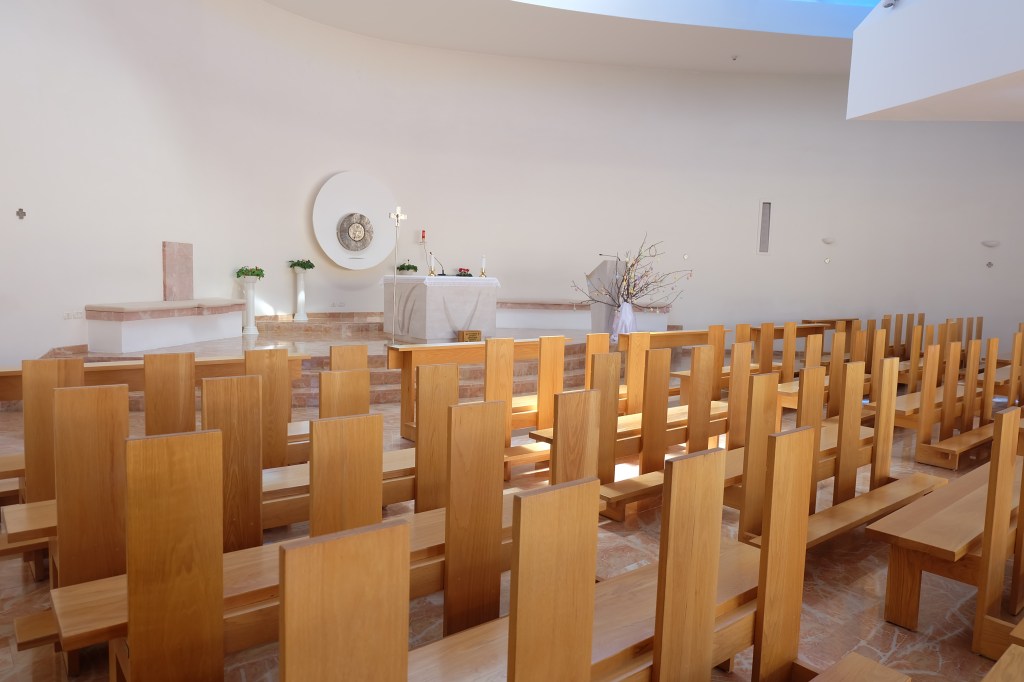
Photo by author, modern chapel at the Milk Grotto in Bethlehem, the Holy Land, 2019.
I know, dear God our Father,
you have no need of our words
nor works in exchange for your
abounding love and grace given us
in Christ Jesus; and there lies
your goodness and holiness when
all you ask of us is our fidelity
to your covenant, that we remain true
to you by dealing with love and justice
to one another which is all for our own good too.
“I gave you a land that you had not tilled and cities which you had not built, to dwell in; you have eaten of vineyards and olive groves which you did not plant.”
Joshua 24:13
You have given us everything, O God:
the earth and everything on it that we have
wasted and destroyed; worst of all, you
have given us family and friends, every person
 and people to love and cherish, respect and
be kind with but whom we have always
hurt with our words and actions when we
see only our very selves, failing to see
others as brothers and sisters in you
as Father from the the very beginning.
“Have you not read that from the beginning the Creator made them male and female, and said, For this reason a man shall leave his father and mother and be joined to his wife, and the two shall become one flesh? So they are no longer two, but one flesh. Therefore, what God has joined together, man must not separate.”
Matthew 19:4-6
Forgive us, merciful Father
for the "hardness of our hearts" (Mt.19:8),
in our building walls among us instead
of bridges to bring us close together
as your children reconciled in Jesus Christ;
help us to find the common grounds that
make us all the same, not different;
make us find and accept our vocation
in life so we may fulfill your calling
by serving you through one another
with love and respect, kindness and mercy
especially in this time of the pandemic.
Amen.
The Lord Is My Chef Breakfast Recipe for the Soul by Fr. Nicanor F. Lalog II
Wednesday, Memorial of St. Clare, Virgin, 11 August 2021
Deuteronomy 34:1-12   ><)))*> >><)))*> ><)))*>   Matthew 18:15-20
The Golden Gate bridge in San Francisco during the wildfires across California last year. Photo from MediaNews Group/The Mercury News via Getty Images; 10 September 2020.
God our loving Father,
today we pray that we become
bridges among people, bringing
them together, closing their gaps
instead of becoming a wall who
prevent unity and harmony.
As we end our readings from
the Book of Deuteronomy with
the death of Moses by recalling
his greatness in the history of Israel
and of the story of our salvation,
we remember his great role
of reconciling people with you,
O God our merciful Father;
Moses was indeed another prefiguration
of your Son Jesus Christ who came
to unite and reconcile in you mankind
separated by sin and evil.
"Amen, I say to you,
whatever you bind on earth
shall be bound in heaven,
and whatever you loose on earth
shall be loosed in heaven.  Again,
amen, I say to you, if two of you
agree on earth about anything
for which they are to pray, it shall
be granted to them by my heavenly Father."
(Matthew 18:18-19)
As we remember today
St. Clare who was a collaborator
of the great St. Francis of Assisi
and foundress of the Poor Clares,
she is most remembered too
in reconciling warring families and
kingdoms in Italy during her time;
in her life of prayer and austerity,
she had lived bridging people
with one another and with God,
exactly what we need these days
of the pandemic and social distancing.
We pray, dear God
with the intercession of St. Clare,
may we take this time of quarantine
to bridge our gaps with one another
especially with our family and friends
so that at the end of this pandemic,
we may start afresh anew
in Jesus Christ, working together
for a better world where we can live
in peace and harmony,
justice and freedom in the spirit
of humility and reconciliation.  Amen.
The Lord Is My Chef Sunday Recipe for the Soul by Fr. Nicanor F. Lalog II
Sunday XIX-B in Ordinary Time, 08 August 2021
1 Kings 19:4-8 ><]]]]'> Ephesians 4:30-5:2 ><]]]]'> John 6:41-51
Photo by Mr. Vigie Ongleo, 04 August 2021, Singapore.
Elijah went a day's journey into the desert,
until he came to a broom tree and sat
beneath it.  He prayed for death,
saying:  "This is enough, O Lord!
Take my life, for I am no better
than my fathers." (2 Kings 19:4)
Many of us can probably identify with the Prophet Elijah in the first reading today: so tired and fed up with all the sufferings and trials that seem unending with another round of lockdown due to a surge in COVID-19 infections.
“This is enough, O Lord!”
Elijah was not the only one to cry out to God in that way: there were Moses, Jeremiah, and Jonas who cried in a similar way while bent under the heavy load of responsibilities on their shoulders from God who never failed in coming to their rescue with his comforting and reassuring words of encouragement.
And this time as we have heard from the first reading, God sent Elijah with bread from heaven to sustain his 40 day journey to Mt. Horeb to escape the soldiers of Queen Jezebel out to kill him after a showdown with the priests of baal at Mount Carmel. God nourishes us not only spiritually and emotionally but also physically and materially if we know him, believe him, and love him in Jesus Christ his Son!
This is the context of the continuation of Jesus Christ’s second bread of life discourse at Capernaum, very timely in these two weeks of our fourth Enhanced Community Quarantine (ECQ) as we rely on God’s mercy and protection against COVID-19 and its new Delta variant.
Photo by Ms. Anne Ramos, March 2020.
Knowing Jesus.
When the people finally caught up with Jesus and his disciples last Sunday at Capernaum, the Lord immediately began his bread of life discourse by declaring “I am the bread of life; whoever comes to me will never hunger, and whoever believes in me will never thirst” (Jn. 6:35).
That is the first time in the fourth gospel where Jesus introduced himself with the “I AM” declaration very crucial for John in presenting him as the Christ, the Son of God. This would be followed later by similar statements when Jesus said “I am the good shepherd”, “I am the vine”, and “I am the resurrection”.
Recall how God told Moses to say to his people in Egypt that he was sent by “I am who am”; hence, when Jesus says “I AM”, it was a cue of who he is – the One who had come down from heaven!
The Jews murmured about Jesus because he said, “I am the bread that came down heaven,” and they said, “Is this not Jesus, the son of Joseph? Do we not know his father and mother? Then how can he say, ‘I have come down from heaven?'” Jesus answered and said to them, “Stop murmuring among yourselves.”
John 6:41-43
Reminiscent of the desert experience when the people murmured against God for lack of food and water, John also begins referring to the crowd as “Jews” to indicate their lack of belief in Jesus, like their forefathers who doubted God in the wilderness. Here we find something so common even to our own time of “knowing” God we so easily claim with everybody even if what we know does not square up with the reality.
Knowing is not purely cerebral. In the Jewish culture, to know is to enter into a relationship. Unlike us Filipinos who are so fond of name dropping when we usually tell everyone how we know somebody’s name and address like on Facebook – even if we are not friends or related at all!
To know anyone especially God by entering
into a relationship requires an opening of the mind.
That is why Jesus told the crowd to stop murmuring,
telling them and us today to stop limiting
ourselves to what we know who the Lord really is
because so often, we hardly know him at all!
To know anyone especially God by entering into a relationship requires an opening of one’s mind. That is why Jesus told the crowd to stop murmuring, telling them and us today to stop limiting ourselves to what we know who the Lord really is because we hardly know him at all!
We keep on receiving him in Holy Communion not as the Person but more as the Bread or Sacred Host; we go to Mass but hardly celebrate it with him; and lastly, we know Jesus more as provider and giver, rarely as companion and friend, most of all as Savior.
The Jews have refused to believe in Jesus at the very start because they have always been closed from knowing him, insisting they know better, that he is the “son of Joseph”. We have seen how last Sunday in their asking of “Rabbi, when did you get here?” in Capernaum was cloaked in suspicion at how was he able to cross the lake at night when winds were strong and waves were huge, unmindful of the signs he had shown in feeding them all at a deserted place.
Their knowing of Jesus as well as of God and the Scriptures have remained superficial, stuck in the material level manifested in their being too legalistic and ritualistic in religion without any regard for the people especially the sick and marginalized. Most of all, they did not seem to really believe in God as they saw more of themselves as God himself who knows everything!
Photo by Ms. Ria De Vera, March 2020.
Believing, loving Jesus.
All these words and actions by Jesus during his public ministry at Galilee and Jerusalem later would be used by his enemies against him, wrongly accusing him of blasphemy and disregard for the Laws or Torah. Their minds were all closed to God’s coming in Jesus or at least to his heavenly origin.
Jesus tried to clarify it with them by referring to God his Father, citing the prophet Isaiah:
“No one can come to me unless the Father who sent me draw him, and I will raise him on the last day. It is written by the prophets: They shall all be taught by God. Everyone who listen to my Father and learns from him comes to me. Amen, amen, I say to you, whoever believes has eternal life. I am the bread of life; this is the bread that comes down from heaven so that one may eat it and not die. I am the living bread that came down from heaven; whoever eats this bread will live forever; and the bread that I will give is my flesh for the life of the world.”
John 6:44-45, 47-48, 50-51
Now here we find Jesus taking off to higher level in his discourse, from knowing to believing that is perfected in loving. As we have said, knowing is relating. It is through our relationship with God that we are taught through Jesus Christ in knowing all about him. Yes, God in the Old Testament revealed himself to the Chosen People through the prophets and his Laws. But now, Jesus is telling the people that God is revealing himself through him, the Son who had come from heaven with the gift of faith.
As a gift, it is not like an ordinary present given to just one or several persons privileged to receive it like the Israelites in the Old Testament; faith as a gift from the Father is freely given to everyone for all time. Jesus is now inviting his audience in Capernaum including us today to open one’s mind, to level up in thinking and understanding because it is above the realm of material world but of spirituality that leads to relating, believing, and loving to be expressed later in the Eucharist, the sign of his self-sacrifice on the Cross.
Recall how last Sunday Jesus stressed that it is a work of God, not of men – that is faith! It is a gift from God freely given to everyone which every individual must “turn on” like a switch and make it operate. In that discourse also, Jesus added that the ultimate fulfillment of this faith in God as work of God is faith in himself, the Son sent by the Father.
In this scene alone, Jesus had mentioned the word “bread” five times, repeating it to the crowd like in a crescendo, rising from a sapiential or cerebral and material meaning into something so profound, higher level inviting us to put on our faith in him as he continues to reveal the Father’s plan for all mankind for all time leading to eternity.
And what is it that remains into eternity? LOVE!
"Love is fully sufficient to itself;
when it enters the heart,
it absorbs all other feelings.
The soul who loves,
loves and knows nothing more."
(St. Bernard of Clairvaux)
Photo from Dr. Yangas Colleges Inc., Bocaue, Bulacan in one of their community pantry called “Paraya”, May 2021.
Jesus is now hinting at his discourse the Eucharist as the meaning of the sign he did at the deserted place when he fed and satisfied the more than 5000 people from just five loaves of bread and two fish. Notice the words “eats” and “flesh” – indications of the elevation of knowing into believing, blossoming in love.
To eat his flesh is to accept Jesus, to be one in him and with him through one another. Knowing Jesus, relating with him means believing him, loving him through one another.
Faith is closely linked with love, they always go hand in hand because whoever believes truly always loves!
St. Paul sums up everything that Jesus had taught this Sunday with his call to us to “live in love, as Christ loved us and handed himself over for us as a sacrificial offering to God for a fragrant aroma” (Eph.5:1-2).
It is very difficult to dissect knowing, believing and loving, of finding the very cause of faith and love except in Jesus Christ who had come to us and continues to come in every Eucharistic celebration. There are times we can be aware of the reasons why we believe and love God and our beloved, even explain what we find so lovable in them but still difficult to locate with precision the starting point of everything. That is why at the end of this discourse two weeks from now, we find everybody leaving Jesus except the Twelve who chose to remain with him.
In this life, we may know so many things but we cannot know everything like God.
Let us stop murmuring, stop all talks and sink into silent prayer, opening our minds and our hearts to Jesus to receive him not only in words but in himself as Body and Blood in the Holy Mass so we can start loving him in one another to make life more bearable in these trying times. Amen.
Lawiswis ng Salita ni P. Nicanor F. Lalog II, Ika-29 ng Hulyo 2021
“Ang Pagbuhay kay Lazaro”, isang painting ni Duccio de Buoninsegna noong 1311. Larawan mula sa commons.wikimedia.org
Sinabi ni Marta kay Jesus,
"Panginoon, kung narito kayo
hindi sana namatay
ang aking kapatid." (Juan 11:21)
Maraming pagkakataon, Panginoon
ganyan din aming sinasabi
kapag kami ay sakbibi ng dalamhati,
tulad ni Santa Marta sa pagpanaw
ng kapatid nilang si San Lazaro:
Kung narito ka, Panginoon.....
...hindi sana nagkaroon ng pandemic,
...hindi sana kami nagipit,
...hindi sana kami nagkasakit,
...hindi sana kami nagkamali,
...hindi sana kami kinakapos,
...hindi sana kami nagugutom,
...hindi sana kami naghikahos,
...hindi sana kami nalinlang,
...hindi sana kami nasaktan,
...hindi sana kami nawalan,
...hindi sana kami nagkahiwalay,
...hindi sana kami napaalis,
...hindi sana kami natalo,
...hindi sana kami napahiya,
...hindi sana kami sumuko,
...hindi sana kami napatigil sa pag-aaral,
...hindi sana kami naulila,
...hindi sana kami naligaw,
...hindi sana kami nabigo,
...hindi sana kami nagkaganito.
Tiyak na marami pa kaming
masasambit na sana ay hindi
nangyari kung narito ka,
Panginoong Jesu-Kristo
katulad ni Santa Marta nang
pumanaw kapatid niya at
kaibigan ninyo na si San Lazaro;
ngunit hayaan din ninyo na aming
mapagtanto kalooban at layon ninyo
kaya kayo naparito upang kami
ang maging kapanatilihan mo
at sumaklolo sa mga nasa peligro.
Itulot po ninyo, Panginoon
aming tularan bunsong kapatid
nina Santa Marta at San Lazaro,
si Santa Maria ng Betanya:
manatili sa iyong paanan,
magnilay at madalisay ang buhay
sa pananalangin upang sa pagdamay
namin sa mga nahihirapan at nabibigatan
ikaw bilang Buhay at Muling Pagkabuhay
ay kanilang panaligan sa aming
pagkakapatiran at pagtutulungan
maramdaman nila, narito ka, Panginoon!
Icon ni Jesus dumalaw sa magkakapatid na San Lazaro, Santa Maria, at Santa Marta sa kanilang tahanan sa Betanya. Larawan mula sa http://www.crossroadsinitiative.com.
The Lord Is My Chef Breakfast Recipe for the Soul by Fr. Nicanor F. Lalog II
Thursday, Memorial of Sts. Martha, Mary and Lazarus, Siblings and Friends of the Lord, 29 July 2021
Exodus 40:16-21, 34-38   ><]]]]'> + ><]]]]'> + ><]]]]'>   John 11:19-27
An icon of Jesus visiting his friends, the siblings Sts. Lazarus, Mary and Martha. Photo from crossroadsinitiative.com.
What a tremendous grace from you,
dearest God our Father through
Pope Francis that we now celebrate
the Memorial not only of St. Martha
but also of her brother St. Lazarus and
sister St. Mary who were all dear friends
of Jesus Christ he frequently visited in
their home at Bethany.
Finally, a beautiful imagery not only
of friendship in the Lord but most of all,
the oft-neglected and taken for granted
relationships of brothers and sisters.
In this time of the pandemic
you know how, O dear God,
we have finally come together
as families free from all excuses
of work and studies, of being far and away;
but sadly, many have ignored and missed
the opportunities to bond together
and mend many gaps long festering
among siblings; instead of fighting and
rivalries, may brothers and sisters
in every family emulate the love and
respect among Saints Martha, Lazarus and Mary.
“The Raising of Lazarus”, 1311 painting by Duccio de Buoninsegna. Photo by commons.wikimedia.org
We pray for all siblings to gather anew
as one family in prayers before you, Lord,
like Saints Martha, Lazarus and Mary;
help them create a space for your Son
Jesus Christ who is the surest bond among us
despite our many differences; like the children of
Israel in the wilderness, may all siblings be
animated and moved by your presence, God our Father:
"Whenever the cloud rose from the dwelling,
the children of Israel would set out on their journey.
But if the cloud did not lift, they would not go forward;
only when it lifted did they go forward." (Exodus 40:36-37)
Most of all, give us the grace
to be the presence of Jesus Christ
when our siblings are sick and burdened
with all kinds of sufferings and miseries
like Martha and Mary present to each other
awaiting Christ’s coming after Lazarus had died:
Martha said to Jesus, "Lord, if you had been here,
my brother would not have died."  Jesus told her,
"I am the resurrection and the life; whoever
believes in me, even if he dies, will live,
and everyone who lives and believes in me
will never die.  Do you believe this?" (John 11:21, 25-26)
Photo by author, Mirador Jesuit Hills, Baguio City, 2018.
Yes, dearest Lord Jesus,
I believe you are the resurrection and life;
whoever believes in you not only lives
but most of all becomes your very presence
especially among those going through
various forms of darkness in this life;
give me the grace to bring your light
and your life, your joys and your hopes
to those heavily burdened
 so they may believe like St. Martha
that "if you, Lord, had been here,
my brother would have not died."
Like St. Martha, and most likely
her siblings, too, St. Lazarus
 and St. Mary who may not have
  understood fully your words and teachings,
keep me open to your coming,
to your visits, sweet Jesus;
make my heart like theirs
filled with warmth and hospitality
to let you stay and reign in me;
most of all, like the three holy siblings
let me share with others the gift of kindness,
of being a kin to everyone in you, with you.  Amen.
Sa tuwing umuulan,
unan at higaan ating tinutunguhan
lahat ang hanap ay kapahingahan
sa gitna ng panahong malamig
at kay inam ipahinga pagod na
katawan at isipan habang may
ilan sa ating ay walang masilungan
walang uuwiang kama na malamig
ni upuang mahalumigmig
habang ang iba naman
lagaslas ng ulan sa loob at
labas ng tahanan ay pareho lang
dahil sa butas butas na bubungan
barong-barong na tirahan.
Sa tuwing umuulan,
mga tiyan at sikmura
mabilis kumalam kahit
puno ng laman
kaya naman kay raming dahilan
tumungo sa kalan at magluto
ng mga pagkaing masarap
tikman tuwing umuulan
pinaiinit nanlalamig na katawan
nagigising mga kalamnan
habang mayroon namang ilan
kape lang ang nakakayanan
maibsan lang lamig at kalam
ng tiyan na walang laman.
Sa tuwing umuulan
huwag sana natin makalimutan
ang maraming walang masilungan
ni matulugan dahil kanilang mga
pinananahanan nasira o lumubog
sa baha na dala ng ulan;
Sa tuwing umuulan
huwag sana natin makalimutan
ang maraming kapatid natin
wala nang damit at gamit
wala ding pagkaing mainit
ni tubig na malinis
pagkakasakit tinitiis
inaasam pagsikat ng araw kinabukasan.
Sa tuwing umuulan
tayo ay manalangin
upang ipagpasalamat mga
biyaya at pagpapala natin
na tayo ay magkakapiling
nakakatulog ng mahimbing
nakakakain ng mga paboritong lutuin;
tangi ko lang hiling
lubusin ating pananalangin
bukod sa pagtulong at pagdamay natin
dagdagan ating pandamdam
huwag maging manhid
iwasan pagpopost ng pagkain
dahil sadyang di maganda ang dating
sa panahon at buhay
ay napakakulimlim.
The Lord Is My Chef Sunday Recipe for the Soul by Fr. Nicanor F. Lalog II
Sunday XVII-B in Ordinary Time, 25 July 2021
2 Kings 4:42-44 ><]]]]*> Ephesians 4:1-6 ><]]]]*> John 6:1-15
Photo by Mr. Raffy Tima of GMA7-News, Batanes after a storm, 2018.
Beginning today until August 22, 2021, our Sunday gospel will be from the sixth chapter of John who continues last week’s scene of the great crowd following Jesus and his disciples to a deserted place in order to rest after returning from their first mission.
We were told by Mark how Jesus was “moved with pity” upon seeing the people who were “like sheep without a shepherd” that he taught them with so many things (Mk.6:34); after teaching them, Jesus fed them – about 5000 men excluding children and women – from just five loaves of bread and two pieces of fish with a lot of leftovers gathered that filled 12 wicker baskets!
It is a very beautiful story found in all four gospel accounts but it is only in John’s gospel where we are presented with a more complete and detailed story of the event followed by Jesus Christ’s “bread of life discourse” at Capernaum. Let us focus at the conversations among Jesus, Philip, and Andrew before the miracle where they used the demonstrative pronouns “where” and “there” that indicate deeper meanings.
The Jewish feast of Passover was near. When Jesus raised his eyes and saw that a large crowd was coming to him, he said to Philip, “Where can we buy enough food for them to eat?” He said this to test him, because he himself knew what he was going to do. Philip answered him, “Two hundred days’ wages worth of food would not be enough for each of them to have a little bit.” One of his disciples, Andrew, the brother of Simon Peter, said to him, “There is a boy here who has five barley loaves and two fish; but what good are these for so many?”
John 6:4-9
Photo from iStock/Studio-Annika.
When all directions point to Jesus – but we miss!
While praying over today’s gospel, one song kept playing in my mind, the Beatles’ 1966 classic love song by Paul McCartney, Here, There and Everywhere. It is a very lovely music, so unique in many aspects that it is also McCartney’s most favorite as a member of the Fab Four.
What struck me with this Beatles hit are the demonstrative pronouns here, there and everywhere used not to point at directions but to a person, the girlfriend of McCartney at that time he so loved who would also be his Here, There and Everywhere!
To lead a better life, I need my love to be here
Here, making each day of the year
Changing my life with a wave of her hand
Nobody can deny that there's something there

There, running my hands through her hair
Both of us thinking how good it can be
Someone is speaking
But she doesn't know he's there
The same is so true with Jesus today asking Philip “Where can we buy enough food for them to eat?”
Jesus was not asking for a store in that deserted place to buy and get food for the people. John tells us that Jesus said this to test Philip because “he himself knew what he was going to do”. He wanted Philip to look deeper, to see beyond places and things even if his answer was correct, that “two hundred days’ wages worth of food would not be enough for each of them to have a little bit.”
When odds are against us, when things are beyond us and humanly impossible, where do we go to?
Of course, we go to God!
Where else do we go when we are in deep or great troubles?
We go to prayers, we go to church, we go to the prayer room or Adoration Chapel, or wherever there is peace and silence where we can be with God.
When this pandemic started, where did we go during lockdown? To God with our online Masses at home, daily praying of the Rosary with the whole family. But when the quarantines were eased, we suddenly forgot God, regarding every where as merely a place, a location.
Every where is where God is, where Jesus is!
From Facebook, May 2020.
We now come to that second demonstrative pronoun in the same scene before the miraculous feeding of five thousand said by Simon Peter’s brother Andrew who told Jesus, “There is a boy here who has five barley loaves and two fish; but what good are these for so many?”
How unfair that the boy who actually had Jesus working on his miraculous feeding of the crowd with those five barley loaves and two fish he had given was merely referred by Andrew as there or here!
See how Andrew did not bother to ask the boy’s name because during that time, any male kid had no any significance at all except by the time they reached 13 years of age for the bar mitzvah, when boys begin to read the Torah. In fact, John noted in this narrative how the children and women were not even counted to show their grave error at that time of giving importance only to men.
How sad the same thing continues to our own time when we are taken for granted as a person, reduced to mere statistics, to mere numbers, to there and here!
Despite our insistence on the use of inclusive terms for all, it seems that the more we have actually degraded the human person into objects as we personified objects. Listen to commercials and newscasts to realize what I mean: food is described as “masarap siya” while typhoon is referred to as “siya ay lalabas ng Philippine Area of Responsibility” while persons are made into objects like handsome men called “yummy” or “delicious”. No wonder, people have become like food, good only when young and fresh but when old, discarded like trash! Sometimes, people are labelled like ice cream as “flavor of the month” or “all-time favorite” when rich and famous while ordinary folks are called “dirty ice cream”.
There is always a person to be respected and recognized in every here and there!
Let us heed St. Paul in the second reading telling us “to live in a manner worthy of the call” we have received as beloved children of God “with all humility and gentleness, with patience, bearing with one another through love, striving to preserve the unity of the spirit through the bond of peace” (cf. Eph. 4:1-3).
How sad that we cannot even look at one another as a brother and a sister, even in our own family circles because we are so focused on the bread, that is, the money and wealth we could get for ourselves. And that is the great irony in this scene: the boy was willing to let go of his five loaves of bread and two pieces of fish yet Andrew did not notice at all the face, the personhood of the boy so kind to share what he had, thinking more of others than himself!
What a tragedy in our time, in our own family and circle of friends, at work and in school, even in our parish community when some people would give more value to things than persons, who would rather maintain or keep their honor and dignity at the expense of others.
Photo by Marc Angelo Nicolas Carpio, January 2020, Bagbaguin, Santa Maria, Bulacan.
When the “where” and “there” of Jesus meet on the Cross
This story of the multiplication of bread occupies an exceptional place in all four gospels. However, it was only John who added a long discourse preached by Jesus at Capernaum after this event to reveal its full meaning.
For John, the multiplication of bread is more than a miracle but a sign, a revelation of supernatural power above the ordinary pointing to Jesus as the Christ, the Son of God who is the bread from heaven who had come down to nourish us in this journey of life to eternity like during the time of Moses in the wilderness. Or like Elisha in the first reading, Jesus multiplied the loaves of bread to satisfy the hunger of not just 100 people but over 5000 with leftovers of 12 wicker baskets.
Photo by author, March 2020.
We are reminded of other instances in the Old Testament like the Jewish feast of Passover as backgrounds of this sign by Jesus in the deserted place as a prelude to the sign of the Holy Eucharist he instituted on Holy Thursday that we celebrate daily especially on Sundays as one body, one family. This in turn will reach its highest point on Good Friday as the ultimate sign Jesus Christ’s loving presence when his being the “where” and “there” of God would be revealed in the final sign of the Crucifixion that many would still miss to recognize.
That is why in the next four weeks, we shall hear John narrating to us the discourse by Jesus to explain the full meaning of this multiplication of bread in that deserted place.
When the people saw the sign he had done, they said, “This is truly the Prophet, the one who is to come into the world.” Since Jesus knew that they were going to come and carry him 0ff to make him king, he withdrew again to the mountain alone.
John 6:14-15
Let us “capture” Jesus in the Holy Communion of the Mass later when the priest holds high the Body of Christ saying, “Behold the Lamb of God, behold him who takes away the sins of the world. Blessed are those called to the supper of the Lamb.”
Here in the Mass, it is very clear this is where Jesus is, where we get the real food to eat. Tell it to everyone, point unto Jesus, there is the Lamb of God who takes away the sins of the world like John the Baptist. Most of all, it is in the the Holy Mass where Jesus is present here, there, and everywhere – in his words proclaimed, Body and Blood shared, and with everyone celebrating!
The Lord Is My Chef Breakfast Recipe for the Soul by Fr. Nicanor F. Lalog II
Wednesday, Week XVI, Year I in Ordinary Time, 21 July 2021
Exodus 16:1-5, 9-15   ><]]]]'>  +  <'[[[[><   Matthew 13:1-9
Photo by Mr. Jim Marpa, 2018.
Every day God,
we pray to you
"Our Father in heaven
hallowed be thy name...
Give us each day
our daily bread"
without realizing the daily bread
you give us that truly nourishes us:
your words of truth and of life
that became flesh in Jesus Christ.
On that day, Jesus went out of the house
and sat down by the sea.
Such large crowds gathered around him
that he got into a boat and sat down,
and the whole crowd stood along the shore.
And he spoke to them at length in parables.
(Matthew 13:1-3)
Thank you very much, dear God
for listening to our prayers,
in giving us the food we need
to nourish our bodies
and your words that sustain us
especially in these trying times.
May we hunger more
for this daily bread from heaven,
listening attentively,
fulfilling your words as you willed them so.
Then the Lord said to Moses,
"I will now rain down bread
from heaven for you.
Each day the people are to go out
and gather their daily portion;
thus will I test them,
to see whether they follow
my instructions or not."
(Exodus 16:4)
But most of all, O God
teach us to be like you: to be more
selective in our listening,
to be more circumspect with what
to hear and process wherein
we listen more on essential things
that matter most than on trivial
and mundane words that are
divisive, preventing our growth
and maturity in our relationships.
If you would listen and act
on everything we say, especially
our grumblings and complaints,
no one among us would still be alive;
but you are kind and understanding,
unlike us who listen more on petty
than essential things said by others.
May we be like the good soil
that is open to listen and nurture
words that build and give life.  Amen.
The Lord Is My Chef Breakfast Recipe for the Soul by Fr. Nicanor F. Lalog II
Tuesday, Week XVI, Year I in Ordinary Time, 20 July 2021
Exodus 14:21-15:1   ><]]]]*> + <*[[[[><   Matthew 12:46-50
Photo by author, Sacred Heart Spirituality Center, Novaliches, QC, 2016.
For the second straight day,
you have amazed me, dear loving God
and Father when your words
speak of previous topics I have prayed
and heard from you:  yesterday was about
getting lost that continued our Sunday reflection;
today is the same scene last Friday
on the memorial of Our Lady of Mount Carmel
when your Son Jesus Christ stretched his hand
to point at his disciples as his family:
And stretching out his hand
toward his disciples, he said,
"Here are my mother and brothers.
For whoever does the will of my
heavenly Father is my brother,
and sister, and mother."
(Matthew 12:49-50)
Today I wonder, if you would allow
me to be funny and a little naughty
or even dare to ask you like Abraham
before you burned Sodom and Gomorrah:
What if Moses did not obey you
and refused to stretch out his hand
over the Red Sea?
Would you still part it so the children of Israel
would be able to cross to safety?
Would you still save them, God?
Would you still part the sea
to let the people go?
Please forgive me, Lord
for my silly questions
that sincerely came to me
as I prayed over your words today,
convincing me more than ever
that even if Moses did not stretch out his hand
 over the sea, dear God,
you would have still saved them
because whether we obey you or not,
you would still love us,
reaching out to us in loving mercy,
even giving us your Son Jesus Christ.
That is your nature, O God:
you are love, you are the perfect Being
always existing, always reaching out;
despite the evil in the world
despite our choosing sin instead of you,
you continue to love us,
forgiving us,
blessing us
because you will forever be
our Father.
Take away our pride,
fill us with the humility of Christ
who stretched out his hands on the Cross
to restore our relationships
with you and one another,
forever reminding us
 we are yours,
always loved and cared for
since the beginning
for we are all interconnected
in you our God, our Creator.  Amen.














 lordmychef.com