40 Shades of Lent by Fr. Nicanor F. Lalog II
Tuesday, Fifth Week in Lent, 23 March 2021
Numbers 21:4-9  ><}}}*> + <*{{{><  John 8:21-30
Photo by author, Franciscan Monastery on Mount Nebo overlooking Israel, 2019.
It has been a year, dear God our Father, since we went into this journey into the wilderness of this COVID-19 pandemic. It has become very similar with the wandering in the desert of your chosen people during the time of Moses that like them, we have become impatient too.
But with their patience worn out by the journey, the people complained against God and Moses, “Why have you brought us up from Egypt to die in this desert, where there is no food or water? We are disgusted with this wretched food!” In punishment the Lord sent among the people seraph serpents, which bit the people so that many of them died.
Numbers 21:4-6
Of course, we know you do not punish for you are love, O God; you even took that occasion to foreshadow the dying on the cross of your Son Jesus Christ for us.
Very much like them, we have been grumbling and complaining with you, forgetting all your goodness to us while we have been remiss with our own duties and responsibilities.
How ironic that the more they spoke of the tastelessness of the food you sent from heaven called manna, the more they revealed their own tastelessness as people.
And that is what is sadly happening with us too — our tastelessness as a people: our tastelessness in choosing our leaders in government, our tastelessness in giving value to your many blessings in life like family and country, our tastelessness in tolerating corruption and all the evils in our society long before this pandemic came.
We have lost our sense of taste, Lord, like being afflicted with COVID-19 — exactly like what your Son Jesus declared to his enemies always seeking ways to entrap him.
He said to them, “You belong to what is below, I belong to what is above. You belong to this world, but I do not belong to this world. That is why I told you that you will die in your sins. For if you do not believe that I AM, you will die in your sins.”
John 8:23-24
Send us your Holy Spirit, O Lord, to enlighten our minds and our hearts, to be simple and humble like those folks in Jerusalem who came to believe in you because you spoke in such a way (Jn.8:30), unlike the learned Pharisees and scribes who, despite thei education, remained tasteless like many among us.
O dear Jesus, give us some tastes! — a taste for what is decent and good, a taste of heaven and holiness, a taste of true order and beauty found only in you. Amen.
40 Shades of Lent by Fr. Nicanor F. Lalog II
Fifth Sunday in Lent-B, 21 March 2021
Jeremiah 31:31-34  +  Hebrews 5:7-9  +  John 12:20-33
Photo by author, details of the Seventh Station of the Cross at the St. Ildephonse Parish Church in Tanay, Rizal, January 2021.
In the beautiful church of the town of Tanay in Rizal is found a most unique Seventh Station of the Cross where one of those depicted when Jesus fell for the second time is a man with dark glasses looking afar. Local residents say the man with sunglasses is Caiaphas, the chief priest during the time of Jesus who led the Sanhedrin at his trial leading to his crucifixion.
Nobody can explain exactly why the artist portrayed that man wore sunglasses that was popular among people of stature and position in the country when the carving was made in 1785. Also interesting aside from the man in shades are the soldiers with him shown with Malay features of brown color and wide eyes opened, all looking somewhere except for one looking at the Lord while clutching his garment as he fell looking heavenwards.
I remembered this piece of work of art inside the Tanay Parish Church declared by the National Museum as “National Cultural Treasure” because our gospel today speaks about a request by some pagans to see Jesus. Seeing has many meanings, always leading to believing. And sometimes, it is in believing we are able to see most of all!
Some Greeks who had come to worship at the Passover Feast came to Philip, who was from Bethsaida in Galilee, and asked him, “Sir, we would like to see Jesus.” Philip went and told Andrew; then andfrew and Philip went and told Jesus. Jesus answered them, “The hour has come for the Son of Man to be glorified. Amen, amen, I say to you, unless a grain of wheat falls to the ground and dies, it remains just a grain of wheat; but if it dies, it produces much fruit. Whoever loves his life loses it, and whoever hates his life in this world will preserve it for eternal life.”
John 12:20-25
Seeing to believe
Photo by Dr. Mylene A. Santos, MD, Infanta, Quezon 2020.
As we have been mentioning three Sundays ago, the fourth gospel uses poetic expressions and symbolisms to convey deeper truths and realities about Jesus and our very selves, our having or lacking faith in God. Like the act of seeing by those Greeks who requested Philip “to see Jesus”.
If they simply wanted to catch a glimpse of Jesus, they could have easily seen the Lord who was always at the temple area at that time. Jesus had always been available to everyone like last Sunday when Nicodemus went to see him at night.
But, John often used the verb to see in many senses that also mean to believe like in his appearance a week after Easter to his disciples along with doubting Thomas: Jesus said to him “Have you come to believe because you have seen me? Blessed are those who have not seen and have believed” (Jn.20:29).
Most mysterious for me in John’s use of the verb to see is in the call of the Lord’s first disciples led by Andrew: He said to them, “Come, and you will see.” So they went where he was staying and saw where he was staying… Andrew followed Jesus. He first found his brother Simon and told him, “We have found the Messiah” (Jn.1:39-41).
What did Andrew see that he later told his brother Simon that they have found the Messiah?
Of course, John’s most notable use of the verb to see is from that scene at the empty tomb on Easter Sunday when the perfect model of the believer is the “other disciple” whom Jesus loved “went in, and he saw and believed” (Jn.20:8).
Very clear in the mind of John that the request of those Greeks to see Jesus was one of faith, of meeting and speaking with Jesus to be enlightened more like Nicodemus last Sunday. Here we find our important role of being another Philip and Andrew, leading other people to see Jesus.
Those Greeks described as “God-fearing” were pagans attracted to the teachings of Judaism and came to Jerusalem to observe the Passover Feast. They already have faith in God that must have been awakened further when they heard the teachings of Jesus; hence, their request to see Jesus.
It happens so often that when by the grace of God people are illuminated with faith even in the most personal manner, they still need Philips and Andrews who would enable them “to see” Jesus to grow and be deepened in faith. There will always be a need for an apostle who could lead others to “see” Jesus because faith happens within a community, within the Church and through others’ mediation.
And here lies the bigger challenge for us disciples for us to make Jesus “seen” in our lives and in our community.
Jesus answered them, “The hour has come for the Son of Man to be glorified. Amen, amen, I say to you, unless a grain of wheat falls to the ground and dies, it remains just as a grain of wheat; but if it dies, it produces much fruit. Whoever loves his life loses it, and whoever hates his life in this world will preserve it for eternal life. Whoever serves me must follow me, and where I am, there also will my servant be. And when I am lifted up from the earth, I will draw everyone to myself.” He said this indicating the kind of death he would die.
John 12:23-26, 32-33
In a sudden twist, John tells us nothing if those “God-fearing” pagans saw Jesus at all because the Lord immediately went on a discourse after being told by Andrew and Philip of the request, briefly interrupted by God’s voice speaking from heaven that everybody heard in the temple area.
Speaking in the parable of the grain of wheat dying first in order to produce much fruit, Jesus tells us how we can lead others to truly see him in us and through us by having the same determination and perseverance to follow him, stay with him, and be like him by dying to ones self for others. For the grain of wheat to die and spring forth to new life, it has to be detached. And so are we.
Notice Jesus repeating that sign of his being lifted up on the cross he mentioned last Sunday to Nicodemus. John mentions it again in this part of his gospel adding an explanation at the end because for him, the Crucifixion is Christ’s greatest sign and revelation of his glory, opening a path for us back to God in his Cross, through his Cross.
In teaching us about the parable of the grain of wheat dying and linking it with his being “lifted up”, Jesus now tells us and every “God-fearing” person that we can only “see” him in the scandal of the Cross.
Did those God-fearing Greeks remained in Jerusalem and saw Jesus on the Cross?
We do not know but we are sure that anyone who requests to see Jesus always sees him if we believe first in his crucifixion which is when everyone is drawn to him as he had said. We must first believe Christ died so we may see him risen to life.
It was on Christ’s dying on the cross when God established a “new covenant” among us as prophesied by Jeremiah in our first reading today, giving us all an access to him in Jesus, through Jesus, with Jesus which we celebrate daily in the Holy Eucharist.
Photo by author, 2020.
Grappling with death to see life
We have never seen the crucifixion of Jesus except in its portrayals in the many movies we used to watch in Holy Week; but, its realities are etched and impressed in our hearts through the many trials and difficulties we have gone through in life that we believe Jesus truly died. And because of that, we have also seen him alive!
Such is the reality of seeing Jesus that every time we describe something so difficult, so trying, we equate it with death like when we say “we felt like dying” taking the exam. And the good news is when we overcome the tests that we use again the word or concept of death to describe something so good as it leads us to glory like when we say a pizza or a steak or a cake to die for.
Such is the paradox and scandal of the Cross of Jesus: we can never see him risen in glory if we avoid and refuse seeing his Passion and Death right in our own selves, in our painful experiences.
Going back to that unique Seventh Station of the Cross at the Tanay Parish Church, I realized how the unbelievers and others among us could not see Jesus as the Christ because they have refused to believe in him first especially when they are down with all kinds of problems and trials, looking somewhere else instead of seeing Jesus fallen in front of them.
Let us believe in Jesus so we may see him in this final week of Lent as we prepare for Palm Sunday next. Amen.
40 Shades of Lent by Fr. Nicanor F. Lalog II
Friday, Solemnity of St. Joseph, Spouse of the Blessed Virgin Mary
2 Samuel 7:4-5, 12-14, 16  +  Romans 4:13, 16-18, 22  +  Matthew 1:16, 18-21, 24
Photo by author of the site believed to be the workshop of St. Joseph in Nazareth, 2017.
Today’s celebration of the Solemnity of St. Joseph as most chaste spouse of the Blessed Virgin Mary is a very special one being in the “Year of Saint Joseph” that began last December 8, 2020 until December 8, 2021 in commemoration of the 150th year anniversary of Pope Pius IX’s declaration of the beloved saint as Patron of the Universal Church.
In launching this Year of Saint Jospeh last year, Pope Francis wrote in his Apostolic Letter “Patris Corde” (With a Father’s Heart) how the COVID-19 pandemic has helped us see more clearly the importance of “ordinary” people who, though far from the limelight, exercise patience and offer hope every day.
The Holy Father explained that the “ordinary” people like those who kept our lives going especially during the lockdowns resemble Saint Joseph, “the man who goes unnoticed, a daily, discreet and hidden presence,” who nonetheless played “an incomparable role in the history of salvation” (Vatican News, 12 December 2020).
I really hope you can have time to read today this very short letter by Pope Francis who is a known devotee of Saint Joseph having popularized among us during his 2015 Papal Visit the image of “Sleeping Saint Joseph”.
In Patris Corde, Pope Francis gives us some helpful points on how we can love with the heart of God our Father like Saint Joseph during this time of the COVID-19 pandemic. One of these traits the Pope invites us to imitate from Saint Joseph is his “creative courage” in loving God and loving others.
If the first stage of all interior healing is to accept our personal history and embrace even the things in life we did not choose, we must now add another important element: creative courage. This emerges especially in the way we deal with difficulties. In the face of difficulty, we can either give up and walk away, or somehow engage with it. At times, difficulties bring out resources we did not even think we had.
Pope Francis, Patris Corde #5
A creative person is always someone who is deeply in love with another person or with one’s craft, art, career or whatever passion.
The most loving person is always the most creative like Saint Joseph who sought ways expressing his love for Mary and her child by deciding to silently divorce her as the gospel tells us.
This is how the birth of Jesus Christ came about. When his mother Mary was betrothed to Jospeh, but before they lived together, she was found with child through the Holy Spirit. Joseph her husband, since he was a righteous man, yet unwilling to expose her to shame, decided to divorce her quietly.
Matthew 1:18-19
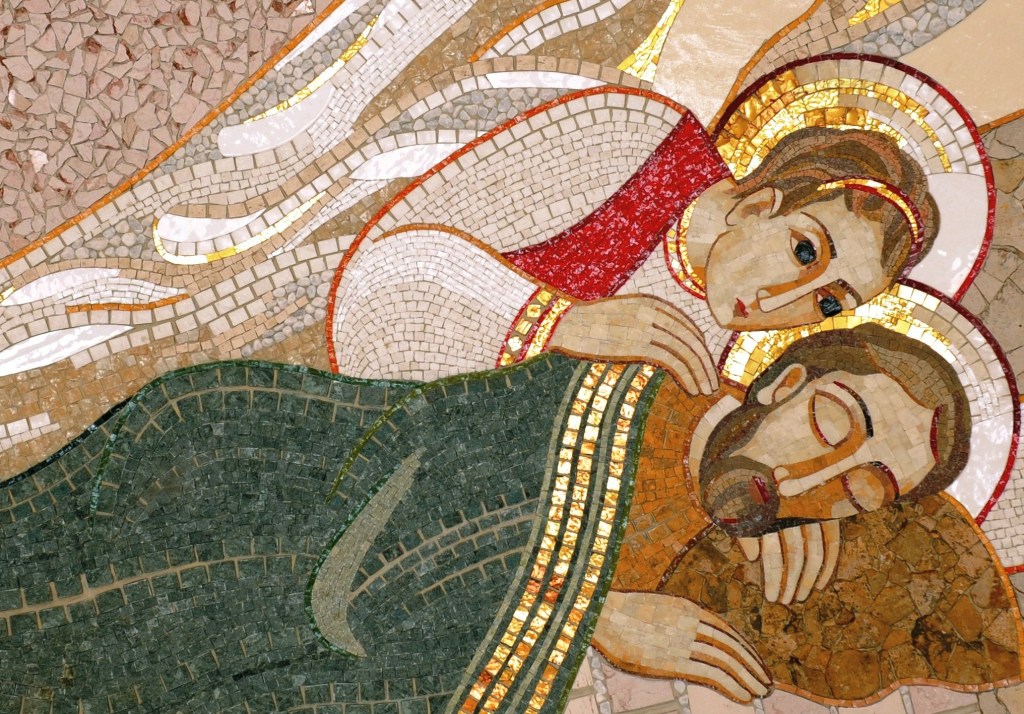
Photo by Arch. Philip Santiago of a mosaic at the San Padre Pio Shrine at Rotondo, Italy of the angel appearing to Saint Joseph in his dream.
Holiness is having creative courage like Saint Joseph.
Notice how the Pope’s description of Saint Joseph is not far from St. Matthew’s calling him a “righteous man” – a holy man – who obeys the Laws of God handed down to them by Moses, including their other traditions meant to keep them clean and pure before God.
Problem during that time is how people have lost sight of God and of others that they were so focused on the letters of the law than its spirit, becoming impersonal in the process as we have seen in instances when they would ask Jesus why he healed the sick even on sabbath day. Worst is when people brought to Jesus a woman caught committing adultery, reminding him of Moses’ instruction to stone her in public.
Such was the dilemma faced by Saint Joseph with Mary being pregnant with a child definitely not his!
In deciding to silently leave Mary, Saint Joseph expressed his righteousness or holiness wherein he showed the true interpretation of their Laws by upholding the dignity of every person, respecting life above all. Like Jesus Christ, Saint Joseph showed that real holiness is authentic love that is willing to sacrifice for the beloved by having the courage to be in pain in giving up or losing a beloved.
Here we find Saint Joseph was not only courageous in facing the painful truth about Mary having a baby not his but also very creative in the sense that because of his great love for the Blessed Virgin, he did not want her exposed to shame and public humiliation in allegedly breaking the seal of their betrothal.
Having courage is more than being able to do death-defying acts that is more on physical strength; courage is a spiritual virtue, a spiritual strength when we do extraordinary things because of higher ideals and values like the love of Jesus who offered us his life on the Cross.
Courage is from the Latin word “cor” for heart which is the seat of our being. And to have courage is to be true and loving that we have such expressions to speak from the heart, to listen to our heart, and to act from our heart when we dare to lose ourselves because of love.
Photo from Aleteia.org of “Let Mum Rest” image St. Joseph nursing the Infant Jesus while Mary sleeps, 2019.
A person who truly loves is always creative,
finding ways in expressing one's love even sometimes
it may be painful and difficult.
A “creatively courageous” person like Saint Joseph is someone so deeply in love with Mary and with God: after learning the circumstances surrounding Mary’s pregnancy, St. Matthew tells us “When Joseph awoke, he did as the angel of the Lord had commanded him and took his wife into his home” (Mt.1:24).
Saint Joseph’s love for Mary found ways to spare her all the pains and hurts that may result if found with a baby not his; but after learning the truth, the more we find him creatively courageous when he sought many ways to save Mother and Child from all harm and even death like bringing them to Egypt in the time of Herod.
See that when Saint Joseph accepted Mary, Jesus came forth to us while at the same time, when Saint Joseph accepted God through the angel as expression of his deep faith and love, he took Mary as wife.
And this is what Pope Francis further explains in Patris Corde that at the end of every account in which Saint Joseph plays a role, the Gospel tells us that he gets up and takes Jesus and Mary who are the most precious treasure of our faith.
Taking Jesus and Mary like Saint Joseph as creative courage calls us Christians to always love the Church and in loving the Church, we love the poor for whom Jesus came and Mary identified herself with in her Magnificat which she sang after accepting the Annunciation by the Angel of Christ’s birth which we celebrate next week on March 25.
In this time of the pandemic, we are called to be creatively courageous in finding Jesus among those people too familiar with us as well as with those so different from us. Don’t you find it so funny that the people we always take for granted are those either so close to us like family or completely strangers?
Being creatively courageous in this time of the pandemic means being more sensitive with others especially in our words and actions like Saint Joseph.
I was wondering during prayers why did he not ask Mary about the truth of her pregnancy so that he would have been spared with all the thinking and praying? That is when I realized the value of Saint Joseph’s silence: he did not speak at all to Mary as a sign of his love and oneness with her who must have been into some difficulties too with the situation of being the Mother of Christ. sympathy.
In his silence, Saint Joseph expressed his complete trust in Mary and in God. And in his being silent, Saint Joseph was creatively courageous expressing aloud his tenderness and care for Mary and her Child, something we need so much in this time of the pandemic.
Let us pray to Saint Joseph in this time of social distancing that like him, we may have the creative courage in touching others with the love of God, especially those who are sick and suffering, those in difficult situations, and those forgotten by their families and friends and even by the society. Have a blessed Friday, everyone!
Saint Joseph, Patron of the Universal Church, pray for us!
Photo from Vatican News, St. Joseph and the Child Jesus, 14 December 2020.
Quiet Storm by Fr. Nicanor F. Lalog II, 16 March 2021
Lately
 I have been feeling gladly
at how the Lord is blessing me abundantly
showing me daily
how life is a journey like Lent
bringing me to desert and valleys
where me and the holy
parry attacks by the wily
making me see the beauty
of colors mixed playfully
in a huge tapestry
woven in mystery.
What I like most in Lent
is its shades of violet
calling us to repent and relent
our ways of evil and sin
so we begin to see God again
in the face of every human being;
if Lent were a palette of spirituality,
imagine mixing white of the Father's purity
with Christ's love colored red so bloody
then everybody shall rejoice in ecstasy
with colors bursting in pink so rosy
as Easter promises it to be!
The Lord Is My Chef Sunday Music by Fr. Nick F. Lalog II, 07 March 2021
Photo from turbosquid.com.
The Season of Lent is like a refresh or reset button of the computer: it is a time when we “reboot” ourselves with prayers, fasting and abstinence, and alms giving to be connected anew with God and with one another. It gives us another chance to make things better in our lives marred by sins and many pains and hurts in the past.
And that is why for this Sunday we have chosen American R&B group Champaign’s 1983 single “Try Again” from their album Modern Heart. It peaked at number 23 on the Billboard Hot100 of that year.
I find the song very lenten in character. The music is sober but not bland. In fact, the cool instrumentation especially at the start kept ringing in my ears as I prayed over the readings this whole week, kind of convinced me of how truly sorry was Pauli Carman to his beloved in failing to be more loving, more intimate, and more personal to her.
I been starin’ at your photograph Wondering where you’re at today And I’ve been hanging by the telephone Hopin’ that you’d call home and stay
You told me you needed More walks, more talks More feelin’ close to me I want to be close to you
I didn’t know you needed Some roses, some romance A little candlelight and slow dance That’s not how it’s been But maybe we can try again Try, try, maybe we can try again
Sometimes in life, we take people around us for granted, we always presume everything is given, everything is well and good, that our loved ones know or assured that we love them so much. Worst is how we sometimes forget that in our love for our family and friends, we have been so focused in our other pursuits purportedly for them that in the process we actually forget them. Things can never replace persons who need to be loved and cherished.
I always tell couples that after years of living together with the coming of kids and career and problems, always remember, first there was your wife or husband for you. No matter what happens, God first called you to each other. Continue the courtship, keep surprising each other with expressions of your love for each other. Watch movies, have romantic dinners together.
The same with us priests: before all the demands of the ministry and apostolate came, there was first Jesus Christ who had come to call us, loving us that every day we have to pray, make time for him.
Try Again exactly tells us what the readings this Sunday teach us: of how we must cleanse ourselves to find our first love again, the person dearest to us. And the good news from God is that we can always try again and make up for our past sins and shortcomings to him and to one another.
Refresh, reset or reboot your self this Lent by making time for your loved ones for intimate and personal moments.
Have a blessed and refreshing week ahead!
Music video by Champaign performing Try Again. (C) 1981 Sony Music Entertainment
Quiet Storm by Fr. Nicanor F. Lalog II, 05 March 2021
*Homily as Chaplain of Our Lady of Fatima University (OLFU) and Fatima University Medical Center (FUMC) in Valenzuela.
Photo by Dr. Mylene A. Santos, MD, February 2021.
Contrary to a common belief by many, Lent is a season of joy because it is a preparation for Easter, the “mother of all feasts” in our Church. Although this season calls for intense prayers, contrition of sin, fasting and abstinence, and alms-giving, Lent does not have to be sober nor somber.
Jesus said to his disciples, “When you fast, do not look gloomy like the hypocrites. They neglect their appearance, so that they may appear to others to be fasting. But when you fast, anoint your head and wash your face…”
Matthew 6:16, 17
At the start of this season during Ash Wednesday, I have told you that life is a daily lent, a daily exodus from darkness into light, from sickness into health, from sin into grace and new life.
During Lent, we are filled with joy as we await our little Easter celebrations in life when we finish all our papers or pass our exams, or achieve whatever goals we have set even in the midst of this pandemic. Lent is a joyful season because it is a celebration of our rising to new life in Jesus Christ. It is therefore a time for us to dream again, to aspire for the best, to “Rise to the Top” as our motto says at Our Lady of Fatima University and Medical Center.
In our readings today are two great dreamers, Joseph the son of Jacob (aka, Israel) called “the Dreamer” and our Lord Jesus Christ, the one referred to as son of the vineyard owner in our gospel’s parable of the wicked tenants.
How sad that in our time of social media that have saturated us with too much showbiz and entertainment, many people no longer dream big except to be rich and famous with a lot of money and many “followers”.
Photo by Dr. Mylene A. Santos, MD, February 2021.
Importance of dreaming to become better persons
Lent invites us to dream big again, dream things that really matter in life like being good and holy, being a better person or “Improving Man as Man” minus all the arte and kikay things and porma we are so used to these days.
Yesterday I went to the mall to get my pair of glasses. I was so surprised to see great crowds seated in about six rows of chairs at the hall with a another row snaking through Watson’s while a guard directed the flow of human traffic with his megaphone. When I inquired at my optical shop about the crowd, I was shocked to learn that it was all due to a sale of cosmmetics!
I am not judging nor demeaning those people lining up for a sale of cosmetics but, should we not examine our priorities again in this time of pandemic?
When I was still assigned in our diocesan school in Malolos, I used to require my students at elementary to start dreaming what they would want to be when they grow up even while still in grade one. I tell them to start dreaming while young. No wonder there are so many young people about to enter college still not certain what course to take or even what to do with his/her life.
Do not be afraid to dream like Joseph and Jesus or Dr. Martin Luther King Jr with his famous “I have a dream” speech.
Photo by author, 2020.
Dream big, it is free! Do not be affected by those without dreams and plans in life. Watch out for them who may be even those closest to you like family and friends like the brothers of Joseph who “hated him so much that they would not even greet him” (Gen.37:4) he spoke to them of his many dreams in life.
Danger of not having a dream
People without dreams are people without vision, people who cannot see beyond the present moment and the physical realities.
Helen Keller said “The only thing worse than being blind is having sight but no vision” like the brothers of Joseph as well as the wicked tenants in the Lord’s parable who have no vision of things beyond this life. That is why they did not mind killing their own brother Joseph who was eventually sold or murdering the only son sent by the vineyard owner to collect his share of harvest.
Here lies the evil of people without dreams in life: they lack any concern at all to the value of person and of human life.
People without vision, without plans in life, without dreams have no regard at all with others. A dreamer is always one who thinks not only of the betterment of his life but also of others. Dreamers are those who perfect themselves, who seek fulfillment in life, not just material things. They think of how they can help others in need for they always seek the higher and deeper truths in life. No wonder, dreamers are also merciful as we shall see how Joseph forgave his brothers for their grave sin against him.
Recently we have started our limited face-to-face classes in our College of Medicine because we are not contented waiting for things to happen, because we dream of something better even in the midst of a pandemic. Dreamers make things happen, even against all odds like Joseph who never stopped dreaming in God after being sold to Egypt by his brothers. The Dreamer eventually became the interpreter of the dream of the Pharaoh that led Egypt to adequately prepare itself for the great famine Joseph had predicted. It led to his rise to power and fame in Egypt that later became the fulfillment of his dream as a teenager when his brothers and father came to him to apologize and buy grains.
On Sunday, our graduates are taking the Physician Licensure Exam. Let us pray for them to have the chance to fulfill their dreams of serving the people as doctors especially in this pandemic. May they all pass the medical board exam with flying colors.
It is not enough that we dream big for ourselves but we also share in others’ dreams because ultimately in the end, all our dreams lead us to God our fulfillment in life. Amen.
Lawiswis ng Salita ni P. Nicanor F. Lalog II, Ika-01 ng Marso, 2021
Larawan kuha ni P. Gerry Pascual sa Switzerland, Agosto 2019.
Noong mga araw na iyon,
umakyat si Jesus sa isang mataas na bundok.
Wala siyang isinama kundi
sina Pedro, Santiago at Juan.
Samantalang sila'y naroon,
nakita nilang nagbagong-anyo si Jesus,
nagningning ang kanyang kasuutan
na naging puting-puti, anupa't
walang sinumang makapagpapaputi
nang gayon (Marcos 9:2-3).
Kay sarap pagnilayan mga paglalarawan
 ating buhay katulad ng kabundukan
dapat akyatin upang marating
rurok ng tagumpay na ating mithiin;
gayun din naman sa ganitong paglalarawan
ating matatanawan ating napagnilayan
paulit-ulit na Kuwaresma yaring ating buhay:
mula sa ilang, mataas na bundok pinuntahan
 kasama tatlong alagad upang masaksihan
pagbabagong-anyo ng Panginoong Jesu-Kristo
paalala na Siya ay kasama at kaisa natin
umaahon upang matunton kabanalang nilalayon.
Alisin at iwanan mga dala-dalahang
sagabal katulad ng mga kasamaan at kasalanan
bunsod ng paghahangad sa mga walang kabuluhan
o kinalaman sa ating kaligtasan gaya ng
kayamanan, kapangyarihan at kapalaluan;
madalas pananamapalataya natin ay sinusubukan
tila ang Diyos mga pangako Niya ay nakakalimutan
basta makinig lamang at Siya ay sundan
asahan gagawa Siya ng paraan at daan
lalo kung tayo ay laang isuko ating pinanghahawakan
upang Kanyang mapalitan
ng higit na mas mainam.
Madalas sa itaas ng kabundukan
hindi kaagad nababanaagan tinutunguhan
ngunit nararamdaman
pagbabago sa pangangatawan
maging sa kalooban;
higit sa magagandang tanawin
pagkaunawa at pananaw kapansin-pansin
lumalawak at nagiging malinaw ang lahat
kapag nataas antas ng ating karanasan
kaya mula sa itaas ng kabundukan
ibaba sa pangkaraniwang pamumuhay at pag-iral
natalos nating karunungan sa Krus ni Hesus!
Habang bumababa sila sa bundok
mahigpit itinagubilin sa kanila ni Jesus:
"Huwag ninyong sasabihin kaninuman
ang inyong nakita hangga't hindi
muling nabubuhay ang Anak ng Tao."
Sinunod nila ang tagubiling ito,
ngunit sila-sila'y nagtanungan
kung ano ang kahulugan
ng sinabi niyang muling pagkabuhay
(Marcos 9:9-10).
Lawiswis ng Salita ni P. Nicanor F. Lalog II, Ika-23 ng Pebrero 2021
Larawan kuha ng may-akda sa Lungsod ng Jericho, Mayo 2019.
"Noong panahong iyon,
si Hesus ay agad pinapunta
ng Espiritu sa ilang.
Nanatili siya roon ng apatnapung araw,
tinutukso ni Satanas.
Maiilap na hayop ang naroon
nguni't si Hesus ay pinaglingkuran
ng mga anghel" (Marcos 1:12-13).
Kay sarap namnamin tagpong ito
ng panunukso ng diyablo kay Kristo
dahil ganito rin ang buhay natin:
isang paulit-ulit na Kuwaresma
doon sa ilang ng kaguluhan at kasamaan
 sakit at mga pagsubok
sabay-sabay dumarating
kung kailan tayo nagpapakabuti
hindi lmang demonyo umaaligid
pati maiilap na hayop nagbabadya ng panganib
kaya mga problema hindi maubos
ni matapos, wala nang ibang ibig
kungdi makahulagpos
sa maraming tanikala at lubid
sa atin ay gumagapos.
Ngunit kung ating matatalos
pinagdaanan ni Hesus ating Manunubos
doon sa ilang Kanya nang tinapos
kapangyarihan ni Satanas
nang ituro Niya sa atin landas
 ng katatagan nang tayo mismo
ay Kanyang sinamahan sa ilang,
 pinaglingkuran ng mga anghel
upang mapagtagumpayanan
 kasalanan at kasamaan;
ating pagmasdan at pagnilayan
kapag tayo nasa kahirapan at kagipitan
maging kadiliman sa buhay,
saka dumarating si Hesus
hatid mabuting balita ng kaligtasan.
Hindi inalis ng Diyos
 ilang sa ating buhay
bagkus tayo ay kanyang sinamahan
sa paglalakbay, ibinigay kanyang Anak
upang sa atin umagapay, gumabay
pabalik sa kanyang tahanan
at kaharian sa langit
na dito pa man sa lupa
 ay atin nang matitikman, masusulyapan
sa Kuwaresma na ating pinaghahandaan
Pasko ng Pagkabuhay
na ating hinihintay
upang magbigay saysay at kulay
sa nananamlay nating buhay
kaya kay Hesus ating ialay!
Pagkatapos dakpin si Juan,
si Hesus ay nagtungo sa Galilea
at ipinangaral ang Mabuting Balita:
"Dumating na ang takdang panahon,
at malapit na ang paghahari ng Diyos!
Pagsisihan ninyo at talikdan
ang inyong mga kasalanan
at maniwala kayo sa Mabuting Balitang ito" (Marcos 1:14-15).
40 Shades of Lent by Fr. Nicanor F. Lalog II
Ash Wednesday, 17 February 2021
Joel 2:12-18   >><)))*>  2Corinthians 5:20-6:2  >><)))*>  Matthew 6:1-6, 16-18
Photo by author, chapel at Franciscan Monastery at Mt. Nebo in Jordan overlooking the Promised Land or Holy Land, May 2019.
Today we begin our annual Lenten pilgrimage with Ash Wednesday in the very different situation and conditions of the COVID-19 pandemic now in its first full year. Although this may be the most unusual, both unreal and surreal Lent since the end of Second World War, this could also be our most real Lent so far.
Being real means getting into the very core of our very selves, focusing on the more essential that are invisible to the eyes. Since the popularity of social media and smart phones, life has become more of a big show than of living that we care more of lifestyles than life itself.
All three readings today invite us to get real, to confront our true selves, stop all pretensions by letting go of our many excuses and alibis. No more ifs and buts. Just our bare selves before God for tomorrow or later may be too late. St. Paul’s words perfectly express the challenge and beauty of Lent 2021:
Brothers and sisters: We are ambassadors for Christ, as if God were appealing through us. We implore you on behalf of Christ, be reconciled to God. Behold, now is a very acceptable time; behold, now is the day of salvation.
2 Corinthians 5:20, 6:2
Lent is a journey into inner self
to reach out to God through others.
The forty days of Lent are a journey characterized by three important acts so central not only to Christianity but also to the other two great faiths of the world, Judaism and Islam. These are fasting, prayer and alms giving. Through these acts, we journey back into our very selves in order to reach out to God through others.
And we start by cleansing our very selves through the putting of dry ashes on the crown of our head instead of the more usual imposition on forehead to prevent the spread of COVID-19.
The use of ashes as an outward sign of our inner cleansing beautifully tells us of its being natural cleansing agents long before the invention of chemical solutions. As such, being closest to earth, ashes remind us so well of our mortality, “for dust thou art and unto dust shall you return”!
However, though we are all marked for death as the ashes signify, they are blessed at the start of today’s Mass to remind us too that we die in Jesus Christ because ultimately, we return to God who is our true origin and end.
Hence, the need to cleanse our very selves by emptying ourselves of all the dirt and filth of sin inside that have marred our image and likeness in God. More than the outward appearance of putting ashes on our heads to signify cleansing is its internal significance of cleansing within by self- emptying through fasting.
In fasting, we cleanse our inner selves by denying ourselves not only of food but also of the usual things that fill us especially in this age of affluence and consumerism. Not only of material things but anything that make us forget God and others, that make us forget that we are mere mortals, weak and imperfect.
By fasting, we empty ourselves of our pride to be filled with Christ’s humility, justice, and love so we realize the world does not revolve around us. That we do not need so many “likes” and “followers” like in social media that inflate our ego but still leave us empty and lost.
And now is the perfect time, as St. Paul reminds us.
When we look back in this past year, so many of our relatives and friends have died, some alone, due to COVID-19 and other illnesses. The pandemic had grimly reminded us of life’s fragility and the need to be more loving always because we’ll never know if we can still be with everyone.
Fasting reminds us who and what are most essential in this life like God, life, and loved ones. Not likes or followers, luxuries, money, fame, or food.
In Tagalog, the word for meat is “laman”; to fast and go without meat literally means “walang laman” which also means “empty”!
When we fast and become empty, then we create space for God and for others.
That is why it is easier to pray and be one with God in meditation and contemplation when our stomach and senses are empty because we become more sensitive to his presence in Jesus. Silence in itself is a kind of fasting, the very key to any form of prayer.
Who needs to look gloomy when fasting when we are filled with the most wonderful and essential in this life who is God as Jesus tells us in the gospel, “When you fast, do not look gloomy like the hypocrites” (Mt.6:16).
In the same manner, whatever we save in our fasting, whatever we deny ourselves, we give and share with others in alms giving. Try opening your Facebook. What fills up your page? Your selfies? Your me-time? Your work and errands? Whatever fills your FB page, most often it always gratifies you for better and for worse. And yes, of course, they all indicate how glamorous and fabulous is your life.
This Lent 2021, so many people have lost their jobs. So many are struggling to make ends meet. Others’ sufferings have become more unbearable not only with financial difficulties but simply due to difficult conditions traveling to undergo chemotherapy or dialysis.
Life has been so unreal, even surreal for all of us since last year. And God is the one most sad of all in what we have been going through in this pandemic. But he cannot do anything for us because we still rely so much with our very selves, with our science and technology that all feed on to our pride and selfishness. Every day we hear of news of all kinds of abuses and lack of kindness going on, even among states and governments in the allocation of vaccines.
The pandemic is not purely medical and biological in nature but something spiritual.
Now, more than ever, is the Prophet Joel’s call more true:
Even now, says the Lord, return to me with your whole heart, with fasting, and weeping, and mourning. Rend your hearts, not your garments, and return to the Lord, your God. For gracious and merciful is he, slow to anger, rich in kindness, and relenting in punishment.
Joel 2:12-13
If there is anyone who wishes this pandemic to end so we can see and be near with each other without any fear of getting sick, of dying, that must be God. Like St. Paul, let us implore everyone to be reconciled with God right in our hearts by taking our fasting, praying, and alms giving seriously. Amen.
Lawiswis ng Salita ni P. Nicanor F. Lalog II, Ika-10 ng Pebrero 2021
Larawan kuha ng may akda, Ikapitong Istasyon ng Krus sa Parokya ni San Ildefonso sa Tanay, Rizal.
Doon sa magandang simbahang
aming pinuntahan kamakailan
matatagpuan din kakaibang larawan
ng ikalawang pagkadapa ni Jesus
habang ang Kanyang krus ay pasan;
isa sa mga taga-usig Niya
hindi kita mga mata dahil
suot niya may kulay na antipara
kagaya ng maraming nabubulagan
at hindi makita katotohanan
nasisilaw sa kapangyarihan
ngunit kaliwanagan ayaw masilayan.
Palagi namang kulang at kapos
ating kaisipan at karunungan
kahit anong ingat at siyasat
hindi sasapat;
Diyos lamang ang ganap
na Siyang nakasisipat
ng mga magaganap
na ni wala sa ating mga hinagap
kaya naman madalas mas mainam pa
na ating matanggap kahit mabigat
kakulangan maging kahangalan
ng mga nanunungkulan.
Madalas aking napag-iisipan
sa dami ng mga kamalian
kagagawan ko o ng iba pa man
kailanma'y hindi naman ako pinabayaan
ng Panginoong Maykapal;
sinasamahan maging sa pagpapasan
ng mga pinagdurusahang bunga
ng mga kasalanan at kamalian
hanggang sa maliwanagan
lahat ay malampasan
at muling makabangon
sa Kanyang kabutihan at kaganapan.
Ito ang ating panaligang
katotohanan sa ating buhay:
lahat ay nagkakamali
maging mga pari
ngunit si Jesus kailanma'y
hindi nagkamali
sa atin ng Kanyang pagpili
kaya tayo ay manatili
 huwag managhili
patunayan nating hindi Siya nagkakamali
 magsumakit sa Kanya mapalapit
hanggang ang langit ay masapit!
Mayroong mga nagsasabi
ito raw lalaking nakasalaming may kulay
ay si Caiaphas na punong pari
na siyang humatol laban kay Jesus
nang Siya ay litisin ng Sanhedrin
nang dakpin noong gabi sa hardin
habang nananalangin;
kay gandang pagnilayan
ngayong aming lipatan ng kaparian
paalala sa amin ng yaring larawan
alisin na at hubarin salamin na madilim
upang makita si Jesus nakadapa sa tabi.
Detalye ng larawan sa itaas ng Ikapitong Istasyong ng Krus sa Simbahan ng Tanay na inukit noon pang 1785.













 lordmychef.com