Quiet Storm by Fr. Nicanor F. Lalog II, 21 August 2024
Photos and poem, annual clergy retreat, 19-23 August 2024
St. Scholastica Spiritual Center in Tagaytay City
Vacare Deo:
A vacation with God
a most awaited Sabbath
when He is truly Lord and God,
and we are His children;
He the Creator,
we His creature
so beloved
coming home to Him,
back in Paradise.
Vacare Deo:
A vacation with God
to be with Him,
to experience Him,
to find and listen to Him,
not that He is lost
 but because
we have drifted
and turned away
 from Him.
Thank you for finding me,
O God,
in making me stop
 to find myself anew
to enjoy this beautiful journey
with your gift of company;
breathe in me your Holy Spirit
to fill and animate me
with love and passion
in finding and following
Jesus Christ in everything
especially within!
Quiet Storm by Fr. Nicanor F. Lalog II, 19 August 2024
“Christ and Rich Young Ruler” by Heinrich Hofmann from en.wikipedia.org.
The volcanic smog from Taal that has shrouded the south since early Monday morning inspired me tonight to share with you this short reflection from the gospel:
Jesus said to him,”If you wish to be perfect, go, sell what you have and give to the poor, and you will have treasure in heaven. Then come, follow me.” When the young man heard this statement, he went away sad, for he had many possessions (Matthew 19:21-22).
I have been trying to imagine not only the sad face of the young man but most of all, the sadness of Jesus. Most often, the first image of a sad Jesus who comes to our mind is when he was in His Passion and Crucifixion.
That’s understandable.
Try imagining, reflecting Jesus sad when we are sad like at the death of His friend Lazarus. The beloved disciple tells us in his gospel account that upon seeing the sisters Mary and Marta, Jesus became more sad not only with the death of a good friend.
If there is one thing we can always be sure of, Jesus shares our feelings too! When we are sad, Jesus must be most sad too. And how unfair when we fail to see the sadness too of Jesus as if we suffer or grieve alone. Perhaps, it is a part of our pa-victim syndrome, of us being on the distaff side always of the story. Let us not forget Jesus because failing to experience and realize the sadness of Christ means we are still filled with pride, so self-centered and most likely, after overcoming our sadness, we would still keep our “possessions”. What a tragedy that has become a vicious circle with us priests.
Photo by author, Chapel of the Angel of Peace, 25 June 2024.
When is Jesus sad?
As we begin our retreat tonight here in Tagaytay, I feel Jesus saddest when we His priests are sad in celebrating the Mass and other sacraments, in doing our ministry. Jesus cries so hard in shame when we priests are not only sad but also angry, even insolently ministering to the people especially when they are poor.
How easy it is for us priests to readily identify with the young man being sad even with our admission or confession of having many possessions. That’s very easy, like saying sorry from the nose. But, are we ready to let go of our attachments so we become joyful in Christ again as seen in the way we celebrate especially the Mass?
When we priests are sad in our ministry, people are more sad that makes Jesus most sad of all! In the first place, no one – nobody – among the people must be saddened by priests or by the Church as an institution. Priesthood is the joy of Jesus Christ!
It is a grave contradiction that we ever be that rich young man in the gospel portrayed as sad due to many possessions. Its deepest pain and cut is found in the very reason of this sadness: Jesus is most sad when we priests are sad because He knows very well we are no longer His.
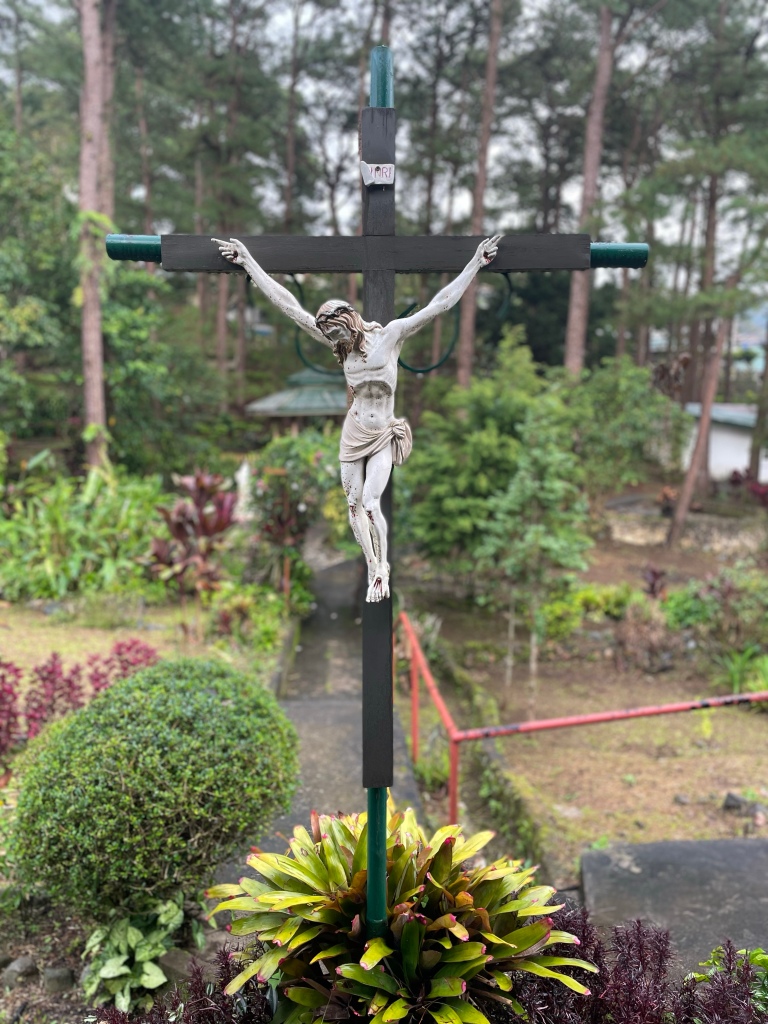
Photo by author, St. Scholastica Spiritual Center, Baguio City, August 2023.
This kind of sadness which is so negative (because we can be sad too like everyone) starts subtly when we priests are inconvenienced, when we have to sacrifice and suffer, forgetting that it is the life we have freely embraced in the first place. Some priests presumed we can suspend for a while our commitments and vows, and simply be human, whatever that means. So, they stop praying, stop sacrificing, stop living out the vows of poverty, obedience and celibacy.
As priests sink deeper into sadness, they find themselves already trapped in a festering evil and sin, becoming angry and lazy, making so many alibis and excuses from celebrating the Mass especially funerals for poor parishioners.
When there is the confluence of sloth and anger, then it becomes a point of no return because sadness detaches us priests from Jesus and His people. That is the saddest part of this sadness, of priests living in their make-believe world of vanities and all kinds of possessions. Worst part of this is how the sad priests are totally oblivious to the fact they have infected with their sadness the people they were sent to help liberated from burdens and miseries. That is when people come to the Mass and sacraments because they just have to fulfill an obligation to God that is most sad because God sent priests to bring joy, not sadness.
If a priest is making you sad, pray hard for that priest. You are not alone. Priests are sad when their brother-priests are sad in the ministry too.
But, Jesus is most sad when His priest is sad. Pray hard for His priests especially those who seem to enjoy and laugh with the “good life” but sadly empty inside. A priest is supposed to be a leaven to the people, someone who would help others to rise and grow. And glow in Jesus. Let us pray:
Lord Jesus Christ,
our Eternal Priest,
sorry for making you sad;
most of all,
for being sad because
of my many possessions;
help me find my way back
to you to be filled anew with
your joy.
Amen.
The Lord Is My Chef Sunday Recipe for the Soul by Fr. Nicanor F. Lalog II
Twentieth Sunday in Ordinary Time, Cycle B, 18 August 2024
Proverbs 9:1-6 ><}}}}*> Ephesians 5:15-20 ><}}}}*> John 6:51-58
Photo by author, James Alberione Center, QC, 15 August 2024.
It is our fourth consecutive Sunday listening to the sixth chapter of John’s gospel that opened with the miraculous feeding by Jesus of more than five thousand people in a deserted place; Jesus fled from there, went back in Capernaum where people caught with Him and disciples as He began three Sundays ago His “Bread of Life” discourse now getting deeper while the drama among the crowd is heating up.
From murmuring last Sunday about Jesus who said “I am the bread that came down from heaven” (Jn.6:41), the people today quarreled among themselves after Jesus said “I am the living bread that came down from heaven; whoever eats this bread will live forever; and the bread that I will give is my flesh for the life of the world” (Jn. 6:51).
Photo by author, James Alberione Center, QC, 15 August 2024.
Notice the beautiful contrast of reactions by people to Jesus: from murmuring last Sunday, they sank deep into quarreling while Jesus leveled up to “the living bread from heaven” from merely “the bread from heaven” last week. For us to live well, we have to eat well by having Jesus Himself as our food and drink.
The Jews quarreled among themselves, saying, “How can this man give us his flesh to eat?” Jesus said to them, “Amen, amen, I say to you, unless you eat the flesh of the Son of Man and drink his blood, you do not have life within you. Whoever eats my flesh and drinks my blood has eternal life, and I will raise him on the last day. For my flesh is true food, and my blood is true drink. Whoever eats my flesh and drinks my blood remains in me and I in him. Just as the living Father sent me and I have life because of the Father, so also the one who feeds on me will have life because of me” (John 6:52-57).
Photo by Ms. Ria De Vera in Banff, Alberta, Canada, 07 August 2024.
Eating is the most common human activity anywhere, any time. Human life basically revolves around eating as we have seen since time immemorial how we have progressed following our search for food. We work to feed ourselves and loved ones. Without food, we die. Food is so essential that there is always food to share in our gatherings.
That is why Jesus chose the bread and wine as the signs of His living presence among us in the Holy Eucharist He established during the Last Supper on Holy Thursday. In the Eucharist, Jesus elevated the most ordinary human activity of eating as most sublime and Divine. In the Holy Mass, we share in Christ’s Body and Blood so we too may share our very selves with one another.
When Jesus said in Capernaum that the bread He is giving is His own flesh with His blood as drink, He was already preparing the people for the Eucharist while at the same time teaching them that eating is not everything. We have to eat well to live well. When tempted by the devil in the wilderness, Jesus right away taught us to remember that man does not live by bread alone but with every word from God. At the start of this discourse last August 04, Jesus challenged the people, “Do not work for the food that perishes but for the food that endures for eternal life, which the Son of Man will give you” (Jn.6:27).
Photo by Ms. Ria De Vera in Banff, Alberta, Canada, 07 August 2024.
Many times, we get so used in our many activities that unconsciously, we miss life itself as we punish ourselves with exhaustion and sickness as well as emptiness.
Food is not just something that fills our stomach but must also lead into our heart and soul. Observe any cuisine and you get a taste of the culture and people it represents, even with strong hints of its geographical origin. In the first reading we find how the Book of Proverbs personified Wisdom as God to remind us that though He is transcendent and so above us, God is easily accessed even in the most ordinary instances like eating.
Wisdom has built her house, she has set up her seven columns; she has dressed her meat, mixed her wine, yes, she has spread her table. She has sent out her maidens; she calls from the heights out over the city: “Let whoever is simple turn in here; to him who lacks understanding, I say, Come, eat of my food, drink of the wine I have mixed! Forsake foolishness that you may live; advance in the way of understanding” (Proverbs 9:1-6).
How lovely is that part of God calling us to come like Jesus in the gospel when He said “come to me all who are burdened” or when He ordered to “let the children come to me”. Is it not the same thing we say when we are about to eat, to come and get it?
Sadly these days, we seem to have retrogressed in our manner of eating. Social media rightly labeled it as “food porn” when we are flooded with everything about food and drinks minus its deeper meanings. Food is sadly seen in its material aspect that eating is more on filling the stomach, forgetting the soul because we have totally forgotten God and the people around us. No wonder that despite the growing food production and plethora of food we have these days, many still starve while the rest of us remain lost in life, more sick.
Photo by Ms. Ria De Vera in Banff, Alberta, Canada, 07 August 2024.
See, my dear friends, the great coincidence on the very Sunday Jesus began his bread of life discourse, it was also the opening of the Paris Olympics with a mockery of the Last Supper that led us into a kind of “quarrel” as organizers and their supporters insisted it wasn’t the Last Supper at all despite the clear indications and proofs.
“How can this man give us his flesh to eat?” Suddenly, we heard anew that same question by the people in Capernaum to Jesus reechoed in the Olympics at the capital city of the Church’s so-called “eldest daughter”, France. Of course, we know this bread of life discourse by Jesus refers to the Holy Eucharist and surely, the many defenders of the Paris Olympics are aware for many of them are Catholics. But, Jesus must have willed this gospel be proclaimed at this time coinciding with the Olympics for us to evaluate anew our faith in Him because at the very core of this bread of life discourse is the mystery of faith.
“How can this man give us his flesh to eat?” In the gospel of Luke, we find a similar question by Mary at the Annunciation that is filled with faith, “How can this be?” (Lk.1:34); but today, like in Capernaum as exemplified by the Paris Olympics, that question is a renewed refusal to believe in the words of Jesus Christ. Worst of all as we noted earlier in our perceptions of food and eating these days, that question shows modern man’s insistence on everything material, totally disregarding our spiritual nature.
Photo by Ms. Ria De Vera in Banff, Alberta, Canada, 07 August 2024.
Like in Capernaum, many people today who refuse to believe Christ’s words resort to malicious and insidious arguments that it becomes useless to really converse with them as they would rather insist on their grossly material understanding and perception of life these days. Many prefer to quarrel these days than accept life’s many mysteries not merely seen nor tasted by the senses but experienced and realized through faith in God.
Life for them has become merely material which in Greek is bios as in biology. There is another Greek word for life which is zoe that refers to the eternal, divine life of God that Jesus repeatedly used in our gospel today.
Like last Sunday, Jesus did not engage Himself into debating with the crowd in Capernaum by simply repeating the words living and life to emphasize the total acceptance of Him – Body and Blood – in faith: “I am the living bread… my flesh for the life of the world. Just as the living Father sent me and I have life because of the Father, so also the one who feeds on me will have life because of me.” These are the very same words too, life and living that Jesus would mention before His Passion and Death as well as after His Resurrection because eating His flesh and drinking His blood is to share in His life that is also the fullness of life. It is only in Christ Jesus can we find fulfillment in life. Let us pray:
Lord Jesus Christ,
help me watch carefully
how I live, not as a fool
but as wise as St. Paul taught
us today in his letter to the Ephesians;
let us not be intoxicated
with life's pleasures and worldly pursuits
but let us be filled with the Holy Spirit.
Amen.
The Lord Is My Chef Daily Recipe for the Soul by Fr. Nicanor F. Lalog II
Friday, Memorial of San Roque (St. Rock/Roche), Healer, 16 August 2024
Ezekiel 16:1-15, 60, 63     <*((((><  +  ><))))*>     Matthew 19:3-12
Photo by author, 15 August 2024.
God our loving Father,
thank you for the gift of personhood,
for your gift of personal relationship
with each one of us;
your servant St. John Paul II
defined a person as a
"full, conscious, relating being."
Very true but sadly,
we never recognize your gift
of personhood,
of our being a person
and its fruit of relationships;
instead of looking into the
heart and soul of every one of us,
we prefer to see each one
in the mind, in the letter,
in the technical than personal:
Some Pharisees approached Jesus, and tested him, saying, “Is it lawful for a man to divorce his wife for any cause whatever?” (Matthew 19:3)
Soften our hearts, Jesus;
take away our stony hearts
and give us natural hearts
that beats with firm faith,
fervent hope in You,
and unceasing charity for everyone.

Forgive us for being so captivated
by our own beauty and prowess,
remove our confusion
and let us be silenced for shame
(Ezekiel 16:15, 63)
to remember your covenant
by appreciating and being open
to your gift of person and relationships
by striving to keep this alive
despite our many flaws and sins.
Amen.
St. Rock,
pray for us so infected
by another kind of pestilence
of pandemic proportion when
we see persons as objects
and make objects like persons.
Amen.
The Lord Is My Chef Daily Recipe for the Soul by Fr. Nicanor F. Lalog II
Thursday, Solemnity of the Assumption of the Blessed Virgin Mary, 15 August 2024
Revelation 11:19;12:1-6, 10 ><}}}}*> 1 Corinthians 15:20-27 ><}}}}*> Luke 1:39-56
Photo from shutterstock.com
Glory and praise,
God Almighty Father
in sending us Jesus our Savior
who gave us His Mother
the Blessed Virgin Mary,
the very first fruit as St. Paul said
of Christ's wondrous work
of salvation due her oneness in Him.
Mary set out and traveled to the hill country in haste to a town of Judah, where she entered the house of Zechariah and greeted Elizabeth (Luke 1:39-40).
Right after the Annunciation
to Mary, her path to her Assumption
began when she "set out and
travelled to the hill country in haste"
to share Christ in her with Elizabeth;
what a beautiful imagery of the same
path to the Calvary, another hill
outside Jerusalem to be with Christ
her Son.
Bless us with the same grace
You gave Mary your Mother, Lord Jesus,
to follow your path to every hill in this life,
to be one with those especially who are
in pain and suffering; let us trust in You
fully in faith, hope and love that the
sufferings we may endure in setting out
to travel to the hills of this life is
the very path of our assumption
in You; let us realize that despite the
many comforts and ease of technology
today, it is not what life really is, that
we all have to go through your
Passion, Death, and Resurrection.
Like Mary, may we believe
your words, Jesus,
will be fulfilled.
Amen.
“The Assumption of the Virgin” by Italian Renaissance painter Titian completed in 1518 for the main altar of Frari church in Venice. Photo from en.wikipedia.org.
The Lord Is My Chef Sunday Recipe for the Soul by Fr. Nicanor F. Lalog II
Nineteenth Sunday in Ordinary Time, Cycle B, 11 August 2024
1 Kings 19:4-8 ><}}}}*> Ephesians 4:30-5:2 ><}}}}*> John 6:41-51
Photo by Ms. Ria De Vera in Banff, Alberta, Canada, 07 August 2024.
Like the Prophet Elijah in the first reading, many times we have found ourselves in the same situation of utter desperation, begging God to take our life to end our sufferings and miseries, crying to Him, “Lord, this is enough!”
Elijah was fleeing from the army of Queen Jezebel out to kill him after the priests of Baal were massacred by the people in a showdown with him in sending fire to their offerings as well as the rains after a long period of drought. He felt a total failure because despite God’s manifestation of powers through him, the Israelites and their King Ahab have refused to be converted to God. And here now is Queen Jezebel making things worst when she vowed to kill him.
Exhausted and deeply discouraged at the turn of things for him, Elijah stopped to rest and lament under the shade of a tree:
Elijah went a day’s journey into the desert, until he came to a broom tree and sat beneath it. He prayed for death, saying: “This is enough, O Lord! Take my life, for I am no better than my fathers” (1 Kings 19:4).
Photo by Ms. Ria De Vera in Banff, Alberta, Canada, 07 August 2024.
“This is enough.”It was the same cry of Moses when he felt so bent under the weight of the load God had placed on his shoulders with the people complaining endlessly after their Exodus from Egypt (Num. 10:11-12).
“This is enough.” It was the same cry by Prophet Jeremiah who in his faithfulness to God was subjected to ridicule and persecution by his own people for telling the truth as we heard daily in the first readings of Masses these past two weeks (Jer. 15:10-11; 20:14-15).
“This is enough.”It is also our cry to God like all the other Biblical figures and saints even if we are not going through difficulties not as momentous as theirs. It is a cry that is also a prayer coming from our innermost being when we feel so saddled with no one to unload our woes except to God – who after all is the very reason why we cry!
It is a cry of faith so akin with love because to believe and to love go hand in hand. It is during that moment when we feel like giving up to God, crying “this is enough” when in reality we surrender everything to God because we have been caught up by Him that we cannot resist His attraction. It is that moment when we feel so “fed up with life” but deep inside, we hear God telling us, like Elijah, “Get up and eat, else the journey will be too long for you!” (1 Kings 19:7).
Photo by author, PDDM chapel, James Alberione Center, QC, 08 August 2024.
Crying “this is enough” is different from murmuring which comes directly from the intellect. It is not coming from the heart that is an outflow of faith and love. To murmur is to reason out and to challenge God and most often our parents and elders.
The Jews murmured about Jesus because he said, “I am the bread that came down from heaven,” and they said, “Is this not Jesus, the son of Joseph? Do we not know his father and mother? How can he say, ‘I have come down from heaven?'” Jesus answered and said to them, “Stop murmuring among yourselves. No one can come to me unless the Father who sent me draw him, and I will raise him the last day” (John 6:41-44).
When we were growing up as kids, it was a mortal sin to murmur to parents and elders. Most of all, it is not only sinful but also bastos because when we murmur, we dare and challenge God and our elders. Murmuring is a willful act, an activity of the intellect tinged with malice and insubordination as we imply to know better, even superior than others. The murmuring of the people against Jesus was clearly their failure and refusal to see Him as the Christ, regarding Him merely as one of them with an insinuation of how could He speak that way and be better than them.
Photo by author, PDDM chapel, James Alberione Center, QC, 08 August 2024.
Our scene is still in Capernaum where the people have caught up with Jesus and His apostles after that feeding of more than five thousand people in the deserted place before the Jewish Feast of Passover. See the exciting progression of Christ’s Discourse on the Bread of Life with the subtle interplay of questions and answers like when Jesus was narrating a parable to the people.
However, here we find Jesus continuing with His discourse by simply declaring Himself as “I am the bread that came down from heaven”. Next week, Jesus will say “I am the living bread that came down from heaven” that would lead the people to quarreling among themselves, not just murmuring! Eventually all these interplay of questions and answers would lead to Jesus challenging the people and us on the last Sunday of this month to either leave or follow Him (August 25, 21st Sunday).
There is no need for Jesus to explain or clarify things as in defending Himself. Clearly, plain and simple, Jesus tells us the truth of Himself as the Bread from Heaven who sustains our life here on earth, precisely more than that bread sent by God to Elijah in the wilderness to continue with his long journey. This requires faith and love on our part.
Photo by Ms. Ria De Vera in Banff, Alberta, Canada, 07 August 2024.
Jesus is telling us today as He had expressed to the people in Capernaum that there is another dimension, of a higher degree and deeper sense of existence in Him that makes us live forever. When He said “No one can come to me unless the Father who sent me draw him”, He was referring to our gift of faith that is akin with love we have mentioned earlier.
But unlike our concept of a gift as being given to a selected few, Jesus here is assuring us all of being gifted with that faith and love. We all have these virtues along with hope that is why we come to the Sunday Mass. Others may have just left these gifts unopened but surely time will come when like Elijah, they will cry out from their hearts “this is enough.”
It is difficult to explain – if it is really possible at all – the deep cause of faith and love except that it is a gift from God. Many times, we may lose faith and love of God but later find them again especially when we are shaken by life-changing moments that may be either good or bad. Just like in falling in love: recall those time when we took some people for granted in our lives only to discover later he or she is the love of your life! Then we become aware of the many reasons beyond explanations why we love them because we are so caught up by that love.
Photo by Ms. Ria De Vera in Banff, Alberta, Canada, 07 August 2024.
Level up that experience in God when believing in Him is to allow ourselves to be captured or seized by Him who alone is infinitely worthy of love when we say, “ah, basta si Lord iyon!” like Carlo Yulo after winning his two gold medals in the Paris Olympics.
We gather today in this Sunday Mass with all of our cries of surrender and desperations to God, sometimes we murmur but Jesus understands us very well as He continues to give Himself to us in the liturgy of the word and in the Eucharist. You are loved and welcomed to rest inside the church to receive that bread from heaven to enable you to journey farther in life. Let us pray:
God our most loving Father,
let us live in the love
of your Son Jesus Christ
as St. Paul urged us today in
his letter to the Ephesians;
our life is a long march
that is monotonous and even painful;
many times we feel like Elijah
giving up, so fed up in life;
thank You, dear Father
in giving us your Son Jesus
who is more than enough to
strengthen us in this long journey
back to You.
Amen.
The Lord Is My Chef Daily Recipe for the Soul by Fr. Nicanor F. Lalog II
Friday, Memorial of St. Teresa Benedicta of the Cross, Martyr, 09 August 2024
Nahum 2:1, 3; 3:1-3, 6-7     <*((((><  +  ><))))*>     Matthew 16:24-28
Photo by author, Chapel of the Angel of Peace, 25 June 2024.
Lord Jesus Christ,
yesterday You reprimanded Peter
for "thinking not as God does,
but as human beings do";
today, You tell us what is to
think as God does by choosing
your path of the Cross:
Jesus said to his disciples, “Whoever wishes to come after me must deny himself, take up his cross, and follow me. For whoever wishes to save his life will lose it, but whoever loses his life for my sake will find it” (Matthew 16:24-25).
Forgive us, dear Jesus,
for always choosing the path of
humans, thinking of one's self,
taking and grabbing whatever
is available, unmindful of others;
give us the courage of St. Teresa
Benedicta of the Cross known as
the philosopher Edith Stein:
born to a family of means
and comfort, one of the first women
to study and teach in university
before World War II in Europe
who became an atheist
only to discover the truth of God
upon meeting a good friend filled with joy
despite the death of her husband;
she eventually converted to Catholic faith
and when war was raging in Europe
as Hitler ordered the extermination of Jews,
St. Benedicta remained despite her many
chances of leaving safely to Switzerland or
South America only to be imprisoned
later at Auschwitz where she died
a martyr in 1942, described by one survivor
of the Holcaust as a "Pieta without the Christ."
In this life of affluence,
of noise and glamor,
St. Benedicta of the Cross taught
as of the beauty of poverty,
of silence and of simplicity,
of choosing your ways, O Lord Jesus
for indeed, "what would there be
for one to gain the whole world
and forfeit his life?"
Sadly, it is happening now, Lord,
it is happening: families so divided
because of fame and wealth,
friendships destroyed because of ideologies,
a nation, a culture going down the drain
because of modern thoughts
so far from your ways, Jesus.

St. Teresa Benedicta of the Cross,
Pray for us to see and follow
the light of Jesus Christ.
Amen.
The Lord Is My Chef Daily Recipe for the Soul by Fr. Nicanor F. Lalog II
Thursday, Memorial of St. Dominic, Priest, 08 August 2024
Jeremiah 31:31-34     <*((((><  +  ><))))*>     Matthew 16:13-23
Graffiti: a writing or drawings on a wall
or other surface, usually without permission
and within public view.

Writings on the wall: an idiom that means
to say something will fail or something
unpleasant will happen like during the time
King Belshazzar when there appeared
writings on the wall of Babylon's impending
end (see Daniel 5:1-30).
Photo by author, Sacred Heart Novitiate, 20 March 2024.
The days are coming, says the Lord, when I will make a new covenant with the house of Israel and the house of Judah. But this is the covenant which I will make with the house of Israel after those days, says the Lord. I will place my law within them, and write it uppn their hearts; I will be their God, and they shall be my people (Jeremiah 31:31, 33).
How lovely,
O God our Father,
You chose to write your covenant
on our hearts-
not on the walls
nor documents
that often spell danger
and disaster
or doom and endings;
how lovely
to simply just look
inside our hearts to find
You and your covenant,
O God;
no need to look out
or look up
or look down
and see dirt
and chaos.
Your writing
on our hearts is simple,
noble and reassuring:
You shall be our God,
we are your people;
when Jesus came,
He gave us His heart
to visibly make
that writing,
that covenant
simply the word LOVE.
Many times,
we cannot find
your laws,
your writing on our hearts
because we have covered
them with so many other gods;
very often,
Jesus comes to us
asking us the same question
to the Twelve,
"But who do you say
that I am?"
but we are so busy
with our many pursuits in life,
reading the many writings
on the wall and pavements
of our sick world.

Cleanse our hearts, Lord
to truly give You our
sincere answers
and remember your
covenant of love
written on our hearts.
Amen.
The Lord Is My Chef Daily Recipe for the Soul by Fr. Nicanor F. Lalog II
Wednesday in the Eighteenth Week of Ordinary Time, Year II, 07 August 2024
Jeremiah 31:1-7     <*((((><  +  ><))))*>     Matthew 15:21-28
Photo by author, Sacred Heart Novitiate, Novaliches, QC, 20 March 2024.
Yes, a day will come when the watchmen will call out on Mount Ephraim: “Rise up, let us go to Zion, to the Lord, our God.” For thus says the Lord: Shout with joy for Jacob, exult at the head of the nations; proclaim your praise and say: The Lord has delivered his people, the remnant of Israel (Jeremiah 31:6-7).
How refreshing are your words
today, God our loving Father;
so upbeat with hope
for the divided nation of
Judah and Israel to finally
be one just like us today:
so divided recently with all
the mockery and sacrilege
in the Paris Olympics
only to be united
by Carlos Yulo's
recent harvest of two gold medals;
what a beautiful lesson in faith in You
that is also hope itself;
from being the least supported
and known sport in the country,
Yulo remained faithful
filled with hope in You
while persevering in gymnastics;
like Yulo and Jeremiah's command,
let us shout with joy to You,
proclaiming your redemption
that literally means "Hosanna"
in Hebrew, the very shouts of joy
when Jesus entered Jerusalem
on Palm Sunday.
She said, “Please, Lord, for even the dogs eat the scraps that fall from the table of their masters.” Then Jesus said to her in reply, “O woman, great is uyour faith! Let it be done for you as you wish.” And her daughter was healed from that hour (Matthew 15:27-28).
Like that Canaanite woman
who begged Jesus,
even bantered with Him
about dogs and puppies,
bread and crumbs
for mercy and healing to her
sick daughter,
help us realize that faith is hope;
that hope is more than positive thinking
of how things would get better
but could even get worse
yet still believe in God!

Thank you Jesus
for always coming to "pagan"
territories like Tyre and Sidon;
keep our faith and hope burning
to await You,
to recognize You,
to meet You
coming in the midst of our
many darkness and brokenness.
Amen.
The Lord Is My Chef Daily Recipe for the Soul by Fr. Nicanor F. Lalog II
Tuesday, Feast of the Transfiguration of the Lord, 06 August 2024
Daniel 7:9-10, 13-14 ><}}}}*> 2 Peter 1:16-19 ><}}}}*> Mark 9:2-10
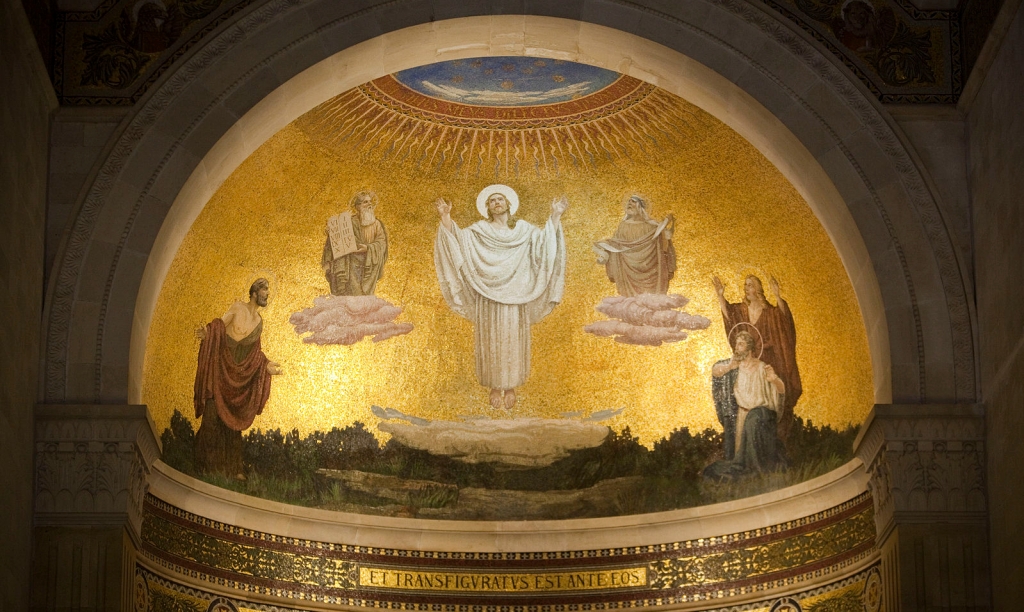
Photo from commons.wikimedia.org of mosaic inside the Basilica of the Transfiguration on Mt. Tabor, Israel.
Thank you very much, Lord Jesus,
 "in taking us always with You,
apart from others by ourselves
like Peter, James, and his brother John
to a high mountain” (cf. Mark 9:2);
many times You set us apart from others
amid many darkness like that night
on Mount Tabor
just to be with You,
to experience You;
how ironic in this age of
so much light everywhere
with a world running 24/7,
the more we are plunged
in darkness
that we feel lost and empty.
Continue to invite us
to detach from so much
worldly attachments
that are so irresistible
due to social media
and the glamor that come with them.
And he was transfigured before them, and his clothes became dazzling white, such as no fuller on earth could bleach them… Then a cloud came, casting a shadow over them; then from the cloud came a voice, “This is my beloved Son. Listen to him” (Mark 9:2-3, 7).
Like Peter, James, and John
we also wonder at the meaning
of your Passion and Death when You
are the Christ?
Why all the sufferings happening
in us and among us with all
the confusions and divisions going on?
Like Peter during the Transfiguration,
we do not know what we are saying to you, Lord;
whether we are filled with joy or burdened
with sorrow, we speak without thinking much
even if you know what is in our hearts.
Open our hearts, dear Jesus,
to always listen to You by remaining with You
on the path to Your Cross;
let us listen more than talk
or click more without much reflections;
two ears form the image of heart,
never the mouth nor the lips.
Let us heed Peter in his words today:
Moreover, we possess the prophetic message that is altogether reliable. You will do well to be attentive to it, as to lamp shining in a dark place, until day dawns and the morning star rises in your hearts (2 Peter 1:19).
Bring us back to your path of faith, Jesus;
amidst all these noise and divisions
of relativism and wokism,
open our hearts by listening intently
to your voice when all is dark
and even dead or as it happens these days,
blindingly so bright with artificial lights
because for as long as we return to You,
sin and failures become means for us
to be changed and transformed -
or transfigured
when we rise in your Resurrection.
Amen.
A 1311 painting of the Transfiguration by Italian artist Duccio di Buoninsegna from commons.wikimedia.org.





 lordmychef.com