Quiet Storm by Fr. Nicanor F. Lalog II, 26 April 2021
Patring the lovely lady
behind this community pantry
said it so well "this is not a charity"
but "like a mutual aid of helping each other in need".
All she did was make us see
those in need as a person like you and me
who lives and breathes
but worries and cries alone
creating the spark unknown
that we started to believe
we can feed the hungry
with whatever we have
if everyone tries to live simply
by seeing everyone's dignity
of not taking anything
more than what is necessary.
The beauty of every community pantry
more than the food aplenty
is the overflowing of the spirit of humanity;
kindness and tenderness again caressed
everyone who has been stressed
and depressed not only by the distress
caused by COVID-19 but mostly
the lack of interest for persons
blinded by personal interests
who thought money as ayuda
will solve the plight and misery
of the many going sick and hungry.
The humility and simplicity
of every community pantry
are the key to its mystery
when everyone begins to see
the needy as another person with dignity
a brother and a sister, a kin and family
thinking of everybody not just self entirely;
everybody is suffering
but at the community pantry
generosity is overflowing
because everybody is thinking
somebody can be in deeper misery.
There is something holy about the pantry
where everyone goes when hungry
that Patricia has brought out in the community
to remind us we are one big family
a normalcy replaced with greed and apathy
with everybody wanting so many
using manipulation to control even the nation;
pray thee may this community pantry
be the start of a beautiful journey
to a brighter future for our country
where everyone lives simply and responsibly
not taking what is more than necessary!
Quiet Storm by Fr. Nicanor F. Lalog II, 22 April 2021
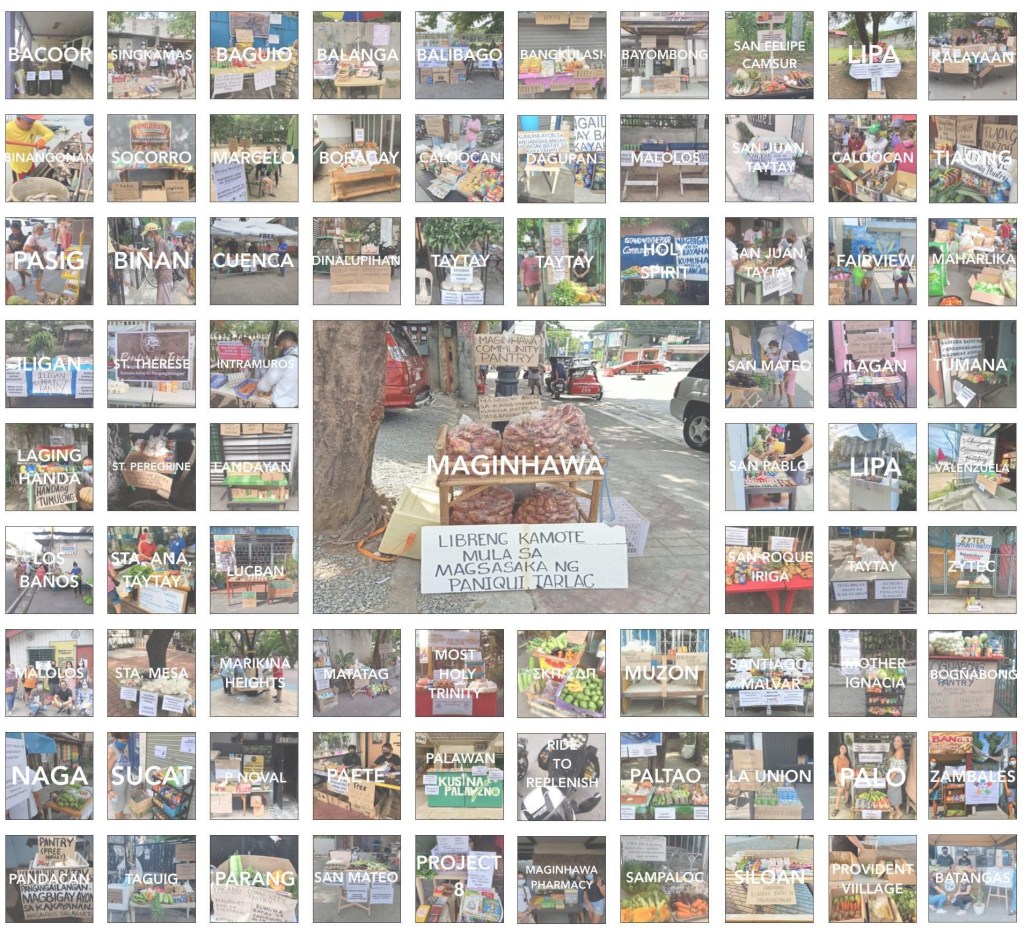
The beauty of this community pantry
that have sprouted all over the country
in just a week exactly
is not found only in the wide variety
of food to the needy but most of all
for food that enrich so many souls:
kindness and tenderness are aplenty
with everyone considered a family.
It was the Lord Himself
who gave us the first community pantry
intended for soul when he said:
"All you who are thirsty,
come to the water!
You who have no money,
come, receive grain and eat;
Come, without paying and without cost,
drink wine and milk!
Why spend your money for what is not bread;
your wages for what fails to satisfy?
Heed me, and you shall eat well,
you shall delight in rich fare.
Come to me heedfully,
listen, that you may have life."
(Isaiah 55:1-3)
What is so amazing now happening in the country
is how those with least to offer
are always the ones with most to share
like that widow praised by Jesus in her poverty
gave her all in the temple treasury:
for the community pantry
there was so much camote
coming from hard pressed farmers
from Paniqui and another load from Mindoro
shared by the child of a Mangyan aged nine
while an elderly man peddling chicharon for a living
asked for two cans of sardines
leaving the pantry with a precious smile of gratitude
with a plenitude of goodwill,
donating two packs of his precious chicharon.
Like manna in the wilderness
the community pantries were heaven-sent;
like the feeding of five-thousand in the wilderness
the community pantries of sharing was the miracle;
like Jesus Christ at the Last Supper,
the community pantries have taught us
to be the bread ourselves, broken and shared
if only to prove there is enough for everyone's needs.
Lawiswis ng Salita ni P. Nicanor F. Lalog II, Ika-21 ng Abril 2021
Mula sa Facebook ni Jean Palma noong ika-18 ng Abril 2021 na nilagyan niya ng caption: “All these community pantries in four days, and counting. What a powerful movement.” #CommunityPantry
Tila magpapasko, presko at mahangin ang panahon noong Lunes ng umaga dito sa Pambansang Dambana ng Birhen ng Fatima sa Valenzuela.
Natutuwa ako noon sa napakabuting balita ng paglaganap nitong tinaguriang mga “community pantry” na nagsimula sa kalye Maginhawa sa Quezon City noong a-kinse lang ng Abril. Wala pang isang linggo ay kumalat na sa buong kapuluan ang kilusan na kung isasalin sa ating sariling wika ay “paminggalang pampamayanan”.
Sa mga kagaya ko na inabot ang singko sentimos na de bote ng Cosmos, bago dumating ang pridyider ay paminggalan ang puntahan ng lahat lalo na sa bahay na matanda kung saan nakatira ang mga impo at lola.
At ang turo sa aming mga bata noon, maaring kumuha ng pagkain sa paminggalan pero huwag uubusan ang ibang kasama sa tahanan.
Higit sa lahat, magsabi lagi upang mapalitan o mapunan sakaling mauubusan lalo na ng kape at asukal.
Kaya naman napakagandang makitang muli itong mga paminggalan hindi na sa tahanan kungdi sa lansangan na tila baga bawat pamayanan naging isang malaking pamilya pinamamayanihan ng pagkakapatiran.
Iyon ang pinaka-buod at kahulugan nitong mga paminggalang pampamayanan na siya rin namang ipinahayag ni Bb. Ana Patricia Non: hindi aniya ito pagkakawanggawa o “charity” kungdi pakikipagkapwa-tao o mutual aid upang matulungan ang bawat isang nangangailangan.
Sa Banal na Kasulatan ay ating natunghayan kamakailan paglalarawan ng pamumuhay ng mga unang Kristiyano:
At nagsasama-sama ang lahat ng sumasampalataya at para sa lahat ang kanilang ari-arian. Ipinagbibili nila ito at ang pinagbilhan ay ipinamamahagi sa lahat ayon sa pangangailangan ng bawat isa.
Mga Gawa ng Apostol 2:44-45
Larawan mula sa inquirer.net.
Isinaysay sa atin ni San Lucas ang naturang bahagi sa buhay ng mga unang Kristiyano upang muling mahimok sa atin ang pagkakapatiran, ang magising ating mga kaisipan at kamulatan na sa buhay hindi pinag-uusapan at batayan ang ano mang kakayahang gawin kungdi ang pagkakakilala sa bawat isa bilang ka-patid, ka-dugtong, at ka-putol. Alisin mo ang unlaping “ka”, ika’y patid at putol. Hiwalay at nag-iisa, walang karugtong.
Kapatiran, samahan ng magkakapatid, hindi ng mga gawain.
Kung babalikan natin yung tagpo matapos mag-ayuno at manalangin ang Panginoong Hesus sa ilang, ang unang panunukso sa kanya ng demonyo ay gawin niyang tinapay ang mga bato.
Ganyang-ganyan pa rin ginagawa ng diyablo at kanyang kampon sa ating panahon na ang palaging tanong ay “ano ba ang nagawa mo?” o “mayroon ka bang naambag?”: para sa kanila, pinakamahalaga yung nagagawa kesa makipag-kapwa.
Hindi nila batid na ang sino mang tunay sa pakikipag-kapwa, laging kasabay ang gumawa ng mabuti.
Kaya hindi rin kataka-taka sa kanila na ang mga addict at kriminal ay patayin dahil para sa kanila walang nagagawang mabuti mga ito sa lipunan.
Isang magandang pagkakataon itong pag-usbong
ng maraming paminggalang pampamayanan
na muli nating mapagtanto dangal ng bawat tao
na dapat mahalin at igalang bilang larawan
at wangis ng Diyos na lumikha sa tanan.
Larawan mula sa Dr. Yanga’s Colleges Inc. sa kanilang “community pantry” sa Bocaue, Bulacan, 20 Abril 2021.
Isang magandang pagkakataon itong pag-usbong ng maraming paminggalang pampamayanan na muli nating mapagtanto dangal ng bawat tao na dapat mahalin at igalang bilang larawan at wangis ng Diyos na lumikha sa tanan.
Inyong pagmasdan, madalas mga taong mapagbilang at mapaghanap ng mga nagawa ay siya ring mga mapanaghili, binibilang mga gawain na tila lahat dapat tumbasan o mayroong kapalit.
At ang pinaka-masaklap, sila din yaong mga wala ring ginagawa, puro salita kaya sila’y katawa-tawa parang sirang plaka katulad ng kanilang pamumula at “red tagging” sa mga nasa likod ng paminggalang pampamayanan o community pantry.
Ayaw nila sa paminggalang pampamayanan dahil doon ang batayan ay pagtuturingan bilang magkakapatid; walang ganid at sakim, nasa isip palagi ang kapwa na maaring mas kawawa kaysa sarili.
Kaya heto ang aking awit na handog sa mga nagpasimuno at nagpapalaganap nitong community pantry.
Kasama na rin ang mga hindi naniniwala, namumula.
At, sumasalaula.
Humuhuni ang ibon
Nagsasayaw sa hangin
At laging masaya
Bakit kaya ang tao may isip at talino
Nalulungkot pa siya

Matutuhan lang ng bawat nilikha
Ang umibig sa tao't daigdig
Lungkot nila'y mapapawi ligaya'y ngingiti

Pagibig at pag-asa
Ang damdaming gigising sa taong mahimbing
Ang tunay na ligaya sa ating puso
Muling magniningning

Ikaw at ako
Hindi man magkalahi
Ay dapat matutong magmahal
Ituring mong tayong lahat ay magkakapatid
(New Minstrels, 1980)
Quiet Storm by Fr. Nicanor F. Lalog II, 05 April 2021
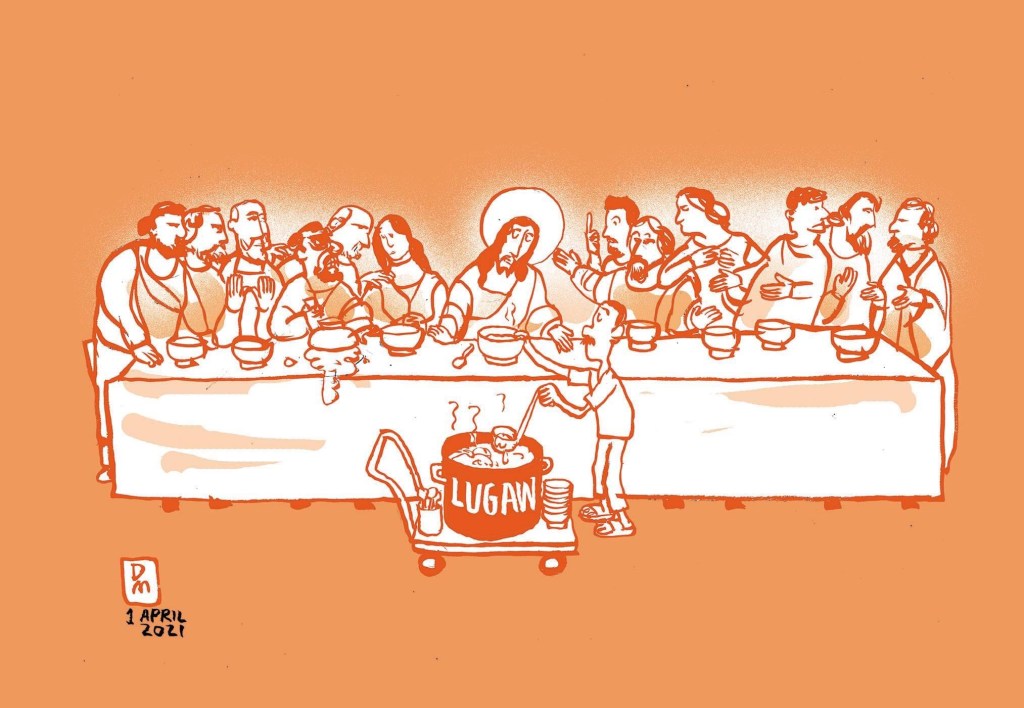
“An Essential Holy Thursday Transubstantiation” by artist DengCoy Miel posted on his Facebook, 01 April 2021.
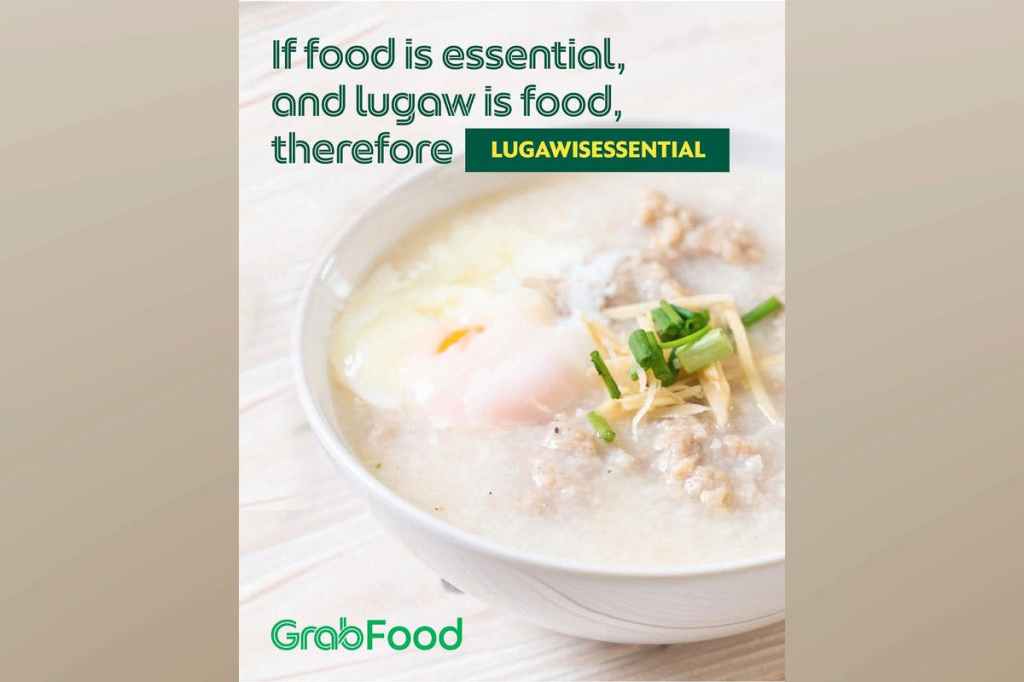
It was a Holy Wednesday when the incident went viral as picked up by network news that evening when the previous night some barangay officials in Muzon, San Jose Del Monte, Bulacan insisted that lugaw is “not essential”, that man can live even without lugaw.
The timing was so perfect being a “Spy Wednesday” or the night of traitors when Judas Iscariot struck a deal with the chief priests to hand them over Jesus for 30 pieces of silver (Mt.26:15).
And so, there were the three barangay officials handing over to their power trip the common lugaw not knowing they have in fact betrayed us Filipinos in their arrogant insistence that lugaw is a non essential food.
The following Holy Thursday, another Judas Iscariot not only betrayed but crucified si lugaw as non-essential without knowing his remark was a self-indictment of this government’s preoccupation with politics, disregard for the people and lack of any definitive plan regarding the year-old pandemic. Trying to sound a smart aleck and clown rolled into one this administration has too much of, his explanations only made him look like the lowest kind of lugaw – rice leftovers boiled in water.
The benighted souls who have denigrated our favorite food have just proven that this pandemic is something we have to see in the light of spirituality and morality, not just a medical and social issue to be addressed.
Any food is always essential because every food signifies a person, has life and sustains life.
Recall that during his Last Supper on the night before he was betrayed, Jesus had chosen the most ordinary but very essential food to be the sign of his loving presence among us until the end of time – the bread. An unleavened bread, to be exact, which was the food taken by the Jews during their exodus from Egypt at the time of Moses.
The bible teems with so many references to the lowly food of bread as something divine with deeper meaning as a sign.
Consider that Jesus was born on a manger which is an open box or a trough for animals like horses and cattle to eat from to signify his being our very food in this life journey. He was born in Bethlehem that literally means “house of bread”; thus, at his last supper, Jesus gave himself to us under the sign of a bread.
In establishing the Sacrament of the Holy Eucharist which St. John Paul II emphasized in 2002 by adding the Mysteries of Light in praying the Rosary, Jesus elevated the meal into the most sublime human activity making our food divine and holy. As a result, the table had become one of the most intimate places in our lives that every time there is a meeting or any gathering, there is always the meal to be shared. I used to tell my students before that every first date is always in a restaurant – if possible a fine dining one – because what matters most is the moment to be shared together by you and your date.
It is always easy to know when couples and parents are not in good terms with each other: they never eat together or during meals, they do not talk or speak to each other. The same is true when people decline our invitations for dinner or party or simple meal: they do not want to be with us. Period. That is why Judas Iscariot had to leave and not finish the Lord’s supper!
See that we never call people as “enemies”: like Jesus Christ, as much as possible we welcome everyone to our table to share meal with us and it is only then when we realize who is our enemy when like Judas, some people stab us in our backs while sharing meal.
When we eat and share food and drinks, we actually share our very selves to our guests and friends. We host parties because we want to share our very selves with our family and friends, to share and be a part of our lives, of our achievements, of our important stages in life. Their coming signify the same willingness to share us their lives too.
Photo by desiringgod.org, April 2019.
The food we share are signs of our bonding, of our relationships, of how we care and respect for one another. It does not really matter what food we share. More often, the most simple and ordinary food are the ones that truly delight us like tuyo. Or lugaw!
How I wish parents today would bring back those days of old when nobody is supposed to waste not even a single grain of rice or any food for that matter because it is from God.
When we were growing up, every meal was the most awaited family time not because of the food but more of the bonding and exchanging of stories. As we age, it has become more truer than ever! That is why we all wish this pandemic would end so we could all eat together as families and friends, is it not?
Any food is always essential because every food signifies a person who has life and sustains life of others.
Every one of us is a companion to each other. From the two Latin words “cum panis” that mean someone you break bread with, a companion is a friend, a fellow traveler who sustains and nourishes you like food in your journey!
In that beautiful story of the road to Emmaus when Jesus appeared to two disciples disappointed with his death and news of his empty tomb on Easter, they recognized him only after he had broken bread but simultaneously disappeared because at the table of the Lord, we also become his Body meant to be shared with everybody.
The recent issue that went viral on whether lugaw is a non-essential or not is a tragic indication of the kind of people we are, of how we categorize persons like food.
There seems to be a direct correlation
between food and humans:
when there are plenty of food,
that is when people are taken for granted,
while where there is scarcity of food, people are valued.
Take the case of ice cream. When somebody is rich and young and beautiful or handsome, they are the “flavor of the month” or the “all-time favorite” and “classic” or “premium”.
And how do we call our ordinary ice cream peddled by Mamang Sorbetero? “Dirty ice cream” – dirty because ordinary and cheap like the street kids, the poor, the “wa-class” and opposite of the more expensive sosyal ice cream.
Worse, with so much food available these days unlike before when we valued every food so much because we can only have apples (and softdrinks) when sick or chocolates when relatives from the States sent packages or some rich neighbors brought you as pasalubong from Dau’s PX stores outside Clark Air Base in Pampanga, things today have also changed in the way we relate with one another.
There seems to be a direct correlation between food and humans: when there are plenty of food, that is when people are taken for granted while where there is scarcity of food, people are valued.
As more food are readily available these days, the more we have become choosy, the more we categorize food as essential and non-essential that at the same time, the more we denigrate humans.
Such was the plan of Satan with his first temptation to Jesus – turn stones into bread after fasting for 40 days in the wilderness.
For Satan, let us have more food and things to satisfy our body so we forget God and one another, and everything of higher value. When food is retained in the stomach and becomes an end in itself, it then becomes an occasion for sin like gluttony, exactly what Satan was pushing for so that we just keep on filling our stomachs with food, satisfying the cravings and desires of the body until we destroy ourselves and our image as likeness of God.
Jesus put food into the right perspective that God is our real and true food that in two instances at least, he fed vast crowds of people in the wilderness after seeing them rightly disposed for material food.
Call it as generation gap but I am shocked when I hear some people especially the young describing handsome men and pretty women as “yummy” and “delicious” like food. Problem with that kind of mentality is how it shows we have come to regard everybody like food that if we are no longer “fresh” or “new”, becoming “old” and stacked in the cold fridge, later to be discarded or thrown out like old people being sent to retirement homes totally unknown to us 40 years ago.
Worst of all is how this administration launched its bloody campaign against drugs when addicts and other criminals were considered as non-essentials to be eliminated or killed like animals – exactly the deeper implication of what that government official kept saying last Holy Thursday that “non essential si lugaw”!
Since last year’s Holy Week when we first went into this lockdown, I have been telling friends to avoid as much as possible posting their lavish food on Facebook as a sensitivity to others with almost nothing to eat. And I maintain it is still valid to this time of this worsening crisis.
Let us be food to everyone as source of strength and nourishment, of inspiration. We do not have to make extraordinary efforts. Simply be human as yourself. Be present with a text or a phone call to those suffering. Pray for them and let them know you care for them.
Be a lugaw who could warm someone’s cold body freezing in fear and anxiety, offering quick relief from whatever suffering others may be going through.
Most of all like a hot, steamy lugaw, giving hope that Jesus is with us, his salvation is coming soon.
Remember, friends, lugaw is essential.
And so is everyone.
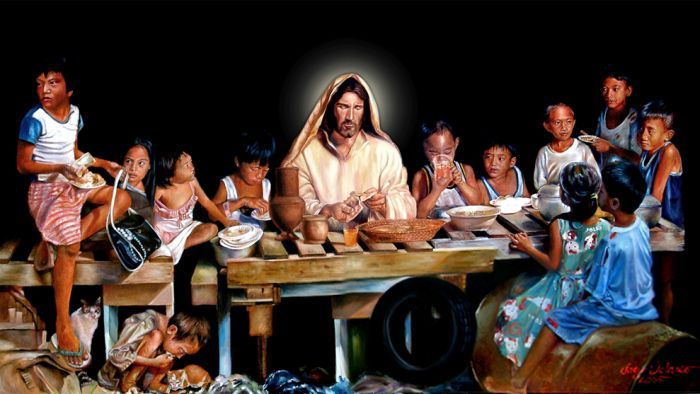
The late Joey Velasco’s 2005 painting “Hapag ng pag-Asa”.
Lawiswis ng Salita ni P. Nicanor F. Lalog II, Biyernes Santo, Ika-02 ng Abril 2021
Larawan mula sa wikipediacommons.org ng “Ecce Homo” ni El Greco.
Kung mayroon mang higit na malungkot
ngayong Biyernes Santo
habang tayo ay muling binalot
saka pinalaot sa gitna ng bulok
at kawalang sistema sa pandemya
noon pa, iyan ay tiyak walang dili iba
kungdi si Hesus na ating Panginoon
at Manunubos; marahil hindi Niya maubos
isipin sa gitna ng masasamang nangyayari sa atin
mas binibigyang pansin ng maraming hangal
sa ating pamahalaan mga bagay-bagay
kay daling isipin habang mga paksa
nagiging usapin dahil sa pagsisinungaling!
Ngayong Biyernes Santo
araw ng pag-aayuno
upang ating mapagtanto
Panginoong Hesus ay naririto
sa ating pagtitiis ng kagutuman
nalilinis ang puso at kalooban
nawawalan ng laman
upang tayo ay mapunan
ng Diyos ng kanyang kabanalan;
kay laking kahibangan
lalo ng mga nasa kapangyarihan
kalimutan at talikuran tuluyan
mga payak at aba, lugaw ang kumakatawan!
Pinakamalungkot pa rin
ngayong Biyernes Santo
ang Panginoong Hesu-Kristo
dahil katulad niya noon
patuloy pangungutya sa kapwa
lahat hinahamak at minamaliit
gayong kanilang mga isipan
ang walang laman, sadyang
mapupurol at makikitid
na hindi nababatid
ang tao na higit na dakila
hindi masalita, nakikilala sa
busilak ng kanilang puso at diwa.
Huwag nating kalimutan
bago sumapit ang Biyernes Santo
noong gabing ipagkanulo si Kristo
pinili niyang walang hanggang tanda
ng kanyang kapanatilihan sa atin
tinapay na walang lebadura
na alalaong-baga sa atin dito sa Asya
kapantay ay lugaw na siyang inihahain
sa mga panahong alanganin
ito ang kinakain upang maging sapin
sa tiyan na dumaraing sa maraming hinaing
di lamang sa gutom kungdi pati
kawalan ng mga pumapansin.
Alalahanin tuwing ikaw ay kumakain
nitong paborito nating pagkain
lugaw marahil ang hihilingin
ni Hesus na Panginoong natin;
napakadaling pakisamahan
lasap kanyang linamnam
hindi maselang lutuin
walang ulam na aalalahanin
ano man maaring isahog at i-pares
sarap at ginhawang walang kaparis
kaya nakakainis mga nagmamalinis
sana'y umalis na
dahil sila ang mga panis!
Salamat sa mga taong simple at payak, maasahan kailanman tulad ng lugaw: mahalaga at mainam sa katawan!
40 Shades of Lent by Fr. Nicanor F. Lalog II
Wednesday, Fifth Week in Lent, 24 March 2021
Daniel 3:14-20, 91-92, 95   +++   John 8:31-42
Parish Church of St. Joseph, Baras, Rizal.
We pray most specially today, O God our Father, for all who are sick especially with COVID-19 along with the doctors and nurses and other medical frontliners who take care of them. We pray also in a special way for doctors and nurses getting sick because of this surge in COVID-19.
At the same time, we pray for our good bishops who gallantly stand to continue with the public Masses because our spiritual nourishment is very essential in times like these. Give them the courage and grace to stand their trials like your three prophets in the first reading today.
Shadrach, Meshach, and Abednego answered King Nebuchadnezzar, “There is no need for us to defend ourselves before you in this matter. If our God, whom we serve, can save us from the white-hot furnace and from your hands, O king, may he save us! But even if he will not, know, O king, that we will not serve your god or worship the golden statue which you set up.”
Daniel 3:16-18
Make us at home with you, Father, like those three young men.
Let us remain in the words of your Son Jesus Christ so we may know the truth and be set free from our idols and others gods like persons who make it difficult for us to truly follow you and do your holy will.
Let our lives be centered in you, Father, through Jesus Christ we receive in the Holy Eucharist daily.
In these trying times of the pandemic worsened by leaders chained to their personal interests and foreign powers, make us remain in you in Jesus and set us free, free from fears and biases and free to serve and care for those in need. Amen.
40 Shades of Lent by Fr. Nicanor F. Lalog II, 25 February 2021
Thursday, Week-I of Lent, 35th Anniversary of EDSA People Power Revolution
Esther C:12, 14-16, 23-25     ><)))*> + ><)))*> + ><)))*>     Matthew 7:7-12
From Pinterest.
Late have I realized, God our Father and of history, that our much revered event/experience of the past, the EDSA People Power of 1986, happened during the Season of Lent. Was it because we were sincere in our prayers that the impossible happened on those days from February 22-25, 1986?
I believe so.
And that is why I pray again for our beloved country before EDSA is totally relegated to just dates in our poor memories or worst, as the most notorious symbol of everything wrong in us which is the highway where it all happened 35 years ago today.
In this Season of Lent as we celebrate another EDSA People Power Revolution Anniversary, teach us again how to pray.
First, to have that attitude of total surrender to you, O God, like when we faced tanks and soldiers in full battle gear holding flowers and rosary beads and images of Mary and the saints at EDSA.
Like Queen Esther in the first reading today, may we pray in total surrender and dependence on you.
Queen Esther, seized with mortal anguish, had recourse to the Lord. She lay prostrate upon the ground, together with her handmaids, from. morning until evening, and said: “God of Abraham, God of Isaac, and God of Jacob, blessed are you. Help me, who am alone and have no help but you, for I am taking my life in my hand.”
Esther 12, 14-15
Most of all, teach us that in order to obtain whatever we may pray from you, let us ask only for what is good for us and for others like during those days at EDSA. So many times you neither hear nor grant our prayers because it is not good enough, for us and for others. Teach us to be good, to desire only what is good, for you are the only Good One.
“Which one of you would hand his son a stone when he asks for a loaf of bread, or a snake when he asks for fish? If you then, who are wicked, know how to give good gifts to your children, how much more will your heavenly Father give good things to those who ask him.”
Matthew 7:9-11
You know very well how most of us, the ordinary people who came there, simply wanted change in our country. You know so well we have neither lands nor money nor names to keep and safeguard. You know so well how most of us simply have you until today.
Photo by author, yellow flowers at the Carmel of the Holy Family Monastery, Guiguinto, Bulacan, 2019.
How sad some persons of power and influence took advantage of that and fooled us into believing they we were one with us in the ideals of EDSA. You also knew so well what were in their hearts then which they still keep to this day — self interests and greed for power, wealth, and fame.
Forgive us, Lord, in allowing them to prostitute EDSA.
Never again should it happen again.
Sayang.
Please show us again the way to regain its glory, its dreams and aspirations especially at this time we are at our lowest point in history as a nation. Send us selfless men and women willing to leave everything behind to you for the good of the nation.
Yes, Lord, “The Filipino is still, and always, worth dying for.”Amen.
Lawiswis ng Salita ni P. Nicanor F. Lalog II, Ika-10 ng Pebrero 2021
Larawan kuha ng may akda, Ikapitong Istasyon ng Krus sa Parokya ni San Ildefonso sa Tanay, Rizal.
Doon sa magandang simbahang
aming pinuntahan kamakailan
matatagpuan din kakaibang larawan
ng ikalawang pagkadapa ni Jesus
habang ang Kanyang krus ay pasan;
isa sa mga taga-usig Niya
hindi kita mga mata dahil
suot niya may kulay na antipara
kagaya ng maraming nabubulagan
at hindi makita katotohanan
nasisilaw sa kapangyarihan
ngunit kaliwanagan ayaw masilayan.
Palagi namang kulang at kapos
ating kaisipan at karunungan
kahit anong ingat at siyasat
hindi sasapat;
Diyos lamang ang ganap
na Siyang nakasisipat
ng mga magaganap
na ni wala sa ating mga hinagap
kaya naman madalas mas mainam pa
na ating matanggap kahit mabigat
kakulangan maging kahangalan
ng mga nanunungkulan.
Madalas aking napag-iisipan
sa dami ng mga kamalian
kagagawan ko o ng iba pa man
kailanma'y hindi naman ako pinabayaan
ng Panginoong Maykapal;
sinasamahan maging sa pagpapasan
ng mga pinagdurusahang bunga
ng mga kasalanan at kamalian
hanggang sa maliwanagan
lahat ay malampasan
at muling makabangon
sa Kanyang kabutihan at kaganapan.
Ito ang ating panaligang
katotohanan sa ating buhay:
lahat ay nagkakamali
maging mga pari
ngunit si Jesus kailanma'y
hindi nagkamali
sa atin ng Kanyang pagpili
kaya tayo ay manatili
 huwag managhili
patunayan nating hindi Siya nagkakamali
 magsumakit sa Kanya mapalapit
hanggang ang langit ay masapit!
Mayroong mga nagsasabi
ito raw lalaking nakasalaming may kulay
ay si Caiaphas na punong pari
na siyang humatol laban kay Jesus
nang Siya ay litisin ng Sanhedrin
nang dakpin noong gabi sa hardin
habang nananalangin;
kay gandang pagnilayan
ngayong aming lipatan ng kaparian
paalala sa amin ng yaring larawan
alisin na at hubarin salamin na madilim
upang makita si Jesus nakadapa sa tabi.
Detalye ng larawan sa itaas ng Ikapitong Istasyong ng Krus sa Simbahan ng Tanay na inukit noon pang 1785.
The Lord Is My Chef Sunday Recipe for the Soul
Feast of the Sto. Niño, 17 January 2021
Isaiah 9:1-6  >><)))*>  Ephesians 1:3-6.15-18  >><)))*>  Mark 10:13-16
Photo by author, 16 January 2021.
Today we spend an extra Sunday for the Christmas Season’s Feast of Sto. Niño granted by Rome to the local Church in recognition of the important role played by that image of the Holy Child gifted by Magellan to Queen Juana of Cebu in 1521.
Its role in the Christianization of the country cannot be denied, considering the historical fact that when Miguel Lopez de Legazpi arrived in Cebu 44 years later after Magellan to claim the country for Spain, they were surprised to discover how the natives venerated the Sto. Niño inside a special hut for worship along with their other anitos.
Legazpi’s chaplain Fray Luis Andres de Urdaneta attested to how that devotion to the Sto. Niño in Cebu enabled them to Christianize other natives without difficulties as the Holy Child image at that time has become the favorite among the people in asking favors like children and bountiful harvests as well as protection from calamities and wars.
The late National Artist Nick Joaquin was absolutely right to claim in his many writings and talks that it was really the Sto. Niño who truly conquered the Philippines that continues to be the most popular Christ-devotion in the country along with the Nuestro Padre Jesus de Nazareno of Quiapo.
More powerful than the swords and cannons or any force in the world indeed is the Child Jesus who has continued to be a paradox in world history: the Son of God born in a lowly stable in a small town called Bethlehem because there was no room for them in the inn during the time of the powerful Caesar claiming to be the king of the whole world by ordering a census of all his subjects in the vast Roman Empire now totally forgotten, his kingdom long gone.
What an irony the God who came so weak like all of us, without any title to His name nor an army at His command still influencing the world in His weakness and silence, in His childlikeness. A reality in life until now we have refused to accept even in the Church.
People were bringing children to Jesus that he might touch them, but the disciples rebuked them. When Jesus saw this, he became indignant and said to them, “Let the children come to me; do not prevent them, for the kingdom of God belongs to such as these. Amen, I say to you, whoever does not accept the kingdom of God like a child will not enter it.” Then Jesus embraced them and blessed them, placing his hands on them.
Mark 10:13-16
A child praying in our Parish, 07 November 2019; photo by Mr. Red Santiago.
Christ’s path of weakness vs. the world’s path of power
It is so timely that during this Ordinary Time we have this Feast of the Sto. Niño to remind us of the central teaching of Jesus Christ to be childlike that gets lost in the novelty and sentimentality of our Christmas celebrations.
See how this call for us to be childlike becomes more difficult even almost impossible to achieve in our world that has become so technical and “sophisticated” as we seek to shape and manipulate everything according to our own design.
The world of men, of macho men we love to relish with delight in the secular and religious world in all of its trappings of fads and fashion and “hard talks”, of external showmanships that we try so hard to project cannot hide the hypocrisies within, of keeping grips and control on everyone and everything like the disciples of Jesus. The tragedy of that scene continuing to happen in our time is how some few people who live in darkness pretend to be seeing the light that in the process are actually misleading people towards darkness and destruction.
Every time we refuse to allow others to come forward with their new thoughts and new ideas, fresh perspectives in governance and management, in the ministry, in theology, when we close our minds to hear others ideas and opinions in doing things, then we are into serious power plays that can be pernicious at the same time.
When this happens, we are all the more challenged to be child-like before God in taking all the risks in exposing what is true, what is real like those kids shouting “the emperor has no clothes”!
To be a child means to owe one’s existence to another which we never outgrow even in our adult life. It is an attitude of being open, that Jesus can be talking to us through people not necessarily like us, even different from us. It is an attitude of trusting others, unlike those hungry for power who only believe in themselves, so afraid they might be proven wrong because their minds are either narrow or closed.
Are we not surprised at all that these control freaks around us who try so hard to project images of power and strength are often the perverts and deviants hiding their childishness and immaturities and other skeletons in the closet?
Photo by author, “Sleeping Sto. Niño”, January 2020.
Becoming and living as God’s children
Jesus shows us today in this feast of the Sto. Niño that it is in the path of being weak like children when we are truly free like Him – free to be a child of God indeed! This He accomplished by dying on the Cross not only to forgive us for our sins but made us a “new man/woman” in God as His children.
Brothers and sisters: Blessed be the God and Father of our Lord Jesus Christ, who has blessed us us in Christ with every spiritual blessing in then heavens, as he chose us in him, before the foundations of the world, to be holy and without blemish before him. In love he destined us for adoption to himself through Jesus Christ, in accord with the favor of his will, for the praise of the glory of his grace that he granted us in the beloved.
Ephesians 1:3-6
How sad that in our efforts to be in the man’s world of power and dominance, we try so hard becoming somebody else whom we are not only to end up alone, lost and unfulfilled.
Our being children of God is something innate in us, already within us that was accomplished by Christ for us at the Cross.
The key is to always go back to Jesus at the Cross.
We have said earlier that to be a child is to owe one’s existence to another that is, ultimately speaking, to God alone.
Hence, one sure sign of being like a child is having the sense of gratitude, of thanksgiving.
Incidentally, the Greek word for thanksgiving is eucharistia or eucharist! In the gospel accounts, we find so many instances of Jesus thanking the Father for everything that beautifully reminds us of His childlikeness.
The moment we feel strong enough without need for others, then we stop being grateful, then we lose that childlikeness in us as we start tinkering with power and influence, assuming to ourselves that everybody owes us, the world needs us.
That is when we stop growing and sooner or later, we collapse and eventually fall so hard on our faces.
How amazing that the Sto. Niño image given by Magellan to Queen Juana holds an orb or a globe. It is very interesting where did the maker of that image got that idea that the world is round when in fact it was the theory that Magellan had in mind in setting out to his ambitious expedition by sailing westward and returning from the east?
Records show that the first images of the Child Jesus or Sto. Niño as we know came from Flanders, a region in the Netherlands. The Flemish people have been making those images as early as the late 1400’s. That is why there is also that popular image of the the Child Jesus in Prague in the Czech Republic.
The mystery remains where did they get that idea of the Child Jesus holding an orb?
Could it be that the Flemish people who were devoutly Catholics at that time must have found the “light” from Jesus Christ in their devotions and prayers as prophesied by Isaiah in the first reading?
Nobody knows for sure but the next time you look at a Sto. Niño, be reminded always that it is the Child Jesus who holds the world in His hands. If you want to have the world in your hand too, be child-like! Be always grateful for who you are and what you have. Jesus promised it anyway.
The Lord Is My Chef Breakfast Recipe for the Soul
Saturday, Feast of the Black Nazarene of Quiapo, 09 January 2021
1 John 5:14-21     >><)))*>   +   <*(((><<     John 3:22-30
Photo by Mr. Jay Javier, Quiapo, 09 January 2020.
For the first time in so many years, there will be no Traslacion today of the Black Nazarene of Quiapo due to the COVID-19 pandemic but devotees are still celebrating its feast via online Masses and by visiting other churches with revered images of Nuestro Padre Señor Jesus de Nazareno first brought in the country by Augustinian Recollects in the early 1600’s.
Like in our celebrations last year of Lent and Easter and recently of Christmas, COVID-19 pandemic has given us much needed time to reflect, meditate, and review our faith in general that has been shaped for better and, for worst, by our many rites and rituals that have turned us blind to its deeper realities of finding Jesus among the poor and suffering.
It is a great marvel for our eyes to see this unique and intense expression of faith of great crowds gathering every year to fulfill their panata or vow to the Black Nazarene. People from all walks of life, children, men and women, young and old flock to Quiapo on this day as part of their panata for a prayer and wish granted them by the Señor Nazareno.
Photo by Mr. Jay Javier, Quiapo, 09 January 2020.
Beloved: We have this confidence in him that if we ask anything according to his will, he hears us. And if we know that he hears us in regard to whatever we ask, we know that what we have asked him for is ours. Children, be on your guard against idols.
1 John 5:14-15, 21
So often people wonder do we really have to go through all these because of a prayer granted like healing or having a child or getting a job or passing a board exam?
The beloved disciple reminds us today during this time of the pandemic that somehow we have to restore some sense of order especially in the Traslacion.
There is no doubt about the faith of everyone — but it is not everything. Faith is directed to God, a Person, not to a ritual or rite nor to an image. In this time of COVID-19, Jesus reiterates to us His love for us, of how like yesterday in the gospel He always wishes the best for us.
Let it be clear we are not passing judgment on the devotees of the Black Nazarene and of other popular devotions anywhere else in the world. In the letter of St. John we heard today, we find that we do not need to go through so much hardships like some people would do in their panata because prayer is not primarily for having things but for deepening relationship with God. We pray because we relate, we want to be one with God. Asking for things or blessings is secondary. Prayers and sacrifices do not necessarily change situations in one’s life; prayers and sacrifices change the person. In fact, when we pray for something, deep within us we already knew if it is meant for us or not; that is why, I always tell people to “claim” from Jesus whatever he/she may be praying for because if it is for you, the Lord will surely give it to you.
It will almost be a year since we have this pandemic but until now, see in most churches how people continue to disregard our health protocols not to touch and kiss images. In less than a month, we shall start the Season of Lent when images are covered so we go deeper into the person of God and not merely to His images and other visuals that unfortunately for some have become their gods. And that is why despite our deep religiosity, we cannot experience real change in our society because we are still individualistic than communal. Values are misplaced or even disregarded when we think more of the favors to be had than the relationships to be kept, the person to be respected and life to be valued. No wonder, so many Catholics ironically and sadly support corrupt politicians and leaders who lie and disregard life despite their being “prayerful”.
From Google.
John said: “He (Jesus) must increase, I must decrease.”
John 3:30
Señor Nazareno reminds us how in this life we imitate John the Baptist remaining humble before Jesus, entrusting everything to Him. Most especially, working hard to ensure that Jesus and His gospel of salvation is made known to everyone.
See how in our gospel today when the disciples of John the Baptist reported to him Christ’s ministries in Judea, seeking clarifications on how to deal with the situation as more and more people were coming to Jesus. The scene reveals to us the deep spirituality of John, telling his disciples how Jesus must increase and he must decrease which is essentially Christ’s teaching on discipleship, that who ever wants to follow Him must first deny himself and take up his cross with Him.
That is the central message of the Black Nazarene: of how we are also willing to forget our very selves, take up our cross and follow Jesus in the path of self-sacrifice. It is finding Jesus among the poor and suffering that made the Quiapo devotion so appealing to every generation, but — we also wonder why our nation remains poor with so many sufferings! There must be something wrong.
This is something that only the pandemic can offer us: to search our souls, sincerely asking our selves if we still find Jesus in the center of all these devotions. How sad that every year, we hear reports of how some devotees getting unruly, insisting on what they believe, on what they want, including the route of the Traslacion.
Amid all these celebrations, do we hear John’s declaration “Jesus must increase and I must decrease”?
That is spirituality which is more about relationship with God than just fulfillment and celebration of rites and rituals that we call religiosity.
The Black Nazarene statue sits at the stage of the Quirino Grandstand in Manila on January 8, 2013, one day before its feast day when it will be paraded around the streets of Manila to the greeting of thousands of devotees. (Photo by LJ Pasion)
Usually, when you ask anyone for the meaning of “Jesus Nazareno”, easily they would say it refers to the Lord’s origins, the town of Nazareth where He grew up after returning from Egypt to escape Herod’s murderous plot against all infants when He was born.
It is true but on deeper reflection, we have to remember that Nazareth is the only place in the New Testament never mentioned in the Old Testament. Besides, Jesus Christ is actually from Bethlehem, the town of David and Joseph His father where He was born in fulfillment of the prophecies.
According to Pope Emeritus Benedict XVI, the words Nazoraios and Nazarenos used to designate Jesus in the gospels came from the Hebrew root “nezer” for root. Remember in the Simbang Gabi the prophecy by Isaiah that “There shall comne forth a shoot (nezer) from the stump of Jesse” (Is.11:1)?
Pope Benedict explains that Matthew must have detected in the name Nazareth a prophetic reference to the “shoot” as a sign of fulfillment of God’s promise to draw new life from the dead stump of Jesse:
If we add that in the inscription above the Cross, Jesus is called ho Nazoraios (cf. Jn.19:19), then the title acquires its full resonance: what is at first sight refers simply to his origin, actually points to his essence: he is the “shoot,” he is the one completely consecrated to God, from his mother’s womb to the day of his death.
Benedict XVI, Jesus of Nazareth: The Infancy Narratives (pp.117-118)
What a beautiful reminder to us all today in this time of COVID-19 in celebration of the feast of the Black Nazarene, reminding us that in this time when everything seems to be “dead” like a “stump” of the tree, God is working something marvelous, something great among us through His Son Jesus Christ.
Jesus is coming, Jesus has come and remains with us despite this pandemic.
But, are we willing to die to ourselves to see Him, to experience Him, and most of all, share Him?








 lordmychef.com