On choosing well

The Lord Is My Chef Sunday Recipe for the Soul by Fr. Nicanor F. Lalog II
Sunday in the Seventeenth Week of Ordinary Time, Cycle A, 30 July 2023
1 Kings 3:5, 7-12 >><}}}}*> Romans 8:28-30 >><}}}}*> Matthew 13:44-46
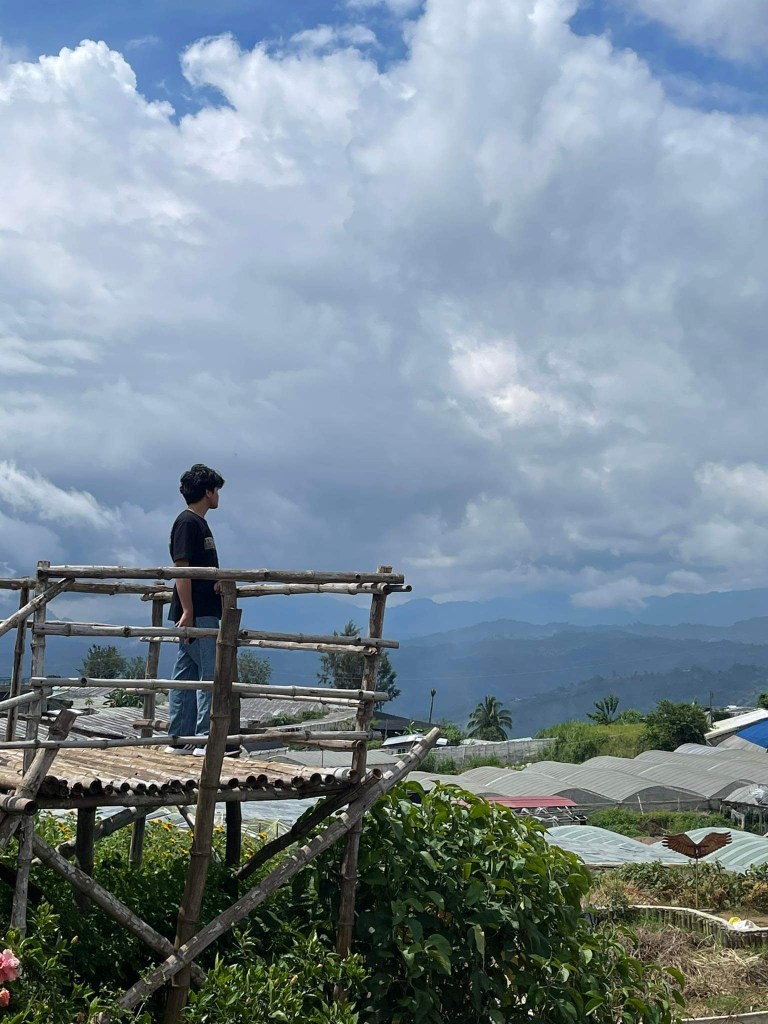
Photo by author, San Juan, La Union, 24 July 2023.

We are now in the final installment of Jesus Christ’s parables this third consecutive Sunday of his teachings on the kingdom of heaven. It is hoped by this time we have learned and realized God is the only treasure we must have in this life.

And the good news is that God our treasure is found in the most ordinary things!

Many times he simply comes to us even without us looking for him while often would also appear if we truly seek him like in the two short parables we heard this Sunday.

Jesus said to his disciples: “The kingdom of heaven is like a treasure buried in a field, which a person finds and hides again, and out of joy goes and sells all that he has and buys that field. Again, the kingdom of heaven is like a merchant searching for fine pearls. When he finds a pearl of great price, he goes and sells all that he has and buys it.”

Matthew 13:44-46
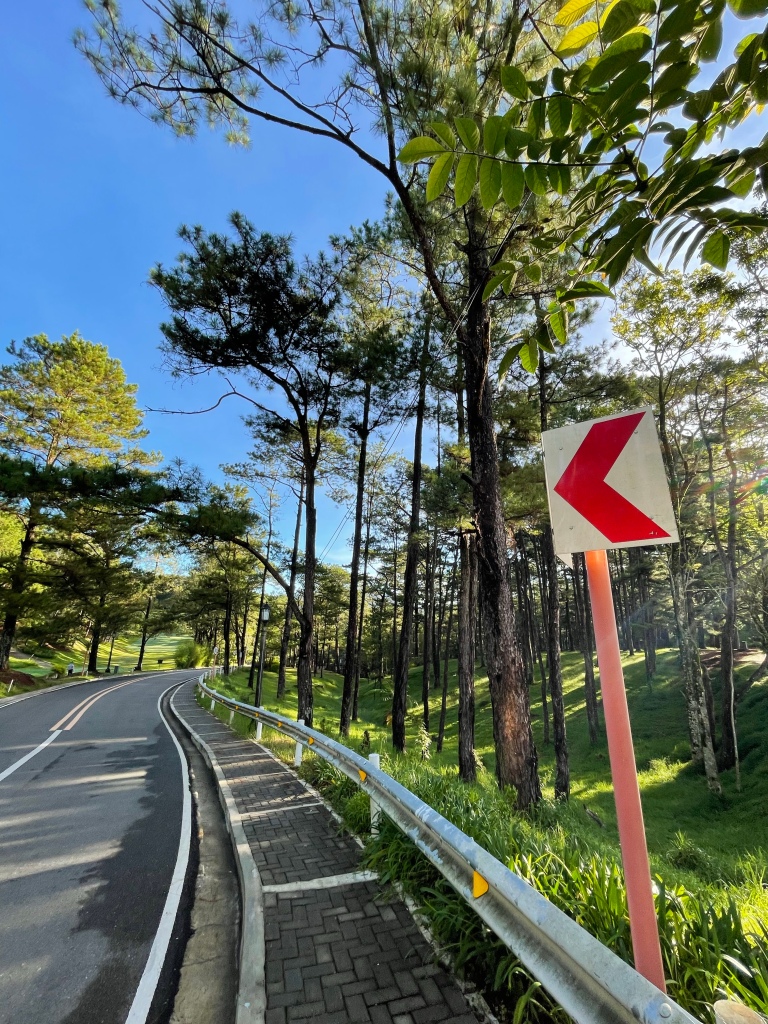
Photo by author, San Juan, La Union, 25 July 2023.

Our gospel may be the shortest these past three Sundays but it challenges us to be wiser in making choices to acquire the only worthy treasure of all – God.

Both the farmer and the merchant exemplify to us this wisdom in letting go of their other possessions just to have the buried treasure and pearl they have found.

Note how the farmer merely chanced upon the treasure buried in a field not his, while the merchant finally found the fine pearl after years of searching all his life. Here we are reminded how God is not that difficult to find by those truly seeking him. The problem lies with us when we refuse to be the good soil so that the seeds sown in us may grow and bear fruit even amid the weeds! Many times, we have stopped having that sense of awe, of being surprised by God who is like a treasure buried in a field somewhere waiting to be found. Worst, a lot often we have simply given up searching for God as if it is impossible to find him like a fine pearl. God is with us in Jesus Christ, our Emmanuel.

This is the good news of our short parables today. Moreover, God even comes to ask us what we want in life like King Solomon in the first reading. Later in the gospel we find Jesus Christ also asking the blind Bartimaeus what does he want while passing by the city of Jericho. Notice how those healed by Jesus always had clear thoughts and focus, so wise in their choices of what they wanted in life like King Solomon. Can we be wise enough like Solomon in choosing well, in asking the right thing from God?

The Lord appeared to Solomon in a dream at night. God said, “Ask something of me and I will give it to you.” Solomon answered: “O Lord, my God, you have made me, your servant, king to succeed my father David; but I am a mere youth, not knowing at all how to act. Give your servant, therefore, an understanding heart to judge your people and to distinguish right from wrong. For who is able to govern this vast people of yours?” the Lord was pleased that Solomon made this request.

1 Kings 3:5-7, 9-10
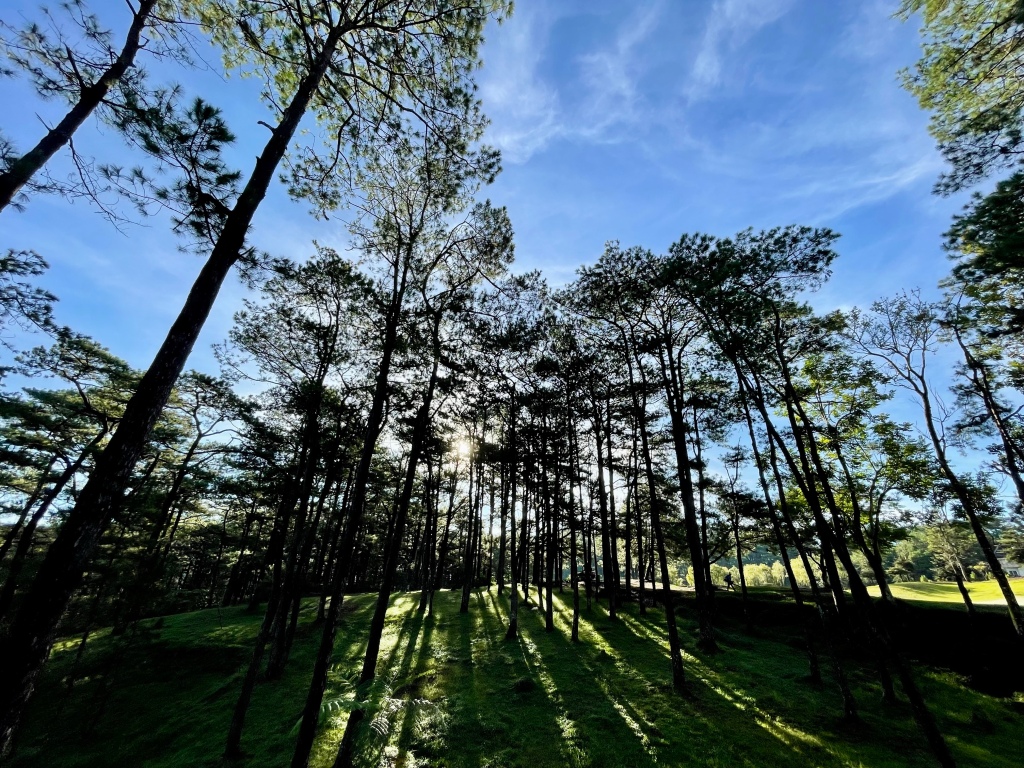
Photo by author, San Juan, La Union, 25 July 2023.

What is so beautiful, even wonderful here is not just the nearness of God with us but his kindness in asking us what we want. Imagine God saying, “Ask something of me and I will give it to you.”

What shall we ask God if he were to come to us in a dream tonight like Solomon? Perhaps we would be at a loss! Remember, God is asking for just one thing we want. At least the genie usually gives three wishes, with only the third one as most crucial being the last for which we are told to always ask for three more wishes!

Here we find again Simon Sinek’s book Start with Why most useful because our whys give us the reason and meaning for whatever we wish to accomplish. Exactly what Solomon must have considered as he laid out to God his situation, his needs, most of all his weakness, “I am a mere youth, not knowing at all how to act.” See why Solomon asked for that grace instead of wealth or fame or strong army?

It is that consciousness of being small and weak before God that pleases him most in granting our prayers. Earlier before this scene Jesus praised and thanked God in giving wisdom to the little ones who accepted him than the wise and the learned who rejected him (Mt.11:25). That is the attitude of being a “good soil” who allows the seed to penetrate and absorb us!

God was so pleased with Solomon because he knew so well his whys that to govern Israel so well amid his many weaknesses, he needed God more than ever. Unlike Adam and Eve who tried to usurp God in his power in knowing right from wrong, Solomon recognized it as divine prerogative we can only share with God. Actually, what he asked for was God himself who is the treasure hidden in the field and the fine pearl found by the merchant. Solomon did not want to be like God inasmuch as he never thought of being wealthy and powerful nor famous that are of no value at all compared to having wisdom, in having a discerning heart to know right from wrong.

Photo by author, shore of the Lake of Galilee in Capernaum, Israel, May 2017.

I have realized in my 25 years as a priest that what we treasure most are not the ones that give us pleasure but the ones who complete us. We ask and pray to God for something or someone not because of need but more of fulfillment found only in Jesus Christ who promised that whatever we ask from his Father would be granted to us in his name if it is for the mission he had entrusted to us. That is why in my prayers, I no longer ask God for anything except of being with him in eternity because I am so sure that whatever I need, he would give. Most of all, if I have God, then I am complete.

The parables of Jesus are inexhaustibly rich yet so accessible to everyone with open minds and open hearts to meet God in Christ through the simple realities of life. That is why St. Paul tells us in the second reading today that “all things work for good for those who love God, who are called according to his purpose” (Rom. 8:28).

Let us pray for more zeal and enthusiasm in being the good soil, in choosing wisely the only treasure worthy in this life who is Jesus Christ, our Emmanuel or God-is-with-us. Let us welcome him in the many parables of life we take for granted that are all part of God’s plan of salvation for us leading to glory that is our destiny. Amen. Today is Sunday, go to Mass and pray for those severely affected by super typhoon Egay especially our brothers and sisters in northern Luzon.


Becoming the good soil

The Lord Is My Chef Daily Recipe for the Soul by Fr. Nicanor F. Lalog II
Friday in the Sixteenth Week of Ordinary Time, Year I, 28 July 2023
Exodus 20:1-27   ><]]]]'> + ><]]]]'> + ><]]]]'>   Matthew 13:18-23
Photo by Ms. Nikki Vergara in Victoria, Laguna, July 2020.
God our loving Father,
make me a good soil,
a real "good earth" who
welcomes your word
to penetrate my heart.
Let me be a
good soil, O Lord,
by allowing myself
to be absorbed 
by your word, 
your seed.
Let your word,
O God, grow
and bear fruit 
in my heart!
Forgive us
that until now
from Mount Sinai
where you gave us
your Ten Commandments
to the shores of Galilee
where Jesus spoke to us
in parables of your kingdom
up to now in the comforts
of our homes and 
parish church amid
the squalor of our many
brothers and sisters
without decent home,
your words seem to have
fallen on deaf ears.
O how you amaze me
so greatly, loving God
for your patience in 
continuing to speak to us,
inviting us to enter into a 
dialogue and relationship
with you; and yet, here we 
are, not listening,
still stubborn;
teach me to give myself
to you completely so
you would absorb me
and fill me with your life
and energy.
Amen.

Start with Why

The Lord Is My Chef Sunday Recipe for the Soul by Fr. Nicanor F. Lalog II
Sunday in the Sixteenth Week of Ordinary Time, Cycle A, 22 July 2023
Wisdom 12:13, 16-19 ><}}}*> Romans 8:26-27 ><}}}*> Matthew 13:24-30
Photo by author, Bgy. Alno, La Trinidad, Benguet, 11 July 2023.

Start with Why is Simon Sinek’s bestselling book written more than a decade ago about the need to focus on asking first “why” before making any choice and decision in life. I have found it very enlightening and useful even in matters of spirituality and prayers.

This is seen in our readings too this Sunday as we continue to listen to our Lord’s teachings using parables until next week. In all occasions of his teachings, his disciples asked him always Why do you speak to them in parables?” (Mt. 13:10).

As we have explained many times before, parables are simple stories we usually take for granted that reveal to us profound truths about life and our very selves, most especially of God and his kingdom which Jesus had come to proclaim.

The key to unlocking the beauty and lessons within parables is having that spirit of openness and sincerity of heart, especially in asking why which may often take different forms.

Jesus proposed another parable to the crowds, saying: “The kingdom of heaven may be likened to a man who sowed good seed in his field. While everyone was asleep his enemy came and sowed weeds all through the wheat, and then went off. When the crop grew and bore fruit, the weeds appeared as well. The slaves of the householder came to him and said, ‘Master, did you not sow good seed in your field? Where have the weeds come from?'”

Matthew 13:24-27
Photo by Onnye on Pexels.com

It is the question we ask most often, why is there evil at all if God our Creator is good? It is most difficult, even scandalizing when evil happens to us despite our efforts to be better and holy.

Today’s parable of the weeds among the wheat answers those many whys we have in life. It is a beautiful continuation of last Sunday’s parable of the sower that offers us Christians with many insights and challenges for the deepening of our faith and commitment to our mission.

First is our sense of sinfulness. It is one of the most serious problem Christianity, even the whole humanity is facing today. More and more people are losing that sense of sinfulness with so many becoming complacent in their faith and morals, always having reasons and alibis, worst, even justifications in committing sins. Or just about everything!

Today’s parable reminds us to always ask like the slaves, “Master, did you not sow good seed in your field? Where have the weeds come from?”

Photo by author, Bgy. Bahong, La Trinidad, Benguet, 12 July 2023.

Why all the evil in the world today?

How sad that many people have grown cynical with evil, simply accepting its existence in the world as a given reality, to be accepted wholly as if we can do nothing about it. Some even go to the extent of thinking the devil does not exist at all with evil simply existing like weeds?!

Here we find the importance of prayer life when we get to examine our conscience daily, asking why all the evils are happening. From there, we learn humility by examining too how we may have contributed in the commission of evil. Most of all, it makes us aware of that tricky “sins of omission”, of how we might have failed by omitting in doing what is good that have contributed to the spread of evil and sin. It is always easy to look outside blaming others, pointing at others for all the evil happening without seeing our own sins.

Second is the danger of neglect and complacency among us disciples of Christ. See the genius of Jesus as a storyteller when he mentioned that the planting of the bad seed or weeds happened while the Master was asleep, “The kingdom of heaven may be likened to a man who sowed good seed in his field. While everyone was asleep his enemy came and sowed weeds all through the wheat, and then went off. When the crop grew and bore fruit, the weeds appeared as well.”

From Pinterest.com.

In the New Testament, sleep is a metaphor for neglect. Jesus cautions us his disciples that if we are not vigilant and discerning of what we allow to influence us, bad seeds can get planted in our lives, families and relationships, even in the Church and in our ministry!

In some translations, the word used for the weeds is darnel, a kind of weed that looks like the wheat to show how evil works itself into our lives by masking itself to look something as good and harmless for a moment. “Wala namang masama” is our usual excuse until later when that evil is unmasked and revealed, its devastating impact had already wreak havoc on us because we have complacently tolerated its growth for some time.

Remember the saying, the devil is in the details. Likewise, keep in mind that the devil does not merely want us to sin but to eventually destroy our lives! “Be sober and vigilant. Your opponent the devil is prowling around like a roaring lion looking for someone to devour” (1 Pt. 5:8).

Third is Christ’s call for us to be patient but firm in dealing with evil and sin. We live in an imperfect world. There will always be evil and sin like this growing trend called liberalism and wokism that stress everyone’s rights without any regard at all with personal responsibility and accountability. These liberals and wokes who have infiltrated the media and government, maybe even the Church, want the natural order of things be changed like gender and marriage. For them, everything is relative. To each his own like praying the Our Father in a drag version.

Photo by Fr. Pop dela Cruz, San Miguel, Bulacan, 2022.

We have to be patient with them and fight them squarely with more reason and charity, to never stoop down to their level that only shows their weaknesses within.

The author of the Book of Wisdom tells us today how God in his power and might chose to be patient and moderate with us sinners precisely because he is strong; the exercise of strength like being noisy, the flexing of muscles with large gatherings actually indicate weakness.

That is why St. Paul in the second reading reminds us of our own weaknesses too in this time of hope and waiting for Christ’s Second Coming while in the midst of all these evils happening. Hence, our need to pray for the Holy Spirit to enable us to carry out our mission in this world marred by sin.

Here we find again the primacy of prayer life. Not just the recitation of prayers. What St. Paul envisions in our short reading today is the kind of prayer wherein God’s own Spirit is the one interceding for us according to God’s will. Teaching people to pray effectively is one of the most challenging of all pastoral duties because we priests and bishops must first be the ones deep into prayer. When we live in the Spirit, we would always be faithfully in prayer.

Sorry to mention here again our disappointment to our bishops in failing to reflect more on the reasons of upholding the rule that only the priest extends his hands in praying the Our Father. It is fidelity to the liturgy to prevent us from being misled by plain emotions that is already happening like in those “charismatic” Mass and gatherings with emphasis on health and wealth (gagaling, gagaling…siksik, liglig at umaapaw) interspersed with clapping of hands.

Photo by author, Bgy. Alno, La Trinidad, Benguet, 11 July 2023.

Jesus assures us in this parable there will be a time for separation, judgment, and punishment but it is not ours to carry out those actions in the present. Let us continue probing our hearts in prayer. Always start by asking why, not with what we think we know. Many times, as the parables of Jesus tell us, the kingdom of God is found in the simplest things in life like a simple word or a sentence we tend to interpret with our many assumptions. Amen. Have a blessed week ahead everyone!

When we drag words down

The Lord Is My Chef Sunday Recipe for the Soul by Fr. Nicanor F. Lalog II
Sunday in the Fifteenth Week of Ordinary Time, Cycle A, 16 
Isaiah 55:10-11 ><]]]]'> Romans 8:18-23 ><]]]]'> Matthew 13:1-23
Photo by author, Bgy. Bahong, La Trinidad, Benguet, 12 July 2023.

Surely you will hear in almost all homilies today something about that blasphemous drag version of the Lord’s Prayer trending in social media. What a coincidence that our Scripture readings this Sunday say a lot about words that teach us so much in dealing with this new kind of pandemic sweeping the world, the “LGBTQ+ woke” syndrome happening in the realm of words and languages.

In the light of recent things happening in our society, today’s readings tell us two important things we have forgotten or have deliberately disregarded: the power of God’s word and the need to listen.

Thus says the Lord: Just as from the heavens the rain and snow come down and do not return there till they have watered the earth, making it fertile and fruitful, giving seed to him who sows and bread to him who eats, so shall my word be that goes forth from my mouth; it shall not return to me void, but shall do my will, achieving the end for which I sent it.

Isaiah 55:10-11
Photo by author, Bgy. Alno, La Trinidad, Benguet, 11 July 2023.
The power of God's word

Our short reading from Isaiah perfectly introduces us to the sequence of Christ’s teachings in the next three Sundays beginning today about the power of God’s word, a preparation for us to understand the parable of the sower.

Here we find from the Prophet Isaiah God’s word as totally “other” – ibang-iba sa lahat – as it reveals and acts because it is the truth and effectiveness in one. See how Isaiah picturesquely expressed the power of God’s word, “Just as from the heavens the rain and snow come down and do not return there till they have watered the earth, making it fertile and fruitful… so shall my word be; it shall not return to me void, but shall do my will, achieving the end for which I sent it.

The Bible never fails in attesting to this conviction, of how God means what he says that has become the very basis of our hopes in him since the very beginning. Everything flows from God’s word, from the creation of the world and the universe to its fulfillment in Jesus Christ until he comes again at the end of time. God’s word creates history with power to renew and restore life, the power to save us as experienced by the thief on the Cross when he said, “Jesus, remember me when you come into your kingdom” (Lk.23:42).

Photo by author, Camp John Hay, Baguio City, 12 July 2023.

Contrast God’s word with our human experience aptly expressed by Shakespeare in Hamlet’s famous quote, “words, words, words!” – of how we use so many words in the belief more is powerful when in fact our words are vain and empty, lacking in substance. Instead of giving life, many times our words hurt and even kill others. In this age of social media, see how we use words to distort truth with lies and deceptions. Its worst aspect is not found in the words we use but in us who pronounce them when we say things without any commitment at all so that many times, our words never stood the test of time because they are easily forgotten when spoken or heard.

St. Paul said it so well in the second reading, of how “all creation is groaning in labor pains even until now” (Rom.8:22) especially when we distort the truth of our words, when we do not mean what we say, when we our words divide instead of unite, when our words destroy instead of build.

See how sin entered through the “words” of the devil that deceived Adam and Eve with the first “fake news” in history that they would not die if they ate the forbidden fruit but instead become like God. Sin took on its ugly face in the use of words again after the first crime of murder committed by Cain who dared to say to God “am I my brother’s keeper” when asked of the whereabouts of Abel.

Words continued to be the means through which sin permeated humans reaching its lowest point when people played God again by building the Tower of Babel to reach the heavens. God punished them by making them speak different languages that resulted in confusion and the collapse of the tower.

How sad that these days, human words are made louder, spread faster by technologies try so hard to undermine God’s word. There is no doubt on the power of the word of God for he himself had shown and assured it. For his words to be fully operational and experienced, we must first listen to Jesus, the word who became flesh.

Photo by author, Camp John Hay, Baguio City, 12 July 2023.
Listening to the word of God

“Whoever has ears ought to hear.”

Matthew 13:9

Jesus used these words seven times in the synoptic gospels, usually in connection with parables like in Matthew chapter 13 which we shall be using in the next three Sundays. We heard it first today and again next Sunday when Jesus explained the parable of the weeds.

His command to “hear” requires more than just taking in the words he speaks to us. To truly hear what Jesus is saying especially within the context of the parables, we must profoundly ponder what he wishes us to know. Just like in our prayers: what is essential is to be able to listen more to God than to tell him our needs which he already knew.

This can only happen in the spirit of silence and openness to God when we suspend our many preconceptions and other ideas especially about the parables we have been so familiar with.

Photo by author, Camp John Hay, Baguio City, 12 July 2023.

The seed is the word of God and Jesus is the Sower who comes to us everyday, speaking to us, telling us the most important things we need to know and do in this life for us to be fulfilled and joyful.

But, do we have our ears attuned to the word of God? Many of us practically live in media, so hooked with gadgets either or both the cellphone and headsets or pods. Nobody seems to listen anymore as we are so engrossed in our own little world centered in the endless me, me, me and I.

In the parable, it does not really matter where the seeds fell; it is always good, at least even as food for the birds! Wherever it fell, the seed always sprang into life! That is the power of the word of God! We just have to give it a chance to grow and mature to bear fruits of “a hundred or sixty or thirtyfold”.

To hear the word of God means also to have our hearts opened to receive God so we can gain insight into the kingdom of God. It is in our hearts where the word of God is sown. Stones and thorns refer to the hardness of our hearts, our refusal to welcome Jesus Christ because we have been dominated by fame and power and other cares of this modern world.

Receiving the word of God is a process, not just a one-shot deal. It is a relationship we have to cultivate in Jesus Christ, just like the ones we try to have with our plants. The Lord himself had warned us repeatedly in the gospels of how there would always be opposition and indifference, even mockery and blasphemy right in the very places where his word should manifest its effectiveness like in our country, the only Christian-nation in this part of the world. If ever the word is not fruitful, it is primarily due to our dispositions and attitudes to God and his word.

Photo by author, Camp John Hay, Baguio City, 12 July 2023.

How timely that at this particular moment in our country we heard again this classic parable of the sower by Jesus Christ.

We, especially in the Church, are being reminded anew to humbly open ourselves to God and his word, to give it a chance to grow and bear fruit, including our rules and other documents especially in the liturgy.

In spending so much time about the posture the laypeople should take in praying the Our Father in the Mass notwithstanding what the rubric says, the devil sneaked into the scene with this drag cover of the Lord’s Prayer. This is something we must reflect. Why even the drag queen had joined the discussion of the Our Father that have deeply hurt us all! With this recent decision by the bishops, the more it seems that the drag version of the Lord’s Prayer is partly our fault too. Let us go back to God and trust his word anew. And the words of the liturgy too. Amen. Have a blessed week ahead!

Praying for endurance & perseverance

The Lord Is My Chef Daily Recipe for the Soul by Fr. Nicanor F. Lalog II
Friday in the Third Week of Ordinary Time, Year I, 27 January 2023
Hebrews 10:32-39   ><0000'> + ><0000'> + ><0000'>   Mark 4:26-34
Photo by Fr. Pop dela Cruz in San Miguel, Bulacan, 15 June 2022.
Lord Jesus Christ,
your words this last Friday of January 2023
are so lovely, so inspiring:
"Therefore, do not throw away your confidence;
it will have great recompense.
You need endurance to do the will of God
and receive what he has promised" (Heb. 10:35-36).
What is to not throw away our confidence?
Simply be assured always in God, with God.
Have faith because he knows very well what is
happening with each of us.
Help us to keep that in mind and heart!
Now, this is what I like, Lord Jesus, 
when the author of the Letter to the Hebrews
told us to have "endurance to do the will of God
and receive what he has promised."
Teach us, Jesus, to bear and endure
all pains in doing your will,
in standing for what is true and good,
in keeping on doing what is good,
in continuing to love amid the pains.
Along with endurance,
give us also perseverance, Lord Jesus:
more than enduring the pains, let us go against
all these difficulties and hardships to perfect
ourselves, our faith and our love like you!
Like the farmer in your parable,
let us persevere, to keep on farming despite
the rains and drought without really knowing
if there would be bountiful harvest or not
except in having that deep faith in God 
that whatever we plant, no matter small,
would always grow and bloom.
Amen.

Advent is remaining faithful

The Lord Is My Chef Daily Recipe for the Soul by Fr. Nicanor F. Lalog II
Tuesday, Memorial of St. Lucy, Virgin & Martyr, 13 December 2022
Zephaniah 3:1-2, 9-13     ><)))*> + ><)))*> +><)))*>     Matthew 21:28-32
Photo by author, Gaudete Sunday 2021.
O loving and merciful Father,
forgive us for not being faithful and true,
for being a disappointment to you
this past year when many of our words
and promises remained on our lips,
miserably falling short in good deeds
and actions especially with the poor and needy,
for believing only to ourselves
than in you.

Thus says the Lord: Woe to the city, rebellious and polluted, to the tyrannical city! She hears no voice, accepts no correction; in the Lord she has not trusted, to her God she has not drawn near… But I will leave as a remnant in your midst a people humble and lowly, who shall take refuge in the name of the Lord; the remnant of Israel. They shall do no wrong and speak no lies; nor shall there be found in their mouths deceitful tongue; they shall pasture and couch their flock with none to disturb them.

Zephaniah 3:1-2, 12-13
Keep us faithful to you in Christ Jesus;
make us realize like the first son in his parable
today to change our minds,
change our attitudes,
change our way of life
to realize the folly of pride 
and self-centeredness;
may these remaining days of the year
in this season of Advent be an opportunity
for us all to remain faithful to you,
to deepen our faith in you,
to entrust our very selves to you
like St. Lucy, enable us to see beyond
what is material and physical,
remaining grounded in you.
Amen.

Liham ni Lazaro sa mayaman

Lawiswis ng Salita ni P. Nicanor F. Lalog II, Ika-28 ng Setyembre, 2022
Larawan mula sa https://krugsstudio.blogspot.com/2016/07/does-anyone-write-letter-anymore.html

Hitik sa mga kahulugan ang talinghaga ng mayaman at ni Lazaro noong araw ng Linggo (Lukas 16:19-31). Kaya namang aking napag-isipan ano nga kaya at sumulat si Lazaro doon sa mayaman? Ano kaya kanyang sasabihin?

Isang kathang-isip lamang ang liham na ito katulad na rin ng talinghaga ng Panginoong Jesu-Kristo. Gayon pa man, batay ito sa mga kuwento na aking pinakinggan at pinagnilayan mula sa mga tao na aking nakadaupang-palad sa mahabang panahon bilang pari. Sinikap ko na mahabi kanilang mga istorya ng buhay na parang hibla ng sinulid upang maging isang telon na maglalarawan ng iba’t-ibang mukha ni Lazaro at ng mayaman.

Wala akong pinatatamaan maliban sa maihatid mahalagang mga aral ng naturang talinghaga ukol sa buhay at kamatayan na tila nalilimutan na ng maraming pamilya at mag-anak kung saan maraming mayaman at Lazaro na nakalupasay, pinababayaan at tinalikdan.

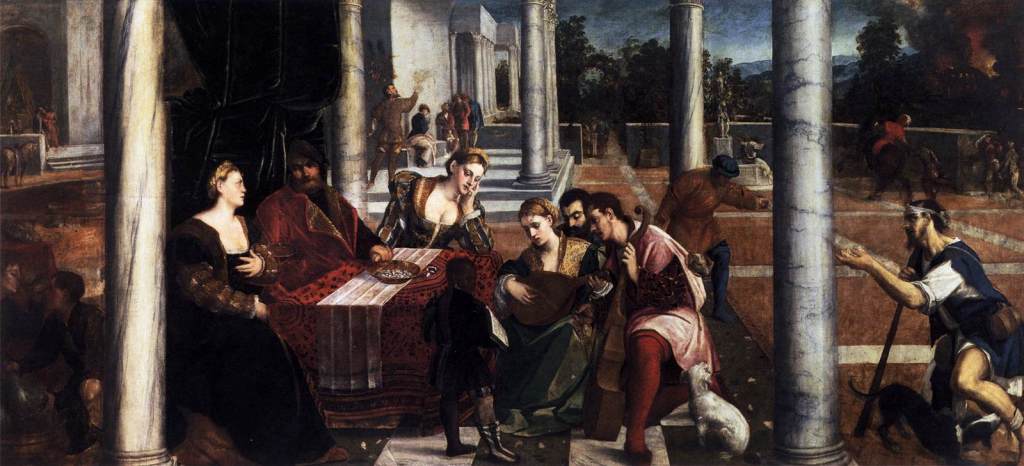
Sinabi ni Jesus sa mga Pariseo, “May isang mayamang nagdaramit nang mamahalin at saganang-sagana sa pagkain araw-araw. At may isang pulubing nagngangalang Lazaro, tadtad ng sugat, na nakalupasay sa may pintuan ng mayaman upang mamulot kahit mumong nahuhulog mula sa hapag ng mayaman. At doo’y nilalapitan siya ng aso at dinidilaan ang kanyang mga sugat.

Lukas 16:19-21
Larawan ng painting ni Bonifacio de Pitati noong 1540 ng “Dives and Lazarus” mula sa commons.wikimedia.org.
Minamahal kong mayaman,

Ako nga si Lazaro at sumusulat ako sa iyo na manhid at ayaw pumansin sa akin dahil ako ay tadtad ng sugat sa buong katawan, nakakadiring tingnan sa aking karumihan at kawalan ng kagandahang mabanaagan dahil ako ay naiiba sa iyo na kinikilala at maraming kaibigan, malakas at malinis.  Kung tingnan.

Mabuti pa ang aso, napapansin ako, dinidilaan aking mga sugat na kailanma'y hindi niya mauunawaan pinagmulan at naging mga sanhi, na pawang mga tao ang may kagagawan.

Isang bagay lang ibig kong ipahayag sa iyo, kapatid ko na mayaman:  sapat na bang dahilan na ako ay iyong talikuran at kalimutan dahil lamang sa ilang halaga ng salapi, mga gamit at ari-arian gaya ng kapirasong lupa na higit pa ang sukat sa ating libingan?

Dahil lamang sa magkakaiba nating paniniwala at sa iyong sariling katuwiran na hindi mabitiw-bitiwan ay ipagpapalit mo ako na kapwa tao gaya ng iyong ina o ama, at kapatid? 

Madalas, ako si Lazaro yung magulang na kung ituring ng mga anak ay kontra-bida sa buhay nila.  

Ikaw iyon, kapatid kong mayaman.

Ikaw iyong bata, yung anak na sadyang mayaman sa kaalaman at kahusayan sa maraming bagay ngunit hindi kailanman sasapat ang mga iyan upang tayo ay mabuhay; mahalaga ang mga kapwa, lalo na mga magulang na nagpalaki at nag-aruga sa atin, mga kapatid na kasabay nating lumaki at lumago, nagkamalay sa mundo, kasama at kasalo sa maraming pagkakataon ng buhay.

Walang perfect love maliban sa pag-ibig ng Diyos; ano man mga nakaraan ikaw ay nasaktan kung maari ay lampasan, pag-usapan, at magpatawaran.

Saan mang tahanan, maraming mga desisyon ang mga magulang na hindi nagugustuhan at marahil hindi rin naunawaan hanggang ngayon; sakaling nagkamali man mga magulang, hindi ba ang mga iyon din ang nagpatibay at nagpatatag upang mga anak ay maging mayaman?  Bakit sila ngayon ang iniiwan, mga Lazaro na nakalupasay sa pintuan na hindi pinapansin, ipinagpalit sa ego at prinsipyo?

Hindi ito drama dahil ang totoo, darating ang panahon tayong lahat mamamatay.

Huwag nating hintayin tulad sa talinghaga ng Panginoon na malibing at mabaon ang mayaman doon sa Hades; ibig mo ba talaga na tayo ay magkahiwalay hindi lamang sa daigdig kungdi hanggang sa kabilang buhay?

Huwag mo nang hintayin, kapatid ko na mayaman na matanawan ako, si Lazaro kapiling ni Abraham, walang dusa at sakit sa kabilang buhay habang ika'y hirap na hirap, kumakaway, tumatawag gayong kakilala mo naman pala ako.  Gayun din naman, kakilala mo rin pala si Amang Abraham --- kung gayon, ikaw ay Kristiyano katulad ko, kilala si Kristo, sumasamba sa Diyos nating Ama!  Bakit hindi mo ako nakilala noong tayo ay nabubuhay pa?

Bahala ka kung ayaw mo pa rin akong pansinin; ito na lamang iiwanan ko sa iyo, higit sa lahat:  huwag kang umasa at maniwala sa ilusyon na makapagbabago ka pa sa tamang panahon lalo na kung kapani-paniwala ang magsasabi na mayroon nga buhay sa kabila!  Ilusyon lang yan na may oras pa upang magbagong-buhay....

Habang maaga pa, magbalik-loob sa Diyos upang siya ay matagpuan at makilala sa mukha ng bawat kapwa, lalo na sa mga Lazaro na tadtad ng sugat ang katawan, nakalupasay sa iyong harapan. 


Lubos na gumagalang,

Lazaro
(Mula sa salitang Hebreo
"El 'azar", ibig sabihi'y
"sinagip ng Diyos".)
Larawan kuha ni G. Jay Javier sa Taal, Batangas, 15 Pebrero 2014.

Talinghaga ng ugnayan natin

Lawiswis ng Salita ni P. Nicanor F. Lalog II, Ika-26 ng Setyembre 2022
Larawan mula sa bloomberg.com ng isang homeless sa New York habang dinaraos noon ang fashion week, 2019.

Sinabi ni Jesus sa mga Pariseo, “May isang mayamang nagdaramit nang mamahalin at saganang-sagana sa pagkain araw-araw. At may isang pulubing nagngangalang Lazaro, tadtad ng sugat, na nakalupasay sa may pintuan ng mayaman upang mamulot kahit mumong nahuhulog mula sa hapag ng mayaman. At doo’y nilalapitan siya ng aso at dinidilaan ang kanyang mga sugat.

Lukas 16:19-21
Alam na alam natin 
ang talinghagang ito
na marahil isasaysay muli 
sa atin ni Kristo
upang magising ating pagkatao, 
makilala sinu-sino
mga tinutukoy 
nitong kuwento
na walang iba kungdi tayo.
Tayo ang mayaman
sagana sa pagpapala di lamang
ng magagarang damit at gamit,
pagkain at inumin
kungdi ng biyaya ng buhay
handog ng Maykapal
na sawimpalad ay ating 
sinasarili, manhid sa kapwa
sarili ang sa tuwina ay tama.
Mayaman tayo 
sa mga pagpapala
ngunit hindi mabanaagan
ni masilayan aliwalas
nitong mukha, ipinagkakait
mga ngiti sa labi, hindi mabati
nakakasalubong upang mahawi
lambong ng kalungkutan,
mapawi pati mga sakbibi.
Ang tunay na mayaman
Diyos ang kayamanan
kanyang nababanaagan 
sa mukha ng bawat kapwa 
na kanyang pinahahalagahan
kesa sa gamit o kasangkapan;
hindi siya kailangang lapitan
ni daingan sapagkat dama niya
hirap at kapighatian ng nahihirapan.
Huwag tayong pakasigurado
na tayo ay mabuting tao
hindi tulad ng mayaman
sa talinghaga ni Kristo
sapagkat si Lazaro
ang taong pinakamalapit
sa iyo, nakalupasay,
nariyan lang sa tabi mo
nilalapitan ng aso maliban sa iyo.
Si Lazaro ang nanay
at ginang ng tahanan
tadtad sa sugat ang katawan
mula sa paglapastangan
ng mga anak at panloloko
ng sariling esposo;
ang mga lola at lolo rin
si Lazaro na namumulot ng mumo
ng pansin at kalinga mula sa mga apo.
Kung minsan si Lazaro
yaong nagtatrabaho sa barko
o malayong dako ng mundo
gaya ni tatay o nanay, ate o kuya
nasaan man sila, tanging pamilya
ang nasa puso nila
 hindi alintana kanilang
pagtitiis at pagpapagal
winawalwal ng kanilang minamahal.
Sino nga ba ako
sa talinghagang ito?
Ang mayaman na manhid
walang pakialam sa kapatid
o si Lazaro nagtitiis ng tahimik
walang imik sa kanyang sinapit
tanging sa Diyos nakakapit
nananalig sa Kanyang pagsagip
upang langit ay masapit!

When you say nothing at all

The Lord Is My Chef Sunday Recipe for the Soul by Fr. Nicanor F. Lalog II
Twenty-Sixth Sunday in Ordinary Time, Cycle C, 25 September 2022
Amos 6:1, 4-7 ><000'> 1 Timothy 6:11-16 ><000'> Luke 16:19-31
Photo by author, Pangasinan, 19 April 2022.
It's amazing how you can speak right to my heart
Without saying a word you can light up the dark
Try as I may I could never explain what I hear when you don't say a thing

The smile on your face lets me know that you need me
There's a truth in your eyes saying you'll never leave me
The touch of your hand says you'll catch me if ever I fall
You say it best when you say nothing at all

Yes, my dear friends, I am so in love these days; the Lord is doing a lot of things in my heart and soul in my ministry that songs automatically play within me like a jukebox every time I pray and meditate. The other day was Five for Fighting’s 100 Years; this Sunday it is When You Say Nothing At All by Paul Overstreet and Don Schlitz first recorded by Keith Whitley in 1988 but became popular with Alison Krauss in 1995 that finally became a worldwide hit with Roan Keating’s version used as soundtrack of the 1999 Julia Robert-starrer Notting Hill.

The lyrics are so lovely, so true while the melody is so cool that is so uplifting and even spiritual as the song tells us a lot of the love of God for us expressed in his Son Jesus Christ who does everything, saying nothing at all, just loving us, understanding us, forgiving us. Most of the time, with us saying nothing at all too because he knows everything.

The more I listen to this song, the more I feel it speaking also of the parable of the Rich Man and Lazarus, of how we truly regard each other as a person, as a brother and sister, as disciples of Jesus when we say nothing at all, when our actions speak loudly or, silently of our love for each other.

Jesus said to the Pharisees: “There was a rich man who dressed in purple garments and fine linen and dined sumptuously each day. And lying at his door was a poor man named Lazarus, covered with sores, who would gladly have eaten his fill of the scraps that fell from the rich man’s table. Dogs even used to come and lick his sores.”

Luke 16:19-21
Photo from bloomberg.com of a homeless man in New York City during a fashion week in summer 2019.

Rich Man, Poor Man

Today’s parable is uniquely found only in Luke’s gospel like last Sunday that stresses Christ’s lesson on the wise use of money in the service of God through one another; but, the parable adds an important dimension in how this wise use of money will have a bearing in our judgment before God upon death. Hence, the gravity of the message expressed in great simplicity with beautiful layers of meaning.

First of all, the rich man has no name while the beggar was named Lazarus that means “God has rescued” or El ‘azar in Hebrew. The scene is still from the previous Sundays when the Pharisees and scribes complained why Jesus welcomed tax collectors and sinners. Jesus took it as an occasion to teach through parables the value of everyone before God, including the lost, the sick, the poor, and the sinful. They are the Lazarus who are given with a name because they are special in the eyes of God who rescues them all.


Then follows the juxtaposition of Lazarus
 lying at the door of the rich man's home
 - a very powerful image that punches us hard
 right in our face, of how numb we have become
 with each other!  

On the other hand, the rich man had no name not because he was less important but because he stands for each one of us blessed and loved by God. Notice that Jesus did not say whether the rich man and Lazarus were good or bad because their character would be revealed later as the parable unfolds.

See how Jesus presented the outer appearances of the two: the rich man was dressed in colorful and fine clothes, eating sumptuous food while Lazarus was somewhat naked, covered with sores in his whole body that dogs would lick as he filled himself with scraps falling from the rich man’s table.

Then follows the juxtaposition of Lazarus lying at the door of the rich man’s home – a very powerful image that punches us hard right in our face, of how numb we have become with each other!

Photo by Mr. Raffy Tima of GMA-7 News, stranded local residents at the airport, June 2020.

Here we find a valuable lesson from this pandemic courtesy of the face mask that finally opened our eyes, including our minds and hearts to look again onto each one’s face, to recognize each person. Before the virus came, we just did not care with everyone we met as we were so cold that we would not even look at each others face, snubbing even those close to us.

There are still other Lazarus around us, living among us, not begging at all from us like this one in the parable who would not say anything at all but silently suffer in pain, hungry and thirsty for recognition and love like parents forgotten and neglected by their grownup children, wives cheated by their spouse, children left alone and misunderstood by their parents, our classmates and colleagues so maligned in the nasty talks going around us and in the social media, the poor and lowly workers exploited by their employers, or just anyone often criticized and judged but never appreciated.

Try thinking of the other Lazarus around us we never bothered to talk to nor even smiled at because we have been preoccupied with our many other worldly pursuits in life. Let us examine ourselves while amid the comforts and luxuries of life may have rightly earned with decent hard work that but may have caused us to have forgotten the “feel” of being human, of being sick and weak that we have forgotten or been totally unaware of those around us.

Death and the urgent call to conversion

See how the parable gets interesting when both characters died and a reversal of situation in the afterlife occurred. The rich man was buried, immediately going down to hell to suffer while Lazarus was carried – not buried – by angels to Abraham in heaven to be comforted. In the two conversations that followed between the rich man and Abraham, we find at the core the primary importance of daily conversion of everyone.

When Abraham told the rich man of the great chasm dividing them that Lazarus could do nothing to alleviate his torment, Jesus is warning us of the exact situation when we die which is eternity, without end. Therefore, while we are still alive, let us be aware and conscious of others too, not just of ourselves. That is essentially conversion, defocusing from our selves to see those around us more.

Remember how the dishonest steward in the parable last week who made friends with the debtors of his master to ensure his good fate after being fired? That finds its application in this Sunday’s parable wherein the rich man should have been like that dishonest steward in befriending Lazarus so he could have made it too in heaven! That is why I love so much that part of the parable of the juxtaposition of Lazarus at the gate of the rich man.

How did the rich man miss and did not see Lazarus right there at his face, hungry and with sores?

From Facebook, 2020.

Let us not be “complacent” as the Prophet Amos warned in the first reading of not being aware of the excesses and sacrilege going on during that time (Am.6:1). It could be happening right now with us when we choose to be silent and uninvolved, even blind and deaf to the suffering people around us because we are like the fool rich man who grew rich for himself instead of “growing rich in what matters to God” (Lk.12:13-21, August 1, 18th Sunday)!

In the second conversation with Abraham by the rich man, we find the pressing need for conversion more urgent, of heeding the calls of the scriptures, of the prophets and of Jesus Christ himself we hear in the gospel proclaimed daily. See also how the rich man had not really changed amid his torments, requesting that Lazarus be sent to warn his brothers living the same way he had lived in order to avoid hell. Imagine while in the afterlife, the rich man was still thinking of those he had left behind on earth!

So ridiculous was his request and yet, we too must be careful because so often, we have such illusion that a clear and irrefutable sign from heaven like what the Pharisees and scribes insisted from Jesus could lead everyone to conversion. It is an illusion because as Jesus had been telling since then, we need to have faith first to see and acknowledge him for us to be converted. It is the same faith that we need to heed St. Paul’s call in the second reading to “Lay hold of eternal life” (1 Tim. 6:12). It is faith that is vibrant and so alive that enables us to recognize our true wealth is God found among one another with us.

When we have faith, whether we are rich or poor, we always see everyone as a brother and sister in Christ. When we have faith, whether we are rich or poor, we are able to love truly because we also believe. And that is when we do not say anything at all because we just keep on doing what is good to everyone, especially the Lazarus among us.

This Sunday, Jesus reminds us of God’s immense love for each one of us, a love we have to share with everyone especially if we have so much unlike others.

Let us reflect our lives these past days and weeks when we felt like Lazarus unrecognized at all, even forgotten amid our being right in the middle of life and everyone. It must be painful and sad. Jesus knows it so well; hold on to him our Savior who is always doing something for us always, especially when he says nothing at all. Amen.

Have a blessed week ahead! God bless you more!

Photo from inquirer.net, Ms. Patricia Non of the Maginhawa Community Pantry, 2021.

Becoming a Jesus Christ, the Good Samaritan

The Lord Is My Chef Sunday Recipe for the Soul by Fr. Nicanor F. Lalog II
Fifteenth Sunday in Ordinary Time, Cycle C, 10 July 2022
Deuteronomy 30:10-14 ><}}}*> Colossians 1:15-20 ><}}}*> Luke 10:25-37
Photo by Mr. Raffy Tima of GMA7-News, May 2022.

After telling us last week to “do not rejoice because spirits are subject to you, but rejoice because your names are written in heaven” (Lk.10:20), Jesus today answers a scholar of the law asking him what he must do to gain eternal life.

It is the very same question we often ask others because inside us we are convinced there is something else deeper than the laws and commandments of God written in the Bible. Like the scholar of the law, we have experienced that God’s commandments and statutes – his very voice, his very words – are written in our hearts.

Moses said to the people: “If only you would heed the voice of the Lord, your God, and keep his commandments and statutes that are written in this book of the law, when you return to the Lord, your God, with all your heart and all your soul. No, it is something very near to you, already in your mouths and in your hearts; you have only to carry it out.”

Deuteronomy 30:10, 14

God’s commandments and laws are not just mere codes of conduct like in other religions. The Law of God is no dead letter but his living Word right in the depths of our hearts no matter how hard we deny his existence. More than a code, the Law of God evokes a relationship that is a fruit of one’s conversion of heart and soul in union with God and with others.

It is here that we find the novel approach by Jesus in narrating the parable of the good Samaritan in answering the scholar of the law who wanted to test him by asking, “Teacher, what must I do to inherit eternal life?” (Lk.10:25) that was followed up with a second one, “And who is my neighbor?” (Lk.10:29) to justify himself. In narrating this parable, Jesus showed us how we must live as neighbors, as brothers and sisters in him who is our head.

Photo from americamagazine.org.

We are all neighbors.

We have heard so many times this beautiful parable by Jesus which only Luke had narrated while the Lord was “resolutely determined to journey to Jerusalem” (Lk.9:51). Too often, we see this parable as a reminder of something we are all aware of, that everyone is our neighbor.

Like the scholar of the law, we are not surprised at all with Christ’s question, “Which of these three, in your opinion, was neighbor to the robbers’ victim?” because we have always thought of the question in our own point of view! We are the ones looking at the victim of the robbers that it is always easy to assume we would be good Samaritan to him which is so presumptuous on our part. Fact is, so often we have failed being a good Samaritan to so many in need who came to us for help because we were like the priest and Levite with many excuses, with more important matters to attend to that they both passed by the robbers’ victim.

Like the scholar of the law, we have failed to see the whole point of Jesus who was asking us to be in the victim’s point of view, to be in his shoes: would anyone be a good Samaritan to help me if I were the victim?

Jesus had reversed the point of view – instead of looking through the window from the outside, we are asked to look at the window from the inside! Would somebody stop to be kind with us?

From inquirer.net.

Many times we have felt so disappointed at some people we were expecting to be our friends, who would be on our side but when trials came, they turned their backs from us and left us alone when suddenly, somebody we least expected or even hardly knew came to help us!

How many times have you found yourself saying, “I thought they considered me as their friend but it turned out, somebody I hardly knew was the one who helped me out of my plight!” Worst, there were times we have said strangers are even better than our family and friends, saying, “Mabuti pa yung ibang tao kesa kamag-anak o kaibigan”.

Hence, to our most Frequently Asked Question (FAQ), “What must I do to inherit eternal life?”, Jesus is asking us to act and live in such a way that everybody sees us as their neighbor, not the other way around. When it is others who see us as their neighbor, it means we are living the gospel, we are like Jesus Christ, the Good Samaritan who came to save us all. It is different when it is us who claim to see everyone as our neighbor – it holds nothing at all but an idea in the mind, a plan or mere intention no matter how noble it may be.

Most of all, to see others as one’s neighbors is a sign of a malady of our faith and religion: that we are not yet evangelized though sacramentalized wherein Jesus is just in our minds but not yet in our hearts, not yet flowing through our very being.

Photo by Lauren DeCicca/Getty Images, Laoag City, 08 May 2022.

The preeminence of Jesus Christ

This oneness in Christ is the gist of Paul’s beautiful exposition about Jesus in our second reading this Sunday. Paul wrote the Colossians while in prison to prevent them from joining some preachers encouraging them to adopt ascetic practices in order to have angelic powers as well as appease higher powers. Paul insisted Jesus Christ is God and what he had accomplished on the cross is sufficient for our salvation.

Christ Jesus is the image of the invisible God, the firstborn of all creation. For in him were created all things in heaven and on earth, the visible and the invisible, whether thrones or principalities or powers; all things were created through and for him. For in him all the fullness was pleased to dwell, and through him to reconcile all things for him, making peace by the blood of his cross through him, whether those on earth or those in heaven.

Colossians 1:15-16, 19

In presenting the preeminence of Jesus Christ, Paul is also telling us that Jesus is the foundation of our moral life. Our lives, our actions must flow from our communion and oneness in Christ. That is when others see us as a neighbor, when they see us as one of them too!

This is the fulfillment of Moses’ teaching in the first reading, that the “voice of the Lord”, the word of God is not far from you for it is in your hearts – that is Jesus Christ who is not only the fulfillment of the laws but the Law himself. After all, as John had expressed in the fourth gospel, Jesus is “the Word who became flesh and dwelt among us”, the Emmanuel, the God-with-us.

From Facebook of Marivic Tribiana, 2021.

Today, Jesus is inviting us that in order to gain eternal life, we must do what he does, that is, to love and be kind with everyone, to be seen as a neighbor and a friend others can count on. In becoming human, God became one of us in Jesus Christ, the one who crossed the street to reach out to us victims of robbers on the way to Jerusalem. He not only healed our wounds but even lifted us to regain our dignity as beloved brothers and sisters. And neighbors.

There is a very beautiful word in English that captures this reality of our being neighbors or brothers and sisters in Christ: “kind” or “kindness” which came from the root kin or kindred. When we say “she or he is kind to me”, it means he or she treats me as a kin or a kindred, not as different like a stranger.

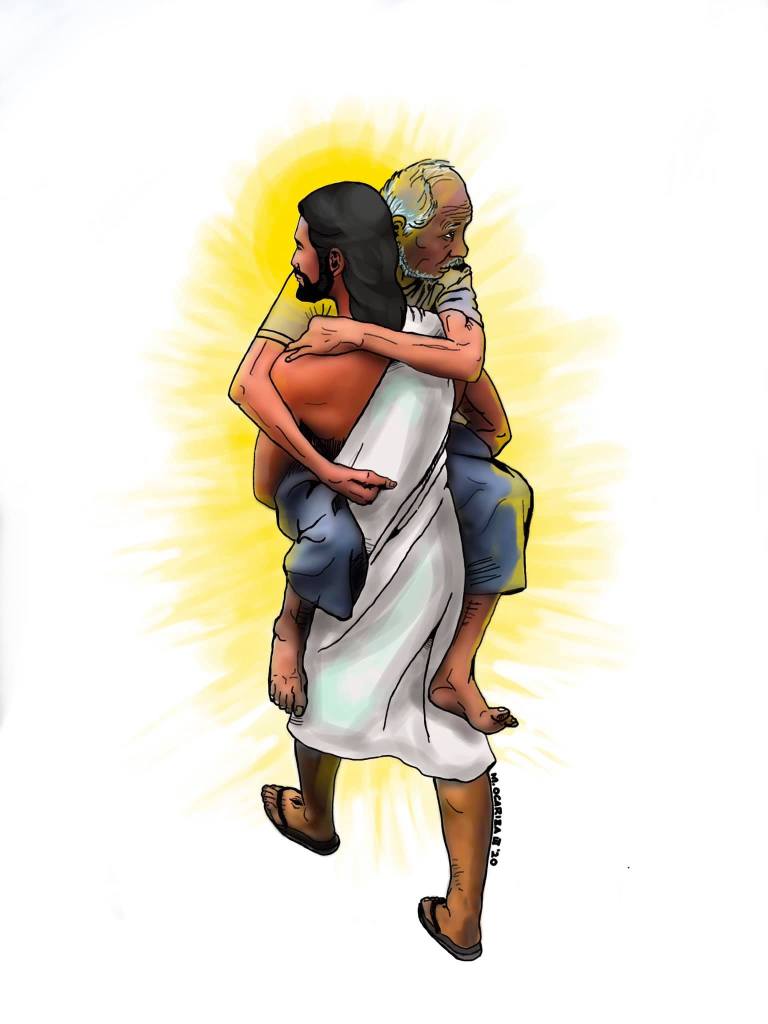
Artwork by Fr. Marc Ocariza based on Marivic Tribiana’s photo, 2021.

We are all kins or kindred in Christ. And every time we choose to be unkind and indifferent with others especially those in need, we are bothered by our conscience because it is an affront to our very personhood. It is unnatural like what the American writer George Saunders had realized:

“So here’s something I know to be true, although it’s a little corny, and I don’t quite know what to do with it: What I regret most in my life are failures of kindness. Those moments when another human being was there, in front of me, suffering and I responded … sensibly. Reservedly. Mildly.”

George Saunders from “Congratulations, By the Way” (page 22)

Avoid having such regrets later in life. Whatever good deed you may do at the moment, do it for it could be Jesus Christ who is passing by, who is the one in need. Amen.

Have a blessed week ahead.