40 Shades of Lent, Friday after Ash Wednesday, 28 February 2020
Isaiah 58:1-9 +++ 0 +++ Matthew 9:14-15
Have mercy on us, O God, have mercy… for we are still totally lost on the real meaning of fasting and abstinence. We have lost its spiritual meaning, focusing more on ourselves for vanity reasons like losing weight and looking good, totally forgetting fasting is all about you and others than us!
How unfortunate, dear God, that we no longer fast on Ash Wednesday and Good Friday but even on Sundays before receiving your Son Jesus in the Holy Communion by making all kinds of excuses with bold claims of having sacrificed so much in doing good deeds for you.
Thus says the Lord God: Cry out full-throated and unsparingly, lift up your voice like a trumpet blast. Tell my people their wickedness, and the house of Jacob their sins. They seek me day after day, and desire to know my ways, like a nation that has done what is just and not abandoned the law of their God. They ask me to declare what is due them, pleased to gain access to God. “Why do we fast, and you do not see it? Afflict ourselves, and you take no note of it?” Lo, on your fast day you carry out your own pursuits, and drive all your laborers. Yes, your fast ends in quarreling and fighting, striking with wicked claw. This, rather, is the fasting that I wish: releasing those bound unjustly, untying the thongs of the yoke; setting free the oppressed, breaking every yoke; sharing your bread with the hungry, sheltering the oppressed and the homeless; clothing the naked when you see them, and not turning your back on your own.”
Isaiah 58:1-4, 6-7
Make us realize that fasting is not punishing ourselves, of denying ourselves with goods and pleasures of the world that leave us empty, wanting for more but never fulfilled deep inside.
Fasting is actually rewarding ourselves with you, O God, our only wealth and treasure, our only fulfillment.
Help us create an empty space within ourselves through fasting and abstinence so that your Son Jesus may dwell and reign in our hearts, saying from within us, “Here I am!” (Is. 58:9).Amen.
40 Shades of Lent, Thursday after Ash Wednesday, 27 February 2020
Deuteronomy 30:15-20 +++ 0 +++ Luke 9:22-25
As we step forward into the second day of Lent, O Lord, you remind us today of your call to conversion which is actually a call to love and a call to life.
Forgive us, O Lord, for those times we have turned away from you in sins, thinking that is the path to life, the path to freedom, the path to fulfillment – only to find out later it is the path to destruction and death.
Moses said to the people: “Today I have set before you life and prosperity, death and doom. If you obey the commandments of the Lord, your God, which I enjoin on you today, loving him, and walking in his ways, and keeping his commandments, statutes and decrees, you will live and grow numerous, and the Lord, your God, will bless you in the land you are entering to occupy. I have set before you life and death, the blessing and the curse. Choose life, then, that you and your descendants may live, by loving the Lord, your God, heeding his voice, and holding fast to him.”
Deuteronomy 30:15-16, 19-20
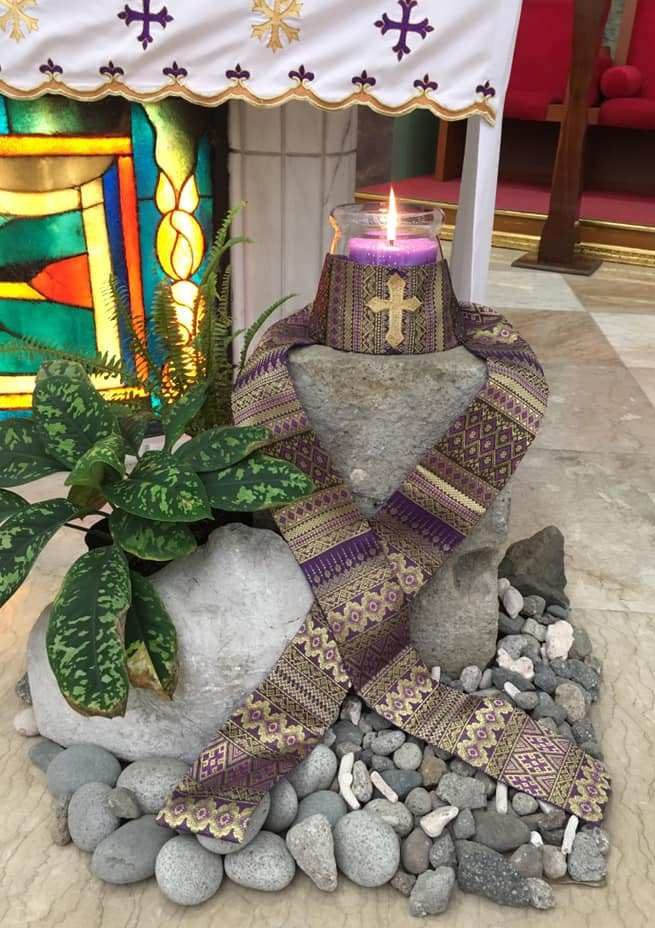
Photo by author, our Parish altar candle, Lent 2019.
Help us, Jesus, “to deny ourselves, take up our crosses daily, and follow you” (Lk.9:23) in the path of conversion and fidelity to your everlasting covenant.
Make us realize that Lent is more than a season we yearly celebrate but a reality of life itself, a life so blessed in your coming to be one with us in our sufferings and struggles.
Give us the strength, dear Jesus, to renew your covenant with us, to always choose God, choose life.
May we also share your love and mercy, understanding and patience, kindness and compassion to our fellow pilgrims in this journey of life so that together in the end, we may all enter into the house of the Father in heaven. Amen.
Lawiswis Ng Salita ni P. Nicanor F. Lalog II, ika-26 ng Pebrero 2020
Mula sa Google.
Mierculés de ceniza
araw ng pag-aayuno at abstinensiya
ngunit tila wala nang nagpapahalaga
ni nakaka-alala.
Marahil ay nalimot na nga
at binalewala mga banal na gawain
tuwing cuaresma na nagpapa-alala
kahalgahan ng Diyos higit sa lahat.
Nagtitiis ng gutom
hindi pinapayagang sayaran
ng anumang laman ang tiyan
alang-alang sa kaganapan at kabanalan.
Kaya nga kung titingnan
pag-aayuno ay higit pa sa sakripisyo
na kung saan tiyan ay walang laman
upang magkapuwang Tagapagligtas ng tanan.
Ngayong cuaresma sana iyong mabuksan
puso at kalooban tingnan ano ba kanilang mga laman
baka naman mga wala nang kabuluhan
pabigat lamang sa kalooban.
Bigyan ng puwang upang makapanahan
sa ating puso at kalooban si Kristong maasahan
upang ngayon pa lamang maranasan
hatid ng Diyos na kaligtasan sa mga sa kanya'y mayroong puwang.
40 Shades of Lent, Ash Wednesday, 26 February 2020
Joel 2:12-18 + + + 2 Corinthians 5:20-6:2 + + + Matthew 6:1-6,16-18
From Google.
We begin today the Season of Lent, the 40 days of prayers and fasting, contrition and alms-giving in preparation for Easter Sunday. It is the only season in our liturgical calendar that starts on an ordinary day, Ash Wednesday when we are reminded of that basic truth in life we have always evaded: that we all die and go back to God.
“Remember man that dust thou art, and unto dust shalt thou return.”
In this age of social media where many practically live in media making known to everyone everything happening to them from confinement to hospital to drinking coffee somewhere or simply saying “thank you” to someone just beside for a gift they have received, the more we need this blessed season to recover the essential realities in life like our true self and God.
So unlike Adam and Eve who went into hiding after their fall, modern men and women have shamelessly flaunt everything they think they have that actually indicate what they lack – depth and meaning, sense and respect.
Ash Wednesday enables us to find anew our bearings in life that must be centered in God, our very life and meaning of being and existence.
Life is a daily Lent.
From Google.
St. Benedict tells his followers in his Rule that “the life of a monk ought to be a continuous Lent”. And this is also very true for every Christian who follows Jesus Christ as Lord and Master.
Our life is a daily Exodus from darkness into light, from sin into grace, from failure into victory, from slavery into freedom when we experience the Paschal mystery of Jesus Christ even if we are not aware of it.
And the sooner we become aware of this reality, the better for us because that is when we find more meaning in life, the deeper our existence becomes.
Pope Francis tells us in his Lenten Message this year that “Jesus’ Pasch is not a past event; rather, through the power of the Holy Spirit it is ever present, enabling us to see and touch with faith the flesh of Christ in those who suffer.”
Life is all about God. This life we live is a sharing in his very life and the more are aware of this reality and link, the more we discover its beauty because we get to know God more in Jesus Christ who have come in flesh and blood for us.
“Brothers and sisters: We are ambassadors for Christ, as if God were appealing through us. We implore you on behalf of Christ, be reconciled to God.”
2 Corinthians 5:20
To be reconciled to God is to be one in God in Christ Jesus through daily conversion. This we achieve through the many sacrifices and corporal and spiritual works of mercy during this season. Fact is, these pious practices are meant to be done even outside the Lenten season so we never lose sight that life is all about God, not us.
From Google.
Lent is a journey into our hearts, and into the heart of God, too!
In these 40 days of Lent, we try little by little to “rend our hearts, not our garments to return to the Lord our God” (Joel 2:13) through prayers and sacrifices. These are done not for others to see but primarily for us to find and meet God waiting for us always to experience his love and mercy, his life and his fullness right in our hearts.
Like in our gospels these past two weeks when we reflected on the “education of the heart”, it is the truth of the heart that is being worked out in Lent. It is our heart that must be strengthened and converted by all these religious practices of the season.
It is in our hearts where God dwells and resides though we often try to bury and disregard.
All these fasting and abstinence, confessions and alms-giving as well as other works of mercy are meant to create a space in our hearts for God and for others. Without the proper attitude in our hearts, everything then becomes a hypocrisy that neither deceives God nor fools humans.
See how Jesus in the gospel which is also a part of his Sermon on the Mount which we have been reflecting these past three Sundays of Ordinary Time have painstakingly reminded us to guard against pleasing humans than God.
Jesus said to his disciples: “Take care not to perform righteous deeds in order that people may see them; otherwise, you will have no recompense from your heavenly Father.”
Matthew 6:1
It is not that we are encouraged to give alms, pray and fast to get rewards from God that Jesus is telling us to practice these pieties but in order to be more focused with the Father. Ultimately, getting into heaven is the reason why Jesus came to save us, to assure us of this reward of being with the Father eternally. There is nothing else greater than that.
This is why Lent is all about God, not us.
From Google.
In our journey to him this season, both as an individual and as a community, Lent enables us to free ourselves from our strong individualistic drives within so we can truly experience conversion in the midst of a community of believers.
The more we see God, we see our sinful selves, and that is when we are converted and renewed in Christ.
This is always marked with a deep realization that we are not alone, that there are also others suffering with whom we must share with God’s rich mercy and love rather than keep these for ourselves alone.
That is what that ash on our forehead reminds us, of God who loves us all, dwelling within each one of us, renewing us, loving us, and most of all, forgiving us. Amen.
The Lord Is My Chef Wedding Homily for Micah and Lery Magsaysay
20 February 2020, Parish of Hearts of Jesus and Mary, Malolos City
Book of Tobit 8:4-9 ><)))*> ><)))*> ><)))*> John 15:12-17
Photo from Micah Magsaysay.
Thank you very much Micah for inviting me to officiate your wedding today with Lery. I love doing this especially with you my former students at the Immaculate Conception School for Boys (ICSB).
I have realized while praying over this wedding homily that those five things I used to tell you every true gentleman should have in his pocket are also applicable to married life.
And so, let us review and reflect on these five things you should have not only in your pocket but in your lives as husband and wife, Micah and Lery.
Now more than ever, in this time of corona virus, you see what we have discussed 20 years ago is very much valid today: always have a clean handkerchief for hygiene. Have two handkerchieves – one for sneezing and coughing, the other for wiping perspirations and dirt from your face.
Preferably, have a white handkerchief to remind you of Jesus Christ who is so pure and clean, sinless and spotless who came to save us by wiping away, taking all the dirt of sins in us.
Every husband and wife is like a handkerchief to each other – cleansing you of dirt and smudges, wiping dry your tears whether caused by pains and hurts or joys and laughters.
A handkerchief reminds us to be kind and merciful with others like Jesus Christ who declared in our gospel this afternoon that it was him who chose you and not you who chose him to be his signs of his presence as husband and wife.
Lery, thank you for making Micah so clean today. You know when they were in high school, he has always been good looking like his buddies – guwaping lang sila talaga, okey na pumapasa – because deep in their eyes I could see they were not ready for the class, all tired and sleepy after playing computers, waiting for their next gimmick.
But today before the Mass started, I went to see Micah and was surprised, not only is he more handsome but this time, serious and really prepared! How you have changed him, Lery, I am amazed. Have more handkerchieves, though, beginning today so you continue to make him clean.
Micah, always have that handkerchief full of pure love like Jesus, ready to die for Lery. Should you make her cry, be man enough to wipe her tears dry. And clean whatever mess you have.
Money
Money is important, Micah and Lery but it is not the most important thing in life, especially for married couples. Do not be enslaved by money. Instead, be generous with others.
Remember the story of Tobiah, the son of Tobit who went to search for a wife in Media where he is also tasked to recover the money his father had deposited in that city. On his way there, he met the Archangel Raphael disguised as a man to work for him as his guide in the journey.
Tobiah was generous to St. Raphael, paying his wage justly. St. Raphael soon found a wife for Tobiah in Sarah. Not only that: St. Raphael taught Tobiah how to drive away the devil Asmodeus who had disrupted Sarah’s earlier seven honeymoons when he would kill her husband just before they would sleep together.
With Asmodeus gone through St. Raphael’s intercession, Tobiah and Sarah prayed and went home to Tobit whose blindness was also cured by the Archangel of healing.
Be like Tobiah and Tobit. Never quarrel about money matters. When you are generous with money in helping those in need, that means you are not yet enslaved by wealth and material things.
Later, Micah you shall hand over to Lery the arrhae or arras that symbolize your money and material wealth. Be true to your pledges to be wise in handling your finances. Heed Mr. Wickfield’s admonition to Aunt Betsey’s nephew David Copperfield to never spend more than what you earn.
Micah and Lery, you are both professionals, working in the office. You are both used to seeing and using all kinds of pen to write and jot things down very important to remember.
Be like the pen, Micah and Lery. In your lives together, always leave a mark of love, a mark of kindness, a mark of understanding.
Most of all, as husband and wife, leave the marks of Jesus Christ. That is the meaning of getting married in the Church, of the Sacrament of Holy Matrimony: you are now the signs of the saving presence of Jesus Christ.
When people see you and feel your deep love for each other, Micah and Lery, they will thank and praise God because they experience Christ’s coming in you.
Photo from Micah Magsaysay.
Comb
I used to tell you in high school that a real man always has a comb, ang sandata ng tunay na lalaki!
Always look good, Micah and Lery! Do not forget your self. Keep in mind that when your kids come and your careers flourish, you were first called by Jesus Christ for each other. Take care of your self, and take extra care of each other!
Photo from Micah Magsaysay.
Continue to go out and date, keep the fire of love burning inside.
After 21 years as a priest, I have less hair now but I still have a comb in my pocket. Just in case the wind blows my hair.
How I wish I have the same long, thick hair of Remo.
The comb does not merely set your hair; it also massages the scalp, soothing you when things are getting so tough and rough.
Take care of yourself, Micah and Lery… never let a “bad hair day” get you down and ruin your love for each other. When you have so much love and care for each other, even if you get old, “kahit maputi na ang buhok ninyo, Micah and Lery”, comb each other’s hair with affections.
Rosary
Photo from Micah Magsaysay.
Last but not least, I used to tell you in high school to always have a rosary in your pocket. A real man is a man of prayer.
Micah and Lery, handle your life with prayer always. Inasmuch as you have invited Jesus today to your wedding day, every day, every Sunday, invite and welcome Jesus into your lives.
May the rosary remind you always of the need to grow deeper in the love of Christ Jesus who chose and called you before this altar today.
Today, you are in Glorious Mysteries where everything is so beautiful and wonderful. But not all days are bright and sunny, Micah and Lery. The Joyful Mysteries are always followed by the Sorrowful Mysteries.
Remember the word PUSH – Pray Until Something Happens.
When you are going through a lot of darkness, the more you should pray and ask for the Luminous Mysteries, the Light of Jesus Christ to guide you and lead you into better days.
Remember those five things we have learned while in high school, Micah. They are still good and applicable in your married life. Teach them to Lery and your future children too.
Handkerchief. Money. Pen. Comb. And Rosary.
May today be the least happiest day of your lives, Micah and Lery. Amen.
The Lord Is My Chef Sunday Recipe for the Soul, Week VII-A, 23 February 2020
Leviticus 19:1-2, 17-18 ><)))*> 1 Corinthians 3:16-23 ><)))*> Matthew 5:38-48
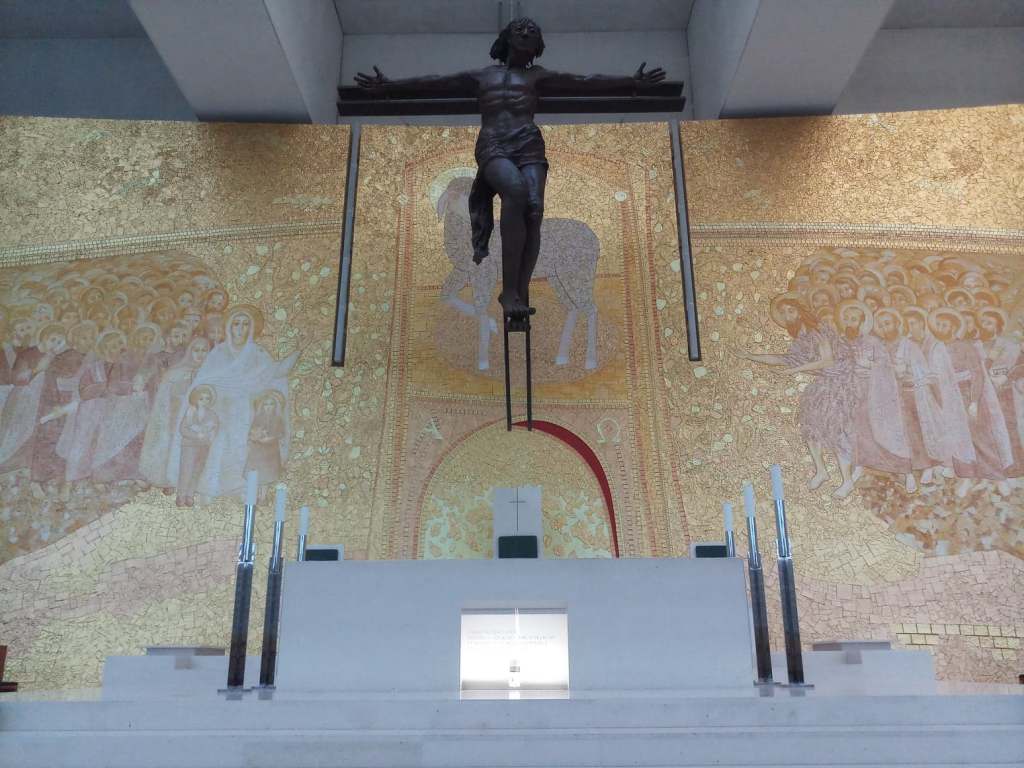
Altar of the modern Minor Basilica of the Holy Trinity at Fatima, Portugal. Photo by Arch. Philip Santiago, 2017.
Jesus concludes his Sermon on the Mount this Sunday just in time for the start of Lent this coming Ash Wednesday. He taught us last Sunday that righteousness is not only measured by acts but most of all by the purity of the heart’s intentions that we call “education of the heart”.
Today Christ comes to the demands of charity and love, the fullness of the Laws in himself.
Jesus said to his disciples: “You have heard that it was said, An eye for an eye and a tooth for a tooth. But I say to you, offer no resistance to one who is evil. When someone strikes you on your right cheek, turn the other one as well… You have heard that it was said, You shall love your neighbor and hate your enemy. But I say to you, love your enemies, and pray for those who persecute you, that you may be children of your heavenly Father..”
Matthew 5:38-39, 43-45
See again the Lord’s pattern in his preaching like last Sunday: a recall of the laws to show his adherence to them contrary to claims of his enemies, and then his infusion of his teaching that perfects the laws: “You have heard… But I say to you…”
Jesus focuses only on two laws today, that of revenge or “lex talionis” (from Latin talio for the word such) and that of hate for enemy which needs some clarifications.
Nowhere do we find in the Laws of Israel “to love your neighbor and hate your enemy”. Experts say Jesus must be citing a popular saying of his time in this part of his teaching. Besides, the Aramiac spoken by the Lord does not connote the harsh meaning we have today for the word “hate”. In short, Jesus is correcting here the norm among Jews of his time to “just love those who love us”.
This is why he adds this beautiful explanation with the most unique conclusion of all.
“For if you love those who love you, what recompense will you have? Do not the tax collectors do the same? And if you greet your brothers only, what is unusual about that? Do not the pagans do the same? So be perfect, just as your heavenly Father is perfect.”
Matthew 5:46-48
Photo by Lorenzo Atienza, 12 June 2019, Malolos Cathedral.
A fraternity of humanity in the Father
Here we find a beautiful dimension of Jesus Christ’s assertion last week that he had come to fulfill the Laws: more than having a broader approach to the spirit of the laws, education of the heart leads us to see everyone as a brother and a sister.
No one is different. Every one is a family – a kin! which is the root of the word “kind”.
Being kind is more than being good as we say in Filipino, mabait or mabuti.
Being kind is treating the other person as a kin, a relative or family; someone who is not different from us. When we say “he is kind to me”, it means more than being good to me but treating me as a family, a brother or a sister – not as “another” or “iba sa akin” as we say in Filipino.
Photo by author, Mt. St. Paul, Baguio City, 03 February 2020.
This is the essence of our “Year of Inter-religious Dialogue, Ecumenism, and Indigenous Peoples” in preparation next year of our 500 years of Christianity in the country.
Everybody is included in that celebration as we reach out to peoples of other faith and beliefs as well as to the indigenous peoples whose forefathers were actually the first settlers of the country.
This is very important in any dialogue and relationship and partnerships including marriage: there must always be the acceptance of everyone in equal footing with same dignity as a person. It is from here we start that fullness of the Laws in Christ in love.
Human holiness as a reflection of God’s holiness in love
Love can only happen where there is equality and fairness. Love demands we are first of all at equal footing with each other. This is why Jesus became human like us: the Son of God became human to stand on equal footing with us that we cannot argue that he is greater because he is truly human, too, going through everything we have gone through except sin.
When he said that we offer our other cheek, to give our cloak, and go for another mile, he is not referring to criminal or penal codes but more into our humanity, that spirit of universal brotherhood so that even our oppressors and enemies come to realize within them that we are one, that we should be caring for one another, not hating and hurting each other.
Loving our enemies does not mean we let evil continue; loving our enemies means continuing to “love” perpetrators of evils until they realize we are brothers and sisters, keeping each other, caring for each other.
Loving our enemies is making them realize that there are nobody else here on earth for them except us – why fight and perish?
Yes, these are easier said than done. And admittedly, I must confess it is the most difficult part of the gospel, of being a Christ-ian. But it is something Jesus is asking us in the most personal manner.
From Google.
Let it be clear that Jesus is not asking us to behave with naiveté that we give in to injustice, evil, and violence but that we always be peacemakers, the blessed ones he said in his Beatitudes. In our fight for justice and peace, we fight with the moral persuasions of love which is the morality of Christ.
The American civil rights leader Rev. Martin Luther King, Jr. had shown in our modern time that the Lord’s teachings are doable: we just have to be convinced and must truly believe in Jesus.
“Love is the most durable power in the world. This creative force is the most potent instrument available in mankind’s quest for peace and security.”
Rev. Martin Luther King, Jr.
When we love truly in Jesus Christ, asserting what is true, what good, what is just, we make God truly present in the world. When that happens, the more we allow him to do his works of changing us within, of transforming us within. It is in our imperfect love that we make God present, the perfect I Am.
The Lord said to Moses, “Speak to the whole Israelite community and tell them: Be holy, for I, the Lord your God, am holy. Take no revenge and cherish no grudge against your people. You shall love your neighbor as yourself. I am the Lord.”
Leviticus 19:1-2, 18
Photo by Dra. Mai B. Dela Peña, Santorini in Greece, 2016.
Hubris, our greatest temptation and sin
The Season of Lent is fast approaching us, set to start with Ash Wednesday this week. It is a season characterized by barrenness: no Gloria and Alleluias, no flowers, no decorations, no images to make us turn back to God again, our Lord and Master alone.
St. Paul reminds us today in our second reading that we are “God’s temple… that there is no need to boast of anyone including one’s self” (1Cor. 3:16, 21). Instead of embracing or holding on to anyone including one’s self, we have to embrace the scandal of the cross of Christ, that is, power in weakness, wisdom in what the world considers folly.
For the ancient Greeks as depicted in their epics, the greatest temptation and sin of man is hubris – the arrogant presumption that he is god, that he can do everything, he can have everything that he defies the gods.
Hubris is the sin of pride that has led everyone from Adam and Eve to all the powerful men and women of history into their downfall. It is absolute power crumbling absolutely, always tragically.
In his Sermon on the Mount where we heard many of the Lord’s teachings this whole month of February, Jesus shows us the path away from hubris, his path of love and holiness in the Father. Let us heed his calls, give his teachings a try and a chance to be fulfilled in us.
Soon afterward Jesus journeyed to a city called Nain, and his disciples and a large crowd accompanied him. As he drew near to the gate of the city, a man who had died was being carried out, the only son of his mother, and she was a widow. A large crowd from the city was with her. When the Lord saw her, he was moved with pity for her and said to her, “Do not weep.” He stepped forward and touched the coffin; at this the bearers halted, and he said, “Young man, I tell you, arise!” The dead man sat up and began to speak, and Jesus gave him to his mother. Fear seized them all, and they glorified God, exclaiming, “A great prophet has arisen in our midst,” and “God has visited his people.”
Luke 7:11-16
Today, we are like at the city of Nain. Traffic is so heavy outside as many of us – family and friends, former classmates, colleagues at work from all over and neighbors – gather to pray and pay our last respects for Archie.
Celebrating a funeral Mass for a young person is always difficult for me. Like Jesus, I feel so sad for their parents. Normally, it is the children who bury their parents. It must be so painful for parents burying a son or a daughter. That is why in our gospel, Jesus was “moved with pity” with the widow of Nain.
But today, amid the pains and sorrows with the sudden death of Archie last week at a very young age, we actually celebrate life in Jesus Christ.
Photo by author of the hills of Galilee from the Walls of Jerusalem, May 2017.
Jesus comes to visit us always
Like in that scene at Nain, we remember and celebrate the life of Archie who had come to visit us even for a short time.
I love that part of the gospel where the people at Nain exclaimed at how “God has visited his people” when Jesus raised the dead young man.
Jesus continues to visit us everyday through one another like Archie.
Despite his many sins and imperfections, Archie made us experience Jesus Christ’s love and friendship, warmth and kindness, especially to his two sons, family, and friends.
Surely, Jesus must have visited Archie, too, during those dark moments of his life.
And the good news is, Archie visited Jesus so often especially these last two years when he started to pick up the pieces of his life.
Last time I saw Archie was last November when he came to celebrate Mass in our Parish. And I have heard how he had sought spiritual guidance from Fr. Carl, driving that far to Paco every month as he renewed his relationship with Christ, trying to follow anew the Lord he had served since elementary as a sacristan and later as a seminarian in our high school seminary.
It is Jesus who first finds us always
Photo by author at Mt. St. Paul Spirituality Center, Baguio, 04 February 2020.
We all know Archie’s tocayo is one of ancient Greece’s great scientist and inventor, Archimedes.
It is said that he discovered the principle of buoyancy – the “Archimedes’ principle” – while taking a bath.
When Archimedes sat onto his bathtub, he observed that “when a body is submerged in a fluid, it experiences an apparent loss in weight that is equal to the weight of fluid displaced by the immersed body.”
Archimedes was so ecstatic with his accidental discovery that he jumped naked from his bathtub out to the streets, shouting “eureka!” or “I have found” the solution to a problem he was trying to solve at that time.
Archimedes had not only enriched the field of mathematics and sciences with his discoveries but also the English language with the word “eureka” or “eureka moment”: when somebody discovers something very significant in business and economics, the sciences especially medicine, and practically in every field and subject.
Most especially in life.
Photo by author, Mt. St. Paul Spirituality Center, Baguio, 04 February 2020.
Archie had the same eureka moment in life: he had found Jesus Christ again that he went back to Mass and Confessions.
He had found meaning in life again after losing hope and directions.
Most of all, Archie had found love again.
Like his namesake of ancient Greece, Archie is now exclaiming “eureka” ecstatically into heaven – naked – with nothing but the love and mercy of Jesus Christ who first found him and brought him back to life a few years ago.
Today as we bring the remains of Archie into his final resting place, we thank God who never stops looking for us, finding us so that we can find him again and finally rest in him.
Today it is Jesus who is most ecstatic of all because he is the first to have found Archie and that is why, he had called him back to him, never to get lost again.
But the souls of the just are in the hand of God, and no torment shall touch them. They seemed, in the view of the foolish, to be dead; and their passing away was thought an affliction and their going forth from us, utter destruction. But they are in peace. In the time of their visitation they shall shine.
Your words today, O Lord, are disturbing, dealing with our senses, with our face, reminding us to attune everything we see, hear, and say – our very selves – to you as your reflection of the Father’s mercy.
Know this, my dear brothers and sisters: everyone should be quick to hear, slow to speak, slow to anger. Therefore, put away all filth and evil excess and humbly welcome the word that has been planted in you and is able to save your souls. Be doers of the word and not hearers only, deluding yourselves. For if anyone is a hearer of the word and is not a doer, he is like a man who looks at his own face in a mirror. He sees himself, then goes off and promptly forgets what he looks like.
James 1:19,21-24
What really matters is what is inside of us, of what comes out from us, our thoughts and actions that reveal our faith in you.
So many times, Lord Jesus, we fail to walk our talk.
Indeed, what we see can be deceiving.
We need to once in a while separate from the crowd, from our daily routine to be with you to adjust our sights.
There are times we see the same things and that is why we live the same way too.
But whenever we spend time just with you alone, Jesus, then we see the realities and most of all, we see far and beyond what is before us.
O sweet Jesus, continue to disturb us, to cleanse our senses – our eyes, our ears, our lips – so that we may mirror your love and mercy in our face, in our lives today especially for those going through many difficulties, those who have lost faith and hope in you and the church. Amen.
Lawiswis ng Salita ni P. Nicanor F. LaLog II, 18 Pebrero 2020
Larawan kuha ng may-akda sa Mt. St. Paul, Trinidad, Benguet, 05 Pebrero 2020.
Buhat nung isang gabi
hindi ako mapakali
nang si Hesus ay hindi makapagtimpi
napabuntung-hininga ng malalim
nang makipagtalo sa kanya
mga Pariseo humihingi ng tanda
na siya nga ang Kristo.
Hindi ba turo ng matatanda
hanggang ngayon siyang laging paalala
masama magbuntung-hininga
na tila baga wala ka nang pag-asa?
Gayun pa man maski ito ay ating alam
madalas hindi natin mapigilan
kapag nahihirapan at nabibigatan.
Katulad natin marahil
si Hesus napupuno na rin:
nagbubuntung-hininga,
humuhugot ng kabutihan
sa kanyang kaibuturan
upang malampasan
mga kasamaan ng kalaban.
Iyan ang kabutihan
magandang kahulugan
nitong pagbubuntung-hininga
na pilit tinatanggihan, di naman maiwasan
dahil ating nang nakagawian
pumaloob sa kaibuturan
kaysa makipag-awayan
Hindi kaduwagan
bagkus katapangan kung minsan
dahil iyong sinasaalang-alang
katiwasayan ng ating mga ugnayan
kaya pilit sinisisid, sinasaid kabutihan
doon sa kalaliman ng kalooban
kung saan nanahan Panginoon ng Kapayapaan.
Larawan kuha ng may-akda, Poblacion ng Los Baños, Laguna, 13 Pebrero 2020.
























 lordmychef.com