The Lord Is My Chef Daily Recipe for the Soul by Fr. Nicanor F. Lalog II
Monday, Memorial of St. Cyril, Bishop and St. Methodius, Monk, 14 February 2022
James 1:1-11   ><]]]]*> + ><]]]]*> + ><]]]]*>   Mark 8:11-13
Photo by Ms. Jo Villafuerte, 2019.
So many people today, O Lord,
are so busy and excited, being
Valentine's day, a day of the heart
when sweethearts speak sweet
nothings, giving flowers to
express their love to their beloved.
I can't blame them, O Lord,
for being taken for a ride in this
highly commercialized world that
has become more stressful;
people have been suffering from
so many forms of difficulties and
trials that for many, they try to
escape momentarily.
Consider it all joy, my brothers and sisters, when you encounter various trials, for you know the testing of your faith produces perseverance. And let perseverance be perfect, so that you may be perfect and complete, lacking in nothing.
James 1:2-4
Teach, O Lord, to consider it true
joy and a blessing in disguise every
trial we go through in life; inasmuch as
we greatly dislike inconvenience and
sufferings, failures and powerlessness,
poverty and sickness, may we recall
yesterday's Beatitudes, that true
blessedness and joy come from going
through these difficulties that bring out
the best in us through time than the
instant gratifications and feel-good
offered by the world.
Grant us the wisdom to appreciate
the trials that come our way, producing
in us the depth and maturity that lead
to fulfillment and perfection; may we
stop looking for outward signs like
those Pharisees who kept on debating
with Jesus without any intentions of
being open to find and accept him.
Amen.
Strictly speaking, today’s Feast of the Presentation of the Lord should be the closing of the Christmas season. It is the 40th day since the birth of Jesus when Mary had completed her days of purification to leave Bethlehem and offer her child with Joseph in the temple in accordance with their law that “every male that opens the womb shall be consecrated to the Lord” (Lk.2:23).
And like Christmas, we find in the Lord’s presentation his Cross looming tall, enlightening us how Jesus and his Cross, joy and suffering, life and death cannot be separated. In Simeon’s Canticle, we find that life’s many contradictions make living wonderful and meaningful, too! (See our Sunday homily, https://lordmychef.com/2022/01/29/living-loving-amid-contradictions/).
He (Simeon) came in the Spirit into the temple; and when the parents brought in the child Jesus to perform the custom of the law in regard to him, he took him in his arms and blessed God, saying: “Now, Master you may let your servant go in peace, according to your word, for my eyes have seen your salvation, which you prepared in sight of all the peoples, a light for revelation to the Gentiles, and glory for your people Israel.”
Luke 2:27-32
Photo by Mr. Raffy Tima of GMA-7 News, March 2020.
“Coming to terms with death is coming to terms with life.”
First thing we realize in this beautiful canticle of Simeon is the true meaning of joy in finding Jesus wherein we learn to befriend death as we come to terms with life and living. It is difficult to explain but evidently, it was pure joy that led Simeon bursting into a song.
St. Paul had a similar experience while in prison which he tried to explain to the Philippians when he wrote, “For to me life is Christ, and death is gain. If I go on living in the flesh, that means fruitful labor for me. And I do not know which I shall choose. I am caught between the two. I long to depart this life and be with Christ, for that is far better. Yet that I remain in the flesh is more necessary for your benefit” (Phil.1:21-24).
Those who have cared and lost a loved one to cancer or any terminal illness have experienced Simeon’s canticle. Remember when our loved ones have finally accepted their fate, when they suddenly become more emotionally stable and even joyful in their dispositions? Unlike before when they were first diagnosed with their illness, they were so afraid, always crying but as they came to embrace the reality, they cried less with a strong sense of courage while we are the ones crying more and most stressed out?
That is because the dying must have seen their direction, their final destination in life.
Like Simeon, they have seen God in the light of Jesus Christ while we who are to be left behind cry more not only due of the pain and sadness of separation but because we do not know where we are going, where we are heading to once our loved ones die. Feel the courage and confidence of Simeon boldly telling God to take him at that instance because he had found “the way, the truth and the life”, Jesus Christ!
Too often, we Filipinos take it as a joke, perhaps laughing to dismiss the topic or cope with the reality that to see God means to die like when we say “gusto nang makita si Lord”. But, that is the truth that Simeon is telling us in today’s gospel which is more “felt” in our own language, “Kunin mo na, Panginoon, ang iyong abang alipin, Ayon sa iyong pangako, Yamang nakita na ng aking mga mata ang iyong pagliligtas” (Lk.2:29-30). Imagine Simeon like the teenagers telling God to take him “now na!”?
Here we find at the presentation of the Lord in the temple how Simeon realized that coming to terms with death is coming to terms with life.
Photo by Ms. Nikki A. Vergara, 2020.
“Coming in the Spirit is living in the presence of God.”
Second thing we find in Simeon’s Canticle is the preeminence of the Holy Spirit in his life. We can never experience and find Jesus without being attuned first with the Holy Spirit who animates us and opens us to Christ’s coming.
Imagine the great crowds of people at the temple on that day, of couples trying to fulfill the law of Moses of purification and presentation of their first-born sons to God. How did Simeon know Joseph and Mary were the parents of Jesus? How was he able to accurately spot and find Jesus is the Messiah amid the many male children being offered on that day at the temple?
“To come in the Spirit” like Simeon is more than being faithful to God; it is having a good and pure heart that is ready to believe and act openly with courage, always looking forward at the fulfillment of what we believe. Coming in the Spirit is being at the right place at the right time when we make things happen than wait, exactly how Luke portrayed Simeon and Anna who both lived in the presence of God! Coming in the Spirit in living in the present moment in God.
Thirdly, we cannot see Christ nor live in the Spirit unless we humbly submit ourselves to God, our Lord and Master. Seeing Christ and living in the Spirit presuppose humility before God – we his creatures, he our Lord and Master.
Most of all, God our origin and our end too!
It is the principle and foundation of life as St. Ignatius of Loyola stressed in his Spiritual Exercises, “El hombre es criado para alabar, hacer reverencia y servir a Dios nuestro Señor, y mediante esto, salvar su anima”, that is, “Man is created to praise and serve God his Lord and Master and by doing this save his soul”.
There is something so beautiful and lovely, so touching in the opening verse of Simeon’s canticle that underscores firmly this basic truth we have always forgotten since the fall of Adam and Eve: “Now, Master you may let your servant go in peace, according to your word, for my eyes have seen your salvation, which you have prepared in sight of all the peoples” (Lk.2:29-31). Every time we sin, we act like Adam and Eve, playing gods, desiring to be like God.
Also known as Nunc Dimittis, Simeon’s canticle echoes the fiat of Mary to God during the Annunciation, expressing his fidelity and humility, his total submission to God. Most of all, it summarizes both the Magnificat of the Blessed Mother and the Benedictus of Zechariah, making Simeon’s Nunc Dimittis the finale in Luke’s Christmas “concert” on the birth of the Messiah.
This is the reason why we sing or recite Nunc dimittis at the end of our Night Prayer called Compline from the Latin completorium for “completion of the waking day”. It is the perfect prayer to close each day as we prepare for the coming brand new day to meet Jesus again, hoping we may be enlightened us in our life’s mission.
Or, if ever we do not wake up the following day, we thank God all the more in making us meet Jesus the past day, eager to finally sing to him our praises in eternity. Amen.
Photo by Mr. Raffy Tima of GMA-7 News, 18 January 2022.
Lawiswis Ng Salita ni P. Nicanor F. Lalog II, Ika-02 ng Pebrero 2022
Kapistahan ng Paghahandog kay Jesus sa Templo
Malakias 3:1-4 ><}}}}*> Hebreo 2:14-18 ><}}}}*> Lucas 2:22-40
Larawan mula sa crossroadinitiative.com.
Ngayon ang ika-40 araw mula ng Pasko ng Pagsilang ng Panginoong Hesus sa Bethlehem, Kapistahan ng Paghahandog sa Kanya sa Templo ng kanyang mga magulang na sina Maria at Jose.
Bukod tangi lamang itong salaysay na matatagpuan sa ebanghelyo ni San Lucas sapagkat ibig niyang ipakita noon sa kanyang mga mambabasa at mga taga-sunod na pumarito si Hesus para sa lahat ng tao, hindi lamang sa mga Hudyo.
Una itong pinagdiwang ng mga Kristiyano sa Jerusalem at lumaganap sa Silangan noong taong 500 kung saan ito tinawag sa wikang Griyego na “Ypapante” na ibig sabihi’y ang “Pagtatagpo” nina Hesus at ng dalawang matanda sa templo na sina Simeon at Anna.
Mula Silangan, umabot ang pagdiriwang na ito sa Europa na nakilala bilang kapistahan din ng Paglilinis ni Maria o “Purification of Mary”. Sa France, nagkaroon ng seremonyas ang mga Kristiyano ng pagbabasbas at pagsisindi ng mga kandila bago pumasok ng simbahan bilang pagkilala kay Hesus na tanglaw ng mundo ayon sa pahayag ni Simeon sa templo, “Liwanag itong tatanglaw sa mga Hentil, At magbibigay-karangalan sa iyong bayang Israel” (Luc. 2:32).
Kaya nang makarating sa Roma ang tradisyong ito noong taong 800, ito rin ang ginawang seremonya ni Papa Sergio I kaya tinagurian itong Candelaria (kandila). Makalipas ang mahigit isang libong taon noong 1962 sa Vatican II, ibinalik sa tunay na pangalan ito bilang Kapistahan ng Paghahandog sa Templo ngunit pinanatili ng mga obispo ang tradisyon ng pagbabasbas at pagsisindi ng mga kandila upang ipakita na si Hesus ang tunay na liwanag sa mundo sa aakay sa atin pabalik sa Diyos.
Kuha ni G. Cristian Pasion, Pasko ng Pagkabuhay, 2021.
Mahalaga na ating mapagnilayang muli at makita sa panahong ito na si Hesus ang tanging liwanag sa ating buhay na tumatanglaw sa gitna ng maraming artipisyal na mga ilaw, mga ilaw na ang binibigyang liwanag ay mga tao at kung sinu-sinong ibig na maging sikat o ibig kilalanin.
Ito yaong mga artipisyal na ilaw ng mga kamera at media na ang pinakikita o ang tinatampok bilang “highlight” ay mga karangyaan, kapangyarihan, katanyagan at mga kapalaluan sa mundo.
Inaanyayahan tayo ng kapistahang ito na tularan sina Simeon at Anna na inabangan buong buhay nila si Hesus na siyang tunay na liwanag ng ating buhay na dapat din nating hanapin, lapitan at sundan.
May isang tao noon sa Jerusalem, ang pangala’y Simeon. Matapat at malapit sa Diyos ang lalaking ito at naghihintay sa katubusan ng Israel. Sumasakanya ang Espiritu Santo na nagpahayag sa kanya na hindi siya mamamatay hangga’t hindi niya nakikita ang Mesiyas na ipinangako ng Panginoon.
Lucas 2:25-26
Bukod sa tanging si San Lucas lamang ang may kuwento ng tagpong ito, mayroon din siyang ginamit na kataga na hindi ginamit ng sinumang manunulat ng Bagong Tipan o maging ng alin mang aklat sa buong Bibliya.
Ito yung salitang naglalarawan kay Simeon bilang , “malapit sa Diyos” na sa Inggles ay “devout”.
Alam na natin yung salitang “righteous” o “matapat” na ginamit din ni San Mateo upang ilarawan si San Jose bilang taong matuwid o banal na tumutupad sa mga batas at alituntunin ng kanilang relihiyon.
Ngunit iyong “malapit” o “devout” sa Inggles o “deboto” sa pangkaraniwang pananalita, tanging si San Lucas lamang ang gumamit niyon sa buong Bibliya. Apat na ulit niya itong ginamit: minsan sa ebanghelyo na ating napakinggan at tatlong ulit sa ikalawang aklat niyang sinulat, Gawa ng mga Apostol.
Mas maliwanag ito sa Inggles nang tawagin ni San Lukas ang mga Hudyong pumunta sa Jerusalem noong Pentecostes bilang mga “devout Jews” o “mga taong palasamba sa Diyos” (Gawa 2:5); tinawag din niyang mga “devout men” o “mga taong may takot sa Diyos” yaong mga naglibing sa ating unang Martir na si San Esteban (Gawa 8:2); at sa pagsasalaysay ni San Pablo ng kanyang pagbabalik-loob, ginamit na salita muli ni San Lucas sa kanyang kuwento upang ilarawan si Ananias bilang “a devout observer of the law” o “taong may takot sa Diyos” (Gawa 22:12).
Alalaong-baga, para kay San Lucas, ang isang “devout” na tao, o wika nga natin deboto ay isang taong malapit sa Diyos dahil siya ay mayroong takot sa Diyos kaya tumutupad sa Kanyang mga utos! Hindi lamang sila matapat o faithful kungdi mayroong malinis na puso at laging handang tumupad ng buong tapang sa kalooban ng Diyos.
Kaya nga sa ating mga Pinoy, ang deboto ay taong malapit, yaong mayroong matalik na ugnayan sa Diyos at sa kapwa!
Sila yaong mga kaibigang maaasahan, mayroong sariling kusa at hindi naghihintay na pagsabihan pa kung ano ang gagawain. Mayroong sariling-palo katulad nina Simeon at Anna na kusang naghihintay, lumalapit sa Diyos at Panginoon.
“Presentation at the Temple” painting ng Italian Renaissance artist Andrea Mantegna noong 1455; hawak ni Mari ang Banal na Sanggol habang si San Jose naman sa gitna ay nakatingin kay Simeon na mayroong balbas na puti. Larawan buhat sa wikipedia.org.
Nadadalisay ang ating pagiging malapit sa Diyos sa isang buhay-panalangin na kung saan mayroong disiplina sa pagdarasal na hindi lamang mga salitang inuusal ng bibig kungdi sinasapuso.
Masdan paanong sinabi ni San Lucas sina Simeon at Anna na palaging nasa templo nananalangin. Higit sa lahat, ang pananalangin ay kaisahan sa Diyos kaya nabatid kaagad ng dalawang matanda na dumating na si Hesus sa pag-uudyok sa kanila ng Espiritu Santo.
Katulad din yan ng pagkakaroon ng matalik na kaibigan: palagi kayong nag-uusap, nagbabahaginan at nag-uunawaan kaya mayroong kaisahan.
Ang pagiging malapit sa Diyos o deboto ay hindi lamang pagaalaga at pagkolekta ng mga imahen at aklat dasalan kungdi pumapaloob sa kalooban ng Diyos na siyang sinasabi ni propeta Malakias sa unang pagbasa na biglang darating ang Panginoon sa kanyang templo na siyang ating mga sarili.
Gayun din naman, ang taong malapit sa Diyos palaging malapit sa kapwa, lalo na sa mga maliliit at nahihirapan sa buhay gaya ng mga may-sakit at kapansanan. Pagmasdan paanong kinilala ni Simeon mga magulang ni Hesus sina Maria at Jose. Binigyan niya ng halaga kanyang mga kapwa-tao hindi lamang ang Panginoong Hesus.
Ang tunay na kaibigang matalik ay yaong naglalapit sa atin sa Diyos at kabutihan, hindi kasalanan at kapahamakan. Nakakatagpo natin si Hesus sa ating mga kapwa tao gaya ng sinasabi ng may-akda ng sulat sa mga Hebreo na ating napakinggan.
Higit sa lahat, ang taong malapit sa Diyos o isang deboto ay puno ng tuwa at kagalakan. Damang-dama ang tuwa at galak nina Simeon at Anna nang makatagpo at makalong si Hesus na sa sobrang tuwa nila sila’y handa nang mamatay.
Iyon ang tunay na palatandaan ng malapit at nakatagpo sa Diyos: puno ng tuwa na anuman ang sapitin sa buhay, hindi niya alintana ang mga takot at pangamba, maging kamatayan sapagkat ito ang maghahatid sa tunay na paglapit at pagbuklod sa Ama kay Kristo Hesus. Amen.
Larawan kuha ng may-akda, Santo Niño Exhibit sa katedral ng Malolos, Enero 2022.
The Lord Is My Chef Sunday Recipe for the Soul by Fr. Nicanor F. Lalog II
Sunday IV-C in Ordinary Time, 30 January 2022
Jeremiah 1:4-5, 17-19 ><}}}}*> 1 Corinthians 13:4-13 ><}}}}*> Luke 4:21-30
Photo by Dr. Mai B. Dela Peña, Santorini, Greece, 2017.
Life and love are full of contradictions that make both so wonderful, so appealing, and so engaging. The more contradictions we encounter in life and love, the more we become better persons, more like Jesus Christ who is himself “the sign of contradiction”.
We are still inside the synagogue at Nazareth where Jesus had come one sabbath, proclaiming – and claiming himself as the fulfillment of that part from the Book of Isaiah he had read. And here we find him already a sign of contradiction at the inauguration of his ministry!
People were amazed with him at the beginning but, soon enough, their true colors appeared: first, they doubted him for being the “son of Joseph”; then, they became hostile to him after hearing him say how God sent Elijah and Elisha to help pagans after being rejected too by their ancestors.
He said to them, “Surely you will quote me this proverb, ‘Physician, cure yourself,’ and say, ‘Do here in your native place the things that we heard were done in Capernaum.'” And he said, “Amen, I say to you, no prophet is accepted in his own native place. Indeed, I tell you, there were many widows in Israel in the days of Elijah when the sky was closed for three and a half years and a severe famine spread over the entire land. It was none to these that Elijah was sent, but only to a widow in Zarephath in the land of Sidon. Again, there were many lepers in Israel during the time of Elisha the prophet; yet not one of them was cleansed, but only Naaman the Syrian.” When the people in the synagogue heard this, they were filled with fury. They rose up, drove him out of the town, and led him to the brow of the hill on which their town had been built, to hurl him down headlong. But Jesus passed through the midst of them and went away.
Luke 4:23-30
Photo by Dr. Mylene A. Santos, MD, a Black Winged Stilt (Himantropus himantopus), Quezon Province, 27 January 2022.
Making a choice, taking a stand with Jesus
It is true that there are always two or even many sides to a story; that is why, it is imperative that we make a choice for what is true which we must accept and believe and hold on. That was the challenge posed by Jesus Christ to the people at the synagogue and to us today: which part of the scriptures do we fulfill today, his coming or his rejection?
While the gospel is good news, it is not always comfortable because it dares us to be like Jesus Christ, freely living in love and in truth. His gospel challenges us always to change our ways and be witnesses of his justice and mercy.
Last Sunday, we are told that every time we listen and take to heart the words of God found in the scriptures, Jesus becomes present among us, “fulfilled in our hearing”; today, we are challenged to affirm and live the word of God daily in words and in deeds.
And that is where the ironies, the contradictions begin when we make a stand for Jesus and his gospel: his words and teachings are all about love and mercy, kindness and care for one another but, the more we preach and practice them, the more life becomes difficult for us. The more we love, the more we are hurt.
Photo by author, 2019.
Like Jesus, every time we come out in the open to make a stand on what is true and just, good and proper, there will always be rejections. When we speak the truth, there will always be some or many who would be hurt and disturbed from the illusions (even delusions) they have been holding on.
It is the most unkindest cut of all, so to speak: the ones who reject us, the ones who feel “hurt” with our stance are the ones closest to us, the ones we are serving, the ones whose lives we are trying to uplift by liberating them from darkness and ignorance, sins and evil.
We have a Filipino saying that goes, “mahirap gisingin ang nagtutulug-tulugan” (it is difficult to wake up one pretending to be asleep).
That was the problem with the people of Nazareth at that time and even with some of us today: we can be easily astonished with one’s proclamations and words but it can happen that such rave can also mean doubts and skepticism. Some people are not really surprised and even if they ask for more proofs and arguments, no amount of explanations can ever enlighten them because they trust more in themselves and in their illusions of having the truth. They have already made up their minds and would keep on holding on their beliefs.
Worst of all, any appealing discourse is rendered useless and immaterial when people take on the person proclaiming or speaking like Jesus Christ: “Is this not Joseph’s son?”
Now we see the contradictions becoming more pronounced than ever when it involves the person. It always happens everywhere wherein it is the messenger, not the message, who becomes the focus and issue at hand. And here we have the perfect communicator of all, Jesus Christ who is both the medium and the message rejected by his own folks and by us today when we insist on the truths we believe in!
It has always been like that since the beginning of the Church until our present day when those who should have been the first to accept the good news and its preachers have reacted exactly like the folks of Jesus at Nazareth! More than 50 years after Vatican II, until now there are still those who continue to reject the reforms and changes we have in the Church, insisting on maintaining the past that was also borne out of developments in the course of history.
Sometimes I find it amusing whenever we put distinctions between “practicing” and “non-practicing” Catholics. Why be called a Catholic or a Christian at all if you do not practice or believe the teachings of our faith and of the Church?
Photo by author, April 2020.
The power of love that surpasses all others
Luke noted at the end of our story today how Jesus “passed through the people and went away” when they tried to hurl him down headlong at the brow of the hill on which their town was built. See their murderous intents against Jesus, their kin?!
But Jesus simply walked away from them, unharmed.
Like the prophet Jeremiah in the first reading, God assures his prophets and each one of us today how he would protect us every time we make a stand for the Gospel, when we live by the values of the Gospel.
We may not concretely experience God’s protection and deliverance in the given moment but we know from the life of Jesus that God is always present with us, especially at the nick of time, leading us to life eternal.
But, there is still something more to that image of Jesus “passing through” the people; it is very evocative of his own passover that would happen on Good Friday at the cross. For now, there would be so many oppositions and contradictions to him but nothing and no one can deter him from proclaiming his good news of salvation to all.
Like Jesus in this scene, we are invited to follow him in his path, to continue listening and internalizing his words, put it into practice in our daily lives which is a daily passing over, of passing through many contradictions and doubts sometimes from people supposed to love and understand us, accept us.
And that is why Paul encourages us in the second reading to choose a “more excellent way” that surpasses all other gifts, the way of love.
As I have told you earlier, life becomes more appealing and wonderful, so enriching when there are many contradictions coming our way because that is when we truly experience the power and meaning of love in Jesus Christ.
Brothers and sisters: “Love is patient, love is kind… It bears all things, believes all things, hopes all things, endures all things. Love never fails.”
1 Corinthians 12: 4, 7, 8
When doubts are cast upon us by others, especially those closest to us whenever we persevere in proclaiming the Gospel of Jesus Christ in words and in deeds, that is also when our love for him and for others is purified and made perfect.
It is very difficult and would always be painful but it is during these contradictions when our lives become more meaningful because of the love that we have and share. Remember the beautiful reminder about loving from St. John of the Cross, “The soul that walks in love never gets tired nor tires others.” Just love, love, love.
Jesus gives us the grace today of meaningful life lived in love if we listen and internalize his words, choosing to make a stand for him by fulfilling his words in deeds despite the many doubts and contradictions around us, especially from people we love and trust.
Have a blessed week ahead!
Photo by Dr. Mylene A. Santos, MD, a Black Winged Stilt (Himantropus himantopus), Quezon Province, 27 January 2022.
Quiet Storm by Fr. Nick F. Lalog II, 24 January 2022
Photo by author, sunrise at Camp John Hay, Baguio City, 2018.
I have always taken homesickness lightly, dismissing it as a simple feeling we all go through once in a while when we leave home for various reasons. Maybe that is due to my entering the seminary in high school, aged 13-16, when I left my family for three years.
Everything changed when I went on vacation to the US in 2003. For the first time in my life, I felt so homesick after extending my two-month vacation to almost five months! That was when I realized the painful truth of homesickness: it is not really that you wanted to come home but more of longing for your loved ones from home, wishing they are with you having a great time at Times Square or enjoying the views from Washington’s Monument or devouring those giant oysters at New Orleans.
Homesickness is not really missing home as a place but home as family, as persons. One writer had said it so well that “homesickness is not really about the places but the faces we miss”!
It is having that feeling while in the midst of all those sights and sounds and tastes, you wish your loved ones are with you too, doubling the fun and adventures you are having. It is wanting to go home and take everybody out to your vacation or location.
But, lately I found out there is something else deeper with the faces and company we miss when we feel homesick; it is also the time and moments lost and gone in the past you try to bring back into the present. Not just of other persons but your very self – including all your dreams and pursuits or desires that got sidelined for so many reasons, valid or not. It is not really about having regrets in life but somehow, homesickness is a feeling best described by our Filipino word panghihinayang. Or, sayang.
It is a case of wasted presence, of taking persons and things for granted.
Thanks to the COVID pandemic. Aside from the virus, we are all afflicted with homesickness, of missing our loved ones whom we cannot visit or stay with due to the corona virus. And, whether we had mild or severe symptoms, homesickness was strongest – and strangest – when we were in isolation or quarantine due to infection.
Basta, all we strongly felt was to see our family and friends because we love them.
Photo by author, Sonnen Berg, Davao City, 2019.
Homesickness depends – for better or for worst – on the kind of presence we have spent with our loved ones.
If we have always been intense – and truthful – in our relationships with family and friends, homesickness becomes a soothing balm that relaxes us after a very tiring day or week specially when in isolation or quarantine. You know that kind of feeling within of assured contentment that you love and you are loved by other persons you do not see often or not even communicate with frequently. That is because when you were together, the presence you have spent with each other was so intense and pure that it had created an invisible bond between or among you that you do not seem apart from each other at all.
There is that wonderful feeling of remembering, of suddenly experiencing the warmth and loving face of your beloved. It happens briefly like a blink of an eye that seemed eternal. That’s because of the love you have.
Problem happens when our occasions of being present with one another is superficial or shallow, when we were physically present with another but emotionally and spiritually detached. That is when the hairline difference between homesickness and regrets occurs. We become homesick, trying to go back not only in place but in time to meet the persons including our old self now all gone. Our former rector, Fr. Memeng Salonga used to tell us in high school seminary that it is not really time that is passing by but you who are passing by. One cannot bring back time that had passed, specially the chances and opportunities it had for you if you do not use it wisely.
That’s the painful truth with homesickness when you miss so much how you have missed and let go of the time and moments you have to be truly present with someone and with your very self. And we say sayang.
Photo by author, Israel, 2017.
Recently I was exchanging text messages with a former student. We last met five years ago and both promised to meet again to work on a project and just simply have another great time together over some bottles of beer.
It never happened because we were both busy. Last Friday, he told me how he had COVID last year, the Delta surge. None of his connections could even get him into the ER of any hospital in the city. It was an eye-opener for him, indeed a second life as he survived COVID with a lot of faith and prayers. And love of family.
As I told him of my plans of slowing down in life and retiring early, he texted, “The way I see it po, it can also be wanting to really live. And not function like a machine.” (See why I love talking to him?)
Exactly! Sad, but true.
That has always been the challenge of life, of authentic living – when we become truly free to live and love and be faithful to God expressed in our kindness and service to one another. Of living in the present, in the here and now, in the “today” of Jesus Christ.
Homesickness does not need to be a sickness if we are always “present”.
Then all we have are memories, persons and events we remember and make present again as part of the here and now.
We hope the experts are proven right that the Omicron could be the beginning of the end of the pandemic. And if ever they are wrong, still, may we all be present, be a gift to everyone, and be home in every today God gives us.
From Facebook by Fragments of My Mind, 22 January 2022.
The Lord Is My Chef Daily Recipe for the Soul by Fr. Nicanor F. Lalog II
Thursday, Week I, Year II in Ordinary Time, 13 January 2022
1 Samuel 4:1-11   ><]]]'> + ><]]]'> + ><]]]'>   Mark 1:40-45
Photo by author, Pililla Wind Farm in Rizal, January 2021.
As we go into another year
with a new surge in COVID-19,
teach me, dear Lord,
how to fight life's many battles;
just when we thought we are almost
done with the pandemic, recent
events indicate more battles are
still coming our way for sure.
May we learn from the lessons of the
past two years to equip us better
this 2022 by deepening our faith in
you and stop manipulating you.
So the people sent to Shiloh and brought from there the ark of the Lord of hosts, who is enthroned upon the cherubim. The two sons of Eli, Hophni and Phinehas, were with the ark of God. When the ark of the Lord arrived in the camp, all Israel shouted so loudly that the earth resounded. The Philistines fought and Israel was defeated; every man fled to his own tent. It was a disastrous defeat, in which Israel lost thirty thousand foot soldiers. The ark of God was captured, and Eli’s two sons, Hophni and Phinehas, were among the dead.
1 Samuel 4:4-5, 10-11
Forgive us, God our Father,
whenever we remember you most
when we are losing life's battles;
and worst, when we manipulate
you to turn the tide in our favor!
Forgive us, God our Father,
when we behave and act like
pagans, believing more in our
images and signs of your presence
than in your very Person.
How foolish like lately in an
accident in Brazil, many among us
even questioned why you have allowed
a boat named "Jesus" crushed by a
falling rock that killed ten people on
board including a child?!*
Teach me, O Jesus, to have the same
attitude of that leper who approached
you and humbly pleaded for healing,
"If you wish, you can make me clean."
And you were so moved with pity that
you stretched out your hand and touched
the leper, telling him, "I do will it.
Be made clean" (Mk.1:40-41).
You have come to join us in our battles,
Lord Jesus; let us then fight with you,
and give us the courage
to approach you and humbly beg you,
trusting you which is in itself a way of
fighting our life's battles.  Amen.
The Quiet Storm by Fr. Nick F. Lalog II, 10 January 2022
Photo by author, Ubihan Island, Meycauayan, 31 December 2021.
It is said that “life is a journey” but I have found through the years that as a journey, life is more of a direction than a destination. It is always easy to plot our life destination but upon reaching them, what do we do next?
If life is a journey that is more on destination, all we will be doing in life is keep on thinking of new places to visit and new goals to achieve until we ran out of destinations and we have nowhere else to go!
That is why life is more of a direction.
It does not mean we stop making plans or setting goals to reach; we just learn to be more open with the directions life is leading us into.
So often it can happen that while pursuing a goal or reaching a destination, we find many things and meet persons along the way who make us change directions in life for something better we never knew existed before.
Sometimes we discover while at the middle of a journey the many directions we have been seeing or noticing earlier that suddenly later make sense, opening new routes for us to take to something more fulfilling or clearer and better.
As we become open for directions in life, the more we become free to be our true selves, free to pursue what is best than be fixated and even held hostage by a previous goal or destination we have set before which we find no longer viable.
It is like using those travel apps Waze and Google Maps that give us the pertinent information like traffic conditions that help us choose the best routes to reach a specific destination.
However, as we travel, we find the apps taking us to longer routes or may even be misleading us because the data available are obsolete or the internet signal is unreliable. And so, we disregard the apps and try to find our way to our destination through directions provided by actual people and signages we check on the streets. Recall how the apps would continue to “speak” and even insist us to turn left or right as it is bent on reaching the destination. Travel apps are concerned merely with the place to reach, totally “unaware” of the person traveling.
That’s the problem with journeying more on destination when we forget persons that we miss the fun and adventures along the way.
When we journey more on directions, we are more concerned with persons and people that we experience fun and adventures, learning new things about peoples we meet or travel with as well as places we pass through on the way to our destination.
Sometimes, we have to scrap everything as the new directions lead us to more interesting places to visit.
In that way, we grow and mature as persons because we have become more free to be ourselves, more free to follow our inner voices within our hearts that lead us to far and exciting new places. In the process, we also discover our true friends and companions in life!
Ultimately, when we are free to follow directions than simply reach destinations, the more we also discover God – the most wonderful journey in life because ultimately he is our only destination and end.
God as a direction demands us a deepening of our faith, hope and love in him whose “invisible hands” guide us to persons and places and situations that seem to be unrelated at first but as we journey, we discover their many linkages, like tiny pieces of a mosaic creating a wonderful picture bigger than us.
God as a direction leads us to more freedom to discover life itself. That is the beauty of every new year: those twelve months of the calendar have no specific destinations but give us directions to follow by being sensitive to where God is leading us. It is totally senseless and useless to consult fortune-tellers for their fearless forecasts of what is going to happen for that will only make you “unfree” to seek and follow new directions in life. Besides, only God knows what will happen and that is why we follow his directions.
Above all, remember that the discovery of God is not the end of a journey but the beginning of a new one in him, with him, and through him. The journey never stops in Christ Jesus to God our Father in heaven. So, have life and be free to follow new directions from God this new year!
Keep traveling in Christ this 2022. Who knows, we might meet once or twice along the way. Amen.
The Lord Is My Chef Christmas Recipe for the Soul by Fr. Nicanor F. Lalog II
Sunday After January 1, Epiphany of the Lord, 02 January 2022
Isaiah 60:1-6 ><]]]'> Ephesians 3:2-3, 5-6 ><]]]'> Matthew 2:1-12
From Google.com.
Metro Manila’s main thoroughfare is called EDSA for Epifanio delos Santos Avenue. Its namesake is a famous scholar from the province of Rizal whose name means “manifestation” or “appearance” from the Greek epiphanes.
EDSA today may be considered as the epiphany of everything wrong in the country, from government inefficiency to people lacking in discipline and patriotism. Mention the word EDSA and you feel sad and gloomy all of a sudden.
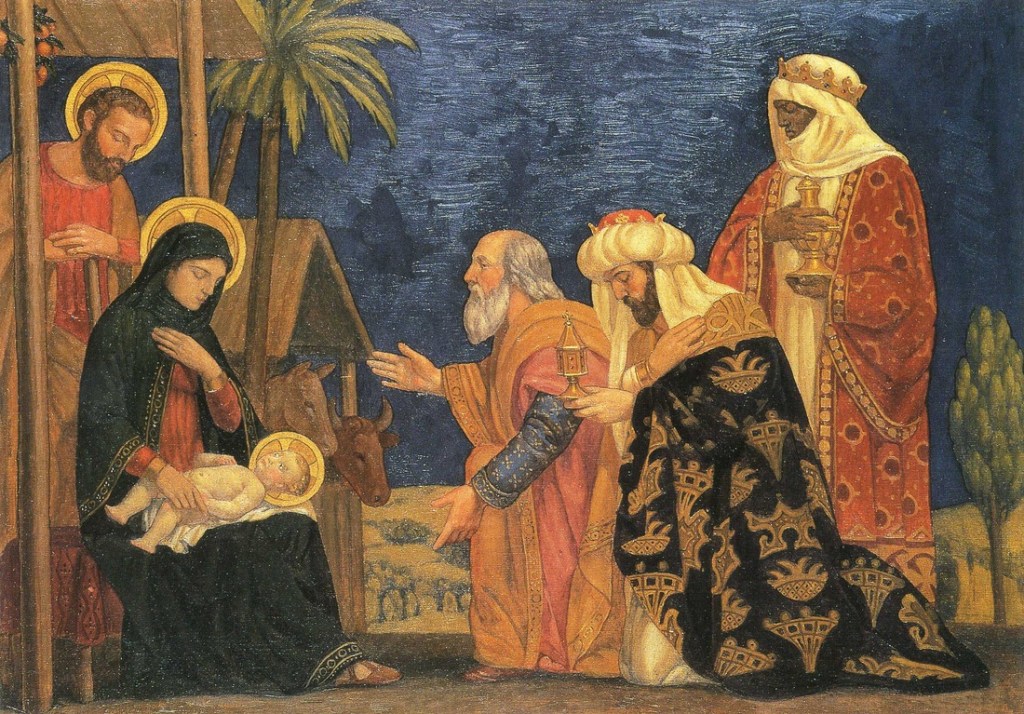
But, the Epiphany we celebrate today brings joy and jubilation because it is the manifestation of the universal kingdom of Jesus Christ to the pagans symbolized by the magi from the East.
After the octave of Christmas on January 1, Epiphany reminds us on this joyous season of Christmas that while deep within each one of us is a natural search or inclination for God, it is actually God who looks for us and eventually finds us.
It is always a grace from God that we desire him and his grace is doubled even tripled when we are like the magi who search and follow God in his “epiphanies”!
When Jesus was born in Bethlehem of Judea, in the days of King Herod, behold, magi from the east arrived in Jerusalem, saying, “Where is the newborn king of the Jews? We saw his star at its rising and have come to do him homage.” When King Herod heard this, he was greatly troubled, and all Jerusalem with him.
Matthew 2:1-3
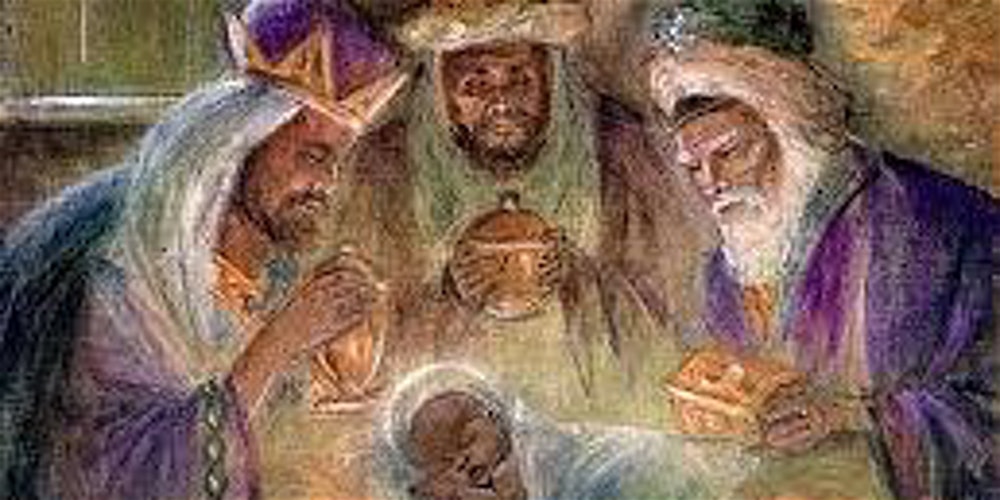
The Magi with baby Jesus, Mary and Joseph. Source: Henry Siddons Mowbray / Public domain
Nobody really knows for sure where and who were those magi who looked and came for the Child Jesus at Bethlehem. They are called kings as attested from our first reading, “Rise up in splendor! Your light has come, the glory of the Lord shines upon you… Nations shall walk by your light; kings by your shining radiance. Caravans of camels shall fill you, dromedaries from Midian and Ephah; all from Sheba shall come bearing gold and frankincense, and proclaiming the praises of the Lord” (Is.60:1, 4, 6).
From this part of Isaiah’s prophecy we also got that picture of the three wise men traveling as kings from the farthest parts of the world of that time riding on camels to show how everyone, from the most most powerful to the simplest of men and women of the world recognize Jesus as the King of Kings.
At the start of this new year 2022, our third year in this COVID-19 pandemic, we are invited to be wise like the magi to search for that Bethlehem where we could find rest and comfort, solace and consolation in the newborn king Jesus Christ. It takes a wise person to search for Jesus – and a wiser person to lead others to Him!
The Epiphany of the Lord reminds us that Christ came to the world to be the fulfillment of everyone and He had become human like us in everything except sin so we can find Him easily right within us, there in our hearts where he is born everyday, where he dwells.
Every new year, every day is a new beginning in Jesus, a day of his epiphany leading us to him. The wise men coming from the East where the sun rises show us Epiphany as a new beginning in our lives, representing our inner journey in life to find and follow Jesus Christ.
From Google.com.
It is said life is a journey; but, as a journey, life is more of a direction than a destination. So often in life, it is really the trip that matters most, the people we journey with as companions that make our life so meanignful.
What matters most in life is we keep on following Jesus Christ our light, our star. That is direction, where He is leading us. It never stops. We just keep on following Him until we reach our final destination in heaven for we are all “coheirs, members of the same body, and copartners in the promise in Christ Jesus through the gospel” (Eph. 3:6).
This direction we have to follow in life never stops for the discovery of God is not the end but the beginning of a journey. And in this journey in Jesus Christ, we do not simply go as followers but are expected to eventually become believers too. Matthew noted at the end of the gospel today how the magi “departed for their country by another way” (Mt. 2: 12) to show how they have become believers eventually of Christ. Their lives have changed and must have never been the same as before after finding Jesus because they have believed, so unlike Herod and the experts at Jerusalem who knew everything about the Messiah being born in Bethlehem but refused to believed him.
This is the danger with us today: many Christians today are mere followers but not wise enough to be believers of Christ.
We all dream to be fulfilled in life. And every lofty dream is always from above, from God as Matthew told us this Christmas the dreams of Joseph and now the dream of the magi. It is said that those who dream with their eyes wide open are the real dreamers, the trailblazers who change the world. That is because they did not only believe in their dreams and with themselves but most of all, they believed in God.
On this Solemnity of the Epiphany of the Lord, He is inviting us to dream and believe so that we may live fully in Him. Every day is a new beginning to search and follow and believe Jesus Christ our light. Today we are given with over 350 days to begin anew in Jesus. Be wise. Search Him. Follow Him. Believe Him. Happy Epiphany of the Lord! Amen.
Photo by author, Ubihan Island, Meycauyan, Bulacan, 31 December 2021.
The Lord Is My Chef Quiet Storm by Fr. Nicanor F. Lalog II
A Funeral Homily, 29 December 2021
Photo by author, Basic Education Department chapel, Our Lady of Fatima University, Valenzuela City, 24 December 2021.
The Christmas liturgy offers us valuable lessons about life, of essentially the meaning of Christ’s coming into the world: He did not remove death and suffering but instead came to suffer and die with us so we may rise with him to eternal life.
Looming over the Nativity scene at Bethlehem is the Cross of the Calvary as we immediately see (except this year) the following day after Christmas on December 26 when we celebrate the feast of the first martyr of the Church, St. Stephen and again on the 28th when we wear red vestments during the Mass for the feast of the Holy Innocents massacred by Herod after being duped by the Magi.
These lessons of our Christmas liturgy become more real, even surreal for some, when there is death happening during this most joyous season of the year.
On this fifth day in the octave of Christmas, we heard from the gospel of Luke the story of the Presentation of the Child Jesus at the temple met by two elderly people promised by God to see the Christ before dying, Simeon and Anna.
Now there was a man in Jerusalem whose name was Simeon. This man was righteous and devout, awaiting the consolation of Israel, and the Holy Spirit was upon him. It had been revealed to him by the Holy Spirit that he should not see death before he had seen the Christ of the Lord. He came in the Spirit into the temple; and when the parents brought in the child Jesus to perform the custom of the law in regard to him, he took him into his arms and blessed God, saying: “Lord, now you let your servant go in peace; your word has been fulfilled: my own eyes have seen the salvation which you prepared in sight of every people, a light to reveal you to the nations and the glory of your people Israel.”
Luke 2:25-32
What a matter-of-fact story this Christmas of awaiting death, awaiting Christ’s coming!
What a beautiful scene reminding us of the realities of life and of death, coexisting side by side.
“Presentation at the Temple” painting by Italian Renaissance artist Andrea Mantegna done around 1455; Mary holding Baby Jesus while St. Joseph at the middle looks on the bearded Simeon. Photo from wikipedia.org.
Life is like our two hands, the left and the right, always with ironies and paradoxes: life and death, light and darkness, joy and sorrow, triumph and defeat, gains and losses.
That is how life is wonderfully portrayed today by Simeon who held in his arms the Child Jesus, filled with joy, basking in the sacred moment with the Savior, and the words that came from his mouth was about dying: “Lord, now you let your servant go in peace; your word has been fulfilled: my own eyes have seen the salvation which you prepared in the sight of every people.”
That is the “moment of Christmas” we mentioned last Saturday: “Christmas is therefore a blessed event, a most sacred moment of holy communion of man and God in Jesus Christ that continues to this day in the most regular yet miraculous reality of life going on amid many joys and pains, victory and defeats, prosperity and poverty, health and sickness, light and darkness and even in death” (https://lordmychef.com/2021/12/24/rejoicing-christmas-moments-all-year-through/).
Simeon shows us that it is only when we have fully appreciated this life we have in God do we fully accept and welcome death which is eternal union with God. Coming to terms with life is coming to terms with death and the same holds true vice-versa. That is why like Simeon we have to strive to live attuned to the Holy Spirit always to be aware of those sacred moments when Jesus comes to us in our daily living.
Photo by author, 18 November 2021.
I know, these are easier said than done… and, yes, it is doubly painful when our loved ones leave us during this Christmas season but when we try to reflect on it deeply, we find it more meaningful.
Ten years ago I met a family in my previous parish who have come to gather for 41 years every Christmas since their mother passed away on Christmas day. They told me how they were celebrating Mass on a bright sunny Christmas day when they have to immediately leave to rush to the hospital where their mother had died after a lingering illness. It was then I learned that their mother was born on March 24, the eve of the Solemnity of the Annunciation of the Birth of Jesus; that’s when I told them of how blessed they must be: their mother was born on the date we celebrate the Incarnation of the Son of God while she entered eternal life on the date we celebrate Jesus came to earth! They loved the imagery I have shown them and from then on until now, I have been invited to their family reunions….
That is the main blessing of Christ’s coming here on earth: he sanctified death that before was a curse. Recall how we have mentioned that Jesus Christ’s Pasch actually began at Christmas, when he passed over from heaven to earth, from eternal to temporal which reached its highest point in his Passion, Death and Resurrection that led to our salvation.
Photo by author, Basic Education Department chapel, Our Lady of Fatima University, Valenzuela City, 24 December 2021.
When the pandemic came last year, everybody laughed at the year 2020 with all kinds of memes and jokes, describing the year supposed to signify “perfect vision” as the worst and most disastrous. It was labelled so bad and almost cursed that everybody eagerly awaited 2021. Now, the jokes and memes are back, calling 2022 sounds like “2020 too”, insinuating another round of disasters as COVID surges happen in Europe and the States.
But, that is life.
As we have said at the start, it is like our two hands, the left and the right. There is always life and death, light and darkness, joy and sadness. That is why Jesus came and from then on we have reckoned time to his birth because every year is an Anno Domini, the year of the Lord.
Whenever we put our hands together at prayer, life and death becomes one along with joy and sorrow, light and darkness in Jesus Christ who gives meaning and fulfillment in everything.
The Lord Is My Chef Simbang Gabi Recipe for the Soul by Fr. Nicanor F. Lalog II
Friday, Simbang Gabi 9, 24 December 2021
1 Samuel 7:1-5, 8-12, 14, 16   ><]]]*> + <*[[[><   Luke 1:67-79
Photo by author, sunrise at the Lake of Galilee, the Holy Land, 2017.
As we complete today our nine-day novena to Christmas, Zechariah comes to full circle in the gospel when he sings the Benedictus (Latin for “Blessed”) to praise and thank God not only for restoring his speech but for the gift of a son John the Baptist and of the Messiah, Jesus Christ.
Last Wednesday we have mentioned to you how we priests, monks and the religious along with other dedicated lay people would sing or recite Mary’s Magnificat at the end of our Evening Prayer called Vespers, Zechariah’s Benedictus is what we pray at the end of our Morning Prayer called Lauds (Latin for praises).
It is a wonderful prayer welcoming the new day filled with God’s blessings of life and fulfillment, joy and peace, love and mercy. What a way to start each day already assured of being a blessed one for everyone.
As we prepare for Christmas tonight and tomorrow, it is worth praying the Benedictus today to pause at three important verbs we find at its beginning:
Zechariah his father, filled with the Holy Spirit, prophesied, saying, “Blessed be the Lord, the God of Israel, for he has come to his people and set them free. He has raised up for us a mighty Savior, born of the house of his servant David.
Luke 1:67-69
For Zechariah, God is blessed because “he has come (or visited) to his people, set them free (or worked redemption), and has raised up for us a mighty Savior from the house of David”. Like Mary’s Magnificat, we notice in Zechariah’s Benedictus the verbs are in the past tense when everything seems to be just starting with John’s birth who would herald the coming of Jesus still be born six months later.
But, Zechariah was filled with the Holy Spirit when he sang this that he must have perceived that early – like Mary – the many great things God had done to him personally and to them as a nation. Most of all, he had sensed- finally, after months of forced silence – the most unique wonderful things God is doing for him and everyone including us today.
This is the reason why we pray the Benedictus every morning for it affirms and not just awaits the tremendous blessings God has for us each new day.
Photo by author, altar of the Church of St. John the Baptist, the Holy Land, 2019.
Everyday, God comes to us, visiting us with his gift of life. A few months ago, former US Secretary of State and decorated soldier Colin Powell died of complications from COVID-19. An accomplished military officer and manager, one of his leadership lessons is that “It ain’t as bad as you think.”
Powell explains that after every disaster, there is always a solution and a way out of every mess in life. There is no need for us to worsen the situation with overthinking because in the coming of each new day, things get better.
So true! Zechariah had the worst days of his life of not having a child for the longest time then made mute by an angel for challenging the wisdom of God. After being forced into silence for nine months, he realized how each day is filled with blessings with God himself coming to us.
Rejoice every morning you wake up by first praying and connecting to God who comes to us daily before checking on your gadgets for messages and news that often dampen your mood. Like Zechariah, the first thing to come from his mouth and lips when his tongue was loosened was praise and thanksgiving to God.
When God comes, his first blessing is always our liberation from sins and baggages that have overburdened us, enslaving us for so long that we have practically stopped living. To experience God in Jesus Christ is always to experience freedom to do what is true and good. To be free in Jesus means to be free from sins and anxieties and fears brought about by our bondage to evil and darkness.
Zechariah felt so free that he was able to praise and thank God for his gifts of life and a child. And Savior, Jesus Christ who had come to his home when Mary visited Elizabeth earlier.
Everyday is blessed primarily because God raised up for us a mighty Savior in Jesus Christ. This is the most wonderful part of Zechariah’s Benedictus, “God has raised up for us a mighty Savior, born of the house of his servant David”. It was very clear with him the role of his son John, a herald of the coming of the Savior who is the fulfillment of God’s promise of old.
Photo by author, 2019.
Each day in Jesus promises us to make it better than yesterday. If we were sick yesterday, today we can recover our health. If yesterday we have failed, today we shall triumph. If yesterday we have lost, today we shall gain for Jesus has conquered everything even death for his love for us.
Likewise, we are invited to become a John the Baptist everyday not only to prepare the way of the Lord but most of all be the sign of the Lord’s presence.
As John the Baptist, we are challenged first to examine our very lives, our inner selves. So many times we get carried away with the many parties and activities of Christmas like gifts to give or receive as we focus on the wrong aspects of this most joyous feast of the year.
Like his father Zechariah, let us rejoice in the presence of God who became human like us so we may also rejoice in the presence of every person especially our loved ones who make Jesus present among us. Let us make this Christmas a true celebration of the presence of Jesus in us not only today but throughout the coming 2022 as God continues to bless us with lower COVID infections. Amen.May God bless you always, heal you of your sickness, and fulfill your prayers this Simbang Gabi!



















 lordmychef.com