The Lord Is My Chef Daily Recipe for the Soul by Fr. Nicanor F. Lalog II
Thursday, Memorial of Sts. John Fisher & Thomas More, Martyrs, 22 June 2023
2 Corinthians 11:1-11   <'[[[>< <'[[[>< + ><]]]'> ><]]]'>   Matthew 6:7-15
Photo by author, sunset over the Caloocan-Malabon-Navotas-Valenzuela district, January 2023.
Glory and praise to you,
God our almighty and loving Father
for the gift of two great saints,
John Fisher and Thomas More
whose memorial we celebrate today
after giving their lives in defending
the gospel of Jesus Christ
before the powerful king of England
in 1535.
Like St. Paul in today's first reading,
St. John Fisher and St. Thomas More
spoke their hearts out to everyone,
opposing King Henry VIII's divorce
and call to break away from Rome;
for standing for what is true and good
like the sanctity of marriage
and primacy of Rome,
they were both beheaded.
What a beautiful example for us
to emulate today when so many of us
professing to be Catholics yet
have turned their backs from
the Church and especially from the Gospel,
choosing to be oblivious
to you dwelling in our hearts;
like St. Paul, they have taught us
that standing firm on our faith
is the best expression of our love
not only for God but for everyone;
help us realize that when we allow
ourselves to follow modern trends
that are contrary to the life and teachings
of Jesus our Lord,
that is when we do not love at all
because that is when we allow evil and sin
to spread its errors and destruction
of persons and life in general.
But I am afraid that, as the serpent deceived Eve by his cunning, your thoughts may be corrupted from a sincere and pure commitment to Christ. For if someone comes and preaches another Jesus than the one we preached, or if you receive a different spirit from the one you received or a different gospel from the one you accepted, you put up with it well enough.
2 Corinthians 11:3-4
Forgive us, dear God,
when we would call you "Father"
but could not stand for what is
true and just, good and holy
there in our hearts;
forgive us, dear God,
when we would call you "Father"
but would keep on holding to our
anger and bitterness,
refusing to forgive
from our hearts;
forgive us, dear God,
when we would call you "Father"
but would always push the lines
and limits in our hearts
until we fall into temptations and sin.

Forgive us Father,
in Jesus' name.
Amen.
The Lord Is My Chef Sunday Recipe for the Soul by Fr. Nicanor F. Lalog II
Solemnity of the Body & Blood of Jesus Christ, 11 June 2023
Deuteronomy 8:2-3, 14-16 ><}}}}*> 1 Corinthians 10:16-17 ><}}}}*> John 6:51-58
Photo by author, 2018.
There is a weird British series in Netflix called the Inside Man about a professor of criminology at the death row in the States for the murder of his own wife. He had deep perceptions and analysis of events that people came to see him in prison to consult in locating their missing loved ones. One of them is an American journalist trying to do a story about him while at the same time seeking his expertise in locating her missing friend, a math tutor in England held hostage in the basement by a pastor and his wife.
Though the series is weird, it has some interesting lines about life and death like when the wife of the pastor told him how she had spent the whole afternoon searching the internet how to kill their son’s math tutor they have thrown in their basement. The wife found it unusual there was nothing in Google that tells of ways of killing another person (so weird, is it not?); however, she was surprised that almost everything she had found in the internet and social media was mainly about sex as he teased her husband that it is not love that makes the world go round but sex!
Yes, it is very funny and weird but her observations seem to be true because nobody in his right mind would ever want to destroy life except terrorists and lunatics. People generally love life that our social media are saturated with contents that try to show how we can enjoy this life through sex, food, and travels in that order. Also with cars for boys aged 5 to 95.
Photo by author, March 2020.
Of course, we all know that is not what life is all about that is filled with mysteries.
Last Sunday we reflected in the Solemnity of the Holy Trinity that mysteries are not problems to be solved but realities to embrace to discover life’s truest meaning found in our relationships with God and with others
This Sunday we celebrate the second most important doctrine and mystery of our faith, the Incarnation of the Son of God Jesus Christ. It is a mystery not only how the Son of God became human like us in everything except sin but most of all, of how he has given us his very flesh and blood as our food and drink in this journey called life.
Jesus said to the crowds: “I am the living bread that came down from heaven; whoever eats this bread will live forever; and the bread that I will give is my flesh for the life of the world.” The Jews quarreled among themselves saying, “How can this man give us his flesh to eat?” Jesus said to them, “Amen, amen, I say to you, unless you eat the flesh of the Son of Man and drink his blood, you do not have life within you. For my flesh is true food, and my blood is true drink.”
John 6:51-53, 55
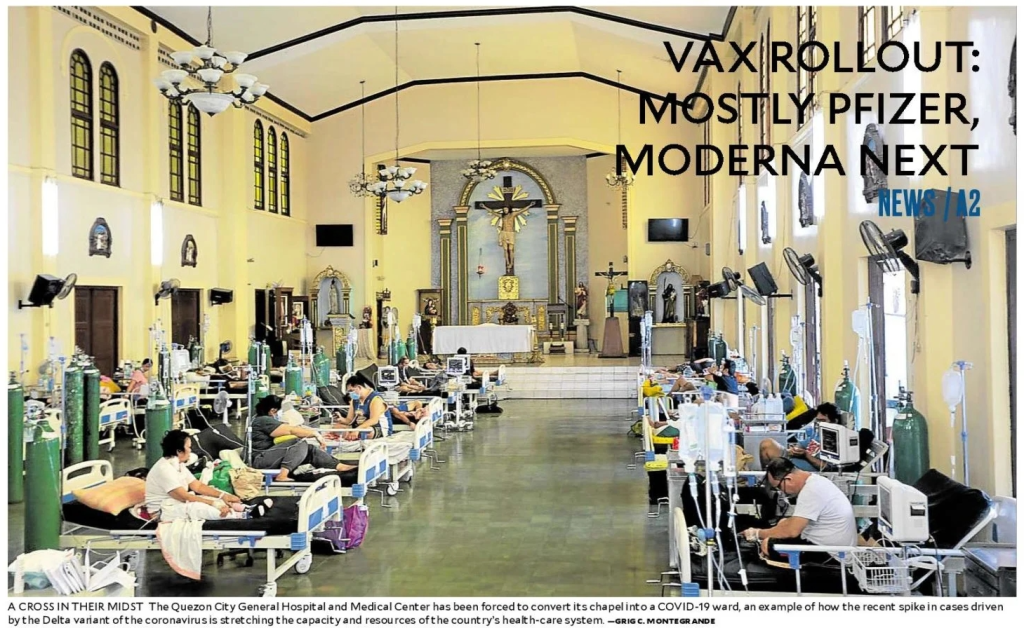
My favorite front page photo during the Delta outbreak of the COVID-19 pandemic published by the Inquirer on 20 August 2021. So evocative of the truth of Jesus himself being our true food and drink – and medicine.
As we have reflected last Sunday, a mystery is a divine truth revealed by God we learn through the gift of faith. It is non-logical but not illogical. It can be explained and understood but not fully.
Here in the mystery of the Body and Blood of Christ we call as the Eucharist, the mystery of our Triune God becomes a reality in our life truly present in perceptible signs of bread and wine. From relating, we now come to the mystery of sharing of our selves like God who shared us his Son Jesus Christ who in turn gave himself for us on the Cross that continues today in the Holy Eucharist as his everlasting sign of his loving presence and service.
See how Jesus spoke clearly in this passage of his giving us his physical body and blood that to receive it, we have to actually eat it too.
First we notice is how in other parts of the New Testament that the term soma is used to refer to the Eucharist which is the Greek word for “body” that may have symbolic meanings; but in this passage, Jesus used the word sarx which means “flesh” in Greek that means only one thing, the corporeal reality of his physical body. Jesus is telling us in no uncertain terms in this passage after the miracle feeding of more than 5000 in the wilderness that he himself is truly and really present as flesh and blood in the Eucharist. Recall that at his Prologue to his gospel, John also used the same term sarx in declaring “the Word became flesh” (Jn.1:14) to correct misunderstandings and doubts that were already developing during the first century of Christianity regarding the physical Incarnation of Jesus the Eternal Word and his true presence in the Eucharist.
Second term used by Jesus four times as he emphasized the reality of his Body and Blood in the Eucharist is the word trogein which in Greek means “to munch” or “bite”; the other Greek word for the verb to eat is phragein which evokes many symbolic meanings like “digesting” a book or “assimilating” the culture. Again, when Jesus said we have to eat his flesh and drink his blood, he truly meant himself as a true food and true drink to nourish and sustain us in this life and hereafter.
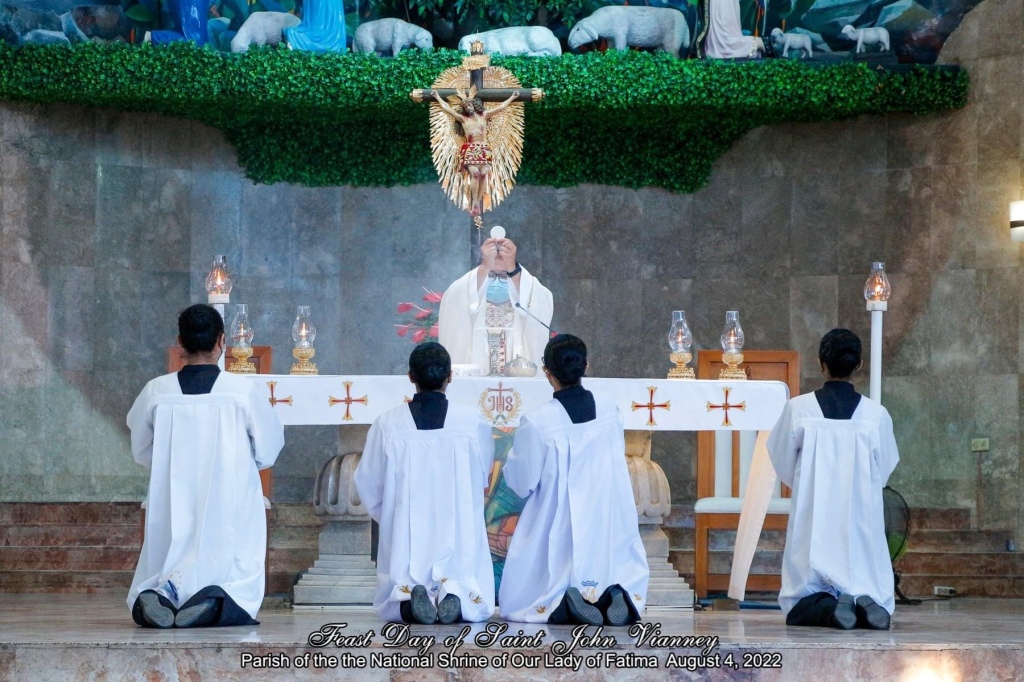
Photo by Kuya Ruben, 04 August 2022.
There lies the beauty of this mystery of the Eucharist: Jesus himself is the one we receive, who comes to us personally, physically to be one with us in our very selves. We do not have to wait for death and be in heaven to experience fullness of life in Christ because he comes truly to us while in this life when we receive him in the Holy Communion.
St. Paul reminds us in the second reading with his rhetorical questions, “The cup of blessing that we bless, is it not a participation in the blood of Christ? The bread that we break: is it not a participation in the body of Christ?” (1 Cor. 10:16) of this reality of Christ’s presence in us and among us. He was not waiting for answers of yes or no but posed those questions to affirm the very truth we all know that Jesus is really present in us and among us especially when we are broken like the Israelites in the first reading. This is where the mystery deepens, becomes more real and more fascinating. Jesus the Son of God emptying himself to be like us in everything except sin so that we may become like him, holy and divine.
This I have learned in my two years of being a chaplain in the hospital. Admittedly, it is difficult especially for me as I could easily be carried away by emotions in seeing the sick and suffering while at the same time, can often have my stomach overturned by sights of blood and wounds of others. But, there is always that indescribable feelings of joy and fulfillment after visiting and anointing our sick patients.
Photo by Kuya Ruben, June 2022.
I have no claims to holiness as I am a sinner too but the Eucharist has become most truest to me these past two years in the hospital and university as well as I get into contact with the sick and the students. When I touch patients to pray over them or help in moving them, when students cry to me or ask for hugs after confessions, they all flash to me during the consecration as I raise and say, This is my Body… This is my Blood. Jesus is most truest in the Eucharist when we too imitate him in giving ourselves to others to be broken and shared.
The Eucharist is the most wonderful gift of God to us when we receive his Son Body and Blood to make us strong and holy like him in this life.
That is why we have to go to Mass every Sunday. That is why a priest has to celebrate Mass daily for the people to be strengthened like him in this journey of life filled with trials and sufferings. That is why Moses kept on reminding the Israelites of their many hardships from their exodus into their wandering in the wilderness. That is why this coming Friday, we cap these three weeks of transition into the Ordinary Time with the Solemnity of the Most Sacred Heart of Jesus, another mystery of Christ truly among us and within us as we experience his love most truly right here in our hearts.
What an awesome God we have indeed who has become so small and so simple like us so we can be great like him. Like the simple bread and wine, in the Mass through the Holy Spirit, they become Christ’s Body and Blood. Let’s make it happen this Sunday in our celebration of the Mass. Amen.Have a blessed week ahead.
The Lord Is My Chef Daily Recipe for the Soul by Fr. Nicanor F. Lalog II
Thursday in the Ninth Week of Ordinary Time, Year I, 08 June 2023
Tobit 6:10-11, 7:9-17   <*((((>< + ><))))*>   Mark 12:28-34
Photo by author, January 2023.
God our loving Father,
cleanse our hearts,
purify us of our desires
and intentions in life;
make us like Tobiah
who could wholeheartedly
declare before you of his
noble intentions in marrying
Sarah:
Now, Lord, you know that I take this wife of mine not because of lust, but for a noble purpose. Call down your mercy on me and on her, and allow us to live together to a happy old age.” They said together, “Amen, amen,” and went to bed for the night.
Tobit 8:7-8
Like the man who inquired
Jesus about the first of all
commandments, grant us
dear God same pure heart
that leads to "understanding"
so that we may be "no longer
far from the Kingdom of God"
(cf. Mark 12:34).
Amen.
The Lord Is My Chef Daily Recipe for the Soul by Fr. Nicanor F. Lalog II
Friday in the Sixth Week of Ordinary Time, Year I, 17 February 2023
Genesis 11:1-9   ><]]]]'> + ><]]]]'> + ><]]]]'>   Mark 8:34-9:1
Thank you, O God our loving Father
for this wonderful Friday;
after a week of stories of our Creation
and Fall, your words today invite us
anew to look deeper into our hearts
to find you and see your plans for us.
The story of the tower of Babel reveals
many things about our hearts,
of how we would always start seeming
to be good, like being one and united
as a people which you have always desired;
but, like the people at that time, our seemingly
good and innocent plans reveal sinister
evil within our hearts:  "Come,
let us build ourselves a city
and a tower with its top in the sky,
and so make a name for ourselves;
otherwise we shall be scattered
all over the earth" (Genesis 11:4).
Forgive us, O God,
the many times we have tried
manipulating you, fooling our selves
with our supposed to be good intentions
when in fact full of evil and selfish motives;
how funny we have never learned that in
our efforts to preserve ourselves through
our many selfish schemes, the more we fall,
the more we ended up divided like at Babel.
The Lord brings to nought the plans of nations; he foils the designs of peoples. But the plan of the Lord stands forever, the design of his heart through all generations.
Psalm 33:10-11
Let us not confuse unity
with oneness right away;
yes we have to be one in you
through others, but never one
in ourselves or with others for a
vested interest for it shall surely collapse
and crash like Babel;
take away our arrogance that pretend
to be sincere and true in always having
the best intentions, the most beautiful plans
when in fact are all self-serving,
trying to impose our very selves on others;
make us realize that life is fragile,
that anything can always happen
with us and with our plans,
that we have no total control of everything
and hence, simply be open to your
new directions and instructions.

Help us forget our selves,
to take up our cross and follow
your Son Jesus Christ
in humility and simplicity,
in hiddenness and silence,
in kindness and love
for others which is your
original plan for us as a people.
Make us one in you, dear Father,
regardless of our language and color,
or any other differences like at Pentecost.
Amen.
The Lord Is My Chef Sunday Recipe for the Soul by Fr. Nicanor F. Lalog II
Sunday in the Fourth Week of Ordinary Time, Year A, 29 January 2023
Zephaniah 2:3, 3:12-13 ><}}}*> 1 Corinthians 1:26-31 ><}}}*> Matthew 5:1-12
Photo by author, 2020.
Blessedness is a very contentious term for us Filipinos. Very often, we equate blessedness with being rich and wealthy like having a lot of money, a beautiful house, and the latest car model as well as clothes and gadgets. Being blessed sometimes means being lucky or fortunate like winning the lotto or having a child graduating in college or getting promoted in one’s job.
In the Visitation, Elizabeth defined for us the true meaning of being blessed like Mary as someone who believed that what the Lord had promised her would be fulfilled (Lk.1:45). Blessedness is essentially a spiritual reality than a material one; however, it implies that being blessed results from doing something good like being faithful to God.
Today in our gospel from Matthew, Jesus shows us that blessedness is still a spiritual reality than a material one but, it is more of a being – like a status in Facebook – than of doing.
Most of all, being blessed is not being in a good situation or condition when all is well and everything proceeding smoothly in life; blessedness according to Jesus at his sermon on the mount is when we are on the distaff side of life like being poor, being hungry, being persecuted and insulted – being like him!
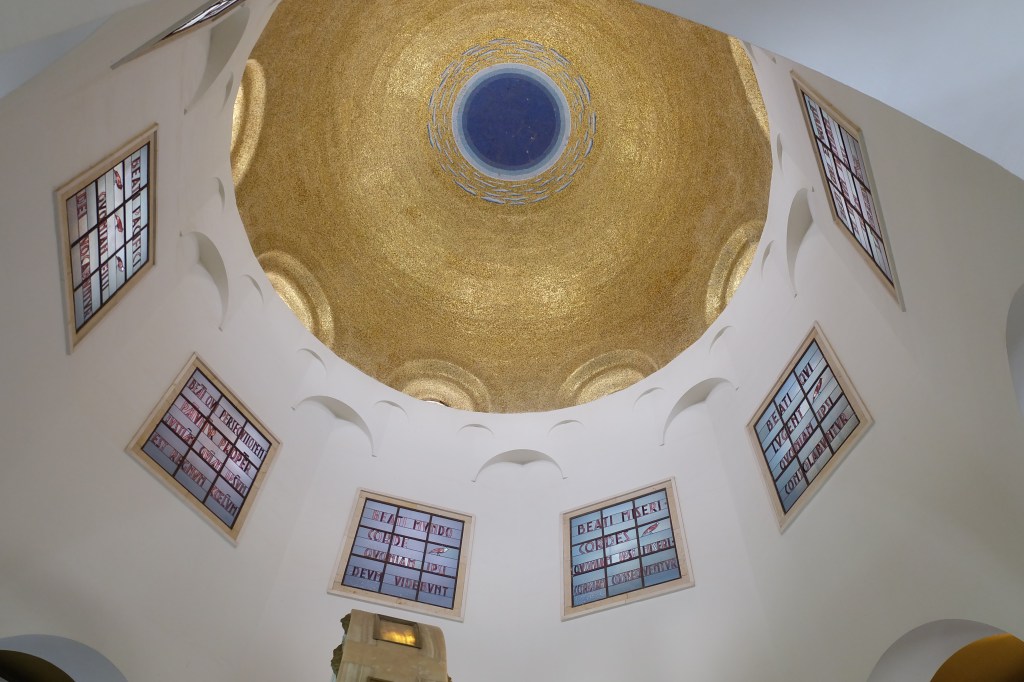
Photo by author, Church of the Beatitudes, Israel, 2019.
“Blessed are the poor in spirit, for theirs is the kingdom of heaven. Blessed are they who mourn, for they will be comforted. Blessed are the meek, for they will inherit the land. Blessed are they who hunger and thirst for righteousness, for they will be satisfied. Blessed are the merciful, for they will be shown mercy. Blessed are the clean of heart, for they will see God. Blessed are the peacemakers, for they will be called children of God. Blessed are they who are persecuted for the sake of righteousness, for theirs is the kingdom of heaven. Blessed are you when they insult and persecute you and utter every kind of evil against you falsely because of me. Rejoice and be glad, for your reward will be great in heaven.”
Matthew 5:3-12
After going around the shores of Galilee, preaching and healing the people, Jesus went up a mountain upon seeing crowds were following him. They were mostly poor people with deep faith in God, hoping and trusting only in him for their deliverance called the anawims.
They were in painful and difficult situations, maybe like many of us, fed up with the traffic and rising costs of everything, fed up with the corruption among public officials and most of all, disillusioned with our priests and bishops!
Then, Jesus called them blessed.
Now, please consider that it is more understandable and normal to say that after being persecuted or after losing a loved one, after all these sufferings that people would be blessed, that the kingdom of God would be theirs.
But, that is not the case with the beatitudes whereby Jesus called them already blessed now, right in their state of being poor, being persecuted, being maligned!
Keep in mind that Matthew’s audience were his fellow Jewish converts to Christianity. By situating Jesus on the mountain preaching his first major discourse, Matthew was reminding his fellow Jewish converts of their great lawgiver, Moses who stood on Mount Sinai to give them the Ten Commandments from God.
However, in the sermon on the mount, Matthew was presenting Jesus not just as the new Moses but in fact more than Moses because Jesus himself is the Law. His very person is what we follow that is why we are called Christians and our faith is properly called Christianity so unlike other religions that are like philosophies or any other -ism.
To understand the beatitudes, one has to turn and enter into Jesus Christ for he is the one truly poor in spirit, meek, hungry and thirsty, merciful, clean of heart, who was persecuted, died but rose again and now seated at the righthand of the Father in heaven. Essentially, the Beatitudes personify Jesus Christ himself. Those who share what he had gone through while here on earth, those who identify with him in his poverty and meekness, mercy and peace efforts, and suffering and death now share in his blessedness.
Therefore, the Beatitudes are paths to keeping our relationship with Jesus Christ who calls us to be like him – poor, hungry and thirsty, meek, clean of heart and persecuted. The Beatitudes are not on the moral plane like the Decalogue that tells us what to do and not to do. Have you ever used the Beatitudes as a guide in examining your conscience when going to Confessions? Never, because the Beatitudes are goals in life to be continuously pursued daily by Christ’s disciples.
Photo by author, Church of the Beatitudes, Israel, 2017.
The Beatitudes are more on the spiritual and mystical plane of our lives that when we try imitating Jesus in his being poor and merciful, meek and clean of heart, then we realize and experience blessedness as we learn the distinctions between joy and happiness, being fruitful and successful.
That is when we find fulfillment while still here on earth amid all the sufferings and trials we go through because in the beatitudes we have Jesus, a relationship we begin to keep and nurture who is also the Kingdom of God. Of course, we experience its fullness in the afterlife but nonetheless, we reap its rewards while here in this life.
As we have noted at the start, we must not take the beatitudes in their material aspect but always in the spiritual meaning. This we find in the first beatitude, Blessed are the poor in spirit, for theirs is the kingdom of heaven.
Actually, this first beatitude is the very essence of all eight other blessedness. Everything springs forth from being poor in spirit, of having that inner attitude and disposition of humility before God. We cannot be merciful and meek, nor pure of heart nor peacemakers unless we become first of all poor in spirit like Jesus, who, “though he was in the form of God, did not regard equality with God something to be grasped. Rather he emptied himself, taking the form of a slave, coming in human likeness and humbled himself” (Phil. 2:6-7, 8).
The prophet Zephaniah showed us in the first reading that poverty in the Old Testament does not only define a social status but more of one’s availability and openness to God with his gifts and calls to us to experience him and make him known. Experience had taught us so well that material poverty is one of life’s best teacher as it leads us to maturity and redemption best expressed in the Cross of Jesus Christ.
In this sense, the beatitude is also the “be-attitude” of every disciple who carries his cross in following Christ. See that each beatitude does not refer to a different person; every disciple of Jesus goes through each beatitude if he/she immerses himself/herself in Christ. That is why last week Jesus preached repentance which leads to conversion. Notice that the beatitudes of Christ are clearly opposite and contrary to the ways of the world as St. Paul tells us in the second reading with God calling the weak and lowly to manifest his power and glory.
Many times in life, we fail to recognize our blessedness when we are so focused with what we are going through, with our work and duties and obligations. This Sunday, Jesus takes us up on the mountain, in the celebration of the Holy Eucharist for us to see ourselves blessed and loved right in the midst of our simplicity and bareness, sufferings and pains. Stop for a while. Find Christ in all your troubles or darkness in life. If you do not find Jesus in your labors and burdens, you are just punishing yourself. If you find Christ because you see more the face of other persons that you become merciful, you work for peace, you mourn and bear all insults and persecution… then, you must be loving a lot. Therefore, you are blessed! Amen.
Have a blessed week ahead!
Photo by author, Church of the Beatitudes, Israel, 2017.
The Lord Is My Chef Sunday Recipe for the Soul by Fr. Nicanor F. Lalog II
Second Sunday in Advent, Cycle A, 04 December 2022
Isaiah 11:1-10 ><}}}*> Romans 15:4-9 ><}}}*> Matthew 3:1-12
Photo by Ezra Acayan/Getty Images, 09 February 2020, Baclaran Church.
Many years from now, future generations will surely discuss these years of our COVID-19 pandemic, with everyone talking about the face masks we wore. Imagine your great grandchildren repeatedly asking their parents why we were covering our faces during this time.
But, these face masks were also the signs of blessing during this pandemic, teaching us to look onto the face of one another, to recognize each one as brother and sister in Christ. I believe these face masks are reminders from God of how we have forgotten to look and value each one as persons to be loved and cared for, respected and protected.
What a beautiful sight when people meet, exchanging glances, adjusting their glasses and face masks to recognize each one again!
In the Book of Genesis, we are told how God created us in his image and likeness that remind us of his “face” even if we know God is spirit. Face means more than the physical face of the person. It reveals in the most undeniable manner one’s state or condition, of what is in him/her. When a person is filled with goodness and love, joy and contentment or, bitterness and hate, evil and sin, we say it is “written all over his/her face”.
Remember Mang Dodong of Caloocan City who was detained for almost a month in Navotas for not having proper ID’s during the lockdown of March 2020 after he tried to buy fish in order to sell in their neighborhood? At the same time when it happened, there was the shameless news of police throwing a birthday bash to their chief in total disregard of the protocols? The injustice against the poor prevailing then and now was all written in Mang Dodong’s face in the news.
Mang Dodong of Caloocan City, photo by Mr. Vincent Go, May 2020.
Here lies the challenge of Advent 2022, the first face-to-face Christmas we shall have in two years since the pandemic when we have to cover our faces with face masks: have I shown God with others on my face? Or maybe, the better question should be, do I see the face of God in the people I meet?
This Second Sunday of Advent, the gospel invites us if like John the Baptist, do we see Jesus Christ coming among us? Do we see him in ourselves and in others?
John the Baptist appeared, preaching in the desert of Judea and saying, “Repent for the kingdom of heaven is at hand!” It was of him that the prophet Isaiah had spoken when he said: A voice of one crying out in the desert, Prepare the way of the Lord, make straight his paths.
Matthew 3:1-3
“St. John the Baptist Preaching in the Wilderness” by German painter Anton Raphael Mengs (1728-1779) from commons.wikimedia.org.
John is our second guide during Advent next to the Prophet Isaiah. John did not only see the coming of Christ but he also showed the Christ had come.
Why did people come to listen to him and be baptized from all over Israel at that time?
His preaching must be so powerful and convincing because people must have also seen in him Christ’s coming. In fact, people of his time thought he was already the Messiah everyone was awaiting. But John was very clear in his preaching that he was not the One.
Such was the power of John’s preaching. Everyone believed him because he did not merely point to the coming of Christ but showed them too Christ already present in him. No wonder, he would be the first to die for Jesus and like Jesus by standing for what is true and good.
How was John able to do this?
Aside from the power of the Holy Spirit that came upon him while still in his mother’s womb during Mary’s visitation, John went to a sort of quarantine too – an Advent – when he left the comforts of his affluent family to live a simple life in the desert.
John wore clothing made of camel’s hair and had a leather belt around his waist. His food was locusts and wild honey.
Matthew 3:4
Last Sunday, we have reflected that Advent is a Sabbath when we rest to be breathed on by God, to be filled with God and his Spirit by first emptying ourselves of our sins and pride. Most of all, in coming to the wilderness empty and simple, John showed the importance of prayer, of relying solely to God. It was prayer that sustained John in the desert and it is prayer that would sustain us during this Advent. In fact, we need to handle life with prayer in order to see Christ coming and most of all, to show Christ to others.
In calling for conversion, John challenged the people of his time too to bear fruits in their efforts of seeing the coming Messiah. All these emptying and sacrifices and being breathed on by God must always be evident not only for everyone to see but for each one to truly experience Christ’s coming.
A painting based on Is.11:1-10 called “Peaceable Kingdom” by American EdwardHicks, a Quaker pastor (1780-1849).
In the first reading, Isaiah reminds us that Advent is a time also of healing when we learn to be small again, even to die in our selves to give way for the coming of the Lord.
On that day, a shoot shall sprout from the stump of Jesse, and from his roots a bud shall blossom. The spirit of the Lord shall rest upon him… Not by appearance shall he judge, nor by hearsay shall he decide, but he shall judge the poor with justice, and decide aright for the land’s afflicted… Justice shall be the band around his waist, and faithfulness a belt upon his hips. Then the wolf shall be a guest of the lamb, and the leopard shall lie down with the kid; the calf and young lion shall browse together, with a little child to guide them. The cow and the bear shall be neighbors, together their young shall rest; the lion shall eat hay like ox. The baby shall play by the cobra’s den, and the child lay his hand on the adder’s lair. There shall be no harm or ruin on my holy mountain; for the earth shall be filled with knowledge of the Lord, as water covers the sea.
Isaiah 11:1-2, 3, 4, 5-9
This for me is one of the loveliest scenes in the Old Testament: aside from the poetry of Isaiah, imagine how God envisions for us a “peaceable kingdom” where humans and animals live together in harmony, when there would be no more harm or ruin on everyone!
So beautiful!
And so possible if we can be like John the Baptist with our eyes seeing more beyond the physical realities of this world by being small again like the shoot, even of dying to one’s self like a stump.
It is only in our littleness, in our barrenness and death can we truly see and find Jesus. But, the moment we see Christ in us, it is no longer difficult to recognize him on others as well as find him in all creation. If we could fine tune our eyes to Jesus and live in one accord with God and everyone as St. Paul calls us in the second reading, then Christ becomes present among us in the world with his peace.
Let us pray on this Second Sunday of Advent that we not only see Jesus coming but also show him present in us and among us so that when we go to our places of work, we do not just “earn a living” but also work on building the kingdom of God here on earth.
Let us pray that beginning this second Sunday of Advent that we not only see Jesus but also show him present in us and among us so that whenever we post on social media, we also build relationships in Christ.
Have a blessed week everyone!
Let us pray on this Second Sunday of Advent that the next time we give donations and help to people in need, it is Jesus whom we find in them so that we go the extra mile in our efforts to uplift them and truly make a “shoot sprout forth from the stump” of this dying earth so that the bud of God’s kingdom may finally blossom in us. Amen.
The Lord Is My Chef Sunday Recipe for the Soul by Fr. Nicanor F. Lalog II
Solemnity of Christ the King, Cycle C, 20 November 2022
2 Samuel 5:1-3 ><000'> Colossians 1:12-20 ><000'> Luke 23:35-43
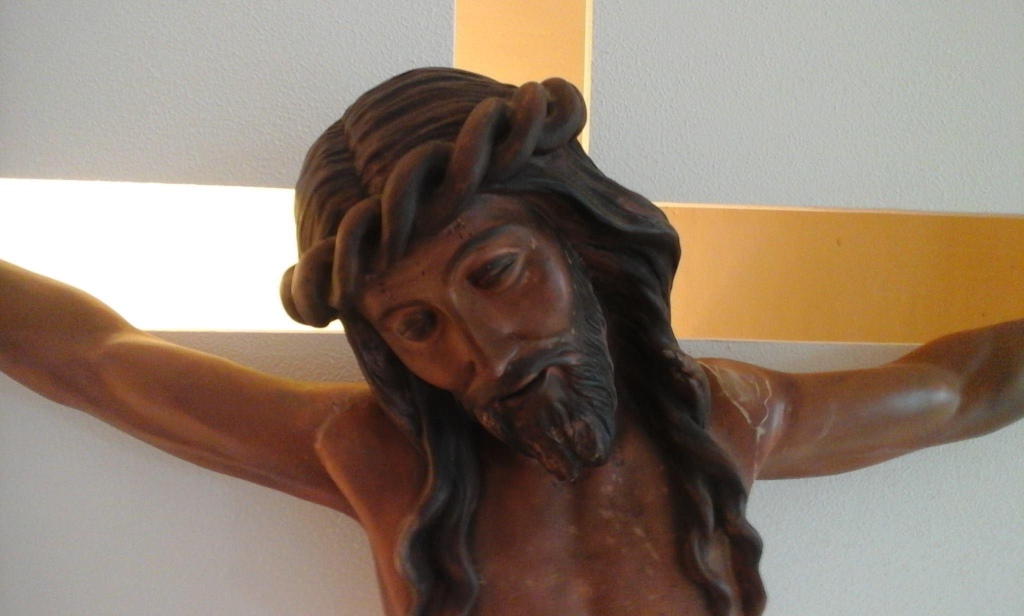
Painting of Christ’s Crucifixion by Tintoretto in 1565 portraying Jesus so “kingly”; interesting too were the people dressed as Venetians of his time as reminder that the evils that crucified Jesus continue in our own time. Photo from wikiart.org.
We now come to the final Sunday of our liturgical calendar called the Solemnity of Christ the King with a scene from his crucifixion on Good Friday. All these Sundays since June “When the days for Jesus’ being taken up were fulfilled, he resolutely determined to journey to Jerusalem” (Lk.9:51), Luke had been showing us that Christ’s crucifixion and glory are one just like John in his gospel account.
But the most beautiful part of our gospel on this solemn celebration is the fact that inasmuch as Jesus had clearly showed in all eternity his kingship while dying on the Cross, it is also right on the cross of sufferings as we strive to resist temptations of turning away from God that we proclaim Christ’s kingship. Please bear with me, my friends in reflecting Luke’s artistic presentation of Christ’s crucifixion as the expression of his kingship.
Notice how Jesus was “sneered, jeered, and reviled” at the cross, reminding us of the devil’s three temptations in the wilderness after his baptism at Jordan by John. After failing to tempt Jesus at the wilderness, Luke said the devil “departed from him for a time” (Lk.4:13), returning at his crucifixion as the most opportune time to test him.
In the wilderness, the temptations by the devil to Jesus applied very well with us too but, here on the cross, it was totally different. The devil himself was nowhere to be found because he was in the person of the rulers, the soldiers, and the thief! And that is how evil and sin have become so “powerful” in a pernicious manner among us when many times we are the devil in fact.
Here, we are reminded to be aware always of that opportune time when the devil attacks us when we see or face many sufferings in life by reflecting the last three temptations of Jesus on the Cross.
Photo by author, 2017, Sacred Heart Novitiate, Novaliches, QC.
The rulers sneered at Jesus and said, “He saved others, let him save himself if he is the chosen one, the Christ of God” (Lk.23:35).
Just like at the wilderness when the devil tempted Jesus with what he can do as the Son of God by changing stone into bread, at the Cross it was the same temptation hurled on him by the rulers of Israel, the priests and the scribes.
How sad that amid the many sufferings in the world today we contemptuously mock others like the poor for not working so hard to liberate themselves from poverty and hunger. There is the tendency among us blessed with better living conditions to look down at others without considering how they never have the same opportunities in life like us in having good education or a caring family or worse, not having the right connections.
The tragic part of this “sneering” by the rulers on Jesus is when we look at others as if they are not humans and persons like us who play gods knowing everything even who should live and who should die like in the systematic approach by state rulers to come up with what St. John Paul II called as “culture of death” in solving poverty and crime with abortions and capital punishments.
Let us examine our attitudes at the way we look at those going through sufferings and pains like sickness, poverty and other social ills we do not go through. Let us stop the mockeries of blaming them for their plight because many times like Jesus Christ, they were betrayed by loved ones like us, by the society, or even by the institutions meant to uplift them.
Photo by author, 2017.
Even the soldiers jeered at him. As they approached to offer him wine they called out, “If you are King of the Jews, save yourself.” Above him there was an inscription that read, “This is the King of the Jews” (Lk.23:36-38).
Sneering and jeering are both contemptuous mocking or insulting of others; they are both employed by those in vantage positions of power and control like the rulers of Israel. Going “higher” than the priests, the Roman soldiers sneered Jesus by rudely mocking him in loud voice. Sneering is a superfluous display of might, of superiority, of power. It is a kind of vanity that is why in the wilderness, the devil tempted Jesus to have all the kingdoms in the world for him to be famous and popular in exchange of worshipping him.
Sneering is something so prevalent these days in our use of the social media where we practically scream and insist on everyone to notice and recognize us, that we have “arrived” in having the latest and most expensive clothes, food, gadgets and everything. There is so much wild attitude among us like the soldiers at the cross when we use social media in too much talks, even of spewing foul languages and invectives as well as lies. Fake news and lies spread so fast and are sadly taken as true to the detriment of its victims because we have been so gullible for gossips and rumors too.
But the worst part of our imitation of the soldiers jeering at Jesus is when many of us are afflicted with this perversion called exhibitionism – from those salacious posts in TikTok to those “food porns” and too much display of everything about ourselves and of our loved ones. When do we get tired of all these selfies that have become so sickening that we do not realize of how we make known to everyone of our emptiness and lack of the more essential things like love and self-respect? Like the soldiers, the more we promote ourselves, the more we affirm the obvious that Jesus indeed is the King we needed most.
Photo by author, 2017.
Now one of the criminal hanging there reviled Jesus, saying, “Are you not the Christ? Save yourself and us” (Lk.23:39).
Reviling is also kind of of mocking others like sneering and jeering; however, to revile is the lowest kind because it is to insult somebody you are with in a same situation. To revile is the lack of recognition of one’s faults and sins that he would rather insult others like this thief traditionally identified as Hestas. In reviling Jesus while also hanging on the cross, Hestas went down deeper his lowest point as a convicted criminal when he had the gall to insult Jesus!
And that is the most unkind evil of all when we become so numb, so dense and stupid to even mock others we are with us in a similar situation. It happens daily when even we are in deep shit, we still see ourselves cleaner and better than others! Just read or watch the news about our politicians.
In the wilderness, the final temptation of the devil to Jesus was to jump from the top of the temple because his angels would not let him fall and even touch ground; here at the cross, Hestas saw himself no different from Jesus, feeling so entitled to be liberated. Many times, this is the problem why evil continues among us: when people from below are promoted to higher positions, they forget their roots that they also forget to fix the problems of inequalities and injustices down below where they came from. The key is to always remember. Like Dimas, the good thief.
Photo by author, 2017.
The other, however, rebuking him, said in reply, “Have you no fear of God, for you are subject to the same condemnation? And indeed, we have been condemned justly, for the sentence we received corresponds to our crimes, but this man has done nothing criminal.” Then he said, “Jesus, remember me when you come into your kingdom.” He replied to him, “Amen, I say to you, today you will be with me in Paradise” (Lk.23:40-4).
See how Luke inserted here the fourth verb “to rebuke” to break the series of sneering, jeering, and reviling of Jesus. Like Dimas, we have to strive in breaking the cycle and series of evil especially in this time.
To rebuke means to express sharp disapproval. Imagine Dimas contradicting Hestas and even the rulers and soldiers as well by defending Jesus Christ while hanging there on the cross.
How sad when we remain silent, when we just walk away from people sneering, jeering and reviling Jesus in those who suffer in life because we are afraid to make a stand for what is true and good, what is right and just. How ironic that another thief hanging on the cross was the only one who made a stand for Jesus on that Good Friday along with the Mary and the beloved disciple below.
Every time we make a stand for life and dignity of every person, when we stand for what is true, right and just, that is when we imitate the tribes of Israel in the first reading coming to David to pledge their loyalty and allegiance to him as their king.
When we submit ourselves to Jesus Christ as our only King to be obeyed and followed, that is when our celebration today becomes a daily reality.
That is when we also earn heaven right on the Cross of our sufferings like Dimas when we “remember” Jesus.
Normally in the whole Bible, it is God who remembers. People always forget. When we sin, we forget consciously and unconsciously God and all the good things he had done to us. We forget others too.
There on the Cross, see the reversals of roles Luke has presented so beautifully, from the devil replaced by the rulers, the soldiers and the other thief; and now Dimas sort of assuming God’s role who remembered everything and everyone, especially Jesus our Savior. Dimas remembered what St. Paul expressed to the Colossians that Jesus is Lord in whom, with whom and through whom everything was created and renewed because he is the Christ!
From Google.
The word “remember” literally means to make member or part again, that is, “re” + “member”.
When we remember somebody, we make that person present with us again.
In asking Jesus to remember him when he comes into his kingdom, Dimas was assured that right now as he remembered everything including his sins, he already becomes a member, a part of his kingdom.
May we not forget and always remember Jesus and others always to experience Paradise even when we are on the cross. Amen. Have a blessed week ahead!
The Lord Is My Chef Daily Recipe for the Soul by Fr. Nicanor F. Lalog II
Thursday, Memorial of St. Leo the Great, Pope & Doctor of the Church, 10 November 2022
Philemon 7-20   ><]]]'> + <'[[[><  ---+---  ><]]]'> + <'[[[><   Luke 17:20-25
Photo by author, 25 October 2022 in Dau, Mabalacat, Pampanga.
Your words today are so lovely,
dear Jesus, spoken through St. Paul
in his letter to Philemon asking him
to take back his former slave Onesimus:
"I, Paul, write this in my own hand:  I will pay.
May I not tell you that you owe me your very self.
Yes, brother, may I profit from you in the Lord.
Refresh my heart in Christ"
(Philemon 19-20).
So nice of St. Paul to ask Philemon
to "refresh my heart in Christ"...
but, can we refresh one's heart in you, Lord?
Are you not the only one who can refresh our hearts?
Dearest Jesus,
many times in life like St. Paul
when we face so much difficulties,
we seek rest and affirmations
that you are still with us,
that you have never left us
not because we doubt you
but because we feel tired,
we feel weak,
our spirits sag;
but when we hear people
doing your work,
expressing their faith, hope and love
in you in the most extraordinary ways
like doing the almost impossible,
our hearts are renewed,
our hearts are refreshed in you!
Like Philemon who had been cheated
or placed on the losing end when his slave Onesimus
fled from him; it must be so difficult for him
to take back Onesimus, to forgive and forget
his transgressions, most of all,
to regard him as a brother without casting
any doubts on his conversion
and reason for being a Christian.
So many hearts must have also been
refreshed in you, O Jesus Christ,
by the saints like St. Leo the Great
in his great works explaining your
mystery of Incarnation,
in his touching homilies,
and handling of the barbarians
attacking Rome at that time;
his zeal and faith in you in achieving
so much feats as a pastor and administrator
refreshed many hearts in Christ
in those dark times following the fall of Rome
that until now upon learning his story
others continue to strive to be holy;
The Good Nurse is another notable
disciple you have used to refresh our tired
hearts in setting things right even if the
big bosses could not stand up against
systematic evil in their organizations.
Indeed, Lord Jesus,
"the Kingdom of God is among us"
not outside observable things
as you explained to the Pharisees
its coming in today's gospel (Lk.17:20-21);
 touch us and fill us with your grace
to do your works, to be more loving and kind,
merciful and forgiving
so that in our witnessing,
in our apostolate and ministry,
in our daily living of your Gospel
we may refresh the hearts
of those with sagging spirits
and joy in making you present
in the world.
Amen.
The Lord Is My Chef Daily Recipe for the Soul by Fr. Nicanor F. Lalog II
Wednesday in the Twentieth Week in Ordinary Time, 17 August 2022
Ezekiel 34:1-11   ><))))*> + ><))))*> + ><))))*>   Matthew 20:1-16
God our loving Father,
what happened in Israel
during Ezekiel's time is happening
again, of "shepherds pasturing
themselves" (Ezekiel 34:2)!
Send us shepherds, dear Father,
who have vision, who seek Jesus our
Good Shepherd and not just listen to one's self
or with what our "cordon sanitaires" say and
whisper to our ears no matter how pleasing
or assuring these may be (should we not be
more at home with being bothered than
pleased, Lord?);give us shepherds who would
come out of their comfort zones like
that landowner ensuring everyone is doing
something; send us shepherds with courage
to smash existing structures of dominance
and cliques within your Church, drive away
the gnostics among us who know only what
is good for one's self to let in a breath
of fresh air to enliven your flock.
Thank you in calling us
to shepherd your flock in
different capacities as priests,
parents, elder brothers and sisters,
superiors, teachers, leaders and
managers; but, shepherding is more
than "strengthening the weak,
healing the sick,
binding up the injured,
bringing back the strayed
and seeking the lost" (cf. Ez. 34:4-5):
all these efforts are meant
to enable every sheep "to work" -
that is, do something good,
something that would awaken
each one's worth and giftedness
as your beloved one like the master
of the vineyard in today's gospel:
Jesus told his disciples this parable: “The Kingdom of heaven is like a landowner who went out at dawn… at nine o-clock… at noon… at three o’clock… and at about five o’clock to hire laborers for his vineyard.”
Matthew 20:1, 3, 5, 6
O dear Jesus,
forgive us your shepherds,
especially us your priests,
who have refused to go out
literally and figuratively speaking,
to look on your flock, to find every
sheep and give each one a chance to
"work" for you, to do something good
like serve others and harness their talents
you have given;
Oh, please forgive us your shepherds
when we feel so entitled knowing everything
and being capable of everything that we have
refused to stop "working" for you, when we
have refused to leave our "work" and made it
into an office than a ministry, replacing service
with power, simplicity with material comfort,
and yes though very sad, we have made your
vocation a privilege as we bask in our
positions and ranks, refusing to give others
the chance to work because we have ceased
shepherding, choosing to be herding or worst,
lording over others.
Amen.
Photo by Mr. Lorenzo Atienza, 12 June 2019, Malolos Cathedral.
The Lord Is My Chef Daily Recipe for the Soul by Fr. Nicanor F. Lalog II
Wednesday in the Seventeenth Week in Ordinary Time, 27 July 2022
Jeremiah 15:10, 16-21   ><)))*> + ><)))*> + ><)))*>   Matthew 13:44-46
Photo by author, Ubihan Island, Meycauayan City, Bulacan, 31 December 2021.
July is about to end,
God our Father,
and while we are surprised
at how fast time flies,
our litanies of complaints
and self-pities drag us down,
afraid of moving on with our
mission like your prophet
Jeremiah in the first reading.
Forgive us, dear God,
for always forgetting that
fulfilling your mission means
rejection and persecution for us
even from those people we serve,
from those supposed to be closest to
us and understand us; remind us,
O Lord like your prophet Jeremiah that
despite your protection and strength,
we cannot expect to be loved in return
by everyone.
And so, let us stop all our self-pity
and just keep on with our mission
as you told Jeremiah today.
May we keep in mind that what we
seek in this life is your kingdom,
your will and not the adulation and
praises of people.
Amen.