The Lord Is My Chef Breakfast Recipe for the Soul by Fr. Nicanor F. Lalog II
Thursday, Week X in Ordinary Time,  10 June 2021
2 Corinthians 3:15-4:1, 3-6   ><)))*>  +  <*(((><   Matthew 5:20-26
Photo by Dr. Mai B. Dela Peña, Santorini, Greece 2016.
Lord Jesus Christ, please remove the veils that cover our minds that prevent us from truly seeing and meeting you. Let us remove the many veils we have unconsciously put on ourselves like our stubbornness and conservatism, legalism and formalism that have made our prayers and worship empty of you.
Brothers and sisters:
To this day, whenever Moses is read,
a veil lies over their hearts of the children of Israel,
but whenever a person turns to the Lord
the veil is removed.
(2Corinthians 3:15-16)
Teach us to submit ourselves more to the promptings and light of the Holy Spirit so that we may reflect you more, dear Jesus, than ourselves.
So many times we have forgotten that we are just bearers of your light, “slaves for your sake” (2Cor.4:5), dear Jesus task to bring people closer to the glory and brightness of God.
Do not let us fall into the same mistakes of the people of your time when praise and worship of God was focused more on the externals than what is inside our hearts expressed in our genuine concern for one another like people we may have hurt or neglected.
Jesus said to his disciples:
"I tell you, unless your righteousness
surpasses that of the scribes and Pharisees,
you will not enter into the Kingdom of heaven."
(Matthew 5:20)
Teach us to go beyond the letters of the Laws.
Enable us to see the deeper and wider meaning of the commandment not to kill by respecting in words and deeds the value of every person, of not maligning any one with nasty talks and through the social media.
Enable us to see the direct link of our celebration of the Eucharist with our behavior and dealing with one another, seeking peace and reconciliation to be truly one in you and with the Father in heaven.
O sweet Jesus, we pray most dearly for those people who have boxed us and refused to give us the chance to show our goodness and goodwill; for those whose frame of mind is so fixed that they would not make the necessary adjustments in this time of crisis to accommodate so many people in great sufferings and trials in their lives.
Let your brightness shine on us, Lord Jesus, in these times of darkness and storms. Amen.
Photo by Ms. Ria De Vera at Bgy. Lalakhan, Sta. Maria, Bulacan, 01 June 2021.
The Lord Is My Chef Breakfast Recipe for the Soul by Fr. Nicanor F. Lalog II
Wednesday, Week X in Ordinary Time, 08 June 2021
2 Corinthians 1:18-22   ><)))'> + <'(((><   Matthew 5:13-16
Photo by author, sunrise at the Lake of Galilee, the Holy Land, 2017.
Praise and thanksgiving to you, O God our loving Father, for this brand new day, so blessed and filled with many opportunities for us to change and grow in the Holy Spirit, to test our limits and see your wisdom in calling and sending us to make you known in the world.
How amazing that in every day you give us, you keep qualifying your call so that even if we are not qualified at all, you still call us because you believe in us.
Not that of ourselves
 we are qualified to take credit for anything
as coming from us; rather, our qualification
comes from God, who has indeed qualified us
as ministers of a new covenant,
not of letter but of spirit;
for the letter brings death,
but the Spirit gives life.
(2 Corinthians 3:5-6)
Forgive us, dear Father, when so many times we refuse to obey your laws especially when they go against our whims and caprices, claiming them to be archaic and irrelevant but at the same time, when we complain of the Church’s many changes and reforms that do not suit us, when we choose to revert to the pass than embrace the changing world.
Let us understand the gospel today where Jesus declares, “Do not think I have come to abolish the law or the prophets. I have come not to abolish but to fulfill” (Mt.5:17).
Let us live in the Holy Spirit to find and rediscover daily the person of Jesus Christ so that we may be gentle and kind like him with one another than being stuck in the rigidity and stagnation of our conservatism that make us harsh and legalistic in our relationships.
Let us live in the Holy Spirit so we may be free and faithful to you always, bubbling with spontaneity and creativity that express your glory, O Lord.
We pray today for those who choose to be sad, who insist on bringing back the past without understanding the true meaning of growing and changing in Christ, of maturing in freedom and love to fully appreciate the beauty of your gift of life. Amen.
The Lord Is My Chef Sunday Recipe for the Soul by Fr. Nicanor F. Lalog II
Solemnity of the Ascension of the Lord, Cycle B, 16 May 2021
Acts 1:1-11  ><}}}'>  Ephesians 4:1-13  ><}}}'>  Mark 16:15-20
Photo by author, Egypt 2019.
So then the Lord Jesus,
after he spoke to them,
was taken up into heaven and
took his seat at the right hand of God.
But they went forth
and preached everywhere,
while the Lord worked with them
and confirmed the word through
accompanying signs.
(Mark 16:19-20)
Thus we heard the closing of St. Mark’s gospel of Jesus Christ. We deliberately chose the word “closing” than “ending” because the Lord’s Ascension is more than an episode in his life but speaks to us of his mystery as the Christ continuing in our time.
The Lord’s Ascension is neither a location indicating heaven somewhere in outer space where Jesus “took his seat at the right hand of God” that we profess every Sunday in the Apostles’ Creed nor a direction of going up, leaving us all behind below here on earth.
If the Ascension were a location or a direction or both, it would mean separation. Then, how could St. Mark claim in his gospel account “the Lord worked with them” if Jesus had really gone to somewhere else?
There is something deeper with the Lord’s Ascension being a part of the mystery of Jesus as the Christ. It is our relationship with God expressed in our relationships with one another in Jesus, through Jesus, and with Jesus who is the head of the Church with us as his body.
In celebrating the Lord’s Ascension, Jesus is inviting us to “level up” our relationships with God and one another in him, with him, and through him while it continues to happen daily among us characterized by our loving service and kindness to everyone which St. Paul reminds us in the second reading.
Brothers and sisters, I, a prisoner for the Lord, urge you to live in manner worthy of the call you have received, with all humility and gentleness, with patience, bearing with one another through love, striving to preserve the unity of the spirit through the bond of peace; one body and one Spirit, as you were also called to the one hope of your call; one Lord, one faith, one baptism; one God and one Father of all, who is over all and through all and in all. But grace was given to each of us according to the measure of Christ’s gift.
Ephesians 4:1-7
Photo from Dr. Yanga’s Colleges, Inc. community pantry in Bocaue, Bulacan called “Paraya”, April 2021.
Christ’s mystery in Ascension revealed among us
See the eloquence and mastery of words by St. Paul in writing his Letter to the Ephesians while imprisoned in Rome with a lot of time to pray and contemplate the mystery of Christ and his gift of salvation to us.
Here we find St. Paul so fatherly in reminding us all of the wealth and richness of our Christian vocation as the Lord’s disciples by living in “humility and gentleness, with patience through love” to preserve our “unity of the spirit through the bond of peace”. This is the application (praxis) of the Lord’s teachings at his last supper we have heard in the last two weeks of his being the true vine and we his branches who must remain in him in love.
As Jesus “entered” into a new level of intimacy in the Father in his Ascension, he invites us to “level up” and deepen our relationships with God through one another to become his presence in the world as a community or a church: “one body and one Spirit, as you were also called to the one hope of your call; one Lord, one faith, one baptism“.
The mystery of the Ascension, of Jesus joining the Father to seat at his right, is expressed and revealed in our community living as his disciples united in his very virtues mentioned by St. Paul. This was made possible by Christ’s Passion, Death, and Resurrection as St. Paul spoke about ascension so different from our typical concepts of location and direction but more of the mystery of Jesus Christ as “The one who descended is also the one who ascended far above all the heavens, that he might fill all things” (Eph.4:10).
The Ascension presents us
a clear image of unity in Christ
that after seven weeks of celebrating Easter,
we  are confronted today with the question:
"Is Jesus working with us or,
are we the only ones working without him at all?"
The very person of Jesus Christ is the measure, the standard we follow, not just norms and code of conducts because he is the only one highly exalted (Phil.2:9-11) for having gone through his Passion, Death, and Resurrection expressed as his one whole mystery in the Ascension until his sending of the Holy Spirit at Pentecost we celebrate next week.
The Ascension presents us a clear image of unity in Christ that after seven weeks of celebrating Easter, we are confronted today with the question: “Is Jesus working with us or, are we the only ones working without him at all?”
To work with Jesus is to work with others, to work as one community. When there is a community, there is always a mission and vice-versa. This is the meaning of the words spoken by the angels to the disciples after the Lord’s ascension.
“Men of Galilee, why are you standing there looking at the sky? This Jesus who has been taken up from you into heaven will return in the same way as you have seen him going into heaven.”
Acts 1:11
We cannot remain idle while waiting for the return of Jesus.
As a community of believers and followers of Christ, we actively await his “Second Coming” by striving to live in holiness so that we may eventually make this world a little better and more humane like what happened with the recent “community pantry movement” started by Ms. Ana Patricia Non in Maginhawa Street, Quezon City now all over the country helping the poor and hungry.
It is a direct response to Vatican II’s universal call to holiness: “all Christians in any state or walk of life are called to the fullness of Christian life and to the perfection of love, and by this holiness a more human manner of life is fostered also in earthly society” (Lumen Gentium, #40).
Posted by Jean Palma on Facebook, 18 April 2021 with the caption: “All these community pantries in four days, and counting. What a powerful movement.” #CommunityPantry
55th World Communications Sunday
And speaking of Vatican II, today we are also celebrating the 55th World Communications Sunday with the theme, “Come and see (Jn.1:46). Communicating by Encountering People Where and as They Are.”
The World Communications Sunday is the only feast instituted by Vatican II through the Decree on the Means of Social Communication (Inter Mirifica) issued in December 4, 1963 to remind the faithful of our responsibility to contribute in the social communication ministry of the Church.
In this year’s message, Pope Francis tells us that the Lord’s invitation to his disciples to “come and see” is also the method for all authentic human communication where we personally experience every person to know his true situation in life.
It is in our personal encounter with others that we are able to share with them the redeeming presence and truth of Jesus Christ through our witnessing in faith, hope and love. True communication is the giving of one’s self in love for others, when we try to be humble and gentle and patient as St. Paul reminds us today.
Communicating Jesus Christ cannot happen entirely in mediated forms and methods, through gadgets nor techniques but only through persons through whom Jesus works and confirms his words through accompanying signs of love and mercy, kindness and understanding.
However, as communicators of the Lord, we have to keep in mind that Jesus is the focus, not us. It is the work of the Lord, not ours.
May the Ascension remind us anew to simply do the work of Jesus by focusing on him and his words, not on ourselves. May we priests and other church communicators forget all those aspirations to “trend” or be “viral” with most “likes” and “followers” to become “influencers” or at least popular to whatever degree to be adored and idolized by fans (and paid by sponsors).
It is Jesus Christ who must rise, not us. So, let us be rooted in the Lord as we keep reaching for the stars while keeping our feet on the ground in our community. Amen. A blessed week ahead with everyone!
40 Shades of Lent by Fr. Nicanor F. Lalog II
Second Sunday of Lent in Cycle B, 28 February 2021
Genesis 22:1-2, 9, 10-13, 15-18  +  Romans 8:31-34  +  Mark 9:2-10
Photo by author, the Sinai Mountain Range in Egypt, May 2019.
As we have been saying, life is a daily Lent: from the desert of our lives last Sunday, today we ascend a mountain with Jesus to be with God and be transformed, transfigured in him. Our efforts to become holy and better persons in itself is like going up a mountain symbolizing God as expressed in many instances in the Bible.
This is the reason that every year following the temptation of Jesus in the desert, the Second Sunday of Lent tells us the story of the transfiguration of Jesus at Mount Tabor to stress anew this lenten character of coming and meeting God in our selves and in our daily lives through many ups and downs in life like in climbing a mountain.
Our readings this Sunday give us some tips on how ascend the mountain of God with Jesus so we may be transformed and transfigured in him.
First important step is to leave everything behind, to travel light. The key to approach a mountain is to bring nothing except one’s self and other essentials only like faith in God. There are many detours with no permanent path going up the mountain like what Abraham realized when God asked him to offer his son Isaac.
Photo by author, Sonnen Berg Mountain View, Davao City, 2018.
Feel the drama of the scene when Isaac sensed something unusual while Abraham remained confident in God…
As the two walked on together, Isaac spoke to his father Abraham: “Father!” he said. “Yes, son,” he replied. Isaac continued, “Here are the fire and the wood, but where is the sheep for the holocaust?” “Son,” Abraham answered, “God himself will provide the sheep for the holocaust.” Then the two continued going forward.
When they came to the place of which God had told him, Abraham built an altar there and arranged the wood on it. Then he reached out and took his knife to slaughter his son. But the Lord’s messenger called to him from heaven, “Abraham, Abraham!” “Here I am!” he answered. “Do not lay your hand on the boy,” said the messenger. “I know now how devoted you are to God, since you did not withhold from me your own beloved son.” As Abraham looked about, he spied a ram caught by its horns in the thicket. So he went and took the ram and offered it up as a holocaust in place of his son.
Genesis 22:7-13
In the gospel, we find a similar situation after Peter had confessed at Caesarea Philippi that Jesus is the Messiah, thus expressing the faith of the Twelve in Christ while making a U-turn back to Jerusalem. It was at that time when Jesus made his first prediction of his coming Passion and Death that confused Peter.
As they travelled to Jerusalem, Jesus preached to the crowds and the Twelve the three conditions of discipleship: deny one’s self, take up his cross, and follow him. It was something Jesus would be teaching repeatedly until they reached Jerusalem to underscore the importance of that instruction from the voice during his transfiguration, “Listen to him”.
After six days Jesus took Peter, James, and John and led them up a high mountain apart by themselves. And he was transfigured before them, and his clothes became dazzling white, such as no fuller on earth could bleach them. Then a cloud came, casting shadow over them; then from the cloud came a voice, “This is my beloved Son. Listen to him.”
Mark 9:2-3, 7
Photo by Atty. Grace Polaris Rivas-Beron atop Mt. Sinai in Egypt, May 2019.
Observe my dear reader how Jesus separated the three disciples from the rest so as to be by themselves like Abraham in the first reading in order to be empty and obedient to God.
An obedient person is first of all a good listener, one who is willing to forget one’s self, to be empty and open to instructions from those above him. From the two Latin words “ob audire” that mean to listen attentively, obedient men and women from Abraham to Jesus Christ to Peter and all the saints were first of all attentive listeners to the leading of the Holy Spirit.
One cannot follow unless he/she first listens. That is why it is in obedience when our faith in God is tested, where we grow deeper in our faith in him too! Every act of obedience is an ascend to God our mountain because to obey the Lord is to trust him especially at times when God seems to contradict himself.
Imagine how painful it must have been for Abraham after waiting for so many years for the birth of his own son by his wife Sarah when God suddenly asked him to offer Isaac as a sacrifice!? Or with Peter, James, and John. After learning that Jesus is finally the awaited Messiah during their conversations at Caesarea Philippi, suddenly the Lord gave his first prediction of his passion and death, to be repeated after his transfiguration.
So many times God can be too much for us to understand that we just have to believe and trust him, to ride on or make sakay. Most of the time we find God so “malabo” or “bomalabs” —- so unclear but at the same time very clear of his great plans for us that we feel him deep inside us that we continue to push ourselves higher to him, believing and hoping he is up to something for us. And that is when he surprises us with the bestest things in life!
When we trust God, when we dare to walk the darkness ascending to the mountain with him with nothing else except our very selves and faith, that is when we are transformed and transfigured in Christ. That is when we are opened to new possibilities we have never imagined. That is when we become fruitful and fulfilled.
Photo by Ms. Jo Villafuerte, Atok, Benguet, September 2019.
As any mountaineer would tell, the best sights are seen from above, from the top when our horizons are widened as we journey to the summit, giving us new perspectives and views on everything, especially in our selves and life in general.
Even if we climb with somebody else like Abraham with Isaac or Peter with James and John, God touches us in the most personal and unique way.
See when Abraham was about to strike Isaac, an angel stopped him that he saw a ram caught by its horns in the thicket which he eventually offered as holocaust instead of his son. Peter hardly knew what to say as they were terrified when Jesus transfigured while conversing with Moses and Elijah until suddenly, they no longer saw anyone with them except Jesus.
Like Abraham and Peter and his companions, we have wondered many times what happened after feeling so lost and confused, when we felt “game over” but suddenly everything turns out perfectly well by the grace of God. We’re not only saved like Isaac but we also begin thinking deeper inside us of many things like the three disciples “questioning what rising from the dead meant” (Mk.9:10).
Go back to those moments of hardships and emptiness with nothing to hold on except God, when climbing up to him in faith was the only thing left to take when great things happen unexpectedly and joyously for us! How we wish to remain up there on cloud nine, in ecstasy, hoping those moments would never end, but….
The challenge of life and of Lent especially when seen in the light of our baptismal promises of being holy like God is not to remain on top of the mountain but to bring that mountain experience down into our daily living. It is an ongoing process of trusting, of being faithful to God especially in prayers, in ascending his mountain daily.
In this age of instants when everything has become so efficient and easy, more and more people are finding prayer and God in general as useless waste of time. We have reduced our lives and existence to mere activities for social media like Facebook, Instagram, and Tweeter flooding them with our photos and words empty of meaning. We have stopped living meaningfully as we have ceased probing deeper into life, exploring what’s inside ourselves who can truly lead us to fulfillment, Jesus Christ. How tragic that after quantifying everything in life to save so much precious time in doing so many things, we still lack quality time.
God is greater than our minds and our hearts (1John 3:30) that not everything can be measured in human success and failure. Sometimes, human success is failure with God while human failure can be success in God as we have seen in the experience of Abraham today.
In this time of Lent, we are encouraged to pray and sacrifice, to strive ascending the mountain of God to deepen our faith in him who has given us Jesus his Son to save us, to make us like him, divine and sublime.
Transfiguration is a process, a call to be faithful to God that to reach our glory, we have to go through a lot of pain and sufferings like the scandal of the cross of Jesus Christ. If we are faithful to God especially in our prayers, in our ascent to his mountain of purifications, we realize in the process we are not alone, that we have God by our side as St. Paul assures us in the second reading: “If God is for us, who can be against us?” (Rom.8:31)
This Sunday, let us be confident and trust in God that everything would be right. Amen.
The Lord Is My Chef Breakfast Recipe for the Soul
First Friday, Memorial of St. Agatha, 05 February 2021
Hebrews 13:1-8     >><)))*>   +++  <*(((><<     Mark 6:14-29
Photo by author, Silang, Cavite, September 2020.
Your words today are very disturbing, Lord Jesus. So many times I find myself like Herod perplexed at listening to your words, praying your words, analyzing and learning your words for they are so delightful to the feelings but so disturbing when I am in a state of sin.
Forgive us, dear Jesus, in making into a cliche that beautiful prayer we once in a while utter to you, “Disturb us, O Lord.” So often we hear and read this beautiful prayer without really meaning it so well like Herod in today’s gospel.
Herod feared John, knowing him to be a righteous and holy man, and kept him in custody. When he heard him speak he was very much perplexed, yet he liked to listen to him. Herodias had an opportunity one day when Herod, on his birthday, gave a banquet for his courtiers, his military officers, and the leading men of Galilee…
The girl hurried back to the king’s presence and made her request, “I want you to give me at once on a platter the head of John the Baptist.” The king was deeply distressed, but because of his oaths and the guests he did not wish to break his word to her. So he promptly dispatched an executioner with orders to bring back his head. He went off and beheaded him in the prison.
Mark 6:20-21, 25-27
Disturb us, O Lord?
So nice to read, so good to say but never easy to totally feel and live out its real meaning!
There is no doubt at how your words disturb us, dear Jesus, bothering our conscience, making us feel uncomfortable specially when we are deeply into sin and evil; but then, we would reason out with our usual alibis and justifications that eventually we find a way out of your teachings like Herod in taking the wife of his brother Philip.
Ironically, and yes, tragically, when our words are put to test by somebody else’s words, we feel more distressed like Herod when asked for the head of John after making a pledge to his daughter to ask for anything. Shamefully, that is when we are pushed to edge to finally make a decision on something so wrong simply because we felt challenged and dared to assert our position and power. We act instinctively without much thinking if we are just being taken for a ride, of being manipulated like Herod.
Beheading of John the Baptist from wikipediacommons.org.
O Lord, you know us so well. Too often in life, we would rather bear the daily hurts no matter how painful for as long as we look good among others than suffer big time in confronting and accepting our true selves before you for fear it could badly wound us, exposing our true selves and other vulnerabilities as a person like Herod. Yes, we would rather save face than save souls.
Give us the grace and courage, Lord Jesus Christ, to face up and dare ourselves to rise to your challenge of purifying ourselves into better persons like John the Baptist who truly played his role as your precursor with his prophetic preaching.
Like St. Agatha your holy virgin and martyr, may we persevere in our sufferings, not disturbed at all at what others may say except in how we may witness your Gospel of love and mercy for you are always “the same yesterday, today and forever” (Hebrews 13:8). Amen.
A mosaic of St. Agatha of Sicily whose breasts were cut off by her torturers hoping she would renounce her faith in Christ. She remained faithful to Jesus who sent St. Peter to appear to her in a vision to console her and thus became the patron saint for those with breast cancer. She eventually died a martyr while in prison as a result of the repeated cruelties inflicted to her around year 251. Photo from aleteia.org.
The Lord Is My Chef Breakfast Recipe for the Soul
Friday, Memorial of St. Vincent, Deacon and Martyr, 22 January 2021
Hebrews 8:6-13     >><)))*>  = + =  <*(((><<     Mark 3:13-19
Photo by author, Dominus Flevit Church, the Holy Land, 2017.
Jesus went up the mountain and summoned those whom he wanted and they came to him. He appointed Twelve, whom he also named Apostles that they might be with him and he might send them forth to preach and have authority to drive out demons. He appointed the Twelve: Simon, whom he named Peter; and Judas Iscariot who betrayed him.
Mark 3:13-16, 19
How great indeed is your love for us, O Lord Jesus Christ! I just wonder how or what are your criteria in calling those you wanted to follow you? You do not seem to reject anyone at all! You want all because you love us all!
Thank you very much, dear Jesus! Despite our many flaws and weaknesses, you still want us, you still call us, and most of all, even send us despite our imperfections.
And amid your great love for us is your “poor memory”, of always forgetting or disregarding our sins against you. Like when you called Simon and named him Peter to lead the Twelve as attested in all accounts as being the first among the list of the Apostles; but, at the same time, always mentioned last in every list of your inner circle is Judas Iscariot who betrayed you. Why called him at all?
So often, I find that so strange with you who knows everything and reads our hearts; but, the more I pray over your calls and our response, the more I find it more strange on our part when despite your mediating a new and perfect covenant in God (first reading from Hebrews), we still choose to turn away from you in sin.
Forgive me, Lord Jesus, when I cannot resist the temptation to slide back to the past, to seek something already obsolete and imperfect simply because they are easier.
Teach me to have the inner strength like of St. Peter, your prince of the Apostles and of St. Vincent, your Martyr and Deacon whose feast we celebrate today. May we remain faithful and vigilant in our commitment in responding to your call, Lord Jesus so we may always be one in the Father. Amen.
Photo by author, St. Joseph Parish in Baras, Rizal (07 January 2021).
The Lord Is My Chef Breakfast Recipe for the Soul
Thursday,Week-I, Year-I in Ordinary Time, 14 January 2021
Hebrews 3:7-14   >><)))*> + >><)))*> + >><)))*>   Mark 1:40-45
Photo by Mr. Jay Javier in Cubao, QC last May 2020.
How timely and relevant are your words today, Lord Jesus Christ, especially when this the second time in less than a week we have heard your story of the healing of a leper who came to you, asking that if you will it, he could be cured of his disease (Mk.1:40-45).
Last week we heard St. Luke’s version of the same event St. Mark is almost exactly telling us today. Are you trying to tell us something very significant about this beautiful healing that assures us of your will and desire to heal us, to grant us what is best for us?
Definitely, you have a lot of things to tell us, to remind us in this part of our history as a nation and as a church when we live like being afflicted with a contagious disease we have to isolate ourselves from one another.
Aren’t we all like lepers today, with all the masks we wear and most especially the social distancing we have to keep from one another due to the COVID-19 pandemic?
And that is why, dear Jesus, we pray for one another especially those ostracized due to the stigma of contagious diseases like COVID-19 and AIDS as well as situations like homosexuality and substance abuse.
Help us realize, dear Jesus, how this corona virus pandemic is a symptom of a deeper malady afflicting us today, including us priests your servants tasked in taking care of the sick. Even before the pandemic began, we have been separated from one another and from you due to the “evil and unfaithful heart we have, forsaking the living God” (Heb.3:12).
May we experience your presence among us in every “today” so that we may all heed the call of the psalmist: “If today you hear his voice, harden not your hearts.”
Help us remain in you in faith, trusting you more while the corona virus continues to wreak havoc to our economy, to our well-being as persons.
Send us Your Holy Spirit to enlighten our minds and our hearts to examine and change our attitudes towards “modern lepers” among us while at the same time, may we spend more time “communing” with You in prayer as a way of life, filled with enthusiasm like the leper You have healed who could not stop himself proclaiming Your powers and Your mercy and love to him. Amen.
Photo by author at Silang, Cavite last September 2020.
The Lord Is My Chef Simbang Gabi Recipe-7 for the Soul
by Fr. Nicanor F. Lalog II
Tuesday, Advent Week IV, 22 December 2020
1 Samuel 1:24-28     >><)))*>   +   <*(((><<     Luke 1:46-56
Photo by Marc Angelo Nicolas Carpio, 20 December 2020.
When I was about to enter the high school seminary, an aunt would always comment on our way to school how I would become a priest when I am a big fan of rock and roll music. You know, the usual stuff ever since with old folks about rock music as evil and everything…
Looking back, I just imagine what if I had told her and my other relatives the meaning of Steely Dan that is my most favorite band? Most likely they would have fainted! And I would tell tell them too that I am the only priest who had played Stairway to Heaven in Radio Veritas where I used to co-anchor a show, playing only good, old rock n’ roll to the delight of many listeners despite protests from management.
Lately I have been blogging every week linking secular music with the Sunday gospel that had enabled me to reach new and younger generations I hope had rediscovered Jesus in the music I had offered them.
The German philosopher Arthur Schopenhauer had said that “music is the food of the soul” and it is very true for it transcends cultures and languages that even if you do not understand the lyrics, music always touches the soul.
Meanwhile, the great English playwright William Shakespeare is said to tell his audience at the start of his plays that “If music be the food of love, play on.” That’s very beatiful. Like love, music is best served with another person; when we sing, it is always to pour our hearts out. We let others hear our song even if we sing alone because that is what music is all about – it is meant to be shared.
This is the reason why Mary sang her Magnificat during her Visitation of Elizabeth, not by herself in Nazareth after the angel had left after announcing to her the birth of Jesus.
Mary said: “My soul proclaims the greatness of the Lord; my spirit rejoices in God my savior. For he has looked upon his lowly servant. From this day all generations will call me blessed: the Almighty has done great things for me, and holy is his Name.”
Luke 1:46-49
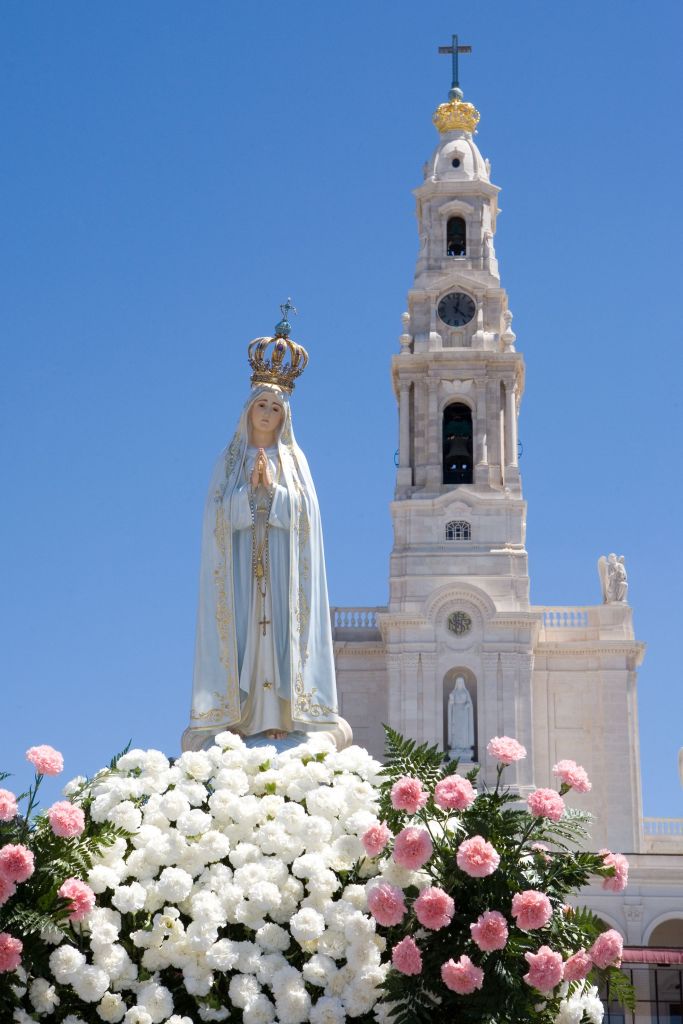
Photo from Pinterest, Our Lady of Fatima Centennial in Portugal, 17 May 2017.
Mary praised and thanked God with her “Magnificat”
Recall how Elizabeth praised Mary twice and her baby Jesus in the womb once yesterday at the Visitation. Naturally for us, when we are praised we always return it by praising too whoever spoke nicely of us.
But that was not the case with Mary. She took the occasion to praise and thank God for all His goodness and salvific work in her and in Elizabeth. Like Hanna in the first reading and responsorial psalm today who sang praises to God in giving her a son in the prophet Samuel, Mary while filled with the Holy Spirit sang this canticle, narrating how God worked in her and through her.
Our lives is a song of thanksgiving always to God who never stops doing great things for us not to make us famous but to bring His divine will into fulfillment. Mary affirmed this when she admitted her own blessedness, “From this day all generations will call me blessed: the Almighty has done great things for me, and holy is his Name.”
Yesterday we have reflected that true blessedness is to trust in God. Likewise, Mary added another dimension in what is to be blessed before God and that is being His servant, His slave or in her very words to the angel at the annunciation, “Behold, I am the handmaid of the Lord. May it be done to me according to your word.”
A handmaid is the feminine form of “slave” but more than being poetic in her identification as a female slave of God, Mary through her Magnificat showed us a glimpse of the lives of the early Christians at that time who were considered “weird” and “odd”, even “bizarre” among the Roman pagans who could not understand why they worshipped Jesus Christ they saw as “a crucified criminal”.
Worst of all for the pagans, they could not understand why the early Christians who were mostly poor would give themselves to Jesus in loving service to others like the sick, the elderly, the hungry, widows and orphans and those living in the margins.
In fact, the Roman historian Pliny recorded in his writings how during the persecution the emperor’s soldiers rounded up Christians in every town and city by looking for anybody doing good, serving the poor and needy! It is something to think about for us Christians today: Would any one of us be arrested because we are doing something good like serving the less fortunate?
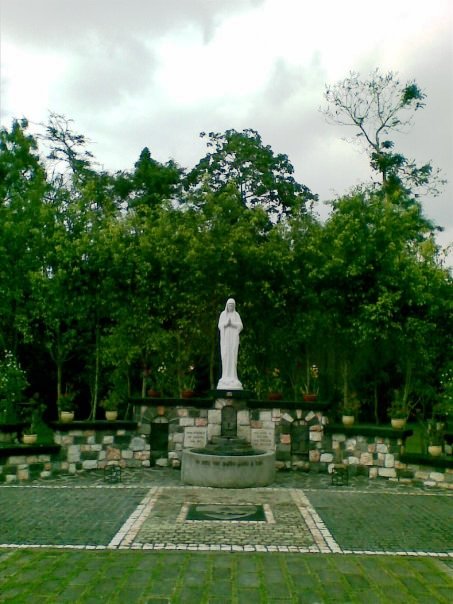
Photo by author, Our Lady of the Poor at Boys Town in Cavite (2009).
Mary, the first model disciple, the first to live out the Gospel
In singing her blessedness by God, Mary had assumed her being the spokeswoman of the early Christians, the poor ones or anawim of Israel who were truly poor materially, trusting entirely on God.
Here lies her challenge to us who love to sing her Magnificat: do we allow God to work in us His salvation?
“He has mercy on those who fear him. He has shown the strength of his arm, and has scattered the proud in their conceit. He has cast down the mighty from their thrones and has lifted up the lowly. He has filled the hungry with good things, and the rich he has sent away empty. He has come to the help of his servant Israel, for he remembered his promise of mercy…”
Luke 1:50-54
Again, we find many similarities in the Mary’s Magnificat and Hanna’s song we heard in the responsorial psalm. But, more than that is the striking similarity of Magnificat with the Beatitudes to be preached by Jesus according to Luke.
In Matthew’s gospel, there are eight Beatitudes preached by Jesus at his sermon on the mount; Luke narrated it differently by citing only four Beatitudes he paired with four woes that Jesus preached in His sermon on the plain (this is due to the different audience Luke and Matthew addressed):
Blessed are you who are poor… Blessed are you who are now hungry… Blessed are you who are now weeping… Blessed are you when people hate you…
Woe to you who are rich… Woe to you who are filled… Woe to you who laugh now… Woe to you when all speak well of you…
Luke 6:20-26
Magnificat is the Gospel in a nutshell. See the works of God cited by Mary perfectly jibing with the Beatitudes of Jesus. Here we find again how Luke has shown us the consistency of Mary as a disciple of her Son Jesus Christ by witnessing to His teachings, living them out for which she was crowned as Queen of heaven and earth.
This is the reason why I love so much the image of Fatima and of Banneux known as Lady of the Poor with Mary portrayed as so simple yet so lovely and beautiful. What a scandal for the Church in our time with all those lavish processions and coronations of the Blessed Virgin Mary where the poor are left out, becoming more of a social function among the rich and famous. What a shame most especially amid the pandemic when some parishes can spend so much fortune in these rituals that look more as a show which the Blessed Virgin would definitely disapprove. Keep in mind how Mary identified herself as “handmaid of the Lord” — do away all those pomp and pageantries please!
Every night, we priests and the religious sing the Magnificat in our Evening prayers to examine ourselves if we have lived out the Gospel message of the Lord, if we have been poor and hungry, if we have allowed ourselves to be used by God to effect His salvation among the suffering.
The same is true with every disciple of Jesus: when we sing the Magnificat or “Ang Puso ko’y nagpupuri”, we have to do some soul searching how consistent we have been as a disciple of the Lord like His Mother Mary.
From the Philippine Daily Inquirer, 24 July 2016.
How sad late yesterday when some people -whether they are trolls or not – had come out expressing support to that cop who brutally shot and killed Sonya Gregorio and her son Anton in their home in Paniqui, Tarlac Sunday afternoon.
How can some people be not affected and even defend or belittle such unspeakable crime of a man supposed to uphold the law, protect civilians?
What had gone wrong with us as the only Christian nation in this part of the world?
Can we sing “Ang puso ko’y nagpupuri sa Panginoon, nagagalak ang aking espiritu, sa aking Tagapagligtas” while we rejoice and defend all forms of brutalities and violence around us?
As we strongly condemn this unspeakable crime and demand justice for Sonya and Anton, let us work hard and pray hardest to imitate Mary to effect change in the society we live in and create by being a voice of the poor and vessel of God’s salvation. Amen.
The Lord Is My Chef Simbang Gabi Recipe-6 for the Soul
by Fr. Nicanor F. Lalog II
Monday, Advent Week IV, 21 December 2020
Zephaniah 3:14-18     >><)))*>   +   <*(((><<     Luke 1:39-45
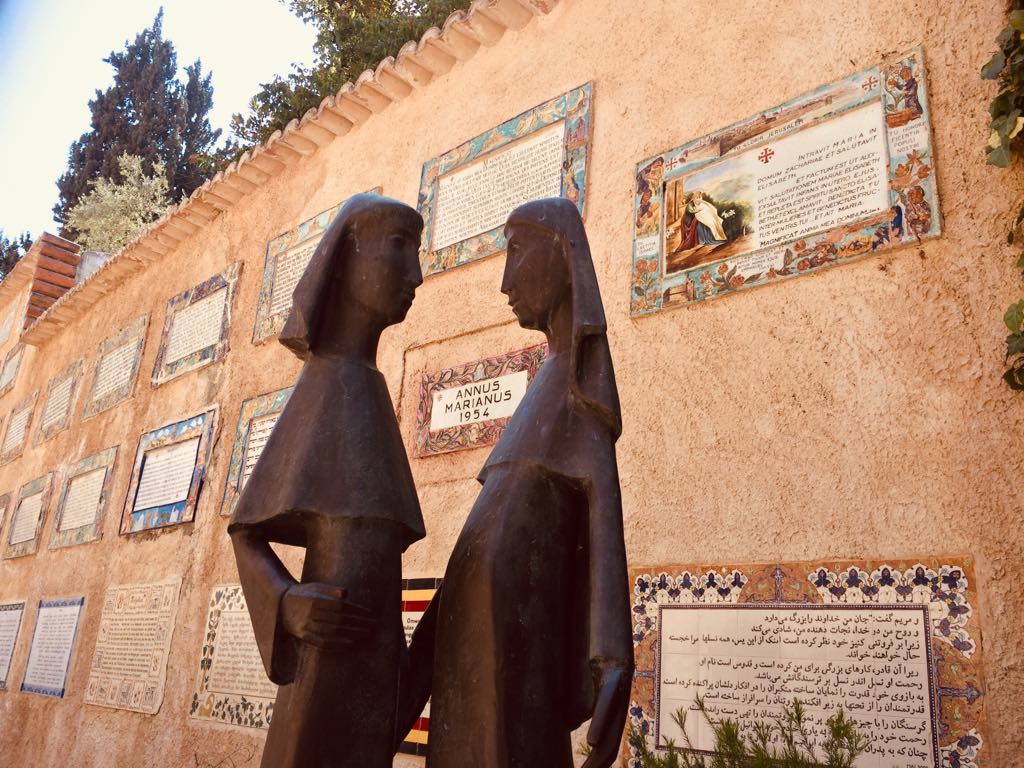
Photo by author, Church of the Visitation, the Holy Land, May 2017.
The Bible rarely tells us conversations between women, except for the Book of Ruth which records to us the story of two women, Naomi and her daughter-in-law Ruth who became the grandmother of King David, and therefore, a kin of our Lord Jesus Christ.
But more rare in the Bible are conversations between two pregnant women, mostly conversations even fights among pregnant mothers and their midwives or rival wives found in the Old Testament. It is therefore so unique is Luke’s account of the Visitation when Mary meets Elizabeth. There must be something so significant for Luke – and for us most especially – in this encounter and exchange.
Mary set out in those days and traveled to the hill country in haste to a town of Judah, where she entered the house of Zechariah and greeted Elizabeth. When Elizabeth heard Mary’s greeting, the infant leaped in her womb, and Elizabeth, filled with the Holy Spirit, cried out in a loud voice and said, “Most blessed are you among women, blessed is the fruit of your womb. And how does this happen to me, that the mother of my Lord should come to me? For at the moment the sound of your greeting reached my ears, the infant in my womb leaped for joy. Blessed are you who believed that what was spoken to you by the Lord would be fulfilled.”
Luke 1:39-45
Women as vessels of God’s blessings
Recall Matthew’s genealogy dominated by the male figures as it was the prevailing culture at that time when women were not really given much attention. But to show the immense power and freedom of God, Matthew mentioned five women who made the coming of Jesus Christ possible.
Most of the women were not really that good whom we would rather describe as a problematique: Tamar pretended to be a prostitute to entice her father-in-law Judah to get her pregnant while Rahab was a real prostitute (a mamasan in fact) at Jericho who helped the spies sent by Joshua before attacking that ancient city; Ruth was a foreigner, not purely Jewish while Bathsheba was the wife of Uriah whom David had killed after she got pregnant with Solomon. And Mary, the wife of Joseph, was found pregnant while still a virgin! (That is what I like most with God – he has a great sense of humor all the time!)
Very interesting with the gospel by Luke is that he got a lot of stories not found in the three other gospels but we find him unique in having a special place for women. He was one of the earliest champions of women in the Church by mentioning many females in his stories to show their important roles in God’s plan for mankind.
Photo by author, frescoes at the Church of the Visitation depicting the Visitation and then the infamous Holy Innocents Day of how an angel helped save the child John the Baptist from Herod’s executioners (2019).
In this story of the Visitation, we find a totally different presentation of women even in today’s world. What do I mean? Recall how during the lockdown the memes of pictures of women meeting with a caption “mga nagbabagang balita” (today’s news headlines) portraying women as rumor mongers or chismosas. Later when classes resumed, another meme circulated of women gathered together exchanging class modules of their children as if to show they are stage mothers.
Luke always presented women so dignified in stature like in the Visitation, so blessed by God.
First thing we notice in the story is how Luke never mentioned Mary and Elizabeth were pregnant. He merely indicated their situation by saying “When Elizabeth heard Mary’s greeting, the infant leaped in her womb” at 1:41 while at the following verse 1:42, Elizabeth proclaims to Mary, “Most blessed are you among women, blessed is the fruit of your womb”. Biblical scholars say that perhaps, Luke wanted to assure his readers that God’s powerful blessings marked both women, over each of whom the Holy Spirit overshadowed them with a child: Elizabeth in her barrenness and old age, Mary in her being a virgin before living with her husband Joseph.
What a display of the power of God so simple, so unassuming!
But the most beautiful part in this conversations by these two great women is the meaning of being blessed. So often when we think of being blessed, especially us Filipinos, it is something more of being “lucky” or “swerte” that means having money to spend and buy things. Sometimes being blessed for us is having achieved something that makes us and our loved ones famous.
The Visitation story tells us something entirely different: to be blessed means to believe in God, that His words would be fulfilled in us like with Mary, “Blessed are you who believed that what was spoken to you by the Lord would be fulfilled” (Lk.1:45).
True blessings
Luke’s Gospel teems with so many occasions of blessings beginning in the infancy narratives up to the Presentation to the temple and then of Jesus pronouncing His blessings especially to those who listen and act on God’s words or those who accept Him as the Christ.
It is at the Visitation where Luke shows us the true meaning of blessedness through Mary because of her faith and trust in God’s word spoken to her by the angel at the annunciation of the birth of Jesus Christ. Her faith makes her a model disciple to be imitated by all followers and believers of her Son Jesus Christ.
And here we find again the artistry of Luke because it is not only Mary who is blessed in the Visitation, but also Elizabeth as another model disciple like the Blessed Mother. Elizabeth was the first to call and recognize Jesus Christ as Lord, “And how does this happen to me, that the mother of my Lord should come to me?” (Lk.1:43).
Photo by author, Advent Week IV, 2020.
See that when Elizabeth heard the greeting by Mary, like when Mary heard the greeting by the angel at the annunciation, it signaled the coming of the messianic age. Pope emeritus Benedict XVI even claims the annunciation is the beginning of the New Testament.
Elizabeth is the first person as far as Luke is concerned to call Jesus “Lord” and the first to call Mary “blessed” whom she will confirm later in her Magnificat, “all generations will call me blessed” (Lk.1:48).
Two women so blessed by God because they both believed in His words, both believed in the Christ still in the womb. Mary and Elizabeth are in fact the first two Christian disciples who showed us the essential task of every disciple: after hearing the word of God and accepting it, we must share it with others not only by repeating it but interpreting it in our very lives that everyone would see it as the good news.
With barely a week left on this final week of Advent, let us ask ourselves how are we going to show to others what we believe happens in Christmas in this time of the pandemic, that true blessedness is not being rich with material wealth but being enriched by a deep and animated faith in Jesus Christ who is Christmas Himself.
The Lord Is My Chef Sunday Recipe for the Soul by Fr. Nicanor F. Lalog II
Fourth Sunday of Advent, Year B, 20 December 2020
2 Samuel 7:1-5, 8-12, 14, 16  >><)))*>  Romans 16:25-27  >><)))*>  Luke 1:26-38
Photo by author, Christmas 2019.
We are now on the final week of our four Sundays of preparations for Christmas. We have been saying Christmas 2020 is surely the most different and difficult in our lives due to the pandemic. However, it may also be the most meaningful when we have more of spiritual values, less of material things; more of the other persons, less of ourselves; and, more of Jesus, less of the Christmas trimmings.
Today we heard the beautiful story of the annunciation of the birth of Jesus Christ found only in the gospel of Luke, the source of many inspirations in arts for many centuries even today. The scene reveals to us the artistry and spirituality of Luke believed to be a medical doctor who was a disciple of St. Paul. He is the only evangelist who admitted he had “investigated everything accurately anew, to write it down in an orderly sequence (the events about Jesus Christ) so that you may realize the certainty of the teachings you have received” (Lk.1:3-4).
And what is that certainty Luke looked into? That Jesus Christ is the Son of God, the fulfillment of the Old Testament promises to the patriarchs and prophets, who is the very presence of God among us. That is why Luke wrote a second volume to his gospel, the Acts of the Apostles to show us Jesus still present in the Church in the power of the Holy Spirit. In this beautiful canvass painted to us by Luke on Jesus the Christ in his Gospel and Acts we also find in a supporting role the Blessed Virgin Mary, His own Mother and model disciple.
The angel Gabriel was sent from God to a town of Galilee called Nazareth, to a virgin betrothed to a man named Joseph, of the house of David, and the virgin’s name was Mary. And coming to her, he said, “Hail, full of grace! The Lord is with you.” But she was greatly troubled at what was said and pondered what sort of greeting this might be. then the angel said to her, “do not be afraid, Mary, for you have found favor with God. Behold you will conceive in your womb and bear a son, and you shall name him Jesus. He will be great and will be called Son of the Most High, and Lord God will give him the throne of David his father, and he will rule over the house of jacob forever, and of his kingdom there will be no end”
Luke 1:26-33
The discipleship of Mary
As a former journalist, I have always considered the four evangelists as the premiere reporters of Jesus Christ. Mark is the old school type of straight news reporting, writing the basic who, what, where, when and why, making his gospel the first to be written and shortest as he was in a hurry, a true journalist. Matthew is more of a feature writer or interpretative reporter while John was a news analyst, an op-ed columnist.
Luke is the modern journalist using the “digital platform” who goes on “live as it happens” with all the colors and actions without losing depth and focus like the BBC and Al Jazeera. He brings us where the news is happening as you must have noticed yesterday in the story of the annunciation of the birth of John the Baptist to Zechariah which also served as introduction to his lead story of Christmas, the annunciation of the birth of Jesus Christ.
Here we see the unique position of Mary as a disciple of Jesus Christ. Unlike Mark and Matthew, Luke tells us how Mary is the only one to have believed in a “situation of contemporaneity” as Fr. Cantalamessa would love to say, meaning, she believed while the event was taking place and prior to any confirmation by the event or history.
See how Matthew presented some facts already known to him in narrating the annunciation to Joseph where the angel clarified Mary’s pregnancy was due to the Holy Spirit. Luke, on the other hand, is like reporting live in real time, so realistic with Mary and the angel conversing to each other!
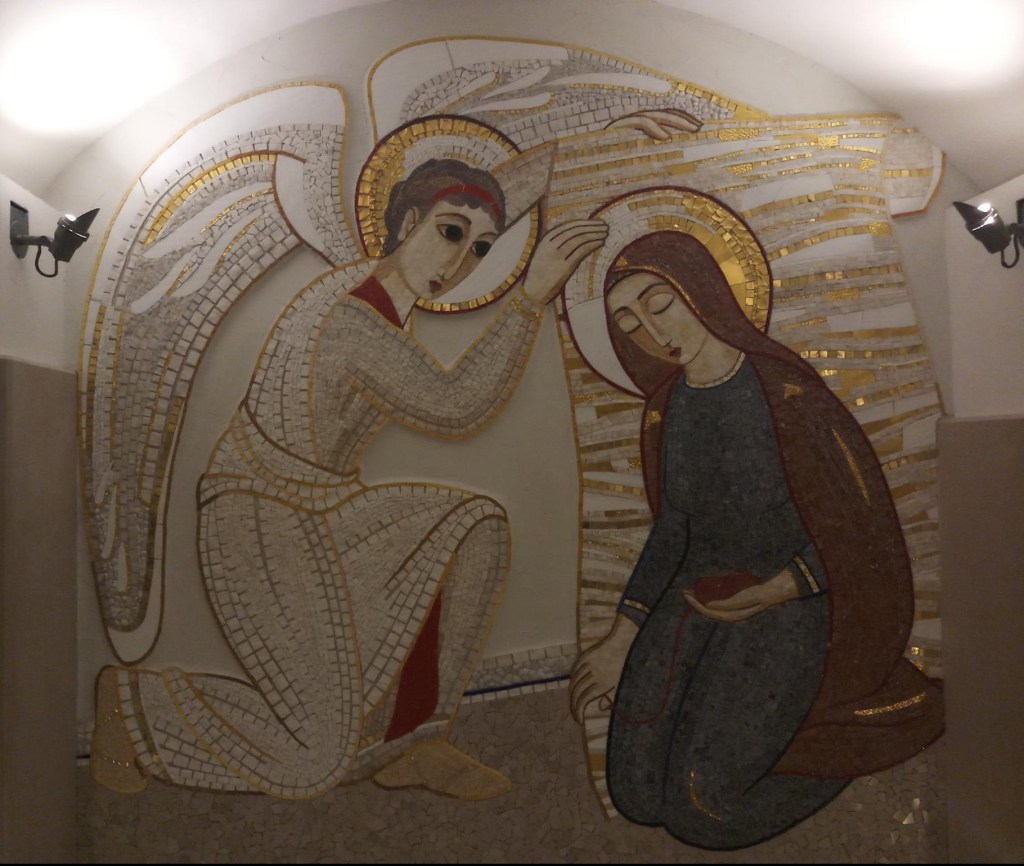
Photo by Arch. Philip Santiago, mosaic of the Annunciation at the San Padre Pio Church in San Giovanni Rotondo, Italy, 2016.
Writing in Greek like the rest of the authors in the New Testament, Luke did not use the usual Hebrew greeting of “Shalom” when Gabriel appeared to Mary, addressing her instead with chaire or “Rejoice favored one” that means especially graced from which came our translation from the Latin “Hail, full of grace!” in 1:28.
The favor or grace of Mary has found with God in 1:30 is explained in 1:31 in the future tense, “you will conceive in your womb and bear a son“. What is amazing here is that there is the sense of certitude on the part of the angel that the future will definitely take place because Mary has already been highly favored one by God before this event. How?
Though Mary will finally become a disciple at the end by saying “Behold, I am the handmaid of the Lord. May it be done to me according to your word” in 1:38, we find in 1:29 how she had always been disposed to the will and grace of God when Luke described how “she was greatly troubled at what was said and pondered what sort of greeting this might be“.
Mary “pondered“ – meaning, she prayed, she meditated right away the greetings to her, indicating her openness and disposition to listen and follow the will of God. That shows how even before the annunciation happened, Mary had always been obedient to God that is why she could say yes to Him when asked to be the Mother of the Savior.
Here we find Mary’s consistency as a disciple of the Lord, her Son Jesus still to be born but already existing in eternity!
When we were growing up, our mother would always tell us that once our names are called either by her or by our father, we only say one thing, “Opo… ano po iyon?” (Yes, what is it?). That is old school discipline where we literally obeyed first even without any instruction yet because we have always been assured parents would never tell kids to do something bad or wrong. And we believed that. Unlike today’s generations where the usual reply to parents’ call is “wait” that no wonder, we now ask God wait before he can speak to us. Thank God I did not get married….
Going back to Mary, we now find the contrast with yesterday’s annunciation to Zechariah: Mary pondered and felt everything in her heart and soul while Zechariah reasoned out, used more his head than his heart – something we must ponder this Christmas. Mary right away had her heart, her very self onto the Christmas Nativity while Zechariah was stuck in his negativity.
Mary believed while the event, the annunciation, was taking place, prior to any confirmation by the event itself or by history. Later we shall see that expression “pondering in her heart” repeated often by Luke and also by John in presenting Mary: after listening to the words of the shepherds who came to see baby Jesus at His birth in Bethlehem, at finding Jesus at the temple aged 12, and during the wedding feast at Cana where He did His first miracle.
Photo by author of the site where the annunciation to Mary took place found below the Basilica of the Annunciation in Nazareth (2019).
The faith of Mary
From the annunciation of the birth of Jesus to His crucifixion, Easter and Pentecost, Mary always believed. During the Visitation, Elizabeth praised her, becoming the first to call Mary as “blessed” because “you believed what was spoken to you by the Lord would be fulfilled” (Lk.1:45).
Eight days after Easter, Jesus said to Thomas, “Have you believed because you have seen me? Blessed are those who have not seen and yet believe! ” (Jn 20:29). Early at the annunciation, Mary was the first to have believed without having seen Jesus Christ!
Mary teaches us the importance of subjective faith or the act of simply believing and trusting God, a person-to-person relationship with Him.
But it is not enough because it could lead to isolationism when we become individualistic and begin to have our own concept of God like what is happening these days especially with many Catholics with their own interpretations of God, heaven, evil and sin among other things.
Like Mary, we need to cultivate also objective faith, believe in the content of faith of the community. Mary believed God relating with the ancient prophets and patriarchs of Israel which the angel mentioned to her during the annunciation. See that after the annunciation, Mary hastily went to visit Elizabeth to share her good news and her faith. In her we learn that faith leads to a mission that is seen in the context of a community, the Church where Mary was portrayed to us praying with the disciples of Jesus during the Pentecost at the Upper Room in Jerusalem.
So here we find the consistency of Mary even before the annunciation that continued on in the life of the Church we still experience today in her many apparitions and messages always centered on Jesus not herself.
That is the call of Advent to us all: to be consistently clear with our faith with the one to be born at Christmas, Jesus Christ who is the Son of the Father, our Savior promised in Old Testament, now the very presence of God among us.
People kneeling on the streets during our Christ the King celebrations, 22 November 2020.
It is not enough that we just pray and believe; like Mary, we need to get out of ourselves and give ourselves to God and the Church. This is especially true with us priests who seem to believe more to himself and to media than with God! We must constantly examine ourselves if we truly believe in what we preach, in the kind of lives we lead. Is Jesus still center of our lives or us that we are so concerned always with our “image”, always seeking “likes” and “followers” than anything else?
If there is anyone who should be the first to be consistent in faith in God in any community, that must be the priest or pastor.
A few weeks ago while striving through the many challenges of my personal life and my ministry since this pandemic began, a parishioner told me how they draw strength and inspiration from me. I asked her why and how? What does my personal life has anything to do with them?
She explained that whenever they see me still going through with my ministry, holding on in my prayers and daily Masses, still smiling and can still laugh and crack jokes — they just feel they too can overcome their trials and difficulties.
I have realized in that short conversation more than preaching and explaining faith and its content, people look more at how faithful are we truly are as men of faith. That aside from dispensing the sacraments and doing all the ministries in my parish, there is also the task so unknown to me before of enkindling the faith of my flock, of guiding and leading them to God based on how do I live that faith in God with joy and patience.
People believe in God and the Church when they experience their pastor believing first in God and the Church. Like the COVID-19 virus, faith is contagious that spreads by coming into contact with. We priests must be the first to be “infected” with faith in the parish so that everyone would be “positive” with it, creating a “pandemic” in faith!
That is the consistency of Mary as a disciple — she is a “carrier” of a deep, joyful and active faith in Jesus, “infecting” everyone so positively that despite the difficult and trying situations we are into, we celebrate Christ’s coming amid the pandemic.






















 lordmychef.com