The Lord Is My Chef Daily Recipe for the Soul by Fr. Nicanor F. Lalog II
Tuesday, Feast of St. Luke, Evangelist, 18 October 2022
2 Timothy 4:10-17   ><}}}}*> + ><}}}}*> + ><}}}}*>   Luke 10:1-9
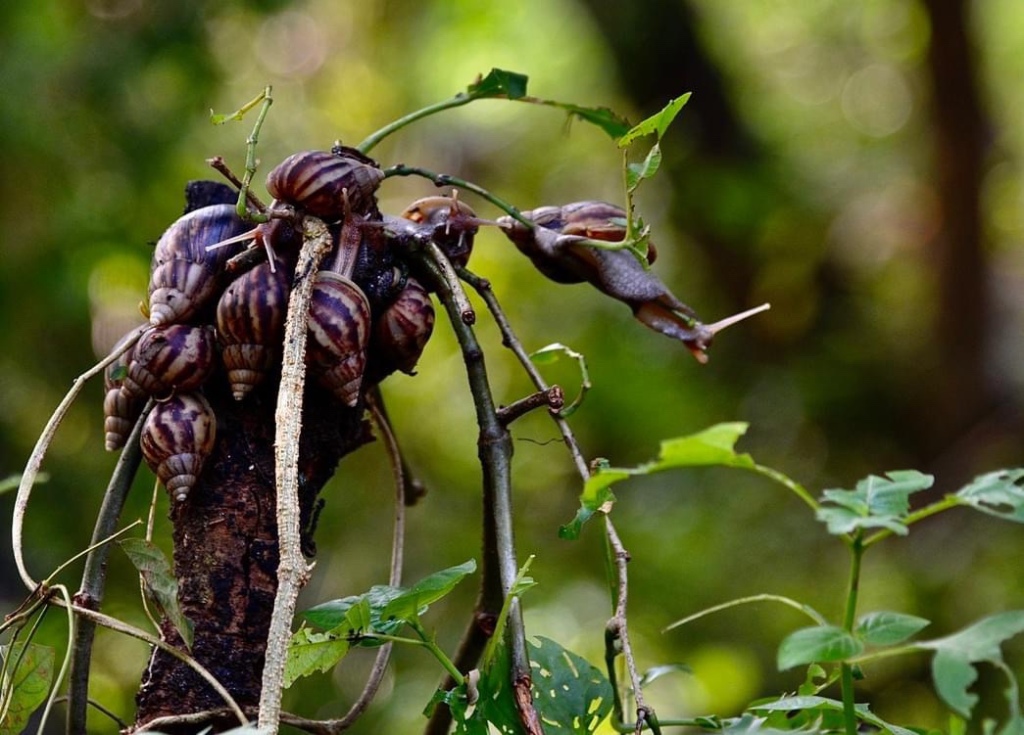
Photo by author, 2018.
Dearest Jesus:
as we celebrate today
the feast of your Evangelist
St. Luke, I pray for the grace
to be like him - prayerful
and faithful to you,
especially when
things become so tough
and difficult.
Of the four Evangelists,
St. Luke emphasized most
your praying so often
to show your oneness
in the Father, of your
going to deserted places
to pray especially before
major events like the choice
of the Twelve Apostles
and the Transfiguration,
clearly showing that prayer
is the very center of the life
of every disciple to be able
to follow Jesus closely by
carrying the cross "daily" (Lk.9:23).

Like St. Luke,
may my life be a prayer,
a gospel in writing.
Photo by author, 2018.
Beloved: Demas, enamored of the present world, deserted me and went to Thessalonica, Crescens to Galatia, and Titus to Dalmatia. Luke is the only one with me.
2 Timothy 4:10-11
Let my prayers,
O dear Jesus,
lead me to deeper
faith in you especially
when in severe tests
like St. Luke who remained
faithful to you by standing
by his mentor St. Paul
even in prison.

Like St. Luke, keep me faithful
to you, Jesus, by always remembering
the poor and marginalized in the
society especially the women
and the sinners this Evangelist
had put on the limelight
like Elizabeth, Anna the Prophetess
and the widow of Nain
as well Zacchaeus and Dimas.

Like St. Luke, keep me faithful
to you Jesus by being faithful too
to your Mother, the Blessed Virgin Mary:
St. Luke was the only one who sought her
in Ephesus to give us the lovely story
of Christmas from the Annunciation
to the Visitation, the Nativity and
the Presentation up to her presence
at the Pentecost found in his
second book called the Acts,
the gospel of the Church
which is the other side of
every fidelity to you and Mary
is fidelity to your Church!
Dearest Jesus,
in writing the Gospel
and the Acts of the Apostles,
you have touched St. Luke so deeply
that he narrated your story in great details
as if he was touching you
that in the process,
he has touched us too,
enabling us to experience
as well as paint and picture
your Divine Mercy for everyone
Amen.
Painting of “Saint Luke Drawing the Virgin” by Flemish painter Roger van der Weyden (1400-1464); photo from en.wikipedia.org.
The Lord Is My Chef Daily Recipe for the Soul by Fr. Nicanor F. Lalog II
Monday in the Twenty-Seventh Week of Ordinary Time, Year II, 03 October 2022
Galatians 1:6-12   ><000'> + ><000'> + ><000'>   Luke 10:25-37
Photo by Dr. Mylene A. Santos, MD, 10 September 2022.
Praise and glory
to you, O God our loving Father!
Thank you for this great
Monday, the first working
day of October!
Stir into flame your gift
to me, dear God, (2 Tim. 1:6),
fill me with zest
fill me with passion
fill me with life
to forge on amid all
the difficulties and trials
this day
this week
may bring to me.
Like the zeal
and enthusiasm
of St. Paul,
let me be firm
in asserting your
Good News of salvation
in Christ Jesus:
"If I were still trying
to please people,
I would not be a slave
of Christ" (Galatians 1:10c).
Keep me faithful to you,
Lord, and stop me from
pretending somebody
else, impressing people
by claiming to be your
disciple in all of its outward
signs without your Cross.

Keep me faithful to you,
Lord and stop me from
seeking attention,
perks and privileges
to be famous by claiming
to be your disciple but
afraid to suffer, afraid of
losing, afraid of failures.

Keep me faithful to you,
Lord, not to the cultic
signs and symbols we have
developed in deepening our
faith in you but, like the
priest and the Levite in
your parable today,
have totally disregarded
the wounded and sick,
the abandoned and
lost, the sinful and poor.
Deepen my faith,
strengthen my faith
to have passion in doing
your works, Lord;
forgive me, Jesus,
when I think and see more
of efficiency and programs
without meeting and
experiencing persons,
building relationships
in you, with you, and
through you.
Amen.
The Lord Is My Chef Daily Recipe for the Soul by Fr. Nicanor F. Lalog II
Wednesday, Feast of St. Lorenzo Ruiz & Companion Martyrs, 28 September 2022
Job 9:1-12, 14-16     ><000'> + ><000'> + ><000'>     Luke 9:57-62
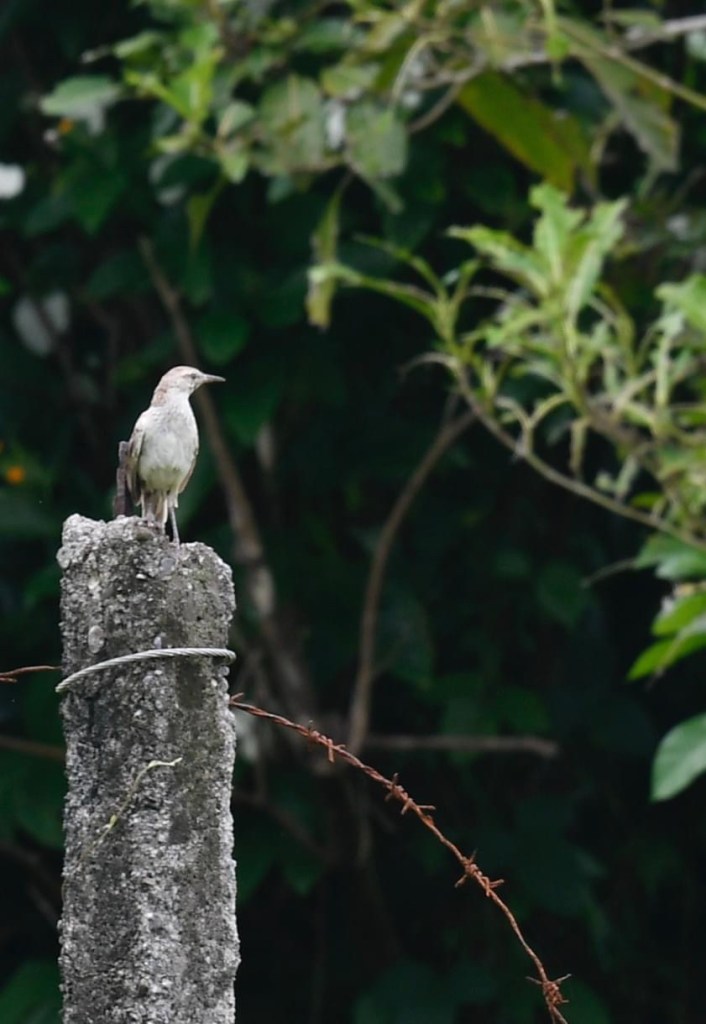
Photo by Dr. Mylene A. Santos, MD, of a Philippine Serpent Eagle at the Sierra Madre, Quezon Province, July 2022.
Life is truly a mystery,
O God our loving Father!
Filled with so many twists
and turns, bends and
corners that lead
and open us to
new vistas,
new situations,
new sceneries
that make us closer
to finding you and
experiencing you.
Job answered his friend and said: God is wise in heart and mighty in strength; who has withstood him and remained unscathed? He made the Bear and Orion, the Pleiades and the constellations of the south; He does great things past finding out, marvelous things beyond reckoning. Should he come near me, I see him not; should he pass by, I am not aware of him.
Job 9:1, 4, 9-11
Like Job
and St. Lorenzo Ruiz,
many times our hearts cry
out to you unable to understand
at how and why so many bad things
are happening to us, sometimes we
feel overburdened almost giving up
but still in the end, we persevere
because we believe in you,
we cannot go without you
for we would rather go in darkness
assured of your presence than in
light without you on our side.
As Jesus and his disciples were proceeding on their journey someone said to him, “I will follow you wherever you go.” Jesus answered him, “Foxes have dens and birds of the sky have nests, but the Son of Man has nowhere to rest his head.”
Luke 9:57-58
Grant us, dear Jesus,
the grace of true freedom to
choose you always freely,
to be free from any attachments
with the world and worldly
except you whom we follow
wholeheartedly like St. Lorenzo Ruiz
and companion martyrs..
And to another he said, “Follow me.” But he replied, “Lord, let me go first and bury my father.” But he answered him, “Let the dead bury their dead. But you, go and proclaim the Kingdom of God.”
Luke 9:59-60
Grant us too, dear Jesus,
the grace to live in the present,
to be always in every here and now,
learning from the past,
forging ahead onto the future
to preach the good news of
salvation urgently,
joyfully!
And another said, “I will follow you, Lord, but first let me say farewell to my family at home.” Jesus answered him, “No one who sets a hand to the plow and looks to what was left behind is fit for the Kingdom of God.”
Luke 9:61-62
Lastly like St. Lorenzo,
teach us dear Jesus to be firm
in our decision in following you,
to stop entertaining thoughts
of turning back from your mission,
thoughts of seeking comforts
and other personal benefits
 except of doing and fulfilling
 your most Holy Will
unto death.
Amen.
The Lord Is My Chef Daily Recipe for the Soul by Fr. Nicanor F. Lalog II
Thursday, Memorial of Our Lady of Sorrows, 15 September 2022
Hebrews 5:7-9     ><}}}}*> + ><}}}}*> + ><}}}}*>     John 19:25-27
“Mater Dolorosa” also known as “Blue Madonna” (1616) by Carlo Dolci. Photo from Wikimedia Commons.
A day after celebrating
the Feast of the Exaltation
of the Cross, you remind us today
dear Jesus of your most wonderful
gift to us, a companion and a model in
discipleship, Mary your Mother.
Being the first disciple,
Mary was the first to receive
and welcome you at your Annunciation,
the first to truly believe in you when she
immediately told you how the newly-wed
couple ran out of wine at Cana,
and the first to remain in you at the foot
of the Cross; there at the Cross as your
Sorrowful Mother, Mary taught us the most
important aspect of discipleship:  intimacy
in you and with you in prayer.
Standing by the cross of Jesus were his mother and his mother’s sister, Mary the wife of Clopas, and Mary of Magdala. When Jesus saw his mother and the disciple there whom he loved, he said to his mother, “Woman, behold, your son.” Then he said to the disciple, “Behold, your mother.” And from that hour the disciple took her into his home.
John 19:25-27
As I prayed on this memorial of
Our Lady of Sorrows, I wondered what
was your Mother Mary was doing there
at the foot of your Cross, Lord Jesus?
More than the tears and sorrow on her
face as portrayed in arts,
all I can see and experience
at her most lovely face, O Lord,
is a disciple so absorbed in prayer,
so united and close with you!
How sad, dear Jesus, that many
of us have forgotten this very
important aspect of discipleship
your Mother had shown us,
a life centered on prayer;
more than reciting prayers,
it is residing in you, Jesus!
Teach us, dear Jesus,
to be like Mary, to truly take
her like the disciple you loved
of being intimate with you and the
Father in prayers; her standing at the
foot of your Cross did not simply happen
at the spur of the moment; it was the highest
moment of her long periods of time spent in
prayers, of communing with you and in you;
many times, we only come to you when we are
standing at your Cross, when trials and
difficulties happen but when everything is
going well, we hardly remembered you nor be
with you at prayer.
All her life,
Mary lived her life in
prayer in you and with you
dear Jesus; when the Pentecost
happened, she was praying
with your disciples at the Upper
Room awaiting the coming of the
Holy Spirit; teach us, Lord Jesus,
that discipleship is essentially
prayer; whatever we do,
it is always borne out of prayer.
Our Lady of Sorrows,
pray for us your children,
especially your priests who are
supposed to be disciples too of
your Son to immerse ourselves
in prayer first of all because before
all else came, there was Jesus Christ
who came first calling us,
sending us on a mission to
proclaim the good news to everyone.
Amen.
The Lord Is My Chef Daily Recipe for the Soul by Fr. Nicanor F. Lalog II
Friday in the Twenty-Third Week in Ordinary Time, Year II, 09 September 2022
1 Corinthians 9:16-19, 22-27   ><]]]]'> + <'[[[[><   Luke 6:39-42
Photo by Mr. Jim Marpa, 2019.
Your words today from St. Paul
are so timely, dearest Lord Jesus;
in a time when so many of us have
become so complacent and even
lazy in this life characterized by
comfort and ease, please reset our
perspectives and points of view,
Jesus, when all we think is ourselves,
of being famous and popular;
worst of all, like in your stern warning
in the gospel, we have become self-
righteous, blinded by our ego that
we see ourselves better than everyone
when all we see are others' faults
without noticing our bigger faults.
Brothers and sisters: If I preach the Gospel, this is no reason for me to boast, for an obligation has been imposed on me, and woe to me if I do not preach it! No, i drive my body and train it, for fear that, after having preached to others, I myself should be disqualified.
1 Corinthians 9:16, 27
Grant me the grace,
O Lord, to be truly your follower,
your disciple, a person of
discipline who treads the path of
truth and mercy, light and understanding,
justice and mercy, honesty and sincerity;
give me the courage to persevere in
following you amid all pains and
difficulties.  Amen.
The Lord Is My Chef Sunday Recipe for the Soul by Fr. Nicanor F. Lalog II
Twenty-third Sunday in Ordinary Time, Cycle C, 04 September 2022
Wisdom 9:13-18 ><}}}}*> Philemon 9-10 ><}}}}*> Luke 14:25-33
Photo by Mr. Lorenzo Atienza, 12 June 2019, Malolos Cathedral Basilica.
One of the most moving parts of the rite of ordination to the priesthood as well at profession of vows by nuns is when they prostrate in front of the church altar to signify their total conviction and commitment to the person of Jesus Christ.
What a beautiful image of the nature and essence of discipleship requiring great sacrifices to faithfully persevere to the end in Jesus who is always the highest priority of our lives, not only of priests and religious but lay people alike for we are all called to a life of holiness.
We find this conviction and commitment to Jesus in Paul’s own experience while in prison when the slave of his friend Philemon named Onesimus fled to seek refuge in him and eventually converted into Christianity.
Conformity and fidelity to the gospel
is beyond morality
because it is an adherence
to the person of Jesus Christ.
It must have been a difficult situation for Paul if found harboring a runaway slave, Onesimus, who in turn could face death as punishment for his act. Remember that slavery was normal during Paul’s time and even if he did not preach directly against its institution, here in this short powerful letter of just 25 verses he planted the seeds for its destruction when he stressed that Onesimus is Philemon’s “brother in the Lord”.
Photo by Dr. Mylene A. Santos, MD at Katmon Harbor nature Sanctuary, Infanta, Quezon, 29 August 2022.
Perhaps this is why he was away from you for a while, that you might have him back forever, no longer as a slave but more than a slave, a brother, beloved especially to me, but even more so to you, as a man and in the Lord. So if you regard me as a partner, welcome him as you would me.
Philemon 15-17
Many times in life, we realize that fidelity to the gospel can be entirely unreasonable like when we have to be like Philemon whom Paul had asked to believe in the sincerity of the conversion of Onesimus his slave when it seemed to be more of convenience or merely circumstantial. Most of all, how could we receive another as a “beloved brother in the Lord” to whom we owe nothing at all when in fact who had hurt us in the first place! Conformity and fidelity to the gospel is beyond morality because it is an adherence to the person of Jesus Christ, of our communion with him and in him as his disciples.
Are we willing to go that far, of leaving everything behind, even our loved ones, our very selves for Jesus like what the gospel asks us today?
Great crowds were traveling with Jesus, and he turned and addressed them, “If anyone comes to me without hating his father and mother, wife and children, brothers and sisters, and even his own life, he cannot be my disciple. Whoever does not carry his own cross and come after me cannot be my disciple.”
Luke 14:25-27
Photo by author, Stations of the Cross, Our Lady of the Most Holy Rosary Chapel, SM Grand Central, Caloocan City, June 2022.
It is already September and we have only about 12 weeks to go before closing this liturgical year to prepare for Christmas with the Advent Season. Jesus is fast approaching Jerusalem and great crowds were already following him.
However, Jesus was very much aware too of the mixed crowd following him where many were simply curious, some were interested, still searching for more proofs perhaps while a few of them were already committed.
How about us today?
See how Luke presented Jesus resolutely journeying to Jerusalem when he turned to face the crowd that includes us today to issue two important lessons about discipleship, hating those dearest to us including our very selves and, second, carrying our cross.
There comes a time in our lives
when the only explanation,
the only justification,
and the only reason
why we do something unthinkable
even foolish is because of Jesus Christ.
Jesus is not asking us to literally hate our family and friends or even our very selves; the word hate in this passage refers more to action than emotion, of doing something that others would surely hate like when we do not give in to their requests to support them in a lie or something not fair and just, or simply sinful and evil. We have experienced how it is actually more difficult to being good Christians doing God’s will, doing what is right and good that are exactly not what our family and friends are doing and would want us to also do. And that is why, when we do not go with them and their whims and caprices, they think we “hate” them.
Following Jesus means putting him first always, even above our loved ones that they always misinterpret as our lack of love and concern for them.
But more difficult than that is hating our very selves, doing a Philemon for the many Onesimus in our lives. There comes a time in our lives when the only explanation, the only justification, and the only reason why we do something unthinkable even foolish is because of Jesus Christ. And that is when we have to hate our selves like when we forgo vengeance, let go of some debts, forget all about technicalities and legalities because we love Jesus. It is really foolish by world standards that sometimes one comes to hate one’s self too for letting go and letting God.
Photo by author, detail of Seventh Station of the Cross in the Parish of San Ildefonso, Tanay, Rizal with a man wearing shades, January 2021.
Meanwhile, to carry one’s cross is more than patiently accepting our human conditions of suffering and sickness, weakness and trials in life. This understanding of carrying one’s cross implies passivity as if the difficulty we are into is something that just happened and fell on our lap or shoulder that we simply have to accept them in the name of Christ.
That is very good and highly commendable but, Jesus wants a more active participation from us. To carry one’s cross is to voluntarily choose and accept a difficulty in life as a direct consequence of our conviction in and commitment to Jesus Christ our Lord and Teacher!
This is the reason Jesus presented us with two parables after sounding his call to discipleship, that one of building a tower and of a general going to war. The two men in these parables had to calculate the cost of their efforts, of how much they have to sacrifice and give to be successful in their endeavors lest they become laughing stocks in the community. The same is true with each one of us today as disciples of Jesus.
“In the same way, anyone of you who does not renounce his possession cannot be my disciple.”
Luke 14:33
Of course, Jesus gives us the grace to become good disciples but grace builds on nature; how much are we willing to sacrifice, to renounce even our very selves to truly follow Jesus through and through?
Kaya mo ba?
Photo from gettyimages.com.
Discipleship in Christ is being devoted to him in the same manner he is devoted to the Father toward whom he is drawing us. There is no other Way but Jesus alone. Therefore, to be his disciple means to prefer nothing to Christ who is our very life, our being, our end.
There is no room for mediocrity in being his disciple. We have seen in history and in our very lives how superficial discipleship had caused more damages to the Church and to each one of us when we fail to be committed to our calls. Despite our long years of seminary formation, many of us priests miserably fail in our discipleship with the many scandals that plague the Church these days, not to mention the endless complaints by people of how their pastors do not prepare homilies nor celebrate Mass daily and worst, refuse to answer sick calls! On the other hand, many families and most especially children have been destroyed by the separations of many couples who have refused to learn of letting go of themselves to let God work in their relationships. Then, there are the siblings who fight simply because they cannot let go of their principles and egos and wealth that matter most to them than their brother or sister, or even parents!
This Sunday, let us pray for God’s counsels, for the enlightenment of the Holy Spirit as expressed in the first reading from the Book of Wisdom so we may not simply know what is good but most of all lead holy lives by experiencing God daily as his disciples. Amen.
Lord My Chef Daily Recipe for the Soul by Fr. Nicanor F. Lalog II
Monday, Memorial of the Queenship of Mary, 22 August 2022
Isaiah 9:1-6   ><}}}*> + ><}}}*> + ><}}}*>   Luke 1:39-47
Photo by author,Makati skyline at sunset from Antipolo City, 13 August 2022.
It is a very busy Monday
for everyone, O God,
our loving Father:
it is the first day of school
for most students,
another first day of work
with all the traffic and woes
of life slowly going back
to normal.
And I really wonder,
what could surprise us today,
Lord, like Mary when your
angel announced to her the
coming of Jesus Christ by
being his mother?
But she was greatly troubled at what was said and pondered what sort of greeting this might be.
Luke 1:29
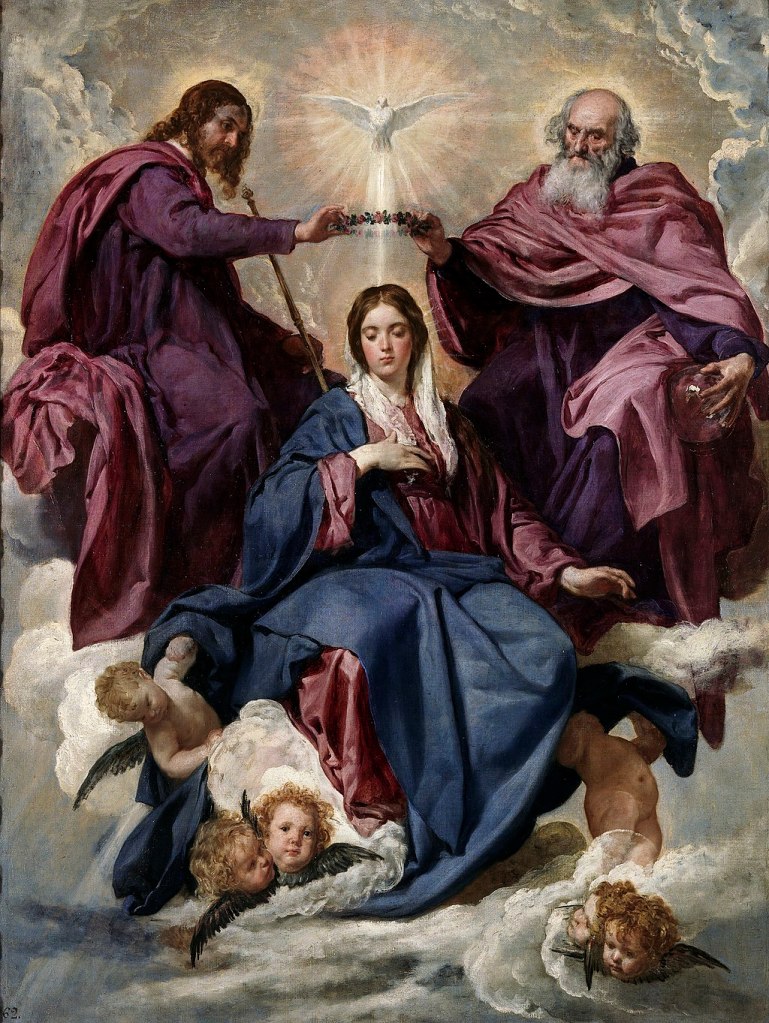
“Coronation of the Virgin” by Diego Velazquez (ca.1635/1636) from en.wikipedia.org.
On this memorial of the
Queenship of Mary,
let us rejoice and be grateful
to you for the grace of being
favored to be up and going this day
no matter how busy we may be;
let us be surprised by the
tremendous blessings you
shower upon us like Mary
when deep in our hearts we know
we are nothing before you;
surprise us, Lord, of your
presence, of your life, of your love,
most of all, of your trust;
enable us to say yes to your call
for us to serve you today,
to bring light in this dark world,
to share Jesus Christ like Mary
who is our "Prince of Peace and
Wonder-Counselor" (Is.9:5).
O most blessed Virgin Mary,
help us to welcome Jesus Christ
daily in our lives in order for us to
share him with everyone like you;
as the first of the human race in rank
before God's presence and as the
Mother of Christ our King, you are
given the title of Queen not only as an
honor but an example of discipleship in
your Son Jesus.  Amen.

O, Mary Queen of heaven,
Pray for us!
The Lord Is My Chef Daily Recipe for the Soul by Fr. Nicanor F. Lalog II
Thursday in the Eleventh Week of Ordinary Time, 16 June 2022
Sirach 48:1-14   ><]]]]'> + ><]]]]'> + ><]]]]'>   Matthew 6:7-15
Photo by author, October 2020.
God our loving Father,
today I pray for the grace of
having not just the right or
positive attitude in life but
most of all, an attitude
that is is holy and blessed.
It is not enough, Lord,
that we have a positive attitude
in life; that attitude or disposition
must always be holy and blessed,
inclined into your heart and will,
dear Father because so often,
the right attitudes of the world do
not agree with your ways, O Lord.
It is not enough we are happy and
positive; there are times we have
to stand for what is right and true,
just and fair like Elija and Elisha.
Like a fire there appeared the prophet Elijah whose words were as a flaming furnace. How awesome are you, Elijah! Whose glory is equal to yours? You sent kings down to destruction, and nobles, from their beds of sickness. You heard threats at Sinai, at Horeb avenging judgments. You anointed kings who should inflict vengeance, and a prophet as your successor… O Elijah, enveloped in the whirlwind! Then Elisha, filled with a twofold portion of his spirit, wrought many marvels by his mere word. During his lifetime he feared no one, nor was any man able to intimidate his will. In life he performed wonders, after death, many marvelous deeds.
Sirach 48:1, 4, 6-8, 12, 14
What a blessed attitude you
have bestowed on Elijah and
Elisha you have bestowed upon us
too in Jesus Christ's coming
and sending of the Holy Spirit.
In Jesus Christ, we have
become your beloved children,
dear God our Father but too
often, we lack the blessed attitude
we must have before you as shown
to us in the Our Father, our most
common prayer recited but taken
for granted.  Help us, dear Jesus,
to acquire and imitate this holy
attitude you have taught us in how
to pray by always addressing God
"our Father", recognizing his holiness,
praying to make his kingdom come
by doing his will always and
forgiving those who have sinned
against us.
Amen.
The Lord Is My Chef Daily Recipe for the Soul by Fr. Nicanor F. Lalog II
Wednesday in the Eleventh Week of Ordinary Time, 15 June 2022
2 Kings 2:1, 6-14   ><}}}}*> + ><}}}}*> + ><}}}}*>   Matthew 6:1-6, 16-18
Photo by author, Singapore 2018.
Today we heard, dear God,
the beautiful story of your two
great prophets, Elijah and his
successor Elisha; but what is
most wondrous is the loyalty
of Elisha's discipleship which is
a beautiful imagery of our relationship
with your Son Jesus Christ.
When the Lord was about to take Elijah up to heaven in a whirlwind, he and Elisha were on their way to Gilgal. Elijah said to Elisha, “Please stay here; the Lord has sent me on to the Jordan.” “As the Lord lives, and as you yourself live, I will not leave you,” Elisha replied. And so the two went together.
2 Kings 1, 6
Our loyalty and fidelity are only
to you, heavenly Father but expressed
through prophets and leaders and mentors
you sent us to prepare us too for your
mission; like Elisha, keep us faithful to you,
may we receive your call gladly through
them, and most of all, like Elisha,
may we submit to you, O God, to become
like Elijah your prophet to your people,
speaking to them only your words,
and doing to them only your will.
Let us be more focused on you,
loving Father, not on us and our work;
may we heed the calls of your Son
Jesus Christ for us to lead prophetic lives
amid this age of too much self-promotion:
Jesus said to his disciples: “Take care not to perform righteous deeds in order that people may see them; otherwise, you will have no recompense from your heavenly Father.”
Matthew 6:1
Lord Jesus Christ,
let me decrease so that
you will increase in me
like all your prophets.
Amen.
The Lord Is My Chef Daily Recipe for the Soul by Fr. Nicanor F. Lalog II
Monday, Memorial of Mary, Mother of the Church, 06 June 2022
Genesis 3:9-15   ><}}}}*> + ><}}}}*> + ><}}}}*>   John 19:25-27
Photo by author, 2018.
Praise and glory to you,
God our loving Father
for all the women of the world
as we resume Ordinary Time
in our Church calendar honoring
Mary, Mother of the Church.
How wonderful to recall how
all four evangelists narrated the
presence of women at the crucifixion
of your Son Jesus Christ:  what a
most wondrous sight that continues
to this day when behind every sufferings
we go through are the women who
often join and accompany us even
until death, giving us strength and
courage, comfort and consolation.
But most wondrous, O God,
is the account of the beloved disciple
of Mary, the Mother of Jesus at the
foot of his Cross on Good Friday,
being addressed as "woman".
Standing by the cross of Jesus were his mother and his mother’s sister, Mary the wife of Clopas, and Mary of Magdalene. When Jesus saw his mother and the disciple whom he loved, he said to his mother, “Woman, behold your son.” Then he said to the disciple, “Behold, your mother.” And from that hour the disciple took her into his home.
John 19:25-27
Only you, O God in your Son Jesus,
can give that unique gift of womanhood
especially your Mother Mary;
you first called her "woman" at the
wedding feast at Cana and now here
at the Cross, when your hour had come.
What a beautiful image, dear Lord,
of Mary, of the woman in your work of
redemption so close and so near you
that is in direct contrast with the other woman
in Genesis, Eve, who turned away from you
in sin.
Bless us dear Jesus,
to constantly repeat this beautiful
scene at the Cross, as an individual
and as a community of your disciples:
let us relive this scene in our lives
as Christians taking Mary your Mother
as well as the Church into our own homes
and most especially of respecting every
woman still ignored and taken for granted
in this time; let us remember always our
equal dignity with women as image and likeness
of God as we carry out your final instructions
of remaining one in you in love and mercy.
Amen.