Arise, be whole again in Christ!

The Lord Is My Chef Sunday Recipe for the Soul by Fr. Nicanor F. Lalog II
Thirteenth Sunday in Ordinary Time, Cycle B, 27 June 2021
Wisdom 1:13-15; 2:23-24 <+> 2 Corinthians 8:7, 9, 13-15 <+> Mark 5:21-24, 35-43

Photo by author, sunrise at the Lake of Galilee, the Holy Land, 2017.

Once again, we find Jesus crossing the Lake of Galilee this week with a crowd following him to listen to his teachings and experience his healing. What a beautiful image of life in Jesus, of constantly crossing the sea, sometimes in the darkness of the night amid storms.

It was something like what we had gone through last Thursday on the Solemnity of the Nativity of John the Baptist when as a nation we crossed history with the inauguration of the new Archbishop of Manila marked with the passing of former President Noynoy Aquino.

We hope and pray that like our gospel this Sunday, our recent crossing will lead us to new awakenings and realizations leading to national healing and yes, a resurrection, a rising from the dead like that young daughter of Jairus brought back to life by Jesus.

When they arrived at the house of the synagogue official, he caught sight of a commotion, people weeping and wailing loudly. So he went in and said to them, “Why this commotion and weeping? The child is not dead but asleep.” And they ridiculed him. Then he put them all out. He took along the child’s father and mother and those who were with him and entered the room where the child was. He took the child by the hand and said to her, Talitha koum, which means, “Little girl, I say to you, arise!” The girl, a child of twelve, arose immediately and walked around. At that they were utterly astounded.

Mark 5:38-42
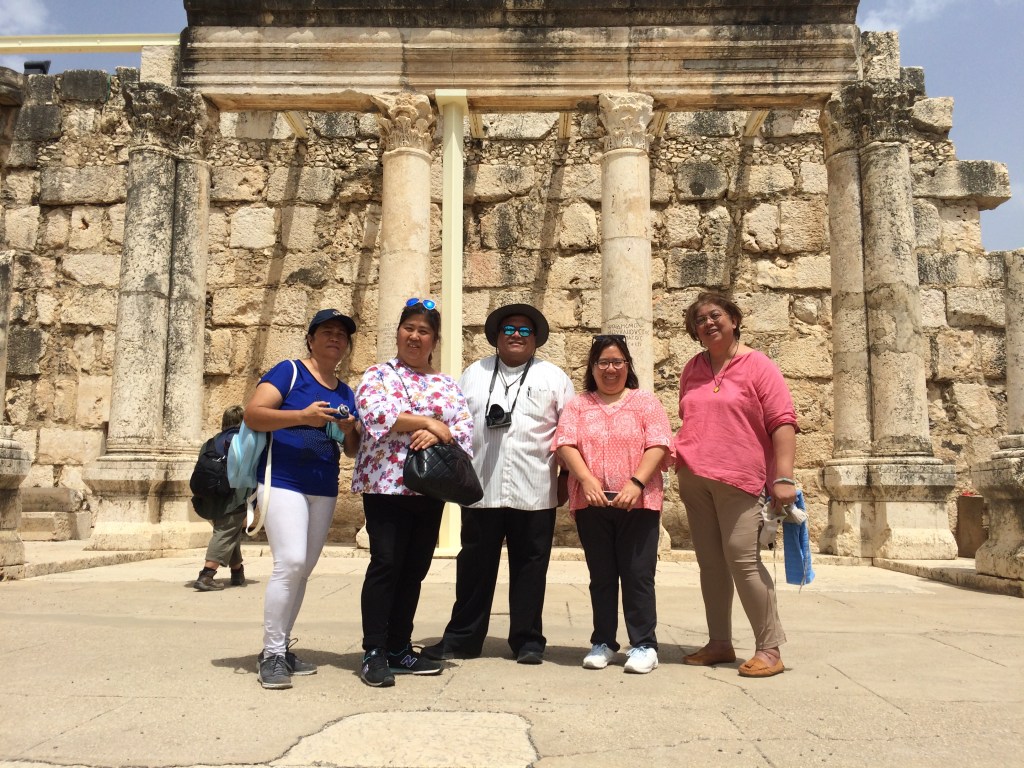
Photo by author with friends at ruins of the synagogue at Capernaum, 2017.

Examining our faith in Jesus

Notice, my dear reader, how similar is our story of Jesus raising to life the dead daughter of Jairus with that of the calming of the storm while crossing the lake last Sunday. In both instances, we find Mark “exaggerating” some details as if Jesus were somewhat oblivious to what was going on around him.

But again, Mark is not entertaining us with his stories narrating the powers and miracles by Jesus for he is telling us something deeper and very important with those surprising details of his stories. Primary of which is the supremacy of Jesus as the Son of God over nature like the sea and death both symbolizing evil and sin.

Mark affirms this truth today in telling us how Jesus brought back to life the dead daughter of Jairus, that Jesus is the Christ who had come launching a new world order where death and sin are overcome in him through his pasch.

Recall last Sunday how Mark ended his story with the disciples asking, “Who then is this whom even wind and sea obey?” (Mk.4:41).

That question is finally answered by our story today that clearly shows Jesus is the Christ, the Son of God who is life himself when he brought back to life the dead little girl.

Unfortunately, like during the time of Mark until now, many still doubt the powers of Jesus. Then and now, there is still that crisis of faith among us expressed by people from the synagogue official’s house who arrived and said, “Your daughter has died; why trouble the teacher any longer?”(Mk.5:35).

If you were in that crowd following Jesus, would you still go with him to enter the house? Would you heed his words like Jairus, “Do not be afraid; just have faith” (Mk.5:36)?

And while inside the house, knowing the little girl was already dead, would you join the rest in ridiculing Jesus who said, “The child is not dead but asleep” (Mk.5:39)?

These are the questions Mark is asking us today like the Christians of his time going through persecution and crisis in the early Church.

It is easy to “believe”, proclaiming with arms raised that Jesus is Lord, that Jesus is the Son of God but it is another thing to be truly convinced, to have faith in him when faced with the stark realities of life persistently attacked by sickness and death, of pains and sufferings that make us wonder why God could allow these to happen!

We have all felt our faith shaken when this pandemic struck us last year that took away those dearest to us so sudden, often without seeing them at all before they were cremated.

Like his story last Sunday, Mark’s narration of the raising to life of the daughter of Jairus is filled with many surprising details we find it so true with our own experiences of struggling to avoid or survive COVID-19, of having a sick child or spouse, of trying to make it to another day, of keeping our jobs to pay for food and rent and other needs of our family.

Do we really have that faith in Jesus, convinced that everything will be “okay” like Nightbirde who can brim with all smiles even if saddled with three kinds of cancer with a 2% chance of survival, claiming it is better than zero?

Today’s gospel is more than the revelation of who Jesus Christ is: the raising to life of the daughter of Jairus dares to invite us in examining our faith in God in the face of unrelenting attacks on life by sickness and death especially in this time of the pandemic.

Death and sickness are realities we face daily, that make us doubt God’s love and concern for us which the first reading clarifies with its declaration that

God did not make death, nor does he rejoice in the destruction of the living. For God formed man to be imperishable; the image of his own nature he made him. But by the envy of the devil, death entered the world, and they who belong to his company experience it.

Wisdom 1:13, 2:23-24
Photo by author, Lake of Galilee, 2019.

Arising and being whole in Jesus

Jesus came not to remove sickness and death, pains and sufferings which did not come from God for God is love. He came to be one with us in sickness and death, in our pains and sufferings so that we may rise with him too in his resurrection and be whole again in him.

Notice the words Jesus used in every healing, “your faith has saved you” to show that healing is not just a cure of the disease but making the person whole again. The words health, healing, wholeness, and holiness are all interrelated if we examine their origins and implications. Hence, we see that whenever Jesus would heal, it is not only an eradication of an illness but restoring harmony and balance in the person – physical, spiritual, mental, and emotional aspects.

It is the same in raising the dead young man in Nain and his friend Lazarus: Jesus or the evangelists used the word “arise” as a foreshadowing of Easter when Jesus himself rose from the dead, an indication of his power over death.

All these people in the gospels Jesus had healed and brought back to life eventually died but the good news is that death and sickness are no longer dark and an ending in itself.

Jesus came to bring salvation to the world, a wholeness in life which disease and physical death can no longer control and hold. That is why we need a firm faith to believe in him in spite of the many sickness and deaths now around us. It is faith that will enable us to grasp the full meaning of this pandemic and other sufferings we are going through in life. It is our deep faith in God that will also enable us to explain and show to others especially our loved ones the true meaning of healings and resurrections performed by Jesus who gives us a share in his victory over sickness and death.

May we dwell on the beautiful exposition of St. Paul today about being poor like Christ “that though he was rich, for your sake he became poor, so that by his poverty you might become rich” (2Cor. 8:9).

We can only be whole when we share whatever we have because that is when we allow Jesus to work in us, to be in us, to complete us. This happens when we wholeheartedly celebrate the Holy Eucharist where we become poor like Jesus, emptying ourselves of our sins, sharing with others our wealth through our contributions not only to the church collections but also to other charities where some of us share also time and talent aside from treasures.

The experience of the community pantry recently had taught us the value of St. Paul’s call for us to share and be poor like Christ when we were encouraged to take only what one needs and to give according to one’s ability – “kumuha ayon sa pangangailangan, magbigay ayon sa kakayahan”.

Yes, the realities of poverty and hunger remain with us but people are fed, sufferings are alleviated and most of all, the whole nation is united in believing again there is hope amidst the pandemic worsened by the systematic evil that has plagued us for so long.

Faith in God is deepened and strengthened when we become poor and weak like Jairus because that is only when we can arise and be whole again in Jesus Christ who is himself our Resurrection and Life. Amen.

A blessed new week to you and everyone!

Photo by author, Lake of Galilee, 2017.

Prayer to not shrink

The Lord Is My Chef Breakfast Recipe for the Soul by Fr. Nicanor F. Lalog II
Tuesday in the Seventh Week of Easter, 18 May 2021
Acts 20:17-27   ><)))*> + ><)))*> + ><)))*>   John 17:1-11
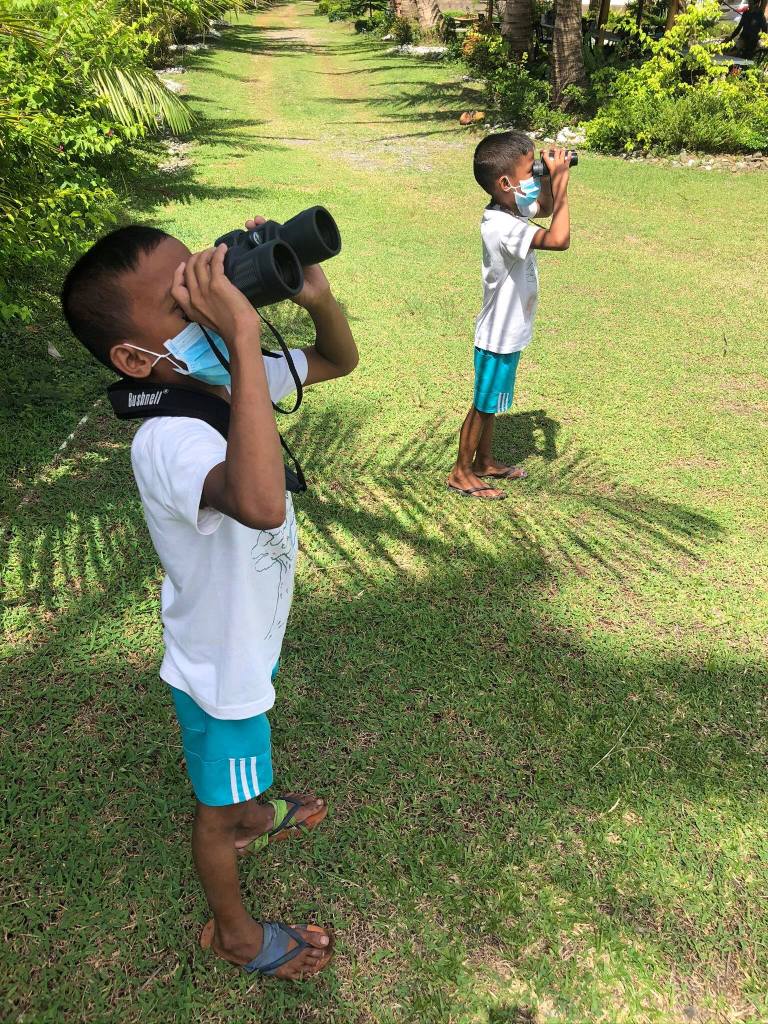
Photo by Mr. Red Santiago of his son, 2019.

God our loving Father, we thank you in giving us St. Paul and all the other saints who inspire us in dealing with life’s many troubles and challenges especially in this time of the pandemic. How great are his words – and courage – in telling “the presbyters of Ephesus” of the great trials coming his way that he might never see them again.

"You know how I lived among you
the whole time from the day I first came
to the province of Asia.  I served the Lord
with all humility and with tears and trials 
that came to me because of the plots of the Jews,
and I did not at all shrink from telling you
what was for your benefit, or from teaching
you in public or in your homes."
(Acts 20:18-20)

Twice St. Paul mentioned to them, “I did not at all shrink”: what an amazing gift and grace of courage! He never chickened out in proclaiming Christ’s gospel of salvation, boldly admitting to everyone his repentance to God in persecuting the Christians before while at the same time proudly declaring his deep faith in Jesus in words and in deeds.

Most of all, St. Paul gallantly faced the realities of life like rejection and other hardships most especially of death, telling the Ephesians they would never meet again (v.25) as he bid them goodbye for Jerusalem that led him to his trial in Rome.

Too often, O Lord, we are afraid to seriously discuss or even entertain thoughts of our death, of our finiteness not only because we are afraid of dying but mostly because we are also afraid of facing the harsh realities of our selves — that we have been wasting our time, we have been remiss with our duties and responsibilities.

And yes, we have shrunk from many instances when we should have stood for what is right and good, for what is fair and just.

Worst, we have left you, dear God and failed to do good, choosing to sin than be loving and kind, and forgiving.

May we hold on always to your High Priestly prayer for us, Lord Jesus that like you, may we realize that the path to glory is always the way of the Cross.

We pray most especially for those who are stuck in situations they know so well as not proper and good; give them the grace and chance to correct their lives, to repent for their sins and return to you and their loved ones.

We pray for those we look up to who do not shrink but deep inside are so hard pressed with the many challenges of remaining upright and holy.

Keep us faithful to you, O Lord, now and forever. Amen.

Photo by Onnye on Pexels.com

“Every Breath You Take” by The Police (1983)

The Lord Is My Chef Sunday Music by Fr. Nick F. Lalog II, 04 April 2021
“The Three Marys” by Henry Ossawa Tanner, from womeninthebible.net.

Blessed happy Easter to everyone!

This is perhaps the only year when it is so difficult to greet others with “Happy Easter” due to this ongoing lockdown following the worsening surge in COVID-19 infections with hospitals now beyond capacity.

But, that is the mystery of Easter: it is an event that truly happened in our history but something more than the usual thing like in Christmas when God became a child like us. At Easter, God broke through all human limitations to enter a new realm, a vast expanse of unknown realities beyond our imaginations, beyond our most dreaded thing in this life we call “death” (https://lordmychef.com/2021/04/04/breaking-into-new-realities/).

Like Mary Magdalene and the rest of the apostles except for John the Beloved, there are times we see nothing at all and say things we hardly think or process because everything seemed to have been lost when suddenly from within we realize life bursting forth, new hope, new beginnings!

And that is Easter!

Like this great song composed by Sting with his former group The Police, Every Breath You Take from their penultimate album Synchronicity released in 1983.

Sting was surprised with the great reception by people worldwide to this song that became their most recognized piece, spending so many weeks in almost every music chart around the globe. It is a song filled with negativities, according to Sting who wrote it in 1982 while on a retreat at Jamaica in the Caribbean following his separation from Frances Tomelty when he got involved romantically with her best friend and neighbor, Trudie Styler. The affair was so controversial, even condemned by many. Complicating things was the brewing rift among them in The Police.

But, that’s how Easter is: death becoming gateway to new life!

Imagine Jesus Christ now singing this to us in the midst of the pandemic, assuring us in every breath we take, he is not only watching us but in fact, with us!

Lent is “seeing” Jesus

40 Shades of Lent by Fr. Nicanor F. Lalog II
Fifth Sunday in Lent-B, 21 March 2021
Jeremiah 31:31-34  +  Hebrews 5:7-9  +  John 12:20-33
Photo by author, details of the Seventh Station of the Cross at the St. Ildephonse Parish Church in Tanay, Rizal, January 2021.

In the beautiful church of the town of Tanay in Rizal is found a most unique Seventh Station of the Cross where one of those depicted when Jesus fell for the second time is a man with dark glasses looking afar. Local residents say the man with sunglasses is Caiaphas, the chief priest during the time of Jesus who led the Sanhedrin at his trial leading to his crucifixion.

Nobody can explain exactly why the artist portrayed that man wore sunglasses that was popular among people of stature and position in the country when the carving was made in 1785. Also interesting aside from the man in shades are the soldiers with him shown with Malay features of brown color and wide eyes opened, all looking somewhere except for one looking at the Lord while clutching his garment as he fell looking heavenwards.

I remembered this piece of work of art inside the Tanay Parish Church declared by the National Museum as “National Cultural Treasure” because our gospel today speaks about a request by some pagans to see Jesus. Seeing has many meanings, always leading to believing. And sometimes, it is in believing we are able to see most of all!

Some Greeks who had come to worship at the Passover Feast came to Philip, who was from Bethsaida in Galilee, and asked him, “Sir, we would like to see Jesus.” Philip went and told Andrew; then andfrew and Philip went and told Jesus. Jesus answered them, “The hour has come for the Son of Man to be glorified. Amen, amen, I say to you, unless a grain of wheat falls to the ground and dies, it remains just a grain of wheat; but if it dies, it produces much fruit. Whoever loves his life loses it, and whoever hates his life in this world will preserve it for eternal life.”

John 12:20-25

Seeing to believe

Photo by Dr. Mylene A. Santos, MD, Infanta, Quezon 2020.

As we have been mentioning three Sundays ago, the fourth gospel uses poetic expressions and symbolisms to convey deeper truths and realities about Jesus and our very selves, our having or lacking faith in God. Like the act of seeing by those Greeks who requested Philip “to see Jesus”.

If they simply wanted to catch a glimpse of Jesus, they could have easily seen the Lord who was always at the temple area at that time. Jesus had always been available to everyone like last Sunday when Nicodemus went to see him at night.

But, John often used the verb to see in many senses that also mean to believe like in his appearance a week after Easter to his disciples along with doubting Thomas: Jesus said to him “Have you come to believe because you have seen me? Blessed are those who have not seen and have believed” (Jn.20:29).

Most mysterious for me in John’s use of the verb to see is in the call of the Lord’s first disciples led by Andrew: He said to them, “Come, and you will see.” So they went where he was staying and saw where he was staying… Andrew followed Jesus. He first found his brother Simon and told him, “We have found the Messiah” (Jn.1:39-41).

What did Andrew see that he later told his brother Simon that they have found the Messiah?

Of course, John’s most notable use of the verb to see is from that scene at the empty tomb on Easter Sunday when the perfect model of the believer is the “other disciple” whom Jesus loved “went in, and he saw and believed” (Jn.20:8).

Very clear in the mind of John that the request of those Greeks to see Jesus was one of faith, of meeting and speaking with Jesus to be enlightened more like Nicodemus last Sunday. Here we find our important role of being another Philip and Andrew, leading other people to see Jesus.

Those Greeks described as “God-fearing” were pagans attracted to the teachings of Judaism and came to Jerusalem to observe the Passover Feast. They already have faith in God that must have been awakened further when they heard the teachings of Jesus; hence, their request to see Jesus.

It happens so often that when by the grace of God people are illuminated with faith even in the most personal manner, they still need Philips and Andrews who would enable them “to see” Jesus to grow and be deepened in faith. There will always be a need for an apostle who could lead others to “see” Jesus because faith happens within a community, within the Church and through others’ mediation.

And here lies the bigger challenge for us disciples for us to make Jesus “seen” in our lives and in our community.

Believing to see.

Photo by Onnye on Pexels.com

Jesus answered them, “The hour has come for the Son of Man to be glorified. Amen, amen, I say to you, unless a grain of wheat falls to the ground and dies, it remains just as a grain of wheat; but if it dies, it produces much fruit. Whoever loves his life loses it, and whoever hates his life in this world will preserve it for eternal life. Whoever serves me must follow me, and where I am, there also will my servant be. And when I am lifted up from the earth, I will draw everyone to myself.” He said this indicating the kind of death he would die.

John 12:23-26, 32-33

In a sudden twist, John tells us nothing if those “God-fearing” pagans saw Jesus at all because the Lord immediately went on a discourse after being told by Andrew and Philip of the request, briefly interrupted by God’s voice speaking from heaven that everybody heard in the temple area.

Speaking in the parable of the grain of wheat dying first in order to produce much fruit, Jesus tells us how we can lead others to truly see him in us and through us by having the same determination and perseverance to follow him, stay with him, and be like him by dying to ones self for others. For the grain of wheat to die and spring forth to new life, it has to be detached. And so are we.

Notice Jesus repeating that sign of his being lifted up on the cross he mentioned last Sunday to Nicodemus. John mentions it again in this part of his gospel adding an explanation at the end because for him, the Crucifixion is Christ’s greatest sign and revelation of his glory, opening a path for us back to God in his Cross, through his Cross.

In teaching us about the parable of the grain of wheat dying and linking it with his being “lifted up”, Jesus now tells us and every “God-fearing” person that we can only “see” him in the scandal of the Cross.

Did those God-fearing Greeks remained in Jerusalem and saw Jesus on the Cross?

We do not know but we are sure that anyone who requests to see Jesus always sees him if we believe first in his crucifixion which is when everyone is drawn to him as he had said. We must first believe Christ died so we may see him risen to life.

It was on Christ’s dying on the cross when God established a “new covenant” among us as prophesied by Jeremiah in our first reading today, giving us all an access to him in Jesus, through Jesus, with Jesus which we celebrate daily in the Holy Eucharist.

Photo by author, 2020.

Grappling with death to see life

We have never seen the crucifixion of Jesus except in its portrayals in the many movies we used to watch in Holy Week; but, its realities are etched and impressed in our hearts through the many trials and difficulties we have gone through in life that we believe Jesus truly died. And because of that, we have also seen him alive!

Such is the reality of seeing Jesus that every time we describe something so difficult, so trying, we equate it with death like when we say “we felt like dying” taking the exam. And the good news is when we overcome the tests that we use again the word or concept of death to describe something so good as it leads us to glory like when we say a pizza or a steak or a cake to die for.

Such is the paradox and scandal of the Cross of Jesus: we can never see him risen in glory if we avoid and refuse seeing his Passion and Death right in our own selves, in our painful experiences.

Going back to that unique Seventh Station of the Cross at the Tanay Parish Church, I realized how the unbelievers and others among us could not see Jesus as the Christ because they have refused to believe in him first especially when they are down with all kinds of problems and trials, looking somewhere else instead of seeing Jesus fallen in front of them.

Let us believe in Jesus so we may see him in this final week of Lent as we prepare for Palm Sunday next. Amen.

A blessed week to everyone!

Photo by author, January 2021.

On leaving and living

Quiet Storm by Fr. Nick F. Lalog II, 09 November 2020
Photo by Dr. Mylene A. Santos, MD, 30 October 2020.
I have always believed
life is more on coming
than on leaving 
because 
whenever we leave,
we also come.
But, 
there is something
about leaving 
that makes 
it strongly felt 
than coming:
from the pain of leaving
follows emptiness -
the angst of still living
when someone is missing.
Most painful part of leaving
is when you are the one left behind;
it is the one who leaves
who actually comes
to somewhere else
while the one left
bears the scars
of leaving,
like grappling
with the unseen
presence
of nothing
but memories
gone 
with the one who had left
who might never come again.
But, I think
it is when leaving 
is truly hurting
that it turns into a coming -
an arrival 
of blessing
of opening 
to a new lease on life 
and living when we discover 
somebody anew
filling what's missing within 
not necessarily seen
that together we spin
a new thread in life again.
The other person
gone is never replaced
by a newfound one;
that's the beauty
of every leaving
and coming
when we leave
in order to come
creating a space
for a new one
until it leaves again
to come another one
until finally
we become one in the Only One.

Friendships should depend on nothing like TIME and SPACE. Remove TIME and what we have is NOW; remove SPACE and what we have is HERE. Don’t you think we could meet once or twice between NOW and HERE?

Richard Bach, Jonathan Livingston Seagull (1970)
Photo by Dr. Mylene A. Santos, MD, 07 November 2020.

Active waiting, authentic living now

The Lord Is My Chef Sunday Recipe for the Soul by Fr. Nicanor F. Lalog II
Week XXXII-A in Ordinary Time, 08 November 2020
Wisdom 6:12-16   ><)))*>   1 Thessalonians 4:13-18   >><)))*>   Matthew 25:1-13
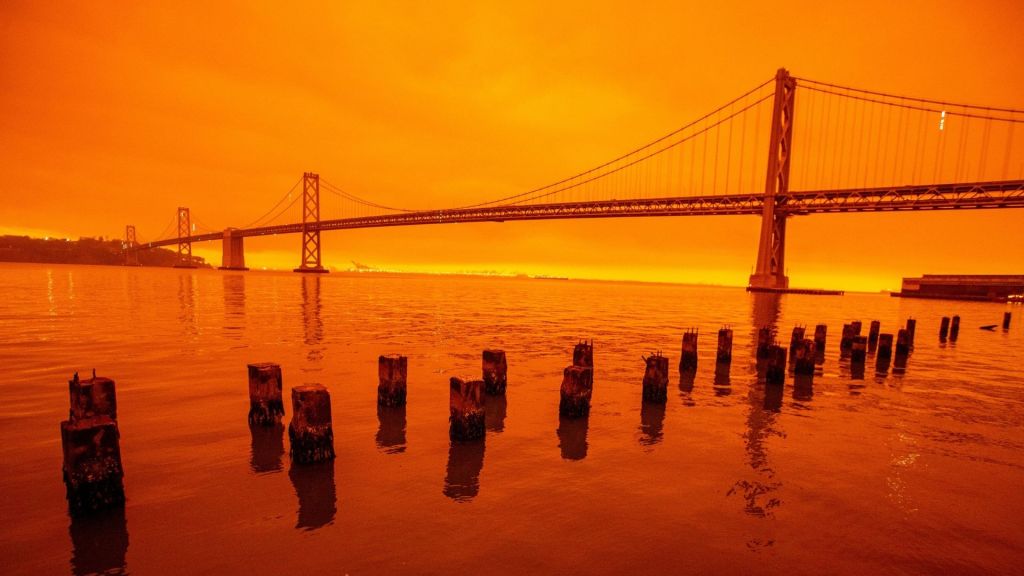
Photo from MediaNews Group/The Mercury News via Getty Images, 10 September 2020 during the widespread California forest fires.

Beginning this Sunday until the Solemnity of Christ the King three weeks from now, we hear from the gospel Jesus speaking of his Second Coming at the end of time to render judgement to everyone.

It is during this time as we come to close the liturgical year and begin the new one with the Advent Season four weeks before Christmas when the Church reminds us in our Sunday Masses the true meaning of Christ’s Second Coming that have disturbed so many people for 2000 years.

Throughout history, it has spawned many doomsday and apocalyptic scenarios among peoples everywhere, particularly religious fanatics and cult followers with disastrous aftermaths like bloodbaths and murders despite their being anchored in a religious belief in God.

Lately there is a growing trend among some people of preparing for the final end of the world without any belief in God but more based on “science” and pop cultures but still with some degree of violence too.

And between these two extremes of awaiting the end of time with and without God, we find a majority who do not seem to care at all!

Everything comes to an end in order to begin anew.

Last Sunday in our reflection on All Saints Day we have mentioned the tension of the here and not yet, of Jesus being here now and still coming again at the end of time we call parousia which we proclaim in every Mass after the consecration.

This tension was a big deal during the time of the early Church with many believers including the Apostles believing they would witness the return of Jesus in their lifetime; but, when many of them started to die without the Second Coming happening, they began to question and reflect on the nature of parousia. They wondered what will happen with those who have died already and those left behind still alive when Christ comes again?

We do not want you to be unaware, brothers and sisters, about those who have fallen asleep, so that you may not grieve like the rest, who have no hope. For if we believe that Jesus died and rose, so too will God, through Jesus, bring with him those who have fallen asleep… we who are still alive, who are left until the coming of the Lord, will surely not precede those who have fallen asleep… will be caught up together with them in the clouds to meet the Lord in the air. Thus we shall always be with the Lord. Therefore, console one another with these words.

1 Thessalonians 4:13-14

From St. Paul’s reflections developed what we call escathology, that branch of theology dealing with the end of time and everything related with it like general and particular judgements, death and resurrection, parousia or Second Coming of Christ at the end of time.

It was St. Paul who insisted the centrality of Christ’s resurrection upon which is also hinged the resurrection of the dead and of his parousia (1Cor.15:14) which we call as mystery of our faith. For him, Christ’s resurrection is the beginning of the resurrection of the dead, the beginning of the end time; therefore, the end is something we shall not fear but in fact be excited with because it is the final victory of God over sin and death. Yes, Christ had definitively won over death at the cross but it is on his Second Coming when death and sin are final vanished to give way to new heaven and new earth.

Everything will come to an end not to simply terminate all but in order to bring forth new beginnings! And the key is authentic living in every here and now.

From a post at Facebook, 2018.

Live in the present, not future; focus on life, not on dates.

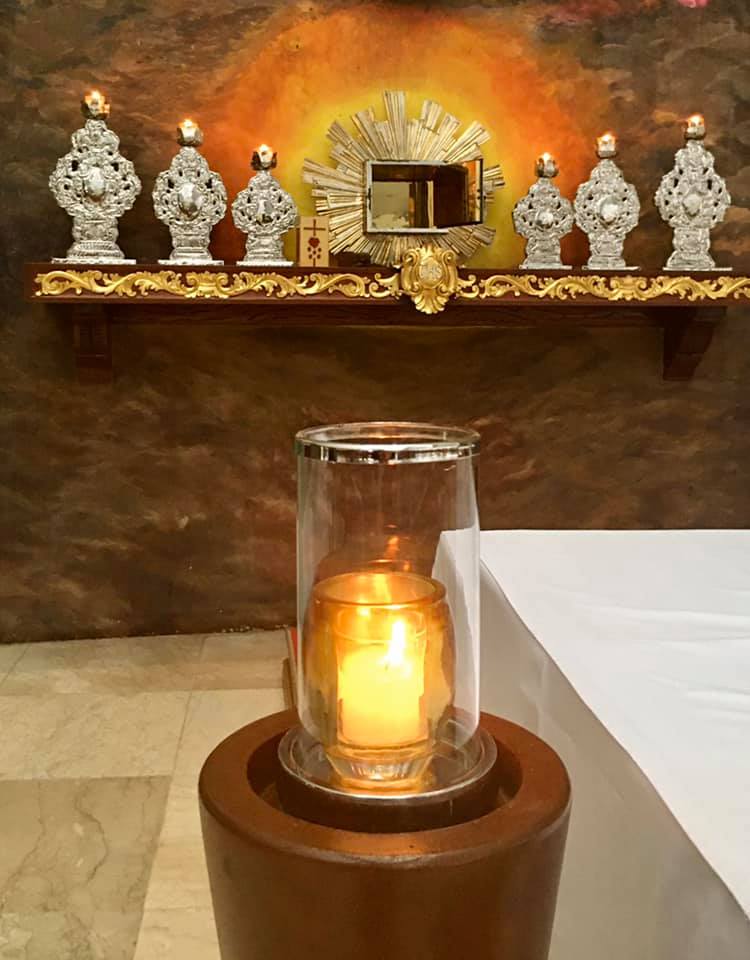
It is sad when many among us Catholics specially those who celebrate Mass every Sunday acclaiming “Christ will come again” are the ones so afraid of end time, always asking for the blessing of their candles in the belief that these would save them from days of darkness.

Wrong! What will truly save us on judgement day is our firm faith in Jesus Christ, not blessed candles. Most of all, what will truly save us on judgement day is to live daily as authentic Christians witnessing the gospel values of Jesus Christ our Savior and Judge.


In today’s parable of the ten virgins awaiting the arrival of the groom, the Lord wants to instill among us the need to focus on the present moment of our lives not on any particular time or date because nobody knows when he would come like the groom in a wedding.

Jesus told his disciples this parable: “The kingdom of heaven will be like ten virgins who took their lamps and went out to meet the bridegroom. Five of them were foolish and five were wise. The foolish ones, when taking their lamps, brought no oil with them, but the wise brought flasks of oil with their lamps.

Matthew 25:1-4

We are all the virgins awaiting the coming of the groom for the wedding. We all came from God and we are designed to return to him in the end for eternal life. Here I find the late Stephen Covey so real in teaching us to always begin with the end in sight which is heaven. In one of his writings, he said “We are not human beings on a spiritual journey; we are spiritual beings on a human journey.”

In 2012, we were shocked when we heard news how he fell from a bicycle in an apparent accident and a few days later, he died. In an instant I have felt how this layman who strongly advocated the infusion of values into business and management is after all a saint, perhaps now in heaven.

His seven habits of highly successful people are all anchored in meaningful, authentic living in the present. That is being wise, of bringing extra oil of charity and kindness and goodness in life while actively waiting the coming of the groom, the coming of our death and end. Habit is something that is good we always do; its opposite is vice. (Stop saying bad habits.)


Life is keeping our lamps burning even if it produces little light than be extinguished and be plunged to total darkness. Nobody is perfect; we all have our lapses in life that is always in darkness. Like those virgins in the parable, wise and foolish alike, we feel drowsy and fall asleep.

Photo by author, Holy Thursday Mass, 2020.

Since the bridegroom was long delayed, they all became drowsy and fell asleep.

Matthew 25:5

Therefore, all the more we need to be wise, not foolish. Being wise is always seeking and following the will of God who is Wisdom himself.

In the first reading, we are told how Wisdom as the personification of God himself can always be had by anyone sincerely searching for him.

Resplendent and unfading is wisdom, and she is readily perceived by those who love her, and found by those who seek her. She hastens to make herself known in anticipation of their desire; whoever watches for her at dawn shall not be disappointed, for he shall find her sitting by his gate.

Wisdom 6:12-14

To seek and obtain wisdom is to have pure or clean hearts that try to seek what is good, free of carnal desires and worldly allurements. Again, the need to have even the faintest light than be in total darkness.


So often, many things in our lives are decisively won – or lost – in a spur of the moment, in single crucial moments when everything comes to the fore. Woe not to those caught asleep but not ready or prepared, ill-equipped for the demand of the moment.

At midnight, there was a cry, ‘Behold, the bridegroom! Come out to meet him!’ Then all those virgins got up and trimmed their lamps. The foolish ones said to the wise, ‘Give us some of your oil, for our lamps are going out.’ But the wise ones replied, ‘No, for there may be not enough for us and you. /go instead to the merchants and buy some for yourselves.’ While they went off to buy it, the bridegroom came and those who were ready went into the wedding feast with him. Then the door was locked.

Matthew 25:6-10
Photo by author, Baguio Cathedral, January 2018.

See how in the parable where everything was similar and the same: ten virgins with lamps becoming drowsy and falling asleep in the night waiting for the groom. Everything changes at midnight with the announcement of the arrival of the groom where the wise virgins were clearly distinguished from the foolish. The wise had extra oil and came into the wedding with the groom, leaving behind the foolish who had to buy for oil in the dead of the night only to return with doors locked, leaving them outside.

This is life in a nutshell: being ready when opportunity strikes is not based on luck but hard work.

And that is the saddest and difficult part we always take for granted: life is often decided on short, instant moments that in a snap of a finger can decide our rising or downfall.

This pandemic is an eye opener for everyone that caught so many of us unprepared.

Any extra oil kept in this time of the corona has proven so wise for some who have adjusted so well in the situation, coping and even managing so well amid the crisis.

What is so disappointing, even appalling are the foolish who chose to wallow in their follies, whining and blaming everyone for the troubles and mess without admitting their own shortcomings.

Let us heed the Lord’s call to “stay awake, for you know neither the day nor the hour” (Mt.25;13) by living authentically as his disciples in every here and now. Amen.

A blessed Sunday and week ahead to everyone!

Photo by author, 22 September 2020.

We are never lost

The Lord Is My Chef Breakfast Recipe for the Soul by Fr. Nicanor F. Lalog II
Commemoration of All the Faithful Departed (All Souls' Day), 02 November 2020
Wisdom 3:1-9  >><)))*>|+|>><)))*>  Romans 6:3-4, 8-9  >><)))*> |+| >><)))*>  John 6:37-40
Photo by Pixabay on Pexels.com

Dearest God almighty Father: this All Souls’ Day is so special, so unique for us just like the rest of the other feasts and celebrations we have had so far this 2020 due to COVID-19 pandemic when we do not have much of our rites and rituals and traditions but more of their meaning.

Thank you, Lord, for making us realize and experience the essence and beauty of our celebrations like yesterday’s All Saints’ Day and today’s All Souls’ Day that are both a “festival of hope” – a virtue we have always taken for granted and misconstrued as something like optimism.

Thank you for the gift of hope, loving Father, that even if we feel everything is lost and gone for us, it is never the case with you. In fact, the more we lose ourselves and everything, the more we give up our beloved to death and eternal rest, the more we are all found in you!

In hope, we are assured that you will never reject us when we come to you:

Jesus said to the crowds: “Everything that the Father gives me will come to me, and I will not reject anyone who comes to me, because I came down from heaven not to do my own will but the will of the one who sent me. And this is the will of the one who sent me, that I should not lose anything of what he gave me, but that I should raise it on the last day.”

John 6:37-39

How lovely to keep in mind, Lord, that hope is never empty because to hope is to rely on your promise and fidelity, on your love and compassion, on your mercy and forgiveness; to hope means keeping our ties and relationships with you who is Life itself.

As we remember our departed loved ones, we not only look back to our happy memories with them but most of all look forward into the future in eternal life Jesus promised us all.

May we stop saying we have “lost” a loved one when a beloved dies because we never “lose” anyone even to death as you assured us in the first reading:

The souls of the just are in the hand of God, and no torment shall touch them. They seemed, in the view of the foolish, to be dead; and their passing away was thought an affliction and their going forth from us, utter destruction. But they are in peace.

Wisdom 3:1-3

Teach us to hope always in you by living in Jesus (Rom. 6:8), never to steer away from his ways for that is when we truly get “lost” in life.

Also today, we thank and praise you, Lord Jesus, for not “rejecting” our prayers to spare us from the wrath of yesterday’s super typhoon “Rolly” as it weakened in category while passing through our region last night.

However, we continue to pray for our brothers and sisters in the Bicol region who have suffered so much from the impact of the super typhoon. Enlighten our minds and our hearts on how we can help them rise and start again to recover their material “losses” while at the same time, heal their memories in “losing” their loved ones.

May they find comfort and strength in you that they have not “lost” loved ones but have found you.

And for those injured, may your healing hands touch them, Jesus, be witnesses of hope in you. Amen.

Photo by author, sunrise at Camp John Hay, Baguio City, 2018.

“King of Pain” by The Police (1983)

The Lord Is My Chef Sunday Music, 01 November 2020
Photo by Mr. Jim Marpa, Bohol, 2019.

I have lined up some songs with “heaven” in their titles or lyrics for this Sunday’s celebration of All Saints’ Day and tomorrow’s All Souls’ Day; but, during prayers and reflections, I kept on hearing Sting singing in my head King of Pain which is my most favorite among his long list of great music.

Our celebrations this November first and second are a mixture of joy and mourning, of heaven and sufferings, of life and death. As we remember today those already in heaven and tomorrow pray for those awaiting entrance into heaven, we also remember on these twin dates the death of loved ones.

No matter how much we may extoll the redemptive nature of death not as an end but a beginning of eternal life, we cannot miss the sadness and pain it brings to everyone that is always for a lifetime.

And that is what hope is all about: hope does not remove sadness or pain. When we hope of getting into heaven with our departed loved ones, no matter how blissful heaven may be, we always have to deal with the hurts of losing a parent or a spouse, a sibling or a friend.

To hope means to firmly believe that when things get worst, even unto death, there is Life itself, God remaining in the end, loving us, taking us to his presence in heaven to live life in its fullness in him.

To hope means to face new beginnings in this life amid the pains we have in our hearts from deaths and separations, believing that someday, if not in this life, everything would be whole and perfect again.

That is why I find King of Pain more apt for All Saints’ Day and All Souls’ Day.

Written by Sting in 1982 at the Goldeneye Estate in Jamaica where Ian Fleming wrote his first James Bond novels, King of Pain expresses the inner torments he was going through as an individual at that time — his recent divorce from his first wife and growing misunderstanding with his other two colleagues, Andrew Summers and Stewart Copeland. They eventually parted ways after the release of the Synchronicity album from which King of Pain came in 1983.

The beat, the music and the lyrics seem to be dark and melancholic at first but as you get the feel of the entire song sung by Sting, then you realize it is actually about a man struggling with sadness or even depression, of a man filled with hopes until you realize it is speaking about you as king of pain.

Aren’t we all the king of pain in one or the other?

And as we bear all the pains, we keep on forging on with life, we never resign but keep hoping even for a piece of heaven, of the sun to celebrate life each day until we make it to the Other Side like our departed loved ones.

All in the grace of a loving God. Amen.

Provided to YouTube by Universal Music Group

We are blessed, meant to be saints

The Lord Is My Chef Sunday Recipe for the Soul by Fr. Nicanor F. Lalog II
Solemnity of All Saints, 01 November 2020
Revelation 7:2-4, 9-14   |+|   1 John 3:1-3   |+|   Matthew 5:1-12
“Mary and the Saints” painting by Duccio di Buonoinsegna (1308-1311) from en.wikipedia.org.

Let me begin our reflection on this All Saints’ Day with a joke from the “Language Nerds” on how the past, the present and the future came and appeared in a bar. Everybody was tense.


Our celebrations today and tomorrow deal with “verb tenses” – the past, the present, and the future that somehow converge in the here and now of Jesus Christ our Lord. We call it the tension of the already here but not yet, like God and heaven – both already here but not yet.

All Saints’ Day and All Souls’ Day are two Catholic celebrations so unique and distinctive of our faith that bring to the fore the beautiful tensions of the “here and not yet”, of that convergence of the temporal and eternal in our present lives.

It is something like our Filipino delicacies of tuyo (dried fish) and balut (fermented duck egg): when you smell the aroma of the frying tuyo by your neighbor, you could taste it but if you want to really experience its delight, you have to go to your neighbor and join their meal. Or the balut: is it an egg or a duckling?

In a similar manner, we find in our Gospel today that proverbial question of which came first, the egg or the chicken? Are we blessed because we followed the Beatitudes first or, are we blessed first that we can practice the Beatitudes of Christ?

When Jesus saw the crowds, he went up the mountain, and after he had sat down, his disciples came to him. He began to teach them, saying: “Blessed are the poor in spirit, for theirs is the kingdom of heaven. Blessed are they who mourn, for they will be comforted. Blessed are the meek, for they will inherit the land. Blessed are they who hunger and thirst for righteousness, for they will be satisfied. Blessed are the merciful, for they will be sown mercy. Blessed are the clean of heart, for they will see God. Blessed are….

Matthew 5:1-8
Photo by Pixabay on Pexels.com

We are all blessed

When Jesus preached his sermon on the mount to launch his ministry, he first presented himself — that he is the Christ, the Anointed or Blessed One because he is in fact the Beatitudes: he is the poor in spirit, the merciful and meek, the one with a clean heart.

Inasmuch as the Beatitudes tell us who is Jesus Christ, the Beatitudes also challenge us followers of Jesus to imitate and follow him in being poor in spirit, merciful, and clean of heart.

At first glance, we notice that blessedness seems like a reward given by Jesus after we have imitated him like being blessed after being insulted and persecuted in his name, working for peace and hungering and thirsting for righteousness.

However, the very fact we are able to bear all these sufferings to live the Beatitudes means that we are already blessed.

And that is the truth: in Christ’s Passion, Death, and Resurrection, we have all been blessed by God that we are able to live as his beloved children, now living in his “kingdom of heaven” right here on earth.

Beloved: See what love the Father has bestowed on us that we may be called the children of God. Yet so we are… we are God’s children now; what we shall be has not yet been revealed. We do know that when it is revealed we shall be like him, for we shall see him as he is. Everyone who has this hope based on him makes himself pure, as he is pure.

1 John 3:1, 2-3

Blessedness is who we are as children of God unless we choose to live otherwise.

Blessedness is God’s gift to us that enables us to live according to his will and plans, projecting us further into the future to finally be with him in all eternity in heaven. When we try to live the Beatitudes of Jesus, of going against the tide and flow of the world where power and wealth, popularity and fame are the means life is measured, then that becomes our gift to God.

And that is when we enter into heaven and become saints like what we celebrate today.

According to St. John Paul II, the good news of life is that we all share in the life of God — and that is why we are all blessed.

Our sharing in the life of God makes us blessed.

The difference that we have with the saints is just the tenses: they are now celebrating at present the fullness of their blessedness, of being present before God in all eternity in heaven because they have so well accomplished while living here on earth the works of the Beatitudes of Christ in the past. They have overcome all tests and trials in the past and now having the rewards of full blessedness.

We, on the other hand, though already sharing in the blessed life of God here on earth in the present, still have to face and endure many other trials in the future to perfect ourselves in Christ until we get a final glimpse of him in the afterlife.

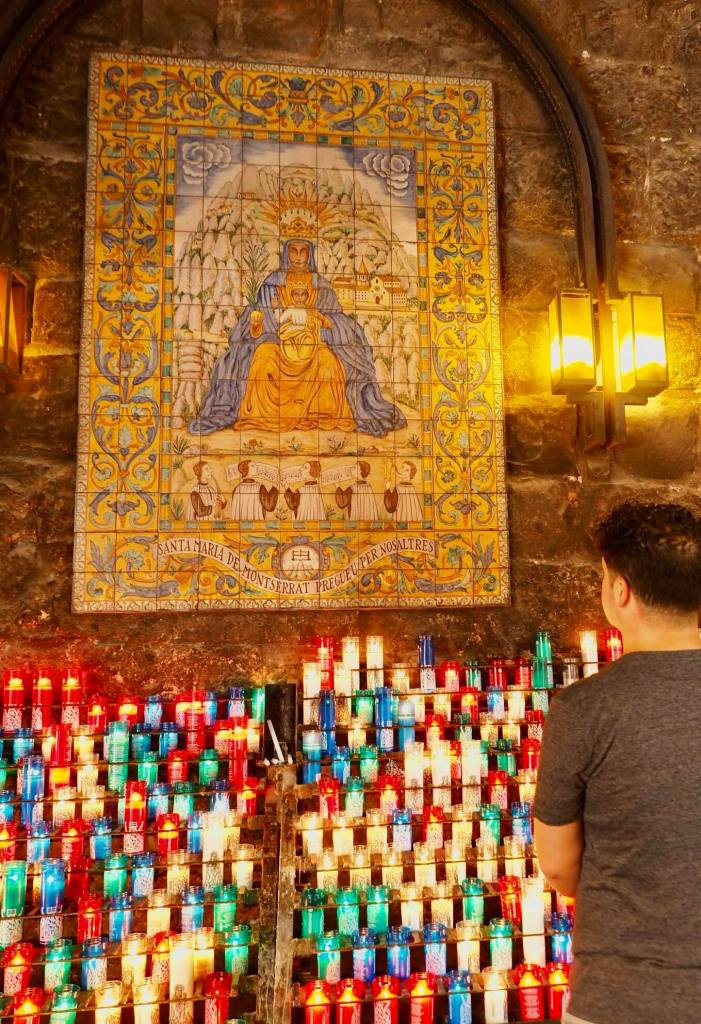
Photo by Dr. Mai B. Dela Peña, MD, at Spain, 2018.

Blessedness is a relationship with God.

It is now clear with us that saints are like us who are blessed because we share in the life of God. However, saints enjoy the fullness of this blessedness of being in the very presence of God as a “reward” or a result of their striving with God’s grace to live out the Beatitudes.

Saints now enjoy the eternal presence of God, the fullness of blessedness and fullness of their relationship in God and with God, from earth into heaven.

This is the reason we have a feast for all the saints or those who have gone ahead of us and tried to lead holy lives, living out their blessedness that they now enjoy the eternal presence of God in heaven. They need not be declared by the Church as saints whoever gets into heaven in the presence of God is a saint.

We who are still living here on earth, though blessed as we share in the life of God, cannot be considered as saints yet because we still have to go through a lot of purifications, of tasks in loving.

Again, we see that tension of the here and not yet in this aspect of being saints, of blessedness: heaven is eternal union with God (hell is eternal separation from God); blessedness and heaven are both our relationships with God.

Therefore, the challenge of our blessedness here on earth as seen in the Beatitudes of Jesus is how we maintain and keep that intimate relationship with God that every choice we make is always a choice for life, of choosing to love than hate, to forgive than revenge, to understand and let go.

In the first reading, John tells us of his vision of heaven with great multitude of “saints” or holy men and women “wearing white robes holding palm branches in their hands”. The Lord told him,

“These are the ones who have survived the time of great distress; they have washed their robes and made them white in the blood of the Lamb.”

Revelation 7:14

Although we are extolling in this solemnity all the unnamed saints now in heaven, this is still a feast celebrating the goodness of God, of his immense love for us in blessing us in Jesus Christ who enables us to do good in the power of the Holy Spirit.

As we remember all the Saints, we celebrate also this sharing of God’s life in us for us to be blessed, assuring us of being saints someday!

We are challenged today to live out this blessedness freely given to us by God by being more loving with others specially in this time of COVID-19 as well as when two super typhoons are threatening to slam into some parts of our country this week.


A short note about cemeteries

Sometimes, non-Catholics laugh at us every November first when we troop to the cemeteries to be with our departed loved ones instead of November 2. Despite the closure of cemeteries this week due to COVID-19, many have earlier visited their loved ones in cemeteries while the rest among us would surely do the same once the ban is lifted.

Is there something wrong? NONE. Except for those who just go to cemeteries to drink and have fun without praying and celebrating Mass in their parishes. But there is nothing wrong with our tradition of visiting cemeteries on November first.

In fact, it is a vibrant display of our faith in God because every time we visit the dead on All Saints’ Day, we also presume they are already saints, already in heaven.

Most of all, our coming to the cemeteries on All Saints’ Day is an expression of our hope in heaven while still here on earth.

The cemetery reminds us of hope in the future. In the past when we buried our dead, the cemetery has become the place of our mourning; but, every November first, the cemetery reminds us it is the place of hope where sadness is not really removed but where we find strength and faith that like our departed loved ones, we shall overcome all trials and sufferings here on earth to be one with them in the presence of God in heaven.

That is the good news of All Saints’ Day and All Souls’ Day: we are so blessed by God in Jesus Christ who had opened our access into heaven not only in the future when we die but even now as we mourn – and celebrate the memory of our dead, we already have a taste of eternal life.

May we live out this blessedness God has given us. Amen.

Hope. And be surprised!

Quiet Storm by Fr. Nicanor F. Lalog II, 14 October 2020
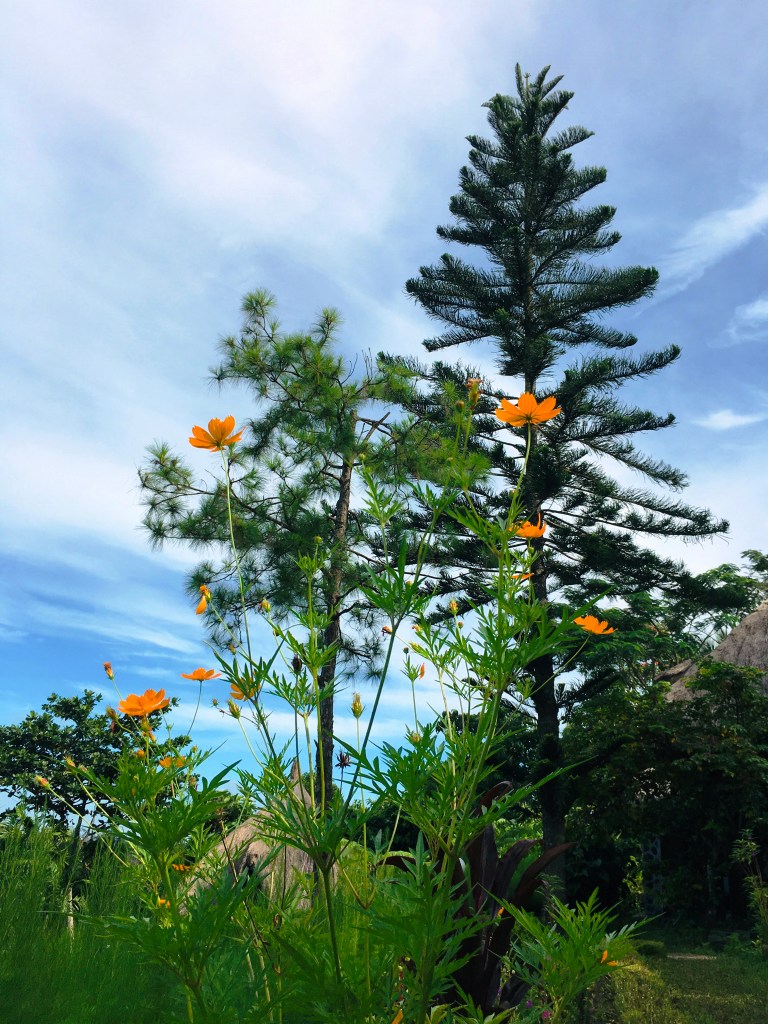
Photo by author, sunrise at the Lake of Tiberias, the Holy Land, May 2019.

HOPE. A favorite word among us, used as an expression for things to get better, especially when we express our “hope” God grants what we pray for, or, in ending our letters of request with “hoping for your kind consideration”.

Even Hollywood is fond of this virtue, portraying it as a reserved power to overcome evil when Neo in the 2003 The Matrix Revolutions was summoned into action to defend their city because he was the only one with “hope”.

Or, something like a turbo charger that will boost every leap of faith when Toretto in Fast and Furious 6 handed to his rival Owen Shaw the computer chip they were tasked to retrieve in the “hope” of getting it back even if they have to chase a giant Antonov An-124 plane taking off.

Of course, Neo and Toretto succeeded in their efforts filled with hope, defeating evil.

But, that is not what hope is all about.


To hope is different from optimism, of believing things can get better;
in fact, we hope because things can get worst.

The late Fr. Henri Nouwen wrote in one of his books that to hope means having that firm conviction within that even if things get worst like death, we are certain God will never forsake us for he loves us very much.

Jesus Christ showed us this true meaning of hope when he decided to go to Jerusalem to accomplish his mission by dying on the Cross for our salvation. I love the way Luke narrated in his gospel this attitude of Jesus in showing us the path of hope amid his knowledge things would get worst than before leading to his Passion and Death (and Resurrection):

When the days for his being taken up were fulfilled, he (Jesus) resolutely determined to journey to Jerusalem…

Luke 9:51

Imagine Jesus “resolutely determined” going to Jerusalem, the very same attitude of saints witnessing the Gospel by facing martyrdom. It is also very true with us when we say our only hope is the Lord when we know of sure death while facing a serious illness.

To hope is to be “resolutely determined” like Jesus and the saints along with our loved ones to follow the arduous path of life, of putting up the good fight against sickness or injustice and evil even if they knew things will lead unto death. At first we wonder, what victory can we claim if in the end we die like the saints and martyrs?

That’s the mystery and paradox of hope: to hope is to completely trust in God that death is not the end of life or any struggle but the highest point of our transformation as we dive to life’s lowest level like defeat, loss, and death when we pray like Jesus on the Cross, “Father, into your hands I commend my spirit” (Lk.23:46).

Hope is faith severely tested, believing and abandoning everything to God, come what may.

Photo by Arch. Philip Santiago, Fatima, Portugal, 2016.

Hope is clearly not positive thinking nor optimism; hope is “faith in God” as Pope Emeritus Benedict XVI tells us in his second encyclical, Spe Salvi (2007). According to Pope Benedict, hope gives us the direction towards the future by enabling us to face the challenges of this life leading to salvation and eternal life.

In this sense it is true that anyone who does not know God, even though he may entertain all kinds of hope, is ultimately without the great hope that sustains the whole of life (Eph.2:12). Man’s great, true hope which holds firm in spite of all disappointments can only be God — God who has loved us and who continues to love us “to the end,” until all “is accomplished” (Jn.13:1 and 19:30)… If we are in a relation with him who does not die, who is Life itself and Love itself, then we are in life. Then we “live”.

Spe Salvi, #27

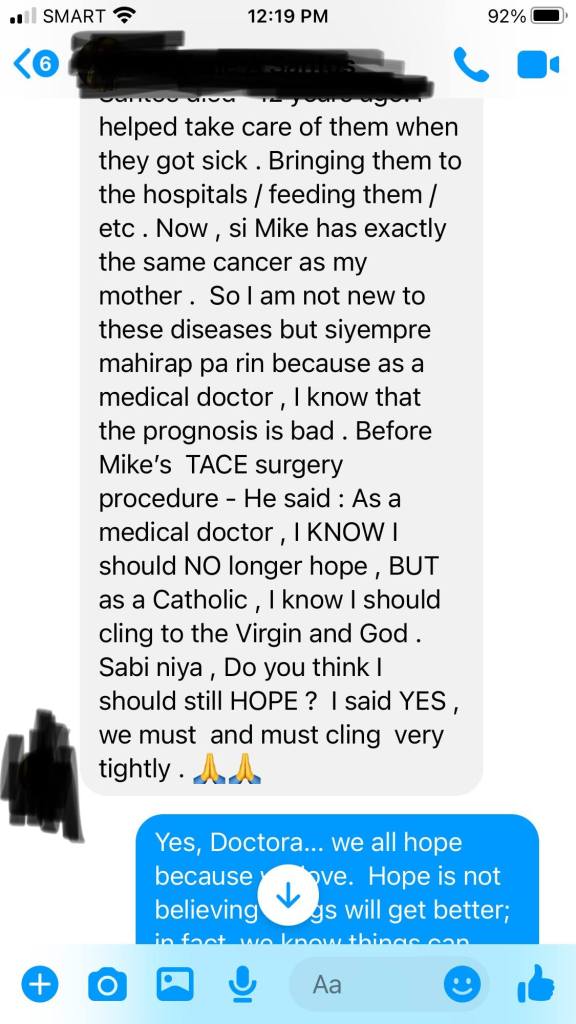
Four weeks ago, a former parishioner had asked me for prayers for her husband with liver cancer. Both are medical doctors; in fact, it was her husband who had actually diagnosed himself while going through radiological lab exam.

It was at that time they “resolutely determined” to go home and face the inevitable by praying together, hoping together in God.

Here lies the mystery and paradox of hope we were talking earlier: why and what do we really hope when we know it is going to end in death?

God. Nothing else and nobody else. God is the reason we hope and what we hope for.

It is only when we have been stripped of everything else when we truly “see” and experience God is all we have in life after all.

Then we become confident God will never abandon us until the end.

That is what my friend and her husband have realized, especially when Dr. Mike died two weeks later after going home.

When I celebrated Mass at his wake, I could not resist telling my friend how the smile of her husband is the sweetest, even most infectious one I have ever seen on the lips of a dead person in my 22 years as a priest!

Truly, the Lord loved Dr. Mike until the end that he died with a smile as the fruit of his hoping in God with his wife.

Indeed, friends have told me that God will give us the grace to face our death when that time comes; and I believe them because I have seen them transformed after accepting their terminal condition that they no longer cry of their situation getting worst while those to be left behind in turn become the ones crying knowing their beloved is passing (https://lordmychef.com/2020/09/22/the-gift-of-tears/).


Hope surprises.
Even God.

Photo by author, 2019.

When I was on my second year of seminary formation in theology, I experienced the most severe test of my vocation to the priesthood that I almost left and abandoned all plans of becoming a priest at all.

What sustained me in the seminary were prayers — and some lines from T.S. Eliot’s very long poem “Four Quartets” published in 1941:

I said to my soul, be still, and wait without hope
For hope would be hope for the wrong thing; wait without love,
For love would be love of the wrong thing; there is yet faith
But the faith and the love and the hope are all in the waiting.
Wait without thought, for you are not ready for thought:
So the darkness shall be the light, and the stillness the dancing.

Too bad I have lost the index card on which I wrote this stanza which I posted on my study lamp, reading it daily even until I have become a priest.

To truly hope, one has to get totally lost and empty, stripped naked of our very selves when darkness is our only light and hopelessness is our only hope.

It is when we have totally lost everything except God when we truly hope.

And that is when all the surprises happen, not only with ourselves but with others.

Not only here but definitely even in eternity, the biggest surprise we are all hoping for.

Photo by author at Silang, Cavite, 22 September 2020.

In 1912, the French poet Charles Pierre Péguy (1873-1914) wrote a very long poem ahead of T.S. Eliot about the virtue of hope, claiming it is God’s favorite because it is full of surprises.

Péguy portrayed Hope as a “little girl” who enlivens her older sisters Faith and Love.

I do not want to dilute its magic and power so I leave it that way for you to savor its sweetness, its truth and beauty in Péguy’s poetry:

The faith that I love best, says God, is hope. Faith doesn’t surprise me. It’s not surprising. I am so resplendent in my creation…. That in order not to see me these poor people would have to be blind. Charity, says God, that doesn’t surprise me. It’s not surprising. These poor creatures are so miserable that unless they had a heart of stone, how could they not have love for each other…. But hope, says God, that is something that surprises me. Even me. That is surprising.

Charles Péguy, The Portal of the Mystery of the Second Virtue

Sometimes in life, we have to hit rock bottom in order to truly hope. Keep hoping and you will surely be surprised by God, by others, and by our very selves that we are always blessed! Amen.