Call of the COVID-19 quarantine: a return to our contemplative spirit

Quiet Storm by Fr. Nicanor F. Lalog II, 29 April 2020

Photo by author, 2010.

This is again for my brother priests and fellow workers in Church communication: our extended “enhanced community quarantine” is a call for us to rediscover the contemplative spirit so essential in our communication apostolate. It is best that before we go in front of the camera, before we post anything at all, or even before we go out doing our social action, let us first have Jesus Christ in us.

After all, it is always Jesus and only Jesus we bring as priests in everything we say and do. Jesus is our life as priests and without him, our works mean nothing. Worst, it may be happening that it is not Jesus whom we are following when we fail to spend time with him in serious prayers that unknown to us, we are already replacing him by creating our own ministry apart from him.

Incidentally, we are celebrating today the Memorial of St. Catherine of Siena who is considered as one of the patron saints for those working in telecommunications and TV stations.

In one of her numerous “ecstatic” visions, it is said that when she was so sick in her room, she begged the Lord to give her a glimpse of the celebration of the Mass in their chapel. The Lord heard her prayer and thus, she became the first person in history to have celebrated Mass by “remote telecast”!

From Google.

Faith and technology

We have mentioned in our previous reflection that we now live our faith in a mass-mediated culture. Media is all around us. And there is always that intense temptation by the devil to put us on TV and the internet to be popular.

So, how do we interact with technology on a daily basis?

What are we posting on Facebook? Are we like the rest who are also hooked into TikTok with all the inanities that go with it?

How much time do we spend for social media and Netflix these days?

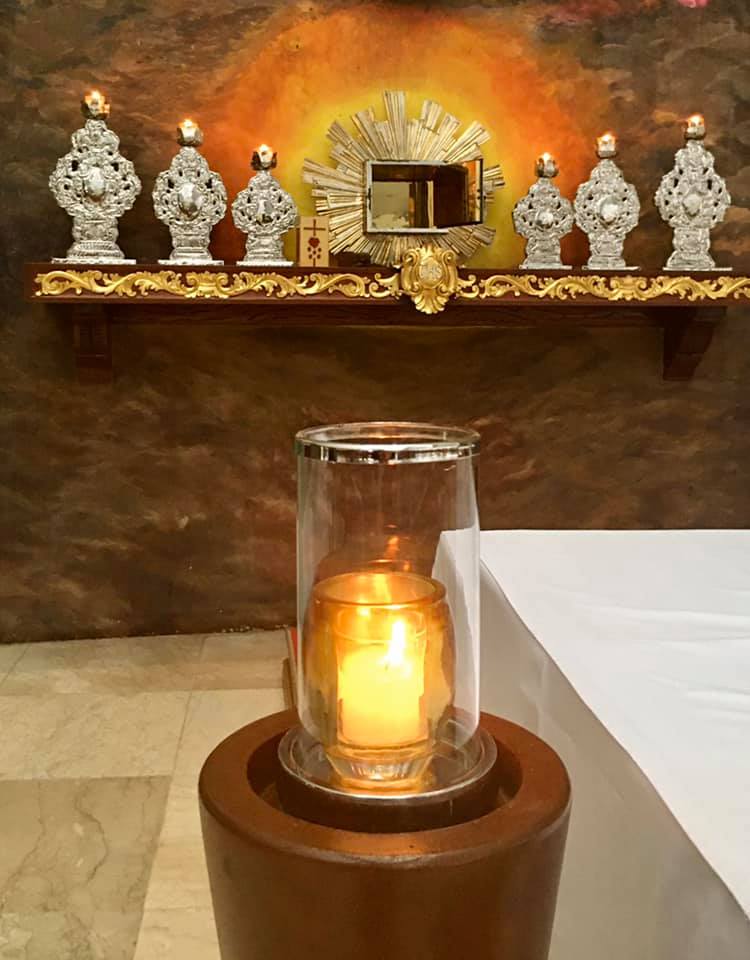
And how many hours do we spend before the Blessed Sacrament, excluding our Liturgy of the Hours and praying of the Holy Rosary?

From Google.

We are familiar with Marshall McLuhan’s dictum “the medium is the message”.

This we have seen in the past very evident in our ministry when some priests have transformed the South American telenovelas and later Koreanovelas into a gospel too that people felt like listening to reviews during the homily. And it had given some people the idea that every homily of the priest must say something about television shows! In fact, about three years ago, some priests have to be reminded by the CBCP during the Simbang Gabi to focus only on the Word of God and not on TV shows and jokes to get the attention of their congregation during Mass.

But let us not forget that later in his life, McLuhan added to his dictum that “the medium is the massage” to warn us that sooner or later, we can be eaten up by media that everything is reduced into a show – or a palabas in Filipino that means outward.

That is what a show is, a palabas which is empty or walang laman.

And shallow, mababaw.

That is the sorry state of our many social communication efforts in the Church when we have Masses that have become like entertainment shows, priests becoming entertainers, church buildings and decors that look like videoke bars evoking none of the sacred, and tarps and posters that are all hype without any evangelical meaning.

Observe also how our presentations and shows in our Catholic schools and parish halls have become mere repetitions of what are on television that have left many of us now stuck in Emmaus who could no longer find the way back to Jerusalem, even to Jesus because all we see are the fun and excitement, the glitz and the glamor of media.

And of our massaged ego.

Road to Emmaus from clarusonline.it

Keeping technology in its place in the Church

We are not saying modern communications is evil; the Church has always been clear that these modern means of communications are in fact a gift from God. Vatican II asserts that it is Church’s “birthright” to use and own these modern means of communication for evangelization (Inter Mirifica, 3)

Our challenge in the Church is to keep these modern technologies in its proper place.

A technological culture is not the most hospitable environment for religious belief, but neither is it necessarily hostile. If we are to find a way of expressing our faith in this technological culture and of speaking to and with the people formed by this culture we need to take time to consider how we, as individuals and as a faith community, interact with technology on a daily basis.

James Mcdonnell, Communicating the Gospel in a Technological Age: Rediscovering the Contemplative Spirit (1989)

In a story posted by the CBCP News two days ago, it reported the experience of Filipino priest Fr. Jun Villanueva who contracted the dreaded COVID-19 disease in New York City last March shortly after he had arrived to study there.

Assigned in a parish in the heart of the Big Apple, Fr. Villanueva tells how he spent his days of being “alone literally and emotionally” as “moments with God”. But, his turning point came after recovering from the corona virus when he began celebrating Mass alone:

“I really cried when I first celebrated Mass without churchgoers. There’s no one in the Church except Jesus,” he recalled. “Then I realized that the Mass is not a show but our union with Jesus, whether there are people or none,” he said. “I started to look at the situation from that perspective”.

Fr. Jun Villanueva, CBCP News, 27 April 2020

That is the first step needed to put technology in its proper place in the Church: that we bring back Jesus Christ whom we have banished in the name of our ministry and vocation. The more we think of putting so much “art” and other things to “enhance” our liturgies, then we banish Jesus Christ.

This is the other pandemic we have refused to stop in the Church: triumphalism, the overdoing of things for God that in the process we actually put more of ourselves in the ministry and liturgy than of the Holy.

Is there anyone or anything greater than the Lord?

Remember St. Theresa of Avila: Solo dios basta!

And, like our saints who guide us closer to God, the only way to have Jesus and bring him back in our lives and ministry, in the church as institution and building is through the contemplative spirit of the priests.

It is a good thing that the catch call these days is that the “return to normal” is actually a “return to basics” like washing of hands, covering of mouths when sneezing, and most of all, a return to God.
From Google.

The spirits of modernity characterized by constant changes and technological efficiency do not jibe so well with the demands of the Gospel of Jesus Christ who have always reminded us of guarding against the temptations of the material world.

Jesus tells us to practice poverty but the world tells us to be wealthy.

Jesus asks us to forget ourselves and follow him but the world tells us to be popular and follow the limelight.

Jesus tells us to go down and be humble but the world tells us to rise up and go higher!

The other day, Jesus reminded us in the gospel:

“Do not work for food that perishes but for the food that endures eternal life, which the Son of Man will give you. For on him the Father, God, has set his seal.”

John 6:27

Most of the time in the Church and in our lives as priests, we have to be “inefficient” like “waste time” doing nothing in front of the Blessed Sacrament; have less of everything like food, money and clothing; be silent to listen more than to speak and talk more.

The contemplative spirit is about poverty and going down while the world tells us to be wealthy and to rise and go upwards.

The contemplative spirit is to be silent and trusting always in the Lord rather than relying on our own powers and abilities.

Here is James McDonnell again on the need to rediscover the contemplative spirit in communicating the gospel in this modern time.

“The contemplative spirit is an attitude of mind and heart that enables us to focus on the essential, important things. It refuses to be hurried or rushed into premature rejection or acceptance of technology. If we Christians allow it to inform our use of communication technologies we shall learn to be realistic, but always hopeful, able to love and reverence our culture even as we strive, with God’s help, to transform it.”

Communicating the Gospel in a Technological Age: Rediscovering the Contemplative Spirit (1989)

Take heart, my dear brother priests: we are representatives of Jesus Christ, our Eternal Priest. We are not entertainers and pleasers of anyone but of God alone. We do not need followers and likers. And we have so many other things to do than TikTok and Facebook or Instagram.

Let us go back to Nazareth to be silent and hidden so we can return to Jerusalem to await for further instructions from the Lord. Amen.
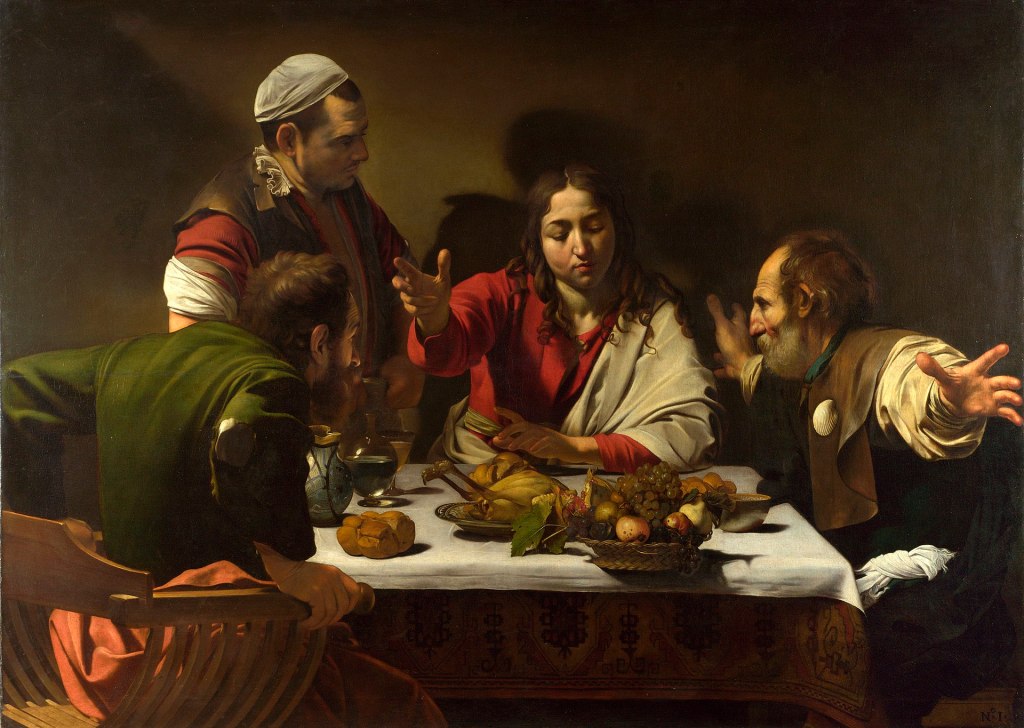
“Supper at Emmaus” by Caravaggio. From Google.

Building up the Body of Christ

The Lord Is My Chef Breakfast Recipe for the Soul, Memorial of St. Catherine of Siena, Virgin and Doctor of the Church, 29 April 2020

Acts of the Apostles 8:1-8 ><)))*> 000 <*(((>< John 6:35-40

Our empty church since March 17, 2020.

Once again, O Lord Jesus Christ, your Body the Church is facing severe trials and difficulties at this moment of history with the pandemic COVID-19 that have closed churches worldwide even in Rome, Italy which is one of the worst hit countries of the corona disease.

Since the martyrdom of St. Stephen, the Church has always been persecuted but never defeated. On the contrary, it was during the persecutions when your Church had really grown beyond leaps and bounds, so to speak.

St. Catherine lived at that time when she was able to unite warring factions in Europe as well as in the Church with her counsels while through her, many individuals found directions in life with her holiness, teachings and directions.

And while churches remain closed with dim prospects of opening soon, you never fail to send us men and women full of devotion to you who continue to work tirelessly in building your Body, the Church.

One of them is Fr. Jun Villanueva from the Diocese of Balanga in Bataan who was infected with COVID-19 while serving in New York.

As he recovered from the deadly disease celebrating Mass in his parish, he had a wonderful realization that many of us priests have seem to forget:

“Then I realized that the Mass is not a show but our union with Jesus, whether there are people or none… from then on I started to look at the situation from that perspective”.

CBCP News, 27 April 2020

In the first reading we are told of the zeal of Saul in destroying the early church alongside the devotion of the early disciples in keeping the young church alive.

Devout men buried Stephen and made a loud lament over him.

Acts of the Apostles 8:2

Only St. Luke used that adjective “devout” in the New Testament to describe people of “good heart, ready to believe, and then act openly and with courage” according to Timothy Clayton of the book “Exploring Advent with Luke”.

Devout people make thing happen for God like St. Stephen and the early Christians.

From Google.

Devout people give themselves to God wholly like St. Catherine and all the saints who remained attuned with the Holy Spirit like Philip in the first reading today, ready to follow its promptings and leads.

Give us the same gift of devotion to you, Jesus, the “Bread of Life” who had come down from heaven so we can build up your Church as your body here on earth.

Help us avoid the pitfalls of pride and self-centeredness that tend to destroy the unity of your Body, the Church.

Most specially, keep us devoted to you in the Blessed Sacrament like St. Catherine of Siena with whom you have shown in a vision while she was sick the celebration of the Eucharist in their chapel making her a patroness of those in television. Amen.

Some lessons from Emmaus

Quiet Storm by Fr. Nicanor F. Lalog II, 26 April 2020

This is for my brother priests and fellow communicators in the church who might be failing to recognize Jesus Christ along the way and sadly, stuck at Emmaus.

That very day, the first day of the week, two of Jesus’ disciples were going to a village seven miles from Jerusalem called Emmaus, and they were conversing about all the tings that had occurred. And it happened that while they were conversing and debating, Jesus himself drew near and walked with them, but their eyes were prevented from recognizing him.

Luke 24:13-16

We live our faith today in a mass-mediated culture.

Media is all around us.

Vatican II tells us that these modern means of communications are gifts from God that are “necessary for the formation of Christians and for pastoral activity” (Inter Mirifica, 3).

Communication is a sharing in the power of God who created everything by just saying “Let there be…”. When this power to communicate is mishandled and eventually abused, sooner or later, it can blind us and prevent us from recognizing Jesus in our midst.

And sadly, it is already happening.

Even before the start of the enhanced community quarantine, many of us were already using the various platforms of social media proclaiming the good news of Jesus Christ.

But, are our hearts still burning deep inside in him and for him?

Is Jesus still the One we are proclaiming, or are we now trying to be like the so-called “influencers” of the secular world that we are more preoccupied and focused with gimmicks and antics, shows and bravaduras for the sake of followers and likes?

Are our hearts still burning with the Sacred Scriptures or the words of the world that we have made our ambos and altars like studios and stage complete with all the props to tickle the bones of people than build up their faith and experience Jesus?

On the road to Emmaus, after Cleopas had expressed their feelings and thoughts to Jesus, he and his companion fell silent and simply listened to Jesus explaining the Sacred Scriptures. No need to shout or mimic voices.

No need to keep on clapping hands like in a circus or even dance like Salome who later asked for the head of St. John the Baptist.

It is sad that on the road to Emmaus, it has become our monologue, our show that Jesus can no longer speak.

Remember that “in the beginning was the word, and the word became flesh”: God’s communication is always preceded by silence.

Even in the road to Emmaus, there was total silence when Jesus spoke that the two disciples were silent that they felt their hearts burning.

As they approached the village to which they were going, he gave the impression that he was going on farther. But they urged him, “Stay with us, for it is nearly evening and the day is almost over.” So he went to stay with them. And it happened that, while he was with them at table, he took bread, said the blessing, broke it, and gave it to them. With that their eyes were opened and they recognized him, but he vanished from their sight. Then they said to each other, “Were not our hearts burning within us while he spoke to us on the way and opened the Scriptures to us?” So they set out at once and returned to Jerusalem where they found gathered together the eleven and those with them…

Luke 24:28-33

The Mass and our Priesthood are both a mystery so unique especially for us. It is something beyond explanation without much physical descriptions but more of inner recognition.

Exactly like Easter: the moment we recognize Jesus in the Scriptures and in the Eucharist, he vanishes because he is more than enough than anybody or anything else in the Mass and in our ministry in general.

Even in our very own lives!

St. Mother Teresa asked us priests long ago to “always give (them) Jesus, only Jesus”. And that will always be valid until the end of time when Jesus comes again.

And here lies the great lesson for us from Emmaus: the more we try harder, insisting on giving “physical appearances” of Jesus in our celebrations with our showbiz kind of preaching complete with a song and dance number to the excessive use of modern means of communications like slide presentations during homilies to our “creative liturgies” that are very distracting to other trappings of overdoing everything called “triumphalism” — that is when we BANISH Jesus from the scene.

In Emmaus, Jesus vanished when the disciples’ eyes were opened.

In some Masses today, unfortunately, Jesus is banished and many eyes are not only left closed but sadly, even blinded.

“Supper at Emmaus” by Caravaggio.

We are priests called to preside the celebration of the Eucharist in persona Christi.

We priests do not own the Mass and we cannot insist on whatever we want to do, even if it is very pleasing and delighting to the senses of the people.

Do away wit all those “styles” and gimmicks.

Jesus saved us not with activities; Jesus saved us by dying on the Cross.

If all we are concerned with is to “feel good”, to tickle our bones and senses, our eyes – and those of the people we serve and bring closer to God would never be opened to recognize Jesus Christ.

Our Masses and other celebrations need only Jesus, always Jesus.

There is no need to put our pictures in every tarpaulin or announcement. Rest assured that every disciple of Jesus is always good-looking and handsome. Believe. And stop bragging it.

Let us have him always and let others recognize him from within. If there is no inner recognition of Jesus, maybe we have never met him at all. Neither in Emmaus nor in Jerusalem nor in our selves.

A blessed week ahead of you, my brother priests and fellow communicators of Christ, in Christ.

Stay with us, Lord

The Lord Is My Chef Sunday Recipe, Easter Week III-A, 26 April 2020

Acts of the Apostles 2:14.22-33 ><)))*> 1 Peter 1:17-21 ><)))*> Luke 24:13-35

Photo by author, sunset at Laguna de Bay (Los Banõs), February 2020.

I am sure all of us can identify with the two disciples going home to Emmaus on that evening of Easter. And surely, as we accept with a heavy heart the extension of this enhanced community quarantine (ECQ) until May 15, we pray like them, saying, “Stay with us, Lord.”

As they approached the village to which they were going, he (Jesus) gave the impression that he was going on farther. But they urged him, “Stay with us, for it is nearly evening and the day is almost over.” So he went in to stay with them. And it happened that, while he was with them at table, he took bread, said the blessing, broke it, and gave it to them. With that their eyes were opened and they recognized him, but he vanished from their sight. Then they said to each other, “Were not our hearts were burning within us while he spoke to us on the way and opened the Scriptures to us?”

Luke 24:28-32
From https://www.clarusonline.it/2017/04/29/i-discepoli-di-emmaus-andata-e-ritorno/

Jesus always walking with us, without us recognizing him

Once again we see the presence of darkness in this story of Easter found only in St. Luke’s gospel. And that is the beauty of Easter – like Christmas – showing us the immense love of God for us that he sent us his Son Jesus Christ in the darkest moments of our lives to lead us to light and life.

And it always happens when we least expect it like that Easter evening when Cleopas and his companion were on their way to Emmaus.

Jesus comes to us as a stranger and most of all, joins us in the “wrong direction” to bring us back to the right path we must take especially when things go against our plans and expectations.

Until now, we cannot still believe how these things are happening to us: the lockdown, the sufferings and uncertainty of life when everything is on a “wait-and-see” situation especially in business and education while houses of worship remain closed and mass gatherings prohibited to control the spread of COVID-19.

But, if we look back and see how we are today, do we not also feel our “hearts burning within” that despite all the sickness and deaths almost everywhere, we are still here, alive, forging on in darkness, and most of all, somehow being led by Jesus even though we do not recognize him right away to be always on our side?

Yes, we worry, we ache deep inside but, more than these, we hope, we love, we live because we firmly believe in the Risen Lord present in us, present among us.

Deep in our hearts we experience Jesus with us, feeling with us, listening to our cries and worries just like that Easter evening to Emmaus. As we would say in Filipino, “ah basta!” that means without doubt, we are certain of someone or something from deep within not visibly seen.

“Supper at Emmaus” by renowned painter Caravaggio. See the emotion depicted by Caravaggio with his trademark of masterful play of light and shadows. At the center is the Risen Lord blessing the bread that caught the two disciples who are seated in disbelief, one outstretching his arms and the others pushing back in his chair. The third character in the painting is the innkeeper unaware of the significance of the gesture of Jesus. It was at this instance that the two disciples recognized Christ as the travelling man with them to Emmaus.

Our inner recognition of Christ in the breaking of bread

Notice that in all resurrection stories, the followers of Jesus did not recognize him immediately. There is always that feeling within them, like what we feel when we see somebody and we try to recall where we have met him/her, trying to dig into our memories when and how did we get to know the seemingly not “stranger” before us.

It is a funny feeling that is finally resolved with a very simple memory of an instance long ago or a small detail that leads into an “inner recognition” of the person before us.

This is how the disciples of Jesus recognized him — not through his external appearances but more from within like when Cleopas and his companion invited him into their home in Emmaus or when the seven apostles led by Simon Peter met him by the shore of the lake when no one would dare ask who he is because deep within, they knew it was the Lord (Jn.21;12-14).

And this happens always in the context of a meal, a table fellowship when Jesus instituted the Sacrament of the Eucharist on Holy Thursday evening before he was arrested to be crucified.

Here we find the mystery of this sign left to us by Jesus to be his very presence among us in his Body and Blood under the perceptible signs of bread and wine as well as the Sacred Scriptures proclaimed in every liturgical gathering: the more we do not see his outward appearances, the more we recognize Jesus!

Every time we celebrate the Mass and listen to the scriptures proclaimed, we realize within us like the people of Jerusalem in the first reading that this Jesus of Nazareth is a true person present in our lives fulfilling his works of salvation despite our sinfulness.

Like some people we meet, we recognize Jesus Christ not with the outward appearances but from within, from what we have experienced beyond explanations that gives us always a sense of awe because as St. Peter tells us in the second reading, “he had ransomed us from our futile conduct with his most precious blood” (1 Pt. 1:18-19) which is affirmed to us in every celebration of the Holy Eucharist.

The Easter mystery of recognizing Jesus when he vanishes

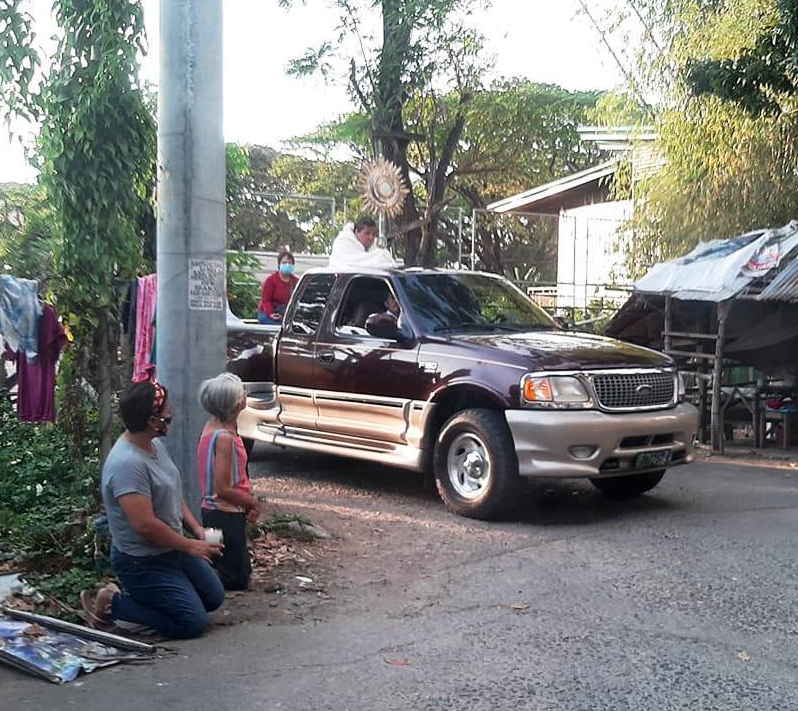
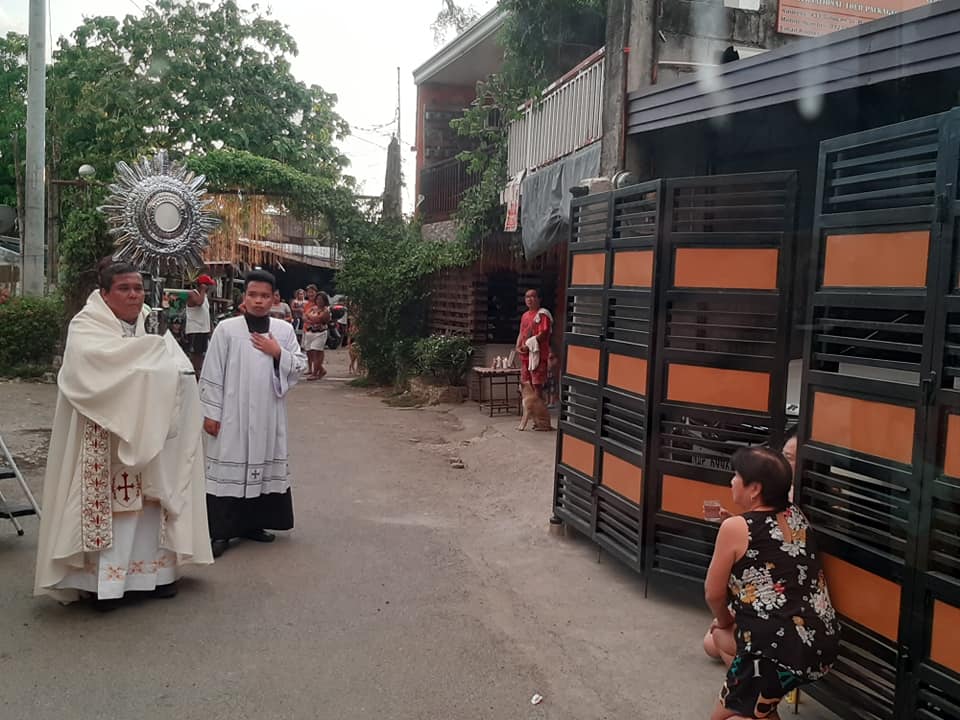
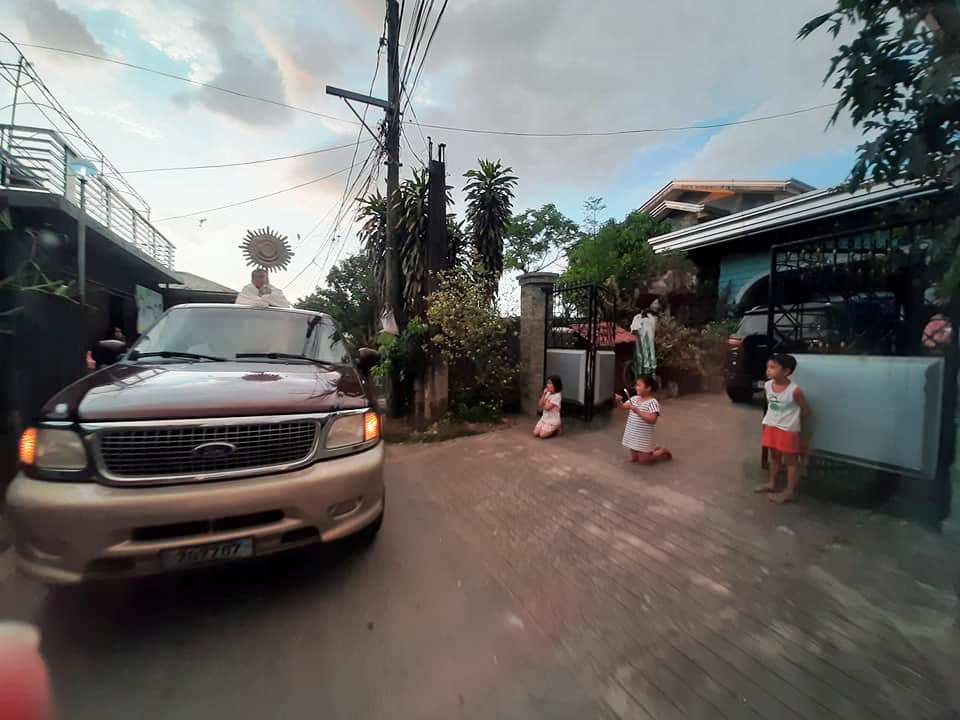
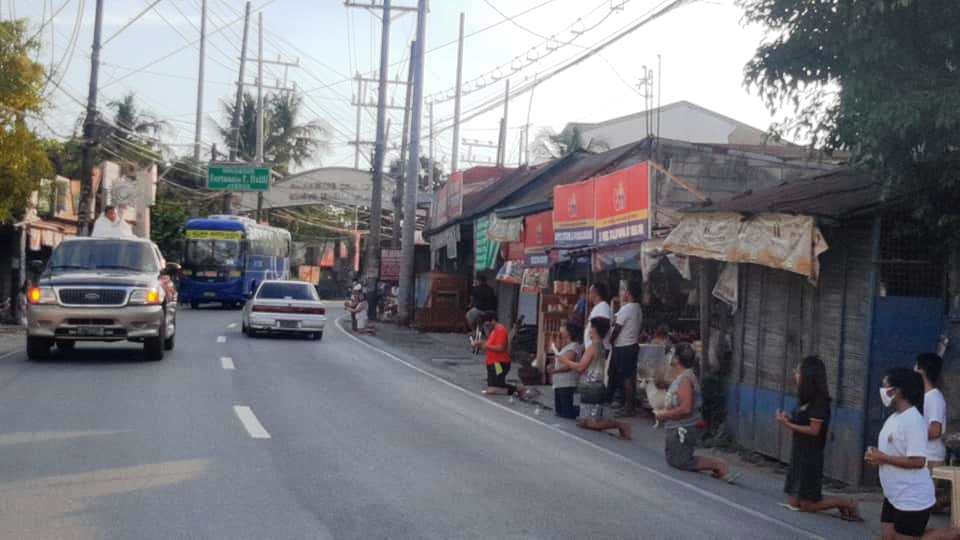
Every Sunday afternoon since this lockdown began due to COVID-19, we have been bringing the Blessed Sacrament around our Parish to remind the people of Christ’s presence among us.

And every Sunday, I am amazed at the faith of the people who would kneel on the side of the road, totally believing that it is Jesus himself who visits them in the Blessed Sacrament.

The sight is so moving with people from all walks of life bowing their heads or raising their hands, recognizing Jesus in the Blessed Sacrament as they pray in silence with others crying. The few motorists passing by stop at the side of the road to see Jesus and be blessed while others get near our truck for a blessing.

Here lies the great mystery of Easter: Jesus need not appear to us in person because as he vanishes in the Blessed Sacrament, that is when we recognize him!

In the most simple gestures of the Mass under the most simple signs of bread and wine, Jesus vanishes from our outward view and through this vanishing our interior or inner recognition opens up that we “see” him in the many instances he had touched us especially in our “heart-breaking” experiences in the past.

We know with certainty that “it is the Lord” – Dominus est – present in every breaking of bread because part of the Easter mystery tells us deep within that it is only in his vanishing that he truly becomes recognizable to us.

What a shame and a tragedy especially in these days of live television or internet Mass when priests do all the gimmicks and antics to wow the people as if they are audience in a show than faithful in a sacred gathering.

May we not forget this mystery of Easter that, the more Jesus vanishes, the more we recognize him because Jesus is more than enough than anybody or anything else especially in the Mass. And when we pray “Stay with us, Lord”, we actually ask for more faith to believe in him to see him in his vanishing. Amen.

A blessed week ahead to everyone! Stay safe, stay in the Lord.

Modern painting of the road to Emmaus.

Urgency and Trust

The Lord Is My Chef Breakfast Recipe for the Soul, Saturday, Feast of St. Mark the Evangelist, 25 April 2020

1 Peter 5:5-14 ><)))*> ><)))*> ><)))*> Mark 16:15-20

Statue of St. Mark and his symbol the lion below him at the western facade of St. Mark Cathedral in Venice, Italy. Photo from Google.

Lord Jesus Christ, as we move into the final week of April and face – with dismay – the extension of this enhanced community quarantine into May 15, the celebration of the feast of your evangelist St. Mark today gives us the much needed boost to persevere in these trying times.

In writing the first gospel account, St. Mark stressed two important things that are very helpful for us today in this time of the corona virus: urgency in proclaiming your gospel and trust in you.

It is something very similar to Stephen Covey Jr.’s concept of “the speed of trust” that when there is trust among people like in a relationship or a team, speed goes up wherein costs are minimized, productivity is increased due to trust.

Give us the grace to trust in you, Lord Jesus, so we can urgently proclaim your gospel of salvation most especially at this time when people are feeling worn out by this lockdown.

So many people are already suffering not only physically but also emotionally and spiritually.

Help us to bring them more joy and hope, healing and renewal not only through our gifts and financial aid but also with our presence and concern for them.

Let us not worry in doing your work with the assuring words of St. Peter in the first reading:

The God of all grace who called you to his eternal glory through Christ Jesus will himself restore, confirm, strengthen, and establish you after you have suffered a little.

1 Peter 5:10

Like in the beginning of the gospel by St. Mark, may we always proclaim your good news Lord whenever and wherever there is a wilderness, emptiness, and weariness among peoples for you are always faithful in enabling us to fulfill your work. Amen.

Nuns bringing relief goods to remote villages in this time of Luzon-wide lockdown due to COVID-19.

The “fourth” temptation of Jesus

Quiet Storm by Fr. Nicanor F. Lalog II, 23 April 2020

Detail of “The Temptation of Jesus According to St. Matthew” on the wall of St. Mark’s Cathedral in Venice, Italy. Photo from psephizo.com.

English journalist and satirist Thomas Malcolm Muggeridge (1903-1990) said in his book “Christ and the Media” (1978) that if Jesus Christ were still with us in this age, the devil would have surely tested him a fourth time in the wilderness with, “I will put you on TV“.

So true!

Muggeridge has been proven right especially in the last 40 years when television has become the new “altar” not only in homes but everywhere, including in our churches that has made the sacred so ordinary, almost profane with priests speaking and moving more like entertainers with the Mass becoming quite like a variety show, complete even with raffles and prizes!

That is why we priests have to restudy again and review Church teachings on social communication during this long quarantine period. And pray more intensely on our next moves after COVID-19.

Although the corona pandemic has given the much-needed push for our social communication ministry in the church, it is my firm belief that the post-COVID 19 scene can be misleading if not handled properly at this stage.

This early, we can see some abuses in the celebrations of the Holy Mass on TV as well as in other similar platforms like Facebook live.

But the most serious danger now becoming so clear and present are some of us priests totally “lost in media” who have become the center of attractions, pushing Jesus Christ out of the total picture.

Communication is sharing in the power of God

Communication is power. In the story of creation, God created everything by merely saying the words “Let there be…” and everything came into being. Our ability to communicate intelligibly unlike other creatures is a tremendous gift from God which is a sharing in his power to communicate.

This is explains the simple reason that when we love a person, we always talk; any lack of communication is a sign of a breakdown in the relationship like when husband and wife or lovers have “LQ”.

We have seen in recent years with the advent of smartphones how powerful can communication be that it can build or destroy anyone with a single “click”.

Or, how our ego is massaged when we are the first to break a news on Facebook or when our posts get viral or trending!

See how the most influential and highest paid people are always the ones on TV.

The seal of “Good Housekeeping” on every product had been replaced with “As Seen on TV!” as mark of good quality of anything being sold.

To succeed in any war campaign or coup d’etat, military handbooks now give top priority in first neutralizing TV and radio stations to ensure victory.

And, sadly also due to this power of TV, every political career is now launched first on television that is why we have more actors and actresses than solons and statesmen in the corridors of power.

How amazing that it is the fictional character Spider-Man, one of the top grossing film franchise in recent years, is the one who reminds us that “with great power comes great responsibility”.

In the Old Testament, people prided themselves in building the tower of Babel that reaches to heaven that God confused them with different languages causing its collapse. The reverse happened in the New Testament when during the Pentecost, God sent the Holy Spirit so people could understand each other despite their different languages and the Holy Church was built up.

When communication is seen in the right perspective, it becomes a spirituality because it is always a sharing in the power of God which is love.

“Communication is more than the expression of ideas and the indication of emotion. At its most profound level, it is the giving of self in love. Christ’s communication was, in fact, spirit and life. In the institution of the Holy Eucharist, Christ gave us the most perfect, most intimate form of communion between God and man possible in this life, and out of this, the deepest possible unity between men. further, Christ communicated to us his life-giving Spirit, who brings all men together in unity.

Pastoral Instruction on the Means of Social Communication (Communio et progressio), #11

Communication is spirituality, the sharing of Jesus Christ

Church communication, specifically the communication by every priest is communicating Jesus Christ, the eternal Word who became flesh.

Our mission as priests according to Vatican II as “man of the Word of the living God” (Presbyterorum Ordinis, 4) is to primarily share Jesus Christ.

My spiritual director and mentor, truly another father and dad to me, Rev. Fr. Franz-Josef Eilers, svd would always tell me….

“Priesthood is for the service of the Lord and a priest should reflect it. He is not to become a ‘star’ with the public but rather another Jesus figure in humble service of the Lord… The test for a good priest is the depth and power of his spiritual life and being with the Lord. Can you imagine saints like John Vianney and John XXIII as television stars? If the media would report about their life, it is ok; but they themselves should not appear as “star” but rather as servants of the Lord. And this is reflected in their spiritual life and not any ‘show’…”

Personal notes with Fr. Eilers

What a tragedy when we priests are more after the number of followers and likes, forgetting the fact that Jesus himself had only 12 followers with one betrayer among them!

What a tragedy when we priests, starting from the seminary, has always been speaking and working around “Galilee” without any moments of silence and hiddenness of Nazareth and of the desert and wilderness.

All the spiritual masters from the apostolic period down to this modern age of Nouwen and Merton, including the secular Pico Iyer have always emphasized silence and solitude or stillness in prayer before the world and the Lord to truly have impact in this world.

We are priests asked to be the mouth and arms and limbs and legs of Jesus Christ. We are not replacing but merely representing Jesus Christ for it is him who is going to change the world, not us. Our task is to be filled always with Jesus Christ, to be like Jesus Christ, to share always and only Jesus Christ.

Like St. John the Baptist, our attitude toward Jesus and our communication ministry must always be “He must increase; I must decrease” (Jn.3:30).

Then why all our pictures in every post, in every announcement?

If we firmly believe in Jesus, we do not need pomp and pageantry and all the gimiks and antics in our celebrations of the Mass or announcements of recollections or bible studies. People would always surely come for Jesus Christ who is more than anybody else.

Photo by Pixabay on Pexels.com

The primacy of Christ in every Church communication

Long before Canadian philosopher and communication researcher Marshall McLuhan (1911-1980) came up with his dictum “the medium is the message”, there has always been the towering figure of St. Augustine in early Church communication process.

In the fourth book of his “Doctrina Cristiana” (Christian Doctrine), he noted that in Christian communication, the process always begins with the Message, Jesus Christ.

Hence, whereas we normally find the process as:

SENDER —> MESSAGE —-> RECEIVER ;

in Church communication, it is always:

MESSAGE (JESUS CHRIST) —> SENDER —> RECEIVER.

When there is a breakdown in this flow of communication, especially by a priest, there is already a problem. When it is the priest who is always in the limelight, always his photo hogging whatever communication platform it may be, or when the homily has become more to delight and tickle the senses, it is a sign of falling into the fourth temptation.

Sooner or later, it will not be surprising that during consecration, instead of experiencing and realizing Jesus saying “This is my Body will be given up for you”, what the priest may be revealing is that This is my body. Be envious.”

Soon, Father will be endorsing products and services, entering into various contracts in the name of the Church, hanging out in the most expensive restaurants, rubbing elbows with the rich and famous, leaving Jesus behind among the poor and worst — alone in the Blessed Sacrament because Father is so busy with his “shootings” and media appearances.

And that is when he forgets being a priest, forgets Jesus Christ until it is too late, he had fallen into the trap of the devil as sex and financial scandals unfold, hurting the Church, hurting Jesus Christ, hurting himself and everybody else in the process.

Anybody can always be a good speaker and orator. But not everybody is called to speak for the Lord. Let us not waste it nor abuse it. Most of all, let us not disappoint the Lord who has called us not because we are good but because he is good!

May this quarantine period be another wilderness experience for us priests and communication ministers in the church so we may empty ourselves to be filled with Jesus Christ the Perfect Communicator we must share and proclaim. Amen.
Finding Jesus in Easter darkness

The Lord Is My Chef Recipe in the Octave of Easter, also Divine Mercy Sunday, 19 April 2020

Acts 2:42-47 ><)))*> 0 <*(((>< 1 Peter 1:3-9 ><)))*> 0 <*(((>< John 20:19-31

Carrying around our parish the Blessed Sacrament every Sunday afternoon since lockdown began.
I have almost forgotten – and it is only now amid this extended lockdown – that I have realized the first Easter happened in darkness! We are in the same situation with the Apostles when Jesus rose from the dead.

What we need is to “quarantine” ourselves more, our heart and soul within to see and recognize our Risen Lord among us like during that first Easter.

On the evening of that first day of the week, when the doors were locked, where the disciples were for fear of the Jews, Jesus came and stood in their midst and said to them, “Peace be with you.” When he had said this, he showed them his hands and his side. The disciples rejoiced when they saw the Lord. Jesus said to them again, “Peace be with you. As the Father has sent me, so I send you.” And when he had said this, he breathed on them and said to them, “Receive the Holy Spirit. Whose sins you forgive are forgiven them, and whose sins you retain are retained.”

John 20:19-23
Stained glass at the back of our parish church depicting the appearance of the Risen Jesus with Thomas, aka, Didymus. Photo by author, 02 April 2020.

Jesus always comes in darkness to bring light of peace

In our reflection last Holy Wednesday, we have mentioned how Jesus was born during the darkest night of the year to bring us that light of hope and salvation. The same is true with Easter when he resurrected in the darkest part of the day just before dawn.

Jesus indeed is the light that bursts and pierces through the darkest darkness of the world and of our very lives, our sinfulness. This is the reason we also celebrate this Sunday the Feast of the Divine Mercy of God in Jesus Christ.

Through his Passion, Death and Resurrection, Jesus is the only one who can penetrate through whatever blockages and imprisonment we have or we are into like sin and evil, pains and hurts in the past that filled us with so much guilt.

In his Divine Mercy, Jesus had come to give us our life back complete with the gift of freedom that we have all lost to sin and evil.

And that is why on Easter, Jesus gave us his greatest gift of all which is peace or shalom in Hebrew that means wholeness or holiness. To be whole literally is to have a good relationship with one’s self, with others, and with God.

Vatican II asserts in its Pastoral Constitution on the Church in the Modern World:

Peace is more than the absence of war: it cannot be reduced to the maintenance of a balance of power between opposing force not does it arise out of despotic dominion, but it is appropriately called “the effect of righteousness” (Is.32:17). It is the fruit of that right ordering of things…

Gaudium et Spes, no. 78

Righteousness in the bible means justice that is also equivalent to holiness which is, to be filled with God, not necessarily to be sinless. That is why after greeting them with peace the second time, Jesus breathed on them the Holy Spirit, an imagery that reminds us of the story of creation when God breathed on the first humans to have life.

At Easter, we were breathed on again by the Risen Lord to renew our lives, to fill us again with God and be closest to him in our breath and thus enabling us to be free again from sin and evil, free for God and for others.

What a joy to read these days due to lockdowns worldwide that the Sierra Madres and Mt. Samat can be seen again from the metropolis or the Himalayas from India after 30 years due to clearer skies with less pollution. Or, the lions in Africa’s wildlife parks lazily sleeping without being disturbed by humans.

These are proofs that there is life indeed amid the darkness of this pandemic when Jesus restores life and balance, making everything new and alive again!

Peace and mercy, unity and mission

At his Supper before his arrest, Jesus prayed to God our Father that we may all be one – ut unum sint – like him and Father (John 17:21) are one. This would be partly fulfilled on Easter and eventually at the coming of the Holy Spirit at Pentecost when the Church is eventually launched.

It is in our faith that we enter into communion with the Father in Jesus Christ and with one another as a community, as a church.

That is why it was a beautiful imagery of Thomas eventually joining them the following Sunday not because he lacked faith; he had faith that is why he came to see and experience Jesus. And that faith bloomed upon encountering Jesus again that according to tradition, Thomas preached the good news to India where he died a martyr by being skinned alive.

We have always said in our previous reflections that whenever and wherever there is faith, there is always union and unity with God and others.

Eventually, from every unity and community, there is always mission.

In our first reading today we have heard how the early Christians were one in their faith, always praying, that is, celebrating the Eucharist from which flowed out their mission.

All who believed were together and had all things in common; they would sell their property and possessions and divide them among all according to each one’s need.

Acts 2:44-45
Easter in our Parish amid COVID-19.

In his entire life, we have seen that Jesus had always been clear in his being sent, that the words he had spoken and things he had done were not all his but from and by the Father.

Watch closely John’s narration of after the Lord’s Resurrection:

On the evening of that first day of the week, when the doors were locked, where the disciples were for fear of the Jews, Jesus came and stood in their midst and said to them, “Peace be with you.” When he had said this, he showed them his hands and his side. The disciples rejoiced when they saw the Lord. Jesus said to them again, “Peace be with you. As the Father has sent me, so I send you.”

John 20:19-21

After giving them the gift of peace and filling them with his breath of life to signify they have been forgiven for their sins and failures when they left him on Good Friday, Jesus is now drawing them into his great mission: As the Father has sent me, so I send you.

This is the defining and definitive characteristic of the Church, of any community of disciples in every age, most especially in this time of the corona virus pandemic.

Our mission continues in the darkness of COVID-19

Churches may be closed, public Masses are banned but the mission of proclaiming in words and in deeds the good news of the Risen Lord continues very loud and clear.

Detractors would always malign us, would spend for trolls just to ask “where is the Church in this time of crisis” but the people know best that we have never been remiss nor even flinched a single second whenever disasters strike anywhere in the world.

In the darkest moments of history in the past up to the present, the Church as a community of disciples of Jesus has always shine so brightly in Christ standing up for the poor and oppressed, the marginalized and forgotten, the sick and the hungry, those suffering in the most far-flung areas with its extensive networks of parishes and BEC’s.

This is also the reason why people always malign us in the Church about what we are doing amid the poverty and sufferings of the world: we work in silence because we are merely being sent by Jesus Christ. Like him our Lord and Master, whatever we say and do are not ours but the One who sent us, the Father in heaven.

We merely represent Jesus Christ who represents the Father and guided by the Holy Spirit, together we forge onto the darkness of this pandemic despite the many sufferings we go through, “tested by fire so that we may prove to be for the praise, glory, and honor of revealing Jesus Christ” (cf. 1 Peter 1:6-7).

This is who we are, disciples of Jesus sent to proclaim his love and mercy especially in the midst of all darkness.

This Sunday amid the darkness and threats of COVID-19, let us join the psalmist in his song, “Give thank to the Lord for he is good, his love is everlasting” (Responsorial Psalm , Ocatve of Easter).

A blessed week to everyone. Stay safe but keep working for the Lord! Amen.

Easter Vigil in our Parish, 12 April 2020.

Photos in the collage clockwise: Malolos Diocese Social Action Center, Inc. with Caritas Manila spearheading relief operations in Bulacan; Sisters from the Daughters of St. Anne walking through fields and mountains to reach out to our poorest of the poor; trays of thousands of eggs to be given away to fisherfolks in Binuangan, Obando by Fr. Ramon Garcia III; last two photos, beneficiaries of the 10-m Php worth of Gift Certificates given throughout Bulacan before Holy Week that included everyone even those from other faith and beliefs.

Let truth set us free

40 Shades of Lent, Wednesday, Week-V, 01 April 2020

Daniel 3:14-20, 91-92, 95 ><)))*> +++ <*(((>< John 8:31-42

After my “daily Mass without congregation”, 31 March 2020. Photo by author.

O God our loving Father, thank you very much for this brand new day you have given us. Thank you for another day to be better, to be safer, and most of all, to be more faithful , truthful, and loving to you.

Grant us the same courage you have given the three young men cast into the hot furnace after refusing to worship the pagan idol of their pagan captors.

King Nebuchadnezzar said: “Is it true, Shadrach, Meshach, and Abednego, that you will not serve my god, or worship the golden statue that I set up? Who is the God that can deliver you out of my hands?” Shadrach, Meshach, and Abednego answered King Nebuchadnezzar, “There is no need for us to defend ourselves before you in this matter… But even if our God will not save us from the white-hot furnace, know, O king, that we will not serve your god or worship your golden statue which you set up.”

Daniel 3:14, 16, 18

O dear Lord, people are wondering why we still pray, why we celebrate the Mass even our churches are closed, and why or what are we doing when we bring the Blessed Sacrament around our parish.

Many are asking where is our God in all these sickness and deaths caused by COVID-19.

Many are like King Nebuchadnezzar trying to put down the Church founded by your Son Jesus Christ, wondering what we are doing in the midst of this pandemic.

Merciful Father, you know us very well as your children.

Give us the perseverance and fidelity to keep on doing what we have always been doing in hiddenness without much pomp and pageantry and other public relation stunts.

Let our silent works for you and in you continue so that people may know you truly exist, you are among us even if you do not give tangible signs of your presence or proofs of your power.

Let us remain in your Son Jesus Christ so we may always know and follow and most of all, stand by him who is Truth himself because “the truth will set us free” (Jn.8:32). Amen.

Photo by Ms. Ria De Vera, kids kneeling before the Blessed Sacrament we have “motorcaded” around our parish last March 22 and 29, 2020.

Rejoicing in the Time of Corona

40 Shades of Lent, Sunday Week IV-A, 22 March 2020

1 Samuel 16:1, 6-7, 10-13 +++ Ephesians 5:8-14 +++ John 9:1-41

Photo by author, Laetare Sunday 2019, Parokya ni San Juan Apostol at Ebanghelista, Bagbaguin, Santa Maria, Bulacan, Philippines.

Today is the Fourth Sunday of Lent known in its Latin verb form “Laetare Sunday” when the liturgy calls us to rejoice because Easter is fast approaching.

But how can we rejoice in the midst of an “enhanced community quarantine” or lockdown, when we cannot even come to church to celebrate the Sunday Mass together, when so many people are dying while millions of others face uncertainties with the widespread disruptions and problems in life caused by COVID-19 worldwide.

On this date is also my 55th birthday – but, no worries, the more I rejoice in the Lord almost alone. Thank you for all the greetings that have been pouring since yesterday. As I was telling you last Sunday, COVID-19 has brought some blessings or good news too for us.

Let us rejoice in the Lord today because he has not left us, the more we feel him present with us, thanks or no thanks to Corona virus.

As Jesus passed by he saw a man blind from birth. His disciples asked him, “Rabbi, who sinned, this man or his parents, that he was born blind?” Jesus answered, “Neither he nor his parents sinned; it is so that the works of God might be made visible through him.”

John 9:1-3

Our “blaming game” vs. light of Christ

More than ever as we suffer through this pandemic of COVID-19, many of us have again resorted to that old myth that whenever something bad happens to us, especially sickness, it is always taken as a punishment from God.

It is totally untrue because nothing bad can come from God. Many times in our lives, we become artificially blind that despite our gift of sight we fail and even refuse to see the truth and realities in us and around us, even in front of us!

What happens is our tendency to blame others like in that question to Jesus, who sinned – the parents or the man himself that he was born blind?

This is the problem with our “blaming game” : we are blinded from taking responsibilities for our acts that we would rather blame others even God for everything bad that happens to us. There are more times that there is no one to be blamed at all like our genes or Mother Nature; we just have to accept things as they are.

And that’s one lesson we must learn fast: there can be no rejoicing when there is no self-acceptance.

How funny and sad that less than a week since our Luzon-wide lockdown, many of us have been quarreling on-line on almost everything we see and hear on TV and the social media that has led to bashing and nasty exchanges of words, even breakdowns. Very funny, and tragic when we focus on non-essentials, almost forgetting COVID-19.

How tragic that some chose to hide facts and truths that have caused the lives of others, too. This is the dark reality of our blaming game – we never admit anything wrong about us.

See beyond external things. Try seeing also how God is working in our midst as Jesus offers us in this holy season of Lent the best way to deal with our present situation by returning to him, by believing in him.

Photo by author, Baliwag, Bulacan (25 February 2020).

Have you noticed the many little miracles happening in some families now together, praying together, staying together?

One reason for rejoicing this fourth Sunday of Lent is perhaps everyone’s hope that after this COVID-19 episode, we all start a new chapter of renewed relationships and bonds, of fresh outlooks after rediscovering the value of life and every person again.

Jesus spat on the ground and made clay with the saliva, and smeared the clay on his eyes, and said to him, “Go wash in the Pool of Siloam”- which means Sent. So he went and washed, and came back able to see.

John 9:6-7

Here again is the presence of water like in last Sunday’s story to remind us of the Sacrament of Baptism which is closely tied with the season of Lent. St. John had translated the meaning of Siloam as “Sent” to stress that Jesus is the Christ, the One sent to cleanse us and wash away our blindness caused by sins and evil.

Another reason to rejoice this Sunday! Most especially now many of us realize the value of the Holy Mass, especially the Sunday Eucharist we used to take for granted before. Every time we celebrate the Mass, we perfect the Baptism we have received when we are washed and refreshed anew in Jesus through his words and Body and Blood.

It is only when we stop blaming others when we begin to see our true selves, when changes finally begin to happen in us.

Like God, let us try to see things and persons beyond what is physical. In the first reading, God chose David over his elder and better brothers who would later defeat Goliath to become Israel’s greatest king from whose lineage came Jesus Christ.

Jesus on the Cross, our true joy

Photo by author, Lent 2019, Parokya ni San Juan Apostol at Ebanghelista, Bagbaguin, Santa Maria, Bulacan, Phils.

The moment we remove Jesus in our lives, when we refuse to acknowledge him as our Lord and Savior, that is also when we are blinded by sin, especially by pride.

Do we not see this so true that led one way or the other to this pandemic?

We have totally turned away from God and his ways, following our greedy paths of power and wealth. We have long been distant from one another despite the great advances in modern communications that have also brought us farther away from God as we spend more time with our gadgets.

We can never rejoice for ourselves and for others when we are far from Jesus Christ. In his very unique manner of looking at things, St. John presents to us some funny contrasts in the story of the man born blind that we also see happening in this COVID-19 pandemic.

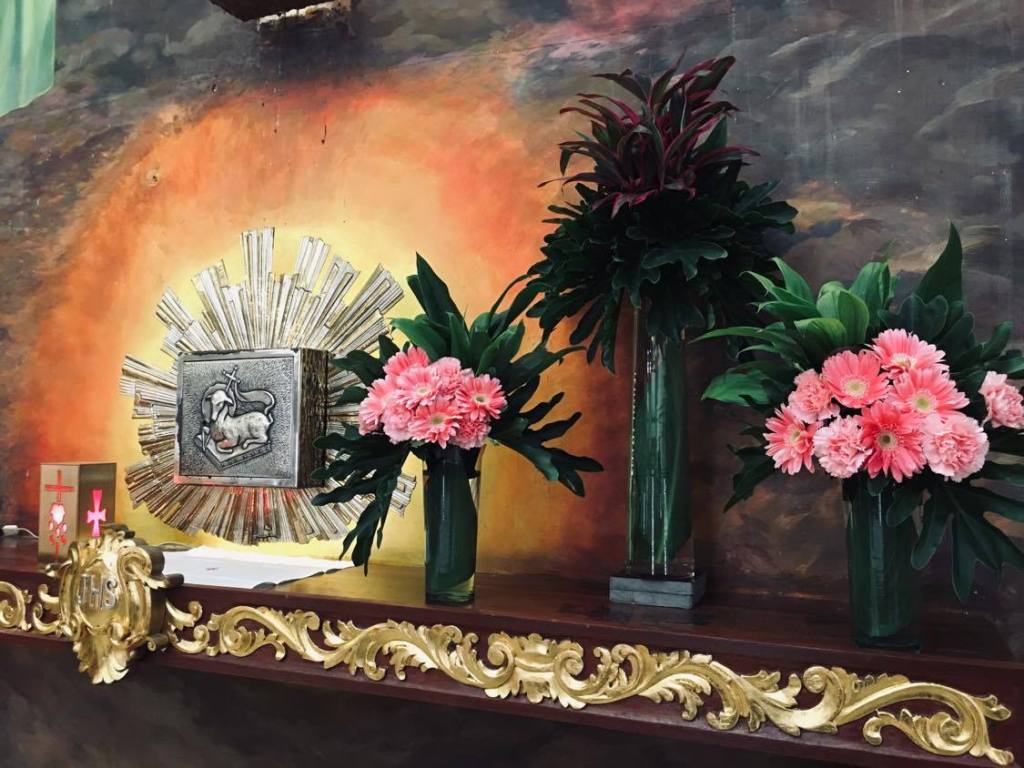
Our Tabernacle, Laetare 2019.

First is when the people doubted the man healed by Jesus was himself the one “who used to sit and beg”, despite his clear declaration of “I am”. We have experienced this so many times when others doubt we can rise and become better.

How sad these past days we have seen how some people have been so mean especially with younger and newer leaders who have risen against the threats of COVID-19, shooting down their efforts, even to the point of maligning and even threatening them. It is as if they are the only “anointed ones” with whom God can work with.

Second is the attitude of the parents of the man born blind: betrayers are the worst kind of artificially blind people. Like the parents of the man born blind, they refused to vouch for his identity and healing for fears of being banned from temple worship.

Ouch! for us in the church with our “holier-than-thou-attitude” especially with those closest with us like family members and friends. Like Judas Iscariot, sometimes those supposed to be dearest to us are blinded by money, power, and fame that they also betray and dump us.

Where has all the love gone for one another, for the country?

In the sacristy, Laetare 2019.

Lastly, there are those supposed to be learned ones but unfortunately blinded simply by lack of faith in God like those Pharisees who refused to believe the man born blind’s story of healing as well as to recognize Jesus as the Christ.

Observe the attitudes of the Pharisees who claimed to know “this man, Jesus, is a sinner” because he healed on a Sabbath while the man born blind retorted “I do not know (Jesus) but how come he had healed me?”

What a tragic comedy! It is the root of the mess we are into today of so many learned men and women pretending to know so much but totally incompetent and ignorant of the realities going on, who do not care at all with the plight of the masses!

Both the whole world and our country are in deep darkness today with so many blind leaders and followers alike. Let us heed St. Paul’s reminder not to be blinded, to stop blaming others and to start confronting ourselves in the light of Jesus Christ.

“Take no part in fruitless works of darkness; rather expose them, for it is shameful even to mention the things done by them in secret; but everything exposed by the light becomes visible, for everything that becomes visible is light.”

Ephesians 5:11-14

Rejoice for an enlightened Sunday and new week for everyone despite COVID-19. Amen.

Standing for Christ

The Lord Is My Chef Breakfast Recipe for the Soul

Saturday, Feast of the Chair of St. Peter, 22 February 2020

1 Peter 5:1-4 ><)))*> 0 <*(((>< Matthew 16:13-19

Chair of St. Peter at the altar of St. Peter’s in Rome. From Google.

Many of us today are wondering, O Lord, about our unusual celebration, the Feast of the Chair of St. Peter. Because deep inside to most of us, chairs and seating mean a lot, whether at the dining table, conference room, the church, or even the bus and other modes of transportation.

Chairs and seats connote position and power. You have noticed it so well when you were invited to a banquet when people scrambled for the best seating positions.

How funny, O Lord, that we try to fool ourselves many times choosing to take the last seats at the back to make it appear we are humble and simple, choosing to be away from the limelight when in fact, the more we insist on having some seats, regardless where it may be, the more we insist on our ego and self, on who we really are!

A sculpture of St. Peter by Edwin Layug near the main door of the Malolos Cathedral. Photo by Lorenzo Atienza.

Remove our masks, Lord. Stop our hypocrisies! Let us heed the words of your humble servant, your first Pope.

Beloved: I exhort the presbyters among you, as a fellow presbyter and witness to the sufferings of Christ and one who has a share in the glory to be revealed. Tend the flock of God in your midst, overseeing not by constraint but willingly, as God would have it, not for shameful profit but eagerly. Do not lord it over those assigned to you, but be examples to the flock.

1 Peter 5:1-3

Pray for us, dearest St. Peter, to see that chairs and seats are signs indeed of primacy – not of prestige or honor but of charity and service in our family and community.

Help us to keep in mind that what really matters for the Lord, in this life, in the church we belong, is not where we are seated but where we stand in him, “the Christ and the Son of the living God” (Mt.16:16). Amen.