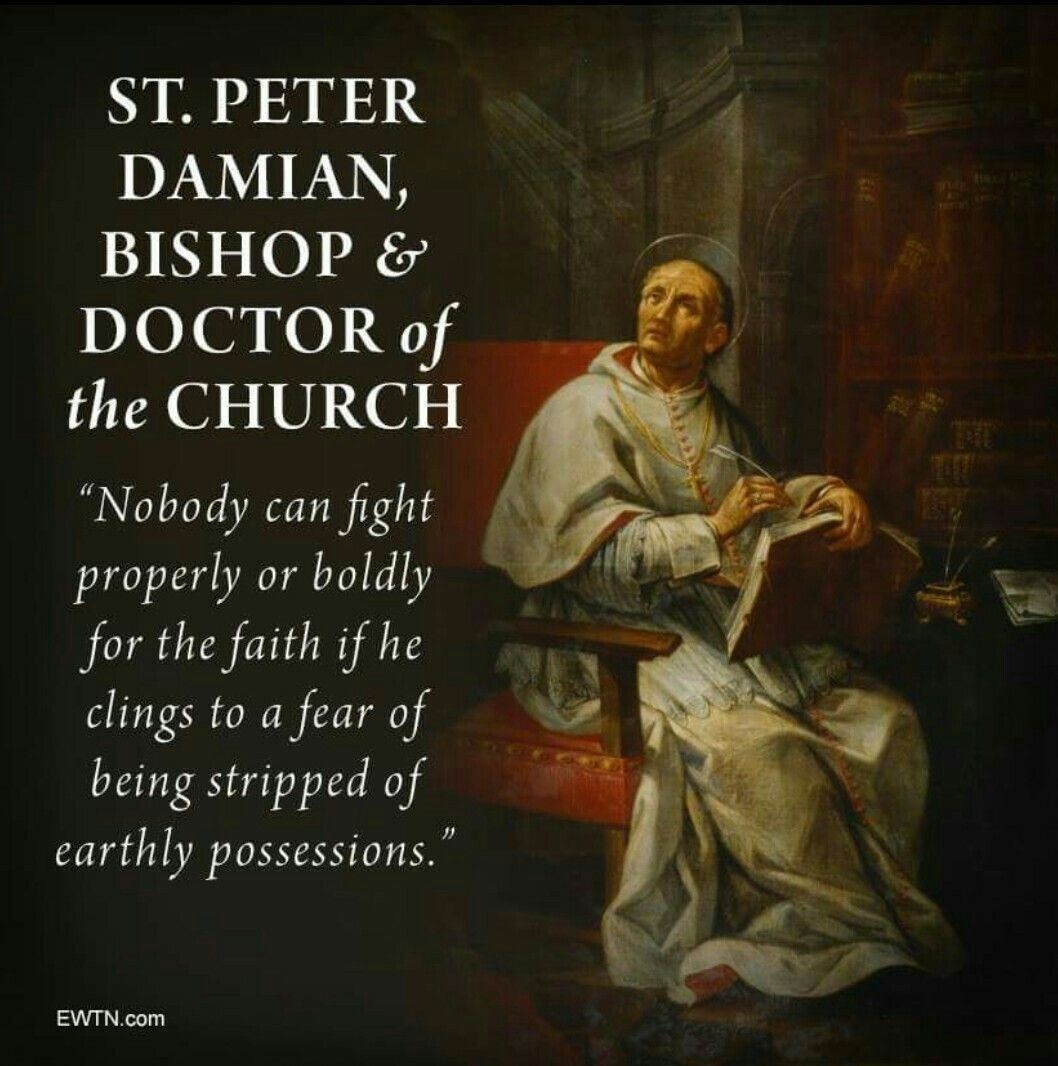
Friday, Memorial of St. Peter Damian, 21 February 2020
James 2:14-24.26 ><)))*> ><)))*> ><)))*> Mark 8:34-9:1
Photo by Mr. Jay Javier, Traslacion 2020, Quiapo, Manila.
Praise and glory to you, O Lord Jesus Christ, for standing by our side through all the trials that have poured upon us this early 2020. In fact, since December you have been keeping us, blessing us, protecting us from all the problems we have been going through in the family and in the world.
You have never left us, Lord, with many of us now moving on with our lives since losing our beloved earlier this year while war between Iran and the US was averted. Thank you, Jesus, the alert level of Taal Volcano had gone down and despite the continuing threats from the new corona virus, things seem to be improving.
Except us, your people who are supposed to be “faithful”.
The words of St. James since Monday have been shaking us down into our very core, reminding us to get real and do away with all the pomp and pageantries of being your faithful disciples.
What good is it, my brothers and sisters, if someone says he has faith but does not have works? Can that faith save him? So also faith of itself, if it does not have works, is dead. You believe that God is one. You do well. Even the demons believe that and tremble. See how a person is justified by works and not by faith alone. For just as a body without a spirit is dead, so also faith without works is dead.
James 2:14, 17, 19, 24-26
Continue to purify us, teach us how to truly “deny one’s self, take up one’s cross, and follow you, O Lord” (Mk.8:34).
How sad, O Lord, that as we approach your holy season of Lent, we are more preoccupied with how ashes should be distributed on Ash Wednesday.
What an “overkill” Lord in dealing with this disease when we have forgotten the more essential cleansing of our hearts, of our minds and conscience that flow into maintaining cleanliness and hygiene inside our churches.
Faith in this time of the new corona virus is proving to be a very crucial test of our being Christ-ians indeed through our genuine works of love and mercy for others.
Give us the same courage of St. Peter Damian in reforming not only your church but most especially our very selves. Amen.
The Lord Is My Chef Recipe for the Soul, Sunday Week V-A, 09 February 2020
Isaiah 58:7-10 ><)))*> 1 Corinthians 2:1-5 ><)))*> Matthew 5:13-16
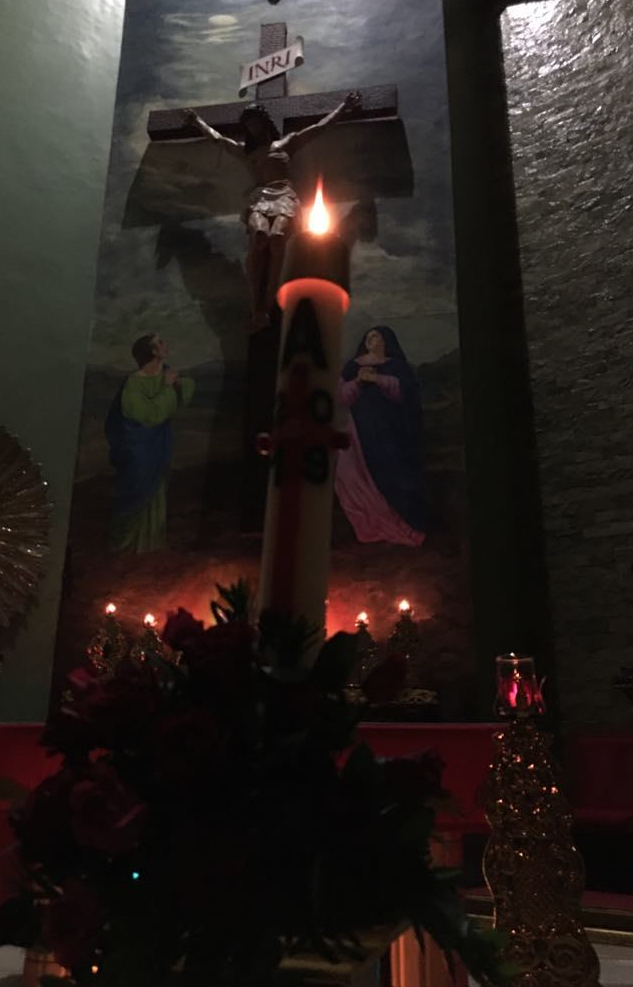
Our parish cross at night, taken with my camera phone, 02 February 2020.
For most of us, 2020 is a very tough year with all the dark clouds that have come to hover above us in January remain in this month of February.
Threats from the corona virus are growing especially in our country. And while the alert level at Taal Volcano had gone down, dangers of its major eruption remain while volcanologists observed last week a “crater glow” on Mayon Volcano, indicating a possible rising of magma in the world’s most perfect cone.
Elsewhere, more bad news are happening like the sudden deaths this week of healing priest Fr. Fernando Suarez and of our very own and beloved Fr. Danny Bermudo, just 24 hours apart due to heart attacks.
In our own circles of family and relatives, friends and colleagues are also dark clouds covering us while we go through our many trials and tests in life that seem to eclipse this early the many gains we have achieved in the whole of 2019.
Indeed, year 2020 shows us in “perfect vision” the sad realities of dark spots in life that behoove us more to heed Christ’s call to be the light of the world.
Jesus said to his disciples: “You are the light of the world. Just so, your light must shine before others, that they may see your good deeds and glorify your Heavenly Father.”
Matthew 5:14, 16
Photo by author, frost on petals, Baguio City, 04 February 2020.
Jesus is the light of the world, not us
Our gospel this Sunday follows immediately the inaugural preaching of Jesus called “the Sermon on the Mount” with the Beatitudes at its centerpiece. We have skipped that part of the gospel last Sunday due to the celebration of the Feast of the Presentation of the Lord.
For us to better appreciate this Sunday’s gospel, let us keep in mind that for Matthew, the Sermon on the Mount is the great discourse of Jesus Christ that depicts his image not only as the new Moses but as the Law himself, being both our Teacher and Savior as well.
Jesus shows us a picture of his person in the Beatitudes as someone we must imitate in being “poor in spirit, meek, and merciful” so we can follow his path to the Father. After all, as the Son of God, Jesus is “the way, the truth, and the life” (Jn. 14:6).
Hence, after enumerating the nine Beatitudes, Jesus followed up his Sermon on Mount with a call for us to be the salt and the light of the world: as salt, we merely bring out the Christ or the taste in every person and as light, it is the light of Christ that we share.
Focus remains in being like Jesus, not in replacing him who is our Savior. That is why he tells us clearly before shifting to another lesson in his Sermon that “your light must shine before others, that they may see your good deeds and glorify your Heavenly Father” (Mt.5:16).
Sharing Christ’s light with our good deeds as a community
So, how do we share the light of Jesus Christ in this age when so many others are claiming to be the light that will dispel all darkness in our lives?
As early as during the darkest period in the history of Israel in the Old Testament called the “Babylonian Captivity (or Exile)”, God had taught his people how to become light for one another during trials and sufferings.
Christ Light of the World, Red Wednesday, 27 November 2019. Photo by author.
Thus says the Lord: Share your bread with the hungry, shelter the oppressed and the homeless; clothe the naked when you see them, and do not turn your back on your own. Then your light shall break forth like the dawn… if you bestow your bread on the hungry and satisfy the afflicted; then light shall rise for you in the darkness, and the gloom shall become for you like midday.
Isaiah 58:7-8, 10
To share one’s bread with the hungry, to welcome the homeless, to clothe the hungry are some of the most concrete demands placed by God to his people since he had freed them from slavery in Egypt and later in Babylonia (Iraq today) when the third part of the Book of Isaiah was written.
Eventually, this prophecy was fulfilled in Jesus Christ who also preached exactly the same things shortly before fulfilling his mission in Jerusalem when he stressed the need to do good to one another because “whatsoever we do to one another, especially to the least among us, we also do unto him” (Mt.25:31-40).
We shall hear this part of Matthew’s gospel at the end of our current liturgical year on November 22, 2020 in the celebration of the Solemnity of Christ the King.
These instructions became the basis of our catechism’s “spiritual and corporal works of mercy” that Pope Francis stressed in 2016 during the Extraordinary Jubilee of Mercy.
From fathersofmercy.com
By saying “you are the light of the world”, Jesus is telling us that to fulfill this mission, we have to do it together as a community, as his Body, the Church!
No matter how good and holy we are, none of us is the “light of the world” on our own.
One candle or lamp, or even a light bulb today cannot produce enough light to brighten a whole town or community. But, if one Christian will be lighting just one little candle in the dark, he or she can encourage others especially those who are timid, hesitant, and indifferent until they finally set the world ablaze with Christ’s light.
Christ’s call to be the light of the world is also a call for us to be united as one community, one family, one faithful couple with all our imperfections and sinfulness. What matters is our striving to be good disciples, always charitable to one another as brothers and sisters in Christ.
Here we find the direct relationship of mission and community: every mission given by Jesus is also a call to become a community because without it, it soon becomes a cult centered on the disciple than the Lord.
Photo by Mr. Jim Marpa, 2018.
The example of St. Paul in sharing Christ’s light
St. Paul shows us the best example of being a light of Jesus is to always have it done and fulfilled in the context of a community, of the Church as the Body of Christ, avoiding chances of grabbing the light from him for personal gains.
“I came to you in weakness and fear and much trembling, and my message and my proclamation were not with persuasive words of wisdom, but with a demonstration of Spirit and power, so that your faith might rest not on human wisdom but on the power of God.”
1 Corinthians 2:3-5
It has always happened especially for us serving in the Church that in sharing the light of Christ, we get carried by our ministry and apostolate that we forget him until we claim being the light ourselves.
Sometimes, we consciously or unconsciously create clouts and personality cults for ourselves for being the best, the brightest, even the holiest and most humble of all!
We foolishly brag the great buildings and edifices we have built or the countless malnourished kids we have fed or sent to school for free through college, et cetera, et cetera, et cetera without being bothered at all where is Jesus Christ in all our efforts and projects!
How sad when we forget that what matters most in life is not what we have done or what we have achieved but what have we become as bearers of the light of Christ like St. Paul.
My dear friend, if you are going through many darkness in life today, simply be good, think only of Jesus Christ in everybody you meet and deal with. That is actually when you shine brightest as the light of Christ because people will be surprised at how calmly and gracefully you carry your cross.
In that way, you encourage others living in darkness to let their little sparks of light come out too without realizing how in their own darkness and limitations they have made Christ’s light seen. Amen.
Have a bright and blessed Sunday with your loved ones!
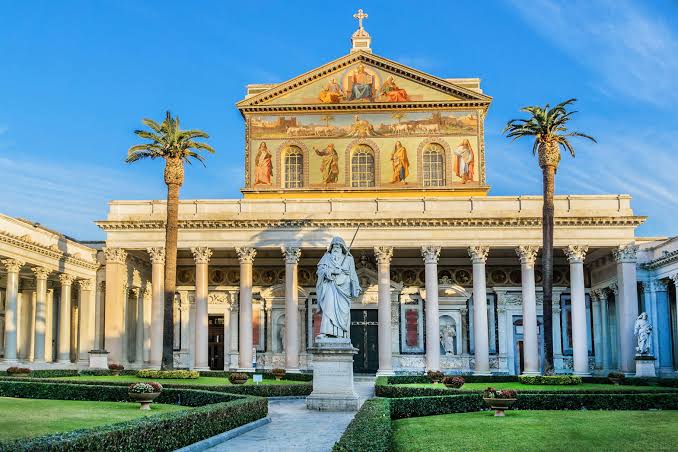
Saturday, Feast of the Conversion of St. Paul, Apostle, 25 January 2020
Acts 22:3-16 ><)))*> ><)))*> ><)))*> Mark 16:15-18
Photo by Lorenzo Atienza, Malolos Cathedral, 29 June 2019.
Glory and praise to you, O Lord Jesus Christ!
Thank you Lord for not leaving us alone, for continuing to live with us, calling us and sending us to your mission in the Church, your blessed Body!
As we celebrate today the Feast of the Conversion of your great Apostle St. Paul, we do not merely recall this personal event of his in the past but most of all, we try to listen to you with him anew in our own time and situation.
Nothing much had changed, O Lord Jesus since that day in Damascus when St. Paul was on his way to persecute your early followers.
Many of us continue to persecute you because of lack of faith in you, of pride, and yes, because of wrong beliefs all premised in that great lie we have the truth, just like St. Paul who was called Saul then.
I fell to the ground and heard a voice saying to me, ‘Saul, Saul, why are you persecuting me?’ I replied, ‘Who are you, sir?’ And he said to me, ‘I am Jesus the Nazorean whom you are persecuting.'”
Acts 22:7-8
It was the single event that converted St. Paul to become your most dynamic Apostle, Lord.
In that short instance, Lord, you remind us of how you personally call each one of us in our own name, no ifs nor buts, everything that is good and bad, even the worst in us.
Like St. Paul, we always hear your personal call but unlike him, we rarely have the courage to answer you, even enter into a dialogue with you just for a brief moment. We would rather stay on top of our horse, only to heed you when we have fallen and blinded by the world.
Likewise, Lord Jesus, in that brief encounter, you taught St. Paul and us today that basic reality of you identifying with the Church, your Body!
Every day, Lord, you continue to call us like St. Paul, asking us the same question, “why do you persecute me?”
O great St. Paul the Apostle, thank you for reminding us always in your letters how Jesus ceaselessly draws us into his Body the Church through the Holy Eucharist that for him is the center of Christian life where we experience Christ’s love in the most personal manner by giving himself for me.
Dearest St. Paul, pray for me that the love of Christ may always be my law and guide in life even to point of offering myself to him who had called me to a life of holiness. Amen.
Sirach 3:2-7, 12-14 ><}}}*> Colossians 3:12-21 ><}}}*> Matthew 2:13-15, 19-23
One of the many bas reliefs at the Cavern Church complex in Cairo, Egypt where the Holy Family fled to escape Herod’s wrath when he ordered the murder of all male children below three years old after learning from the Magi the birth of the “new king of the Jews”.
Among the celebrations during this Christmas Season, the Feast of the Holy Family is something peculiar because it was not borne out of liturgical origins but more of the changing times in the past 126 years since it was first celebrated as a devotion.
In the beginning, it was designed to counteract the growing attacks against family life and morality of the rapidly changing times.
Since 1969 when Vatican II designated its feast to be celebrated within the Christmas octave, the feast of the Holy Family has proven to be a major contribution in helping us understand the mystery of the Lord’s nativity in our modern time.
When the magi had departed, behold, the angel of the Lord appeared to Joseph in a dream and said, “Rise, take the child and his mother, flee to Egypt, and stay there until I tell you. Herod is going to search for the child to destroy him.” Joseph rose and took the child and his mother by night and departed for Egypt. He stayed there until the death of Herod, so that what the Lord had said through the prophet might be fulfilled, out of Egypt I called my son.
Matthew 2:13-15
A diptych mosaic depicting the story of the flight to Egypt of the Holy Family on the walls of the Saint Virgin Mary’s Coptic Church in Cairo, Egypt beside the Cavern Church. It is one of the oldest churches in Egypt that dates back to the third century.
Christmas, a living story continuing in our family
The feast of the Holy Family reminds us that Christmas is a living story that continues to this day wherein God comes first in and through our family.
We go back to Matthew’s gospel to hear again the important role of Joseph not only in taking Mary as his wife in order to give name to Jesus but also to protect them from all harm.
We have seen during Christmas how Jesus had always been subjected to suffering right in his mother’s womb when Joseph and Mary have to travel from Nazareth to Bethlehem to comply with Augustus Caesar’s directive to all subjects of the empire to register.
Now, they have to travel outside Israel to flee to another country to escape the murderous plot of Herod against Baby Jesus.
We have heard again the continuation of Joseph’s mission revealed again to him by an angel in a dream. But, Matthew added something very interesting that is the key to understanding our gospel today and our feast of the Holy Family.
He (Joseph) stayed there until the death of Herod, so that what the Lord had said through the prophet might be fulfilled, out of Egypt I called my son.
Matthew 2:15
Entrance to the Cavern Church where the Holy Family lived for about three years while in Egypt before going back to Israel.
Remember Matthew’s audience and followers were Christians of Jewish origins.
The Holy Family’s flight to Egypt is very similar to the story of Jacob’s migration into that country during the great famine when one of his sons, Joseph the dreamer, became a governor there.
Many years later, the Egyptians would make them suffer that God sent them Moses to bring them back to the Promised Land through Exodus that has become the single most important date in their entire history. Also known as the “passover”, it was at that time when Israel passed over from slavery in Egypt into freedom in the Promised Land.
But, the result was not favorable because after settling back into the Promised Land, the people would repeatedly break God’s covenant by worshipping foreign gods and idols that eventually led to their Babylonian exile, not to mention the division of the kingdom into two after David’s death.
By citing a prophecy by Hosea, Matthew is now telling us how Jesus, the Son of God, is the new beginning of fidelity to the covenant. Like Moses, God took out Jesus from Egypt; but greater than Moses and unlike him, Jesus would never be unfaithful to the covenant.
As the new beginning not only for Israel but also for the whole world, Jesus in fact passed us over from sin to grace with his own passover or pasch – his Passion, Death and Resurrection.
Welcoming Jesus in our family through our love and care for each member
The family is the basic unit of every society. Destroy the family, we destroy the society. Eventually, we destroy our nation.
The same is true with us in the Church: the family is a domestic church. Jesus comes first in our family.
But how can he now come when our family is disintegrating, when it is right in the family where women and children are first abused?
How can Jesus come in our family when we have lost all senses of the holy, of God that we no longer pray and gather together in the Sunday Mass and other sacraments?
See how the giant flatscreen has become every family’s altar and deity, replacing the Christ the King or any other Poon in our homes. Malls have replaced our places of worship. Worst of all, the great feasts and seasons of Christmas and Easter have become so commercialized, reduced to become our modern excuses for much needed breaks and supposed family bonding in beaches and abroad.
The Holy Family’s flight to Egypt brought them closer with one another and most especially with God. Unfortunately, our own “flight to Egypt” has become our excuse to leave God behind and focus more with our own lives.
A portion of a larger mix of bronze reliefs on one of the doors of the Duomo Cathedral in Florence, Italy depicting the harsh conditions the Holy Family have to face in Egypt while escaping Herod. Photo by Ms. Janine Lloren, 2015.
A friend had shared this photo with me which she had taken while on a trip in Italy, home to thousands of our OFW’s who, like the Holy Family, have to leave our country to find life, to escape “death”.
Like Jesus, Mary, and Joseph, God “sends” us out to our own, different “flight to Egypt”, pulling us out from the comforts of our family and home, career and other comfort zones in order to gather ourselves so we can start anew in Christ to be more free to love and be faithful to him and our loved ones.
Many times in our lives, separations and other adversarial situations make us better persons, enabling us to be more fruitful in life than just having everything for granted and so easily.
The adversarial conditions the child Jesus have experienced very early on – from his birth to early childhood in Egypt – strike many similarities with our situations today.
It is hoped that with this Feast of the Holy Family, we may be reawakened again with our sense of mission in bringing Jesus Christ more present especially when life is threatened, when persons are denied of justice and freedom.
May the first and second readings remind us that every relationship we have here on earth, starting in our families must always be based on our relationship with God our Father. Amen.
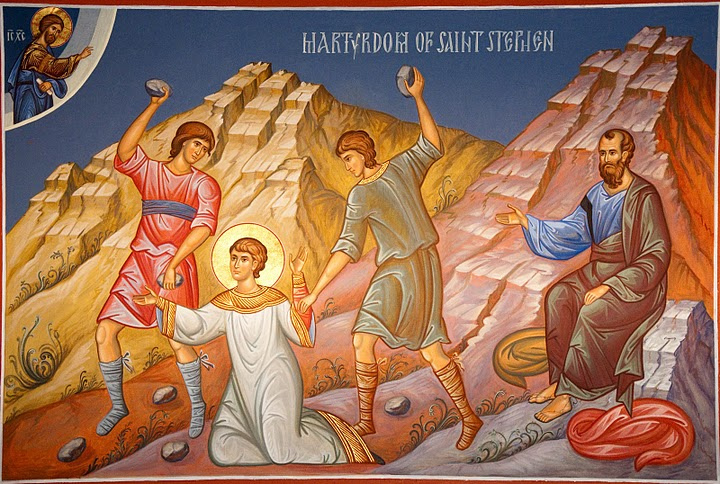
Thursday, Feast of St. Stephen, First Martyr, 26 December 2019
Acts 6:8-10, 7:54-59 ><)))*> ><)))*> ><)))*> Matthew 10:17-22
From The Holy Orders of St. Stephen. Seated in blue is Saul who would alter become known as Paul; at the upper right corner is Jesus Christ appearing to our first martyr of the Church.
How blessed indeed is your birth and coming to us, Lord Jesus Christ! You became like us human so we can become like you, divine!
And now, a day after we celebrated your birthday with joy, you have deepened this joy in us by being one in you, one with you in your humility and love to offer one’s self totally like our first martyr in the Church, St. Stephen.
As they were stoning Stephen, he called out, “Lord Jesus, receive my spirit.”
Acts 7:59
You give us the spirit of love and courage, the spirit of truth and justice, the spirit of mercy and forgiveness, the spirit of self-surrender to be one with you, sweet Jesus.
Teach us to be like St. Stephen to be able to give back to you this same spirit from you as we continue to follow you amid so many forms of persecutions. Amen.
Quiet Storm by Fr. Nicanor F. Lalog II, 23 December 2019
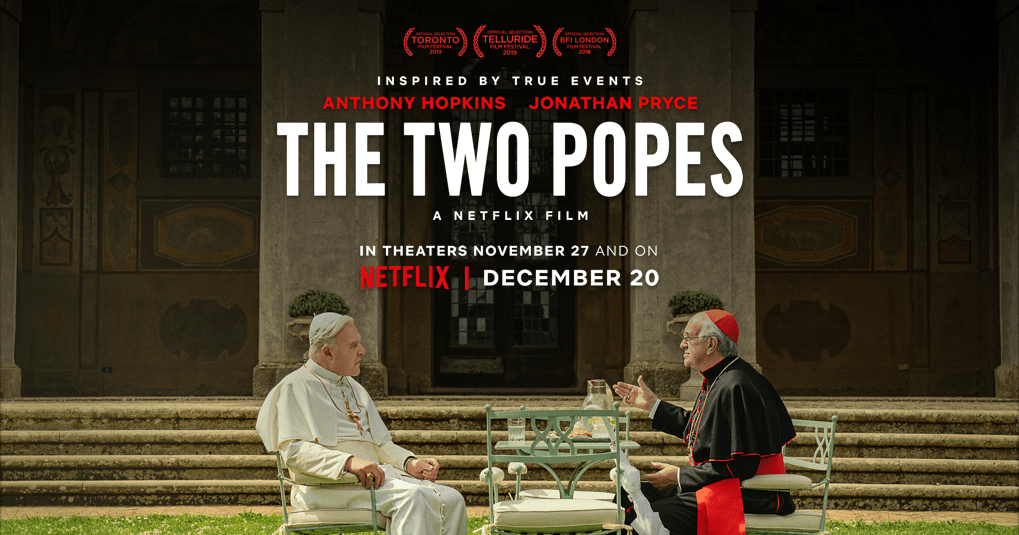
From Netflix.
As early as Friday night after my second Simbang Gabi Mass at 8:30, I have been wanting to react on social media against Netflix’s “The Two Popes”.
But I tried to control my self because I have only seen its first 30 minutes – and besides, it is a fiction story. So, in the spirit of fairness, I tried to finish the movie in three installments until Saturday afternoon before making any comments.
And I felt sad in having seen it at all.
“The Two Popes” is not entertaining. It is misleading without any strong elements to build on our faith and appreciate our religion. At its worst, despite its claim of being inspired by true events, the movie is unCatholic and unChristian.
From Google.
UnCatholic and UnChristian
Movies about religions and religious figures and personalities are always controversial by nature. But for as long as they follow the paths of honesty, sincerity, and truth, these movies eventually emerge as true expressions of art that can truly deepen one’s faith.
But “The Two Popes” at its opening scene is already disturbing and objectionable when it portrayed the Cardinals at the 2005 conclave as having animosity and rivalry among themselves in electing Pope Emeritus Benedict XVI.
Yes, we priests including bishops and Cardinals are all humans like anybody else but no one among us would ever dare to aspire for the papacy. While it is true there are some priests who are into “careerism” in the diocesan level, everything changes starting with the episcopacy or the office of the bishop.
In fact, part of the problem why we have so many vacant dioceses in the country and the whole world is that many priests refuse to accept their appointment as bishops because of many fears that are so real that come with the immense responsibilities of the position. According to the Vatican, three out of every ten priests offered to become bishops decline the offer personally made by the Pope through his Papal Nuncio in every country.
How much more with the Papacy?!
In the movie, Pope Benedict toured Cardinal Bergoglio inside the Sistine Chapel and showed him the “crying room” where the newly elected Pope may stay and cry – yes – before finally accepting his election as Pope.
That alone is true but not the movie portrayal during the conclave that claim Cardinals aspiring to become the Pope. It is something preposterous and totally untrue.
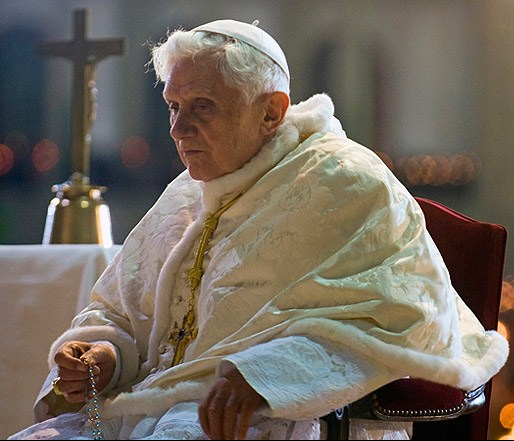
Catholic World Report
What is very disturbing in “The Two Popes” is how it presented Cardinal Ratzinger and Cardinal Bergoglio like “lowlife” lawmakers of congress gunning for the top post for prestige and power with their respective bloc members going around in hushed conversations with matching dagger looks at each other.
This is the movie’s weakest point: rather than being seen as something about deepening our faith in God and the institutional Church or any established religion for that matter, it played on “politics” in the guise of showing the flaws and frailties of two popes competing for position and fame.
You might say “it is just a movie” but, not everyone can rightly see whatever good intentions – if it really has – that the movie is trying to present.
Instead of enlightening the viewers in their faith to the Church in general, there was something sinister in the way it presented almost everyone except Cardinal Bergoglio.
Behind the movie’s beautiful cinematography and studio sets are “subliminal messages” as if inciting viewers to dismiss the Catholic Church and other religions because they are all the same – run by egoistic, power hungry people enjoying so many luxuries in life that the common masses could not even imagine to exist.
We priests are sinners and though there are some of us who have sold Jesus like Judas Iscariot for the price of wealth and fame, there are much too many who still work in silence and hiddenness and holiness bringing Christ to the people.
The Catholic Church has continued to exist since Christ’s ascension because the good shepherds like Jesus have always far outnumbered the rotten ones. Hence, those scenes repeated twice or thrice of Pope Benedict worried with his “popularity” are outrageously absurd!
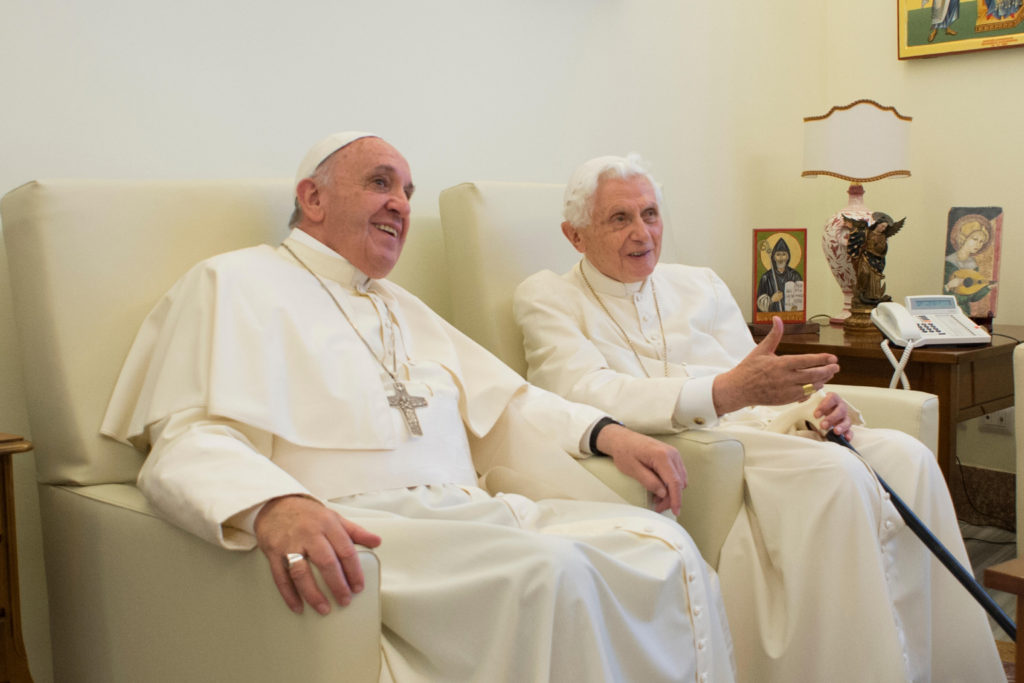
The Catholiy abc Sun.
Bias against Pope Emeritus Benedict XVI
The movie is supposed to show us how two great men of God, of divergent backgrounds and worlds apart, resolved their many conflicts within themselves and with others regarding their faith and ministry and mission in leading the Catholic Church.
Both actors, especially Anthony Hopkins did superb jobs in playing their roles.
The movie tried to show the triumph of the Divine in mysterious ways we can never explain nor understand using men of limitations and weaknesses.
What makes “The Two Popes” so unkind and unchristian is the fact that it is more about Pope Francis as the vida and Pope Emeritus Benedict XVI as contravida. It could have been better if the producers just centered on the present Holy Father as basis of their film and called it “The Pope”. Period.
How can it be a film about faith and religion when the plot itself is unfair and grossly biased against the supposed co-star who is also a Pope?
The movie is also unfair to Pope Francis who would surely never allow himself to be praised and exalted at the expense of the Pope Emeritus or any other person, whether in real life or fiction.
This for me is the most unkindest cut of all in this Netflix movie that fans the many wrong impressions fed on by media against Cardinal Josef Ratzinger since his being the Prefect of Sacred Congregation of Doctrine and Faith during the time of St. John Paul II.
Throughout the film, it is very evident at how the Pope Emeritus is put on the bad light as if he never cared at all about actual situations in the Church and in the world, from the sex scandals to issues on celibacy among other things because he is so absorbed in his intellectual pursuits in the world of books and the academe.
We are of Christ
In 1963, the American film “The Cardinal” was released, earning six Academy Awards and very positive reviews for excellently portraying Catholic religion amid issues of interfaith marriage, sex outside marriage, abortion, racism, and dictatorships set during the Second World War.
It was also inspired by true events based on the life of the late Cardinal Francis Spellman of New York.
Its music theme has become a classic piece too that we have all learned by heart while still in high school seminary.
I can still remember the film that showed in a very positive light the main character with all his flaws and shortcomings as a person, as a priest. No need to put other characters down just to underscore his goodness.
The film had a Vatican liaison officer in the person of the young German priest Fr. Dr. Josef Ratzinger who, after that movie, would be attending Vatican II as a periter or consultant to join the efforts in reforming the Church and make it more responsive to modern time.
Yes, the very same Pope Emeritus Benedict XVI portrayed in the Netflix movie as “ignorant” of the Beatles and of tango and of many other things of the modern world.
Netflix
“The Two Popes” ended positively with the “unlikely friendships” of Pope Benedict and Cardinal Bergoglio but still with its askewed presentation of the two holy men, of the people in Vatican, and of the Church’s members and leaders.
So unlike the classic “The Cardinal”, “The Two Popes” missed the essence of the papacy and of the Church as an institution and a body of believers – that Christianity is not about categories or labels as conservatives, progressives, or liberals: it is about our being of Jesus Christ alone.
It is deceivingly appealing to the senses but nothing really so profound about faith and Jesus Christ and his Church. With hindsight, though, after seeing the movie, the more I have come to love and admire Pope Emeritus Benedict XVI for his love and faith in Jesus and the Church.
And Jesus told his disciples… “Blessed are you when they insult you and persecute you and utter every kind of evil against you falsely because of me” (Mt.5:11).
The Lord Is My Chef Simbang Gabi Recipe, 17 December 2019
Genesis 49:2.8-10 ><)))*> ><)))*> ><)))*> Matthew 1:1-17
Parokya ng Banal na Mag-Anak, Violeta Village, Guiguinto, Bulacan. Photo by Arch. Philip Santiago.
Today we shift our focus in our Advent preparations to the first coming of Jesus Christ when he was born in Bethlehem more than 2000 years ago. Strictly speaking, the Christmas countdown officially starts only today especially with our very long but beautiful gospel from Matthew.
Maybe you are wondering what’s good with our gospel today when it is all about names that mostly sound very funny.
Importance of names: origin and mission
In ancient time, giving name to children was a very serious matter among peoples, especially the Jews.
For them, a name indicates two very important things about a person: one’s origin and mission in life, something parents of today have entirely forgotten, even ignorant because they are more concerned with fad and being unique in naming their children that always end up as a joke as it is always bizarre and weird.
And their poor kid suffers for the rest of his/her life like that man named “Fantastic”. All his life he felt so sad being called Fantastic that he told his wife when he dies, never put his name on his tombstone.
Eventually Mr. Fantastic died and the wife kept her promise not to put his name on his marker. But she felt the need to honor her beloved husband who was so good and honest that in lieu of his name, she asked a tribute written to honor him.
It said, “Here lies a very gentle and loving husband and father who never looked at other women except his wife.”
Every time passersby see and read that tribute, they would always exclaim “Fantastic!”
From Google.
Going back to the importance of giving names….
Corporations are more serious than parents in choosing names and trademarks to their products and services. Every trademark and brand always evokes deeper meanings than just being a product or entity that some of them have entered the vocabulary of many languages like Google, Xerox, and Frigidaire.
And the sad thing about this is how many babies are now being named to follow things and products than the other way around, giving more value to things than human beings!
The book of the genealogy of Jesus Christ, the son of David, the son of Abraham. Abraham became the father of Isaac, Isaac the father of Jacob, Jacob the father of Judah and his brothers.
Matthew 1:1-2
Detail of the ceiling of Parokya ng Banal na Mag-anak after the front or main door: the genealogy of Jesus Christ that starts with Abraham. Great concept by the Parish Priest, Fr. Ed Rodriguez. Photo by Arch. Philip Santiago.
Genealogy of Jesus as direction of Matthew’s Gospel
St. Matthew opens his gospel account with the genealogy of Jesus to settle right at the very start the question about the origin and mission of Jesus Christ.
Here we find the artistry and genius of St. Matthew, some 2000 years ahead of the late Stephen Covey’s third habit of highly effective people: “begin with an end in mind.”
By starting his genealogy with Abraham and David, St. Matthew gives us the whole gospel message in a glance because they are the two key figures in the beginning and realization of God’s promise to send Jesus Christ who would save us all.
Let us just focus on Abraham which means “he who is the father of many.”
It was to him that the story of God’s promise began after the dispersal of mankind following the collapse of the Tower of Babel.
From then on, Abraham points to what is ahead in God’s divine plan, not only for himself but also for the whole mankind for it is through him that blessings come to all. His journey from his birthplace of Ur into Canaan is symbolic of his journey from the present into the future, walking in faith following the Lord’s path and divine plan.
In Abraham we find God starting anew the history of mankind after the Fall that leads up to Jesus Christ who came to lead us all back into the Father.
With Abraham as the main header of Christ’s genealogy, we find not only the beginning but also the end of St. Matthew’s gospel which is the universality of God’s plan of salvation with Jesus telling his disciples to make disciples of all nations (Mt.28:19).
Detail of the ceiling near the sanctuary of Parokya ng Banal na Mag-Anak, the culmination of the genealogy of Jesus. Photo by Arch. Philip Santiago.
Imitating Abraham into our time
Last December 10 was a very important date for me and my parish: it was the ordination date of our first priest.
While waiting for the start of the Mass at the front door (which is actually the back of the Cathedral or any church), I just prayed in silence thinking about my role in the ordination of Fr. RA Valmadrid.
While I marveled at the beautiful renovations of our Cathedral, my sight was slowly moved towards the altar.
It was like an “Abraham experience” in Matthew’s genealogy for me: a wayfarer on a journey into the future, towards God, walking in faith.
In a quick glance, I kind of saw the future glory of every faithful coming to the altar to receive Jesus Christ in the sacraments especially the Holy Eucharist.
I just felt the beauty of entering the Cathedral, or any church which is more than stepping into a building but more of entering God himself, our point of origin and final destination.
Do we realize this tremendous blessing and grace of being baptized, of being a child of God, not only given with a name but most of all, of being counted into the family of God our Father?
In the first reading we have heard Jacob calling his 12 sons. What is so striking here is the blessing Jacob had bestowed upon Judah, instead of Joseph who was the best of all his sons, the holiest and most intelligent.
Like Abraham and Judah, or anyone in the genealogy of Jesus Christ, we can find our own selves too not as the vida or contravida but simply being called to be God’s instrument in fulfilling his plan in sending his Son Jesus Christ.
Truth is, God always comes in the most unexpected situations and peoples most of the time.
In Christ Jesus through our Baptism and faith, we find our genealogy – our origin and mission – as children of God.
If you want to get a feel of this reality, try reading aloud, very slowly, the genealogy of Jesus Christ. At the end, include your self, mention your name, your mother and father. Then close your eyes and let your life flash back in silence.
In the silence of your heart, do you find God coming more to you than you to God?
So amazing, is it not? We are all part of Christ’s genealogy. Let’s bring him forth into the world in our life of faithful witnessing like Abraham. Amen.
Red Wednesday in Memory of Persecuted Christians, 27 November 2019
Revelation 15:1-4 ><)))*> ><)))*> ><)))*> Luke 21:12-19
From Google.
Today, O dear Jesus, we gather as one nation to remember the 300 million Christians worldwide who are persecuted in various forms because of their faith in you: those who were denied of work, housing, liberty, and most especially, life.
We remember and pray for our Christian brothers and sisters who were unjustly tortured and murdered because of carrying a cross and confessing their love for you, Jesus Christ.
Jesus said to the crowd: “You will be hated by all because of my name, but not a hair of your head will be destroyed. By your perseverance you will secure your lives.”
Luke 21:17-19
May those who have suffered and those still suffering be consoled with your love and peace, Lord.
Have mercy on their persecutors, let them realize that religion should bring us together and not apart.
Most especially, Lord Jesus, teach us to remember in carrying and embracing our crosses in the midst of these persecutions. Wash away our sins of indifference. Give us courage to follow promptings of your Holy Spirit in working for genuine peace and justice.
Empty ourselves of hatred and mistrust of one another to always remember we are all brothers and sisters in the Father. Amen.
Red Wednesday poster of Bacolod Diocese last year.
“Praise be to Christ” says the floor of the Church of the Beatitudes, Galilee, Holy Land, 2019.
Our loving Father in heaven:
Thank you very much for the gift of church, especially beautiful and lovely churches where we encounter you in prayers and the sacraments.
How amazing that these churches “breathe” with their walls, “whispering” to you the many praises and thanksgiving of countless people who have encountered you there.
Whenever I come inside a church, I try to feel your presence as well as those other faithful including those who have gone home to you in heaven.
Indeed, we your “chosen people as living stones” are your buildings, your temple and dwelling place.
Whenever we enter a church, we also enter you, our God as you fill us with life like those fruitful trees saw by Ezekiel in the first reading growing on the banks of the river flowing from the temple.
Forgive us when we destroy our bodies and our communities, forgetting that we are your temple.
Forgive us when we refuse to celebrate the Sunday Mass with our fellow believers.
St. John Lateran Basilica, the Cathedral of the Pope as Bishop of Rome, our Mother Church. Photo by Arch. Philip Santiago, 2017.
As we celebrate today the Feast of the Dedication of the Mother of all churches, the Major Basilica of St. John Lateran in Rome, remind us also to take care of our churches, to always maintain their sacredness, do away with all profanities and “shows” so many priests and lay people are now so fond of doing forgetting it is always your house, not ours.
Breathe into us your life-giving Spirit, Lord Jesus, for us to create a space within us and in our churches for you to come and renew us. Amen.
Photo by the author. Baguio City Cathedral, January 2019.
We have reflected last Sunday that prayer is an expression of our faith.
Where there is faith and prayer, there is always love.
And when we have prayer, faith and love, we have a relationship and community of two or three and more persons together as one, rooted in God.
Today we hear another parable by Jesus only St. Luke has, that of the Pharisee and the tax collector to show us another dimension of faith expressed in prayer.
Photo by the author at the Wall of Jerusalem, May 2017.
Like last week, St. Luke tells us anew the Lord’s purpose in narrating this parable:
Jesus addressed this parable to those who were convinced of their own righteousness and despised everyone else.
Luke 18:9
Were you moved or affected in any way upon hearing our parable today?
Did you feel a silent but swift, sharp thud inside your heart while your mind tried to reason out that the parable is not meant for you?
Listen again and pause, let the Lord’s words sink deeper into your heart:
“Two people went to the temple area to pray; one was a Pharisee and the other was a tax collector. The Pharisee took up his position and spoke this prayer to himself, ‘O God, I thank you that I am not like the rest of humanity — greedy, dishonest, adulterous —- or even like this tax collector. I fast twice a week, and I pay tithes on my whole income.’ But the tax collector stood off at a distance and would not even raise his eyes to heaven but beat his breast and prayed, ‘O God, be merciful to me a sinner.’
Luke 18:10-13
If prayer creates a relationship, Jesus is teaching us today the right attitude we must have to keep this communion we have in faith and love. Any relationship is bound to fail, or would not even exist at all despite the formalities of having ties and links like what we see or even have in our various social circles where roles are just acted out.
We call it “plastic” or fake. Untrue!
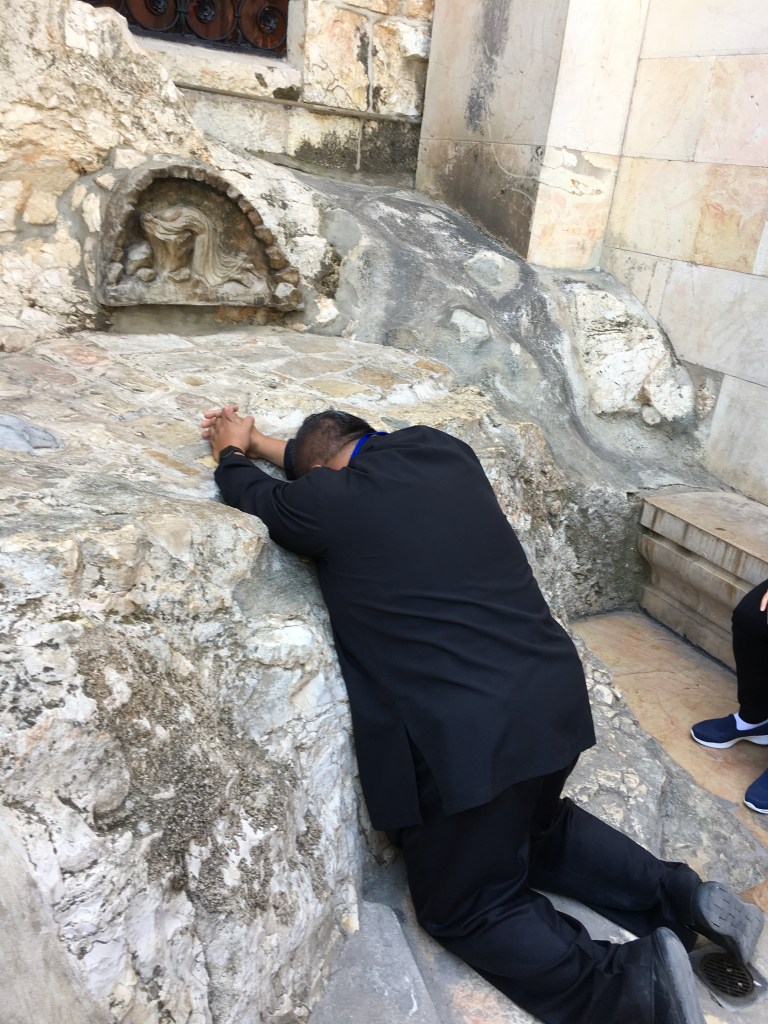
Praying at the Garden of Gethsemane, May 2019.
Prayer to be efficacious like any relationship must always be true.
Here Jesus directs our attention in the “where” when we pray – not just the location or locus of our prayer but our “place” in that relationship first with God who is our very foundation.
When all we see is our self in prayer like in any relationship, there is always a problem. It is clearly a one way street, a monologue.
Worst of all, it is an indication of the absence of God or even others because the pray-er is so preoccupied with his or her very self!
The Pharisee was clearly not in God even if he were in front of the temple. His very self was very far from God and all he had was his bloated ego. He may be a very pious person but not really good at all for he has no space for God and for others. He is a very closed man without any room for others.
The tax collector, on the other hand, may be physically far outside the temple but was the one actually nearest to God with his self-acceptance and ownership of his sinfulness, of his need for God. He was closest to God because he was more open with God and with others by admitting his own sinfulness.
Again we find the key to tis Sunday’s parable towards the end:
(Jesus said) ‘I tell you, the latter (tax collector) went home justified, not the former; for whoever exalts himself will be humbled, and the one who humbles himself will be exalted.'”
Luke 18:14
Photo by Dra. Mai B. Dela Pena, Germany, 2016.
Prayer is more than entering a church or a prayer room, or finding our most suitable spot or space to pray.
Prayer is being one with God, of being suffused in God.
“Where” are we when we pray?
First, we become one with God, one in him in prayer when we first admit our sinfulness, when we confess our sins to him, and own them without any “ifs” and “buts”.
God always comes to those who truly open themselves to him by emptying themselves of their sins and inadequacies.
The tax collector was justified in his prayer more than the Pharisee because in confessing his sins, he admitted his need for God. He knew very well his place, so unlike the Pharisee who felt God owes him so much!
When Pope Francis granted his first media interview (to their Jesuit Magazine!), the first question asked of him was, “who is Jose Mario Bergoglio?”
The Holy Father quickly answered, “I am a sinner.”
No wonder when he was elected Pope on March 13, 2013 at the Vatican, he first asked for prayers from the huge crowd gathered before he bestowed his apostolic blessing to them. It clearly showed that despite his holding the highest post in the Church, he considers himself a sinner, so weak needing prayers from the people.
I always tell couples during weddings that when they have a quarrel, the first one to speak and make the move for reconciliation is the one with most love, the one who is most willing to bow to start anew.
Most often in life, friendships and relationships are kept when we are willing to take the lower stance, not necessarily admitting fault or guilt in any misunderstanding because being lowly indicates the person’s need for the other person and of one’s love to work on that relationship despite its fragility.
Ordination of deacons, Malolos Cathedral, 12 June 2019.
Second, we are in God and with God in prayer when we have that attitude and inner disposition of being poor and lowly. Being lowly or poor means having the conviction to leave everything behind and go down with God into the lowest point because one is so confident of the efficacy of prayer like what Ben Sirach tells us in the first reading.
Most of all, like Mary the Mother of Jesus during the Annunciation of the Christ’s birth.
The one who serves God willingly is heard; his petition reaches the heaven. The prayer of the lowly pierces the clouds; it does not rest till it reaches its goal.
And thirdly, we are in God in prayer when there is an offering daily of one’s self to God.
It is not enough to be lowly and sorry for our sins in prayer. It has to be sustained because prayer is also a discipline like any sport. In the second reading, St. Paul calls us to persevere and endure until the end for Jesus Christ.
We need to be passionate with our prayer life, willing to go to all extent to offer everything for the Lord, to fulfill his will “who shall award us with the crown of righteousness in heaven.”
We are all sinners forgiven and beloved by God.
May we find ourselves in God and with God always both in our sinfulness and lowliness. Amen.