The Lord Is My Chef Breakfast Recipe for the Soul by Fr. Nicanor F. Lalog II
Wednesday, Dedication of the Basilicas of Sts. Peter and Paul, 18 November 2020
Acts of the Apostles 28:11-16, 30-31     >><)))*>  +  <*(((><<     Matthew 14:22-33
Photo from wp-media.patheos.com
Today, O Lord, we celebrate anew the Dedication of your two other Major Basilicas in Rome, St. Peter’s and St. Paul’s. Last week, we celebrated the dedication of the Cathedral of Rome, the St. John Lateran and in August, the St. Mary Major.
All these major basilicas remind us of the spiritual nature of the Church signified by these beautiful buildings of stones as community of believers following you, dear Jesus.
Since the beginning, we have always been sailing in rough, stormy seas as you have seen your apostles that night in their boat “being tossed about by the waves, for the wind was against it” (Mt. 14:24).
As I prayed today on that scene with the recent fierce winds of typhoon Ulysses still so vivid to me, I felt like Peter – so fearful with winds like in the gospel today when you bid him come to you by walking on water too. “But when he saw how strong the wind was he became frightened” and began to sink in water, crying out to you, “Lord, save me!”(Mt. 14:30).
When the strong winds and heavy rains by typhoonUlysses ravaged our region last week, it was also nighttime, so dark, so cold, and we felt so fearful like Peter. Some people took shelter in our church and hopefully have given them some sense of security in you, Lord.
As I reflected on the many things that have frightened me from the winds, I have realized some beautiful things too about you that reassure me of your perfect love that casts out all fears.
Photo by author, Sea of Galilee, May 2019.
Two things I have found so fearful with the winds, Lord.
First was the howling sound of the winds.
It was scary especially when you are very silent, Lord, because I felt so alone.
No wonder the Apostles thought you were a ghost when they saw you walking on water!
Inside and outside the Church today are so many voices like harsh winds that add to our many confusions that isolate us from you and from one another, making us so afraid that sometimes lead us to doubt your presence and love.
Please give us the courage to grow deeper in your silence, befriending it more when you are most silent so we may heighten our sensitivity of your presence and overcome our fears.
Second thing so frightening with the winds, O Lord, is its relentless force that refuses to stop that it seems to pummel everything on its path.
Sometimes in life, forces around us can be felt so strongly that frighten us but without really hitting us at all!
Yes, it is so scary but unfounded! Sometimes, it is more in our minds than in the winds actually because we are afraid of being bruised and hurt, of being knocked down especially when we do not know where the blows are coming from.
Remind us, Lord, how often our fears are imaginary.
Teach us not to resist the strong winds, to be calm, to hold on, and if ever we are swept away, to await you for you are definitely coming even if you have to walk on water to save us! Amen.
The Lord Is My Chef Breakfast Recipe for the Soul by Fr. Nicanor F. Lalog II
Wednesday, Memorial of St. Jerome, Priest/Doctor of the Church, 30 September 2020
Job 9:1-12, 14-16  >><)))*>  +  >><)))*>  +  >><)))*>   Luke 9:57-62
Photo by author, city of Jerusalem from Dominus Flevit Chapel, May 2017.
God our Father, sometimes I feel our situation today is very much like during the time of Job when sickness and destruction are all around us with the threats of death no longer lurking out in the dark but most present and getting nearer to us even at daylight.
And that is why lately, I have felt very much like Job too that I want to engage you in a conversation to ask you why all these things happening to me and those special to me. I am so afraid, God, of getting sick that I chill inside when I hear those dear to me going through surgery, chemotherapy, and dialysis.
I feel like asking you why these things going on, why them getting sick instead of just praying for them but, every time these things cross my mind, I just feel like Job:
Job answered his friends and said: I know well that it is so; but how can a man be justified before God? He does great things past finding out, marvelous things beyond reckoning. Should he come near me, I see him not; should he pass by, I am not aware of him; should he seize me forcibly, who can say him nay? Who can say to him “What are you doing?” How much less shall I give him any answer, or choose out arguments against him! Even though I were right, I could not answer him, but should rather beg for what was due me. If I appealed to him and he answered my call, I could not believe that he would hearken to my words.
Job 9:1, 10-12, 14-16
I wonder, Lord, if my faith and trust in you have deepened during this pandemic or, have I just become passive with how things are going on, getting used to the new situations, blankly hoping things will soon get better.
Have I really learned to trust you more than ever, surrendering everything into your hands like Job as I have realized too your immeasurable greatness, your being God beyond my limited knowledge and understanding that you make me wonder and be awed with your transcendence?
Yes, Lord, deep inside me amid all these fears and questions is the conviction you can never be doubted, that all I need is to completely trust you and strive to be good. Thank you for that grace as I continue to pray for healing of those dearest to me.
Let me grow closer to you as your disciple, forgetting everything about myself, surrendering myself to you in complete trust unlike those called by Jesus to follow him in the gospel today filled with many alibis and excuses.
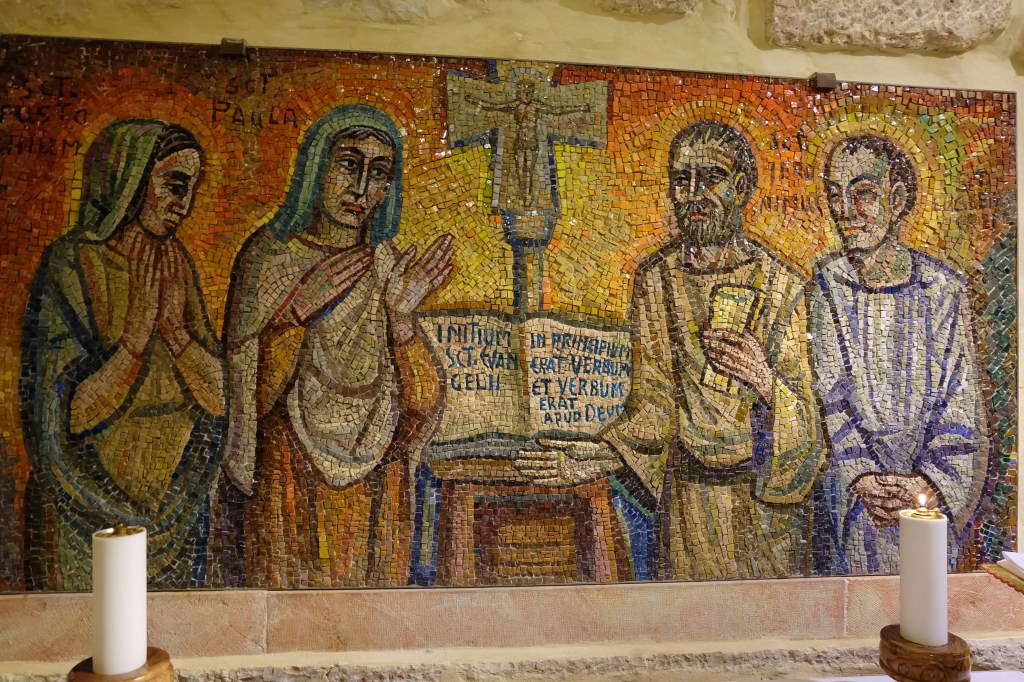
May I have the devotion and discipline of St. Jerome whose memorial we celebrate today in finding you, loving you, and following you in the Sacred Scriptures as well as in the people we serve.
Like St. Jerome, may I have the courage to contemplate like Job on things beyond this world and life like death and eternity without bargaining or haggling with you except to trust in you completely. Amen.
Photo by author, mosaic on the wall of the Chapel of St. Jerome in a cave underneath the Church of the Nativity in Bethlehem where he had lived for 34 years until his death in 420 devoting himself in prayers and studies of the Sacred Scriptures while directing some women like “Paula” towards holiness (May 2017).
Photo by author, CICM Retreat House, Taytay, Rizal, 2007.
Praise and glory to you, O God our loving Father! Please, keep us open to your coming in Jesus Christ. Surprise us always with your simplicity, silence, and hiddenness.
You know how we are always attracted with people’s credentials and titles, outward appearances, and great talents in speaking and explaining things that we get carried away, leaving you behind.
I came to you in weakness and fear and much trembling, and my message and my proclamation were not with persuasive words of wisdom, but with a demonstration of spirit and power, so that your faith might rest not on human wisdom but on the power of God.
1 Corinthians 2:3-5
Let us come to you and meet you in Jesus by forgetting our self, taking our cross and following him in his passion and death.
Sometimes we forget your simple invitation to come to you with our sinful selves minus our pretensions and masks because all you want is our total selves. You do not ask for our perfections but imperfections, nor for our virtues and talents but for our lacking and sins.
And through this all, Lord, you give us life and freedom, fulfillment in you in our hearing:
Photo by Fr. Gerry Pascual at Yvoire, France, 2018
Jesus unrolled the scroll and found the passage where it was written: The spirit of the Lord is upon me, because he has anointed me to bring glad tidings to the poor. He has sent me to proclaim liberty to captives and recovery of sight to the blind, to let the oppressed go free, and to proclaim a year acceptable to the Lord. Rolling up the scroll, he handed it back to the attendant and sat down, and the eyes of all in the synagogue looked intently at him. He said to them, “Today this Scripture passage is fulfilled in your hearing.”
Luke 4:17-21
Come, Lord Jesus, you are most welcomed in me. Amen.
Lawiswis ng Salita ni P. Nicanor F. Lalog II, Ika-16 ng Hunyo 2020
Larawan kuha ng may-akda sa Pulilan, Bulacan, Enero 2020.
Minsan aking napanaginipan
matalik kong kaibigan
aming binalikan
mga bukid aming nilakaran
noong aming kabataan;
nagtungo rin kami sa simbahan
doon sa kabayanan
at umistambay pagkaraan
para magkuwentuhan sa Krus na Daan.
Hiniling ko sa kanya
ako'y isama sa kanyang bahay-pahingahan
doon sa bukid ngunit tinanggihan
pinauwi at binilinan tulungan
maraming nangangailangan
lalo na aming mga kaibigan.
Sa aking pagtayo at paghayo
siyang gising ko naman
at natanto
matagal nang yumao
kaibigan ko.
Larawan kuha ng may-akda sa Assumption Sabbath, Baguio City, Enero 2018.
Maliwanag sa akin
kahulugan ng napanaginipan
dahil kung minsan
ako ay nahihirapan at nabibigatan
sa mga pasan-pasan
at tila naman walang ibang maasahan
bukod sa wala ring pakialam
kaya di maiwasan mag-asam
na mawala na lamang
at sumakabilang buhay.
Ngunit hindi iyon ang solusyon
hindi rin kalooban ng Panginoon
na mayroong nilalayon
dapat nating bigyan ng tuon;
mga hirap at pagod
konsumisyon at ilusyon
bahagi ng ating misyon
bigay at dinadalisay ng Panginoon
kaya't magtiyaga, Siya ay ating abangan
at tiyak matatagpuan, Kanyang tutulungan.
“Screenshot” ng palad ng isang mag-aaral sa Dr. Yanga’s Colleges Inc. na nagsulat ng mga aral napakinggan niya kay G. Michael Yanga, Pangulo ng naturang paaralan, 2019.
Madalas tayo ang nagtatanong
sa Panginoon ng direksiyon
ngunit paano kung Siya mismo
sa atin naman ang magtanong
sa kalagitnaan ng ating misyon
"Bakit ka narito?" gaya noong
paghintayin Niya si Elias sa yungib ng Horeb
matapos Siyang mangusap
sa banayad na tinig ng hangin;
kay sarap namnamin at damhin
dahil tuwing tayo tatanungin
nitong Panginoon natin,
ibig sabihin Siya ay ating kapiling!
Ano man iyong gampanin
ngayong quarantine ay pagyamanin
palaging unahin na ang Diyos ay hintayin
dahil tiyak na Siya ay darating
hanggang matapos itong COVID-19
pangako Niyang kaligtasan at kaganapan
Kanyang tutuparin!
The Lord Is My Chef Sunday Recipe for the Soul, Feast of the Presentation of the Lord, 02 February 2020
Malachi 3:1-4 ><)))*> Hebrews 2:14-18 ><)))*> Luke 2:22-40
Photo by author of Baby Jesus at the Bishop’s Chapel, Malolos Cathedral, 07 January 2020.
We take a break from our Ordinary Sunday to celebrate today the Feast of the Presentation of the Lord at the temple, 40 days after Christmas. It is a prolongation of the celebration of the Lord’s Nativity with a paschal undertone recognizing Christ as Light who had come to us to lead us back to the Father through his Passion, Death, and Resurrection.
This feast used to be known in the East as the Ypapante or the Encounter of Jesus by the two elderly people at the temple, Simeon and Anna. When it reached Europe, it came to be known as the “Purification of the Blessed Virgin Mary” based on St. Luke’s description, evolving into Candlemass or Candelaria when Pope Sergius I in Rome adopted in the eighth century the French tradition of procession of lighted candles at dawn before the Mass to signify Jesus as the light of the world who had come to bring us back to the Father expressed by Simeon in his canticle.
“Now, Master, you may let your servant go in peace, according to your word, for my eyes have seen your salvation, which you prepared in sight of all the peoples, a light for revelation to the Gentiles, and glory for your people Israel.”
Luke 2:29-32
Despite its evolution through the ages with its many names and practices, the Feast of the Presentation of the Lord is a good reminder to us in recognizing, meeting, and sharing Jesus Christ to everyone as the light of the world.
Photo by author of a view from the Temple of Jerusalem, May 2017.
Being devout leads us to recognize and meet Jesus
Only St. Luke reports the story of the Presentation of Jesus at the temple because he wanted to show his audience who were Gentiles or pagan converts that Jesus came not only for the Jews but for everyone.
This remains true to us especially in these modern times when people live in artificial lights and “Klieg lights” that put us on the centerstage only to leave us later groping in the dark, even blinded to false hopes of virtual realities.
St. Luke invites us today to emulate both Simeon and Anna in recognizing and meeting Jesus, the only Light of the world who dispels darkness within and around us.
Now there was a man in Jerusalem whose name was Simeon. This man was righteous and devout, awaiting the consolation of Israel, and the Holy Spirit was upon him. It had been revealed to him by the Holy Spirit that he should not see death before he head seen the Christ of the Lord. He came in the Spirit into the temple; and when the parents brought in the cild Jesus to perform the custom of the law in regard to him, he took him into his arms and blessed God.
Recall how during our Simbang Gabi that for the Jews, a “righteous” person is someone who is holy because he faithfully keeps the Laws of God like St. Joseph, the husband of Mary.
But more than being holy and just, St. Luke also described to us Simeon – as well as Anna implicitly – as “devout” Jews. It is a word rarely used in the Bible. In fact, St. Luke used it only four times: once here in this scene and thrice in the Acts of the Apostles.
In Acts 2:5, St. Luke called the Jews who came to Jerusalem for Pentecost as “devout” ones; then in 8:2, he said “devout men buried” the first martyr of the Church, St. Stephen; and finally in 22:12, he gave the distinction to Ananias as “a devout observer of the law” who came upon instructions from God to pray over and heal Saul who was blinded by Christ’s light on the way to Damascus.
In all four instances, St. Luke described people as “devout” including Simeon and Anna as those of “good heart, ready to believe, and then to act openly and with courage” (Timothy Clayton, Exploring Advent with Luke; page 125). Devout people or devoted persons are a notch higher than just being faithful because they do not merely wait but look forward to the fulfillment of what they believe.
Devoted people make things happen; they do not wait for things to unfold. And that is why they are always at the right place in the right time. Like Simeon and Anna, they give themselves to God wholly to stay attuned with the Holy Spirit and be ready to follow its promptings and leads.
Anna meeting Jesus from catholicfunfacts.com.
See the common trait of both Simeon and Anna as devout people — the presence of the Holy Spirit in them that amid the crowd in the temple on that day, they were able to spot the Child and Savior Jesus Christ being presented by his parents Mary and Joseph!
There was also a prophetess, Anna, the daughter of Phanuel, of the tribe of Asher. She was advanced in years, having lived seven years with her husband after her marriage, and then as a widow until she was eighty-four. She never left the temple, but worshipped night and day with fasting and prayer. And coming forward at that very time, she gave thanks to God and spoke about the child to all who were awaiting the redemption of Jerusalem.
Luke 2:36-38
Jesus comes to us everyday in various ways, in many occasions. He is always passing by, calling us. We have to be on guard in these moments so that we do not miss him. Like reporters following the news, we have to be focused or “tutok” and immersed or “babad” so that nothing or no one escapes us.
Three ways of being devout like Simeon and Anna
It is imperative that we have to be devout first with God so that we recognize and meet his Son Jesus Christ coming to us so we may eventually share him to enlighten everyone. Simeon and Anna show us three important things to keep for us to be devoted to God to encounter Jesus Christ.
First, we have to be faithful in our prayer life. There is no other way in meeting Christ except in having a life of prayer which is a discipline. It is something we do as a habit, every day, every night. Not just once a year like those going to Quiapo every January 9 or completing any novena and then the whole year does nothing.
Devotion is more than collecting images of Jesus, the Virgin Mary, and the saints, joining processions during fiesta or Holy Week, then nothing. Devotion is life, not a show.
Like Simeon and Anna, we have to grow intimately with the Lord by cultivating personal prayers and joining communal activities like the Sunday Mass so that we may know personally and vibrantly God who always leads us to various directions and mission. God is never static but dynamic, unlike us people who keep on insisting on some of our traditions and ways no longer applicable.
Notice how in the first reading the Prophet Malachi said the Lord will suddenly come in the temple, calling on people to always await him (Mal.3:1).
The Old Jerusalem from the inside of the Church of Dominus Flevit (The Lord Cried) at the Mount of Olives, Jerusalem. Photo by author, May 2017.
Second, we can only recognize, meet and share Jesus Christ as Light when we care, love, and respect others. See how Simeon spoke to Mary about his coming mission and its harsh realities. He recognized not only Jesus but also Mary and Joseph. Simeon’s speaking to Mary and Joseph means he recognized the important roles of the parents in being instrumental that he met the Lord.
Any devotion to God and his saints and the blessed Mother Mary without any concern for the people especially the poor and the needy is merely a show and a pageantry of clerical and liturgical excesses. It is triumphalism in its purest sense and hypocrisy at its worst.
We meet Jesus among other people not only within us. This is the gist of the author of the Letter to the Hebrews today when he claimed how Jesus suffered and endured sufferings and death to help those facing trials and tests in life.
Third, we can only recognize, meet, and share Jesus Christ as Light when there is joy in our hearts. And not just being joyful but overflowing with joy like Simeon and Anna that upon encountering the Child Jesus, the more they felt eager to share the good news with others. In fact, they were overjoyed that they even felt so ready to die.
Our parish church on a Sunday afternoon. Photo by Angelo Nicolas Carpio, 12 January 2020.
Fruit of devotion is finally embracing Jesus Christ
Every night before we priests and religious pray Simeon’s Canticle in our Compline (Night prayer), we recite a responsory that says, “Into your hands, Lord, I commend my spirit”. And after that, the antiphon: “Protect us, Lord, as we stay awake; watch over us as we sleep, that awake, we may keep watch with Christ, and asleep, rest in his peace.”
It is only then that we recite or chant Simeon’s Canticle or Nunc Dimittis. It is then followed by the final prayer closed with a blessing that says, “May the all-powerful Lord grant us a restful night and peaceful death. Amen.”
Without sounding morbid or anything, it is my most favorite prayer of all our prayers because it is filled with joy, filled with Jesus, filled with Light. At the end of the day, what a consolation to be filled with joy of Christ that you have had a glimpse of him that you rest in peace hoping to meet him again as well as share him with others too.
I think it is only when we are overflowing with joy that we realize its fullness is found only in Christ, whether in this life or in eternal life. Amen.
The Lord Is My Chef Simbang Gabi Recipe, 24 December 2019
2 Samuel 7:1-5, 8-12, 14, 16 ><)))*> <*(((>< Luke 1:67-79
Marker on the Church where St. John the Baptist is believed to have been born in Ein Karem, Jerusalem. Photo by author, May 2019.
At last!
These are most likely the two words we must be saying today on this ninth day of our Simbang Gabi.
Finally, we have completed the nine day novena to the birth of our Savior Jesus Christ for tonight will be Christmas.
But, more than being the last day of our novena, today is also the beginning of better days ahead for us all starting with Christmas!
From this day on, let us imitate Zechariah in his new found faith, hope and love in God expressed in his song of praise and thanksgiving after recovering his sense of hearing and speaking after nine months of forced silence.
“Blessed be the Lord, the God of Israel, for he has come to his people and set them free. He has raised up for us a mighty Savior, born of the house of his servant David.”
Luke 1:68-69
Sunrise at the Lake of Galilee, the Holy Land. Photo by author, May 2019.
Three canticles of praise, three prayers of faith
Popularly known as the Benedictus from its Latin opening verse “Blessed be God”, this is the second of the three canticles St. Luke tells us Zechariah had sang after naming his son “John”.
The other two songs are the Magnificat by Mary during her Visitation of Elizabeth and the third is the Nunc Dimittis by Simeon upon seeing the child Jesus during his presentation at the Temple of Jerusalem.
These canticles or songs make up the beautiful Christmas story by St. Luke who put them onto the mouths of Mary, Zechariah, and Simeon to signify their being filled with the Holy Spirit in experiencing the coming of Jesus Christ: Mary sang “my soul proclaims the greatness of the Lord” during the Visitation in response to the praises by Elizabeth (Lk.1:46-55) while Simeon the prophet prayed to God to “let him go in peace” – to die – after seeing the coming of the Savior (Lk.2:29-32).
These eventually became part of the prayers of the Church (Liturgy of the Hours) we priests and religious are obliged to pray day in, day out:
Benedictus in the morning to show how willing are we to face the new day by making our Savior Jesus Christ present in our lives like St. John the Baptizer, his precursor;
Magnificat in the evening to praise and thank God in working his salvation in us through Jesus Christ;
Nunc Dimittis at night before bedtime to signify our readiness to die and finally be one with God in Jesus Christ.
They are our “spiritual vitamins” that fill us with the Holy Spirit to strengthen and deepen our relationship with the Father in Jesus Christ which every Christian may pray too to experience and be one with God daily.
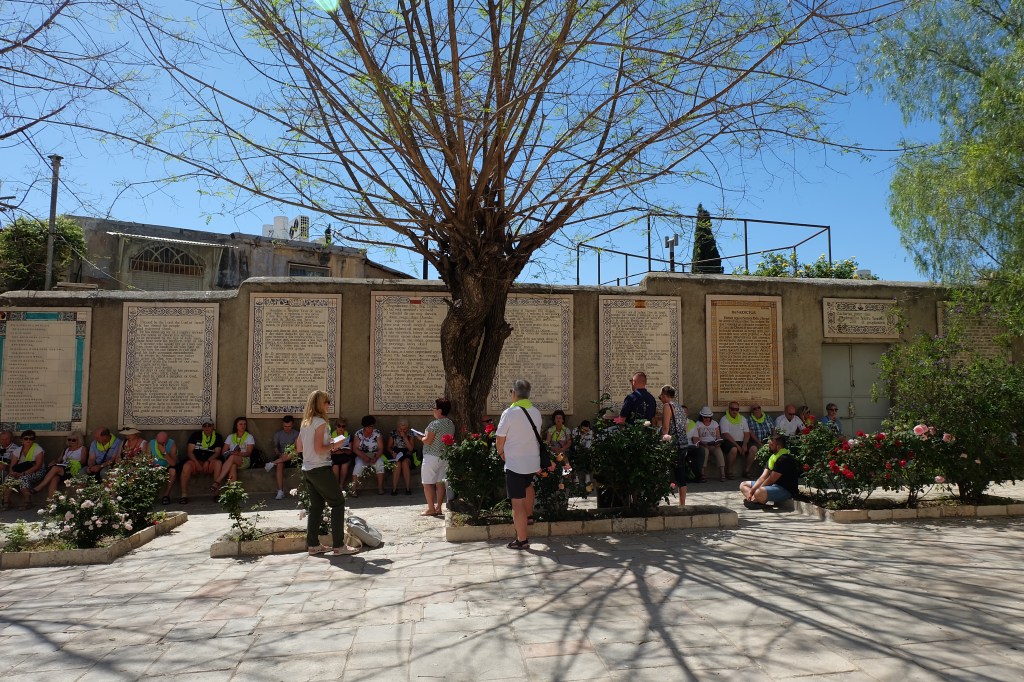
Pilgrims waiting outside the Church of St. John the Baptist in Ein Karem, Jerusalem. On the walls are the translation into different languages of the world, including Filipino, of Zechariah’s Benedictus. Photo by author, May 2019.
Why God is blessed according to Zechariah
The Benedictus signifies Zechariah’s coming to full circle after nine months of forced silence after doubting the angel’s message that he and Elizabeth would finally have a son.
Our sacristy, Advent 2019.
In singing the Benedictus, Zechariah did not only recover his power of speech but most of all showed the fruits of his nine months of silence and prayer preparing for the birth of his son John as well as, ultimately, for Christ’s coming (his song indicates it).
Finally, Zechariah has been healed of his pains and hurts that prevented him in experiencing God, in believing in his powers again, giving him more reasons to hope and be joyful.
This is the reason we also have the Advent Season when we try to dispose ourselves more to Christ’s coming to us not only at Christmas but everyday in our lives.
Zechariah mentions three powerful verbs why he praised God: for he has come to his people, set them free, and has raised up a mighty Savior.
God has come to us
Zechariah first experienced God coming to him when the angel announced to him John’s birth while incensing at the temple during the Day of Atonement. Unfortunately, he was “absent” at God’s “presence” that he questioned how Elizabeth would bear a child.
Everything now changes not only because he had seen his own son but he himself experienced God’s coming in his life.
Sometimes, our pains and hurts, frustrations and disappointments, defeats and failures blind us, numb us that we cannot see, we cannot experience God coming to us in every brand new day he gives us, through the people we meet with their smiles and greetings, with our family and friends who have have stayed with us in good times and bad.
Every morning we wake up to reminds us God has come to us. Rise and meet him in joy, entrust the new day to him, and ask for the grace to remain in him!
God has set us free
Every time God comes, there is always freedom – freedom from evil and sin, freedom from the past and all its pains and hurts, freedom from guilt feelings, freedom everything that prevents us from being truly free to be our own, good sel, to be free and faithful to love and forgive others too.
Carmelite Monastery, Guiguinto, Bulacan. Photo by author, November 2019.
Literally speaking, Zechariah felt free again to speak and express himself fully. But more than that is the experience to go and live fully in God.
We can never experience Christmas if we cannot assert this freedom Christ had won for us when he died on the Cross. Forget all those “hugot” lines and move forward with life.
The name of God is “I AM” because he is always in the PRESENT, never in the past nor in the future.
That is why each new day is a gift, a present from God who as set us free from yesterday’s mistakes and failures and sins.
Go and be free for God!
God has raised up for us a mighty Savior
Christmas is not a date but an event, a person we experience in Jesus Christ who is a dialogue himself according to Pope Emeritus Benedict XVI. Jesus is always communing with us, inviting us to be one in him in his love.
In his Benedictus, Zechariah is also professing the saving work of God in Jesus Christ who became human like us in everything except sin. God is so blessed because of his great love for us, he chose to enter, or intervene into human history to bring us into eternal life by faith in Christ Jesus.
To raise up is a strong term also indicating the Paschal mystery Christ will go through, the ultimate communion of God into our own lowliness of suffering and death to bring us into the glorious victory of his resurrection.
Every morning, every day we are reminded by Zechariah of the words of the angel Gabriel to Mary regarding the birth of John: nothing is impossible with God.
And Zechariah had experienced this first hand when his barren and old wife Elizabeth conceived their child John.
May we have a renewed faith, hope and love in God at the closing of our Simbang Gabi this year. Like David in the first reading, rest be assured of God’s plan for each of us. Let us be patient to wait and prepare always for his coming like Zechariah even in his old age. Amen.
Birthplace of St. John the Baptist at Ein Karen, Jerusalem. Photo by author, May 2019.
Third Sunday of Advent or Gaudete Sunday, 15 December 2019
Isaiah 35:1-6, 10 ><}}}*> James 5:7-10 ><}}}*> Matthew 11:2-11
Malolos Cathedral, 10 December 2019. Photo by author.
For most people, our title is something odd and weird, perhaps even an oxymoron, for how can waiting be joyful and patient?
Many people hate to wait. Waiting for them is a waste of time because they believe it is an activity that is empty, full of risks of leading to nothing and disappointments. That is why they make all kinds of excuses in having all the devices and gadgets they need to busy themselves with while they are – after all – still “waiting”!
This Season of Advent is the most opportune time to rediscover the beauty and joy of patient waiting, especially this Third Sunday known as “Gaudete Sunday” from the Latin gaudere, to rejoice.
Advent teaches us that waiting is both joyful and patient; that it is more than an activity but a being that is always indicative of having something leading to fullness!
Our Parish altar, Gaudete 2019.
Patience is waiting that leads to fulfillment.
Pink is our motif this Third Sunday of Advent to signify joy in waiting for the Lord’s Second Coming. Waiting is an experience in itself filled with joy – if we really know how to wait patiently.
Patience is from the Latin word patior, to suffer. Its Greek origin is hupomone that suggests continuance and submission that literally means “submissive waiting”.
Both in its Latin and Greek origins, patience is a condition or a being of willing to wait because it knows there is something coming. It is never empty: you patiently wait because you already have something, you are holding onto something already. We wait in line whether in the grocery or at the doctor’s clinic because we know we would be attended to later. We wait precisely because we have something – almost – but not yet.
In this sense, patient waiting is more than an activity but more of a being and a condition that leads us to trust and faith, then into hope, and eventually into fullness.
Impatient people cannot wait because they do not see beyond the present condition. Their perceptions are very limited that they have to satisfy their wants immediately, just like our culture of instants these days or the so-called IGG for “Instant Gratification Generation”.
The desert and the parched land will exult; the steppe will rejoice and bloom. They will bloom with abundant flowers, and rejoice with joyful song. Strengthen the hands that are feeble, make firm the knees that are weak, say to those whose hearts are frightened: Be strong, fear not! Here is your God, he comes with vindication; with divine recompense he comes to save you. Then will the eyes of the blind will be opened, the ears of the deaf be cleared; then will the lame leap like a stag, then the tongue of the dumb will sing
Isaiah 35:1-2, 3-6
An oasis in the Dead Sea desert, May 2017. Photo by author.
Intimacy: the joy of patient waiting
There are three key personalities in Advent: Isaiah, John the Baptist, and the Blessed Virgin Mary. Isaiah saw the coming of the Christ from a very distant past while John pointed everyone that the awaited one has already come. Mary, on the other hand, celebrated Advent because she brought forth Jesus in her womb.
Today we are joined by Isaiah and John the Baptist to complete our joy of patient waiting that Christ in fact is already with us though not yet…
In our first reading we have seen the imagery of the desert like last Sunday in John’s preaching. The desert evokes the feeling of nothingness and emptiness like waiting itself as most people think.
But, in the bible since the time of Abraham, the desert is the favorite place where God would always meet with people. It was always in the desert where the prophets and the people waited and experienced God.
Wild flowers in the desert of Jordan, May 2019.
So you see, my dear reader and follower, the desert is more than a place but also the intimacy of God with his people and later with his Son Jesus Christ who would always go to the desert or deserted place to pray like in the Transfiguration, or when he prayed and fasted for 40 days and nights before being tempted by the devil after his baptism by John at Jordan. It was also in the desert where Jesus did many of his memorable conversations that led to conversions like at Jacob’s well where he met a Samaritan woman one hot afternoon.
Examine your lives, dear reader and follower: it is always in the desert of our lives, in its bareness and desolation, when we are empty and thirsty when we truly experienced God closest.
Isaiah spoke of this prophecy when the Israelites were at their lowest point of misery and defeat as exiles in a pagan country with no freedom, no temple, even no God.
When we are full of material things, full of ourselves, when everything is going so perfectly well in life, that is when we are ironically shallow and superficial. What really deepened us in life are those desert moments of tribulations and trials because that is when we have found and rediscovered true intimacy – with God and with our loved ones!
Patient waiting is a desert full of joy because that is where we experience intimacy and fullness, the tension of the already here but not yet, not only with God but also with one another.
Here we find St. James imagery of the farmer as finest example of patient waiting, of trusting in God that what we have sown would grow and be fruitful. Despite our culture of instants, there are so many things that cannot be rushed, when we have to patiently wait in time like intimacy.
How do we recognize our true friends? They are the ones who always stand by our side especially when we our down and out, the ones who accompany us in our patient waiting when we are in the middle of a storm, or in the desert, desolate.
Malolos Cathedral Dome, December 2019. Photo by author.
Proceeding in joy in the presence of the Lord
One problem with waiting is when we are superseded by our so many expectations that may also be unrealistic. We hate waiting, we stop hoping because we feel disappointed and frustrated because we do not get what we really expect from our waiting.
The problem is with us, not with waiting itself. So often we await things instead of persons. To wait in joy with patience demands openness for the one who is coming not on what is coming.
True waiting is always about persons, not things. Waiting is beautiful and joyful because you are not alone in waiting, there is always another person waiting for you, waiting with you. And when we finally meet with the one we are waiting, then we have presence!
This is why the synonym for gift is also present, from presence.
Every waiting is directed to another person who also awaits the other person. When we focus our waiting on things than persons, then we miss everything in our waiting which is the presence of the other person.
This is the meaning of the response of Jesus to the emissaries of John.
Camp John Hay “Belen”, December 2017.
When John the Baptist heard in prison of the works of the Christ, he sent his disciples to Jesus with this question, “Are you the one who is to come, or should we look for another?” Jesus said to them in reply, “Go and tell John what you hear and see: the blind regain their sight, the lame walk, lepers are cleansed, the deaf hear, the dead are raised, and the poor have good news proclaimed to them.”
Matthew 11:2-5
Jesus was telling the emissaries of John that the one they have been waiting had come, already present among the people especially the sick and the poor. God had come in the midst of his people, healing them, consoling them, uplifting them.
This Third Sunday of Advent, Jesus is asking us like the crowds: what are we looking for, what are we waiting for? Set aside or totally forget all your expectations, open yourself, open your heart, open your eyes to see and experience the presence of the Christ who had come, who will come again, and always comes among us.
Indeed, we are so blessed because despite our being sinful, of being the least in the kingdom of heaven, we have Jesus coming to us day in, day out. Share his coming, share his healing, share his joy! Amen.
Isaiah 25:6-10 ><)))*> ><)))*> ><)))*> Matthew 15:29-37
The Manor House, Camp John Hay, Baguio City, 2017.
Praise and glory to you, O Lord Jesus Christ for coming to us, in fulfilling our lives, in making our joy complete. Unfortunately, no one seem to be waiting for you or worst, we live as if you have not come at all.
How sad, O Lord, that often even if we are so excited with Christmas, it does not necessarily mean we are excited of you as a person coming to us. Even if we love to sing and hear that carol “Joy to the World”, we are not really joyful because our hearts are far from you.
Forgive us, Jesus, in being focused with time and dates, than with your person and with your coming.
The more we get focused with dates and gifts and carols and other trimmings of Christmas, the less we think of you and of others too.
Open our hearts to receive you in us.
On that day it will be said: “Behold our God, to whom we looked to save us! This is the Lord for whom we looked; let us rejoice and be glad that he has saved us!” For the hand of the Lord will rest on this mountain.
Isaiah 25:9-10
Open our hearts to you, Jesus, that you are more than enough than anything we could wish for.
Make us desire more of you than of things so we may always have an abundance of you as our “bread” or everything in this life. Amen.
Isaiah 4:2-6 ><)))*> ><)))*> ><)))*> Matthew 8:5-11
Sunrise at the Lake of Galilee, the Holy Land, 2017.
O God our loving Father, who among is truly worthy to receive you under our roofs?
Who among us is truly worthy of receiving you in our sinful selves?
No one, O dear God!
Yet, you still sent us your only Son Jesus Christ to live among us, to dwell among us sinners so that unworthy as we are, we may be worthy to receive him.
Just say the word, Lord, like with the centurion’s request to you in today’s gospel.
Cleanse us, our minds, our lips, and our hearts so that we may be worthy to receive you into our lives in your daily coming. Most especially in your Second Coming, Lord Jesus.
Unworthy as we are, let us come to you with clean hearts and receive you Jesus in your sacred banquet of the Holy Eucharist, the foretaste of that banquet in the Kingdom of heaven.
For over all, the Lord’s glory will be shelter and protection; shade from the parching heat of day, refuge and cover from storm and rain.
Isaiah 4:6
Come, Lord Jesus! Amen.
Trees at the Sacred Heart Novitiate in Novaliches, Quezon City, 2017.
The Lord Is My Chef Sunday Music, 01 December 2019
Photo by Mr. Jim Marpa, 2018.
A blessed Sunday to you my dear follower and reader!
It’s the first day of December, the final month of the year but at the same time the start of a new year in our Church calendar with the Season of Advent, the four Sundays before Christmas.
From the Latin adventus that means coming, Advent has a two-fold character on the two comings of Jesus Christ: beginning today until December 16, all readings and prayers are focused on his Second Coming; from December 17 to the 24th, we shift our sights to the first Christmas when Christ was born in Bethlehem 2000 years ago.
Jesus said to his disciples: “As it was in the days of Noah, so it will be at the coming of the Son of Man. In those days before the flood, they were eating and drinking, marrying and giving in marriage, up to the day that Noah entered the ark. They did not know until the flood came and carried them all away. So will it be also at the coming of the Son of Man.”
Matthew 24:37-39
Nobody knows when Jesus Christ is coming again but he assures us that it will be sudden and unexpected like in the days of Noah. It is useless to know exactly when it would be because it may be any time. According to St. Bernard of Clairvaux, between the two comings of Christ is his third coming – that is, in every moment of our lives.
Contrary to common beliefs, the Second Coming of Christ at the end of time known as parousia will not necessarily be catastrophic. It all depends to our attitude: if we are negligent of our Christian duties to love and serve those in need, then we end in disaster like what Jesus tells us in the gospel today.
Jesus is coming again not to destroy the world but to bring it to perfection, into new heaven and new earth. What he is asking us is to be like him, Christ-like, to be his presence by allowing us to let his light shine through our words and deeds.
Here to inspire us to glimpse Christ’s coming to our daily lives is Johnny Nash in his 1972 hit “I Can See Clearly Now”.
Composed and produced by Nash himself, I Can See Clearly Now evokes a very Advent spirit of active waiting and vigilance. Its musical arrangement laced with reggae influences from Nash’s earlier collaborations with Bob Marley gives the song with some touch of solemnity that makes it so perfect for this First Sunday of Advent.
Happy listening and may the song open your eyes too to Jesus Christ’s love for you!

















 lordmychef.com