Advent is conversion in the desert

Lord My Chef Sunday Recipe for the Soul by Fr. Nicanor F. Lalog II
Second Sunday in Advent-A, 07 December 2025
Isaiah 11:1-10 ><}}}}*> Romans 15:4-9 ><}}}}*> Matthew 3:1-12
Photo by author, The Deesis Mosaic in the Hagia Sophia, Istanbul, Turkiye, 01 November 2025.

A few weeks before the Holy Father visited Turkiye recently, we were also in Istanbul and had the great chance of visiting the magnificent Hagia Sophia. And we wonder why Pope Leo XIV skipped the more historical and popular Hagia Sophia to visit instead the Blue Mosque just across.

The Hagia Sophia or “Holy Wisdom” was the largest church in the Eastern Roman Empire when Istanbul was called Constantinople until the Ottoman Turks conquered the city and converted the church into a mosque. More than a hundred years ago when Turkiye became a republic, the government made Hagia Sophia a museum until recently when it was reverted into a mosque again.

My initial feeling when I got inside Hagia Sophia was deep sadness. “Malaking panghihinayang” as in “sayang na sayang” in Filipino because it used to be ours but due to the Great Schism of 1054 when the Eastern Roman Church broke away from Rome, it fell into the hands of the Moslems who made it into a mosque, altering or hiding the many great works of art there that date back to the Byzantine era 1200 to 1400 years ago.

Photo by author, The Deesis Mosaic in the Hagia Sophia, Istanbul, Turkiye, 01 November 2025.

One of its many treasures you might be familiar found in history books and magazines is the “Deesis Mosaic” of Jesus flanked to his left by his Mother Mary and John the Baptist to his right.

From the Greek word “deesis” that means supplication or intercession, the mosaic features Mary and John beseeching Jesus to forgive mankind at his Second Coming. Though the three images have been badly deteriorated due to the elements passing through the window beside it, its beauty remains intact, especially the evocative faces of Mary, Jesus and John.

Seeing it personally, one could feel the pagsusumamo of John the Baptist and Mother Mary expressed in the softness of their face in earnestly asking Jesus to forgive mankind on the day of judgment. And it seems to be working so well as you could feel too the tender compassion of Jesus Christ’s look as he raised his right hand in a blessing position while holding with his other hand a thick book that is perhaps a Bible.

Detail of John the Baptist from the Deesis Mosaic in his abbreviated Greek name Ionnes Prodromos; photo by author, Istanbul, 01 November 2025.

The Deesis Mosaic is very Advent in character because it is about God’s mercy and forgiveness in Christ Jesus at his Second Coming at the end of time.

Here we find how early on in the ancient Church they have been preoccupied in this first aspect of Advent, the Second Coming of Christ at the end of time and of Advent’s essence – our conversion from sins. At the forefront of that call is the Lord’s Precursor, John the Baptist, that is why every second and third Sundays of Advent we hear in the gospel his ministry at Jordan.

John the Baptist appeared, preaching in the desert of Judea and saying, “Repent, for the kingdom of heaven is at hand!” It was of him that the prophet Isaiah had spoken when he said: A voice crying out in the desert, Prepare the way of the Lord, make straight his paths. … At that time Jerusalem, all Judea, and the whole region aroun d the Jordan were going out to him and were being baptized by him in the Jordan River as they acknowledged their sins (Matthew 3:1-3, 5-6).

John the Baptist remains relevant in preparing for the Lord’s coming, whether at the end of time or in preparation for our Christmas celebration. Like him, we are all called to be an Advent person, vigilantly preparing ourselves for Christ’s coming at the end of time that happens in every here and now, right in our own desert in this modern time.

Yes, we are like John the Baptist living in our own desert, a world we describe as a global village wired and connected by the internet yet so apart from each other. Instead of bringing us closer with one another, all these modern inventions have actually grown us more detached from one another like when eating in a fast food. It is so alienating especially for us seniors to be placing our orders on those tall electronic boards programmed for us to order more food and drinks not healthy at all.

Or, take those TNVS or Transport Network Vehicle Services like Grab. We no longer travel in the real sense as we just move to destinations with that desert feeling when inside a Grab car with the driver too far from us passengers in front, following instructions from apps while we at the back sit silently scrolling our phones or pounding a laptop. See also how driving has become going in the wilderness with the horrendous traffic where humans turn into monsters in road rage while machines and CCTVs monitor who’s violating traffic rules and who gets through the RFID.

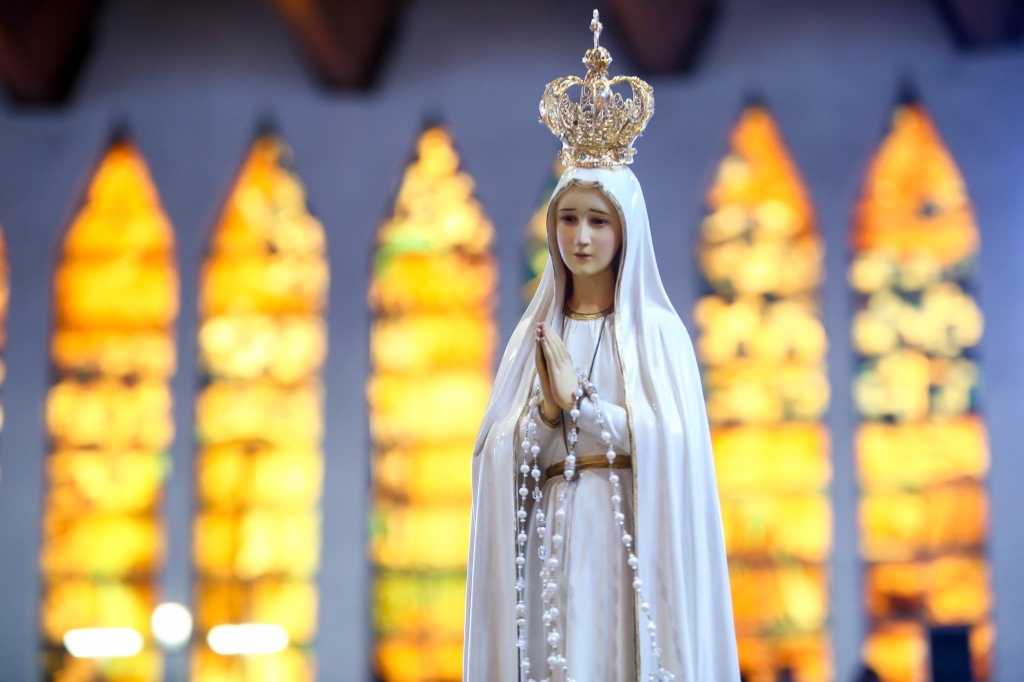
Photo by author, Basic Education Department Chapel, Our Lady of Fatima University, Valenzuela City, December 2023.

This Second Sunday in Advent, John the Baptist invites us to be aware of the desert we are living into where we have become less personal, less human as we move away from God that we have lost our sense of sin, acting more on impulses without much thinking its effects and consequences.

We think more of ourselves than of God and others, overextending our rights insisting on our ways that actually destroy lives through abortions and gender manipulations. We no longer speak of what is true and good by simply following trends and what is convenient. No more feelings, no more compassion. No more others. No more God nor heaven and eternity.

“St. John the Baptist Preaching in the Wilderness” by German painter Anton Raphael Mengs (1728-1779) from commons.wikimedia.org.

We do not have to dress on camel’s hair nor eat locusts and wild honey like John but simply make a space within us for God and for others.

We would be gravely wrong to think John was only speaking to the people of his time especially to the Pharisees and Sadducees; Matthew wrote his gospel account at that time to nourish the faith of early Christians facing persecutions and many challenges in life like in our own time when it is so tempting to follow the evil ways of the world.

John continues to warn us today of the sure return of the Christ when everyone shall face judgment which is not something to be feared like a sword of Damocles hanging above our heads ready to strike us anytime. It is a call and a demand for concrete actions of conversion, of leaving our sinful ways to follow Christ’s path of holiness.

“Even now the ax lies at the root of the trees. Therefore every tree that does not bear good fruit will be cut down and thrown into the fire. I am baptizing you with water, for repentance, but the one who is coming after me is mightier than I. I am not worthy to carry his sandals. He will baptize you with the Holy Spirit and fire” (Matthew 3:10-11).

Advent assures us of Christ’s Second Coming when he shall purify and renew us to fulfill Isaiah’s prophecy in the first reading when “the wolf shall be a guest of the lamb, the leopard shall lie down with the kid… the calf and young lion shall browse together, with a little child to guide them… the cow and bear shall be neighbors, together their young shall rest, the lion shall eat hay like the ox… the baby shall play by the cobra’s den, and the child lay his hand on the adder’s lair”(Isaiah 11:6-8).

“Peaceable Kingdom”, a painting based on Is.11:1-10 by American Edward Hicks, a Quaker pastor (1780-1849) from wikimedia.org.

As we have reflected last Sunday, every coming of Jesus is a day of judgment but not a catastrophe. It becomes a disaster for those unprepared, living in sin. But for those like John the Baptist, striving to live the gospel amid the desert of this world, Christ’s coming is salvation and peace for Jesus is full of love and compassion and tenderness for his people.

Life is so difficult these days especially when we see our great disparities with the corrupt who simply steal our money and those we call “lumalaban ng patas sa buhay”. Imagine how in our country the world is like a desert, so hostile with the weak and the poor who have to wrestle with 500 pesos – if ever they have – to stretch it for a noche buena on Christmas Eve.

St. Paul reminds us in the second reading that in times like these, we look up to God and his Sacred Words, to keep hoping, trusting and believing in Christ’s coming already happening especially in the Sunday Eucharist. Let us gather together as one community, encouraging each other in Christ like John in Jordan while awaiting the Lord’s coming, rejoicing like the psalmist today who sang, “Justice shall flourish in his time, and fullness of peace forever” (Ps. 72:7). Amen. A blessed Second Week in Advent everyone!

Repentance, true wisdom

Lord My Chef Daily Recipe for the Soul, 13 October 2025
Monday in Twenty-Eighth Week of Ordinary Time, Year I
Romans 1:1-7 <*((((>< + ><))))*> Luke 11:29-32
Photo by author, St. Paul Center for Renewal, Alfonso, Cavite, August 2025.
Are we doomed,
Lord Jesus?
Your words today
are so penetrating
and we deserve them
considering the news of
wholesale corruption in our
country,
the indifference of many
that sadly include shepherds
of souls.

While still more people gathered in the crowd, Jesus said to them, “This generation is an evil generation; it seeks a sign, but no sign will be given it, except the sign of Jonah… At the judgment the men of Nineveh will arise with this generation and condemn it, because at the preaching of Jonah they repented, and there is something greater than Jonah here” (Luke 11:29, 32).

The sign of Jonah
is about repentance
while the sign
of the queen of the south
is about wisdom;
true wisdom happens
when we repent
because repentance is
an expression of our
fear of the Lord that is
the beginning of wisdom;
teach us, Jesus, to be signs
who point to you,
the "someone larger"
than Jonah and the queen
of the south for you are the
ultimate sign of all;
like Paul, let us be the
living witnesses of your
glorious resurrection
by proclaiming your good
news of salvation both in
words and in actions.
Amen.

Fr. Nicanor F. Lalog II
Our Lady of Fatima University
Valenzuela City
(lordmychef@gmail.com)
Photo by author, St. Paul Center for Renewal, Alfonso, Cavite, August 2025.

Feeling God

Lord My Chef Daily Recipe for the Soul, 15 July 2025
Tuesday, Memorial of St. Bonaventure, Bishop & Doctor of the Church
Exodus 2:1-15 ><))))*> + ><))))*> + ><))))*> Matthew 11:20-24
Photo by Ms. Jo Villafuerte, Atok, Benguet, 03 September 2019.
Sometimes I wonder
O God how it feels to be
in front of you,
of what to feel when you are
so like us humans - sadly
frustrated,
exasperated.

Jesus began to reproach the towns where most of his mighty deeds had been done, since they had not repented. “Woe to you, Chorazin! Woe to you, Bethsaida! For if the mighty deeds done in your midst had been done in Tyre and Sidon, they would long ago have repented in sackcloth and ashes” (Matthew 11:20-21).

Forgive us, dear Jesus
when we are so callous
and numb before you,
not feeling you at all
because we are so absorbed
in our own pride and foolishness,
justifying our sinful ways
that we hardly feel you,
because we could not feel others
nor ourselves as our bloated egos
numbed our humanity; we have lost our
sense of sinfulness and could no longer
appreciate what is good and beautiful,
right and orderly; we have become like
those two Hebrews Moses caught fighting
each other that instead of feeling his care
and concern for them,
they felt separated he would kill
them like the Egyptian officer.
How true were the words
of our Saint for today,
the most pure Bonaventure
who wrote, "If you do not know
your own dignity and condition,
you cannot value anything
at its proper worth."
Help us realize Jesus 
how once mighty cities
like Chorazin, Bethsaida
and Capernaum remains in ruins
to these days, never to have
recaptured their old glory days
because since your time,
they never saw their dignity
and condition as your beloved
ones; let us not fall into ruins too
because of our unrepentance for
our sins. Amen.
Photo by author, Capernaum in Israel, May 2017.

Bad news is good news

The Lord Is My Chef Daily Recipe for the Soul by Fr. Nicanor F. Lalog II
Monday, Memorial of Dedication of St. Mary Major in Rome, 05 August 2024
Jeremiah 28:1-17 <*((((>< + ><))))*> Matthew 14:13-21
From en.wikipedia.org
God our loving Father,
teach us to appreciate bad news
that comes our way because
most often from it comes too
the good news;
like in the life of your prophet Jeremiah
who spoke always of bad news,
of gloom and doom to the people of Judah
so that they would repent and be converted;
but they chose to listen to the good news
of Hananiah you have not authorized
to speak on your behalf,
greatly misleading them
with false hopes of liberation
from the Babylonians that
actually worsened as Jeremiah
had told them.
Truth hurts
but we must always hear
and accept it so that we may
grow and mature like the Apostles
when Jesus told them,
"There is no need for them to go away;
give them some food yourselves"
(Matthew 14:16);
from that bad news,
the Apostles were able to surrender
themselves and their loaves of bread
to Jesus who multiplied them to
satisfy the great crowds with
so many leftovers!
The construction and 
dedication of St. Mary Major in Rome
happened during those problematic
years of the fourth century Church
with many bad news like
Nestorianism that denied Christ's divinity;
in accepting all the bad news at that time,
the church of St. Mary Major
was miraculously built
and finally named in honor
of Mary, Mother of God
after resolving the heresy of Nestorianism.
In this time of so many bad news
especially when immorality and decadence
seem to prevail and govern lives these days,
help us dear Jesus to hold on more to you,
to implore the Holy Spirit to
enlighten our minds and our hearts
in seeking, following and standing
by your truth
to finally win over people
back to sanity
and deceny.
Amen.

Fatima and the number “13”

The Lord Is My Chef Daily Recipe for the Soul by Fr. Nicanor F. Lalog II
Homily for the 106th Anniversary of Last Apparition in Fatima, 13 October 2023
Isaiah 61:9-11 ><}}}}*> Galatians 4:4-7 ><}}}}*> Luke 11:27-28

Today – October 13, 2023 – is the 106th anniversary of the last apparition of the Blessed Virgin Mary at Fatima, Portugal when the “Miracle of the Sun” happened, witnessed by about 70,000 people. It was her sixth apparition to the three young children at Cova da Iria that started in May 13, 1917.

Except for the month of August when authorities jailed the three children on August 13 on their way to Cova da Iria to force them to recant their earlier statements of the apparition, the Blessed Mother appeared to them on August 19 at the nearby Valinhos where she repeated her calls for prayers and sacrifices as well as the request for them to come every 13th day until the coming October when she reveals herself after a great miracle.

What is significant with the 13th day of each month that Mary appeared in Fatima from May to October 1917 that we have continued with this 13th Day Devotion?

From Pinterest.com.

The Blessed Mother never explained to the three children, now St. Francisco and his sister St. Jacinta Marto and their cousin Sr. Lucia dos Santos why she appeared to them every 13th day of each month.

According to later interviews with Sr. Lucia who became a Carmelite sister and the last to die of the three children in 2005, she believed as the fruit of her prayers that the number 13 signified the Blessed Trinity. Sr. Lucia explained that number “13” illustrates to us that there is one (“1”) God in three (“3”) Persons (she was recently declared Venerable by Pope Francis to pave the way for her sainthood).

Here we find anew in the Fatima apparitions the consistency of truths found in our Church teachings and doctrines, specifically, the Blessed Trinity, that there is One God in Three Persons. Saints have also tried to explain the Blessed Trinity in simple analogies like the number 13 reflection of the Venerable Sr. Lucia.

In a 2022 article by Catholic author Joseph Pronechen that appeared in Soul magazine (see, https://www.bluearmy.com/the-significance-of-fatimas-13th-day/), he presented how the number “13” has many biblical foundations to be chosen by the Blessed Mother in Fatima as date of her apparitions. Foremost of this is found in the Old Testament Book of Esther.

Esther was among the Jewish exiles living in Persia after the Babylonian captivity. She was said to be so lovely and beautiful that the Persian king, Ahasuerus chose her to be his Queen among his many wives. Her uncle named Mordecai was the King’s most trusted adviser too that earned the jealousy among Persians in the royal court. Both Mordecai and Queen Esther remained faithful to God despite their royal positions. Esther then discovered a plot by some of the King’s men to exterminate all the Jews in Persia, especially her uncle Mordecai. It was at this instance that she prayed so hard to God for her to be able to warn her King of his men’s evil plot against the Jews even it could have cost her own life.

By the grace of God, Esther was able to muster all the strength and courage to speak to King Ahasuerus to foil the evil plot of his men set on “the 13th day of the twelfth month of Adar” (Esther 3:7).

The Persian king truly loved Queen Esther and ordered the arrest and execution of his aide (Haman) to prevent the murder of so many Jews. Queen Esther thus saved her fellow Jews on the 13th day of the Jewish month of Adar! And because of her intervention, King Ahasuerus ordered Jews in his kingdom to freely worship their God with assurance of protection from enemies.

Like Queen Esther, the Blessed Virgin Mary is also our Queen being the Mother of the King of kings, Jesus Christ. Every August 22 we celebrate her Queenship and in the Glorious Mysteries, we meditate her being Queen of heaven and earth.

Most of all, like Queen Esther, the Blessed Virgin Mary in Fatima intervened on October 13, 1917 to save the world from the ongoing WWI that began in 1914 and ended the following year in 1918. Sad to say, the world was plunged anew into the darkness of WWII that was more deadlier in 1939-1945 as predicted by our Lady at Fatima if the world would not heed calls for repentance and conversion of sinners. In recent history we have witnessed how our Queen Mother Mary saved St. John Paul II on May 13, 1981 – her feast day as our Lady of Fatima – from a deadly assassination attempt at St. Peter Square in the Vatican. Again, the world is in the darkness of deadly wars right in the Holy Land and in Ukraine by Russia whom the Virgin Mary had specifically mentioned in her October 13, 1917 apparition at Fatima.

When are we going to follow her maternal instructions of repentance and conversion, something which she merely repeated from similar calls by Prophets in the Old Testament and by her Son Jesus Christ in the gospels?

If we truly consider Mary is our Queen, why can’t we obey her and follow her instructions more than 100 years ago?

See how in today’s gospel Jesus underscored the importance of listening and following his words as main component of being part of his family. Mary was the first to listen and act on his word at the Annunciation and until now, she does the same thing so we may be saved from the wraths of evil caused by man’s inhumanity to one another.

Page from Ilustração Portuguesa, 29 October 1917, showing the people looking at the Sun during the Fátima apparitions attributed to the Virgin Mary. From en.wikipedia.org.

Going back to the Sacred Scriptures, we find more bases of the significance of number “13” used by the Blessed Mother at Fatima in 1917. In the Book of Acts, we find that when the Holy Spirit came on Pentecost, the 12 Apostles (Matthias replaced Judas Iscariot) were with “Mary the mother of Jesus” (Acts 1:14). Here we find 12 (Apostles) + 1 (Mary) = 13!

In the gospel accounts, we know Jesus Christ’s choice of 12 apostles was from the “12 tribes of Israel” or 12 sons of Jacob who was also called by God as “Israel”. Again, 12 + 1 = 13.

According to an interview by Pronechen of a Jewish rabbi, the meaning of number 13 in Hebrew is “bonding of many into one”. Every time we pray the Apostle’s Creed, we profess our faith not only in God in Three Persons but also to the Catholic Church that bonds us into Christ’s body who was born of the Virgin Mary. In Fatima on October 13, 1917, our Lady called on us to be one in God through Jesus in prayers, fasting and sacrifices, and commitment to live as true Christians.

Most of all, Pronechen explained that according to the Jewish rabbi he had interviewed, every letter in the Hebrew language has a numeric value. The word “love” which is ahava in Hebrew is connected with God with a numeric value of 13. Now, consider that when the Virgin Mary first appeared at Fatima on May 13, 1917, it was the original feast of Our Lady of the Blessed Sacrament. Here we find another intimate link in our Lady of Fatima’s insistence in celebrating Mass and receiving Jesus in the Holy Communion often because the Holy Eucharist is the Sacrament of Love.

How wonderful to meditate that our Blessed Mother Mary appeared in Fatima 106 years ago today with that singular message and expression of God’s love for us all!

When are we going to listen to her call for us to truly live in the love of God expressed by Jesus Christ on the Cross? Amen. Have a blessed weekend everyone!

From cbcpnews.net, 13 May 2022, at the Parish of the National Shrine of Our Lady of Fatima, Valenzuela City.

Repenting, remaining in God present in us, with us in Christ

40 Shades of Lent by Fr. Nicanor F. Lalog II
Third Sunday in Lent-C, 20 March 2022
Exodus 3:1-8, 13-15 ><}}}*> 1 Corinthians 10:1-6, 10-12 ><}}}*> Luke 13:1-9
Photo by author, July 2020 in Bagbaguin, Santa Maria, Bulacan.

As I have told you at the start of this 40-day journey, Lent is like a coming home to God with Ash Wednesday until Saturday after as the porch and each Sunday a door leading us into the inner rooms closer to God.

At each door these past two Sundays, we were opened to God’s majesty and wonder, love and mercy in Jesus Christ who had come to help us triumph over many temptations in life, to be transformed and transfigured in him.

With Luke as our guide this year, he had opened to us each Sunday a very unique door to experience God’s majesty and mystery, his love and mercy offered in Jesus Christ.

This becomes most pronounced this Third and Fourth Sundays when we find his gospel stories as exclusively his alone: Christ’s call to repentance following the news of Pilate’s massacre of 18 Galileans during a temple worship and the parable of the Merciful Father more known as parable of the Prodigal Son.

Some people told Jesus about the Galileans whose blood Pilate had mingled with the blood of their sacrifices. Jesus said to them in reply, “Do you think that because these Galileans suffered in this way they were greater sinners than all other Galileans? By no means! But I tell you, if you do not repent, you will all perish as they did! Or those eighteen people who were killed when the tower at Siloam fell on them – do you think they were more guilty than everyone else who lived in Jerusalem? By no means! But I tell you, if you do not repent, you will all perish as they did!”

Luke 13:1-5
Photo by author, parish Via Crucis, 11 March 2022.

Our “blaming game”

At first hearing, our gospel today sounds like a news broadcast of brutalities and mishaps, trials and sufferings happening almost daily around the world. So many times, they happen closest to us personally or within our own circles of family and friends.

Only Luke has this account of teaching by Jesus; nowhere would you find in the gospels any account of Pilate ordering this massacre of Galileans but the Jewish historian Josephus had recorded many instances of the Roman governor’s ruthless reign.

And here we find the artistry of Luke in inserting this scene in his gospel the Church has chosen as part of our Lenten itinerary. So often in life, we keep on blaming somebody else except our very selves for every negative things happening to us and around us, even considering it as “divine chastisements” or karma to those people we consider as evil.

It is true that evil begets evil, but the seeming dominion of sin and evil in the world is so wide for us to attribute blame only to certain persons as if others, including ourselves, had no part in it. It always takes two to tango!

Worst case of this “blaming game” of ours is to even link our sufferings and trials with God.

Nothing bad can ever come from God like disasters and catastrophes, sickness and turmoils because God is love. God offers only life, never death nor destruction for he does only what is good. It is very wrong to think at all that God has something to do with any of these problems happening in the world like the pandemic or in our personal lives.

Photo by author, Sinai Mountain Range in Egypt, May 2019.

This is the gist of the Lord’s response to the people bringing him the bad news of the 18 Galileans ordered massacred by Pilate, “Do you think that because these Galileans suffered in this way they were greater sinners than all other Galileans? By no means!”. God does not punish at all! Bad things happen because of sins and that is what we always have to look inside us, how have we contributed to the evil happening.

And to make it clearer that God has nothing to do whatsoever with all these bad things happening to us, Jesus added, “Or those eighteen people who were killed when the tower at Siloam fell on them – do you think they were more guilty than everyone else who lived in Jerusalem? By no means!”.

However, Jesus is not telling us to be resigned to the absurdities of the world and of humankind. We can all do something to greatly prevent and reduce all these misfortunes and sufferings around us and that is the way of repentance, of conversion – the very calls of the prophets in the Old Testament and by John the Baptist.

Now, Jesus our Savior, the Son of God, is voicing out this call of repentance with urgency and new authority not only because it is the only way back to God but precisely due to his very nature of being loving and patient, merciful and forgiving.

The kind of God we have, the only one there is

The grace of this third Sunday of Lent is the revelation of the kind of God we have, the only one there is: a very loving and patient, merciful and forgiving God who is also perfectly present among us in Jesus Christ.

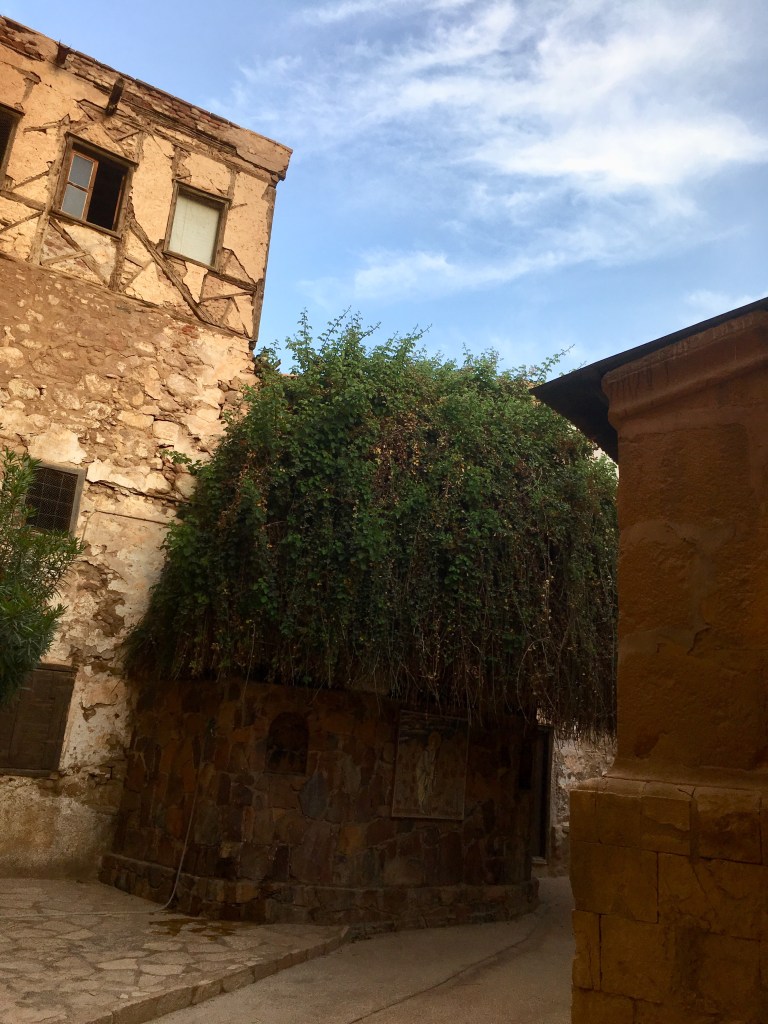
Photo by author, site of the burning bush in Sinai now inside St. Catherine’s Monastery in Egypt.

In the first reading, we are told of that unforgettable scene of Moses at the burning bush where God revealed himself as “I AM WHO AM” – the One who is always present with us in the past, in the future, and most especially in every here and now, the present moment.

When we think of God, what comes to our mind, what do we say about him?

God told Moses “Thus you say to the Israelites: The Lord, the God of your fathers, the God of Abraham, the God of Isaac, the God of Jacob, has sent me to you” (Ex. 3:15) to remind them that this God has always been present with his people.

With Abraham, God first made the promise of being the father of all nations (last Sunday’s first reading), to Isaac he revealed himself in the stairway to heaven, and to Jacob that he would bring them to Egypt and liberate them after. Now in Moses, everything is coming into fulfillment of this great nation to be set free by God, a prefiguration Christ and his saving mission.

Throughout history, God never left his people, working great marvels in the past to deliver them from slavery, a passing over and exodus, assuring us of his presence and salvation in the future by remaining at our side.

History is cyclic, everything seems to be happening again but with an upward trajectory towards God; in every repetition of history, the question is where are we standing with God, are we still the same the first time we encountered him, descending to vice and sins or have we grown in virtues and holiness?

Salvation history and secular history continue to unfold for both are one in God; hence, we must not waste every moment to return to God, to repent and be converted. Beware of Paul’s warning, “Therefore, whoever thinks he is standing secure should take care not to fall” (1 Cor. 10:12)! Remember those Galileans massacred by Pilate or those 18 people at Siloam crushed to death by tower that had fallen – anything can happen with us, so be ready. Never leave God who is always with us, assuring us with salvation in Jesus.

Beginning this Sunday, continuing to next week with the parable of the prodigal son and finally on the fifth Sunday of Lent when we skip Luke’s gospel to borrow from John for the story of the woman caught in adultery, we are being immersed into the deeper mystery of this God we call Father made known to us by Jesus Christ through his own passion, death and resurrection.

The more we enter God’s mystery every Sunday of Lent, the more his “height, breath and depth” (Eph. 3:18) appear to us, making us realize he is real, very true like another person we can feel and hear, always with us, patiently waiting for us to bear fruit like the owner of the fig tree in the parable.

How have you experienced God’s presence this past week?

What else do we need to be convinced of his love and mercy that we still refuse to repent and be converted in Jesus Christ?

The time is now, not yesterday or tomorrow for God is I AM WHO AM, one who is in the present. Amen. Have a blessed week.

Thank you for the prayers; I am home trying to recuperate from my surgery.

Photo by author, inside St. Catherine Monastery with Mt. Sinai at the background in Egypt, May 2019.

Ash Wednesday: rising from the ruins of life

40 Shades of Lent by Fr. Nicanor F. Lalog II
Ash Wednesday, 02 March 2022
Joel 2:12-18 ><}}}}*> 2 Corinthians 5:20-6:2 ><}}}}*> Matthew 6:1-6, 16-18
Image from Google.

For the third straight year, we enter the Season of Lent in the most unusual conditions in the world. Perhaps, even surreal. We had in 2020 the start of the COVID-19 pandemic persisting through 2021 up to the present that has altered the way we live and how we look at life.

Just when we felt like “Easter” coming in 2021, there came the stronger Delta variant at around this time that claimed so many lives among us.

Now in 2022 after we have all the vaccines available to put COVID-19 in control with a “tamer” variant Omicron, we have a more serious concern with Russia invading Ukraine.

To a certain degree, it is “good” this had happened at this time when we are starting the Lenten Season with Ash Wednesday that reminds us the question we should be asking is not “where is God” but “where are we, his people”?

It has always been the same question ever since – of “where are we in relation to God” every time there are man-made and natural disasters like wars and famine, epidemics and plagues, or earthquakes, drought and floods.

It is easier to blame God for all of our troubles because he is always silent, never answering us back; but, it is in his silence when we also realize the truth that we are the ones who have drifted apart from God, who have gone lost away from him who is always looking for us, waiting for us to come back.

It is in the silence of God that he is most present especially when we are deep in sin and sufferings.

Even now, says the Lord, return to me with your whole heart, with fasting, and weeping, and mourning; rend your hearts, not your garments, and return to the Lord, your God. For gracious and merciful is he, slow to anger, rich in kindness, and relenting in punishment. Why should they say among the peoples, “Where is their God?” Then the Lord was stirred to concern for his land and took pity on his people.

Joel 2:12-13, 17b-18
From istockphoto.com by Getty Images.

Lent: A coming home to God for us mortals, sinners, and ruined

Lent is a “coming home” to God with Ash Wednesday serving like a porch that leads us inside the “house of God” with each of its five Sundays acting like a door opening us closer and closer into the innermost room where God is.

In the shadows of the war in Ukraine, the COVID-19 pandemic and the heated national elections in our country, let us focus on the practice of giving of ashes every Ash Wednesday which is a gesture often mentioned in the Bible.


Ashes remind us first of all, of our mortality, that we shall all die one day. This is the reason why we priests say “Remember that you are dust and to dust you shall return” (Gen.2:7) while imposing ashes on your foreheads in the form of a cross.

And there lies the good news too of Ash Wednesday: we do not just die, rot and return to ash because at the end of time, we shall all rise again to become whole – body and soul – like Jesus Christ!

From ravenscov.org.

Though we are marked for death, Ash Wednesday reassures us of our resurrection and salvation in Christ signified by the ash in the form of a cross on our foreheads.

Ashes signal our readiness for repentance as expressed in the new formula in the imposition of ashes, “Turn from sin and believe in the Gospel”.

Recall how in the Book of Jonah when the king of Nineveh removed his royal robe, covered himself in sackcloth, and sat in ashes upon hearing Jonah’s preaching as he ordered too his people to do the same that averted the wrath of God.

In the gospels of Matthew and Luke, we find how Jesus lambasted the people of Chorazin and Bethsaida for not repenting upon seeing his mighty deeds, so unlike the pagans at Tyre and Sidon who would have “repented long ago in sackcloth and ashes” (Mt. 11:21 & Lk.10:13).

Ashes also signify ruin, destruction and devastation in life like Job who had lost all precious to him when he said, “(God) He has cast me into the mire; I am leveled with the dust and ashes” (Job 30:19).

It is the most applicable signification of ashes to us today in this time of prolonged pandemic with its deep emotional and psychological impact on everyone trying to grapple with life’s many challenges as we try to start anew almost daily.

The feeling is best described by the Book of Lamentations in the aftermath of the destruction of Jerusalem: “Those accustomed to dainty food perish in the streets; those brought up in purple now cling to the ash heaps” (Lam. 4:5).

Indeed, that ash on our foreheads reminds us of the ruin we are into as an individual, as a nation, as citizens of the world.

How often did we have to shelve and postpone our many plans in life since 2020 due to this pandemic with its recurring surges now worsened by this war at Ukraine launched by Russian president Putin?

We were already sighing in great relief the past weeks with declining cases of COVID when suddenly – to our great disbelief and dismay that this can still happen in the 21st century when Putin invaded Ukraine, casting the world into another grave danger of unimagined proportion.

And lastly, who does not feel ruined after all these years of the pandemic worsened by decadent politics that has gone into an abyss of filth and insanity?

Now more than ever we could feel and experience the “ash heap” we are into with only God who can raise us up and cleanse us again.

Photo by Ms. Jo Villafuerte, 21 February 2022.

Lent is a joyful season!

Contrary to what most people believe, Lent is not all that drab and dry. While its prevailing mood is of sobriety and seriousness in the light of its call for penance, fasting and almsgiving, Lent is a joyful season preparing us to Easter.

St. Paul tells us in the second reading that “now is the day of salvation”:

Brothers and sisters: We are ambassadors for Christ, as if God were appealing through us. We implore you on behalf of Christ, be reconciled to God. Behold, now is the acceptable time; behold, now is the day of salvation.

2 Corinthians 5:20, 6:2

To be reconciled with God who is “gracious and merciful, slow to anger, rich in kindness, and relenting in punishment” begins right inside our hearts when we open it – rend – so it may be cleansed of sins for Jesus to dwell inside again.

Like our reflection last Sunday, it is the truth of the heart that must be expressed on this Ash Wednesday, that must be cleansed and “repaired” after so many beatings and ruins especially these past years (https://lordmychef.com/2022/02/26/taking-jesus-to-the-heart/).

It is the heart that must be strengthened and converted by our lenten practices because its purity is revealed by our very lives, the kind of life we lead, the aura we project even if half of our face is covered by the face mask.

This is the very essence of the Lord’s calls in the gospel to do these practices “in secret”, not be seen by others that it becomes more of a show. It is God whom we must please, not the people; to enter into one’s room is to enter into one’s self to meet God with our true selves, without our usual alibis, of ifs and buts.

From Google.

This is the grace of Lent that begins on this Ash Wednesday: it is God who actually comes to us, to meet us, to work in us in his “mercy and graciousness” so we may experience his loving presence again despite all our sins and troubles.

Life is a daily Lent, a cleansing of our hearts, a repairing of our hearts ruined especially when we have truly loved and ended up being misunderstood and persecuted.

Do not worry, human love is always imperfect; only God can love us perfectly. That is what Ash Wednesday is reminding us, that we are finite and sinful, ruined most of the time but always open to God who never leaves nor forsakes us his children.

In this spirit, let us also not forget that Lent is a journey we take with others, a daily exodus from darkness to light, from sickness to healing, from ruins to newness, from sin to forgiveness and grace.

Photo by author, Lent 2019.

We come home to God together as a people, as a family, as brothers and sisters in Christ.

May our gathering together on this Ash Wednesday be an occasion to free ourselves from the ever-growing threats of individualism that has marked our age with everyone feeling a celebrity, even playing God.

Please don’t forget to practice fasting and abstinence today to create a space for God and for others in your heart.

Have a blessed and safe Lenten season, everyone!

Advent is being small and simple

The Lord Is My Chef Sunday Recipe for the Soul by Fr. Nicanor F. Lalog II
Second Sunday of Advent-C, 05 December 2021
Baruch 5:1-9 ><}}}*> Philippians 1:4-6, 8-11 ><}}}*> Luke 3:1-6
Photo by Mr. Jim Marpa, 2018.

From “beginning with the end” last Sunday at the start of Advent, we now move into its second week when we are reminded by the readings and gospel that “everything begins small and simple” in God and with God’s kingdom.

So often in life, God’s beauty and majesty are revealed in small, little beginnings that are hidden and obscured, things and persons we take for granted without knowing it is in them and through them that God silently continues his works of wonder among us.

Such is the reality of Christ’s coming – then and now and in the end of time – as presented by Luke who began his account this Second Sunday of Advent with the introduction of John the Baptist.

“St. John the Baptist Preaching In the Wilderness” by Anton Raphael Mengs from en.wikipedia.org.

In the fifteenth year of the reign of Tiberius Caesar, when Pontius Pilate was governor of Judea, and Herod was tetrarch of Galilee, and his brother Philip tetrarch of the region of Ituraea and Trachonitis, and Lysanias was tetrarch of Abilene, during the high priesthood of Annas and Caiaphas, the word of God came to John the son of Zechariah in the desert.

Luke 3:1-2

Feel the solemnity of Luke’s report, so formal, evoking a sense of power and might, an air of superiority with all the trappings of those in the corridors of power in government and religion.

Then abruptly, he wrote tersely, “the word of God came to John the son of Zechariah in the desert”. Boom! So simple yet elegantly emphatic.

Notice Luke’s artistry presenting a list of who’s who living in palaces and Temple with all the comfort and luxury available at that time when in a sudden shift, without losing the building up of the drama that led to the climax that is John “proclaiming a baptism of repentance for the forgiveness of sins, as it is written in the book of the words of the prophet Isaiah: A voice of one crying out in the desert: ‘Prepare the way of the Lord, make straight his paths'” (Lk.3:3-4).

In introducing to us the person of John the Baptist which started in the very first chapter of his gospel, Luke is actually telling us how John was already the presence of Christ, that aside from being his precursor, he had Jesus in himself already! For Luke, John foreshadowed Christ’s work of salvation reaching its summit at Easter even while orienting us to Christmas.

The nearness of God

Every year, the second and third Sundays of Advent narrate the preaching and baptism by John the Baptist at Jordan to remind us how Jesus comes to us whenever, wherever the word of God is heard, accepted, and proclaimed that result into repentance and forgiveness of sins.

See how Luke shows us the overlapping of salvation history with our secular history, a clear indication of the presence and nearness of God with us in Christ’s coming. Tiberius Caesar, Pontius Pilate, Herod, Philip, and Lysania with the high priests Caiaphas and Ananias were true persons who have lived in a particular time and specific places when John and Jesus lived too.

Here we find so true that God works silently and subtly in Jesus in our own personal lives and in the whole world for indeed, he is the God of history.

Photo by author, Chapel at the Basic Education Department, Our Lady of Fatima University, Valenzuela City, 28 November 2021.

This Second Sunday of Advent we are assured of God’s nearness with us in Christ, especially when there are those darkness and obscurity, hiddenness and being unknown. These little and simple things in life are occasions where God reveals himself to us! Take them to heart.

Sometimes in life it is good to be down and even unknown, away from the limelight specially in this age of social media where everything even coffee breaks and new purchases or grades and medals of children are made known to everyone with much noise like blaring trumpets.

This boom in social media is so tiring and even disgusting with nothing hidden anymore, nothing is personal, and worst, nothing sacred any more! God and faith and sacraments have become commodities, persons are cheapened and used for personal advantages that even personal messages or PM’s have become “public happenings”. No more respect and dignity to others and most of all, unknown to those so immersed in the social media, they are the ones in the losing end, losing their very selves as they lose touch and grounding with reality.

Contrast it with John the Baptist in the desert with his balanced life between solitude and community and most of all, his rootedness in God and with realities of life that he can speak about the need for repentance to renew one’s self.

The gift of Advent

It can happen that when we are so filled with our selves, when we are so spread out feeling famous, “viral” and “trending” that we are also most empty and nothing like those powerful men mentioned by Luke, from the Roman emperor to the high priests; hence, the need to be hidden and unknown, little and small once in a while to allow enough room for changes and growth, and most especially to have a room within us for Jesus to work in us.

This is the gift of Advent Season: a time for us to be like John, to withdraw from the busy and toxic world so we may be alone and at home again with one’s true self, with loved ones, and with God in Jesus, through Jesus.

In the first reading we heard the end of a poem by Baruch where God consoles his people personified by Jerusalem, giving them hope of redemption someday from their Babylonian conquerors. It was the lowest point in the Jewish history when Jerusalem and their Temple were destroyed with the entire nation exiled to Babylon as slaves. No country, no Temple, so down and so small yet, God tells them:

Photo by author, Advent 2019.

Jerusalem take off your robe of mourning and misery; put on the splendor of glory from God forever: wrapped in the cloak of justice from God, bear on your head the mitre that displays the glory of eternal name. For God will show all the earth your splendor; you will be named by God forever the peace of justice, the glory of God’s worship.

Baruch 5:1-4

See the beautiful image of God taking possession of his people exiled and enslaved, changing their lot into something so wonderful filled with splendor!

The same thing happens with us when we are down and lost for that is when God doubles his efforts in finding us, redeeming us, uplifting us. It had happened before in the coming of his Son Jesus Christ more than 2000 years ago which continues to happen now and would surely happen again in its fullness at his Parousia.

Nothing happens in life and in the world without God knowing even the minutest, single details we do not notice at all. Let us imitate the confidence of Paul this Season of Advent:

I am confident of this, that the one who began a good work in you will continue to complete it until the day of Christ Jesus. God is my witness, how I long for all of you with the affection of Christ Jesus.

Philippians 1:6, 8
Photo by author, Advent 2020.

This Second Sunday of Advent we are told that even if we do not see Jesus like in the gospel of Luke when it is still concerned with the preaching of John the Baptist, he is already with us in those small and little sacrifices we do out of love for him.

Like John, Advent invites us to withdraw to the wilderness, to the desert to be hidden from the limelight to give God a space to come to us, to be present in us.

Like John, Advent invites us to empty ourselves of our pride and sins, to repent and be washed clean by God’s loving mercy and forgiveness to be filled with his humility, justice and love.

Like John, Advent wants us to be the fulfillment of Isaiah’s prophecy: to be the voice of reason and faith in this noisy world of lies and superficialities; to make straight the path so bended with many excuses and alibis that have moved the lines of morality and propriety; to fill the valleys with sense and meaning; and, to make low every mountain and hill of human pride and arrogance that have left us more empty and lost than before.

Let us all be a John the Baptist, not only a precursor but also a presence of Jesus.

A blessed second week of Advent to everyone!

The color of Lent is also green

40 Shades of Lent by Fr. Nicanor F. Lalog II
Friday, Third Week in Lent, 12 March 2021
Hosea 14:2-10   ><}}}*> + <*{{{><   Matthew 12:28-34
Photo by author, December 2020.

When we were growing up, you know it so well, God our Father, how we fondly recited a rhyme from “Mother Goose” that says: “Roses are red, violets are blue; Sugar is sweet, so are you. And I love you!”

How lovely is this elementary rhyme for the great truth it imparts even in this season of Lent when our motif is violet for repentance which is also the shade representing fidelity, modesty, humility, and simplicity that to give a violet means “I love you too in response to what a red rose says, “I love you”!

To be sorry for sins is a great expression of love; but, to forgive like you dear God is the greatest expression of love!

And that is why, while violet expresses our love for you by being sorry for our sins this season of Lent, then, it can be rightly said that the color of Lent is also green for wherever there is love flowing from contrition for sins and its forgiveness, then there is found life in you!

When there is love, there is always life — like the verdant shades of green you told Hosea in the first reading today:

I will be like the dew for Israel: he shall blossom like the lily; He shall strike root like the Lebanon cedar, and put forth his shoots. His splendor shall be like the olive tree and his fragrance like the Lebanon cedar. Again they shall dwell in his shade and raise grain; they shall blossom like the vine, his fame shall be like the wine of Lebanon.

Hosea 14:6-8

Remind us always, Lord, that Lent need not be dry and drab; it is characterized by joy and life because of the love and mercy you have poured upon us through Jesus Christ. What a lovely scene that finally today in the gospel, a scribe came to Jesus not to debate him but be clarified of which is the first of all of the commandments.

May we imitate that scribe to come to you to sincerely seek wisdom and truth with a humble heart so we may realize that to love God above all means loving one’s self and loving others too at the same time. That love of God is always expressed in the face of every person we must see as a brother and a sister in Christ.

Let us return to you, O God in Jesus through others so that life may bloom again in us and around us. Give us the grace of contrition, to be sorry of our sins so our hearts may be cleansed to finally see how roses are red, violets are blue turning to shades and hue of green when life blooms in YOU. Amen.

Photo by author, December 2020.

Welcoming Jesus who knocks at our door

The Lord Is My Chef Breakfast Recipe for the Soul by Fr. Nicanor F. Lalog II
Tuesday, Week XXXIII, Year II in Ordinary Time, 17 November 2020
Revelation 3:1-6, 14-22     >><)))*>  +  <*(((><<     Luke 19:1-10
Photo by author, May 2019 Holy Land Pilgrimage.

Your words today, O Lord, are so comforting — after some reprimanding for our sins and misgivings!

And that is how you display your love and mercy and forgiveness that sometimes we fail to see and even recognize.

Despite our being “alive but dead” like the church in Sardis (Rev. 3:1) when we backslide to our old ways of sinfulness as well as our being “neither cold nor hot” like those in Laodicea when we refuse to make a stand for what is true and just, you still come to us, seeking us, trying to bring us back to your fold.

Behold, I stand at the door and knock. If anyone hears my voice and opens the door, then I will enter his house and dine with him, and he with me.

Revelation 3:20

Keep us humble, Lord Jesus, like Zacchaeus who openly admitted his “being short in stature” (Lk.19:3-4) that he had to climb a sycamore tree to see you passing by. And when you finally met him and told him of your coming into his home, he welcomed you right into his heart by being sorry for his sins, promising to repay or recompense those he had extorted money from.

A sycamore tree at the world’s oldest city of Jericho in Israel, 2019.

Like the blind man you have healed yesterday and now Zacchaeus, keep us following you Jesus on the middle of the road, leaving our comfort zones, to dirty our hands and garments in doing your works among the poor and needy specially in this time of calamity.

Open our ears to listen to your voice, to be on guard waiting for your coming, to your knocking at our door to welcome you back into our lives.

May we grab every opportunity to welcome you into our lives, Lord Jesus, by turning away from sins and heeding your voice of love and compassion among the poor and suffering. Amen.