The Lord Is My Chef Daily Recipe for the Soul by Fr. Nicanor F. Lalog II Wednesday, Memorial, St. Francis Sales, Bishop & Doctor of the Church, 24 January 2024 2 Samuel 7:4-17 <*((((>< + ><))))*> Mark 4:1-20
“The Sower at Sunset” by Vincent Van Gogh, oil on canvas painted in June 1888 from wikimedia commons.
Lord Jesus Christ, as you narrated to us today the parable of the sower, I wonder what were the other seeds you have sowed aside from your word?
On another occasion, Jesus began to teach by the sea. A very large crowd gathered around him so that he got into a boat on the sea and sat down. And the whole crowd was beside the sea on land. And he taught them at length in parables, and in the course of his instruction he said to them, “Hear this! A sower went out to sow.”
We are not just the different kinds of soil where your seeds fell, Lord Jesus; like you, may we also be sowers of your word and teachings, sowers of your love and mercy, sowers of compassion and kindness, sowers of your light and life, sowers of your hope and healing, sowers of your very presence.
When God told David not to build him a temple as he promised to raise a house for him from whom shall come the Christ, that was when the Father also sowed the seeds of redemption and fulfillment in you, Lord Jesus!
On this feast of St. Francis Sales, patron of Catholic journalists and media practitioners, we pray for all communicators to sow unity and peace, not division nor misunderstanding, nor animosities; we pray for all journalists of different platforms to sow understanding and clarity, to sow justice and equality among peoples, and to sow respect for life at all times because every communication must promote first of all the dignity of every person. Amen.
The Lord Is My Chef Sunday Recipe for the Soul by Fr. Nicanor F. Lalog II
Twenty-Eighth Sunday in Ordinary Time, Cycle A, 15 October 2023
Isaiah 25:6-10 ><}}}}*> Philippians 4:12-14, 19-20 ><}}}}*> Matthew 22:1-14
Photo by Mr. Jay Javier in Taal, Batangas, 15 February 2014.
I grew up in a generation when dressing properly – meaning, decently – was deeply inculcated both at home and the school. It has always been considered in our time as a sign of maturity when we come properly attired in every occasion.
Now, those days are gone along with the expression “Sunday’s best” when sneakers are paired with formal suits and worn even in weddings! Dressing has become so relative with total disregard for basic fashion sense and worst of all, without any sense of propriety at all in the name of personal comfort and style as well as individuality. That culture on “liberal” or “liberated” dressing has encroached into the church with priests refusing to wear the proper garments and dress as required by Code of Canon law. How ironic that while the lay people appreciate us priests dressed properly for the liturgy and ministry, the harshest insults and negative reactions against it come from some priests who argue using the hot weather as an excuse. Many priests have subscribed to the lame excuse of people that clothes do not make us who we are, that there is much more beneath the clothing we wear of who we really are.
True but not absolutely because what we wear, how we look outside is indicative of who we are, what we value, what we believe in. Dress speaks a lot about ourselves whether we like it or not as the Lord’s parable this Sunday teaches us.
The servants went out into the streets and gathered all they found, bad and good alike, and the hall was filled with guests. But when the king came in to meet the guests he saw a man there not dressed in a wedding garment. He said to him, ‘My friend, how is it that you came in here without a wedding garment?’ But he was reduced to silence. Then the king said to his attendants, ‘Bind his hands and feet, and cast him into the darkness outside, where there will be wailing and grinding of teeth.’ Many are invited, but few are chosen.”
Matthew 22:11-14
Photo by Fr. RA Valmadrid, National Shrine of Our Lady of Fatima, 13 October 2023.
We now come to the third and final series of parables addressed by Jesus Christ directly to his enemies, the chief priests and elders of the people while teaching at the temple area in Jerusalem to underscore to them the need to reform their lives and be converted to his good news of salvation like the tax collectors and prostitutes.
See how in today’s parable some semblances with the parables of the two sons and wicked tenants of the past two weeks to show us God’s loving patience in doing everything to make us come to him like the subjects of the king with all the chances to come to his son’s wedding banquet.
And like with the parables of the past two Sundays, Matthew makes again a crucial twist in today’s parable that can be sufficiently ended in that part when the king was enraged by the continued refusal of his guests to come to his son’s wedding banquet that he ordered them all killed and instead extended his invitation to everyone in the streets.
The wedding banquet is heaven like the vineyard in the parables of the past two Sundays.
But it is not only referring to heaven at the end of time but also speaks so well of the here and now – the present life we live as citizens of the kingdom of God in Jesus Christ. Rejecting the invitation to come to the meal which as an expression of our citizenship in God’s kingdom is an act of disloyalty and treason against him.
Photo by Arch. Philip Santiago, Hearts of Jesus and Mary parish, Malolos City, 2022.
When we were baptized, we became citizens of the kingdom of God. We do our “pledge of allegiance” to God as his citizens every time we pray and most especially celebrate Mass which is just half of the whole deal of being citizens of his kingdom! Like in being Filipinos or whatever nationality we have, we must live up to our citizenship in God’s kingdom by being good and holy. That is the wedding dress referred to in the parable, the life we lead as children and citizens of God and his kingdom.
Jesus invites us today to face squarely the uncomfortable issues that prevent us from being his good and faithful disciples and citizens of God’s kingdom. Many times we are like those invited guests in the parable who allowed something else in their lives like their wealth and possession, businesses and worldly pursuits become more important than their allegiance to the King. Every time we sin, every time we skip the Sunday Mass, that is when we have our new God and King that may be our very selves, gadgets, vices, or the malls we frequent more than the church!
Here we find a deepening in Jesus Christ’s invitation to conversion into conforming our lives into him. St. Paul made a lot of beautiful imageries of “putting on Jesus Christ” as our new clothes and garment which we have retained in the Rite of Baptism when the newly baptized is clothed with the white dress. See how the man caught by the king fell silent when confronted because there was no excuse at all at not wearing the wedding dress in the banquet. The same thing is true with us today. We have no excuse for not being dressed, for not being conformed in Jesus Christ in our lives as his disciples. Everyday he gives us the opportunities of being conformed to him through our daily conversions through prayers and good works. God does not expect us to wear extravagant nor expensive clothes for his wedding banquet; just a clean and decent clothes are enough. Nobody is perfect.
Photo by Dra. Mylene A. Santos, MD at Tagalag, Valenzuela City, 13 September 2023.
One of the things I used to enjoy in my school and seminary days were joining stage plays. Yes, I love acting but I just don’t know if acting (and singing) love me. Nonetheless, one of our most dreaded moments before the actual play was always the dress rehearsal when everything is considered as the “real thing”, the real play as our teaches and nuns have insisted when we were supposed to have memorized our lines and cues.
But, as I grew and matured, I realized that life is not a dress rehearsal at all; each day is an actual “play”, a “live” presentation where we must “perform” or “act” so well. Yes, we are all required to memorize our lines and cues in life but many times, we forget them. Nobody is perfect. And here lies the immense love and kindness of God to us: he allows us to improvise for our selves in case we have forgotten our lines just like those people instantly invited to the wedding banquet of the King’s son. They were able to improvise to make it to the banquet hall except for that one who came not dressed for the occasion. He was silent because he was so lazy to improvise, to find ways like the chief priests and elders in the time of the Lord. Until now, many of us make a lot of excuses and alibis for not being conformed in Christ, from the ordinary excuse of being “difficult” to the most absurd that “I am only human” or tao lamang, mahina at marupok. Keep in mind St. Paul’s words in the second reading, “I can do all things in him who strengthens me… My God will supply whatever you need, in accord with his glorious riches in Christ Jesus” (Phil.4:13, 19).
Photo by Ka Ruben, National Shrine of Our Lady of Fatima, 2022.
Every Sunday we are invited to celebrate with others the coming of Jesus and the salvation he has won for us. This wedding banquet is the Sunday Mass we celebrate, a fulfillment of the first reading from Isaiah of that mountain where “the Lord of hosts will provide for all peoples a feast of rich food and choice wines, juicy, rich food and pure, choice wines” (Is. 25:6). In the Holy Eucharist, we have the choicest food and drinks – the Body and Blood of Jesus Christ – given to us to nourish us and keep us strong in this journey of life into eternity in heaven with the Father.
How amazing that nothing is really imposed upon us in coming to this banquet of the Lord in the Eucharist that is totally free of charge except that we have to come properly dressed on the inside, of being conformed in him.
But please, let’s get dressed also on the outside. No need to wear expensive and beautiful clothes. Just proper and clean ones are more than enough. A good rule of thumb we can rely on is this: God has blessed me tremendously this week and I am coming to celebrate with him, for him. How do I look to to express to him my gratitude and appreciation to his wondrous gifts? Amen. It is a Sunday, go to Mass!
The Lord Is My Chef Sunday Music by Fr. Nicanor F. Lalog II, 30 July 2023
Photo by author in San Juan, La Union, 26 July 2023.
Finally we’re back! Sorry for being silent with our Sunday music blog relating secular songs with the Gospel of Jesus Christ.
For our return engagement since our last blog in June 11, 2023 with Stephen Bishop’s Parked Cars (https://lordmychef.com/2023/06/11/parked-cars-by-stephen-bishop/), we feature this Sunday one of our favorite local talents, Mr. Zack Tabudlo with his 2021 hit Habang Buhay from his album called Episode.
We can’t recall where and when we first heard this swinging OPM love song that sounds like from our era of VST & Co. Fact is, Tabudlo has other previous hits before Habang Buhay which struck us with two important things we find so close to our Sunday gospel.
First is its melodic upbeat tune teeming with profundity despite its being so light and refreshing to listening (and dancing). Though we find traces of influence from the late 1970 to1980’s disco era in Tabudlo’s music, Habang Buhay is so sincere with its Gen Z identity that is authentically so Pinoy especially with its shouts of Halika nga that is twice repeated.
Aking sinta, ano ba'ng mayro'n sa iyo?
'Pag nakikita ka na, bumabagal ang mundo
'Pag ngumingiti ka, para bang may iba
'Pag tumitingin sa 'kin, mapupungay mong mga mata
Wala akong takas sa nakakalunod mong ganda, ha
Halika nga (ha, ha, ha)
That shout of Halika nga is so typically Pinoy, so warm and genteel like Jesus Christ calling us to be open to his parables, to find God hidden in the most simplest things of ordinary life. Halika nga evokes those tender, loving calls of our Lola during summer vacation calling us to change clothes soaked in dirt and perspiration with a glass of Julep or Sunny Orange juice during those endless afternoons of fun and games.
Halika nga sometimes is an expression of playfulness masking as deeply serious. It is something we rarely hear these days because nobody seems to offer us with comfort and company, with love and concern anymore.
In Habang Buhay, Tabudlo is overjoyed, playfully or teasingly calling his beloved halika nga for them to bask and savor this wonderful love they have found. If we could just hear Jesus calling us too, telling us halika nga to stay with him to discover God as the only worthwhile love and treasure we could ever have in this life.
And where do we find that kind of love? In Christ’s dying for us on the Cross which Tabuldo had thought of as the true expression of his love that is faithful until the end.
Andito 'ko hanggang sa 'ting pagtanda
Mamahalin kita basta't 'pag nahulog
Nakahawak ako, 'wag ka lang bibitaw
Habang-buhay na ako'y iyo
Wala nang ibang nakagawa sa 'kin nang ganito
Kundi ikaw, nag-iisang diyosa ng buhay ko
'Wag ka nang matakot, 'wag kang mangamba
Andito ako 'pag ika'y mag-isa
Wala akong takas sa nakakalunod mong ganda, ha
Halika nga (ha, ha, ha)
This is the second thing that struck us in Habang Buhay, an amazing song that speaks of love that is pure and true, and most of all, willing to suffer and sacrifice. Like in the gospel today of the parables of the treasure buried in the field that prompted the farmer to sell all his possessions to acquire that property and of the fine pearl found by a merchant who also sold everything he had just to have it. The same is true with love, and with God: what are we willing to let go to have the love of our life?
It’s a rarity in this fast-paced world to hear from young people speaking about love in its deeper sense like the giving of self for a beloved, giving us deep sighs of relief that we’re leaving this world in good hands. Habang Buhay assures us not only of a love that is forever but invites us too to trust the next generation by witnessing to them Christ’s love found on the Cross. Amen.
The Lord Is My Chef Sunday Recipe for the Soul by Fr. Nicanor F. Lalog II
Sunday in the Seventeenth Week of Ordinary Time, Cycle A, 30 July 2023
1 Kings 3:5, 7-12 >><}}}}*> Romans 8:28-30 >><}}}}*> Matthew 13:44-46
Photo by author, San Juan, La Union, 24 July 2023.
We are now in the final installment of Jesus Christ’s parables this third consecutive Sunday of his teachings on the kingdom of heaven. It is hoped by this time we have learned and realized God is the only treasure we must have in this life.
And the good news is that God our treasure is found in the most ordinary things!
Many times he simply comes to us even without us looking for him while often would also appear if we truly seek him like in the two short parables we heard this Sunday.
Jesus said to his disciples: “The kingdom of heaven is like a treasure buried in a field, which a person finds and hides again, and out of joy goes and sells all that he has and buys that field. Again, the kingdom of heaven is like a merchant searching for fine pearls. When he finds a pearl of great price, he goes and sells all that he has and buys it.”
Matthew 13:44-46
Photo by author, San Juan, La Union, 25 July 2023.
Our gospel may be the shortest these past three Sundays but it challenges us to be wiser in making choices to acquire the only worthy treasure of all – God.
Both the farmer and the merchant exemplify to us this wisdom in letting go of their other possessions just to have the buried treasure and pearl they have found.
Note how the farmer merely chanced upon the treasure buried in a field not his, while the merchant finally found the fine pearl after years of searching all his life. Here we are reminded how God is not that difficult to find by those truly seeking him. The problem lies with us when we refuse to be the good soil so that the seeds sown in us may grow and bear fruit even amid the weeds! Many times, we have stopped having that sense of awe, of being surprised by God who is like a treasure buried in a field somewhere waiting to be found. Worst, a lot often we have simply given up searching for God as if it is impossible to find him like a fine pearl. God is with us in Jesus Christ, our Emmanuel.
This is the good news of our short parables today. Moreover, God even comes to ask us what we want in life like King Solomon in the first reading. Later in the gospel we find Jesus Christ also asking the blind Bartimaeus what does he want while passing by the city of Jericho. Notice how those healed by Jesus always had clear thoughts and focus, so wise in their choices of what they wanted in life like King Solomon. Can we be wise enough like Solomon in choosing well, in asking the right thing from God?
The Lord appeared to Solomon in a dream at night. God said, “Ask something of me and I will give it to you.” Solomon answered: “O Lord, my God, you have made me, your servant, king to succeed my father David; but I am a mere youth, not knowing at all how to act. Give your servant, therefore, an understanding heart to judge your people and to distinguish right from wrong. For who is able to govern this vast people of yours?” the Lord was pleased that Solomon made this request.
1 Kings 3:5-7, 9-10
Photo by author, San Juan, La Union, 25 July 2023.
What is so beautiful, even wonderful here is not just the nearness of God with us but his kindness in asking us what we want. Imagine God saying, “Ask something of me and I will give it to you.”
What shall we ask God if he were to come to us in a dream tonight like Solomon? Perhaps we would be at a loss! Remember, God is asking for just one thing we want. At least the genie usually gives three wishes, with only the third one as most crucial being the last for which we are told to always ask for three more wishes!
Here we find again Simon Sinek’s book Start with Why most useful because our whys give us the reason and meaning for whatever we wish to accomplish. Exactly what Solomon must have considered as he laid out to God his situation, his needs, most of all his weakness, “I am a mere youth, not knowing at all how to act.” See why Solomon asked for that grace instead of wealth or fame or strong army?
It is that consciousness of being small and weak before God that pleases him most in granting our prayers. Earlier before this scene Jesus praised and thanked God in giving wisdom to the little ones who accepted him than the wise and the learned who rejected him (Mt.11:25). That is the attitude of being a “good soil” who allows the seed to penetrate and absorb us!
God was so pleased with Solomon because he knew so well his whys that to govern Israel so well amid his many weaknesses, he needed God more than ever. Unlike Adam and Eve who tried to usurp God in his power in knowing right from wrong, Solomon recognized it as divine prerogative we can only share with God. Actually, what he asked for was God himself who is the treasure hidden in the field and the fine pearl found by the merchant. Solomon did not want to be like God inasmuch as he never thought of being wealthy and powerful nor famous that are of no value at all compared to having wisdom, in having a discerning heart to know right from wrong.
Photo by author, shore of the Lake of Galilee in Capernaum, Israel, May 2017.
I have realized in my 25 years as a priest that what we treasure most are not the ones that give us pleasure but the ones who complete us. We ask and pray to God for something or someone not because of need but more of fulfillment found only in Jesus Christ who promised that whatever we ask from his Father would be granted to us in his name if it is for the mission he had entrusted to us. That is why in my prayers, I no longer ask God for anything except of being with him in eternity because I am so sure that whatever I need, he would give. Most of all, if I have God, then I am complete.
The parables of Jesus are inexhaustibly rich yet so accessible to everyone with open minds and open hearts to meet God in Christ through the simple realities of life. That is why St. Paul tells us in the second reading today that “all things work for good for those who love God, who are called according to his purpose” (Rom. 8:28).
Let us pray for more zeal and enthusiasm in being the good soil, in choosing wisely the only treasure worthy in this life who is Jesus Christ, our Emmanuel or God-is-with-us. Let us welcome him in the many parables of life we take for granted that are all part of God’s plan of salvation for us leading to glory that is our destiny. Amen. Today is Sunday, go to Mass and pray for those severely affected by super typhoon Egay especially our brothers and sisters in northern Luzon.
The Lord Is My Chef Sunday Recipe for the Soul by Fr. Nicanor F. Lalog II
Sunday in the Fifteenth Week of Ordinary Time, Cycle A, 16
Isaiah 55:10-11 ><]]]]'> Romans 8:18-23 ><]]]]'> Matthew 13:1-23
Photo by author, Bgy. Bahong, La Trinidad, Benguet, 12 July 2023.
Surely you will hear in almost all homilies today something about that blasphemous drag version of the Lord’s Prayer trending in social media. What a coincidence that our Scripture readings this Sunday say a lot about words that teach us so much in dealing with this new kind of pandemic sweeping the world, the “LGBTQ+ woke” syndrome happening in the realm of words and languages.
In the light of recent things happening in our society, today’s readings tell us two important things we have forgotten or have deliberately disregarded: the power of God’s word and the need to listen.
Thus says the Lord: Just as from the heavens the rain and snow come down and do not return there till they have watered the earth, making it fertile and fruitful, giving seed to him who sows and bread to him who eats, so shall my word be that goes forth from my mouth; it shall not return to me void, but shall do my will, achieving the end for which I sent it.
Isaiah 55:10-11
Photo by author, Bgy. Alno, La Trinidad, Benguet, 11 July 2023.
The power of God's word
Our short reading from Isaiah perfectly introduces us to the sequence of Christ’s teachings in the next three Sundays beginning today about the power of God’s word, a preparation for us to understand the parable of the sower.
Here we find from the Prophet Isaiah God’s word as totally “other” – ibang-iba sa lahat – as it reveals and acts because it is the truth and effectiveness in one. See how Isaiah picturesquely expressed the power of God’s word, “Just as from the heavens the rain and snow come down and do not return there till they have watered the earth, making it fertile and fruitful… so shall my word be; it shall not return to me void, but shall do my will, achieving the end for which I sent it.“
The Bible never fails in attesting to this conviction, of how God means what he says that has become the very basis of our hopes in him since the very beginning. Everything flows from God’s word, from the creation of the world and the universe to its fulfillment in Jesus Christ until he comes again at the end of time. God’s word creates history with power to renew and restore life, the power to save us as experienced by the thief on the Cross when he said, “Jesus, remember me when you come into your kingdom” (Lk.23:42).
Photo by author, Camp John Hay, Baguio City, 12 July 2023.
Contrast God’s word with our human experience aptly expressed by Shakespeare in Hamlet’s famous quote, “words, words, words!” – of how we use so many words in the belief more is powerful when in fact our words are vain and empty, lacking in substance. Instead of giving life, many times our words hurt and even kill others. In this age of social media, see how we use words to distort truth with lies and deceptions. Its worst aspect is not found in the words we use but in us who pronounce them when we say things without any commitment at all so that many times, our words never stood the test of time because they are easily forgotten when spoken or heard.
St. Paul said it so well in the second reading, of how “all creation is groaning in labor pains even until now” (Rom.8:22) especially when we distort the truth of our words, when we do not mean what we say, when we our words divide instead of unite, when our words destroy instead of build.
See how sin entered through the “words” of the devil that deceived Adam and Eve with the first “fake news” in history that they would not die if they ate the forbidden fruit but instead become like God. Sin took on its ugly face in the use of words again after the first crime of murder committed by Cain who dared to say to God “am I my brother’s keeper” when asked of the whereabouts of Abel.
Words continued to be the means through which sin permeated humans reaching its lowest point when people played God again by building the Tower of Babel to reach the heavens. God punished them by making them speak different languages that resulted in confusion and the collapse of the tower.
How sad that these days, human words are made louder, spread faster by technologies try so hard to undermine God’s word. There is no doubt on the power of the word of God for he himself had shown and assured it. For his words to be fully operational and experienced, we must first listen to Jesus, the word who became flesh.
Photo by author, Camp John Hay, Baguio City, 12 July 2023.
Listening to the word of God
“Whoever has ears ought to hear.”
Matthew 13:9
Jesus used these words seven times in the synoptic gospels, usually in connection with parables like in Matthew chapter 13 which we shall be using in the next three Sundays. We heard it first today and again next Sunday when Jesus explained the parable of the weeds.
His command to “hear” requires more than just taking in the words he speaks to us. To truly hear what Jesus is saying especially within the context of the parables, we must profoundly ponder what he wishes us to know. Just like in our prayers: what is essential is to be able to listen more to God than to tell him our needs which he already knew.
This can only happen in the spirit of silence and openness to God when we suspend our many preconceptions and other ideas especially about the parables we have been so familiar with.
Photo by author, Camp John Hay, Baguio City, 12 July 2023.
The seed is the word of God and Jesus is the Sower who comes to us everyday, speaking to us, telling us the most important things we need to know and do in this life for us to be fulfilled and joyful.
But, do we have our ears attuned to the word of God? Many of us practically live in media, so hooked with gadgets either or both the cellphone and headsets or pods. Nobody seems to listen anymore as we are so engrossed in our own little world centered in the endless me, me, me and I.
In the parable, it does not really matter where the seeds fell; it is always good, at least even as food for the birds! Wherever it fell, the seed always sprang into life! That is the power of the word of God! We just have to give it a chance to grow and mature to bear fruits of “a hundred or sixty or thirtyfold”.
To hear the word of God means also to have our hearts opened to receive God so we can gain insight into the kingdom of God. It is in our hearts where the word of God is sown. Stones and thorns refer to the hardness of our hearts, our refusal to welcome Jesus Christ because we have been dominated by fame and power and other cares of this modern world.
Receiving the word of God is a process, not just a one-shot deal. It is a relationship we have to cultivate in Jesus Christ, just like the ones we try to have with our plants. The Lord himself had warned us repeatedly in the gospels of how there would always be opposition and indifference, even mockery and blasphemy right in the very places where his word should manifest its effectiveness like in our country, the only Christian-nation in this part of the world. If ever the word is not fruitful, it is primarily due to our dispositions and attitudes to God and his word.
Photo by author, Camp John Hay, Baguio City, 12 July 2023.
How timely that at this particular moment in our country we heard again this classic parable of the sower by Jesus Christ.
We, especially in the Church, are being reminded anew to humbly open ourselves to God and his word, to give it a chance to grow and bear fruit, including our rules and other documents especially in the liturgy.
In spending so much time about the posture the laypeople should take in praying the Our Father in the Mass notwithstanding what the rubric says, the devil sneaked into the scene with this drag cover of the Lord’s Prayer. This is something we must reflect. Why even the drag queen had joined the discussion of the Our Father that have deeply hurt us all! With this recent decision by the bishops, the more it seems that the drag version of the Lord’s Prayer is partly our fault too. Let us go back to God and trust his word anew. And the words of the liturgy too. Amen.Have a blessed week ahead!
The Lord Is My Chef Daily Recipe for the Soul by Fr. Nicanor F. Lalog II
Wednesday in the Thirty-Third Week of Ordinary Time, Year II, 16 November 2022
Revelation 4:1-11 ><))))*> + ><))))*> + ><))))*> Luke 19:11-28
Photo by author in Dau, Mabalacat, Pampanga, 24 October 2022.
Your words today, Lord Jesus Christ,
are difficult to comprehend and imagine
but John's descriptions of his vision of heaven
make us appreciate and realize
God's great love for us
and his desire for us to be
with him in eternity
enjoying this great mystery of his divinity.
After this I had a vision of an open door to heaven, and I heard the trumpetlike voice that had spoken to me before, saying, “Come up here and I will show you what must happen afterwards.” At once I was caught up in spirit. A throne was there in heaven…
Revelation 4:1-2
St. Paul had told us too
"that the suffering of this present time are
as nothing compared with the glory to be
revealed for us" (Rom.8:18) as you have
shown John in this vision;
teach us to be more firm in our
faith in you,
fervent in our hope in you,
and unceasing in our love for you
through others so that when the time comes,
we may also see and experience
what you have shown John.
Open our eyes and our minds,
especially our hearts and souls
to your reality,
to your presence, dear Jesus,
that we believe in you
and hold on your promises of
returning unlike those people who
refused to recognize their king
and became the biggest losers
of all in your parable.
To lose you, O Lord Jesus,
is life's most biggest lost.
Amen.
The Lord Is My Chef Sunday Recipe for the Soul by Fr. Nicanor F. Lalog II
Fifteenth Sunday in Ordinary Time, Cycle C, 10 July 2022
Deuteronomy 30:10-14 ><}}}*> Colossians 1:15-20 ><}}}*> Luke 10:25-37
Photo by Mr. Raffy Tima of GMA7-News, May 2022.
After telling us last week to “do not rejoice because spirits are subject to you, but rejoice because your names are written in heaven” (Lk.10:20), Jesus today answers a scholar of the law asking him what he must do to gain eternal life.
It is the very same question we often ask others because inside us we are convinced there is something else deeper than the laws and commandments of God written in the Bible. Like the scholar of the law, we have experienced that God’s commandments and statutes – his very voice, his very words – are written in our hearts.
Moses said to the people: “If only you would heed the voice of the Lord, your God, and keep his commandments and statutes that are written in this book of the law, when you return to the Lord, your God, with all your heart and all your soul. No, it is something very near to you, already in your mouths and in your hearts; you have only to carry it out.”
Deuteronomy 30:10, 14
God’s commandments and laws are not just mere codes of conduct like in other religions. The Law of God is no dead letter but his living Word right in the depths of our hearts no matter how hard we deny his existence. More than a code, the Law of God evokes a relationship that is a fruit of one’s conversion of heart and soul in union with God and with others.
It is here that we find the novel approach by Jesus in narrating the parable of the good Samaritan in answering the scholar of the law who wanted to test him by asking, “Teacher, what must I do to inherit eternal life?” (Lk.10:25) that was followed up with a second one, “And who is my neighbor?” (Lk.10:29) to justify himself. In narrating this parable, Jesus showed us how we must live as neighbors, as brothers and sisters in him who is our head.
Photo from americamagazine.org.
We are all neighbors.
We have heard so many times this beautiful parable by Jesus which only Luke had narrated while the Lord was “resolutely determined to journey to Jerusalem” (Lk.9:51). Too often, we see this parable as a reminder of something we are all aware of, that everyone is our neighbor.
Like the scholar of the law, we are not surprised at all with Christ’s question, “Which of these three, in your opinion, was neighbor to the robbers’ victim?” because we have always thought of the question in our own point of view! We are the ones looking at the victim of the robbers that it is always easy to assume we would be good Samaritan to him which is so presumptuous on our part. Fact is, so often we have failed being a good Samaritan to so many in need who came to us for help because we were like the priest and Levite with many excuses, with more important matters to attend to that they both passed by the robbers’ victim.
Like the scholar of the law, we have failed to see the whole point of Jesus who was asking us to be in the victim’s point of view, to be in his shoes: would anyone be a good Samaritan to help me if I were the victim?
Jesus had reversed the point of view – instead of looking through the window from the outside, we are asked to look at the window from the inside! Would somebody stop to be kind with us?
From inquirer.net.
Many times we have felt so disappointed at some people we were expecting to be our friends, who would be on our side but when trials came, they turned their backs from us and left us alone when suddenly, somebody we least expected or even hardly knew came to help us!
How many times have you found yourself saying, “I thought they considered me as their friend but it turned out, somebody I hardly knew was the one who helped me out of my plight!” Worst, there were times we have said strangers are even better than our family and friends, saying, “Mabuti pa yung ibang tao kesa kamag-anak o kaibigan”.
Hence, to our most Frequently Asked Question (FAQ), “What must I do to inherit eternal life?”, Jesus is asking us to act and live in such a way that everybody sees us as their neighbor, not the other way around. When it is others who see us as their neighbor, it means we are living the gospel, we are like Jesus Christ, the Good Samaritan who came to save us all. It is different when it is us who claim to see everyone as our neighbor – it holds nothing at all but an idea in the mind, a plan or mere intention no matter how noble it may be.
Most of all, to see others as one’s neighbors is a sign of a malady of our faith and religion: that we are not yet evangelized though sacramentalized wherein Jesus is just in our minds but not yet in our hearts, not yet flowing through our very being.
Photo by Lauren DeCicca/Getty Images, Laoag City, 08 May 2022.
The preeminence of Jesus Christ
This oneness in Christ is the gist of Paul’s beautiful exposition about Jesus in our second reading this Sunday. Paul wrote the Colossians while in prison to prevent them from joining some preachers encouraging them to adopt ascetic practices in order to have angelic powers as well as appease higher powers. Paul insisted Jesus Christ is God and what he had accomplished on the cross is sufficient for our salvation.
Christ Jesus is the image of the invisible God, the firstborn of all creation. For in him were created all things in heaven and on earth, the visible and the invisible, whether thrones or principalities or powers; all things were created through and for him. For in him all the fullness was pleased to dwell, and through him to reconcile all things for him, making peace by the blood of his cross through him, whether those on earth or those in heaven.
Colossians 1:15-16, 19
In presenting the preeminence of Jesus Christ, Paul is also telling us that Jesus is the foundation of our moral life. Our lives, our actions must flow from our communion and oneness in Christ. That is when others see us as a neighbor, when they see us as one of them too!
This is the fulfillment of Moses’ teaching in the first reading, that the “voice of the Lord”, the word of God is not far from you for it is in your hearts – that is Jesus Christ who is not only the fulfillment of the laws but the Law himself. After all, as John had expressed in the fourth gospel, Jesus is “the Word who became flesh and dwelt among us”, the Emmanuel, the God-with-us.
From Facebook of Marivic Tribiana, 2021.
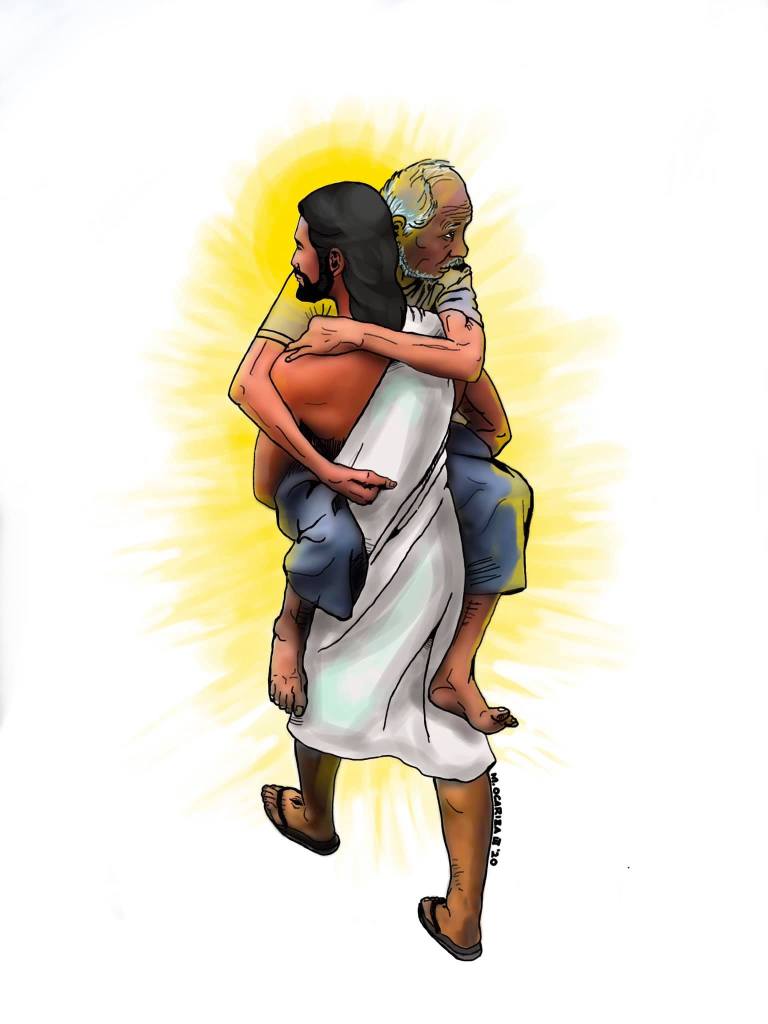
Today, Jesus is inviting us that in order to gain eternal life, we must do what he does, that is, to love and be kind with everyone, to be seen as a neighbor and a friend others can count on. In becoming human, God became one of us in Jesus Christ, the one who crossed the street to reach out to us victims of robbers on the way to Jerusalem. He not only healed our wounds but even lifted us to regain our dignity as beloved brothers and sisters. And neighbors.
There is a very beautiful word in English that captures this reality of our being neighbors or brothers and sisters in Christ: “kind” or “kindness” which came from the root kin or kindred. When we say “she or he is kind to me”, it means he or she treats me as a kin or a kindred, not as different like a stranger.
Artwork by Fr. Marc Ocariza based on Marivic Tribiana’s photo, 2021.
We are all kins or kindred in Christ. And every time we choose to be unkind and indifferent with others especially those in need, we are bothered by our conscience because it is an affront to our very personhood. It is unnatural like what the American writer George Saunders had realized:
“So here’s something I know to be true, although it’s a little corny, and I don’t quite know what to do with it: What I regret most in my life are failures of kindness. Those moments when another human being was there, in front of me, suffering and I responded … sensibly. Reservedly. Mildly.”
George Saunders from “Congratulations, By the Way” (page 22)
Avoid having such regrets later in life. Whatever good deed you may do at the moment, do it for it could be Jesus Christ who is passing by, who is the one in need. Amen.
40 Shades of Lent by Fr. Nicanor F. Lalog II
Fourth Sunday in Lent-C a.k.a. "Laetare Sunday", 27 March 2022
Joshua 5:9, 10-12 ><}}}*> 2 Corinthians 5:17-21 ><}}}*> Luke 15:1-3, 11-32
Photo by Dr. Mylene A. Santos, MD, in Lourdes, France, 20 March 2022.
Life is a daily Lent, a coming home to the Father. As I have been telling you, the 40-days of Lent is a journey back home to God in Jesus Christ with each Sunday like a door leading us closer to Him. We rejoice this Fourth Sunday – Laetare Sunday – as we near God’s inner room, knowing Him more than ever as we experience His immense love and mercy for us like a Father welcoming his children to “enter” and celebrate home in Him.
But, are we really in the journey?
Or, are we just like the two selfish, self-centered brothers in the parable who took their father for granted by pursuing for their own very selves?
Tax collectors and sinners were all drawing near to listen to Jesus, but the Pharisees and scribes began to complain, saying, “This man welcomes sinners and eats with them.” So to them Jesus addressed this parable: “A man had two sons…”
Luke 15:1, 3, 11
Photo by author, Laetare Sunday 2019 in my former parish.
Acting like the sons…
Once again, we hear another story from Luke that is uniquely his. It is more known as the parable of the prodigal son when in fact the center of the story is the loving and merciful father giving everything including his very self to his two sons.
There are two preceding parables before this third one, that of the lost sheep and of the lost coin that are in chapter 15 of Luke’s gospel. See how Jesus developed into a rising crescendo his series of parables starting with a lost sheep, a lost coin, and finally, lost sons. The common thread running through the three parables was the great joy of the shepherd, woman and father upon having their lost ones again. Clearly, God is the shepherd, the woman, and the father looking for the lost sheep, lost coin and lost sons. And here lies the very essence of the parables, especially in this third one about the loving and merciful father: “the Pharisees and scribes who began to complain why Jesuswelcomes sinners and eats with them.”
We are those Pharisees and scribes who doubt and refuse to believe, even run away from our loving God in the belief there must be somebody else there who could love us truly by giving us what we need.
Photo by author, Laetare Sunday 2019 in my former parish.
Exactly like the younger son in the parable who sees God merely as a provider, an ATM or a Western Union counter who gives the cash we need to buy things we believe would complete us without realizing God is our life, our identity and root of being. This we find at what prompted the younger son to return home (return home, not come home which happens only when home is a person, not a place nor thing).
When he had freely spent everything, a severe famine struck that country, and he found himself in dire need. So he hired himself out to one of the local citizens who sent him to his farm to tend the swine. And he longed to eat his fill of the pods on which the swine fed, but nobody gave him any. Coming to his senses he thought, “How many of my father’s hired workers have more than enough food to eat, but here am I, dying from hunger. I shall get up and go to my father and I shall say to him, “Father, I have sinned against heaven and against you. I no longer deserve to be called your son; treat me as you would treat one of your hired workers.”
Luke 15:14-19
Sometimes we are like the younger son who returns home just to preserve one’s self – to have a roof and to have food so as not to starve, never go hungry. It is the first temptation of the devil, teasing Jesus and us to turn stones into bread because man lives to eat! That is why we keep on asserting our own power so we can do everything because we have forgotten our being-ness in God. We hate having nothing, being empty and would rather fill our bellies with whatever we can stuff our mouth with that in the process even swallow our pride and dignity to have, to possess everything, even everybody except God.
Photo by author, Laetare Sunday 2019.
On the other hand, we are like the Pharisees and scribes “complaining why Jesus welcomes sinners and eats with them” so personified by the elder son who refused to enter their house to join the celebrations at the return of his prodigal brother because his manipulative schemes have been unmasked. For him, serving his father was just a show because he was only an actor, everything was a movie or a teleserye playing one’s roles in exchange of a fee and fame.
He said to his father in reply, “Look all these years I served you and not once did I disobey your orders; yet you never gave me even a young goat to feast with my friends. But when your son returns who swallowed up your property with prostitutes, for him you slaughter the fattened calf.”
Luke 15:29-30
Again, we find here some semblance of the second and third temptations to Jesus and to us by the devil: worship him and you will be popular and powerful! We all want having the best for us to be the very best among our peers and neighbors. We are willing to buy time, even buy people just to be known and popular. We would not mind being patient over a long period of time believing in the end, we could end up having all.
When we think of our needs to be secured and safe, popular and powerful, the first that comes to our minds and consciousness are things that money can buy, food that fill stomach, and drinks that refresh the body. Like the two brothers, they were all concerned with material and physical, nothing spiritual nor emotional or even mental. A life without any depth like Alfie played by Michael Caine with music by Burt Bacharach asking, “What’s it all about, Alfie? Is it just for the moment we live?”
That’s the tragedy of our lives, of being like the Pharisees and scribes personified by the two brothers who were so lost in their own selves, refusing to see beyond to find others and God, now and eternity, earth and heaven.
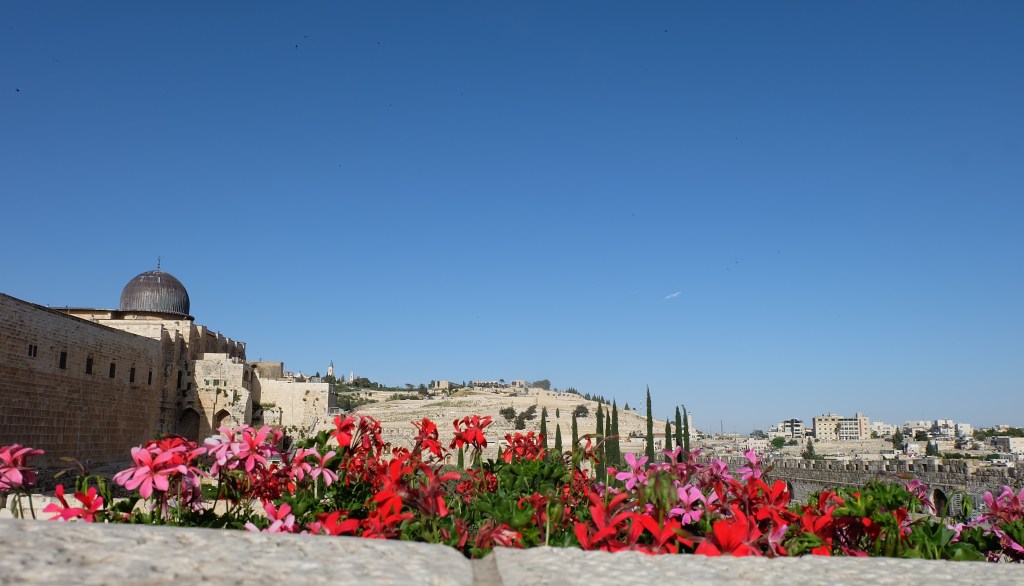
Photo by author, view from the Old Jerusalem, May 2019.
…becoming like the Father
This is the grace of this fourth Sunday, its greatest joy and cause for celebration: our being home in God, being whole again in Him after realizing and accepting our broken and sinful selves.
Make no mistake that it was us who have found God; no, it is the other way around.
God is the Father always awaiting for us that He sent Jesus Christ to lead us home again in Him. In this parable, the late Fr. Henri Nouwen rightly said Jesus is the “prodigal son” who left heaven not out of rebellion but because of obedience and submission to lead us all back to the Father, the only One who loves us truly, our very “first love” for He is the one who loves us first and still loves us no matter what.
Stop seeking for the world’s basic staples of food and wealth, fame and power because the most basic truth in this life is we are loved by God who is love Himself because He is life. See Luke’s sense of humor: the prodigal son wanted only food and shelter but the father gave him back his status as son with the ring, fine clothes and slippers, and feast while the elder son was longing for a mere young goat without realizing it has long been his for everything the father has was his too! Like us in many occasions in life, we fail to see how much we already have in God that we turn away from Him to settle for lesser things.
See our foolishness in desiring the world when it has always been ours if we remain in God. That is why we need to celebrate because finally we have found what is truly basic and valuable, God who gave us his Son Jesus Christ so we can find our way back home to Him and learn what is most valuable in life.
In this parable, Jesus is asking us to “level up” our existence, to rise above our very selves and be who we really are as beloved children of the Father who is merciful and rich in kindness.
Like in the first reading, no more manna for we have entered the Promised Land where we can have real food and real drink – Jesus Christ who sustains us to eternal life. Let us keep in mind and heart Paul’s reminder and call in the second reading that “Whoever is in Christ is a new creation… so, let us be reconciled in God” (2 Cor. 5:17, 20). Only those who are reconciled in God in Jesus can experience true joy… so, stop complaining and whining of others getting close with God. Join us and celebrate! Amen.
The Lord Is My Chef Breakfast Recipe for the Soul by Fr. Nicanor F. Lalog II
Friday, Week XVI, Year I, 23 July 2021
Exodus 20:1-17 ><]]]]'> + ><]]]]'> + ><]]]]'> Matthew 13:18-23
“The Sower” by Van Gogh from commons.wikimedia.org
It has been raining for a week,
loving God and Father.
Farmers and sowers must be so
delighted to come out in the fields
to sow their seeds while we stay home
trying to keep ourselves dry and warm.
Help us to make room for you, dear Father,
to open up ourselves to the seeds
of your presence that come to us daily
in your words in the Sacred Scriptures.
Let us be like the fertile soil in the parable
by Jesus "who hears the word and
understands it, who indeed bears fruit
and yields a hundred or sixty or
thirtyfold." (Matthew 13:23)
Your seed is always good
springing into life wherever it falls
for you alone, O God, is good!
How lovely it is to imagine
that all Ten Commandments sprang up
from just one seed that is YOU, dear Father -
You are the seed we always reject
when You are the seed we all need.
Whenever we choose to commit sin,
we take on other strange gods
and idols besides You that
we worship and follow.
May we open ourselves to You, God
welcoming you like a seed into our little room
so we may find home in You when it blooms.
Amen.
The Lord Is My Chef Breakfast Recipe for the Soul
Wednesday, Third Week in Ordinary Time, 27 January 2021
Hebrews 10:11-18 >><)))*> + >><)))*> + >><)))*> Mark 4:1-20
Forgive me, Lord Jesus, for being deaf, for refusing to listen to you, for not having the ears to hear your calls. Twice you called out on the crowd gathered before you in the gospel today, “Hear this! A sower went out to sow… Whoever has ears to hear ought to hear” (Mk. 4:3, 9).
So many times in life, we have forgotten the essential use of our ears which is to hear and listen so we may understand. Most of the time, our ears have been reduced to mere decorations of our head to hold eyeglasses as well as be stuffed with ear plugs or covered with headsets to be deadened by sounds we prefer to hear and listen to.
Make us realize anew that our ears were shaped in such a way to look like our heart when put together so that the more we hear and listen to you and others, the more we love.
So many things begin with our ears.
And so often, from the ears, they go to our hearts to be processed.
From hearing to listening to loving.
It is only with a listening heart that we can truly see you passing by everyday in our lives like the Sower sowing to us the seeds of love, the seeds of the kingdom of heaven.
Moreover, cleanse our hearts, remove so many other things not supposed to be there that distort our perceptions of you and of others.
May we realize too that in our refusal to listen to you, so many people have also stopped listening to us, your disciples, especially when we speak more of our words, more of our thoughts, than of your Word and Holy Will.
As you open our ears and hearts to your Word, dear Jesus, teach us to be patient too like our Father, the Sower, to never give up sowing your seeds of the kingdom of God even if nobody listens to us. Amen.
Van Gogh painting of “The Sower” from wikimediacommons.org.