New commandment, new heaven, new earth

The Lord Is My Chef Sunday Recipe for the Soul by Fr. Nicanor F. Lalog II
Fifth Sunday in Easter-C, 15 May 2022
Acts 14:21-27 ><}}}}*> Revelation 21:1-5 ><}}}}*> John 13:31-33, 34-35
Photo by author, Bolinao, Pangasinan, 20 April 2022.

Our readings today speak a lot about being “new” – new followers of the new faith as Christianity spread during the first missionary journey of Paul and Barnabas, a vision of new heaven and new earth by John at the end of time, and a new commandment by Jesus Christ to his disciples that include us today.

What is so wonderful and so new in this “new” order of things in our readings is how they encompass the past, present, and future as expressed in the beautiful tension we all experience in life like Jesus Christ on the night before he was betrayed, after Judas had left their Last Supper.

Many times, we feel like being caught in a time warp when everything seems to be happening too fast that the past, present and future are in just one setting. It is like seeing one’s life in a flash.

“My children, I will be with you only a little while longer. I give you a new commandment: love one another. As I have loved you, so you also should love one another. This is how all will know that you are my disciples, if you have love for one another.”

John 13:33, 34-35
Photo by author, Bolinao, Pangasinan, 20 April 2022.

Most often, we feel ambivalent with anything or anyone that is new like being excited but at the same time afraid because it is always something or someone we are not familiar with. It is generally what we feel when we move into new residences or new school or new jobs; when we meet new people like new superiors, new co-workers and new classmates.

But lately, we have found something new and different with our new set of leaders after the elections last Monday: of course, followers of the winners are happy and glad while those who have lost are more than sad, wondering what have happened, and still could not accept the new developments (or retrogression, depending on which side you are with).

Perhaps it is in this recent events that we feel our readings this Sunday very relevant and appropriate to us all, to always welcome whatever and whomever is new by seeing them in the light of Jesus Christ who is ever new with us each day.

For a proper understanding of Jesus and of our faith in him, we need to experience him in that tension of the here and not yet he beautifully expressed in saying “I will be with you only a little while longer”. Remember, Jesus declared these words shortly before his arrest; notice his composure and dignity. Unlike most of us, Jesus was never caught off guard by his impending death. In fact, “when the days for his being taken up were fulfilled, he resolutely determined to journey to Jerusalem” (Lk.9:51) to face his death. As truly human, he was frightened but faced all his fears so that he was in total control with everything until he had given up his breath and spirit to the Father. That is why in this scene after he had washed their feet and Judas had left them, Jesus gathered his disciples in a “heart-to-heart” talk, calling them “my children”.

Problem with us when things or, as Pablo Coelho put it in one of his works, when the universe does not seem to conspire in our favor, we resist the change: we keep frozen in the past, spending the present thinking all possible scenarios in the future, forgetting that God is in the present as he calls himself as “I AM.” Focus on Jesus than on things around us so we may see beyond them.

Photo by Ms. Jing Rey Henderson in Taroytoy, Aklan, 30 April 2022.

First thing we recognize in the words of Jesus is what we have reflected last week in his being our Good Shepherd – his oneness with his flock, with us. There is that inner sense of belongingness of Christ in the Father, and of Christ in us. It is what that makes us embrace whatever or whomever new comes to us, regardless we like or do not like them because it is Jesus with whom we are one with first of all.

Jesus stayed only a little while with his disciples here on earth; now he is risen, Jesus is in the glory of the Father in heaven who shall come again at the end of time to establish the new heaven and new earth John was privileged to see in the second reading. It is in this tension between the here and not yet, of Jesus who had come and will come again and is come that we are challenged to witness his presence among us in love.

It is love that is truly the power the Risen Lord has and enabled him then and now to break all barriers in time and space to appear to his disciples and us to experience him today. It is a love so unique – so new unlike the “love” preached by other gurus. Christ’s love is rooted in oneness, in his being one with the Father, one in the Father. It is a love so divine yet human too because it is a love Jesus had shared with us as a gift, something we have, a love we must acknowledge for it to work in us by having that inner belongingness and oneness with him, in him and through him.

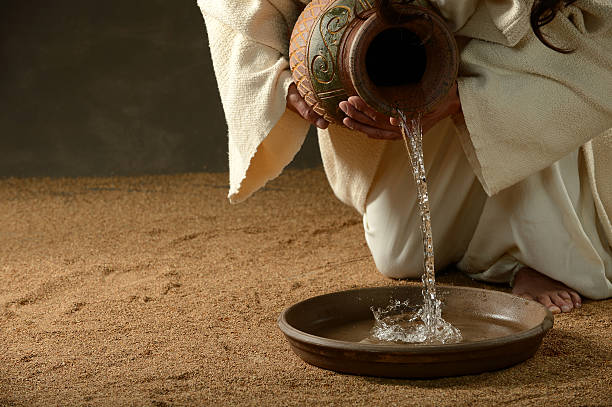
How?

Photo from gettyimages.com.

This we find in the preceding scene of the washing of the disciples’ feet: it is Jesus who cleanses us in the sacraments and in our daily encounter with him. When we allow Jesus to cleanse us daily, purifying us from all our sins and imperfections, that is when we enter into communion in him. It is only then that we are truly able to love like him – love without measure willing to offer one’s self, loving even those we consider as enemies.

This is perhaps what we need most these days following the elections. Suspend our biases and presumptions for a while and allow Jesus to work in us, to make us new.

Let us go back to Jesus Christ, allow ourselves to be cleansed by him anew so that we may enter into being-in him and being-with him like Paul and Barnabas who always acted in union with him, never on their own. Since then until now, we continue to experience this love of Christ expressed in our liturgy and most especially in the Church’s oneness and charity. It is a love we all have to recapture and continue for it a love always new because it is Jesus who works in us and through us even in the worst situations to transform every dismal picture we see to become new and wonderful.


Lord, let us come to you again
for we have been not clean;
wash our feet so that
we may listen to you
and do your work and mission;
help us to let go of our own agenda
no matter how lofty they may be
for the mission is yours, not ours;
most of all, let us come to you again
at your Cross to be able to truly love
like you, one in the Father and the Holy Spirit
found among our brothers and sisters
especially those not like us;
forgive us for our harsh words
and our lack of kindness with them;
it is only in loving like you 
can there be truly a new order in this world
that heralds a new heaven and 
a new earth.  Amen.

Have a blessed week ahead.

Photo by author, 2018.

Jesus in our blessedness, and sinfulness

The Lord Is My Chef Sunday Recipe for the Soul by Fr. Nicanor F. Lalog II
Third Sunday in Easter-C, 01 May 2022
Acts 5:27-32, 40-41 ><]]]]'> Revelation 5:11-14 ><]]]]'> John 21:1-19
Photo by author, sunrise at the Lake of Tiberias, Israel, 2017.

This is the last Sunday in this Easter Season when we shall hear a story of the Risen Lord appearing to his disciples; starting next Sunday, our gospels will be from his Last Supper discourse that were his final instructions before his Passion, Death, and Resurrection.

This is the third appearance by Jesus to his disciples that happened at the shore of Lake Tiberias (aka, Galilee) one early morning after Simon Peter and six other disciples went fishing the night before and caught nothing. The story is quite long but very remarkable with how Jesus was recognized in the blessedness of John the beloved and in the sinfulness of Peter.

Such is the beauty and power of Easter, of Jesus breaking all barriers to come to us so we may experience his love and mercy and forgiveness. As we have reflected last week, it is not the number nor length of our Risen Lord’s appearances that matter but its inexpressible intensity demanding our intense response to him which we find today in John and Simon Peter.

Photo by author, November 2018.

“It is the Lord!”

The disciples were still at a loss three weeks after the Lord had risen. Despite his twice appearances to them, they could not yet grasp Easter’s meaning; it would still be a long way to go before they understand everything when the Holy Spirit comes on Pentecost as Jesus had promised them.

Trying to pick up the pieces of their lives, the seven disciples led by Simon Peter went fishing one night but caught nothing until Jesus appeared to them unrecognized.

When it was already dawn, Jesus was standing on the shore; but the disciples did not realize that it was Jesus. Jesus said to them, “Children, have you caught anything to eat?” They answered him, “No.” So he said to them, “Cast the net over the right side of the boat and you will find something.” So they cast it, and were not able to pull it in because of the number of fish. So the disciple whom Jesus loved said to Peter, “It is the Lord.” When Simon Peter heard that it was the Lord, he tucked in his garment, for he was lightly clad, and jumped into the sea.

John 21:4-7

What a beautiful story reminding us of the need to be always in the state of grace, of being in love first with Jesus to see and recognize him in the bountiful blessings he pours upon us daily!

See how it was the disciple whom Jesus loved who first recognized the Lord upon seeing the plentiful catch of fish with a wonderful interplay of catching many fish and recognizing Jesus.

Photo by author, Puerto del Sol, Bolinao, Pangasinan, 20 April 2022.

For people truly in love with Jesus, everyday is a miracle, a day of his coming, of his loving presence among us.

Being in love with Jesus is having a prayer life in him that makes us attuned with him, becoming automatic with us to find Christ present in the various events happening in our lives, whether they are good or bad as both count as blessings to anyone who truly believes in him.

John must have been so in love with Jesus, remembering so well the first time he met the Lord with his brother James and their partners Peter and brother Andrew after a similar incident when they have caught nothing the previous night and Jesus invited them to “cast their net into the deep.” It must have been a “love at first sight” for him with the Lord that they eventually left everything including their father to follow Jesus as “fishers of men” (Lk.5:1-11, Fifth Sunday Ordinary Time, 06 February 2022).

When we love, our senses and our memories are heightened of our beloved’s words and actions that we can see and feel them around us even after they are gone. When we love, we find newness in life every day with Jesus standing at the shore every dawn waiting for us to wake up and lead us to a bountiful catch of fish daily. Of course, the fish is found only in the sea or lake but for us to catch them, we need to find Jesus first.

That is why it is necessary that we begin and end each day in Jesus praying. When we love someone, we always talk and listen, always communicating in various ways with our beloved.

Problem is when we do not pray, we get preoccupied with what we do not have – of not catching anything – of looking more into the dark or murky waters of life not seeing the light in the horizon, of Jesus at the shore.

Photo by author (2017), the shore of Lake Tiberias where Jesus asked Simon Peter thrice “Do you love me?”

“Lord, you know everything; you know that I love you.”

After bringing in their haul of “one hundred fifty-three large fish” to the shore for breakfast with Jesus, our story reaches its climax with Jesus asking Peter thrice, using his original name Simon with the question, “Do you love me?”.

Peter was distressed that Jesus had said to him a third time, “Do you love me?” and he said to him, “Lord, you know everything; you know that I love you.” Jesus said to him, “Feed my sheep… And when he had said this, he said to him, “Follow me.”

John 21:17, 19

Peter understood fully well (gets niya, as the young would say) why Jesus asked him thrice with “do you love me?” to signify the three occasions he denied knowing him while being arraigned by the Sanhedrin on the night of Holy Thursday.

This time, there was no denying on Peter’s part that he had truly sinned that night in denying Jesus three times! And he was distressed because he was deeply sorry, telling Jesus, “Lord, you know everything; you know that I love you.” See the humility and sincerity of Peter in responding to the Lord’s question as he admitted his guilt of denying Jesus; but at the same time, his love and faith in the Lord despite his sinfulness and weaknesses. In telling Jesus “Lord you know everything; you know that I love you”, Peter was declaring his deep conviction that Jesus knows very well all our sins but at the same time knows too as well how much we love him in all of our imperfections.

Sin is not really that bad at all, so to speak, in the sense that even in our sinfulness, Jesus comes to meet us, assuring us of his love, of his mercy and forgiveness.

Photo by author, September 2021.

Just like his first words when nailed on the Cross, “Father, forgive them, they know not what they do” (Lk.23:34), Jesus comes to us quickly in our moments of sin, inviting us to come back to him. Every time we feel that guilt after committing a sin, when we feel that shame within, that is the moment too when Jesus calls us personally like Simon, not only asking us if we love him but assuring us most of all that he loves us in spite and despite our sins.

Here we find a different interplay: the more Jesus directed Simon unto himself – do you love me?– the more Simon saw his sinfulness but at the same time experienced Christ’s forgiveness and love for him because like John the beloved, he had always loved Jesus from the start despite his many flaws and weaknesses that would later be smoothened by the Lord.

Remain in love with Jesus. This is the grace of this third Sunday in Easter. We cannot follow nor meet Jesus whether in our blessedness or sinfulness unless we love him first of all. Jesus perfectly knows human love is imperfect; only he can love us perfectly. We do not have to pretend to be perfect before him; just be our true selves, sinful yet sorrowful, to surely meet him who never leaves our side.


Dearest Lord Jesus,
open my heart to love you more
so that my eyes may always see you
in life's many blessings and trials 
that come my way daily;
let me love you more so that
I obey God rather than men and women
who keep on demanding so many things
from me, enslaving me with their many
offers that pretend to make me perfect;
when things become difficult,
open my eyes like your Apostles
who found themselves worthy
to suffer dishonor for your sake (Acts 5:29, 31)
who alone is "worthy to receive power 
and riches, wisdom and strength,
honor and glory and blessing" (Rev.5:12).
Amen.

Photo by author, Puerto del Sol, Bolinao, Pangasinan, 19 April 2022.

Easter is going out, not coming in

The Lord Is My Chef Daily Recipe for the Soul by Fr. Nicanor F. Lalog II
Wednesday in the Second Week of Easter, 27 April 2022
Acts 5:17-26   ><]]]]'> + <'[[[[><   John 3:16-21
Photo by Cristian Palteng, 16 April 2022, Easter Vigil at the National Shrine of Our Lady of Fatima, Valenzuela City.
Praise and glory to you,
Lord Jesus Christ for making 
this Easter Season so special:
our first major celebration since 
the pandemic began in 2020 with
our church gatherings always the
target of lockdowns and restrictions;
but this Easter, we have risen with you, 
dear Jesus, when we were finally allowed 
to gather and celebrate the Eucharist
without much restrictions.
Make us realize this fundamental truth
of your Resurrection, Lord Jesus:  that Easter
is more of coming out than getting in.

The high priest rose up and all his companions, that is, the party of Sadducees, and, filled with jealousy, laid hands upon the Apostles and put them in public jail. But during the night, the angel of the Lord opened the doors of the prison, and led them out, and said, “Go and take your place in the temple area, and tell the people everything about this life.”

Acts 5:17-20
So many times, you have come
to set us free, Jesus, from our prison
cells of self-doubts, cynicisms, 
hopelessness, pains and hurts, 
guilt and sins but we refuse to 
believe you are risen, that you
have conquered evil and sin, darkness
and death; open our minds and our
hearts, Lord Jesus, to believe and accept
the love you have freely given us.
Let us go out to you, sweet Jesus,
to bask in the warmth of your light 
and truth that we are loved.  Amen.

He touches me

Quiet Storm by Fr. Nick F. Lalog II, 26 April 2022
From Google.

The word “touch” is a very touching one, connoting so many meanings while at the same time gives us a “feel” of what it really is. Its literal and figurative senses always go together with the most touching reaching deep down inside us that are also the gentlest and simplest.

We are touched by words and gestures, by sights and sounds, and literally speaking, we are touched most when touched by another person. Experts claim that a five second touch is equivalent to about 300 words of encouragement so that for us to be emotionally well, we need at least three hugs a day.

Photo by author, Mirador Jesuit Villa and Retreat House, Baguio City, January 2019.

Reflecting on the very few stories of the Easter appearances by Jesus to his disciples, we find how the gospel writers did not need to write so much details to convince us that the Lord had risen for it is not the number nor length of his appearances that matter but its inexpressible intensity. Especially in the fourth gospel, we notice – and we are touched, too like the disciples – the deep intensity of Christ’s appearances that resulted only in silence and adoration among them.

And that is one very true characteristic of Jesus – he touches us. Always. Even if we can not touch him nor see him. There is always that joy of Easter bursting forth within us in moments of prayers, of intimate conversations with loved ones and friends, or upon seeing a beautiful sight or experiencing nature.

It is Jesus Christ who touches us most that is why we believe in him even if we cannot explain how it all happened. It has always been like that since he rose from the dead. In fact, I doubt Thomas really touched Jesus when they met on the eighth day because he was so “touched” upon seeing the Risen Lord that he said, “My Lord and my God”, the most intense expression of faith in the bible!

See that nothing is said if Thomas indeed touched the wounds of Jesus for he was caught up in the experience and sight of the Risen Lord.

Then he said to Thomas, “Put your finger here and see my hands, and bring your hand and put it into my side, and do not be unbelieving, but believe.” Thomas answered and said to him, “My Lord and my God!”

John 20:27-28
“The Incredulity of Saint Thomas”, a painting by Caravaggio from commons.wikimedia.org.

Like Thomas, Jesus touches us in the most personal and unique manner that deep inside us we also cry with intensity “my Lord and my God” to him. Though we can enumerate many reasons and persons who have led us into believing in Jesus, we also admit at the same time that there is no specifically single reason nor person for our faith in God except our very selves, of our personal conviction that transcends all proofs and logic because, we were so touched.

The gospels teem with so many stories of Jesus touching especially the sick when healing them and surprisingly, as we reflect on these stories, we too are touched, even by the Lord. And our perspectives and lives eventually change because we have experienced Jesus.

The same is very true with the many people we have known and met, the few perhaps we have befriended and loved: so many things in our lives have turned for the best simply because we were touched, literally and figuratively speaking.

When I was still teaching in our all-girls’ school in Malolos City, I used to remind my students in high school to never be fooled by a man’s looks and “porma”, to always look for a man who really loves you, respects you, and touches you as a person, as a woman. And they would always ask me how can they determine that? My usual response was they would “feel” that because a man or any person with integrity would always “touch” you.

Then I would play to them Lisa Stansfield’s 2004 He Touches Me:

He don’t bring me anything but love
If you offered me the stars I would decline
I don’t need ’em I got mine
I don’t know where to start
But I know what’s in my heart
So keep your silver and your gold 
’cause I got my man to have and hold

As our lives gradually return to some semblance of normalcy following the decrease in cases of COVID-19, it would be nice that we try to remember and recall those many experiences we have had since the start of the pandemic in 2020, the people who touched us.

One beautiful lesson this pandemic had taught us is that even if we practice social distancing, we can still be emotionally close with one another in so many ways and means. And even if we still have to maintain that social distance as minimum health protocol in this pandemic, there are so many occasions for us to touch one another to express our love and concern, our gratitude and apologies to any one who have touched us.

From QuotesGram.com.

It is about time that we touch base with them again, and this time, let us get in touch with one another in the most meaningful and loving way, with intensity, so that no matter what happens next, we may have that deep sense of joy and fulfillment of being truly human, of having experienced “the warmth of a loving face” as Camus expressed in The Plague.

Everyone is drained and exhausted by COVID-19, with many still out of touch following their many losses during the pandemic – loved ones, career, studies, goals and plans in life that were disrupted, permanently or temporarily.

Let us help each other to regain composure and directions in life by being kind with everyone. Most of all, let us touch one another with our simplest gestures of a smile or a wave of hand that here is another person – also struggling, also trying to pick up the pieces of life, moving on to start anew. Many times, the simplest things have the most lasting impact on us because they are also the most touching. And that is because, with our kindness, that is also when people feel being touched and loved by God most.

I hope you were touched… a blessed day ahead of you!

Photo by author, Puerto del Sol, Bolinao, Pangasinan, 19 April 2022.

Easter is speaking “new languages”

The Lord Is My Chef Recipe for the Soul by Fr. Nicanor F. Lalog II
Monday, Feast of St. Mark, Evangelist, 25 April 2022
1 Peter 5:5-14    ><]]]]'> + <'[[[[><   Mark 16:15-20
Photo by author, Puerto del Sol, Bolinao, Pangasinan, 20 April 2022.
What a wonderful grace,
O God our Father on this 
Easter Season that we celebrate
the feast of St. Mark, the first
evangelist who reminds us all
of writing our own gospel 
account too!
And for us to write our own
gospel account, St. Mark reminds us
beautifully of something so essential
with Easter:  speaking the new languages
of love and humility in Jesus Christ
our Risen Lord not only in words
but most especially in deeds.

Jesus appeared to the Eleven and said to them: “Go into the whole world and proclaim the gospel to every creature. These signs will accompany those who believe: in my name they will drive out demons, they will speak new languages….”

Mark 16:15, 17
While it is truly a gift 
to speak different languages,
but what is most wonderful
in proclaiming your gospel 
Lord Jesus is to witness to other
people your love and kindness,
your mercy and compassion,
your gentleness and humility
that is always the same in every
language spoken by everyone.
Amen.

Love is going down, not up

The Lord Is My Chef Recipe for Holy Thursday by Fr. Nicanor F. Lalog II, 14 April 2022
Exodus 12:1-8, 11-14  ><}}}}*>  1 Corinthians 11:23-26  ><}}}}*>  John 13:1-15
Photo from aleteia.org, Cathedral of Monreale, Italy.

Tonight we enter the holiest three days of the year, the Triduum of the Passion, Death and Resurrection of Jesus Christ with the Mass of the Lord’s Supper that leads us into Easter on Sunday, the mother of all our feasts.

It was during the Lord’s Supper on Thursday evening before he was arrested when he gave us the commandment to “do this in memory of me” referring to the celebration of the Holy Eucharist which is the sacrament of love because on that Supper of the Lord, it was then when Jesus gave himself to us in signs what he would do on Good Friday. It was during that supper known as the Last Supper when Jesus showed His “love in action” for us in all time made present in every celebration of the Eucharist. This is the reason why Holy Thursday is also known as “Maundy Thursday” from the Latin word mandatus, mandatum or commandment/law.

Unlike in the Gospel accounts of Matthew, Mark, and Luke along with Paul who mentioned the institution narrative of the Eucharist in our second reading tonight, John opted to tell us what we might describe as a “sidelight” to Holy Thursday, the washing of the feet of the disciples; but for John, the “beloved disciple” of Jesus, the washing of the feet is the core and essence of the Last Supper – not a sidelight – for it shows us and even makes us experience how Jesus “loves us to the end.”

“Before the feast of Passover, Jesus knew that his hour had come to pass from this world to the Father. He loved his own in the world and he loved them to the end…He rose from supper and took off his outer garments. He took a towel and then tied it around his waist. Then he poured water into a basin and began to wash the disciples’ feet and dry them with the towel around his waist.”

John 13:1, 4-5
The lower we go down, the greater our love is.

True love is always a downward movement. Unlike in our society today when love is equated with selfish interests and materialism that calls for “upward mobility” for more wealth and power, knowledge and freedom and fame measured in likes and followers, true love is actually a “passing over”, a pasch or a passion like that with Jesus Christ.

When we let go of our positions, of our titles, of our very selves to go down with the rest, to go down with our students, with our followers, with our subordinates — that is when we truly love like Jesus Christ. It is what we mentioned last Fifth Sunday in Lent (03 April 2022) when Jesus bended down twice, first before the woman caught committing adultery and second to her accusers who left the scene when Jesus dared the sinless among them to cast the first stone on her. Now at the washing of his disciples’ feet at the last supper, Jesus again bended down reaching his lowest bending tomorrow on the Cross.

In all the bending down by Jesus – to the woman caught committing adultery, to her accusers, to the washing of feet of the Twelve and to his crucifixion – he shows us his immense love and mercy to us sinners, bending down to save our face and uplift those down in shame and pain among us (https://lordmychef.com/2022/04/02/the-joy-of-meeting-god/).

Note the movements by Jesus at the washing of his disciples’ feet were in itself a “passing over”, expressions of his love: “he rose from supper, took off his outer garments, took towel then tied it around his waist, poured water into a basin and began to wash his disciples’ feet and dry them with the towel around his waist.”

In Israel at that time, washing their master’s feet was not part of the servants’ “job description” because it was – and still – demeaning. But for those who truly love, for those who love to the end like Jesus, the most demeaning acts can also be the highest expression of love! When you take care of your sick parent, when you give yourself in service to people you hardly know and would not care for at all, when you try to bear all the pains and hurts in silence – these can be all so demeaning but meaningful to others and to God.

Photo from GettyImages/iStockPhotos.

Imagine the great love of Jesus for us, no matter how sinful we may be like Judas Iscariot whose feet Jesus still washed before betraying him. In its original Greek, “to betray” means to hand over a beloved to extreme pain and suffering, the opposite of Passover when we go down to love; to hand over is to break away, to break ties, to discard, to stop loving.

And this is the good news of this Holy Thursday: we have all been cleansed by Jesus in his pasch, in our baptism, and for those who have gone to confession, in the Sacrament of Reconciliation. Would we still remain to be in sin, outside of Jesus?

Tonight, there are two persons with supporting roles in the Supper of Jesus Christ: Peter and Judas. The former denied the Lord thrice while the latter betrayed Jesus. Peter repented and thus became the Rock of the Church while Judas grieved and took his own life.

We too can be either Peter or Judas when we deny or betray friends and loved ones or when they deny or betray us. It may have taken some time for Peter to finally stoop down before Jesus at the shore of the Lake of Tiberias to admit his sin of denying the Lord three times. But the fact remains that he bent low before Jesus in repentance that before the flock could be entrusted to him, the Lord asked him thrice if he loves Him. In Peter we have seen that before we could love the Church, the sheep, we must first of all love the Lord. Judas remained high in his pride; though he felt sorry for his sins, he could not go down on his knees before Jesus for he had lost his love for Him that made him decide to take his life instead.


Lord Jesus Christ, you love us so much 
and yet we love you so little;
you have gone so low for us, 
not only emptying yourself 
by taking the form of a slave 
to come in our human likeness 
but even humbled yourself in obedience until death. 
We always try to look so strong and powerful, 
refusing to bend our knees to go down before You and others, 
always trying to save face and honor; 
but, the truth is we are so weak inside, 
so ashamed to admit our faults and sinfulness. 
Give us the grace this Holy Thursday 
to be one with you again, 
to go down in you with our brothers and sisters, 
especially those whom we have denied or betrayed. 
Give us the grace to imitate your love 
and be heralds of your gospel of salvation to others. 
Amen.

Photo by author, 2016.

Lent is for seeking God

40 Shades of Lent by Fr. Nicanor F. Lalog II
Monday in the Third Week of Lent, 21 March 2022
2 Kings 5:1-15  <*{{{>< + ><}}}*>  Luke 4:24-30
Photo by author, St. Catherine’s Monastery at the foot of Mt. Sinai, Egypt, May 2019.
Thank you dear Father
in bringing us to this third week
of Lent, of experiencing your loving
presence, your mystery, your
person; but, still, O God, I continue
to seek you.
Or, do I really seek you?
So many times I seek you
God like a lost object, a thing
I need at the moment like Naaman
seeking for a cure to my sickness that
in the process, I try to pull strings
around, asking help from everyone -
the more knowledgeable, the more
famous and credible, the better.
Why can't I just take the word of a believer
like that captured slave girl 
in our first today?
So many times I seek you
God like an idea, merely with 
an operation of my intellect
that I reason out a lot, even arguing
with all my preconceived ideas of 
who you are, of what you like, even of
what must be done like Naaman 
who felt insulted when your prophet Elisha 
merely sent him a message to wash seven times
in Jordan river; why can't I just be like 
his servants who knew better of 
simply obeying orders, of keeping 
things simple than our preference 
for complicated ones? 
Worst, O God, are the many times like
the people of Nazareth when I seek you
to dominate you, to insist myself on
you than me surrendering to you!
Remove my many blindspots,
Lord Jesus in truly seeking God
especially in this season of Lent;
teach me to seek him by surrendering
myself to his will like you,
simply believing in him who
dwells within me and in others
through my loving service
and kindness to everyone. 
Amen.

Lent: a return to our first love

40 Shades of Lent by Fr. Nicanor F. Lalog II
First Sunday of Lent-C, 06 March 2022
Deuteronomy 26:4-10 ><}}}*> Romans 10:8-13 ><}}}*> Luke 4:1-13
Photo by author, view of Israel from Mount Nebo in Jordan, May 2019.

Pope Emeritus Benedict XVI used to say that the imagery of the desert during the season of Lent is an invitation for us to remember, to revisit and to return to our very “first love” of all – God.

Yes! God is our first love for he is the first to love us, always calling us to come to him to have more of his love. Pope Benedict wrote in his first encyclical in 2005, Deus Caritas Est, that “Love can be commanded (by God) because it has first been given by him”, and that “love grows through love”.

And that is why every first Sunday of Lent, we hear the story of the temptation of Jesus by the devil in the desert as he invites us to go back to our first love, God our Father, teaching us and giving us the grace to overcome temptations that have brought us apart from God and everyone.

Filled with the Holy Spirit, Jesus returned from the Jordan and was led by the Spirit into the desert for forty days, to be tempted by the devil. He ate nothing during those days, and when they were over he was hungry.

Luke 4:1-2
Photo by author, view of Israel from Mount Nebo in Jordan, May 2019.

Let your love flow.

Of the three evangelists who recorded the temptation of Jesus in the desert by the devil, only Luke gives us a more detailed and sober version that you could feel Christ’s docility to the Holy Spirit; Matthew and Mark were both abrupt, as if Jesus was hurriedly led by the Spirit into the desert after his baptism at Jordan.

Luke’s version gives us a sense of peace and tranquility in Jesus who obeyed the Holy Spirit spontaneously which he would always do throughout his ministry; this his disciples would imitate as we shall see in Luke’s second book, the Acts of the Apostles.

This short introduction by Luke to the temptation of the Lord in the desert teaches us the first step in every Lent and ultimately in life: our docility to the Holy Spirit like Jesus Christ.

Photo by author, Mount Nebo, Jordan, May 2019.

And there lies the problem with us as we refuse to love God, when we refuse to mature in love as we keep on looking even inventing our own loves that in the end leaves us empty and alienated.

In this age of too much gadgets and instants plus emphasis on freedom and independence, we have forgotten to be docile and submissive in the good sense as we keep on asserting our very selves, always trying to be in command of everything.

Experience tells us that the key to truly experiencing love – to love and be loved – is to let yourself be led by your beloved, by a loved one. To simply let your love flow.

The three pillars of Lent: prayer, fasting and alms-giving rest on our willingness to submit ourselves to God, to trust him and rely only in him.

To be filled with the Spirit is to be filled with love that we first search God to love him and have more of his love to share with others.

The three “faces” of power that ruin love

Too often, we resist God by subduing our inner call to love, preferring to control everything and everyone. We prefer power than love, thinking wrongly that we can force or impose love on others.

Remember the movie “Bruce Almighty” about 20 years ago?

The turning point of the movie happened when Jennifer Aniston left her boyfriend Jim Carrey who could not submit himself and follow his heart to propose to her; Jim could not understand why can’t just God played by Morgan Freeman impose love on his girlfriend Jennifer to save him all the efforts and time in proving his love and proposing to her. Freeman as God simply told Bruce he cannot force love because that’s the way it is, so free that is why love is so wonderful!

Love and power cannot go together. Love is ruined when power and control come in any relationship. Adam and Eve desired the powers of God that led them into sin and be banished from Paradise.

This we see in the three temptations of Jesus Christ by the devil which is centered on power; notice how Jesus resisted temptation by choosing the path of love of God which is the path of powerlessness.

Photo from commons.wikipedia.org, Basilica di San Marco, Venice, Italy.

The devil said to him, “If you are the Son of God, command this stone to become bread.” Jesus answered him, “It is written, One does not live by bread alone.”

Luke 4:3-4

The first temptation of power is the ability to do everything. Every suitor is guilty of this when he tries to do everything just to win the heart of the woman of his dreams which often ends sadly, even miserably or tragic.

Too often, we feel and believe that it is love when we try to do everything just for the beloved.

No! We are not God. We cannot do everything. Love is not about doing but being.

Jesus could have turned that stone into bread but he did not do it because it is not the proof of his being the Son of God. His docility to the Father, his fidelity to his words and will expressed by his self-sacrifice at the Cross proved that he is indeed the Christ.

At the same time, his love for people is not in doing everything, especially in giving us the quick-fixes to our many problems and sufferings. In the wilderness, Jesus fed more than 5000 people from just five loaves of bread and two pieces of fish after he had found the people ready to love, ready to accept him and one anther.

The problem with power to do everything is we cease from becoming a person who “feels” and experiences pain and hunger, sadness and failures that eventually make us stronger and deeper in love and convictions. When we keep on doing everything believing in our powers, then we get burned in the process, becoming resentful and bitter later after skipping the normal courses of life.

We are loved not by what we can do nor achieve but what we could become – a nicer, kinder, forgiving and understanding and loving person.


Then he took him up and showed him all the kingdoms of the world in a single instant. The devil said to him, “I shall give to you all this power and their glory; for it has been handed over to me, and I may give it to whomever I wish. All this will be yours, if you worship me.” Jesus said to him in reply, “It is written: You shall worship the Lord, your God, and him alone shall you serve.”

Luke 4: 5-8

The second temptation of power is to dominate others. If you cannot do everything, subjugate others who can do things for you. Entice them with everything and whatever you have; buy their souls like our politicians who shamelessly forget history and values of freedom and democracy for the sake of winning an office.

Photo by author, 2019.

Love begets love. Jesus had no need to be popular, to be viral and liked by everyone. He loves us so much and the love he offers us is a love that is willing to die in one’s self, a love that goes for the Cross because that is true love. Never convenient nor comforting. Love is always difficult because it is a decision we keep and stand for every day.

This is the gist of the first reading when Moses reminded the people to always remember and review their history to be aware of how God had never left them, loving them despite their sinfulness. Remembering keeps our love alive because it always reminds us of the persons behind every events in our lives, keeping us united to the person in love even up to the present moment. Recall those time you have “lover’s quarrel” or LQ: what is usually the first thing that comes to your mind? Is it not your love story, of how you met and dreamt together, of how you love each other?

Love is about persons, not about things like wealth and fame. The Beatles said it so well in the 60’s, All You Need is Love.


Then he led him to Jerusalem, made him stand on the parapet of the temple, and said to him, “If you are the Son of God, throw yourself down from here, for it is written: He will command his angels concerning you, to guard you, and : With their hands they will support you, lest you dash your foot against a stone.” Jesus said to him in reply, “It also says, You shall not put the Lord, your God, to the test.”

Luke 4:9-12

The third temptation of power is to manipulate, even God, the all-powerful. This is the most insidious temptation that hides its sinister plans in a lot of “loving” and “caring” facades of fakeries.

It is the worst of the three as it enters one’s psyche, the highest degree of brainwashing. See how the devil had chosen the site of the temple, citing the scriptures in tempting the Lord.

The devil does the same with us, especially those toxic people who would try to massage our egos, trying to win us over unto them only to manipulate us and when worst comes to worst, play victims to us.

Love is never manipulative; the more you love, the more you become free to be your true self, your better self. Love is always a desire to become like the one you love, a movement to becoming like the beloved, not imposing one’s self to another. Love is always an invitation to journey, to be a companion, to come and follow without hidden agendas and plans.

Love is self-emptying, of giving, of baring one’s self to another to share life, never to take advantage or pull-off a big gain or profit from another. That is why St. Paul reminds us in the second reading that God is never far from us for his word is “near you, in your mouth and in your heart” (Rom.10:8).

The grace of this First Sunday of Lent is Jesus taking the first step by coming to us out of his great love for us so that we can begin the journey back to the Father, our first love, helping us overcome the many temptations not to love. May we follow his path of powerlessness, of docility to the Holy Spirit to truly experience God’s abounding love for us. Amen.

A blessed week ahead to everyone.

Photo by Ms. Jo Villafuerte, 21 February 2022.

Lent is choosing life

40 Shades of Lent by Fr. Nicanor F. Lalog II
Thursday after Ash Wednesday, 03 March 2022
Deuteronomy 30:15-20   ><)))*> + <*(((><   Luke 9:22-25
Photo by author, Sonia’s Garden, Tagaytay City, 15 February 2022.
Thank you very much,
dear God our loving Father
for the gift of prayer today:
to pray to you, to remember you
is already a choice for life,
a rejection of death.

Moses said to the people: “I call heaven and earth today to witness against you: I have set before you life and death, the blessing and the curse. Choose life, then, that you and your descendants may live, by loving the Lord, your God, heeding his voice, and holding fast to him. For that will mean life for you, a long life for you to live on the land that the Lord swore he would give to your fathers Abraham, Isaac, and Jacob.”

Deuteronomy 30:19-20
Thank you for the gift of these
40 days of Lent for us to be 
conscious again of our decision
to choose life, to choose you;
but, Lord, what is to choose life,
what is to choose YOU?

Then Jesus said to all, “If anyone wishes to come after me, he must deny himself and take up his cross daily and follow me. For whoever wishes to save his life will lose it, but whoever loses his life for my sake will save it. What profit is there for one to gain the whole world yet lose or forfeit himself?”

Luke 9:23-25
Choosing life, choosing YOU
dear God means choosing to love
myself, you, and others;
choosing life, choosing YOU
dear God means choosing the
Cross of Jesus Christ your Son;
how ironic that with love being
the best we can have in life, 
it is what we always reject too
as we find it hard to love our very
selves and in the process, love you
and others.
Choosing to love myself is to accept my 
giftedness, to see myself as you
see me despite my sins and flaws
yet still loved and forgiven;
to love you, O Lord, means to
enter into a personal relationship
with you, to love whom you love,
to simply love; and to love others is 
to love as myself, to find you in them
especially the sick and the poor.
Oh God!  How easy it is to say these
because it is indeed a cross - sometimes
too heavy when I love myself more than
I love you or others;  while we always 
choose life and love, in reality we choose
death because we refuse to love like
Jesus who gave his life for our sake
so that we may also love like him.
Send me the Holy Spirit to enlighten
my mind and my heart always so that
in every choice I make beginning
this Lent, may I be more focused with
the "who" or person than the "what" or thing
because it is only in YOU found within me
and in every person I meet that there can
truly be life, love and blessings.  Amen.

Ash Wednesday: rising from the ruins of life

40 Shades of Lent by Fr. Nicanor F. Lalog II
Ash Wednesday, 02 March 2022
Joel 2:12-18 ><}}}}*> 2 Corinthians 5:20-6:2 ><}}}}*> Matthew 6:1-6, 16-18
Image from Google.

For the third straight year, we enter the Season of Lent in the most unusual conditions in the world. Perhaps, even surreal. We had in 2020 the start of the COVID-19 pandemic persisting through 2021 up to the present that has altered the way we live and how we look at life.

Just when we felt like “Easter” coming in 2021, there came the stronger Delta variant at around this time that claimed so many lives among us.

Now in 2022 after we have all the vaccines available to put COVID-19 in control with a “tamer” variant Omicron, we have a more serious concern with Russia invading Ukraine.

To a certain degree, it is “good” this had happened at this time when we are starting the Lenten Season with Ash Wednesday that reminds us the question we should be asking is not “where is God” but “where are we, his people”?

It has always been the same question ever since – of “where are we in relation to God” every time there are man-made and natural disasters like wars and famine, epidemics and plagues, or earthquakes, drought and floods.

It is easier to blame God for all of our troubles because he is always silent, never answering us back; but, it is in his silence when we also realize the truth that we are the ones who have drifted apart from God, who have gone lost away from him who is always looking for us, waiting for us to come back.

It is in the silence of God that he is most present especially when we are deep in sin and sufferings.

Even now, says the Lord, return to me with your whole heart, with fasting, and weeping, and mourning; rend your hearts, not your garments, and return to the Lord, your God. For gracious and merciful is he, slow to anger, rich in kindness, and relenting in punishment. Why should they say among the peoples, “Where is their God?” Then the Lord was stirred to concern for his land and took pity on his people.

Joel 2:12-13, 17b-18
From istockphoto.com by Getty Images.

Lent: A coming home to God for us mortals, sinners, and ruined

Lent is a “coming home” to God with Ash Wednesday serving like a porch that leads us inside the “house of God” with each of its five Sundays acting like a door opening us closer and closer into the innermost room where God is.

In the shadows of the war in Ukraine, the COVID-19 pandemic and the heated national elections in our country, let us focus on the practice of giving of ashes every Ash Wednesday which is a gesture often mentioned in the Bible.


Ashes remind us first of all, of our mortality, that we shall all die one day. This is the reason why we priests say “Remember that you are dust and to dust you shall return” (Gen.2:7) while imposing ashes on your foreheads in the form of a cross.

And there lies the good news too of Ash Wednesday: we do not just die, rot and return to ash because at the end of time, we shall all rise again to become whole – body and soul – like Jesus Christ!

From ravenscov.org.

Though we are marked for death, Ash Wednesday reassures us of our resurrection and salvation in Christ signified by the ash in the form of a cross on our foreheads.

Ashes signal our readiness for repentance as expressed in the new formula in the imposition of ashes, “Turn from sin and believe in the Gospel”.

Recall how in the Book of Jonah when the king of Nineveh removed his royal robe, covered himself in sackcloth, and sat in ashes upon hearing Jonah’s preaching as he ordered too his people to do the same that averted the wrath of God.

In the gospels of Matthew and Luke, we find how Jesus lambasted the people of Chorazin and Bethsaida for not repenting upon seeing his mighty deeds, so unlike the pagans at Tyre and Sidon who would have “repented long ago in sackcloth and ashes” (Mt. 11:21 & Lk.10:13).

Ashes also signify ruin, destruction and devastation in life like Job who had lost all precious to him when he said, “(God) He has cast me into the mire; I am leveled with the dust and ashes” (Job 30:19).

It is the most applicable signification of ashes to us today in this time of prolonged pandemic with its deep emotional and psychological impact on everyone trying to grapple with life’s many challenges as we try to start anew almost daily.

The feeling is best described by the Book of Lamentations in the aftermath of the destruction of Jerusalem: “Those accustomed to dainty food perish in the streets; those brought up in purple now cling to the ash heaps” (Lam. 4:5).

Indeed, that ash on our foreheads reminds us of the ruin we are into as an individual, as a nation, as citizens of the world.

How often did we have to shelve and postpone our many plans in life since 2020 due to this pandemic with its recurring surges now worsened by this war at Ukraine launched by Russian president Putin?

We were already sighing in great relief the past weeks with declining cases of COVID when suddenly – to our great disbelief and dismay that this can still happen in the 21st century when Putin invaded Ukraine, casting the world into another grave danger of unimagined proportion.

And lastly, who does not feel ruined after all these years of the pandemic worsened by decadent politics that has gone into an abyss of filth and insanity?

Now more than ever we could feel and experience the “ash heap” we are into with only God who can raise us up and cleanse us again.

Photo by Ms. Jo Villafuerte, 21 February 2022.

Lent is a joyful season!

Contrary to what most people believe, Lent is not all that drab and dry. While its prevailing mood is of sobriety and seriousness in the light of its call for penance, fasting and almsgiving, Lent is a joyful season preparing us to Easter.

St. Paul tells us in the second reading that “now is the day of salvation”:

Brothers and sisters: We are ambassadors for Christ, as if God were appealing through us. We implore you on behalf of Christ, be reconciled to God. Behold, now is the acceptable time; behold, now is the day of salvation.

2 Corinthians 5:20, 6:2

To be reconciled with God who is “gracious and merciful, slow to anger, rich in kindness, and relenting in punishment” begins right inside our hearts when we open it – rend – so it may be cleansed of sins for Jesus to dwell inside again.

Like our reflection last Sunday, it is the truth of the heart that must be expressed on this Ash Wednesday, that must be cleansed and “repaired” after so many beatings and ruins especially these past years (https://lordmychef.com/2022/02/26/taking-jesus-to-the-heart/).

It is the heart that must be strengthened and converted by our lenten practices because its purity is revealed by our very lives, the kind of life we lead, the aura we project even if half of our face is covered by the face mask.

This is the very essence of the Lord’s calls in the gospel to do these practices “in secret”, not be seen by others that it becomes more of a show. It is God whom we must please, not the people; to enter into one’s room is to enter into one’s self to meet God with our true selves, without our usual alibis, of ifs and buts.

From Google.

This is the grace of Lent that begins on this Ash Wednesday: it is God who actually comes to us, to meet us, to work in us in his “mercy and graciousness” so we may experience his loving presence again despite all our sins and troubles.

Life is a daily Lent, a cleansing of our hearts, a repairing of our hearts ruined especially when we have truly loved and ended up being misunderstood and persecuted.

Do not worry, human love is always imperfect; only God can love us perfectly. That is what Ash Wednesday is reminding us, that we are finite and sinful, ruined most of the time but always open to God who never leaves nor forsakes us his children.

In this spirit, let us also not forget that Lent is a journey we take with others, a daily exodus from darkness to light, from sickness to healing, from ruins to newness, from sin to forgiveness and grace.

Photo by author, Lent 2019.

We come home to God together as a people, as a family, as brothers and sisters in Christ.

May our gathering together on this Ash Wednesday be an occasion to free ourselves from the ever-growing threats of individualism that has marked our age with everyone feeling a celebrity, even playing God.

Please don’t forget to practice fasting and abstinence today to create a space for God and for others in your heart.

Have a blessed and safe Lenten season, everyone!