The Lord Is My Chef Daily Recipe for the Soul by Fr. Nicanor F. Lalog II
Tuesday in the Fourth Week of Ordinary Time, Year II, 30 January 2024
2 Samuel 18:9-10, 14, 24-25, 30-19:3 ><}}}}*> + <*{{{{>< Mark 5:21-43
Photo by author, 19 January 2024, Our Lady of Fatima University-Sta. Rosa, Laguna Campus.
Today, O God,
I join the psalmist
in his prayer to you:
"Incline your ear, O Lord;
answer me, for I am afflicted and poor.
Have mercy on me, O Lord,
for to you I call all the day.
Gladden the soul of your servant,
for to you, O Lord,
I lift up my soul"
(Psalm 86:1, 3-4).
Gladden our hearts,
gladden our souls, Father
 in Jesus Christ
your Son;
many mothers
are now grieving
over their lost sons or
daughters to sickness
and accidents;
like David in the first reading,
it does not matter what kind of
a son or a daughter
one's children
may have been;
their death is always
a terrible loss,
a most unfair and unkind
one when parents should
have gone first
ahead of children.
You alone,
Lord Jesus Christ,
can comfort and gladden
our souls amid our many
griefs and miseries;
you alone, Jesus,
can stop our internal bleeding
for the many pains and hurts
within us we silently
endure like that woman in today's gospel
afflicted with hemorrhages
for 12 years;
raise us up, Jesus,
from the pits of
our agonies and slow deaths,
bring back to life
those losing zest of living
because of betrayals and
infidelities,
those in countless despair
of failures and frustrations.

Dear Jesus,
we pray for those who hide
all their pains and sufferings
as they forge on daily in life,
keeping the faith in you as they
try to make ends meet and
most especially struggling
to fulfill their promises of life
and brighter future
 for their loved ones
gladly awaiting their
coming home.
Amen.
Photo by Dra. Mylene A. Santos, MD, an orange-bellied flowerpecker (Dicaeum trigonostigma) somewhere in the Visayas, December 2023.
The Lord Is My Chef Daily Recipe for the Soul by Fr. Nicanor F. Lalog II
Monday in the Fourth Week of Ordinary Time, Year II, 29 January 2024
2 Samuel 15:13-14, 30; 16:5-13  <*((((>< + ><))))*>  Mark 5:1-20
An illustration of the healing of the Gerasenes demoniac from Pinterest.
On this final week of January
as we approach in two weeks the
Season of Lent,
you teach us today,
dear Father with many
lessons about "facing" evil;
at first, I felt evil is always
"confronted", something we always
fight head on but from the
two readings today,
your words tell me O Lord
there are times we just have
to stand firm against evil without
necessarily fighting it out right away
but not condoning it either.
But the king replied: ”What business is it of mine or of yours, sons of Zeruiah, that he curses? Suppose the Lord has told him to curse David; who then will dare say to, ‘Why are you doing this'” Then the king said to Abishai and to all his servants: ”If my own son, who came forth from loins, is seeking my life, how much more might this Benjaminite to do! Let him alone and let him curse, for the Lord has told him to. Perhaps the Lord will look upon my affliction and mae it up to me with benefits for the curses he is uttering this day.”
2 Samuel 16:10-12
Give me, O God, the same
patience of David to accept the
evils happening to me as I am guilty
of so many evils too;
like David, let me be mindful always
of my own evil ways and sins that
definitely will haunt me,
will chase me,
and will charge me later
in recompense for my own
sins too.
There are times, Lord,
that I must accept
how I deserve some evil to befall me
as a result of my own sinfulness
like David.
If ever the evils that come to me
are undeserved,
keep my cool and patience,
as well as goodwill
like Jesus Christ your Son
and our Lord;
after healing the Gerasenes demoniac,
he was driven out from the town
by the people;
many times,
people do not understand
anything at all when evils
befall us and others;
maintain my peace
within me, Lord,
that I may not react against
my accusers like you
especially when they all get it wrong;
let me tower over everyone else
with firm faith in you,
dignity in silence,
and clear conscience
when people wrongly
 accuse me of deeds
I am not guilty of
for you alone is my
salvation.
Amen.
The Lord Is My Chef Sunday Recipe for the Soul by Fr. Nicanor F. Lalog II
Fourth Sunday in Ordinary Time, Cycle B, 28 January 2024
Deuteronomy 18:15-20 ><}}}}*> 1 Corinthians 7:32-35 ><}}}}*> Mark 1:21-28
Photo by Dra. Mylene A. Santos, MD, an orange-bellied flowerpecker (Dicaeum trigonostigma) somewhere in the Visayas, December 2023.
The gospel makes us wonder anew this Sunday on the mystery of Jesus, on what was with his person and speech. Remember how we wondered the other Sunday on what he had told Andrew and his companion who “went and see” Jesus at his dwelling at “four in the afternoon” (Jn. 1:39) that they realized he was indeed the Messiah, the Christ.
Reading further in that portion of the fourth gospel, we find how Andrew and companion brought two others to Jesus, Simon Peter and Nathanael to become disciples too. This Sunday as we return to Mark’s gospel, the evangelist tells us the start of Jesus Christ’s public ministry on a sabbath in the synagogue of Capernaum with his first four “fishers of men”:
Then they came to Capernaum, and on the sabbath Jesus entered the synagogue and taught. The people were astonished at his teaching, for he taught them as one having authority and not as the scribes.
Mark 1:21-22
Photo by author of ruins of parts of the synagogue at Capernaum where Jesus taught, May 2017.
Every time we hear the word “authority” especially among us Filipinos, it often evokes the sense of power, of superiority over persons and things. In Tagalog, we translate it as “power” or kapangyarihan, kakayanan mapangyari ano mang bagay.
But, Jesus is now telling us something deeper about true authority. People compared his kind of authority with their scribes, men of power and authority in their time along with the priests and Pharisees who were considered experts in scriptures being learned men, highly regarded and feared. Their authority flowed only from their position and name, from the outside and not from within.
Jesus shows us today that real authority flows from within, from a person’s inner self, from one’s heart, not from designations nor positions. True authority is felt even without the titles nor any forms of externalities. True authority comes from people who “walk their talk” so to speak.
Photo by author, tourists and pilgrims at the ruins of the synagogue at Capernaum where Jesus taught, May 2017.
People of true authority “actualize” their words and their thoughts, making them a “reality” that everyone not just notices but even feels their authority. True authority creates a certain sense of aura, of positive vibes (arrive or “dating”) and a lot of mysteries that even in just reading Mark’s account of Jesus in the synagogue, we too could feel it and be astonished with the people there 2000 years ago!
What is most amazing here is that Mark did not tell us what Jesus spoke of nor what he taught nor even described how he spoke. What was so unheard of from Jesus that people and even us today are astonished with his words?
Keep in mind how Mark narrated this scene in the context of the synagogue on a sabbath – a beautiful reminder to us of Jesus continuing the Jewish tradition that had come into fulfillment in him. Recall also that at the start of Mark’s gospel After John had been arrested, Jesus came to Galilee proclaiming the gospel of God: ”This is the time of fulfillment. The kingdom of God is at hand. Repent, and believe in the gospel” (Mk.1:14-15).
Photo by author in May 2019 of a signage at the entrance of the ruins of the synagogue in Capernaum where Jesus taught more than 2000 years ago.
In the synagogue, Jesus continued this preaching. He claimed what he proclaimed for he is in fact – his very person – is the kingdom of God who had come as we reflected last Sunday.
People felt God in him as he spoke, very similar with the experience of the chosen people in the wilderness with Moses in the first reading. There in the synagogue on that sabbath day, Mark presents to us how Jesus is indeed the “Word who became flesh” that people felt God in him because he claimed what he proclaimed. As the first reading from Deuteronomy reminds today, the surest criterion for recognizing a prophet is being a spokesperson of God like Moses now fulfilled in Jesus Christ.
We all share in this prophetic ministry of Christ when we were baptized but, are we rooted in God’s words that we speak only God’s words like Jesus?
Can we claim what we proclaim that after celebrating the Sunday Mass, people experience Christ’s authority within us when we go home and go back to work and school because we actualize, we make God real in ourselves in our words and deeds?
How sad that we – especially us your priests – speak more of our selves and of the world, making the Mass a videoke and a variety show rolled into one that God is hardly felt by the people except be entertained.
The second time Mark mentioned the people being amazed with Jesus in his speaking with authority in the synagogue on that sabbath day was when he exorcised a man with an unclean spirit.
In their synagogue was a man with an unclean spirit… Jesus rebuked him and… And the unclean spirit convulsed him and with a loud voice came out of him. All were amazed and asked one another, “What is this? A new teaching with authority. He commands even the unclean spirits and they obey him.” His fame spread everywhere throughout the whole region of Galilee.
Mark 1:23, 25, 26-28
The surest sign of God speaking through us or anyone is when healing and repentance happen just like in the synagogue on that sabbath day. Notice how Mark recorded the words of the people about Jesus, “A new teaching with authority.”
In John’s gospel during the Last Supper we heard Jesus telling his disciples about his new command or teaching too which is to “love one another as I have loved you” (13:34).
True authority is about love and healing, kindness and compassion, mercy and forgiveness. Definitely not about subjugation nor manipulation nor use of force as we always experience from those with authority who display their powers and literally throw their weight around even amid heavy traffic with their security escorts blaring with sirens.
People were amazed at Jesus in healing the man with unclean spirit and called it a new teaching with authority because they felt God present among them because there was healing and exorcism which only God can do.
Most of all, the people in the synagogue felt God with them because Jesus was one of them unlike the scribes and other people of authority who were above them, detached from them.
The same thing is most true with us these days. Whatever authority we have is to help and comfort people, not to scare them nor burden them. We are most moved by people in authority – whether at home or in school, at work or in the community and in the church – when they are kind and approachable, caring and understanding.
Photo by author at the shore of the Lake of Galilee in Capernaum, Israel, May 2017.
Jesus teaches us today that true authority is making God present in us by offering comfort and consolation to those suffering like the poor and the weak who merely survive as they try to make ends meet daily.
True authority is being prophetic, making God and his words our very own, becoming ourselves his presence and his healing hands with our loving service to everyone, offering hope and inspiration to those down in sins and miseries.
True authority leads to salvation and liberation from sins. This begins with our communion in God through Jesus Christ in our personal and communal prayers, especially the Sunday Mass.
We are all blessed with the same kind of authority of Jesus Christ. Let us claim it by being free from all anxieties in this life (second reading) by joining Jesus in his journeys like the four disciples with him in the synagogue in Capernaum. Amen. Have a blessed week ahead.
The Lord Is My Chef Daily Recipe for the Soul by Fr. Nicanor F. Lalog II
Friday, Memorial of Sts. Timothy & Titus, Bishops, 26 January 2024
Titus 1:1-8 <*(((>< + ><)))*> + <*(((>< + ><)))*>  Luke 10:1-9
Photo by Ms. Jo Villafuerte in Atok, Benguet 2022.
How lovely to celebrate
a day after the Feast of the
Conversion of St. Paul the Memorial
of his two co-workers in you, O Lord
Jesus Christ: St. Timothy
and St. Titus.
First of all, a reminder to us all
that your work, Lord,
never stops after us;
it is our responsibility to ensure
those after us shall continue your work
of witnessing the Gospel,
making you present in the world,
and tending your beautiful
garden of the faithful.
After all, we are like St. Titus,
"a child in common faith" of
our parents,
teachers and catechists,
pastors,
brothers and sisters,
friends
and everyone who made you Jesus
known to us in word and in deed.
For this reason I left you in Crete so that you might set right what remains to be done and appoint presbyters in every town, as I directed you.
Titus 1:5
We praise and thank you,
dear Jesus for the trust
in calling us to be your co-workers;
remind us always to never forget
the vineyard.
the garden,
the flock,
the Church
is not ours but yours;
we are mere stewards
like St. Paul and his co-workers
St. Titus and St. Timothy.
Inspire us dear Jesus
to imitate St. Titus who worked
to reconcile the people of Crete
with their founder St. Paul;
let us be bridges of peoples,
promoting peace and unity,
not creating cults around us
consciously or unconsciously
like many of your pastors
these days.
Let us keep in mind
like St. Titus and St. Timothy
that we we simply do your work
in the way you want it be done.
Amen.
Lawiswis Ng Salita ni P. Nicanor F. Lalog II
Kapistahan ng Pagbabalik-loob ni San Pablo, Ika-25 ng Enero, 2024
Gawa ng mga Apostol 22:3-16 ><}}}*> + ><}}}*> + ><}}}*> Marcos 16:15-18
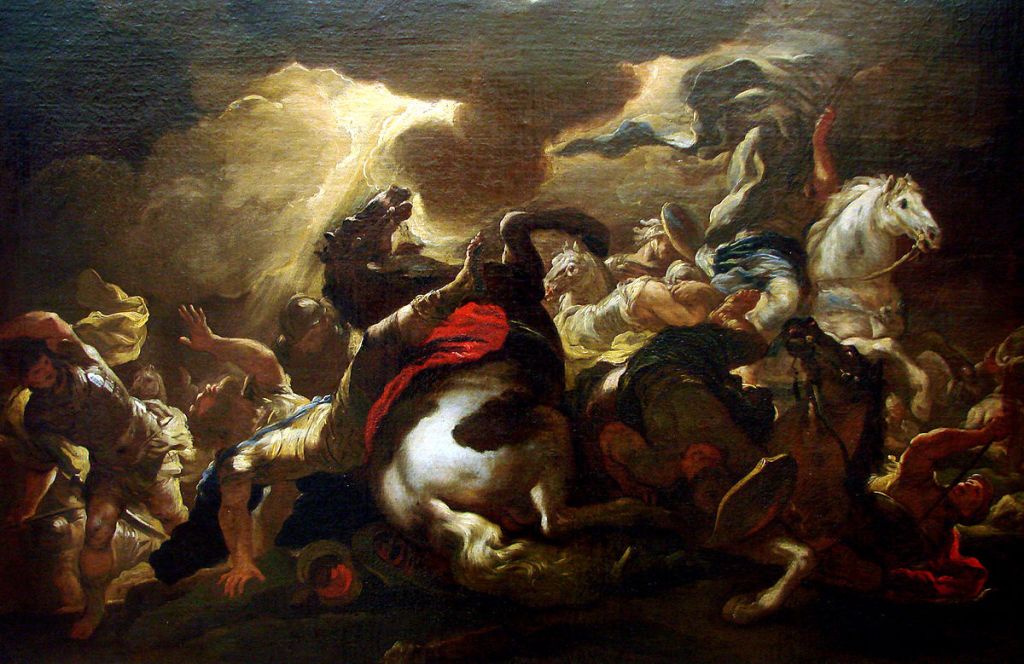
Painting ng “The Conversion of St. Paul” ni Luca Giordano noong 1690 mula sa wikipedia.org.
“Magbago ka na!” Iyan ang mga salitang madalas nating marinig at sinasabi sa mga tao na alam nating mayroong masamang pag-uugali at gawain. Madalas bitiwan mga salitang iyan tuwing Bagong Taon at mga Mahal na Araw.
Ngunit, maari nga ba talagang magbago ng pag-uugali o ng pagkatao ang sino man? Ibig bang sabihin yung dating iyakin magiging bungisngis o dating madaldal magiging tahimik? Iyon bang matapang kapag nagbago magiging duwag o dating palaban magiging walang kibo at imik?
Kung isasalin sa sariling wika natin ang salitang “conversion”, nagpapahiwatig ito ng pagbabago tulad ng na-convert sa ibang relihiyon o sa ibang anyo o gamit. Ngunit sa bawat pagbabago, mayroong higit na malalim na nababago na hindi namang ibig sabihin ay nag-iiba o naging different.
Kasi iyong sinasabing conversion ni San Pablo o ng sino pa mang tao ay hindi naman pagbabago ng pagkatao kung tutuusin; sa bawat conversion, hindi naman nababago ating pagkatao talaga kungdi ating puso na naroon sa ating kalooban.
Kaya tinatawag itong pagbabalik-loob, di lamang pagbabagong-buhay.
Binabalikan natin ang Diyos na nananahan sa puso natin, doon sa kalooban natin.
Higit na malalim at makahulugang isalin ang conversion sa katagang “pagbabalik-loob” dahil ang totoo naman ay bumabalik tayo sa Diyos na naroon sa loob ng ating sarili.
Dito ipinakikita rin na likas tayong mabuti sapagkat mula tayo sa Diyos na mismong Kabutihan. Kailangang pagsisihan mga kasalanan, talikuran at talikdan kasamaan na siyang mga balakid sa ano mang pagbabalik-loob at saka pa lamang mababago ating pamumuhay.
Katulad ni San Pablo, sino man sa atin na makatagpo sa liwanag ng Diyos, nagiging maliwanag ang lahat kayat atin nang hahangarin ang Diyos na lamang at kanyang kalooban. Nananatili ating katauhan at pag-uugali ngunit naiiba direksiyon at pokus.
Kapansin-pansin na bawat nagkakasala wika nga ay malayo ang loob sa Diyos na ibig sabihin ay “ayaw sa Diyos” gaya ng ating pakahulugan tuwing sinasabing “malayo ang loob”. Ang nagbabalik-loob ay lumalapit, nagbabalik-loob at pumapaloob sa Diyos.
Pangangaral ni San Pablo sa Areopagus sa Athens (larawan mula sa wikipedia.org).
Isang magandang paalala sa ating lahat itong Kapistahan ng Pagbabalik-loob ni San Pablo na hindi malayo at hindi rin mahirap maabot, bumalik sa Diyos sa pamamagitan ni Kristo Jesus. Maari itong mangyari sa gitna mismo ng ating sira at maruming sarili.
Hindi nabago pagkatao at pag-uugali ni San Pablo kung tutuusin: nanatili pa rin siyang masugid, matapang at masigasig. Nabago lamang ang direksiyon at pokus o tuon ng kanyang pag-uugali at pagkatao. At siya pa rin iyon. Inamin niya sa ating unang pagbasa ngayon na siya ay “isang Judio, ipinanganak sa Tarso ng Cilicia ngunit lumaki rin sa Jerusalem. Nag-aral kay Gamaliel at buong higpit na tinuruan sa Kautusuan ng mga ninuno at masugid na naglilingkod sa Diyos” (Gawa 22:3).
Nanatiling masugid sa Diyos si San Pablo ngunit naiba na ang batayan na dati ay sa mga Kautusan at tradisyon ngunit sa kanyang pagbabalik-loob, si Jesu-Kristo na ang batayan ng kanyang pananampalataya. Personal niyang naranasan si Jesus kaya gayon na lamang kanyang pagiging masugid na alagad. Sinasabing kung hindi siya nadakip at nakulong hanggang sa patayin marahil ay umabot siya sa Africa sa pagpapalaganap ng Mabuting Balita.
Hindi rin nabawasan kanyang tapang; bagkus pa nga ay higit pa siyang tumapang. Lahat ng hirap tiniis niya at hinarap gaya ng pambubugbog sa kanila, ma-shipwreck sa isla, mabilanggo ng ilang ulit at ni minsan hindi umatras sa mga balitaktakan at paliwanagan sa mga Judio at maging kay San Pedro ay kanyang kayang salungatin at pagsabihan kung kinakailangan.
Gayon na lamang ang malasakit ni San Pablo sa Panginoong Jesu-Kristo at kanyang Mabuting Balita kaya naman sabay ang pagdiriwang ng kanilang Dakilang Kapistahan ni San Pedro tuwing ika-29 ng Hunyo dahil magkapantay kanilang kahalagahan sa pagpapatatag, pamumuno at pagpapalaganap ng pananampalataya at Simbahan.
Ordinasyon sa pagka-diyakano sa Katedral sa Malolos, ika-12 ng Hunyo 2019.
Alalaong-baga, katulad ni San Pablo, ano man ating pagkatao at pag-uugali siya pa ring mga dahilan kaya tayo tinatawag ng Panginoon upang maglingkod sa kanya; ililihis at ihihilig lamang niya mga ito ayon sa kanyang panukala at kalooban.
Kaming mga pari kapag inordenahan ay ganoon pa rin naman pagkatao at pag-uugali ngunit nababago direksiyon at tuon sa bagong estado ng buhay at misyon.
Gayun din ang mga mag-asawa. Lalabas at lalabas tunay na pagkatao at pag-uugali ngunit hindi iyon mga sagwil upang lumago at lumalim sila sa pagmamahalan at pagsasama bilang mag-asawa.
Wika nga sa Inggles, “God does not call the qualified; he qualifies the call.” Maraming pagkakataon tinatawag tayo ng Diyos maglingkod sa kanya di dahil sa tayo ay magagaling at mahusay; madalas nagugulat pa tayo na mismong ating kapintasan at kakulangan ang ginagamit ng Diyos para tayo maging mabisa sa pagtupad sa kanyang tawag.
Madalas at hindi naman maaalis na sumablay pa rin tayo at sumulpot paulit-ulit dating pag-uugali. Kaya naman isang proseso na nagpapatuloy, hindi natatapos ang pagbabalik-loob sa Diyos. Araw-araw tinatawagan tayong magbalik-loob.
Larawan kuha ni G. Jim Marpa sa Dabaw, 15 Enero 2024.
Gaya ni San Pablo nang siya ay ma-bad trip kay Juan Marcos na iniwan sila ni Bernabe sa una nilang pagmimisyon. Batay sa kasulatan, ibig pagbigayn pa ni San Bernabe na muling isama si Juan Marcos sa pangalawang pagmimisyon nila ngunit mariin ang pagtanggi at pagtutol ni San Pablo kaya’t sila ay naghiwalay ng landas bagamat nanatili silang mga alagad ni Kristo. Sa bandang huli naman ay nagkapatawaran sila.
Ganoon din tayo, hindi ba? Walang perfect. Ang mahalaga araw-araw nagbabalik-loob tayo sa Diyos dahil araw-araw lumiligwak din tayo sa ating maling pag-uugali at mahunang pagkatao.
Higit sa lahat, sa ating patuloy na pagbabalik-loob, doon lamang magiging maliwanag sa ating ang kalooban ng Diyos na palagi nating inaalam sapagkat batid nating ito ang pinakamabuti para sa atin. Ang kalooban ng Diyos ang magtuturo sa atin ng tamang landas na tatahakin upang ating buhay ay maging ganap at kasiya-siya.
Subalit kadalasan tayo ay nabibigo, naguguluhan kung ano ang kalooban ng Diyos dahil akala natin para itong tanong na isang pindot ay malalaman kaagad ang sagot tulad ng sa Google. Mahirap mabatid kalooban ng Diyos kung tayo ay malayo sa kanya dahil sa mga kasalanan. Kaya tulad ni San Pablo, idalangin natin sa Ama sa pamamagitan ni Jesu-Kristong Anak niya na magpatuloy tayo sa pagbabalik-loob upang manatili tayong nakapaloob sa Diyos. Amen. San Pablo, ipanalangin mo kami!
The Lord Is My Chef Daily Recipe for the Soul by Fr. Nicanor F. Lalog II
Wednesday, Memorial, St. Francis Sales, Bishop & Doctor of the Church, 24 January 2024
2 Samuel 7:4-17  <*((((>< + ><))))*>  Mark 4:1-20
“The Sower at Sunset” by Vincent Van Gogh, oil on canvas painted in June 1888 from wikimedia commons.
Lord Jesus Christ,
as you narrated to us today
the parable of the sower,
I wonder what were the other
seeds you have sowed
aside from your word?
On another occasion, Jesus began to teach by the sea. A very large crowd gathered around him so that he got into a boat on the sea and sat down. And the whole crowd was beside the sea on land. And he taught them at length in parables, and in the course of his instruction he said to them, “Hear this! A sower went out to sow.”
We are not just the different
kinds of soil where your seeds
fell, Lord Jesus;
like you, may we also be
sowers of your word and teachings,
sowers of your love and mercy,
sowers of compassion and kindness,
sowers of your light and life,
sowers of your hope and healing,
sowers of your very presence.

When God told David not to build
him a temple as he promised to raise
a house for him from whom
shall come the Christ,
that was when the Father also
sowed the seeds of redemption
and fulfillment in you,
Lord Jesus!
On this feast of St. Francis Sales,
patron of Catholic journalists and
media practitioners,
we pray for all communicators
to sow unity and peace,
not division
nor misunderstanding,
nor animosities;
we pray for all journalists
of different platforms
to sow understanding
and clarity,
to sow justice and equality
among peoples,
and to sow respect for life
at all times because every
communication must promote
first of all the dignity
 of every person.
Amen.
The Lord Is My Chef Daily Recipe for the Soul by Fr. Nicanor F. Lalog II
Tuesday in the Third Week of Ordinary Time, Year II, 23 January 2024
2 Samuel 6:12-15, 17-19  <'[[[[>< + ><]]]]'>  Mark 3:31-35
Photo by Mr. Jim Marpa, 15 January 2024 in Davao.
How timely are your
words today, O God,
for us always checking
on what is trending
and viral,
on who's in,
and who's out:
The mother of Jesus and his brothers arrived at the house. Standing outside they sent word to Jesus and called him. A crowd seated around him told him, “Your mother and your brothers and your sisters are outside asking for you.” And looking around at those seated in the circle he said, “Here are my mother and my brothers. For whoever does the will of God is my brother and sister and mother.”
Mark 3:31-32, 34-35
Remind us,
dear Jesus that being in
and being out with you
is not physical nor spatial
but spiritual in nature;
even with one another!
How sad
many of us these days
 are preoccupied in being in,
being hip,
being included
and accepted
for the sake of status
and fame;
being in
being out
is being close,
being far
from the beloved's heart.
Help us,
dear God to imitate
King David
though he was inside
the circle of those
carrying your ark
to Jerusalem,
his heart, his mind,
his very self was in you
totally!
Amen.
The Lord Is My Chef Sunday Recipe for the Soul by Fr. Nicanor F. Lalog II
Feast of the Sto. Niño, Cycle B, 21 January 2024
Isaiah 9:1-6 ><}}}*> Ephesians 1:3-6, 15-18 ><}}}*> Mark 10:13-16
Photo by Ms. Anne Ramos, 22 March 2020 in Bagbaguin, Sta. Maria,Bulacan during our “libot” of the Blessed Sacrament at the start of the COVID-19 lockdown.
Our Lord Jesus Christ’s attitude to children is perfectly clear in our gospel this Sunday, “Let the children come to me; do not prevent them, for the kingdom of God belongs to such as these. Amen, I say to you, whoever does not accept the kingdom of God like a child will not enter it” (Mk 10:15).
Being like a child is actually the main teaching of Jesus Christ who came to us precisely as one. Right at his infancy like most babies these days, Jesus faced a lot of great risks of being harmed or even getting killed.
See how Jesus insisted in all his teachings on this need to become like a child, to go back to one’s beginnings in order to get into God’s kingdom which is actually him, his very person. Keep in mind that the kingdom of God is not a territorial domain but the very person of Jesus Christ himself. It is from this fact we realize that being a child as taught by Jesus is a mystery that can never be explained nor solved in our minds and mental faculties. This we find in that occasion when Nicodemus, a Pharisee, came to Jesus hiding in the darkness of the night to discuss the kingdom of God. When Jesus told him of the need to be born from above (or, be born again in earlier translations) which is to become like a child, he thought it to be in the literal manner.
Jesus chided Nicodemus by saying, “You are the teacher of Israel and you do not understand this?” (Jn. 3:9-10). It was not sarcasm nor an insult by Jesus but a clarification to everyone including us today that being a child to enter the kingdom of God is a mystery we have to embrace and experience and feel in the heart not deduced in the mind.
And this is exactly what the Feast of the Sto. Niño is all about that we celebrate every third Sunday in January.
The Vatican has given us this special celebration as an extension of the Christmas season in recognition of the great role played by the image of Sto. Niño Magellan gifted Queen Juana of Cebu in 1521.
After leaving our shores after Magellan was killed in Mactan, the Spaniards returned in 1565 under Miguel Lopez de Legazpi to claim our islands for the King of Spain. Upon their arrival in Cebu, they found the Sto. Niño enshrined in a house of worship prominently displayed as the main God of the natives along with their other idols and gods. Historians say the people of Cebu during those years between 1521 to 1565 have found the Sto. Niño as the most powerful and effective in granting their prayers for children (fertility), rains and bountiful harvests that rightly it was the Sto. Niño who actually conquered the Philippines that we have become the only Christian nation in this part of the world. In those 44 years after Magellan and his men left the Philippines, the Sto. Niño had remained and stayed with the natives keeping them safe and secured all those years until the Spaniards returned to be colonized through Legazpi.
What a beautiful imagery of the Sto. Niño staying behind with our forefathers conquering them not with swords nor force but with love and mercy, and youthfulness of the Child Jesus!
Recall how last Sunday we have reflected the words stay and remain when Andrew asked Jesus where he was staying: to stay, to dwell mean more than its spatial nature as a place or location but also in a deeper sense, a communion. It is in dwelling in Jesus who is the kingdom of God that we belong, we become a part of that kingdom.
When Jesus spoke of “being born from above” to Nicodemus, he was not only referring to the Sacrament of Baptism but to the very fact how he as the Christ from the very start has always dwelled and remained in the Father.
Three days after being found in the temple in Jerusalem when Jesus was 12 years old, he told Mary his Mother, “Why were you looking for me? Did you not know that I must be in my Father’s house?”(Lk.2:49). What a beautiful expression of that union in “being in my Father’s house” to show us this mystery of Jesus being like a child, the Son of God who has remained the Father’s beloved One into his adulthood because he had always been in union with the Father. Jesus is inseparable from the Father because he himself takes abode and dwelling in God.
“The Finding of the Savior at the Temple” painting by William Holman Hunt (1860) from en.wikipedia.org.
When Jesus was approaching his Passion and Death, he repeatedly told everyone how everything he had said and done were not his but his Father’s to indicate his communion and union in him. Ultimately there on the Cross, his final words expressed the same truth that he is the Son of God obedient unto death especially when he called out, “Father, into your hands I commend my spirit” (Lk.23:46).
Therefore, to accept and welcome a child in Jesus’ name is not just an act of charity nor of a simple finding of Jesus among children. It is ultimately being one, of remaining in the Father because Jesus also said “whoever welcomes such a child in my name, welcomes me” (Mt 18:5).
Photo by author, 2022.
That is why the kingdom of God is for those who are like children always one with God like Jesus.
To be a child is to remain in God, to always love expressed in kindness and care for others especially the weak, being forgiving and merciful and compassionate with those lost like the Father.
To be like a child is being a light who brightens the life of others just like a babies whose very sight and smiles can ease our pains and sorrows, giving us the much needed boost to forge on in life. We are filled with hope whenever we encounter or see infants because they remind us too of God dwelling in them, of a God who assures and ensures us with s bright future.
This the reason we have in our first reading that part of the Book of Isaiah we heard proclaimed on Christmas day to remind us that Jesus is the light born on the darkest night of the year to illumine our lives and the world darkened by sins and evil like wars, poverty, and diseases. We see light in being like a child because that is when we are one in the Father too in being like a child.
Let me cite again that beautiful movie Firefly where the main character, the child named Tonton loved his mother so much that he totally believed her stories that sent him into a journey to search for the magical island filled with fireflies. Tonton dwelled in his mother’s love that he eventually found the magical island with the many fireflies that in the process also brought light into the darkness within the three adults he befriended in the bus going to Bicol.
Many times in my ministry as chaplain in our hospital, I have seen the great powers within every child – of how a sick baby, a sick child could send his/her parents to summon all their faith in God to heal them, to save them.
Listen to the stories of those who join the Traslacion every year in Quiapo: most of them had their panata borne out of answered prayers for their sick children. Every parent knows it so well how they have moved mountains and did the most extraordinary for the sake of their infants and children.
That is the mystery of the kingdom of God belonging to children when God gives us every spiritual blessing we need to achieve the impossible (second reading) to become like children by remaining in God as the only power and salvation in this life.
Be with a child, stay with a child and you shall find God’s kingdom.
Be like a child and you shall experience the kingdom of God! Amen. Have a blessed week ahead!
The Lord Is My Chef Daily Recipe for the Soul by Fr. NIcanor F. Lalog II
Friday in the Second Week of Ordinary Time, Year II, 19 January 2024
1 Samuel 24:3-21  <'[[[[>< + ><]]]]'>  Mark 3:13-19
Photo by Ms. April Oliveros on Mt. Pulag, March 2023.
Dearest Lord Jesus:
today I imagined myself
one of your twelve Apostles
you have called and appointed;
I also imagined myself like
David in the first reading,
stealthily cutting off an end
of King Saul's mantle while
inside a cave in pursuit of him
to kill him!
In my prayers,
I felt one desire,
one important thing
I need in the moment:
the grace to overcome
personal differences
especially with my co-workers
in your vineyard,
with those above me
as superiors.

Teach me, O Lord,
to overcome differences
with others like your Apostles
who came from various backgrounds
with temperaments and attitudes
even poles apart
like Matthew the former tax collector
and collaborator with the Romans
working with Simon the Cananean
also referred to as the Zealot;
teach me to focus more on you,
to always find you,
most of all,
to bring you and share you
in every dealing with others
I have differences with.

Grant me the grace
to be centered in you alone
than be overtaken by our many
differences that ruin
the mission you have entrusted to us.
Likewise,
teach me the virtue of respect
that literally means to look
again and again (re specere);
when differences become so
deep, even would cause us
to fight others like David and
King Saul,
let me still focus on you,
O Lord,
to respect the person
and their office
and designation
in order to avoid hurting
and dividing your precious Body,
the Church.
Amen.
Photo by Ms. April Oliveros on Mt. Pulag, March 2023.
The Lord Is My Chef Daily Recipe for the Soul by Fr. Nicanor F. Lalog II
Thursday in the Second Week of Ordinary Time, Year II, 18 January 2024
1 Samuel 18:6-9, 19:1-7  <*{{{{>< + ><}}}}*>  Mark 3:7-12
Photo by author, sunflower farm in La Trinidad, Benguet, 12 July 2023.
"In God I trust; I shall not fear."
Let those words of the psalmist
today be my prayer too, dear Father
especially when jealousy slowly
creeps into me,
when people around me do better,
when they seem to be more
loved or liked or accepted;
like King Saul in the first reading
today, there are times I am filled
with insecurities
with my own self,
with my strengths
and abilities,
most especially,
with your love.
Jealousy arises easily in our hearts… When we truly enjoy God’s unlimited generosity, we will be grateful for what our brothers and sisters receive. Jealousy will simply have no place in our hearts.
Fr. Henri Nouwen
How true were the words
of the late Fr. Henri Nouwen;
jealousy arises easily
in our hearts;
sometimes they just come
without us even
thinking about it;
problem is,
many times we entertain
and let it take over us,
feeling we are a victim
of something,
 like King Saul,
or the elder brother in
the parable of the prodigal son,
or those early workers
in the parable of the vineyard
who felt they should be paid more
than those late workers
who were paid with same wage
as theirs.
When good things happen
to others,
teach me to rejoice
with them,
let me be thankful
too for their being blessed
by you;
let me not be jealous
of whatever they have
for you never fail to bless me
too with so many things
they do not have;
let me be more trusting
in your generosity,
O God,
to never have fear of you
running out of blessings
and other good things
for each one of us
according to our own abilities;
let me rejoice
when other people
are blessed like in the gospel today
because whatever good things
that happen around us
are signs
you are with us
in Christ Jesus.

Instead of looking on what
others have,
let me look what I have,
and always,
let that be YOU
in Christ Jesus!
Amen.


















 lordmychef.com