The Lord Is My Chef Daily Recipe for the Soul by Fr. Nicanor F. Lalog II
First Friday, Fourth Week in Ordinary Time, 07 February 2025
Hebrews 13:1-8     ><}}}}*>  +  ><}}}}*>  +  ><}}}}*>     Mark 6:14-29
Photo by Mr. Gelo Carpio Nicolas, January 2020.
Keep me faithful and true
to you,
Jesus
because
you are
"the same yesterday,
today,
and forever"
(Hebrews 13:8);
it is I who forgets
all the time,
who chooses to turn away
from you and be unloving,
unkind,
unforgiving.
Forgive me, Jesus
when you tell me
"Let brotherly love continue"
(Hebrews 13:1)....
...but many times
I can't look or even consider
 each one a brother or a sister
because of our many differences.
"Do not neglect hospitality,
for through it some have unknowingly
entertained angels"
(Hebrews 13:2)...
...I think,
more than the angels
but on many occasions it was
you whom I have turned away,
Jesus because I am
so suspicious of others
who come to me for whatever
needs.
"Be mindful of prisoners
as if sharing their imprisonment,
and of the ill-treated as of yourselves,
for you are also in the body"
(Hebrews 13:3)...
I'm sorry,
Jesus for the many times
I have imprisoned others
in my narrow mind
of many biases
 and prejudices.
"Let marriage be honored
among all and the marriage bed
be kept undefiled"
(Hebrews (13:4)...
what a shame,
Jesus in our age when
marriage is no longer honored
and just taken for granted
with many couples
defiling their bed.
"Let your life be free
from love of money but
be content with what you have"
(Hebrews 13:5)...
alas!
my dearest Jesus,
save us your priests
our diocese so in love
with money,
with the rich
and powerful with whom
we are so close
and identified with,
totally neglecting
the poor and the suffering
among us with our
many excuses and alibis,
always at their beck and calls.
Yes, Jesus,
many times we feel like
Herod: bothered
only by the gospel,
bothered only of your
presence among the poor
and suffering
but so much like Herod,
we never bothered ourselves
to truly find you
and follow you.
Amen.
Photo from Wikipedia, mosaic of Jesus with Mary and John the Baptist at the Hagia Sophia in Turkey.
Quiet Storm by Fr. Nicanor F. Lalog II, 05 February 2025
Photo by author, Cathedral of St. Catherine of Alexandria, Dumaguete City, 07 November 2024.
Discipline is a word so misunderstood these days that too often, it is frowned upon or even feared by many. In this age of so much “freedom” without any regard to “responsibility”, discipline has become its main casualty.
Discipline has very interesting origins. From the Latin verb discere which is to learn or to follow, its noun is disciplina for teaching or learning from which came the word discipulus for disciple, a follower or a pupil. Hence, a person of discipline is one who follows or obeys teachings.
The more disciplined a person is,
the more free a person becomes!
As we have mentioned at the start, due to the wrong perception of “freedom” these days as the ability to do whatever one wants, many see discipline as suppression of freedom. But what is most true is its opposite – the more disciplined a person is, the more free the person becomes!
Photo by author, sunrise at St. Paul Spirituality Center, Pico, La Trinidad, Benguet, 06 January 2025.
When we discipline ourselves in every aspect of our lives like in food and drink intake, in using our time wisely, in budgeting our money and resources among other things, the more we become free to many other things in life. Remove discipline and do whatever you like in your life, eventually you become “unfree” because definitely you will miss your responsibilities and obligations like studies in school and duties at home and the office.
Freedom is never absolute. It has always been limited to choosing and doing what is good. When freedom is abused, it can lead us into being not free at all.
Likewise, some people think discipline is temporary and optional. Many believe that discipline is just for kids and young people who ought to follow their parents and elders. What about adults following their superiors and those above them in the natural and social hierarchy of things and relationships? This perhaps explain the reason why there is a growing complaint against young people lacking respect to elders and those in authority.
Discipline is a life-long process, the one sure thing we would need even rely upon so much as we age and get old. Discipline is imposed and taught in our younger age so that we would mature, grow and develop as persons. It is a lifelong process, a habit, a good that we keep on doing until we die. Or, even if we get old and sick, discipline is our North Star, the Polaris within ourselves especially when everything is dark, when we seem lost in life. Discipline enables us to succeed and be fulfilled in life. Find any bum and surely you shall find no discipline at all; but, you can never find a successful person without any discipline.
“Jesus Unrolls Book In the Synagogue” painting by James Tissot (1886-1894), brooklynmuseum.org
Our Lord Jesus Christ is the most perfect example of a disciplined person, of leading a disciplined life. All evangelists tell us how Jesus always went to the synagogue on a sabbath to worship and to preach. Most of all, Jesus always prayed early in the morning or later in the evening in some deserted place. These were all forms of discipline He must have learned from His parents Mary and Joseph who were both portrayed in the gospels as devout Jews, both with high degrees of discipline in life even before Christ was born.
Prayer after all is a discipline, something we have to cultivate that leads to a loving relationship with God and with others too! And here we find the deeper reality of discipline which is not just a human effort and endeavor. Discipline is the work of God, His gift and grace to each one of us to have fulfillment in life
Discipline is not just a human effort;
discipline is the work of God too!
Brothers and sisters: You have also forgotten the exhortation addressed to you as children: My son, do not disdain the discipline of the Lord or lose heart when reproved by him; for whom the Lord loves, he disciplines; he scourges every son he acknowledges. Endure your trials as “discipline”… At the time, all discipline seems a cause not for joy but for pain, yet later it brings the peaceful fruit of righteousness to those who are trained by it (Hebrews 12:5-7, 11).
Photo by author, St. Scholastica Spirituality Center, Tagaytay, August 2024.
How I wish parents would still use that analogy by the author of the Letter to the Hebrews regarding discipline. When we were growing up, our parents would always explain to us after scolding us due to misdemeanor or a mistake that it was to discipline us in doing what is right or what is good.
This is something so evident these days, when you hear the older folks saying how life was more orderly before because of discipline unlike today. And one may find this lack of discipline everywhere – in public places not only home, including in churches. Partly to be blamed for that is us, the older folks who have stopped teaching discipline to kids and the youth.
Lately I have been seeing many of my former students in elementary and high school. I have always known many of them hated me when in school because I was a strict teacher (and priest). Including many of our teachers too! That is why whenever we talked about their school days, I always asked them to forgive me for making their lives so difficult as I demanded excellence and precision in their studies and most of all, discipline at all times like cleanliness in their clothing and bearing, order and silence in classrooms, and of course, proper decorum inside the church.
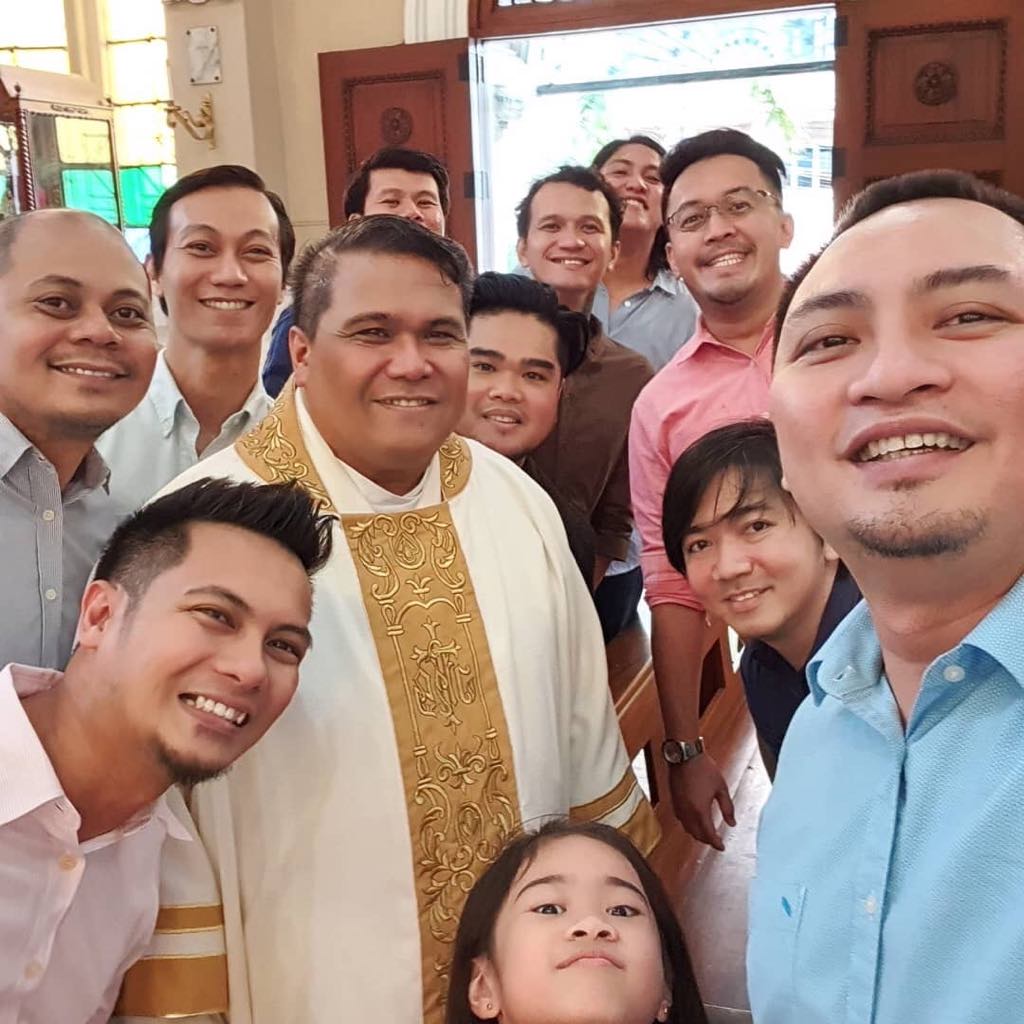
At the wedding of one of my former student with his classmates in January 2020.
Surprisingly, they always ended up thanking me for the discipline I have taught and instilled in them that according to them led to their success in both their personal and professional life. Many of them have their family of their own now with some living overseas. It brings me so much joy with some tears when they tell me how they have taught their own children of the discipline I drilled in them about studies and reading, of prayer, and of simply being the very best for God in everything. It is the same thing with some of our teachers who have remained some of my dearest friends today with some living and working abroad. In fact, they claimed that it was my “terroristic discipline” that greatly prepared them for their lives and work in foreign lands and cultures.
We need to discipline ourselves for God’s grace to work in us. And remember, grace builds on nature – that’s the beauty of discipline: the more we practice it, the more blessed we become! It is a built-in app or program God has installed in each of us. Use it extensively by switching it on always. In case there’s a glitch, still, switch it on and surely it would work. As always. Have a disciplined week ahead.
The Lord Is My Chef Daily Recipe for the Soul by Fr. Nicanor F. Lalog II
Wednesday, Memorial of St. Agatha, Virgin & Martyr, 05 February 2025
Hebrews 12:4-7, 11-15     ><))))*> + ><))))*> + ><))))*>     Mark 6:1-6
Photo by author, Sakura Farm, Atok, Benguet, 27 December 2024.
Today dear Lord,
I pray for more discipline
which is a frightening
and misunderstood word
and concept for many
these days.
There are some who think
discipline is suppression of freedom,
a kind of constriction not realizing
it is in discipline we truly become
free; for some, discipline is optional,
even seasonal when in reality,
we need discipline in our entire life;
lastly, people have difficulty with
discipline because they see it only
as a human activity, a human effort
forgetting that God has a large part
in our discipline.
Brothers and sisters: You have also forgotten the exhortation addressed to you as children: My son, do not disdain the discipline of the Lord or lose heart when reproved by him; for whom the Lord loves, he disciplines; he scourges every son he acknowledges. Endure your trials as “discipline”… At the time, all discipline seems a cause not for joy but for pain, yet later it brings the peaceful fruit of righteousness to those who are trained by it (Hebrews 12:5-7, 11).
“Jesus Unrolls Book In the Synagogue” painting by James Tissot (1886-1894), brooklynmuseum.org
How I admire your own
discipline, Lord Jesus:
your coming home to
Nazareth and most especially
your practice of sabbath
are clear indications of your
great discipline!
How lovely that the word
discipline is also from disciple,
a follower;
as your follower,
help me continue with my
self-discipline
to inspire and teach
others too of the importance
of discipline in life
and in discipleship.
Amen.
*We also pray today
for all with breast cancer
being the memorial of
their patroness, St. Agatha
whose breasts were cut off
as one of the tortures she
endured; but after having a
vision of St. Peter,
her breasts were restored
and completely healed
while in prison.
Lawiswis ng Salita ni P. Nicanor F. Lalog II, Ika-04 ng Pebrero 2025
Larawan kuha ng may-akda, Tagaytay, 17 Enero 2025.
Sampung araw
bago sumapit
ang Valentine's
sa akin ay lumapit
isang dalagita
nahihiyang nagtanong
bagama't ibig niyang
mabatid kung
"makakahanap po ba ako
ng lalaking magmamahal
sa akin ng tunay
at tapat?"
Ako'y nanahimik,
ngumiti at tumingin sa
dalagitang nahihiyang
nakatungo ang ulo
sa kanyang tanong
at nang ako'y magsimulang
mangusap,
mukha niya ay bumusilak
sa tuwa sa bagong
kaalaman sa pag-ibig
na matiyaga niyang
sinasaliksik.
Larawan kuha ng may-akda, Atok, Benguet, 27 Disyembre 2024.
Ito ang wika ko sa dalagita:
"Ang pag-ibig,"
ay hindi hinahanap
parang gamit nakakamit
dahil ang pag-ibig
ay kusang dumarating
kaya iyong matiyagang hintayin
ikaw ang kanyang hahanapin;
tangi mong gampanin
buksang palagi iyong
puso at damdamin
dahil itong pag-ibig
ay dumarating sa mga tao
 at pagkakataong
hindi inaasahan natin;
banayad at mayumi
hindi magaspang pag-uugali
magugulat ka na lamang
ika’y kanyang natagpuan
palagi na siyang laman
 ng puso at isipan."
"Pakaingatan din naman",
wika ko sa dalagita
"itong pag-ibig ay higit pa
sa damdamin na dapat
payabungin tulad ng mga
pananim,
linangin upang lumalim
hanggang maging
isang pasya
na laging pipiliin
ano man ang sapitin
at hantungan."
Ang pag-ibig
ay parating dumarating
ngunit kadalasan hindi
natin pansin
kung minsan tinatanggihan,
inaayawan
dahil ang ibig ay kumabig;
darating at mananatili
itong pag-ibig
sa simula na ating limutin
lahat ng para sa sarili
natin.
Larawan kuha ng may-akda, Atok, Benguet, 27 Disyembre 2024.
The Lord Is My Chef Daily Recipe for the Soul by Fr. Nicanor F. Lalog II
Tuesday, Fourth Week in Ordinary Time, Year I, 04 February 2025
Hebrews 12:1-4     ><]]]]'>  +  ><]]]]'>  +  ><]]]]'>     Mark 5:21-43
Photo by author, sunrise at the Sea (Lake) of Galilee, the Holy Land, 18 May 2019.
When Jesus had crossed again in the boat to the other side, a large crowd gathered around him, and he stayed close to the sea (Mark 5:21).
Lord Jesus Christ:

How lovely to hear
this story of your frequent crossing
of the sea to the other side
to reach out to more people
hungry and thirsty
for your words that comfort
and forgive, ease one's burdens
and most especially
for your healing touch.

You always come to us,
Jesus, reaching out to us
when all we have to do is follow
you and as much as possible,
be near you to touch you
like that sick woman
who touched your
clothe after Jairus
had begged you to come
to touch his sick and dying
daughter.
That's all we have to do:
follow you,
be near you,
and touch you;
but, of the large
crowd there like today,
only one dared to touch you;
only one father
had the courage to ask you
to come and lay your hands
on his daughter.
Photo by Dra. Mylene A. Santos, MD in France, 2023.
Give me Jesus
the courage to come to you,
to get near you
and touch you
with faith
and desire to meet you,
to speak to you,
to be with you;
take away my fears
of leaving the safety
of the sidewalks,
of walking the main street
that leads to your Cross
when in fact,
it was you who have
paid the price for me
by dying on the Cross.
Let the words
of the author of the Letter
to the Hebrews sink in me,
"In your struggle against sin
you have not yet resisted
to the point of shedding
 blood" (12:4)
because I am
 always afraid,
always hesitant
in following you,
in touching you.
Touch me, Jesus
so I may cross the sea
with you despite the storm
and giant waves;
touch me, Jesus
so I may cross the street
and walk beside you
in your arduous journey;
touch me, Jesus
so I may stand with you
at your Cross.
Amen.
Photo by author, Sacred Heart Novitiate, Novaliches, QC, 20 March 2024.
Quiet Storm by Fr. Nicanor F. Lalog II, 03 February 2025
Photo from the Presentation Chapel of the Basilica of the National Shrine of the Immaculate Conception in Washington DC.
Every night before going to bed, we priests and religious along with some laypeople pray the Compline or Night Prayer of the Liturgy of the Hours. From the Latin completus, the Compline completes the daily prayers of the Church.
It is also my most favorite since our seminary days when we chanted Simeon’s Canticle which we heard proclaimed in yesterday’s gospel in the celebration of the Feast of the Lord’s Presentation.
He (Simeon) came in the Spirit into the temple; and when the parents brought in the child Jesus to perform the custom of the law in regard to him, he took him in his arms and blessed God, saying: “Now, Master you may let your servant go in peace, according to your word, for my eyes have seen your salvation, which you prepared in sight of all the peoples, a light for revelation to the Gentiles, and glory for your people Israel” (Luke 2:27-32).
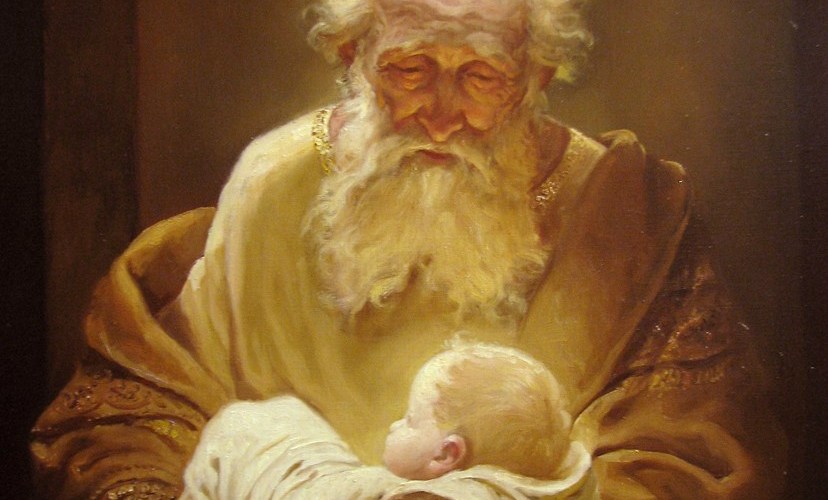
A painting of Simeon with the Child Jesus from the dailyprayerblog.blogspot.com
The Simeon Moment
is befriending death
as we find Jesus Christ.
The “Simeon Moment” is when we are like Simeon in realizing that nothing matters most in this life except God found within us and those closest to us like family and friends whom we would never trade for anybody and anything. It is finding true joy in Christ alone that we are able to befriend death like St. Francis of Assisi who called death a “cousin”.
According to Luke, God had promised Simeon that he would not die until he had seen the promised Messiah (Christ). All his life, Simeon prayed and offered sacrifices at the temple in Jerusalem awaiting the coming of Christ – and he was not disappointed even if it took so long! That is why, he burst into a song which we now pray every night because that is when we experience in the stillness of the darkness within and outside us that only Jesus and always Jesus who fulfills us.
Those who have cared and lost a loved one to cancer or any terminal illness have experienced that “Simeon Moment”. Remember when our loved ones have finally accepted their fate, when they suddenly become more emotionally stable and even joyful in their dispositions? Unlike before when they were first diagnosed with their illness, they were so afraid, always crying but as they came to embrace the reality, they cried less with a strong sense of courage while we are the ones crying more and most stressed out?
Photo by author, November 2024.
That is because the dying must have seen their their final destination in life, Jesus Christ. Like Simeon during the presentation at the temple after seeing and holding in his hands so close to himself the Holy Infant, we find the dying so calm and peaceful during their final hours because they have seen or were already in the presence of the Lord.
Like Simeon, they were silently joyful in Christ’s presence while we who were left behind cried not only due to the pain and sadness of separation but because we do not know where we are going, where we are heading unlike our departed loved ones.
Feel the courage and confidence of Simeon boldly telling God to “take him” at that instance because he had found Jesus Christ. Its Filipino translation says it so well, “Kunin mo na, Panginoon, ang iyong abang alipin, ayon sa iyong pangako, yamang nakita na ng aking mga mata ang iyong pagliligtas (Lk.2:29-30).”
We Filipinos often take it as a joke, always laughing to dismiss the topic or cope with the reality that to see God literally means to die like when we say “gusto nang makita si Lord”. But, that was how Simeon really felt because he had literally seen the Son of God, as if telling him to take him “now na!” because the Simeon Moment is therefore we have that realization within us that coming to terms with death is coming to terms with life, and vice versa.
Photo from crossroadinitiative.com.
The Simeon Moment
is living in the Holy Spirit
Wherever is Jesus Christ, there is always the Holy Spirit. We will never find Christ and have the Simeon Moment unless we are attuned first with Holy Spirit who animates us and opens us to Christ’s coming.
Imagine the great crowds of people at the temple on that day, of couples trying to fulfill the law of Moses of purification and presenting their first-born son to God. How did Simeon know Joseph and Mary were the parents of the Christ? How was he able to accurately spot and find Jesus is the Messiah amid the many male children being offered on that day at the temple?
“To come in the Spirit” like Simeon is more than being faithful to God; it is having a good and pure heart that is ready to believe and act openly with courage, always looking forward at the fulfillment of what we believe. Coming in the Spirit is being at the right place at the right time when we make things happen than wait, exactly how Luke portrayed Simeon and Anna who both lived in the presence of God! Coming in the Spirit is living in the present moment in God.
We cannot see Christ nor live in the Spirit unless we humbly submit ourselves to God, our Lord and Master. Seeing Christ and living in the Spirit presuppose humility before God – we His creatures, He our Lord and Master.
Most of all, our origin and our end too!
It is the principle and foundation of life as St. Ignatius of Loyola stressed in his Spiritual Exercises, “El hombre es criado para alabar, hacer reverencia y servir a Dios nuestro Señor, y mediante esto, salvar su anima”, that is, “Man is created to praise and serve God his Lord and Master and by doing this save his soul”.
There is something so beautiful and lovely, so touching in the opening verse of Simeon’s canticle that underscores firmly this basic truth we have always forgotten since the fall of Adam and Eve when he asked God to take him after seeing the Christ. Every time we sin, we act like Adam and Eve, playing gods, desiring to be like God.
Also known as Nunc Dimittis, Simeon’s canticle echoes the fiat of Mary to God during the Annunciation, expressing his fidelity and humility, his total submission to God. Most of all, it summarizes both the Magnificat of the Blessed Mother and the Benedictus of Zechariah, making Simeon’s Nunc Dimittis the finale in Luke’s Christmas “concert” on the birth of the Messiah.
This is the reason why we chant Nunc dimittis at the end of our Night Prayer. It is the perfect prayer to close each day as we prepare for the coming new day to meet Jesus again, hoping we may be enlightened in our life’s mission expressed by the antiphon we recite before and after chanting it, “Protect us Lord as we stay awake; watch over us as we sleep that awake we may keep watch with Christ and asleep rest in his peace”.
Or, if ever we ever do not wake up the following day, we still thank God all the more in making us meet Jesus the past day, eager to finally sing to him our praises in eternity with Night Prayer’s final blessing, “May the Lord grant us a restful night and a peaceful death”.
The Simeon Moment is a grace and gift Jesus gives us daily not only for the dying but to everyone of us seeking Him, awaiting Him like Simeon. And like Simeon, we are assured that anyone who seeks and awaits God is never disappointed. Have a blessed day in Christ Jesus! Amen.
Photo by author, sunrise bursting through thick fogs over Taal Lake in Bgy. Dayap Itaas, Laurel, Batangas, 17 January 2025.
The Lord Is My Chef Daily Recipe for the Soul by Fr. Nicanor F. Lalog II
Monday, Memorial of St. Blaise, Bishop & Martyr, 03 February 2025
Hebrews 11:32-40     ><))))*>  +  ><))))*>  +  ><))))*>     Mark 5:1-20
Photo by author, Atok, Benguet, 27 December 2024.
Thank you,
dear Father in heaven
for making me feel your
proverbial pat on the shoulder
this Monday:
while the author of the Letter
to the Hebrews wrote of the
heroes and heroines of Old Testament
to remind us of their incredible deeds,
great hardships and sufferings that
led to their giving up their lives
for the sake of their faith,
you remind me too, dear God,
  of my own sufferings and trials in life
far more greater and fulfilling than theirs
not on my own account but in Jesus' name.
The world was not worthy of them. They wandered about in deserts and on mountains, in caves and in crevices in the earth. Yet all these, though approved because of their faith, did not receive what had been promised. God had foreseen something better for us, so that without us they should not be made perfect (Hebrews 11:38-40).
You have rewarded so well all
those great men and women in
the Old Testament but they have to
wait until Jesus Christ's coming for
the fulfillment of your promise to them
in his life, death, and resurrection;
in Jesus, every simplest deed of
self denial and sacrifice lead to
fulfillment like in his exorcism of
that possessed man in Gerasenes
who "had been dwelling among the tombs,
and no one would restrain him any longer,
even with a chain" (Mark 5:3);
only Jesus was able to restore him to
fullness in life, just like with
everyone of us today.

Every miraculous healing by any saint,
any martyrdom is a celebration of
Christ's power over sin and evil,
a proverbial pat on our shoulder
for letting God,
and letting go.
Amen.

St. Blaise,
Bishop and Martyr,
Pray for us.
Photo by author, Mt. Olis, Atok, Benguet, 27 December 2024.
The Lord Is My Chef Sunday Recipe for the Soul by Fr. Nicanor F. Lalog II
Feast of the Presentation of the Lord, 02 February 2025
Malachi 3:1-4  ><}}}}*>  Hebrews 2:14-18  ><}}}}*>  Luke 2:22-40
“Presentation at the Temple” painting by Italian Renaissance artist Andrea Mantegna done around 1455; Mary holding Baby Jesus while St. Joseph at the middle looks on the bearded Simeon. The man at the right is said to be a self-portrait of the artist while the woman at the back of Mary could be his wife. Photo from wikipedia.org.
We take a break from our regular Sunday cycle of readings today being the second of February, the Feast of the Presentation of Jesus at the Temple which is also 40 days after His birth. That is why it is technically the end of Christmas when Joseph and Mary left Bethlehem to bring Jesus to the Temple in Jerusalem.
The Presentation of Jesus at the Temple is one of the earliest major feasts celebrated by the Church in Jerusalem in the third century that reached Rome 300 years later with the designation as the Purification of Mary. Years later as it spread to France, it came to be known as Chandeleur, or Candlemas in English speaking countries and Candelaria in Spanish when the blessing of candles with a short procession was incorporated into its liturgy due to that part of Simeon’s Canticle calling Jesus as the “light of the world” (gentiles). Following the reforms of Vatican II in 1969, St. Paul VI brought it back to its original title as the “Feast of the Presentation of the Lord” due to its Christological emphasis while retaining the traditional rite of the blessing of candles and short procession into the church.
In the Eastern Churches, this Feast is called the Encounter or the meeting of Jesus with the two elderly Simeon and Anna who were both promised by God to witness the coming of His promised salvation before they died.
One thing remains clear in its long history of celebrating the Lord’s Presentation is the beautiful assurance and sign of Jesus Christ’s presence among us enlightening us, lighting our paths, meeting us most especially in our old age as our fulfillment in life.
Now there was a man in Jerusalem whose name was Simeon. This man was righteous and devout, awaiting the consolation of Israel, and the Holy Spirit was upon him. It had been revealed to him by the Holy Spirit that he should not see death before he had seen the Christ of the Lord. He came in the Spirit into the temple; and when the parents brought in the child Jesus to perform the custom of the law in regard to him, he took him into his arms and blessed God, saying: “Now, Master, you may let your servant go in peace, according to your word, for my eyes have seen your salvation, which you prepared in sight of all the peoples, a light for revelation to the Gentiles, and glory for your people Israel” (Luke 2:25-32).
Presentation in the Temple painting by Fra Angelico from fineartamerica.com.
For our reflection, let us identify ourselves with Simeon as we dwell on his actions and words in that momentous Presentation of the Lord in the Temple.
From our long gospel account this Sunday, we get a picture of Simeon as an old man; however, not just chronologically speaking in age but also in his feeling isolated and weak deep inside, waiting for so long in faith and in hope for the coming of the Christ who would bring salvation and peace to a troubled world and a troubled self like us. Let us now reflect on Simeon’s action:
"he took him into his arms and blessed God"
(Luke 2:28)
Photo from crossroadinitiative.com.
Look at the artistry of Luke as a storyteller and a physician who knew so well how people felt when approaching death whether due to an illness or old age like Simeon and Anna. See how Luke had assembled in one scene the two old people meeting the eternally young Son of God in the temple as if telling us not only to meet Jesus Christ but also to take Him into our arms to embrace and carry Him!
To embrace and carry the Infant Jesus like Simeon and Anna is a call for us to transform and level up our way of looking at old age as a reality we must accept and appreciate than hide or avoid with many illusory tactics that only make it more difficult and leave us more fearful.
Be proud of your grey or white hair like George Clooney and Meryl Streep. Don’t be ashamed of those wrinkles for they are our badges of the many wars and battles we have fought in life, regardless whether we have won or lost. One thing is clear though and that is we are still alive. Laugh it off when our memory fails, when we get slow in everything because life is not a race nor a competition but an art that is perfected as we age.
Taking to carry Baby Jesus like Simeon and Anna is embracing old age called “ageing gracefully” – a modern virtue that calls us to deepen our prayer life as we realize and accept the fact that it is now our “boarding time” for the final Encounter with the Lord in eternity.
In my previous parish assignment, there were three elderly men I have become friends with until their death. As they declined in their health, they came to me so often and later called for me to hear their Confessions whenever they would suddenly remember sins they have committed when they were younger. It must have been a unique grace from God to have that “Simeon moment” of carrying and embracing Jesus to be cleansed and purified before they have died. And I am convinced in my four years as a hospital chaplain that everyone is gifted with this “Simeon moment” to carry Jesus just before our final Encounter with Him in the afterlife. To carry Jesus is to cultivate a spiritual life centered in prayer like Simeon and Anna and those three friends I had.
Inversely, the young are blessed too with “Simeon moment” when like Mary and Joseph they share the Christ in them with those who are old and weak by accompanying them, understanding them, and bearing with them in their old age. It is only after we have “taken” the Child Jesus into our hands to hold and carry and embrace can we sing praise to God like Simeon:
"Now, Master, you may let your servant
go in peace, according to your word,
for my eyes have seen your salvation"
(Luke 2:29-30)
A painting of Simeon with the Child Jesus from the dailyprayerblog.blogspot.com
To age gracefully by carrying and embracing the Infant Jesus like Simeon is realizing deep within us that getting old and weak is also part of our celebration of life because that is when we enter Life Himself and when we also let Him enter us completely.
How did Simeon recognize it was the Savior that the two poor couple with a pair of turtledoves or pigeons were presenting in the temple that day?
Long before Joseph and Mary came to offer Jesus at the temple that day, Simeon had already entered into God’s presence in his long period of waiting through prayers and sacrifices. When Mary and Joseph came to the temple to present Jesus, God entered Simeon through the Holy Spirit to recognize the coming of the awaited Christ. Simeon’s prayerful singing of his praise to God while holding the Infant Jesus on that day was the fulfillment and expression of his long fidelity to God, of his being attuned to the Divine presence and promptings all his life.
In this age of instants, nobody waits anymore because many think that waiting is empty, a weakness and a poverty. A waste of time and energy.
The Fourth Joyful Mystery portrayed in the Presentation Chapel of the Basilica of the National Shrine of the Immaculate Conception in Washington DC.
But Simeon shows us the exact opposite in his Canticle. It is in our waiting for God amidst the darkness and nothingness when Jesus really comes like that day in the temple. God is most present and closest with us when all we can do is cry “Lord” or “Jesus” because His very name is already His presence. If we keep that in mind like Simeon, we will surely find and embrace Jesus wherever, whenever.
As we celebrate the Jubilee of Hope this 2025, let us be reminded of Simeon along with the Prophetess Anna who were both Pilgrims of Hope who never lost sight of Christ in the midst of their long waiting. The first and second readings this Sunday assure us that God is coming, God has come in Jesus amid our many darkness and nothingness, weakness and decline.
Like Simeon and Anna, let us await to approach Jesus always for He alone matters most in this life found within us, among our family and friends and the people around us, expressed in love and mercy, kindness and forgiveness, and joy. Just be patient and wait, Jesus will appear for you to take Him and embrace Him in your arms like Simeon. Tell that to Jesus now with your other deep longings and you will not be disappointed. Amen.
Photo by author, sunrise bursting through thick fogs over Taal Lake in Bgy. Dayap Itaas, Laurel, Batangas, 17 January 2025.
The Lord Is My Chef Daily Recipe for the Soul by Fr. Nicanor F. Lalog II
Friday, Memorial of St. John Bosco, Priest, 31 January 2025
Hebrews 10:32-39     <*((((>< <*(((>< + ><)))*> ><))))*>     Mark 4:26-34
Photo by author, Sacred Heart Novitiate, Novaliches, QC, 20 March 2024.
Remember the days past when, after you had been enlightened, you endured a great contest of suffering… Therefore, do not throw away your confidence; it will have great recompense (Hebrews 10:32, 35).
Thank you,
O God our loving Father
for another month past
this new year;
there is indeed no other path
to take but forward
in you and with you
through Jesus.
How amazing,
dear Lord as I look back
to my many setbacks and problems
hurdled in the past,
the more I look forward
into the future!
The more I am excited
of the coming days ahead
because if I made it through
in the past,
through the long, dark nights
of trials and sufferings,
you are always with me
in Jesus.
Photo by author, St. Scholastica Spirituality Center, Tagaytay, August 2024.
Keep me faithful, Jesus;
let me not lose that confidence
in you, Lord, like the farmer
in your parable:
let me keep on sowing your
gospel in words and in deeds
especially among the young and
the underprivileged like
St. John Bosco whose memorial
we celebrate today;
let me do whatever good
I can do today;
most of all,
like St. John Bosco,
let me love without measure
without claiming anything at all
except as your work, Lord Jesus
in sowing seeds until they
sprout to life and grow
until harvest time.
Amen.
Photo by author, Northern Blossoms, Atok, Benguet, 27 December 2024.
The Lord Is My Chef Daily Recipe for the Soul by Fr. Nicanor F. Lalog II
Thursday, Third Week in Ordinary Time, Year I, 30 January 2025
Hebrews 10:19-23     ><}}}}*>  +  ><}}}}*>  +  ><}}}}*>     Mark 4:21-25
Photo by author, sunset in Atok, Benguet, 27 December 2024.
Many times, O Lord Jesus,
I feel you "hide" from me
not because you are avoiding me
but simply because you want me to
find you.
And be surprised
because that is how it is
really with you and the Father
and the Holy Spirit:
you want us
to experience that sense
of awe and wonder
of Jacob in Bethel
when he dreamt of your stairway
to heaven that upon waking up,
he cried out in joy, "Truly,
the Lord is in this spot,
although I did not know it!"
(Genesis 28:16)
Photo by author, Mt. Olis Park, Atok, Benguet, 27 December 2024.
Many times in the gospel
you have asked those you have
healed not to say anything
about you to anyone but
the more they talk about you,
dear Jesus;
and this is what you are
telling us today,
that we cannot hide a shining light
or lamp;
any good will always shine
will always be known
and be seen.
And that is YOU,
Jesus.
When I examine my life,
I have experienced many instances
when you, Jesus, had broken
through the surface after being "hidden"
for a long time deep within me;
and what a joy until now
especially when I am confused,
when I feel alone,
when I see nothing
but darkness,
that is actually when you are "hidden",
 waiting to reveal yourself
 in the simplest occasions,
giving me with "more"
even though I already have
received so much from you
just in finding you!

Grant me the grace, Jesus,
"to approach and seek you
with a sincere heart and in
absolute trust... let me hold
unwaveringly to our confession
that gives us hope for you are
trustworthy as I rouse one another
to love and good works"
(Hebrews 10:22, 23, 24).
Amen.
Photo by author, sunrise at St. Paul Spirituality Center, Pico, La Trinidad, Benguet, 06 January 2025.