The Lord Is My Chef Daily Recipe for the Soul by Fr. Nicanor F. Lalog II
Thursday, Sixth Week in Ordinary Time, Year I, 20 February 2025
Genesis 9:1-13     <*{{{{><  +  ><}}}}*>     Mark 8:27-33
Jesus and his disciples set out for the villages of Caesarea Philippi. Along the way he asked his disciples, “Who do people say that I am?” They said in reply, “John the Baptist, others Elijah, still others one of the prophets.” And he asked them, “But who do you say that I am?” Peter said to him in reply, “You are the Christ.” (Mark 8:27-29)
You are always on the move,
Lord Jesus:
you are always moving,
crossing the lake,
hiking in the mountains
and most often,
walking the streets.

What a lovely imagery
of you, Jesus,
always on the road
with me following you,
watching you,
observing you,
sometimes stopping
because of being tired
but you are always there
waiting for me.
And now,
what a lovely scene
of you back on the road again
but this time asking those closest
to you - including me! -
with that most personal question
of all: "But who do you say
that I am?"
Who are you for me, Jesus?
So many, actually.
I may not be as eloquent
like Peter, but no doubt about
who are you for me, Jesus:
my life,
my meaning,
my love,
my hopes,
my fullness.

But,
very often along this
road,
on these streets we walk
and cross,
dear Jesus
when that who are you for me
is shaken,
is tested,
even doubted
like Peter:
how could you allow
yourself and us your followers
suffer and cry,
and die?
He began to teach them that the Son of Man must suffer greatly and be rejected by the elders, the chief priests, and the scribes, and be killed, and rise after three days. He spoke this openly. Then Peter took him aside and began to rebuke him (Mark 8:31-32).
Let us think always
as God does, Jesus,
not as human beings do
seeking fame and prestige,
comfort and wealth,
self and ego;
let me walk closer with you
Jesus on the streets,
on whatever road
you take
upholding that covenant
of God with Noah to
uphold and respect
human life by
"accounting for human
life" (Genesis 9:5);
more than the colorful
rainbows of the skies,
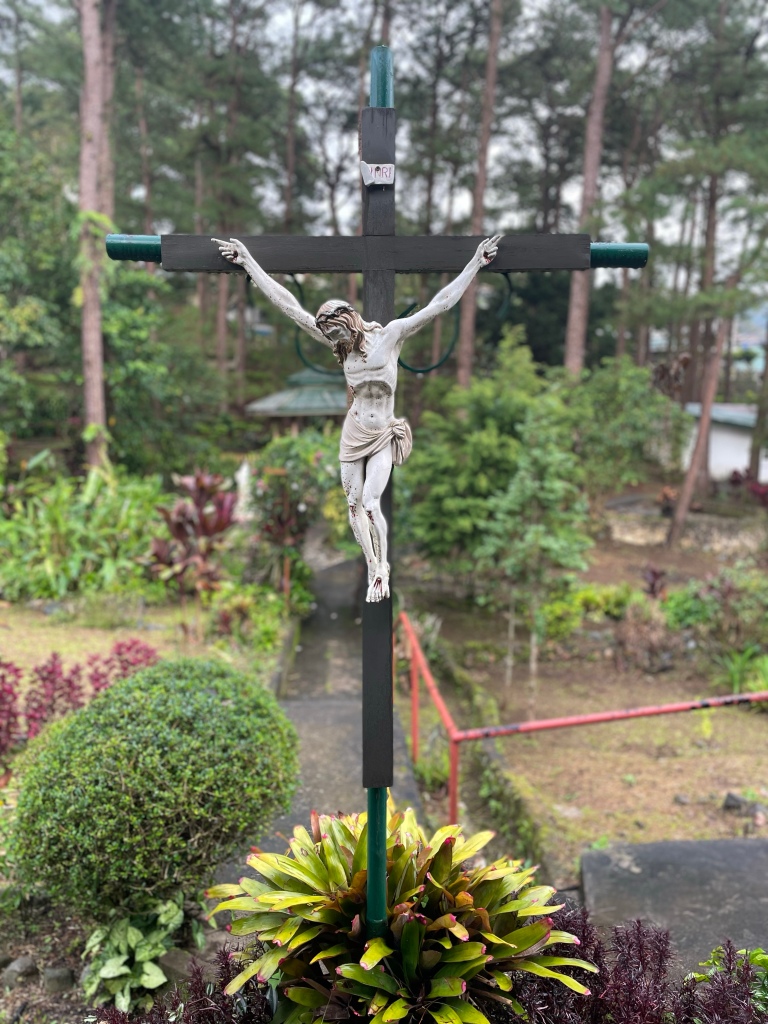
may we always see in your
outstretched arms on the Cross
the true and new covenant
of God with us sealed in
your blood.
Amen.
Photo by author, St. Scholastica Spirituality Center, Baguio City, August 2023.
The Lord Is My Chef Daily Recipe for the Soul by Fr. Nicanor F. Lalog II
Wednesday, Sixth Week in Ordinary Time, Year I, 19 February 2025
Genesis 8:6-13, 20-22     <*0000>< + ><0000*>     Mark 8:22-26
I really wonder,
dear God,
how it felt to be inside
Noah's Ark for 40 days?
The feeling of restlessness,
of anxiety and uncertainty
of the future,
so unsure of what was to come
while at the same time
filled with hope
praying for the best.

How was the boat too?
How did it look like?
What was the smell inside,
the feeling inside that big ark,
the sounds from all the animals
and everything within and
outside?
We have been there many times,
Father, in that big ark called life;
we have passed through many floods,
have waited many times for the waters
to recede,
for the sun to shine,
for life to return to normal.

Through it all,
you never left us, Lord;
send us Noah
who would stand with
us inside the ark for
40 days and 40 nights,
stay afloat,
stay alive
wherever direction you bring us.
Help us, dear Father
to be patient even if we can't
see right away the distant shore
like that blind man healed
by Jesus at Bethsaida;
lead us, Father
in this ark of life
away from the idolatry of
modern world,
away from the trappings
of easy and comfortable life,
away from sin and evil
to be closer to your mercy,
to your "beth hesda" -
to your house of mercy.
Amen.
Photo by author, Cathedral of St. Catherine of Alexandria, Dumaguete City, November 2024.
The Lord Is My Chef Daily Recipe for the Soul by Fr. Nicanor F. Lalog II
Tuesday, Sixth Week in Ordinary Time, Year I, 18 February 2025
Genesis 6:5-8; 7:1-5, 10     <*000><  +  ><000*>     Mark 8:14-21
Photo by author, Nagsasa Cove, San Antonio, Zambales, October 2024.
When he became aware of this he said to them, “Why do you conclude that it is because you have no bread? Do you not understand or comprehend? Are your hearts hardened? Do you have eyes and not see, ears and not hear? Do you still not understand?” (Mark 8:17-18, 20)
Yes,
dear Jesus,
I still do not understand;
enlighten my mind and my heart,
Jesus,
to see your light,
to find your face
among the people I meet
so I could understand more;
I still do not understand
so many things
and people, Lord Jesus,
because I have become numb
and oblivious to your presence;
worst,
I have become so complacent
with those around me
without realizing
their needs
nor situation
as I focus more on
what I have
and what I do not have.
Cleanse my heart
and my mind,
Jesus,
like what the Father did
to earth at the time of Noah;
wash away my many
presumptions
and prejudices
against others
so I may understand more,
stop concluding right away
until I have seen more
in order to love more
like you.
Amen.
The Lord Is My Chef Daily Recipe for the Soul by Fr. Nicanor F. Lalog II
Monday, Sixth Week in Ordinary Time, Year I, 17 February 2025
Genesis 4:1-15, 25     <*((((><  +  ><))))*>     Mark 8:11-13
Photo by author, DRT, Bulacan, November 2024.
How interesting are your words
today, O God our loving Father,
of how Cain like the Pharisees
came to Abel to "discuss" about
something as a pretext before
killing him; the Pharisees went to
Jesus to argue with him
and asked him for a sign
from heaven to test him.
How funny and insane,
dear Father,
how much time we spend
just to discuss
and argue things
about you
and your ways,
asking for many signs
just for us to believe
you; how unfortunate,
our quest for signs
has often led us to sin,
to more divisions
and separations,
more lies
and more hate
because
we have too much self.
Forgive us, Father.
Teach us to offer
you a sacrifice of praise
as the psalmist
sings today
by "doing well,
holding up our heads"
(Genesis 4:7)
giving our best to
listen to you,
to seek you,
and follow you.
Amen.
The Lord Is My Chef Sunday Recipe for the Soul by Fr. Nicanor F. Lalog II
Sixth Sunday in Ordinary Time, Cycle C, 16 February 2025
Jeremiah 17:5-8 ><}}}}*> 1 Corinthians 15:12, 16-20 ><}}}}* Luke 6:17, 20-26
After the call of his first disciples last Sunday, Jesus went on to preach in Galilee as great crowds followed him with some of them becoming his disciples too. From among these many disciples, Jesus chose twelve to be his Apostles after praying one night on a mountain (Lk. 6:12-16).
As they went down from the mountain, Jesus taught the Twelve along with his other disciples and crowd of people who have gathered to listen to him in what came to be known as his Sermon on the Plain.
Luke patterned his Sermon on the Plain on earlier account of Matthew’s Sermon on the Mount that portrayed Jesus like the new Moses and moreover, the new Law himself. Matthew’s Sermon on the Mount has a smaller audience that was limited to just the Twelve while Luke’s Sermon on the Plain had a wider audience of not just the Apostles but also the other disciples and the crowd of people who have been following him.
But, more than their differences in their setting and audience, the two sermons differ greatly in the message itself. Both Luke and Matthew begin with four beatitudes, but Matthew concludes with additional beatitudes while Luke matched the four beatitudes with four woes that frankly speaking, are very disturbing.
“But woe to you who are rich, for you have received your consolation. Woe to you who are filled now, for you will be hungry. Woe to you who laugh now, for you will grieve and weep. Woe to you when all speak well of you, for their ancestors treated the false prophets in this way” (Luke 6:24-26).
Again, Luke is telling us something deeper about Jesus in his version of the Sermon on the Plain that actually echoes the Blessed Virgin Mary’s Magnificat found only in his gospel too.
Recall in the Magnificat how Mary spoke of God sending the rich “away empty” (Lk.1:53) as he blessed the poor and the hungry. And here now is Jesus Christ fulfilling those words of his Mother.
The gospels and the whole Bible itself teem with many pronouncements against the rich and those in similar good fortune in life. Is God against the rich, those happy and those of good reputation? What’s wrong with being rich or well-off, of having our fill of food and laughter, and being spoken well of by others?
Photo by author, November 2024.
Nothing really.
Jesus is not against anyone for he loves everyone as he preached extensively on the need to love one another as we love God. If Jesus preached only love, he would have not been crucified, and most definitely would have not made so much enemies. But, the kind of love Jesus preached was so radical that shook not only the ways of the old but also of modern time because it is a kind of love that pulls down the mighty and favors the poor and those suffering. His Sermon on the Plain rings louder than ever today as we have not seemed learned from the lessons of the past. And believe it or not, the four woes declared by Jesus in his Sermon on the Plain are actually expressions of his magnanimous love, contrary to what others claim.
The four woes that are antitheses of the four blessings are not actually maledictions as most interpretations have expressed. A malediction is like a curse, an expression of one’s desire for someone’s harm like in calling down God’s wrath. The four woes of Jesus in his Sermon on the Plain is far from that reality nor a condemnation against anyone.
Photo by author, Church of the Beatitudes, the Holy Land, May 2017.
In calling the rich “woeful” along with those who are filled and those who laugh “now” as well as those of whom “all speak well”, Jesus is neither condemning them nor declaring them as evil-doers; in calling them “woeful”, Jesus reminds them and us today of being on the wrong and bad path in life that can lead to a fatal outcome or end.
Like in the parable of the rich man and Lazarus that only Luke has an account in his gospel, Jesus Christ’s “woes” are warnings – “red flags” – everyone must consider who might be in the wrong direction and wrong choices in “enjoying” life “now” without any concern for those who are suffering like the poor and the hungry, those who grieve and those maligned and hated.
Photo by Mr. Jay Javier, Quiapo, 09 January 2020.
The poor, the hungry, the weeping and the hated are blessed not simply because of their state in life but more of their willingness to forego so many worldly things “now” for they trust in God who shall deliver them to salvation and justice.
They are blessed because they have realized that things of the world are passing, something that the worldly could not accept. How sad that many today have lost sight of eternity and even of God, living only for the “now”.
Jesus is not asking us to be “masochists” or at the other end of the extreme, to be complacent in the face of widespread suffering and pains. Remember how in the synagogue at Nazareth one sabbath when Jesus launched his ministry by proclaiming from the Prophet Isaiah how the Spirit of God rested on him to bring glad tidings to the poor, liberty to captives, healing to the sick (3rd Sunday, Jan. 26).
By calling the poor and the suffering as “blessed”, Jesus assures them that God is with them and that justice shall be reestablished on “that day” when they enter the kingdom that has been prepared for them in eternal life. He called us “woe” to warn us while there is still enough time to change our course in life to be blessed not only now but in all eternity too!
Photo from forbes.com.
See how our readings this Sunday are actually about our making of wise choices in life: in the first reading, Jeremiah warns us of the consequences of trusting God or trusting humans while the psalms show us the ways of the just and the ways of the wicked; Paul in the second reading presents to us the grace of believing in Christ’s Resurrection and the folly of denying it while in the gospel, Jesus offers us blessing or woe in living.
These readings show us there is no middle ground in following Jesus nor grey areas in God. Our decisions in life define the course of our lives like what the Pepsi Cola ad used to say in the 1990’s, “we are made (or unmade) by the decision we make.”
Moreover, in giving us those four woes, Luke reminds us that in making our decisions, we must consider more than the moral but the Christological perspective of life to be like Jesus Christ – who is himself the “blessed” because he is the poor one, the hungry, the weeping and the hated.
Should we make the wrong decisions in life, Jesus remains magnanimous, remaining in us, telling us those woes over and over so we would still make the right choices in life. Don’t take it personally; Jesus cares for you.
In three weeks we shall be entering the Season of Lent. Incidentally, the last time we celebrated Sixth Sunday of Ordinary Time in Cycle C was in 2010, the Seventh Sunday in 2007, and the Eighth Sunday in 2001!
Our gospel readings in the coming two more Sundays before Ash Wednesday would still be taken from Jesus Christ’s Sermon on the Plain to emphasize the closeness of God with those who are poor and suffering.
As we approach the holy Season of Lent that calls us to more prayers, fasting and almsgiving, we can already start this Sixth Sunday examining our lives to see if we are aligned with the blessed ones of God or are we the woeful ones. The choice is ours. Let us pray for the grace to choose Jesus, only Jesus, always Jesus. Amen. A blessed week ahead to everyone!
Lawiswis ng Salita ni P. Nicanor F. Lalog II, Ika-14 ng Pebrero 2025
Larawan kuha ng may-akda, Tagaytay, 17 Enero 2025.
Pansamantalang titigil
sa mga kinikilig
pag-inog nitong daigdig
sa araw na ito
ng mga pusong umiibig;
tiyak bibigay din
ano mang hinhin
at yumi
ng sinomang dilag
kapag nakatanggap
ng bulaklak kanino man
magbuhat.
Ngunit
ang masaklap tuwing
katorse ng Pebrero
ang maraming pag-ibig
katulad na lamang ng
petsang dumaraan,
wala nang katapatan
at kadalisayan
mga magkasintahan
pag-ibig dinurumihan
isa't isa'y sinasaktan
at dinudungisan.
Pagmasdan
ating kapanahunan
pilit binibigyang katuwiran
kasalanan at kasamaan
matutunghayan saanman
mga larawan ng kataksilan
wala nang kahihiyan
ipinangangalandakan
mga kapalaluan
sa gitna ng kapangahasang
magmaang-maangan
na wala silang kalaswaan.
Alalahanin
at balikan tagpo sa
halamanan
nang magkasala
una nating mga magulang
sila'y nagulantang
sa kanilang kahubaran
nabuksan murang malay
at kaisipan
nang kainin bawal na bunga
ng puno ng kaalaman
ng mabuti at masama;
mabuti pa sila noon
nahiya at nagtago
habang ngayon
namamayagpag
sa yabang at kapalaluan
ang karamihan
kanya-kanyang rason
maraming palusot
puro baluktot
at paninindigan
2day
2morrow
4ever
nakalimutang
pag-ibig
ay panig
sa katotohanan
hindi kasinungalingan;
ang tunay na pag-ibig
hatid ay kaayusan
hindi kaguluhan,
kapayapaan at kapanatagan
hindi takot
at kahihiyan
ang diwa
nitong Valentine's.
The Lord Is My Chef Daily Recipe for the Soul by Fr. Nicanor F. Lalog II
Friday, Memorial of Sts. Cyril (Monk) & Methodius (Bishop), 14 February 2025
Genesis 3:1-8     ><0000'> + ><0000'> + ><0000'>     Mark 7:31-37
Photo by author, 14 August 2024.
On this most joyous day
when most hearts has only
one thing to say,
I pray dear Lord Jesus Christ
that I remain and stay
at your side,
never to hide
because of shame
and sin.
Then the eyes of both of them were opened, and they realized they were naked… When they heard the sound of the Lord God moving about in the garden at the breezy time of the day, the man and his wife hid themselves from the Lord god among the trees of the garden (Genesis 3:7, 8).
How times have changed,
Lord, when in the garden at Eden
the man and his wife sinned,
they hid whereas today
no one is ashamed anymore
of their nakedness;
what a shame that today,
we don't hide in shame
instead flaunt our nakedness
for everyone to be convinced
we are clean,
we are right,
we have not sinned.
Heal our deafness,
Jesus;
take us off away from others
to be with yourself
like that deaf mute,
put your fingers into our ears,
pierce our hearts,
touch our souls
for us to see our
indifference to sin
and evil
and shout your words
"Ephphatha"
that we may be opened
anew to the sad realities
of our nakedness
we ironically use
to cover
our sins.
Amen.
The Lord Is My Chef Daily Recipe for the Soul by Fr. Nicanor F. Lalog II
Thursday, Fifth Week in Ordinary Time, Year I, 13 February 2025
Genesis 2:18-25     ><0000'> + ><0000'> + ><0000'>     Mark 7:24-30
Photo by author, Fatima Ave., Valenzuela City, July 2024.
Your words today, O Lord,
are very striking:
in the gospel you were
seeking rest while
a Syrophoenician woman -
a pagan and outsider -
was seeking healing of her
daughter;
in the first reading,
God felt it was not good
for man to be alone
and he cast him into a deep
sleep, took one of his ribs
and made it into a woman;
in both instances,
you listened and heard
O God the needs of your
people whether it was
loudly voiced out like that
pagan woman or
simply kept in the man's heart.

And that's the good news
so good for us to hear today:
you listen.
Always.
Likewise,
in both stories,
there is always a giving up
on our part for us to be
heard and answered by you,
Lord:
the Syrophoenician begged
and disregarded her very self
for her daughter possessed by
the demon while the man
gave names to all the creatures
and animals given him;
moreover,
the man had to lose his one rib
to give way for the woman's coming
in order for him to have company
while in the gospel,
the pagan woman accepted
her being a foreigner,
an outsider
that Jesus reintegrated her
into the fold.
Many times, Lord,
we feel left out in you,
we feel you not listening
nor hearing our deepest pleas
and longings
when in fact
you know them so well
that you only await us
to come to you
and voice them out,
express them to you
trustingly.
Amen.
Photo by author, Fatima Ave., Valenzuela City, July 2024.
The Lord Is My Chef Daily Recipe for the Soul by Fr. Nicanor F. Lalog II
Wednesday, Fifth Week in Ordinary Time, Year I, 12 February 2025
Genesis 2:4-9, 15-17     ><000'> + ><000'> + ><000'>     Mark 7:14-23
Photo by author, sunrise in Atok, Benguet, 27 December 2024.
Bring me back, Lord
to Eden
to Paradise
where everything started;
bring me back inside my heart,
inside you, Lord,
the beginning of your creation,
the center of your attention:
Then the Lord God planted a garden in Eden, in the east and he placed there the man whom he had formed… to cultivate and care for it. The Lord God gave man this order: “You are free to eat from any of the trees in the garden except the tree of knowledge of good and evil. From that tree you shall not eat; the moment you eat from it you are surely doomed to die” (Genesis 2:8, 15, 16-17).
Photo by author, morning in Atok, Benguet, 27 December 2024.
Take me back inside my heart,
Jesus, to be clean and free again
to choose you,
to be faithful,
to be loving;
indeed, "what comes out
of a person is what defiles him"
(Mark 7:20) even from the very start
when the Father created us;
until now, even inside you
our "home" we still could not
understand it like the disciples
(Mark 7:17-18) because
we would always choose
our own selves,
our own desires,
our limited knowledge.
Photo by author, afternoon in Atok, Benguet, 27 December 2024.
Let me remember Eden
and let me return to Eden,
Jesus,
to be one with you again -
me the creture,
you my Lord and my God;
take me back in your presence,
Jesus and let me realize
that though man is the
master of his world,
God is man's Master
and Lord for He is the
Creator, we are the creature.
Amen.
The Lord Is My Chef Daily Recipe for the Soul by Fr. Nicanor F. Lalog II
Tuesday, Memorial of Our Lady of Lourdes & World Day of Sick, 11 February 2025
Isaiah 66:10-14     <'000>< + ><000'> + <'000>< + ><000'>     John 2:1-11
Photo by author, Our Lady of Lourdes Parish, Bignay, Valenzuela City, 03 February 2025.
Thank you,
dearest God our loving Father
in sending us your Son Jesus Christ
who gave us his Mother
the Blessed Virgin Mary
to be our Mother too!
From the very beginning of
his ministry to our modern time,
Mary has always been close with
Jesus who showed us your great signs
of your loving presence,
generosity and mercy,
life and joy first anticipated
at the wedding at Cana,
his first miracle.
On the third day there was a wedding in Cana in Galilee, and the mother of Jesus and his disciples were also invited to the wedding. when the wine ran short, the mother of Jesus said to him, “They have no wine.” Jesus said to her, “Woman, how does your concern affect me? My hour has not yet come.” His mother said to the servers, “Do whatever he tells you” (John 2:1-5).
From stillromancatholicafteralltheseyears.com, January 2022.
How lovely that Jesus Christ's
first sign (miracle) happened
 "on the third day" -
a prefiguration of Easter -
the fullness of your coming to us,
the fullness of our healing and salvation,
the third day after his "hour";
how prominent that
at his "hour" on the Cross,
blood and water flowed out
from Jesus' side pierced by a lance
while there at the wedding at Cana,
Jesus transformed water into
an excellent wine.
Both at Cana and at Lourdes
 there was water,
 the sign of life;
most of all,
 in both instances
 like at the Cross,
 Mary was present
bringing us healing
and joy.

At Cana,
 water became an excellent wine
 to prefigure the Lord’s Supper
 we celebrate each day in the Holy Mass
 as a foretaste of our promised glory in heaven
 while at Lourdes,
 water transformed
and healed the sick.
Photo by author, Grotto of Our Lady of Lourdes at St. Paul Spirituality Center in Pico, La Trinidad, Benguet, 06 January 2025.
Thank you
most Blessed Virgin Mary
to your witness of faith in Christ;
your example enabled us
to encounter
the gift of God in Jesus,
to create the feast of joy
of communion,
of healing,
of fulfillment
that can only be made possible
by God’s presence
and his gift of self
in Christ;
in Cana and on to Lourdes
and wherever we may be,
every day is God’s coming,
the “hour” of Jesus
in every “here” and “now”
when we experience the sign
of God’s overflowing generosity
to us all who are so tired
and exhausted
most especially
so sickly;
you, O Blessed Virgin Mary,
are the fulfillment
of Isaiah's prophecy of God
sending us a mother who shall
comfort us in moments of
sickness and darkness;
continue to help us,
most Blessed Virgin Mary of Lourdes
to get through these times
of many diseases and sickness;
get us closer to Jesus your Son
who is our true peace and joy
by doing whatever he tells us
like the servants at Cana.
Amen.






 lordmychef.com