The Lord Is My Chef Recipe for the Soul by Fr. Nicanor F. Lalog II
Monday, Feast of St. Mark, Evangelist, 25 April 2022
1 Peter 5:5-14    ><]]]]'> + <'[[[[><   Mark 16:15-20
Photo by author, Puerto del Sol, Bolinao, Pangasinan, 20 April 2022.
What a wonderful grace,
O God our Father on this
Easter Season that we celebrate
the feast of St. Mark, the first
evangelist who reminds us all
of writing our own gospel
account too!
And for us to write our own
gospel account, St. Mark reminds us
beautifully of something so essential
with Easter:  speaking the new languages
of love and humility in Jesus Christ
our Risen Lord not only in words
but most especially in deeds.
Jesus appeared to the Eleven and said to them: “Go into the whole world and proclaim the gospel to every creature. These signs will accompany those who believe: in my name they will drive out demons, they will speak new languages….”
Mark 16:15, 17
While it is truly a gift
to speak different languages,
but what is most wonderful
in proclaiming your gospel
Lord Jesus is to witness to other
people your love and kindness,
your mercy and compassion,
your gentleness and humility
that is always the same in every
language spoken by everyone.
Amen.
40 Shades of Lent by Fr. Nicanor F. Lalog II
Friday in the Fourth Week of Lent, 01 April 2022
Wisdom 2:1, 12-22   <*{{{{>< + ><}}}}*>   John 7:1-2, 10, 25-30
As we move closer
to the final week of Lent
leading to the Holy Week,
give me the courage, O God
our loving Father to confront my
true self and be true before you.
Let me strip myself naked
before you, merciful Lord, minus
all my masks and pretensions
to truly examine myself:
on whose side am I really with,
with you or the enemies?
A lot often, when we feel we are good
and virtuous, and most especially when
we are indeed good and virtuous, we
believe that people are inspired to
follow our example; but, in reality, the
opposite happens.  Like in our first
reading today when the wicked dare to test
us, subjecting us to many evils:
Let us see whether his words be true; let us find out what will happen to him. For if the just one be the son of God, he will defend him and deliver him from the hand of his foes. With revilement and torture let us put him to the test that we may have proof of his gentleness and try his patience. Let us condemn him to a shameful death; for according to his own words, God will take care of him.
Wisdom 2:17-20
Yes, the words of the author
refer to Jesus Christ your Son
and our Lord but, so many times
we have felt challenged by almost
everyone if like our Lord, we could
bear all their taunts and tortures;
in the gospel, you courageously stood
and spoke dear Jesus in public
during the Feast of the Tabernacles
despite threats of being arrested
and killed!
Purify me, O God,
to witness your truth, justice,
and love, avoiding any taint of
Pharisaism or holier-than-thou
attitudes so common these days,
pretending to be a victim when
in fact a victimizer.
There were three crosses
on that Good Friday at the Calvary:
lead me to the true Cross,
standing at the foot of the Lord
Jesus Christ, witnessing his
love and mercy, justice and
peace.  Amen.
40 Shades of Lent by Fr. Nicanor F. Lalog II
Thursday in the Third Week of Lent, 24 March 2022
Jeremiah 7:23-28   <*(((>< + ><)))*>   Luke 11:14-23
Photo by author, 11 March 2022.
Bless us, dear God our Father
this Lent which happens to be
the campaign period for our
coming elections in May, a day
of deliverance towards true
freedom and democracy,
most of all, political maturity
if we choose rightly.
But, I have long felt so saddened
at how this election campaign has
been going on, pushing aside the
beautiful and rich and meaningful
lessons of Lent:  we have not only
forgotten that we are in a 40-day journey
in you and to you with Jesus Christ
but we have forgotten to listen to
your voice.
This is the nation that does not listen to the voice of the Lord, its God, or take correction. Faithfulness has disappeared; the word itself is banished from their speech.
Jeremiah 7:28
Awake us, O Lord,
before we perish and lost again:
many among us in the Church
have taken side with candidates
pretending to take side with
truth and with you; many among
us have drag your holy name
in the pulpit, trying to be modern
prophets when our lives are not
prophetic at all, when we have forgotten
to tend the sick and poor among your flock,
when we smell more like politicians we
rub elbows so often than smell like
your sheep; worst of all, O God, is how
we hurl harsh words, spewing them like
an erupting volcano when deep within
us are all the dirt and sins
we have refused to face and clean
amid our many double standards.
How easy, indeed, for us to find
the devil, the power of Beelzebul
present in our society specially in
politics without seeing more
and presenting more your Son,
Jesus Christ to everyone that too often,
we scatter than unite; teach us to
speak and act more to unite your
people than divide them.  Amen.
The Lord Is My Chef Daily Recipe for the Soul by Fr. Nicanor F. Lalog II
Thursday, Week VII, Year II in Ordinary Time, 24 February 2022
James 5:1-6   ><)))*> + ><)))*> + ><)))*>   Mark 9:41-50
Photo by author, salt at the shore of the Dead Sea, Israel, May 2017.
Lord Jesus,
as I prayed your words
today, I remembered our
dear Pope emeritus,
Benedict XVI telling us
in his book "Jesus of
Nazareth, Holy Week"
how Luke strangely recorded
that you "ate salt" with your
disciples in Acts 1:4;
according to this most holy
and learned Pope of modern
time, "Salt is regarded as a
guarantee of durability.  It is a
remedy against putrefaction,
against the corruption that
pertains to the nature of death...
of preserving life" (page 271).
I have always loved that piece of
information and deep reflection by
Pope Benedict XVI that when you,
O Lord, mentioned this most common
commodity in the gospel, I just felt
joy and assurance from you:
Everyone will be salted with fire. Salt is good, but if salt becomes insipid, with what will you restore its flavor? Keep salt in yourselves and you will have peace with one another.
Mark 9:49-50
"Rub" us with your salt,
Jesus, to purify us and make us
durable in being faithful to you
always, never becoming a scandal
for others to commit sin.
Keep us salted, Lord,
always flavorful and tasty,
so alive filled with zest for life
with your presence, with your
love and mercy for others
that truly lead us to peace
and harmony; do not let us be
"corroded" by the world as
St. James warned in the first
reading.  Amen.
The Lord Is My Chef Daily Recipe for the Soul by Fr. Nicanor F. Lalog II
Thursday in the First Week of Advent, 02 December 2021
Isaiah 26:1-6   ><)))*>  +  <*(((><   Matthew 7:21, 24-27
Photo by author, Malolos Cathedral, 2018.
Jesus said to his disciples: “Not everyone who says to me, ‘Lord. Lord,’ will enter the Kingdom of heave, but only the one who does the will of my Father in heaven.”
Matthew 7:21
Dearest Jesus,
how must I call out to you?
Not merely with my lips and mouth
but most specially with my heart
and soul as I stretch my arms,
reaching out to others with my hands!
Thank you for the reminder, Lord;
calling you "Lord" is not enough
if we do not surrender our very selves
to you, if we do not trust in you;
to call on you Lord is to "open up the
gates to let in a nation that is just,
one that keeps faith" (Isaiah 26:2).
Help us to build our house on rock,
one that is built upon you and identifies
with you like a "strong city with walls
and ramparts to protect us"; let us trust
only in you, Jesus, by putting into
action our prayers, witnessing to your
words and teachings for you alone is
the everlasting rock!
True discipleship in you, dear Jesus
is believing in you, trusting in you
alone... not in one's self and abilities,
nor follies.  Amen.
The Lord Is My Chef Daily Recipe for the Soul by Fr. Nicanor F. Lalog II
Tuesday, Feast of St. Andrew, Apostle, 30 November 2021
Romans 10:9-18   ><}}}*> + ><}}}*> + ><}}}*>   Matthew 4:18-22
Photo by Mr. Jim Marpa, 2019.
On this Feast of your "Protokletos" or
your "first to be called" as Apostle, I pray
Lord Jesus, for the many other St. Andrew
who have led me to you to be your disciple.
How beautiful it is to recall from the
fourth gospel how St. Andrew was
originally a disciple of St. John the Baptist
but when he met you on your baptism,
he dared asked you where you stayed;
and when you told him to "come and see",
the next thing we are told he called his
elder brother Simon, telling him how he
had seen the Messiah and brought him to you.
My coming and seeing you, and following
you, dear Jesus, happened through the men
and women you have earlier called to be fishers
of men to call me too with their kindness and
witnessing to your gospel:  my former teachers,
the many priests who have inspired me with
their ministry and friendships, the nuns who
nurtured my vocation in elementary, the many
other dedicated men and women of faith
whose lives with their encouraging conversations
and affirmations have inspired me
to seek and follow you more, Lord.
Hence, on this day, I pray also for deeper faith,
livelier hope and more infectious love from you,
Lord Jesus, that I may also be like St. Andrew,
a fisher of men and women who would bring
people closer to you in the service of the Church
and for the poor and needy.
But how can they call on him in whom they have not believed? And how can they believe in him of whom they have not heard? And how can they hear without someone to preach? And how can people preach unless they are sent?
The Lord Is My Chef Daily Recipe for the Soul by Fr. Nicanor F. Lalog II
Monday, Solemnity of All Saints, 01 November 2021
Revelation 7:2-4, 9-24 ><]]]'> 1 John 3:1-3 ><]]]'> Matthew 5:1-12
Photo by Fr. Howard John Tarrayo, 05 August 2021.
For the second time since last year, all roads do not lead to the cemeteries this November 1-2 due to the pandemic. While there is still that annual exodus to the provinces, the government has preferred to keep cemeteries closed despite the many casualties of COVID-19 while allowing malls and other establishments to operate, including the opening this week of favorite destinations of Baguio and Tagaytay.
Most unkind of all is how thousands of people were allowed including children to visit for several days Manila Bay’s newest attraction, the dolomite beach while cemeteries remain closed and religious gatherings still limited as this government is more concerned in “resurrecting” the economy than considering as “essential” at this time the people’s religious and spiritual needs.
And so, we mourn for the second straight year this November 1 and 2 not only for our departed loved ones but for the benighted souls of this Administration.
But, have a heart as we find solace and comfort in Jesus Christ who encourages us every year on this first day of November with his teachings on the Beatitudes which we hear proclaimed every Solemnity of All Saints. The Beatitudes reveal the mystery of Jesus Christ who invites us to enter into a communion in him by expressing also the meaning of being his disciples. Jesus is in fact every Beatitude – the one who is truly poor in spirit, the first to be persecuted, the one with a clean heart, and the peacemaker.
For this year, let us reflect on the second beatitude which we find very close to our situation under the COVID-19 pandemic as most of us have lost a family member or friends.
When Jesus saw the crowds, he went up the mountain, and after he had sat down, his disciples came to him. He began to teach them, saying: “Blessed are the poor in spirit, for theirs is the kingdom of heaven. Blessed are they who mourn, for they will be comforted.”
In a world that thrives and promotes so much fun and merry-making, our second beatitude is difficult to understand or even grasp in this time of the pandemic. What is “blessed” with grieving and mourning when you have lost a loved one so suddenly, without having the chance to even see them before they were cremated?
There are two kinds of mourning that the gospels offer us exemplified by the two most extreme of the Apostles, Judas Iscariot who betrayed Jesus and, Simon Peter who denied the Lord thrice (see “Jesus of Nazareth” by Pope emeritus Benedict XVI, The Beatitudes, pp.86-89).
The first kind of mourning as shown by Judas Iscariot is when one has lost hope, succumbing to the miseries of losing a beloved and becomes mistrustful of love and of truth that leads to self-destruction. It is the worst kind of mourning that eats away and destroys man within just like Judas Iscariot who hanged himself.
Then Judas, his betrayer, seeing that Jesus had been condemned, deeply regretted what he had done. He returned the thirty pieces of silver to the chief priests and elders, saying “I have sinned in betraying innocent blood.” They said, “What is that to us? Look to it yourself.” Flinging the money into the temple, he departed and went off and hanged himself.
Matthew 27:3-5
The second kind of mourning that Jesus must be referring to as “blessed” which leads to salvation is when the mourning is caused by an encounter with the truth that leads to conversion like what happened to Simon Peter who was struck by the gaze of Jesus that he burst into healing tears and cleansed his soul to enable him to begin anew in his life in the Lord.
Just as he was saying this, the cock crowed, and the Lord turned and looked at Peter; and Peter remembered the word of the Lord… He went out and began to weep bitterly.
Luke 22:60-61, 62
This will have its lovely conclusion eight days after Easter before Jesus ascended into heaven when he asked Simon Peter thrice, “Do you love me?” (Jn.21:15ff.) to remind him of that episode that eventually pushed him to follow Christ unreservedly “by taking care of his sheep”.
Blessed are those who weep because first of all, they have love in their hearts. Deaths and bad news that befall our loved ones sadden us, even jolt us with deep pain that move us to console them, to suffer with them, and to be one with them by reconnecting with them and their loved ones like when we go to a funeral or a wake.
This did not happen with Judas Iscariot. The little love he had in his heart when he realized his sin was completely wiped out when he chose to surrender totally to evil, finding no more hope for forgiveness and reconciliation with Jesus. When grief becomes so overpowering and consuming, it totally wipes out the embers of love left in our hearts and like Judas, that is when we choose to die miserably sad and separated from God who is love.
Never lose hope in Jesus. Seek that love in your heart. Seek Jesus in that tiny voice telling you to always come home to him. Do not be shy nor ashamed of your loss and failure. Keep that fire of love in Jesus burning.
Blessed are those who weep because more than the love they have in their hearts, they have been loved first of all. We weep and grieve the death of a beloved family member or relative or friend because of the love they have given us, of the kindness they have shown us, and the care they have lavished us.
Simon Peter did not merely have love in his heart. Luke dramatically described to us how Peter’s eyes met the merciful and loving eyes of Jesus while he was denying the Lord. It must have struck him so hard that immediately he felt contrition for his sin, feeling strongly the need to reform himself and reconnect with the Lord. He could not let the imperfect love he has in his heart to just go to waste that is why when he wept bitterly on that Holy Thursday evening, it was not the end but the beginning of another chapter in his beautiful story of love for Jesus. It was precisely what he meant when he told Jesus at Tiberias, “Lord, you know everything; you know that I love you” (Jn.21:17) – that despite his weaknesses and failures, he loves Jesus, he tries so hard to love Jesus in his little ways.
When in the midst of great sufferings and pain specially after we have sinned or we have lost a loved one, we are blessed as we mourn and grieve because that is when we realize strongly our weakness and limitations that we reach out to God, to be nearer to him. To desire God in itself is always a grace and a blessing too!
Photo by author, 2018.
Blessed are those who mourn because that is when we actually stand for what is true and good, for what is just and right.
When we weep, it does not mean we have lost; in fact, even in the face of apparent loss like Jesus on the Cross, mourning is the most firm expression of our belief in what is right and just, and what is true and good.
The best scene for this kind of blessed mourning that leads to salvation is found at the death of Jesus Christ where his Mother, the Blessed Virgin Mary stood by the foot of his Cross with her cousin Mary the wife of Clopas, Mary Magdalene, and the beloved disciple John (Ibid.,p. 87).
By standing at the foot of the Cross and later carrying in her arms the dead body of her Son Jesus Christ called La Pieta, Mary showed us that mourning is blessed because it is the strongest depiction of our solidarity with God, of our going against evil and sin.
In this world when conformity to whatever “everyone is doing” is the rule of the game like corruption, dishonesty, infidelity, lies and manipulation of people, mourning and weeping with the victims of oppression and persecution can be our strongest signs of protest and resistance against the prevailing evils of our time.
When we weep and mourn for victims of violence and evil, that is when we become God’s instruments of his comfort to his people. From the Latin words cum fortis “with strength”, to comfort means to strengthen those persecuted or oppressed or those facing intense sufferings and tests.
When we weep, when we grieve and mourn over a lost beloved or a lost cause, that is when God comforts us, when he makes us stronger in resisting evil and sin.
Ultimately, that is when our mourning leads to salvation, that is why blessed are those who mourn and weep.
What are your griefs today?
What do you mourn?
Blessed are you in your weeping not only in having love in your heart but most of all, for being loved. Dwell in the love of God in Jesus Christ like the saints who have gone ahead of us, resisting all evils and temptations to sin for the Lord comforts us his people always. Amen.
The Lord Is My Chef Daily Recipe for the Soul by Fr. Nicanor F. Lalog II
Tuesday, Week XXIX, Year I in Ordinary Time, 19 October 2021
Romans 5:12, 15, 17-19, 20-21   ><)))*> + <*(((><   Luke 12:35-38
Praise and glory to you,
our loving God and Father
in giving us so much hope today,
inspiring us to be better, to be free
to choose and follow you,
to love and serve you in one another.
Where sin increased, grace overflowed all the more, so that, as sin reigned in death, grace also might reign through justification for eternal life through Jesus Christ our Lord.
Romans 5:20-21
Let us live in your Son
Jesus Christ, in the realm of grace
than live in Adam in the realm of sin
and death, enslaved to our passions
and selfish desires.
Let your Holy Spirit work within us,
dear Jesus, to allow us to live in a way
pleasing to God our Father.
Like the psalmist, enable us to proclaim,
"Here I am, Lord; I come to do your will."
Open our eyes to the reality,
O God, of the two kinds of humanity
pervading:  the sinful humanity and the
redeemed humanity in Christ;
how sad that so often, especially
in the news we read and follow,
it is always the humanity in solidarity
with Adam in sin that seems to prevail.
Let us claim your abounding grace,
"girding our loins and lighting our lamps"
to be focused more on our justification
found in your righteousness in Christ.
Amen.
The Lord Is My Chef Daily Recipe for the Soul by Fr. Nicanor F. Lalog II
Monday, Week XXVIII, Year I in Ordinary Time, 11 October 2021
Romans 1:1-7   ><]]]]*> + ><]]]]*> + ><]]]]*>   Luke 11:29-32
Photo by author, 2019.
Praise and glory to you,
O God our loving Father
who has called us through
Jesus Christ your Son
to be your servants.
As we begin this brand new
week of work and school,
let us be reminded
of this great honor from you
that we have taken for granted,
even forgotten and disregarded.
May we learn from St. Paul
to take pride in this calling
to be your servant.
Paul, a slave of Christ Jesus, called to be an Apostle and set apart for the Gospel of God… among whom are you also, who are called to belong to Jesus Christ; to all the beloved of God in Rome, called to be holy. Grace and peace from God our Father and the Lord Jesus Christ.
Romans 1:1, 6-7
In Baptism, we have been called
to be your servant and apostle,
most of all called to be holy
like you, God our Father;
help us recapture the beauty
and honor of this call from you;
enable us to activate this call in us
set apart as a people for a very special
mission especially in this time of the
pandemic.
Most of all, let us remember today
your call for us to witness to Jesus Christ
and his Gospel of salvation through the
particular circumstances of our lives
lest that day of judgment catch us by
surprise immersed in sin and evil,
forgetting the sign of Jonah
and Nineveh (Lk.11:29-32).
Amen.
The Lord Is My Chef Daily Recipe for the Soul by Fr. Nicanor F. Lalog II
Thursday, Memorial of St. Jerome, Priest & Doctor of the Church, 30 September 2021
Nehemiah 8:1-4, 5-6, 7-12  ><]]]]*> + ><]]]]*> + ><]]]]*>   Luke 10:1-12
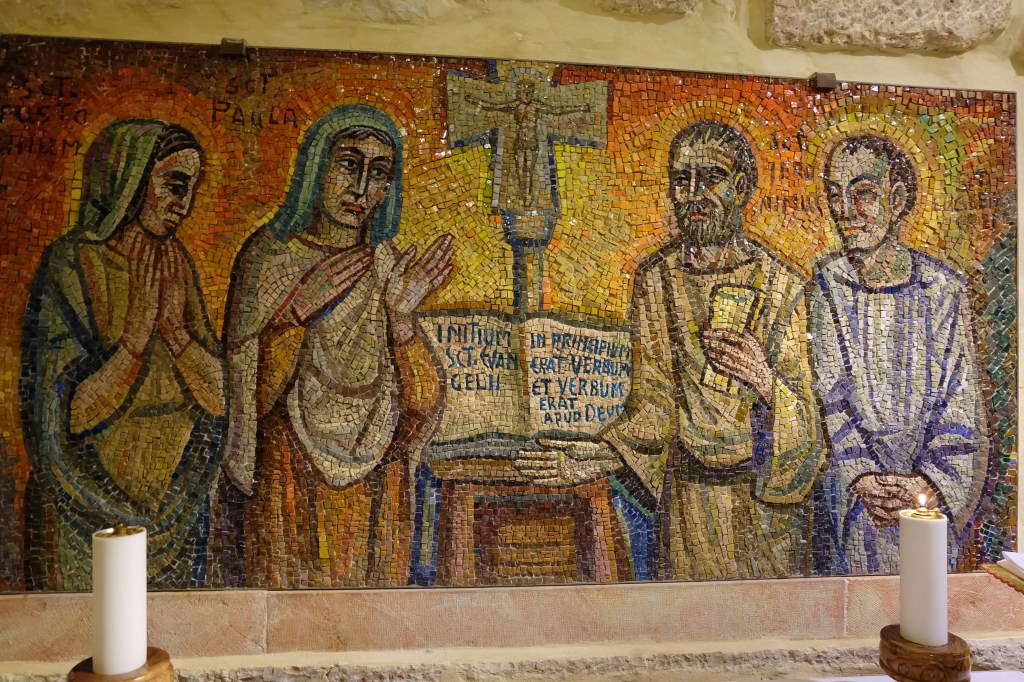
Photo by author (2017), mosaic at the Chapel of St. Jerome beneath the Church of Nativity in Bethlehem where the saint had lived and died in 420; many years later, his bones were transferred to the Basilica of St. Mary Major in Rome.
What a blessed Thursday
you have given us today,
our dear loving God the Father
as we celebrate the Memorial
of St. Jerome who taught us that
"ignorance of the scriptures is
ignorance of Jesus Christ".
In him we find hope and consolation
to tame our cantankerous attitudes
in this age of too much means of
communication that lead to more
quarrels and division than peace and unity;
give us the grace, O Lord
that like St. Jerome we may assiduously
pray, study, and most of all, live
the Sacred Scriptures so we may be emptied
of our many impurities to be filled with
your humility and kindness.
How wonderful that on this day
the first reading describes to us the
great joy your words have brought to
your exiles upon their return to Jerusalem;
let us give the proper respect due to your
words, dear God, for they are life!
Then Nehemiah, that is, His Excellency, and Ezra the priest-scribe and the Levites who were instructing the people said to all the people: “Today is holy to the Lord your God. Do not be sad, and do not weep,” for all the people were weeping as they heard the words of the law. He said further: “Go, eat rich foods and drink sweet drinks and allot portions to those who had nothing prepared; for today is holy to our Lord. Do not be saddened this day, for rejoicing in the Lord must be your strength!”
Nehemiah 8:9-10
Bless us your priests, Father,
who are supposed to be men of the Word
according to Vatican II that we may
"enflesh" your holy words like Jesus
the eternal Word who became flesh
so that indeed, as your Son had said
in today's gospel, people would pray
for more laborers in the field than
anything else to feed their hunger
and thirst for meaning in this life.
Amen.








 lordmychef.com